World

HSBC profits slide on bank impairment charges

Global bank giant HSBC on Tuesday announced tumbling profits for the third quarter on impairment charges linked to a weak economic outlook and its upcoming sale of French retail operations.

The London-headquartered bank’s share price slid seven percent in morning deals, making it the biggest-falling on the British capital’s FTSE 100 index.

HSBC also announced a boardroom shake-up with the appointment of a new chief financial officer, as the Asia-focused lender faces headwinds in China and global recession prospects.

Net profit slumped 46 percent to $1.91 billion in June-September compared with the third quarter last year. Pre-tax profit slumped 40 percent, HSBC added in a statement.

The bank was hit by a $2.4-billion write-off from the planned disposal of its French business next year, offsetting gains made by soaring interest rates.

HSBC has meanwhile set aside provisions totalling $1.1 billion for loans expected to sour.  

“Macroeconomic headwinds, including higher inflation and a weaker outlook, continue to weigh on the global economy,” it said. 

The bank specifically cited global uncertainty sparked by Russia’s invasion of Ukraine, the fall of the British pound and China’s troubled real estate sector.

Stripping out the one-off hits, adjusted pre-tax profit jumped 18 percent to $6.5 billion, beating analyst expectations.

The bank’s net interest income, measuring what it makes from lending minus interest paid on deposits, came in at $8.6 billion — its best third quarter in more than eight years.

– China strains –

“We retained a tight grip on costs, despite inflationary pressures, and remain on track to achieve our cost targets for 2022 and 2023,” said chief executive Noel Quinn.

The bank said HSBC senior executive Georges Elhedery would next year become chief financial officer, replacing Ewen Stevenson who departs the group.

Senior HSBC executives are next week expected in Hong Kong for a bank summit after the city recently lifted mandatory quarantine for all international arrivals. 

It comes after Chinese leader Xi Jinping tightened his grip on power by securing a third five-year term in office, handing top jobs to a number of loyalists who back his strict zero-Covid strategy.

The policy of lockdowns and other strict measures has been a major cause of the country’s economic woes and the prospect of more upheaval has sent chills through trading floors.

HSBC has vowed to accelerate a multi-year pivot to Asia and the Middle East, with ambitions to lead Asia’s wealth management market.

But the lender is under pressure from Chinese financial giant and major shareholder Ping An to spin off its Asian operations to unlock shareholder value amid tensions between China and Western powers.

HSBC, which has rejected the calls, added Tuesday that it was “exploring the potential sale” of its Canadian division.

In late-morning deals, HSBC shares were down 7.0 percent at 441.35 pence.

“Rising interest rates may be good news for banks but it’s all the other stuff which is causing them headaches right now,” noted AJ Bell financial analyst Danni Hewson.

“Concern about the impact of a slowing economy on bad debts and growth in the loan book is being exacerbated at HSBC by the departure of well-respected finance director Ewen Stevenson and the deteriorating situation in China.”

She added that “Stevenson’s departure may also make HSBC more vulnerable to pressure from its largest shareholder Ping An to break up the bank.”
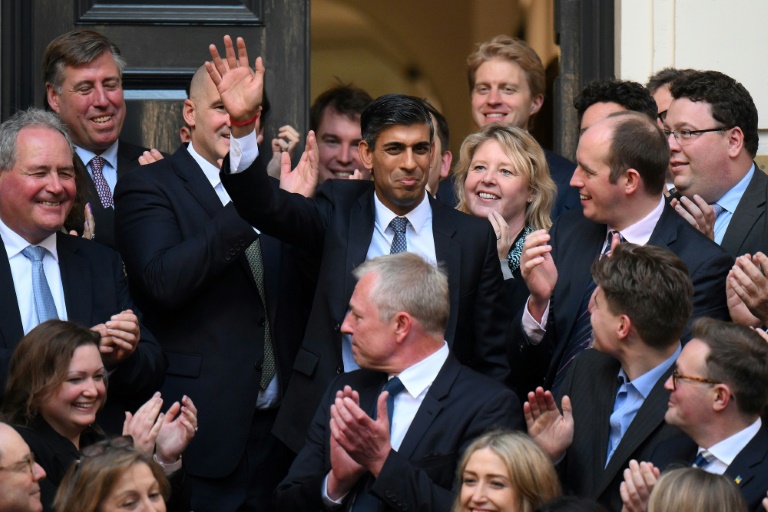

Sunak to be appointed UK's third PM this year

Rishi Sunak will on Tuesday be installed as Britain’s third prime minister this year, after the humiliated Liz Truss left office after just 49 days, with the new premier inheriting a daunting array of problems.

Departing Downing Street, Truss wished Sunak “every success” and said she remained “more convinced than ever” that Britain needed to be “bold” in confronting the challenges it faced.

Sunak became the ruling Conservatives’ new leader on Monday after triumphing over rival contender Penny Mordaunt who failed to secure enough nominations from Tory MPs, and ex-premier Boris Johnson who dramatically aborted a comeback attempt.

The 42-year-old Hindu is Britain’s first prime minister of colour and the youngest in more than two centuries. President Joe Biden called the choice “groundbreaking”.

Sunak was due to take power in a morning audience with King Charles III — who is anointing his first prime minister since ascending the throne following the death of his mother Queen Elizabeth II.

The new prime minister was then expected to speak at around 11:35 am (1035 GMT).

– ‘Unite or die’ –

Britain’s Conservative-supporting media hailed Sunak’s appointment.

“The force is with you, Rishi,” ran The Sun’s headline, in a reference to Sunak’s love of “Star Wars” films. The Daily Mail called it “a new dawn for Britain”.

But the left-leaning Guardian highlighted Sunak’s warning to Conservative MPs that the party must “unite or die”.

Truss left office as the shortest-serving premier in history, after a calamitous tax-slashing budget sparked economic and political turmoil.

The 47-year-old announced her resignation last Thursday, admitting she could not deliver her mandate from Conservative members — who had chosen her over Sunak in the summer.

He has now staged a stunning turnaround in political fortunes, and vowed to do the same for Britain as it confronts decades-high inflation, surging borrowing costs and imminent recession. 

But he also faces the uphill task of uniting a party riven with divisions and infighting.

Gavin Williamson, who served as a minister in the Tory governments of both Theresa May and Johnson, said the party was in the “last chance saloon” on unity.

Iain Duncan Smith, a former Conservative leader, added that MPs now understood the “existential threat” facing the Tories and that they needed to unite or accept being “out of power for a long time”.

– ‘Choices’ –

After delivering the now all-too-familiar new leader’s speech, Sunak will start appointing his top team before facing his first session of “Prime Minister’s Questions” in parliament on Wednesday.

Finance minister Jeremy Hunt — appointed by Truss just 11 days ago in a bid to salvage her premiership — could remain in the role after stabilising the markets.

He endorsed Sunak on Sunday, writing in the Telegraph that he was a leader “willing to make the choices necessary for our long-term prosperity”.

After reversing almost all of Truss’s various tax cuts, Hunt has warned “difficult decisions” loom over public spending.

Whoever heads the Treasury is set to unveil the government’s much-anticipated fiscal plans on October 31.

Sunak must also decide whether to appoint to his cabinet senior MPs who did not support him, such as Mordaunt, in a bid to unify his fractured party. 

One unlikely to get a seat around the table is former boss Johnson, who was driven out in July partly thanks to Sunak’s resignation.

On Sunday he announced he would not go forward with his audacious leadership bid.

– ‘No mandate’ –

Sunak, a wealthy descendant of immigrants from India and East Africa, is also facing calls for a general election after becoming the latest leader who lacks a direct mandate from the electorate.

Pollster Ipsos said Monday that 62 percent of voters want a vote by the end of the year.

“He has no mandate, no answers and no ideas,” Labour’s deputy leader Angela Rayner tweeted.

Ed Davey, leader of the Liberal Democrats, welcomed the country getting its first British Asian leader but also insisted it was time for a general election.

“Given the Conservatives have trashed the economy… I guess one’s not surprised that they’re scared of the British public,” he told Times Radio.

The next election is not due until January 2025 at the latest and opposition parties have no way to force one, unless dozens of Conservative MPs acquiesce.

That appears unlikely as a flurry of polls show Labour with its largest lead in decades.

Meta confirms WhatsApp outage, working to restore service

US tech giant Meta confirmed a global outage was affecting its messaging service WhatsApp on Tuesday and said it was working to restore the app “as quickly as possible”.

“We’re aware that some people are currently having trouble sending messages and we’re working to restore WhatsApp for everyone as quickly as possible,” a Meta spokesman told AFP.

Problems with the hugely popular service were reported by monitoring site Downdetector and user complaints on social media on Tuesday morning.

Downdetector said thousands of WhatsApp users had been reporting problems since 0717 GMT, with a sharp spike appearing on its dedicated chart covering the past 24 hours.

Social media users said they were unable to connect to the app or send messages, although some reported a restoration of the service at around 0850 GMT.

The hashtag #whatsappdown was one of the most trending on Twitter across the world on Tuesday, while millions of messages on Meta-owned photo-sharing platform Instagram also flagged the outage.

Some Twitter users tried to find a funny side to the technical trouble, joking that Twitter would seek to exploit the situation and gain a flurry of new connections in the coming hours. 

The origin of the outage is unclear.

WhatsApp’s parent company Meta, formerly known as Facebook, suffered an unprecedented outage last year affecting its leading social media platforms including Facebook, Instagram, WhatsApp and Messenger.

The duration and scale of the disruption to the four services used by billions of people led to a major incident that Downdetector described as one of the largest ever observed.

At the time, Facebook acknowledged that the incident was due to an error on their part and not a technical problem.

WhatsApp, a free messaging service, crossed the threshold of two billion users worldwide in February 2020 and is one of the most popular apps.

Meta confirms WhatsApp outage, working to restore service

US tech giant Meta confirmed a global outage was affecting its messaging service WhatsApp on Tuesday and said it was working to restore the app “as quickly as possible”.

“We’re aware that some people are currently having trouble sending messages and we’re working to restore WhatsApp for everyone as quickly as possible,” a Meta spokesman told AFP.

Problems with the hugely popular service were reported by monitoring site Downdetector and user complaints on social media on Tuesday morning.

Downdetector said thousands of WhatsApp users had been reporting problems since 0717 GMT, with a sharp spike appearing on its dedicated chart covering the past 24 hours.

Social media users said they were unable to connect to the app or send messages, although some reported a restoration of the service at around 0850 GMT.

The hashtag #whatsappdown was one of the most trending on Twitter across the world on Tuesday, while millions of messages on Meta-owned photo-sharing platform Instagram also flagged the outage.

Some Twitter users tried to find a funny side to the technical trouble, joking that Twitter would seek to exploit the situation and gain a flurry of new connections in the coming hours. 

The origin of the outage is unclear.

WhatsApp’s parent company Meta, formerly known as Facebook, suffered an unprecedented outage last year affecting its leading social media platforms including Facebook, Instagram, WhatsApp and Messenger.

The duration and scale of the disruption to the four services used by billions of people led to a major incident that Downdetector described as one of the largest ever observed.

At the time, Facebook acknowledged that the incident was due to an error on their part and not a technical problem.

WhatsApp, a free messaging service, crossed the threshold of two billion users worldwide in February 2020 and is one of the most popular apps.

Italy's new PM Meloni sets out programme to parliament

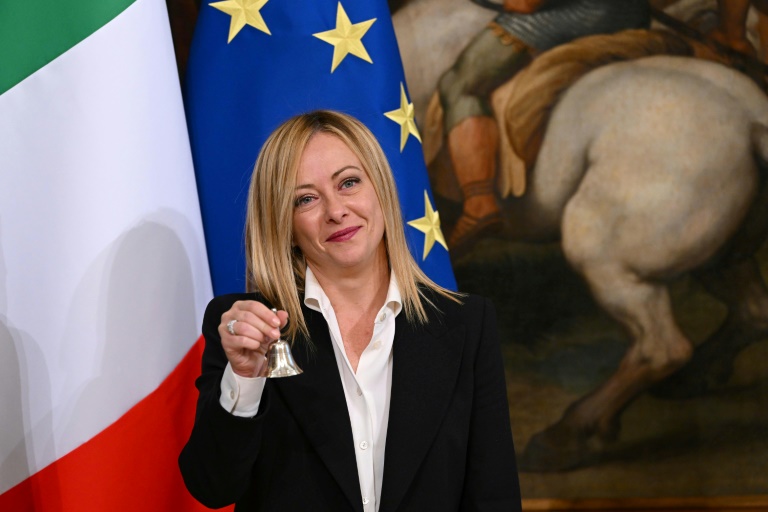
Giorgia Meloni will address Italy’s parliament for the first time as prime minister on Tuesday, setting out her plan for government one month after her far-right party’s historic election victory.

The 45-year-old, who was sworn in as Italy’s first woman premier on Saturday, is expected to outline her approach to challenges including soaring inflation, an energy crisis and looming risk of recession in the eurozone’s third-largest economy.

But even before she spoke, her coalition ally Matteo Salvini, leader of the anti-immigration League party and her new deputy prime minister and minister for infrastructure, set out his own programme.

In a series of tweets late Monday, he vowed action to help households with high energy bills, lower the pension age, extend a flat tax and finally build a long discussed bridge between mainland Italy and Sicily, which he said would create 100,000 jobs.

Meloni’s coalition, which includes former premier Silvio Berlusconi’s right-wing Forza Italia party, agreed before the election an expensive programme of tax cuts and spending promises.

But she herself has emphasised fiscal prudence, wary of Italy’s colossal debt, and installed at the economy minister a figure who served under ex-premier Mario Draghi.

“Salvini cyclone on Meloni’s government” headlined La Repubblica daily.

After her speech to the lower house of parliament, lawmakers will on Tuesday evening hold a vote of confidence in Meloni’s government, the most right-wing in Rome since World War II.

The vote, followed by another in the Senate Wednesday, is largely procedural, as her coalition has a comfortable majority in parliament.

– Following Draghi –

Meloni’s post-fascist Brothers of Italy party won a historic 26 percent of the vote in September 25 elections, with a promise to defend Italy’s borders, traditional values and national interests abroad.

But to govern she needs Salvini’s League party, which won nine percent in the elections, and Berlusconi, whose party won eight percent.

The prospect of a Eurosceptic, populist government in Italy — a NATO member and a founding nation of the European Union — has sparked concern among Rome’s allies.

But despite her party’s roots in Italy’s neo-fascist movement, Meloni is expected to follow a similar economic policy to Draghi, at least initially.

Meloni had what she called a “fruitful” first meeting with French President Emmanuel Macron on Sunday in Rome, and spoke on the telephone Saturday with European Commission President Ursula von der Leyen. 

She named as economy minister Giancarlo Giorgetti, a relatively moderate member of the League who was economic development minister under Draghi.

Roberto Cingolani, who served as energy minister in the last government, will also stay on as an adviser, helping to keep the lights on as Italy tries to wean itself off Russian gas in the wake of the war in Ukraine.

“On economic policies, there is general popular support for what Draghi was doing,” Gilles Moec, chief economist at the AXA group, told AFP.

Italy’s economy bounced back from a deep recession sparked by coronavirus lockdowns in 2020, but is still struggling with mammoth debt worth 150 percent of gross domestic product.

And the fall-out of the Ukraine war risks causing a fresh contraction next year, according to the International Monetary Fund.

Key to Italy’s future growth is almost 200 billion euros in grants and loans from the European Union’s post-pandemic recovery fund.

But the money is dependent on Rome implementing major reforms, from criminal justice to public administration, by 2026.

Meloni’s coalition said before the election that it wants to review the EU plan but has given no detail.

Analysts say there is little room for manoeuvre, with the funds already being disbursed and Brussels unwilling to re-open negotiations.

Hong Kong, Shanghai fall again on China worries as other markets mixed

Hong Kong and Shanghai stocks saw big swings Tuesday following the previous day’s rout after Xi Jinping tightened his grip on power in China, while other markets fought to maintain a rally fuelled by hopes of a less hawkish Federal Reserve.

Optimism about upcoming corporate earnings was providing some support, with Wall Street chalking up another strong day ahead of reports this week from big-name firms including Apple, Amazon and Microsoft.

Investors were keeping a wary eye on developments in China after Xi at the weekend was handed another five year term as leader and gave top jobs to a number of loyalists who back his strict zero-Covid strategy.

The policy of lockdowns and other strict measures has been a major cause of the country’s economic woes and the prospect of more upheaval has sent chills through trading floors.

The uncertainty resulted in a drop of more than six percent in Hong Kong on Monday, with tech firms — which have been hardest hit by Xi’s crackdown on a range of private-sector companies — taking the brunt of the pain.

The selling spread to New York later in the day, with the Nasdaq Golden Dragon China Index of 65 Chinese stocks diving 14 percent — its biggest fall on record — wiping more than $90 billion off their market value.

Any hopes for a big bounce from bargain-buying on Tuesday were short-lived with wild fluctuations in the city seeing the Hang Seng Index swing from gains to losses in a three percent band before finishing down 0.1 percent.

Shanghai struggled to get out of negative territory and ended slightly lower, while the onshore yuan sank to its weakest level since 2007 and the offshore yuan hit its lowest level since trading in it started 12 years ago.

“We’re certainly staying away from the Chinese market right now because the political scene is not favourable,” Laila Pence, of Pence Wealth Management, told Bloomberg TV.

“There’s a lot less risk in the US and just as much upside.”

The gloomy mood in China cast a shadow over an largely positive start to the week elsewhere as investors were cheered by a report suggesting the Fed could discuss at next week’s policy meeting the possibility of slowing down its pace of interest rate hikes.

The bank’s policy of ramping up borrowing costs to fight decades-high inflation has hammered global markets this year as investors worry that they will send the economy into recession.

“Investors are getting more confident that inflation will soften as the consumer rethinks massive purchases,” said OANDA’s Edward Moya.

“Fed rate hike expectations will remain volatile, but expectations are growing that a weaker economy will let the Fed pause their tightening after the February policy meeting.”

Tokyo, Sydney, Singapore, Wellington, Manila and Bangkok all rose, though Seoul, Taipei, Mumbai and Jakarta fell.

Focus is now on the release of earnings, with a sense of hope that the results will not be as bad as feared.

A fifth of S&P 500 companies have so far released their figures, with more than half beating expectations, according to Bloomberg News.

The yen hovered around 149 to the dollar after rallying Friday and Monday, with speculation swirling that Japanese authorities had intervened to support the struggling currency.

However, there are expectations it will continue to drop owing to the divergence between the Bank of Japan’s ultra-loose monetary policy and the Fed’s tightening.

The pound was also sitting around $1.13 as the choice of former chancellor Rishi Sunak as Britain’s next prime minister provided a sense of stability after weeks of uncertainty caused by former leader Liz Truss’s controversial debt-fuelled budget.

London was lower ahead of Sunak becoming Britain’s third premier in less than two months with a full in-tray including a cost-of-living crisis, boosting the economy and uniting his fractured Conservative party. Paris and Frankfurt rose.

– Key figures around 0810 GMT –

Tokyo – Nikkei 225: UP 1.0 percent at 27,250.28 (close)

Hong Kong – Hang Seng Index: DOWN 0.1 percent at 15,165.59 (close)

Shanghai – Composite: FLAT at 2,976.28 (close)

London – FTSE 100: DOWN 0.4 percent at 6,984.49

Pound/dollar: UP at $1.1310 from $1.1281 on Monday

Dollar/yen: DOWN at 148.89 yen from 148.95 yen

Euro/dollar: DOWN at $0.9871 from $0.9876

Euro/pound: DOWN at 87.21 pence from 87.56 pence

West Texas Intermediate: DOWN 0.8 percent at $83.87 per barrel

Brent North Sea crude: DOWN 0.8 percent at $92.53 per barrel

New York – Dow: UP 1.3 percent at 31,499.62 (close)

16 dead, million seek shelter as cyclone hits Bangladesh

At least 16 people died after a cyclone slammed into Bangladesh, forcing the evacuation of about a million people from their homes, officials said Tuesday.

Around 10 million people were without power in 15 coastal districts, while schools were shut across southern and southwestern regions.

Cyclones — the equivalent of hurricanes in the Atlantic or typhoons in the Pacific — are a regular menace but scientists say climate change is likely making them more intense and frequent.

Cyclone Sitrang made landfall in southern Bangladesh late Monday but authorities managed to get about a million people to safety before the monster weather system hit.

Jebun Nahar, a government official, said 14 people died, mostly after they were hit by falling trees, and two died after a boat sank in squally weather in the Jamuna river in the north. 

“We still have not got all the reports of damages,” she told AFP.

People evacuated from low-lying regions such as remote islands and river banks were moved to thousands of multi-storey cyclone shelters, Disaster Management Ministry secretary Kamrul Ahsan told AFP.

“They spent the night in cyclone shelters. And this morning many are heading back to their homes,” he said.

In some cases police had to cajole villagers who were reluctant to abandon their homes, officials said.

Trees were uprooted as far away as the capital Dhaka, hundreds of kilometres (miles) from the epicentre of the storm.

Heavy rains lashed much of the country, flooding cities such as Dhaka, Khulna and Barisal — which witnessed 324 millimetres (13 inches) of rainfall on Monday.

About 33,000 Rohingya refugees from Myanmar, controversially relocated from the mainland to a storm-prone island in the Bay of Bengal, were ordered to stay indoors and there were no reports of any casualties or damage, officials said.

A feared major storm surge did not materialise, however.

– Panic and snakes –

On the southern island of Maheshkhali, the cyclone uprooted many trees and created panic after power and telecoms were cut.

“Such was the power of the wind we could not sleep in the night because of the fear that our homes will be destroyed. Snakes entered many homes. Water also inundated many homes,” said Tahmidul Islam, 25, a resident of Maheshkhali.  

In the worst-affected Barisal region, teeming rains and heavy winds wreaked havoc for vegetable farms, Aminul Ahsan, regional district administrator, told AFP.

In the neighbouring eastern Indian state of West Bengal, thousands of people were evacuated Monday to more than 100 relief centres, officials said, but there were no reports of damage and people were returning home on Tuesday.

Last year, more than a million people were evacuated along India’s east coast before Cyclone Yaas battered the area with winds gusting up to 155 kilometres (96 miles) an hour — equivalent to a Category 2 hurricane.

Cyclone Amphan, the second “super cyclone” ever recorded over the Bay of Bengal, which hit in 2020, killed more than 100 people in Bangladesh and India, and affected millions.

In recent years, better forecasting and more effective evacuation planning have dramatically reduced the death toll from such storms. The worst recorded, in 1970, killed hundreds of thousands of people.

UBS net profit down in Q3 as revenues fall

Swiss banking giant UBS on Tuesday reported a fall in net profits in the third quarter, though still better than expected against a backdrop of falling revenues at the investment bank.

Profits at Switzerland’s largest bank were down 24 percent to $1.7 billion from July to the end of September.

The firm also saw its income fall by 10 percent to $8.2 billion in the same period, in a global economic and political environment that the group’s chief executive Ralph Hamers described as “increasingly complex”.

“Clients remain concerned about persistently high inflation, elevated energy prices, the war in Ukraine and residual effects of the pandemic,” Hamers said in a statement.

He said the energy crisis was also having an impact, including on their retail and small business clients in Switzerland.

“The impact of all this has been far-reaching –- affecting asset levels, market volatility, rates and investor sentiment across the globe.”

The figures nonetheless exceeded expectations, with analysts predicting a net profit of around $1.4 billion and revenues of $7.9 billion.

The bank’s revenues have dipped recently due to a fall in its mergers and acquisitions and a drop in income from market activity.

Income from its core wealth management operations also retreated year-on-year.

Large US retail banks have seen their profits fall in the last quarter amid a reduction in merger and acquisitions, stock market entries and fundraising.

'The child will be sent to an orphanage': a Ukrainian nurse's Russian prison ordeal

Ukrainian nurse Viktoria Obidina spent over five months in Russian captivity, forced to drink dirty water, endure beatings and hunger.

But it was not knowing the fate of her four-year-daughter that tormented her the most.

“They brought us water from a lake, sometimes there were tiny fishes in it,” recalled Obidina, who was returned to Ukraine earlier this month as part of a prisoner swap with Russia. “In August, when the (lake) started blooming, the water tasted of algae.”

In an interview with AFP on Monday, 26-year-old Obidina recounted her ordeal in the notorious Russian-controlled prison in the town of Olenivka in eastern Ukraine.

When Russia invaded its neighbour on February 24, Obidina, an army nurse in the southern port city of Mariupol, was dispatched to Azovstal, the city’s vast steel plant where hundreds of Ukrainian soldiers hunkered underground in a network of Soviet-era tunnels.

Obidina’s four-year-old daughter Alisa had been staying at the family’s apartment with a nanny.

But as food supplies ran out in the besieged city and Russian bombardment became relentless, Obidina made the difficult decision to take her daughter with her to Azovstal.

“I understood very well: if not us, then who will care for the wounded?”

– Moments of despair –

In the underground bunker, the four-year-old helped her mother treat wounded patients.

“She was such a good sport, she was so mature! She knew very well that she could not distract me,” Obidina recalled. “She helped me, she gave out medicines. I would tell her which ones and to whom and she would help me.”

But there were also moments of despair for Alisa.

“She asked me, “Mom, is this our last day?”

“Of course, I told her that no, we will live, everything will be good. But the shelling was massive. We were terrified.”

It was during one of those moments that a soldier at Azovstal recorded a short video with Alisa, where the ponytailed girl, hiding in the dark bunker with a book in her hands, asks to go home.

The video went viral and helped build international pressure on Russia to evacuate those remaining at Azovstal after the city had fallen to Moscow. But it also proved fateful for Obidina.

In May, Obidina and her daughter left the plant together with a group of Ukrainian civilians as part of a hard-won UN-led evacuation agreement.

But Russian forces recognised the mother and daughter from the online video, and Obidina was arrested. Before she was taken away, she managed to hand Alisa to another evacuee.

“I was told that the child will be sent to an orphanage and I am being taken prisoner.”

– Psychological rehab –

Obidina said investigators beat her to force her to disclose information about the Ukrainian army. 

In the Olenivka prison, she was kept with some two dozen inmates in a cell designed for six people.

All this time, Obidina had no news of her daughter and no idea what awaited her.

Earlier this month, Obidina was transferred to the Russian city of Taganrog together with other female inmates to what she thought would be another prison. The detainees had their hands tied, they were blindfolded and put on a plane. 

Finally, they were taken by bus to Ukraine-controlled territory and Obidina realised a prisoner swap was under way.

She also learned that her daughter was safe.

With the help of distant relatives and volunteers, Alisa, who turned five earlier this month, was reunited with her grandmother in Poland.

Obidina says she lost 10 kilos (22 pounds) while in captivity and is now undergoing psychological rehabilitation in a clinic in Dnipro. She plans to leave the army and devote herself to her daughter.

In Poland, Alisa is attending daycare and learning Polish and the mother and daughter were able to speak by phone.

“She grew up so much,” Obidina said. 

“She said she missed me a lot and is waiting to see me.”

Will Africa's metals boom suffer the same curse as oil?

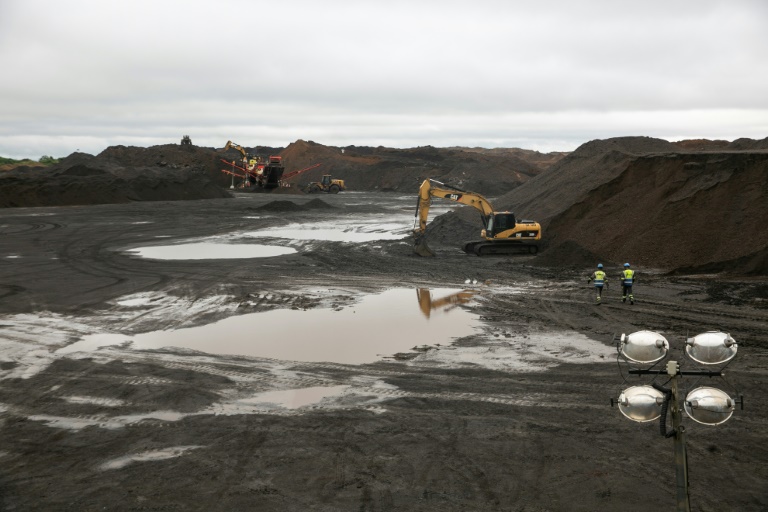
Mechanical diggers are hard at work in the bleak landscape of the Moanda open-cast mine in Gabon, using giant jaws to rip out manganese and then dump the ore into trucks with a crash.

“We’re lucky here in Moanda. We find it about five to six metres (about 18 feet) below the surface,” said manager Olivier Kassibi, whose mine yields 36 tonnes of manganese each day.

Element number 25 on the periodic table, manganese has traditionally been perceived as a useful if humdrum material widely employed in steel and alloys.

More recently, though, the silvery metal has gained star status thanks to its emerging role in rechargeable car batteries, helping to wean the world off carbon-spewing fossil fuels.

Decarbonisation of the world economy will take centre stage at the UN’s COP27 climate talks in Egypt next month.

And as the great transition goes into higher gear, eyes are turning to Africa.

Its soil is rich in manganese, cobalt, nickel and lithium — crucial ingredients in cleaner technology for generating or storing power.

The Moanda region alone contains as much as a quarter of known global reserves of manganese, according to the Compagnie Miniere de l’Ogooue (Comilog), a subsidiary of the French group Eramet which operates the site.

– Curse of oil –

But hopes that the mineral boom will translate into a new dawn of prosperity in the world’s poorest continent are clouded by memories of what happened with oil.

In Africa’s oil-producing countries, black gold meant a gush of wealth for a well-connected few — but only drops for the needy majority.

Corruption sucked the dollars out of plans for roads, hospitals and schools, and environmental damage was often all that remained.

Africa’s potential in new-age minerals is “huge”, said the former chief economist of the African Development Bank, Rabah Arezki, who pointed out that reserves are not even known because so little exploration has been done.

But, he said, “there is very little reason to think that this windfall will benefit the people of Africa, particularly because of governance concerns.”

New metals deposits are following one another at a giddying pace.

In one example, Firefinch Ltd of Australia was looking for gold at Goulamina in southern Mali when it came across lithium, said Seydou Semega, geologist and local director of the firm.

Firefinch then created a local offshoot, Leo Lithium, and inaugurated the mine in early 2022 — a facility that it says could create 1,200 jobs and generate more than $100 million a year for Mali in taxes and dividends.

“Could Africa be the main source of lithium in the world?” asked Simon Hay, director of Leo Lithium. “Absolutely.” 

Comilog, which has operated the Moanda mine since 1960, claims the creation of 3,400 direct and 6,000 indirect jobs, a contribution of around $345 million per year to the national economy in various forms, plus millions of dollars in health and education provisions for the population.

“You need to have a social policy that is as committed as possible to share this wealth,” said its CEO, Leod Paul Batolo.

Comilog is keen to list its green principles, which include rehabilitating and replanting extraction sites, decarbonising the energy mix of its factories and “setting limits” on encroaching on wildlife areas.

But more generally, innumerable studies say the exploitation of resources in Africa has a long and dark history of unequal distribution of wealth, corruption, environmental damage and rights violations.

– ‘Value chain’ –

A big problem is that Africa is typically used as a source of raw materials, and rarely for processing them into goods of higher value, said Gilles Lepesant, a geographer at the French National Centre for Scientific Research (CNRS).

“If activity is limited to mining and extracting ore, Africa will reap no benefit from the energy transition in Europe. It’s absolutely necessary to invest in the value chain,” he said.

He pointed to the Democratic Republic Congo, whose soil is estimated to contain half of the world’s reserves of cobalt, as an example of something that is “both an opportunity and a curse.”

Poorly regulated mining leads to environmental damage and encourages child labour, a phenomenon that is hard to resolve when a family’s livelihood depends on it.

In the sector of tropical forestry, many rich countries have demanded traceability of wood and labour in order to reassure concerned consumers. 

But this is far harder to achieve in the metals used in car batteries and other gadgets, said Lepesant.

“In a lot of cases, the mined metal is exported for refining to other countries, for example China, and then combined with other metals, so it’s hard to know if the cobalt you have on your production line actually comes from such and such a mine in the Democratic Republic of Congo,” he said.

Analyst Hugo Brennan of British firm Verisk Maplecroft said African nations had to strike “a tricky balancing act” — providing incentives for investment while enforcing social and environmental standards — to ensure their mining boom does not go the same way as oil.

Close Bitnami banner
Bitnami