World

Leave 'immediately', pro-Russian officials tell Kherson residents

Pro-Russian authorities on Saturday urged residents in the southern Kherson region, which Moscow claims to have annexed, to leave the main city “immediately” in the face of Kyiv’s advancing counter-offensive.

It comes as President Volodymyr Zelensky said Russia had launched 36 rockets overnight in a “massive attack” on Ukraine, following reported strikes on energy infrastructure that resulted in power outages across the country.

And Japanese Prime Minister Fumio Kishida became the latest world leader to reproach Moscow for its talk of using nuclear weapons.

Kyiv’s forces have been advancing along the west bank of the Dnipro river, towards the Kherson region’s eponymous main city.

Kherson was the first major city to fall to Moscow’s troops, and retaking it would be a major prize in Ukraine’s counter-offensive.

In recent days, Russia has been moving residents in the region — which Moscow claims to have annexed in September — east to Russia, in efforts Kyiv has denounced as “deportations”.

“Due to the tense situation on the front, the increased danger of mass shelling of the city and the threat of terrorist attacks, all civilians must immediately leave the city and cross to the left bank” of the Dnipro river, the region’s pro-Russian authorities announced on social media.

A Moscow-installed official in Kherson, Kirill Stremousov, told Russian news agency Interfax on Saturday that around 25,000 people had made the crossing.

Sergiy Khlan, the Ukrainian deputy head of the Kherson region, said Russians were removing property and documents from banks and the passport office as they withdrew.

Ukraine’s general staff said Moscow’s forces had abandoned two more settlements in Kherson and were evacuating medical personnel from a third, accusing them of looting local civilians.

– A ‘serious threat’ –

Earlier Saturday, Japan’s Kishida denounced Moscow’s comments regarding the possible use of nuclear weapons in the Ukraine conflict.

“Russia’s act of threatening the use of nuclear weapons is a serious threat to the peace and security of the international community and absolutely unacceptable,” he said.

The 77-year period of no nuclear weapons use “must not be ended”, said Kishida, speaking in Australia.

Since Russia invaded Ukraine in February, Putin has made several thinly veiled threats about his willingness to deploy tactical nuclear weapons.

Earlier this month, the European Union foreign policy chief Josep Borrell warned that the Russian army would be “annihilated” if Russia launched such an attack.

Washington has also warned Moscow of “catastrophic” consequences should they use such weapons.

Japan is the only country ever to have been hit with nuclear weapons: the US atomic bomb dropped on Hiroshima on August 6, 1945, which killed 140,000 people, and the second US bomb on Nagasaki, three days later, which killed 74,000 people.

– ‘Afraid for our lives’ –

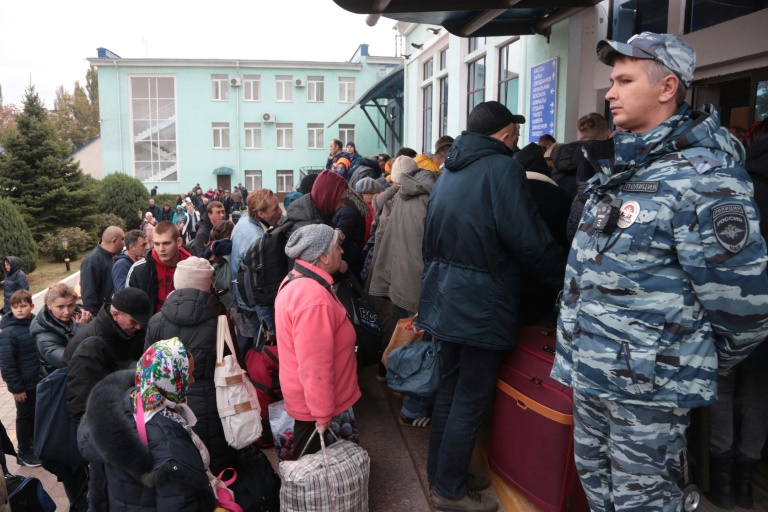
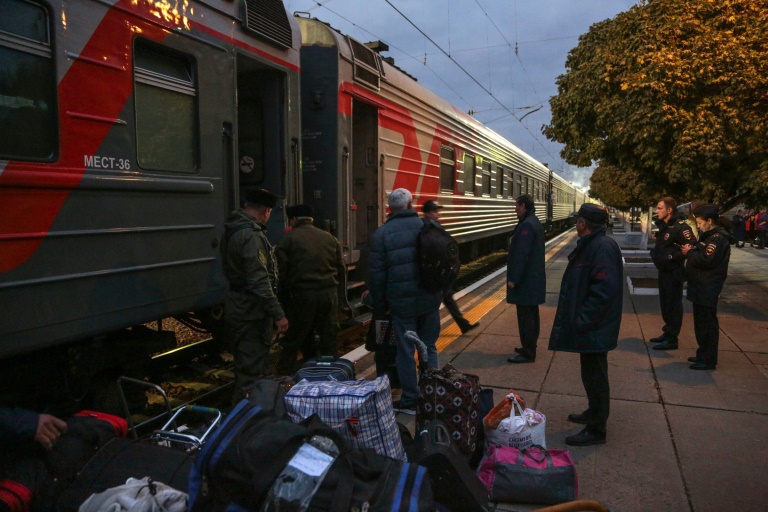
At a train station in the town of Dzhankoy in the north of Crimea, a peninsula that Moscow annexed from Ukraine in 2014, Kherson residents were boarding a train for southern Russia, an AFP reporter saw Friday.

“We are leaving Kherson because heavy shelling started there, we are afraid for our lives,” said Valentina Yelkina, a pensioner travelling with her daughter. 

More than a million households in Ukraine have been left without electricity following Russian strikes on energy facilities across the country, the deputy head of the Ukrainian presidency Kyrylo Tymoshenko said on Saturday.

Fresh Russian strikes targeted energy infrastructure in Ukraine’s west, the national operator said earlier, with officials in several regions of the war-scarred country reporting power outages as winter approaches.

Russians “carried out another missile attack on energy facilities of the main networks of Ukraine’s western regions”, Ukraine’s energy operator Ukrenergo said on social media.

“These are vile strikes on critical objects,” said Zelensky. “The world can and must stop this terror.”

Power outages were reported in other parts of the country and local officials repeated calls to reduce energy use. Some parts of Ukraine have already cut their electricity use by up to 20 percent, according to Ukrenergo.

“Saturday in Ukraine starts with a barrage of Russian missiles aimed at critical civilian infrastructure,” Ukraine’s Foreign Minister Dmytro Kuleba said on Twitter. He once again urged Kyiv’s allies to hasten the delivery of air defence systems.

In the Russian Belgorod region bordering Ukraine, at least two civilians were killed in strikes on Saturday, according to the local governor Vyacheslav Gladkov. Nearly 15,000 people were left without electricity, he added.

Russia last week reported a “considerable increase” in Ukrainian fire into its territory, saying attacks had largely concentrated on Belgorod region and neighbouring regions of Bryansk and Kursk.

Major Hurricane Roslyn approaches Mexico's Pacific coast

Hurricane Roslyn strengthened to a major Category 4 storm on Saturday as it approached Mexico’s Pacific coast, the US National Hurricane Center said, warning of potentially damaging winds, dangerous storm surge and flash flooding.

The storm was some 150 miles (240 kilometers) west-southwest of Manzanillo, with maximum sustained winds of 130 miles per hour, and is forecast to slam into the coast of Nayarit state on Sunday at or near major hurricane strength, the NHC said in its 1500 GMT update.

“Additional strengthening is forecast today. Although some weakening is possible beginning tonight, Roslyn is expected to still be near or at major hurricane strength when it makes landfall on Sunday,” the NHC said.

“On the forecast track, the center of Roslyn will move parallel to the southwestern coast of Mexico through midday today, then approach the coast of west-central Mexico, likely making landfall along the coast of the Mexican state of Nayarit Sunday morning.”

The NHC warned of flash flooding and landslides caused by the storm. 

“A dangerous storm surge is expected to produce significant coastal flooding near and to the east of where the center makes landfall,” it said.

Authorities have declared a precautionary alert in the Pacific coast states of Jalisco, Colima, Nayarit and Sinaloa.

Forecasts suggest Roslyn could make landfall near the town of San Blas, with a population of about 40,000 and where there are several fishing communities.

Tropical cyclones hit Mexico every year on both its Pacific and Atlantic coasts, usually between May and November.

At the end of May, Agatha, the first Pacific storm of the season, hit the coast of the state of Oaxaca (south), where heavy rain in mountainous towns killed 11 people.

Back in October 1997, Hurricane Pauline struck Mexico’s Pacific coast as a Category 4 storm, leaving more than 200 dead.

Palestinian shot dead and Israeli stabbed in Jerusalem

Soldiers shot dead a Palestinian in the occupied West Bank on Saturday, hours after a knife attack in east Jerusalem left an Israeli man in a serious condition.

The Palestinian health ministry said Rabi Arafah Rabi, 32, was hit by “a bullet to the head” at a checkpoint southeast of the city of Qalqilya.

An Israeli military spokesman said soldiers fired on a car containing three suspects near Qaliqilya as the vehicle sped off after hitting a soldier when they tried to stop it for inspection.

“The soldiers fired toward the vehicle,” the spokesman said. 

“The soldier did not need medical treatment. We are aware of reports regarding a hit. The incident is under review.”

Violence in the Israeli-Palestinian conflict has surged in recent months, amid an uptick in anti-Israeli attacks and near daily raids by Israeli forces in the occupied West Bank.

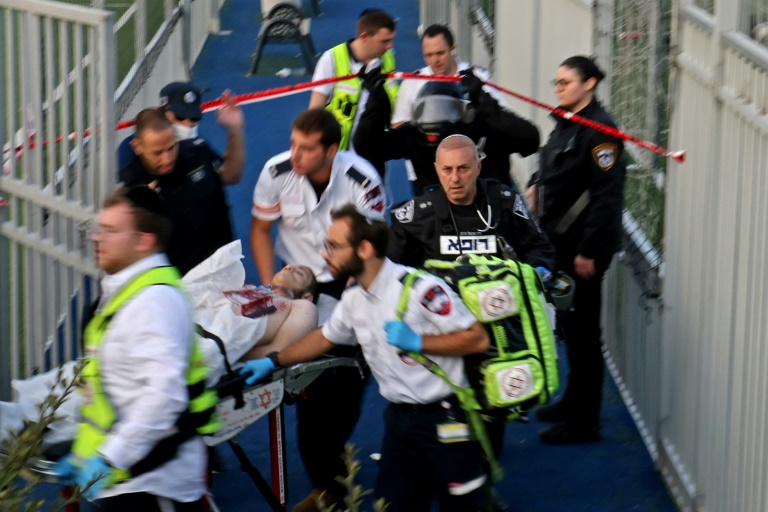
Earlier on Saturday, police said officers “neutralised” a Palestinian stabbing suspect in Israeli-annexed east Jerusalem after an attack that left an Israeli man in serious condition.

Police said the man was stabbed in the back.

“One person was critically wounded and taken to hospital” after the knife attack, police said.

Israeli media said the stabbing victim was a religious Jew in his 20s.

“The suspect stabbed a passer-by with a knife and fled” the scene north of the Old City, police said.

They said the suspect, who is 16, was later found at a football pitch in the Sheikh Jarrah district of east Jerusalem, not far from the scene of the stabbing.

Police said he tried to run off when he saw officers coming, but an officer gave chase.

At one stage he turned to the police officer “with an object in his hand, the officer feared for his life… shot at him and neutralised” him.

The suspect’s condition is not known.

More than 115 Palestinian fighters and civilians have been killed this year, the heaviest toll in the West Bank for nearly seven years, according to the United Nations.

Israel seized east Jerusalem in the Six-Day War of 1967 and later annexed it in a move not recognised by most of the international community.

Some 200,000 Israelis live in the sector as well as 300,000 Palestinians.

Around 475,000 Israelis now live in settlements across the West Bank, alongside some 2.8 million Palestinians, who in different areas of the territory are subject to Israeli military rule or live under limited Palestinian governance.

On Friday, the Palestinian health ministry said a Palestinian was killed overnight in clashes with soldiers in the flashpoint West Bank city of Jenin, and three other Palestinians were wounded in the clashes.

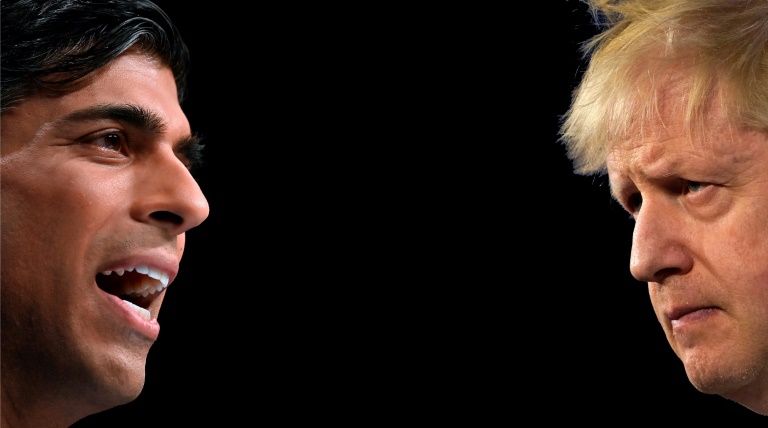
Johnson returns to UK as Sunak qualifies for PM race

Former prime minister Boris Johnson returned to Britain Saturday from a Caribbean holiday aiming to launch an audacious political comeback, as Conservative rival Rishi Sunak reached the minimum threshold to contest the UK’s top job.

Johnson cut short a luxury stay in the Dominican Republic to join the seemingly three-person race to replace outgoing leader Liz Truss, with allies telling British media he was “up for it”.

The divisive 58-year-old Brexit architect only relinquished power in early September, two months after announcing his resignation following a Tory revolt over a slew of scandals.

His apparent bid to return to office just weeks later has already been decried by opposition politicians, and even some in his own fractured ruling party who are demanding stability and unity.

“It is simply not right to risk repeating the chaos (and) confusion of the last year,” said David Frost, a right-wing formerly loyal minister appointed to the House of Lords by Johnson.

“We must move on,” he urged the Tories, adding they “must get behind a capable leader who can deliver a Conservative programme” who he identified as ex-finance minister Sunak.

Frost’s comments echo Dominic Raab — Johnson’s deputy prime minister — who told Sky News an imminent parliamentary inquiry into the “Partygate” scandal that dogged his former boss could prove too distracting.

Late Friday, Sunak’s allies in parliament revealed he had garnered the nominations of 100 Conservative MPs, the threshold set by the party to stand.    

However, both Sunak and Johnson are yet to announce they are running, with reports that a declaration by the former was imminent.

– ‘Hogwash’ –

The Tories were forced into a second, this time expedited, leadership contest since the summer after Truss dramatically announced Thursday she would stand down — just 44 tempestuous days into her tenure.

It followed a disastrous tax-slashing mini-budget that sparked economic and political turmoil which Sunak had predicted.

In a sign of the toll from the tumult, ratings agency Moody’s said Friday it had downgraded Britain’s outlook, blaming in part “heightened unpredictability in policy making”.

Meanwhile, the pound — which hit a record low against the dollar in the mini-budget’s immediate aftermath, but had since rallied — slumped.

Cabinet member Penny Mordaunt, who just missed out on making the final runoff after Johnson quit, was the first to formally unveil her candidacy, on Friday.

The 49-year-old said she was running for “a fresh start, a united party and leadership in the national interest” but is already trailing her rivals by dozens of nominations.

The accelerated contest will see the Conservatives’ 357 MPs hold a vote Monday on any candidates with the 100 nominations, before a possible online ballot of party members later in the week if two remain.

The Sunak and Johnson camps are reportedly seeking talks to see if there is scope for a unity deal — although there is plenty of bad blood since the former prime minister’s defenestration.

Sunak’s July resignation helped trigger the government mutiny that ultimately led to Johnson’s ousting.

Tory MP James Duddridge, a key Johnson ally who confirmed Friday the ex-leader was intent on standing, said Saturday that he had now secured the support of 100 colleagues.

But the claim was met with scepticism by other Conservatives, with one MP telling the BBC it was “hogwash”.  

– ‘BBB’ –

Johnson has nonetheless been endorsed by several Tory heavyweights, including on Saturday ex-interior minister Priti Patel.

Meanwhile, posting a photo of Johnson on the phone to his Facebook, backbench Conservative MP Lee Anderson revealed he was backing him after “a long chat about everything past and present”.

“My inbox is full of BBB (bring back Boris),” he said, referring to an acronym and hashtag used by his supporters. 

But in a sign of the party’s deep divisions, others such as Johnson’s ex-chief of staff Steve Barclay warned against turning to him.

Former leader William Hague, Sunak’s mentor, told Times Radio his return as prime minister would lead to a “death spiral” for the Tories.

Veteran backbencher Roger Gale warned that Johnson could face a wave of resignations from MPs refusing to serve under him again.

Although he remains popular with party members who could decide the contest, polling shows he is broadly disliked by the electorate, with a YouGov survey finding 52 percent opposed his comeback.

Another poll also found three in five voters now want an early general election, in line with demands from opposition parties, as Britons struggle with a worsening cost-of-living crisis.

Xi in control at China Congress, as ex-president removed

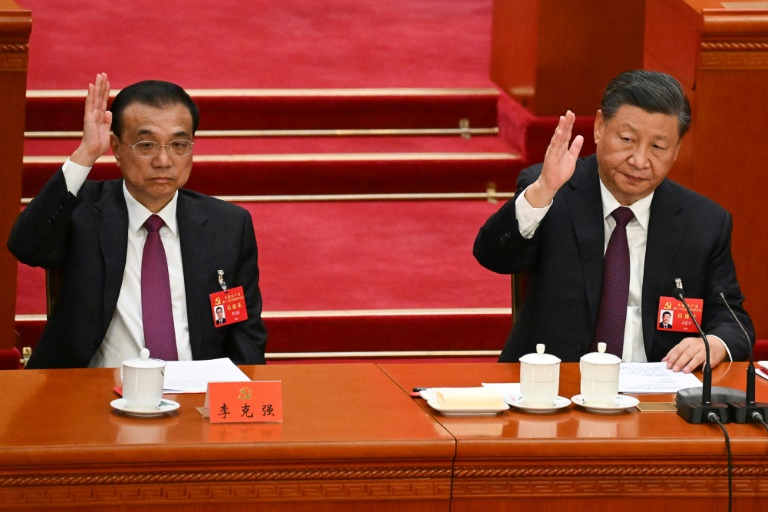
Chinese President Xi Jinping locked in support for a historic third term in power at the Communist Party’s Congress on Saturday, but the dramatic removal of his predecessor from the event stole the headlines.

At the end of the week-long gathering in Beijing, China’s ruling party approved a sweeping reshuffle that saw a number of top officials — including Premier Li Keqiang — step down, allowing Xi to appoint new allies.

The largely rubber-stamp meeting of around 2,300 party delegates was meticulously choreographed, with Xi determined to avoid any surprises as he enshrined his leadership for the next five years.

However, in an unexpected move that punctured the proceedings at the Great Hall of the People, former leader Hu Jintao was led out of the closing ceremony.

The frail-looking 79-year-old seemed reluctant to leave the front row where he was sitting next to Xi.

State media reported late Saturday that Hu was “not feeling well” when he was removed.

“Xinhuanet reporter Liu Jiawen has learned that Hu Jintao insisted on attending the closing session… despite the fact that he has been taking time to recuperate recently,” Xinhua said on Twitter. 

“When he was not feeling well during the session, his staff, for his health, accompanied him to a room next to the meeting venue for a rest. Now, he is much better.”

– ‘Core position’ –

Delegates then approved a call obliging all party members to “uphold Comrade Xi Jinping’s core position on the Party Central Committee and in the Party as a whole”, according to a unanimously passed resolution on changes to the party charter.

Xi is now all but certain to be unveiled as general secretary on Sunday, shortly after the first meeting of the new Central Committee.

This will allow Xi to sail through to a third term as China’s president, due to be announced during the government’s annual legislative sessions in March.

The Central Committee of around 200 senior party officials was elected shortly before the closing ceremony.

A list of officials in the group revealed that four out of seven members of the party’s Standing Committee — the apex of power — would retire.

Among them is Premier Li Keqiang, as well as fellow Politburo Standing Committee members Wang Yang — who was touted as a possible successor to Li — Han Zheng, and Li Zhanshu.

Han and Li Zhanshu were widely expected to step down, having surpassed the informal age limit of 68 for Politburo-level officials — a requirement not extended to 69-year-old Xi.

Wang and Li Keqiang, both 67, could still have continued in the Standing Committee or 25-member Politburo for another five-year term.

Other high-profile Communist Party top brass absent from the new Central Committee include high-ranking diplomat Yang Jiechi and economic tsar Liu He.

– Rubber stamp –

Analysts were closely watching for whether the party charter would be amended to enshrine “Xi Jinping Thought” as a guiding philosophy, a move that would put Xi on a par with Mao Zedong.

That did not take place, though the resolution did call the creed “the Marxism of contemporary China and of the 21st century”, adding that it “embodies the best Chinese culture and ethos of this era”.

Xi previously abolished the presidential two-term limit in 2018, paving the way for him to rule indefinitely.

The Congress has effectively cemented Xi’s position as China’s most powerful leader since Mao.

“Xi’s power will be akin to that of the dictator of China, and there will be next to no scope for anyone to advise him to attempt course correction,” said Steve Tsang, director of the SOAS China Institute at the University of London.

One of the key questions outstanding is if Xi will appoint a potential successor to the Politburo Standing Committee. This could be answered on Sunday when the Standing Committee is unveiled.

Delegates also on Saturday enshrined in the party’s constitution opposition to Taiwanese independence. Beijing has always pledged to re-take the self-ruled democratic island, by force if necessary.

Taiwan’s Mainland Affairs Council accused China late Saturday of harbouring an “old mindset of invasion and confrontation” and called on Beijing to “resolve differences through peaceful, equitable and realistic means.”

Far-right Meloni sworn in as Italy's first woman PM

Far-right leader Giorgia Meloni was sworn in as Italian prime minister on Saturday, to become the first woman to head a government in Italy.

Meloni took the oath before President Sergio Mattarella at the Quirinal Palace in Rome, once home to popes and kings of Italy.

Her post-fascist Brothers of Italy party — Eurosceptic and anti-immigration — won the September 25 legislative polls but needed outside support to form a government.

Meloni’s appointment is an historic event for the eurozone’s third largest economy and for Brothers of Italy, which has never been in government.

It won 26 percent of the vote last month, compared to eight and nine percent respectively for her allies Forza Italia and the far-right League.

Meloni’s list of 24 ministers, including six women, revealed a desire to reassure Italy’s partners. She named Giancarlo Giorgetti as economy minister, who served under the previous government of Mario Draghi.

Giorgetti, a former minister of economic development, is considered one of the more moderate, pro-Europe members of Matteo Salvini’s League.

Meloni also named ex-European Parliament president Antonio Tajani, of Forza Italia, as foreign minister and deputy prime minister.

Salvini will serve as deputy prime minister and minister of infrastructure and transport.

That appointment is likely to disappoint Salvini, who wanted Meloni to give him the role of interior minister again after he previously held the post between 2018 and 2019.

The position went instead to a technocrat, Rome prefect Matteo Piantedosi.

A formal ceremony for the handover of power from Draghi to Meloni will take place on Sunday before the premier leads the first cabinet meeting.

European Commission chief Ursula von der Leyen congratulated Meloni on her appointment.

“I count on and look forward to constructive cooperation with the new government on the challenges we face together,” she tweeted on Saturday, while European Parliament speaker Roberta Metsola tweeted in Italian that “Europe needs Italy”.

US President Joe Biden congratulated Meloni and called Italy a “vital NATO ally and close partner.”

Ukrainian President Volodymyr Zelensky tweeted that he looked “forward to continued fruitful cooperation to ensure peace and prosperity in Ukraine, Italy and the world”.

Hungarian Prime Minister Viktor Orban also sent his congratulations on Twitter.

“Big day for the European Right!” he wrote.

– Unity concerns –

The consultations to cobble together a government had been overshadowed by disagreements with her two would-be coalition partners over Meloni’s ardent support for Ukraine since the Russian invasion, whereas the leaders of Forza Italia and the League are both considered close to Moscow.

A recording was leaked in which Italy’s former prime minister Silvio Berlusconi — who heads Forza Italia — talks about his warm ties with Moscow and appeared to blame the war in Ukraine on Zelensky.

Berlusconi says the comments were taken out of context.

Salvini is a long-time fan of Russian President Vladimir Putin and has criticised Western sanctions on Russia.

Despite her Eurosceptic stance, Meloni has been firm about her support for Ukraine, in line with the rest of the European Union and the United States.

But the tensions add to concerns that Meloni’s coalition, held together by the need for a parliamentary majority, will struggle to maintain unity.

– Challenges ahead –

Meloni’s coalition wants to renegotiate Italy’s portion of the EU’s post-Covid recovery fund. 

It argues the almost 200 billion euros ($197 billion) it expects to receive should take into account the current energy crisis, exacerbated by Moscow’s invasion of Ukraine, which has hit supplies of Russian gas to Europe.

But the funds are tied to a series of reforms only just begun by Draghi’s government, and analysts say Meloni has limited room for manoeuvre.

Meloni had campaigned on a platform of “God, country and family”, sparking fears of a regression on rights in the Catholic-majority country.

Spanish soccer star Garcia 'glad to pay more tax to help out'

Athletic Bilbao forward Raul Garcia agrees with the Spanish government’s plan to impose a temporary tax on the richest people in the country.

Budget minister Maria Jesus Montero announced in September that some of those in the wealthiest minority of the population would be taxed more during the next two years, because of rampant inflation caused by fallout from Russia’s war in Ukraine.

“Obviously we live in a comfortable financial situation, but it does not isolate me from the situations that my friends, my family are living in,” Garcia told Spanish newspaper El Pais.

“I understand that life is not the same thing I am living. That’s why I think we have to be supportive.”

Various players in Spain over the past decade have been punished for tax fraud offences, including former Real Madrid and Barcelona players, Cristiano Ronaldo and Lionel Messi.

The Socialist-led coalition government’s new asset tax, described as a “solidarity” tax, will see those who have holdings worth over three million euros (2.96 million dollars) subject to extra payments from 1.7 percent rising to 3.5 percent, depending on the size of their fortune. 

“There are people who are unemployed, who aren’t making it to the end of the month, who don’t have money for food, I see it among my friends,” added the 36-year-old veteran.

“Suddenly a mortgage is drowning you, with both people at home working. Or if you have to plan whether to have a child or not for financial reasons.

“I understand that if they are charging me some taxes… charging, no, collecting, so that everyone can benefit, I understand it and I also want it to be that way.”

“I’m glad to have my taxes raised, if they go where I think they should go, because I don’t think all that should be done is being done.”

Athletic, who have started the season well and are currently sixth in La Liga face Barcelona on Sunday at Camp Nou.

Iranians strike as Mahsa Amini protests enter sixth week

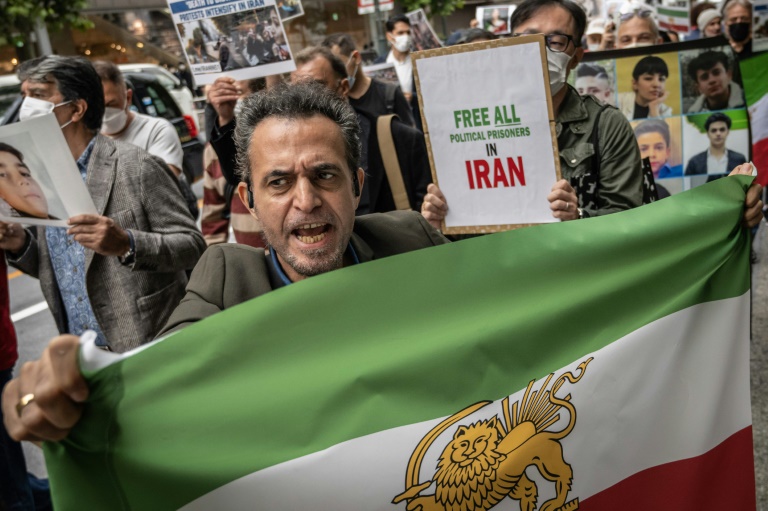
Shopkeepers and factory workers went on strike in Iran on Saturday as women-led nationwide protests sparked by the death in custody of Mahsa Amini entered a sixth week, activists said.

The death of 22-year-old Amini, after her arrest for allegedly breaching Iran’s strict dress code for women, has fuelled the biggest protests seen in the Islamic republic for years.

Young women have led the charge, removing their headscarves, chanting anti-government slogans and confronting the security forces, despite a crackdown that human rights groups say has killed at least 122 people.

Activists issued a call for fresh demonstrations as the Iranian working week got underway on Saturday, but it was difficult to gauge the turnout due to curbs on internet access.

“On Saturday… We will be together for freedom,” activist Atena Daemi said in a Twitter post that bore an image of a bare-headed woman raising her fist.

The 1500tasvir social media channel told AFP there were “strikes in a couple of cities including Sanandaj, Bukan and Saqez”, while adding it was difficult to see evidence of them online as “the internet connection is too slow”.

Saqez, in the western province of Kurdistan, is Amini’s home town, where anger flared at her burial last month, helping trigger the protest movement.

Elsewhere, “students protested in Yazd Faculty of Arts and Architecture, University of Tehran, Allameh University, Razi University in Kermanshah, Hamedan, Ahvaz and Yasuj universities,” 1500tasvir said.

– ‘Operatives, oligarchs, lobbyists’ –

Dozens of workers were seen gathering outside the Aidin chocolate factory in the northwestern city of Tabriz in footage shared by 1500tasvir. AFP was unable to immediately verify the videos.

Iran accused its arch enemy the United States of seeking to use the protests to gain concessions in talks aimed at restoring the 2015 nuclear agreement.

“The Americans continue to exchange messages with us, but they are trying to fan the flames of what has been going on inside Iran in recent days,” said Foreign Minister Hossein Amir-Abdollahian.

The organisers of a massive rally held in Berlin in solidarity with the Iranian protesters called on “democratic governments… to STOP negotiating with the criminal state called the Islamic republic”.

In a statement, the Iranians for Justice and Human Rights group also called for the expulsion of the Islamic republic’s ambassadors.

“We are not asking you to interfere in Iran, wage war or sanction Iran’s people,” it said.

“We want you to impose targeted sanctions on the leaders, operatives, oligarchs and lobbyists of the Islamic republic.”

The Berlin rally, which drew thousands of people, is one of a number of demonstrations being held around the world, including in Australia and Japan.

A teachers’ union in Iran has called for a nationwide strike on Sunday and Monday over the crackdown that Amnesty International says has cost the lives of at least 23 children.

The Co-ordinating Council of Teachers Syndicates said the “sit-in” would be in response to “systematic oppression” by the security forces at schools.

– ‘Detaining, maiming, killing’ –

Activists have also accused the authorities of a campaign of mass arrests and travel bans to quell the protests, with athletes, celebrities and journalists caught up in the dragnet.

Overnight an Iranian climber, who was reportedly placed under house arrest for competing abroad last weekend without a headscarf, thanked her supporters on Instagram.

Elnaz Rekabi, 33, wore only a headband in an event at the Asian Championships in Seoul, in what many saw as gesture of solidarity with the Amini protests.

“I sincerely thank all those who came to the airport for welcoming me, I love you,” Rekabi said in her first social media comments since returning to Iran on Wednesday to a hero’s welcome.

The BBC and London-based Iran International television said on Friday that Rekabi had been placed under house arrest. Her phone had reportedly been seized from her before she flew home.

On Friday, a New York-based human rights group called on the International Federation of Sport Climbing to do more to protect her.

IFSC “should engage with rights organisations to protect pro climber #ElnazRekabi and all Iranian athletes”, the Center for Human Rights in Iran tweeted.

“Don’t take the government in Iran’s word at face value — it has a documented history of detaining, maiming and killing those who oppose it,” the CHRI added.

burs-dv/kir

Pro-Russian authorities tell Kherson residents to leave 'immediately'

Pro-Russian authorities on Saturday urged residents in the southern Kherson region, which Moscow claims to have annexed, to leave the main city “immediately” in the face of Kyiv’s advancing counter-offensive.

It comes as President Volodymyr Zelensky said Russia launched 36 rockets overnight in a “massive attack” on Ukraine, following reported strikes on energy infrastructure that resulted in power outages across the country.

Kyiv’s forces have been advancing along the west bank of the Dnieper river, towards the Kherson region’s eponymous main city.

The first major city to fall to Moscow’s troops, retaking it would be a key prize in Ukraine’s counter-offensive.

In recent days, Russia has been moving residents in the region — which Moscow claims to have annexed in September — in efforts described as “deportations” by Kyiv. 

“Due to the tense situation on the front, the increased danger of mass shelling of the city and the threat of terrorist attacks, all civilians must immediately leave the city and cross to the left bank of the Dnieper river,” the region’s pro-Russian authorities said on social media.

A Moscow-installed official in Kherson, Kirill Stremousov, told Russian news agency Interfax on Saturday that around 25,000 people had made the crossing.

– ‘Afraid for our lives’ –

At a train station in the town of Dzhankoy in the north of Crimea, a peninsula that Moscow annexed from Ukraine in 2014, Kherson residents were boarding a train for southern Russia, an AFP reporter saw Friday.

“We are leaving Kherson because heavy shelling started there, we are afraid for our lives,” said Valentina Yelkina, a pensioner travelling with her daughter. 

Another Kherson resident, 70-year-old Yelena Bekesheva, said she was going to Moscow. 

“We didn’t immediately make the decision (to leave) but then we were invited by our friends and relatives,” she told AFP. 

Meanwhile more than a million households in Ukraine were left without electricity following Russian strikes on energy facilities across the country, the deputy head of the Ukrainian presidency Kyrylo Tymoshenko said on Saturday.

Fresh Russian strikes targeted energy infrastructure in Ukraine’s west, the national operator said earlier, with officials in several regions of the war-scarred country reporting power outages.

Russians “carried out another missile attack on energy facilities of the main networks of Ukraine’s western regions”, Ukraine’s energy operator Ukrenergo said on social media.

– ‘A barrage of Russian missiles’ –

Power outages were reported among others in the northwestern Volyn region, parts of the southwestern Odessa region and the city of Khmelnitskyi in western Ukraine with local authorities reiterating calls to reduce energy use.

“Saturday in Ukraine starts with a barrage of Russian missiles aimed at critical civilian infrastructure,” Ukraine’s Foreign Minister Dmytro Kuleba said on Twitter, urging Kyiv’s allies to hasten the delivery of air defence systems.

According to Ukraine’s air force, Moscow’s troops on Saturday fired 17 cruise missiles by aircraft from southern Russia and at least 16 Kalibr cruise missiles from ships in the Black Sea.

Ukraine’s authorities have called on residents to reduce power consumption amid the attacks with some parts of Ukraine reducing their electricity use by up to 20 percent, according to Ukrenergo. 

“We see savings in different regions and on different days the level of voluntary consumption reduction ranges from five to 20 percent on average,” Ukrenergo chief Volodymyr Kudrytskyi said in written comments to AFP.

He added that while these were “significant volumes” for Ukraine’s energy system, they were not enough for regions where the infrastructure “suffered the most damage” and Ukrenergo must resort to “forced restrictions”.

Meanwhile in the Russian Belgorod region bordering Ukraine, at least two civilians were killed in strikes on Saturday, according to the local governor.

“There are two dead among civilians” following shelling on “civilian infrastructure” in the town of Shebekino governor Vyacheslav Gladkov said, adding that nearly 15,000 people were left without electricity.

Russia said in mid-October there has been a “considerable increase” of Ukrainian fire into its territory with attacks largely concentrating on Belgorod region and neighbouring Bryansk and Kursk.

Xi in control at China Congress, as ex-president removed

Chinese President Xi Jinping locked in support for a historic third term in power at the Communist Party’s Congress on Saturday, but the dramatic removal of his predecessor from the event stole the headlines.

At the end of the week-long gathering in Beijing, China’s ruling party approved a sweeping reshuffle that saw a number of top officials — including Premier Li Keqiang — step down, allowing Xi to appoint new allies.

The largely rubber-stamp meeting of around 2,300 party delegates was meticulously choreographed, with Xi determined to avoid any surprises as he enshrined his leadership for the next five years.

However, in an unexpected move that punctured the proceedings at the Great Hall of the People, former leader Hu Jintao was led out of the closing ceremony.

The frail-looking 79-year-old seemed reluctant to leave the front row where he was sitting next to Xi.

No official explanation was given and AFP did not receive any response from Chinese authorities on the incident.

Delegates then approved a call obliging all party members to “uphold Comrade Xi Jinping’s core position on the Party Central Committee and in the Party as a whole”, according to a unanimously passed resolution on changes to the party charter.

Xi is now all but certain to be unveiled as general secretary on Sunday, shortly after the first meeting of the new Central Committee.

This will allow Xi to sail through to a third term as China’s president, due to be announced during the government’s annual legislative sessions in March.

The Central Committee of around 200 senior party officials was elected shortly before the closing ceremony.

A list of officials in the group revealed that four out of seven members of the party’s Standing Committee — the apex of power — would retire.

Among them is current Premier Li Keqiang, as well as fellow Politburo Standing Committee members Wang Yang — who was touted as a possible successor to Li — Han Zheng, and Li Zhanshu.

Han and Li Zhanshu were widely expected to step down, having surpassed the informal age limit of 68 for Politburo-level officials — a requirement not extended to 69-year-old Xi.

Wang and Li Keqiang, both 67, could still have continued in the Standing Committee or 25-member Politburo for another five-year term.

Other high-profile Communist Party top brass absent from the new Central Committee include high-ranking diplomat Yang Jiechi and economic tsar Liu He.

– Rubber stamp –

Analysts were closely watching for whether the party charter would be amended to enshrine “Xi Jinping Thought” as a guiding philosophy, a move that would put Xi on a par with Mao Zedong.

That did not take place, though the resolution did call the creed “the Marxism of contemporary China and of the 21st century”, adding that it “embodies the best Chinese culture and ethos of this era”.

Xi previously abolished the presidential two-term limit in 2018, paving the way for him to rule indefinitely.

The Congress has effectively cemented Xi’s position as China’s most powerful leader since Mao.

“Xi’s power will be akin to that of the dictator of China, and there will be next to no scope for anyone to advise him to attempt course correction,” said Steve Tsang, director of the SOAS China Institute at the University of London.

One of the key questions outstanding is if Xi will appoint a potential successor to the Politburo Standing Committee. This could be answered on Sunday when the Standing Committee is unveiled.

Delegates also on Saturday enshrined in the party’s constitution opposition to Taiwanese independence. Beijing has always pledged to re-take the self-ruled democratic island, by force if necessary.

Close Bitnami banner
Bitnami