World

Iranians strike as Mahsa Amini protests enter sixth week

Shopkeepers and factory workers went on strike in Iran on Saturday as nationwide protests sparked by the death in custody of Mahsa Amini entered a sixth week, activists said.

The death of 22-year-old Amini, after her arrest for allegedly breaching Iran’s strict dress code for women, has fuelled the biggest protests seen in the Islamic republic for years.

Young women have led the charge, removing their headscarves, chanting anti-government slogans and confronting the security forces on the streets, despite a crackdown that rights groups say has killed at least 122 people.

Activists issued a call for fresh demonstrations as the Iranian working week got underway on Saturday, but it was difficult to immediately gauge the turnout due to curbs on internet access.

“On Saturday… We will be together for freedom,” activist Atena Daemi said in a Twitter post that bore an image of a bare-headed woman with her fist raised in the air.

The 1500tasvir social media channel told AFP that there were “strikes in a couple of cities including Sanandaj, Bukan and Saqez” but added that it was difficult to see evidence of them online as “the internet connection is too slow”.

Saqez, in the western province of Kurdistan, is Amini’s home town, where anger flared at her burial last month, helping trigger the protest movement.

The Norway-based Hengaw rights group also said shopkeepers were on strike in Bukan, Sanandaj and Saqez, as well as Marivan.

– ‘Systematic oppression’ –

Elsewhere, dozens of students were seen clapping and chanting during a protest at Shahid Beheshti University in Tehran, in a video tweeted by 1500tasvir on Saturday.

Dozens of workers were seen gathering outside the Aidin chocolate factory in Tabriz, capital of East Azerbaijan province, in other footage it shared. AFP was unable to immediately verify the videos.

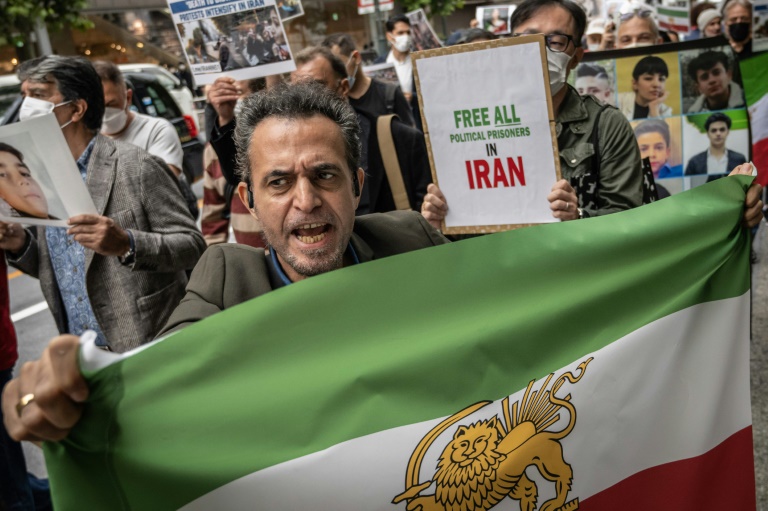
People were also gathering around the world on Saturday for rallies in solidarity with the Iranian protest movement.

In Tokyo, demonstrators held up portraits of Amini and others who have been killed in the crackdown, as well as a banner bearing the protest slogan: “Women, life, freedom”.

Iranians living in Germany were converging on Berlin ahead of a major demonstration later Saturday, activists said.

A teachers’ union in Iran has called for a nationwide strike on Sunday and Monday over the crackdown that Amnesty International says has cost the lives of at least 23 children.

In a statement, the Co-ordinating Council of Teachers Syndicates said the “sit-in” would be in response to “systematic oppression” by the security forces at schools.

It identified four teenagers who had been killed in the crackdown — Nika Shahkarami, Sarina Esmailzadeh, Abolfazl Adinezadeh and Asra Panahi — and said a large number of teachers had been arrested without charge.

“Iran’s teachers do not tolerate these atrocities and tyranny and proclaims that we are for the people, and these bullets and pellets you shoot at the people target our lives and souls,” it said.

– ‘Detaining, maiming and killing’ –

Activists have also accused the authorities of a campaign of mass arrests and travel bans to quell the protests, with athletes, celebrities and journalists caught up in the dragnet.

Overnight an Iranian climber, who was reportedly placed under house arrest for competing abroad last weekend without a headscarf, thanked her supporters on Instagram.

Elnaz Rekabi, 33, wore only a headband in an event at the Asian Championships in Seoul, in what many saw as gesture of solidarity with the Amini protests.

“I sincerely thank all those who came to the airport for welcoming me, I love you,” Rekabi said in her first social media comments since returning to Iran on Wednesday to a hero’s welcome.

The BBC and London-based Iran International television said on Friday that Rekabi had been placed under house arrest.

Her phone had reportedly been seized from her before she flew home.

On Friday, a New York-based human rights group called on the International Federation of Sport Climbing to do more to protect her.

IFSC “should engage with rights organisations to protect pro climber #ElnazRekabi and all Iranian athletes”, the Center for Human Rights in Iran tweeted.

“Don’t take the government in Iran’s word at face value — it has a documented history of detaining, maiming and killing those who oppose it,” the CHRI added.

burs-dv/lg
'Too late': Escape routes close on Ukraine's new front

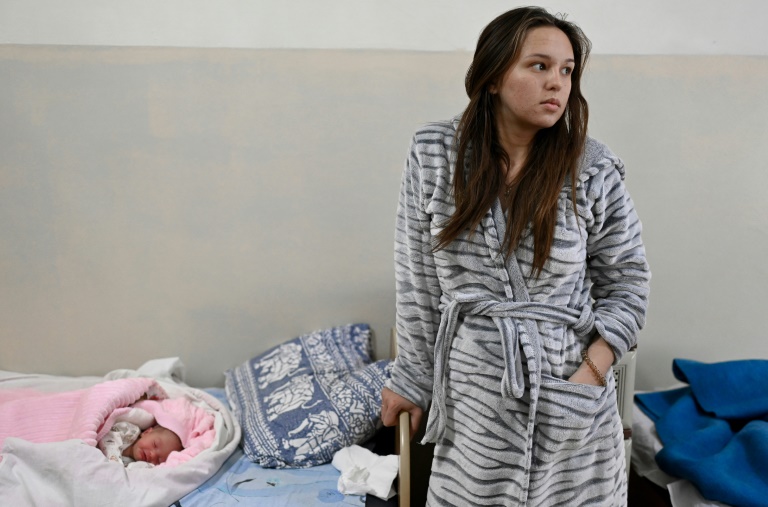
The newborn peeking out of a pink blanket in a hospital on the north bank of Ukraine’s Dnieper river may never see her grandparents back home in the Russian-occupied south.

Her mother fled for the relative safety of government-held Zaporizhzhia to make sure the baby was born a citizen of the country the Russians invaded eight months ago.

But her grandparents stayed behind and out of reach on the opposite side of the shore.

“It may be too late for them to get out,” 19-year-old Anastasia Skachko lamented while stealing glances at her still-nameless girl.

“I don’t even want them to try. The roads are all either mined or getting shelled.”

A Ukrainian counteroffensive that saw the Russians give up most of the land they grabbed in the north of the vast war zone has reached the strategically vital south.

And the great Dnieper river running across the battle-engulfed country is forming a natural new front that is splitting families and stalling the Ukrainian advance.

– Clinging on –

Russia’s dispirited forces are clinging on to the southern Kherson region -– a land bridge giving the Kremlin access to the annexed Crimea peninsula -– and shelling the advancing Ukrainians with renewed might.

The fighting is obliterating riverside towns and sealing off escape routes that families had somehow still managed to use in the first stages of the war.

Skachko said she was able to get through to her mother on WhatsApp to tell her that she was now a grandmother.

But the phone she reached started with the Russian international dial code +7 instead of the Ukrainian +38.

The Russians have disconnected existing lines from the Ukrainian system to cement their authority and cut off the flow of news.

“It is hard to say how she will ever see the little one,” said Skachko.

“We both understand this. But neither of us wanted to talk about it over the phone.”

– Open prison –

The martial law imposed by the Kremlin’s retreating forces across lands Russia still claims at its own makes daily life even more unpredictable.

Russia has effectively sealed the last southern checkpoint to keep people from fleeing to government-held lands.

Some are being bused further from the front to areas under firmer Russian control — a process Ukrainians compare to a forced deportation.

The handful of people who managed to talk their way past the soldiers and reach the city of Zaporizhzhia described life back home resembling an open prison.

Reporters can only visit the region in scripted Kremlin tours.

“There are soldiers with dogs and machine guns on every corner,” said occupied Melitopol native Oleksandra Boyko after managing to escape with her own baby girl.

“Most of them are Chechens.”

The Kremlin has relied on Chechen strongman Ramzan Kadyrov’s personally-trained army to run some of the captured land.

Those who fled described them as the most lawless of all the invading forces they had met.

“The guys from (neighbouring) Dagestan are a little bit nicer but Kadyrov’s men are just brutal,” said occupied Berdyansk native Natalia Voloshyna.

– Psychological pressure –

Yet many described the psychological pressures of the invasion being even more painful than the acute security fears.

All the women AFP spoke with said the Kremlin-installed rulers only hire or help people who renounce their Ukrainian citizenship and apply for a Russian one.

“They tell you, you either work with us, or you get nothing. I immediately told them no,” said Voloshyna.

“They don’t necessarily touch you. But then you end up living without a salary, without any assistance.”

Boyko said her family was offered “huge payments” if it registered her four-month-old as a Russian citizen.

“I said no out of principle. I am Ukrainian. She should be Ukrainian,” the Melitopol native said.

“But there are people who agree because there is almost no work and they will not hire you without a Russian passport,” she said.

“If there is nothing to eat, what else can you do?”

Displaced by flooding, Nigerians in desperate need of help

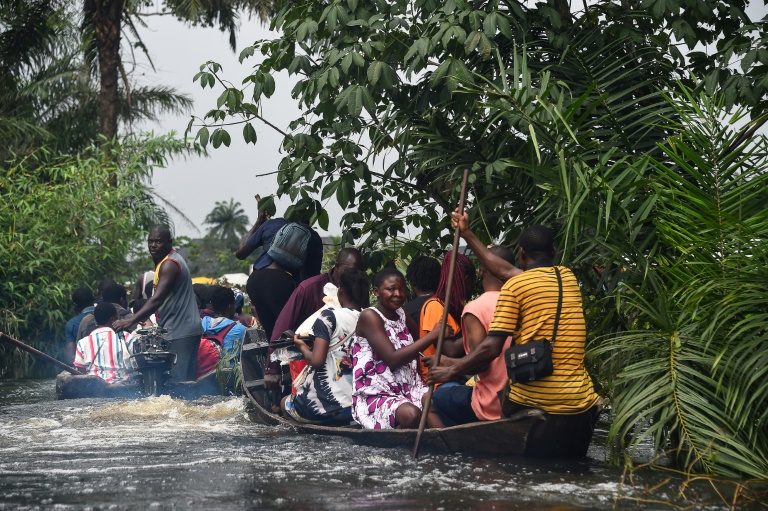
It was pitch black when the waters came, forcing mother Fortune Lawrence and her eight children to jump on a makeshift boat and flee their house.

For the past two weeks, they have been living in dire conditions near Ahoada, in Rivers state, in a school now crowded with more than a thousand people displaced by Nigeria’s worst floods in a decade.

“I was afraid to die in the water,” said Lawrence, surrounded by other families. “Here, we have nothing. Not enough food, no diapers, no mosquito nets.”

Flooding is frequent during Nigeria’s rainy season but this year, more than 600 people have died and 1.3 million others were forced to leave their homes, according to the latest government figures. 

In southern Rivers state, one of the worst affected, informal camps have popped up for those who managed to escape.

Some people are still stuck in flooded towns and villages, according to resident Obed Onyekachi.

There was “no way they could cross and come here,” said the 32-year-old, with anger in his voice. “How many of our brothers have been swallowed by the water, have gone missing?”

“Crops have been destroyed. We have no hope anymore. We will have to face starvation.”

– Contaminated water – 

Travelling across the state is a challenging task and makes it difficult to deliver aid.

On the main road, a tank truck has tipped over in the floods, and residents said several people had died in the area, where there are strong currents.

Others have managed to cross, wading through waist-deep water.

Alamin Mohamed, 25, was trying to travel on his motorbike, but said he had been stuck on the road for seven days.

“We don’t know how much time it will last,” he said.

The roof of a church could be seen poking out from the murky waters, between high voltage power lines. Wooden rafts have been ferrying large groups of people around.

The UN’s Food and Agriculture Organization representative in Nigeria, Fred Kafeero, warned this week that the floods had increased the risk of disease outbreaks such as cholera.

At a primary school in Ihuike, a community in Ahoada, displaced people are lying on the floor, squeezed against one another. There are around 50 people in each classroom.

A group of local volunteers are cleaning and dividing the meagre food supplies received from local authorities.

“We need a clean environment. We are really careful but we are exhausted. Even the water from the well is contaminated,” said one volunteer, who asked to remain anonymous. 

– Health risks –

Ten days ago, the governor of Rivers state, Ezenwo Nyesom Wike, approved one billion naira (about $2.3 million) for emergency relief measures for flood victims.

Still, the needs are immense. In one of the informal camps, women told AFP they did not have anything for menstrual hygiene. “We have no tissue for that,” one woman said.

At the entrance to the camp, children stood in line, waiting to be seen by women wearing surgical gloves. 

They were getting an oral HIV test, explained nurse Bukky Chika Emeyi. In case of a positive result, they will need a blood test in hospital.  

“Their living conditions are bad. The risk of transmission is high,” said the 27-year-old, who works with the local charity IHVN.

“Women are giving birth, helped by other women who are not trained, not educated, and using unsterilised tools.”

Johnson returns to UK as Sunak qualifies for PM race

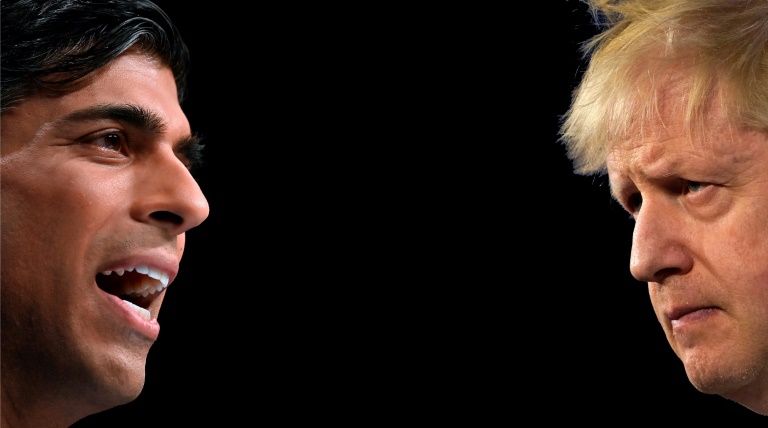
Former prime minister Boris Johnson on Saturday returned to Britain from a holiday to launch an audacious political comeback, as Conservative leadership rival Rishi Sunak reached the minimum threshold to contest the UK’s top job.

Johnson cut short a Caribbean trip to join the race to replace outgoing leader Liz Truss, with allies telling British media he was “up for it”.

The divisive 58-year-old Brexit architect only handed over power in early September, two months after announcing his resignation following a Tory revolt over a slew of scandals.

His apparent bid to return to office just weeks later has already been decried by opposition politicians, and even some in his own fractured ruling party who argue that both it and the country need stability and unity.

“We’ve got to go forward, not go back,” Dominic Raab — Johnson’s deputy prime minister — told Sky News, adding an imminent parliamentary inquiry into the “Partygate” scandal that dogged his former boss could prove too distracting.

Raab said former finance minister Sunak’s economic experience meant he was the “standout candidate”.

The Tories were forced into a second, this time expedited, leadership contest since the summer after Truss dramatically announced Thursday she would stand down — just 44 tempestuous days into her tenure.

It followed a disastrous tax-slashing mini-budget that sparked economic and political turmoil which had been predicted by Sunak.

– ‘Fresh start’ –

Late Friday, Sunak’s allies in parliament said he had garnered the nominations of 100 Conservative MPs, the threshold set by the party to stand.    

However, both Sunak and Johnson are yet to announce they are running, leaving it to allies to signal their intent.

Cabinet member Penny Mordaunt, who just missed out on making the final runoff after Johnson quit, became the first to formally declare her candidacy again Friday.

The 49-year-old said she was running for “a fresh start, a united party and leadership in the national interest”. But she is already trailing her rivals by dozens of nominations.

The accelerated contest will see the Conservatives’ 357 MPs hold a vote Monday on any candidates with the 100 nominations, before a possible online ballot of party members later in the week if two remain.

The Sunak and Johnson camps are reportedly seeking talks to see if there is scope for a unity deal — although there is plenty of bad blood since the former prime minister’s defenestration.

Sunak’s July resignation as chancellor of the exchequer helped trigger the government mutiny that ultimately led to Johnson’s ousting.

James Duddridge, one of Johnson’s closest allies in parliament, said late Friday he had been in contact with his old boss via WhatsApp.

“He said… ‘We are going to do this. I’m up for it’,” the MP told Sky News, as the broadcaster published a photograph apparently showing Johnson on a flight home from the Dominican Republic.

– ‘Wielded the knife’ –

The ever-ebullient former leader has won the backing of several cabinet heavyweights, including Defence Secretary Ben Wallace — a favourite of the Tory grassroots — who is “leaning towards” supporting Johnson.

But Wallace noted that he still had “some questions to answer” over the myriad controversies that engulfed his government, which resulted in the yet-to-launch investigation in the House of Commons.

If found guilty of lying to the Commons over “Partygate” — lockdown-breaching revels held in Downing Street — Johnson could be suspended or even expelled from parliament.

As a result of such controversies, Johnson left Number 10 with dismal poll ratings, and other Tories appear aghast at the prospect of his return.

Veteran backbencher Roger Gale warned that Johnson could face a wave of resignations from MPs refusing to serve under him as leader.

Although he remains popular with members who could decide the contest, polling shows he remains broadly disliked by the electorate, with a YouGov survey finding 52 percent of voters opposed his comeback.

Another poll also found that three in five voters now want an early general election, in line with demands from opposition parties, as Britons struggle with a worsening cost-of-living crisis.

In Sunak’s constituency in Yorkshire, northern England, 58-year-old farmer Elaine Stones said the party had made a mistake in electing Truss instead of him last month. 

“He’s honest, reliable and he should have been voted in last time,” she told AFP. 

But in a sign of party-wide divisions, retiree Maureen Ward called him a “backstabber” who helped to topple Johnson. 

“He wielded the knife and once you do that, you can’t be trusted,” she said.

Xi solidifies control over China's Communist Party at Congress

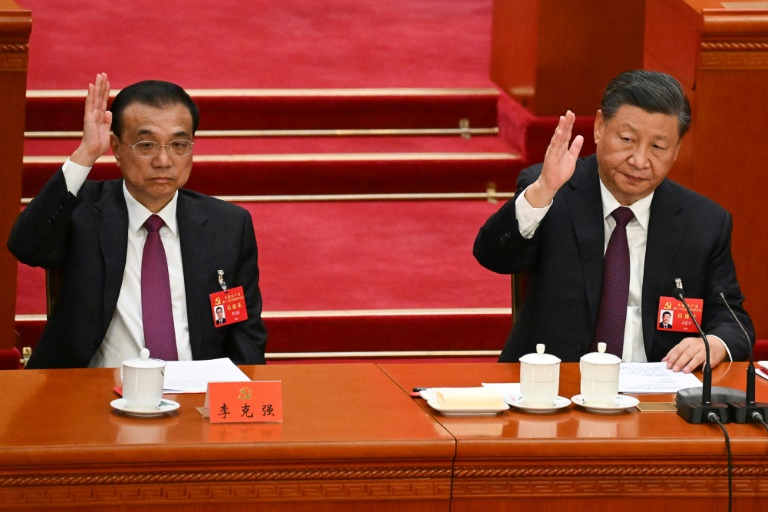
Chinese President Xi Jinping locked in full control of the Communist Party as its Congress ended on Saturday, all but assuring he will secure a historic third term in power.

At the end of the week-long gathering in Beijing, China’s ruling party approved a sweeping reshuffle that saw a number of top officials — including Premier Li Keqiang — step down, allowing Xi to appoint new allies.

The largely rubber-stamp meeting of around 2,300 party delegates was meticulously choreographed, with Xi determined to avoid any surprises as he enshrined his leadership for the next five years.

But in an unexpected move that punctured the proceedings at the Great Hall of the People, former leader Hu Jintao was led out of the closing ceremony.

The frail-looking 79-year-old seemed reluctant to leave the front row where he was sitting next to Xi.

No official explanation was given and AFP did not receive any response from Chinese authorities on the incident.

Delegates then approved a call obliging all party members to “uphold Comrade Xi Jinping’s core position on the Party Central Committee and in the Party as a whole”, according to a unanimously passed resolution on changes to the party charter.

Xi is now all but certain to be unveiled as general secretary on Sunday, shortly after the first meeting of the new Central Committee.

This will allow Xi to sail through to a third term as China’s president, due to be announced during the government’s annual legislative sessions in March.

The Central Committee of around 200 senior party officials was elected shortly before the closing ceremony.

A list of officials in the group revealed that four out of seven members of the party’s Standing Committee — the apex of power — would retire.

Among them is current Premier Li Keqiang, as well as fellow Politburo Standing Committee members Wang Yang — who was touted as a possible successor to Li — Han Zheng, and Li Zhanshu.

Han and Li Zhanshu were widely expected to step down, having surpassed the informal age limit of 68 for Politburo-level officials — a requirement not extended to 69-year-old Xi.

Wang and Li Keqiang, both 67, could still have continued in the Standing Committee or 25-member Politburo for another five-year term.

Other high-profile Communist Party top brass absent from the new Central Committee include high-ranking diplomat Yang Jiechi and economic tsar Liu He.

– Rubber stamp –

Analysts were closely watching for whether the party charter would be amended to enshrine “Xi Jinping Thought” as a guiding philosophy, a move that would put Xi on a par with Mao Zedong.

That did not take place, though the resolution did call the creed “the Marxism of contemporary China and of the 21st century”, adding that it “embodies the best Chinese culture and ethos of this era”.

Xi previously abolished the presidential two-term limit in 2018, paving the way for him to rule indefinitely.

The Congress has effectively cemented Xi’s position as China’s most powerful leader since Mao.

“Xi’s power will be akin to that of the dictator of China, and there will be next to no scope for anyone to advise him to attempt course correction,” said Steve Tsang, director of the SOAS China Institute at the University of London.

One of the key questions outstanding is if Xi will appoint a potential successor to the Politburo Standing Committee. This could be answered on Sunday when the Standing Committee is unveiled.

Delegates also on Saturday enshrined in the party’s constitution opposition to Taiwanese independence. Beijing has always pledged to re-take the self-ruled democratic island, by force if necessary.

US face Netherlands at FIFA Women's World Cup in repeat of final

Holders and four-time champions the United States will face the Netherlands in the group phase of next year’s FIFA Women’s World Cup in a repeat of the 2019 final.

Megan Rapinoe’s United States will also meet debutants Vietnam and a play-off winner at the finals in Australia and New Zealand, following the draw in Auckland on Saturday.

European champions England, the pre-tournament favourites together with the Americans, will play China, Denmark and one of Senegal, Haiti or Chile. 

Led by veteran forward Rapinoe, the US are top of the FIFA rankings and going for a third crown in a row, having beaten the Dutch 2-0 in the 2019 final.

Germany, Sweden, France and Spain will also be sides to watch out for when the World Cup is staged at 10 stadiums in New Zealand and Australia from July 20 to August 20, 2023. 

The opening match will be co-hosts New Zealand against former champions Norway in Auckland.

With 32 teams — divided into eight groups of four — it will be the largest FIFA Women’s World Cup since the tournament began in 1991.

The US will meet minnows Vietnam to start their campaign, then up next will be the Dutch. Their other game will be against Portugal, Cameroon or Thailand.

“We’re excited about the match-ups. It’s a pretty tough group, but at the same time it’s going to be good games, especially against Holland,” said United States coach Vlatko Andonovski.

“The Dutch are very good, they have always been one of the top teams, they won the previous Euro and got into the final of the last World Cup.

“I expect a huge challenge for us.”

Andries Jonker, the Netherlands coach, called the clash with the Americans “huge for them and us, it’s a really big challenge”.

“If you want to win this trophy, you have to beat them,” he added.

– ‘Largest women’s sporting event’ –

American two-time World Cup winner Carli Lloyd led the draw with former England striker Ian Wright among those helping out at a ceremony attended by about 800 people at Auckland’s Aotea Centre.

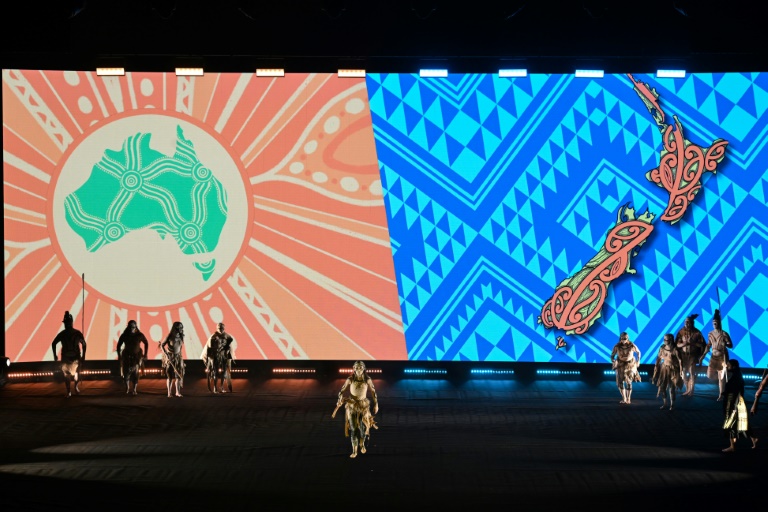
The ceremony, with England coach Sarina Wiegman and New Zealand Prime Minister Jacinda Ardern among the guests, opened with a nod to New Zealand and Australia’s Indigenous culture.

Ardern calls the 2023 World Cup “the world’s largest women’s sporting event ever”.

Beforehand, FIFA president Gianni Infantino criticised television broadcasters who have offered “100 times less” to screen the Women’s World Cup compared to the men’s.

Global interest in the World Cup is anticipated to be at an all-time high, with women’s football enjoying a surge in popularity in some countries.

The Women’s Euros final in July between hosts England and rivals Germany at Wembley drew 87,192 spectators, a record for both a men’s or women’s European championship.

Chloe Kelly scored in extra-time to give England a breathless 2-1 victory in front of a sell-out crowd and their first major title in women’s football.

Wiegman’s side backed that up with a 2-1 win over a young US team, in front of another bumper crowd at Wembley Stadium, earlier this month.

The US then lost to Spain in another friendly.

While women’s football is booming in countries such as England and is already well-established in France, some nations are only just getting started.

The Philippines, Morocco, Republic of Ireland, Vietnam and Zambia will all be competing at the Women’s World Cup for the first time.

A play-off tournament in February will decide who takes the remaining three spots of the 32. 

Australia and New Zealand will host one semi-final each, with the August 20 final at the 83,000-capacity Stadium Australia in Sydney.

Japan, Australia ink security pact with eye on China

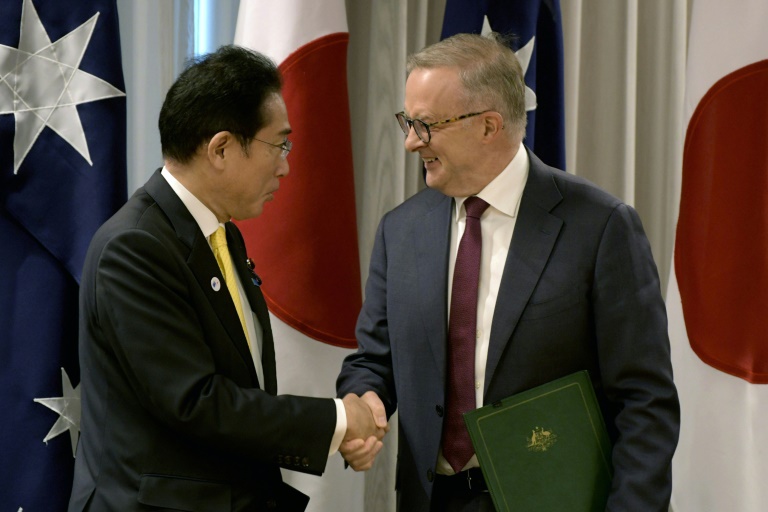
Australia and Japan agreed to share sensitive intelligence and deepen defence cooperation Saturday, signing a security pact to counter China’s military rise.

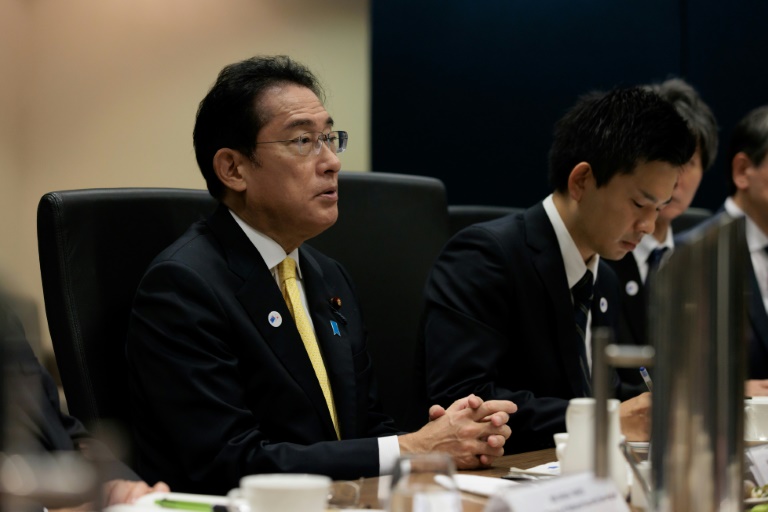
Prime ministers Fumio Kishida and Anthony Albanese inked the accord in the Western Australian city of Perth, revamping a dusty 15-year-old statement drafted when terrorism and weapons proliferation were the overriding concerns.

The text declares the two democracies “natural partners” who face growing risks to their shared interests, and vows greater cooperation on “intelligence, surveillance and reconnaissance”. 

“This landmark declaration sends a strong signal to the region of our strategic alignment”, Albanese said.

Kishida said the agreement was a response to an “increasingly harsh strategic environment”, without citing China or North Korea by name.

Neither Australia nor Japan has the ranks of overseas intelligence operatives and foreign informants needed to play in the major leagues of global espionage.

Japan does not have a foreign spy agency equivalent to America’s CIA, Britain’s MI6 or Russia’s FSB. Australia’s ASIO is a fraction of the size of those organisations.

But according to expert Bryce Wakefield, Australia and Japan have formidable signals and geospatial capabilities — electronic eavesdropping tools and high-tech satellites that provide invaluable intelligence on adversaries.

Wakefield, director of the Australian Institute of International Affairs, said the agreement is another signal that Japan is becoming more active in the security arena.  

“It is a significant agreement in that Japan hasn’t overtly worked with partners outside the United States on security,” he said. “It may actually end up being a template for cooperation with other countries, for example, the United Kingdom.”

Some even see the accord as another step toward Japan joining the powerful Five Eyes intelligence-sharing alliance between Australia, Britain, Canada, New Zealand and the United States.

It is “an epoch-making event that Japan can share SIGINT with a foreign nation except for the United States”, Ken Kotani, an expert in the history of Japanese intelligence at Nihon University, told AFP.

“This will strengthen the framework of the Quad (Australia, India, Japan and the United States) and is the first step for Japan to join the Five Eyes,” he added.

– ‘Leaked like a sieve’ –

Such a suggestion would have been unthinkable a few decades ago, but events in Japan’s neighbourhood have forced a rethink of the country’s pacifist policies established in the wake of World War II.

In recent years North Korea has repeatedly lobbed missiles over and around Japan, while China has built the world’s largest navy, revamped the globe’s biggest standing army, and amassed a nuclear and ballistic arsenal right on Japan’s doorstep.

But hurdles remain for Tokyo’s closer security cooperation with allies.

Japan’s intelligence sharing with allies has been hampered by longstanding concerns about Tokyo’s ability to handle sensitive confidential material and transmit it securely.

“To put it bluntly Japan has traditionally leaked like a sieve,” said Brad Williams, author of a book on Japanese intelligence policy and a professor at the City University of Hong Kong.

Laws have been introduced to more severely punish intelligence leaks, but for now, Australia will likely be forced to scrub any intelligence it passes to Japan for information gleaned from the Five Eyes network.

– Earths, wind and fire –

Prime ministers Kishida and Albanese also vowed more cooperation on critical minerals, the environment and energy.

Japan is a major buyer of Australian gas and has made a series of big bets on hydrogen energy produced in Australia as it tries to ease a lack of domestic energy production and dependence on fossil fuels.

“Japan imports 40 percent of its LNG from Australia. So it’s very important for Japan to have a stable relationship with Australia, from the aspect of energy,” a Japanese official said ahead of the meeting.

A memorandum of understanding on critical minerals will see Japan tap Australia’s supply of rare earths, which are crucial in producing everything from wind turbines to electric vehicles.

China currently dominates world production of critical minerals, leading some to worry that supplies could be cut for political reasons.

China's Communist Party endorses Xi's 'core' leadership

China’s Communist Party on Saturday endorsed Xi Jinping’s “core position” in the country’s leadership, all but assuring he will be handed an unprecedented third term in power. 

At the end of the week-long gathering in Beijing, China’s ruling party approved a sweeping reshuffle that saw a number of top officials — including Premier Li Keqiang — step down, allowing Xi to appoint new allies.

The largely rubber-stamp meeting of among 2,300 party delegates was meticulously choreographed, with Xi determined to avoid any surprises as he enshrined his leadership for the next five years.

But in an unexpected move that punctured the proceedings at the Great Hall of the People, former leader Hu Jintao was led out of the closing ceremony. No official explanation was given. 

Delegates then approved a call obliging all party members to “uphold Comrade Xi Jinping’s core position on the Party Central Committee and in the Party as a whole”, according to a unanimously passed resolution on changes to the party charter.

Xi is now all but certain to be unveiled as general secretary on Sunday, shortly after the first meeting of the new Central Committee.

This will allow Xi to sail through to a third term as China’s president, due to be announced during the government’s annual legislative sessions in March.

A new Central Committee of around 200 senior Party officials was elected shortly after before the closing ceremony.

A list of officials of the newly elected group revealed that four out of seven members of the Party’s Standing Committee — the apex of power — would retire.

Among them was current Premier Li Keqiang, as well as fellow Politburo Standing Committee members Wang Yang — who was touted as a possible successor to Li — Han Zheng, and Li Zhanshu.

Han and Li Zhanshu were widely expected to step down, having surpassed the informal age limit of 68 for Politburo-level officials — a requirement not extended to 69-year-old Xi.

Wang and Li Keqiang, both 67, could still have continued in the Standing Committee or 25-member Politburo for another five-year term.

Other high-profile Communist Party top brass absent from the new Central Committee include high-ranking diplomat Yang Jiechi and economic tsar Liu He.

– Rubber-stamping –

Analysts were closely watching for whether the charter would be amended to enshrine “Xi Jinping Thought” as a guiding philosophy, a move that would put Xi on a par with Mao Zedong.

That did not take place, though the resolution did call the creed “the Marxism of contemporary China and of the 21st century”, adding that it “embodies the best Chinese culture and ethos of this era”.

Xi previously abolished the presidential two-term limit in 2018, paving the way for him to rule indefinitely. 

The Congress effectively cemented Xi’s position as China’s most powerful leader since Mao.

“Xi’s power will be akin to that of the dictator of China, and there will be next to no scope for anyone to advise him to attempt course correction,” said Steve Tsang, director of the SOAS China Institute at the University of London.

One of the key questions outstanding is if Xi will appoint a potential successor to the Politburo Standing Committee. This could be answered on Sunday when the Standing Committee is unveiled.

Delegates also on Sunday enshrined into the party’s constitution opposition to Taiwanese independence. The party had always pledged to re-take the self-ruled democratic island, by force if necessary.  

Japan, Australia ink security pact with eye on China

Australia and Japan agreed to share sensitive intelligence and deepen defence cooperation Saturday, signing a security pact to counter China’s military rise.

Prime ministers Fumio Kishida and Anthony Albanese inked the accord in the Western Australian city of Perth, revamping a dusty 15-year-old accord drafted when terrorism and weapons proliferation were the overriding concerns.

Under the deal, the countries’ defence forces will train together in Northern Australia, and “expand and strengthen cooperation across defence, intelligence sharing” and a raft of other areas, Australian officials said.

“This landmark declaration sends a strong signal to the region of our strategic alignment”, said Albanese, hailing the “Joint Declaration on Security Cooperation”.

Kishida said the agreement was a response to an “increasingly harsh strategic environment”, without citing China or North Korea by name.

Neither Australia nor Japan has the ranks of overseas intelligence operatives and foreign informants needed to play in the major leagues of global espionage.

Japan does not have a foreign spy agency equivalent to America’s CIA, Britain’s MI6 or Russia’s FSB. Australia’s ASIO is a fraction of the size of those organisations.

But according to expert Bryce Wakefield, Australia and Japan have formidable signals and geospatial capabilities — electronic eavesdropping tools and high-tech satellites that provide invaluable intelligence on adversaries.

Wakefield, director of the Australian Institute of International Affairs, said the agreement is another signal that Japan is becoming more active in the security arena.  

“It is a significant agreement in that Japan hasn’t overtly worked with partners outside the United States on security,” he said. “It may actually end up being a template for cooperation with other countries, for example, the United Kingdom.”

Some even see the accord as another step toward Japan joining the powerful Five Eyes intelligence-sharing alliance between Australia, Britain, Canada, New Zealand and the United States.

It is “an epoch-making event that Japan can share SIGINT with a foreign nation except for the United States”, Ken Kotani, an expert in the history of Japanese intelligence at Nihon University, told AFP.

“This will strengthen the framework of the Quad (Australia, India, Japan and the United States) and is the first step for Japan to join the Five Eyes,” he added.

– ‘Leaked like a sieve’ –

Such a suggestion would have been unthinkable a few decades ago, but events in Japan’s neighbourhood have forced a rethink of the country’s pacifist policies established in the wake of World War II.

In recent years North Korea has repeatedly lobbed missiles over and around Japan, while China has built the world’s largest navy, revamped the globe’s biggest standing army, and amassed a nuclear and ballistic arsenal right on Japan’s doorstep.

But hurdles remain for Tokyo’s closer security cooperation with allies.

Japan’s intelligence sharing with allies has been hampered by longstanding concerns about Tokyo’s ability to handle sensitive confidential material and transmit it securely.

“To put it bluntly Japan has traditionally leaked like a sieve,” said Brad Williams, author of a book on Japanese intelligence policy and a professor at the City University of Hong Kong.

Laws have been introduced to more severely punish intelligence leaks, but for now, Australia will likely be forced to scrub any intelligence it passes to Japan for information gleaned from the Five Eyes network.

– Earths, wind and fire –

Prime ministers Kishida and Albanese also vowed more cooperation on critical minerals, the environment and energy.

Japan is a major buyer of Australian gas and has made a series of big bets on hydrogen energy produced in Australia as it tries to ease a lack of domestic energy production and dependence on fossil fuels.

“Japan imports 40 percent of its LNG from Australia. So it’s very important for Japan to have a stable relationship with Australia, from the aspect of energy,” a Japanese official said ahead of the meeting.

A memorandum of understanding on critical minerals will see Japan tap Australia’s supply of rare earths, which are crucial in producing everything from wind turbines to electric vehicles.

China currently dominates world production of critical minerals, leading some to worry that supplies could be cut for political reasons.

As elections near, Taylor Swift and sex tapes on the US campaign trail

With fewer than three weeks left to go ahead of the US midterm elections, candidates are redoubling their efforts to reach voters — even relying on memes and sex tapes to make their cases, as evidenced by these offbeat stories from the campaign trail this week.

– Swifties run for Senate –

Several candidates had the same idea Friday when they attempted to win cool points by capitalizing off the release of Taylor Swift’s new album “Midnights.” 

Ohio Senate candidate Tim Ryan, Pennsylvania governor hopeful Josh Shapiro and New York Congressman Jamaal Bowman posted the album cover template on social media, subbing in their own pictures for the mega-star’s and inserting their policy platforms where the tracking listings appear on the original.

And Senator Mark Warner asked Thursday on Twitter “I wonder if one of @taylorswift13’s tracks tonight will be about data privacy … that’s certainly an issue that keeps me up at midnight.”

The singer, who has sometimes called herself “Miss Americana,” offered her own opinion on the state of US politics in a lyric from the “Midnights” song “Anti-Hero”: “Did you hear my covert narcissism lightly disguised as altruism like some kind of congressman?”

– Meme archive –

John Fetterman, the 6-foot-8-inch tall, tattooed, hoodie-wearing Senate candidate from Pennsylvania, recently created the Fettermemes — a site dedicated to memes intended to humorously ridicule his Republican opponent Mehmet Oz.

The platform functions as a library of sorts, archiving videos of the TV star surgeon divided into categories such as “Bad Policies,” “Scam,” “Weird,” “Out of Touch” — and one simply called “LOL.”

Under each section are stored a compilation of clips of Oz in television interviews, hosting his own show, speaking at events and even dancing and eating a piece of watermelon. 

Website visitors can download and use the videos — or photos also linked on the page — to create their own memes.

– Campaign sex tape –

Mike Itkis, an independent running for Congress in New York’s 12th district, generated buzz after posting a censored sex tape in an effort to show his “sex-positive approach.”

His campaign platform includes a call to “Make sexual rights explicit -– do NOT rely on privacy or free speech rights.”

The US army reserve officer stars alongside adult video star Nicole Sage in a 13-minute video called “Bucket List Bonanza,” published to a popular pornography site.

Itkis’ website also proclaims he is “Not married. No kids. Not celibate. Atheist.” and lists his campaign platforms on sexuality in a less graphic manner, including the legalization of sex work and “to redefine abortion debate as a right to unplanned sex.”

– ‘Missy Elliott Day’ –

In Virginia, Republican Governor Glenn Youngkin declared October 17 as a special state holiday dedicated to rapper Missy Elliott. 

The rapper, best known for her early-2000s songs such as “Work It” and “Get Ur Freak On,” is originally from the town of Portsmouth in the eastern US state.  

“As a native Virginian, she has inspired young women in the Commonwealth and beyond to pursue careers in the arts and music,” Youngkin said on Twitter. “She is the American dream!”

Close Bitnami banner
Bitnami