World

Liz Truss becomes Downing Street's briefest incumbent

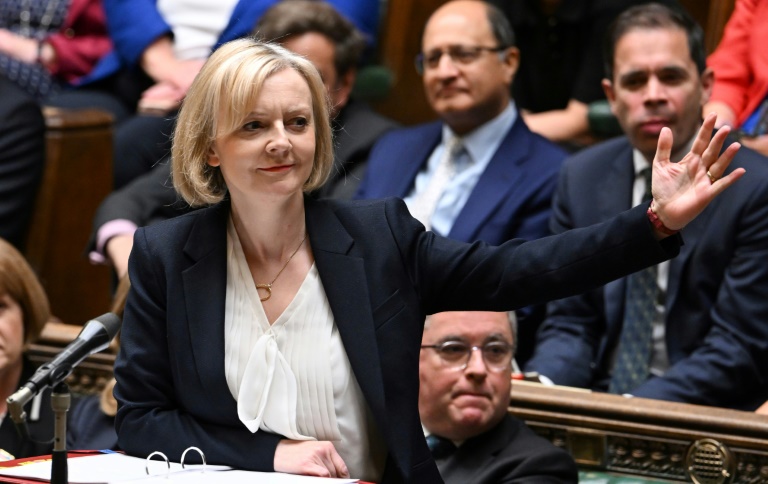
Liz Truss is set to become the shortest-serving prime minister in Britain’s history, after the public, MPs and the markets comprehensively rejected the self-styled heir to Margaret Thatcher.

Truss succeeded Boris Johnson by selling to the Conservative rank-and-file a plan to turbo-charge economic growth through tax cuts, via increased borrowing. 

She accused her rival in this summer’s Tory leadership race, Rishi Sunak, of “scaremongering” when he warned that such an approach at a time of rampant inflation would drive up interest rates for millions of Britons. 

But that is exactly what happened.

On Thursday, Truss was forced to announce her own resignation, a week after firing her finance minister and “ideological soulmate”, Kwasi Kwarteng, in a desperate bid to shore up her position.

The Tories expect to have a new leader in place by October 28, meaning Truss will comfortably underperform 19th-century leader George Canning, who died in office after serving for 118 days.

She is no stranger to screeching U-turns, having begun her political journey as the Liberal Democrat-supporting daughter of progressive parents. At that time, she also opposed the monarchy and Brexit.

Her youthful calls to abolish the royal family ran headlong into her new role when Queen Elizabeth II died on September 8, only two days after appointing Truss. 

The new prime minister paid tribute to the late monarch, curtsied to King Charles III, and joined the queen’s successor on a tour of his new UK realms. 

But her tribute from the steps of 10 Downing Street was widely seen as stilted, betraying the leaden oratory of Truss in comparison to the verbal theatrics of Johnson.

Yet after scandal-ridden Johnson, Truss’s unvarnished style and promises of a right-wing agenda found favour with the Tory membership.

– ‘Human hand grenade’ –

“She’s always been outspoken. She’s always been a disrupter,” said Mark Littlewood, head of the Institute of Economic Affairs think-tank and a former member of Oxford University’s Liberal Democrat club with Truss.

“You really need to understand Elizabeth Truss as a kind of free-market liberal,” he told AFP when she took power.

Truss’s rise to become the UK’s third female prime minister inevitably led to comparisons with the first: Thatcher.

During her year-long stint as foreign minister, Truss was pictured riding atop a tank and sporting a Russian fur hat in Moscow, just like the Tory icon.

Johnson’s former top aide Dominic Cummings likened her to a “human hand grenade”, and some MPs accused her of excessive self-promotion.

Truss admitted to not being the “slickest presenter”. She was mocked online for a bizarre speech she gave as environment minister in 2014, offering impassioned support for British cheese and pork.

– Liberal to Tory –

Truss grew up first in Scotland and then in an affluent suburb of Leeds, northern England. 

Her mother was a nurse, teacher and campaigner for nuclear disarmament who took her on protests, and her father was a left-wing maths professor.

During the Tory leadership campaign, Truss criticised her Leeds school for fostering “low expectations”.

That prompted a backlash from teachers, contemporaries and locals who accused her of inventing an “insulting” back-story to curry favour with the Tory right.

Despite the school’s supposed failings, she went on to Oxford, where — like Sunak — she graduated in philosophy, politics and economics.

At Oxford, she was president of the university’s Liberal Democrat branch. At the party’s national conference in 1994, she gave a speech calling for the abolition of the monarchy.

“I was a bit of a teenage controversialist,” Truss admitted during campaigning this summer.

By her own admission, her switch to the Conservatives shocked her parents, but she says her beliefs had evolved.

After university, Truss worked in the energy sector, including for Shell, and telecommunications before entering politics a decade later.

She was a local councillor in southeast London for four years and became an MP in 2010, part of a new generation of women and minority candidates encouraged by then party leader David Cameron.

He quashed protests from the local party in the agricultural South West Norfolk constituency, after it emerged that Truss had been having an extra-marital affair with a fellow Tory. 

Her critics were dubbed the “Turnip Taliban”.

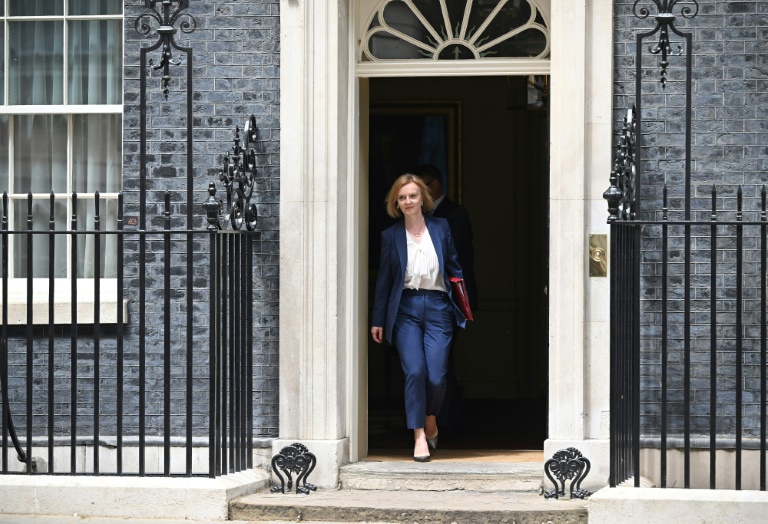
Truss’s marriage to an accountant survived the episode, and he stood close by as she made her resignation statement outside 10 Downing Street. They have two daughters.
Chad protest clashes leave 'about 30' dead, including security forces

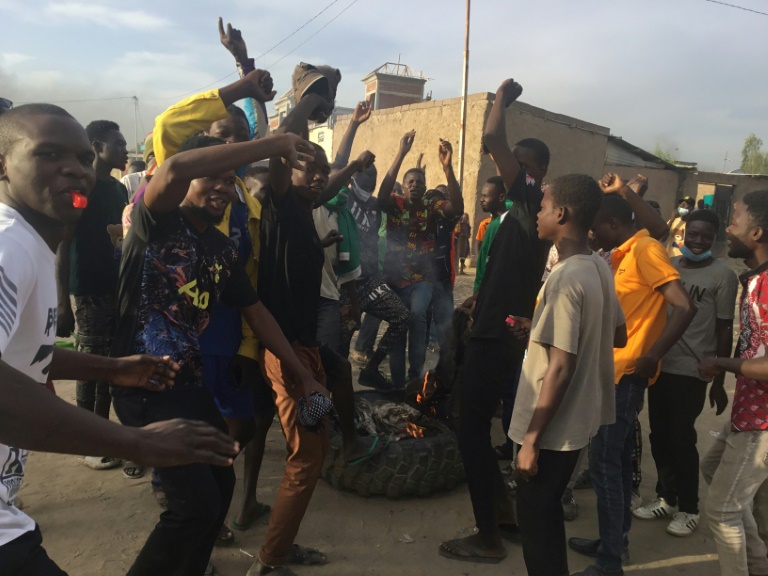
Deadly clashes between police and demonstrators protesting at the military’s grip on power erupted in Chad on Thursday, claiming “about 30” lives, including around 10 members of the security forces, according to an official toll.

Hundreds of demonstrators turned out in the capital N’Djamena to mark the date when the military had initially promised to hand over power — a spell that has been extended for another two years.

“There were about 30 deaths, including about 10 among the security forces, and several injured,” government spokesman Aziz Mahamat Saleh told AFP.

“A banned demonstration became an insurrection,” he said.

He accused demonstrators of attacking “public buildings”, including the offices of the governor, the headquarters of the prime minister’s party and that of the speaker of parliament.

An AFP reporter saw five bodies on the floor of the city’s Union Chagoua Hospital, two of which were covered with the Chadian national flag and three with bloodied white sheets.

The head doctor, Joseph Ampil, later confirmed to AFP that five individuals had “died from gunshots”.

Palls of black smoke could be seen in some parts of the city and the crack of teargas grenades could be heard.

Barricades were set up in several districts and tyres were set alight in the main avenues to block traffic.

In an opposition stronghold, streets were deserted and littered with tree branches and piles of bricks. Schools and university establishments were closed, and many traders in the city centre lowered their shutters.

The headquarters of Prime Minister Saleh Kebzabo’s UNDR party was also attacked by demonstrators “and partially burned down”, UNDR Vice President Celestin Topona told AFP.

France, Chad’s former colonial power, condemned the violence, noting it featured “the use of lethal weapons against demonstrators”.

“France is not playing any part in these events, which lie strictly in Chad’s domestic political domain,” the foreign ministry said.

“False information about France’s purported involvement is baseless.”

Moussa Faki Mahamat, head of the African Union Commission, posted a tweet to “firmly condemn the repression” of the protests and call for peaceful ways to overcome the country’s “crisis”.

– Key date –

The violence comes on the heels of a national forum organised by military strongman Mahamat Idriss Deby Itno that extended his stay in power.

The 38-year-old five-star general took over in April 2021 after his iron-fisted father, Idriss Deby Itno, in power for three decades, was killed during an operation against rebels.

The younger Deby has since angered many at home and embarrassed backers abroad by staying in power beyond his initially promised deadline, which would have expired on Thursday.

“They’re firing on us. They are killing our people,” Succes Masra, whose Transformers party was among groups that had called the protest, said on Twitter.

“The Soldiers of the one-and-only General who refused to honour his word and on the day when the 18 months are up — this is how he intends to install the (Deby) dynasty.”

Deby’s junta had originally declared it would restore civilian rule after 18 months in power and he initially promised not to take part in elections that would follow.

But as this deadline neared, a nationwide forum staged by Deby reset the clock.

On October 1, the conference approved a new “maximum” 24-month timeframe for holding elections.

It also named Deby “transitional president” and declared he could be a candidate in the poll.

Deby was sworn in on October 10, and later appointed a so-called government of national union headed by Kebzabo, a 75-year-old former journalist and one-time opposition figure.

One protester, Abass Mahamat, 35, said he had chosen to voice his anger at “this facade of a dialogue which entrenches the system”.

“In 31 years, we haven’t seen any positive change in our country.”

The vast, arid Sahel state has had a long history of coups and political turmoil since it gained independence from France in 1960.

During his long stay in power, the elder Deby fought off several attempts to unseat him by rebels crossing from Libya and Sudan.

He was supported by France, which deemed him a strong ally in its campaign against jihadism in the Sahel.

S.Africa paves way for cryptocurrency regulation

South Africa’s financial watchdog on Thursday declared cryptocurrency a financial product, paving way for the regulation of the assets in the continent’s most advanced economy.

The announcement comes in the wake of financial institutions and watchdogs around the world grappling on how to regulate digital currencies.

The decision by the Financial Sector Conduct Authority (FSCA) means financial firms dealing in cryptos will have to apply for licensing next year between June 1 and November 20.

“You cannot have a situation where you have entities operating outside the regulatory framework, it is not ideal, and certainly not in the public interest,” FSCA Commissioner Unathi Kamlana told a news briefing.

The crypto asset, which will not be issued by the central bank, will be tradeable, transferred or stored electronically “for the purpose of payment, investment”.

Robust travel demand boosts American Airlines' Q3 profits

American Airlines reported a strong third quarter Thursday, capitalizing on robust demand for travel that the company sees persisting as Covid-19 worries recede.

Echoing commentary from rivals such as United Airlines and Delta Air Lines, American scored a 13 percent jump in revenues compared with the 2019 period on lofty ticket prices, despite flying around 10 percent less capacity.

“Demand remains strong, and it’s clear that customers in the US and other parts of the world continue to value air travel and the ability to reconnect post-pandemic,” said American Chief Executive Robert Isom.

Profits for the quarter ending September 30 was $483 million, more than double the year-ago level with a 50 percent increase in revenues to $13.5 billion, a quarterly record.

After a devastating industry downturn during the worst days of the coronavirus pandemic, US carriers have begun to prosper in 2022 as more governments pare back restrictions.

Executives point to several factors that are overriding worries about inflation and rising recession risk: continuing “pent-up” travel demand following Covid-19 lockdowns; the shift to hybrid working that allows more travel; and industry-wide capacity constraints that are lifting plane ticket prices.

American released fourth-quarter forecasts that show continued strength, with its projection of between 50 and 70 cents per share in profits easily topping analyst expectations.

Shares rose 2.4 percent to $14.32 in pre-market trading.

UK PM on brink as political chaos deepens

Embattled British Prime Minister Liz Truss on Thursday acknowledged a “difficult day” after a key minister resigned and MPs rebelled, but showed no sign of quitting.

More than a dozen Conservative MPs have publicly urged Truss to resign just six weeks into office, after her tax-cutting plans caused a market meltdown during an already severe cost-of-living crisis.

Many more are reported to have submitted letters calling for her to be removed, although party rules currently forbid another leadership campaign for 12 months.

Truss on Thursday met with Graham Brady, the chair of the 1922 committee of backbench Conservative MPs that ultimately has the power to decide her fate, Downing Street said.

However, officials said Truss had initiated the meeting, and that it was not a sign her departure was imminent. 

“The prime minister acknowledges yesterday was a difficult day and she recognises the public wanted to see the government focussing less on politics and more on delivering their priorities,” her official spokesman told reporters.

But events appear to be reaching a head after what right-wing tabloid the Sun called “a day of extraordinary mayhem” on Wednesday.

Interior minister Suella Braverman left, apparently at Truss’s demand after she sent an official document in a personal email.

But Braverman, an arch right-winger who enjoys strong support among the Tory membership, used her resignation message to attack Truss in blistering terms.

– ‘Clinging to power’ –

There then followed farcical scenes in parliament as many Tory MPs rebelled against the government’s demand that they drop the party’s manifesto commitment to maintain a ban on fracking.

Accusations swirled of heavy-handed efforts to whip MPs into line, some of whom later briefed the media that it was the nail in the coffin of the Truss premiership.

The Times reported the prime minister was “clinging to power”, and cited a Truss supporter in her cabinet as saying: “It’s terminal.”

Conservative lord Ed Vaizey said the “only way out of this mess is for Liz Truss to stand down and for somebody to be appointed as prime minister by Conservative MPs”.

If she does leave, the party could avoid a lengthy leadership contest by consolidating around a unity candidate for her replacement.

But Truss on Wednesday said she was “not a quitter” — and no single successor has emerged with widespread backing for a coronation.

– ‘Must leave’ –

The prime minister’s woes began when her showpiece tax-slashing policy sparked market chaos that threatened the country’s pension funds, forcing her into a series of humiliating U-turns.

Braverman’s departure on Wednesday triggered the second reshuffle this month after Truss sacked close ally Kwasi Kwarteng over the budget debacle, replacing him with Jeremy Hunt, who swiftly reversed almost all the policy announcements.

The Daily Telegraph reported that Braverman left after a “heated face-to-face row” with Truss and Hunt “over their demands to soften her stance on immigration”.

Truss appointed Grant Shapps to replace Braverman even though she had fired him as transport secretary when she took office. 

Both Shapps and Hunt had supported her rival for the leadership, Rishi Sunak, leaving her isolated in her own cabinet.

Braverman, seen as a hardliner on immigration, said she had resigned over a “technical infringement” of government rules.

But in her resignation letter, she flagged up “serious concerns” that Truss was breaking manifesto promises.

“Pretending we haven’t made mistakes, carrying on as if everyone can’t see we’ve made them, and hoping things will magically come right is not serious politics,” Braverman wrote.

– PM booed –

Braverman’s resignation message came hours after Truss sought to dispel doubts over her leadership with a combative appearance in parliament.

Truss faced harsh putdowns from opposition Labour leader Keir Starmer as she took part in her first Prime Minister’s Questions since the budget U-turns.

Starmer asked the House of Commons: “What’s the point of a prime minister whose promises don’t even last a week?” as opposition MPs jeered and booed Truss and her own party’s MPs remained silent.

Truss insisted that she would not stand down.

Later on Wednesday there were febrile scenes in parliament as the opposition proposed a debate on Truss’s controversial decision to resume fracking — drilling onshore for gas.

Labour MPs alleged that Conservatives were physically forced to vote against the proposals by the whips, who enforce party discipline, but dozens failed to vote along party lines.

Polls show Truss’s personal and party ratings have plummeted, with YouGov saying Tuesday that she had become the most unpopular leader it has ever tracked.

A separate survey of Conservative members found that less than two months after electing her as party leader and prime minister, a majority now think she should go.

Turkish central bank cuts rates again as inflation rockets

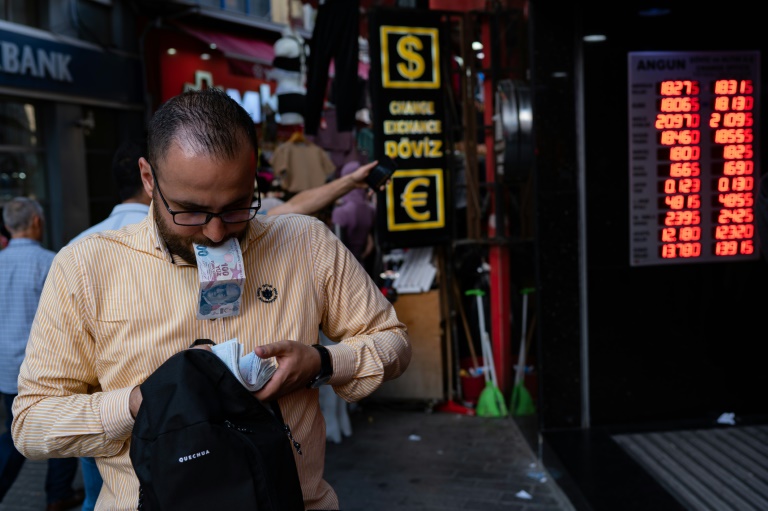
Turkey’s central bank on Thursday cut its policy rate for the third consecutive month despite a plunging lira and an annual inflation rate that has soared over 83 percent.

Turkey’s monetary policymakers are bucking the global trend of central banks raising interest rates to combat inflation, as high borrowing rates cool down the economy and prices.

The latest decision comes after President Recep Tayyip Erdogan said the central bank would keep cutting rates every month for “as long as I am in power” — and despite inflation hitting 83.45 percent in September on an annual basis.

Erdogan wants to lower interest rates to single digits by the end of the year as he prioritises economic growth eight months before a general election — which could promise to be the closest since he came to power nearly two decades ago.

Turkish policymakers have insisted on following this unconventional economic model at the expense of an astronomical inflation.

The central bank said Thursday it was cutting its one-week repo rate to 10.5 percent from 12 percent, with a surge in consumer prices it said was “driven by the lagged and indirect effects of rising energy costs” caused by Russia’s war on Ukraine.

The interest rate cut was widely anticipated, but the 150 basis points cut was larger than expected after two 100 basis points moves in both August and September.

The bank hinted that the easing cycle would end next month.

“The (Monetary Policy) Committee evaluated taking a similar step in the following meeting and ending the rate cut cycle,” the bank said.

Liam Peach, senior emerging markets economist at the London-based Capital Economics, said this guidance “appears to be an admission that lowering interest rates is hardly the right thing to be doing when inflation is so high.”

“But at the same time, it would take interest rates to nine percent and satisfy Erdogan’s wish to bring rates down into single digits,” he added. 

– ‘Re-election strategy’-

Inflation began to rise worldwide after economies emerged from Covid lockdowns but it worsened this year as Russia’s invasion of Ukraine sent energy and food prices through the roof.

Erdogan, a vocal opponent of higher borrowing costs, has called high interest rates his “biggest enemy”. 

Earlier this month he vowed that while he remained in power, “the interest will continue to come down with each passing day, each passing week, each passing month.”

As a result, the Turkish lira keeps losing its value against the US dollar and is down 28 percent since January.   

“Erdogan’s economic re-election strategy is clear… use money from Russia and (the) Gulf to fund FX intervention to defend the lira, cut policy rates as far as possible to get credit and growth going,” BlueBay Asset Management analyst Timothy Ash said. 

The powerful Turkish leader has responded to the economic crisis by an overhaul of his foreign policy and repairing ties with his former rivals in the Arab world, including oil-rich Saudi Arabia. 

Additional trade-focussed deals with Russia have helped shore up Turkey’s dwindling foreign currency reserves and potentially given Erdogan enough breathing room to ride out the economic storm until the June election.

However, Washington has been warning Turkish companies and banks trading with Russia for several months they could face possible sanctions.

Elizabeth Rosenberg, the US assistant secretary for terrorist financing and financial crimes, traveled to Ankara and Istanbul this week, the Department of the Treasury said. 

Her meetings “affirmed the importance of close partnership between the United States and Turkey in addressing the risks caused by sanctions evasion and other illicit financial activities.”

Turkish central bank cuts rates again as inflation rockets

Turkey’s central bank on Thursday cut its policy rate for the third consecutive month despite a plunging lira and an annual inflation rate that has soared over 83 percent.

Turkey’s monetary policymakers are bucking the global trend of central banks raising interest rates to combat inflation, as high borrowing rates cool down the economy and prices.

The latest decision comes after President Recep Tayyip Erdogan said the central bank would keep cutting rates every month for “as long as I am in power” — and despite inflation hitting 83.45 percent in September on an annual basis.

Erdogan wants to lower interest rates to single digits by the end of the year as he prioritises economic growth eight months before a general election — which could promise to be the closest since he came to power nearly two decades ago.

Turkish policymakers have insisted on following this unconventional economic model at the expense of an astronomical inflation.

The central bank said Thursday it was cutting its one-week repo rate to 10.5 percent from 12 percent, with a surge in consumer prices it said was “driven by the lagged and indirect effects of rising energy costs” caused by Russia’s war on Ukraine.

The interest rate cut was widely anticipated, but the 150 basis points cut was larger than expected after two 100 basis points moves in both August and September.

The bank hinted that the easing cycle would end next month.

“The (Monetary Policy) Committee evaluated taking a similar step in the following meeting and ending the rate cut cycle,” the bank said.

Liam Peach, senior emerging markets economist at the London-based Capital Economics, said this guidance “appears to be an admission that lowering interest rates is hardly the right thing to be doing when inflation is so high.”

“But at the same time, it would take interest rates to nine percent and satisfy Erdogan’s wish to bring rates down into single digits,” he added. 

– ‘Re-election strategy’-

Inflation began to rise worldwide after economies emerged from Covid lockdowns but it worsened this year as Russia’s invasion of Ukraine sent energy and food prices through the roof.

Erdogan, a vocal opponent of higher borrowing costs, has called high interest rates his “biggest enemy”. 

Earlier this month he vowed that while he remained in power, “the interest will continue to come down with each passing day, each passing week, each passing month.”

As a result, the Turkish lira keeps losing its value against the US dollar and is down 28 percent since January.   

“Erdogan’s economic re-election strategy is clear… use money from Russia and (the) Gulf to fund FX intervention to defend the lira, cut policy rates as far as possible to get credit and growth going,” BlueBay Asset Management analyst Timothy Ash said. 

The powerful Turkish leader has responded to the economic crisis by an overhaul of his foreign policy and repairing ties with his former rivals in the Arab world, including oil-rich Saudi Arabia. 

Additional trade-focussed deals with Russia have helped shore up Turkey’s dwindling foreign currency reserves and potentially given Erdogan enough breathing room to ride out the economic storm until the June election.

However, Washington has been warning Turkish companies and banks trading with Russia for several months they could face possible sanctions.

Elizabeth Rosenberg, the US assistant secretary for terrorist financing and financial crimes, traveled to Ankara and Istanbul this week, the Department of the Treasury said. 

Her meetings “affirmed the importance of close partnership between the United States and Turkey in addressing the risks caused by sanctions evasion and other illicit financial activities.”

Alleged Gambian death squad member denies German charges

A Gambian man on trial in Germany accused of belonging to a death squad that assassinated opponents of former dictator Yahya Jammeh, including an AFP journalist, on Thursday denied the charges. 

“I did not participate in these acts,” the defendant Bai Lowe’s lawyer told the court in the northern town of Celle, reading a statement by the accused. 

Lowe, 47, who is charged with crimes against humanity, murder and attempted murder, including the 2004 killing of AFP correspondent Deyda Hydara, listened intently to the English translation of the declaration read out in German. 

In it, Lowe said he had merely repeated in the past what other people had told him about the facts of the case.

Explaining previous statements in media interviews that appeared to incriminate him, Lowe told the court that he had intended to demonstrate to his fellow Gambians how cruel Jammeh’s regime was.

Lowe, who went on trial in April, is accused of involvement in two murders and one attempted murder while working as a driver for the hit squad known as the Junglers between December 2003 and December 2006.

Human Rights Watch has called the proceedings “the first to prosecute human rights violations committed in Gambia during the Jammeh era on the basis of universal jurisdiction”.

Universal jurisdiction allows a foreign country to prosecute crimes against humanity, war crimes and genocide, regardless of where they were committed.

– ‘Betrays common sense’ –

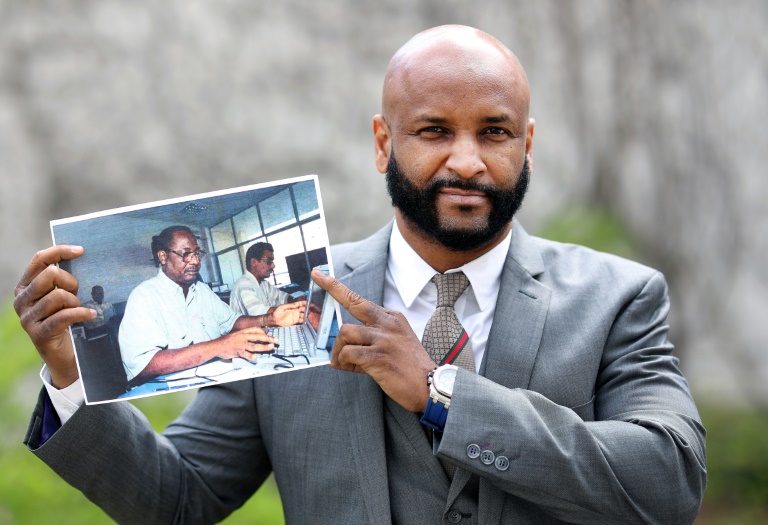
Hydara was an editor and co-founder of the independent daily The Point and a correspondent for AFP for more than 30 years.

The father-of-four also worked as a Gambia correspondent for the Reporters Without Borders (RSF) campaign group.

He was gunned down in his car on the outskirts of Banjul on December 16, 2004.

Lowe is accused of having helped stop Hydara’s car before driving one of the killers in his own vehicle.

In a statement sent to AFP, Hydara’s son Baba said he rejected Lowe’s account to the judges.

“As a victim and a plaintiff in this case I feel disappointed, insulted and cheated by (this) statement that betrays common sense,” he said.

Hydara’s lawyer, Patrick Kroker, added that “the statement of the accused seems made up and incomplete. Moreover, it has already been contradicted on several occasions by the evidence collected so far”.

“It’s a step backwards in the search for the truth for the victims of Yahya Jammeh,” Kroker told AFP. 

“We assume that the court will not give any credence to this statement.”

Attorney Ida Jagne, who was in Hydara’s car when he was killed, also dismissed Lowe’s testimony.

“The statement is extremely not credible… because the accounts he gave in interviews were very detailed: who participated, what happened,” Jagne’s own lawyer Peer Stolle told reporters outside the courtroom.

Lowe arrived in Europe via Senegal in December 2012, saying he was seeking asylum as a political refugee who feared for his life under Jammeh. 

He was detained on the charges in Germany in March 2021.

Jammeh ruled Gambia with an iron fist for 22 years but fled the country in January 2017 after losing a presidential election to relative unknown Adama Barrow. 

He refused to acknowledge the results but was forced out by a popular uprising and fled to Equatorial Guinea.

Five former members of the intelligence service were sentenced to death by a Gambian court only in July this year for the murder of a political activist during Jammeh’s rule.

Philippines to get US military helicopters after scrapping Russia deal

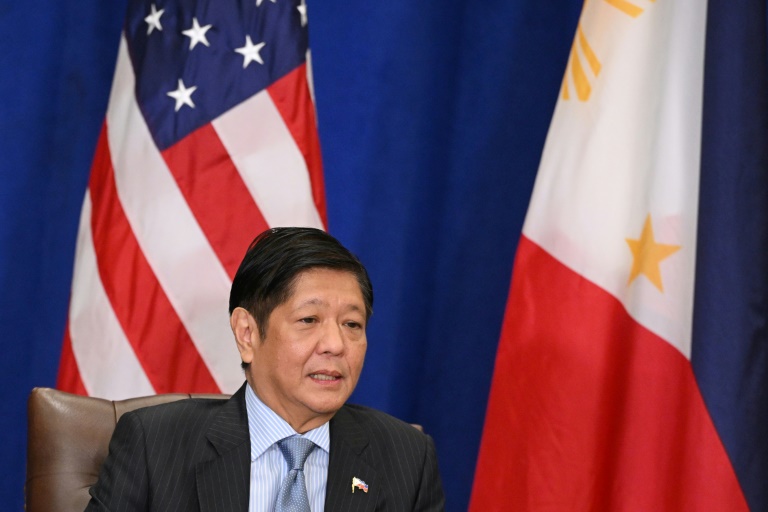
The Philippines will acquire heavy-lift military helicopters from the United States, President Ferdinand Marcos Jr said Thursday, after scrapping a deal to buy similar aircraft from Russia.

The government of his predecessor Rodrigo Duterte had signed a deal worth $216 million for 16 Mi-17 helicopters, but backed out in the months following Russia’s invasion of Ukraine and the imposition of wide-ranging sanctions on Moscow.

Earlier Thursday, local media had quoted the Russian ambassador to the Philippines as saying that deal was still valid.

But Marcos said it was dead.

“We have secured an alternative supply (for heavy-lift helicopters) from the United States,” Marcos, who was elected president in May, told a business forum.

“Unfortunately, we made a down payment (to the Russian manufacturer) that we are hoping to negotiate to get at least a percentage of that back,” he added.

“But the deal as it stood maybe at the beginning of or in the middle of last year has already been cancelled.”

Russian ambassador Marat Pavlov, however, was quoted in local media as saying the manufacturer was still proceeding with the assembly of the Mi-17s.

The Russian embassy in Manila could not be reached for comment.

Marcos did not specify which US helicopter was chosen as the alternative, only that they will be manufactured in Poland.

The Philippine ambassador in Washington, Jose Romualdez, told reporters in August that Manila was looking at Chinooks to replace the Mi-17s.

Romualdez had separately told AFP in August that the decision to cancel the Mi-17 deal was triggered by the Ukraine war, and that Manila was also wary of violating a 2017 US law that sanctions anyone doing business with Russia’s intelligence or defence sectors.

The Philippines is a longtime US ally and began a modest military modernisation programme in 2012.

Until recently, its equipment included Vietnam War-era helicopters and World War II naval vessels used by the United States.

Italy opens talks on new government as coalition spars over Ukraine

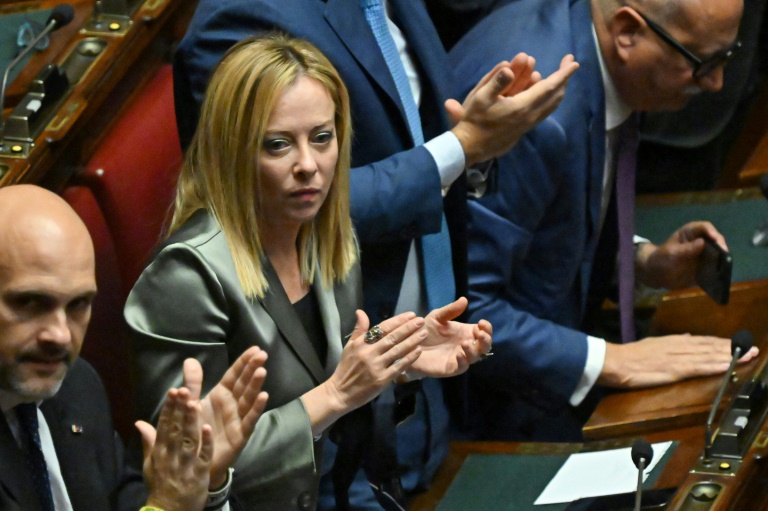
Italy’s president began consultations Thursday on forming a new government following the victory of far-right leader Giorgia Meloni in elections last month, as tensions over Ukraine threatened the unity of her coalition.

Meloni, 45, is expected to be named Italy’s first woman prime minister following the talks, which are set to wrap up Friday, after her post-fascist Brothers of Italy party came top in September 25 polls.

But the largely procedural process has been overshadowed by the leak of a recording of ex-premier Silvio Berlusconi — whose Forza Italia party is part of Meloni’s coalition — talking about his warm ties with Moscow and appearing to blame the war in Ukraine on its president, Volodymyr Zelensky.

Meloni, whose party is Eurosceptic but who has strongly backed Western support for Kyiv and sanctions against Russia, issued a statement late Wednesday to make her position clear.

“I intend to lead a government with a clear and unequivocal foreign policy line,” she said, after more than 24 hours of silence over the leak.

“Italy is fully, and with its head held high, part of Europe and the Atlantic Alliance.”

Her statement included a clear warning to her allies, who also include Matteo Salvini of the far-right League party, who has also previously expressed his admiration for Russian President Vladimir Putin.

“Anyone who does not agree with this cornerstone will not be able to be part of the government, even at the cost of not forming a government,” Meloni said.

Berlusconi, 86, also said in a statement that his personal and political position “do not deviate from that of the Italian government (and) the European Union” on Ukraine.

But the tensions only add to concerns that Meloni’s coalition, held together by the need for a parliamentary majority, will struggle to maintain a coherent policy on foreign issues, and others.

“Meloni, Russian roulette,” read the headline of La Repubblica newspaper Thursday. 

– Swearing-in soon –

Meloni’s appointment is a given but under Italy’s constitution, President Sergio Mattarella will only name her after holding formal talks with all the major parties.

The newly elected speaker of the Senate, Brothers of Italy veteran Ignazio La Russa, was first to arrive at the grand Quirinale presidential palace in Rome, once home to centuries of popes.

Then came the speaker of the lower house of parliament, to be followed by smaller parties and representatives from the main party in the opposition, the centre-left Democratic Party.

On Friday morning, it is the turn of representatives of Meloni’s coalition, with speculation she could be asked to form a government as early as Friday afternoon.

She will then have to confirm she is able to form a government with her allies, and could be sworn in with her ministers as early as the weekend.

However, the process of allocating the top jobs has been fraught, with Berlusconi and Salvini — whose parties won just eight and nine percent, respectively, in the elections, well below Meloni’s 26 percent — angling for influence.

Berlusconi ally Antonio Tajani, a former president of the European Parliament, is widely tipped to become foreign minister.

Meanwhile, League veteran Giancarlo Giorgetti has been tipped as economy minister, with the responsibility of guiding debt-laden Italy through a crisis sparked by soaring inflation linked to the war in Ukraine.

Outgoing Prime Minister Mario Draghi, a former European Central Bank chief parachuted in to lead a national unity government in February 2022, has no formal role in the consultation process.

He headed Thursday to a European Union summit in Brussels, and was due to return to Rome on Friday afternoon.

Close Bitnami banner
Bitnami