World

Amazon workers reject union in latest US warehouse vote

Workers at an Amazon warehouse near Albany voted decisively against establishing a union, US officials announced Tuesday, dealing a setback to the fledgling labor drive at the e-commerce behemoth.

The tally was 406 against Amazon Labor Union’s (ALU) proposal and 206 in support of the organization, said a spokeswoman for the National Labor Relations Board.

The election marks the second straight defeat for the ALU, which surged to prominence in April following its upset win at a large Staten Island warehouse that voted to become Amazon’s first US facility to unionize.

The ALU did not immediately respond to a request for comment, but the group’s president, Christian Smalls, said on Twitter before the counting that he was “proud” of the effort regardless of the outcome.

“Taking on a Trillion dollar company can never be a loss for workers,” Smalls tweeted. 

“We will continue to empower all workers to give them the right to unionize. You miss 100% of the shots you don’t take!”

Amazon, which has continued to contest its defeat in the first Staten Island vote, said it was pleased with Tuesday’s outcome.

“We’re glad that our team in Albany was able to have their voices heard, and that they chose to keep the direct relationship with Amazon as we think that this is the best arrangement for both our employees and customers,” said spokesperson Kelly Nantel. 

The elections at Amazon have come amid a wave of labor drives at consumer-facing companies, including Starbucks, Apple, REI and Chipotle, all of which have voted to unionize one or more store or restaurant. 

But Amazon’s initial victory in Staten Island was on a much bigger scale, providing a jolt to the US labor movement while propelling Smalls and other ALU leaders to prominence. 

Smalls, a former Staten Island Amazon worker, and other current and ex-employees established the group  2021, denouncing Amazon’s rigid workforce practices during the pandemic and arguing a union was the way towards better pay and benefits.

But after prevailing in the 8,000 employee JFK8 warehouse, the ALU had also lost a second election in May at the smaller LDJ5 warehouse, which is also in Staten Island.

Besides trying to spread the ALU to new Amazon sites, the union’s leaderships is also facing barriers in getting Amazon to come to the bargaining table to recognize the union and negotiate a contract.

Amazon has refused to accept the election outcome in the first Staten Island vote, arguing the results should be tossed out in light of alleged improprieties.

Last month, an NLRB official rejected Amazon’s claims as groundless after a 24-day hearing on the e-commerce giant’s claims.

But Amazon has said it plans to appeal that decision.
Thousands strike in France for higher wages

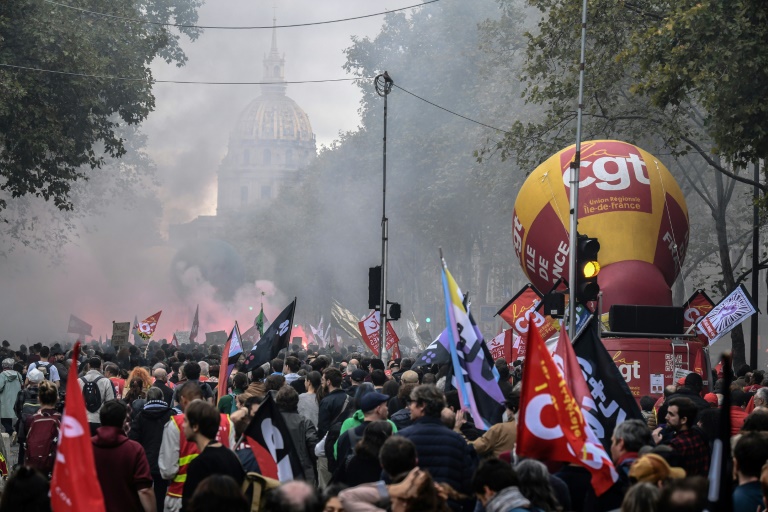
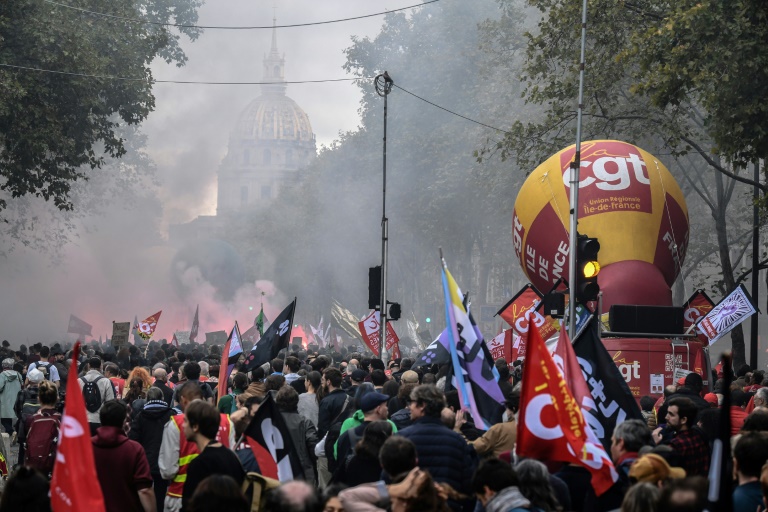
Striking workers held rallies across France on Tuesday to demand higher wages in response to soaring inflation, amplifying a protest by refinery workers that has emptied petrol stations and caused headaches for millions of motorists.

The strike caused fewer transport disruptions than feared, though unions have vowed further action against President Emmanuel Macron in coming weeks — in particular over a hostly contested pensions reform.

“It’s a shame it had to come to blockades for something to happen,” said Nadine, a 45-year-old employee in the metalworking industry who was among more than 1,000 demonstrators in Strasbourg, northeast France.

“But today if we don’t block anything, no one listens,” she said.

Among a crowd of some 1,800 marching in the southern city of Montpellier, Magali Mallet, a medical secretary, said she was there because many workers were “living on a knife’s edge”.

The interior ministry said 107,000 people took part in marches across the country, including 13,000 in Paris — an estimate far below the 70,000 reported by the CGT union.

Anti-capitalist “black bloc” protesters also joined the demo in the capital, spraying graffiti and smashing windows at a bank and a BMW dealership before being dispersed by riot police.

The ministry said 11 people were arrested in Paris and nine officers injured in clashes with the protesters, with four arrests elsewhere.

The broader strike came after workers at several oil refineries and depots operated by energy giant TotalEnergies voted to extend walkouts that are now in their third week.

The blockades have seriously disrupted fuel distribution across the country, particularly in northern and central France and the Paris region.

“We’re going to seek a 10 percent pay hike. With the cost of living rising, and energy costs, we need it — there are more and more poor workers,” said Laurent Leger, 59, at the Paris march.

– ‘Serious consequences’ –

Prime Minister Elisabeth Borne said that less than a quarter of petrol stations nationwide were experiencing shortages, down from 30 percent previously.

Her government used requisition powers to order some of the workers back to fuel depots, a move that infuriated unions but has so far been upheld in the courts.

But officials are also pushing bosses to acknowledge the wage demands, with Interior Minister Gerald Darmanin saying Tuesday that there was “a salary problem” in France, and urging employers “to increase pay when possible”.

Workers have also been striking in the nuclear power sector, potentially hampering efforts to restart reactors down for maintenance or safety work.

Power grid operator RTE warned Tuesday that “any extension of the social movement” at the nuclear power stations would have “serious consequences” on electricity provision this winter.

Macron said last week only 30 out of 56 nuclear reactors were online, while the country hoped to have 45 working by January.

But French state energy provider EDF said Saturday that it was postponing plans to bring five of the halted reactors back on stream.

– Tense autumn? –

Beyond transport and other public-sector workers, unions had hoped to bring out staff in industries such as food and healthcare.

The education ministry said less than six percent of its workers had walked out, though that rate reached 23 percent for vocational schools.

The strike could herald a tense autumn and winter as Macron also seeks to implement his flagship domestic policy of raising the French retirement age to 64 or 65, up from 62 currently.

The economic squeeze partly caused by Russia’s invasion of Ukraine, along with the failure of Macron’s party to secure an overall majority in June legislative polls, could also inflame public anger.

A poll by the Elabe group found that one in three French people would be prepared to take part in a strike or protest in the coming weeks to demand pay increases as inflation soars. 

sl-burs/ah/js/rox

Thousands strike in France for higher wages

Striking workers held rallies across France on Tuesday to demand higher wages in response to soaring inflation, amplifying a protest by refinery workers that has emptied petrol stations and caused headaches for millions of motorists.

The strike caused fewer transport disruptions than feared, though unions have vowed further action against President Emmanuel Macron in coming weeks — in particular over a hostly contested pensions reform.

“It’s a shame it had to come to blockades for something to happen,” said Nadine, a 45-year-old employee in the metalworking industry who was among more than 1,000 demonstrators in Strasbourg, northeast France.

“But today if we don’t block anything, no one listens,” she said.

Among a crowd of some 1,800 marching in the southern city of Montpellier, Magali Mallet, a medical secretary, said she was there because many workers were “living on a knife’s edge”.

The interior ministry said 107,000 people took part in marches across the country, including 13,000 in Paris — an estimate far below the 70,000 reported by the CGT union.

Anti-capitalist “black bloc” protesters also joined the demo in the capital, spraying graffiti and smashing windows at a bank and a BMW dealership before being dispersed by riot police.

The ministry said 11 people were arrested in Paris and nine officers injured in clashes with the protesters, with four arrests elsewhere.

The broader strike came after workers at several oil refineries and depots operated by energy giant TotalEnergies voted to extend walkouts that are now in their third week.

The blockades have seriously disrupted fuel distribution across the country, particularly in northern and central France and the Paris region.

“We’re going to seek a 10 percent pay hike. With the cost of living rising, and energy costs, we need it — there are more and more poor workers,” said Laurent Leger, 59, at the Paris march.

– ‘Serious consequences’ –

Prime Minister Elisabeth Borne said that less than a quarter of petrol stations nationwide were experiencing shortages, down from 30 percent previously.

Her government used requisition powers to order some of the workers back to fuel depots, a move that infuriated unions but has so far been upheld in the courts.

But officials are also pushing bosses to acknowledge the wage demands, with Interior Minister Gerald Darmanin saying Tuesday that there was “a salary problem” in France, and urging employers “to increase pay when possible”.

Workers have also been striking in the nuclear power sector, potentially hampering efforts to restart reactors down for maintenance or safety work.

Power grid operator RTE warned Tuesday that “any extension of the social movement” at the nuclear power stations would have “serious consequences” on electricity provision this winter.

Macron said last week only 30 out of 56 nuclear reactors were online, while the country hoped to have 45 working by January.

But French state energy provider EDF said Saturday that it was postponing plans to bring five of the halted reactors back on stream.

– Tense autumn? –

Beyond transport and other public-sector workers, unions had hoped to bring out staff in industries such as food and healthcare.

The education ministry said less than six percent of its workers had walked out, though that rate reached 23 percent for vocational schools.

The strike could herald a tense autumn and winter as Macron also seeks to implement his flagship domestic policy of raising the French retirement age to 64 or 65, up from 62 currently.

The economic squeeze partly caused by Russia’s invasion of Ukraine, along with the failure of Macron’s party to secure an overall majority in June legislative polls, could also inflame public anger.

A poll by the Elabe group found that one in three French people would be prepared to take part in a strike or protest in the coming weeks to demand pay increases as inflation soars. 

sl-burs/ah/js/rox

Britain summons China diplomat over protest assault

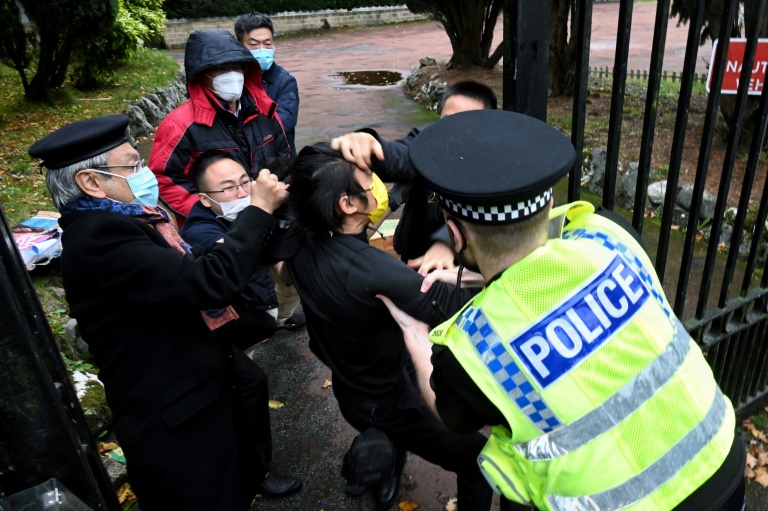
The UK’s foreign office on Tuesday summoned a top Chinese diplomat in London over footage of a Hong Kong pro-democracy protester being assaulted in the grounds of a Chinese consulate in Britain.

China’s Charge d’Affaires Yang Xiaoguang was summoned after Beijing earlier Tuesday accused demonstrators of “illegally entering” the consulate in the northern British city of Manchester.

British police have said a group of men came out of the consulate during a peaceful demonstration on Sunday afternoon, dragging one of the protesters inside the grounds and assaulting him.

“We have serious concerns about the footage that we have seen showing an incident at the Chinese Consulate-General,” said foreign office minister Zac Goldsmith.

“Today we have made our view clear to the Chinese authorities: the right to peaceful protest in the UK must be respected,” he added.

But Chinese foreign ministry spokesman Wang Wenbin said the protesters were to blame and that “violation of the peace and dignity of China’s overseas embassies and consulates will not be tolerated”.

“The troublemakers illegally entered the Chinese Consulate-General in Manchester, endangering the security of the premises,” Wang said at a daily press briefing.

He urged the UK to “earnestly fulfil its duties and take effective measures to step up protection of the premises and personnel of the Chinese embassy and consulates”.

The man involved in the incident, who is in his 30s, sustained injuries and spent the night in hospital, local police said.

– ‘They beat me up’ –

Video footage posted on Twitter showed a grey-haired man kicking protesters’ banners and scuffling with a group of demonstrators at the gates of the consulate.

A group of men were then shown punching a protester lying on the ground inside the mission’s gates.

The newly appointed chair of the UK parliament’s foreign affairs committee, Alicia Kearns, accused the Chinese consul-general Zheng Xiyuan, one of China’s most senior UK diplomats, of being at the scene and “ripping down posters” during a “peaceful protest.”

China has not responded to those claims.

The BBC reported that the injured activist was from Hong Kong, which was engulfed by massive pro-democracy protests in 2019 before Beijing imposed a harsh national security law to mute dissent.

“They dragged me inside. They beat me up,” he told the broadcaster.

The protest took place as China opened its five-yearly Communist Party Congress, where President Xi Jinping is widely expected to be handed a historic third term in power.

Greater Manchester Police said in a statement that around 40 people had gathered outside the consulate for a planned peaceful protest.

Shortly before 4:00 pm (1500 GMT) “a small group of men came out of the building and a man was dragged into the consulate grounds and assaulted”, police said.

“Due to our fears for the safety of the man, officers intervened and removed the victim from the consulate grounds.”

– ‘Denial of free speech’ –

Police have said they had not made any arrests, and asked for witnesses to get in touch and pass on any footage of the incident.

Several senior British politicians have condemned the use of violence against a protester.

Kearns, tweeted that interior and foreign ministers Suella Braverman and James Cleverly “need to urgently investigate”.

The Chinese Communist Party “will not import their beating of protestors and denial of free speech to British streets”, she added.

And influential former Conservative Party leader Iain Duncan Smith called for the government to “demand a full apology from the Chinese ambassador to the UK”.

Nathan Law, a Hong Kong activist who has fled to the UK, tweeted: “If the consulate staff responsible are not held accountable, Hongkongers would live in fear of being kidnapped and persecuted.”

He called for Cleverly and Braverman to “investigate and protect our community and people in the UK”.

Qatar inaugurates solar plant as World Cup approaches

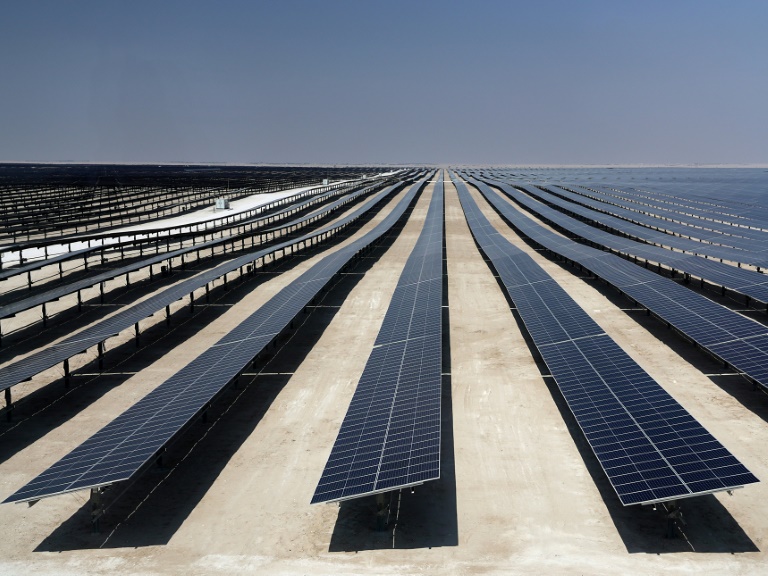
Gas-rich Qatar inaugurated Tuesday its first solar power plant stretching across the desert, a vast site planned to provide up to 10 percent of the tiny Gulf nation’s energy supply.

The solar farm in al-Kharsaah, west of the capital Doha, is “one of the biggest” in the Middle East, said Saad Sherida al-Kaabi, the emirate’s energy minister and president of QatarEnergy.

It was launched in 2016 in partnership with France’s TotalEnergies and Japan’s Marubeni as part of a broader push by Qatar — one of the world’s biggest producers of liquified natural gas — to invest in solar energy.

The project, at a cost of 1.7 billion Qatari riyals (about $467 million), consists of some 1.8 million solar panels and covers an area of more than 10 square kilometres (3.9 square miles).

Operational since June, the plant has a capacity of 800 megawatts and will “expand” further in coming years, Kaabi told a press conference. 

Kaabi said the plant is part of Qatar’s “strategic initiatives to build projects that contribute to reducing gas and thermal emissions”.

During the day, sun-tracking technology moves the panels to ensure maximum solar exposure, while at night, robotic arms clean off the dust.

Organisers of the football World Cup, which begins on November 20, have used the huge solar plant to back claims that Qatar will host the first “net zero” World Cup.

But Kaabi said he could not confirm the al-Kharsaah plant will provide power for the stadiums hosting matches during the November-December tournament.

Qatar, while lagging behind other Gulf states in the solar race, has announced a target of five gigawatts of solar energy capacity by 2035.

It announced two major solar projects in August that will more than double its energy output from the renewable source within two years.

Saudi Arabia has also announced a target of five gigawatts of solar energy capacity, but vowed to reach it by 2030. The United Arab Emirates has had solar plants for more than a decade.

Under-fire Kyiv still finding first victims of war

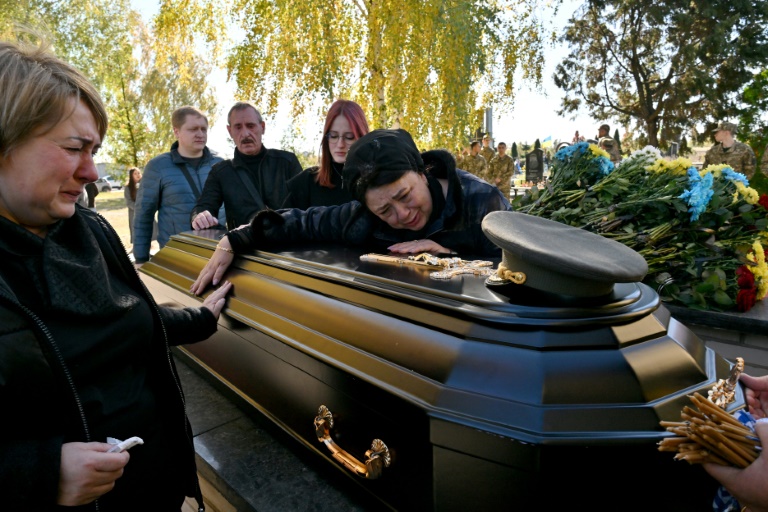
The cruise missiles had just finished smashing into Kyiv when Tetyana Telyzhenko buried the mutilated body of her tortured son in the capital’s traumatised suburb of Bucha.

Tuesday’s strikes appeared to be aimed at Ukrainian power stations that Russian-guided suicide drones had failed to reach the previous day.

But the body of Tetyana’s 44-year-old son Oleksiy had been missing since his capture in Russia’s aborted assault on Kyiv in the first weeks of the war in March.

Tetyana never saw her son’s corpse after its discovery in a random field last month.

Her granddaughter decided it would be too much.

“She wouldn’t let me see his interrogation video either,” the grieving mother said.

“She told me that I wouldn’t recognise him after what they had done to him.”

The Russians have launched a punishing new air assault on Ukraine’s biggest cities after failing to seize them in the first eight months of war.

– Punishing air assault –

This has pierced the euphoric mood that permeated Kyiv after its residents took up arms and pushed the Russians back — at monumental cost.

One of these men was Oleksiy. 

UN investigators concluded last month that “war crimes” had been committed by Russian forces in Kyiv suburbs such as Bucha and Irpin.

Ukraine’s national police puts the number of civilians executed by invading soldiers or killed by Russian bombs in Bucha and its neighbouring town at 1,137.

Oleksiy’s mother said her son was probably being interrogated by the Russians about his peacetime work as a top instructor at Ukraine’s SBU security service academy.

He had only just signed up with a local volunteer defence unit when he disappeared.

But she has no idea how he died. His body was identified through DNA.

“It must have been so difficult for him,” she whispered.

– Tired of asking –

“He had never killed a thing in his life. He was so squeamish that he couldn’t even kill the fish that he caught in the river.”

The UN war crimes investigations had helped bring a sense of closure to many who lost loved ones during the first weeks after the invasion.

Kyiv began rebuilding its suburbs and families that had fled abroad began to return.

This month’s shift in Russian tactics to long-range strikes aimed at wiping out Ukraine’s critical infrastructure ahead of the approaching winter has brought the war home to Kyiv.

The city’s power grid is still holding up and its streets fill up with traffic around lunchtime.

But shops are boarding up windows and taking unplanned breaks to allow staff to rush to safety when air raid sirens — which most had begun to ignore — wail at random hours.

The rector of Oleksiy’s SBU academy had the air of a man slightly embarrassed by continuously begging for Western military help as he laid to rest the body of one of his former star students.

“We are very grateful for the help that our international partners have been able to give,” SBU academy rector Andriy Chernyak said at the Bucha cemetery.

– ‘I simply hate them’ –

“But everyone needs to understand that this is not a fight for Ukraine. It is a fight for democracy and peace.”

Oleksiy’s Russian-speaking mother said she now felt nothing but anger and pain.

Her life was intertwined with those of her Russian friends on the other sides of the border before the Kremlin’s forces invaded on February 24.

But Russian President Vladimir Putin’s war has changed all that.

Any Kremlin attempt to win over Ukrainian hearts and minds — if that ever was the plan — had had the reverse effect on Tetyana.

“I have many friends in Russia. Now I don’t even know whether to treat them as friends,” she said moments after the funeral.

“They keep writing to me, saying ‘We are not responsible for this’. But I simply can’t deal with it. If they support that regime, I simply hate them.”

Ukraine warns situation 'critical' after Russia attacks power grid

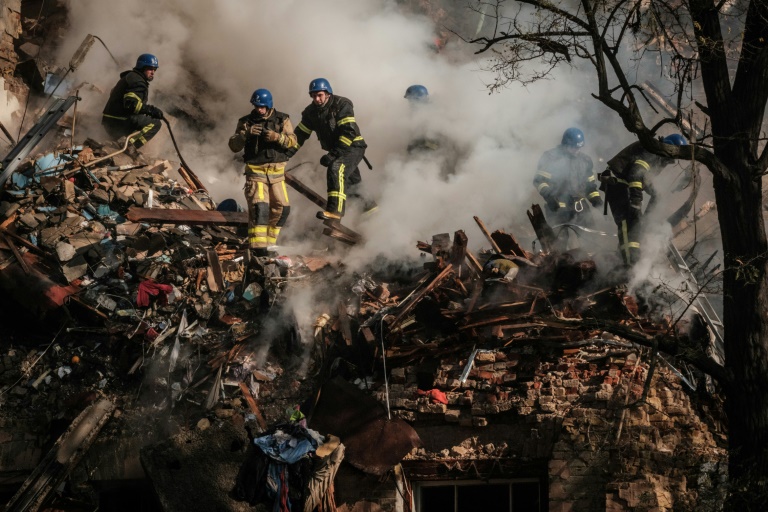
Ukraine warned Tuesday of an emerging “critical” risk to its power grid after President Volodymyr Zelensky said that repeated Russian bombardments had destroyed one-third of the country’s power facilities as winter approaches.

The warning came as Russian forces claimed to have retaken territory from Ukrainian troops in the eastern Kharkiv region, Moscow’s first announced capture of a village there since being nearly entirely pushed out of the region last month.

At the same time, Russian attacks rocked energy facilities in Kyiv and urban centres across the country, causing blackouts and disrupting water supplies, one day after the capital was bombarded with a swarm of suicide drones.

“The situation is critical now across the country. It’s necessary for the whole country to prepare for electricity, water and heating outages,” Kyrylo Tymoshenko, the deputy head of the Ukrainian president’s office, told Ukrainian television.

The strikes in the early hours of Tuesday hit Kyiv, Kharkiv in the east, Mykolaiv in the south and central regions of Dnipro and Zhytomyr, where officials said hospitals were running on backup generators.

But drones also bombarded Kyiv on Monday — the second in a row — leaving five dead, officials said, in what the presidency described as an attack of desperation after a string of battlefield losses.

Zelensky called the repeated targeting of energy infrastructure “another kind of Russian terrorist attacks”.

“Since October 10, 30 percent of Ukraine’s power stations have been destroyed, causing massive blackouts across the country,” the Ukrainian leader said on Twitter. 

– Hospitals on back-up power –

Many towns and cities in the Zhytomyr region, west of Kyiv, and parts of the city of Dnipro in central Ukraine were without electricity, while power was restored to the southern city of Mykolaiv after strikes overnight. 

“Now the city is cut off from electricity and water supplies. Hospitals are working on backup power,” the mayor of Zhytomyr, Sergiy Sukhomlyn, said in a statement online.

The national emergency services said that after 10 days of strikes on energy facilities, some 1,162 towns and villages in nine regions had been left without power and more than 70 people were killed and 290 injured.

Kyiv mayor Vitali Klitschko said three people had been killed in Tuesday’s strikes.

Zelensky earlier said the fresh wave of nationwide strikes — which he said had damaged a residential building and flower market in Mykolaiv — was a Russian attempt to “terrorise and kill civilians.”

– Kremlin denies Iran drone use –

Following the wave of kamikaze drone attacks against Kyiv on Monday, Foreign Minister Dmytro Kuleba demanded EU sanctions on Iran, accusing Tehran of providing Russia with drones.

But on Tuesday, he said Ukraine should cut diplomatic ties with Iran, citing the “death” and “destruction” caused by the drones.

The Kremlin said on Tuesday it had no knowledge of its army using Iranian drones in Ukraine.

“Russian tech is being used,” Kremlin spokesman Dmitry Peskov said, referring other questions to the defence ministry.

The defence ministry did however confirm strikes on energy facilities over the past 24 hours, saying it had used long-range and precision weapons.

Iran has denied exporting any weapons to either side, but the United States warned it would take action against companies and nations working with Tehran’s drone programme following the strikes in Kyiv.

Western officials however said it was “increasingly evident that Russia is pursuing a deliberate strategy of trying to destroy heating, electrical networks” and that Iranian drones were playing an “increasingly significant role” in the conflict.

Senior presidential aide Mykhaylo Podolyak meanwhile called for Russia to be excluded from the upcoming G20 summit.

With fighting ongoing across a sprawling frontline in east and southern Ukraine, its military said that over the past 24 hours it had shot down 38 Iranian-made Shahed-136 unmanned aerial vehicles.

Russia announced a rare battlefield victory Tuesday, in the eastern Kharkiv region, saying its forces had captured the village of Gorobiivka.

It was the first claim of victory since Ukrainian forces in September reclaimed huge swathes of the east in a string of embarrassing battlefield defeats.

Moscow’s forces have also been pushing towards Bakhmut in the eastern Donetsk region, and with the fight edging closer, locals’ allegiances are spilling out into the public.

One shopper, Yulia, said she believed Ukrainian forces bombed cities that were about to be captured by Russia — repeating a conspiracy theory popular on social media.

“I don’t understand why Ukraine is destroying cities,” said the 46-year-old, who declined to give her surname saying that she was afraid of reprisals for her views.

Separately on Tuesday, Russian investigators said initial indications suggest that the crash of a military plane into a residential building near Ukraine was due to a technical malfunction.

Investigators said they were questioning the pilots of the Sukhoi Su-34, who managed to parachute out of the plane before it crashed on Monday evening into the nine-storey building, engulfing it in flames.

Stock markets climb on bright US earnings and UK policy U-turns

Major global equities rose Tuesday, with sentiment soothed after a series of upbeat US earnings and Britain shredded its controversial budget.

Analysts pointed to better-than-expected reports from Goldman Sachs and Johnson & Johnson as a positive driver for stocks, along with shifting investor sentiment.

On Wall Street, the Dow Jones jumped two percent at the open after a day of strong trading in Asia and Europe, before paring back gains later in the morning.

Goldman Sachs reported a third-quarter update that topped analyst expectations on strong trading revenues.

The investment bank followed on from positive earnings news from the Bank of America on Monday, days after JPMorgan Chase and others also logged solid numbers.

“Better-than-expected US earnings reports sparked a rally on Wall Street with positive momentum reverberating across European equities,” Interactive Investor analyst Victoria Scholar told AFP.

“Risk appetite is picking up after a volatile week for markets, as corporate results look to be the main driver of price action today.”

US industrial production also picked up more than anticipated in September, according to official data Tuesday, bouncing back after a dip in August.

Analysts remain hopeful that an upbeat third-quarter results season could give a shot in the arm to markets which have been slammed this year on fears over inflation and Federal Reserve interest rate hikes.

But Craig Erlam, senior market analyst at OANDA, warned the upbeat investor sentiment might not last, saying there was a “strong feeling of a bear market rally about trading over the course of the last week.”

“From the post-US-inflation rebound to what has now been a strong start to the week — in part driven by the UK’s decision to no longer shoot itself in the foot — nothing about this screams sustainable.”

– UK turbulence –

Frankfurt stocks closed up one percent on Tuesday as a key survey showed German investor confidence climbed slightly in October, but it still held at a low level.

London gains were muted after the Bank of England poured cold water on a newspaper report that it could delay the sale of government bonds again to help maintain market stability.

A BoE spokesperson described the Financial Times story as “inaccurate”.

The British pound retreated slightly after jumping Monday above $1.14 as the UK government sensationally ripped up its controversial debt-fuelled budget.

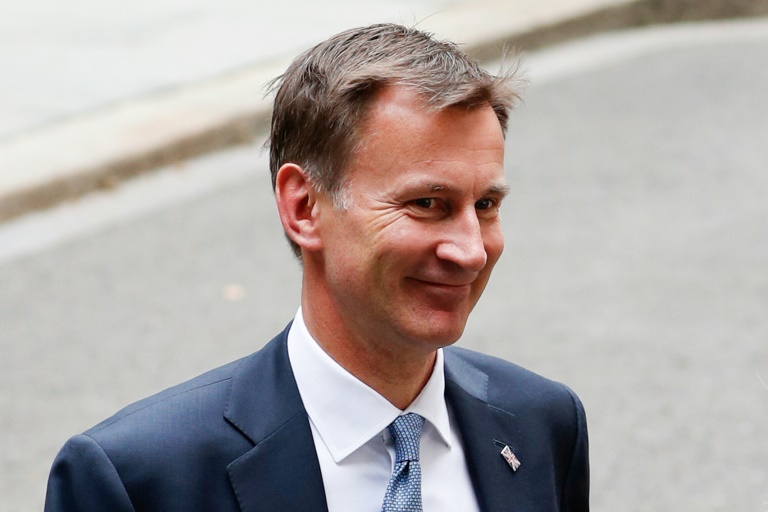
After a volatile few weeks during which the pound hit a record low, new finance minister Jeremy Hunt sought Monday to reassure investors as he scrapped tax cuts and warned of tough spending cuts.

Monday’s move, which dealt a blow to Prime Minister Liz Truss’s authority, sent sterling up as much as two percent at one point and the cost of government borrowing tumbled, while the FTSE 100 jumped.

“Investors continue to monitor the political and economic turbulence surrounding the UK,” noted XTB analyst Walid Koudmani.

Markets in China fluctuated a day after authorities delayed the release of third-quarter economic figures, which analysts said were likely to show the weakest growth since the pandemic owing to Covid-19 lockdowns.

The decision comes as the Communist Party holds a key gathering at which President Xi Jinping is expected to be handed a third term.

Oil prices slumped Tuesday in response on the expectation that the US will draw more barrels than expected from its strategic reserves heading into the winter season.

– Key figures around 1540 GMT –

London – FTSE 100: UP 0.2 percent at 6,936.74 points

Frankfurt – DAX: UP 0.9 percent at 12,765.61

Paris – CAC 40: UP 0.4 percent at 6,067.00

EURO STOXX 50: UP 0.6 percent at 3,463.83 

New York – Dow: UP 0.4 percent at 30,302.02

Tokyo – Nikkei 225: UP 1.4 percent at 27,156.14 (close)

Hong Kong – Hang Seng Index: UP 1.8 percent at 16,914.58 (close)

Shanghai – Composite: DOWN 0.1 percent at 3,080.96 (close)

Pound/dollar: DOWN at $1.1295 from $1.1358 on Monday

Dollar/yen: UP at  149.25 yen from 149.04 yen

Euro/dollar: DOWN at $0.9826 from $0.9841 

Euro/pound: UP at 86.99 pence from 86.64 pence

Brent North Sea crude: DOWN 2.73 percent at $89.12 per barrel

West Texas Intermediate: DOWN 3.45 percent at $81.58 per barrel

burs-rox/jmm

German cybersecurity chief sacked over alleged Russia ties

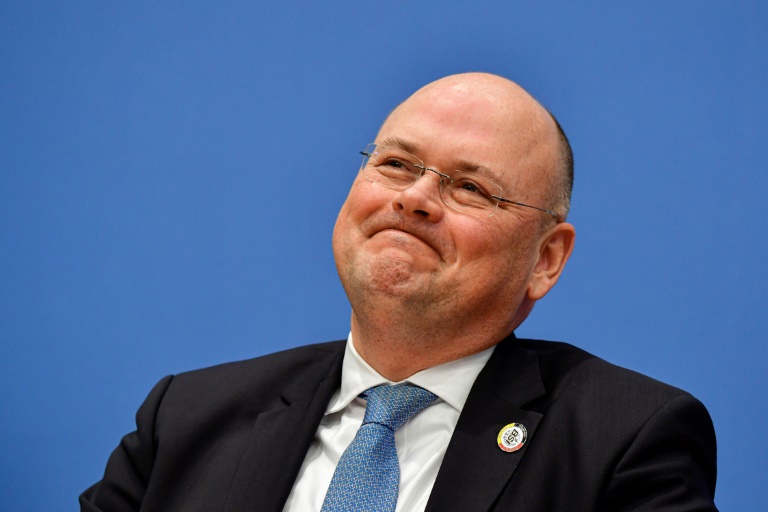
Germany’s cybersecurity chief was sacked on Tuesday after a TV satire show accused him of having ties to Russian intelligence services, with the country on high alert over potential sabotage activities by Moscow.

Arne Schoenbohm, head of the Federal Cyber Security Authority (BSI), had been at the centre of intense speculation since the popular show accused him in early October of contacts with Russia.

He has now been relieved of his duties “with immediate effect”, an interior ministry spokesman told AFP on Tuesday, citing “the allegations revealed and widely discussed in the media” as one of the reasons behind the move.

The allegations “have permanently damaged the necessary public trust” in Schoenbohm as head of the authority, the spokesman said. 

“This is all the more true in the current crisis situation regarding Russian hybrid warfare,” he added.

Schoenbohm was accused in the satire show on broadcaster ZDF of contacts with Russian secret services through an association he co-founded in 2012 known as the Cyber Security Council Germany.

One member of that association, Berlin cybersecurity company Protelion, reportedly operated under the name “Infotecs GmbH” until the end of March. 

The report said this was a subsidiary of Russian cybersecurity company OAO Infotecs, founded by a former employee of the Russian KGB intelligence service.

According to other German media reports, Schoenbohm had maintained contact with the Cyber Security Council Germany until recently and the interior ministry had on August 24 approved a request for him to give a speech to the association.

The interior ministry spokesman on Tuesday said all allegations against Schoenbohm would be “thoroughly and emphatically examined and subjected to a detailed evaluation”. 

– ‘Great annoyance’ –

The cybersecurity chief would be “presumed innocent” in the meantime, he said.

The Handelsblatt daily had reported that there was “great annoyance” within the government over the allegations.

A planned joint appearance by Schoenbohm and Interior Minister Nancy Faeser to present a cybersecurity report was cancelled last week. 

Schoenbohm told Spiegel on Tuesday that as he had not heard back over the allegations, he had himself sought disciplinary proceedings to clarify the issue.

He added that he did not know “what the ministry has checked and what are the concrete allegations against me.” 

Germany has in recent years repeatedly accused Russia of online espionage attempts.

The most high-profile incident blamed on Russian hackers to date was a cyberattack in 2015 that paralysed the computer network of the lower house of parliament, the Bundestag, forcing the entire institution offline for days while it was fixed.

Russia denies being behind such actions.

Tensions between Russia and Germany have only intensified since Moscow’s invasion of Ukraine.

The BSI has warned that companies, individuals and critical infrastructure are at risk of being hit by Russian cyberattacks.

Last week, the rail network in the north of the country was temporarily paralysed by what operator Deutsche Bahn called “sabotage”, with some officials pointing the finger at Russia.

Important communications cables were cut at two sites, forcing rail services to be halted for three hours and causing travel chaos for thousands of passengers.

Moscow is also suspected of being behind explosions last month that set off leaks in the Nord Stream 1 and 2 gas pipelines, which connect Russia to Germany.

German cybersecurity chief sacked over alleged Russia ties

Germany’s cybersecurity chief was sacked on Tuesday after a TV satire show accused him of having ties to Russian intelligence services, with the country on high alert over potential sabotage activities by Moscow.

Arne Schoenbohm, head of the Federal Cyber Security Authority (BSI), had been at the centre of intense speculation since the popular show accused him in early October of contacts with Russia.

He has now been relieved of his duties “with immediate effect”, an interior ministry spokesman told AFP on Tuesday, citing “the allegations revealed and widely discussed in the media” as one of the reasons behind the move.

The allegations “have permanently damaged the necessary public trust” in Schoenbohm as head of the authority, the spokesman said. 

“This is all the more true in the current crisis situation regarding Russian hybrid warfare,” he added.

Schoenbohm was accused in the satire show on broadcaster ZDF of contacts with Russian secret services through an association he co-founded in 2012 known as the Cyber Security Council Germany.

One member of that association, Berlin cybersecurity company Protelion, reportedly operated under the name “Infotecs GmbH” until the end of March. 

The report said this was a subsidiary of Russian cybersecurity company OAO Infotecs, founded by a former employee of the Russian KGB intelligence service.

According to other German media reports, Schoenbohm had maintained contact with the Cyber Security Council Germany until recently and the interior ministry had on August 24 approved a request for him to give a speech to the association.

The interior ministry spokesman on Tuesday said all allegations against Schoenbohm would be “thoroughly and emphatically examined and subjected to a detailed evaluation”. 

– ‘Great annoyance’ –

The cybersecurity chief would be “presumed innocent” in the meantime, he said.

The Handelsblatt daily had reported that there was “great annoyance” within the government over the allegations.

A planned joint appearance by Schoenbohm and Interior Minister Nancy Faeser to present a cybersecurity report was cancelled last week. 

Schoenbohm told Spiegel on Tuesday that as he had not heard back over the allegations, he had himself sought disciplinary proceedings to clarify the issue.

He added that he did not know “what the ministry has checked and what are the concrete allegations against me.” 

Germany has in recent years repeatedly accused Russia of online espionage attempts.

The most high-profile incident blamed on Russian hackers to date was a cyberattack in 2015 that paralysed the computer network of the lower house of parliament, the Bundestag, forcing the entire institution offline for days while it was fixed.

Russia denies being behind such actions.

Tensions between Russia and Germany have only intensified since Moscow’s invasion of Ukraine.

The BSI has warned that companies, individuals and critical infrastructure are at risk of being hit by Russian cyberattacks.

Last week, the rail network in the north of the country was temporarily paralysed by what operator Deutsche Bahn called “sabotage”, with some officials pointing the finger at Russia.

Important communications cables were cut at two sites, forcing rail services to be halted for three hours and causing travel chaos for thousands of passengers.

Moscow is also suspected of being behind explosions last month that set off leaks in the Nord Stream 1 and 2 gas pipelines, which connect Russia to Germany.

Close Bitnami banner
Bitnami