World

Nigeria floods toll has passed 600: government

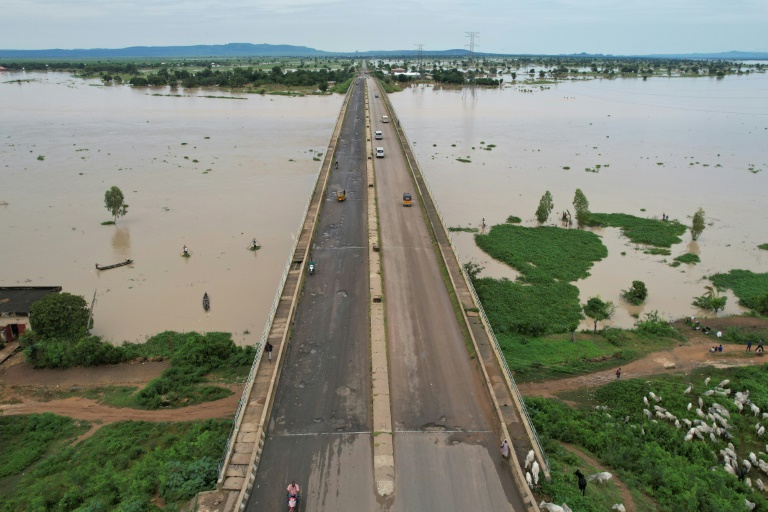
More than 600 people are now known to have perished in the worst floods in a decade in Nigeria, according to a new toll released Sunday.

The disaster had also forced more than 1.3 million from their homes, said a statement by Nigeria’s ministry of humanitarian affairs, released on Twitter.

“Unfortunately, over 603 lives have been lost as of today October 16, 2022,” said Humanitarian Affairs Minister Sadiya Umar Farouq.

The previous toll from last week stood at 500, but the numbers had risen in part because some state governments had not prepared for the floods, said the minister.

The flooding also completely destroyed more than 82,000 houses and nearly 110,000 hectares (272,000 acres) of farmland, said Umar Farouq.

While the rainy season usually begins around June, the rainfall had been particuarly heavy since August, said the National Emergency Management Agency (NEMA).

In 2012, 363 people died and more than 2.1 million were displaced by flooding. 

Sub-Saharan Africa is disproportionately affected by climate change and many of its economies are already struggling from ripple effects of the Russia-Ukraine war.

Rice producers have warned that the devastating floods could impact prices in the country of some 200 million people where rice imports are banned to stimulate local production.

The World Food Programme and the UN’s Food and Agriculture Organization said last month that Nigeria was among six countries facing a high risk of catastrophic levels of hunger.

Aston Martin showroom hit as UK vows action on climate protests

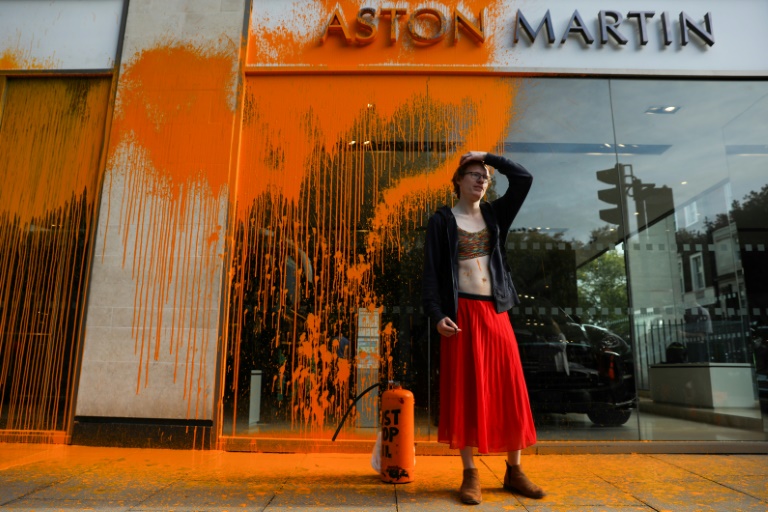
Climate activists on Sunday sprayed orange paint over an Aston Martin showroom in central London, as the government vowed new powers for police to halt an intensifying wave of “direct action” protests.

Members of the group Just Stop Oil also staged a sit-in protest on Park Lane where the sports carmaker’s store is located in an exclusive area of the British capital.

The action came after two Just Stop Oil activists hurled tomato soup over one of Vincent van Gogh’s “Sunflowers” paintings at London’s National Gallery on Friday.

Another spray-painting protest by the same group on Friday targeted the headquarters of London’s Metropolitan Police, who arrested 28 demonstrators.

Then on Saturday, Animal Rebellion protesters poured milk onto shop floors and displays at high-end retailers across Britain including Harrods in London, demanding the world end cattle farming.

Home Secretary Suella Braverman said she was introducing stronger legislation this week to counter citizen protests by groups such as Just Stop Oil and Extinction Rebellion.

Under the plan, the government would be able to apply for legal injunctions to outlaw such protests ahead of time, and make it easier for police to protect “essential” goods, services and infrastructure.

“I will not bend to protestors attempting to hold the British public to ransom,” the hardline Braverman said in a statement.

“This serious and dangerous disruption, let alone the vandalism, is not a freedom of expression, nor a human right. It must stop.” 

But outside the Aston Martin showroom, 19-year-old pregnant mother Chloe Thomas said she was fighting to protect the next generations of humanity.

“How do I explain to my daughter in the years to come where the animals went, where the culture went, where the beauty went, why there are no bees and why I can’t put food in her tummy?” she said.

Just Stop Oil has stepped up its campaign since the new UK government of Prime Minister Liz Truss vowed to allow new drilling for offshore fossil fuels, to counter a surge in energy prices triggered by Russia’s war in Ukraine.

Aston Martin showroom hit as UK vows action on climate protests

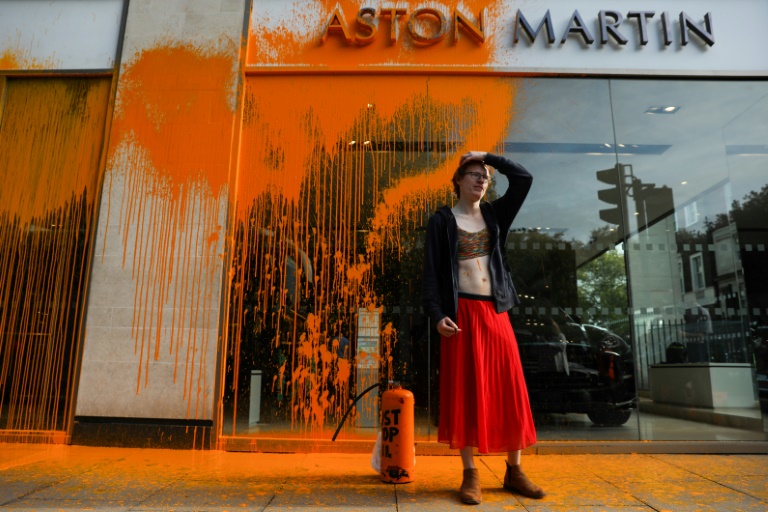
Climate activists on Sunday sprayed orange paint over an Aston Martin showroom in central London, as the government vowed new powers for police to halt an intensifying wave of “direct action” protests.

Members of the group Just Stop Oil also staged a sit-in protest on Park Lane where the sports carmaker’s store is located in an exclusive area of the British capital.

The action came after two Just Stop Oil activists hurled tomato soup over one of Vincent van Gogh’s “Sunflowers” paintings at London’s National Gallery on Friday.

Another spray-painting protest by the same group on Friday targeted the headquarters of London’s Metropolitan Police, who arrested 28 demonstrators.

Then on Saturday, Animal Rebellion protesters poured milk onto shop floors and displays at high-end retailers across Britain including Harrods in London, demanding the world end cattle farming.

Home Secretary Suella Braverman said she was introducing stronger legislation this week to counter citizen protests by groups such as Just Stop Oil and Extinction Rebellion.

Under the plan, the government would be able to apply for legal injunctions to outlaw such protests ahead of time, and make it easier for police to protect “essential” goods, services and infrastructure.

“I will not bend to protestors attempting to hold the British public to ransom,” the hardline Braverman said in a statement.

“This serious and dangerous disruption, let alone the vandalism, is not a freedom of expression, nor a human right. It must stop.” 

But outside the Aston Martin showroom, 19-year-old pregnant mother Chloe Thomas said she was fighting to protect the next generations of humanity.

“How do I explain to my daughter in the years to come where the animals went, where the culture went, where the beauty went, why there are no bees and why I can’t put food in her tummy?” she said.

Just Stop Oil has stepped up its campaign since the new UK government of Prime Minister Liz Truss vowed to allow new drilling for offshore fossil fuels, to counter a surge in energy prices triggered by Russia’s war in Ukraine.

Aston Martin showroom hit as UK vows action on climate protests

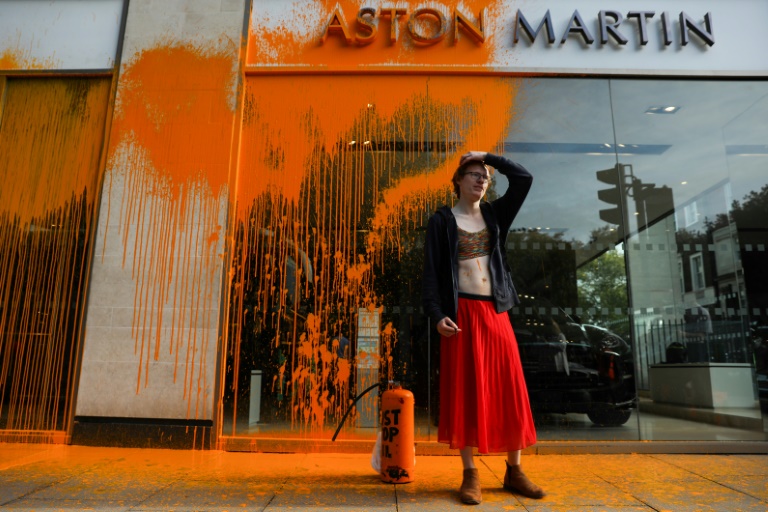
Climate activists on Sunday sprayed orange paint over an Aston Martin showroom in central London, as the government vowed new powers for police to halt an intensifying wave of “direct action” protests.

Members of the group Just Stop Oil also staged a sit-in protest on Park Lane where the sports carmaker’s store is located in an exclusive area of the British capital.

The action came after two Just Stop Oil activists hurled tomato soup over one of Vincent van Gogh’s “Sunflowers” paintings at London’s National Gallery on Friday.

Another spray-painting protest by the same group on Friday targeted the headquarters of London’s Metropolitan Police, who arrested 28 demonstrators.

Then on Saturday, Animal Rebellion protesters poured milk onto shop floors and displays at high-end retailers across Britain including Harrods in London, demanding the world end cattle farming.

Home Secretary Suella Braverman said she was introducing stronger legislation this week to counter citizen protests by groups such as Just Stop Oil and Extinction Rebellion.

Under the plan, the government would be able to apply for legal injunctions to outlaw such protests ahead of time, and make it easier for police to protect “essential” goods, services and infrastructure.

“I will not bend to protestors attempting to hold the British public to ransom,” the hardline Braverman said in a statement.

“This serious and dangerous disruption, let alone the vandalism, is not a freedom of expression, nor a human right. It must stop.” 

But outside the Aston Martin showroom, 19-year-old pregnant mother Chloe Thomas said she was fighting to protect the next generations of humanity.

“How do I explain to my daughter in the years to come where the animals went, where the culture went, where the beauty went, why there are no bees and why I can’t put food in her tummy?” she said.

Just Stop Oil has stepped up its campaign since the new UK government of Prime Minister Liz Truss vowed to allow new drilling for offshore fossil fuels, to counter a surge in energy prices triggered by Russia’s war in Ukraine.

At least four inmates killed in fire at notorious Iran prison

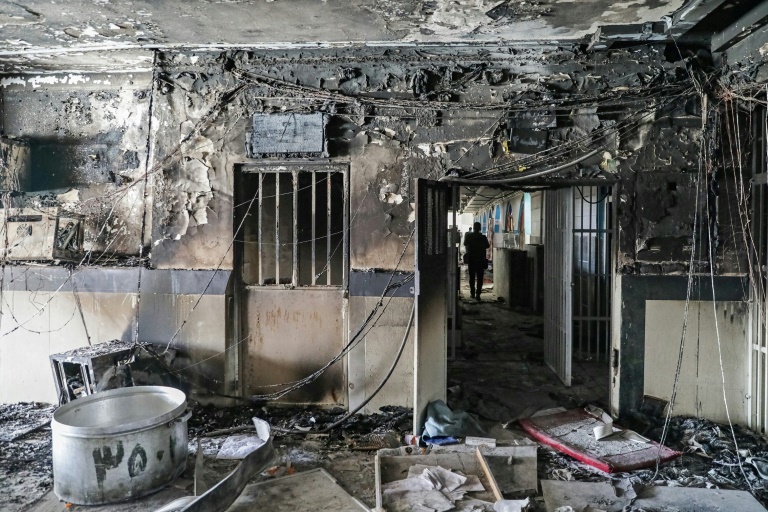
At least four Iranian inmates died in a fire in Tehran’s notorious Evin prison overnight, the judiciary said Sunday, further stoking tensions one month into protests sparked by the death of Mahsa Amini.

The Iranian authorities blamed the fire on “riots and clashes” among prisoners, but rights groups said they had little faith in the official version of events.

“Four prisoners died due to smoke inhalation caused by the fire, and 61 were injured,” the judiciary authority’s website Mizan Online reported.

Four others were in “serious condition”, it said, adding that the fire had been extinguished.

Prisoners’ relatives and rights groups voiced grave fears for the inmates, and said authorities had used tear gas at the facility.

Gunshots and explosions were heard during the blaze from inside the complex, illuminated by flames and smothered by smoke, in video footage posted on social media channels.

The fire came after four weeks of protests over the death of 22-year-old Amini, following her arrest for allegedly violating Iran’s strict dress code for women.

The wave of demonstrations has turned into a major anti-government movement in the Islamic republic, confronting its clerical leadership with one of its biggest challenges since the ousting of the shah in 1979.

Evin, infamous for the ill-treatment of political prisoners, also holds foreign detainees and thousands facing criminal charges.

Hundreds of those arrested during the recent demonstrations and in a crackdown on civil society have been sent there.

“We do not accept official explanations,” the Norway-based group Iran Human Rights (IHR), adding it had received reports that guards had sought to “incite” prisoners.

– ‘Arbitrarily detained’ –

Rights groups reported night-time protests in Tehran in solidarity with Evin detainees, and more demonstrations were held Sunday, including at Tehran University.

Iranian rights activist Atena Daemi, herself a long-time inmate of Evin, wrote on Twitter that in the early hours of Sunday several buses and ambulances were seen leaving the facility.

She said some prisoners in Ward 8, which houses political detainees, had been transferred to another jail.

IHR reported that inmates’ relatives gathered outside Evin on Sunday, seeking information about their loved ones.

Kazem Gharibabadi, deputy head of Iran’s judiciary, visited the prison and blamed “those incarcerated in Ward 7” for the unrest. He said the fire “did not spread to other wards”.

Citing a Tehran prosecutor, the official IRNA news agency said the clashes had “nothing to do with the recent unrest in the country”.

The four inmates who died had been convicted of robbery, Mizan said.

Evin prison holds French-Iranian academic Fariba Adelkhah and US citizen Siamak Namazi, whose family said he was taken back into custody days ago after a temporary release. Namazi’s US attorney Jared Genser said he had spoken to his family, and that he was unharmed.

France said it was following “with the greatest attention” the situation of French citizens “arbitrarily detained” in the facility.

– In ‘distress’ –

Australian academic Kylie Moore-Gilbert, who was held in Evin for most of her 800-plus days behind bars in Iran, told AFP she had heard that all the women political prisoners were safe.

But supporters of Austrian prisoner Massud Mossaheb said he was suffering from the effects of smoke inhalation and tear gas.

“He can barely speak… He is in big distress,” their Twitter account said. 

Hossein Sadeghi, the father of rights activist Arash Sadeghi who was arrested days ago, said he had spoken with his son. 

Amnesty International’s secretary general Agnes Callamard stressed that Iranian authorities “have the legal obligation to respect and protect the lives and wellbeing of all the prisoners”.

European Union foreign policy chief Josep Borrell said the bloc expected “maximum transparency on the situation” at Evin.

The EU has agreed to level new sanctions, a move expected to be endorsed by its foreign ministers Monday.

At least 108 people have been killed in the Amini protests, and at least 93 more died in separate clashes in Zahedan, Sistan-Baluchestan province, according to IHR.

Iranian President Ebrahim Raisi on Sunday accused US President Joe Biden of “inciting chaos” after he expressed support for protests, while the head of the Revolutionary Guards accused the West of a cultural “invasion” of Iranian schools.

“The riots are a path that has come from strategic think tanks in America and England which has spread to our classrooms,” the Guards’ Sepah News website quoted Major General Hossein Salami as saying.

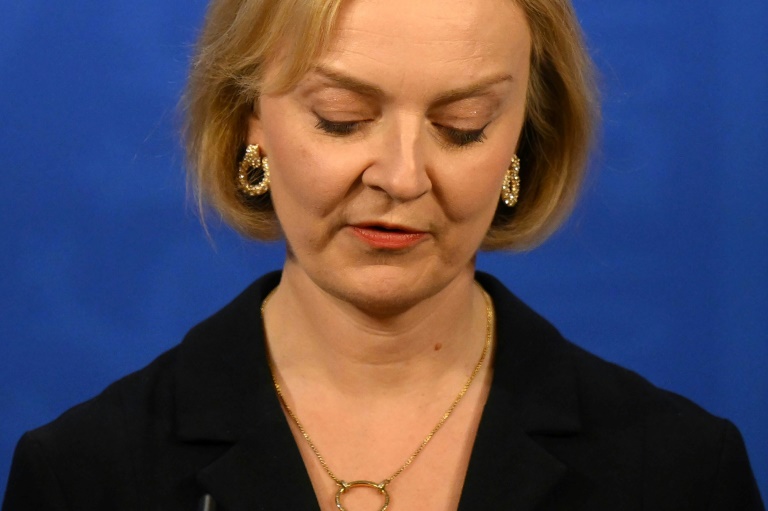
UK's embattled Truss told: 'The game is up'

Britain’s Prime Minister Liz Truss on Sunday vied to reboot her economic programme, but Conservative critics warned the party faces electoral oblivion under her crippled leadership.

With even US President Joe Biden joining in attacks on her libertarian platform, Truss admitted it had been a “wrench” to fire her friend Kwasi Kwarteng as chancellor of the exchequer on Friday.

But writing in the Sun on Sunday newspaper, she said: “We cannot pave the way to a low-tax, high-growth economy without maintaining the confidence of the markets in our commitment to sound money.” 

That confidence was jeopardised on September 23 when Kwarteng and Truss unveiled a right-wing programme, inspired by 1980s US president Ronald Reagan, of £45 billion ($50 billion) in tax cuts financed exclusively by higher debt.

Markets tanked in response, driving up borrowing costs for millions of Britons, and the Conservatives’ poll ratings have similarly slumped, leading to open warfare in the governing party mere weeks after Truss succeeded Boris Johnson.

“I think the game is up, and it’s now a question as to how the succession is managed,” senior Tory MP Crispin Blunt said on Channel 4.

Truss has been forced into a screeching policy U-turn which cost Kwarteng his job. But she depressed the bond markets even more with a painful press conference on Friday, and the government was nervously awaiting the resumption of trading on Monday.

Bidding to placate investors, Kwarteng’s replacement Jeremy Hunt is now warning that taxes may in fact have to rise, and is pressing for spending restraint by his cabinet colleagues even as Britons endure a cost-of-living crisis.

Hunt met the prime minister at her country retreat on Sunday to thrash out a new budget plan which he is due to deliver on October 31, effectively demolishing the “Trussonomics” programme that brought her to power.

– Who’s in charge? –

“It’s going to be very, very difficult, and I think we have to be honest with people about that,” Hunt told the BBC — prompting a warning from trade unions of concerted strike action if he enforces painful cuts.

Hunt said he was “not taking anything off the table”, but also defended Truss.

“She’s been willing to do that most difficult of things in politics, and that is to change tack,” he said, adding: “The prime minister’s in charge.” 

But many questioned that verdict. “Truss has become a pointless prime minister — an empty vessel with no policies or power,” the Sunday Times editorialised.

The Treasury declined to confirm reports that Hunt plans to delay a planned cut to the basic rate of income tax, removing yet another headline measure announced by the new government last month.

Up to 100 letters expressing no confidence in Truss have been submitted by Tory MPs, the Sunday Times and Sunday Express said.

Opponents were said to be coalescing around Truss’s defeated leadership rival Rishi Sunak and another one-time foe, Penny Mordaunt, for a possible “unity ticket” to rebuild the stricken Tories.

Defence Secretary Ben Wallace could be another compromise candidate for leader, the Sunday Mirror reported.

– ‘Libertarian jihadists’ –

Tory MP Robert Halfon, who supported Sunak, likened Truss and Kwarteng to “libertarian jihadists” who had indulged in “ultra free-market experiments”.

“Of course, colleagues are unhappy with what is going on, with haemorrhaging in the opinion polls,” he told Sky News. “It’s inevitable that colleagues are… talking to see what can be done about it.”

Fellow Tory Alicia Kearns, newly elected as chair of the powerful foreign affairs committee in the House of Commons, also questioned Truss’s prospects for survival.

“We’ve had questions around our moral competency (under Johnson),” she told Times Radio. “We’ve now got questions around our fiscal competency.”

But Johnson loyalists — still seething at Sunak’s perceived disloyalty towards the scandal-tainted former leader — warned against a coronation that cuts out Tory grassroots members.

Any new leader would face strong pressure to call an early general election, and the opposition Labour party has streaked far ahead in the polls.

Justin Welby, the Archbishop of Canterbury, echoed Biden’s critique of Truss’s “trickle-down” economics.

In an interview with the Guardian newspaper, the spiritual head of the Anglican Church said he was “deeply sceptical” that tax cuts for the rich would benefit anyone else.

French PM threatens to force workers back as energy strikes continue

France’s prime minister warned striking oil industry workers Sunday that the government might once again use its requisition powers to force workers back to their posts to ease fuel shortages.

Left-wing leader Jean-Luc Melenchon meanwhile backed calls by some trade unions for a general strike on Tuesday.

Elisabeth Borne told TF1 television that if the situation remained tense Monday, then the authorities would proceed with more requisitions like the ones enforced last week.

About 30 percent of service stations were experiencing supply problems for one type of fuel or another, she said. “That’s too many.”

She appealed to those TotalEnergeies workers still on strike not to “block the country with all the difficulties that that creates”.

After three weeks of industrial action, three out of seven of the country’s oil refineries and five major fuel depots (of around 200) are affected, the government said.

Geoffroy Roux de Bezieux, president of the Medef business lobby group, told Radio J that another week of fuel shortages might have a real impact on the economy.

“This isn’t a normal strike,” he added. “The right to strike has limits.”

Farmers are struggling to find the fuel they need to plant their winter crops on time, particularly in the north of the country.

– ‘General strike’ –

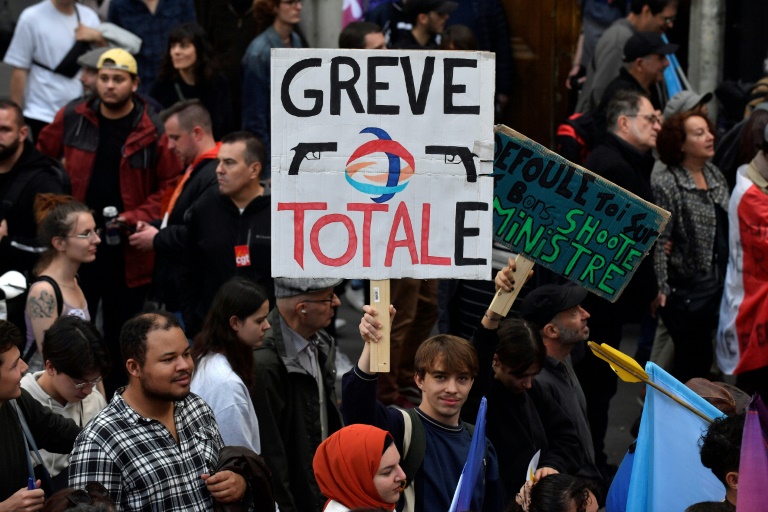
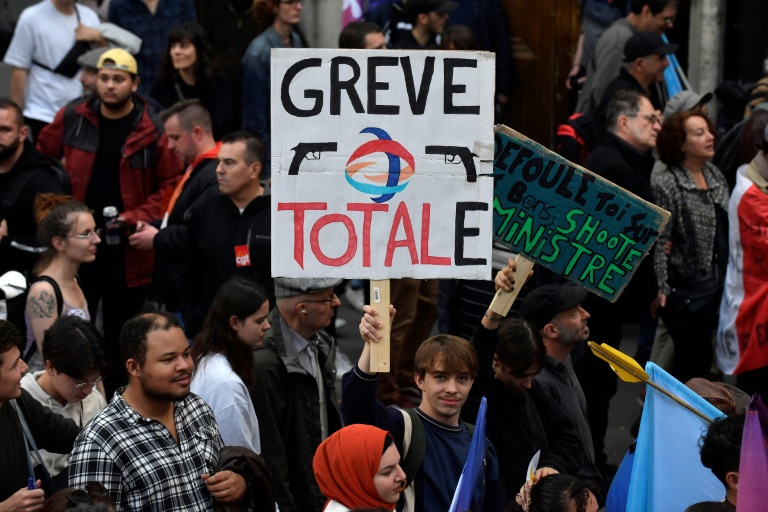
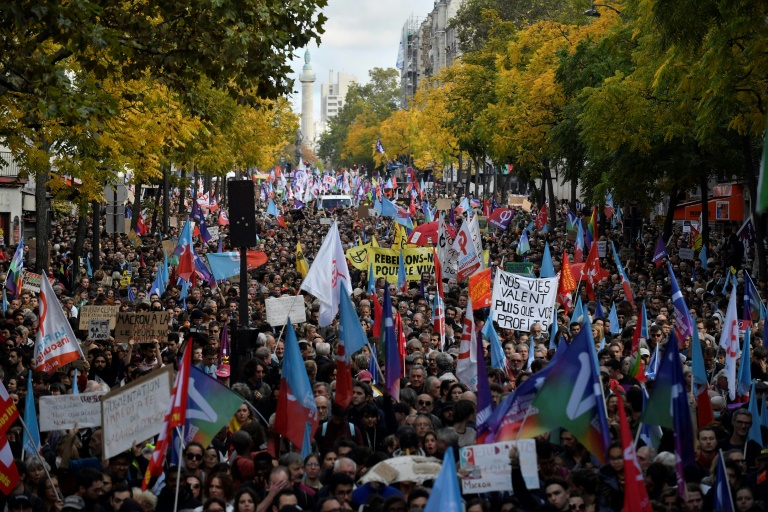
Borne’s warning came after tens of thousands marched through Paris Sunday to protest the rising cost of living, and government inaction over climate change.

The demonstration was called by the left-wing political opposition and led by Melenchon, head of the France Unbowed (LFI) party.

While most of the march passed peacefully, security forces did fire teargas and launched baton charges on several occasions after being pelted with objects. On the fringes of the march, masked men dressed in black ransacked a bank.

Some protesters wore yellow florescent vests, the symbol of the often violent anti-government protests in 2018 that shook the pro-business government of President Emmanuel Macron.

“The people at the top are out of touch,” said Christopher Savidan, an LFI activist out of work for five years.

“We pay taxes — we don’t know why. Everything is going down the drain.”

Opponents of Macron are hoping to build on the momentum created by the refineries dispute, which began at the end of September.

“We’re going to have a week the likes of which we don’t see very often,” Melenchon told the crowd.

“Everything is coming together. We are starting it with this march, which is an immense success.”

Melenchon also called for a “general strike” Tuesday. Some but not all unions have already declared the date a national day of strikes targetting road transport, trains and the public sector.  

– Huge profits –

The huge profits made by energy groups due to record fuel prices have led to some sympathy for employees pushing for higher wages. 

But some drivers struggling to find fuel for their vehicles are losing patience. Many companies have cut back on travel and deliveries, and even emergency service vehicles face shortages.

A poll by the BVA polling group released Friday suggested that only 37 percent of people supported the stoppages.

The strikes and protests are being closely watched by the government, which is aiming to pass a highly controversial change to the pensions system in the next few months. 

Macron, who won re-election in April, has pledged to push back the retirement age from 62, with the reform scheduled before the end of the winter.

“I’m really worried,” one ruling party MP told AFP last week on condition of anonymity. “We need to find a route between the need for reforms and the fact that people are riled up and tired.” 

TotalEnergies announced on Friday that it had reached a pay deal with the two largest unions representing staff at its refineries, raising hopes of an end to the standoff. 

But the hardline CGT union has refused to accept it, with its members continuing to maintain picket lines.

French PM threatens to force workers back as energy strikes continue

France’s prime minister warned striking oil industry workers Sunday that the government might once again use its requisition powers to force workers back to their posts to ease fuel shortages.

Left-wing leader Jean-Luc Melenchon meanwhile backed calls by some trade unions for a general strike on Tuesday.

Elisabeth Borne told TF1 television that if the situation remained tense Monday, then the authorities would proceed with more requisitions like the ones enforced last week.

About 30 percent of service stations were experiencing supply problems for one type of fuel or another, she said. “That’s too many.”

She appealed to those TotalEnergeies workers still on strike not to “block the country with all the difficulties that that creates”.

After three weeks of industrial action, three out of seven of the country’s oil refineries and five major fuel depots (of around 200) are affected, the government said.

Geoffroy Roux de Bezieux, president of the Medef business lobby group, told Radio J that another week of fuel shortages might have a real impact on the economy.

“This isn’t a normal strike,” he added. “The right to strike has limits.”

Farmers are struggling to find the fuel they need to plant their winter crops on time, particularly in the north of the country.

– ‘General strike’ –

Borne’s warning came after tens of thousands marched through Paris Sunday to protest the rising cost of living, and government inaction over climate change.

The demonstration was called by the left-wing political opposition and led by Melenchon, head of the France Unbowed (LFI) party.

While most of the march passed peacefully, security forces did fire teargas and launched baton charges on several occasions after being pelted with objects. On the fringes of the march, masked men dressed in black ransacked a bank.

Some protesters wore yellow florescent vests, the symbol of the often violent anti-government protests in 2018 that shook the pro-business government of President Emmanuel Macron.

“The people at the top are out of touch,” said Christopher Savidan, an LFI activist out of work for five years.

“We pay taxes — we don’t know why. Everything is going down the drain.”

Opponents of Macron are hoping to build on the momentum created by the refineries dispute, which began at the end of September.

“We’re going to have a week the likes of which we don’t see very often,” Melenchon told the crowd.

“Everything is coming together. We are starting it with this march, which is an immense success.”

Melenchon also called for a “general strike” Tuesday. Some but not all unions have already declared the date a national day of strikes targetting road transport, trains and the public sector.  

– Huge profits –

The huge profits made by energy groups due to record fuel prices have led to some sympathy for employees pushing for higher wages. 

But some drivers struggling to find fuel for their vehicles are losing patience. Many companies have cut back on travel and deliveries, and even emergency service vehicles face shortages.

A poll by the BVA polling group released Friday suggested that only 37 percent of people supported the stoppages.

The strikes and protests are being closely watched by the government, which is aiming to pass a highly controversial change to the pensions system in the next few months. 

Macron, who won re-election in April, has pledged to push back the retirement age from 62, with the reform scheduled before the end of the winter.

“I’m really worried,” one ruling party MP told AFP last week on condition of anonymity. “We need to find a route between the need for reforms and the fact that people are riled up and tired.” 

TotalEnergies announced on Friday that it had reached a pay deal with the two largest unions representing staff at its refineries, raising hopes of an end to the standoff. 

But the hardline CGT union has refused to accept it, with its members continuing to maintain picket lines.

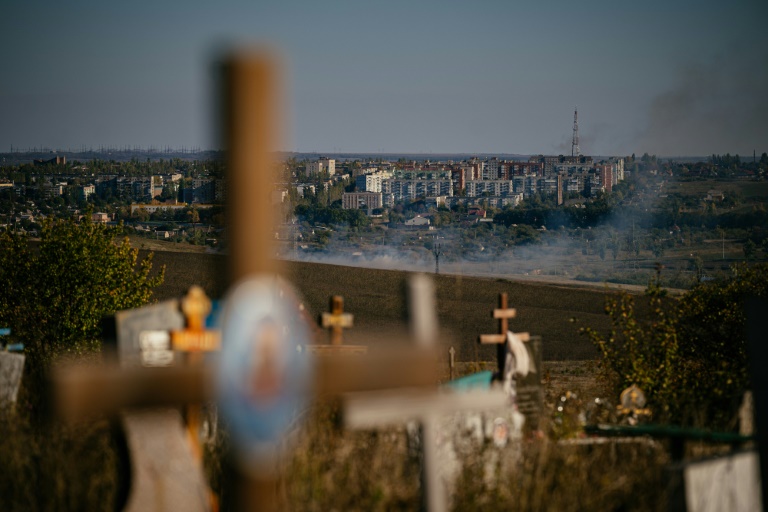
Under approaching Russian fire in Bakhmut, eastern Ukraine

Days are spent under a hail of shells, and night brings no respite for Ukrainian soldiers as enemy forces draw ever closer in Bakhmut, one of the last towns where Russian troops are still advancing. 

The metallic boom of shelling echoes across the hills surrounding the small town, home to 70,000 people before the war.

Russia has been falling back in its offensive — but in Bakhmut, unlike across most of the front line, Ukrainians are on the defensive.

They face the “most difficult” challenges, President Volodymyr Zelensky said this weekend.

Ukrainian troops still control the northern and western parts of the city, AFP journalists saw on Saturday.

Metal crosses and blocks of concrete mark the Ukrainian front line, dubbed “point zero”. No one is allowed past.

Around it, in the “grey zone”, Russia is on the offensive. 

Pro-Russian separatist forces have pressed ahead east and south of Bakhmut, relying on their base in the city of Donetsk about 100 kilometres (62 miles) away. 

On Thursday, they said they recaptured two neighbouring villages, Opytine and Ivangrad. 

– Close combat –

The retaking of the two villages raised fears that Russian forces, including Wagner paramilitary units, may have infiltrated the eastern part of the city, according to a British intelligence note. 

On the ground, Ukrainian soldiers told AFP there was now close combat with members of pro-Russian forces.

Enemy troops “start when night falls. They send their reconnaissance units around 6 pm,” said one soldier who uses the nom de guerre “Poliak”. 

In a bitter tone of voice, the 50-year-old from the 93rd brigade said inexperienced, “single use” soldiers are sent into the line of fire to “divert” attention from more experienced units carrying out sabotage. 

“Between then and 5 am, we get about seven or eight (diversion) attacks like that,” he explained.

Poliak recently suffered a minor shrapnel injury and returned exhausted from the most intense of the fighting.  

After four sleepless nights, the former truck driver said he experiences “hallucinations” from the stress and fatigue. 

One evening, his unit opened fire, thinking they could see a Russian commando through night-vision goggles. 

Early in the morning, they realised they had been shooting at a pile of logs.

The unit has since been given some rest. Of its 13 men, five were injured, and two never came back. 

– Lost purpose –

Every building in the Ukrainian-controlled centre of Bakhmut bears the marks of two months of intense combat.

Windows of the buildings still standing have been smashed, and rooves have been ripped off.

Civilians live in their basements, taking great risks as they search for food, water, fuel, fresh air, or power from communal generators. 

There is no running water in Bakhmut, and electricity was completely cut off ten days ago.

Miraculously, the phone network is holding up. 

People stock up on food at the market, where a few items are laid out on wooden planks. 

An 80-year-old woman stood in a state of shock in the streets, holding a pipe for her wooden stove. 

“We cannot even bury people anymore,” she said.

“My sister has been under the rubble (after a strike) overnight on October 12-13. No one can come get her body. I just wander about, without any purpose. I do not know where to go,” the former beekeeper said. 

“My bees are somewhere in the forest, left to fend for themselves. And we are left fending for ourselves too,” she said, bursting into tears.

Protesters march in Paris as French refinery strikes continue

Three weeks into a refinery strike that has caused fuel shortages across the country, tens of thousands of protesters marched in Paris on Sunday, adding to a growing picture of defiance and anger about inflation.

The demonstration against the rising cost of living on Sunday was called by the left-wing political opposition and led by the head of the France Unbowed (LFI) party, Jean-Luc Melenchon.

Security forces fired teargas and launched baton charges on several occasions after they were pelted with objects, while several shops and at least one bank were targeted by suspected anarchists.

Some protesters wore yellow florescent vests, the symbol of often violent anti-government protests in 2018 which shook the pro-business centrist government of President Emmanuel Macron.

Opponents of Macron are hoping to build on the momentum created by the refinery standoff which began at the end of September.

“We’re going to have a week the likes of which we don’t see very often,” Melenchon said Sunday while speaking on a truck in the middle of the crowd. 

“Everything is coming together. We are starting it with this march, which is an immense success.”

Several French unions, but not all, have announced a national day of strikes on Tuesday that is expected to affect road transport, trains and the public sector.  

Organisers claimed 140,000 people attended Sunday’s march, but police put the figure at 30,000. 

The strikes and protests are being closely watched by the government which is aiming to pass a highly controversial change to the pensions system in the next few months. 

Macron, who won re-election in April, has pledged to push back the retirement age from 62, with the reform scheduled before the end of the winter.

“I’m really worried,” one ruling party MP told AFP last week on condition of anonymity. “We need to find a route between the need for reforms and the fact that people are riled up and tired.” 

– ‘Unacceptable’ –

Four of France’s seven refineries — all belonging to Paris-based energy group TotalEnergies — remained blocked on Sunday.

The French company announced on Friday that it had reached a pay deal with the two largest unions representing staff at its refineries, raising hopes of an end to the standoff. 

But the hardline CGT union has refused to accept it, with its members continuing to maintain picket lines.

Budget Minister Gabriel Attal denounced the continuation of the strike on Sunday as “unacceptable”, while business lobby group Medef said “150 people” were “taking the country hostage.”

“Of course there’s a right to strike, but at some point the country needs to be able to work,” Attal told French media.

Staff at two other refineries owned by the US group Esso-ExxonMobil returned to work at the end of last week, but operations there will need at least a fortnight to return to normal, the company said.

Around a third of petrol stations across the country have supply problems, meaning drivers are often waiting hours to refuel.

Many companies have cut back on travel and deliveries, while even emergency service vehicles face shortages.

The huge profits made by energy groups due to record fuel prices have led to some sympathy for employees pushing for higher wages. 

But one poll by the BVA polling group released Friday suggested that only 37 percent of people supported the stoppages.

Sunday’s protest march through Paris was called by Melenchon’s party and backed by its coalition allies — the Greens, Socialists and Communists.

Recent Nobel literature laureate Annie Ernaux and another 60 figures from the arts and public life had also called for people to join the march in a joint letter.

Close Bitnami banner
Bitnami