World

Major flooding in Crete kills two

Two people were killed after torrential rain brought major flooding to the Greek island of Crete, firefighters said on Sunday.

Rain started to fall on Saturday morning in the southern Greek island, a popular holiday destination, hitting the Heraklion region particularly hard.

Greek firefighters said the body of a 49-year-old woman was found in the sea on Sunday, raising the death toll to two from the floods.

On Saturday, a man in his 50s was found dead after he was trapped in his car as torrential rains began.

The two individuals were going to Heraklion for work, Greek public television ERT reported.

A second missing individual was found alive on Saturday evening.

The rains forced the evacuation of several homes and unleashed extensive damage in seaside villages, where streets became rivers carrying away everything in their path, local media reported.

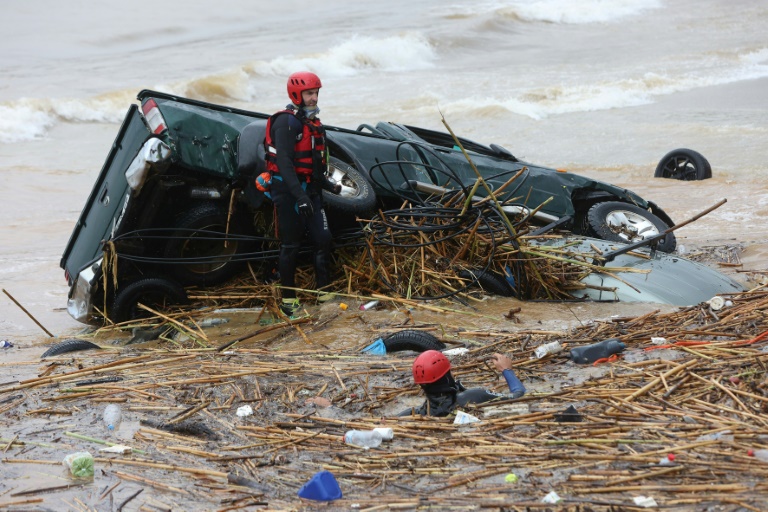
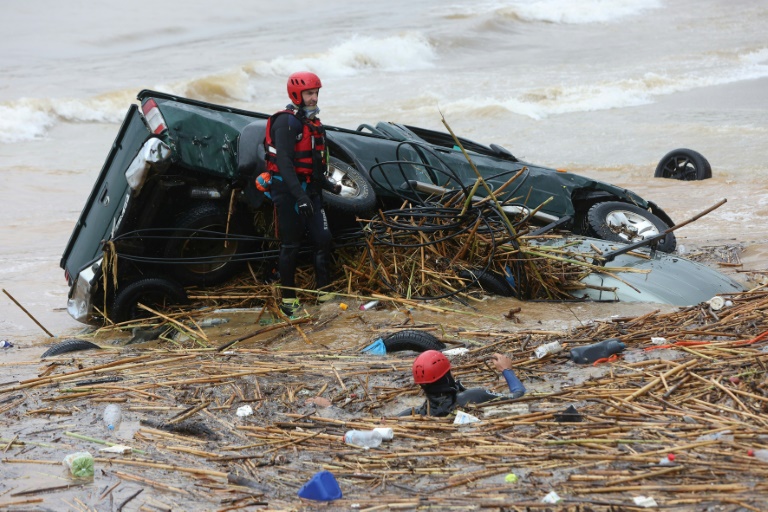
The flash floods pushed several cars into the sea along the beach of the seaside resort of Agia Pelagia, with some almost completely submerged in the water surrounded by debris. 

The beach was covered in scrap including plastic bottles and toys, next to straw umbrellas.

The flooding also damaged more than 15 shops, mainly fine restaurants, in Agia Pelagia, popular with wealthy diners.

The Civil Defence department said it was mobilised and asked all citizens to be vigilant on Sunday in Crete and the surrounding islands of Rhodes, Karpathos, Kastellorizo and Kasos. 

Major flooding in Crete kills two

Two people were killed after torrential rain brought major flooding to the Greek island of Crete, firefighters said on Sunday.

Rain started to fall on Saturday morning in the southern Greek island, a popular holiday destination, hitting the Heraklion region particularly hard.

Greek firefighters said the body of a 49-year-old woman was found in the sea on Sunday, raising the death toll to two from the floods.

On Saturday, a man in his 50s was found dead after he was trapped in his car as torrential rains began.

The two individuals were going to Heraklion for work, Greek public television ERT reported.

A second missing individual was found alive on Saturday evening.

The rains forced the evacuation of several homes and unleashed extensive damage in seaside villages, where streets became rivers carrying away everything in their path, local media reported.

The flash floods pushed several cars into the sea along the beach of the seaside resort of Agia Pelagia, with some almost completely submerged in the water surrounded by debris. 

The beach was covered in scrap including plastic bottles and toys, next to straw umbrellas.

The flooding also damaged more than 15 shops, mainly fine restaurants, in Agia Pelagia, popular with wealthy diners.

The Civil Defence department said it was mobilised and asked all citizens to be vigilant on Sunday in Crete and the surrounding islands of Rhodes, Karpathos, Kastellorizo and Kasos. 

Key moments from Xi's address to China's Communist Party Congress

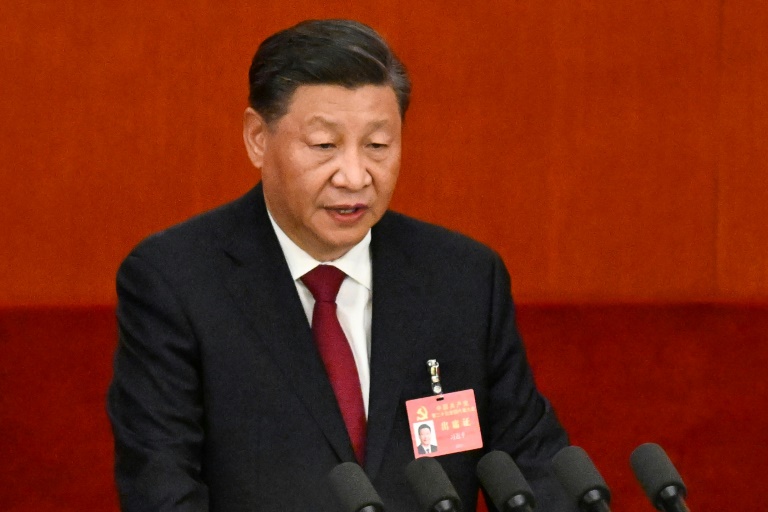
President Xi Jinping kicked off China’s five-yearly Communist Party Congress on Sunday with a wide-ranging speech defending Beijing’s zero-Covid approach, hailing its anti-graft efforts and reasserting its ambition to absorb Taiwan by force if necessary.

The speech gave Xi an opportunity to tout his government’s achievements to the conclave’s roughly 2,300 delegates, ahead of being handed an expected third term in power at the end of the week.

AFP gives a rundown of key takeaways from Xi’s opening address:

– ‘Critical moment’ –

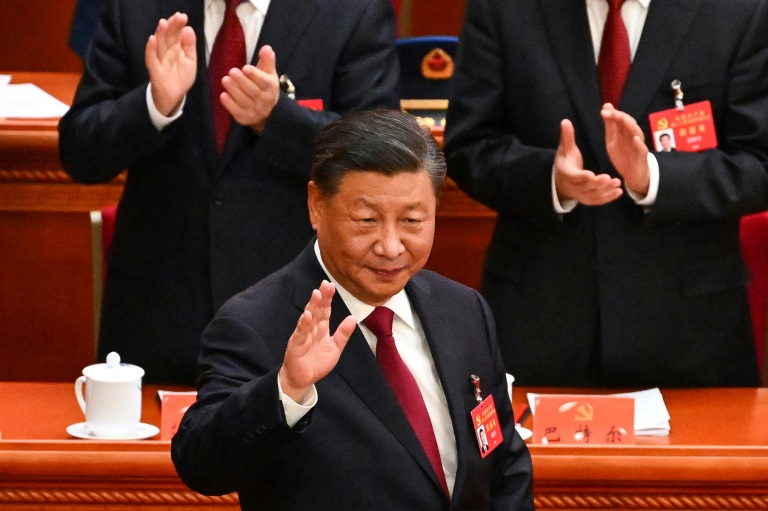
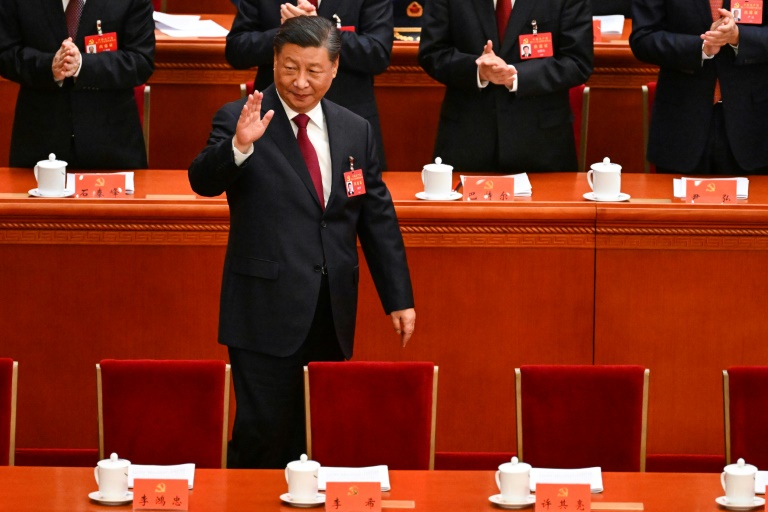
Xi took the stage at Beijing’s Great Hall of the People to thunderous applause, beginning his speech by hailing the Communist Party’s rule and noting that the gathering came at a crucial time.

“The 20th National Congress of the Communist Party of China is a very important congress convened at a critical moment,” Xi said.

– Putting ‘lives first’ –

After weathering months of criticism over the effects of his country’s strict zero-Covid policy, Xi said China had put “the people and their lives first” when dealing with the pandemic.

He said China had “protected people’s safety and health to the highest degree and achieved significant positive results in coordinating epidemic prevention and control with social and economic development”.

Xi gave no sign that the rigid policy — which has forced millions into lockdowns over just handfuls of cases as the rest of the world learns to live with the virus — would relent anytime soon. 

– Hong Kong and Taiwan –

China’s increasing assertiveness in the Taiwan Strait, as well as its moves to snuff out dissent in Hong Kong following pro-democracy protests in 2019, have drawn pointed critiques from Western governments.

But Xi on Sunday hailed the end of what he described as the “chaos” in Hong Kong, while condemning “external forces” interfering in self-ruled Taiwan, which China claims as its own.

“The situation in Hong Kong has achieved a major transition from chaos to governance,” he said, going on to pledge a “major struggle against separatism and interference” in Taiwan.

He later added that “the Taiwan issue… must be resolved by Chinese people alone”. 

“We… will never commit to abandoning the use of force, and reserve the option to take all necessary measures,” Xi said in remarks greeted by thunderous applause.

– Anti-graft drive –

Xi told delegates that his long-running crackdown on corruption had put an end to “serious latent dangers” within the Communist Party, military and the state.

“The fight against corruption has won an overwhelming victory and has been comprehensively consolidated, eliminating serious latent dangers within the party, the state and the military,” he said, referencing a campaign critics say has been used to curb internal dissent.

– Climate fight –

The Chinese president also vowed that Beijing was committed to the global fight against climate change.

China will “actively participate in global governance on climate change”, Xi told delegates, committing to carbon emissions reduction while promising to “strengthen the clean and efficient use of coal”.

Despite vowing to reduce coal use from 2026 as part of a broad set of climate promises, Beijing has stepped up spending on the fossil fuel in the face of extreme weather, a domestic energy crunch and rising global fuel prices — raising concerns its policies may hinder the fight against climate change.

– ‘Cold War mentality’ –

Xi said Beijing opposed a “Cold War mentality” in international diplomacy, but made no mention of frayed relations with the United States.

“China… resolutely opposes all forms of hegemony and power politics, opposes the Cold War mentality, opposes interfering in other countries’ domestic politics, opposes double standards,” he said, claiming Beijing “will never seek hegemony and will never engage in expansion”.

– Things left unsaid –

While the Chinese leader’s speech referenced the fraught international climate, he notably made no mention of Russia’s invasion of Ukraine or the major ripple effects the conflict has had on the global economy.

He also made no reference to the situation in China’s western region of Xinjiang, where Beijing stands accused of widespread human rights abuses and detaining over a million Uyghur and other Muslim minorities in re-education camps.

Nor did his speech touch on the unprecedented crisis in China’s real estate sector, where cash-strapped, debt-laden developers have seen sales plummet and confidence dashed in the housing market.

Xi hails China's rise, demands unity at Congress

President Xi Jinping hailed China’s rise as a global power and demanded unity around his leadership on Sunday, launching a Communist Party Congress that is set to rubber stamp his bid to rule for a historic third term.

In an opening address to 2,300 delegates gathered at the Great Hall of the People, Xi promoted and defended a range of signature policies — including zero-Covid and his anti-corruption drive that has taken down rivals in the party.

“Unity is strength, and victory requires unity,” Xi said after walking onstage to a thunderous reception from the hand-picked attendees who will vote during the week-long Congress on the party leadership for the next five years.

The president — whose 10-year rule has seen the country become a global superpower — said “China’s international influence, appeal and power to shape the world has significantly increased”.

During his 100-minute “work report” on the past five years, Xi also focused on two of China’s most sensitive security and sovereignty issues in relation to Hong Kong, after democracy protests were crushed there, and on the self-ruled island of Taiwan.

He lauded Hong Kong’s transition from “chaos to governance”, while his vow to “never commit to abandoning the use of force” on the self-ruled island of Taiwan drew rapturous applause.

– Zero-Covid –

Xi celebrated the party’s continued efforts to eradicate Covid — which are placing heavy curbs on people’s lives and is hammering the nation’s economy — as a major achievement. 

He insisted the approach had “protected people’s safety and health to the highest degree”.

He also highlighted as a success his graft crackdown, which has seen thousands of people jailed and critics have said has been used to crush dissent and opposition to his rule.

Xi said the anti-corruption campaign had eliminated “serious latent dangers” within the Communist Party, the military and the state.

“The fight against corruption has won an overwhelming victory and has been comprehensively consolidated,” he said.

In a speech that mostly focused on domestic issues, Xi also told the delegates that China would “actively participate in global governance on climate change”.

Xi also reiterated that China opposed a “Cold War mentality” in international diplomacy, but made no mention of frayed relations with the United States.

Xi also did not reference the Ukraine war.

– Stability –

There were no policy announcements in the address, which was largely a review of the current state of play, and analysts said Xi wanted to project stability. 

“This is a very turbulent time with the Covid crisis, economic downturn and tense international situation, especially with the US,” said Alfred L. Chan, a Xi biographer and professor based in Canada. 

“Caution, rather than dramatic change, is more prudent.”

Should everything go to plan for Xi, the 69-year-old will be endorsed as the party’s general secretary after the week-long meeting ends, cementing his position as China’s most powerful leader since Mao Zedong.

Xi and the party’s other top brass are likely to be unveiled on October 23, the day after the Congress closes.

If picked as party leader for another five-year term as expected, he is almost certain to be elected president at the annual meeting of China’s National People’s Congress in March.

In the highly choreographed, mostly closed-door conclave this week, the delegates will pick members of the party’s roughly 200-member Central Committee, which in turn selects the 25-person Politburo and its all-powerful Standing Committee — the country’s highest leadership body.

– Heavy security –

A heavy police presence was in place around Beijing early Sunday as authorities prepared for the Congress. 

Participants navigated a string of security checks before entering the hall, where a giant hammer-and-sickle emblem hung over the stage on which top leaders are due to be seated.

“Long live the great, glorious and correct Chinese Communist Party,” blared one of the bright red banners adorning the hall.

In the background, authorities were working to extinguish any form of public dissent.

In the lead-up to the Congress, China’s internet censors removed virtually all references to reports of a rare protest in Beijing that involved banners denouncing Xi and the country’s Covid policies.

Video footage and photos shared on social media on Thursday appeared to show a protester draping two hand-painted banners on the side of a bridge with slogans criticising the Communist Party’s policies.

It's Xi's party at China's historic 20th Congress

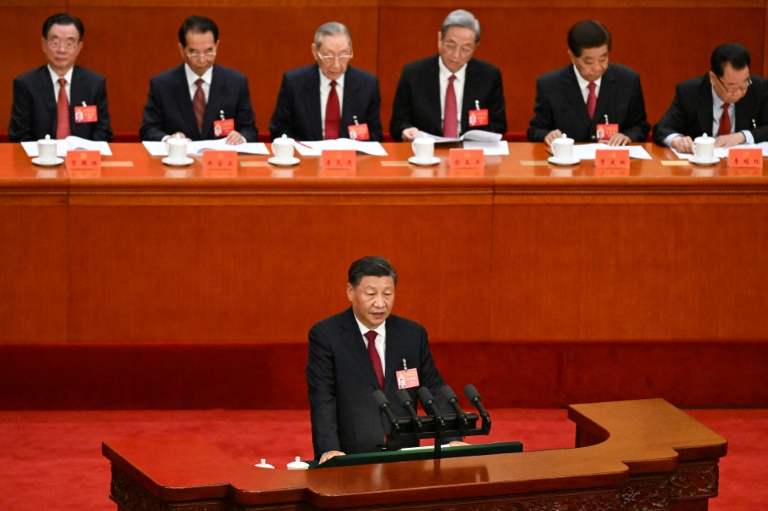
Rapturous applause greeted Chinese President Xi Jinping as he took the stage Sunday at the start of a carefully choreographed Communist Party Congress expected to confirm him as the country’s most powerful leader since Mao Zedong.

Around 2,300 delegates gathered in Beijing’s imposing Great Hall of the People, bedecked in the party’s signature red and gold with banners bearing slogans hailing the “great, glorious and correct Chinese Communist Party”.

Xi’s opening speech came after a minute’s silence for deceased party heroes, such as Mao and his successor Deng Xiaoping, and a live military band’s rendition of the national anthem.

Beneath a giant hammer-and-sickle emblem, he spoke for around an hour and a half, presenting his scorecard of the government’s work under his tenure and setting out his vision for his precedent-breaking third term.

Attendees diligently scribbled notes, with the occasional flash of colour from those in military attire or the traditional dress of one of China’s ethnic minority groups punctuating a sea of monochrome suits. 

Among more unusual delegates were the first Chinese woman to spacewalk, astronaut Wang Yaping, and Olympic hero speed skater Wu Dajing, wearing his national tracksuit. 

In line with strict health protocols, all those attending were masked, apart from the front row of top-ranked guests. 

These included Xi’s predecessor Hu Jintao, grey-haired and looking frail, though Hu’s predecessor Jiang Zemin did not appear to be in attendance. 

Also present was Zhang Gaoli, a former vice premier accused by tennis star Peng Shuai of “forcing” her into sex, before she retracted her allegations after disappearing from public view for three weeks.

– ‘He is the core’ –

The Congress is a display of party unity and strength, with carefully vetted delegates drawn from all of China’s provinces.

It is also a show of loyalty to Xi personally, with the 69-year-old expected to secure a third term as Communist Party general secretary, throwing out leader succession norms that have prevailed since the 1990s. 

Guangxi delegate He Xiangyin told AFP she fully supported that move. 

“As long as he (works) for the happiness of the people, and continues to improve our quality of life, we will all support him,” she said. “He’s the core of what we do.”

Asked whether there were worries that there would be no one suitable to take over after Xi, Jiangsu delegate Li Yinjiang was dismissive. 

“Our party will surely train someone properly for the role. Each generation passes the torch to the next,” he said. 

During the speech, thunderous clapping greeted Xi’s mention of perceived successes, ranging from stamping out Covid-19 outbreaks to quelling unrest in Hong Kong. 

The longest and loudest applause came for his comments on Taiwan, as he stated: “Reunification of the motherland must be achieved and will be achieved.”

Xi made no direct mention of the northwestern region of Xinjiang, where Western countries have accused China of widespread human rights abuses against the country’s Muslim minorities, primarily the Uyghurs.

“We in Xinjiang live such happy lives, because our great party is leading us… As a Uyghur person, I am extremely thankful that I can live here in China,” Rehema Awuqi, from the party’s Xinjiang delegation, told AFP after the speech. 

In the week leading up to the event, Beijing has been spruced up with banners, exhibitions and flower arrangements extolling the party’s virtues and Xi’s political philosophy, and urging onlookers to “delightedly welcome” the Congress.

A heavy security presence was in place in the capital, with police standing sentry at major intersections and an increased number of personnel deployed on pedestrian bridges around the city.

The mostly closed-door conclave is taking place under China’s strict zero-Covid policy, with journalists and other attendees holed up from Friday in a virus-secure bubble with mandatory mask-wearing and daily PCR tests.

Changing climate claims railways, houses and beaches in California

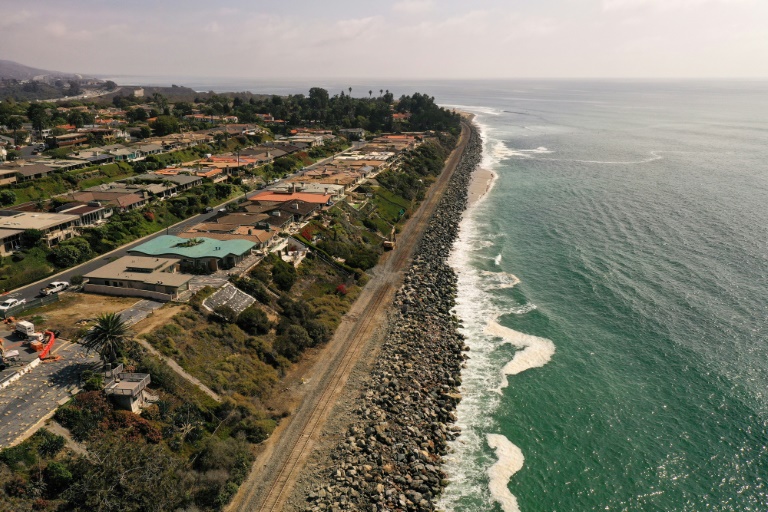
Steve Lang can see catastrophic erosion worsened by climate change happening in real time along one of the world’s most scenic railroad lines, where the sea is swallowing homes, tracks and California’s beautiful beaches.

“Every day I come here and watch this, and it makes me want to cry,” the 68-year-old tells AFP on rail tracks he crosses to go surfing.

Powerful waves wash in from the Pacific over the rails where the “Pacific Surfliner” runs, ferrying sightseers through the stunning coastal landscapes of southern California.

Not long ago, the railway was cushioned by hundreds of feet (tens of meters) of golden sand. But violent southern swells have washed that sand away.

With the beach gone, there was nothing to protect the rails from the fury of Tropical Storm Kay as it lashed the coast in September, eating away at the land on which they stood.

The track, which carries 8.3 million passengers annually between San Diego and San Luis Obispo, is now closed for emergency work. 

– Climate change – 

In the luxury Cyprus Shore settlement, an enclave of about a hundred plush villas that was once home to former president Richard Nixon, residents look on uneasily.

Without the beach to protect it, the hillside on which it is built is being eaten away and multi-million dollar homes are sliding towards the sea.

The cliffside parking lot is collapsing and two villas with cracked walls are now officially uninhabitable.

“These homes were valued at minimum $10 million each,” says Lang.

“We’ve been trying to raise the alert for years, but we don’t get much traction.”

The tragedy of the encroaching waters is not limited to San Clemente, says acting mayor Chris Duncan, but a problem for the whole state.

“This area here in Cyprus Shore… is a microcosm,” he says.

“The entire California coast is threatened by climate change and threatened by coastal erosion.”

Erosion is a natural phenomenon that has helped shape our continents over millennia.

But scientists say it is being speeded up by the warming of the planet; exacerbated by rising sea levels brought about by melting ice caps and glaciers, and by the more powerful waves that warmer oceans hold.

Humanity’s unchecked burning of fossil fuels since the industrial revolution has pushed average global temperatures up by 1.2 degrees celsius. They are expected to continue rising.

– ‘Lost battle’ – 

By 2050, between $8 billion and $10 billion of infrastructure could be underwater in California, and other construction valued at $6 billion to $10 billion will be in a high-tide hazard zone, according to a 2019 study released by California’s state legislature.

In San Clemente, local transport authorities are trying to stabilize the shifting tracks.

Every day, tons of rocks are dumped to reinforce the seawall and protect them, in a $12 million project expected to last more than six weeks.

But “it’s a losing battle,” Duncan sighs. 

The line was closed in September 2021 to add 18,000 tons of rock, and that didn’t solve the problem.

“While the rock might temporarily stabilize the slope, it causes exponential sand loss,” he says.

“Because now when the waves hit, it doesn’t hit a soft beach. It hits a hard rock, bounces off, takes all other sand with it.”

Duncan wants federal money to build back the beaches.

“I’m talking about breakwaters, about living shorelines, about possibly groins where it might be appropriate.”

Some advocate a more radical solution to save the railway line.

“The best would be to move (the track) back away from the coast,” says Joseph Street, a geologist at the California Coastal Commission.

“But of course that’s obviously a big, big effort to do that, very expensive.”

And, he points out, it does nothing to protect the homes that are at risk behind the track.

– Retreat –

“A lot of our urban planners and decision makers have really dragged their feet on responding to this problem,” says Stefanie Sekich-Quinn, of Surfrider Foundation. 

The environmental NGO advocates moving the line away from the coast, an option put forth in a 2009 federal report.

California has a handful of such initiatives. On the same rail line, authorities in nearby San Diego announced this year a $300 million project to relocate a portion of tracks further inland.

But in San Clemente, that’s really a last resort, says Duncan.

“People are going to want officials like me to work to save our homes, to save our rail corridor, and not just give up,” he says.

Hounded at home, China's video game firms welcomed in Europe

China is investing billions in Europe’s video game industry, but analysts have warned that there could be trouble along the road unless regulators start to take stricter notice.

Europe is embroiled in long-running disputes with Beijing over trade, environment, education, raw materials, intellectual property — but so far video games are not part of the fight.

As Beijing tightens up on the video game industry at home, China’s tech giants are looking to make investments overseas — prompting concerns ranging from data security to limits on creative freedom.

“Europe has this idea that we will be able to separate strategic industries from non-strategic industries,” Antonia Hmaidi from the Mercator Institute think-tank told AFP.

“Video games for most policymakers will always go into the non-strategic pile.” 

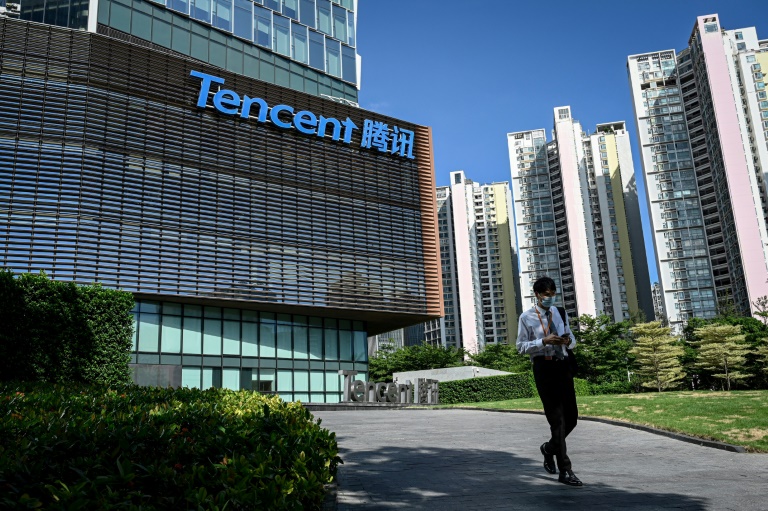
This has helped Tencent, the world’s largest games company by revenue, to buy into studios across Europe –- including the then world-record $8.6 billion deal for Finnish firm Supercell in 2016.

Chinese rival NetEase made its biggest foray into foreign gaming studios in August, snaffling French firm Quantic Dream — just days before Tencent upped its stake in Ubisoft, another French studio.

EU regulators only look at major investments with a pan-European dimension, and national regulators have shown no interest.

When Tencent bought British studio Sumo for $1.3 billion last year, the deal was scrutinised not by UK regulators but by their US counterparts. 

– ‘Cold’ China –

Chinese firms are increasingly seeking profits abroad, analysts say, because of stifling restrictions in their home market.

Tencent recorded its first-ever quarterly loss in August on the back of a wide-ranging crackdown on the tech sector.

The Chinese government has identified video games as a potential threat not only to state power but also to the wellbeing of citizens. 

Beijing introduced a nine-month ban on approval of new video games last year and now approves only a fraction of the number it once allowed on to the market. 

Game makers have had to scrub “politically harmful” content, and the state has tightly restricted the time youngsters can spend gaming. 

“Chinese companies in general are looking further afield given the climate of the domestic market,” said Louise Shorthouse of Ampere analysis. 

Several reports have suggested that Tencent is preparing to ramp up its overseas investments and could even begin to take control of smaller firms. 

Tencent is essentially “sitting on a load of cash”, said Kevin Shimota, a former marketing manager at the company and author of “The First Superapp”. 

“The Chinese market is cold right now so in terms of Tencent’s global strategy you’d expect it to be more aggressive,” he said.

But he stressed that the aim was unlikely to be direct takeovers or deeper control of foreign companies, rather Tencent might look at ways of developing games for audiences outside of China. 

– ‘More erratic’ –

Tencent is ubiquitous in China, an empire of games, social media and payment services largely funnelled through its WeChat app, which boasts more than one billion monthly users. 

Its leader, Pony Ma, has worked hard to keep himself out of the limelight –- and out of Beijing’s firing line. 

And the company is determined to present a humble face to the world. 

“Whether we are a minority investor or a majority shareholder, we do not exercise creative, editorial, management, or day-to-day control,” Tencent told AFP in a statement. 

Tencent’s business model has generally been to buy into foreign firms and publish their games for the Chinese market. 

As those foreign companies were unlikely to find any other way into China, they welcomed the investment and new revenue streams. 

NetEase is following the same model.

A blog from Quantic Dream announcing the takeover stressed that the French firm would maintain control over the “editorial line, the artistic direction of our projects and the management of the studio”. 

NetEase did not respond to AFP’s request for comment. 

Analyst Hmaidi said the hands-off approach was fine when business was booming — but the effects of an economic downturn or political upheaval were impossible to predict.

European regulators, she suggested, could benefit from a broader approach that questioned whether a single country — China or any other nation — should be allowed to dominate an entire industry.

“Having a sector dependent on China just in general is bad at the moment,” she said.

Hounded at home, China's video game firms welcomed in Europe

China is investing billions in Europe’s video game industry, but analysts have warned that there could be trouble along the road unless regulators start to take stricter notice.

Europe is embroiled in long-running disputes with Beijing over trade, environment, education, raw materials, intellectual property — but so far video games are not part of the fight.

As Beijing tightens up on the video game industry at home, China’s tech giants are looking to make investments overseas — prompting concerns ranging from data security to limits on creative freedom.

“Europe has this idea that we will be able to separate strategic industries from non-strategic industries,” Antonia Hmaidi from the Mercator Institute think-tank told AFP.

“Video games for most policymakers will always go into the non-strategic pile.” 

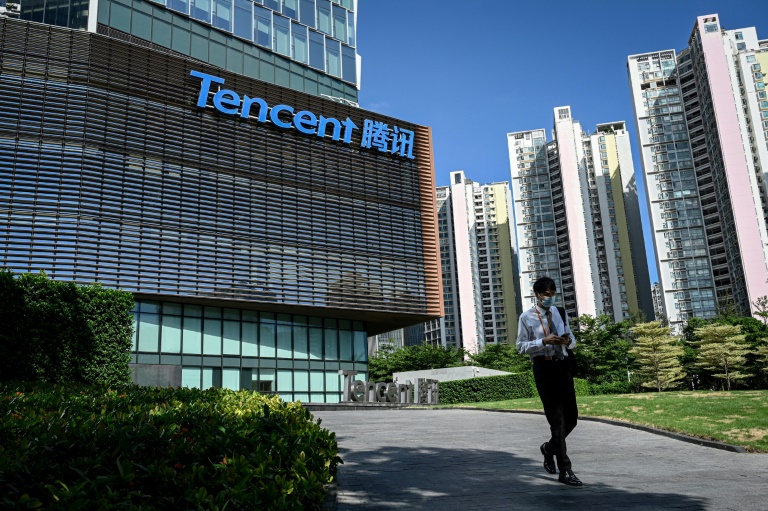
This has helped Tencent, the world’s largest games company by revenue, to buy into studios across Europe –- including the then world-record $8.6 billion deal for Finnish firm Supercell in 2016.

Chinese rival NetEase made its biggest foray into foreign gaming studios in August, snaffling French firm Quantic Dream — just days before Tencent upped its stake in Ubisoft, another French studio.

EU regulators only look at major investments with a pan-European dimension, and national regulators have shown no interest.

When Tencent bought British studio Sumo for $1.3 billion last year, the deal was scrutinised not by UK regulators but by their US counterparts. 

– ‘Cold’ China –

Chinese firms are increasingly seeking profits abroad, analysts say, because of stifling restrictions in their home market.

Tencent recorded its first-ever quarterly loss in August on the back of a wide-ranging crackdown on the tech sector.

The Chinese government has identified video games as a potential threat not only to state power but also to the wellbeing of citizens. 

Beijing introduced a nine-month ban on approval of new video games last year and now approves only a fraction of the number it once allowed on to the market. 

Game makers have had to scrub “politically harmful” content, and the state has tightly restricted the time youngsters can spend gaming. 

“Chinese companies in general are looking further afield given the climate of the domestic market,” said Louise Shorthouse of Ampere analysis. 

Several reports have suggested that Tencent is preparing to ramp up its overseas investments and could even begin to take control of smaller firms. 

Tencent is essentially “sitting on a load of cash”, said Kevin Shimota, a former marketing manager at the company and author of “The First Superapp”. 

“The Chinese market is cold right now so in terms of Tencent’s global strategy you’d expect it to be more aggressive,” he said.

But he stressed that the aim was unlikely to be direct takeovers or deeper control of foreign companies, rather Tencent might look at ways of developing games for audiences outside of China. 

– ‘More erratic’ –

Tencent is ubiquitous in China, an empire of games, social media and payment services largely funnelled through its WeChat app, which boasts more than one billion monthly users. 

Its leader, Pony Ma, has worked hard to keep himself out of the limelight –- and out of Beijing’s firing line. 

And the company is determined to present a humble face to the world. 

“Whether we are a minority investor or a majority shareholder, we do not exercise creative, editorial, management, or day-to-day control,” Tencent told AFP in a statement. 

Tencent’s business model has generally been to buy into foreign firms and publish their games for the Chinese market. 

As those foreign companies were unlikely to find any other way into China, they welcomed the investment and new revenue streams. 

NetEase is following the same model.

A blog from Quantic Dream announcing the takeover stressed that the French firm would maintain control over the “editorial line, the artistic direction of our projects and the management of the studio”. 

NetEase did not respond to AFP’s request for comment. 

Analyst Hmaidi said the hands-off approach was fine when business was booming — but the effects of an economic downturn or political upheaval were impossible to predict.

European regulators, she suggested, could benefit from a broader approach that questioned whether a single country — China or any other nation — should be allowed to dominate an entire industry.

“Having a sector dependent on China just in general is bad at the moment,” she said.

China's Communist Party Congress opens to endorse Xi's rule

Chinese President Xi Jinping on Sunday hailed his Communist Party’s zero Covid policies and graft crackdown as he opened a five-yearly Congress at which thousands of delegates were set to rubber stamp his bid to rule for a historic third term.

Xi walked onstage to thunderous applause from the roughly 2,300 hand-picked attendees who had gathered at Beijing’s Great Hall of the People for the event.

In an opening address lasting about 100 minutes, Xi promoted and defended a wide range of policies under his rule and said the Congress was taking place at a “critical moment” for the country. 

Xi celebrated the party’s continued efforts to eradicate Covid — which are placing heavy curbs on people’s lives and is hammering the nation’s economy — as a major achievement.

He said the approach had “protected people’s safety and health to the highest degree”.

Xi also highlighted as a success his graft crackdown, which has seen thousands of people jailed and critics have said has been used to crush dissent and opposition to his rule.

Xi said the anti-corruption campaign had eliminated “serious latent dangers” within the Communist Party, the military and the state.

“The fight against corruption has won an overwhelming victory and has been comprehensively consolidated,” he said.

Xi also focused on two of China’s most sensitive security and sovereignty issues at the start of speech — in relation to Hong Kong, after democracy protests were crushed there, and Taiwan. 

He lauded Hong Kong’s transition from “chaos to governance”, while his vow to “never commit to abandoning the use of force” on the self-ruled island of Taiwan drew rapturous applause.

In a speech that mostly focused on domestic issues, Xi told the delegates that China would “actively participate in global governance on climate change”.

Xi also reiterated that China opposed a “Cold War mentality” in international diplomacy, but made no mention of frayed relations with the United States.

“China… resolutely opposes all forms of hegemony and power politics, opposes the Cold War mentality, opposes interfering in other countries’ domestic politics, opposes double standards,” he said.

Xi did not reference the Ukraine war.

– Xi’s unprecedented rule –

Should everything go to plan for Xi, the 69-year-old will be endorsed as the party’s general secretary after the week-long meeting ends, cementing his position as China’s most powerful leader since Mao Zedong.

If picked as party leader for another five-year term as expected, Xi is almost certain to be elected president at the annual meeting of China’s National People’s Congress in March.

Xi and the party’s other top brass are likely to be unveiled on October 23, the day after the Congress closes.

In the highly choreographed, mostly closed-door conclave, the delegates will also pick members of the party’s roughly 200-member Central Committee, which in turn selects the 25-person Politburo and its all-powerful Standing Committee — the country’s highest leadership body.

A heavy police presence was in place around Beijing early Sunday as authorities prepared for the Congress. 

A fleet of buses whisked journalists and other attendees to a virtually empty Tiananmen Square and into the Great Hall of the People.

Participants navigated a string of security checks before entering the hall, where a giant hammer-and-sickle emblem hung over the stage on which top leaders are due to be seated.

“Long live the great, glorious and correct Chinese Communist Party,” blared one of the bright red banners adorning the hall.

In the lead-up to the Congress, China’s internet censors removed virtually all references to reports of a rare protest in Beijing that involved banners denouncing Xi and the country’s Covid policies.

Video footage and photos shared on social media on Thursday appeared to show a protester draping two hand-painted banners on the side of a bridge with slogans criticising the Communist Party’s policies.

Key moments from Xi's address to China's Communist Party Congress

President Xi Jinping kicked off China’s five-yearly Communist Party Congress on Sunday with a wide-ranging speech defending Beijing’s zero-Covid approach, hailing its anti-graft efforts and reasserting its ambition to absorb Taiwan, by force if necessary.

The speech gave Xi an opportunity to tout his government’s achievements to the conclave’s roughly 2,300 delegates, who are expected to hand him a historic third term in power at the end of the week.

Below, AFP gives a rundown of key takeaways from Xi’s opening address:

– ‘Critical moment’ –

Xi took the stage at Beijing’s Great Hall of the People to thunderous applause, beginning his speech by hailing the Communist Party’s rule and noting that the gathering came at a crucial time.

“The 20th National Congress of the Communist Party of China is a very important congress convened at a critical moment,” Xi said.

– Putting ‘lives first’ –

After weathering months of criticism over the effects of his country’s strict zero-Covid policy, Xi said China had put “the people and their lives first” when dealing with the pandemic.

He said China had “protected people’s safety and health to the highest degree and achieved significant positive results in coordinating epidemic prevention and control and social and economic development”.

– Hong Kong and Taiwan –

China’s increasing assertiveness in the Taiwan Strait, as well as its moves to snuff out dissent in Hong Kong following pro-democracy protests in 2019, have drawn pointed critiques from Western governments.

But Xi on Sunday hailed the end of what he described as the “chaos” in Hong Kong, while condemning “external forces” interfering in self-ruled Taiwan, which China claims as its own.

“The situation in Hong Kong has achieved a major transition from chaos to governance,” he said, going on to pledge a “major struggle against separatism and interference” in Taiwan.

He later added that “the Taiwan issue… must be resolved by Chinese people alone”. 

“We will adhere to striving for the prospect of a peaceful reunification with the greatest sincerity and greatest efforts, but will never commit to abandoning the use of force, and reserve the option to take all necessary measures,” Xi said.

– Anti-graft drive –

Xi told delegates that his long-running crackdown on corruption had put an end to “serious latent dangers” within the Communist Party and military.

“The fight against corruption has won an overwhelming victory and has been comprehensively consolidated, eliminating serious latent dangers within the party, the state and the military,” he said, referencing a campaign critics say has been used to curb internal dissent.

– Climate fight –

The Chinese president also vowed Sunday that Beijing was committed to the global fight against climate change.

China will “actively participate in global governance on climate change”, Xi told delegates, while promising to “strengthen the clean and efficient use of coal”.

– ‘Cold War mentality’ –

Xi said that Beijing opposed a “Cold War mentality” in international diplomacy, but made no mention of frayed relations with the United States.

“China… resolutely opposes all forms of hegemony and power politics, opposes the Cold War mentality, opposes interfering in other countries’ domestic politics, opposes double standards,” he said, claiming Beijing “will never seek hegemony and will never engage in expansion”.

Close Bitnami banner
Bitnami