World

Jeremy Hunt: softly-spoken survivor takes on hardest role

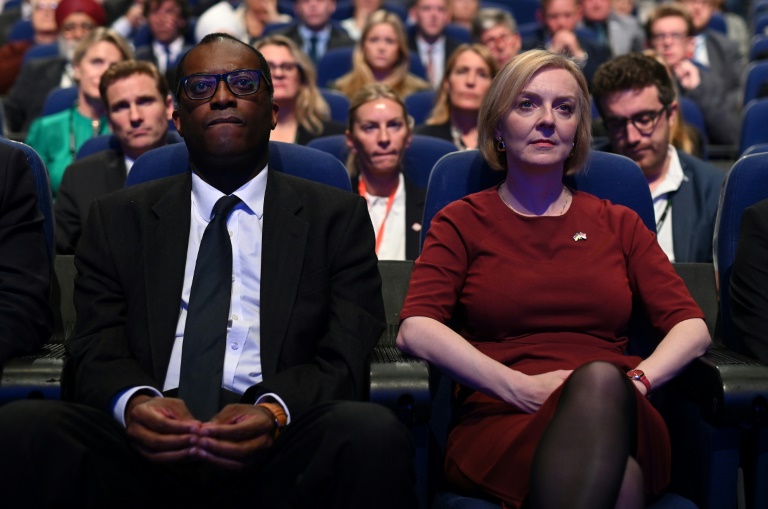
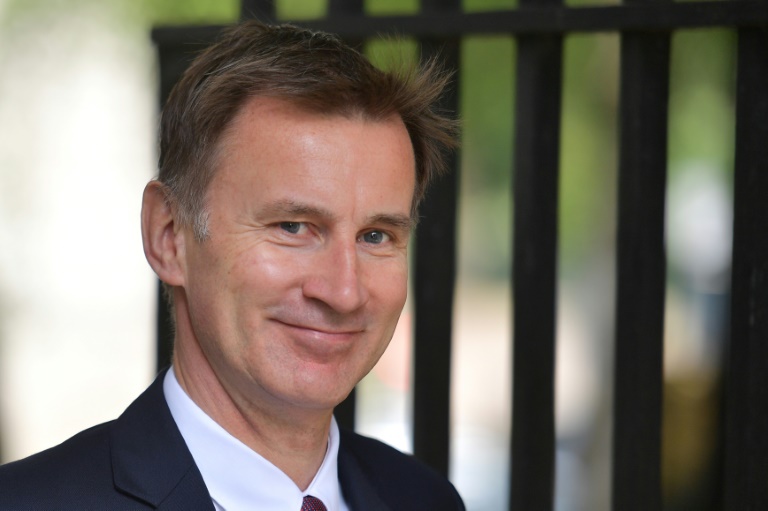
Newly appointed UK finance minister Jeremy Hunt is a mild-mannered political survivor who will require all of his considerable experience to calm an economy and government beset by chaos.

Hunt, 55, was health minister under David Cameron, and foreign minister under Theresa May, but found himself on the sidelines after Boris Johnson defeated him to become party leader in 2019.

After another failed leadership attempt this year following Johnson’s demise, Hunt suddenly finds himself thrust into the heart of the economic and political storm.

Under-pressure Prime Minister Liz Truss called him “one of the most experienced and widely respected government ministers and parliamentarians”.

“He will drive our mission to go for growth, including taking forward the supply-side reforms that our country needs,” she said on Friday.

Hunt hails from the centre of the Conservative Party, and his appointment indicates Truss wants to appease those MPs already plotting to remove her after her tax-cutting budget sparked market chaos.

He saw unbroken cabinet service from the Tory election victory in 2010 to his leadership defeat in 2019.

In government, he oversaw the London 2012 Olympics, was Britain’s longest-serving health secretary and proved a steady pair of hands as the UK’s top diplomat.

A supporter of remaining in the EU, Hunt was relegated to the backbenches when pro-Brexit Johnson took charge, although he was chair of the influential Health and Social Care Select Committee, which sought to hold the government to account during the pandemic.

However, he was also criticised for his pandemic planning while health chief.

As the culture, media and sport minister, he was under intense pressure to resign in 2012 over his contacts with Rupert Murdoch during a phone-hacking scandal involving the mogul’s media empire.

However, Hunt toughed it out and the judge-led inquiry into press ethics exonerated him of bias towards Murdoch’s News Corporation in its bid to take over broadcaster BSkyB.

– Surrey, Oxford and Japan –

Hunt was promoted to health secretary, one of the hardest jobs in cabinet at the time, as the government implemented long-lasting austerity measures in the wake of the 2008 economic crisis.

Hundreds of thousands of National Health Service workers went on strike in 2014 for the first time in 32 years following Hunt’s rejection of an across-the-board pay rise.

But he remained in the role as May took charge following the 2016 vote to leave the EU, only leaving when Johnson quit the Foreign Office in July 2018 over May’s Brexit policy.

As foreign secretary, Hunt set up the Yemen peace talks.

Born on November 1, 1966, Hunt is the eldest son of Admiral Nicholas Hunt, who was the fleet commander-in-chief from 1985 to 1987, one of the highest positions in the Royal Navy.

Hunt grew up in Godalming, southwest of London, and now represents the local South West Surrey constituency in parliament.

He was educated at Charterhouse, a prestigious private school.

Hunt went on to Oxford University, where he first became politically active as president of the Conservative Association, and was a contemporary of Johnson and Cameron.

He graduated with a first in philosophy, politics and economics.

– Big Rice –

After university, Hunt worked as a management consultant and later an English language teacher in Japan. He now speaks fluent Japanese.

Hunt had a successful career as an entrepreneur.

He set up Hotcourses, which puts prospective students in touch with universities and colleges.

Selling his stake made him a sterling multi-millionaire. He was elected to parliament in 2005.

He served as the Conservatives’ culture, media and sport spokesman in opposition then took over the brief as secretary of state when his party took office in 2010.

He is married to Lucia, who is from China. They have a son and two daughters.

They first met via Hotcourses as she was a Warwick University student recruiter. They married within a year in 2009.

She told The Mail on Sunday newspaper that he calls her “Precious” and she calls him “Big Rice” — based on her grandmother’s mispronunciation of Jeremy.

“He is kind, he is always generous, he cares about his family and he is very strong,” she said.

Shortly after being made foreign secretary, Hunt made perhaps his biggest blunder when he accidentally called his wife Japanese, on a visit to China.
Pound slides amid UK political drama, stocks soar

The pound fell Friday as under-fire British Prime Minister Liz Truss sacked her finance minister and made a dramatic policy U-turn, while equities rallied for a second day despite surging US inflation.

The yen held around three-decade dollar lows as rampant US consumer prices cemented expectations of more hefty Federal Reserve rate hikes.

Truss sacked Kwasi Kwarteng as finance minister as pressure mounted on her government following last month’s big spending, tax-slashing budget, which spooked markets.

The September 23 budget sent the pound tumbling to a record dollar low near parity with the greenback and bond yields surged, before stabilising thanks to interventions by the Bank of England. 

Sterling sank 1.2 percent to $1.1188 after Prime Minister Liz Truss dismissed Kwarteng. It reduced those losses as Truss appointed Jeremy Hunt as her new finance minister.

“The soap opera that is UK politics continues to dominate FX markets Friday,” said Stephen Innes, managing partner at SPI Asset Management.

Truss later announced a dramatic policy U-turn, stating the “need to act now to reassure the markets”, abandoning plans to eliminate an increase in corporation tax.

UK 10-year government bond yields fell further following the announcement, despite the Bank of England having insisted the costly market interventions would end Friday.

London’s FTSE 100 was 1.6 percent higher in afternoon trading. 

– ‘Astonishing rebound’ –

Stock markets continued to push higher Friday after rising on Thursday despite data showing strong inflationary pressures in the United States.

“Markets staged an astonishing rebound despite a hotter-than-expected inflation report in the United States,” said Interactive Investor analyst Richard Hunter on the broad-based gains.

“The reasons… were not immediately clear, although traders pointed to a technical rebound as investors unwound defensive positions which had been in place ahead of the inflation report.”

US CPI inflation data showed prices rose last month at a faster clip than expected, despite this year’s series of Fed interest rate hikes, which have fanned fears of a global recession.

The month-on-month reading came in double estimates, while core inflation — which strips out volatile energy and food prices — was also elevated.

The figures sparked a sharp plunge on Wall Street but the selling quickly reversed, and all three main indices finished the day with gains of more than two percent.

Wall Street opened higher on Friday as a number of top banks kicked off earnings season, JPMorgan Chase, Citigroup, Wells Fargo and U.S. Bancorp all beating analysts’ expectations. 

“None of those banks missed consensus earnings estimates, like investment bank Morgan Stanley did, yet their reports were laced with increased provisions for credit losses,” noted market analyst Patrick O’Hare at Briefing.com.

US retail sales came in flat in September, below analyst expectations of a 0.2 percent rise.

“The key takeaway from the report is that it is not adjusted for inflation, so the lackluster numbers for September suggest consumers were pulling back on spending activity in the face of high inflation,” O’Hare said.

– Key figures around 1330 GMT –

London – FTSE 100: UP 1.6 percent at 6,956.37 points

Frankfurt – DAX: UP 2.1 percent at 12,616.25

Paris – CAC 40: UP 2.4 percent at 6,021.88

EURO STOXX 50: UP 2.3 percent at 3,438.20

New York – Dow: UP 0.6 percent at 30,207.67

Tokyo – Nikkei 225: UP 3.3 percent at 27,090.76 (close)

Hong Kong – Hang Seng Index: UP 1.2 percent at 16,587.69 (close)

Shanghai – Composite: UP 1.8 percent at 3,071.99 (close)

Pound/dollar: DOWN at $1.1232 from $1.1326 Thursday

Dollar/yen: UP at 147.84 yen from 147.12 yen

Euro/dollar: DOWN at $0.9751 from $0.9776

Euro/pound: DOWN at 86.81 pence from 88.29 pence

Brent North Sea crude: DOWN 1.6 percent at $93.02 per barrel

West Texas Intermediate: DOWN 1.9 percent at $87.46 per barrel

burs-rl/jj

Climate activists throw soup over Van Gogh's 'Sunflowers' in London

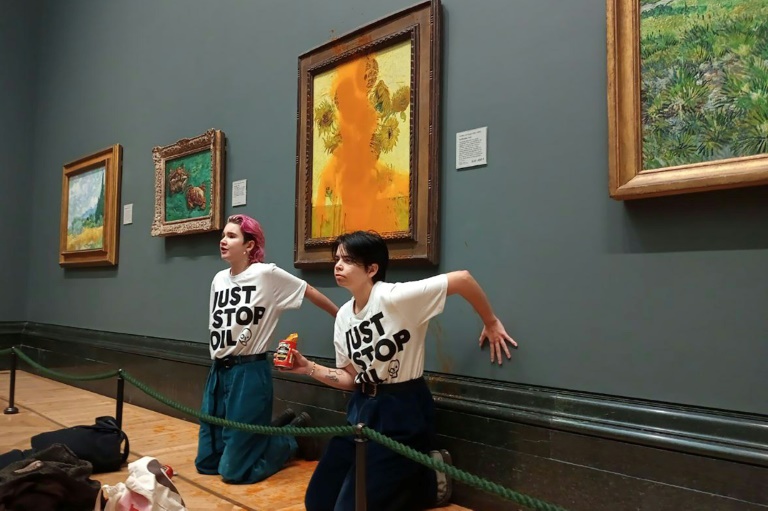
Environmental protesters threw tomato soup over Vincent van Gogh’s “Sunflowers” painting at the London’s National Gallery on Friday, in the latest “direct-action” stunt targeting works of art.

The gallery said the protesters caused “minor damage to the frame but the painting is unharmed”.

Protest group Just Stop Oil aims to end UK government approval for exploring, developing and producing fossil fuels, and has mounted a series of high-profile protests.

London’s Metropolitan Police said its officers arrested two protesters from the group for criminal damage and aggravated trespass after they “threw a substance over a painting” at the gallery on Trafalgar Square and glued themselves to a wall just after 11 am (1000 GMT).

Police said they had unglued the protesters and taken them to a central London police station.

The National Gallery said the two protesters “appeared to glue themselves to the wall adjacent to Van Gogh’s ‘Sunflowers'” and threw a “red substance” at the painting. The room was cleared of visitors and police were called, it added.

A video posted on Twitter by the Guardian newspaper’s environment correspondent Damien Gayle and retweeted by the eco-activism group shows two women wearing T-shirts bearing the slogan “Just Stop Oil” lobbing cans of soup at the iconic painting.

After glueing themselves to the wall, one of the activists shouts: “What is worth more, art or life?”

“Are you more concerned about the protection of a painting or the protection of our planet and people?” she asks.

In the video, someone can be heard yelling “oh my God” as the soup hits the canvas and another person shouts “Security!” while soup drips from the frame onto the floor.

Just Stop Oil said in a statement its activists threw two cans of Heinz Tomato soup over the painting to demand the UK government halt all new oil and gas projects.

It later tweeted that the protest’s message was “Choose life over art”.

“Human creativity and brilliance is on show in this gallery, yet our heritage is being destroyed by our government’s failure to act on the climate and cost of living crisis,” the group said.

The activist group said the painting has an estimated value of $84.2 million.

The National Gallery says on its website the signed painting from 1888 was acquired by the gallery in 1924. 

Van Gogh created seven versions of “Sunflowers” in total and five are on public display in museums and galleries across the world. 

One of those — the Van Gogh Museum in Amsterdam — said it was keeping “a close eye on developments” that might affect its own security measures.

Well-known Dutch ‘art detective’ Arthur Brand, dubbed the “Indiana Jones of the Art World” for recovering famous artworks, condemned the attack.

“There are hundreds of ways to achieve attention for the climate problems. This should not be one of them,” he said.

– ‘Cross a line’ –

The attack came a week after British Home Secretary Suella Braverman issued a threat to direct-action climate protesters, who she said were using “guerrilla tactics” to bring “chaos and misery” to the public.

“Whether you’re Just Stop Oil, Insulate Britain or Extinction Rebellion, you cross a line when you break the law — and that’s why we’ll keep putting you behind bars,” she said.

Just Stop Oil has previously targeted several other famous paintings with glue attacks.

In June, two activists glued their hands to the frame of van Gogh’s painting “Peach Trees in Blossom” at the Courtauld Gallery in London.

In July, supporters glued their hands to the frame of British painter John Constable’s “The Hay Wain” at the National Gallery.

They first taped over the canvas with a “reimagined version” of the bucolic scene, showing the landscape covered in pollution, dotted with wildfires and overflown by aircraft. 

In the same month, they glued themselves to a full-scale copy of Leonardo Da Vinci’s “The Last Supper” at the Royal Academy in London.

In recent days, Just Stop Oil has held multiple protests blocking major roads.

Met Police Commissioner Mark Rowley said of the protests that he was “frustrated so many officers are being taken away from tackling issues that matter most to communities”.

burs-am/har/gil

Putin, Baku criticise Macron for 'unacceptable' Karabakh remarks

Russian President Vladimir Putin and Azerbaijan on Friday slammed “unacceptable” comments from French leader Emmanuel Macron’s on the decades-long conflict between arch foes Baku and Yerevan.

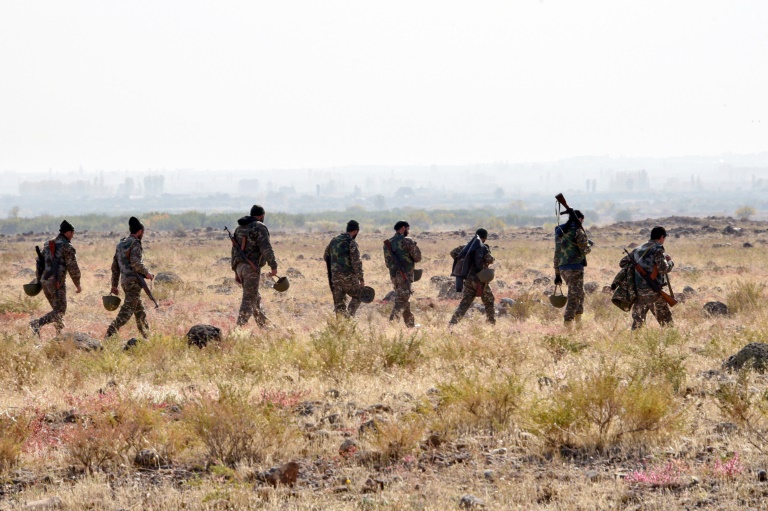
The Caucasus neighbours have fought two wars — in 2020 and in the 1990s — over Azerbaijan’s Armenian populated region of Nagorno-Karabakh.

Deadly clashes in September along the Armenian-Azerbaijani border have raised the fears of a fresh all-out conflict.

In comments to French television Wednesday, Macron accused Russia of “destabilising” and “seeking to create disorder” in the Caucasus.

The French leader’s remarks “show a lack of understanding of the course of the conflict,” Putin said during a meeting of leaders of Commonwealth of Independent States members in Kazakhstan. 

He added that Macron’s accusations “sounded incorrect” and were “unacceptable”.

“There will be an opportunity” to “discuss” this with Macron, Putin said as he also invited the leaders of Armenia and Azerbaijan to Russia for talks “at any time, in any place”.

“Russia has always sincerely sought to resolve any conflicts, including issues related to Karabakh,” he said. 

Macron also accused Azerbaijan of launching “a terrible war, with many deaths, atrocious scenes”.

More recently, “Azerbaijan has launched several offensives along the border (with Armenia). We have condemned them. We will not abandon Armenians,” he said.

Azerbaijani President Ilham Aliyev reacted angrily Friday, saying Macron “came up with insulting, unacceptable, false and provocative statements”.

“We do not see any further possibility for France to play any role in the process of normalisation of Azerbaijani-Armenian relations,” he said.

Armenian Prime Minister Nikol Pashinyan, who was also present at the meeting in Astana, said Baku was preparing “to annex more Armenian lands”.

– Future peace treaty –

On Friday Russia’s Foreign Minister Sergei Lavrov, Armenian counterpart Ararat Mirzoyan and Azerbaijan’s Jeyhun Bayramov met for talks in the Kazakh capital Astana.

Russian, Armenian, and Azerbaijani foreign ministries said the trio discussed joint efforts on normalising Azerbaijani-Armenian relations.

The meeting was held amid the growing Western engagement in the volatile Caucasus region, where Russia — distracted by its war in Ukraine — is visibly losing influence after decades of domination.

On Wednesday, Kremlin foreign policy advisor Yuri Ushakov criticised the “attempts of non-regional players — the EU and US — to wedge themselves in our work” on the region.

With Moscow increasingly isolated on the world stage following its February invasion of Ukraine, the US and the EU have taken a leading role in mediating the Armenia-Azerbaijan peace talks.

Last week, the European Union announced a “civilian EU mission” to Armenia to help delineate the borders with Azerbaijan.

Following a slew of diplomatic efforts from Brussels and Washington, Armenian and Azerbaijani foreign ministers met on October 3 in Geneva to begin drafting the text of a future peace treaty.

In September, more than 285 people were killed in border clashes at the Caucasus neighbours’ border, before a US-brokered truce ended the worst fighting since their 2020 war. 

That six-week war in autumn 2020 claimed the lives of more than 6,500 troops from both sides and ended with a Russian-brokered ceasefire.

Under the deal, Armenia ceded swathes of territory it had controlled for decades, and Moscow deployed about 2,000 Russian peacekeepers to oversee the fragile truce.

When the Soviet Union collapsed in 1991, ethnic Armenian separatists in Nagorno-Karabakh broke away from Azerbaijan. The ensuing conflict claimed around 30,000 lives.

'Shelf-life of a lettuce': Truss's nightmare on Downing Street

British Prime Minister Liz Truss has had the shortest of political honeymoons since taking over from Boris Johnson.

Taking out the 10 days of mourning for Queen Elizabeth II, Truss had only a week in control of events before her political programme imploded, leading to the sacking of her finance minister.

“That is the shelf-life of a lettuce,” The Economist magazine commented this week.

– September 5 –

Truss wins a vote by Conservative party members by 81,326, against 60,399 for Johnson’s former finance minister Rishi Sunak. 

As the new leader of the largest party in parliament, that makes her prime minister — with support from less than 0.2 percent of the UK electorate and only a minority of her own MPs.

The next day, she is confirmed as prime minister by the queen. 

Despite her weak mandate, Truss purges all Sunak supporters from her new cabinet, and installs the like-minded Kwasi Kwarteng as chancellor of the exchequer.

– September 8 –

Truss unveils a costly scheme to cap household energy bills, in response to Russia’s invasion of Ukraine. 

But the dramatic announcement is eclipsed by the queen’s death, which suspends all government business for 10 days.

– September 23 –

Kwarteng announces a “mini-budget” which details the price of the energy scheme -– £60 billion ($67 billion) over the next six months. 

But there are no measures to raise funds. 

Instead, he announces massive new borrowing to pay for sweeping tax cuts — including for top-earners — along with scrapping a cap on bankers’ bonuses.

The announcement immediately draws political fire for being unfair. But the markets reserve the most stinging verdict in their response to the new borrowing — driving the pound down towards parity against the dollar.

Two days later, a Sunday, Kwarteng vows “more to come” on tax cuts. The next day, when markets reopen, the pound plumbs new depths. 

The budget is dubbed “Kami-Kwasi” by media, which begin reporting tensions between Kwarteng and Truss, and deep disquiet among Tory MPs including cabinet ministers.

– September 28 – 

With bond market turmoil placing British pension funds in jeopardy, the Bank of England announces a two-week programme to buy long-term UK bonds, capped initially at £65 billion, “to restore orderly market conditions”. 

– September 29 –

Pollsters YouGov report a 33-point lead for the main opposition Labour party over the Tories –- its biggest margin since the heyday of former Labour prime minister Tony Blair in the late 1990s.

Other polls also point to electoral disaster for the Conservatives. But hours before his keynote speech at the party’s annual conference at the start of October, Kwarteng vows to “stay the course”.

– October 3 –

Kwarteng and Truss are forced into a humiliating U-turn as civil war engulfs the party conference, scrapping the planned cut in the top rate of income tax following hurried late-night talks.

In her own conference speech on October 5, Truss vows to pursue her “growth, growth, growth” agenda but fails to reassure party rebels and nervous markets. 

UK government bond yields keep rising, inflicting more pain for UK households as mortgage rates surge.

– October 10 – 

In another volte-face, Kwarteng reveals he will publish a medium-term fiscal plan alongside independent budget forecasts on October 31 –- Halloween –- rather than in late November as originally planned. 

But on October 12, Truss rules out any cuts to public spending, even as she vows no further U-turns on the remaining tax cuts, compounding perceptions of a government in chaos.

– October 14 – 

With markets still rattled and pressure piling on Truss, the prime minister fires Kwarteng after just 38 days in the role, further stoking rumours that her party was about to attempt her own ouster.

Kwarteng defends the economic programme in a letter to Truss, insisting it was needed because “the status quo was simply not an option”.

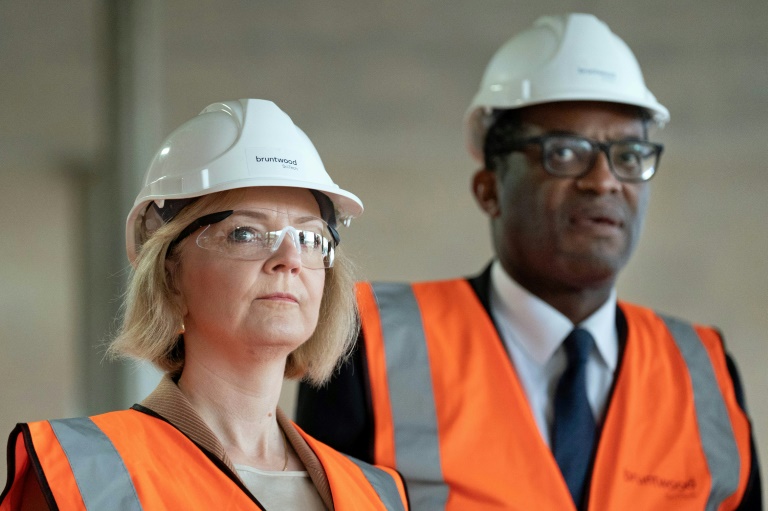
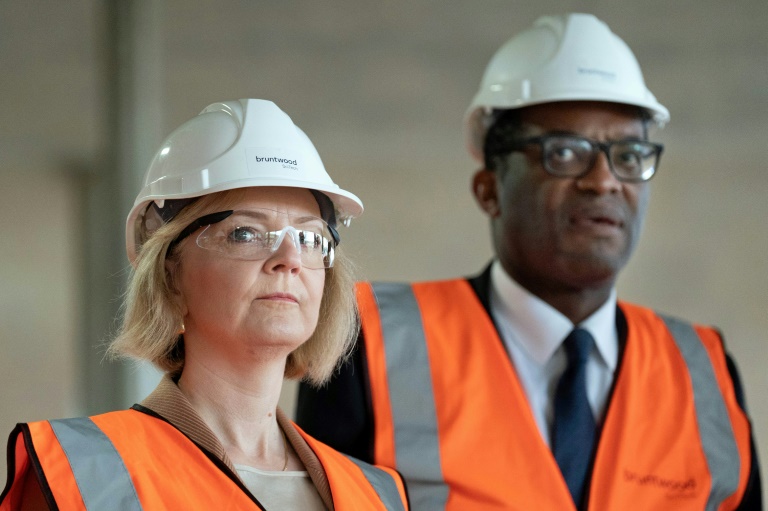
In his place, she appoints former foreign minister Jeremy Hunt.

Denmark paves the way for 'loss and damage' climate aid

It may seem a drop in the ocean, but the $13 million Denmark has earmarked as aid for climate change-related “loss and damages” set an important precedent.

It might just end up helping open a fresh flow of aid to the world’s most vulnerable countries.

Danish Development Cooperation Minister Flemming Moller told the UN General Assembly last month the money was for “climate adaptation and concrete activities to avert, minimise and address climate-induced loss and damage”.

It would mainly help island states and countries in the Sahel region of North Africa, he added.

Denmark’s gesture, however modest, represents an important contribution to the debate over the still-contentious notion of “loss and damages”.

“In some ways, Denmark is a pioneer,” said Lily Salloum Lindegaard, who specialises in the politics of climate change at the Danish Institute for International Studies.

Only Scotland and Belgium’s Walloon government have made such commitments previously, she added — and on a modest scale.

“But Denmark’s commitment provides further progress if we are to address the extensive losses and damages already experienced due to climate change,” Lindegaard told AFP.

“In comparison to the needs on the ground, the Danish commitment is quite small” given the scale of the problem.

But, she added: “The Danish commitment is more significant in political terms, as developed countries have long shied away from finance to losses and damages.”

– Pushback –

As the consequences of global warming — measured in lives lost and economic damages — have piled up, calls for loss and damage as a separate category have mounted.

Developing nations see this kind of funding as compensation — a form of reparations — above and beyond “adaptation” support to build resilience against future impacts.

Rich nations, while acknowledging the need that developing nations have for aid, remain wary of setting a legal precedent that might suggest liability for any and all future damages.

“Climate finance to date has basically only gone to preventing climate change impacts and related losses and damages through mitigation and adaptation efforts,” said Lindegaard.

And not every country is willing to go further, she added.

“There has already been some pushback from the US,” said Lindegaard.

“However, the science of loss and damage is already quite clear and continues to develop quickly, which makes it increasingly difficult for countries to sidestep the issue.”

– ‘We are committed’ –

As climate change amplifies the devastation of extreme weather events, pressure is mounting on developed nations to do more to help.

The world’s most vulnerable countries in the Global South are least responsible for causing the problem — the G20 group of major economies account for 80 percent of greenhouse gas emissions today, and even more historically. 

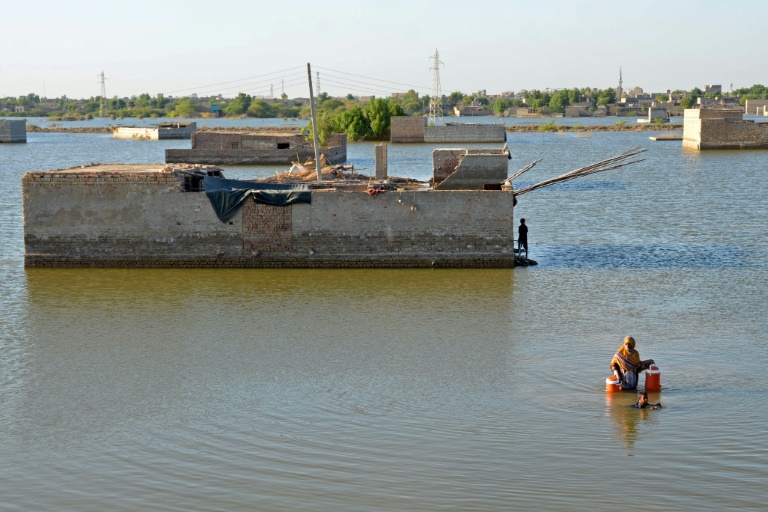
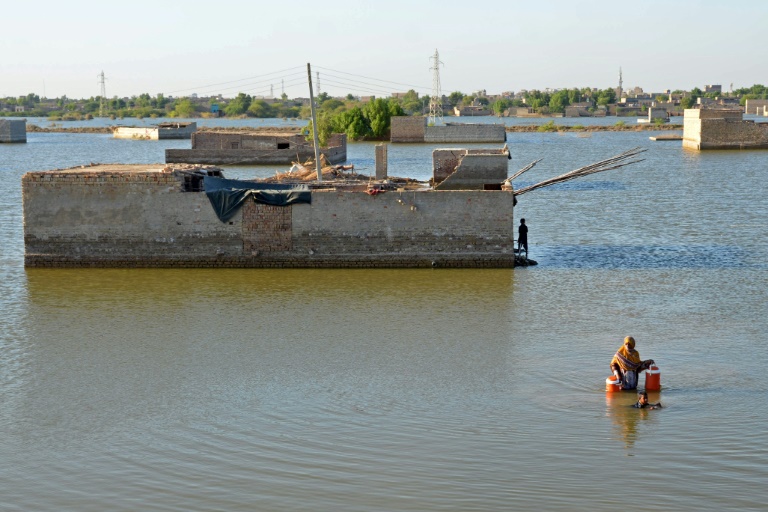
Pakistan — a nation of 220 million that has seen record monsoon rains this year linked to climate chang — emits less than one percent.

Denmark’s announcement at the UN Assembly General sent a clear message, Danish Development Minister Flemming Moller Mortensen told AFP.

“We are committed to helping the people and communities that are suffering from the consequences of climate change. 

“These are the people that are losing their houses to floods, the farmers that are losing their harvest because of drought”.

– Start of a dialogue –

At last year’s COP26, developing countries did not get the commitments they were looking for on targeted financial commitments.

Rich countries agreed only to begin a two-year dialogue on the issue running through 2024.

Denmark spends some $2.9 billion annually on development aid according to the OECD, equivalent to about 0.7 percent of gross national income.

It has set a target of spending at least 60 percent of its aid on climate adaptation, and is the first country to specifically allocate funds to redress its impacts.

But even Denmark’s commitment is short on details.

Its funds will be distributed between NGOs and a strategic initiative with details forthcoming, said the foreign ministry.

Their announcement was nevertheless widely seen as setting an important precedent.

It remains to be seen whether other countries will follow suit.

Denmark paves the way for 'loss and damage' climate aid

It may seem a drop in the ocean, but the $13 million Denmark has earmarked as aid for climate change-related “loss and damages” set an important precedent.

It might just end up helping open a fresh flow of aid to the world’s most vulnerable countries.

Danish Development Cooperation Minister Flemming Moller told the UN General Assembly last month the money was for “climate adaptation and concrete activities to avert, minimise and address climate-induced loss and damage”.

It would mainly help island states and countries in the Sahel region of North Africa, he added.

Denmark’s gesture, however modest, represents an important contribution to the debate over the still-contentious notion of “loss and damages”.

“In some ways, Denmark is a pioneer,” said Lily Salloum Lindegaard, who specialises in the politics of climate change at the Danish Institute for International Studies.

Only Scotland and Belgium’s Walloon government have made such commitments previously, she added — and on a modest scale.

“But Denmark’s commitment provides further progress if we are to address the extensive losses and damages already experienced due to climate change,” Lindegaard told AFP.

“In comparison to the needs on the ground, the Danish commitment is quite small” given the scale of the problem.

But, she added: “The Danish commitment is more significant in political terms, as developed countries have long shied away from finance to losses and damages.”

– Pushback –

As the consequences of global warming — measured in lives lost and economic damages — have piled up, calls for loss and damage as a separate category have mounted.

Developing nations see this kind of funding as compensation — a form of reparations — above and beyond “adaptation” support to build resilience against future impacts.

Rich nations, while acknowledging the need that developing nations have for aid, remain wary of setting a legal precedent that might suggest liability for any and all future damages.

“Climate finance to date has basically only gone to preventing climate change impacts and related losses and damages through mitigation and adaptation efforts,” said Lindegaard.

And not every country is willing to go further, she added.

“There has already been some pushback from the US,” said Lindegaard.

“However, the science of loss and damage is already quite clear and continues to develop quickly, which makes it increasingly difficult for countries to sidestep the issue.”

– ‘We are committed’ –

As climate change amplifies the devastation of extreme weather events, pressure is mounting on developed nations to do more to help.

The world’s most vulnerable countries in the Global South are least responsible for causing the problem — the G20 group of major economies account for 80 percent of greenhouse gas emissions today, and even more historically. 

Pakistan — a nation of 220 million that has seen record monsoon rains this year linked to climate chang — emits less than one percent.

Denmark’s announcement at the UN Assembly General sent a clear message, Danish Development Minister Flemming Moller Mortensen told AFP.

“We are committed to helping the people and communities that are suffering from the consequences of climate change. 

“These are the people that are losing their houses to floods, the farmers that are losing their harvest because of drought”.

– Start of a dialogue –

At last year’s COP26, developing countries did not get the commitments they were looking for on targeted financial commitments.

Rich countries agreed only to begin a two-year dialogue on the issue running through 2024.

Denmark spends some $2.9 billion annually on development aid according to the OECD, equivalent to about 0.7 percent of gross national income.

It has set a target of spending at least 60 percent of its aid on climate adaptation, and is the first country to specifically allocate funds to redress its impacts.

But even Denmark’s commitment is short on details.

Its funds will be distributed between NGOs and a strategic initiative with details forthcoming, said the foreign ministry.

Their announcement was nevertheless widely seen as setting an important precedent.

It remains to be seen whether other countries will follow suit.

UK's Truss fires finance minister as economic plan in tatters

British Prime Minister Liz Truss on Friday dismissed her finance minister, forcing Kwasi Kwarteng to carry the can for turmoil sparked by her right-wing economic platform as restive Conservatives plotted her own demise.

The chancellor of the exchequer was dismissed in person by Truss after he rushed back early from international meetings in Washington, and she was due to hold her first Downing Street news conference at 2:30 pm (1330 GMT).

There was no immediate announcement of his successor, who will become Britain’s fourth finance minister this year, and the pound slumped anew on currency markets.

“You have asked me to stand aside as your chancellor. I have accepted,” Kwarteng wrote in a letter to Truss, who only succeeded Boris Johnson on September 6.

But he insisted that their economic programme was needed because “the status quo was simply not an option”.

In reply, Truss wrote that Kwarteng had “put the national interest first”.

“I know that you will continue to support the mission that we share to deliver a low-tax, high-wage, high-growth economy that can transform the prosperity of our country for generations to come,” she said.

Financial upheaval sparked by the new government’s September 23 plan to slash taxes — financed via billions in more borrowing — has subsided somewhat since the Bank of England intervened in bond markets.

But the central bank was adamant it would end its bond-buying spree on Friday, and market analysts said only a bigger climbdown by Truss following Kwarteng’s disastrous budget announcement last month would avert fresh panic.

Tony Travers, from the London School of Economics, told AFP Kwarteng had been made “the fall guy for the government’s mistakes” — but that the sacking had not taken the pressure off Truss or calmed the Tories.

“It’s very hard to see them coming back from this” by the next election, he added. 

– ‘Not going anywhere’ –

Kwarteng was due to have stayed in Washington this weekend to conclude annual meetings of the International Monetary Fund and World Bank, after earned a rebuke from IMF chief Kristalina Georgieva on the need for “coherent and consistent” policies.

Speaking in Washington on Thursday, Kwarteng had insisted that his job was safe. “I’m not going anywhere,” he said.

But UK broadcasters showed live footage of Kwarteng’s British Airways plane landing at Heathrow airport a day early, after Truss held hurried meetings with her own financial advisors on Thursday in his absence.

Speculation was rife that Truss would row back on planned changes to corporation tax, having already changed her mind about cutting income tax for the highest earners.

The promised tax cuts were the centrepiece of Truss’s successful pitch to Tory party members that she,, rather than rival Rishi Sunak, was the best candidate to replace Johnson. 

That programme now lies in tatters, and Truss’s judgement is in question more than ever, after Sunak’s warnings were entirely vindicated: higher borrowing to pay for tax cuts served only to terrify the markets and drive up borrowing costs for millions of Britons.

A new YouGov poll for The Times newspaper said 43 percent of Conservative voters want a new prime minister in Downing Street.

Other polls show a mammoth lead up opening up for the main opposition Labour party, threatening electoral meltdown for the Tories. 

– ‘Romcom-worthy dash’ –

Junior minister Greg Hands said “I don’t recognise” multiple reports that senior Tory MPs were plotting to unseat Truss by installing a new leadership team under Sunak and Penny Mordaunt, who also ran to succeed Johnson.

Pressed on whether Truss will still be in 10 Downing Street in a week, Hands told ITV: “Oh definitely.”

The chancellor’s September 23 budget sparked market chaos because of fears it would drive up state debt. 

The pound tumbled to a record dollar low near parity with the greenback and bond yields surged, before stabilising thanks to interventions by the Bank of England (BoE). 

But with that costly BoE crutch ending on Friday, markets had already priced in a fresh about-turn by the government, leaving Downing Street with no room for manoeuvre.

Sophie Lund-Yates, lead equity analyst at Hargreaves Lansdown, said before Kwarteng’s sacking that his “romcom-worthy dash through the airport” showed the government waking up to financial reality.

But for many pundits, the self-inflicted damage risks proving terminal for Truss and her hard-right platform.

Another new poll by Ipsos showed Truss’s net satisfaction score at minus 51, lower than any of her predecessors this century, while Kwarteng left office with historically low ratings for a chancellor.

UK's Truss fires finance minister as economic plan in tatters

British Prime Minister Liz Truss on Friday dismissed her finance minister, forcing Kwasi Kwarteng to carry the can for turmoil sparked by her right-wing economic platform as restive Conservatives plotted her own demise.

The chancellor of the exchequer was dismissed in person by Truss after he rushed back early from international meetings in Washington, and she was due to hold her first Downing Street news conference at 2:30 pm (1330 GMT).

There was no immediate announcement of his successor, who will become Britain’s fourth finance minister this year, and the pound slumped anew on currency markets.

“You have asked me to stand aside as your chancellor. I have accepted,” Kwarteng wrote in a letter to Truss, who only succeeded Boris Johnson on September 6.

But he insisted that their economic programme was needed because “the status quo was simply not an option”.

In reply, Truss wrote that Kwarteng had “put the national interest first”.

“I know that you will continue to support the mission that we share to deliver a low-tax, high-wage, high-growth economy that can transform the prosperity of our country for generations to come,” she said.

Financial upheaval sparked by the new government’s September 23 plan to slash taxes — financed via billions in more borrowing — has subsided somewhat since the Bank of England intervened in bond markets.

But the central bank was adamant it would end its bond-buying spree on Friday, and market analysts said only a bigger climbdown by Truss following Kwarteng’s disastrous budget announcement last month would avert fresh panic.

Tony Travers, from the London School of Economics, told AFP Kwarteng had been made “the fall guy for the government’s mistakes” — but that the sacking had not taken the pressure off Truss or calmed the Tories.

“It’s very hard to see them coming back from this” by the next election, he added. 

– ‘Not going anywhere’ –

Kwarteng was due to have stayed in Washington this weekend to conclude annual meetings of the International Monetary Fund and World Bank, after earned a rebuke from IMF chief Kristalina Georgieva on the need for “coherent and consistent” policies.

Speaking in Washington on Thursday, Kwarteng had insisted that his job was safe. “I’m not going anywhere,” he said.

But UK broadcasters showed live footage of Kwarteng’s British Airways plane landing at Heathrow airport a day early, after Truss held hurried meetings with her own financial advisors on Thursday in his absence.

Speculation was rife that Truss would row back on planned changes to corporation tax, having already changed her mind about cutting income tax for the highest earners.

The promised tax cuts were the centrepiece of Truss’s successful pitch to Tory party members that she,, rather than rival Rishi Sunak, was the best candidate to replace Johnson. 

That programme now lies in tatters, and Truss’s judgement is in question more than ever, after Sunak’s warnings were entirely vindicated: higher borrowing to pay for tax cuts served only to terrify the markets and drive up borrowing costs for millions of Britons.

A new YouGov poll for The Times newspaper said 43 percent of Conservative voters want a new prime minister in Downing Street.

Other polls show a mammoth lead up opening up for the main opposition Labour party, threatening electoral meltdown for the Tories. 

– ‘Romcom-worthy dash’ –

Junior minister Greg Hands said “I don’t recognise” multiple reports that senior Tory MPs were plotting to unseat Truss by installing a new leadership team under Sunak and Penny Mordaunt, who also ran to succeed Johnson.

Pressed on whether Truss will still be in 10 Downing Street in a week, Hands told ITV: “Oh definitely.”

The chancellor’s September 23 budget sparked market chaos because of fears it would drive up state debt. 

The pound tumbled to a record dollar low near parity with the greenback and bond yields surged, before stabilising thanks to interventions by the Bank of England (BoE). 

But with that costly BoE crutch ending on Friday, markets had already priced in a fresh about-turn by the government, leaving Downing Street with no room for manoeuvre.

Sophie Lund-Yates, lead equity analyst at Hargreaves Lansdown, said before Kwarteng’s sacking that his “romcom-worthy dash through the airport” showed the government waking up to financial reality.

But for many pundits, the self-inflicted damage risks proving terminal for Truss and her hard-right platform.

Another new poll by Ipsos showed Truss’s net satisfaction score at minus 51, lower than any of her predecessors this century, while Kwarteng left office with historically low ratings for a chancellor.

Royal Mail plans up to 10,000 job cuts

British postal operator Royal Mail on Friday unveiled plans to axe up to 10,000 jobs, blaming the move partly on ongoing staff strikes that contributed to a first-half loss.

The announcement came one day after staff staged the first of 19 walkouts targeting the critical run-up to Christmas, joining several other UK sectors carrying out industrial action as sky-high inflation erodes the value of wages.

Royal Mail’s job cuts follow “the impact of industrial action, delays in delivering agreed productivity improvements and lower parcel volumes”, its parent group said in a results statement, sending shares tanking.

“Our operational full-time employee workforce will need to reduce by an estimated 10,000 by the end of August 2023,” International Distributions Services added alongside news it had plunged into the red.

– ‘Gross mismanagement’ –

The planned job losses comprise almost seven percent of Royal Mail’s total workforce of 150,000 people.

The restructuring includes up to 6,000 compulsory redundancies.

Dave Ward, general secretary of the CWU union that has organised Royal Mail walkouts, said the job cuts were “the result of gross mismanagement “.

He added there had been “a failed business agenda of ending daily deliveries, a wholesale levelling-down of the terms, pay and conditions of postal workers, and turning Royal Mail into a gig economy-style parcel courier”.

The group suffered an operating loss of £219 million ($245 million) in the six months to the end of September, it added Friday.

That contrasted sharply with profit of £235 million a year earlier, when it was buoyed by strong parcel demand during the pandemic.

“It now expects full-year losses to hit £350 million, which is the figure it had hoped to make in cost savings before the strikes erupted,” noted Susannah Streeter, senior investment and markets analyst at Hargreaves Lansdown.

The threat of further strike action beyond Christmas “means that no certainty can be given over the full year outlook for the group as a whole”, she added.

Royal Mail said full-year operating losses could increase to £450 million should “customers move volume away for longer periods” as a result of strike action.

The share price of International Distributions Services was down more than eight percent at 192.65 pence in afternoon London trading, having recovered from even sharper losses following Friday’s news.

– Royal makeover –

Set up more than 500 years ago, Royal Mail has experienced some of its most turbulent times during the past decade, particularly following its controversial privatisation in 2013.

The firm’s core letters business has been ravaged as consumers increasingly go online to communicate.

However, it enjoyed booming demand for parcel deliveries during Britain’s Covid lockdowns — and played a vital role delivering test kits and protective clothing in the pandemic.

Yet the Covid-era boom in parcels has tailed off.

Following the death of Queen Elizabeth II last month, all new Royal Mail postboxes will no longer feature the EIIR royal cipher.

The cipher stood for Elizabeth II Regina (“queen” in Latin).

Instead they will be imprinted with CIIIR, representing Charles III Rex (“king” in Latin). A crown will feature above both letters.

New British stamps will also feature an image of his head.

Close Bitnami banner
Bitnami