World

Africa's longest oil pipeline takes shape in Niger

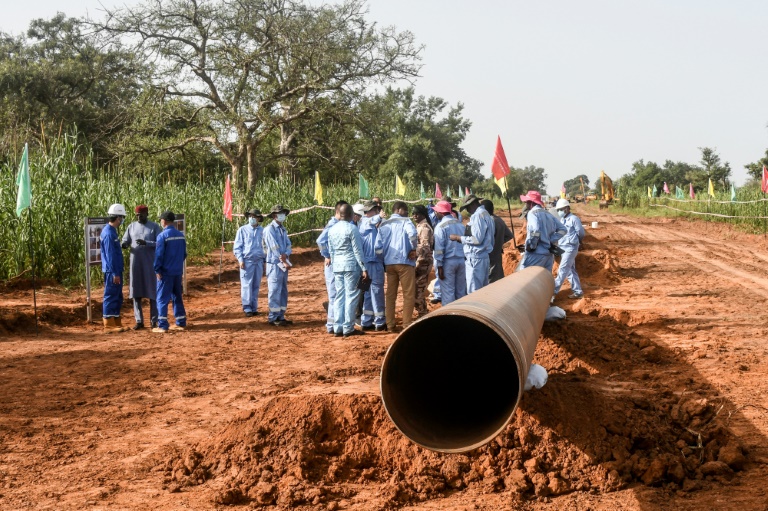
Chinese and Nigerien workers haul giant steel pipes over mounds of earth as heavily armed soldiers keep guard.

At Gaya in southwest Niger, near the border with Benin, the longest oil pipeline in Africa is being built. 

With a projected length of nearly 2,000 kilometres (1,240 miles) — including 1,250 km in Niger itself — the pipeline will connect oil wells in the eastern region of Agadem, a zone troubled by deadly jihadist incursions, with the Beninese port of Seme.

Climate campaigners are clamouring for an end to investment in carbon-spewing fossil fuels.

But in Niger — the poorest country in the world according to the benchmark of the UN’s Human Development Index — this project is seen as an economic lifeline.

The landlocked West African state became an oil producer in 2011. The China National Petroleum Corporation (CNPC), exploiting the reserves, has been sending oil by pipeline to refineries in Zinder in south-central Niger.

For exports, Niger initially planned to ship crude through the Cameroonian port of Kribi via neighbouring Chad.

It eventually opted for the “Beninese corridor” terminating on the northern rim of the Gulf of Guinea.

Launched in 2019, the project was supposed to be completed in 2022, but the Covid-19 pandemic slowed it down, said Nafiou Issaka, deputy general manager of the West African Oil Pipeline Company (WAPCO).

More than 600 km of pipeline has already been laid, and Niger is on track to sell crude on the international market from next July, according to the ministry of petroleum and energy.

More than 700 soldiers have been deployed to ensure security for the project, though a large part of the territory it crosses has so far been spared from jihadist violence, according to a security source who asked not to be named.

– ‘Niger’s biggest investment’ –

Niger has long been a major producer of uranium, ranked in global 7th place in 2021 with a total output of 2,248 tonnes, after a year-over-year decline in the past decade, according to the World Nuclear Association.

But uranium revenues continue to fall and the country’s leaders are banking on oil to boost the national budget, much of which is devoted to the fight against jihadists in the southeast and the west.

Six billion dollars will be invested in the pipeline.

“It is Niger’s biggest investment since independence” from France in 1960, said Kabirou Zakari, who heads the ministry’s oil refining division.

From 2023, oil production should be increased to 110,000 barrels per day, of which 90,000 barrels will be exported, Zakari told AFP.

Oil could then “generate a quarter of the country’s GDP” — more than 13.6 billion dollars in 2020 according to the World Bank — and “about 50 percent of Niger’s tax revenue”, compared to four percent and 19 percent respectively today, added Zakari.

He estimated Niger’s oil reserves at around two billion barrels. According to official projections, Niger will produce 200,000 barrels per day in 2026.

– Fuel smuggling –

The Algerian oil company Sonatrach has announced an “encouraging” discovery of oil in Kafra, a vast area of 23,737 square kilometres (9,165 square miles) on the border with Algeria.

The British company Savannah Energy, a major player in the gas industry in neighbouring Nigeria, says it too has found deposits in the Agadem region, where the Chinese are already operating.

A black market for oil products is flourishing in the capital Niamey and in other big cities. A litre of petrol (gasoline) exchanges hands for 300 FCFA (40 US cents), just under half of the price at the pump.

On Tuesday, Niger’s President Mohamed Bazoum said fuel smuggling organised from neighbouring Nigeria had become a source of “supply for terrorists” and called for a crackdown.
5.3 billion cell phones to become waste in 2022: report

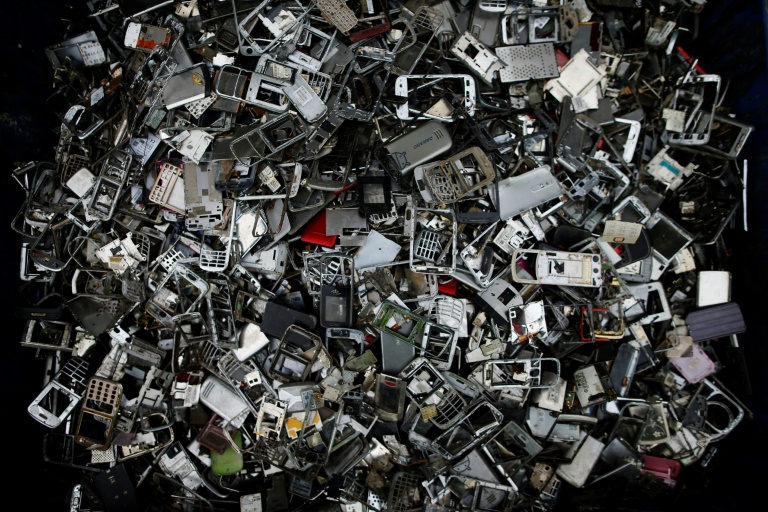
More than five billion of the estimated 16 billion mobile phones possessed worldwide will likely be discarded or stashed away in 2022, experts said Thursday, calling for more recycling of the often hazardous materials they contain. 

Stacked flat on top of each other, that many disused phones would rise 50,000 kilometres (30,000 miles), more than a hundred times higher than the International Space Station, the WEEE research consortium found.

Despite containing valuable gold, copper, silver, palladium and other recyclable components, almost all these unwanted devices will be hoarded, dumped or incinerated, causing significant health and environmental harm. 

“Smartphones are one of the electronic products of highest concern for us,” said Pascal Leroy, Director General of the WEEE Forum, a not-for-profit association representing forty-six producer responsibility organisations. 

“If we don’t recycle the rare materials they contain, we’ll have to mine them in countries like China or Congo,” Leroy told AFP.

Defunct cell phones are just the tip of the 44.48-million-ton iceberg of global electronic waste generated annually that isn’t recycled, according to the 2020 global e-waste monitor.

Many of the five billion phones withdrawn from circulation will be hoarded rather than dumped in the trash, according to a survey in six European countries from June to September 2022. 

This happens when households and businesses forget cell phones in drawers, closets, cupboards or garages rather than bringing them in for repair or recycling.

Up to five kilos (8 pounds) of e-devices per person are currently hoarded in the average European family, the report found.

According to the new findings, 46 percent of the 8,775 households surveyed considered potential future use as the main reason for hoarding small electrical and electronic equipment. 

Another 15 percent stockpile their gadgets with the intention to sell them or giving them away, while 13 percent keep them due to “sentimental value”. 

– Societal challenge –

“People tend not to realise that all these seemingly insignificant items have a lot of value, and together at a global level represent massive volumes,” said Pascal Leroy.

“But e-waste will never be collected voluntarily because of the high cost. That is why legislation is essential.”

This month the EU parliament passed a new law requiring USB-C to be the single charger standard for all new smartphones, tablets and cameras from late 2024.

The move is expected to generate annual savings of at least 200 million euros ($195 million) and cut more than a thousand tonnes of EU electronic waste every year.

According to Kees Balde, Senior Scientific Specialist at the  United Nations Institute for Training and Research (UNITAR), legislation in Europe has prompted higher e-waste collection rates in the region compared to other parts of the world. 

“At the European level, 50-55 percent of e-waste is collected or recycled,” Balde told AFP. “In low-income countries, our estimates plunge to under 5 percent and sometimes even below 1 percent.”

At the same time, thousands of tons of e-waste are shipped from wealthy nations — including members of the European Union — to developing countries every year, adding to their recycling burden. 

At the receiving end, financial means are often lacking for e-waste to be treated safely: hazardous substances such as mercury and plastic can contaminate soil, pollute water and enter the food chain, as happened near a Ghanaian e-waste dumpsite. 

Research carried out in the west African nation in 2019 by the IPEN and Basel Action Network revealed a level of chlorinated dioxins in hens’ eggs laid near the Agbogbloshie dumpsite, near central Accra, 220 times higher than levels permitted in Europe. 

“We have moved mountains in Europe,” said WEEE Forum director Pascal Leroy. “The challenge now is to transfer knowledge to other parts of the world.”

Protest-hit Iran accuses US of 'destablisation' plot

Iran’s president Thursday accused arch-enemy the United States of seeking to destabilise the Islamic republic, which has been rocked by nearly a month of women-led protests sparked by the death of Mahsa Amini.

Outrage over the 22-year-old woman’s death, three days after she was arrested by Iran’s notorious morality police, has fuelled the biggest wave of street protests and violence seen in the country for almost three years.

Young women and schoolgirls have been at the forefront of the protests, shouting anti-government slogans, setting their headscarves ablaze and facing off with security forces in the streets.

Chants of “Woman, Life, Freedom”, the protest movement’s catchcry, were again heard overnight in the northwestern city of Bukan, where demonstrators burned the Iranian flag, in a video verified by AFP.

Iran’s ultra-conservative President Ebrahim Raisi again blamed the United States, its bitter foe since the 1979 Islamic Revolution and chief adversary in a standoff over Iran’s nuclear programme.

“Following the failure of America in militarisation and sanctions, Washington and its allies have resorted to the failed policy of destabilisation,” he said.

Fresh protests were held on Thursday, with students gathered at Tehran University shouting insults at a security officer who pointed his gun at them, in online video footage verified by AFP.

Across town at Valiasr Square, a government billboard showing pictures of famous Iranian women all observing the hijab rule drew scorn as it featured some personalities known to be less supportive of the headscarf rule.

– Thousands detained –

Gunshots and tear gas were fired on Wednesday as security forces confronted protests in a crackdown that rights groups say has already claimed at least 108 lives.

New online videos showed members of the public confronting security forces as they sought to arrest demonstrators, at times forcing officers to run away.

In other footage verified by AFP, women are seen being beaten and chased by security forces in Rasht in Gilan province.

Some oil workers have gone on strike in support of the protests, and 12 from the Bushehr petrochemical plant were arrested as a result, the Human Rights Activists News Agency (HRANA) said Thursday.

Deadly unrest has rocked especially Sanandaj in Amini’s western home province of Kurdistan — but also Zahedan in Iran’s southeastern Sistan-Baluchestan province, where demonstrations erupted on September 30 over the reported rape of a teenage girl by a police commander.

HRANA charged that “the unregulated use of shotguns with pellets by law enforcement has resulted in the injury of many protesters”, including elderly people, teenagers or even children.

The US-based group said it had the names of at least 106 people slain by the security forces, and knew of another 11 dead who remained unidentified.

At least 94 more had been killed in Zahedan, one of the few Sunni-majority cities in predominantly Shiite Iran, HRANA said, adding that 20 security personnel had been killed, including six in Zahedan.

It said on Thursday that it “estimates 5,710 individuals have been arrested in #IranProtests2022” and added that the number is growing daily.

– ‘Deepening the divide’ –

Iranian judges have been issued orders against handing down soft sentences for people found to be the “main elements of riots”, the judiciary said.

In its widening crackdown, Iran has restricted internet access and blocked social media platforms including Instagram and WhatsApp.

Washington, which has imposed new sanctions against Tehran over the crackdown, said it was taking steps to ensure Iranians would have online access.

“Iran’s continued violent crackdown on peaceful protestors is an affront to human rights,” said US Deputy Secretary of State Wendy Sherman.

“I spoke with major US tech firms and urged them to… provide the Iranian people with additional services and communications tools.”

The clerical state’s bloody crackdown has drawn widespread condemnation.

“Continued repression is not the answer,” said Comfort Ero, president and CEO of the International Crisis Group think-tank, in a tweet.

“The government’s violent crackdown is only deepening the divide between a state that will not give in to demands for greater freedom, and a society that will not give up asking for them.”

An Iranian investigation found Amini had died on September 16 of a longstanding illness rather than reported beatings.

Her parents have denied this and filed a complaint against the officers involved. A cousin living in Iraq has told AFP she died of “a violent blow to the head”.

Yen hits lowest level against dollar since 1990 

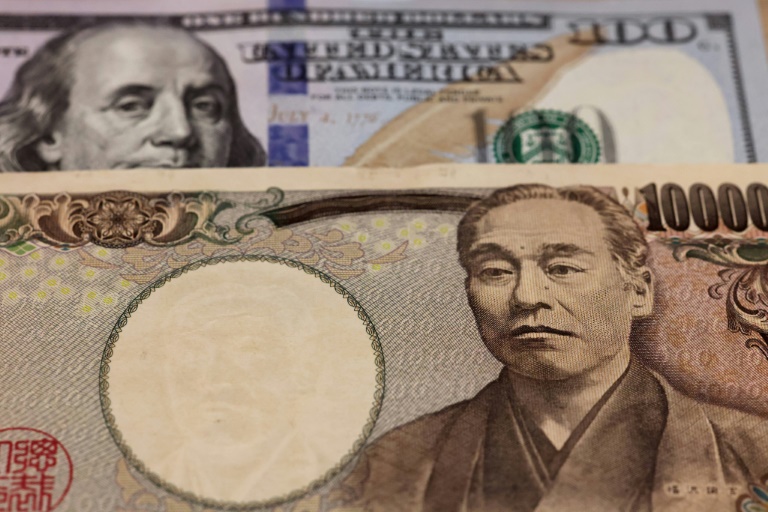
The yen on Thursday dropped to the lowest level against the dollar since 1990 after US inflation data indicated more aggressive interest rate hikes from the Federal Reserve.

One dollar was worth 147.67 yen following the stronger-than-expected inflation number, which comes as Japan’s central bank holds off from hiking interest rates.

“The yen has been the weakest major currency so far in 2022,” noted Carol Kong, a currency strategist at Commonwealth Bank of Australia.  

“There are two key reasons behind its rapid weakness. The first is the growing divergence in monetary policy between the US and Japan,” she told AFP.  

“The Bank of Japan continues to keep monetary policy easy because inflation and wages remain relatively low” in the country. 

Kong said the yen had been hit hard also by a collapse in Japan’s current account balance after oil prices surged following the invasion of Ukraine by key energy producer Russia.  

With Japan relying on oil imports to meet most of its energy needs, the surge in crude costs recently sent its current account into deficit, she pointed out. 

On the upside, a weaker yen is helpful to Japanese exporters, whose products turn cheaper for foreign buyers holding stronger currencies.

Fast Retailing, the parent company of Japanese clothing giant Uniqlo, posted on Thursday a record full-year net profit thanks to the weak yen and a rebound in demand after virus lockdowns.

The yen’s dramatic fall — from around 115 against the dollar in February to over 138 in late August — was a boon for the company, which owns Uniqlo stores worldwide.

Wall Street and European stock markets were meanwhile also down sharply following Thursday’s US inflation data that solidified expectations of further big interest rate hikes from the Federal Reserve.

US consumer prices rose 0.4 percent in September compared to August, double the figure projected by analysts.

burs-bcp/rl

Germany agrees to replace cheap national transport ticket

Germany on Thursday moved closer to approving a successor to a popular ultra-cheap, country-wide public transport ticket rolled out over the summer to curb inflation and cut carbon emissions.

State and federal transport ministers agreed on a 49-euro ($47) monthly pass allowing users to travel on subways, buses and regional trains anywhere in Germany.

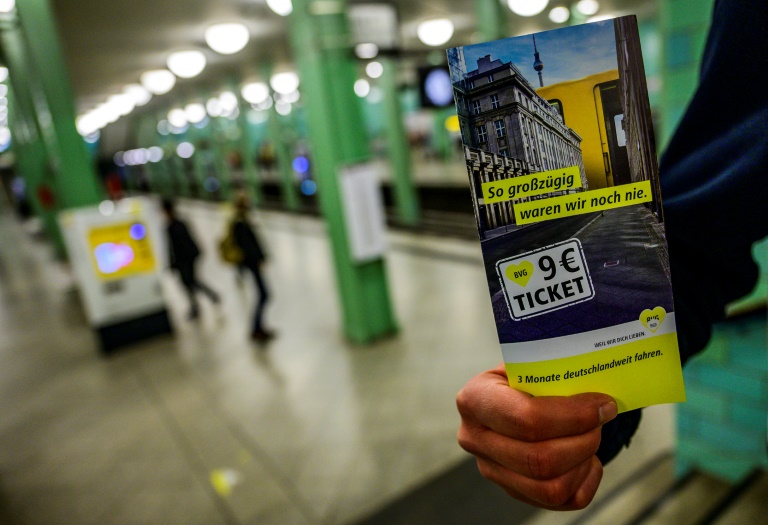
It would replace a nine-euro monthly pass in June, July and August that proved a roaring success, selling a total of 52 million tickets in addition to benefitting 10 million who already had monthly tickets.    

“We can get to work on the modalities but the main issues have been resolved — it will be a Germany-wide ticket offering everything that the nine-euro ticket did,” Federal Transport Minister Volker Wissing told reporters, pending approval by Berlin and regional governments.

Wissing said it would be likely be rolled out from January 1 and offered only as an annual subscription, renewing automatically each month, but can be cancelled at any time.

However at more than five times the special price offered in the summertime, consumer advocates have raised doubts about how attractive the new ticket will be.

The financing has also yet to be hammered out, with the federal government offering 1.5 billion euros per year from 2023 and asking states to match that amount.

Chancellor Olaf Scholz himself had said the summer tickets were “one of the best ideas” his centre-left-led coalition government had introduced, and pledged to come up with a longer-term measure.

The VDV public transport association touted the passes’ pollution savings of 1.8 million tonnes — the equivalent of the annual C02 output from almost 388,000 vehicles.

However Finance Minister Christian Lindner from the pro-business Free Democrats had baulked at the price tag of an extension, delaying the roll-out of a successor ticket.

Several cities and towns stepped into the breach with their own regional offers until a national policy can be implemented.

Germany, Europe’s top economy, is struggling with soaring inflation driven by surging energy costs.    

Ukraine could extradite Russians to ICC: prosecutor

Ukraine could extradite Russian war crimes suspects to the International Criminal Court (ICC) even though Moscow is not a member, the tribunal’s prosecutor said on Thursday.

Kyiv authorities could send Russians to the Hague-based court if trials could not take place in Ukraine for legal reasons, ICC chief prosecutor Karim Khan said.

Russia, which invaded Ukraine on February 24, refused to join the ICC when the court was set up in 2002 to try people for offences including war crimes, crimes against humanity and genocide.

“Legally yes it wouldn’t represent an obstacle to our jurisdiction,” Khan told a press conference at the headquarters of the EU’s judicial agency, Eurojust.

“Certainly if there was a need… and there was a reason why those trials could not take place in Ukraine, whether it’s because of some legal additional provisions that we have or not, I am sure that we would get the cooperation from Ukraine,” he added.

The ICC opened its own probe into the war in Ukraine shortly after Russia invaded, but has said it is keen for Ukraine to bring suspects to justice where possible.

Khan would not say when the ICC expects to file its own first charges, saying he would wait until the “evidence is sufficient.”

“We are moving forward, we have focus, but I will make announcements at the right time,” he said.

Kyiv has already convicted 10 people over crimes committed during Russia’s invasion, Ukrainian Prosecutor General Andriy Kostin told the news conference.

It has indicted a total of 186 people, mostly in absentia, and filed court papers for 45 people.

Ukraine will meanwhile file war crimes charges over Russia’s bombardment of Kyiv and other cities this week, said Kostin.

“All of the hits of every missile, every drone, every damage of civil infrastructure, every Ukrainian who was killed or wounded by these missile attacks, all of them are documented and criminal proceedings were opened,” he said.

Ukraine’s allies have pledged more powerful air defence systems after days of devastating Russian attacks that President Vladimir Putin said were retaliation for a deadly explosion at a Crimean bridge. 

Several Western leaders have described the Russian strikes as a war crime.

Romania meanwhile said it had joined an international investigation team probing war crimes along with Lithuania, Poland, Ukraine, Estonia, Latvia and Slovakia, along with Eurojust and the ICC.

Stocks slump after key US inflation data

Equities fell sharply on Thursday after data showed US inflation jumped more than expected in September.

The data solidified expectations of further interest rate hikes, helping push the dollar higher, including striking its highest level against the Japanese yen since 1990.

US consumer prices rose 0.4 percent in September compared to August, twice the 0.2 percent projected by analysts even as the annual increase in the consumer price index slowed slightly to 8.2 percent from 8.3 percent.

But core inflation, excluding volatile energy and food prices, climbed to 6.6 percent from 6.3 percent in August.

The US Federal Reserve has  raised interest rates at an aggressive clip of 0.75 percentage points at its last three meetings, and signalled plans to continue doing so until rampant inflation is brought under control.

That has led to a slump in stock prices in recent months, as higher interest rates will reduce consumer spending power.

Last month saw a brief rally in stocks after data suggesting that the US economy was slowing, as investors hoped that it would allow a “pivot” by the Fed to a slower rate of interest rate hikes.

“The strong CPI only reinforces the view that there is no way the Federal Reserve can contemplate a ‘pivot’ this year,” said Stephen Innes at SPI Asset Management. 

Wall Street stocks plunged at the open, with the Dow falling 1.1 percent. The S&P 500 slumped 2.1 percent and the tech-heavy Nasdaq Composite 2.8 percent. 

European stocks, which had drifted higher before the US inflation data, turned lower. Frankfurt shed 1.1 percent and Paris 1.6 percent.

The FTSE 100 in London was down 1.3 percent, with media speculating the government may cut back on its fiscal stimulus plans and and increase corporate taxes in its latest policy U-turn.

But the speculation sent the pound soaring 1.4 percent against the dollar. Meanwhile the UK government’s 30-year bond yield eased to 4.63 percent and the 10-year fell to 4.31 percent.

The ten-year yield on Wednesday struck 4.64 percent, the highest since the 2008 global financial crisis and higher than the level that prompted the BoE’s recent bond market intervention.

Oil prices fell after the US inflation data, which reinforced recession concerns and about sliding demand prospects.

The dollar rose as high as 147.67 yen, its highest level since 1990, as US and Japanese monetary policy increasingly diverge. The Bank of Japan has so far refused to raise interest rates, making yen investments less attractive than dollar investments.

“The Bank of Japan continues to keep monetary policy easy because inflation and wages remain relatively low” in Japan, said Carol Kong, and economist and currency strategist at Commonwealth Bank of Australia.

– Key figures around 1530 GMT –

London – FTSE 100: DOWN 1.3 percent at 6,740.61 points

Frankfurt – DAX: DOWN 1.1 percent at 12,037.08

Paris – CAC 40: DOWN 1.6 percent at 5,727.54

EURO STOXX 50: DOWN 1.9 percent at 3,269.59

New York – Dow: DOWN 1.6 percent at 28,749.43

Tokyo – Nikkei 225: DOWN 0.6 percent at 26,237.42 (close)

Hong Kong – Hang Seng Index: DOWN 1.9 percent at 16,389.11 (close)

Shanghai – Composite: DOWN 0.3 percent at 3,016.36 (close)

Pound/dollar: UP at $1.1193 from $1.1100 Wednesday

Dollar/yen: UP at 147.19 yen from 146.91 yen

Euro/dollar: DOWN at $0.9666 from $0.9703

Euro/pound: DOWN at 86.38 pence from 87.41 pence

Brent North Sea crude: DOWN 0.4 percent at $92.09 per barrel

West Texas Intermediate: DOWN 1.0 percent at $86.41 per barrel

burs-rl/bp

Ukraine restores power supplies after Russian missile salvos

Ukraine said Thursday it had reset its power grid after mass Russian strikes on energy facilities as Turkey held back on an expected offer to mediate talks between Moscow and Kyiv.

And in a sign that Ukraine’s counter-offensive was advancing in the south, the Moscow-installed head of the Kherson region under Russia’s control asked Moscow for help to evacuate civilians from the area. 

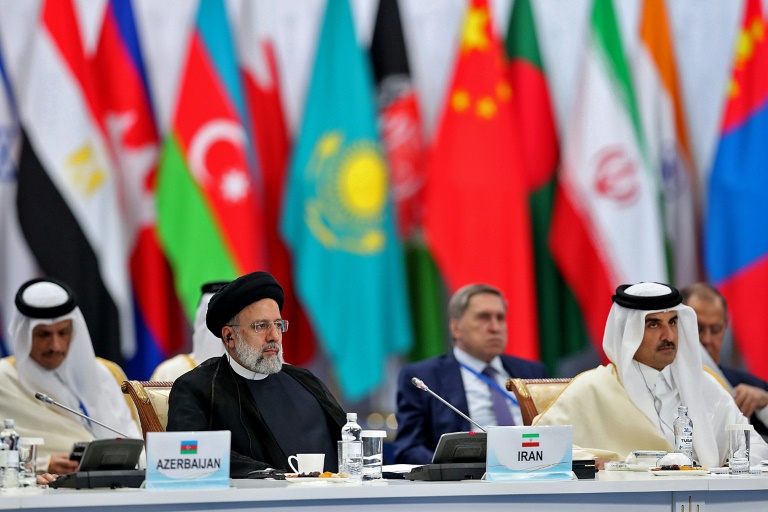
Turkish leader Recep Tayyip Erdogan defended Ankara’s booming trade ties with Moscow during an in-person meeting with Russian counterpart Vladimir Putin on the sidelines of a summit of regional leaders in Kazakhstan.

But Erdogan did not deliver an offer to mediate negotiations between Moscow and Kyiv — expected by the Kremlin — and comments between the leaders made no mention of Ukraine and focussed instead on economic ties.

Putin during the meeting proposed to create a “gas hub” in Turkey as Russia’s supplies to Europe have been disrupted by Ukraine-related sanctions.

NATO member Turkey has sought to retain dialogue with its Western allies as well as Moscow, and has not joined sanctions on Russia over its invasion of Ukraine.

Erdogan also refrained from commenting on mass Russian strikes on Ukraine earlier this week that mostly targeted energy infrastructure and left at least 20 dead. 

The attacks caused power and hot water cuts across the country, but the head of Ukraine’s energy operator Ukrenergo said Thursday that the power grid had “stabilised”, reassuring users emergency power cuts would be unneccessary.

– Rebels push to Bakhmut –

On the battlefield, Russian-backed separatist forces in the eastern Donetsk region of Ukraine said they had captured two villages near the industrial city of Bakhmut, posting small gains against Kyiv’s counteroffensive.

“A group of DNR and LNR troops — with fire support from the Russian Armed Forces — liberated Opytne and Ivangrad,” a statement released by separatist authorities said on Telegram, using acronyms for the so-called Donetsk and Lugansk people’s republics. 

The villages are located just south of Bakhmut, a wine-making and salt-mining city that used to be populated by some 70,000 people and which Russian forces have been pummelling for weeks to capture.

The reported gains after Ukrainian troops had for weeks been clawing back large swathes of territory in the south and east of Ukraine — including Donetsk — controlled by Russian forces for months.

The Ukrainian military countered in an update that it had repelled attacks near several frontline villages.

– Boy pulled from rubble –

Ukraine troops told AFP this week near the frontline south of Bakhmut that they were still outgunned by Russian artillery on their section of the frontline. Russian supply lines from the part of Donetsk occupied since 2014 are still intact. 

AFP reporters in Yampil just outside the recently liberated town of Lyman on Thursday heard heavy exchanges of artillery fire to the southeast. 

A Ukrainian soldier returning from the frontline said that positions in the village of Torske were under fire from Russian guns guided by spotter drones.

In the southern Kherson region, that Russia has claimed to have annexed, Ukraine forces have been clawing back territory for weeks.

The Moscow-appointed leader Vladimir Saldo suggested to residents that they “leave to other regions to protect themselves from missile strikes”.

Saldo said the region was being hit by an increasing number of rocket attacks that were causing “serious damage” and asked Russia to help organise the evacuations.

Also in the south, where Ukrainian forces have also announced sweeping gains over recent weeks, the town of Mykolaiv was again rocked by Russian bombardments.

The head of the city Oleksandr Sienkevych said on social media that a five-story residential building was hit, with two upper floors destroyed completely.

“An 11-year-old boy was recovered from under the rubble and another seven people may still be there,” he said, adding a security guard was killed at a sea rescue station.

France orders more strikers back to work as fuel shortages bite

The French government on Thursday ordered workers back to a second fuel depot in a bid to ease petrol shortages from a three-week strike, a move that infuriated unions hoping to amplify the conflict into a broader protest against President Emmanuel Macron.

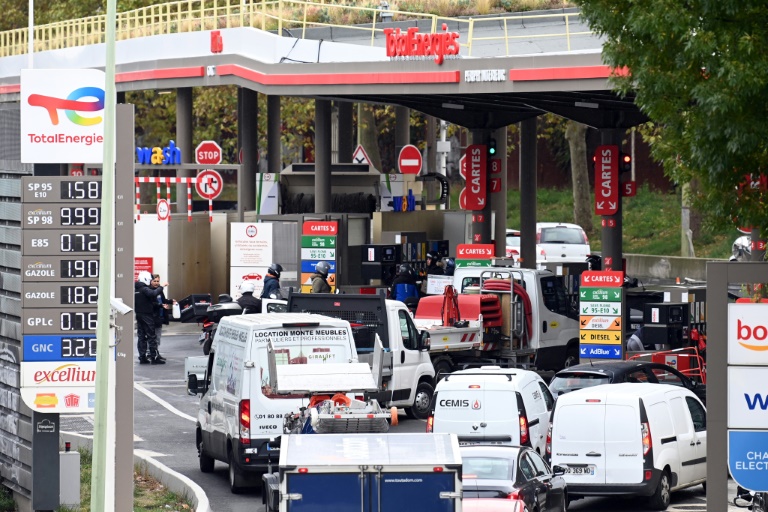
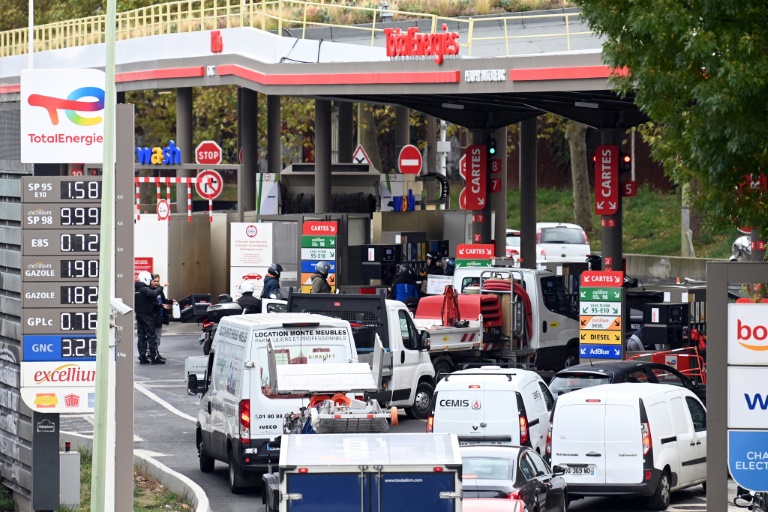
Motorists across the country have faced long queues to fill tanks at stations that often run dry in a day, as six of France’s seven refineries have been shut down.

“I have to honour my contracts for cleaning homes. And when there’s no petrol and I have a lot of rounds to make, things get complicated,” said Elisabeth Mailhes, waiting at a station in the capital.

Macron acknowledged the mounting anger in a televised address Wednesday, promising that relief was in sight for next week.

The office of Prime Minister Elisabeth Borne said Thursday the government was “counting on talks resuming in the coming hours between management and labour representatives”. 

But in the meantime, essential workers were told to return to work Thursday at the huge TotalEnergies fuel depot near Dunkirk, northern France, where around a dozen police were stationed outside, an AFP journalist saw.

Borne’s office cited a “real economic threat” for much of northern France, which relies heavily on agriculture, fishing and industry.

The strike has left 30 percent of service stations nationwide with little or no fuel, though nearly half of stations are impacted in northern France and the greater Paris region, the energy transition ministry said.

The CGT and FO unions leading the refineries strike have said they will fight the requisition orders in court, calling them an illegal manoeuvre against the right to labour action.

“This is the Macron dictatorship,” said Benjamin Tange, a CGT official at the Dunkirk site.

“What we’re seeing is the anger built up over several months and years, and a breakdown of any social dialogue,” he said. 

– Escalation of tensions feared –

The government had already requisitioned depot workers to return to the Esso-ExxonMobil refinery at Gravenchon-Port-Jerome in northern France on Wednesday.

In response, CGT and FO leaders planned to meet with other unions Thursday to discuss broadening the strike to other sectors, potentially with a mass walk-out next Tuesday.

The CGT is already pushing to extend the strike throughout the energy sector, potentially disrupting operations in the country’s all-important nuclear sector.

The refinery unions are seeking pay hikes in response to steep inflation, pointing to the massive profits of energy companies as gas and oil prices have soared during Russia’s invasion of Ukraine.

On Thursday, TotalEnergies told AFP it would propose a six percent raise for next year, below the CGT’s demand for an immediate 10 percent hike, retroactive to January 1.

“We’re not going to negotiate through the media,” responded Eric Sellini, the CGT coordinator at the company.

Government officials are pressing the companies to negotiate, fearing an escalation of tensions ahead of a nationwide march Sunday against inflation, organised by Macron’s left-wing opponents.

Finance Minister Bruno Le Maire told RTL radio that given TotalEnergies’ huge profits this year, it had “the capacity… and therefore an obligation” to raise workers’ pay.

In a sign that talks are making headway, striking workers at the Esso-ExxonMobil refinery in Fos-sur-Mer, outside Marseille in the southeast, voted Thursday to lift the blockade after reaching a pay deal, unions and management told AFP.

France orders more strikers back to work as fuel shortages bite

The French government on Thursday ordered workers back to a second fuel depot in a bid to ease petrol shortages from a three-week strike, a move that infuriated unions hoping to amplify the conflict into a broader protest against President Emmanuel Macron.

Motorists across the country have faced long queues to fill tanks at stations that often run dry in a day, as six of France’s seven refineries have been shut down.

“I have to honour my contracts for cleaning homes. And when there’s no petrol and I have a lot of rounds to make, things get complicated,” said Elisabeth Mailhes, waiting at a station in the capital.

Macron acknowledged the mounting anger in a televised address Wednesday, promising that relief was in sight for next week.

The office of Prime Minister Elisabeth Borne said Thursday the government was “counting on talks resuming in the coming hours between management and labour representatives”. 

But in the meantime, essential workers were told to return to work Thursday at the huge TotalEnergies fuel depot near Dunkirk, northern France, where around a dozen police were stationed outside, an AFP journalist saw.

Borne’s office cited a “real economic threat” for much of northern France, which relies heavily on agriculture, fishing and industry.

The strike has left 30 percent of service stations nationwide with little or no fuel, though nearly half of stations are impacted in northern France and the greater Paris region, the energy transition ministry said.

The CGT and FO unions leading the refineries strike have said they will fight the requisition orders in court, calling them an illegal manoeuvre against the right to labour action.

“This is the Macron dictatorship,” said Benjamin Tange, a CGT official at the Dunkirk site.

“What we’re seeing is the anger built up over several months and years, and a breakdown of any social dialogue,” he said. 

– Escalation of tensions feared –

The government had already requisitioned depot workers to return to the Esso-ExxonMobil refinery at Gravenchon-Port-Jerome in northern France on Wednesday.

In response, CGT and FO leaders planned to meet with other unions Thursday to discuss broadening the strike to other sectors, potentially with a mass walk-out next Tuesday.

The CGT is already pushing to extend the strike throughout the energy sector, potentially disrupting operations in the country’s all-important nuclear sector.

The refinery unions are seeking pay hikes in response to steep inflation, pointing to the massive profits of energy companies as gas and oil prices have soared during Russia’s invasion of Ukraine.

On Thursday, TotalEnergies told AFP it would propose a six percent raise for next year, below the CGT’s demand for an immediate 10 percent hike, retroactive to January 1.

“We’re not going to negotiate through the media,” responded Eric Sellini, the CGT coordinator at the company.

Government officials are pressing the companies to negotiate, fearing an escalation of tensions ahead of a nationwide march Sunday against inflation, organised by Macron’s left-wing opponents.

Finance Minister Bruno Le Maire told RTL radio that given TotalEnergies’ huge profits this year, it had “the capacity… and therefore an obligation” to raise workers’ pay.

In a sign that talks are making headway, striking workers at the Esso-ExxonMobil refinery in Fos-sur-Mer, outside Marseille in the southeast, voted Thursday to lift the blockade after reaching a pay deal, unions and management told AFP.

Close Bitnami banner
Bitnami