World

France threatens to break refinery blockades in strike standoff

The French government on Tuesday threatened to forcibly break blockades of refineries and oil depots, which have been paralysed by strike action, and said it would force some workers to return to their jobs.

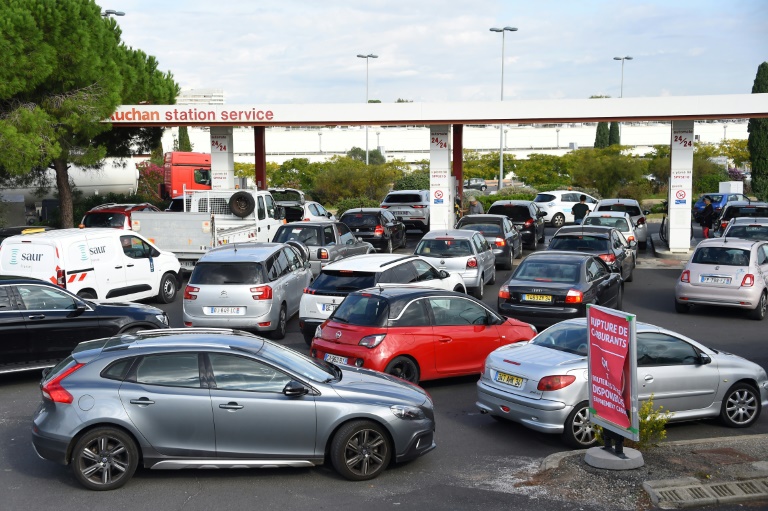
Motorists continued to besiege petrol stations many of which were low on, or out of, petrol, as strike action at energy giant TotalEnergies and other oil majors entered its third week and wage talks stalled.

Government ministers and President Emmanuel Macron have urged a negotiated resolution to the crisis, but on Tuesday government spokesman Olivier Veran threatened force to end the blockades which have paralysed several of France’s refineries and oil depots.

If blockades were not ended “immediately”, Veran told the RTL broadcaster, “we could intervene to lift them”.

He said ongoing action by the hard-left CGT union at TotalEnergies installations was “excessive and out of line”.

Also on Tuesday, Finance Minister Bruno Le Maire called breaking up the blockades “the only solution”.

– ‘They don’t respect us’ –

But stoppages continued at several refineries, including at France’s biggest near Le Havre in the north of the country, after strikers at TotalEnergies Tuesday voted to extend their action.

“We are still waiting for details from management on what they want to negotiate on,” Eric Sellini, coordinator for the CGT union at the oil major, told AFP.

The CGT at the French branch of Esso-ExxonMobil on Tuesday also renewed its strike call, even though it was outvoted on Monday by a majority of other union representatives who signed a pay deal.

The government said it would not tolerate continued stoppages at the company, and Prime Minister Elisabeth Borne said she would order the striking Esso-ExxonMobil workers to return to their posts or face prison or fines.

“Some unions, despite an agreement, want to continue the blockages,” she told parliament. “This, we cannot accept.”

She said “essential personnel” would be “requisitioned” to ensure the functioning of the oil depots. 

At Fos-sur-Mer, in southern France, home to refineries run by TotalEnergies and Esso, strikers said their working conditions had been getting worse for years.

“For the past 10 years we have not been getting the slightest recognition for our work,” said one worker who joined Esso 24 years ago.

“Not only don’t they pay us enough, they also don’t respect us,” agreed CGT spokesman Fabien Cros at the neighbouring TotalEnergies installation.

– ‘What a mess’ –

Motorists formed long queues outside petrol stations from dawn on Tuesday. In central Paris, traffic slowed as waiting cars blocked roads, cycle paths and pedestrian crossings, hoping to be served before the pumps went dry.

Many used social media to exchange tips. One post in a Facebook group Monday said that a local BP service station would be resupplied “at 2:30 pm”. Another replied: “It’s now 2:37 pm and they’re out of diesel.” 

Another user reacted: “What a mess.”

Jefferson Saint-Louis, a taxi driver, said that “without fuel we can’t work. I’m just going to go home”.

The petrol crisis comes at a time of high energy prices and inflation that are sapping French households’ purchasing power.

The left-wing opposition coalition Nupes has called for a “March against the high cost of living” in Paris and elsewhere on Sunday.

At the weekend, several prominent French people came out in support of the initiative, including this year’s winner of the Nobel Prize for Literature, Annie Ernaux.

– ‘An entire country hostage’-

Opposition politicians on the left were quick to criticise the government’s hardening stance Tuesday.

“With this government, when dialogue stalls, it’s threats for the wage earners and caresses for the bosses,” tweeted Manuel Bompard, a deputy for the leftwing LFI party.

Jordan Bardella, president of the far-right RN party, said that “super profits at Total and the salary of the chairman” made worker demands “not unreasonable”.

But Gilles Platret, vice president of the conservative LR party, backed the government’s tougher stance, saying strikers were “taking an entire country hostage”.

TotalEnergies posted a profit of $5.7 billion in the second quarter of the year, more than double the year-earlier figure.

CEO Patrick Pouyanne’s total compensation package was worth 5.9 million euros ($5.7 million) in 2021, up 52 percent from the previous year’s, according to the group’s annual report.

burs-jh/tgb/rl
Winter power shortages won't worry off-grid Swiss valley

While people across Europe are being urged to save energy this coming winter to avert power shortages, Switzerland’s Bavona Valley is unfazed, having never been plugged into the power network.

Located in the Italian-speaking Ticino region of southern Switzerland, the remote, glacially-carved valley following the Bavona river is one of the steepest in the Alps.

But there are 12 hamlets made up of stone dwellings scattered along the rugged valley which are home to a few dozen inhabitants for most of the year, except in winter when fewer than 10 stay on.

Eleven of the hamlets are not connected to the power grid, despite the area producing lots of electricity thanks to dams located high up near the mountain tops.

They were built after World War II to provide electricity for the German-speaking region of Switzerland over on the northern side of the Alps, said Romano Dado, a former local councillor in Cevio, the village at the lower end of the valley on which the hamlets depend.

Bringing power down into the valley would have required transformers, but “the people here didn’t have the money for that,” he told AFP. Only the last hamlet at the very top of the valley could afford this luxury.

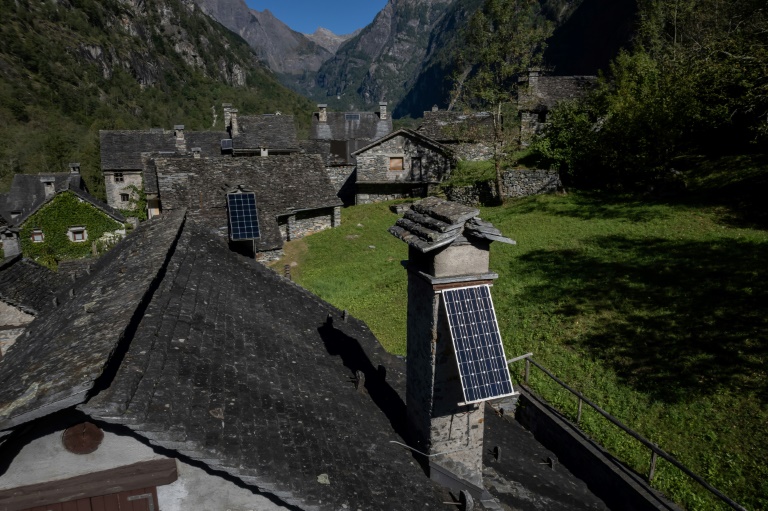
As the decades passed, the valley’s population shrank from around 500 to fewer than 50 now, according to Dado, and the inhabitants learned to get by without being on the electricity grid, making do with their fireplaces and installing solar panels on the roofs from as early as the 1980s.

– Oil lamps and candles –

Residents also use gas canisters, candles and oil lamps. To wash their clothes, “we go to the river, as always”, said Tiziano Dado, Romano’s stonemason brother.

The narrow valley, around 10 kilometres long (six miles) and flanked by towering slopes reaching more than 2,500 metres in altitude, has seen sometimes-fatal avalanches, floods and landslides throughout the centuries.

Seasonal migration to the summer pastures persisted in the area until the 1970s. 

Families went up the valley with their animals from March until the end of December, coming back down for Christmas, said Sonia Fornera, from Orizzonti Alpini, a group of experts in Alpine history and culture.

“It was a hard life but a simple life,” said Bice Tonini, 88, warming herself by the fireplace in her house.

Despite her age, she continues to live there from spring to October thanks to her solar panels.

“There is so much wastage of electricity” in modern society, she lamented.

At night, there are no street lights to prevent her from admiring the stars — and she enjoys the nightly show far more than watching television, which is a rare sight in the valley.

– Museum or dream? –

“We are used to living in a very simple way and we’re not afraid of making savings” in terms of energy, said Ivo Dado, 81, who proudly had solar panels installed in 1987.

The former farmer — no immediate relation to the Dado brothers — is delighted that some cities are giving up on their traditional festive illuminations this December.

“This Christmas will be as before, with less light. It will be beautiful again!” he said.

This sparing attitude towards electricity is not to everyone’s taste.

“Solar panels are a partial solution,” Martino Giovanettina, a writer and owner of one of the few restaurants in the valley, told AFP.

He believes the lack of electricity, plus the stringent rules for renovating old buildings, are contributing to depopulating the valley, turning it into an open-air “museum” of the past, instead of orientating towards tourism, as neighbouring valleys have done.

The Bavona Valley has no set-up for tourists at all, apart from a cable car from the last hamlet up to the dams, and the parking of motorhomes is banned.

Doris Femminis, a 2020 Swiss Prize for Literature winner, grew up in the valley and raised goats there during her 20s. Now she recounts the story of the Bavona Valley in her books.

Now living in the Jura mountains in western Switzerland, she returns every two months to this “wonderful place of one’s childhood”.

“In Switzerland, we like the idea of still having a corner of wild nature,” she said, but acknowledged that such places are not suited to modern life.

“It’s a place of the past,” she told AFP.

“Nobody wants to live there anymore; it’s just a dream.”

Defiant Ukraine reopens eastern rail link despite missiles

As Russia launched a huge wave of missile strikes against Ukrainian cities Monday, defiant rail workers in the east of the country managed to restore a severed rail link.

Angered by a truck bombing that damaged a bridge carrying Russia’s main road and rail link to the occupied Ukrainian region of Crimea, Moscow has stepped up strikes on civilian targets.

But, despite the savage bombardment, the passenger rail service between recently-occupied Izyum and Ukraine’s second city Kharkiv restarted after Russia’s February 24 invasion forced a seven-month closure.

“The trains will be running twice a day, every day,” said Izyum railway manager Andrei Gadyatskiy, standing in the rain in front of the boarded up windows of his partially burned station.

Any transport away from Ukraine’s eastern frontline will serve, for some, as a lifeline to the most basic necessities. 

“It will allow them to go to Kharkiv, to use their bank cards,” Gadyatskiy said.

Raisa Starovoytova came to the station on Monday because she could barely believe rumours that the train had returned. 

“I came to find out about the train because I will need to get back to Kharkiv,” she told AFP, relieved to confirm that she would be able to leave later in the week.

The 65-year-old retired teacher had returned to Izyum after the Russian retreat, to see what had happened to her home.

“They took everything they could… mattresses, bedding… I came to take the bedding at least, but it wasn’t there,” she said.

– Former airport shuttle –

There is no electricity to power the electric locomotives that once served the eastern network, and Russian missile attacks still regularly hit the marshalling yards in Kharkiv.

But a Ukrainian DPKr-3 diesel that once shuttled air travellers between the capital Kyiv and Boryspil international airport has been pressed into service, 600 kilometres (360 miles) east of its home.

In the early stages of the war, Izyum came under intense Russian shelling and the invading army occupied the city from early April until its liberation last month by Ukrainian forces.

After the Russian retreat, the discovery of a mass burial site and the corpses of torture victims made Izyum a byword for the alleged atrocities committed under Russian occupation.

Now the town once again has a link to the regional capital, Kharkiv, by the rail line, along with stops in former frontline towns like Savyntsi, Tsyganska and Balakliya along the way.

Mariya Tymofiyenko had not been to Balakliya since the start of the war.

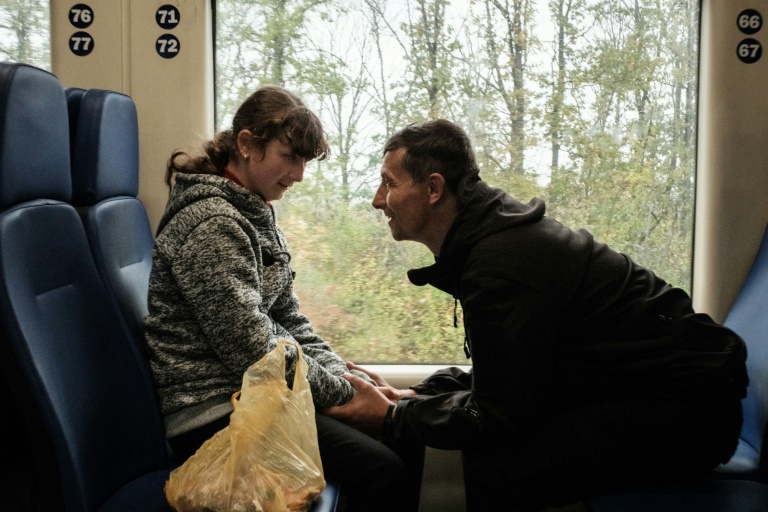
“I’m 73 years old and I still have to ride a bicycle because the buses are not running. It’s too far to walk,” she told AFP, on board the train as it wound its way through low wooded hills under leaden grey skies.

She hopes that Balakliya, where she has relatives, will prove a respite from the ruined town left behind by the Russian occupation of Izyum.

– ‘Tortured, beaten’ –

“I have no hope. If it’s like Izyum, I don’t know — here they broke into my flat, my garage. They stole everything. They ate all my preserves. They took all the tools,” she told AFP, blinking back tears.

“So many people died under the rubble. Apartments were destroyed, the schools. It was terrifying,” she said, wrapped up well against the first damp, chilly days of autumn.

“So many people were tortured, taken away, beaten. One man, my neighbour from one street over, was hanged,” she continued. 

“Yesterday, my granddaughter called me and said, ‘Grandma, I checked on the internet and the train to Balakliya will start again tomorrow.’ And I said, ‘OK, OK I will take it’.”

Families gather for cremation of Thai nursery attack victims

Devastated families gathered Tuesday for the cremation of their loved ones killed in a Thai nursery massacre that claimed 36 lives including 24 children.

Thailand has been left stunned by the tragedy in the northeastern province of Nong Bua Lam Phu, one of the worst mass killings in the country’s history.

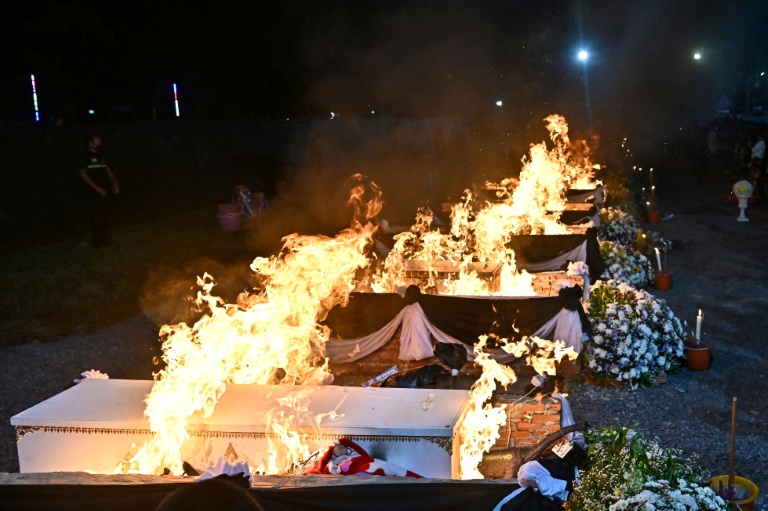
As night fell Tuesday at Wat Rat Samakee temple in the Na Klang district where the attack took place, the exhausted and grieving community said a final goodbye as 19 funeral pyres were set ablaze with monks chanting.

Police officers had carried the coffins outside in the dusky light, laying them on top of specially built brick pyres decorated with white and black fabric.

Sobbing families escorted the smallest of the coffins, placing portraits, toys and flowers beside them before the items were removed as the pyres were lit and the crowd quietened.

“An incident like this shouldn’t have happened,” said local Thanakorn Nueangmatcha, 39, ahead of the funeral.

“They were only children.”

Other victims of the attack will be cremated at different temples in the area.

A former police officer armed with a gun and knife went on a rampage through the nursery on Thursday before going on to kill his wife and child and taking his own life.

Prime Minister Prayut Chan-O-Cha visited the temple complex on Tuesday, taking part in a small ceremony while monks chanted, before travelling back to the Thai capital.

It followed a visit on Friday by King Maha Vajiralongkorn who met families of the victims in a hospital.

The funerals, sponsored by the royal household, end three days of rites that began Saturday.

The mass ceremony is highly unusual as bodies are normally cremated alone — but the area’s small local temples have been overwhelmed by the number of victims.

Temporary furnaces have also been set up at other nearby temples, local media reported.

– ‘The old way’ –

The close-knit rural community had already come together on Monday as volunteers, soldiers and officials mixed cement and spread gravel to prepare a field inside the temple complex for the cremations.

They were working to build the pyres in the style traditionally seen in Thailand’s northeast, said Maemon Meeyuan, grandmother of one of the victims.

“We’re doing it the old way,” she told AFP.

Prayut has ordered an investigation into the massacre, with police saying they intend to interview about 180 witnesses.

The attacker, 34-year-old sacked police sergeant Panya Khamrab, was dismissed from his post earlier this year on a drugs charge, with locals saying they suspected he was a methamphetamine addict.

However, preliminary tests found he did not have drugs in his system at the time of the killings.

At the temple ahead of the funerals, 75-year-old Komma Charoenchai said he was “still shocked” by the tragedy but added that people must “let authorities handle the matter”.

Alarm grows over Iran protest crackdown in Kurdish city

Rights groups voiced alarm Tuesday over the extent of an Iranian crackdown on a Kurdish-populated city that has become a hub for protests, as oil refinery workers took industrial action in a new tactic.

Iran’s clerical authorities have been shaken by over three weeks of protests that erupted after the death of Mahsa Amini, a 22-year old Iranian of Kurdish origin, who had been arrested by the notorious morality police.

Despite the use of brutal force by the authorities that activists say has left dozens dead, and led to hundreds of arrests, there is so far no sign of the protest movement coming to an end.

Protests have been especially intense in the city of Sanandaj in the western province of Kurdistan, Amini’s home region, where rights groups fear heavy casualties and accuse authorities of resorting to shelling of neighbourhoods.

The Norway-based Hengaw rights group said an Iranian warplane had arrived at the city’s airport overnight and buses carrying special forces were on their way to the city from elsewhere in Iran.

It said residents were having problems sending video evidence of events due to internet restrictions but said a seven-year-old had been killed on Sunday night. AFP could not immediately verify the claims.

Hengaw said at least seven people had been confirmed killed by the security forces in Sanandaj and other Kurdish-populated cities since Saturday. 

Amnesty International said it was “alarmed by the crackdown on protests in Sanandaj amid reports of security forces using firearms and firing teargas indiscriminately, including into people’s homes”.

On a visit to Sanandaj, Interior Minister Ahmad Vahidi reaffirmed Tehran’s position — strongly contested by rights groups — that the unrest had been “supported, planned and carried out by separatist terrorist groups”.

– ‘All together!’ –

The New-York based Center for Human Rights in Iran said there was a risk of a similar situation in Sistan-Baluchistan province in the southeast where activists say more than 90 people have been killed since September 30.

“The ruthless killings of civilians by security forces in Kurdistan province, on the heels of the massacre in Sistan-Baluchistan province, are likely preludes to severe state violence to come,” said its director Hadi Ghaemi.

Analysts have said the protests are proving particularly challenging for the authorities under supreme leader Ayatollah Ali Khamenei, 83, due to their duration and multi-faceted nature, ranging from street demonstrations to individual acts of defiance.

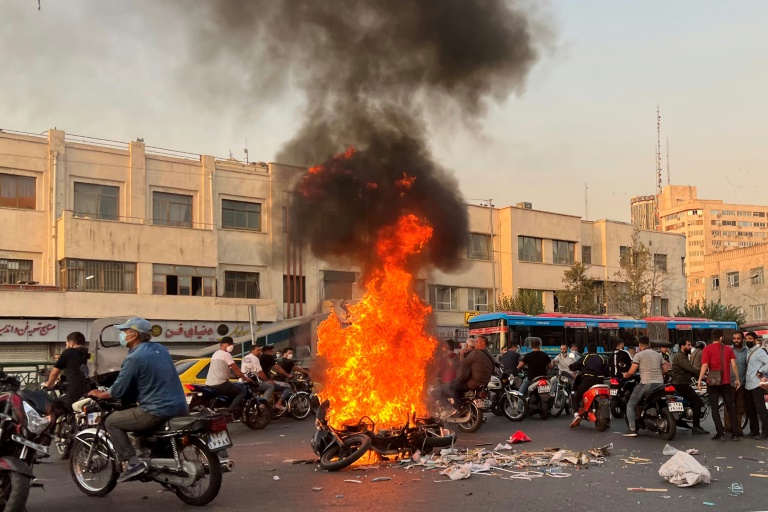
In a new development on Monday, protests spread to Iran’s oil refineries with videos showing striking workers burning tyres and blocking roads outside the Asalouyeh petrochemical plant in the southwest.

They could also be heard shouting slogans including “Death to the dictator” and “Don’t be scared, we are all together!”.

Similar actions were in progress on Tuesday with Oslo-based group Iran Human Rights (IHR) saying strikes were in progress in Abadan in western Iran and Bushehr to the south.

State news agency IRNA denied there was any strike action in the area. The governor of Asalouyeh, Ali Hashemi, told the Fars news agency that “opportunists” who had caused fires in the area had been arrested.

University campuses and even school classrooms have also seen repeated protests, with students at the Amir Kabir University of Technology in Tehran on Monday shown chanting anti-regime slogans.

In a video shared by the 1500tasvir social media channel that monitors protests and police violations, students at the Tehran Art University were shown spelling out the Persian word for blood in a human chain.

– ‘Vain effort to silence’ –

The crackdown on the protests sparked by Amini’s death on September 16 has claimed at least 95 lives, according to IHR.

Activists say that among those who died in the protests are two teenage girls, Nika Shakarami and Sarina Esmailzadeh. Their families say they were killed by security forces after being detained. Authorities insist they died in falls.

UNICEF executive director Catherine Russel said: “We are extremely concerned by continuing reports of children and adolescents being killed, injured and detained.”

The crackdown has prompted international condemnation with US National Security Advisor Jake Sullivan telling Iran the “world is watching” and “will hold responsible those using violence in a vain effort to silence” protesters.

Britain said Monday it had imposed sanctions on Iran’s morality police, the unit which arrested Amini and enforces strict dress rules for women including the compulsory headscarf.

Iran said it has summoned the British ambassador to protest against the “baseless” sanctions.

French Foreign Minister Catherine Colonna said on Tuesday that five French citizens are currently being held in Iran. Paris had previously said four French were held. According to the Iranian intelligence ministry, at least one of nine foreigners Iran is holding over links to the protests is French.

Turkey calls for Russia, Ukraine truce ahead of Erdogan-Putin meeting

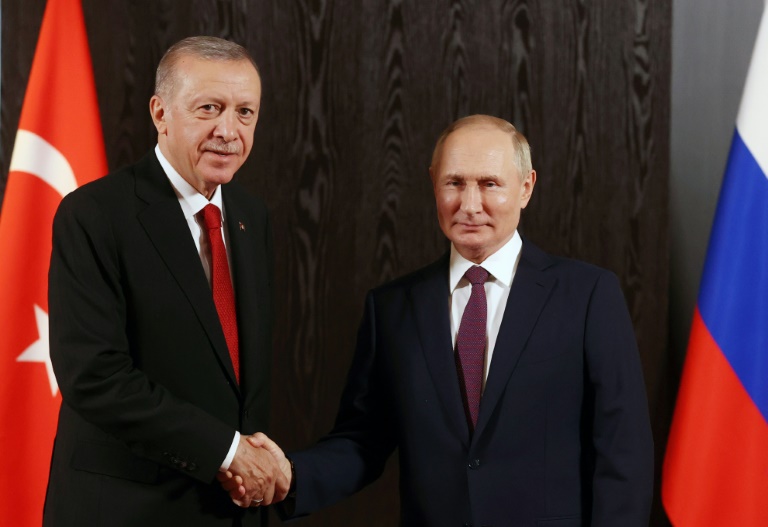
Turkey on Tuesday called for a ceasefire in Ukraine just days ahead of a likely meeting between the leaders of Turkey and Russia in the Kazakh capital Astana. 

Turkish President Recep Tayyip Erdogan, who won plaudits for securing a grain deal as well as Russia-Ukraine prisoner swap, has long sought to bring together Kyiv and Moscow for truce talks that neither side particularly wants. 

NATO member Turkey, which has stayed neutral throughout the conflict in Ukraine, has good relations with its two Black Sea neighbours — Vladimir Putin’s Russia and Ukraine. 

“Unfortunately (both sides) have quickly moved away from diplomacy” since the talks between Russian and Ukrainian negotiators in Istanbul in March, Foreign Minister Mevlut Cavusoglu said in a televised interview. 

“As the Ukraine-Russian war drags on, unfortunately, the situation gets worse and more complicated,” added the Turkish diplomat, who called for an immediate ceasefire. 

“A ceasefire must be established as soon as possible. The sooner the better,” he said. 

-‘Viable ceasefire’-

Erdogan, who has a good working relationship with Putin despite disagreements on several issues including in Syria, is likely to meet with the Russian leader in Astana on Thursday, a Turkish official told AFP speaking on condition of anonymity. 

Turkey has refrained from joining Western sanctions against Russia.

Erdogan, who met Putin on the sidelines of a regional summit in Uzbekistan last month, is keen to boost trade with Moscow as he tries to stabilise the battered Turkish economy in the run up to elections next June.

Ankara has bowed to pressure from the United States and confirmed the last three Turkish banks still processing Russian bank card payments were pulling the plug. 

The decision followed weeks of increasingly blunt warnings from Washington for Turkey to either limit economic ties with Russia or face the threat of sanctions itself.

Erdogan has not yet commented on mass Russian strikes across Ukraine on Monday, which Ukrainian emergency services said killed at least 19 people and wounded more than 100. 

Cavusoglu held a telephone call with Ukrainian counterpart Dmytro Kuleba after the attacks, a Turkish diplomatic source said, without elaborating further.

During the interview on Tuesday, Cavusoglu called for a “just peace” based on Ukraine’s territorial integrity. 

“There must be a just peace for Ukraine. Where is the war going on? It’s going on on Ukrainian soil,” he said. 

“A process that will ensure Ukraine’s border and territorial integrity should start. Without a ceasefire, it is not possible to talk about those issues in a healthy way: a viable ceasefire and a just peace.”

Turkey has rejected Russia’s annexation of four Ukrainian provinces as a “grave violation” of international law and called for negotiations to end the conflict.

Russia fires missile salvo on Ukraine before G7 meeting

Russia said on Tuesday it launched “mass” strikes on Ukraine hours ahead of a G7 meeting expected to condemn an earlier missile blitz that Kyiv’s allies said was a mark of Moscow’s desperation.

Officials in Ukraine’s western region of Lviv said at least three Russian missiles targeted energy infrastructure and the mayor of the region’s main city, also called Lviv, said about one-third of the city was without power.

Russia’s defence ministry confirmed the attacks saying it had carried out massive strikes using long-range and high-precision weapons and that “all assigned targets were hit”.

The G7 meeting comes a day after Russian missiles rocked the Ukrainian capital for the first time in months. President Volodymyr Zelensky was defiant, warning his country “cannot be intimidated”.

Moscow’s forces rained down more than 80 missiles on cities across Ukraine on Monday, according to Kyiv.

Ukraine’s emergency services said on Tuesday that the overall toll had risen to 19 dead and more than 100 people wounded.

The United Nations said on Tuesday the wave of attacks may have violated the laws of war and would amount to war crimes if civilians were deliberately targeted.

Monday’s mass barrage came in apparent retaliation for an explosion on Saturday that damaged a key bridge linking Russia to Crimea, a peninsula Moscow annexed from Ukraine in 2014.

Russian President Vladimir Putin blamed Ukraine for the bridge blast and warned of “severe” responses to any further attacks.

Ukrainian Foreign Minister Dmytro Kuleba said the strikes on Monday showed Moscow was “desperate” after a spate of embarrassing military setbacks.

Turkey on Tuesday called for a viable ceasefire between Russia and Ukraine “as soon as possible”, with Turkish President Recep Tayyip Erdogan expected to meet Putin this week.

Speaking in a televised interview, Turkish Foreign Minister Mevlut Cavusoglu also called for a “just peace” based on Ukraine’s territorial integrity. 

At an urgent meeting of the UN General Assembly on Monday Ukrainian ambassador Sergiy Kyslytsya branded Russia a “terrorist state”, noting his own immediate family had come under attack on Monday.

The meeting was called to debate Moscow’s declared annexation of four partly occupied Ukrainian regions.

– ‘Stay the course’ –

Residents across Ukraine expressed shock and rage after Monday’s barrage.

In Dnipro, Ukrainian serviceman Maxim was on leave from the front lines for the first time in six months to celebrate his wife’s birthday when Russian missiles slammed into the central Ukrainian city, damaging their home.

“We are fighting on the front exactly to protect these places” far from enemy lines, he said. “But they still manage to hit them.”

The strike, he said, had made him more determined than ever to repel the Russian forces in northeastern Ukraine.

Zelensky and G7 leaders were set to convene via video link at 1200 GMT on Tuesday to discuss the latest Russian attacks.

– ‘A profound change’ –

The office of UK Prime Minister Liz Truss said she would use the gathering “to urge fellow leaders to stay the course”.

“Nobody wants peace more than Ukraine. And for our part, we must not waver one iota in our resolve to help them win it.”

German government spokesman Steffen Hebestreit told reporters on Monday that Chancellor Olaf Scholz had spoken with Zelensky and assured him “of the solidarity of Germany and the other G7 states”.

French President Emmanuel Macron convened his defence and foreign affairs ministers over the strikes, which he said signalled “a profound change in the nature of this war”.

US President Joe Biden condemned Monday’s attacks in stark terms, saying they demonstrated “the utter brutality” of Putin’s “illegal war”.

In a statement, the White House said Biden had spoken to Zelensky and had pledged to furnish Ukraine with “advanced air defence systems”. 

Though Russia’s UN representative Vasily Nebenzya did not directly address the missile strikes at the session, he defended his country’s annexation of Ukrainian regions, saying the aim was “to protect our brothers and sisters in eastern Ukraine”.

Putin meanwhile was due to meet the head of the UN’s nuclear energy watchdog, Rafael Grossi, in Saint Petersburg on Tuesday to discuss the Russian-controlled nuclear plant in the Ukrainian region of Zaporizhzhia.

Fighting around the facility for months has raised fears of a nuclear accident.

bur/gw

Equities, oil prices slump on recession fears

Stock markets and oil prices slumped Tuesday as investors grow increasingly fearful that more big interest rate hikes will tip economies into deep recessions.

The mood darkened also on the worsening Ukraine war and weaker demand expectations in China.

With the focus on inflation, analysts said US consumer price index data released later this week will be crucial to the direction of risk assets. 

Another big reading could spark a fresh equity selloff and surge in the dollar.

“There is growing pessimism in the markets now and with some big data points to come from the US this week, not to mention the start of earnings season,” noted Craig Erlam, analyst at Oanda trading group.

“Investors should probably brace for more volatility.”

Traders had hoped that bumper rate increases by the US Federal Reserve this year would begin to drag on the economy and slow runaway prices, allowing policymakers to reduce the pace of monetary tightening.

But a forecast-beating US jobs report on Friday highlighted the tough work the country’s central bank has slowing inflation from four-decade highs, and many observers warn recession is virtually inevitable.

– ‘Real danger’ –

World Bank chief David Malpass said there was a “real danger” of a global contraction next year, adding that the surge in the dollar was weakening the developing nations’ currencies and pushing their debt to “burdensome” levels.

And JP Morgan boss Jamie Dimon told CNBC that while the US economy was holding up, it faced several headwinds including rising rates, surging inflation, Fed tightening and the Ukraine war.

He added that he saw a US recession in six to nine months, and that the S&P 500 could fall another 20 percent.

Barings strategist Christopher Smart said: “It’s little wonder investors enter the week in a dreary mood, especially with headlines from Ukraine signalling a further escalation in geopolitical tensions.

“Of course, markets are meant to look ahead, but it’s hard not to see the next few quarters bringing more of the same.”

Chip manufacturers globally took a pounding from new US export controls aimed at restricting China’s ability to buy and make high-end chips with military applications.

The Philadelphia Stock Exchange Semiconductor Index saw its lowest close since late 2020, while Bloomberg News reported that $240 billion had been slashed from companies’ market values worldwide.

– Dollar steady –

Taipei led the losses in Asia — diving more than four percent — as chip giant TSMC plunged 8.3 percent, while a hefty selloff in Samsung Electronics dragged Seoul down 1.6 percent. Tokyo was also sharply lower owing to a hit to tech firms.

All three markets had been closed Monday and were reacting to Friday’s US announcement for the first time.

On currency markets, the dollar steadied after recent strong gains as the US heads the monetary tightening drive.

The pound remained under pressure, despite the Bank of England unveiling further measures to calm markets rocked by a UK budget, saying it would extend purchases of government bonds.

– Key figures around 1045 GMT –

London – FTSE 100: DOWN 1.1 percent at 6,884.70 points

Frankfurt – DAX: DOWN 0.9 percent at 12,165.15

Paris – CAC 40: DOWN 0.7 percent at 5,801.48

EURO STOXX 50: DOWN 0.9 percent at 3,328.03

Tokyo – Nikkei 225: DOWN 2.6 percent at 26,401.25 (close)

Hong Kong – Hang Seng Index: DOWN 2.2 percent at 16,832.36 (close)

Shanghai – Composite: UP 0.2 percent at 2,979.79 (close)

New York – Dow: DOWN 0.3 percent at 29,202.88 (close)

Euro/dollar: UP at $0.9710 from $0.9708 on Monday

Pound/dollar: UP at $1.1060 from $1.1059 on Monday

Euro/pound: FLAT at 87.76 pence

Dollar/yen: DOWN at 145.68 yen from 145.72 yen

West Texas Intermediate: DOWN 2.4 percent at $88.98 per barrel

Brent North Sea crude: DOWN 2.2 percent at $94.10 per barrel

Shielding Ukraine from Russian strikes a challenge: analysts

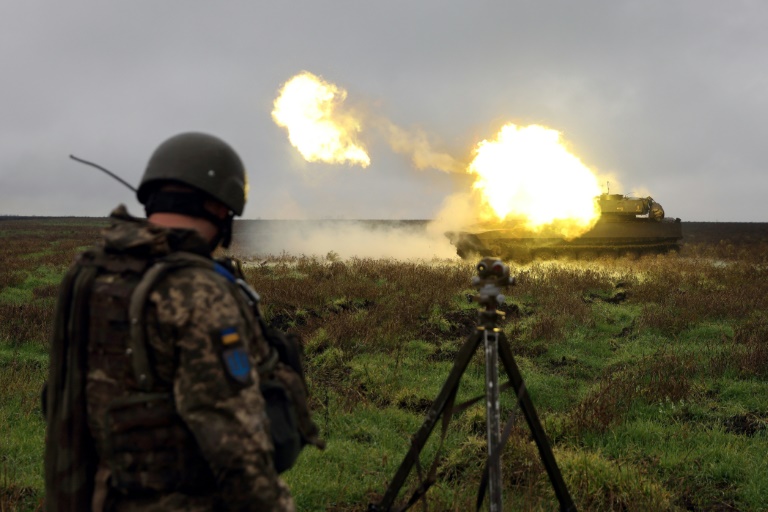
Russia’s deadly air strikes on Ukraine’s cities this week have triggered calls for more military aid, but analysts warn than no air-defence systems can completely defend Ukrainian territory.

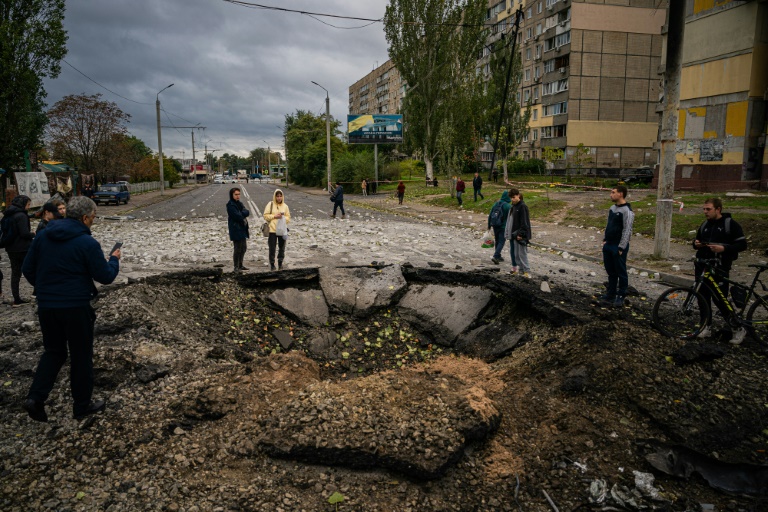
Kyiv says a barrage of Russian strikes across the country on Monday killed at least 19 people, wounded more than 100, and damaged infrastructure.

Missiles including cruise missiles rained down on the country’s cities, including in rare strikes on the capital Kyiv, far from the frontlines in the east and south.

Ukraine also accused Russia of using Iranian-made drones launched from neighbouring Belarus and Russia-annexed Crimea.

While Kyiv says its army managed to shoot down more than half of these, Prime Minister Denys Shmygal has called for “more modern weapons to protect the sky and civilians”.

“The cries for Western air defences around Ukrainian population centres will become much louder after” Monday’s strikes, said Tyler Rogoway, editor of the The War Zone website.

“Cruise missiles are a challenge though — even for modern Western air defence systems,” he added in a Twitter thread, as they are not “an impenetrable shield”. 

Francois Heisbourg, of the International Institute for Strategic Studies (IISS), warned hard choices would have to be made about where best to concentrate defensive weapons.

“What infrastructure and what population centres should be defended, and how efficiently? Defending everything would amount to defending nothing.”

Even in Israel, a country with an area 27-times smaller than Ukraine, the Iron Dome air defence system is not 100 percent effective.

– ‘No one-size-fits-all system’ –

Nicholas Fiorenza, of the British intelligence analysis firm Janes, said full coverage was unlikely.

“Don’t think there is any country capable of stopping (every) single possible missile or UAV (unmanned aerial vehicle) or a plane getting through,” he told AFP.

The Ukrainian defence ministry said Monday that Russia had Russia fired 83 missiles at Ukraine, of which its air defences shot down 52, among which were 43 cruise missiles.

The Russians appear to have fired short-range Iskander and Tochka-U ballistic missiles, as well as Kalibr cruise missiles, said Gustav Gressel of the European Council on Foreign Relations.

The Ukrainians have S-300 air defence system and others, some of which are running low on munitions. To fend off the drone attacks, it also has Man-portable air-defence systems (MANPADS).

“However defending large cities with MANPADS would require lots of launchers, due to their short range,” Gressel said.

More broadly, “there is no (one-size-fits-all) weapons system to defend (Ukraine), as the targets are fairly different in speed, course, altitude, and numbers,” he added.

“Air defences need to be layered, and different weapons system supporting each other.” 

This was the case around Kyiv in March and April, he said. 

“They intercepted several Tochka-Us and Kalibr missiles, although of course not all in one attack.”

– ‘No impact before spring’ –

Following Monday’s attacks, the United States said it was preparing shipment of “advanced medium- and long-range air defence capabilities” to Ukraine.

Germany promised delivery “in the coming days” of the first Iris-T missile shield system reportedly able to protect a large city. 

Its range spans a height of 20 kilometres (12 miles) and a breadth of 40 kilometres (25 miles).

Berlin’s Defence Minister Christine Lambrecht said the latest Russian strikes highlighted “the importance of the rapid delivery of air defence systems to Ukraine”.

But the contract for the Iris-T systems includes 12 weeks of training Ukrainians to use them, Fiorenza warned. 

“I don’t see them starting to have an impact before next spring,” he said. 

Pressure will also be on Western arms manufacturers to produce air defence weaponry, long put on the back burner as it was deemed less useful in the battle against jihadists from Afghanistan to the Sahel.

Wojciech Lorenz, head of the international security programme at the Polish Institute of International Affairs, said air and missile defence systems were “unfortunately in short supply in the West”.

“But we should find what we can send to further strengthen Ukrainian morale and to limit the destruction if Russia decides to attack civilian targets” across Ukraine, he said.

Michael O’Hanlon, of the Brookings Institution, said air and missile defence systems were “expensive and not fool-proof”, but essential.

“And just as Israel’s Iron Dome has shown over the years, they can give a besieged population a greater sense of hope even when their 100 percent effectiveness cannot be presumed,” he added.

BoE widens action on 'UK financial stability' fears

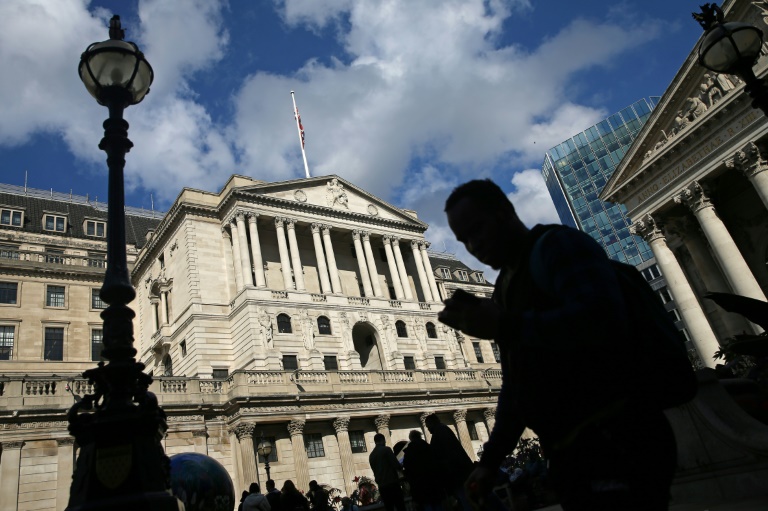
The Bank of England on Tuesday unveiled yet more measures aimed at calming markets rocked by a UK budget as it warned over risks to the nation’s financial stability.

The week had already seen action taken by the BoE and UK government aimed at bringing calm to bond markets in particular as state borrowing soars.

The moves are a response to soaring UK bond yields and after the pound tumbled to a record low against the dollar since the government of new Prime Minister Liz Truss unveiled debt-fuelled tax cuts in a budget last month.

A day after it launched a temporary facility aimed at easing liquidity pressures, the central bank Tuesday said it was widening the scope of daily purchases of UK government bonds, or gilts, until Friday.

In a statement, the BoE said the latest action would “act as a further backstop to restore orderly market conditions”. 

It noted that “the beginning of this week has seen a further significant repricing of UK government debt, particularly index-linked gilts”, which the central bank will now purchase under its wider operation of bond purchases.

“Dysfunction in this market, and the prospect of self-reinforcing ‘fire sale’ dynamics pose a material risk to UK financial stability,” it added.

Tuesday’s intervention by the BoE resulted in a small drop in yields, while the pound steadied versus the dollar.

“The key sticking point is that the support measures are only scheduled to last until Friday,” noted AJ Bell investment director Russ Mould.

“Extending it could go one of two ways — the market either applauds the move and breathes a sigh of relief or it gets even more worried, thinking that the extra time suggests the crisis is more severe than originally thought.”

– Unemployment down –

In some positive news, official data Tuesday revealed British unemployment fell to a near 50-year low at 3.5 percent.

Wages, however, continue to be eroded by decades-high inflation that threatens to send Britain into recession.

The British government on Monday brought forward key growth and inflation forecasts to Halloween, hoping not to spook markets further.

Finance minister Kwasi Kwarteng will unveil debt-reduction plans and UK economic predictions on October 31 rather than in late November.

It comes after Kwarteng was already forced to axe a tax cut for the richest earners, in the face of outrage as millions of Britons face a cost-of-living crisis with UK inflation around 10 percent.

– ‘Painful cuts’ –

Britain meanwhile faces “big and painful” cuts in public spending to fix state finances should it decide against more U-turns over tax cuts, a leading think tank warned Tuesday.

“With a weaker economy, getting government finances on a sustainable path without cancelling tax cuts could force… big and painful spending cuts,” the Institute for Fiscal Studies said in a study.

Reducing debt “through spending cuts alone, without actually specifying which budgets would be cut, risks stretching credulity to breaking point”, it added.

The budget was widely criticised, including by the International Monetary Fund, over fears that government debt would balloon to pay for the tax cuts, including on salaries of all UK workers.

Fitch last week lowered the outlook on its credit rating for British government debt to negative from stable.

The BoE has piled on further pressure by hiking its main interest rate to a 14-year high of 2.25 percent in a bid to cool inflation — and is expected to go even stronger on tightening next month.

This in turn has seen retail banks ramp up interest rates on mortgages, with analysts predicting heavy price falls for property.

Close Bitnami banner
Bitnami