World

Austrian president re-elected on promises of stability

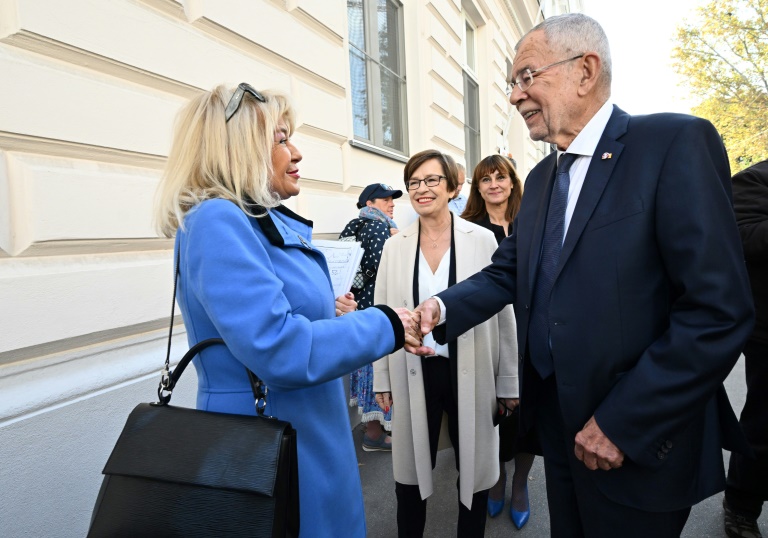
Austrian President Alexander Van der Bellen has been re-elected, projections showed Sunday, after campaigning on promises of stability as the Alpine country struggles with an energy crisis and inflation.

The 78-year-old incumbent swept 56.1 percent of the votes with six other candidates — all men — lagging far behind, according to projections published by the SORA polling institute.

Campaigning on a slogan of “clarity” and “stability”, Van der Bellen had been widely tipped to clinch a second mandate in the first round and avoid a run-off.

“Now it’s time to look ahead together… The tasks ahead of us are great,” the economics professor and pro-European liberal said in a video message on Facebook, vowing to start to work right away on Monday.

– ‘Consistency’ –

Some 6.4 million people were eligible to cast their ballots from the European Union country’s total population of nine million.

The presidential post, which has a term of six years, is largely ceremonial. 

The final official result is not expected until Monday.

Van der Bellen will be Austria’s oldest head of state to be sworn in.

“I am in favour of consistency,” 73-year-old retiree Monika Gregor told AFP outside a Vienna polling station earlier Sunday, saying she had voted for Van der Bellen and thought he was “very clever”.

Posters proclaimed the former Greens leader to be “the safe choice in stormy times” as the ripple effects of Russia’s invasion of Ukraine push up inflation throughout Europe.

Van der Bellen was running as an independent, but he had the explicit or implicit backing of Austria’s major parties except the far-right Freedom Party (FPOe). 

The latter fielded its own candidate, Walter Rosenkranz who, according to the projections, got 17.9 percent.

Also standing for the presidency was 35-year-old punk rocker Dominik Wlazny, founder of the Beer Party, named for its advocacy of the popular beverage.

He came in third place with 8.4 percent, according to the projections.

Alexander Nittmann, 35, a software developer, said he had voted for Wlazny, hoping he would bring “a breath of fresh air”.

Van der Bellen — who supporters affectionately call “the professor” — faced an unexpectedly tough fight in 2016, only winning the race in a run-off against an FPOe politician.

But the FPOe’s ratings have plummeted since 2019, following a corruption scandal that brought down the government they were part of and led to the resignation of then-chancellor Sebastian Kurz in 2021.

Analyst Thomas Hofer said ahead of Sunday’s vote that it was “crucial” for Van der Bellen to avoid a run-off such as that of 2016, when the campaign was “very divisive and hostile”.

– Trademark professorial manner –

“Van der Bellen stands for integrity and stability, which is very appreciated by voters given the multitude of crises that many European countries are currently facing,” Julia Partheymueller, a political analyst at the University of Vienna, told AFP.

Van der Bellen — also known as “Sasha”, a nickname that nods to his Russian roots — was born in Vienna during World War II to an aristocratic Russian father and an Estonian mother who fled Stalinism.

The arrival of the Red Army a year later forced the family to escape to the southern state of Tyrol, where Van der Bellen spent an “idyllic childhood”.

Van der Bellen — known for his trademark professorial manner — studied economics at the University of Innsbruck and finished his PhD in 1970 before going on to become dean of economics at the University of Vienna.
Hurricane Julia slams Nicaragua, menaces Central America

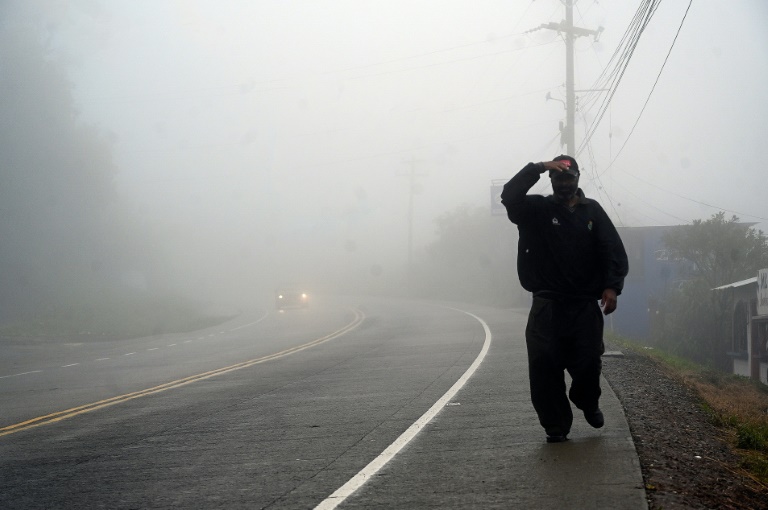
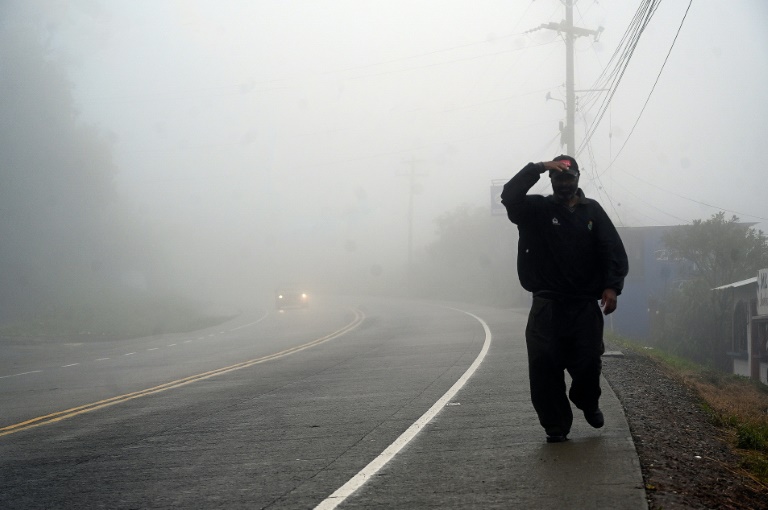
Hurricane Julia raked across Nicaragua Sunday, lashing the country with winds and heavy rain and bringing potentially life-threatening flash flooding and mudslides to much of Central America.

Maximum sustained winds were estimated at 85 miles per hour (140 kph) when the storm made landfall near the Laguna de Perlas area at 0715 GMT, the country’s weather agency said.

By late morning, the fifth Atlantic hurricane of the season had weakened slightly to a tropical storm with top sustained winds at near 70 miles per hour as it churned westward across Nicaragua.

But the US National Hurricane Center warned that Julia — whose center was some 65 miles northeast of the capital Managua at 1500 GMT — was still packing a punch, not just for Nicaragua but for neighboring countries.

“This rainfall may cause life-threatening flash floods and mudslides across Central America today and Monday,” with dangerous conditions also reaching southern Mexico, the NHC said in its latest advisory.

Julia was expected to emerge off the Pacific coast by Sunday evening, then shift northwestward to “parallel the Pacific coasts of Honduras, El Salvador and Guatemala tonight and Monday.”

Maintaining its tropical storm strength, Julia is forecast to produce five to 10 inches (12.7 to 25.4 centimeters) of rain in Nicaragua and El Salvador, with isolated pockets receiving as much as 15 inches.

Hours earlier in Bluefields, Nicaragua, one of the main coastal towns buffeted by the storm, fishermen had been busy safeguarding their boats as people rushed to buy groceries and withdraw money from ATMs.

Hurricane-force winds and heavy rains began to be felt around midnight, according to AFP photographers in the city, while state media reported detached roofs, fallen trees and power outages.

Before reaching Nicaragua, Julia passed over a trio of Colombian islands, an environment ministry official told AFP, causing rain and lightning in the country’s north.

Julia was a Category 1 hurricane, on the low side of the five-tier Saffir-Simpson wind scale, when it roared ashore in Nicaragua.

Authorities have evacuated some 6,000 people in Laguna de Perlas, in the Miskito keys located off the coast, and in other zones.

“We have to prepare with food, plastic, a little bit of everything, because we don’t know what’s going to happen,” Javier Duarte, a cabinetmaker in Bluefields, told AFP.

The municipality of some 60,000 inhabitants has many flimsy structures.

Julia’s arrival in Central America comes less than two weeks after deadly Hurricane Ian crashed into the southeastern US state of Florida, in one of the most powerful US hurricanes on record.

The Category 4 storm flattened entire neighborhoods on the Sunshine State’s southwest coast. More than 100 people were killed, according to US media.

Hurricane Julia slams Nicaragua, menaces Central America

Hurricane Julia raked across Nicaragua Sunday, lashing the country with winds and heavy rain and bringing potentially life-threatening flash flooding and mudslides to much of Central America.

Maximum sustained winds were estimated at 85 miles per hour (140 kph) when the storm made landfall near the Laguna de Perlas area at 0715 GMT, the country’s weather agency said.

By late morning, the fifth Atlantic hurricane of the season had weakened slightly to a tropical storm with top sustained winds at near 70 miles per hour as it churned westward across Nicaragua.

But the US National Hurricane Center warned that Julia — whose center was some 65 miles northeast of the capital Managua at 1500 GMT — was still packing a punch, not just for Nicaragua but for neighboring countries.

“This rainfall may cause life-threatening flash floods and mudslides across Central America today and Monday,” with dangerous conditions also reaching southern Mexico, the NHC said in its latest advisory.

Julia was expected to emerge off the Pacific coast by Sunday evening, then shift northwestward to “parallel the Pacific coasts of Honduras, El Salvador and Guatemala tonight and Monday.”

Maintaining its tropical storm strength, Julia is forecast to produce five to 10 inches (12.7 to 25.4 centimeters) of rain in Nicaragua and El Salvador, with isolated pockets receiving as much as 15 inches.

Hours earlier in Bluefields, Nicaragua, one of the main coastal towns buffeted by the storm, fishermen had been busy safeguarding their boats as people rushed to buy groceries and withdraw money from ATMs.

Hurricane-force winds and heavy rains began to be felt around midnight, according to AFP photographers in the city, while state media reported detached roofs, fallen trees and power outages.

Before reaching Nicaragua, Julia passed over a trio of Colombian islands, an environment ministry official told AFP, causing rain and lightning in the country’s north.

Julia was a Category 1 hurricane, on the low side of the five-tier Saffir-Simpson wind scale, when it roared ashore in Nicaragua.

Authorities have evacuated some 6,000 people in Laguna de Perlas, in the Miskito keys located off the coast, and in other zones.

“We have to prepare with food, plastic, a little bit of everything, because we don’t know what’s going to happen,” Javier Duarte, a cabinetmaker in Bluefields, told AFP.

The municipality of some 60,000 inhabitants has many flimsy structures.

Julia’s arrival in Central America comes less than two weeks after deadly Hurricane Ian crashed into the southeastern US state of Florida, in one of the most powerful US hurricanes on record.

The Category 4 storm flattened entire neighborhoods on the Sunshine State’s southwest coast. More than 100 people were killed, according to US media.

Iran state TV hacked with image of supreme leader in crosshairs

Hackers supporting Iran’s wave of women-led protests interrupted a state TV news broadcast with an image of gun-sight crosshairs and flames over an image of supreme leader Ayatollah Ali Khamenei, in footage widely shared online on Sunday.

In other anti-regime messages, activists have spray-painted “Death to Khamenei” and “The police are the murderers of the people” on billboards in Tehran.

“The blood of our youths is on your hands,” read an on-screen message that flashed up briefly during the TV broadcast Saturday evening, as street protests sparked by the death of Mahsa Amini, 22, again rocked Tehran and other cities.

“Police forces used tear gas to disperse the crowds in dozens of locations in Tehran,” state news agency IRNA reported, adding that the demonstrators “chanted slogans and set fire to and damaged public property, including a police booth”.

Anger has flared since the death of Amini on September 16, three days after she was arrested by the notorious morality police for an alleged breach of the Islamic republic’s strict dress code for women.

“Join us and rise up,” read another message in the TV hack claimed by the group Edalat-e Ali (Ali’s Justice).

It also posted pictures of Amini and three other women killed in the crackdown that has claimed at least 95 lives according to Norway-based group Iran Human Rights.

Another 90 people were killed in Iran’s far southeast, in unrest on September 30 sparked by the alleged rape of a teenage girl by a police chief in Sistan-Baluchestan province, said IHR, citing the UK-based Baluch Activists Campaign.

One Islamic Revolutionary Guard Corps member was killed Saturday in Sanandaj, Kurdistan province, and a member of the IRGC’s Basij paramilitary force died in Tehran from “a serious head injury following an armed attack by a mob,” IRNA said — in killings that raised the death toll among security forces to 14.

– Bloody crackdown –

Iran has been torn by the biggest wave of social unrest in almost three years, which has seen protesters including university students and even young schoolgirls chant “Woman, Life, Freedom”.

In Amini’s hometown Saqez, Kurdistan, schoolgirls chanted and marched down a street waving their hijab headscarves in the air, in videos the Hengaw rights group said were recorded on Saturday.

Gruesome footage has emerged from the state’s often bloody response, spread online despite widespread internet outages and blocks on all the major social media platforms.

One video shows a man who was shot dead at the wheel of his car in Sanandaj, Kurdistan’s capital, where the province’s police chief, Ali Azadi, later charged he was “killed by anti-revolutionary forces”.

Angry men then appear to take revenge on a member of the feared Basij militia, swarming him and beating him badly, in another widely shared video.

Yet another video clip shows a young woman said to have been shot dead in Mashhad in the country’s northeast.

Many on social media said it evoked images of Neda Agha Soltan, a young woman who became an enduring symbol of the Iranian opposition after she was shot dead at protests in 2009.

– ‘Not afraid anymore’ –

In the face of the violence and the online restrictions, protesters have adopted new tactics to spread their message of resistance in public spaces.

“We are not afraid anymore. We will fight,” read one large banner placed on an overpass of Tehran’s Modares highway, seen in images verified by AFP.

In other footage, a man with a spray can is seen altering the wording of a government billboard on the same highway from “The police are the servants of the people” to “The police are the murderers of the people”.

Several water features in the Iranian capital were said to have been coloured blood-red, although the head of city’s municipality parks organisation Ali Mohamad Mokhtari insisted that “this information is completely false”.

Iran has accused outside forces of stirring up the protests, as solidarity rallies have been worldwide. The United States, European Union and other governments have imposed new sanctions on Iran.

Iranian army commander Abdolrahim Mousavi said the force “will not permit any interference and aggression by any foreign powers in the country’s internal affairs”, IRNA reported Sunday.

IRNA also said students at universities in Tehran and in Bushehr in the country’s south organised gatherings to condemn “the actions of rioters”.

Iranian pop singer Shervin Hajipour — who was arrested after his song “Baraye” went viral online and became a protest anthem — appeared back in an Instagram video Sunday for the first time since his release.

In a short message, the 25-year-old denied links to any “movement or organisation outside the country” and said his song was only meant to “express solidarity with the people”.

burs/sjw-fz/lg/pjm

Fake heiress Anna Sorokin vows to fight deportation to Germany

Anna Sorokin, the young Russian-German woman who bilked wealthy New Yorkers while pretending to be an heiress herself, has said she would fight deportation to Germany after her recent release from prison.

The 31-year-old Sorokin, whose extraordinary story inspired a fictionalized series on Netflix and who has been a social-media phenomenon, was freed on bail late Friday and immediately placed under house arrest, with an ankle bracelet confining her to her modest Manhattan apartment.

She had spent the last year and a half in a detention center north of New York City operated by the US Immigration and Customs Enforcement agency, known as ICE, convicted of overstaying her tourist visa. 

Sorokin was first arrested in 2017, then sentenced in 2019 to two years in a New York detention center on charges including grand larceny. No sooner had she served that sentence — she was released early for good behavior — than ICE agents detained her.

Since February she has faced a deportation order to Germany, but in a weekend interview in her Manhattan building with The New York Times, Sorokin said she was fighting to stay in the United States.

“Letting them deport me would have been like a sign of capitulation — confirmation of this perception of me as this shallow person who only cares about obscene wealth, and that’s just not the reality,” she told the Times.

“I could have left,” Sorokin added, “but I chose not to because I’m trying to fix what I’ve done wrong. I have so much history in New York and I felt like if I were in Europe, I’d be running from something.”

Passing herself off in 2016 and 2017 as Anna Delvey — a German heiress who claimed to have a fortune of $60 million — Sorokin insinuated herself into the upper reaches of New York society, persuading members of the elite to invest in an exclusive arts club bearing her name.

She had a rare talent for spinning elaborate lies with a preternatural poise that made them seem believable.

Sorokin obtained tens of thousands of dollars in loans, free trips on a private jet and accommodation in some of New York’s swankiest boutique hotels.

In all, prosecutors said, she swindled the unsuspecting out of $275,000.

The Russian-born Sorokin, who holds German citizenship, is the daughter of a truck driver and a shopkeeper who emigrated to Germany in 2007.

In her oversized designer glasses that were something of a trademark, she frequented the fashion worlds of London and Paris before moving to New York in 2013 for Fashion Week.

Her story eventually caught the attention of American producer Shonda Rhimes (“Grey’s Anatomy,” “Scandal”), who turned it into the Netflix miniseries “Inventing Anna,” starring Julia Garner. 

French energy giant offers pay talks to end fuel strike

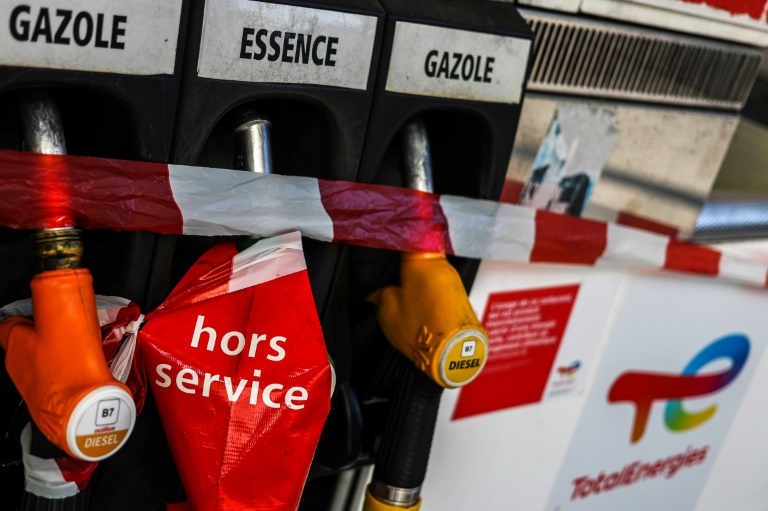
France’s TotalEnergies said on Sunday it would advance annual pay talks with unions if they dropped a blockade of fuel depots and refineries that has slashed petrol supplies across the country.

Vehicle owners have faced increasingly long waits to fill up after two weeks of strikes by workers demanding higher wages in response to soaring prices.

“I haven’t been able to work for two days now,” complained 60-year-old taxi driver Thierry. 

He said he had “gone round the whole of Paris” to find fuel and had already been waiting for three hours at a filling station in the capital for fuel tankers to turn up.

Like other major oil companies, TotalEnergies has seen its profits soar as energy prices skyrocket during the war in Ukraine, and government officials have been pressing the company to settle the standoff.

TotalEnergies runs a network of around 3,500 filling stations in France, nearly a third of the total. Most of them are low on fuel or even empty for some types.

“If the depot blockades end and with the agreement of all labour representatives, the company proposes to move forward the annual salary negotiations from November to October,” TotalEnergies said.

The discussions would define “how employees will benefit from TotalEnergies’ exceptional results before the end of this year, taking into account this year’s inflation”.

On Sunday, the CGT union branch at the company — which is leading the strikes at TotalEnergies and at rival Esso-ExxonMobil — said the industrial action would continue but it was open to talks as soon as Monday.

“If we do start talks, it will be based on our demands — a 10-percent salary hike … retroactive for the year 2022,” branch coordinator Eric Sellini told AFP.

Currently three of Total’s refineries are blocked, including its largest, in Normandy, as well as a fuel depot near Flandres in the north.

The government has already dipped into strategic stockpiles in a bid to bring relief, and fuel tankers are being allowed exceptionally to make deliveries on Sunday to replenish filling stations.

“I’m all in favour of dialogue so French people don’t have to put up with this industrial action for too long,” Energy Transition Minister Agnes Pannier-Runacher told BFM television.

She said the government had increased supplies by 20 percent but fears of running out of fuel were aggravating the shortage. Some areas have seen a 30-percent spike in sales to motorists.

“The situation should improve tomorrow,” she said.

Austrian president re-elected on promises of stability: projections

Austrian President Alexander Van der Bellen has been re-elected, projections showed Sunday, after campaigning on promises of stability as the Alpine country struggles with an energy crisis and inflation.

The projections showed the 78-year-old incumbent swept 54.6 percent of the votes with six other candidates — all men — lagging far behind.

The final official result is not expected until Monday.

Campaigning on a slogan of “clarity” and “stability”, Van der Bellen had been widely tipped to clinch a second mandate.

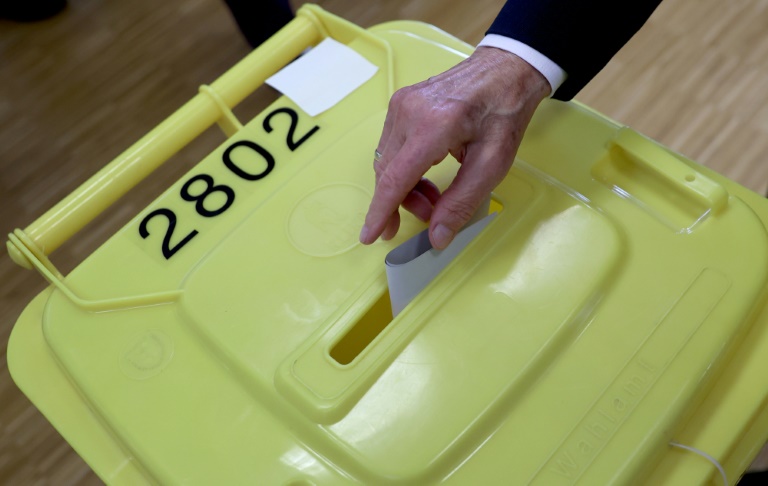
“It would be nice if we had clarity today,” the economics professor said after casting his ballot in central Vienna earlier Sunday.

“Nice for Austria, nice for us — if we can then fully concentrate on the diverse tasks ahead, the multitude of crises… that we in Austria, in Europe, are facing.”

Polls ahead of the election had suggested the pro-European liberal would secure more than 50 percent of the vote, thus avoiding a run-off.

Some 6.4 million people were eligible to cast their ballots from the European Union country’s total population of nine million.

The presidential post, which has a term of six years, is largely ceremonial. 

– ‘Consistency’ –

“I am in favour of consistency,” 73-year-old retiree Monika Gregor told AFP outside a Vienna polling station earlier Sunday, saying she had voted for Van der Bellen and thought he was “very clever”.

Posters proclaim the former Greens leader to be “the safe choice in stormy times” as the ripple effects of Russia’s invasion of Ukraine push up inflation throughout Europe.

Van der Bellen was running again as an independent, but he has the explicit or implicit backing of Austria’s major parties except the far-right Freedom Party (FPOe). 

The latter has fielded its own candidate, Walter Rosenkranz who, according to the projections, got 18.9 percent.

Also standing for the presidency was 35-year-old punk rocker Dominik Wlazny, founder of the Beer Party, named for its advocacy of the popular beverage.

He came in fourth place with 8.1 percent, according to the projections.

Alexander Nittmann, 35, a software developer, said he had voted for Wlazny, hoping he would bring “a breath of fresh air”.

Van der Bellen — who supporters affectionately call “the professor” — faced an unexpectedly tough fight in 2016, only winning the race in a run-off against an FPOe politician.

But the FPOe’s ratings have plummeted since 2019, following a corruption scandal that brought down the government they were part of and led to the resignation of then-chancellor Sebastian Kurz in 2021.

Analyst Thomas Hofer said ahead of Sunday’s vote that it was “crucial” for Van der Bellen to avoid a run-off such as that of 2016, when the campaign was “very divisive and hostile”.

– Trademark professorial manner –

“Van der Bellen stands for integrity and stability, which is very appreciated by voters given the multitude of crises that many European countries are currently facing,” Julia Partheymueller, a political analyst at the University of Vienna, told AFP.

Van der Bellen will be Austria’s oldest head of state to be sworn in if he wins.

Van der Bellen — also known as “Sasha”, a nickname that nods to his Russian roots — was born in Vienna during World War II to an aristocratic Russian father and an Estonian mother who fled Stalinism.

The arrival of the Red Army a year later forced the family to escape to the southern state of Tyrol, where Van der Bellen spent an “idyllic childhood”.

He studied economics at the University of Innsbruck and finished his PhD in 1970 before going on to become dean of economics at the University of Vienna.

Israeli forces hunt east Jerusalem checkpoint attacker

Israeli forces on Sunday hunted a Palestinian suspected of killing an 18-year-old military policewoman in east Jerusalem, an attack that left another Israeli in critical condition from a gunshot wound to the head.

The Saturday shooting at a checkpoint by the Palestinian refugee camp of Shuafat in Israeli-annexed east Jerusalem came amid spiralling violence in the Israeli-Palestinian conflict.

Hours earlier, two Palestinian teenagers were shot dead in an Israeli raid in the West Bank, as the United Nations warned of “mounting violence” in the occupied Palestinian territory.

Police said the alleged Shuafat gunman, a 22-year-old Palestinian resident of east Jerusalem, was driven to the checkpoint by an accomplice. He got out of the car, opened fire and ran into the camp as the driver sped away. 

The dead Israeli soldier was identified as Noa Lazar.

Prime Minister Yair Lapid said Sunday his heart was “broken” by her death.

“We won’t rest until bringing the despicable murderers to justice,” Lapid said before Israeli Jews were set to mark the Sukkot holiday.

Another Israeli, a 30-year-old man, was taken to Hadassah hospital in serious condition after being shot in the head, the medical centre said in a statement.

Israeli police said shrapnel lightly wounded two additional border officers.

Israeli armed forces chief Lieutenant General Aviv Kohavi visited the checkpoint on Sunday.

A court meanwhile extended the detention by a week of four people arrested on suspicion of involvement in the attack, police said.

– Camp entrances shut –

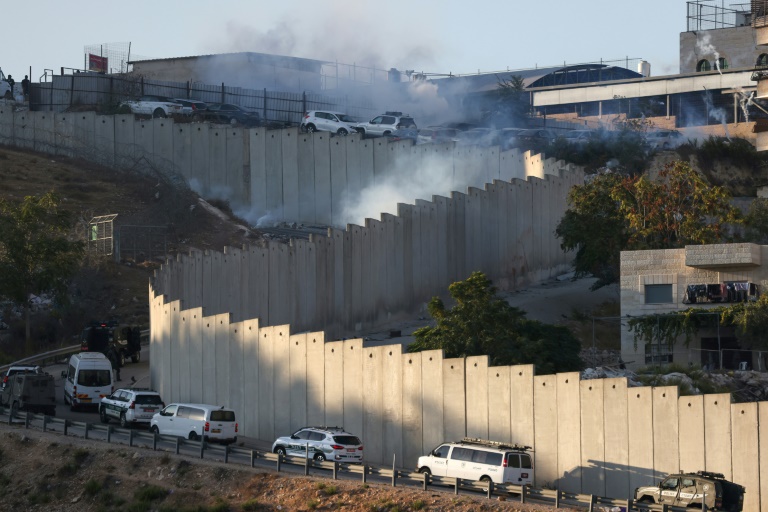
As the pursuit of the gunman got underway, Israeli forces shut the entrances to the refugee camp.

The Palestinian Red Crescent Society said its medics were prevented from reaching the area, while the Israeli rights group HaMoked pressed officials to reopen access for thousands of residents “who need to get to their homes, work, school, and to hospitals”.

Police on Sunday said officers were using “riot control weapons” in the camp, as dozens of people hurled stones at the force.

Smoke billowed from the densely populated neighbourhood.

Earlier Saturday, two Palestinian teenagers were shot dead in an operation by Israeli forces in Jenin, the northern West Bank flashpoint city.

The Palestinian health ministry announced the killing of “two citizens by occupation (Israeli) bullets in Jenin”, while 11 others were wounded.

The ministry identified those killed as Ahmad Daraghmeh, 16, and Mahmud as-Sous, 18. The Islamic Jihad militant group praised the teenagers as “its martyrs”.

Israel’s military said troops had entered Jenin to detain a 25-year-old Palestinian it said was a member of Islamic Jihad and suspected of shooting at troops in the area.

“Dozens of Palestinians hurled explosive devices and Molotov cocktails at IDF (Israeli military) soldiers and shots were fired at them,” an army statement said.

In response to attacks on Israeli civilians earlier this year, Israel’s army has been conducting near daily raids in the West Bank that have left dozens dead, including Palestinian fighters and civilians.

– ‘Deteriorating situation’ –

Following the latest deaths in Jenin, the Palestinian presidency said Israeli action could “push matters towards an explosion”.

“A point of no return, which will have devastating consequences for all”, said Nabil Abu Rudeineh, spokesman for president Mahmud Abbas, in a statement published by the official Palestinian news agency Wafa.

The agency also reported Israeli forces had fired directly at journalists during the Jenin raid.

Two reporters were wounded Wednesday while covering a military operation witnessed by an AFP journalist near the West Bank city of Nablus, in which one Palestinian was killed.

In May, Palestinian-American journalist Shireen Abu Akleh was shot dead while covering an Israeli raid in Jenin.

Saturday’s violence in Jenin came a day after Israeli forces shot dead two other Palestinian teenagers in the West Bank.

The UN envoy for Middle East Peace, Tor Wennesland, voiced alarm at “the deteriorating security situation”, saying at least 100 Palestinians had been killed in the West Bank this year.

Israel has occupied the West Bank since the 1967 Six-Day War and around 475,000 Israelis now live in settlements across the territory, which are considered illegal by most of the international community.

They live alongside some 2.8 million Palestinians, who in different areas of the West Bank are subject to Israeli military rule or live under limited Palestinian governance.

New deadly strike hits Ukraine city after Crimean bridge blast

A Russian missile strike killed at least 13 people in Zaporizhzhia, authorities said on Sunday — the latest deadly attack targeting the southern Ukrainian city, prompting President Volodymyr Zelensky to call the bombardment “absolute evil”.

The reports came a day after a key bridge linking Russia with the annexed Crimean peninsula was partially destroyed by an explosion, and as the Kremlin replaced its top general amid major battlefield setbacks in Ukraine.

Russian President Vladimir Putin will chair a meeting of his Security Council on Monday in the wake of the bridge attack, the Kremlin told Russian media.

Ukrainian officials said 13 people had died and 49 people, including six children, were in hospital after Russian missiles again hit Zaporizhzhia.

At least 17 people, including a child, died when seven Russian missiles hit the centre of the industrial city earlier this week.

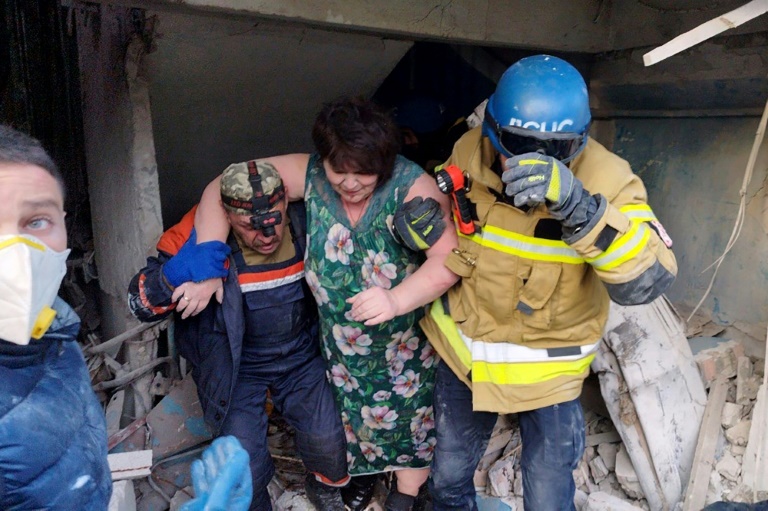
Regional official Oleksandr Starukh posted pictures of heavily damaged apartment blocks on Telegram and said a rescue operation had been launched to find victims under the rubble.

Zelensky denounced the “merciless strikes on peaceful people” and residential buildings as “absolute evil” perpetrated by “savages and terrorists”.

Divers were to inspect the waters beneath the giant Crimea bridge on Sunday, a day after a truck bomb ignited a massive fire on the road and rail link, killing three people.

“We are ordering the examination by divers. They will start work from six in the morning,” Russian Deputy Prime Minister Marat Khusnullin announced.

“First results” of Russia’s inspection of the bridge were due on Sunday, he added.

Russia on Saturday said traffic had resumed over the strategic link, a symbol of the Kremlin’s 2014 annexation of Crimea.

The 19-kilometre (12-mile) bridge was attacked at dawn on Saturday, sparking celebrations from Ukrainians and others on social media. Dramatic footage showed it burning and a road section plunging into the water.

But Zelensky did not directly mention it in his nightly address and officials made no claim of responsibility. 

Following the blast, the bodies of an unidentified man and a woman were pulled out of the water, probably passengers in a car driving near the exploded truck, Moscow said.

Authorities had identified the owner of the truck as a resident of Russia’s southern Krasnodar region and said his home was being searched.

– ‘Emergency situation’ –

The bridge is logistically crucial for Moscow — a vital transport link for carrying military equipment to Russian soldiers fighting in Ukraine.

It is also hugely symbolic. President Vladimir Putin personally inaugurated the structure in 2018 — even driving a truck across it — and Moscow had maintained the link was safe despite the fighting.

While some in Moscow hinted at Ukrainian “terrorism”, Russian state media continued to call it an “emergency situation”. 

Zelensky’s adviser Mykhailo Podolyak posted a picture on Twitter of a long section of the bridge half-submerged. “Crimea, the bridge, the beginning,” he wrote.

But in a later statement, he appeared to suggest Moscow had a hand in the blast, noting the truck that detonated “entered the bridge from the Russian side”.

The Kremlin’s spokesman said Putin had ordered a commission to be set up to look into the blast. 

Officials in Moscow stopped short of blaming Kyiv but a Russian-installed official in Crimea pointed the finger at “Ukrainian vandals.”

“There is an undisguised terrorist war against us,” Russian ruling party deputy Oleg Morozov told the RIA Novosti news agency. 

Military analysts said the blast could have a major impact if Moscow saw the need to shift already hard-pressed troops to Crimea from other regions or if it prompted a rush by residents to leave.

Mick Ryan, a retired Australian senior officer now with the Center for Strategic and International Studies in Washington, said that even if Ukrainians were not behind the blast, it constituted “a massive influence operation win for Ukraine”.

“It is a demonstration to Russians, and the rest of the world, that Russia’s military cannot protect any of the provinces it recently annexed,” he said on Twitter.

Authorities in Crimea tried to allay fears of food and fuel shortages in the territory, which has been dependent on the Russian mainland since its annexation from Ukraine.

– Moscow appoints new general –  

The blast came after lightning territorial gains by Ukraine in the east and south that have undermined the Kremlin’s official annexation of Donetsk, neighbouring Lugansk and the southern regions of Zaporizhzhia and Kherson.

After weeks of military setbacks that triggered unprecedented domestic criticism of Russia’s army, Moscow on Saturday announced that a new general — Sergei Surovikin — would take over its forces in Ukraine. 

Surovikin previously led Russia’s military in southern Ukraine. He has combat experience from the 1990s conflicts in Tajikistan and Chechnya, as well as, more recently, in Syria.

German state vote tests public mood as energy crisis bites

Germans in the coastal state of Lower Saxony headed to the polls Sunday in a closely-watched regional election seen as a test for Chancellor Olaf Scholz’s Social Democrats amid an acute energy crisis.

Voting stations will close at 6:00 pm (1600 GMT), with latest surveys putting Scholz’s centre-left SPD slightly ahead of the conservative CDU party of former chancellor Angela Merkel.

Anxiety about sky-rocketing energy bills has dominated the race in the northwestern region on the North Sea, reflecting the national mood.

Russia’s war in Ukraine has sent energy costs soaring, pushing German inflation to a record-high of 10 percent in September and fuelling fears of a looming recession in Europe’s top economy.

Lower Saxony’s popular premier Stephan Weil from the SPD, eyeing a third term, said the election contest had been “the most difficult of my life”.

“Never have I seen so many question marks and worries on citizens’ faces,” he told WirtschaftsWoche magazine. 

Weil, 63, has cast himself as a safe pair of hands in uncertain times and wants Lower Saxony — home to auto giant Volkswagen as well as most of Germany’s wind turbines — to play a leading role in the green energy transition.

He has also welcomed a controversial 200-billion-euro ($198-billion) energy fund newly unveiled by Scholz to shield German consumers from price shocks.

Weil’s main rival, state economy minister Bernd Althusmann from the CDU, says the massive support package lacks clarity. 

He has accused the federal government of being slow to take decisive action as Germans brace for a grim winter.

The 55-year-old challenger has billed Sunday’s vote as a verdict on Scholz’s coalition in Berlin of the SPD, the Greens and the liberal FDP.

“If the CDU becomes the strongest party in Lower Saxony, which is realistic, it will be a serious blow to the already divided federal government,” he told the Rheinische Post.

By 12:30 pm, turnout stood at 24.6 percent, according to the regional election administration in Hanover, compared with nearly 27 percent by that time five years ago.

– Nuclear plant row –

Opinion polls put the SPD at 31-33 percent in Lower Saxony, followed by the CDU on 27-28 percent.

A win would be a boost for Scholz’s SPD after it lost the last two state polls to the CDU, in North Rhine-Westphalia and Schleswig-Holstein, where voters punished his handling of the Ukraine crisis.

The Greens are tipped to win 16 percent, which would be their best showing yet in the state of 6.1 million voters.

The far-right AfD is polling at around 11 percent, nearly double what it scored in 2017. 

A strong showing by the AfD, a party riven by infighting, “would be a protest vote that until a few months ago few would have expected” in Lower Saxony, political scientist Ursula Muench told AFP.

The FDP meanwhile is hovering at five percent, the threshold needed to enter into the regional parliament.

A major bone of contention between the leading candidates has been the fate of Lower Saxony’s Emsland nuclear power plant — one of only three still operational in Germany. 

Althusmann has responded angrily to Berlin’s decision to proceed with Emsland’s planned shutdown this year, despite the need for energy diversification as the country weans itself off Russian gas and oil.

German Economy Minister Robert Habeck, from the traditionally anti-nuclear Greens, recently announced  the other two plants will be kept on standby until April 2023, in a landmark U-turn.

Weil has backed Berlin’s stance, saying Emsland was not needed to secure Lower Saxony’s energy supply — though he conceded that other regions may struggle when the colder weather hits.

Although the SPD and CDU currently govern together in Lower Saxony, Weil has ruled out a repeat coalition, instead preferring to team up next with the Greens.

Close Bitnami banner
Bitnami