World

New deadly strike hits Ukraine city after Crimea bridge blast

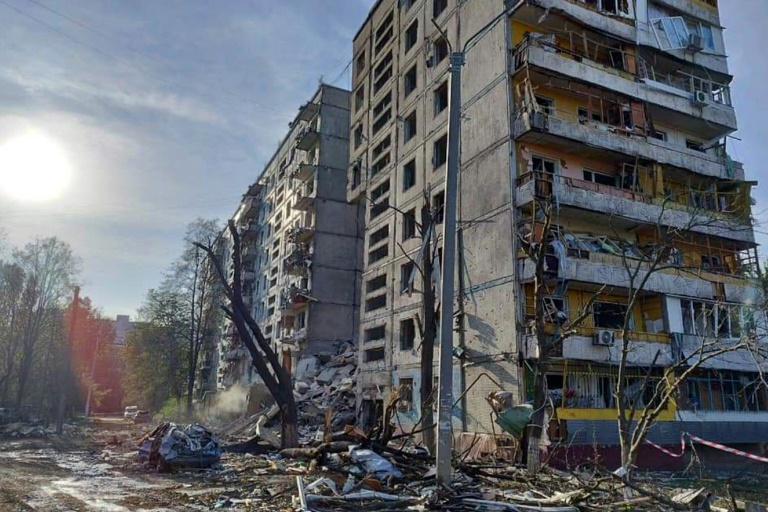
An overnight Russian missile strike killed at least 12 people in Zaporizhzhia, authorities said on Sunday, in the latest deadly attack to hit the southern Ukrainian city that President Volodymyr Zelensky called “absolute evil”.

The reports came a day after a key bridge linking Russia with the annexed Crimea peninsula was partially destroyed by an explosion, and as the Kremlin replaced its top general amid major battlefield setbacks in Ukraine.

Zelensky said 12 people had died and 49 people, including six children, were in hospital after Russian missiles again hit Zaporizhzhia.

City council secretary Anatoliy Kurtev, provided a higher death toll of 17.

At least 17 people including a child also died when seven Russian missiles hit the centre of the industrial city earlier this week.

Regional official Oleksandr Starukh posted pictures of heavily damaged apartment blocks on Telegram and said a rescue operation had been launched to find victims under the rubble.

Zelensky denounced the “merciless strikes on peaceful people” and residential buildings as “absolute evil” perpetrated by “savages and terrorists”.

Divers were to inspect the waters beneath the giant Crimea bridge Sunday a day after a truck bomb ignited a massive fire on the road and rail link, killing three people.

“We are ordering the examination by divers, they will start work from six in the morning,” Russia’s Deputy Prime Minister Marat Khusnullin announced.

“First results” of Russia’s inspection of the bridge were due Sunday, he added.

Russia on Saturday said traffic had resumed over the strategic link symbolising the Kremlin’s 2014 annexation of Crimea.

The 19-kilometre (12-mile) bridge was attacked at dawn, sparking celebrations from Ukrainians and others on social media, where dramatic footage showed it burning with a road section plunging into the water.

But Zelensky did not directly mention it in his nightly address and officials made no claim of responsibility. 

Following the blast, the bodies of an unidentified man and a woman were pulled out of the water, likely passengers in a car driving near the exploded truck, Moscow said.

Authorities had identified the owner of the truck as a resident of Russia’s southern Krasnodar region, saying his home was being searched.

– ‘Emergency situation’ –

The bridge is logistically crucial for Moscow, a vital transport link for carrying military equipment to Russian soldiers fighting in Ukraine.

It is also hugely symbolic. President Vladimir Putin personally inaugurated the structure in 2018 — even driving a truck across — and Moscow had maintained the link was safe despite the fighting.

While some in Moscow hinted at Ukrainian “terrorism”, state media continued to call it an “emergency situation”. 

Zelensky’s adviser Mykhailo Podolyak posted a picture on Twitter of a long section of the bridge half-submerged. “Crimea, the bridge, the beginning,” he wrote.

But in a later statement, he appeared to suggest Moscow had a hand in the blast, noting the truck that detonated “entered the bridge from the Russian side”.

The Kremlin’s spokesman said Putin had ordered a commission to be set up to look into the blast. 

Officials in Moscow stopped short of blaming Kyiv, but a Russian-installed official in Crimea pointed the finger at “Ukrainian vandals.”

“There is an undisguised terrorist war against us,” Russian ruling party deputy Oleg Morozov told the RIA Novosti news agency. 

Military analysts said the blast could have a major impact if Moscow saw the need to shift already hard-pressed troops to the Crimea from other regions or if it prompted a rush by residents to leave.

Mick Ryan, a retired Australian major general now with the Center for Strategic and International Studies in Washington, said that even if Ukrainians were not behind the blast, it constituted “a massive influence operation win for Ukraine”.

“It is a demonstration to Russians, and the rest of the world, that Russia’s military cannot protect any of the provinces it recently annexed,” he said on Twitter.

Authorities in Crimea tried to calm fears of food and fuel shortages in Crimea, dependent on the Russian mainland since annexation frm Ukraine.

– Moscow appoints new general –  

The blast came after Ukraine’s lightning territorial gains in the east and south that have undermined the Kremlin’s official annexation of Donetsk, neighbouring Lugansk and the southern regions of Zaporizhzhia and Kherson.

After weeks of military setbacks that triggered unprecedented domestic criticism of Russia’s army, Moscow on Saturday announced that a new general — Sergei Surovikin — would take over its forces in Ukraine. 

Surovikin previously led Russia’s military in southern Ukraine. He has combat experience in the 1990s conflicts in Tajikistan and Chechnya, as well as, more recently, in Syria.

Jailed Duterte critic held hostage during deadly breakout attempt

Jailed Philippine human rights campaigner Leila de Lima was briefly taken hostage Sunday during an attempted breakout by three detained militants who were shot dead by police, authorities said. 

The incident happened at the national police headquarters, where de Lima, a former senator, has been held for more than five years with other high-profile detainees.

A police officer handing out breakfast was stabbed with a fork by an inmate, who then freed two others from their cells.

Two of the prisoners were shot dead by a sniper, Interior Secretary Benjamin Abalos told reporters. 

The third prisoner ran to de Lima’s cell. He tied up and blindfolded the 63-year-old, before a police officer shot him in the head, Abalos said. 

Police said de Lima was safe and the situation inside the detention facility had “returned to normal”. An investigation was underway. 

Police chief General Rodolfo Azurin said the three inmates were members of the militant group Abu Sayyaf, which has been accused of kidnapping and beheading several foreigners.

De Lima did not appear to have been the target, Azurin told local radio station DZBB.

“They saw her as an ideal cover. Their intention really was to escape,” he said.

De Lima was unhurt, Boni Tacardon, her lawyer, confirmed to AFP.

“She was brought to the hospital for the standard medical check-up,” Tacardon said.

“But based on the information given to us by our staff who’s with the senator now, she appears OK.”

– Calls to free de Lima –

De Lima, an outspoken critic of former president Rodrigo Duterte and his deadly drug war, is due to appear in court on Monday.

She has been behind bars since 2017 on drug trafficking charges that she and human rights groups have called a mockery of justice and payback for going after Duterte.

Since President Ferdinand Marcos Jr took power in June, there have been renewed calls from diplomats and rights defenders for de Lima to be released.

The latest incident underscored the need for her to be “freed immediately”, said Carlos Conde of Human Rights Watch.

Marcos tweeted that he would speak to de Lima “to check on her condition and to ask if she wishes to be transferred to another detention center”.

But Tacardon said de Lima did not want to be transferred.

For now, de Lima and her defence team were considering their options, including the hospital inside the national police headquarters. 

Before her arrest on February 24, 2017, de Lima had spent a decade investigating “death squad” killings allegedly orchestrated by Duterte during his time as Davao City mayor and in the early days of his presidency.

She conducted the probes while serving as the nation’s human rights commissioner, then from 2010 to 2015 as justice secretary in the Benigno Aquino administration that preceded Duterte’s rule.

De Lima won a Senate seat in 2016, becoming one of the few opposition voices as the populist Duterte enjoyed a landslide win.

But Duterte then accused her of running a drug trafficking ring with criminals inside the nation’s biggest prison while she was justice secretary.

De Lima lost her bid for re-election to the Senate in May and Duterte stepped down in June.

The lawyer and mother of two has been held in a compound for high-profile detainees, rather than one of the Philippines’ notoriously overcrowded jails.  

Thai nursery massacre families pray to free children's souls

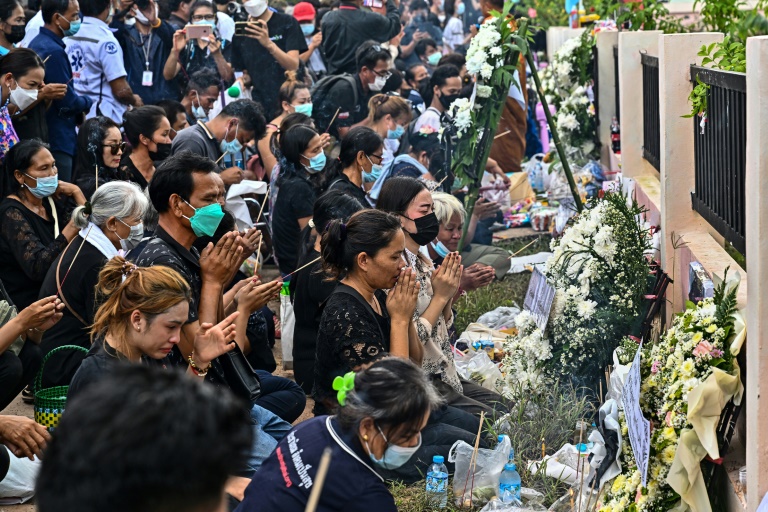
Mourning families knelt Sunday outside a Thai nursery where their children were murdered, performing a Buddhist ceremony to put their souls at rest.

Sacked police officer Panya Khamrab killed 36 people — 24 of them children — on Thursday in a gun and knife rampage in northeastern Nong Bua Lam Phu province, in one of the kingdom’s worst-ever mass killings.

Saffron-robed monks led prayers for the dead Sunday on a second day of ritual mourning at a temple close to the nursery in Na Klang district, a quiet farming area torn apart by Thursday’s bloodshed.

Earlier, families wept as they knelt outside the nursery in a ceremony to help release their children’s souls. Some clutched their children’s portraits, beloved toys and favourite food, which they placed outside the compound as offerings.

Around a low fence surrounding the single-storey, pink-roofed nursery where just a few days ago youngsters played happily, piles of flowers built up.

The sweet aroma of incense scented the air as the assembled crowd, including many well-wishers from the close-knit local community, bowed their heads in prayer, a low crackle of thunder echoing in the distance.

Officials solemnly carried children’s treasured possessions out of the nursery to return to families — favourite blankets and much-loved toys, each carefully placed in name-tagged bags. 

“When I see the tears of the families, I just feel very sad… I can’t describe it. I feel really bad (about) what’s happened in my hometown,” Rutt, 57, told AFP after joining her fellow villagers in supporting the bereaved.

The carnage began when the attacker forced his way in during the children’s nap time at about 12:30 pm (0530 GMT) on Thursday, opening fire with his own legally owned 9mm pistol and slashing with a knife.

Afterwards, the 34-year-old went home to murder his wife and son before taking his own life, police said, ending the rampage at about 3:00 pm.

Most of the victims died from knife injuries or gunfire, and relatives told AFP of the horrific wounds inflicted on their little ones.

– King’s support –

Prime Minister Prayut Chan-O-Cha, who was due to join prayers Sunday evening, has ordered a swift investigation and police have said they expect to interview about 180 witnesses in the coming days.

Panya was sacked as a police sergeant earlier this year for drug abuse and locals say they suspected he was a methamphetamine addict, although preliminary tests found no drugs in his system.

King Maha Vajiralongkorn met survivors and relatives at a hospital late on Friday in a rare public interaction for the monarch, who is officially regarded as semi-divine.

The king said he “shared the grief” of the families and pledged to support them. 

The attack stunned Thailand and caused horror around the world. On Saturday, the Thai community in Melbourne, Australia, held a candlelit vigil to mourn the victims.

Hurricane Julia makes landfall on Nicaraguan coast

Hurricane Julia touched down on Nicaragua’s Caribbean coast early Sunday morning, the US National Hurricane Center said, carrying with it the threat of flash flooding and mudslides across Central America.

Maximum sustained winds were estimated at 85 miles per hour (140 kph) when the storm made landfall near the Laguna de Perlas area at 0715 GMT, the weather agency said.

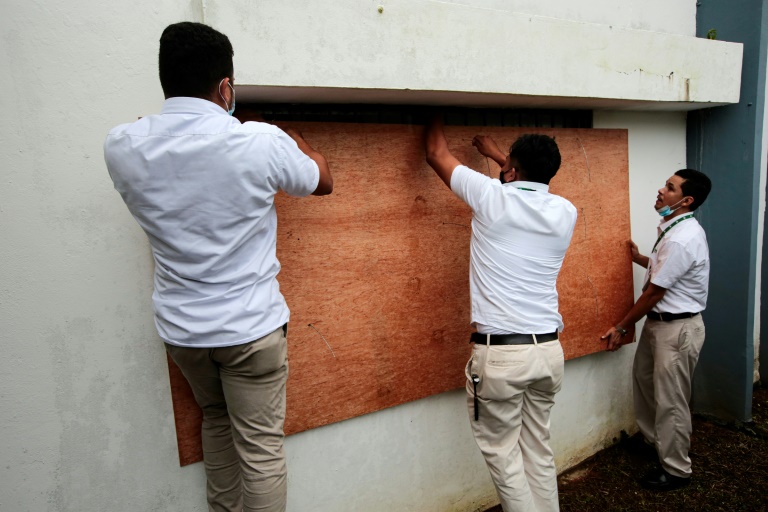
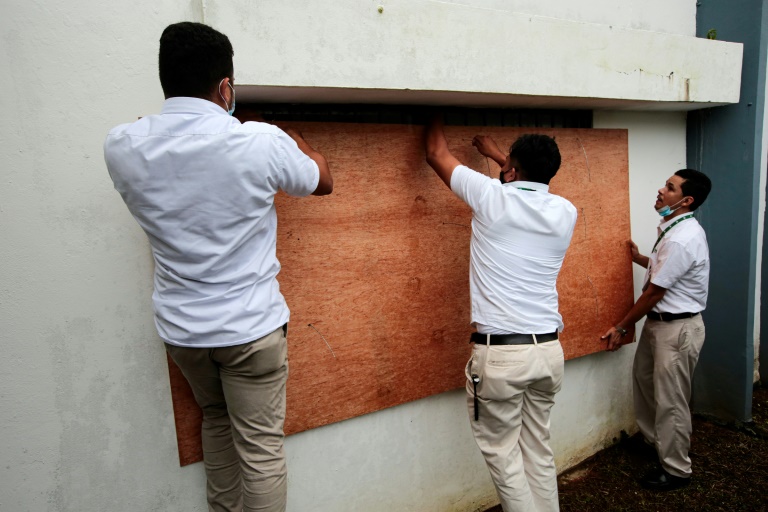
Hours earlier in Bluefields, one of the main coastal towns expected to be buffeted by the storm, fishermen were busy safeguarding their boats as people rushed to buy groceries and withdraw money from ATMs.

Hurricane-force winds and heavy rains began to be felt by around midnight, according to AFP photographers in the city, while state media reported detached roofs, fallen trees and power outages.

Before reaching Nicaragua, Julia passed over a trio of Colombian islands, an environment ministry official told AFP, causing rain and lightning in the country’s north.

While authorities reported no significant damage or casualties on the islands, home to about 48,000 people, Colombian President Gustavo Petro put the area on “maximum alert” and ordered hotels to open space for use as shelters.

Julia is classified as a Category One storm, on the low side of the five-tier Saffir-Simpson hurricane wind scale.

It is expected to move across Nicaragua on Sunday before traveling near or along the Pacific coasts of Honduras, El Salvador and Guatemala through Monday, the NHC said.

Nicaragua has evacuated some 6,000 people in Laguna de Perlas, in the Miskito keys located off the coast, and in other zones.

“We have to prepare with food, plastic, a little bit of everything, because we don’t know what’s going to happen,” Javier Duarte, a cabinetmaker in Bluefields, told AFP.

The municipality of some 60,000 inhabitants has many flimsy structures.

The NHC said that “life-threatening flash floods and mudslides” were possible due to heavy rain “over Central America and Southern Mexico through early next week.”

The storm’s center was about 30 miles (50 kilometres) northeast of Bluefields as of 0715 GMT Sunday, the NHC said.

Julia’s arrival in Central America comes less than two weeks after deadly Hurricane Ian crashed into the southwest of the US state of Florida, in one of the deadliest US hurricanes on record.

The Category 4 storm flattened whole neighborhoods on the Sunshine State’s west coast. More than 100 people were killed according to US media.

Hurricane Julia makes landfall on Nicaraguan coast

Hurricane Julia touched down on Nicaragua’s Caribbean coast early Sunday morning, the US National Hurricane Center said, carrying with it the threat of flash flooding and mudslides across Central America.

Maximum sustained winds were estimated at 85 miles per hour (140 kph) when the storm made landfall near the Laguna de Perlas area at 0715 GMT, the weather agency said.

Hours earlier in Bluefields, one of the main coastal towns expected to be buffeted by the storm, fishermen were busy safeguarding their boats as people rushed to buy groceries and withdraw money from ATMs.

Hurricane-force winds and heavy rains began to be felt by around midnight, according to AFP photographers in the city, while state media reported detached roofs, fallen trees and power outages.

Before reaching Nicaragua, Julia passed over a trio of Colombian islands, an environment ministry official told AFP, causing rain and lightning in the country’s north.

While authorities reported no significant damage or casualties on the islands, home to about 48,000 people, Colombian President Gustavo Petro put the area on “maximum alert” and ordered hotels to open space for use as shelters.

Julia is classified as a Category One storm, on the low side of the five-tier Saffir-Simpson hurricane wind scale.

It is expected to move across Nicaragua on Sunday before traveling near or along the Pacific coasts of Honduras, El Salvador and Guatemala through Monday, the NHC said.

Nicaragua has evacuated some 6,000 people in Laguna de Perlas, in the Miskito keys located off the coast, and in other zones.

“We have to prepare with food, plastic, a little bit of everything, because we don’t know what’s going to happen,” Javier Duarte, a cabinetmaker in Bluefields, told AFP.

The municipality of some 60,000 inhabitants has many flimsy structures.

The NHC said that “life-threatening flash floods and mudslides” were possible due to heavy rain “over Central America and Southern Mexico through early next week.”

The storm’s center was about 30 miles (50 kilometres) northeast of Bluefields as of 0715 GMT Sunday, the NHC said.

Julia’s arrival in Central America comes less than two weeks after deadly Hurricane Ian crashed into the southwest of the US state of Florida, in one of the deadliest US hurricanes on record.

The Category 4 storm flattened whole neighborhoods on the Sunshine State’s west coast. More than 100 people were killed according to US media.

Israeli forces hunt east Jerusalem checkpoint attacker

Israeli forces were hunting the assailant behind an attack that killed a soldier at an east Jerusalem checkpoint, authorities said Sunday, hours after two Palestinian teenagers were shot dead in an Israeli raid in the occupied West Bank. 

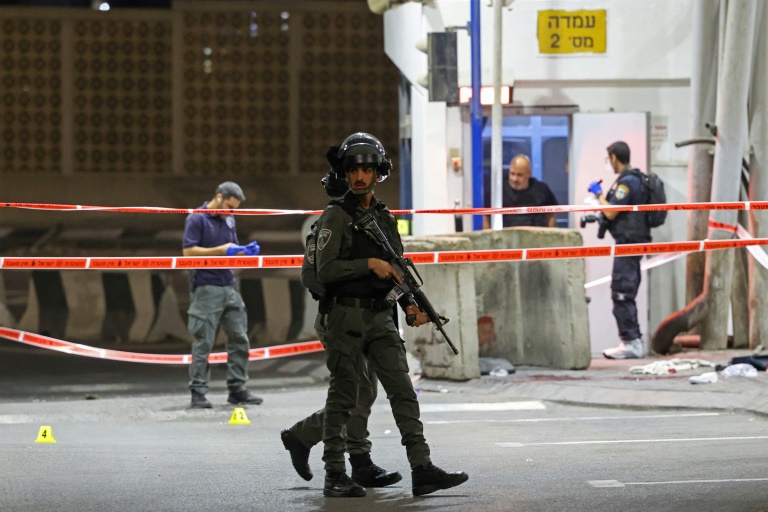
The Israeli army said a soldier had been “killed as a result of being critically injured by a shooting attack” that police said had taken place at a checkpoint in Israeli-annexed east Jerusalem near Shuafat Palestinian refugee camp.

The soldier was identified by the army as Noa Lazar, 18. She had served in the military police.

Another Israeli, a 30-year-old man, was taken to Hadassah hospital in serious condition after being shot in the head, the medical centre said in a statement.

Two additional border police officers were lightly wounded by shrapnel, police said.

Police cordoned off the area near the checkpoint and dozens of officers had been deployed at the entrance and exit of east Jerusalem.

Three Palestinians in their 20s from east Jerusalem were arrested on suspicion of “involvement in the attack”, a police statement said.

Israeli Prime Minister Yair Lapid said Sunday morning his “heart” was “broken” by Lazar’s death.

“We won’t rest until bringing the despicable murderers to justice,” he said in a statement.

– ‘Devastating consequences’ –

Earlier Saturday, two Palestinian teenagers were shot dead in an operation by Israeli forces in Jenin, the flashpoint northern city in the occupied West Bank. 

The Palestinian health ministry announced the killing of “two citizens by occupation (Israeli) bullets in Jenin”, as Israeli troops carried out an arrest there. Eleven others were also wounded.

Those killed were named by the Palestinian health ministry as Ahmad Daraghmeh, 16, and Mahmoud as-Sous, 18. The Islamic Jihad militant group praised the teenagers as “its martyrs”.

Israel’s military said troops entered Jenin on Saturday to detain a 25-year-old Palestinian it said was a member of Islamic Jihad and suspected of shooting at troops in the area.

“During the activity, dozens of Palestinians hurled explosive devices and Molotov cocktails at IDF soldiers and shots were fired at them,” an army statement said, adding that soldiers fired at “the armed suspects”. 

Saturday’s incident is the latest in a series of frequent and often deadly raids by Israel’s army targeting Palestinian militants, which have left dozens of both Palestinian fighters and civilians dead.

Following the latest deaths in Jenin, the Palestinian presidency called on Washington to “exert serious pressure on Israel to stop its all-out war against our Palestinian people”.

Israeli action “will push matters towards an explosion and a point of no return, which will have devastating consequences for all,” said Nabil Abu Rudeineh, spokesman for president Mahmud Abbas, in a statement published by the official Palestinian news agency Wafa.

The agency also reported Israeli forces fired directly at journalists during the Jenin raid.

Two reporters were wounded Wednesday while covering a military operation witnessed by an AFP journalist near the West Bank city of Nablus, in which one Palestinian was killed.

In May, Palestinian-American journalist Shireen Abu Akleh was shot dead while covering an Israeli raid in Jenin.

– ‘Deteriorating situation’ –

Saturday’s violence in Jenin comes a day after two other Palestinian teenagers were shot dead by Israeli forces, according to the health ministry — Adel Dawoud, 14, killed in the northern West Bank, and Mahdi Ladadweh, 17, killed near the city of Ramallah.

“I am alarmed by the deteriorating security situation, including the rise in armed clashes between Palestinians and Israeli security forces in the occupied West Bank, including East Jerusalem,” Tor Wennesland, the UN’s Special Coordinator for the Middle East Peace Process, said in a statement.

Israel has occupied the West Bank since the 1967 Six-Day War and around 475,000 Israelis now live in settlements across the territory, which are considered illegal by most of the international community. 

They live alongside some 2.8 million Palestinians, who in different areas of the West Bank are subject to Israeli military rule or limited Palestinian governance.

'Sabotage' to blame for major German rail breakdown

“Sabotage” targeting communications infrastructure was to blame for major disruption to the German railway network on Saturday, operator Deutsche Bahn said while the government said no motive had yet been identified.

“Cable sabotage” was the cause of the breakdown, which led to a three-hour suspension of train services throughout northern Germany, a spokesman for the company told AFP.

German Transport Minister Volker Wissing said essential cables “were deliberately and intentionally severed” in two places. 

“It is clear that this was a targeted and deliberate action,” he added, saying the motive was not “yet known”.

He described the incident as “clearly premeditated”.

Specifically, there was damage to the GSM-R, a radio network used for communication on the railway, Der Spiegel reported, quoting security sources.

Any damage to the cable would require “certain knowledge” of the rail system, the Bild daily said, adding that federal police were investigating. 

Traffic was completely interrupted for about three hours because of “a breakdown in the digital radio system for the trains”, before being restored, according to Deutsche Bahn. 

Services were affected between Berlin and regions in the west and north of the country including Schleswig-Holstein, the cities of Hamburg and Bremen, as well as Lower Saxony and parts of North Rhine-Westphalia. 

– Protection of critical infrastructure –

The Berlin-Amsterdam route was also suspended, and thouands of travellers were stranded at stations across the affected regions.

Cancellations and delays were still expected on Saturday despite the restoration of rail services, Deutsche Bahn warned. 

The attack comes just over two weeks after sabotage attacks on the Nord Stream 1 and 2 gas pipelines linking Russia and Germany. 

The German government has also stepped up protection of its critical infrastructure. 

Deutsche Bahn is regularly criticised for delays on its services. 

At the beginning of September, the company said it would carry out massive improvement works, including replacing 137,000 concrete sleepers.

An independent report pointed the finger at “production faults” in the sleepers.

The derailment of a train in the Bavarian Alps in early June, which killed five people and injured more than 40, highlighted the poor state of German rail infrastructure, linked to years of under-investment. 

The government has in recent months been encouraging car-loving Germans to take the train by offering cheap tickets.

Austrians vote in presidential election with incumbent set to win

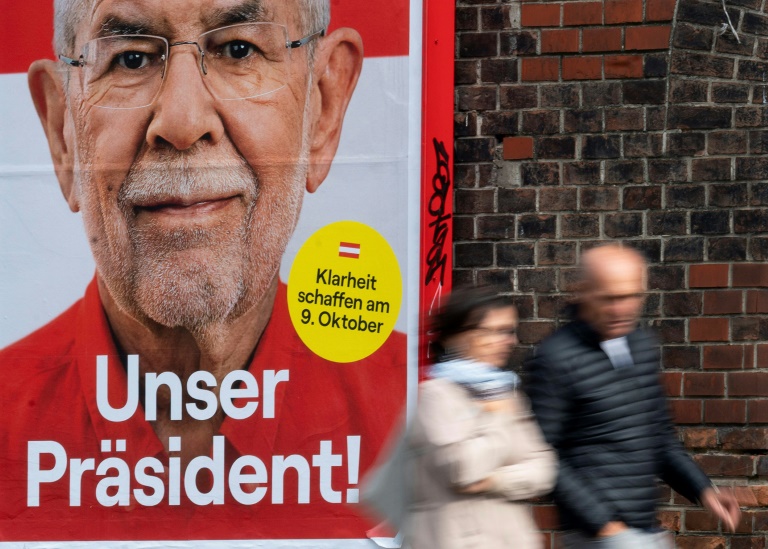
Austrians started voting Sunday in a presidential election expected to return incumbent Alexander Van der Bellen, seen as a beacon of stability as the Alpine EU member struggles with an energy crisis and inflation.

Campaigning on a slogan of “clarity”, Van der Bellen is widely tipped to clinch a second mandate, with his six challengers — all men — lagging far behind.

“The biggest competitor on Sunday will be the sofa,” the 78-year-old economics professor said Friday at his last campaign rally, appealing to people to vote.

Polls put the pro-European liberal as securing more than 50 percent of the vote, thus avoiding a run-off.

Some 6.4 million people are eligible to cast their ballots from the country’s total population of nine million.

Polling stations in Vienna and much of the rest of the country opened at 7:00 am local time (0500 GMT) with a few opening as early as 6:00 am.

They close at 5:00 pm (1500 GMT) with early projections published once they close.

The former Greens leader runs again as an independent with posters proclaiming him “the safe choice in stormy times” with the ripple effects of Russia’s invasion of Ukraine pushing up inflation throughout Europe.

But he has the explicit or implicit backing of Austria’s major parties except the far-right Freedom Party (FPOe), which has fielded its own candidate, Walter Rosenkranz, who is sitting in second place in the polls on 15 percent.

Also standing for the presidency is 35-year-old punk rocker Dominik Wlazny, founder of the Beer Party named for its advocacy of the popular beverage.

Van der Bellen — who supporters affectionately call “the professor” — faced an unexpectedly tough fight in 2016, only winning the race in a run-off against an FPOe politician.

But the FPOe’s ratings have plummeted since 2019 after a corruption scandal brought down the government they were part of and eventually led to the resignation of then-chancellor Sebastian Kurz himself in 2021.

Analyst Thomas Hofer said it is “crucial” that Van der Bellen avoids a run-off like in 2016 when the campaign was “very divisive and hostile”.

– ‘Stability’ –

“Van der Bellen stands for integrity and stability, which is very appreciated by voters given the multitude of crises that many European countries are currently facing,” Julia Partheymueller, a political analyst at the University of Vienna, told AFP.

Known for his trademark professorial manner, Van der Bellen will be Austria’s oldest head of state to be sworn in if he wins.

The presidential post, with a term of six years, is largely ceremonial. 

Van der Bellen — also known as “Sascha”, a nickname that nods to his Russian roots — was born during World War II in Vienna to an aristocratic Russian father and an Estonian mother who fled Stalinism.

The arrival of the Red Army a year later forced the family to escape to the southern state of Tyrol, where Van der Bellen spent an “idyllic childhood”.

He studied economics at the University of Innsbruck and finished his PhD in 1970 before going on to become dean of economics at the University of Vienna.

At an election event last month, Alexandra Hoefenstock said she would vote Van der Bellen as he had managed the political crises well in his last stint in office.

“I hope for political stability,” the 38-year-old Vienna city worker said.

Julia becomes hurricane as it closes in on Central America

Tropical storm Julia turned into a hurricane Saturday as it swirled towards Central America, where it is expected to make landfall along Nicaragua’s Caribbean coast, weather forecasters said.

In Bluefields, one of the main Nicaraguan coastal towns expected to be buffeted by the storm, fishermen were busy safeguarding their boats and people rushed to buy groceries and withdraw money from ATMs.

“Julia has become a hurricane with 75 mile-per-hour (120 kilometer-per-hour) maximum sustained winds as it passes near San Andres and Providencia Islands,” which belong to Colombia, the US National Hurricane Center said.

An official from Colombia’s environment ministry told AFP the hurricane had touched down on the Caribbean islands along with a third, Santa Catalina, at about 6:00 pm (2300 GMT), causing rain and lightning in the country’s north.

While authorities have so far reported no significant damage or casualties in the islands, home to about 48,000 people, President Gustavo Petro put the area on “maximum alert” and ordered hotels to open space for use as shelters.

Julia is classified as a Category One storm, on the low side of the five-tier Saffir-Simpson hurricane wind scale.

It is expected to make landfall in Nicaragua overnight, then move across the country on Sunday before traveling near or along the Pacific coasts of Honduras, El Salvador and Guatemala through Monday, the NHC said.

If Julia stays on its current course, it will make landfall as a Category One hurricane between the coastal communities of Orinoco and Laguna de Perlas, north of Bluefields, said Nicaraguan Vice President Rosario Murillo, citing official reports.

Nicaragua has evacuated some 6,000 people in the Laguna de Perlas area, in the Miskito keys located off the coast, and in other zones.

“We have to prepare with food, plastic, a little bit of everything, because we don’t know what’s going to happen,” Javier Duarte, a cabinetmaker in Bluefields, told AFP.

The municipality of some 60,000 inhabitants has many flimsy structures.

The NHC said that “life-threatening flash floods and mudslides” were possible due to heavy rain “over Central America and Southern Mexico through early next week.”

The storm’s center was about 20 miles southwest of Colombia’s San Andres Island and about 125 miles northeast of Bluefields as of 0000 GMT Sunday, the NHC said.

Julia is set to strike Central America less than two weeks after deadly Hurricane Ian crashed into the southwest of the US state of Florida, in one of the deadliest US hurricanes on record.

The Category 4 storm flattened whole neighborhoods on the Sunshine State’s west coast. More than 100 people were killed according to US media.

Julia becomes hurricane as it closes in on Central America

Tropical storm Julia turned into a hurricane Saturday as it swirled towards Central America, where it is expected to make landfall along Nicaragua’s Caribbean coast, weather forecasters said.

In Bluefields, one of the main Nicaraguan coastal towns expected to be buffeted by the storm, fishermen were busy safeguarding their boats and people rushed to buy groceries and withdraw money from ATMs.

“Julia has become a hurricane with 75 mile-per-hour (120 kilometer-per-hour) maximum sustained winds as it passes near San Andres and Providencia Islands,” which belong to Colombia, the US National Hurricane Center said.

An official from Colombia’s environment ministry told AFP the hurricane had touched down on the Caribbean islands along with a third, Santa Catalina, at about 6:00 pm (2300 GMT), causing rain and lightning in the country’s north.

While authorities have so far reported no significant damage or casualties in the islands, home to about 48,000 people, President Gustavo Petro put the area on “maximum alert” and ordered hotels to open space for use as shelters.

Julia is classified as a Category One storm, on the low side of the five-tier Saffir-Simpson hurricane wind scale.

It is expected to make landfall in Nicaragua overnight, then move across the country on Sunday before traveling near or along the Pacific coasts of Honduras, El Salvador and Guatemala through Monday, the NHC said.

If Julia stays on its current course, it will make landfall as a Category One hurricane between the coastal communities of Orinoco and Laguna de Perlas, north of Bluefields, said Nicaraguan Vice President Rosario Murillo, citing official reports.

Nicaragua has evacuated some 6,000 people in the Laguna de Perlas area, in the Miskito keys located off the coast, and in other zones.

“We have to prepare with food, plastic, a little bit of everything, because we don’t know what’s going to happen,” Javier Duarte, a cabinetmaker in Bluefields, told AFP.

The municipality of some 60,000 inhabitants has many flimsy structures.

The NHC said that “life-threatening flash floods and mudslides” were possible due to heavy rain “over Central America and Southern Mexico through early next week.”

The storm’s center was about 20 miles southwest of Colombia’s San Andres Island and about 125 miles northeast of Bluefields as of 0000 GMT Sunday, the NHC said.

Julia is set to strike Central America less than two weeks after deadly Hurricane Ian crashed into the southwest of the US state of Florida, in one of the deadliest US hurricanes on record.

The Category 4 storm flattened whole neighborhoods on the Sunshine State’s west coast. More than 100 people were killed according to US media.

Close Bitnami banner
Bitnami