World

Vietnam's VinFast targets US market in 'preposterously hard' gamble

Having conquered most industries at home, optimistic chiefs at conglomerate Vingroup are setting their sights much higher as they ramp up plans to sell the first ever Vietnamese car in the mighty US market.

The pivot is a bold move by chairman Pham Nhat Vuong — Vietnam’s richest man — who started out selling dried noodles in the former Soviet Union before amassing his $5 billion fortune in a range of sectors including real estate, tourism and education.

His firm’s auto unit VinFast already has electric vehicles (EVs) on the streets of Hanoi, though the attraction of the lucrative United States market is too good to ignore.

However, the firm admits that competing in the crowded and difficult US market, which is dominated by Tesla, will be a huge but worthwhile task.

“If we can make it there, we can make it anywhere,”  CEO Le Thi Thu Thuy told AFP from the factory site where the finishing touches were being made to the VF8, a mid-size SUV with a sleek design by Italy’s Pininfarina, which worked with Ferrari for decades. 

But, she added, “we want to show people who might not have the correct understanding of Vietnam that Vietnam today is quite different to Vietnam during the war, or even to Vietnam 10 years ago”.

While the aim of getting Americans driving its cars by Christmas may seem a huge ask, Vingroup — Vietnam’s biggest private firm — has a track record of delivering.

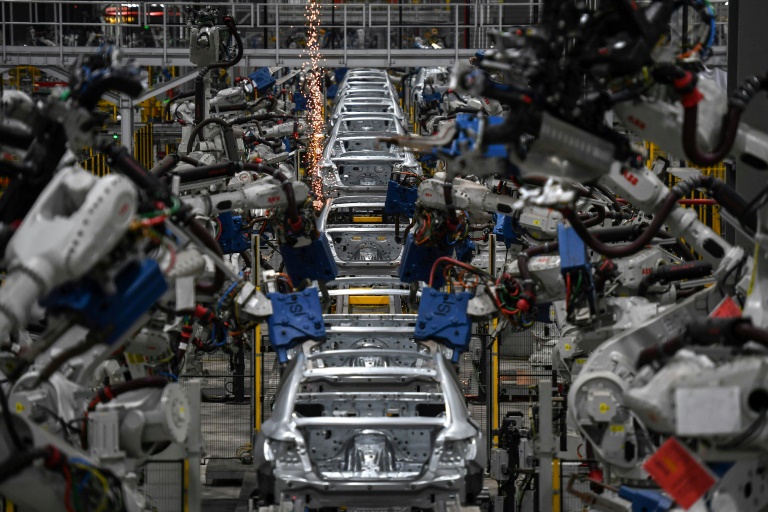
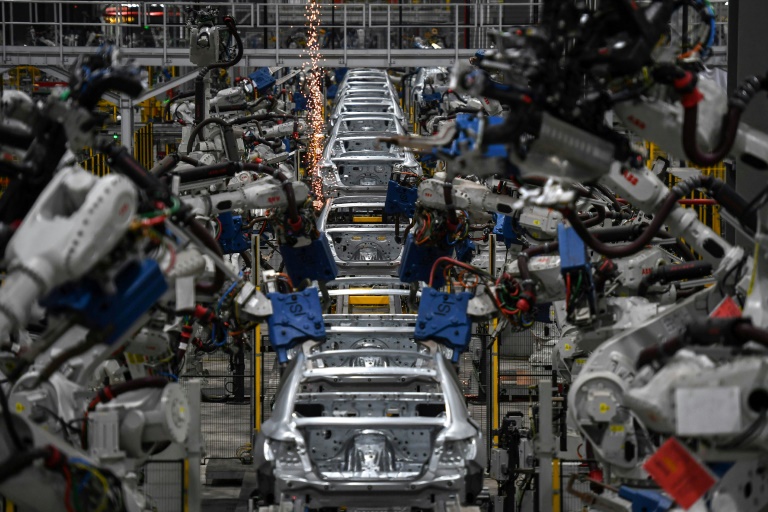
Within two years, Pham transformed a muddy patch of swampland near the northern port city of Haiphong into a state-of-the-art factory — complete with 1,200 robots, German, Japanese and Swedish machinery, and a global team from auto giants including BMW and General Motors. 

– Public scepticism –

The company has already invested heavily in its American dream.

In July, VinFast opened six showrooms in California, including a flagship store at one of the trendiest malls in upmarket Santa Monica, though for now it is only taking orders as vehicles are not yet available.

It plans 30 in total by the end of the year, while it has also broken ground on a $2 billion electric vehicle and battery plant in North Carolina that it says will produce 150,000 cars a year when it is fully up and running.

The factory aims to create more than 7,000 new jobs, prompting US President Joe Biden himself to tweet the announcement back in March.

“I always joke that he is the best salesperson we have,” says Thuy.

But the American public will likely be far more sceptical, said Karl Brauer, a Los Angeles-based analyst with iSeeCars.com, a vehicle comparison site.

“It’s been typical for it to take a couple of decades for brand new automakers to the US market to become ingrained,” he said, referencing South Korea’s Hyundai and Kia, which struggled through the 90s and early 2000s.

They are now among the most popular car makers in the United States. 

Americans’ perception may be “this is some unheard-of-brand I’ve never had any experience with, and I’m not sure I have any faith in the quality”, he added. 

– Push into Europe –

To hook customers, VinFast is pushing a highly unusual monthly battery-leasing model for the two cars headed to the United States — the VF8 and VF9 — lowering the cost of the upfront payment to $42,000 and $57,500 respectively. Tesla’s SUVs start at around $65,000.

Once the battery life goes down to 70 percent, VinFast replaces it for free, and aims to repurpose or recycle the old one.

“The theory behind that is we’re giving you a vehicle that is priced similarly to an internal combustion engine vehicle,” Thuy explained. 

The scale of VinFast’s ambition, which extends to Europe, where they plan to open the first of 20 showrooms by the end of the year, has stunned many in the business.

“It is preposterously hard to build a car and sell it, at least to a global audience, as seems to be the ambitions of VinFast,” said Matthew Degen, senior editor at Kelley Blue Book, a car shopping and research site. 

“It usually takes years and years to get a car from a design on paper into something that’s in your hands and you’re actually driving it.”

However, VinFast developed three cars in just 21 months.

And although the regular car market is already saturated, he says, there may be a “brief window” for them to make their mark in the still developing electric vehicle sector.

For Brauer, VinFast’s success will largely come down to millennials. 

They will “have trouble with people over 50 years old… but younger consumers in this country are getting more and more open to new vehicles”.
Vietnam's VinFast targets US market in 'preposterously hard' gamble

Having conquered most industries at home, optimistic chiefs at conglomerate Vingroup are setting their sights much higher as they ramp up plans to sell the first ever Vietnamese car in the mighty US market.

The pivot is a bold move by chairman Pham Nhat Vuong — Vietnam’s richest man — who started out selling dried noodles in the former Soviet Union before amassing his $5 billion fortune in a range of sectors including real estate, tourism and education.

His firm’s auto unit VinFast already has electric vehicles (EVs) on the streets of Hanoi, though the attraction of the lucrative United States market is too good to ignore.

However, the firm admits that competing in the crowded and difficult US market, which is dominated by Tesla, will be a huge but worthwhile task.

“If we can make it there, we can make it anywhere,”  CEO Le Thi Thu Thuy told AFP from the factory site where the finishing touches were being made to the VF8, a mid-size SUV with a sleek design by Italy’s Pininfarina, which worked with Ferrari for decades. 

But, she added, “we want to show people who might not have the correct understanding of Vietnam that Vietnam today is quite different to Vietnam during the war, or even to Vietnam 10 years ago”.

While the aim of getting Americans driving its cars by Christmas may seem a huge ask, Vingroup — Vietnam’s biggest private firm — has a track record of delivering.

Within two years, Pham transformed a muddy patch of swampland near the northern port city of Haiphong into a state-of-the-art factory — complete with 1,200 robots, German, Japanese and Swedish machinery, and a global team from auto giants including BMW and General Motors. 

– Public scepticism –

The company has already invested heavily in its American dream.

In July, VinFast opened six showrooms in California, including a flagship store at one of the trendiest malls in upmarket Santa Monica, though for now it is only taking orders as vehicles are not yet available.

It plans 30 in total by the end of the year, while it has also broken ground on a $2 billion electric vehicle and battery plant in North Carolina that it says will produce 150,000 cars a year when it is fully up and running.

The factory aims to create more than 7,000 new jobs, prompting US President Joe Biden himself to tweet the announcement back in March.

“I always joke that he is the best salesperson we have,” says Thuy.

But the American public will likely be far more sceptical, said Karl Brauer, a Los Angeles-based analyst with iSeeCars.com, a vehicle comparison site.

“It’s been typical for it to take a couple of decades for brand new automakers to the US market to become ingrained,” he said, referencing South Korea’s Hyundai and Kia, which struggled through the 90s and early 2000s.

They are now among the most popular car makers in the United States. 

Americans’ perception may be “this is some unheard-of-brand I’ve never had any experience with, and I’m not sure I have any faith in the quality”, he added. 

– Push into Europe –

To hook customers, VinFast is pushing a highly unusual monthly battery-leasing model for the two cars headed to the United States — the VF8 and VF9 — lowering the cost of the upfront payment to $42,000 and $57,500 respectively. Tesla’s SUVs start at around $65,000.

Once the battery life goes down to 70 percent, VinFast replaces it for free, and aims to repurpose or recycle the old one.

“The theory behind that is we’re giving you a vehicle that is priced similarly to an internal combustion engine vehicle,” Thuy explained. 

The scale of VinFast’s ambition, which extends to Europe, where they plan to open the first of 20 showrooms by the end of the year, has stunned many in the business.

“It is preposterously hard to build a car and sell it, at least to a global audience, as seems to be the ambitions of VinFast,” said Matthew Degen, senior editor at Kelley Blue Book, a car shopping and research site. 

“It usually takes years and years to get a car from a design on paper into something that’s in your hands and you’re actually driving it.”

However, VinFast developed three cars in just 21 months.

And although the regular car market is already saturated, he says, there may be a “brief window” for them to make their mark in the still developing electric vehicle sector.

For Brauer, VinFast’s success will largely come down to millennials. 

They will “have trouble with people over 50 years old… but younger consumers in this country are getting more and more open to new vehicles”.
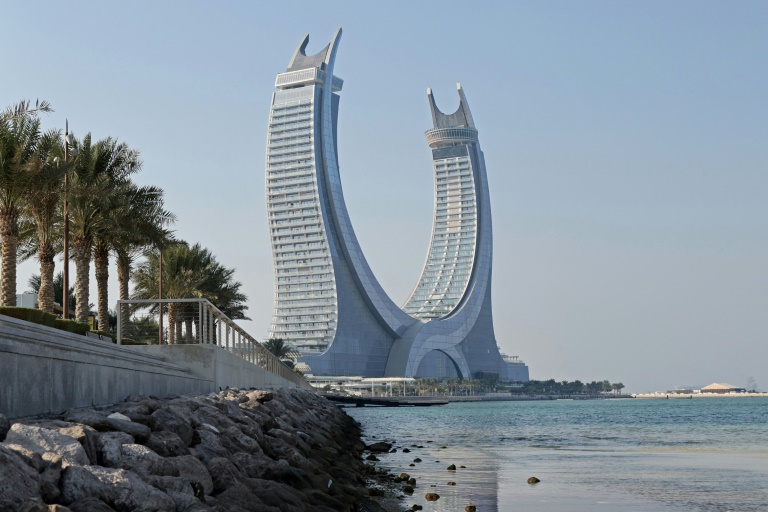
Hey big spenders: Qatar woos the rich with luxury World Cup

With deluxe match packages selling for thousands of dollars and five-star hotels doing a brisk trade, a sheen of glamour coats Qatar’s World Cup despite football’s working-class roots.

A penchant for luxury in the energy-rich Gulf state, which has one of the world’s highest GDPs per head, has rubbed off on an unusually high-end edition of a tournament for the masses.

If you’re able to spring $4,950 for a VIP ticket to a group game, you can enjoy drinks, a six-course meal and entertainment at a lounge overlooking the halfway line at Lusail Stadium, north of Doha.

Those with bottomless budgets in the resource-rich region have attractive accommodation options too, with one third-party site offering $4,000-a-night hotel rooms and $26,000 for a “head of state” suite — with a 30-night minimum stay.

Things are a little different for ordinary fans.

Cheaper options include a steel bed in a shared room in the semi-desert near the capital at $84 a night, or accommodation on docked cruise ships from $179 to $800.

Stadium crowds will include Qatar’s migrant labourers, who were offered some tickets at 40 riyals ($11) to watch a sport whose players and core supporters are traditionally blue-collar.

According to Ronan Evain, executive director of Football Supporters Europe, the onus on “premium” experiences has left some fans cold.

“It’s clear that there’s a focus on a type of premium tourism, but the vast majority that go to a World Cup are middle-class,” Evain told AFP.

“They’re not the sort of people who can afford to stay on a cruise liner at $5,000 a week.”

– ‘Solution is to cancel’ – 

The hordes of ticketless fans that usually descend on a World Cup will be reduced in number, as only ticket holders and up to three guests each can enter Qatar during the November 20 – December 18 tournament.

Many supporters will stay elsewhere in the Gulf and board the estimated 100-200 World Cup shuttle flights a day from the United Arab Emirates (UAE), Saudi Arabia, Kuwait and Oman.

Even those options do not come cheap.

In Dubai, an hour’s flight away and expected to be a major destination, an official World Cup package costs $1,500 for four nights in a shared room, including one return flight to Doha but no match tickets.

The Qatar World Cup is at least compact, with all eight stadiums in and around Doha — eradicating the cross-country travel needed at previous editions such as Brazil 2014 or Russia 2018.

“The problem with the World Cup in Qatar is that there are very few alternatives,” said Evain.

“At a World Cup in Brazil or Russia, you can take a train, hire a car, stay 200 kilometres (120 miles) away or come just for the day of the match.

“None of that is possible in Qatar. Either you can’t find accommodation or accommodation is too expensive,” he added.

“People are looking for a solution and for quite a few people the solution is to cancel, because they can’t afford this sort of budget.”

– High-end experiences –

However, Sue Holt, executive director of Expat Sport, the UAE agent for the official World Cup package provider, said there was a range of accommodation “to suit most budgets”.

The United States, Britain, France, Mexico, China and India were among the countries where fans were showing most interest in packages for the UAE, she said.

“Sports tourists generally tend to be older and travel in groups, which can be families, friends or sporting groups,” she said.

“Part of the appeal of this type of travel is that it is a collective, shared experience watching your favourite team or player together.”

These supporters “will include people who have never ventured to this region before”, added Holt.

According to Robert Mogielnicki, senior resident scholar at the Arab Gulf States Institute in Washington, hosting the World Cup is about “prestige” for Qatar, a monarchy of just 2.8 million people, overwhelmingly expatriate workers.

“What the Qataris don’t want to happen is get stuck with an oversupply of tourism infrastructure for a segment of tourists unlikely to be a regular, consistent presence in the country,” he said, explaining the limited options.

“I suspect that the Qataris will keep looking to attract wealthier tourists from elite circles,” added Mogielnicki, who is also adjunct assistant professor at Georgetown University and George Washington University.

“Lots of the momentum behind regional tourism projects, especially in Saudi Arabia, does seem to focus on high-end, luxury experiences these days.”

Crimea bridge resumes traffic after blast, Russian army leadership changed

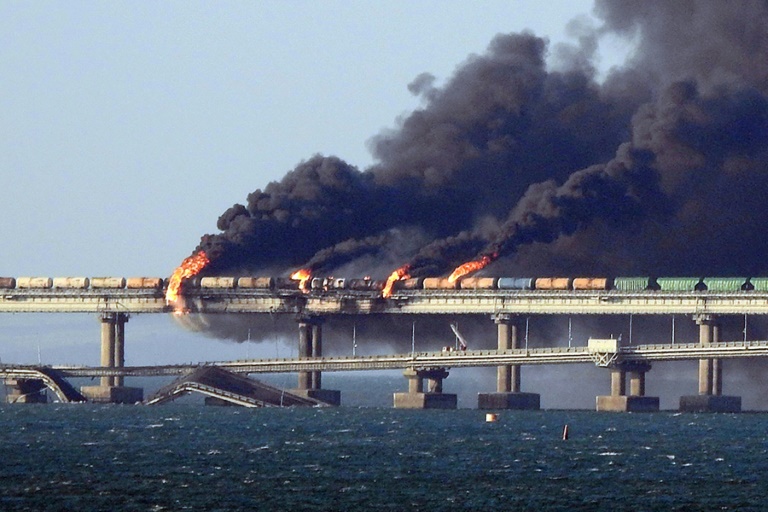
Traffic resumed Saturday over a key bridge linking Russia with Crimea — seen as a symbol of the Kremlin’s annexation of the peninsula — after it was partially destroyed by an explosion Moscow blamed on a truck bomb.

The Kremlin announced on the same day the appointment of a new general to lead its Ukraine offensive following a series of battlefield setbacks that triggered unprecedented criticism of its army at home.

The 19-kilometre (12-mile) bridge was hit by a blast around dawn on Saturday, killing three people, setting several oil tankers ablaze and collapsing two car lanes, Russian investigators said.

The explosion drew celebrations from Ukrainians and others on social media, but Ukrainian President Volodymyr Zelensky made no direct mention of it in his nightly address and officials made no claim of responsibility. 

Russian Deputy Prime Minister Marat Khusnullin told reporters “traffic has been fully restored” on the bridge’s railway, according to state news agency Ria Novosti, without specifying when operations resumed.

Khusnullin had confirmed the resumption is for “both freight and passenger traffic” in an earlier post on Telegram, and said one of the destroyed lanes would be restored “in the near future”. 

Local officials had said earlier in the day that the bridge had been reopened to motor traffic with vehicles subject to stringent screening, while rail operator Grand Service Express said the first trains had left the peninsula for Moscow and St Petersburg.

Dramatic social media footage posted less than 24 hours before Moscow’s statements showed the bridge on fire with parts plunging into the water.

Following the blast, the bodies of an unidentified man and a woman were pulled out of the water, likely passengers in a car driving near the exploded truck, Moscow said.

Authorities had identified the owner of the truck as a resident of Russia’s southern Krasnodar region, saying his home was being searched.

– ‘Emergency situation’ –

The bridge is logistically crucial for Moscow, a vital transport link for carrying military equipment to Russian soldiers fighting in Ukraine.

It is also hugely symbolic.

President Vladimir Putin personally inaugurated the bridge in 2018 — even driving a truck across it — and Moscow had maintained the crossing was safe despite the fighting.

While some in Moscow hinted at Ukrainian “terrorism”, state media continued to call it an “emergency situation.” 

In his address, Zelensky spoke of a “sunny” future for Ukrainians — one without occupiers, “in particular in the Crimea”.

While he made no mention of the strategic bridge, his adviser Mykhailo Podolyak earlier posted a picture on Twitter of a long section of the bridge half-submerged.

“Crimea, the bridge, the beginning,” he wrote.

“Everything illegal must be destroyed, everything stolen must be returned to Ukraine, everything occupied by Russia must be expelled.”

But in a later statement, he appeared to suggest that Moscow had a hand in the blast.

“It is worth noting that the truck that detonated, according to all indications, entered the bridge from the Russian side. So the answers should be sought in Russia,” he said.

The Ukrainian post office announced it was preparing to print stamps showing the “Crimean bridge — or more precisely, what remains of it”. 

The Kremlin’s spokesman said Putin had ordered a commission to be set up to look into the blast. 

Officials in Moscow stopped short of blaming Kyiv, but a Russian-installed official in Crimea pointed the finger at “Ukrainian vandals.”

– Calls for retaliation –

Some officials in Moscow and in Russian-occupied Ukraine called for retaliation. 

“There is an undisguised terrorist war against us,” Russian ruling party deputy Oleg Morozov told the RIA Novosti news agency. 

A Russian-installed official in the occupied Ukrainian Kherson region, Kirill Stremousov, said: “Everyone is waiting for a retaliatory strike and it is likely to come.”

Military analysts said the blast could have a major impact if Moscow saw the need to shift already hard-pressed troops to the Crimea from other regions or if it prompted a rush by residents to leave.

Mick Ryan, a retired Australian major general now with the Center for Strategic and International Studies in Washington, said that even if Ukrainians were not behind the blast, it constituted “a massive influence operation win for Ukraine.”

“It is a demonstration to Russians, and the rest of the world, that Russia’s military cannot protect any of the provinces it recently annexed,” he said on Twitter.

Authorities in Crimea tried to calm fears of food and fuel shortages in Crimea, dependent on the Russian mainland since Moscow annexed it in 2014.

The blasts come after Ukraine’s recent lightning territorial gains in the east and south that have undermined the Kremlin’s claim that it annexed Donetsk, neighbouring Lugansk and the southern regions of Zaporizhzhia and Kherson.

– Moscow appoints new general –  

After weeks of military setbacks, Moscow on Saturday announced that a new general — Sergei Surovikin — would take over its forces in Ukraine. 

Surovikin previously led Russia’s forces in southern Ukraine. He has combat experience in the 1990s conflicts in Tajikistan and Chechnya, as well as, more recently, in Syria.

The decision, which — unusually — was made public, comes after growing discontent among the elite over the army’s leadership.

Also on Saturday, the governor of Russia’s Belgorod region, which borders Ukraine, said Kyiv’s forces had fired at a Russian border village, injuring a teenage girl.  

North Korea fires more missiles, seventh launch in two weeks

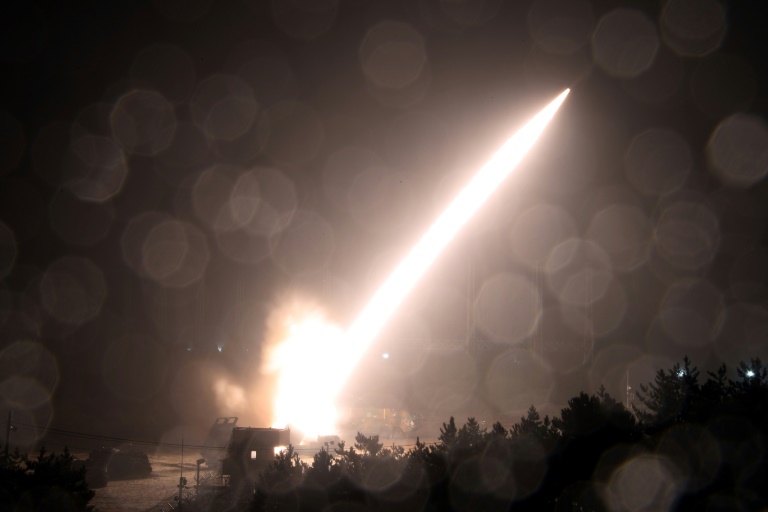
North Korea fired two ballistic missiles into the sea early Sunday, Seoul’s military said, the seventh such launch in two weeks, just hours after a nuclear-powered American aircraft carrier wrapped up joint drills off the Korean peninsula.

Seoul, Tokyo and Washington have ramped up combined naval exercises in recent weeks, infuriating Pyongyang, which sees them as rehearsals for invasion and justifies its blitz of missile launches as necessary “countermeasures”.

With talks long stalled, Pyongyang has doubled down on its banned weapons programmes, firing an intermediate range ballistic missile over Japan last week, with officials and analysts warning it has completed preparations for another nuclear test.

South Korea’s military said Sunday it had “detected two short-range ballistic missiles between 0148 and 0158 (1648-1658 GMT) fired from the Munchon area in Kangwon province towards the East Sea”, referring to the body of water also known as the Sea of Japan.

The missiles “flew approximately 350 kilometres (217 miles) at an altitude of 90 kilometres”, Seoul’s Joint Chiefs of Staff said in a statement, calling the launches a “serious provocation”.

Tokyo also confirmed the launches, with the coast guard saying the missiles had landed outside the Japan’s exclusive economic zone.

Japanese senior vice defence minister Toshiro Ino said Tokyo was analysising the missiles, adding that “either one of them has the possibility of being a submarine-launched ballistic missile (SLBM)”.

Seoul said last month it had detected signs the North was preparing to fire an SLBM, a weapon Pyongyang last tested in May.

The US military’s Indo-Pacific Command said in a statement that they were “consulting closely with our allies and partners”, adding that the launch highlighted the “destabilising” nature of North Korea’s missile programmes.

– Drills, drills, drills –

North Korea’s missile tests usually aim to develop new capabilities, but its recent launches, “from different locations at different times of day, may be intended to demonstrate military readiness,” said Leif-Eric Easley, a professor at Ewha University in Seoul.

“This is not merely for self-defense and deterrence as Pyongyang claims,” Easley told AFP.

“The Kim regime is trying to coerce Seoul, Tokyo and Washington to abandon their trilateral security cooperation.”

The recent spate of launches is part of a record year of weapons tests by isolated North Korea, which leader Kim Jong Un last month declared an “irreversible” nuclear power, effectively ending the possibility of denuclearisation talks.

In response to the growing threat from the North, Seoul, Tokyo and Washington have ramped up joint military drills, including with the USS Ronald Reagan aircraft carrier and its strike group, which was redeployed to the area last week.

On Thursday Seoul’s military said it had scrambled 30 fighter jets after 12 North Korean warplanes staged a rare formation flight and apparant air-to-surface firing drills.

Go Myong-hyun, a researcher at the Asan Institute for Policy Studies, said North Korea was trying to claim that the nature of its sanctions-busting weapons tests were the same as the defensive joint drills between the allies.

“North Korea is trying to give equivalence through its continued missile launches,” he told AFP.

– No new sanctions –

Analysts say Pyongyang is emboldened to continue its weapons testing, confident that gridlock at the United Nations will protect it from further sanctions.

Last week, the United Nations Security Council held an emergency meeting to discuss Pyongyang’s launch over Japan, which officials and analysts said was a Hwasong-12 that likely travelled the longest horizontal distance of any North Korean test.

But at the meeting, North Korea’s longtime ally and economic benefactor China blamed Washington for provoking the spate of launches, with Deputy Chinese ambassador to the UN Geng Shuang accusing the United States of “poisoning the regional security environment”.

US ambassador to the UN Linda Thomas-Greenfield called for the “strengthening” of existing sanctions on North Korea, something China and Russia vetoed in May.

The council has been divided on responding to Pyongyang’s nuclear ambitions for months, with Russia and China on the sympathetic side and the rest of the council pushing for punishment.

“To Kim’s benefit, there are other contingencies occupying the slate of US policymakers, which involve his two primary backers, Russia and China,” Soo Kim, an analyst at the RAND Corporation, told AFP.  

“So we’re not likely to see Moscow or Beijing supporting the US on the North Korea issue anytime soon,” she said. “If anything, the two countries may have an even greater motivation to not help the US right now.”

Officials in Seoul and Washington have been warning for months that Pyongyang will also conduct another nuclear test, likely after China’s Communist Party Congress later this month.

“A flurry of missile tests like the one we’ve seen could indicate a build-up to a nuclear test, but predicting the timing with any precision is quite challenging,” US-based security analyst Ankit Panda told AFP.

“A test can take place almost immediately after Kim orders one.”

Israeli forces hunt east Jerusalem checkpoint attacker

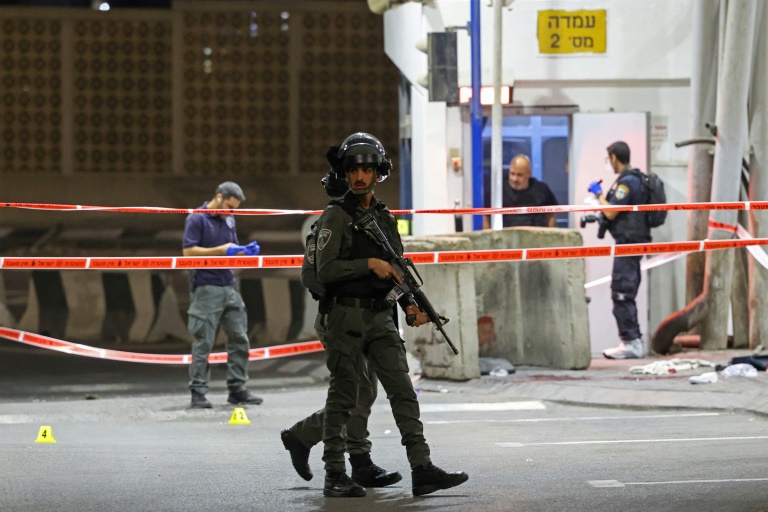
Israeli forces were hunting the assailant behind an attack that killed a soldier at an east Jerusalem checkpoint, authorities said Sunday, hours after two Palestinian teenagers were shot dead in an Israeli raid in the occupied West Bank. 

The Israeli army said a soldier had been “killed as a result of being critically injured by a shooting attack” that police said had taken place at a checkpoint in Israeli-annexed east Jerusalem near Shuafat Palestinian refugee camp.

Another Israeli had been “severely injured”, police said, and a third person, whose nationality was not specified, was hit by “shrapnel” in the incident, according to emergency services group Magen David Adom (MADA), which said all gunshot victims were in their 20s.

Police cordoned off the area near the checkpoint and dozens of officers had been deployed at the entrance and exit of east Jerusalem, while the Palestinian Red Crescent Society said its medics were being prevented from entering the refugee camp.

Israeli Prime Minister Yair Lapid described the shooting as a “severe” attack.

“My heart is with the wounded and their families this evening. Terror will not defeat us, we are strong even on this difficult evening,” he said in a statement.

– ‘Devastating consequences’ –

Earlier Saturday, two Palestinian teenagers were shot dead in an operation by Israeli forces in Jenin, the flashpoint northern city in the occupied West Bank. 

The Palestinian health ministry announced the killing of “two citizens by occupation (Israeli) bullets in Jenin”, as Israeli troops carried out an arrest there. Eleven others were also wounded.

Those killed were named by the Palestinian health ministry as Ahmad Daraghmeh, 16, and Mahmoud as-Sous, 18. Islamic Jihad praised the teenagers as “its martyrs”.

Israel’s military said troops entered Jenin on Saturday to detain a 25-year-old Palestinian it said was a member of the Islamic Jihad militant group and suspected of shooting at troops in the area.

“During the activity, dozens of Palestinians hurled explosive devices and Molotov cocktails at IDF soldiers and shots were fired at them,” an army statement said, adding that soldiers fired at “the armed suspects”. 

Saturday’s incident is the latest in a series of frequent and often deadly raids by Israel’s army targeting Palestinian militants, which have left dozens of both Palestinian fighters and civilians dead.

Following the latest deaths in Jenin, the Palestinian presidency called on Washington to “exert serious pressure on Israel to stop its all-out war against our Palestinian people”.

Israeli action “will push matters towards an explosion and a point of no return, which will have devastating consequences for all,” said Nabil Abu Rudeineh, spokesman for president Mahmud Abbas, in a statement published by the official Palestinian news agency Wafa.

The agency also reported Israeli forces fired directly at journalists during the Jenin raid.

Two reporters were wounded Wednesday while covering a military operation witnessed by an AFP journalist near the West Bank city of Nablus, in which one Palestinian was killed.

In March, Palestinian-American journalist Shireen Abu Akleh was shot dead while covering an Israeli raid in Jenin.

– ‘Deteriorating situation’ –

Saturday’s violence in Jenin comes a day after two other Palestinian teenagers were shot dead by Israeli forces, according to the health ministry — Adel Dawoud, 14, killed in the northern West Bank, and Mahdi Ladadweh, 17, killed near the city of Ramallah.

“I am alarmed by the deteriorating security situation, including the rise in armed clashes between Palestinians and Israeli security forces in the occupied West Bank, including East Jerusalem,” Tor Wennesland, the UN’s Special Coordinator for the Middle East Peace Process, said in a statement.

Israel has occupied the West Bank since the 1967 Six-Day War and around 475,000 Israelis now live in settlements across the territory, which are considered illegal by most of the international community. 

They live alongside some 2.8 million Palestinians, who in different areas of the West Bank are subject to Israeli military rule or limited Palestinian governance.

'Transformation' beckons for embattled Credit Suisse

Battered by a series of scandals, rumours of financial trouble and plunging shares, Credit Suisse is preparing “transformation plans” to restore confidence in the Swiss banking giant.

Ulrich Koerner, who took over as chief executive in August, is due to present the strategic review on October 27.

With Switzerland’s second-biggest bank refraining from revealing its intentions, speculation about its incoming strategy has been swirling.

– Divest or raise capital? –

Andreas Venditti, an analyst at Swiss investment firm Vontobel, said “a capital increase appears increasingly likely” for Credit Suisse.

In a note to clients, Venditti estimates that amount needed at four billion Swiss francs ($4 billion).

Investors fear that such a move would dilute the value of bank shares.

Its stock price has shed 70 percent since the March 2021 collapse of British financial firm Greensill. Credit Suisse was heavily exposed to the group.

Carlo Lombardini, a lawyer and professor of banking law at the University of Lausanne, said a capital injection would leave a “bitter taste” for shareholders.

“But they probably don’t have a choice,” Lombardini told AFP.

The bank will have to raise funds from shareholders to finance layoffs and the cost of restructuring, he said.

Another option would be for the bank to sell assets.

“It’s a tough choice,” said David Benamou, investment director at Axiom Alternative Investments, noting that it would hurt the bank’s future revenues.

“Market conditions are tight and a seller who is forced to sell usually does not get a favourable price,” Benamou said.

Analysts at Jefferies, a financial services firm, said “asset sales alone are unlikely to be the solution to the potential capital shortfall problem”.

But, they added, it “could be a first step and buy time until shares recover and the outlook gets better, at which time a capital raise, if needed, would be a less dilutive and more acceptable option”.

– Is it a takeover target? –

Credit Suisse shares have rebounded after sinking to a record low of 3.518 Swiss francs on Monday, showing that markets are giving it “a chance to put together a solid plan”, said Ipek Ozkardeskaya, analyst at Swissquote bank.

With its market value melting by 10 billion Swiss francs earlier this week, Credit Suisse became “a very attractive target for banks that would like to buy a nice wealth management branch”, said Benamou.

But Credit Suisse has the means to remain independent, he said, and any bid could face political resistance.

“I think the Swiss want Credit Suisse to remain Swiss,” Benamou said. 

– Is it a ‘Lehman moment’? –

In addition to the $10 billion exposure to Greensill, the implosion of US fund Archegos cost Credit Suisse $5 billion.

On top of that, Credit Suisse was fined $475 million by US and British authorities in October over loans to state-owned companies in Mozambique.

Koerner, who took the reins in August with the mammoth task of revitalising the bank, sent an internal message to reassure staff last week, saying Credit Suisse had a “strong capital base and liquidity position”.

But investors concerns reached fever pitch last weekend with rumours on social media that the bank may be on the brink of a “Lehman moment” — a reference to the US investment firm whose disintegration precipitated the 2008 global financial crisis.

This triggered Monday’s stock plunge as well as an increase in the cost of buying insurance against Credit Suisse defaulting on its debt.

Analysts, however, have played down concerns that the Swiss bank could follow in the footsteps of Lehman Brothers, stressing that it was “too big to fail” and the government would not let it to collapse.

The Swiss government rescued Credit Suisse rival UBS in 2008 when it teamed up with the central bank to set up a fund that absorbed the group’s toxic assets.

Benamou said a state intervention for Credit Suisse was unlikely as banks have been required to put aside enough cash to withstand a new crisis following the 2008 financial shock.

In an effort to reassure markets, Credit Suisse announced plans on Friday to buy back up to $3 billion of debt.

Austrians vote in presidential election with incumbent set to win

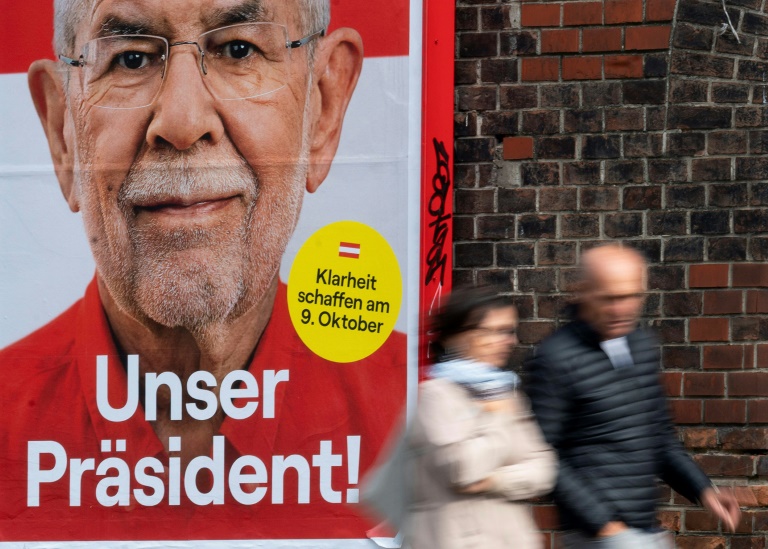
Austrians vote Sunday in a presidential election expected to return incumbent Alexander Van der Bellen, seen as a beacon of stability as the Alpine EU member struggles with an energy crisis and inflation.

Campaigning on a slogan of “clarity”, Van der Bellen is widely tipped to clinch a second mandate, with his six challengers — all men — lagging far behind.

“The biggest competitor on Sunday will be the sofa,” the 78-year-old economics professor said Friday at his last campaign rally, appealing to people to vote.

Polls put the pro-European liberal as securing more than 50 percent of the vote, thus avoiding a run-off vote.

Some 6.4 million people are eligible to cast their ballots from the country’s total population of nine million.

With posters proclaiming him “the safe choice in stormy times” amid an energy crisis pushing up inflation throughout Europe, the former Greens leader runs as an independent.

But he has the explicit or implicit backing of Austria’s major parties except the far-right Freedom Party (FPOe), which has fielded its own candidate, Walter Rosenkranz, who is sitting in second place in the polls on 15 percent support.

Also standing for the presidency is 35-year-old punk rocker Dominik Wlazny, founder of the Beer Party named for its advocacy of the popular beverage.

Van der Bellen — who supporters affectionately call “the professor” — faced an unexpectedly tough fight in 2016, only winning the race in a run-off against an FPOe politician.

But the FPOe’s ratings have plummeted since 2019 after a corruption scandal brought down the government they were part of and eventually led to the resignation of then-chancellor Sebastian Kurz himself in 2021.

Analyst Thomas Hofer said it is “crucial” that Van der Bellen avoids a run-off like in 2016 when the campaign was “very divisive and hostile”.

– ‘Stability’ –

“Van der Bellen stands for integrity and stability, which is very appreciated by voters given the multitude of crises that many European countries are currently facing,” Julia Partheymueller, a political analyst at the University of Vienna, told AFP.

Known for his trademark professorial manner, Van der Bellen will be Austria’s oldest head of state to be sworn in if he wins.

The presidential post, with a term of six years, is largely ceremonial. 

Van der Bellen — also known as “Sascha”, a nickname that nods to his Russian roots — was born during World War II in Vienna to an aristocratic Russian father and an Estonian mother who fled Stalinism.

The arrival of the Red Army a year later forced the family to escape to the southern state of Tyrol, where Van der Bellen spent an “idyllic childhood”.

He studied economics at the University of Innsbruck and finished his PhD in 1970 before going on to become dean of economics at the University of Vienna.

Polling stations open at 7:00 am local time (0500 GMT) and close at 5:00 pm (1500 GMT) with exit polls published once they close.

At an election event last month, Alexandra Hoefenstock said she would vote Van der Bellen as he had managed the political crises well in his last stint in office.

“I hope for political stability,” the 38-year-old Vienna city worker said.

Along US Gulf Coast, huge gas plants jostle for space

As war rages in Ukraine, and Europe thirsts for fuel, the liquified natural gas (LNG) industry along the US Gulf Coast is preparing to expand — a distressing development to some nearby neighbors.

“It’s our life they took here,” says Travis Dardar from the doorstep of his camper trailer.

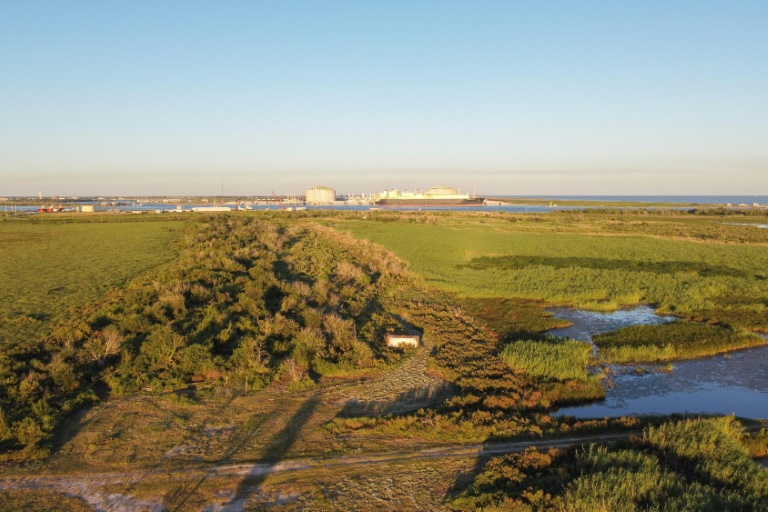
An imposing LNG export terminal — a massive facility that receives and liquefies gas from pipelines, then transfers the LNG to ships for export — will soon loom next to his house, forcing him and his wife to move.

Another plant is also planned where he fishes, imperiling his shrimp and oyster business.

“This is way more catastrophic than any hurricane,” Dardar says, adding that people can rebuild after a hurricane.

In this marshy coastal region between Texas and Louisiana, the proliferation of LNG export terminal projects has unsettled residents, who consider the plants to be a threat to their coast, their serenity and their way of life. 

“We don’t know what they’re going to do next. We know one thing: We can’t live here,” Dardar says.

– The Ukraine fallout –

Last March, a few weeks after the first salvos of the Russian invasion of Ukraine, President Joe Biden pledged to increase LNG deliveries to Europe, which has traditionally been heavily dependent on Russian gas.

US suppliers have exported 1,574 billion cubic feet (44.6 billion cubic meters)of LNG to Europe so far in 2022, a sharp rise from the 917 billion cubic feet (26 billion cubic meters) in 2020, according to the Center for Liquefied Natural Gas, a Washington-based trade group that represents the sector.

The United States has become the world’s largest exporter of LNG, an industry centered around the energy-rich Gulf of Mexico, with its infrastructure and strategic location.

This area alone has five of the seven active US export terminals and 22 of the 24 projects submitted to the authorities for construction.

This activity, in turn, brings many jobs, promises Charlie Riedl, executive director of the Center for LNG. As long as the terminal construction projects meet environmental criteria, the government should “authorize them without delay,” he says.

– Noise, light and emissions –

But some residents see the coasts of Louisiana and Texas as “sacrifice zones,” says John Allaire, another resident.

“You’ve got the noise, you’ve got the light, you’ve got the air pollution. And you got the fact that they converted several hundred acres of wetlands into a big concrete pad over there,” adds Allaire from his boat, pointing to the new LNG export terminal near his home.

Allaire dejectedly watches the waves caused by the huge LNG tankers that erode the shoreline. Sludge from dredging covers his beach.

He is also concerned about the consequences on wildlife. The project planned for the land along his property is located on a wetland that is home to a critically endangered bird, the black rail.

“It’s really horrifying to see this (Biden) administration that came in touting environmental justice and the climate crisis… to be approving these kinds of facilities,” says Kelsey Crane, in charge of public policy at the association Earthworks.

– High cancer rates –

Many petrochemical facilities are already visible across the Sabine River in Port Arthur, Texas.

Near the Cheniere Energy terminal — which last year paid nearly $1.5 million in fines for cracks in its tanks — activist John Beard leads a “toxic tour” of the area, joined by other environmentalists.

In June, an explosion caused the temporary closure of the Freeport LNG terminal further south, reminding residents of the immediate risks posed by the plants. 

But Beard, head of the Port Arthur Community Action Network, also denounces the long-term effects on the health of residents who are largely minorities.

In Port Arthur, the population is predominantly African-American or Hispanic, and a quarter of them live below the poverty line, according to the US Census Bureau.

The county has a 25 percent higher cancer death rate than the rest of the state, according to the Texas Cancer Registry.

Beard believes that the gas industry did not choose this area by chance: “They take the path of least resistance and that is with the poor and those who don’t have access to lawyers, and who are not as educated or knowledgeable.”

Julia becomes hurricane as it closes in on Central America

Former tropical storm Julia turned into a hurricane Saturday as it swirled towards Central America, where it is expected to make landfall along Nicaragua’s Caribbean coast, weather forecasters said.

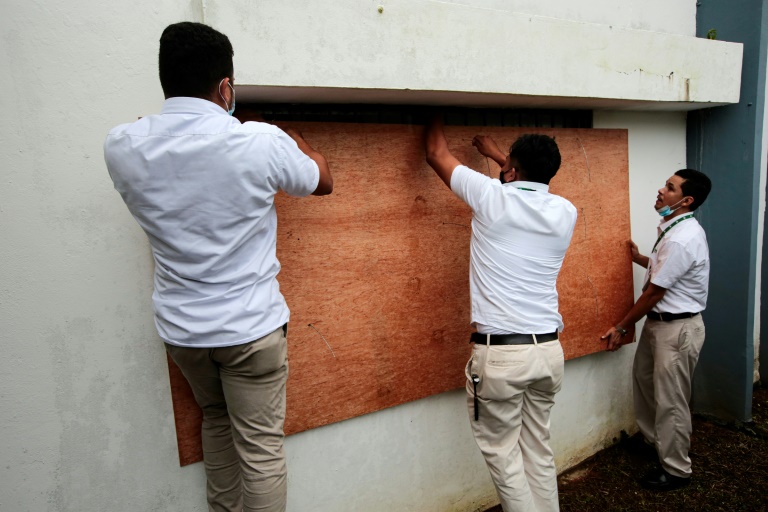
In Bluefields, one of the main Nicaraguan coastal towns expected to be buffeted by the storm, fishermen were busy safeguarding their boats and people rushed to buy groceries and withdraw money from ATMs.

“Julia has become a hurricane with 75 mile-per-hour (120 kilometer-per-hour) maximum sustained winds as it passes near San Andres and Providencia Islands,” which belong to Colombia, the US National Hurricane Center said.

Julia is classified as a Category One storm, on the low side of the five-tier Saffir-Simpson hurricane wind scale.

It is expected to make landfall in Nicaragua overnight, then move across the country on Sunday before traveling near or along the Pacific coasts of Honduras, El Salvador and Guatemala through Monday, the NHC said.

If Julia stays on its current course, it will make landfall as a Category One hurricane between the coastal communities of Orinoco and Laguna de Perlas, north of Bluefields, said Nicaraguan Vice President Rosario Murillo, citing official reports.

Nicaragua has evacuated some 6,000 people in the Laguna de Perlas area, in the Miskito keys located off the coast, and in other zones.

“We have to prepare with food, plastic, a little bit of everything, because we don’t know what’s going to happen,” Javier Duarte, a cabinetmaker in Bluefields, told AFP.

The municipality of some 60,000 inhabitants has many flimsy structures.

The NHC said that “life-threatening flash floods and mudslides” were possible due to heavy rain “over Central America and Southern Mexico through early next week.”

The storm’s center was about 20 miles southwest of Colombia’s San Andres Island and about 125 miles northeast of Bluefields as of 0000 GMT Sunday, the NHC said.

Julia is set to strike Central America less than two weeks after deadly Hurricane Ian crashed into the southwest of the US state of Florida, in one of the deadliest US hurricanes on record.

The Category 4 storm flattened whole neighborhoods on the Sunshine State’s west coast. More than 100 people were killed according to US media.

Close Bitnami banner
Bitnami