World

US hurricane rebuilding rules must adapt to 'era of climate change': expert

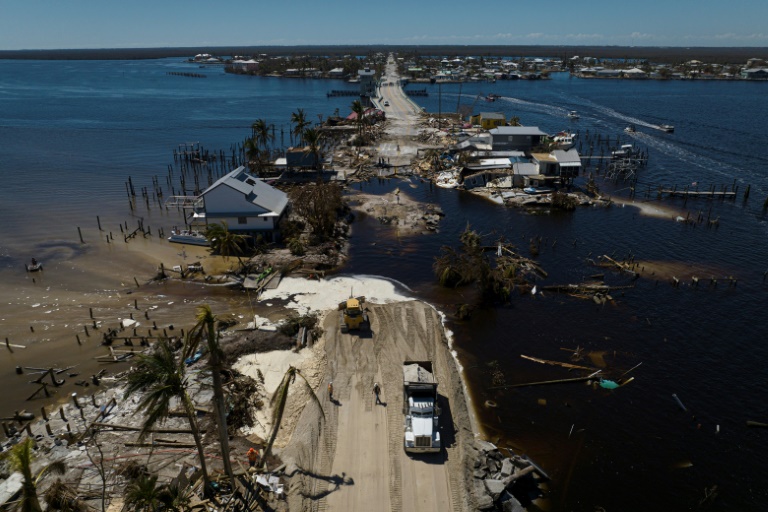
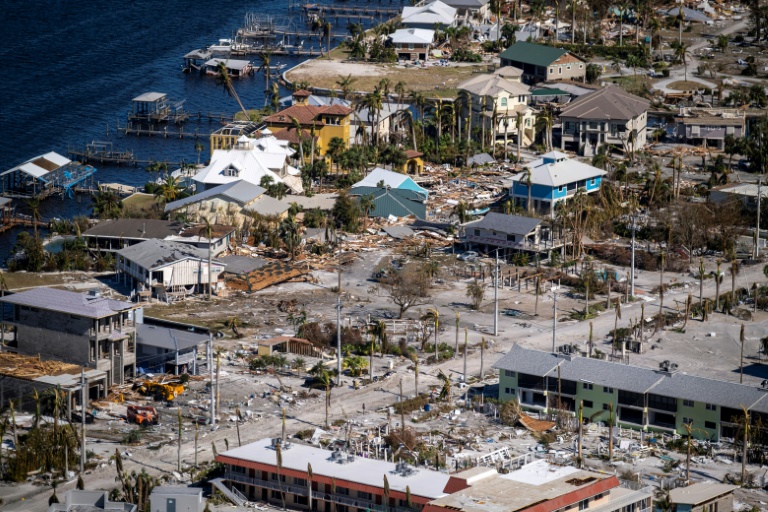
After an extreme weather event, such as Hurricane Ian which devastated parts of Florida last month, most Americans choose to rebuild rather than move to less hazardous areas.

But as climate change increases the frequency and scale of natural disasters, does US policy need to adapt?

Gavin Smith, a professor of environmental planning at the University of North Carolina, worked for several states following major hurricanes, including Katrina in Mississippi (2005) and Matthew in North Carolina (2016).

According to him, current reconstruction standards are not up to the challenges posed by climate change, but correcting them will require real “political will.”

Smith’s responses to AFP have been lightly edited and condensed for clarity.

– Current reconstruction rules –

Q: What are the rules for re-construction after a hurricane, and are they adapted to climate change?

A: Communities must comply with the local codes and standards in place in their jurisdiction before the storm struck.

In the US, we have the National Flood Insurance Program (NFIP), which has historically been subsidized by the federal government. 

For a community to join the program, it has to adopt certain flood risk reduction standards. They include building codes as well as land use plans. 

Then, if a home is damaged in the storm more than 50 percent of their value, it must be built back to the most recent code and standards in place.

Our standard for flood is rebuilding largely back to the “100 year flood,” more accurately termed the one percent annual chance flood event. But in an era of climate change, that “100 year” flood is happening more and more often.

Most risk reduction codes and standards often reflect a climate of the past.

For example, we spent $14 billion rebuilding the levee system in New Orleans after hurricane Katrina. That levee system was built back to the “100 year flood.” 

So you could make the argument that in the era of climate change, that levee system is already out of date. 

– Political will –

Q: What do you expect from government officials?

A: Disasters can present opportunities to rebuild communities safer.

What I’m suggesting is that if we’re going to spend hundreds of millions of dollars building these communities back, we need to require communities to adopt higher codes and standards. 

But that takes political will of both members of Congress and local elected officials.

These are really difficult trillion dollar questions.

You’ll also have builders and the private sector saying, “We should limit those kinds of regulations, as we need to quickly rebuild.”

It takes a lot of political will for a mayor or for a governor to say “No, we’ve got to do what’s right in the long run.:

Unfortunately, people don’t get elected by saying “I am going to require higher standards.”

That’s not a winning slogan. It takes political will to say, enough is enough, we need to adopt higher standards, it’s going to take time, cost more, and people may have to pay more to do it.

That said, we also need to make sure we include equity in processes adopted to develop those standards. 

The shrimpers and the crabbers that live in a very modest house on the water, if we make them adopt higher standards, can they afford it?

– Rules for resilience – 

Q: Concretely, what would be these better standards?

A: A really simple way to think about it is “where” and “how” you build in relation to natural hazards, including those exacerbated by climate change.

The “how” include elevating structures, more stringent standards for wind performance, like better roof shingles, hardening our infrastructure — communication systems, bridges, roads, levees… We can also do this by protecting natural systems like dunes and wetlands.

The “where” is what we would often refer to as land use planning.

Should we be putting a hospital, or a school, in an area subject to storm surge? Probably not. 

A community may choose to say, we’re not going to build a house within 200 meters of the beach. 

Or adopt a gradual disinvestment strategy in extremely risky areas (managed retreat). It’s very difficult to do politically, but it’s happening on a small scale.

Resilience is really about a series of protective measures or choices. It’s not just one. A levee, if that’s your only protection and it fails, to me that’s not resilience. 
Why more Americans are flocking to Florida, even as hurricanes intensify

There’s nothing in the world that would convince Cape Coral resident Kenneth Lowe to leave — not even having to empty his home of flood water a week after Hurricane Ian pummeled the city.

“Southwest Florida is my heaven on earth and hurricanes come with South Florida. So you just have to take it,” the 28-year-old tells AFP, standing in a street strewn with debris.

“It’s my favorite place, it’s worth it.”

Experts warn the frequency of supercharged hurricanes and floods in this climate-prone region is only expected to increase over time — but the population of the southeastern United States continues to rise.

The paradox is especially striking in Cape Coral. 

Between 2010 and 2021, its population grew by 33 percent to 204,000 people, according to census data. Founded in 1958, it embodies the Florida dream that many come looking for.

Navigable canals criss-cross the region, connecting to the Caloosahatchee River, which gives way to the Gulf of Mexico. This affords many people the chance to enjoy a house on the water, and even space for a small boat.

But developing Cape Coral meant first draining the swamp it was built on — and destroying the mangroves and coral reefs that acted as natural defenses against waves and storm surges.

The city was pulverized by Ian, which intensified especially rapidly, fueled by warm waters and high humidity.

A study in Nature Communications earlier this year found that due to climate change, Atlantic hurricanes dump around 10 percent more water during their rainiest three-hours.

In the streets of Cape Coral, dozens of residents are now piling up their belongings in front of their homes: beds, cupboards, refrigerators that have become unusable.

“We will just rebuild and, hopefully, it will be another 100 years before the next big one,” said Tamara Lang, 56.

Lang moved from Chicago and bought her house in Cape Coral just a few months ago — and says she didn’t factor hurricanes into her decision. But she too has no intention of leaving. 

“We love it here,” she said. “This has been our happy place since we got it.”

– Rapid growth –

According to sociologist Mathew Hauer, who studies the impacts of climate change on society, people are not adequately informed about the risks they are taking on.

“If people really understood the flood risk of properties, we’d see changes in where people are purchasing homes and where they’re choosing to live,” said Hauer, an assistant professor at Florida State University.

Another problem: flood zone maps drawn up by the Federal Emergency Management Agency (FEMA) are out of date, says Gavin Smith, a professor of landscape architecture and environmental planning at North Carolina State University.

“It should be viewed as a minimum standard, but they’re often used to regulate the where and how of development,” he told AFP.

Census data reveals a population explosion in the coastal counties of North and South Carolina, as well as Georgia. Florida itself added 2.7 million residents between 2010 and 2020.

“It’s one of the fastest growing regions in the US,” said Hauer, adding: “I don’t see any sign yet that the trend toward migration down into the Sunbelt is going to turn.”

But according to a paper he published in Nature Climate Change, if sea levels rise around three feet (0.9 meters) between now and the end of the century, some 4.3 million people in the continental United States would be forced to move.

Coastal residents of Florida make up about half that figure.

– ‘Immobility paradox’ – 

Retirees from northern climes — including seasonal migrants known as snowbirds — have long been drawn to the “Sunshine State.”

In addition to their beauty, the state’s coastlines are a vital economic resource, supporting a massive tourism industry.

And once you’re settled, it’s not easy to relocate.

Sixty-seven percent of Americans would rather rebuild than leave an area impacted by a severe weather event, according to a 2021 Marist Poll.

“This is what we call the immobility paradox,” said Hauer. 

A psychological tendency against giving up surely factors into the decision-making — but there are also social dimensions like leaving loved ones, and the harsh economic constraint of having to find a new job, he added.

Smith notes that discounting the true risks one faces is a “universal human trait.”

“I don’t think we are going to leave because we have nowhere to go,” said Irene Giordano, 56, who moved south in 2019 from Virginia to Cape Coral.

During Ian, water rose a foot-and-a-half high in her house.

“I’m praying that this is the last one in my lifetime,” she said.

Death toll from missiles on Ukraine town rises to 17

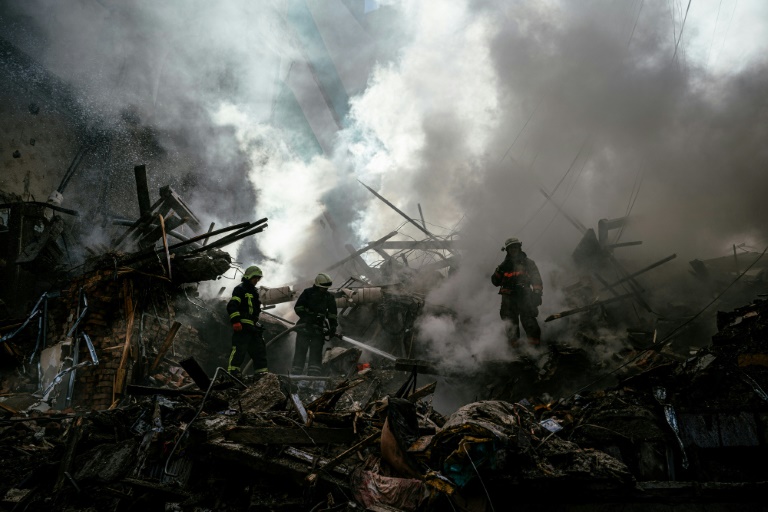
At least 17 people including a child died when seven Russian missiles struck the industrial town of Zaporizhzhia in southern Ukraine, the Ukrainian authorities said Saturday.

The missiles struck before dawn on Thursday, with three landing in the town centre, just 40 kilometres (25 miles) from the artillery battles of the southern front.

“In total, 17 people were killed,” Ukraine’s State Emergency Service said on Telegram, adding that one of them was a child.

The toll has repeatedly risen since an initial tally of one dead. Earlier on Saturday, it had stood at 14.

A five-storey residential building on the main street was almost razed to the ground.

President Volodymyr Zelensky lashed out on Telegram saying Zaporizhzhia “is subjected to massive rocket attacks every day… (it’s a) deliberate crime”.

The Ukrainian-controlled city is located in the eponymous Zaporizhzhia region, also home to the Russian-occupied nuclear plant that has been the site of heavy shelling.

Moscow claims to have annexed the region even though its forces do not control all of it.

Ukraine said at least 30 people were killed last week when a convoy of civilian cars in the Zaporizhzhia region was shelled in an attack Kyiv blamed on Moscow.

Russia says three killed in Crimea bridge blast, army leadership changed

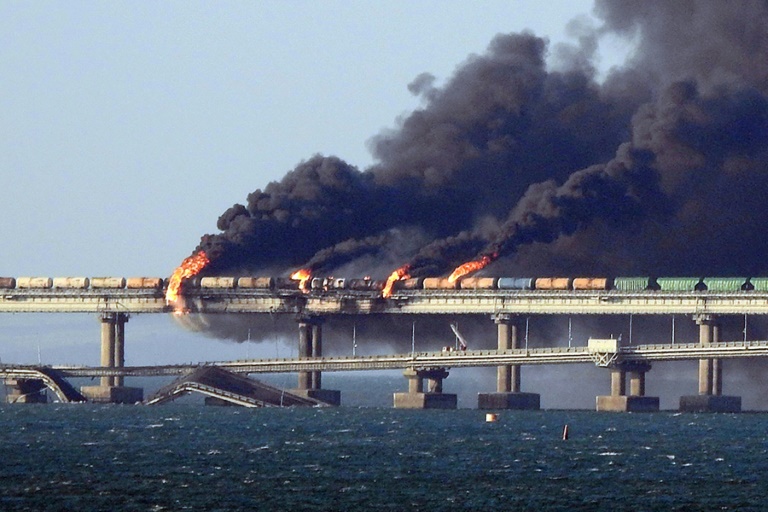
Russia said Saturday three people had been killed after a truck exploded on its bridge linking Crimea — a symbol of its annexation of the peninsula — without immediately blaming Ukraine.

On the same day, after a series of setbacks on the battlefield that triggered unprecedented criticism of its army at home, Moscow appointed a new general to lead its Ukraine offensive. 

The blast ripped through the 19-kilometre (12-mile) bridge more than seven months into Moscow’s Ukraine offensive.

Local officials said later that it had reopened to motor traffic with vehicles subject to stringent screening. Shortly after, Grand Service Express, which operates rail services there, said the first trains had left the peninsula for Moscow and St Petersburg.

The blast aroused intense excitement and speculation from Ukrainians and others on social media, but Ukrainian President Volodymyr Zelensky made no direct mention of it in his nightly address, and officials made no claim of responsibility.

Earlier, dramatic social media footage showed the bridge on fire with parts plunging into the water. 

Russian investigators said three people had been killed. The bodies of an unidentified man and a woman were pulled out of the water, likely passengers in a car driving near the exploded truck, Moscow said.

The authorities also said they had identified the owner of the truck as a resident of Russia’s southern Krasnodar region, saying his home was being searched.

Russia said the blast — which happened just after 6:00 am (0300 GMT) — had set ablaze seven oil tankers transported by train and collapsed two car lanes. 

– ‘Emergency situation’ –

The bridge is logistically crucial for Moscow, a vital transport link for carrying military equipment to Russian soldiers fighting in Ukraine.

It is also hugely symbolic.

President Vladimir Putin personally inaugurated the bridge in 2018 — even driving a truck across it — and Moscow had maintained the crossing was safe despite the fighting.

While some in Moscow hinted at Ukrainian “terrorism”, state media continued to call it an “emergency situation.” 

In his address, Zelensky spoke of a “sunny” future for Ukrainians — one without occupiers, “in particular in the Crimea.”

While he made no mention of the strategic bridge, his advisor Mykhailo Podolyak earlier posted a picture on Twitter of a long section of the bridge half-submerged.

“Crimea, the bridge, the beginning,” he wrote.

“Everything illegal must be destroyed, everything stolen must be returned to Ukraine, everything occupied by Russia must be expelled.”

But in a later statement, he appeared to suggest that Moscow had a hand in the blast.

“It is worth noting that the truck that detonated, according to all indications, entered the bridge from the Russian side. So the answers should be sought in Russia,” he said.

The Ukrainian post office announced it was preparing to print stamps showing the “Crimean bridge — or more precisely, what remains of it”. 

The Kremlin’s spokesman said Putin had ordered a commission to be set up to look into the blast. 

Officials in Moscow stopped short of blaming Kyiv, but a Russian-installed official in Crimea pointed the finger at “Ukrainian vandals.”

– Calls for retaliation –

Some officials in Moscow and in Russian-occupied Ukraine called for retaliation. 

“There is an undisguised terrorist war against us,” Russian ruling party deputy Oleg Morozov told the RIA Novosti news agency. 

A Russian-installed official in the occupied Ukrainian Kherson region, Kirill Stremousov, said: “Everyone is waiting for a retaliatory strike and it is likely to come.”

Military analysts said the blast could have a major impact if Moscow saw the need to shift already hard-pressed troops to the Crimea from other regions or if it prompted a rush by residents to leave.

Mick Ryan, a retired Australian major general now with the Center for Strategic and International Studies in Washington, said that even if Ukrainians were not behind the blast, it constituted “a massive influence operation win for Ukraine.”

“It is a demonstration to Russians, and the rest of the world, that Russia’s military cannot protect any of the provinces it recently annexed,” he said on Twitter.

Authorities in Crimea tried to calm fears of food and fuel shortages in Crimea, dependent on the Russian mainland since Moscow annexed it in 2014.

The blasts come after Ukraine’s recent lightning territorial gains in the east and south that have undermined the Kremlin’s claim that it annexed Donetsk, neighbouring Lugansk and the southern regions of Zaporizhzhia and Kherson.

– Moscow appoints new general –  

After weeks of military setbacks, Moscow on Saturday announced that a new general — Sergei Surovikin — would take over its forces in Ukraine. 

Surovikin previously led Russia’s forces in southern Ukraine. He has combat experience in the 1990s conflicts in Tajikistan and Chechnya, as well as, more recently, in Syria.

The decision, which — unusually — was made public, comes after growing discontent among the elite over the army’s leadership.

Also on Saturday, the governor of Russia’s Belgorod region, which borders Ukraine, said Kyiv’s forces had fired at a Russian border village, injuring a teenage girl.  

'Not afraid anymore': more violence as Iran protests enter fourth week

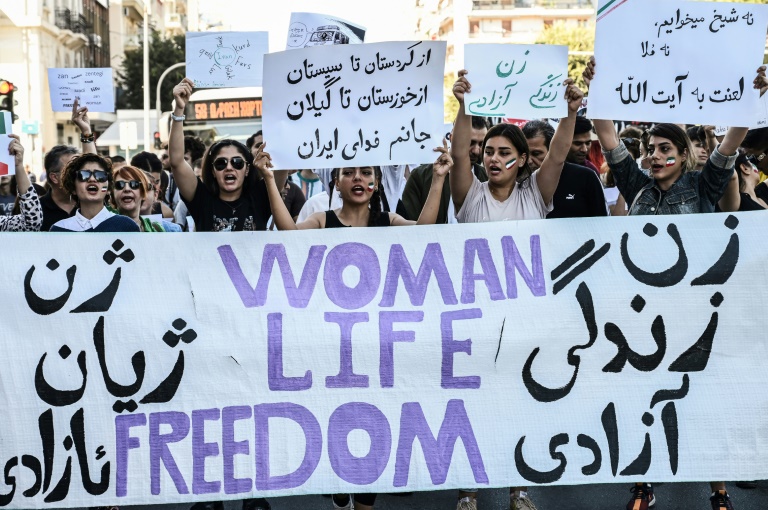
Schoolgirls chanted slogans, workers went on strike and protesters clashed violently with security forces across Iran on Saturday, as demonstrations over the death of Mahsa Amini entered a fourth week.

Anger flared after the 22-year-old Iranian Kurd’s death on September 16, three days after her arrest in Tehran by the notorious morality police for an alleged breach of the Islamic republic’s strict dress code for women.

Iran said on Friday an investigation found Amini had died of a longstanding illness rather than “blows” to the head, despite her family reportedly saying she had previously been healthy.

Amini’s father told London-based Iran International that he rejected the official report.

“I saw with my own eyes that blood had come from Mahsa’s ears and back of her neck,” the outlet quoted him as saying Saturday.

The women-led protests continued even as ultraconservative President Ebrahim Raisi posed for a group photograph with students at Tehran’s all-female Al-Zahra University to mark the new academic year.

Young women on the same campus were seen shouting “Death to the oppressor”, said the Oslo-based group Iran Human Rights (IHR).

In Amini’s hometown Saqez, in Kurdistan province, schoolgirls chanted “Woman, life, freedom” and marched down a street swinging headscarves in the air, in videos the Hengaw rights group said were recorded on Saturday.

Gruesome videos were widely shared online of a man who was shot dead while sitting at the wheel of his car in Sanandaj, Kurdistan’s capital.

The province’s police chief, Ali Azadi, said he was “killed by anti-revolutionary forces”.

Angry men appeared to take revenge on a member of the feared Basij militia in Sanandaj, swarming around him and beating him badly, in a widely shared video.

– ‘We will fight’ –

Internet monitor Netblocks reported outages in Sanandaj, and national mobile network disruptions.

Another shocking video shows a young woman said to have been shot dead in Mashhad. Many on social media compared it to footage of Neda Agha Soltan, a young woman who became an enduring symbol of the opposition after being shot dead at protests in 2009.

Despite internet restrictions, protesters have adopted new tactics to get their message across.

“We are not afraid anymore. We will fight,” said a large banner placed on an overpass of Tehran’s Modares highway, according to online images verified by AFP.

In other footage, a man is seen altering the wording of a large government billboard on the same highway from “The police are the servants of the people” to “The police are the murderers of the people”.

The ISNA news agency reported a heavy security presence in the capital, especially near universities. It said “scattered and limited gatherings” were held in Tehran during which “some demonstrators destroyed public property”.

Street protests were also reported in Isfahan, Karaj, Shiraz and Tabriz, among other cities.

US-based campaigner and journalist Omid Memarian tweeted: “Videos coming out from Tehran indicate that there are so many protests, in every corner of the city, in small and big numbers.”

Hengaw, a Norway-based Kurdish rights group, said “widespread strikes” took place in Saqez, Sanandaj and Divandarreh, in Kurdistan province, as well as Mahabad in West Azerbaijan.

– ‘Blind eye’ –

IHR said at least 95 protesters have been killed in the crackdown, which has fuelled tensions between Iran and the West, especially its arch-enemy the United States.

Citing the UK-based Baluch Activists Campaign, IHR said another 90 people had been killed in Sistan-Baluchestan province after accusations that a regional police chief had raped a teenage girl triggered unrest there.

Raisi — who in July called for the mobilisation of all state institutions to enforce hijab rules — met Saturday evening with the judiciary chief and the parliament speaker, state news agency IRNA reported.

“They stressed that Iranian society now needs unity of all strata regardless of language, religion and ethnicity to overcome the hostility and divisiveness against Iran,” IRNA said.

Iran has repeatedly accused outside forces of stirring up the protests, and last week announced that nine foreign nationals — including from France, Germany, Italy, Poland and the Netherlands — had been arrested.

On Friday, France advised its nationals visiting Iran to “leave the country as soon as possible”, citing the risk of arbitrary detention.

The Netherlands advised its citizens to avoid travelling to Iran or to leave when they can do so safely.

Nazanin Zaghari-Ratcliffe, a British-Iranian charity worker held in Tehran for six years until her release in March, called on the UK government to act over Iran’s rights abuses.

“We cannot be indifferent about what is happening in Iran,” she told Sky News. “And I think we have to hold Iran accountable.”

Rubble and relief in recaptured south Ukraine village

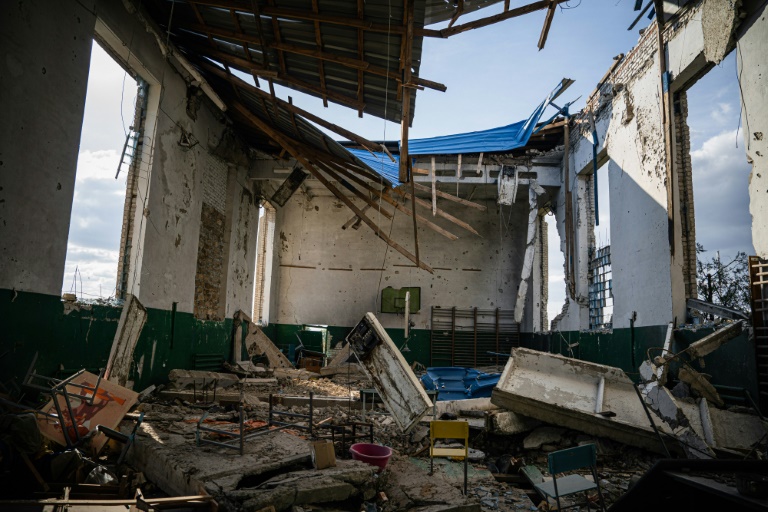
A basketball hoop stands in the rubble of a school gym. The roof was blown apart during days of heavy fighting in Kreschenivka, a village recently recaptured from Russian troops in southern Ukraine.

The Russians made the village primary school their command post, said Pavlo Ulesco, 62, who showed AFP around.

With trenches and huge pits to hide weapons, they were firmly dug in when Ukrainian soldiers arrived — and the damage is all the more severe for it.

One of the school buildings has been severely hit, some of its walls dashed to piles of bricks.

“At first they shelled the Russians from a distance,” Ulesco said. “The street fighting lasted two or three days.”

Villager Vasyl Khomych said it was “hell”. The 65-year-old remembers the sky “turning red”, flashing like lightning as the ground trembled.

His friend Maria Zheleznyak, 62, said Ukrainian soldiers had arrived at around 07:15 am on October 2. By around 09:00 am, there was fierce fighting.

Ukrainian troops were “shelling, shooting. It was terrible”.

“We heard cars, tanks, lorries driving like crazy. 

“But we survived.”

She was overcome with relief when she recognised the Ukrainian soldiers by the yellow bands on their uniforms.

“We cried so much, we hugged everyone,” she said.

Despite the intensity of the fighting, neither of the villagers remembered seeing any Russian corpses. 

The Ukrainian army has been removing traces of Russia’s movement through the south, including the Kherson region where Kyiv on Thursday claimed to have recaptured 400 square kilometres (some 150 square miles) from Moscow’s forces in less than a week.

AFP saw only two burnt-out Russian tanks in the school compound. Another near the entrance to the village had been taken away, Ulesco said.

On the main road to Kreschenivka, several destroyed tanks, which AFP saw on Friday morning, had already been towed away by the afternoon.

The corpses of Russian soldiers, seen a few days earlier on social media in pictures beside the sculpture of a watermelon on the road leading into the village, had also disappeared. 

The Ukrainian army, which had invited AFP to visit recaptured southern territories, appeared reluctant to show the damage it had inflicted on Russian forces.

AFP was barred from filming or talking to soldiers.

In Kreschenivka and three villages largely spared the fighting — Ukrainka, Biliaivka and Shevchenkivka — people praised Ukrainian troops, and mocked the Russian soldiers who “confined them” to their homes for seven months.

“When the battle started in Kreschenivka, they all fled on foot or by bike… and half an hour later, a (Ukrainian) helicopter shot” and killed them, said 55-year-old Galyna Dekhtyuk, who lives in Shevchenkivka.

In Biliaivka, the drive to recapture the area came as a surprise. As elsewhere in the rural south occupied by Moscow, internet has been cut off and phone connection is poor.

“We didn’t even see how they left, but we were so happy,” said Iryna Shashovska, 41.

Her husband Leonid Tereshchenko, 63, said he spent five days detained by Russian forces while they checked he wasn’t pro-Ukrainian or a “Nazi”.

He was adamant there was no fighting in Biliaivka.

“They ran away,” he said.

Ireland petrol station blast kills 10

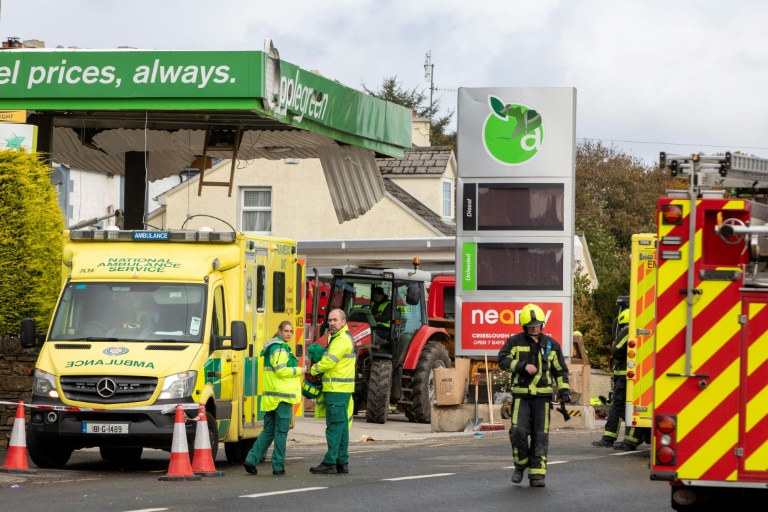
Ten people including a schoolgirl were killed in an explosion at a petrol station in Ireland’s northwest, police said on Saturday suggesting a “tragic accident” may have been to blame.

The blast occurred at around 3:20 pm (1520 GMT) on Friday in the County Donegal village of Creeslough, Ireland’s police, the Garda Siochana, said in a media conference Saturday. 

“The ten casualties are four men, three women, two teenagers — a boy and a girl — and a younger girl,” said police, adding that all the victims appeared to be locals.

The death toll was not expected to rise, as no one remains unaccounted for, said the force.

Police are treating the incident with an “open mind”, but said that “our information at this moment in time is pointing towards a tragic accident”.

Focus will turn to the causes of the incident once the search and recovery operation is completed.

Rescue efforts by Ireland’s emergency services went on through the night after the blast ripped through a petrol station forecourt and a nearby apartment complex.

An aerial photograph taken after the explosion showed the petrol station building destroyed. 

Two two-storey residential buildings behind it had collapsed, while the facade of a similar adjacent building was blown off.

Resident Kieran Gallagher, whose house is about 150 metres (500 feet) from the scene, said the blast sounded like a “bomb”.

“I was in my house at the time and heard the explosion. Instantly I knew it was something — it was like a bomb going off,” he told the BBC.

At a service at the local church on Saturday morning, Father John Joe Duffy said the community had been hit by “a tsunami of grief”.

Many emergency services vehicles remained at the scene overnight, including fire services from both sides of the border with British-run Northern Ireland.

Gardai and civil defence personnel were also involved, and a coastguard helicopter airlifted some of the injured from Letterkenny University Hospital to the capital Dublin for further treatment.

– ‘Shocked and numbed’ –

The university hospital, some 15 miles (24 kilometres) from the explosion, was placed on an emergency footing to deal with “multiple injuries”, it said in a statement.

Ireland’s premier Micheal Martin called it a “very dark day” as he spoke to the media briefly before heading to the scene.

“The scale and enormity of it, it’s such a small community, it means that almost everybody will know on a friendly basis people who’ve lost their lives,” he said.

“It’s a very dark day for the people of Donegal and for Ireland.”

Martin spoke to members of the emergency services after arriving, thanking them for their efforts.

“We do need to get to the bottom of all that,” he said of the tragedy.

“This is a scale of death and injury that we do not want to see happening as people go about their daily lives.

“A young child in the shop loses her life, and two teenagers,” he added. “It is truly a shocking, tragic event that has brought an incredible toll on this community.”

Agriculture Minister Charlie McConalogue, who represents northeast Donegal in the Irish parliament, compared the scenes to events during the decades-long sectarian conflict on the island of Ireland over British rule in Northern Ireland.

“People are shocked and numbed,” McConalogue told Irish broadcaster RTE.

“The scenes from the event are reminiscent of the images from The Troubles years ago, in terms of the scene on the ground and the damage and the debris.”

Creeslough is around 30 miles (50 kilometres) from the border with Northern Ireland and has a population of about 400 people.

The Applegreen service station is on the N56 road, which loops around the northern tip of the Irish republic.

Applegreen tweeted that the news was “devastating”.

“Our thoughts and prayers are with the families and friends of the deceased, those who have been injured, and the wider Creeslough community,” said the company.

'Not afraid anymore': more violence as Iran protests enter fourth week

Schoolgirls chanted slogans, workers went on strike and protesters clashed violently with security forces across Iran on Saturday, as demonstrations over the death of Mahsa Amini entered a fourth week.

Anger flared after the 22-year-old Iranian Kurd’s death on September 16, three days after her arrest in Tehran by the notorious morality police for an alleged breach of the Islamic republic’s strict dress code for women.

Iran said on Friday an investigation found Amini had died of a longstanding illness rather than “blows” to the head, despite her family reportedly saying she had previously been healthy.

But the women-led protests continued even as ultraconservative President Ebrahim Raisi posed for a group photograph with students at Tehran’s all-female Al-Zahra University to mark the new academic year.

Young women on the same campus were seen shouting “Death to the oppressor”, said the Oslo-based group Iran Human Rights (IHR).

In Amini’s hometown Saqez, in Kurdistan province, schoolgirls chanted “Woman, life, freedom” and marched down a street swinging headscarves in the air, in videos the Hengaw rights group said were recorded on Saturday.

Gruesome videos were widely shared online of a man who was shot dead while sitting at the wheel of his car in Sanandaj, Kurdistan’s capital.

The province’s police chief, Ali Azadi, said he was “killed by anti-revolutionary forces”.

Angry men appeared to take revenge on a member of the feared Basij militia in Sanandaj, swarming around him and beating him badly, in a widely shared video.

Internet monitor Netblocks reported outages in Sanandaj, and national mobile network disruptions.

Another shocking video shows a young woman said to have been shot dead in Mashhad, in what many on social media compared to footage of Neda Agha Soltan, a young woman who became an enduring symbol of the opposition after being shot dead at protests in 2009.

– ‘We will fight’ –

Despite internet restrictions designed to impede gatherings and stop images of the crackdown getting out, protesters have adopted new tactics to get their message across.

“We are not afraid anymore. We will fight,” said a large banner placed on an overpass of Tehran’s Modares highway, according to online images verified by AFP.

In other footage, a man is seen altering the wording of a large government billboard on the same highway from “The police are the servants of the people” to “The police are the murderers of the people”.

The ISNA news agency reported a heavy security presence in the capital, especially near universities. It said “scattered and limited gatherings” were held in Tehran during which “some demonstrators destroyed public property”.

Street protests were also reported in Isfahan, Karaj, Shiraz and Tabriz, among other cities.

US-based campaigner and journalist Omid Memarian tweeted: “Videos coming out from Tehran indicate that there are so many protests, in every corner of the city, in small and big numbers.”

Hengaw, a Norway-based Kurdish rights group, said “widespread strikes” took place in Saqez, Sanandaj and Divandarreh, in Kurdistan province, as well as Mahabad in West Azerbaijan.

IHR says at least 92 protesters have been killed in the crackdown, which has fuelled tensions between Iran and the West, especially its arch-enemy the United States.

Raisi — who in July called for the mobilisation of all state institutions to enforce hijab rules — appealed for unity.

“Despite all the efforts of ill-wishers, the strong and hardworking people of Islamic Iran will overcome the problems ahead with unity and cohesion,” he was quoted as saying Saturday on the presidency’s website.

– ‘Blind eye’ –

Iran has repeatedly accused outside forces of stirring up the protests, and last week announced that nine foreign nationals — including from France, Germany, Italy, Poland and the Netherlands — had been arrested.

On Friday, France advised its nationals visiting Iran to “leave the country as soon as possible”, citing the risk of arbitrary detention.

The Netherlands advised its citizens to avoid travelling to Iran or to leave when they can do so safely.

“There may be demonstrations which can turn violent. The police sometimes act harshly… authorities can also arbitrarily detain people with a foreign nationality,” it said.

Nazanin Zaghari-Ratcliffe, a British-Iranian charity worker held in Tehran for six years until her release in March, called on the UK government to act over Iran’s rights abuses.

“We cannot be indifferent about what is happening in Iran,” she told Sky News. “And I think we have to hold Iran accountable.”

Russia says three killed in Crimea bridge blast, army leadership changed

Russia said Saturday three people had been killed after a truck exploded on its bridge linking Crimea — a symbol of its annexation of the peninsula — without immediately blaming Ukraine.

On the same day, after a series of setbacks on the battlefield that triggered unprecedented criticism of its army at home, Moscow appointed a new general to lead its Ukraine offensive. 

The blast ripped through the 19-kilometre bridge more than seven months into Moscow’s Ukraine offensive.

Local officials said it had reopened to motor traffic with vehicles subject to stringent screening. Shortly after, Grand Service Express, which operates rail services there, said the first trains had left the peninsula for Moscow and St Petersburg.

Dramatic social media footage showed the bridge on fire with parts plunging into the water. 

Russian investigators said three people had been killed. Two bodies — a man and a woman — were pulled out of the water after the bridge had partially collapsed.

Their identities were still to be established, but they were likely passengers in a car driving near the exploded truck, Moscow said.

The authorities also said they had identified the owner of the truck as a resident of Russia’s southern Krasnodar region, saying his home was being searched.

Russia said the blast — which happened just after 6:00 am local time — had set ablaze seven oil tankers transported by train and collapsed two car lanes of the giant road and rail structure. 

– ‘Emergency situation’ –

The bridge is logistically crucial for Moscow, a vital transport link for carrying military equipment to Russian soldiers fighting in Ukraine.

It is also hugely symbolic.

President Vladimir Putin personally inaugurated the bridge in 2018, and Moscow had maintained the crossing was safe despite the fighting.

While some in Moscow hinted at Ukrainian “terrorism”, state media continued to call it an “emergency situation.” 

Ukraine’s presidential advisor Mykhailo Podolyak earlier took to Twitter posting a picture of a long section of the bridge half-submerged.

“Crimea, the bridge, the beginning,” he wrote.

“Everything illegal must be destroyed, everything stolen must be returned to Ukraine, everything occupied by Russia must be expelled.”

But in a later statement, he appeared to suggest that Moscow had had a hand in the blast.

“It is worth noting that the truck that detonated, according to all indications, entered the bridge from the Russian side. So the answers should be sought in Russia,” he said.

The Ukrainian post office announced it was preparing to print stamps showing the “Crimean bridge — or more precisely, what remains of it”. 

The Kremlin’s spokesman said Putin had ordered a commission to be set up to look into the blast on the bridge. 

Officials in Moscow stopped short of blaming Kyiv.

But a Russian-installed official in Crimea pointed the finger at “Ukrainian vandals.”

And the spokeswoman of Russia’s foreign ministry said Kyiv’s reaction to the blasts showed its “terrorist nature.” 

– Calls for retaliation –

Some officials in Moscow and in Russian-occupied Ukraine called for retaliation. 

“There is an undisguised terrorist war against us,” Russian ruling party deputy Oleg Morozov told the RIA Novosti news agency. 

A Russian-installed official in the occupied Ukrainian Kherson region, Kirill Stremousov, said: “Everyone is waiting for a retaliatory strike and it is likely to come.”

There have been several explosions at Russian military installations in the Crimean peninsula.

If it is established that Ukraine was behind the latest blast, it will trigger alarm with the bridge so far from the frontline.

Authorities in Crimea appeared to downplay the blasts and tried to calm fears of food and fuel shortages in Crimea, dependent on the Russian mainland since Moscow annexed it in 2014.

The blasts come after Ukraine’s recent lightning territorial gains in the east and south that have undermined the Kremlin’s claim that it annexed Donetsk, neighbouring Lugansk and the southern regions of Zaporizhzhia and Kherson.

– Moscow appoints new general –  

After several weeks of military setbacks, Moscow on Saturday announced that a new general — Sergei Surovikin — would take over its forces in Ukraine. 

Surovikin previously led Russia’s forces in southern Ukraine. He has combat experience in the 1990s conflicts in Tajikistan and Chechnya, as well as, more recently, in Syria.

The decision, which — unusually — was made public, comes after growing discontent among the elite over the army’s leadership.

This month, Chechen leader Ramzan Kadyrov had called for a top general to be fired in Ukraine after Russian forces lost control of the key city of Lyman. 

Senior Russian lawmaker Andrei Kartapolov urged officers to stop “lying” about the situation on the battlefield.

Also on Saturday, the governor of Russia’s Belgorod region, which borders Ukraine, said Kyiv’s forces had fired at a Russian border village, injuring a teenage girl.  

On Friday, Moscow said its forces had captured ground in Donetsk, their first claim of new gains since a Kyiv counter-offensive rattled Moscow’s military campaign. 

The Donetsk region, partially controlled by Kremlin-backed separatists for years, is a key prize for Russian forces, which sent troops to Ukraine into February.

Liberation no holiday for Ukraine resort village

Ukraine’s recent rapid advance into Russian-occupied territory liberated the resort village of Shchurove, once a forest haven for families and fishermen taking a break from city life.

But the Russian occupation and the recent fierce battle in the woods around the village have left the once neat little bungalows and country hotels devastated, and the streets silent.

The few civilians around estimate that only between 20 and 30 of the once 200 permanent residents remain, and the only guests are the cheerful Ukrainian soldiers resting among the ruins.

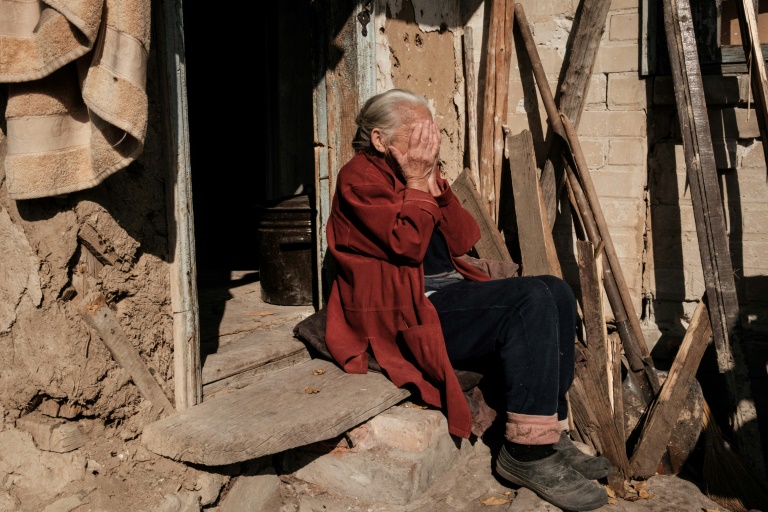
“God only knows how we survived. Only a few of us remain,” said Svitlana Borisenko, 65, a widow who has lived in Shchurove all her life, even through the four months of occupation.

“It was miserable when Russia arrived, it was a disaster. They destroyed everything around them. They kicked in our doors and it was really terrifying.”

Borisenko was twice forced for cook and clean for the occupiers. 

But on Saturday the Ukrainian troops who drove away the last Russians holding out in the village school house last week were enthusiastically taking care of themselves.

– Forest mushrooms –

In one of the damaged guesthouses, next to a swimming pool half-filled with green-stained water, they have set up a wood-fired grill and have caught and prepared a bucket of pike.

Six of the men are crouched around a water bowl cleaning and slicing a huge pile of forest mushrooms, gathered in a pine wood filled with the carcases of smashed tanks.

There are occasional dull detonations in the distance, but a mortar crewman assured AFP that Russian forces are now more than five kilometres (three miles) away.

Atop the four-storey school house, now a hollowed ruin surrounded by chipped concrete and spent cartridges, there now flies a blue and yellow Ukrainian banner.

Inside there are hundreds of unused Kalashnikov rounds in Russian ammo boxes, amid the filthy bedding and abandoned clothes left by the sudden retreat.

Nearby live 75-year-old Zynaida Chupryna and her son Ivan Lobachov, 43.

The tail of a mortar shell sticks out from the flower bed by their bungalow, the warhead buried in the sandy earth. Two craters are visible in their back garden.

Shrapnel from one of the blasts pockmarked the back door, and the modest home’s asbestos roofing has been partly ripped off — allowing rainwater to collapse the interior ceilings.

“I’m trying to clean up because… We’re not dirty. Look what they’ve done to us. We’re still people,” Chupryna told AFP.

“We crawl around in the basement. What else can we do? They shell all the time. If you go upstairs, you’re finished. We couldn’t go outside.”

As much a nature lover as the tourists who came before the war to relax on the banks of the Siversky Donets, Chupryna says she longs to swim in the river once again.

Her son Ivan, a former forest ranger who retired on a disability pension after losing an eye in an accident, said Russian soldiers twice offered the pair food.

– Car battery –

But he suspected the offer was a trick: the troops wanted to collect personal data in exchange for aid, perhaps in order to issue Russian papers to the Ukrainian residents.

Now, the pair have received a single World Food Programme aid parcel, holding seven kilos (15 pounds) of rice and enough oil and canned meat to see them through two weeks.

They have no electricity, but Lobachov has rigged a car battery up to a transistor radio and was aware that an explosion had damaged the bridge between Russia and occupied Crimea.

To the extent that this was a defeat for Russia’s President Vladimir Putin, he took some bitter consolation from the news. “It’s good, I’m glad,” he said, looking at a loss.

Close Bitnami banner
Bitnami