World

'Not afraid anymore': violence flares as Iran protests enter fourth week

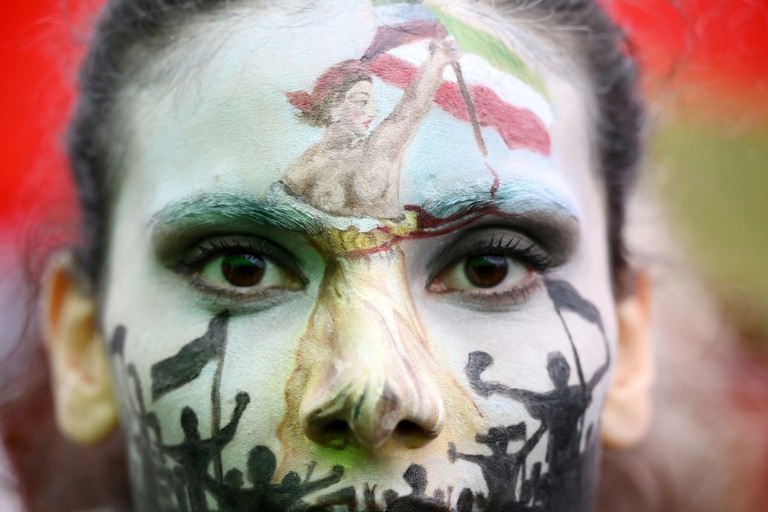
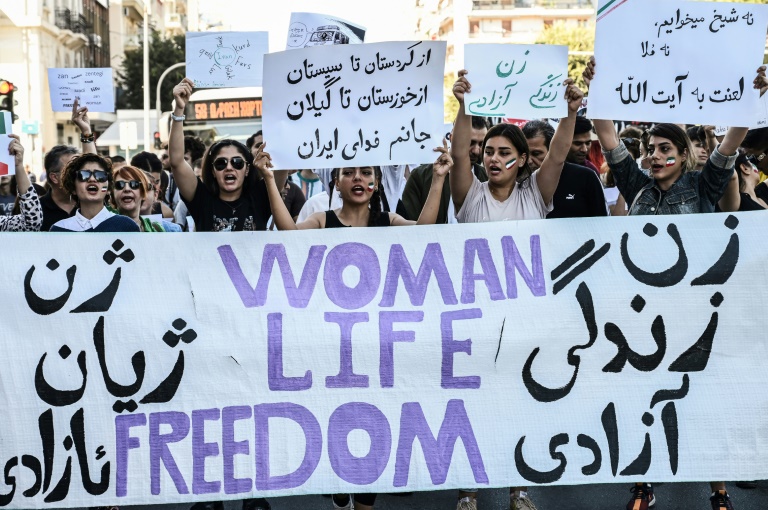
Schoolgirls chanted slogans, workers went on strike and protesters clashed violently with security forces across Iran on Saturday, as demonstrations over the death of Mahsa Amini entered a fourth week.

Anger flared after the 22-year-old Iranian Kurd’s death on September 16, three days after her arrest in Tehran by the notorious morality police for an alleged breach of the Islamic republic’s strict dress code for women.

Iran said on Friday an investigation found Amini had died of a longstanding illness rather than “blows” to the head, despite her family reportedly saying she had previously been healthy.

But the women-led protests continued even as ultraconservative President Ebrahim Raisi posed for a group photograph with students at Tehran’s all-female Al-Zahra University to mark the new academic year.

Young women on the same campus were seen shouting “Death to the oppressor”, said the Oslo-based group Iran Human Rights (IHR).

In Amini’s hometown Saqez, in Kurdistan province, schoolgirls chanted “Woman, life, freedom” and marched down a street swinging headscarves in the air, in videos the Hengaw rights group said were recorded on Saturday.

Gruesome videos were widely shared online of a man who was shot dead while sitting at the wheel of his car in Sanandaj, Kurdistan’s capital.

The province’s police chief, Ali Azadi, said he was “killed by anti-revolutionary forces”.

Angry men appeared to take revenge on a member of the feared Basij militia in Sanandaj, swarming around him and beating him badly, in a widely shared video.

Another shocking video shows a young woman said to have been shot dead in Mashhad, in what many on social media compared to footage of Neda Agha Soltan, a young woman who became an enduring symbol of the opposition after being shot dead at protests in 2009.

– ‘We will fight’ –

Despite internet restrictions designed to impede gatherings and stop images of the crackdown getting out, protesters have adopted new tactics to get their message across.

“We are not afraid anymore. We will fight,” said a large banner placed on an overpass of Tehran’s Modares highway, according to online images verified by AFP.

In other footage, a man is seen altering the wording of a large government billboard on the same highway from “The police are the servants of the people” to “The police are the murderers of the people”.

Hengaw, a Norway-based Kurdish rights group, said “widespread strikes” took place in Saqez, Sanandaj and Divandarreh, in Kurdistan province, as well as Mahabad in West Azerbaijan.

Street protests were also reported in many neighbourhoods of Tehran — where bazaar shops were shuttered — as well as in Isfahan, Karaj, Shiraz and Tabriz, among other cities.

IHR says at least 92 protesters have been killed in the crackdown, which has fuelled tensions between Iran and the West, especially its arch-enemy the United States.

Raisi — who in July called for the mobilisation of all state institutions to enforce hijab rules — appealed for unity.

“Despite all the efforts of ill-wishers, the strong and hardworking people of Islamic Iran will overcome the problems ahead with unity and cohesion,” he was quoted as saying Saturday on the presidency’s website.

Local media quoted a municipal official as saying pictures published Friday of fountains in Tehran appearing to pour blood, after an artist turned the water red to reflect the crackdown, were false and there was “no change in colour”.

– ‘Blind eye’ –

Iran has repeatedly accused outside forces of stirring up the protests, and last week announced that nine foreign nationals — including from France, Germany, Italy, Poland and the Netherlands — had been arrested.

On Friday, France advised its nationals visiting Iran to “leave the country as soon as possible”, citing the risk of arbitrary detention.

The Netherlands advised its citizens to avoid travelling to Iran or to leave when they can do so safely.

“There may be demonstrations which can turn violent. The police sometimes act harshly… authorities can also arbitrarily detain people with a foreign nationality,” it said.

Nazanin Zaghari-Ratcliffe, a British-Iranian charity worker who was held in Tehran for six years until her release in March, called on the UK government to act over Iran’s rights abuses.

“I want the (UK government) to observe what is happening, not to turn a blind eye. I want them to protect us. We cannot be indifferent about what is happening in Iran,” she told Sky News.

“And if we talk about protecting rights of our citizens, we have to do something about it. And I think we have to hold Iran accountable.”
Ireland petrol station blast kills 10

Ten people including a schoolgirl were killed in an explosion at a petrol station in Ireland’s northwest, police said on Saturday suggesting a “tragic accident” may have been to blame.

The blast occurred at around 3:20 pm (1520 GMT) on Friday in the County Donegal village of Creeslough, Ireland’s police, the Garda Siochana, said in a media conference Saturday. 

“There are 10 fatalities as a result of that explosion.

“The ten casualties are four men, three women, two teenagers — a boy and a girl — and a younger girl,” said police, adding that all the victims appeared to be locals.

Based on current information, it is not expected that there will be any further casualties and there are no outstanding reports of unaccounted for persons, said the force.

Police are treating the incident with an “open mind”, but said that “our information at this moment in time is pointing towards a tragic accident.”

Focus will turn to the causes of the incident once the search and recovery operation is completed.

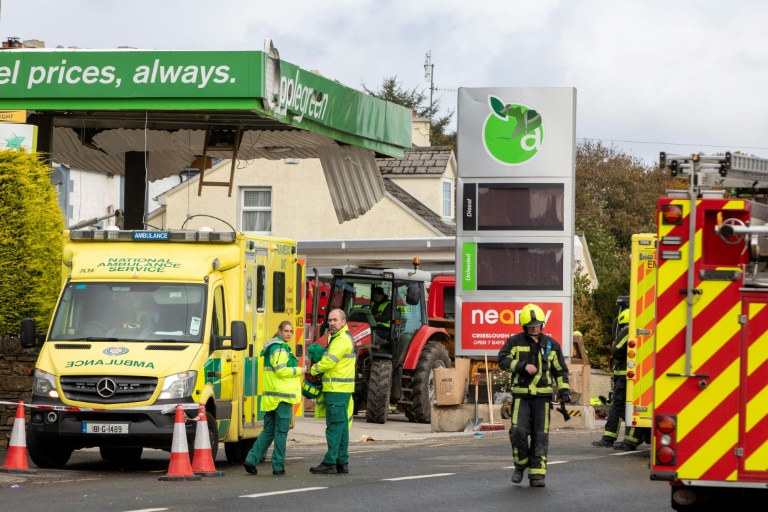
Rescue efforts by Ireland’s emergency services went on through the night after the blast ripped through a petrol station forecourt and a nearby apartment complex.

An aerial photograph taken after the explosion showed the petrol station building destroyed. 

Two two-storey residential buildings behind had collapsed, while the facade of a similar adjacent building was blown off.

Resident Kieran Gallagher, whose house is about 150 metres (500 feet) from the scene, said the blast sounded like a “bomb”.

“I was in my house at the time and heard the explosion. Instantly I knew it was something — it was like a bomb going off,” he told the BBC.

At a service at the local church on Saturday morning, Father John Joe Duffy said the community had been hit by “a tsunami of grief”.

Many emergency services vehicles remained at the scene overnight, including fire services from both sides of the border with British-run Northern Ireland.

Gardai and civil defence were also involved, and a coastguard helicopter airlifted some of the injured from Letterkenny University Hospital to the capital Dublin.

– ‘Shocked and numbed’ –

The university hospital, some 15 miles (24 kilometres) from the explosion, was placed on an emergency footing to deal with “multiple injuries”, it said in a statement.

Ireland’s premier Micheal Martin called it a “very dark day” as he spoke to the media briefly before heading to the scene.

“The scale and enormity of it, it’s such a small community, it means that almost everybody will know on a friendly basis people who’ve lost their lives,” he said.

“It’s a very dark day for the people of Donegal and for Ireland.”

Martin earlier thanked members of the emergency services who were working non-stop “in extremely traumatic circumstances”.

Agriculture Minister Charlie McConalogue, who represents northeast Donegal in the Irish parliament, compared the scenes to events during the decades-long sectarian conflict on the island of Ireland over British rule in Northern Ireland.

“People are shocked and numbed,” McConalogue told Irish broadcaster RTE.

“The scenes from the event are reminiscent of the images from The Troubles years ago, in terms of the scene on the ground and the damage and the debris.”

Creeslough is around 30 miles (50 kilometres) from the border with Northern Ireland and has a population of about 400 people.

The Applegreen service station is on the N56 road, which loops around the northern tip of the Irish republic.

Applegreen tweeted that the news was “devastating”.

“Our thoughts and prayers are with the families and friends of the deceased, those who have been injured, and the wider Creeslough community,” said the company.

Ireland’s President Michael D. Higgins expressed his “shock” in an official statement.

“This tragedy is a terrible blow to a community that is closely knit and where every loss and injury will be felt by every member of the community and far beyond,” he said.

Russia says three killed in Crimea bridge blast, army leadership changed

Russia on Saturday said three people were killed in after a truck exploded on its bridge linking Crimea — a symbol of its annexation of the peninsula — without immediately blaming Ukraine.

On the same day, after Moscow suffered a series of setbacks on the battlefield that triggered unprecedented criticism of its army at home, Moscow appointed a new general to lead its Ukraine offensive. 

The blast ripped through the 19-kilometre bridge more than seven months into Moscow’s Ukraine offensive, although local authorities said it had reopened to motor traffic with vehicles subject to stringent screening. 

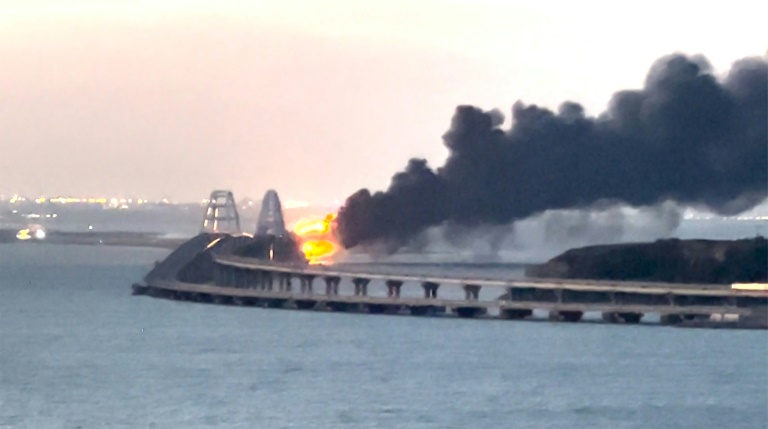
Dramatic social media footage showed the bridge on fire with parts plunging into the water. 

Russian investigators said three people were killed and that two bodies — a man and a woman — were pulled out of the water after the bridge had partially collapsed. 

They were likely to be passengers of a car that was driving near the exploded truck and that their identities were being established, Moscow said. 

It had also identified the owner of the truck as a resident of Russia’s southern Krasnodar region, saying his place of residence was being searched. 

Russia said the blast — which occurred just after 6 am local time — set ablaze seven oil tankers transported by train and collapsed two car lanes of the giant road and rail structure. 

The bridge, personally inaugurated by President Vladimir Putin in 2018, is a vital transport link for carrying military equipment to Russian soldiers fighting in Ukraine.

It is hugely important to the Kremlin, and Moscow had maintained the bridge crossing was safe despite the fighting.

While some in Moscow hinted at Ukrainian “terrorism”, state media continued to call it an “emergency situation.” 

Ukraine’s presidential advisor Mykhailo Podolyak earlier took to Twitter posting a picture of a long section of the bridge half-submerged.

“Crimea, the bridge, the beginning,” he wrote.

“Everything illegal must be destroyed, everything stolen must be returned to Ukraine, everything occupied by Russia must be expelled.”

The Ukrainian post office announced it was preparing to print stamps showing the “Crimean bridge — or more precisely, what remains of it”.

The Kremlin’s spokesman said Putin had ordered a commission to be set up to look into the blast on the bridge which is hugely symbolic and logistically crucial for Moscow. 

Officials in Moscow stopped short of blaming Kyiv.

But a Russian-installed official in Crimea pointed the finger at “Ukrainian vandals.” Another in the neighbouring Kherson region said repairs could “take two months”. 

And the spokeswoman of Russia’s foreign ministry said that Kyiv’s reaction to the blasts showed its “terrorist nature.” 

– Calls for retaliation –


Some officials in Moscow and in Russian-occupied Ukraine called for retaliation. 

“There is an undisguised terrorist war against us,” Russian ruling party deputy Oleg Morozov told the RIA Novosti news agency. 

A Russian-installed official in the occupied Ukrainian Kherson region, Kirill Stremousov, said: “Everyone is waiting for a retaliatory strike and it is likely to come.”

There have been several explosions at Russian military installations in the Crimean peninsula.

If it is established that Ukraine was behind the latest blast, alarm bells may sound with the bridge so far from the frontline.

Authorities in Crimea appeared to downplay the blasts and tried to calm fears of food and fuel shortages in Crimea, which is fully reliant on the Russian mainland since Moscow annexed it in 2014. 

At around 1400 GMT, Moscow-appointed head of the peninsula, Sergei Askyonov, said car traffic had resumed on the bridge but that all vehicles were being inspected. 

“Road traffic has begun on the Crimea bridge,” he said on Telegram. 

The blasts come after Ukraine’s recent lightning territorial gains in the east and south that have undermined the Kremlin’s claim that it annexed Donetsk, neighbouring Lugansk and the southern regions of Zaporizhzhia and Kherson.

– Moscow appoints new general –  

After several weeks of crushing military defeats, Moscow on Saturday announced that a new general — Sergei Surovikin — would take over its forces in Ukraine.  

The decision — made public in an unusual move — comes after the setbacks on the battlefield led to growing discontent among the elite towards the army’s leadership. 

This month, Chechen leader Ramzan Kadyrov had called for a top general to be fired in Ukraine after Russian forces lost control of the key city of Lyman. 

Senior Russian lawmaker Andrei separately urged officers to stop “lying” about the situation on the battlefield.  

Surovikin previously led Russia’s forces in southern Ukraine. He has combat experience in the 1990s conflicts in Tajikistan and Chechnya, as well as, more recently, in Syria.

Also on Saturday, the governor of Russia’s Belgorod region that borders Ukraine said Kyiv’s forces had fired at a Russian border village, injuring a teenage girl.  

But Russian forces had made some gains in eastern Ukraine this week. 

On Friday, Moscow said its forces had captured ground in Donetsk in east Ukraine, their first claim of new gains since a Kyiv counter-offensive rattled Moscow’s military campaign. 

The Donetsk region, which has been partially controlled by Kremlin-backed separatists for years, is a key prize for Russian forces, which sent troops to Ukraine in February.

US says Hong Kong risks reputation over yacht linked to Putin ally

Hong Kong could damage its reputation as a financial hub if it gives haven to sanctions dodgers, the United States cautioned Saturday, after the city said it would not act against a superyacht reportedly owned by a Kremlin ally.

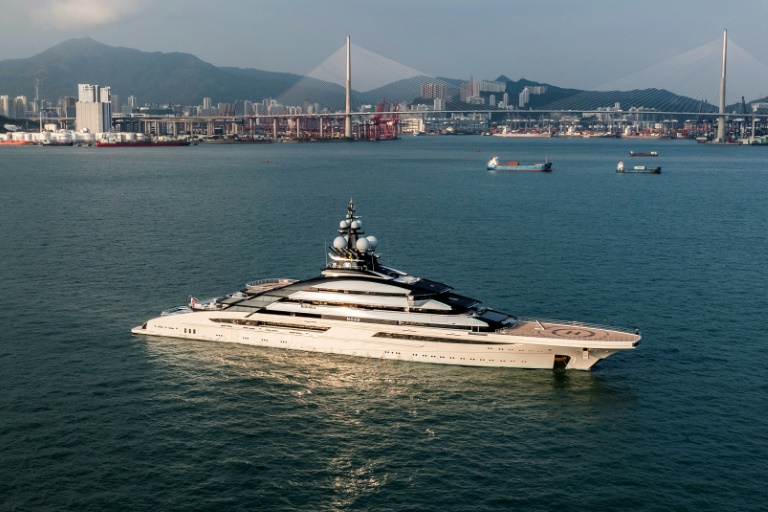
The Nord — a US$500 million, 142-metre (466-foot) luxury vessel linked to Russian billionaire Alexei Mordashov — arrived in the Chinese territory’s waters this week.

Mordashov is among the oligarchs who are close to Russian President Vladimir Putin and have been targeted by Western sanctions following Moscow’s invasion of Ukraine.

Some of them have had their luxury yachts seized in places such as Spain and Fiji, but Hong Kong said Friday that while it implements UN sanctions, it cannot enforce those imposed “unilaterally” by countries or blocs.

“The possible use of Hong Kong as a safe haven by individuals evading sanctions from multiple jurisdictions further calls into question the transparency of the business environment,” a US State Department spokesperson told AFP in response.

“Hong Kong’s reputation as a financial centre depends on adherence to international laws and standards.”

Yachts owned by those close to Putin have become targets for Ukraine’s Western allies, who are hunting for the assets of sanctioned figures as they seek to punish Moscow for the Ukraine invasion.

In March, Italy seized the Lady M, a yacht belonging to Mordashov, citing European Union sanctions.

China has conspicuously not condemned the invasion of Ukraine, and said it has a “no-limits” relationship with Russia.

A spokesperson for Mordashov told Bloomberg News this week that the billionaire was in Moscow and declined to comment on the yacht’s movements.

The Nord — which boasts two helipads, a cinema and more than a dozen luxury cabins — switched its flag from the Cayman Islands to Russia in June.

It was anchored in the eastern Russian port of Vladivostok before making its way to Hong Kong.

He's not even running — but US midterms could make or break Trump

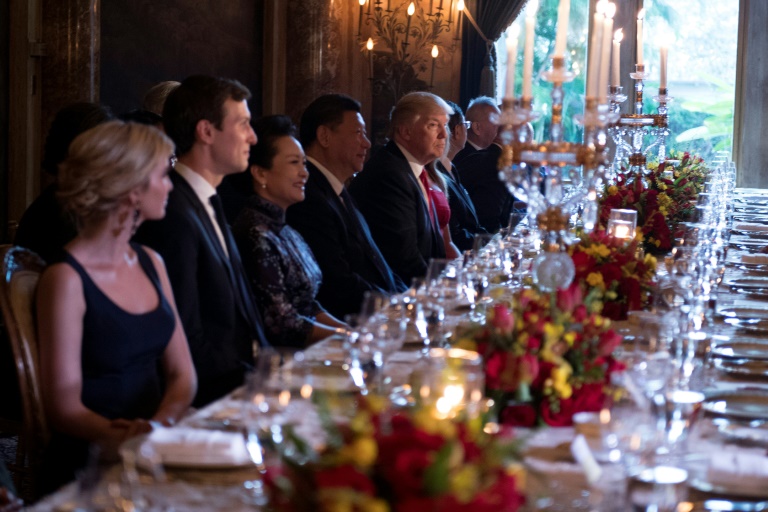
After losing the 2020 presidential election, Donald Trump could have worked on his golf swing or produced another book by the pool at his south Florida beach club.

Instead he threw himself into the midterm election campaign with unprecedented gusto, staking his kingmaker reputation on a slew of controversial candidates in key primary races.

His US Senate picks in open races — mostly anti-abortion hardliners, backers of his election fraud conspiracy theories or out-of-towners with tenuous local ties — have been struggling however.

And with exactly a month to go until Election Day, many Republicans are laying the blame at the gates of Mar-a-Lago. 

“Donald Trump is not on any ballot in 2022, but his political future is,” John Hudak, a senior fellow at the Brookings Institution, wrote in a recent blog post.

Trump’s project to reshape the Republican Party in his image via the midterms will likely “either make Donald Trump an also-ran or the commanding force in party politics for years to come,” Hudak argued.

Many of Trump’s primary endorsements have been seen as undermining more electable, mainstream alternatives, and potentially squandering easy victories in key battlegrounds seen as ripe for flipping from the Democrats.

Among his controversial picks are celebrity physician Mehmet Oz in Pennsylvania — seen by many as an out-of-touch “carpetbagger,” prone to rhetorical gaffes — and Ohio’s J.D. Vance, a venture capitalist who has spent most of his adult life in Silicon Valley and faces similar issues. 

The story is the same in Georgia, where ex-football star Herschel Walker faces questions over domestic abuse, dishonesty about his past and mental fitness. 

And in Arizona, Blake Masters is struggling in what should be a winnable seat with a campaign that Politico has described as “hardline nationalist.”

– ‘Little to gain’ –

Senate Minority Leader Mitch McConnell — who needs just one gain to take the upper chamber from the Democrats — has offered oblique hints that he sees “candidate quality” as a problem. 

Hudack put it more starkly.

“(If) Senate candidates like Walker, Oz, Vance or Blake Masters ultimately lose in numbers that maintains Democrats’ Senate majority, Mr Trump will be widely blamed,” he said. 

A poor election night for Trump candidates would be chum in the water for his 2024 rivals, a list that potentially includes outspoken anti-Trumpist Liz Cheney, Florida’s firebrand governor Ron DeSantis and ex-vice president Mike Pence. 

Cheney aside, Republican presidential hopefuls have largely continued to genuflect to Trump through his post-presidency. 

But figures such as ex-secretary of state Mike Pompeo, estranged Trump ally Chris Christie and one-time UN ambassador Nikki Haley could be emboldened by poor results on November 8.

David Greenberg, a media and history professor at Rutgers University, said the former president — for now the clear frontrunner for the 2024 Republican nomination — had “little to gain” in the midterms.

“But Trump has a lot to lose because if his candidates flame out, then he will be seen as having lost his magic,” Greenberg told AFP. 

“Some primary voters in 2024 may think twice about supporting him again, especially if a popular alternative such as DeSantis also runs.”

A note of caution: the polls are expected to tighten before November and all of Trump’s most divisive candidates could yet triumph in photo finishes. 

– ‘Clear leader’ –

Expect some of the circling sharks to back off if this happens — and for Trump to look suddenly like a political genius with a bold vision rather than a liability.   

Trump watchers often point out that much of the former president’s die-hard base cares little about the Senate or Washington politics in any case. 

“Despite losing reelection, two impeachments, nearly a dozen serious criminal probes, and countless scandals that would have long ago sunk most any other politician, Trump remains the clear leader of the Republican Party,” said political analyst Nicholas Creel, of Georgia College and State University. 

“Trump’s support in the Republican Party is far too resilient to be damaged by a poor showing by the party this November.”

Other observers though expect the tycoon’s many legal woes, including the mushrooming scandal over his mishandling of classified government secrets, to be as a big a drag on his political prospects as the performance of his midterm picks.

Irina Tsukerman, a New York-based national security lawyer and geopolitical analyst, said Trump was increasingly perceived as a “political liability” — incapable of winning a future presidential election even against a weak Democrat.

“Overall, it looks like he will be strongly discouraged from running in 2024, which he may not do for his own reasons — such as avoiding embarrassment and keeping the money he is currently raising,” she told AFP.

Trump’s office did not respond to a request for comment.

'Sabotage' to blame for major German rail breakdown

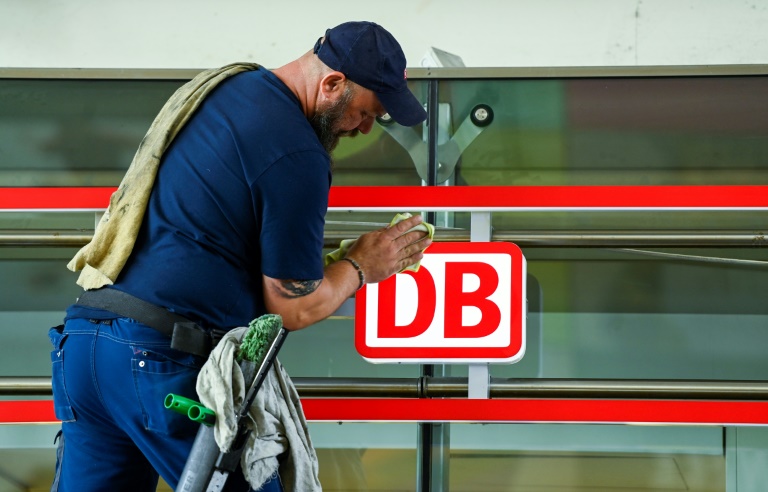
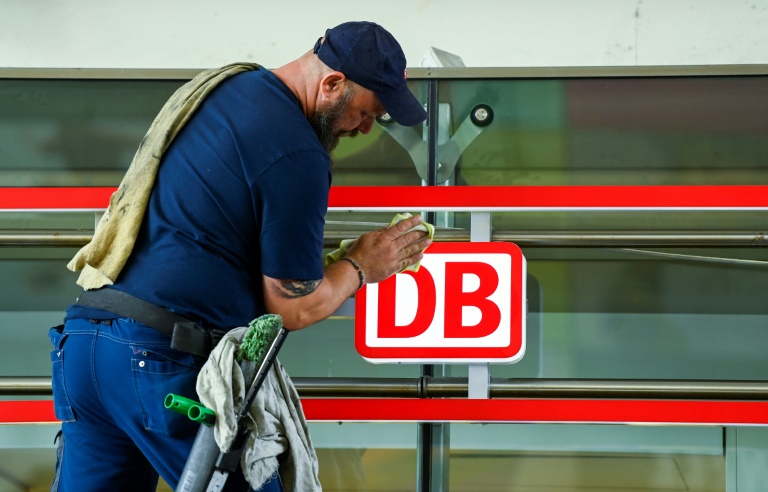
“Sabotage” targeting communications infrastructure was to blame for major disruption to the German railway network on Saturday, operator Deutsche Bahn said while the government said no motive had yet been identified.

“Cable sabotage” was the cause of the breakdown, which led to a three-hour suspension of train services throughout northern Germany, a spokesman for the company told AFP.

German Transport Minister Volker Wissing said essential cables “were deliberately and intentionally severed” in two places. 

“It is clear that this was a targeted and deliberate action,” he added, saying the motive was not “yet known”.

He described the incident as “clearly premeditated”.

Specifically, there was damage to the GSM-R, a radio network used for communication on the railway, Der Spiegel reported, quoting security sources.

Any damage to the cable would require “certain knowledge” of the rail system, the Bild daily said, adding that federal police were investigating. 

Traffic was completely interrupted for about three hours because of “a breakdown in the digital radio system for the trains”, before being restored, according to Deutsche Bahn. 

Services were affected between Berlin and regions in the west and north of the country including Schleswig-Holstein, the cities of Hamburg and Bremen, as well as Lower Saxony and parts of North Rhine-Westphalia. 

– Protection of critical infrastructure –

The Berlin-Amsterdam route was also suspended, and thouands of travellers were stranded at stations across the affected regions.

Cancellations and delays were still expected on Saturday despite the restoration of rail services, Deutsche Bahn warned. 

The attack comes just over two weeks after sabotage attacks on the Nord Stream 1 and 2 gas pipelines linking Russia and Germany. 

The German government has also stepped up protection of its critical infrastructure. 

Deutsche Bahn is regularly criticised for delays on its services. 

At the beginning of September, the company said it would carry out massive improvement works, including replacing 137,000 concrete sleepers.

An independent report pointed the finger at “production faults” in the sleepers.

The derailment of a train in the Bavarian Alps in early June, which killed five people and injured more than 40, highlighted the poor state of German rail infrastructure, linked to years of under-investment. 

The government has in recent months been encouraging car-loving Germans to take the train by offering cheap tickets.

'Sabotage' to blame for major German rail breakdown

“Sabotage” targeting communications infrastructure was to blame for major disruption to the German railway network on Saturday, operator Deutsche Bahn said while the government said no motive had yet been identified.

“Cable sabotage” was the cause of the breakdown, which led to a three-hour suspension of train services throughout northern Germany, a spokesman for the company told AFP.

German Transport Minister Volker Wissing said essential cables “were deliberately and intentionally severed” in two places. 

“It is clear that this was a targeted and deliberate action,” he added, saying the motive was not “yet known”.

He described the incident as “clearly premeditated”.

Specifically, there was damage to the GSM-R, a radio network used for communication on the railway, Der Spiegel reported, quoting security sources.

Any damage to the cable would require “certain knowledge” of the rail system, the Bild daily said, adding that federal police were investigating. 

Traffic was completely interrupted for about three hours because of “a breakdown in the digital radio system for the trains”, before being restored, according to Deutsche Bahn. 

Services were affected between Berlin and regions in the west and north of the country including Schleswig-Holstein, the cities of Hamburg and Bremen, as well as Lower Saxony and parts of North Rhine-Westphalia. 

– Protection of critical infrastructure –

The Berlin-Amsterdam route was also suspended, and thouands of travellers were stranded at stations across the affected regions.

Cancellations and delays were still expected on Saturday despite the restoration of rail services, Deutsche Bahn warned. 

The attack comes just over two weeks after sabotage attacks on the Nord Stream 1 and 2 gas pipelines linking Russia and Germany. 

The German government has also stepped up protection of its critical infrastructure. 

Deutsche Bahn is regularly criticised for delays on its services. 

At the beginning of September, the company said it would carry out massive improvement works, including replacing 137,000 concrete sleepers.

An independent report pointed the finger at “production faults” in the sleepers.

The derailment of a train in the Bavarian Alps in early June, which killed five people and injured more than 40, highlighted the poor state of German rail infrastructure, linked to years of under-investment. 

The government has in recent months been encouraging car-loving Germans to take the train by offering cheap tickets.

Ireland petrol station blast kills nine

At least nine people have been killed in an explosion at a petrol station in County Donegal in Ireland’s northwest, police said on Saturday.

The Garda Siochana police force said eight people had been hospitalised and that it “can now confirm nine fatalities as a result of this incident.

“The search and recovery for further fatalities continues” at the site in the village of Creeslough,” it said.

The cause of the explosion remained unknown and police had yet to announce the launch of an inquiry as the search through rubble went on.

The toll from Friday’s explosion had already risen from three to seven overnight.

Rescue efforts by Ireland’s emergency services went on through the night after the blast ripped through a petrol station forecourt and a nearby apartment complex.

An aerial photograph taken after the explosion showed the petrol station building destroyed. 

Two two-storey residential buildings behind had collapsed, while the facade of a similar adjacent building was blown off.

Resident Kieran Gallagher, whose house is about 150 metres (500 feet) from the scene, said the blast sounded like a “bomb”.

“I was in my house at the time and heard the explosion. Instantly I knew it was something — it was like a bomb going off,” he told the BBC.

At a service at the local church on Saturday morning, Father John Joe Duffy said the community had been hit by “a tsunami of grief”.

Many emergency services vehicles remained at the scene overnight, including fire services from both sides of the border with British-run Northern Ireland.

Gardai and civil defence were also involved, and a coastguard helicopter airlifted some of the injured from Letterkenny University Hospital to the capital Dublin.

– ‘Shocked and numbed’ –

The university hospital, some 15 miles (24 kilometres) from the explosion, was placed on an emergency footing to deal with “multiple injuries”, it said in a statement.

Ireland’s premier Micheal Martin said his “thoughts and prayers are today with those who have lost their lives, and those injured in the devastating explosion”.

“People across this island will be numbed by the same sense of shock and utter devastation as the people of Creeslough at this tragic loss of life,” he said.

Martin thanked members of the emergency services who were working non-stop “in extremely traumatic circumstances”.

Agriculture Minister Charlie McConalogue, who represents northeast Donegal in the Irish parliament, compared the scenes to events during the decades-long sectarian conflict on the island of Ireland over British rule in Northern Ireland.

“People are shocked and numbed,” McConalogue told Irish broadcaster RTE.

“The scenes from the event are reminiscent of the images from The Troubles years ago, in terms of the scene on the ground and the damage and the debris.”

Creeslough is around 30 miles (50 kilometres) from the border with Northern Ireland and has a population of about 400 people.

The Applegreen service station is on the N56 road, which loops around the northern tip of the Irish republic.

Applegreen tweeted that the news was “devastating”.

“Our thoughts and prayers are with the families and friends of the deceased, those who have been injured, and the wider Creeslough community,” said the company.

Ireland’s President Michael D. Higgins expressed his “shock” in an official statement.

“This tragedy is a terrible blow to a community that is closely knit and where every loss and injury will be felt by every member of the community and far beyond,” he said.

Russia says three killed in Crimea bridge blast

Russia on Saturday said three people were killed after a truck exploded on its bridge linking Crimea to mainland Russia — a symbol of its annexation of the peninsula — without immediately blaming Ukraine. 

The blast ripped through the 19-kilometre bridge — hugely important to the Kremlin — more than seven months into Moscow’s Ukraine offensive. 

Dramatic social media footage showed the bridge on fire with parts plunging into the water. 

“According to preliminary information, three people were killed,” Russia’s investigative committee said in a statement. 

It said the bodies of a man and a woman had been pulled out of the water after the bridge had partially collapsed. 

Moscow said they were likely to be passengers of a car that was driving near the exploded truck and that their identities were being established. 

It also said that it had identified the owner of the truck as a resident of Russia’s southern Krasnodar region, saying his place of residence was being searched. 

Russia said the blast set ablaze seven oil tankers transported by train and collapsed two car lanes of the giant road and rail structure. 

“Today at 6:07 am (0307 GMT) on the road traffic side of the Crimean bridge… a car bomb exploded, setting fire to seven oil tankers being carried by rail to Crimea,” the national anti-terrorism committee said.

The bridge, personally inaugurated by President Vladimir Putin in 2018, is a vital transport link for carrying military equipment to Russian soldiers fighting in Ukraine.

It is hugely important to the Kremlin, and Moscow had maintained the bridge crossing was safe despite the fighting.

While some in Moscow hinted at Ukrainian “terrorism”, state media continued to call it an “emergency situation.” 

Ukraine’s presidential advisor Mykhailo Podolyak earlier took to Twitter posting a picture of a long section of the bridge half-submerged.

“Crimea, the bridge, the beginning,” he wrote.

“Everything illegal must be destroyed, everything stolen must be returned to Ukraine, everything occupied by Russia must be expelled.”

The Ukrainian post office announced it was preparing to print stamps showing the “Crimean bridge — or more precisely, what remains of it”.

The Kremlin spokesman said Putin had ordered a commission to be set up to look into the blast, Russian news agencies reported.  

Officials in Moscow stopped short of blaming Kyiv.

But an official in Russian-installed Crimea pointed the finger at “Ukrainian vandals.” Another in the neighbouring Kherson region said repairs could “take two months”. 

And the spokeswoman of Russia’s foreign ministry said that Kyiv’s reaction to the blasts showed its “terrorist nature.” 

– ‘Undisguised terrorist war’ –

Some officials in Moscow and in Russian-occupied Ukraine called for retaliation. 

“There is an undisguised terrorist war against us,” Russian ruling party deputy Oleg Morozov told the RIA Novosti news agency. 

A Russian-installed official in the occupied Ukrainian Kherson region, Kirill Stremousov, said: “Everyone is waiting for a retaliatory strike and it is likely to come.”

There have been several explosions at Russian military installations in the Crimean peninsula.

If it is established that Ukraine was behind the latest blast, alarm bells may sound with the bridge so far from the front line.

The blasts come after Ukraine’s recent lightning territorial gains in the east and south that have undermined the Kremlin’s claim that it annexed Donetsk, neighbouring Lugansk and the southern regions of Zaporizhzhia and Kherson. 

The Moscow-installed head of the peninsula, Sergei Aksyonov, called on Crimeans to remain “calm” as authorities appeared to downplay the blasts. 

“I call on everyone to clam down and not spread fake information,” he said on Telegram. “The situation is being controlled, professionals are working on the ground.”

He said rail links to Russia had been halted and added that authorities had set up food and heating points to help stranded drivers. 

Authorities also tried to calm fears of food and fuel shortages in Crimea, which is fully reliant on the Russian mainland since Moscow annexed it in 2014. 

– Border village shelled – 

On the same day, the governor of Russia’s Belgorod region that borders Ukraine said Kyiv’s forces had fired at a Russian border village, injuring a teenager. 

On Friday, Russian forces said they had captured ground in Donetsk in east Ukraine, their first claim of new gains since a Kyiv counter-offensive rattled Moscow’s war effort.

Separatist forces in the conflict-torn Donetsk region said they had retaken a series of villages near the Ukraine-controlled industrial town of Bakhmut, which has been under Russian shelling for weeks.

The Donetsk region, which has been partially controlled by Kremlin-backed separatists for years, is a key prize for Russian forces, which sent troops to Ukraine in February.

Ukrainian President Volodymyr Zelensky said late Friday  his forces had recaptured nearly 2,500 square kilometres (965 square miles) in the counter-offensive that began late last month. 

'Not afraid anymore': Clashes as Iran protests enter fourth week

Schoolgirls chanted slogans, workers went on strike and street clashes erupted across Iran on Saturday, as protests over the death of Mahsa Amini entered a fourth week in defiance of a bloody crackdown.

Anger flared after the 22-year-old Iranian Kurd’s death on September 16, three days after she was arrested in Tehran by the notorious morality police for an alleged breach of the Islamic republic’s strict dress code for women.

Iran said Friday an investigation found Amini had died of a longstanding illness rather than “blows” to the head, despite her family reportedly saying she had previously been healthy.

But the protests continued Saturday even as ultra-conservative President Ebrahim Raisi posed for a group photograph with female students at Tehran’s Al-Zahra University to mark the start of the academic year.

In Amini’s hometown Saqez, in the western province of Kurdistan, schoolgirls were heard chanting “Woman, life, freedom” and seen marching down a street swinging headscarves over their heads, in videos the Hengaw rights group said were recorded on Saturday.

In another video it shared, a group of girls could be heard chanting the same phrase — the catchcry of the protests — as they entered a school in Sanandaj, the capital of Kurdistan province.

Despite internet restrictions designed to impede gatherings and prevent images of the crackdown getting out, protesters have adopted new tactics to get their message across.

“We are not afraid anymore. We will fight,” said a large banner placed on an overpass of the Modares highway that cuts through central Tehran, according to online images verified by AFP.

– ‘Widespread strikes’ –

In another widely shared video, a man is seen altering the wording of a large government billboard from “The police are the servants of the people” to “The police are the murderers of the people”.

Hengaw, a Kurdish rights group based in Norway, said “widespread strikes” were taking place in Saqez, Sanandaj and Divandarreh, in Kurdistan province, as well as Mahabad in West Azerbaijan province.

Shots could be heard as protesters clashed with security forces on a street in Sanandaj, in a video shared by the 1500tasvir social media channel that monitors violations in the Islamic republic.

The same source said there were protests in the southern city of Shiraz.

It also shared a verified video of a demonstration in Karaj, a city west of Tehran, as well as footage of drivers honking car horns in the southern city of Kerman as dozens of people gathered on the roadside.

AFP was unable to immediately verify other footage from 1500tasvir.

Oslo-based group Iran Human Rights says at least 92 protesters have been killed in the crackdown, which has fuelled tensions between Iran and the West, especially its arch enemy the United States.

Raisi — an ultraconservative who in July called for the mobilisation of all state institutions to enforce hijab rules — appealed for unity.

“Despite all the efforts of ill-wishers, the strong and hardworking people of Islamic Iran will overcome the problems ahead with unity and cohesion,” he was quoted as saying Saturday on the presidency’s website.

– Arbitrary detentions –

Iran has repeatedly accused outside forces of stirring up the protests, and last week announced that nine foreign nationals — including from France, Germany, Italy, Poland and the Netherlands — had been arrested.

On Friday, the French government advised its nationals visiting Iran to “leave the country as soon as possible”, citing the risk of arbitrary detention.

The Dutch government advised its citizens to avoid travelling to the Islamic republic or to leave when they can do so safely.

“In many towns in the country there may be demonstrations which can turn violent. The demonstrations are increasing,” it said in a statement.

“The police sometimes act harshly and in an arbitrary fashion… Iranian authorities can also arbitrarily detain people with a foreign nationality.”

Nazanin Zaghari-Ratcliffe, a British-Iranian charity worker who was held in Tehran for six years until her release in March, called on the UK government to act over Iran’s human rights abuses, in an interview aired Saturday on Britain’s Sky News.

“I want the (UK government) to observe what is happening, not to turn a blind eye. I want them to protect us. We cannot be indifferent about what is happening in Iran,” she said.

“And if we talk about protecting rights of our citizens, we have to do something about it. And I think we have to hold Iran accountable.”
Close Bitnami banner
Bitnami