World

First minors sentenced under Hong Kong security law

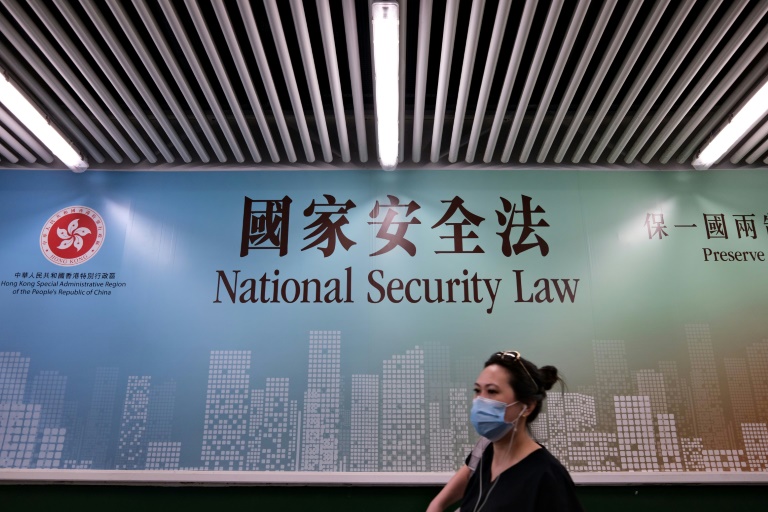
The first minors convicted under Hong Kong’s national security law were Saturday sentenced to detention in a training centre by a judge who said their calls to overthrow China’s government must be met with deterrence.

A 16-year-old girl and three 17-year-olds were members of a little-known pro-independence group that called itself “Returning Valiant” and promoted a violent uprising against China at street booths and on social media last year, the court heard.

They were charged with “conspiracy to incite subversion” under a sweeping national security law that Beijing imposed on the city to stamp out dissent after huge and sometimes violent democracy protests three years ago. 

On Saturday, judge Kwok Wai-kin said the defendants’ message could have turned peaceful demonstrators violent — even though he conceded there was no direct evidence of anyone being incited.

“Even if one person is incited, Hong Kong’s stability and residents’ safety could have been greatly harmed,” Kwok said.

The four teens, which AFP has chosen not to name because of their age, all pleaded guilty last month alongside fellow defendant Kwok Man-hei, 19.

All five were sentenced to up to three years at a training centre, a rehabilitation-focused detention facility which can be a sentencing option for teens aged 14 to 20. 

In a previous hearing, prosecutor Stella Lo said the group spread its messages outside busy railway stations, gave press conferences and held online broadcasts over the span of four months.

The defendants cited the French Revolution and Ukraine’s struggle for democratisation over the past decade to support their cause, the court heard.

Flyers handed out by the group also quoted the Chinese Communist Party’s Mao Zedong saying that “revolution is not a dinner party” and is instead “an act of violence by which one class overthrows another,” Lo added.

Some of the teenagers were still at school when they were arrested.

The case also involves two adult defendants, whose sentences will be decided separately next month.

Most have already spent a year in pre-trial detention, after new rules introduced by the security law made it more difficult for suspects to get bail.

The national security law states that any person who incites subversion must be sentenced to between five and 10 years in jail if the case is of a serious nature.

Hong Kong courts typically refrain from sending minors to prison and prefer options that emphasise rehabilitation.

But prosecutor Anthony Chau said sentences under the National Security Law must have a deterrent effect.

Defence lawyers argued that the door should be left open for the defendants to be given more lenient sentences, given the typical discount of pleading guilty.

Hong Kong’s once-popular democracy movement has been dismantled by both by the security law and by prosecutors deploying a colonial era sedition law.

More than 210 people have been arrested under the law, with nearly 130 formally charged, mostly for political views and speech.

Authorities have launched a separate terrorism prosecution against other Returning Valiant members for an alleged bomb plot, with police accusing them of trying to manufacture the powerful explosive TATP.

Thai king tells massacre victims' families 'I share your grief'

Thailand’s king has told bereaved families he “shares their grief” in a rare public address following a nursery massacre that killed dozens.

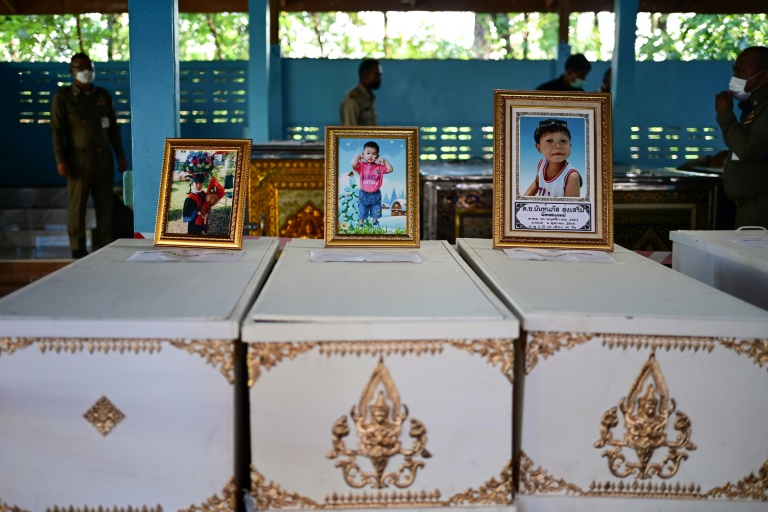
King Maha Vajiralongkorn met survivors and relatives at a hospital in northeastern Nong Bua Lam Phu province late on Friday, a day after an ex-policeman murdered 24 children and 12 adults on a three-hour gun and knife rampage in a sleepy rural area.

Buddhist funeral rites and prayers for the dead were expected to begin later Saturday, starting three days of mourning for the victims of one of the country’s worst ever mass killings.

As the king offered his help and condolences, grieving families knelt on the hospital floor — as is Thai custom in the presence of the monarch, who is seen as semi-divine.

“I come here to give you support. I am extremely sad for what has happened. I share your sorrow, your grief,” he said in video footage published online on Saturday.

“There are no words that can express the sorrow. I support you all and wish you to be strong, so the spirits of the children can be at ease.”

The king, with Queen Suthida at his side, said he would pray for the dead.

“We have to do our best, the best that we can,” he said.

– Flowers, grief –

The royal visit came after a day of grief at the small yellow-walled nursery on the edge of a village in Na Klang district, some 500 km (300 miles) north of Bangkok.

Heartbroken parents placed white roses one by one on steps of the nursery where their young children’s lives were brutally cut short on Thursday afternoon by sacked police sergeant Panya Khamrab.

Prime Minister Prayut Chan-O-Cha joined the mourners on Friday, laying flowers and handing out compensation cheques to grieving families. 

Some, struggling to comprehend the atrocity, wept inconsolably, clutching their children’s favourite toys or blankets — and in one case a half-full bottle of milk.

The dead include pregnant teacher Supaporn Pramongmuk, whose husband posted a poignant tribute on Facebook.

“I would like to say thank you for all the support for me and my family. My wife has fulfilled her every duty as a teacher,” Seksan Srirach wrote.

“Please be a teacher in heaven, and my child please take care of your mother in heaven.”

The attacker forced his way into the childcare centre at about 12:30 pm (0530 GMT) on Thursday to begin his murderous spree, opening fire with his own legally owned 9mm pistol and slashing with a knife.

Afterwards the 34-year-old went home to murder his wife and son before taking his own life, police said, ending the rampage at about 3 pm.

In total, he killed 24 children — 21 boys and three girls — and 12 adults. Most died from a combination of knife wounds and gunshots, according to police investigators.

PM Prayut has ordered a swift probe into the massacre, and it has emerged that Panya was sacked from the police for drug abuse.

Several people in the close-knit community have told AFP he was known in the area as a methamphetamine addict.

Google looks to raise its smartphone game with latest Pixel 7

Google is looking to up its smartphone game with the Pixel 7, the latest entrant in a competitive corner of personal electronics where it has traditionally been a bit player.

The device was unveiled this week in Brooklyn, where representatives from the Mountain View, California giant highlighted top-flight features that can silence background noise on the phone. 

First introduced in 2016, the Pixel was a late-comer to the portable phone trend, arriving nearly a decade after Apple’s iPhone and seven years after Samsung’s Galaxy model, the two products that dominate today’s market.

In 2020, global deliveries of the Google phone were just 2.7 million, next to more than 200 million for both the Apple and Samsung options.

Those paltry sales figures are partly due to the Google phone’s limited availability, with the Pixel 5 sold in less than 10 countries as the tech giant has focused its smartphone investment on software rather than its own hardware.

While Google’s phones are comparable in terms of quality to the top sellers, the product “has often lacked backing from Google” in terms of marketing, said Runar Bjørhovde, a research analyst at market research firm Canalys.

Google has instead focused on boosting its Android operating system, which was launched in 2008 and included more than 80 percent of the smartphones sold in the first half of 2022, according to Canalys.

Maurice Klaehne of Counterpoint Research said that “Google certainly has the capability and resources to become a major smartphone player, but that is not Pixel’s strategy,” noting that growing Android remains Google’s main objective.

But “Selling more Pixel devices might mean taking away share from other Android players, and this would go against Pixel’s goal,” he said.

Bjørhovde noted that, with the latest version of the phone, Google has pivoted somewhat, releasing a product that is compatible with wearables, earbuds and other devices produced by the company.

– Wonders of AI –

The prior phone version, the Pixel 6, was the first to employ Tensor processing developed by Google to enable more sophisticated artificial intelligence and machine learning. 

The Pixel 7 has a second-generation Tensor, the G2, which can make blurry photos more clear, excise distracting extras from photos and remove the background noise on telephone calls.

The upgraded system also can translate language in real-time, including idioms, and transmit more nuanced photos of  different skin tones.

At a launch event, Google vice president Rick Osterloh said the new product “represents years of development across Google, and a long-term investment in the Pixel portfolio.”

The company has seen an uptick in sales, reaching 6.2 million Pixels in the 12 months ending June 30, 2022, up 129 percent from the prior 12-month stretch, according to figures from Canalys.

This includes a doubling in market share in the United States, where Pixel now only accounts for two percent of smartphone sales.

Priced at $599 in the United States, the Pixel 7 is being positioned as relatively affordable. The latest versions of the iPhone and Samsung Galaxy are both around $800.

Google has been bolstering its Pixel marketing, partnering with the NBA professional basketball league. 

The company also plans to distribute Pixel 7 in 17 countries, compared to 13 markets for the prior version.

“Google has the potential to become a long-term player in the smartphone market,” said Bjørhovde. “However, it will be dependent upon global scale and breaking into new markets to achieve this and create a profitable business that can last.”

He's not even running — but US midterms could make or break Trump

After losing the 2020 presidential election, Donald Trump could have worked on his golf swing or produced another book by the pool at his south Florida beach club.

Instead he threw himself into the midterm election campaign with unprecedented gusto, staking his kingmaker reputation on a slew of controversial candidates in key primary races.

His US Senate picks in open races — mostly anti-abortion hardliners, backers of his election fraud conspiracy theories or out-of-towners with tenuous local ties — have been struggling however.

And with exactly a month to go until Election Day, many Republicans are laying the blame at the gates of Mar-a-Lago. 

“Donald Trump is not on any ballot in 2022, but his political future is,” John Hudak, a senior fellow at the Brookings Institution, wrote in a recent blog post.

Trump’s project to reshape the Republican Party in his image via the midterms will likely “either make Donald Trump an also-ran or the commanding force in party politics for years to come,” Hudak argued.

Many of Trump’s primary endorsements have been seen as undermining more electable, mainstream alternatives, and potentially squandering easy victories in key battlegrounds seen as ripe for flipping from the Democrats.

Among his controversial picks are celebrity physician Mehmet Oz in Pennsylvania — seen by many as an out-of-touch “carpetbagger,” prone to rhetorical gaffes — and Ohio’s J.D. Vance, a venture capitalist who has spent most of his adult life in Silicon Valley and faces similar issues. 

The story is the same in Georgia, where ex-football star Herschel Walker faces questions over domestic abuse, dishonesty about his past and mental fitness. 

And in Arizona, Blake Masters is struggling in what should be a winnable seat with a campaign that Politico has described as “hardline nationalist.”

– ‘Little to gain’ –

Senate Minority Leader Mitch McConnell — who needs just one gain to take the upper chamber from the Democrats — has offered oblique hints that he sees “candidate quality” as a problem. 

Hudack put it more starkly.

“(If) Senate candidates like Walker, Oz, Vance or Blake Masters ultimately lose in numbers that maintains Democrats’ Senate majority, Mr Trump will be widely blamed,” he said. 

A poor election night for Trump candidates would be chum in the water for his 2024 rivals, a list that potentially includes outspoken anti-Trumpist Liz Cheney, Florida’s firebrand governor Ron DeSantis and ex-vice president Mike Pence. 

Cheney aside, Republican presidential hopefuls have largely continued to genuflect to Trump through his post-presidency. 

But figures such as ex-secretary of state Mike Pompeo, estranged Trump ally Chris Christie and one-time UN ambassador Nikki Haley could be emboldened by poor results on November 8.

David Greenberg, a media and history professor at Rutgers University, said the former president — for now the clear frontrunner for the 2024 Republican nomination — had “little to gain” in the midterms.

“But Trump has a lot to lose because if his candidates flame out, then he will be seen as having lost his magic,” Greenberg told AFP. 

“Some primary voters in 2024 may think twice about supporting him again, especially if a popular alternative such as DeSantis also runs.”

A note of caution: the polls are expected to tighten before November and all of Trump’s most divisive candidates could yet triumph in photo finishes. 

– ‘Clear leader’ –

Expect some of the circling sharks to back off if this happens — and for Trump to look suddenly like a political genius with a bold vision rather than a liability.   

Trump watchers often point out that much of the former president’s die-hard base cares little about the Senate or Washington politics in any case. 

“Despite losing reelection, two impeachments, nearly a dozen serious criminal probes, and countless scandals that would have long ago sunk most any other politician, Trump remains the clear leader of the Republican Party,” said political analyst Nicholas Creel, of Georgia College and State University. 

“Trump’s support in the Republican Party is far too resilient to be damaged by a poor showing by the party this November.”

Other observers though expect the tycoon’s many legal woes, including the mushrooming scandal over his mishandling of classified government secrets, to be as a big a drag on his political prospects as the performance of his midterm picks.

Irina Tsukerman, a New York-based national security lawyer and geopolitical analyst, said Trump was increasingly perceived as a “political liability” — incapable of winning a future presidential election even against a weak Democrat.

“Overall, it looks like he will be strongly discouraged from running in 2024, which he may not do for his own reasons — such as avoiding embarrassment and keeping the money he is currently raising,” she told AFP.

Trump’s office did not respond to a request for comment.

US ammunition supplies dwindle as Ukraine war drains stockpiles

The United States will soon be unable to provide Ukraine with certain types of ammunition that are essential to Kyiv’s battle against Russia’s invasion, as supplies are being used up faster than they can be replaced.

Washington has become by far the largest supplier of arms to Ukraine since Russia launched the invasion on February 24, with more than $16.8 billion in military assistance provided since that date.

But US stockpiles of some equipment are “reaching the minimum levels needed for war plans and training,” and restocking to pre-invasion levels could take years, Mark Cancian of the Center for Strategic and International Studies wrote in a recent analysis.

Washington is “learning lessons” from the conflict about ammunition needs in a great power war, which are “far greater” than expected, a US military official acknowledged on condition of anonymity.

American defense firms were forced to drastically reduce production in the 1990s as the United States slashed defense spending following the collapse of the Soviet Union, and their number fell dramatically, from dozens to single digits.

Now, the US government must convince the industry to reopen assembly lines and relaunch production of items such as Stinger anti-aircraft missiles, which have not been made since 2020.

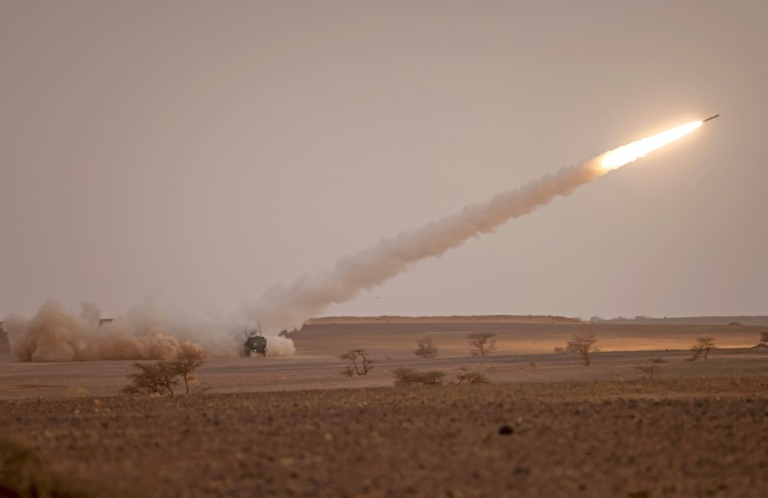
Some US-provided equipment has become emblematic of the war in Ukraine, such as Javelin anti-tank weapons that were widely used by Kyiv’s forces to blunt the Russian advance on the capital, and the Himars, a precision rocket system now playing a key role in counter-offensives against Moscow’s troops in the east and south.

– ‘No alternatives’ –

But US stocks of ammunition for Himars — which fires GPS-guided rockets known as GMLRS, with a range of more than 80 kilometers (50 miles) — are dwindling.

“If the United States sent one-third of that inventory to Ukraine (as has been the case with Javelin and Stinger), Ukraine would receive 8,000 to 10,000 rockets. That inventory would likely last several months, but, when the inventory is exhausted, there are no alternatives,” said Cancian, who previously worked on weapons procurement for the US government.

“Production is about 5,000 a year. Although the United States is working to increase that amount, and money has recently been allocated for that purpose, it will take years,” he said, adding that older equipment could help fill the gap.

The United States has provided some 8,500 Javelin missiles to Kyiv, but production of a weapon that has become a symbol of Ukrainian resistance is only about 1,000 per year.

– ‘As long as it takes’ –

The US government ordered $350 million worth of the missiles in May, but it will again take several years before stockpiles are replenished.

The United States has also supplied more than 800,000 NATO standard 155 mm artillery shells to Kyiv — three-quarters of the total amount delivered by all Western countries, according to official Pentagon statistics.

The amount of shells Washington has provided “is probably close to the limit that the United States is willing to give without risk to its own warfighting capabilities,” Cancian said.

US production of these shells currently stands at 14,000 per month, but the Pentagon has announced that it aims to increase that figure to 36,000 within three years. That would still only bring annual production to 432,000 — less than half of what has been provided to Ukraine in seven months.

And the US defense industry production is speeding up, Laura Cooper, a senior defense department official responsible for Russia and Ukraine, said Tuesday.

“The United States will continue to stand with the Ukrainian people and provide them with the security assistance they need to defend themselves for as long as it takes,” she said.

US ammunition supplies dwindle as Ukraine war drains stockpiles

The United States will soon be unable to provide Ukraine with certain types of ammunition that are essential to Kyiv’s battle against Russia’s invasion, as supplies are being used up faster than they can be replaced.

Washington has become by far the largest supplier of arms to Ukraine since Russia launched the invasion on February 24, with more than $16.8 billion in military assistance provided since that date.

But US stockpiles of some equipment are “reaching the minimum levels needed for war plans and training,” and restocking to pre-invasion levels could take years, Mark Cancian of the Center for Strategic and International Studies wrote in a recent analysis.

Washington is “learning lessons” from the conflict about ammunition needs in a great power war, which are “far greater” than expected, a US military official acknowledged on condition of anonymity.

American defense firms were forced to drastically reduce production in the 1990s as the United States slashed defense spending following the collapse of the Soviet Union, and their number fell dramatically, from dozens to single digits.

Now, the US government must convince the industry to reopen assembly lines and relaunch production of items such as Stinger anti-aircraft missiles, which have not been made since 2020.

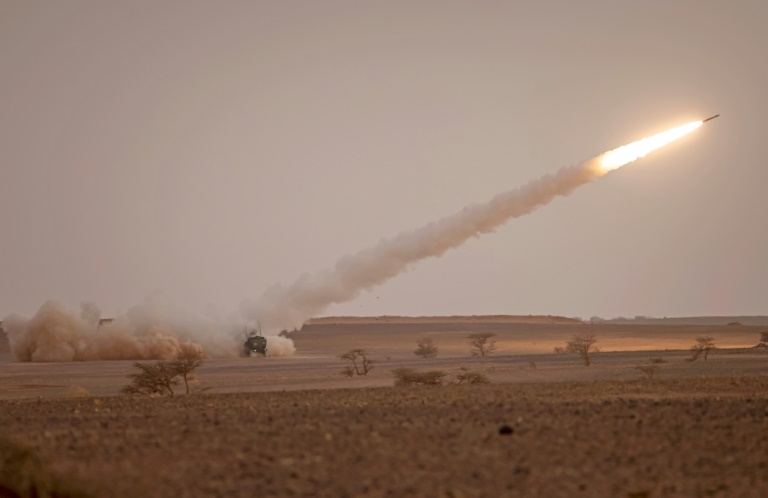
Some US-provided equipment has become emblematic of the war in Ukraine, such as Javelin anti-tank weapons that were widely used by Kyiv’s forces to blunt the Russian advance on the capital, and the Himars, a precision rocket system now playing a key role in counter-offensives against Moscow’s troops in the east and south.

– ‘No alternatives’ –

But US stocks of ammunition for Himars — which fires GPS-guided rockets known as GMLRS, with a range of more than 80 kilometers (50 miles) — are dwindling.

“If the United States sent one-third of that inventory to Ukraine (as has been the case with Javelin and Stinger), Ukraine would receive 8,000 to 10,000 rockets. That inventory would likely last several months, but, when the inventory is exhausted, there are no alternatives,” said Cancian, who previously worked on weapons procurement for the US government.

“Production is about 5,000 a year. Although the United States is working to increase that amount, and money has recently been allocated for that purpose, it will take years,” he said, adding that older equipment could help fill the gap.

The United States has provided some 8,500 Javelin missiles to Kyiv, but production of a weapon that has become a symbol of Ukrainian resistance is only about 1,000 per year.

– ‘As long as it takes’ –

The US government ordered $350 million worth of the missiles in May, but it will again take several years before stockpiles are replenished.

The United States has also supplied more than 800,000 NATO standard 155 mm artillery shells to Kyiv — three-quarters of the total amount delivered by all Western countries, according to official Pentagon statistics.

The amount of shells Washington has provided “is probably close to the limit that the United States is willing to give without risk to its own warfighting capabilities,” Cancian said.

US production of these shells currently stands at 14,000 per month, but the Pentagon has announced that it aims to increase that figure to 36,000 within three years. That would still only bring annual production to 432,000 — less than half of what has been provided to Ukraine in seven months.

And the US defense industry production is speeding up, Laura Cooper, a senior defense department official responsible for Russia and Ukraine, said Tuesday.

“The United States will continue to stand with the Ukrainian people and provide them with the security assistance they need to defend themselves for as long as it takes,” she said.

Putin 'in a corner' with options narrowing

US President Joe Biden admitted this week that American diplomats still did not know how Russian President Vladimir Putin could bring an end to his faltering war in Ukraine and save face. Western analysts see no good options.

The question of Putin’s “off-ramp” — or decisions that allow him to end the fighting without admitting defeat — has exercised Western policymakers and foreign policy experts since the very start of the war in February.

“Where does he find a way out?” Biden asked on Thursday while talking in New York. “Where does he find himself in a position that he does not, not only lose face, but lose significant power within Russia?”

A French diplomat, talking recently on condition of anonymity, stressed that European allies were no closer to reading Putin’s thinking, other than his desire to secure what appears to be an increasingly unlikely military victory.

“There’s a war that he is not managing to win, but what would satisfy him? We don’t have the answers,” the diplomat said. 

Instead of looking for a negotiated climbdown, Putin has escalated in recent weeks, formally annexing four regions of Ukraine on September 30 and approving a partial mobilisation of up to 300,000 men for the war.

“He may think the battlefield situation isn’t great but things will settle down during the winter, that Ukrainian offences will come to an end, that they’ll be able to mobilise,” Eliot A. Cohen, a military historian and former US State Department adviser, told AFP.

“I think he’s mistaken. I think the Russians are in a serious world of hurt,” added Cohen, an expert at the Center for Strategic and International Studies at the US-based Johns Hopkins University.

The Ukrainians are continuing to win back occupied territory in the northeast and south, while the Kremlin’s mobilisation has led to rare dissent in Russia amid evidence that many recruits lack adequate weapons and kit.

“Russia’s behaviour is irrational,” wrote Joris van Bladel, a fellow at the Belgian Royal Institute for International Relations think-tank. “The only ‘rational’ element the Kremlin is counting on is time.”

“Russia tries to buy time in the hope that the European countries will collapse before Russia’s downfall,” he added.

– ‘Dangerous moment’ –

Putin’s escalation on the ground has also been accompanied by new rhetoric about the possible use of nuclear weapons which is directed at Western countries.

Some analysts see it as a bluff and others as a sign of desperation.

“His hope is that references to nuclear weapons will deter the democracies from delivering weapons to Ukraine, and buy him enough time to get Russian reserves to the battlefield to slow the Ukrainian offensive,” Timothy Snyder, an American historian of Russia and Ukraine, wrote this week. 

But Biden said Thursday that he believed Putin was “not joking” with his threats, adding that it was difficult to imagine how this did “not end up with Armageddon.”

Western nations have signalled that they would feel compelled to react in some way if Russia crossed the nuclear threshold, raising the risk of direct conflict between the NATO military alliance and Moscow.

“It’s a very, very dangerous moment,” former US secretary of state John Kerry said late last month. 

Putin is “more in a corner than anyone would like him to be because that’s not good for anybody”, Kerry told MSNBC on September 28.

Cohen said Putin could authorise the use of chemical or biological weapons instead — less provocative than a low-yield nuclear weapon — “but the military utility of those might not be all that great”.

– ‘Journey to hell’ – 

With the Russian president continuing to raise the stakes, another “off-ramp” is one that sees Putin bundled out of power, either through a popular uprising or — more likely — a “palace coup” in which he is replaced by a rival.

More problems with the mobilisation, a significant military collapse or a successful new Ukrainian offensive on a separate part of the frontline could increase the domestic pressure on Putin, who celebrated his 70th birthday on Friday.

“The key question is whether Russia’s elites and broader society are prepared to accompany their president on this journey to hell,” wrote Tatiana Stanovaya, a Russian political scientist at the Carnegie Endowment for International Peace, a US think-tank.

Marie Dumoulin, a Russia specialist at the European Council on Foreign Relations cautioned that “we shouldn’t take our dreams for a reality. Nobody knows when it will happen, in what circumstances, and what will come after Putin.”

“There are tensions inside the system, that’s for sure, but it seems to me to be about internal clans competing for power without contesting the authority of Putin,” she told AFP.

For the moment, it’s “not so much people taking a swing at him but taking a swing at each other,” Cohen said.

Scientists reach tallest tree ever found in Amazon

After three years of planning, five expeditions and a two-week trek through dense jungle, scientists have reached the tallest tree ever found in the Amazon rainforest, a towering specimen the size of a 25-storey building.

The giant tree, whose top juts out high above the canopy in the Iratapuru River Nature Reserve in northern Brazil, is an angelim vermelho (scientific name: Dinizia excelsa) measuring 88.5 meters (290 feet) tall and 9.9 meters (32 feet) around — the biggest ever identified in the Amazon, scientists say.

Researchers first spotted the enormous tree in satellite images in 2019 as part of a 3D mapping project.

A team of academics, environmentalists and local guides mounted an expedition to try to reach it later that year. But after a 10-day trek through difficult terrain, exhausted, low on supplies and with a team member falling ill, they had to turn back.

Three more expeditions to the reserve’s remote Jari Valley region, which sits at the border between the states of Amapa and Para, reached several other gigantic trees, including the tallest Brazil nut tree ever recorded in the Amazon — 66 meters.

But the enormous angelim vermelho remained elusive until the September 12-25 expedition, when researchers traveled 250 kilometers (155 miles) by boat up rivers with treacherous rapids, plus another 20 kilometers on foot across mountainous jungle terrain to reach it.

One person on the 19-member expedition was bitten by what the team doctor believes was a poisonous spider.

But it was worth it, says forest engineer Diego Armando Silva of Amapa Federal University, who helped organize the trip.

“It was one of the most beautiful things I’ve ever seen. Just divine,” Silva, 33, told AFP.

“You’re in the middle of this forest where humankind has never set foot before, with absolutely exuberant nature.”

After camping under the massive tree, the group collected leaves, soil and other samples, which will now be analyzed to study questions including how old the tree is — at least 400 to 600 years, Silva estimates — why the region has so many giant trees, and how much carbon they store.

Around half of the weight of the region’s giant trees is carbon absorbed from the atmosphere — fundamental in helping curb climate change, says Silva.

But despite its remoteness, the region’s giants are under threat.

Angelim vermelho wood is prized by loggers, and the Iratapuru reserve is being invaded by illegal gold miners infamous for bringing ecological destruction, says Jakeline Pereira of environmental group Imazon, which helped organize the expedition.

“We were so thrilled to make this find,” says Pereira.

“It’s super important at a time when the Amazon is facing such frightening levels of deforestation.”

Over the past three years, average annual deforestation in the Brazilian Amazon has increased 75 percent from the previous decade.

Scientists reach tallest tree ever found in Amazon

After three years of planning, five expeditions and a two-week trek through dense jungle, scientists have reached the tallest tree ever found in the Amazon rainforest, a towering specimen the size of a 25-storey building.

The giant tree, whose top juts out high above the canopy in the Iratapuru River Nature Reserve in northern Brazil, is an angelim vermelho (scientific name: Dinizia excelsa) measuring 88.5 meters (290 feet) tall and 9.9 meters (32 feet) around — the biggest ever identified in the Amazon, scientists say.

Researchers first spotted the enormous tree in satellite images in 2019 as part of a 3D mapping project.

A team of academics, environmentalists and local guides mounted an expedition to try to reach it later that year. But after a 10-day trek through difficult terrain, exhausted, low on supplies and with a team member falling ill, they had to turn back.

Three more expeditions to the reserve’s remote Jari Valley region, which sits at the border between the states of Amapa and Para, reached several other gigantic trees, including the tallest Brazil nut tree ever recorded in the Amazon — 66 meters.

But the enormous angelim vermelho remained elusive until the September 12-25 expedition, when researchers traveled 250 kilometers (155 miles) by boat up rivers with treacherous rapids, plus another 20 kilometers on foot across mountainous jungle terrain to reach it.

One person on the 19-member expedition was bitten by what the team doctor believes was a poisonous spider.

But it was worth it, says forest engineer Diego Armando Silva of Amapa Federal University, who helped organize the trip.

“It was one of the most beautiful things I’ve ever seen. Just divine,” Silva, 33, told AFP.

“You’re in the middle of this forest where humankind has never set foot before, with absolutely exuberant nature.”

After camping under the massive tree, the group collected leaves, soil and other samples, which will now be analyzed to study questions including how old the tree is — at least 400 to 600 years, Silva estimates — why the region has so many giant trees, and how much carbon they store.

Around half of the weight of the region’s giant trees is carbon absorbed from the atmosphere — fundamental in helping curb climate change, says Silva.

But despite its remoteness, the region’s giants are under threat.

Angelim vermelho wood is prized by loggers, and the Iratapuru reserve is being invaded by illegal gold miners infamous for bringing ecological destruction, says Jakeline Pereira of environmental group Imazon, which helped organize the expedition.

“We were so thrilled to make this find,” says Pereira.

“It’s super important at a time when the Amazon is facing such frightening levels of deforestation.”

Over the past three years, average annual deforestation in the Brazilian Amazon has increased 75 percent from the previous decade.

Iran says Mahsa Amini died of illness rather than 'blows'

Iran said Friday an investigation into the death in custody of Mahsa Amini found she lost her life to illness rather than reported beatings that sparked three weeks of bloody protests.

Amini, 22, died on September 16, three days after falling into a coma following her arrest in Tehran by the morality police for allegedly breaching the Islamic republic’s strict dress code for women.

Anger over her death has triggered the biggest wave of protests to rock Iran in almost three years and a crackdown that has killed dozens of protesters and seen scores arrested.

Despite security personnel using lethal force, the women-led protests have continued for 21 consecutive nights, according to online videos verified by AFP.

Iran’s Forensic Organization said Friday that “Mahsa Amini’s death was not caused by blows to the head and vital organs and limbs of the body”.

The death of Amini, whose Kurdish first name is Jhina, was related to “surgery for a brain tumour at the age of eight”, it said in a statement.

Amini’s bereaved parents have filed a complaint against the officers involved, and one of her cousins living in Iraq has told AFP she died of “a violent blow to the head”.

Other young women and girls have been killed at the protests, but rights group Amnesty International says Iran has been forcing televised confessions out of their families to “absolve themselves of responsibility for their deaths”.

– ‘Suicide’ –

The mother of 16-year-old Nika Shahkarami, who died after going missing on September 20, insisted on Thursday she was killed by the state after joining an anti-hijab protest in Tehran.

Nasrin Shahkarami also accused the authorities of threatening her to make a forced confession over her daughter’s death.

“I saw my daughter’s body myself… The back of her head showed she had suffered a very severe blow as her skull had caved in. That’s how she was killed,” she said in a video posted online by Radio Farda, a US-funded Persian station based in Prague.

Iran’s judiciary has since denied reports the security forces killed another teenage girl, Sarina Esmailzadeh, at a rally in Karaj, west of Tehran last month.

Its website quoted a prosecutor as saying an investigation showed Esmailzadeh, also 16, had “committed suicide” by jumping from a building.

Oslo-based group Iran Human Rights said the Esmailzadeh family had come under heavy pressure from government agents to “force them to repeat the suicide state narrative”. 

It said that when the family was asked to identify the teenager’s body, “multiple injuries were clearly visible on her face and the right side of her forehead was completely crushed due to the severity of the blows”.

In a widening crackdown, Iran has blocked access to social media, including Instagram and WhatsApp, and launched a campaign of mass arrests.

Protesters have sought ways to avoid detection, with schoolgirls hiding or blurring their faces while shouting “Death to the dictator” and defacing images of Iran’s supreme leader Ayatollah Ali Khamenei, in verified videos.

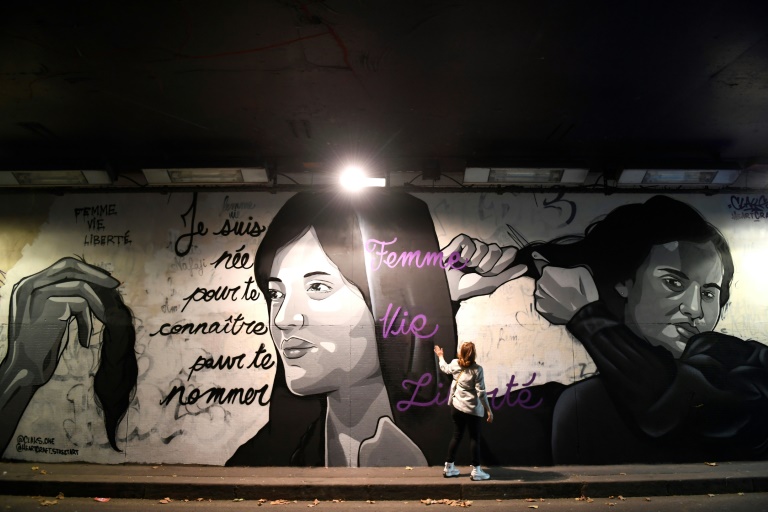
Other footage has shown people chanting the protest catchcry “Woman, Life, Freedom!” from their apartment windows under the cover of night.

Another form of protest emerged on Friday morning, with fountains in Tehran appearing to pour blood after an artist turned their waters red to reflect the deadly crackdown.

The BBC’s Persian service said the water was later drained, although traces of red could still be seen on the fountains in images it published on Instagram.

– Canada sanctions Iran Guards –

The street violence that ensued across Iran, dubbed “riots” by the authorities, has led to dozens of deaths, prompting Western governments to step up sanctions against the Iranian state and its security apparatus.

The French foreign ministry on Friday advised its nationals visiting Iran to “leave the country as soon as possible”, citing the risk of arbitrary detention.

Canada announced Friday that it will deny entry to more than 10,000 officers and other senior members of Iran’s Revolutionary Guards, accusing them of “heinous” acts against the Iranian people.

“This is the strongest measure we have to go after states and state entities,” Prime Minister Justin Trudeau said, adding it was previously applied only against regimes for war crimes or genocide.

A joint letter signed by 21 mainly Iranian human rights groups called on US President Joe Biden to do more to “discourage further state violence, and address the long history of atrocities and impunity in that country.”

Solidarity demonstrations continued around the world, with rallies in Amsterdam and Berlin on Friday.

In Copenhagen, an Iranian armed with a knife managed to penetrate the embassy grounds in what Iran said was an attack targeting its female ambassador.

The Danish ambassador was summoned to the foreign ministry in Tehran to hear a formal protest against the security breach, state media said.

burs-dv-kir/raz/dhc

Close Bitnami banner
Bitnami