World

Distraught parents lay white roses for Thai nursery massacre victims

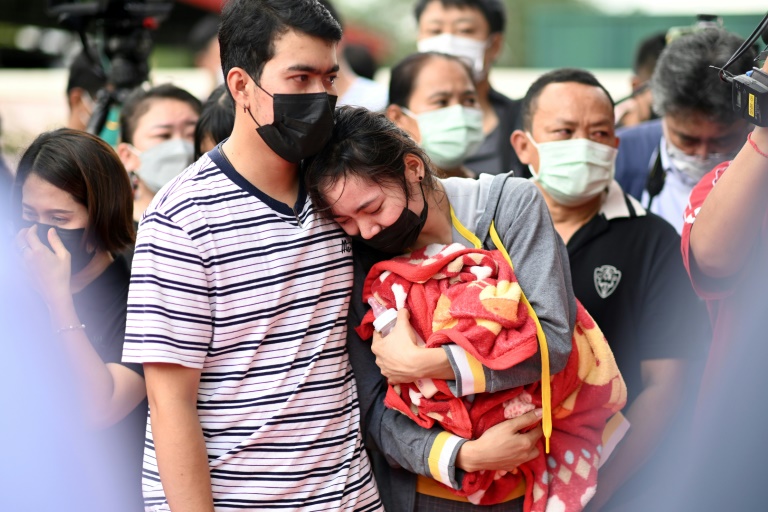
One by one, grieving parents came to lay single white roses on the steps of the Thai nursery where nearly two dozen of their children were murdered.

Some bowed their heads in prayer, some hugged each other in consolation as they laid the blooms on the steps of the low, yellow-walled building, tributes to 22 young lives cut short.

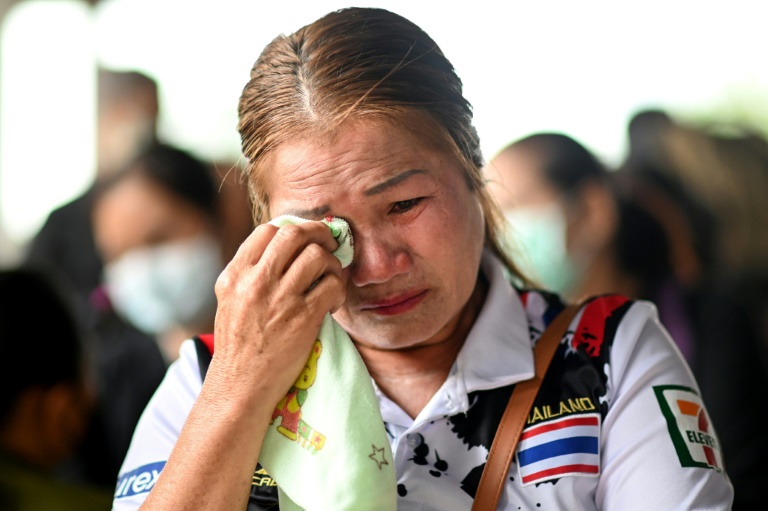
One mother wept inconsolably, hugging her dead son’s favourite red-and-yellow blanket and his milk bottle, still half-full.

Outside the nursery, in a local government compound on the edge of a village deep in the green farmlands of northeast Thailand, scores of traumatised relatives gathered.

Attacker Panya Khamrab, a sacked policeman, killed at least 36 people on his gun-and-knife rampage, including his own wife and child, in one of Thailand’s worst ever mass killings, before ending his own life.

Naliwan Duangkot, 21, who lost her two-year-old nephew Kamram at the nursery, comforted the boy’s mother, her 19-year-old sister-in-law Panita Prawanna. 

“Before he passed away he wished to eat pizza. We were very sad that we didn’t buy pizza for him before,” Naliwan told AFP.

“He was very sweet, very kind, he always shared things with children, with everyone,” she said.

“Last night for him, he was very difficult and he asked if he could sleep with his parents, and his little sister,” she said.

“We don’t accept that this is going to be his last night with his parents and his little sister.”

The family heard about Thursday’s shooting from neighbours.

Panita and her husband rushed to the scene by motorbike to search for Kamram, only to learn the worst.

Cradling her 11-month-old daughter Kanta, Panita fought back tears as she said: “It is incomprehensible.”

– Community shocked –

At the hospital in Nong Bua Lam Phu, the nearest town, relatives of the injured waited in turns at the ICU to visit their loved ones, bringing food, diapers and other supplies.

As the day wore on and the heat rose under the baking tropical sun, more and more people arrived at the nursery — the whole of a small rural community united in grief.

Where two days ago children played happily, now adults sat in shock, their disbelieving silence punctuated by occasional soft weeping.

Buarai Tanontong, 51, who lost two three-year-old grandsons, was among those left stunned by the events.

“I was very shocked and frightened. I couldn’t sleep, I didn’t think that it would be my two grandsons,” she said as she clutched her distraught daughter’s shoulder outside the nursery.

Local Kamjad Pra-intr said the gunman was a familiar figure in the area.

“Everyone knows who the shooter is. He used to be a police officer. He was a nice guy but later on we all know he was into meth,” she said.

“It’s a small community so we know each other and we are like a family, I know three or four kids who died there.”

Kam Pornnikom described the horror of learning that his three-year-old grandson was among the dead. 

“My heart almost stopped. His parents had split up so I was like his father-figure and the grandmother was like his mother,” he said.

“I’m speechless. How could he do this to children?”
Troubled Lesotho votes for parliament

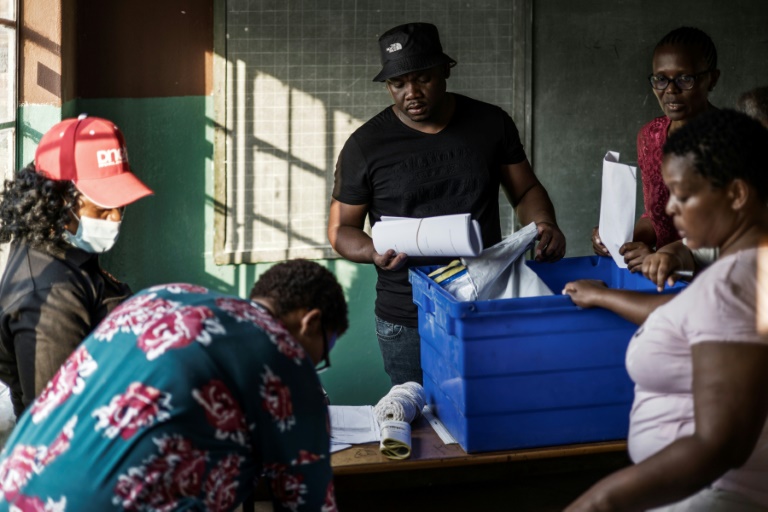
Voters in the southern African kingdom of Lesotho were casting ballots in parliamentary elections on Friday, but hopes were low that the outcome will end the country’s long-running political gridlock.

Lesotho has been governed for the past decade by a string of coalition governments that have proved fractious and frail, and no premier has served out a full five-year term.

“It is very likely that there will be a coalition again,” said Liesl Louw-Vaudran, a researcher at South Africa’s Institute for Security Studies (ISS), in Pretoria. 

Surrounded entirely by South Africa, which heavily depends on it for water, Lesotho is a mountain kingdom of two million people nicknamed the “Kingdom in the Sky.”

It has been buffeted by coups and attempted coups since independence from Britain in 1966, and nearly a third of its population live on less than $1.90 (1.90 euros) a day. 

“I hope that my vote will count,” said Paul, a 32-year-old who said he walked for kilometres to cast his ballot in Koro-Koro, about an hour from the capital Maseru. 

Like many, he used to work in South Africa, but the Covid-19 pandemic upended that and today is unemployed.

Polling stations opened at 7:00 am (0500 GMT) and were due to close at 5:00 pm. About 1.5 million people are registered to vote. 

Only 47 percent of registered voters bothered to cast their ballot at the last elections in 2017. 

“I have never voted, and I am not willing to vote,” Dineo Moketsie, a 32-year-old teacher told AFP earlier in the week, angry at politicians who he said have done nothing to better living conditions in the country. 

“I just feel that it’s a waste of time”. 

The process can also be cumbersome and queues outside polling stations can sometimes last hours. 

The outgoing government is led by the All Basotho Convention (ABC). But current Prime Minister Moeketsi Majoro is not seeking another term, after being ousted as party head earlier this year. 

His predecessor Thomas Thabane was forced to step down in 2020, after being accused of ordering the murder of his estranged wife. Charges against him were dropped in July. 

The ABC’s new leader, former health minister Nkaku Kabi, is squaring off against an array of contenders.

More than 50 parties are in the running.

“People still believe in our movement and we’re going to win,” said Kabi, 49. 

– Millionaire challenger –

His main challengers include Mathibeli Mokhothu, who heads the Democratic Congress — Lesotho’s second largest party — and Sam Matekane, a millionaire believed to be the country’s richest man who could be a dark horse, according to analysts. 

“Our country is sinking. So, we have to try and save (it),” Matekane told AFP in an interview. 

His party, “Revolution for Prosperity”, dwarfs most of the others in terms of resources, said Rataibane Ramainoane, a political adviser to the government.

“Its presence is being felt across the country,” he said.

Still, no one is expected to win outright, darkening prospects of much-needed reform, said Seroala Tsoeu-Ntokoane, a political analyst at the National University of Lesotho.

“Coalitions are a source of instability because they’re formed with political parties with not much to hold them together, no mutual policy platform, no mutual respect,” she said. 

The outgoing parliament failed to pass a law aimed at strengthening political stability, by banning lawmakers from switching party allegiance within the first three years of their tenure.

The 120-seat parliament is chosen by a mixed electoral system — 80 lawmakers are voted in by constituents, while another 40 seats are distributed proportionally.

International observers will monitor the vote. Results are expected next week.

Families mourn Thai nursery dead ahead of king's visit

Weeping, grief-stricken families gathered Friday outside a Thai nursery where an ex-policeman murdered two dozen children in one of the kingdom’s worst mass killings.

King Maha Vajiralongkorn and Prime Minister Prayut Chan-O-Cha will later visit survivors of the attack that left at least 36 people dead, including the attacker’s wife and child.

Around the small, low-slung building, where only two days ago scores of preschool children played, officials in white uniforms laid a large floral wreath on behalf of the king.

A line of heartbroken parents placed white roses on the steps of the nursery as the baking sun bore down.

Buarai Tanontong’s two three-year-old grandsons were among those killed at the nursery after the attacker burst in.

“I couldn’t sleep. I didn’t think that it would be my two grandsons,” she said, clutching her inconsolable daughter’s shoulder.

Overnight, coffins carrying the bodies of the victims arrived at a morgue in Udon Thani, the closest city to the rural district ripped apart by Thursday’s three-hour rampage.

The health ministry, police and provincial government officials gave a death toll of 36 plus the attacker on Friday, one less than that given by national police a day earlier. No explanation was given for the change.

– ‘Be a teacher in heaven’ –

Armed with a 9mm pistol and a knife, sacked police sergeant Panya Khamrab opened fire on the childcare centre in the northeastern Nong Bua Lam Phu province at about 12:30 pm (0530 GMT).

Following the attack, 34-year-old Panya fled the scene in a pickup truck to head home and murder his wife and son before taking his own life, police said, ending the killing spree at about 3:00 pm.

In total, he killed 24 children — 21 boys and three girls — and 12 adults.

The dead include pregnant teacher Supaporn Pramongmuk, whose husband posted a poignant tribute on Facebook.

“I would like to say thank you for all the support for me and my family. My wife has fulfilled her every duty as a teacher,” husband Seksan Srirach wrote.

“Please be a teacher in heaven, and my child please take care of your mother in heaven.”

A red carpet was installed around the nursery by officials before the royal wreath was laid, and later removed.

Social media users expressed criticism about the laying of a ceremonial carpet at a crime scene.

– Drug addict –

Flags on government buildings flew at half-mast on Friday in a gesture of mourning for one of the deadliest days in recent Thai history.

Nanthicha Punchum, acting chief of the nursery, described harrowing scenes as the attacker barged into the building in the rural Na Klang district.

“There were some staff eating lunch outside the nursery and the attacker parked his car and shot four of them dead,” she told AFP.

She said the attacker smashed down the door with his leg and then started stabbing the children.

Local media reported that one child survived because they were sleeping hidden by a blanket when the attacker struck.

National Police Chief Damrongsak Kittiprapat told reporters that Panya, a former police sergeant, was suspended in January and sacked in June for drug use.

He said the attacker — who used a legally purchased pistol — had been due in court on a drugs charge, adding that Panya was in a manic state but it was unknown whether it was drug-related.

Witness Paweena Purichan, 31, said the attacker was well known in the area as a drug addict.

She told AFP she encountered Panya driving erratically as he fled the scene.

“The attacker rammed a motorbike into two people who were injured. I sped off to get away from him,” she said.

“There was blood everywhere.”

And Pranom Innurak described how her sister, now recovering in hospital, was injured.

“He was driving a car on his way back home and he rammed into everyone on his way,” she told AFP, adding that her sister’s daughter was among the dead.

“When my sister got hit, she wasn’t that hurt yet. She flew out from her food stall. He then used a knife to attack her.”

Thai PM Prayut has ordered a rapid probe into the attack, and on Friday police interviewed witnesses and families.

The attack came less than three years after a soldier in the central city of Nakhon Ratchasima gunned down 29 people and wounded scores more in a 17-hour rampage, before he was shot dead by commandos.

And less than a month ago an army officer shot dead two colleagues at a military training base in the capital Bangkok.

But while Thailand has high rates of gun ownership, mass shootings such as Thursday’s are rare.

US, Philippines reinforce alliance with joint military drills

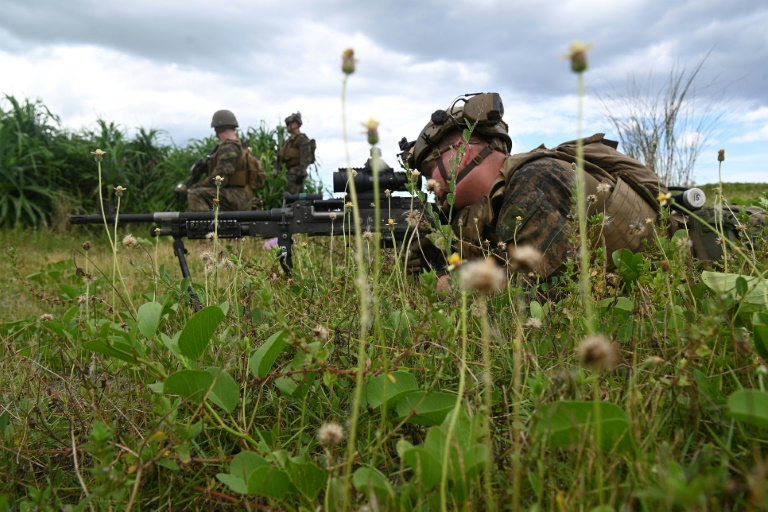
US and Philippine marines stormed a beach near a disputed rocky outcrop in the South China Sea on Friday as part of joint military drills involving more than 3,500 troops. 

It is the first time the annual naval exercises have been held under Philippine President Ferdinand Marcos, who has expressed strong support for the decades-old alliance, after rocky relations under his predecessor Rodrigo Duterte.

Duterte had threatened to cancel drills and axe a key military deal with the United States as he pivoted towards China.

But Marcos told US President Joe Biden during a meeting in New York last month that he appreciated America’s role in “maintaining the peace in our region”. 

China’s recent war games around Taiwan, which it claims as part of its territory, rang alarm bells among nations surrounding the South China Sea. 

Beijing claims sovereignty over almost the entire sea, while the Philippines, Vietnam, Malaysia and Brunei have overlapping claims to parts of it. 

China has ignored an international court ruling that its claims have no legal basis, and has aggressively asserted its stance.

It has built artificial islands as well as deployed hundreds of coast guard and maritime militia vessels to prowl the strategic waters, swarming reefs and harassing fishing and other boats.

The KAMANDAG exercises — the Filipino acronym for “Cooperation of the Warriors of the Sea” — kicked off Monday and will be held across the country’s main island of Luzon until October 14.

One of the objectives is improving the Philippine military’s coastal defence capability. 

Around 300 troops were involved in Friday’s amphibious drills held on an uninhabited beach in Zambales province, about 240 kilometres (150 miles) east of Scarborough Shoal, which China seized from the Philippines in 2012.

The rich fishing ground has become a flashpoint between the two countries.

“We are preparing for any threat that will be coming sooner or later,” said Major Emery Torre, spokesman for the Philippine Marine Corps.

But Torre said the exercises did not simulate an attack by a particular country and were not related to a specific situation.

Marcos has taken a harder line on defending Philippine waters, insisting he would not let China trample on Manila’s maritime rights.

During aerial surveillance over Scarborough Shoal on Thursday, the Philippine Coast Guard spotted six Chinese vessels, including four coast guard and two militia boats, in and around the small ring of reefs. 

“We are doing the patrol operations to establish a presence at the area and also for the sake of our fishermen,” said coast guard spokesman Armand Balilo.

As regional tensions rise, Washington is keen to preserve its security alliance with Manila, which includes a mutual defence treaty and permission for the US military to store defence equipment and supplies on several Philippine bases.

It also allows US troops to access certain military bases in the country.

Solomons PM tells Australia no Chinese military presence

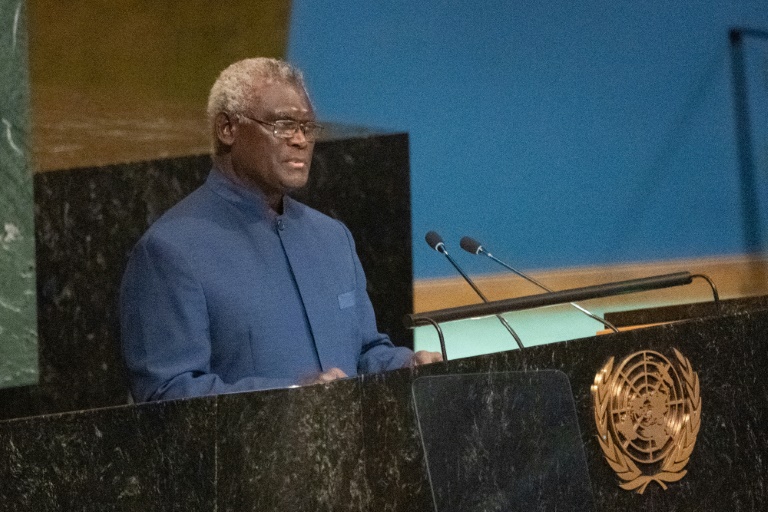
Solomon Islands Prime Minister Manasseh Sogavare said Friday he has assured Australia that his nation will not allow a Chinese military presence in its territory.

The island nation has been at the centre of a diplomatic tussle in the southern Pacific Ocean between the United States, Australia and their allies on one side and an increasingly assertive China on the other.

Australian Prime Minister Anthony Albanese met Sogavare in Canberra on Thursday to smooth ties that have been frayed since the Solomons signed a security pact with Beijing this year — a move that sparked fears of Chinese military presence in the region.

“About China, this is a sensitive issue we discussed and I assured Australia when I met with Anthony Albanese yesterday that we will not allow such to happen,” Sogavare said in a written reply to questions sent by AFP.

Previously, however, Sogavare has said that China would be permitted to build wharves and airports — which could be useful for both civilian and military purposes.

Solomon Islands switched diplomatic recognition from Taipei to Beijing in 2019 and signed its security pact with China earlier this year.

Last year in November, violent demonstrations broke out in the Solomons capital Honiara, sparked in part by China’s growing influence in the country but also fuelled by poverty and inter-island rivalries.

Much of Honiara’s Chinatown was torched.

Further such riots were “highly unlikely”, Sogavare told AFP, saying his government had put in place measures to control any violence.

The Solomons-Australia relationship has been strained in recent months.

Canberra in September offered to help Solomon Islands fund its upcoming national elections — an offer Sogavare initially condemned but later accepted.

The Solomon Islands government has been sensitive to criticism of its ties to China.

Earlier this year, Sogavare threatened to ban foreign media after Australia’s national broadcaster aired a report about rising Chinese influence in the Solomons.

Sogavare said he expressed concern to Albanese about the conduct of Australian journalists, accusing them of “failing to abide by the standards when reporting about our affairs”.

This week, Solomons Foreign Minister Jeremiah Manele said he was “not comfortable” with indirect references to China in a draft US-Pacific partnership declaration.

And Sogavare told the United Nations in September that his country had been “vilified” for its relationship with Beijing.

Families mourn Thai nursery dead ahead of king's visit

Weeping, grief-stricken families gathered Friday outside a Thai nursery where an ex-policeman murdered two dozen children in one of the kingdom’s worst mass killings.

Thai King Maha Vajiralongkorn and Prime Minister Prayut Chan-O-Cha will later visit survivors of the attack that left at least 37 people dead, including the attacker’s wife and child.

Around the small low-slung building, where only two days ago scores of preschool children played, officials in white uniforms laid a large floral wreath on behalf of the king.

A line of heartbroken parents placed white roses on the steps of the nursery as the baking sun bore down on them.

Buarai Tanontong’s two three-year-old grandsons were among those killed at the nursery when the attacker burst through the door.

“I couldn’t sleep. I didn’t think that it would be my two grandsons,” she said, clutching her inconsolable daughter’s shoulder.

Overnight, coffins carrying the bodies of the victims arrived at a morgue in Udon Thani, the closest city to the rural district ripped apart by Thursday’s three-hour rampage.

– ‘Be a teacher in heaven’ –

Armed with a 9mm pistol and a knife, sacked police sergeant Panya Khamrab opened fire on the childcare centre in the northeastern Nong Bua Lam Phu province at about 12:30 pm (0530 GMT).

Following the attack, 34-year-old Panya fled the scene in a pickup truck to head home and murder his wife and son before taking his own life, police said, ending the killing spree around 3:00 pm. 

In total, he killed 24 children — 21 boys and three girls — and 13 adults. 

The dead include pregnant teacher Supaporn Pramongmuk, whose husband posted a poignant tribute on Facebook.

“I would like to thank all the support for me and my family. My wife has fulfilled her every duty as a teacher,” husband Seksan Srirach wrote. 

“Please be a teacher in heaven, and my child please take care of your mother in heaven.”

A red carpet was installed around the nursery by officials before the royal wreath was laid, and later removed.

Social media users expressed criticism about the laying of a ceremonial carpet at a crime scene.

– Drug addict –

Flags on government buildings flew at half-mast on Friday in a gesture of mourning for one of the deadliest days in recent Thai history.

Nanthicha Punchum, acting chief of the nursery, described harrowing scenes as the attacker barged into the building in the rural Na Klang district.

“There were some staff eating lunch outside the nursery and the attacker parked his car and shot four of them dead,” she told AFP.

She said the attacker smashed down the door with his leg and then started stabbing the children.

Local media reported that one child survived because they were sleeping hidden by a blanket when the attacker struck.

National Police Chief Damrongsak Kittiprapat told reporters that Panya, a former police sergeant, was suspended in January and sacked in June for drug use.

He said the attacker — who used a legally purchased pistol — had been due in court on a drugs charge, adding that Panya was in a manic state but it was unknown whether it was drug-related.

Witness Paweena Purichan, 31, said the attacker was well-known in the area as a drug addict.

She told AFP she encountered Panya driving erratically as he fled the scene.

“The attacker rammed a motorbike into two people who were injured. I sped off to get away from him,” she said.

“There was blood everywhere.”

Thai PM Prayut has ordered a rapid probe into the attack, and on Friday police interviewed witnesses and families. 

The attack came less than three years after a soldier gunned down 29 people in a 17-hour rampage and wounded scores more before he was shot dead by commandos.

And less than a month ago an army officer shot dead two colleagues at a military training base in the capital Bangkok.

But while Thailand has high rates of gun ownership, mass shootings such as Thursday’s are rare.

Distraught parents lay white roses for Thai nursery massacre victims

One by one, grieving parents came to lay single white roses on the steps of the Thai nursery where nearly two dozen of their children were murdered.

Some bowed their heads in prayer, some hugged each other in consolation as they laid the blooms on the steps of the low, yellow-walled building, tributes to 22 young lives cut short.

One mother wept inconsolably, hugging her dead son’s favourite red-and-yellow blanket and his milk bottle, still half-full.

Outside the nursery, in a local government compound on the edge of a village deep in the green farmlands of northeast Thailand, scores of traumatised relatives gathered.

Attacker Panya Khamrab, a sacked policeman, killed at least 37 people on his gun-and-knife rampage, including his own wife and child, in one of Thailand’s worst ever mass killings, before ending his own life.

Naliwan Duangkot, 21, who lost her two-year-old nephew Kamram at the nursery, comforted the boy’s mother, her 19-year-old sister-in-law Panita Prawanna. 

“Before he passed away he wished to eat pizza. We were very sad that we didn’t buy pizza for him before,” Naliwan told AFP.

“He was very sweet, very kind, he always shared things with children, with everyone,” she said.

“Last night for him, he was very difficult and he asked if he could sleep with his parents, and his little sister,” she said.

“We don’t accept that this is going to be his last night with his parents and his little sister.”

The family heard about Thursday’s shooting from neighbours.

Panita and her husband rushed to the scene by motorbike to search for Kamram, only to learn the worst.

Cradling her 11-month-old daughter Kanta, Panita fought back tears as she said: “It is incomprehensible.”

– Community shocked –

At the hospital in Nong Bua Lam Phu, the nearest town, relatives of the injured waited in turns at the ICU to visit their loved ones, bringing food, diapers and other supplies.

As the day wore on and the heat rose under the baking tropical sun, more and more people arrived at the nursery — the whole of a small rural community united in grief.

Where two days ago children played happily, now adults sat in shock, their disbelieving silence punctuated by occasional soft weeping.

Buarai Tanontong, 51, who lost two three-year-old grandsons, was among those left stunned by the events.

“I was very shocked and frightened. I couldn’t sleep, I didn’t think that it would be my two grandsons,” she said as she clutched her distraught daughter’s shoulder outside the nursery.

Kamjad Pra-intr said the gunman was a familiar figure in the area.

“Everyone knows who the shooter is. He used to be a police officer. He was a nice guy but later on we all know he was into meth,” she said.

“It’s a small community so we know each other and we are like a family, I know three or four kids who died there.”

Death toll in Indian Himalayas avalanche rises to 19

At least 19 people are confirmed dead after an avalanche struck climbers in the Indian Himalayas, authorities said Friday, with bad weather hampering the fourth day of search and rescue efforts.

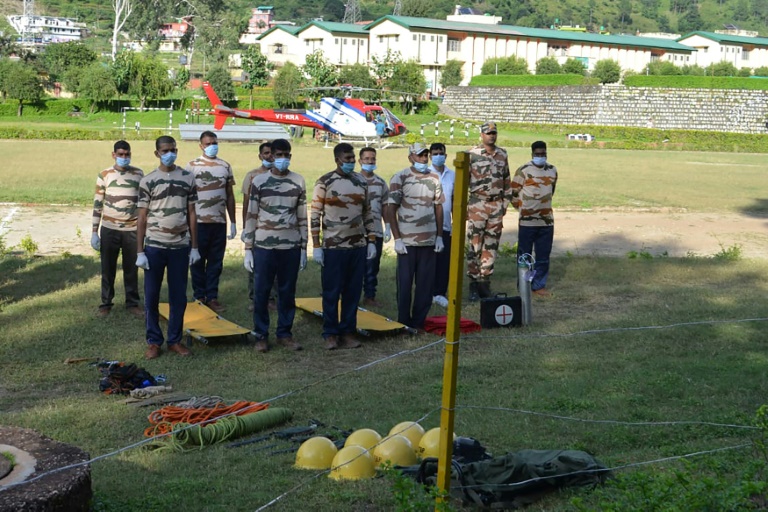
A group of climbing trainees and instructors were caught in Tuesday’s massive snowslide near the summit of Mount Draupadi ka Danda II in the northern state of Uttarakhand. 

“Nineteen bodies have been recovered. 10 people are still missing,” state disaster agency spokesperson Ridhim Aggarwal told AFP.  

“Rescue operations have resumed for the day but are subject to weather,” she added. “The weather is bad.”

Police, disaster authorities and the Indian air force have been mobilised to help with search efforts, with 32 people successfully rescued from the mountain despite snow and rainfall.

An advance helicopter landing ground had been prepared near the site of the avalanche at 4,900 metres (16,000 feet) above sea level, the Indo-Tibetan Border Police said Thursday.

Sunil Lalwani, one of the rescued trainee climbers, credited the instructors for saving many lives.

“We were 50-100 metres from the summit with our instructors ahead of us, when suddenly an avalanche hit us and took everyone down,” Lalwani was quoted as saying by the Hindustan Times on Thursday.

“It happened in a matter of seconds and we were dumped in a crevasse. We were somehow able to breathe… It’s because of them that we are alive today.”

Among the bodies recovered earlier in the week was that of climber Savita Kanswal, who had summited Everest this year.

Kanswal was an instructor with the expedition and had been feted by the climbing community for summiting the world’s highest peak and nearby Makalu in just 16 days — a women’s record.

– Fatal accidents common –

Fatal climbing accidents are common in the Himalayas, home to Everest and several of the world’s highest peaks.

In August, the body of a mountaineer was recovered two months after he fell into a crevasse while crossing a glacier in the northern state of Himachal Pradesh. 

Last week, renowned US ski mountaineer Hilaree Nelson’s body was found on the slopes of Nepal’s Manaslu peak after she went missing skiing down the world’s eighth-highest mountain.

The same day, Nepali climber Anup Rai was killed and a dozen others were injured after an avalanche on the 8,163-metre (26,781-foot) mountain. 

Although no substantial research has been done on the impacts of climate change on mountaineering risks in the Himalayas, climbers have reported crevasses widening, running water on previously snowy slopes, and the increasing formation of glacial lakes. 

One dead in unrest at Argentina soccer match: official

One person died Thursday when violent clashes near a soccer match outside Buenos Aires between Boca Juniors and Gimnasia y Esgrima spilled into the stadium and onto the pitch, authorities said.

Police fired rubber bullets and tear gas outside the Carmelo Zerillo stadium in La Plata, about 50 kilometers (31 miles) south of Argentina’s capital as they attempted to stop fans from pushing into the already crowded venue.

The unrest continued inside, where shocked spectators were seen squeezing through fencing to escape the violence and get onto the field. 

“I can confirm that there is one person dead. This person died of cardiac arrest,” said Sergio Berni, security minister of Buenos Aires province, where the Argentina league first division match took place. 

The game was suspended after nine minutes until further notice “due to lack of (security) guarantees,” referee Hernan Mastrangelo said, minutes after the players and technical staff left the pitch for the dressing rooms.

“It affected all of us on the field,” he added. “The air became unbreathable. The situation got out of control and there were no security guarantees.”

Authorities at San Martin hospital in La Plata confirmed the death of a 57-year-old man due to cardiac arrest as he was being transferred from the stadium to the hospital.

Several fans, including children being led or carried by adults, rushed to get out of the stands and onto the pitch, where people were seen sitting or lying down apparently recovering from tear gas exposure.

The match came at a critical point in the Argentine top-flight league, with four rounds to go and Gimnasia playing its last chance to secure the title at home, while Boca was looking for a win to return to the premier division.

“What was going to be a party ends in this. It hurts us all what happened, it is tremendous and we regret it,” Boca Juniors manager Hugo Ibarra told reporters.

The deadly violence came five days after a stampede in Indonesia prompted by police firing tear gas inside a packed stadium left at least 131 people dead, including 32 children.

Egypt replants mangrove 'treasure' to fight climate change impacts

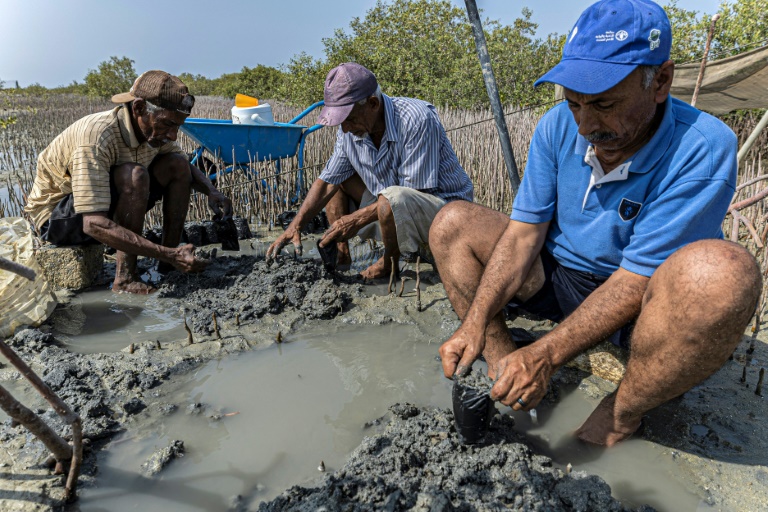
On Egypt’s Red Sea coast, fish swim among thousands of newly planted mangroves, part of a programme to boost biodiversity, protect coastlines and fight climate change and its impacts.

After decades of destruction that saw the mangroves cleared, all that remained were fragmented patches totalling some 500 hectares (1,200 acres), the size of only a few hundred football pitches.

Sayed Khalifa, the head of Egypt’s agriculture syndicate who is leading mangrove replanting efforts, calls the unique plants a “treasure” because of their ability to grow in salt water where they face no problems of drought.

“It’s an entire ecosystem,” Khalifa said, knee-deep in the water. “When you plant mangroves, marine life, crustaceans and birds all flock in.”

Between the tentacle-like roots of months-old saplings, small fish and tiny crab larvae dart through the shallows — making the trees key nurseries of marine life.

Khalifa’s team are growing tens of thousands of seedlings in a nursery, which are then used to rehabilitate six key areas on the Red Sea and Sinai coast, aiming to replant some 210 hectares.

But Khalifa dreams of extending the mangroves as far “as possible,” pointing past a yacht marina some six kilometres (four miles) to the south.

The about $50,000-a-year government-backed programme was launched five years ago.

– ‘Punch above their weight’ –

Mangroves also have a powerful impact in combating climate change.

The resilient trees “punch above their weight” absorbing five times more carbon than forests on land, according to the UN Environment Programme (UNEP).

The stands of trees also help filter out water pollution and act as a natural barrier against rising seas and extreme weather, shielding coastal communities from destructive storms.

UNEP calculates that protecting mangroves is a thousand times cheaper than building seawalls over the same distance.

Despite their value, mangroves have been annihilated worldwide at rapid speed. 

Over a third of mangroves globally have been lost globally, researchers estimate, with losses up to 80 percent in some coastlines of the Indian Ocean.

Mangrove expert Niko Howai, from Britain’s University of Reading, said in the past many governments had not appreciated “the importance of mangroves”, eyeing instead lucrative “opportunities to earn revenue” including through coastal development.

In Egypt’s case, “mass tourism activities and resorts, which cause pollution”, as well as boat activity and oil drilling wreaked havoc on mangroves, said Kamal Shaltout, a botany professor at Egypt’s Tanta University.

Shaltout warned that mangrove restoration efforts “will go to waste” if these threats are not addressed.

“The problem is that the mangroves we have are so limited in number that any damage causes total disruption,” he said.

– Impact of mass tourism –

There is little reliable information to indicate how much has been lost, but Shaltout said “there are areas that have been completely destroyed”, particularly around the major resort town of Hurghada.

Red Sea tourism accounts for 65 percent of Egypt’s vital tourism industry.

The scale of damage, a 2018 study by Shaltout and other researchers found, “probably far exceeds what could be replaced by any replanting programme for years to come”.

Efforts to link up replanted areas will be potentially blocked by barriers of marinas, resorts and coastal settlements.

“Mangroves are hardy, but they are also sensitive, especially as saplings,” Howai said.

“Intermingling mangrove reforestation with existing development projects is not impossible, but it is going to be more challenging.”

To be successful, Shaltout said that tourist operators must be involved, including by tasking resorts with replanting areas themselves.

“It could even come with certain tax benefits, to tell them that just like they have turned a profit, they should also play a role in protecting nature,” the botanist said.

Close Bitnami banner
Bitnami