World

Judge halts Twitter-Musk case, sets Oct. 28 deadline to close deal

A US judge on Thursday suspended litigation in the saga over Elon Musk’s proposed $44-billion takeover of Twitter, giving the parties until October 28 to finalize the on-again, off-again megadeal.

Delaware Judge Kathaleen McCormick, ruling on a Musk request to freeze the case that had drawn a biting retort from Twitter, said a trial originally scheduled to begin in 11 days could be rescheduled for next month if a deal is not finalized.

“If the transaction does not close by 5 pm on October 28, 2022, the parties are instructed to contact me by email that evening to obtain November 2022 trial dates,” McCormick said in the order.

The move buys time for a potential reconciliation between two parties that began squabbling as soon as Musk sealed an agreement in April to purchase the influential social media site for $54.20 per share.

With an October 17 trial date on Twitter’s breach-of-contract suits against Musk looming, the unpredictable Tesla boss did an about-face on Tuesday, reviving his $44-billion takeover plan on condition the Delaware court halt the lawsuit against him.

Twitter said Tuesday it expects to close the buyout deal at the $54.20 price in a statement that did not address Musk’s demands over freezing the litigation.

Legal briefs filed earlier Thursday shed further light on prickly proceedings characterized by mutual distrust.

“There is no need for an expedited trial to order Defendants to do what they are already doing and this action is now moot,” said a filing prepared by Musk’s attorneys that alluded to his latest offer.

“Yet, Twitter will not take yes for an answer. Astonishingly they have insisted on proceeding with this litigation, recklessly putting the deal at risk and gambling with their stockholders interests.”

The filing said Twitter had opposed a suspension on the “theoretical possibility” of lack of financing for the transaction, adding that Musk has access to financing to close the deal “on or around October 28.”

-‘Trust us’ this time –

Twitter refuted those arguments, noting that Musk’s side had still not committed to a closing date and calling Musk’s latest appeal “an invitation to further mischief and delay,” Twitter attorneys said in a filing to the Delaware court.

“‘Trust us,’ they say, ‘we mean it this time,'” Twitter lawyers said in a brief that described Musk as seeking an “indefinite” time frame to close the deal.

“The obstacle to terminating this litigation is not, as Defendants say, that Twitter is unwilling to take yes for an answer. The obstacle is that Defendants still refuse to accept their contractual obligations.

“Until Defendants commit to close as required, Twitter is entitled to its day in court to… prove Defendants’ breaches so as to ensure complete relief in the event the closing should for any reason not occur,” they said.

Analysts say the litigation provides leverage to Twitter against the risk of another shift by Musk.

US media have reported that the talks are stuck in part on Musk’s assertion that the deal is contingent on billions of dollars in debt financing by major banks.

Twitter “thought they had a deal before,” said Adam Badawi, a law professor at the University of California, Berkeley. “So to actually accept something from (Musk), it’s going to have to be as ironclad as it possibly can.”

But experts were eyeing the latest court twist as beneficial for Musk.

“I think it’s definitely an advantage to him. I mean, he obviously very much wanted to delay this,” Ann Lipton, a law professor at Tulane University, told AFP.

But she noted the advantage would shift to Twitter should Musk not seal the deal by October 28.

“If somehow that doesn’t happen, I think that Twitter will have a stronger case that he’s been acting in bad faith all along, which… justifies whatever equitable remedies would be appropriate for that,” Lipton added.

A serial entrepreneur made rich through his success with Tesla electric cars, Musk began to step back from the Twitter deal soon after it was agreed.

Musk said in July he was canceling the purchase because he was misled by Twitter concerning the number of fake “bot” accounts, allegations rejected by the company.

Twitter, meanwhile, has sought to prove Musk was contriving excuses to walk away — simply because he changed his mind.

Musk’s potential stewardship of the influential social media site has sparked worry from activists who fear he could open the gates to more abusive and misinformative posts.

Shares of Twitter, which surged on Tuesday’s news of Musk’s reversal, fell 3.7 percent to $49.39.
Ukraine, climate? Nobel Peace Prize unveiled under cloud of war

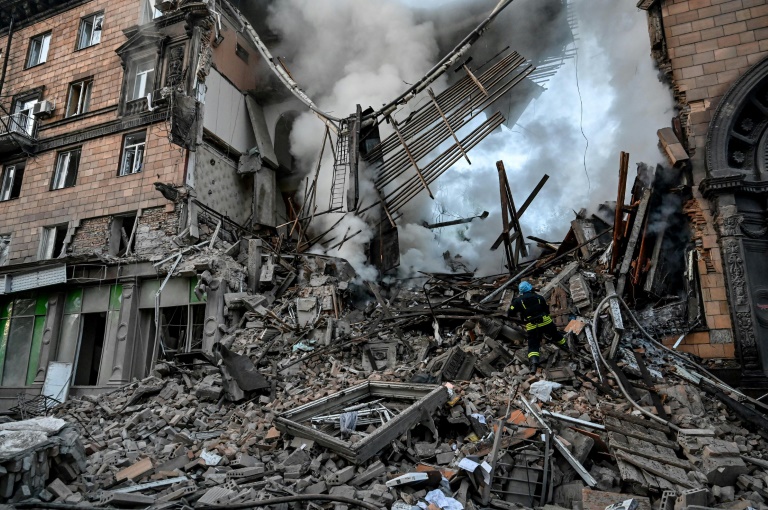
The Nobel Peace Prize will be unveiled Friday, with experts speculating it could go to critics of Vladimir Putin, climate activists or even no prize at all amid the war in Ukraine.

The climax of the Nobel season, the Peace Prize laureate will be announced at 11:00 am (0900 GMT) in Oslo, against the backdrop of Moscow’s invasion of Ukraine which has plunged Europe into one of its worst crises since World War II.

The Norwegian Nobel Committee keeps the list of nominations a closely guarded secret, but it is known to have 343 names on it, including 251 individuals and 92 organisations.

With Ukraine dominating headlines since the start of the year, some prize experts say it is doubtful the committee can ignore it.

“It is likely we will see a prize that in one way or another will point in the direction of Ukraine,” the director of the Peace Research Institute Oslo, Henrik Urdal, told Norwegian broadcaster NRK just hours before the announcement.

In such case, he said possible laureates could be Belarusian opposition leader Svetlana Tikhanovskaya and Russian dissident Alexei Navalny, thorns in the side of the Kremlin and one of its few allies in the war, Belarus strongman Alexander Lukashenko.

Or it could go to the International Court of Justice based in The Hague, which in March ordered the immediate end of the Russian offensive, or the UN High Commission for Refugees, as millions of people have been displaced by the conflict.

Urdal also mentioned those documenting suspected war crimes, such as the International Criminal Court (ICC), also based in The Hague, or investigative site Bellingcat.

Ukraine President Volodymyr Zelensky’s chances are seen as minimal as long as the war is raging, even though he is the bookies’ favourite.

Other Nobel observers — including Oda Andersen Nyborg, head of the Norwegian Peace Council — have meanwhile suggested the prize could this year go to climate campaigners, as the planet’s alarm bells ring.

Swedish teen activist Greta Thunberg has been seen as a potential Nobel laureate for several years despite her young age, and could take home the prize with her movement “Fridays for Future”, British naturalist David Attenborough or other environmentalists.

– ‘Tense world’ –

The five members of the Nobel committee may also go in an entirely different direction, or even decide to not award the prize at all, as they have already done 19 times in the past, most recently 50 years ago.

The head of the committee hinted mildly however that the panel had chosen one or several laureates — up to three can be honoured. 

The decision was “maybe even harder” this year, Berit Reiss-Andersen, chair of the Norwegian Nobel Committee, told NRK, noting that “we’re living in a difficult security situation and a tense world”.

Last year, the Peace Prize crowned two champions of freedom of the press, Philippine journalist Maria Ressa and her Russian colleague Dmitry Muratov.

The Peace Prize is the only Nobel awarded in Oslo, with the other disciplines announced in Stockholm.

On Monday, the Medicine Prize kicked off the 2022 season, going to Swedish paleogeneticist Svante Paabo, who discovered Neanderthal DNA and the previously unknown Denisova hominin.

The Physics Prize on Tuesday honoured Alain Aspect of France, Austria’s Anton Zeilinger and John Clauser of the United States for their discoveries in the field of quantum entanglement.

On Wednesday, the Chemistry Prize went to another trio, Carolyn Bertozzi and Barry Sharpless of the United States together with Morten Meldal of Denmark, for laying the foundation for a more functional form of chemistry where molecules are linked together, called click chemistry.

French author Annie Ernaux on Thursday won the Nobel Literature Prize, the 17th woman to get the nod out of 119 literature laureates since 1901.

The Nobel season winds up Monday with the Nobel Economics Prize.

US judge blocks new New York gun controls

A US federal judge blocked the enforcement of New York’s new gun law Thursday, undermining for the second time this year the state’s efforts to control a key factor in rising homicides.

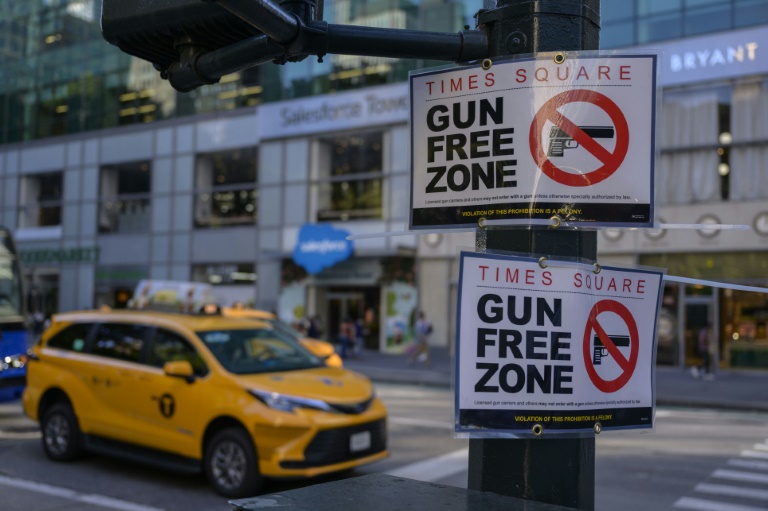
The judge accepted a petition to place a temporary stay on the state law passed on July 1 and implemented on September 1 that tightly restricted carrying guns in “sensitive places” such as Times Square in New York City, bars, schools and playgrounds.

The new law was passed after the Supreme Court — in a landmark ruling on June 23 — overturned New York’s previous gun laws, saying they unlawfully limited a person’s right to carry a firearm in public.

But gun rights advocates said the new law, even though tailored to follow the Supreme Court ruling, in practice impinged on their constitutional rights to free speech and to possess firearms.

Judge Glenn Suddaby apparently agreed, awarding the gun rights advocates a stay, or temporary block, on the new law while their lawsuit over it proceeds.

The ruling is the latest chapter in the fight over the state’s gun laws tightly limiting permission to carry a firearm outside the home. 

In the newest version after the Supreme Court ruling, the state law required a person seeking a public handgun license to demonstrate “good moral character,” a process that included vetting their social media accounts, providing four character references and taking 18 hours of firearms training.

It also set a long list of “sensitive locations” where firearms could not be carried.

The judge agreed that these requirements were unlawfully onerous and broad, and that Times Square and other sensitive locations did not merit special protection.

Suddaby said the new law still gives New York officials too much power to reject gun permit applicants by forcing them to go to lengths to prove they were of good moral character, rather than assuming they were in the absence of contradictory information.

“We are grateful to Judge Suddaby for his quick action to restore the right of the people to keep and bear arms,” said Erich Pratt, the senior vice president of Gun Owners of America.

New York Governor Kathy Hochul said they were weighing an appeal against the stay. 

“I will continue to do everything in my power to combat the gun violence epidemic and protect New Yorkers,” she said in a statement.

But the plaintiffs in the case, supported by Gun Owners of America, could then pursue their arguments to the Supreme Court, where the majority justices have already made clear they generally endorse a constitutional right to carry arms.

Easter Island blaze chars famous moai statues

A forest fire that tore through part of Easter Island has charred some of its fabled monumental carved stone figures, known as moai, authorities said Thursday. 

“Nearly 60 hectares (148 acres) were affected, including some moai,” Carolina Perez, cultural heritage undersecretary, said in a Twitter post. 

On Easter Island, which lies some 3,500 kilometers (2,175 miles) off the west coast of Chile, 100 hectares have been razed by flames since Monday, Perez said. The area around the Rano Raraku volcano, a UNESCO World Heritage Site, was the most affected. 

An estimated several hundred moai are in that area, as well as in the quarry where the stone used to carve the sculptures is extracted.

“The damage caused by the fire can’t be undone,” Pedro Edmunds, mayor of Easter Island, told local media. 

There is still no report on the total damage.

But the fire comes just three months after the island was reopened to tourism on August 5, after two years of closure due to Covid-19. 

Before the pandemic, Easter Island — whose main livelihood is tourism — received some 160,000 visitors a year, on two daily flights. 

But with the arrival of Covid-19 in Chile, tourist activity was completely suspended.

The island was long inhabited by Polynesian people, before Chile annexed it in 1888.

US flies Russian cosmonaut to ISS as Ukraine conflict rages

A SpaceX capsule carrying a Russian crew member docked Thursday with the International Space Station on a NASA mission that carries significant symbolism amid the war in Ukraine.

The Crew Dragon spaceship “Endurance” blasted off Wednesday from Florida and rendezvoused with the orbiting research outpost some 30 hours later, docking at 5:01 pm Eastern Time (2301 GMT). 

“Crew-5 is happy to have finally arrived at the International Space Station,” said commander Nicole Mann, the first Native American woman in space. “We are looking forward to getting to work.”

Also aboard: Koichi Wakata of Japan, Josh Cassada of the United States and Anna Kikina of Russia, the only female cosmonaut currently in service.

Around two hours after docking, hatches will open allowing the crew to join seven others already on the station: two Russians, four Americans, and an Italian.

Two weeks ago, an American astronaut took off on a Russian Soyuz rocket for the orbital platform.

The long-planned astronaut exchange program has been maintained despite soaring tensions between the United States and Russia since Moscow’s invasion of Ukraine in February.

Ensuring the operation of the ISS has become one of the few remaining areas of cooperation between the United States and Russia.

During a post-launch briefing, Sergei Krikalev, head of the human space program at Roscosmos, hailed the occasion as the start of a “new phase of our cooperation,” evoking the historic Apollo-Soyuz mission of 1975, a symbol of detente at the height of the Cold War. 

Krikalev, a former cosmonaut respected by his American colleagues, has been on something of a charm offensive after the last head of Roscosmos, Dmitry Rogozin, earlier this year threatened to withdraw cooperation and let the ISS crash over US or European territory.

While Russia has announced plans for its own station, analysts believe it would be difficult to build in the next few years, and withdrawing from the ISS would effectively ground Moscow’s once-proud civilian space program.

Stocks mostly retreat, pound drops

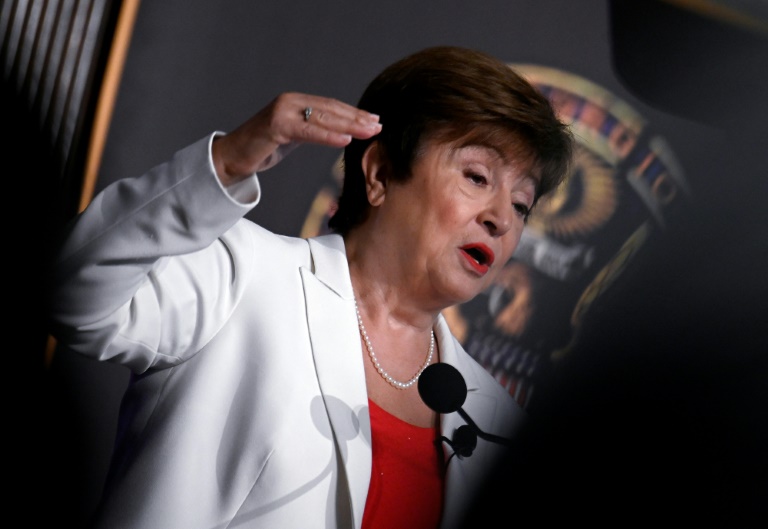
Global equity markets mostly fell Thursday and the pound retreated once more against the dollar ahead of key US jobs data as IMF chief Kristalina Georgieva warned of rising global recession risks.

Oil prices advanced, building on gains made before OPEC and other major producers led by Russia decided to slash output by two million barrels a day.

OANDA market analyst Craig Erlam said European markets erased early gains as “investors take a cautious approach” ahead of Friday’s release of the critical US jobs report that could influence the Federal Reserve’s next move.

Wall Street also endured a dreary session, with the S&P 500 losing one percent on worries that a better-than-expected employment data could send stocks lower due to expectations for more aggressive interest rate hikes.

“You’d have to be very courageous to make a big bet today before the jobs data,” said Gregori Volokhine of Meeschaert Financial Services. “Today people are playing the waiting game.”

Stocks snapped higher at the start of the week after disappointing US economic data fueled hopes of a moderation in the Fed’s efforts to counter inflation.

“The narrative in recent days of weaker data being positive as it could be a precursor to slower tightening didn’t seem sustainable and it’s already proving to be the case,” added Erlam.

Instead, he said he believed the rally to be a response to the sharp drop in shares in the previous weeks as the Fed made clear it would keep raising rates until inflation is brought down, even if that triggers a recession.

In a speech ahead of the IMF’s annual meetings next week, IMF chief Kristalina Georgieva urged policymakers to address rampant inflation.

She acknowledged that if central banks move too aggressively to tamp down price pressures, it could trigger a “prolonged” economic downturn.

But in an interview with AFP, she said policymakers “have to stay the course,” because right now “The risk of doing not enough is bigger than the risk of doing too much.”

– Oil prices steady –

Oil prices advanced further after the announcement from OPEC+ nations on the biggest reduction in output since the Covid-19 pandemic.

The move should support crude prices, but as high oil prices have been stoking the inflation that is driving central banks to raise interest rates, the move will further exacerbate the situation.

“The oil producing nations want to support the oil market, but a high oil price hurts most nations, so in a roundabout way, the move will probably add to global inflation,” said analyst David Madden at Equiti Capital.

The pound tumbled against the dollar after Fitch ratings agency lowered the outlook for British debt to negative from stable.

This comes after the government of new Prime Minister Liz Truss recently announced a budget packed with debt-fueled tax cuts.

“The large and unfunded fiscal package announced as part of the new government’s growth plan could lead to a significant increase in fiscal deficits over the medium term,” Fitch said in a statement.

“We consider that statements by the Chancellor (finance minister) hinting at the possibility of additional tax cuts and the likely modification of fiscal rules legislated in January reduce the predictability of fiscal policy.”

– Key figures around 2050 GMT –

New York – Dow: DOWN 1.2 percent at 29,926.94 (close)

New York – S&P 500: DOWN 1.0 percent at 3,744.52 (close)

New York – Nasdaq: DOWN 0.7 percent at 11,073.31 (close)

London – FTSE 100: DOWN 0.8 percent at 6,997.27 (close) 

Frankfurt – DAX: DOWN 0.4 percent at 12,470.78 (close)

Paris – CAC 40: DOWN 0.8 percent at 5,936.42 (close)

EURO STOXX 50: DOWN 0.4 percent at 3,433.45 (close)

Tokyo – Nikkei 225: UP 0.7 percent at 27,311.30 (close)

Hong Kong – Hang Seng Index: DOWN 0.4 percent at 18,012.15 (close)

Shanghai – Composite: Closed for a holiday

Pound/dollar: DOWN at $1.1161from $1.1326 on Wednesday

Euro/dollar: DOWN at $0.9794 from $0.9884

Euro/pound: UP at 87.74 pence from 87.27 pence

Dollar/yen: UP at 145.11 yen from 144.64 yen

Brent North Sea crude: UP 1.1 percent at $94.42 per barrel

West Texas Intermediate: UP 0.8 percent at $88.45 per barrel

burs-jmb

World Bank spent almost $15 bn on fossil fuel projects since Paris deal: report

The World Bank has pumped $14.8 billion into fossil fuel projects globally in the period following the landmark Paris climate accord, a report said Thursday.

Though the multilateral lender pledged in 2018 to end financing for upstream oil and gas, and direct funding had declined, the move failed to include indirect financing, according to the report compiled by an NGO coalition called The Big Shift Global.

It comes amid growing pressure on US President Joe Biden to fire World Bank chief David Malpass, a Trump appointee who has dodged questions about the reality of human-driven climate change.

“Each time the World Bank invests in another fossil fuel project, it fuels more climate disaster,” said Sophie Richmond of Big Shift. “There is no justification for using taxpayers’ money to exacerbate the climate crisis.”

One of the main ways the Bank continued to fund fossil fuels was by exploiting a “major loophole” by lending to intermediaries such as banks or financial institutions and by acting as a guarantor in case a country did not meet its obligations, the report said.

Under the 2015 Paris deal, world leaders committed to limiting long-term warming to 1.5 Celsius (2.7 degrees Fahrenheit) to avert devastating outcomes for the planet’s future habitability. 

The biggest project listed in the report, called “Investing in Climate Disaster: World Bank Finance for Fossil Fuels,” was the Trans-Anatolian Pipeline in Azerbaijan, funded in 2018 to the tune of $1.1 billion, with the Bank acting as a guarantor. 

“It serves to perpetuate on-going use of fossil gas in Europe,” the report said, while noting that while the pipeline may increase gas export revenues, market volatility makes it an unreliable source of income.

The World Bank Group’s own assessment stated the project was “expected to have potentially significant adverse social and environmental impacts that are diverse, irreversible, or unprecedented” — but it gave a green light anyway.

– Coal plants –

Another project highlighted was the construction of two coal plants in Indonesia called Java 9 and 10, where the Bank supplied $65 million in indirect funds — despite the fact that the Java and Bali grid is already experiencing 40 percent oversupply of electricity.

“It is obvious that the new Java 9 & 10 coal-fired power plants will bring more disaster in terms of environmental, social and health issues, in an area already covered with coal plants and industries,” said Yuyun Indradi of Trend Asia, an NGO that promotes clean energy. 

The report’s authors also rejected the Bank’s treatment of natural gas as a “bridge” between fossil fuels and renewable energy, saying it crowded out needed investments in clean energy.

In a statement to AFP, the World Bank said, “We dispute the findings of the report: it makes inaccurate assumptions about the World Bank Group’s lending. 

“In fiscal year 2022, the Bank Group delivered a record $31.7 billion for climate-related investments, to help communities around the world respond to the climate crisis, and build a safer and cleaner future.”

A separate report published by Oxfam earlier this week said the World Bank “supplies very little evidence to support its claims about the amount of climate finance it provides,” leaving the public to take their figures “on faith.”

World Bank spent almost $15 bn on fossil fuel projects since Paris deal: report

The World Bank has pumped $14.8 billion into fossil fuel projects globally in the period following the landmark Paris climate accord, a report said Thursday.

Though the multilateral lender pledged in 2018 to end financing for upstream oil and gas, and direct funding had declined, the move failed to include indirect financing, according to the report compiled by an NGO coalition called The Big Shift Global.

It comes amid growing pressure on US President Joe Biden to fire World Bank chief David Malpass, a Trump appointee who has dodged questions about the reality of human-driven climate change.

“Each time the World Bank invests in another fossil fuel project, it fuels more climate disaster,” said Sophie Richmond of Big Shift. “There is no justification for using taxpayers’ money to exacerbate the climate crisis.”

One of the main ways the Bank continued to fund fossil fuels was by exploiting a “major loophole” by lending to intermediaries such as banks or financial institutions and by acting as a guarantor in case a country did not meet its obligations, the report said.

Under the 2015 Paris deal, world leaders committed to limiting long-term warming to 1.5 Celsius (2.7 degrees Fahrenheit) to avert devastating outcomes for the planet’s future habitability. 

The biggest project listed in the report, called “Investing in Climate Disaster: World Bank Finance for Fossil Fuels,” was the Trans-Anatolian Pipeline in Azerbaijan, funded in 2018 to the tune of $1.1 billion, with the Bank acting as a guarantor. 

“It serves to perpetuate on-going use of fossil gas in Europe,” the report said, while noting that while the pipeline may increase gas export revenues, market volatility makes it an unreliable source of income.

The World Bank Group’s own assessment stated the project was “expected to have potentially significant adverse social and environmental impacts that are diverse, irreversible, or unprecedented” — but it gave a green light anyway.

– Coal plants –

Another project highlighted was the construction of two coal plants in Indonesia called Java 9 and 10, where the Bank supplied $65 million in indirect funds — despite the fact that the Java and Bali grid is already experiencing 40 percent oversupply of electricity.

“It is obvious that the new Java 9 & 10 coal-fired power plants will bring more disaster in terms of environmental, social and health issues, in an area already covered with coal plants and industries,” said Yuyun Indradi of Trend Asia, an NGO that promotes clean energy. 

The report’s authors also rejected the Bank’s treatment of natural gas as a “bridge” between fossil fuels and renewable energy, saying it crowded out needed investments in clean energy.

In a statement to AFP, the World Bank said, “We dispute the findings of the report: it makes inaccurate assumptions about the World Bank Group’s lending. 

“In fiscal year 2022, the Bank Group delivered a record $31.7 billion for climate-related investments, to help communities around the world respond to the climate crisis, and build a safer and cleaner future.”

A separate report published by Oxfam earlier this week said the World Bank “supplies very little evidence to support its claims about the amount of climate finance it provides,” leaving the public to take their figures “on faith.”

World Bank spent almost $15 bn on fossil fuel projects since Paris deal: report

The World Bank has pumped $14.8 billion into fossil fuel projects globally in the period following the landmark Paris climate accord, a report said Thursday.

Though the multilateral lender pledged in 2018 to end financing for upstream oil and gas, and direct funding had declined, the move failed to include indirect financing, according to the report compiled by an NGO coalition called The Big Shift Global.

It comes amid growing pressure on US President Joe Biden to fire World Bank chief David Malpass, a Trump appointee who has dodged questions about the reality of human-driven climate change.

“Each time the World Bank invests in another fossil fuel project, it fuels more climate disaster,” said Sophie Richmond of Big Shift. “There is no justification for using taxpayers’ money to exacerbate the climate crisis.”

One of the main ways the Bank continued to fund fossil fuels was by exploiting a “major loophole” by lending to intermediaries such as banks or financial institutions and by acting as a guarantor in case a country did not meet its obligations, the report said.

Under the 2015 Paris deal, world leaders committed to limiting long-term warming to 1.5 Celsius (2.7 degrees Fahrenheit) to avert devastating outcomes for the planet’s future habitability. 

The biggest project listed in the report, called “Investing in Climate Disaster: World Bank Finance for Fossil Fuels,” was the Trans-Anatolian Pipeline in Azerbaijan, funded in 2018 to the tune of $1.1 billion, with the Bank acting as a guarantor. 

“It serves to perpetuate on-going use of fossil gas in Europe,” the report said, while noting that while the pipeline may increase gas export revenues, market volatility makes it an unreliable source of income.

The World Bank Group’s own assessment stated the project was “expected to have potentially significant adverse social and environmental impacts that are diverse, irreversible, or unprecedented” — but it gave a green light anyway.

– Coal plants –

Another project highlighted was the construction of two coal plants in Indonesia called Java 9 and 10, where the Bank supplied $65 million in indirect funds — despite the fact that the Java and Bali grid is already experiencing 40 percent oversupply of electricity.

“It is obvious that the new Java 9 & 10 coal-fired power plants will bring more disaster in terms of environmental, social and health issues, in an area already covered with coal plants and industries,” said Yuyun Indradi of Trend Asia, an NGO that promotes clean energy. 

The report’s authors also rejected the Bank’s treatment of natural gas as a “bridge” between fossil fuels and renewable energy, saying it crowded out needed investments in clean energy.

In a statement to AFP, the World Bank said, “We dispute the findings of the report: it makes inaccurate assumptions about the World Bank Group’s lending. 

“In fiscal year 2022, the Bank Group delivered a record $31.7 billion for climate-related investments, to help communities around the world respond to the climate crisis, and build a safer and cleaner future.”

A separate report published by Oxfam earlier this week said the World Bank “supplies very little evidence to support its claims about the amount of climate finance it provides,” leaving the public to take their figures “on faith.”

IMF chief says world better prepared for this crisis

The global economy is at a difficult crossroads, buffeted by multiple shocks including soaring inflation, rising interest rates and a growing threat of broad debt crisis, but IMF Managing Director Kristalina Georgieva told AFP that institutions are better prepared to weather this storm.

Below is an excerpt from an interview conducted ahead of the IMF and World Bank annual meetings in Washington next week:

Could the fallout in 2023 be worse than the 2008 global financial crisis?

What we had today is (a) much stronger banking sector than we had then, and that has proven to be a source of resilience for the world economy. We also have something very important: stronger central banks, truly independent with the experience that they have built since the global financial crisis. And that shows in how central banks are reacting to the signs of inflation.

Does the IMF have enough tools and financial resources?

During the last year since Covid, we have extended lending of about $270 billion. We have a lending capacity of $1 trillion. So we have space to continue to support the members. We do see an increase in requests for fund programs, not surprisingly. Just since Russia invaded Ukraine, we have provided financial support to 16 countries of about $90 billion and we are currently looking at some 21 requests… My message to countries: act early. Come to us for precautionary instruments so you can build your position in this very difficult time to sustain your economy against the risks to come.

China is a major creditor, are they doing enough to help with debt relief?

We have got… very substantive engagement with China in the context of the countries that ask for treatment under the Common Framework. And we have made good progress with China stepping up to co-chair the creditors committee for Zambia and to reach an agreement on Zambia, and now we expect the same for Chad. What we need to recognize is that the Chinese institutions are still working their way through debt issues. There are many lenders in China. Only recently the Ministry of Finance and central bank, the People’s Bank of China, got the mandate to coordinate, and it takes some time to reach that coordination. 

But time is not our friend. And this is what we have conveyed clearly, that we do not want to see individual defaults turning into opening a gateway for a debt crisis. And it is not in China’s interest. 

Close Bitnami banner
Bitnami