World

Exhausted Ukrainian soldiers say 'only death' awaits Russians

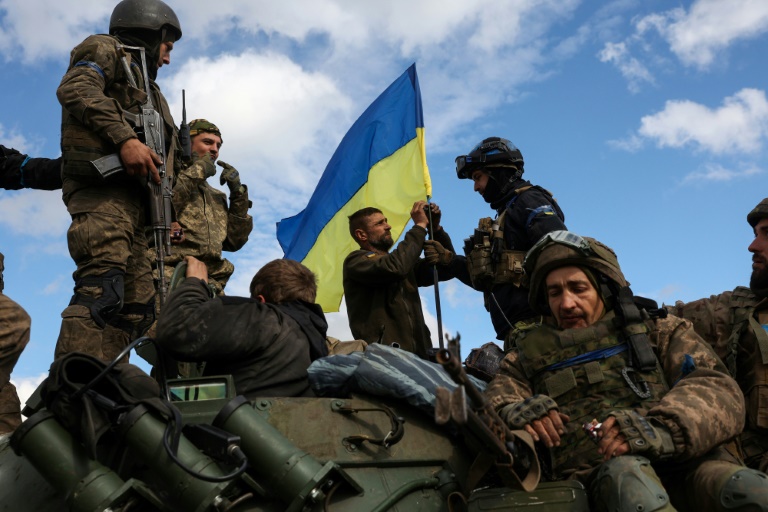
Exhausted and caked in mud, Ukrainian paratroopers fly their blue and yellow national flag from tanks, fresh from recapturing the strategic city of Lyman from the Russians.

Painted on the front and rear of the tanks are large white crosses, the emblem adopted by the Ukrainian army for their blistering counter-offensive which has seen Kyiv retake thousands of square kilometres in the east and south.

“It was hard, really hard,” admits Oleksandr, a slim paratrooper with grey eyes and a small moustache, talking about winning back Lyman in Donetsk, one of four regions that Russian President Vladimir Putin has annexed.

“We were moving forward,” he said. Ukrainian soldiers serving on the front line rarely give their full name for security reasons.

“We had no other choice. We’re protecting our land.”

He expressed no fear about Russian reinforcements after Putin called up hundreds of thousands of reservists last month in a bid to stem a spiral of defeats.

“No matter how many of them there are, they don’t really want to fight us,” said Oleksandr.

“Only death” awaits Russian troops in Ukraine he believes — “or captivity if they are lucky”.

In a country lane near Lyman, a strategic railway hub, bearded paratroopers wear blue ribbons on their forearms or chests.

– ‘Chase them’ –

“We are exhausted,” admits one young soldier, who did not want to give his name.

Visibly tired, some flash the V sign for victory while others raise hands to greet journalists. 

“We’re resting a bit and then we’ll go further,” says the same soldier smiling along with those around him.

“We’ll chase them away.”

Another Ukrainian soldier wears a Russian tactical vest over his national uniform.

“A trophy,” he laughs.

The Russians “put up resistance” says another, eating a bar of chocolate, “they didn’t run straight away”.

With face and hands daubed with mud, Roman, a 34-year-old soldier whose helmet is covered with a camouflage net, smokes quietly. 

“We had some smart (Russians), who surrendered,” he said.

– ‘Untenable’ –

Bodies of Russian soldiers still lie on the ground, including one with his head torn off, likely by an explosion, near the small town of Drobysheve, less than five kilometres (three miles) from Lyman.

Nearby, a Ukrainian de-miner advances slowly, metal detector in hand, through the forest.

His colleague prepares a wire detonator.

“Now there will be a boom”, he warns, before a dizzying explosion rings out in the distance, releasing a cloud of white smoke.

In Drobysheve, a charitable foundation is evacuating residents.

Valentina, 78, wearing a blue scarf, waits with her husband in the evacuation van.

“We evacuated when there were bombardments but we came back afterwards because we really wanted to go home. But it was untenable,” she said, tears in her eyes. 

“We’re going to Kyiv.”

Leonid, 65, came to wish his neighbours goodbye, but vowed not to join them.

“We will stay here. On our land.”
Russian elite voice growing anger as losses mount in Ukraine

A growing list of failings and defeats in Ukraine have spawned angry outbursts from Russia’s elite, who still support the “military operation” but have gone as far as to suggest army chiefs should face the firing squad.

Before September saw a series of battlefield reversals, public criticism of the army was rare.

The offensive had been presented as a sacred, patriotic mission and speaking ill of the armed forces could lead to a long stay in prison.  

Today, nobody among the elite is calling into question the merits of Moscow’s viewpoint or the operation against a neighbouring nation.

But the military setbacks and problems over the mobilisation of hundreds of thousands of reservists have led usually quiet public figures to attack the military hierarchy.

On Wednesday, the head of the lower house of parliament’s defence committee, said the army should “stop lying”, as daily briefings praise enormous losses supposedly suffered by Ukrainian forces without mention of Russian troop reversals.

“The people know. Our people are not stupid,” warned former general Andrei Kartapolov.

“And they see that we do not want to tell them even part of the truth. That can lead to a loss of credibility,” he told the online show of star presenter Vladimir Solovyov, an ultra-patriot.

– Capital punishment –

Solovyov, who is under EU sanctions, said certain members of the army’s top ranks deserved to face a firing squad.

“The guilty should be punished, we don’t have capital punishment unfortunately, but for some of them it would be the only solution.

“They don’t even have an officer’s sense of honour because they are not shooting themselves,” he said.

For celebrity war reporter Alexander Kots, writing on his Telegram channel, “There won’t be any good news (from the front) in the near future.”

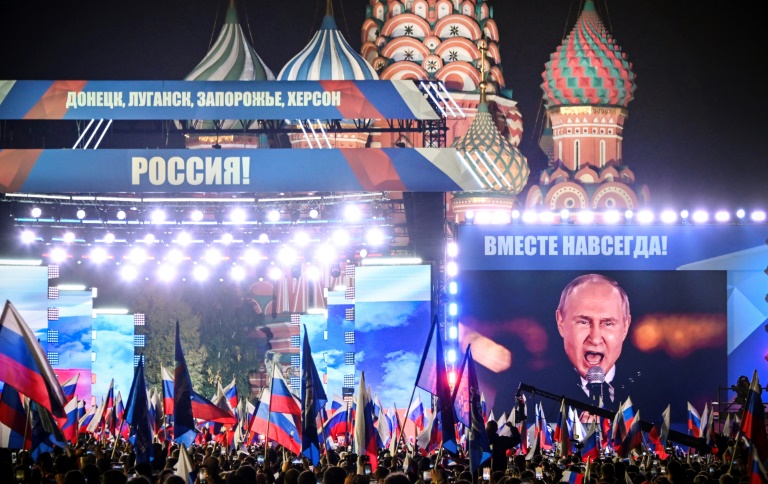
The verbal assaults and an air of defeatism were all the more striking when Vladimir Putin celebrated the annexation of four Ukrainian regions with a concert on Moscow’s Red Square.

“Victory will be ours,” blared the president from a giant video screen amid a sea of Russian flags.

None of the criticism has directly targeted the all-powerful head of state, or even his defence minister Sergei Shoigu.

But when Chechen leader Ramzan Kadyrov hit out at Russia’s generals, urging the use of nuclear weapons and hinting Putin had been ill-informed, the Kremlin had to react.

– Sabotage –

Kremlin spokesman Dmitry Peskov responded, saying: “In difficult moments, emotions must be excluded … We prefer to make measured and objective evaluations (of the situation).”

Putin was moved to admit publicly to “errors” in the effort to mobilise reservists after an avalanche of documented cases of people without army experience were called up to the front.

Russia’s political opposition has been virtually wiped out with its main leader Alexei Navalny in jail.

What remains of the opposition operates mostly from abroad and is attempting to rebuild within Russia amid hopes of riding popular discontent.

“The millions of people who remain in Russia are hostages of Putin and do not want to fight,” said Navalny ally Leonid Volkov, who announced on YouTube the re-launch of an activist network in the nation’s regions.

“The struggle can take different forms, with different levels of risk — we can put out information, offer legal aid, do voluntary work or sabotage the work of military commissariats, some of which burn very well,” he noted.

Stocks mostly retreat, pound drops

Equity markets mostly fell Thursday and the pound retreated once more against the dollar on lingering recession fears despite hopes that the US Federal Reserve will tame the pace of aggressive interest rate hikes.

Oil prices also dropped, failing to power ahead after OPEC and other major producers led by Russia decided to slash output by two million barrels per day.

The cut, the biggest since the pandemic struck, was viewed by traders as an attempt to boost prices.

The Kremlin on Thursday said the OPEC+ decision was designed to stabilise global oil markets.

And Washington said it was a concession to Moscow. The United States has been lobbying to hold down fuel prices and isolate Russia over its Ukraine aggression.

The European Union has proposed introducing a price cap on Russian oil as part of new sanctions over Ukraine.

Moscow has said a price cap on its oil would have a “detrimental effect” on global markets and warned it would not supply crude to countries that introduce it.

Shares in Shell slid about 4.5 percent in Thursday trading after the British energy giant revealed that its third-quarter profit would be hit by a slump in refining margins.

“Shell enjoyed record profits in the first and second quarter spurred by a surge in underlying oil and gas prices following Russia’s invasion of Ukraine,” noted Victoria Scholar, head of investment at Interactive Investor.

“However, since June, oil has posted four consecutive months of declines, with Brent crude down by around 25 percent.”

Scholar said Shell was “grappling with a dysfunctional and volatile gas market as well as expectations of softening oil demand, particularly from China as the global economy cools”.

– Awaiting US jobs –

Markets remained on guard over the economic outlook awaiting the release of US non-farm payroll jobs Friday.

The pound was down about half-a-percent against the dollar after Fitch ratings agency lowered the outlook for British debt to negative from stable.

This after the government of new Prime Minister Liz Truss recently announced a budget packed with debt-fuelled tax cuts.

Ahead of the downgrade Wednesday, sterling had plunged more than two percent after Truss failed to reassure investors with a speech at her Conservative party conference.

The pound, however, has recovered since reaching a record-low close to parity against the dollar at the end of September.

– Key figures around 1100 GMT –

London – FTSE 100: DOWN 0.6 percent at 7,008.78 points

Frankfurt – DAX: DOWN 0.3 percent at 12,484.16

Paris – CAC 40: DOWN 0.5 percent at 5,957.14

EURO STOXX 50: DOWN 0.3 percent at 3,438.49

Tokyo – Nikkei 225: UP 0.7 percent at 27,311.30 (close)

Hong Kong – Hang Seng Index: DOWN 0.4 percent at 18,012.15 (close)

Shanghai – Composite: Closed for a holiday

New York – Dow: DOWN 0.1 percent at 30,273.87 (close)

Pound/dollar: DOWN at $1.1263 from $1.1326 on Wednesday

Euro/dollar: DOWN at $0.9887 from $0.9889

Euro/pound: UP at 87.72 pence from 87.29 pence

Dollar/yen: UP at 144.75 yen from 144.59 yen

Brent North Sea crude: DOWN 0.3 percent at $93.07 per barrel

West Texas Intermediate: DOWN 0.5 percent at $87.32 per barrel

Lebanon far from gas riches even if Israel deal agreed: analysts

Lebanon is grappling to strike a deal with Israel over contested maritime gas fields, but even with an agreement the cash-strapped country faces multiple hurdles before tapping potential hydrocarbon riches, analysts say.

“A deal would mark one step forward but it does not mean that Lebanon has become a gas- or oil-producing country,” said Marc Ayoub, an associate fellow at the American University of Beirut’s Issam Fares Institute.

“We are talking of a timeline of five to six years… before the first gas” if commercially viable reservoirs are in fact found, the energy expert told AFP, describing the timeframe as “optimistic”.

With the demand for gas rising worldwide because of an energy crisis sparked by Russia’s invasion of Ukraine, Lebanon hopes that an offshore discovery would ease its current unprecedented financial downturn.

But more than a decade since it declared its maritime boundaries and an Exclusive Economic Zone, it still has no proven natural gas reserves.

One well drilled in 2020 by a consortium of energy giants TotalEnergies, Eni and Novatek showed only traces but no commercially viable gas deposits.

Further test drilling, in a block near the border, has been hampered by the maritime border dispute between Lebanon and Israel, which are technically still at war.

Following years of US-mediated negotiations, a draft proposal from Washington at the weekend was welcomed by both sides.

But Israel on Thursday said it would reject amendments to the proposal requested by Lebanon this week, further prolonging a final agreement.

A final deal, however, would allow “offshore exploration activities to continue,” off Lebanon’s coast, Ayoub said.

“But that doesn’t mean that Lebanon has become rich… or that its crisis has been solved.” 

– ‘First gas’ –

A 2012 seismic study of a limited offshore area by the British firm Spectrum estimated recoverable gas reserves in Lebanon at 25.4 trillion cubic feet.

The authorities in Lebanon have announced higher estimates.

Block 9 near the border with Israel contains the so-called Qana field or Sidon reservoir, and will be a major zone for offshore exploration by TotalEnergies and Eni that were awarded a contract in 2018.

“This time next year, we should know if there is a commercial discovery in Qana or not,” Ayoub said.

“If we have a discovery, it will take… no less than three to five years after exploration” before production could start.

This time frame, according to Ayoub, assumes there are no delays by Lebanese authorities who are widely blamed for the corruption and mismanagement behind the country’s financial crash.

It took months for the Lebanese Petroleum Administration (LPA) regulatory body to name its board after it was formed in 2012, because of political disputes over nominations.

Several bidding rounds for offshore gas and oil licences have been hit by delays since they began in 2013.

Already, Lebanon lags far behind Israel which has been investing in the offshore Karish field for years and is expecting its first gas within weeks.

– Risky investment –

Roudi Baroudi, an energy consultant, said that gas or oil production could start within three years if commercially viable reservoirs are found.

But to attract energy firms and benefit from potential discoveries, Lebanon desperately needs to undergo changes, he told AFP.

“Lebanon is not a good investment unless the government implements reforms,” the energy expert said.

Reforms would provide “the basic assurances that international companies need to work with less risk”.

State institutions in Lebanon have collapsed under the weight of the crisis, with strikes by civil servants adding to the paralysis.

An economic recovery plan has yet to take off more than three years since the financial downturn began, despite mounting pressures from foreign donors and the International Monetary Fund.

And political gridlock has caused a months-long delay in forming a new government amid fears of a presidential vacuum after Michel Aoun’s mandate expires at the end of October.

With a bankrupt state unable to deliver more than an hour or two of mains electricity a day, energy firms may choose to work on their Lebanon projects out of Cyprus, according to Baroudi.

“With no rule of law, Lebanon is a jungle,” he said.  “It’s absolute chaos, whether judicially, financially or in terms of regulatory” bodies.

Lebanon far from gas riches even if Israel deal agreed: analysts

Lebanon is grappling to strike a deal with Israel over contested maritime gas fields, but even with an agreement the cash-strapped country faces multiple hurdles before tapping potential hydrocarbon riches, analysts say.

“A deal would mark one step forward but it does not mean that Lebanon has become a gas- or oil-producing country,” said Marc Ayoub, an associate fellow at the American University of Beirut’s Issam Fares Institute.

“We are talking of a timeline of five to six years… before the first gas” if commercially viable reservoirs are in fact found, the energy expert told AFP, describing the timeframe as “optimistic”.

With the demand for gas rising worldwide because of an energy crisis sparked by Russia’s invasion of Ukraine, Lebanon hopes that an offshore discovery would ease its current unprecedented financial downturn.

But more than a decade since it declared its maritime boundaries and an Exclusive Economic Zone, it still has no proven natural gas reserves.

One well drilled in 2020 by a consortium of energy giants TotalEnergies, Eni and Novatek showed only traces but no commercially viable gas deposits.

Further test drilling, in a block near the border, has been hampered by the maritime border dispute between Lebanon and Israel, which are technically still at war.

Following years of US-mediated negotiations, a draft proposal from Washington at the weekend was welcomed by both sides.

But Israel on Thursday said it would reject amendments to the proposal requested by Lebanon this week, further prolonging a final agreement.

A final deal, however, would allow “offshore exploration activities to continue,” off Lebanon’s coast, Ayoub said.

“But that doesn’t mean that Lebanon has become rich… or that its crisis has been solved.” 

– ‘First gas’ –

A 2012 seismic study of a limited offshore area by the British firm Spectrum estimated recoverable gas reserves in Lebanon at 25.4 trillion cubic feet.

The authorities in Lebanon have announced higher estimates.

Block 9 near the border with Israel contains the so-called Qana field or Sidon reservoir, and will be a major zone for offshore exploration by TotalEnergies and Eni that were awarded a contract in 2018.

“This time next year, we should know if there is a commercial discovery in Qana or not,” Ayoub said.

“If we have a discovery, it will take… no less than three to five years after exploration” before production could start.

This time frame, according to Ayoub, assumes there are no delays by Lebanese authorities who are widely blamed for the corruption and mismanagement behind the country’s financial crash.

It took months for the Lebanese Petroleum Administration (LPA) regulatory body to name its board after it was formed in 2012, because of political disputes over nominations.

Several bidding rounds for offshore gas and oil licences have been hit by delays since they began in 2013.

Already, Lebanon lags far behind Israel which has been investing in the offshore Karish field for years and is expecting its first gas within weeks.

– Risky investment –

Roudi Baroudi, an energy consultant, said that gas or oil production could start within three years if commercially viable reservoirs are found.

But to attract energy firms and benefit from potential discoveries, Lebanon desperately needs to undergo changes, he told AFP.

“Lebanon is not a good investment unless the government implements reforms,” the energy expert said.

Reforms would provide “the basic assurances that international companies need to work with less risk”.

State institutions in Lebanon have collapsed under the weight of the crisis, with strikes by civil servants adding to the paralysis.

An economic recovery plan has yet to take off more than three years since the financial downturn began, despite mounting pressures from foreign donors and the International Monetary Fund.

And political gridlock has caused a months-long delay in forming a new government amid fears of a presidential vacuum after Michel Aoun’s mandate expires at the end of October.

With a bankrupt state unable to deliver more than an hour or two of mains electricity a day, energy firms may choose to work on their Lebanon projects out of Cyprus, according to Baroudi.

“With no rule of law, Lebanon is a jungle,” he said.  “It’s absolute chaos, whether judicially, financially or in terms of regulatory” bodies.

Gunman murders at least 30 in Thai nursery attack

A former police officer stormed a nursery in Thailand on Thursday, shooting dead at least 30 people, most of them children, before killing himself and his family.

The attacker, armed with a shotgun, a pistol and a knife, opened fire on the childcare centre in Nong Bua Lam Phu province at about 12:30 pm (0530 GMT) before fleeing the scene in a pickup truck.

“The death toll from the shooting incident… is at least 30 people,” said Anucha Burapachaisri, a spokesman for the Thai prime minister’s office.

The dead include at least 23 children, said police colonel Jakkapat Vijitraithaya, from the province where the attack happened.

After the attack, the gunman went home and killed himself and his wife and child, Jakkapat said.

The gunman has been named as Panya Khamrab, 34, and Jakkapat said he was dismissed from the force last year for drug use.

Eyewitness Paweena Purichan, 31, was riding her motorcycle to her shop when she encountered the fleeing Panya driving erratically.

“He intended to crash into others on the road,” she told AFP. 

“The attacker rammed a motorbike and two people were injured. I sped off to get away from him.” 

“There was blood everywhere.” 

Paweena said the attacker was well known in the area as a drug addict.

Thailand forms part of Southeast Asia’s so-called Golden Triangle which has long been an infamous hotspot for the trafficking and abuse of drugs.

Surging supplies of methamphetamine have sent street prices crashing in Thailand to all-time lows, according to the UN Office on Drugs and Crime.

– Mass shootings rare –

The mass killing comes less than a month after a serving army officer shot dead two colleagues at a military training base in the capital Bangkok.

While Thailand has high rates of gun ownership, mass shootings are extremely rare.

But in the past year, there have been at least two other cases of shooting murders by serving soldiers, according to the Bangkok Post.

In 2020, in one of the kingdom’s deadliest incidents in recent years, a soldier gunned down 29 people in a 17-hour rampage and wounded scores more before he was shot dead by commandos.

That mass shooting, linked to a debt dispute between gunman Sergeant-Major Jakrapanth Thomma and a senior officer, triggered public anger against the military.

The soldier was able to steal assault rifles from an army depot before embarking on his killing spree, posting live updates on social media as he did so.

Military top brass were at pains to portray the killer as a rogue soldier.

Crowd-pleaser or obscure pick for literature Nobel?

The Nobel Literature Prize will be announced on Thursday, with speculation in literary circles split over whether it will go to an overdue bestselling author or a relative unknown lifted into the spotlight.

The Swedish Academy will reveal its pick at 1:00 pm (1100 GMT) in Stockholm. Last year, the prestigious award went to British-Tanzanian author Abdulrazak Gurnah. American poet Louise Gluck won it the year before.

Literary critics and Nobel watchers are split into two camps this year.

There are those who see the Academy’s past choices as confirmation that it sees no need to crown renowned authors, especially those who already sell millions of books.

And then there are those who think it could be time to award a writer known and loved the world over.

The 18-member Swedish Academy is still recovering from a 2017-2018 #MeToo scandal that left it in tatters, and its controversial awarding of the 2019 Nobel to Austrian novelist Peter Handke.

Famed — and lambasted — for its male Eurocentric Nobel picks, the revamped Academy has since gone on to award an American woman and a man born in Zanzibar whose work focuses on the plight of refugees and exile, colonialism and racism.

The jury has repeatedly maintained that its prize is neither political nor subject to gender or ethnic quotas, and insists that its only criteria is the quality of a writer’s body of work.

– ‘Well-known name’ –

Nonetheless, “the Academy is now very conscious of its reputation when it comes to diversity and gender representation, in a totally different way than they were before the 2017-2018 scandal”, Bjorn Wiman, culture editor at Sweden’s newspaper of reference Dagens Nyheter, told AFP.

“I think we can expect a more well-known name this year, after last year’s surprise,” he said.

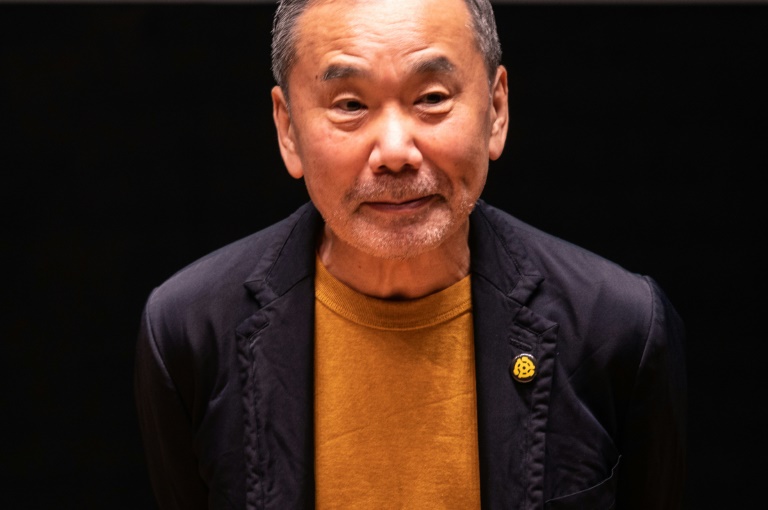
If the Academy were to lean that way, the prize could go to public favourites Haruki Murakami of Japan, Joyce Carol Oates and Cormac McCarthy of the US and Canada’s Margaret Atwood, who have all been mentioned in Nobel speculation for years.

But after two well-received laureates, the Academy could also venture for a more polemic pick this time, with France’s Michel Houellebecq — known for controversial remarks on Islam, among others — long topping some betting sites this year.

Early Thursday, Canada’s Anne Carson overtook him as the favourite among bookies.

A choice also likely to stir controversy would be Salman Rushdie, the British author of “The Satanic Verses” who was the victim of an attempted murder attack in August.

Other political picks, in the context of the war in Ukraine, would be Russian novelist Lyudmila Ulitskaya, exiled in Berlin and a fierce critic of President Vladimir Putin, Sofi Oksanen of Finland or Ukraine’s Andrey Kurkov.

Names that regularly make the rounds in Nobel speculation include Hungarian authors Peter Nadas and Laszlo Krasznahorkai, French novelists Annie Ernaux and Maryse Conde, Norwegians Jon Fosse and Karl Ove Knausgaard, Kenya’s Ngugi wa Thiong’o, Croatia’s Dubravka Ugresic, Americans Thomas Pynchon and Don DeLillo, Antiguan-American Jamaica Kincaid, Israel’s David Grossman, Argentina’s Cesar Aira and Syrian-born poet Adonis.

– Time for Asia? –

Asia has not had a Nobel winner since China’s Mo Yan 10 years ago. 

Giving the prize to Yan Lianke — an acerbic observer of Chinese society who’s had some of his works banned in China — would anger Beijing, and the same goes for Lao Yiwu, known by his pen name Lao Wei and considered the “Chinese Solzhenitsyn”.

Their compatriot Can Xue is also considered worthy of the distinction.

Big Western countries top the list of Nobel Literature laureates — France leads the rankings with 15 — while giant nations like China and India have only one each.

Indian poet and novelist Vikram Seth is seen as a possible laureate.

The Swedish Academy was long plagued by suspected leaks, but is known for cloak-and-dagger methods to try to keep its musings and preparatory Nobel work under wraps.

Its deliberations are also sealed for 50 years.

It is known to have a long list that is whittled down throughout the year to a short list of five names, before the 18 members vote on a winner.

After Thursday’s announcement, the Nobel season continues Friday with the highly-anticipated Peace Prize, the only Nobel announced in Oslo.

Punters have suggested this year’s prize could sound the alarm over the war in Ukraine or the climate.

The Economics Prize wraps things up on Monday, October 10.

Markets mostly up as focus turns to key US jobs report

Equity markets rose Thursday as traders fought to extend this week’s global rally, though concerns about the impact of a huge oil output cut on inflation tempered hopes that central banks could soon ease their rate hike campaigns.

The mood on trading floors has been a little lighter this week, sending equities surging and weighing on the dollar, after weak readings on US factory activity and job openings fed speculation that the Federal Reserve’s strict tightening drive was having an effect.

But confidence took a knock Wednesday from a better-than-expected read on private jobs hiring and a report showing the key services sector holding up more than expected.

The figures highlighted the resilience of the US economy in the face of multiple rate hikes and point to the long road ahead for the Fed in fighting decades-high inflation.

Fed officials have lined up for weeks to insist that they will not budge from lifting borrowing costs until prices are tempered — even at the cost of a recession — while some have warned traders not to expect any cuts next year.

“After an increase in expectations of an imminent Fed pivot given the softer than expected US (factory data), the strength in the services (sector) not only eases concerns of an imminent US recession, it also refutes any notion that the Fed will look to take its foot off the tighten pedal any time soon,” said National Australia Bank’s Rodrigo Catril.

The latest US data came as OPEC and other major producers led by Russia decided to slash output by a massive two million barrels a day — the biggest reduction since the pandemic struck.

Moscow said a possible price cap by the European Union on Russian crude would have a “detrimental effect” on the global oil sector, saying Moscow would not sell to countries that introduced it.

The news gave already elevated oil prices another leg up, with both contracts piling on more than one percent Wednesday.

It also fuelled concerns that energy costs — a major driver of the spike in global inflation since Russia’s invasion of Ukraine — will drive higher again.

“All the developments we have seen on the supply side at this point very much sets the stage for what we believe will be higher prices into the end of this year,” Damien Courvalin, at Goldman Sachs, told Bloomberg Television.

“With this cut and the winter seasonal demand, inventories will continue to fall.”

– UK ratings warning –

Still, crude edged up only slightly in Asia, and SPI Asset Management’s Stephen Innes said: “So far, the oil market appears to be priced to post OPEC+ perfection. The current WTI move should not impact US inflation significantly nor raise eyebrows at the Fed just yet.”

All three main indexes on Wall Street ended in the red but stronger than earlier in the day but Asia fared better on Thursday.

Tokyo, Sydney, Singapore, Seoul, Taipei, Mumbai, Bangkok and Jakarta all rose again but Hong Kong dipped after blasting almost six percent higher Wednesday.

Sydney and Manila were also slightly lower. Shanghai is closed all week for a holiday.

London, Paris and Frankfurt were marginally up in the morning.

But commentators remained on guard over the outlook, with eyes now on the release of US non-farm payroll jobs on Friday, warning that an above-forecast reading could spark another major selloff.

On currency markets, the dollar, which bounced Wednesday after suffering a sell-off for most of the week, was slightly down again in Asian business.

Even sterling managed to resume its gains despite news that Fitch had lowered the outlook for British debt from stable to negative after the government of new Prime Minister Liz Truss announced a mini-budget packed with debt-fueled tax cuts.

The pound plunged more than two percent earlier as Truss failed to reassure investors with a speech at her Conservative party conference where she insisted she would stick to her fiscal plan.

– Key figures around 0810 GMT –

Tokyo – Nikkei 225: UP 0.7 percent at 27,311.30 (close)

Hong Kong – Hang Seng Index: DOWN 0.4 percent at 18,012.15 (close)

Shanghai – Composite: Closed for a holiday

London – FTSE 100: FLAT at 7,053.31

Pound/dollar: UP at $1.1350 from $1.1326 on Wednesday

Euro/dollar: UP at $0.9920 from $0.9889

Euro/pound: UP at 87.40 pence from 87.29 pence

Dollar/yen: UP at 144.61 yen from 144.59 yen

West Texas Intermediate: UP 0.3 percent at $88.05 per barrel

Brent North Sea crude: UP 0.4 percent at $93.72 per barrel

New York – Dow: DOWN 0.1 percent at 30,273.87 (close)

Iranian Kurd exiles in Iraq under fire as protests rage

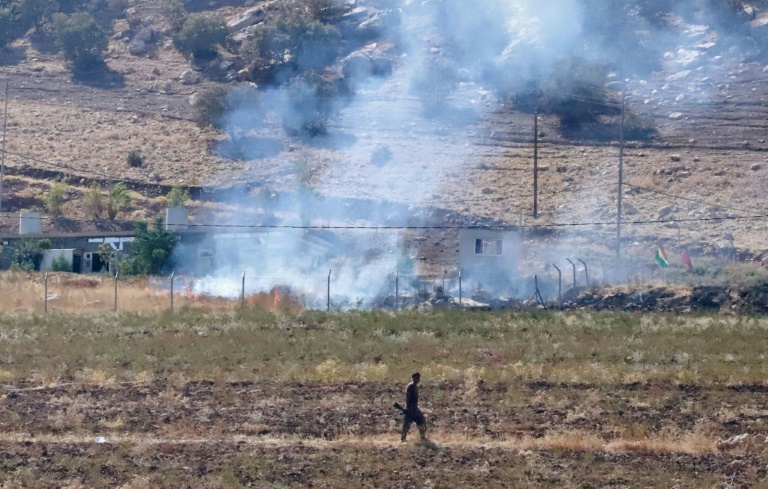
As protests flare across Iran over the death of young Iranian Kurdish woman Mahsa Amini, the Kurdistan region of neighbouring Iraq has paid a price, coming under bombardment from the Islamic republic’s forces.

Their target is the long-exiled Iranian Kurdish opposition, installed in Iraq under Saddam Hussein during his war with Iran in the 1980s.

Tehran regards these armed factions as “terrorists” and accuses them of attacking its territory.

A general in Iran has charged that the Kurdish opposition groups have been inciting the Mahsa Amini protests in Iranian Kurdistan, in the face of a lethal crackdown by the security forces.

Amini, 22, was pronounced dead on September 16, days after Iran’s notorious morality police detained her for allegedly breaching Iran’s strict dress code for women.

According to Adel Bakawan, director of the French Centre for Research on Iraq (CFRI), Iran needed to “find an enemy” to blame for stoking the nationwide protests.

“The weakest link that could be targeted without provoking consequences was the Iranian Kurds,” he said.

On September 28, Iran unleashed a deluge of fire on positions of Kurdish militants in northern Iraq, killing 14 people and wounding 58, including civilians. It has followed up with less bloody attacks.

On Monday, Iran’s foreign ministry spokesman Nasser Kanani reiterated Tehran’s accusation against these groups, saying they threaten the country’s national security.

However, experts say the far-left groups have practically ceased all military activity, focusing on political action instead.

– Protected presence –

Any fighters they still have could be viewed as reservists, keeping up training.

Iranian Kurdish journalist Raza Manochari said there has been an agreement since the 1990s between such groups and the government of Iraq’s own Kurdistan region.

It protects their deployment, “and in exchange, they do not engage in military activities, to avoid causing problems for relations with Iran”, he said.

Manochari, who has himself lived in Iraq for eight years, highlighted the ties between Kurds in the two countries: they speak the same Sorani dialect, and many have relatives on both sides of the border.

Massud Barzani, leader of Iraq’s Kurdistan Democratic Party and former president of the autonomous Iraqi Kurdistan region, was born in 1946 in Iran.

He is the son of iconic Kurdish nationalist leader Mulla Mustafa Barzani, a head of the only breakaway state in Kurdish history founded in the Iranian town of Mahabad until it was crushed by Iranian troops in 1946 after a year.

Today, Iran’s Kurdish minority — about 10 million people out of a population of 83 million — complain of marginalisation.

“In Iran, the Kurds don’t have many basic cultural and political rights,” said Shivan Fazil, researcher at the Stockholm International Peace Research Institute.

“The right of education in their mother tongue continues to be outlawed,” he said.

– ‘Never use Iraqi soil’ –

Their plight is bleaker than that of Kurds elsewhere in the region, Fazil said, citing Kurds in parliament in Turkey since 2015, a de facto autonomy in northeast Syria and the regional Kurdish government in northern Iraq.

Aso Saleh, an executive committee member of the Iranian Kurdish party KDPI targeted by Tehran last month, said the party has “never used the soil or the territory of Iraq to launch any attack on Iranian forces”.

Sweden-based Saleh said the movement was “predominantly located inside Iranian Kurdistan”, where its activities must remain “covert”.

Only “the leadership and bureaucratic apparatus” were present in Iraq.

“This movement is trying to bring democracy and federalism to Iran,” he told AFP of the party founded in Iran in 1945.

Edris Abdi of the Iraq-based Komala Iranian Kurdish nationalist group told AFP: “We do not engage in military activity.”

Hardi Mahdi Mika, a political scientist at Iraq’s Sulaimaniyah University, points to the Kurdish minority’s marginalisation.

“In terms of economic growth and unemployment, the Kurdish regions are the poorest” in Iran, he said. “The government is neglecting these regions.”

Kurdish workers cross the border every day in search of temporary jobs in Iraq that are better paid than at home in sanctions-hit Iran.

Even in Iranian provinces where they are in the majority, “the Kurds have no say in local governance”, Mika said.

str-burs-tgg/srm/hc/it 

Inflation puts squeeze on Spain's legendary lunch menu

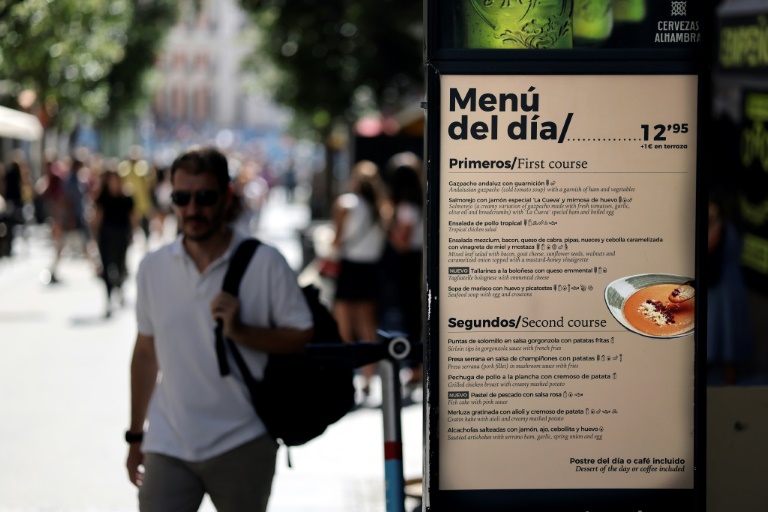
Dreamt up in the 1960s to attract tourists, Spain’s three-course “menu del dia”, or set lunch menu, has long been seen as the best deal in town. 

But with inflation hovering around 10 percent, its affordability is under threat as restaurants seek ways to economise.

For a starter, main course and dessert or coffee (or both), bread and a drink, the average price is around 12.8 euros ($12.60), according to figures from Hosteleria de Espana, Spain’s main hostelry association representing the hotel and restaurant industry.

Offered by almost every Spanish restaurant, its price makes it a popular option in a country where people frequently eat out. 

“Everyone chooses it,” says Sara Riballo, who is in her 30s, sitting on a terrace in central Madrid. 

“We eat out several times a week and we usually go for the set menu because it’s better value for money, it’s quicker and it’s quite varied,” agrees her colleague Estefania Hervas.

Spanish restaurants serve up on average four million “menus del dia” every day in the country of 47 million people, the hostelry association says. 

The idea was first cooked up nearly six decades ago when Spain was under the dictatorship of Francisco Franco.

A ministerial order was issued that all restaurants must offer a “tourist menu” to cater to the growing waves of foreign visitors to the Spanish coast. 

The decree was written into Spain’s official state bulletin, stating that the menu must from August 1, 1964 include, as a “minimum”, a soup, a main course, a dessert, a glass of wine and some bread. 

– ‘Extremely worried’ –

The tradition has lasted until today, where it acts as a sort of barometer for the Spanish economy, says Emilio Gallego, secretary-general of the hostelry association. 

“It’s a very, very popular way of eating lunch with millions sold every day across the country. It’s something we are constantly tracking,” he said.

Describing itself as “extremely worried by the effects of inflation and the price rises of recent months,” the association found three-quarters of its restaurants had raised the price of their menu del dia between November 2021 and April 2022. 

And that was before inflation peaked in July at 10.8 percent. 

In recent months, the price of olive oil has risen by 42.5 percent alongside the cost of bread, milk, eggs, meat and pasta, not to mention the spiralling bills for electricity, refrigeration or gas for stoves and ovens. 

With the industry “badly hit by rising energy and raw material costs at a time when it was still recovering from the health crisis”, it has had little choice but to raise prices, Gallego said. 

In most cases, restaurants have raised the price of their menu del dia by 10 to 15 percent, an increase of between 1.0 and 1.5 euros.

– ‘We won’t survive’ –

At Cafe Gijon, a landmark restaurant on Madrid’s central Castellana boulevard, they serve up 250 set meals a day, priced at 15 euros each. 

But manager Jose Manuel Escamilla said the prices are likely to rise in the coming weeks. 

“Everything’s going up: the price of electricity and mortgage costs have shot through the roof. If things carry on like this, we won’t survive.”

“It’s difficult because it will affect our customers but at the end of the day, if we don’t do it, we won’t be able to function,” he said.

Many restaurants are searching for other ways to save money and protect their margins. 

At a restaurant in one of Madrid’s chic neighbourhoods, they are now ordering meat in bulk and whole fish rather than pre-cut portions because the price is lower, admitted one of its buyers, speaking on condition of anonymity.

Gallego believes other restaurants will adapt by creating other formats, such as a two-course option of a main course with either a starter or dessert.

At Valgame Dios in Madrid’s Chueca neighbourhood, the number of dishes on offer has already been slimmed down.

“Instead of three or four starters, we have two,” explains waitress Laura Rubio, who says she’s just “waiting to see what will happen” and whether it will put off diners.

Like other customers, 47-year-old scriptwriter Helio Mira is putting a brave face on things. 

“It’s not only the price of the menu del dia that is going up but the price of life in general but what can we do?” he said.

“We just have to ride out the storm.”

Close Bitnami banner
Bitnami