World

Bolsonaro, Lula battle for Brazil runoff endorsements

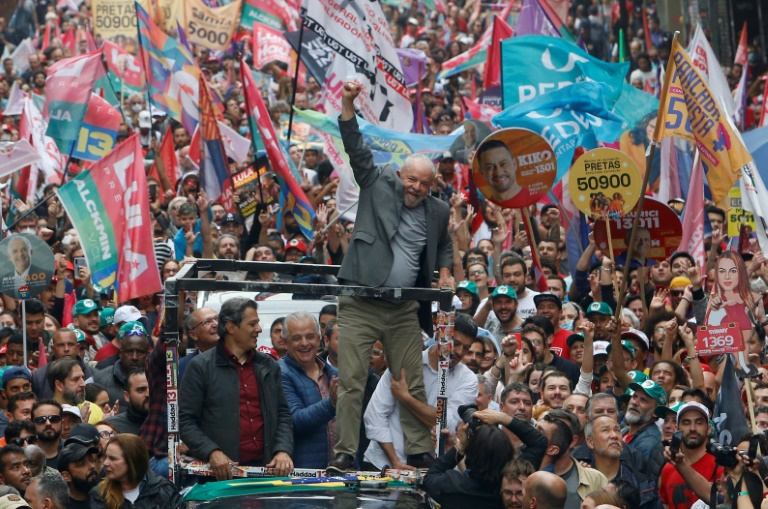
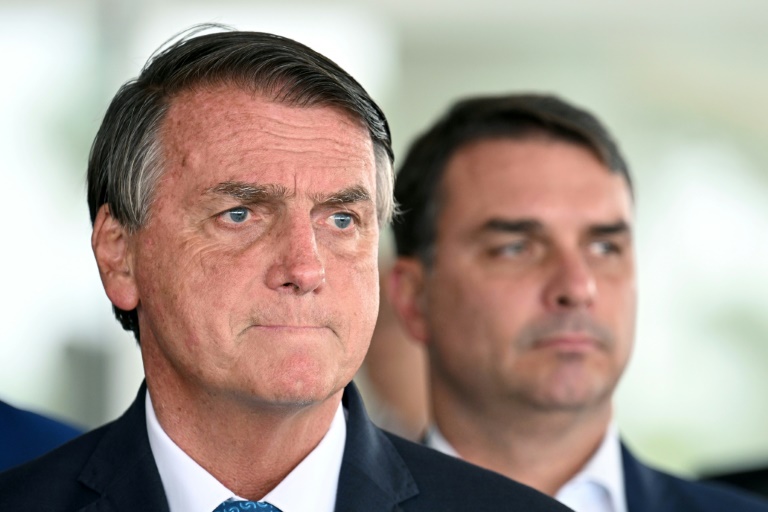
Far-right incumbent Jair Bolsonaro and leftist challenger Luiz Inacio Lula da Silva both got key endorsements Tuesday as they geared up for their battle for Brazil’s presidential runoff on October 30.

The two rivals are aggressively chasing endorsements for their polarizing final bout, after finishing with a closer-than-expected five-point difference in Sunday’s first-round election: 48 percent for ex-president Lula to 43 percent for Bolsonaro.

Both are racing to win over Brazilians who voted for the third- and fourth-place finishers, center-right candidate Simone Tebet (four percent) and center-left candidate Ciro Gomes (three percent).

They will also be campaigning hard to woo those who cast blank or spoiled ballots (three percent and two percent, respectively) or simply didn’t vote — 21 percent of the South American giant’s 156 million voters.

Bolsonaro racked up several major endorsements, including from influential corruption buster Sergio Moro, his one-time justice minister, who had quit his administration in protest in 2020.

Lula (2003-2010) meanwhile got an important, if grudging, nod from Gomes.

The center-left firebrand served as a minister in Lula’s first administration, but later fell out with him and emerged as one of his fiercest critics.

– ‘Lula not an option’ –

“Lula is not an option,” Moro, the ex-judge who led the massive “Car Wash” graft investigation, wrote on Twitter.

“His government was stained by the corruption of democracy,” he said, declaring his backing for Bolsonaro.

Moro is famous as the judge who jailed Lula, the biggest name felled in “Car Wash,” an investigation that uncovered a sprawling web of corruption that stole billions from state-run oil company Petrobras.

He resigned his judgeship to become Bolsonaro’s justice minister in 2019, but quit the following year, accusing the president of interfering in police investigations that targeted his inner circle.

The resignation was hugely damaging for Bolsonaro, who had run on an anti-corruption platform.

But the president said all that was now “water under the bridge.”

“From here on, it’s a new relationship,” he said. “There are no scores to settle.”

Brazil’s Supreme Court annulled Lula’s controversial corruption convictions last year, ruling Moro was biased in the case.

Moro tried to make a presidential run himself this year, but failed to garner enough support and opted instead for the Senate, winning a seat for the southern state of Parana.

Bolsonaro also got endorsements from the governors of Brazil’s second- and third-biggest states, Minas Gerais and Rio de Janeiro — newly re-elected Romeu Zema and Claudio Castro, respectively.

He also scored one from outgoing Governor Rodrigo Garcia of Sao Paulo, Brazil’s most populous and wealthiest state, who lost his own re-election bid.

– ‘The only exit’ –

Lula’s endorsement from Gomes’s Democratic Labor Party (PDT) came despite a long history of animosity between the two men.

Gomes grudgingly went along with party leadership, saying in a video he “supported” the endorsement as “the only exit, under the circumstances.”

Lula also looks likely to get the backing of third-place candidate Tebet, a center-right senator and anti-abortion Catholic who could be key to luring socially conservative women voters.

She has hinted she is ready to back Lula. But it will be another matter winning over her party, the Brazilian Democratic Movement (MDB), which has a strong pro-Bolsonaro wing.

“Make your decision soon. Mine is already made,” Tebet has told the divided party’s leadership.
US boosts arms aid as Ukraine expands battle gains

The United States announced more weapons for Ukraine’s army as it claimed sweeping gains along two major battlefronts in an offensive rush to beat the arrival of fresh Russian troops and the looming winter.

The White House said it was shipping four more Himars precision rocket launchers, 32 artillery pieces, 75,000 artillery rounds and 200,000 rounds of small arms ammunition to Ukraine as Russian fighters were backpedalling from Kyiv’s attack.

Ukrainian President Volodymyr Zelensky on Tuesday said his forces were making “rapid and powerful” gains and had retaken “dozens” of villages from Russia this week in the east and south.

In a briefing in Moscow, the Russian military conceded in updated maps of the fronts that they had incurred significant territorial losses.

A Kremlin-installed official in the southern Ukraine region of Kherson, which Moscow declared Friday was now its own “sovereign territory,” urged residents to stay calm amid the Ukrainian army’s thrust, promising that Russian jets and artillery were fighting back.

“There is no reason to panic,”  Kirill Stremousov, the Moscow-appointed deputy head of Kherson region, said on social media.

“Yes, you can hear explosions at a distance, but they’re infrequent.”

– Russian battlefield maps –

Zelensky said eight settlements in the southern Kherson region, where Moscow’s forces have retreated, have been retaken.

The latest battlefield maps from Moscow showed that Russian troops had left many areas in Kherson, including along the west bank of the Dnipro River.

In the eastern Kharkiv region, the maps indicated that Russian forces had almost entirely abandoned the east bank of the Oskil River, potentially giving the Ukrainians space to shell key Russian troop transportation and supply corridors.

“Our soldiers do not stop. And it’s only a matter of time before we expel the occupier from all of our land,” Zelensky said.

Russia, meanwhile, pushed ahead with its rapid-fire mobilisation of more troops to shore up those already fighting in Ukraine.

Defence Minister Sergei Shoigu said the new fighters were being trained at “80 training grounds and six training centres”.

“As of today, more than 200,000 people have entered the army,” he said.

– Fresh US aid –

Washington announced $625 million worth of arms to be drawn down immediately from existing US military stockpiles. 

The new batch added four of the potent Himars medium-range missile launchers to the 16 already delivered, which have allowed Ukraine to strike Russian command depots and arms stockpiles far behind the front lines.

The Pentagon is also sending 500 precision-guided 155mm artillery rounds, which can pinpoint targets at a medium- to long-range.

“This package will provide Ukrainian armed forces with additional capabilities and munitions that it needs to maintain momentum in the east and in the south,” said Laura Cooper, the Pentagon’s top official for Russia and Ukraine.

“We’re looking very closely at their consumption rates for ammunition, to make sure that they have what they need for the counteroffensive,” she said.

– UN to meet on Russia ‘annexation’ –

The United Nations General Assembly has called for an urgent meeting on Monday to discuss Russia’s declared annexation of the four regions in Ukraine that it partially occupies.

At the meeting, the 193 UN member states will weigh a resolution currently under preparation after Russia vetoed a condemnation of its annexation claim in the Security Council last week.

Diplomatic sources said a resolution was being drafted by the European Union together with Ukraine and other countries.

The resolution could make clearer the degree of Moscow’s isolation and support on the global stage, as the war grinds on and its effects spread. 

Earlier this year, the General Assembly passed three resolutions concerning Russia’s invasion, with the third, at the end of April, revealing some erosion of international unity against Moscow.

– Ukrainian economy to shrink –

The World Bank, meanwhile, said Ukraine’s economy could shrink 35 percent this year, as the invasion has forced more than 14 million people from their homes and stifled industrial production.

Following Moscow’s invasion, Ukraine’s economy has been “scarred by the destruction of productive capacity, damage to agricultural land, and reduced labour supply,” it said.

Ukraine’s central bank chief, Kyrylo Shevchenko, announced Tuesday he was stepping down for health reasons.

“The war was yet another difficult test for our team and for me personally,” the 49-year-old said. 

Together with bank leaders, “we were able to keep (the) banking system operational during the war, providing Ukrainians access to financial services and ensuring financial stability despite the most difficult circumstances,” he said.

Nobel physics winner wanted to topple quantum theory he vindicated

American physicist John Clauser won the 2022 Nobel Prize for a groundbreaking experiment vindicating quantum mechanics — a fundamental theory governing the subatomic world that is today the foundation for an emerging class of ultra-powerful computers.

But when he carried out his work in the 1970s, Clauser was actually hoping for the opposite result: to upend the field and prove Albert Einstein had been right to dismiss it, he told AFP in an interview.

“The truth is that I strongly hoped that Einstein would win, which would mean that quantum mechanics was giving incorrect predictions,” the 79-year-old said, speaking by telephone from his home in Walnut Creek, just outside San Francisco.

Born in Pasadena in 1942, Clauser credits his father, an engineer who designed planes in the war and founded the aeronautics department at Johns Hopkins University in Baltimore, for instilling in him a lifelong love of science. 

“I used to wander around his laboratory and say ‘Wow, oh boy, when I grow up I want to be a scientist so I can play with these fun toys too.'”

As a graduate student at Columbia in the mid-1960s, he grew interested in quantum physics alongside his thesis work on radio astronomy.

– Quantum entanglement –

According to quantum mechanics, two or more particles can exist in what’s called an entangled state — what happens to one in an entangled pair determines what happens to the other, no matter their distance.

The fact that this occurred instantly contradicted Einstein’s theory of relativity which held that nothing — including information — can travel faster than the speed of light. 

In 1935 he dismissed this element of quantum entanglement — called nonlocality — as “spooky action at a distance.” 

Einstein instead believed that “hidden variables” that instructed the particles what state to take must be at play, placing him at odds with his great friend but intellectual adversary Niels Bohr, a founding father of quantum theory.

In 1964, the Northern Irish physicist John Bell proposed a theoretical way to measure whether there were in fact hidden variables inside quantum particles. Clauser realized he could resolve the long standing Bohr-Einstein debate if he could create the right experiment.

“My thesis advisor thought it was a distraction from my work in astrophysics,” he recalled, but undeterred, he wrote to Bell, who encouraged him to take up the idea.

It wasn’t until Clauser had completed his doctorate and taken up a job at UC Berkeley that he was actually able to start working on the experiment, along with collaborator Stuart Freedman.

They focused a laser on calcium atoms, making it emit particles of entangled photon pairs that shot off in opposite directions, and used filters set to the side to measure whether they were correlated.

After hundreds of thousands of runs, they found the pairs correlated more than Einstein would have predicted, proving the reality of “spooky action” with hard data.

At the time, leading lights of the field were unimpressed, said Clauser, including the renowned physicist Richard Feynman who told him the work was “totally silly, you’re wasting everybody’s time and money” and threw him out his office.

Questioning the foundation of quantum mechanics was deemed unnecessary.

– Quantum computing  –

That wasn’t the view of the Nobel committee, who awarded Clauser, Alain Aspect of France, and Anton Zeilinger of Austria the world’s most prestigious science prize for their pioneering work in advancing the field.

“It took a long time for people to realize the importance of the work,” chuckled Clauser. 

“But I suppose it is a certain vindication, everyone was telling me it was silly.”

Einstein’s theory had more appeal to Clauser than Bohr’s, which he confessed to not fully grasping.

But over time, he came to realize the true value of his and his co-winners’ experiments. Demonstrating that a single bit of information can be distributed through space is today at the core of quantum computers. 

Clauser pointed to China’s quantum-encrypted Micius communications satellite, which relies on entangled photons thousands of kilometers apart.

“We did not prove what quantum mechanics is — we proved what quantum mechanics isn’t,” he said, “and knowing what it is not then has practical applications.”

EU lawmakers impose single charger for all smartphones

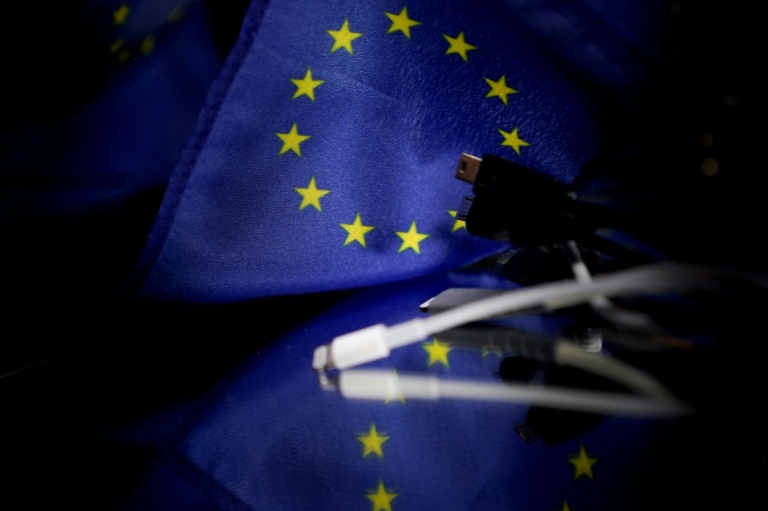
The EU parliament on Tuesday passed a new law requiring USB-C to be the single charger standard for all new smartphones, tablets and cameras from late 2024.

The measure, which EU lawmakers adopted with a vote 602 in favour, 13 against, will — in Europe at least — push Apple to drop its outdated Lightning port on its iPhones for the USB-C one already used by many of its competitors.

Makers of laptops will have extra time, from early 2026, to also follow suit.

EU policymakers say the single charger rule will simplify the life of Europeans, reduce the mountain of obsolete chargers and reduce costs for consumers. 

It is expected to save at least 200 million euros ($195 million) per year and cut more than a thousand tonnes of EU electronic waste every year, the bloc’s competition chief Margrethe Vestager said.

The EU move is expected to ripple around the world.

The European Union’s 27 countries are home to 450 million people who count among the world’s wealthiest consumers. Regulatory changes in the bloc often set global industry norms in what is known as the Brussels Effect.

“Today is a great day for consumers, a great day  for our environment,” Maltese MEP Alex Agius Saliba, the European Parliament’s pointman on the issue, said.

“After more than a decade; the single charger for multiple electronic devices will finally become a reality for Europe and hopefully we can also inspire the rest of the world,” he said.

– Faster data speed –

Apple, the world’s second-biggest seller of smartphones after Samsung, already uses USB-C charging ports on its iPads and laptops. 

But it resisted EU legislation to force a change away from its Lightning ports on its iPhones, saying that was disproportionate and would stifle innovation.

However some users of its latest flagship iPhone models — which can capture extremely high-resolution photos and videos in massive data files — complain that the Lightning cable transfers data at only a bare fraction of the speed USB-C does.

The EU law will in two years’ time apply to all handheld mobile phones, tablets, digital cameras, headphones, headsets, portable speakers, handheld videogame consoles, e-readers, earbuds, keyboards, mice and portable navigation systems.

People buying a device will have the choice of getting one with or without a USB-C charger, to take advantage of the fact they might already have at least one cable at home.

Makers of electronic consumer items in Europe agreed a single charging norm from dozens on the market a decade ago under a voluntary agreement with the European Commission.

But Apple refused to abide by it, and other manufacturers kept their alternative cables going, meaning there are still some six types knocking around.

They include old-style USB-A, mini-USB and USB-micro, creating a jumble of cables for consumers.

USB-C ports can charge at up to 100 Watts, transfer data up to 40 gigabits per second, and can serve to hook up to external displays.

Apple also offers wireless charging for its latest iPhones — and there is speculation it might do away with charging ports for cables entirely in future models. But currently the wireless charging option offers lower power and data transfer speeds than USB-C.

US Navy's $13 bn carrier embarks on first deployment

The US Navy’s newest aircraft carrier embarked on its maiden deployment Tuesday, a milestone for a ship that has suffered problems with some of the advanced technologies it carries.

The USS Gerald R. Ford — which cost more than $13 billion — will work with countries including Canada, France and Germany during a deployment that will include training on air defense, anti-submarine warfare and amphibious operations.

A live video on a US Navy Facebook page showed tugboats moving the gray-painted ship away from the pier at Naval Station Norfolk in Virginia.

The ship’s deployment will “demonstrate its unmatched, multi-domain, full-spectrum lethality in the Atlantic,” Admiral Daryl Caudle said in a statement ahead of the ship’s departure.

The deployment will involve 9,000 people, 20 ships and 60 aircraft from nine different countries, the US Navy said, without providing a breakdown by nation.

Commissioned in 2017, the carrier is massive — more than 1,100 feet (335 meters) long, and displacing 100,000 long tons (101,000 tonnes) when fully loaded. But it can still sail at a speed of more than 34 miles (54 kilometers) per hour. 

The ship — named for the 38th US president — requires hundreds fewer crew members to operate than previous carriers and is designed to be able to carry futuristic energy weapons that are still under development.

A key improvement over previous carriers is supposed to be the rate at which it can launch and retrieve aircraft, but there have been issues with the systems involved, according to a June 2022 report to Congress.

– Delayed deployment –

“The Navy anticipates achieving reliability goals in the 2030s,” the Government Accountability Office report said of the carrier’s Electromagnetic Aircraft Launch System and Advanced Arresting Gear, adding that reliability issues could “prevent the ship from demonstrating one of its key requirements — rapidly deploying aircraft.”

The vessel’s weapons elevators — which move missiles and bombs from its magazines to the deck so they can be loaded onto planes — have also suffered problems.

“The ship’s first deployment was delayed by a need to complete work on the ship’s weapons elevators and correct other technical problems,” the Congressional Research Service said in a report updated in August, adding that the final elevator was tested and certified in late 2021.

As the Gerald R. Ford goes to sea and with other similar carriers in the works, there is debate over whether new weapons such as anti-ship ballistic missiles have rendered such ships obsolete, or will do so in the future.

Mackenzie Eaglen, a senior fellow and defense expert at the American Enterprise Institute, argues that their time is far from over due to the deterrent role they play.

“The US military — most visibly through US Navy… carrier strike groups — first deters bad actors and messy wars. If deterrence is lost, then we have a lot of equipment and bases that are vulnerable in the next conflict,” Eaglen said.

“As the US (seemingly constantly) debates the utility of the carrier, other nations are busy heavily investing in aircraft carriers — from India, China, France, UK, Australia and Italy — which speaks to the ship’s continued utility both in peacetime and war,” she added.

Ukraine rocket artillery crews chase Russian retreat

As Russian forces regroup after being driven back from their northeastern positions, Ukrainian artillery crews are determined not to give them breathing space to build a new defensive front.

Over the six months of Russia’s occupation of a swathe of eastern Ukraine, the war was dominated by an artillery duel in which Ukraine’s beleaguered defenders often found themselves outgunned.

But last month in the northeastern region of Kharkiv, Ukraine turned the battle on its head with a series of offensives led by tanks and infantry, with Kyiv’s forces outflanking and isolating Russian bastions before forcing them to retreat. 

But there is still a role for artillery, with gunners from units like the 14th Mechanised Brigade, named after Prince Roman the Great, leap-frogging ahead, popping from cover to launch salvoes of shells and rockets to harass Russian units behind the front line.

President Vladimir Putin’s supporters in Moscow have blamed their recent defeats on the West, arguing that the Russian army is facing a mercenary army with a huge arsenal of NATO weapons — and some advanced systems have indeed been delivered.

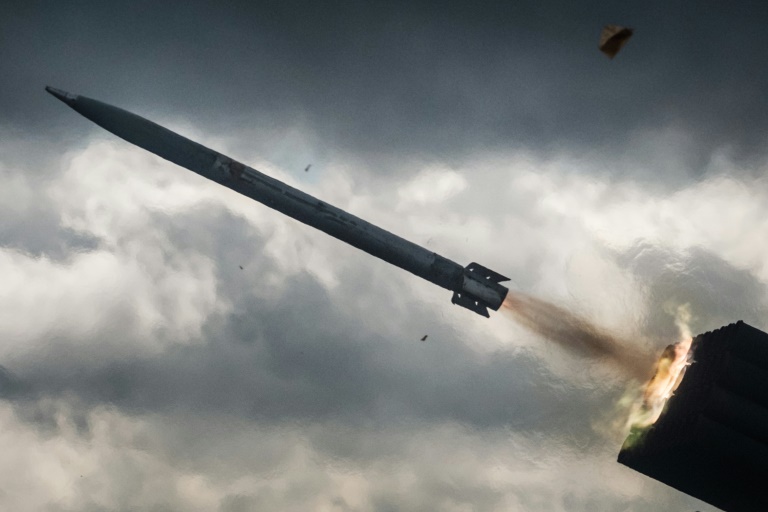
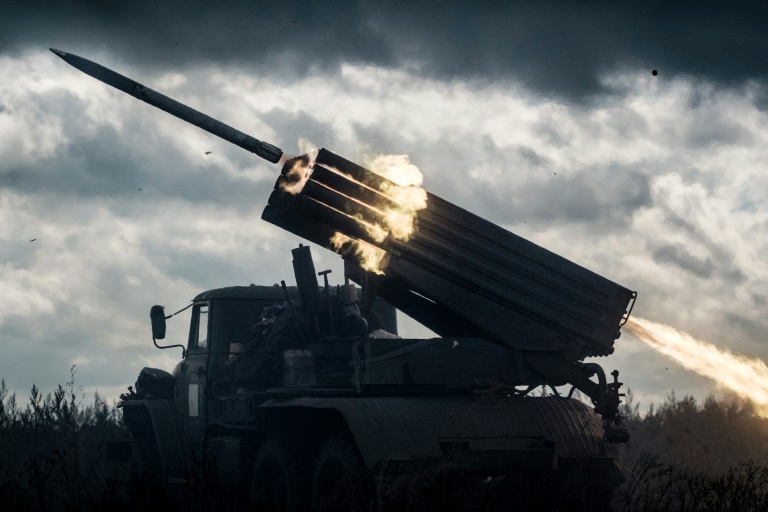
But on Tuesday, the Ukrainian artillery unit operating in eastern Kharkiv was armed with a weapon that has been in use with Soviet and post-Soviet armies since 1963, a BM-21 Grad multiple rocket launcher mounted on a Ural six-wheeled truck.

– Deafening bangs –

For “Dmytro”, the 22-year-old commander of the small unit, the six-decade-old design is perfectly adequate for the task at hand, firing high explosives at a concentration of Russian troops spotted gathered by a warehouse across the front line.

“In general this Grad system is good enough for the mission, and I like to work with it,” he told AFP. 

They work in a six-man crew. The unit leader receives target coordinates over the radio, while a driver moves the truck with its 40 missile tubes from its hiding place and onto exposed farmland, with clear skies between the launch site and Russian lines.

The unit leader — equipped with a touch-screen tablet with mapping information — calculates the trajectory of the strike and calls it to the crew, who dial it in, elevating the launch tubes and swivelling the launcher. 

A series of deafening bangs and a first volley of 122mm rockets roars off. Then there’s a brief pause as the team tweaks the elevation of the launcher higher, then turns away as the second volley kicks up gritty earth.

After the second noisy barrage, 15 of the launcher’s 40 missile tubes are empty.

From the field, the gunners can’t see the target, but Dmytro is confident they hit the Russian soldiers.

“They had some mission and if we manged to hit them, and I’m sure that we managed to hit them, then they will not be able to fulfil that mission,” he said.

Study eyes US cooperation with Pakistan amid China rise

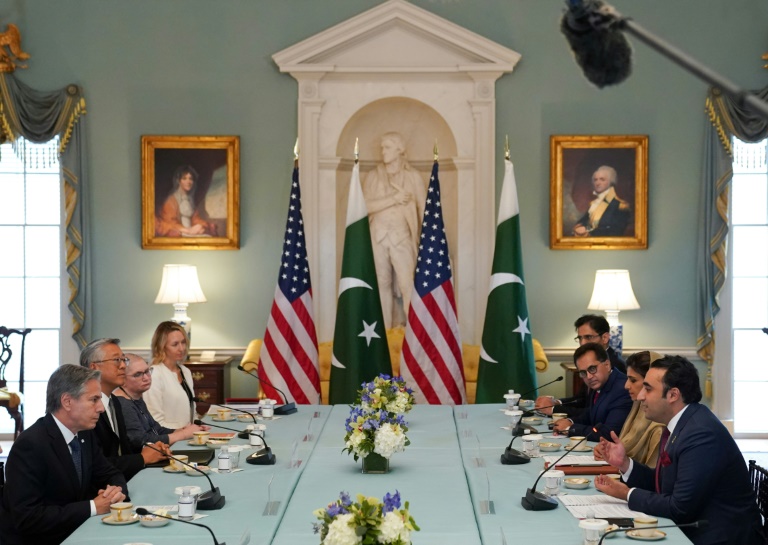
The United States needs to keep engaging Pakistan despite lingering distrust over Afghanistan, with investment and climate cooperation key to reducing the South Asian nation’s growing reliance on China, a study group recommended Tuesday.

The group released its findings during a visit to Washington by the head of Pakistan’s powerful military, General Qamar Javed Bajwa, a week after a trip by the civilian foreign minister, Bilawal Bhutto Zardari.

The study group, which did not involve the US government, included scholars and former US ambassadors to Pakistan Ryan Crocker, Cameron Munter and Robin Raphel, along with Husain Haqqani, Pakistan’s former ambassador in Washington.

Pakistan and the United States were partners in the Cold War and, officially, in the Afghanistan war. But American officials lost patience with Islamabad which they suspected of quietly maintaining support for the Taliban, who triumphed as US troops withdrew last year.

“Instead of allowing existing differences to define the partnership, it may be time to recognize that both sides need to understand the other’s interests so that they can then find a way to work on areas of mutual concern,” the study group said.

The United States must move beyond leveraging aid to change Pakistan’s policies, a tactic that has been a proven failure.

Islamabad, in turn, needs to accept “that all of Pakistan’s problems, especially terrorism and militancy, cannot be laid at the door of the US.”

Pakistan has forged increasingly close relations with China, triggering warnings from the United States that Beijing — seen as Washington’s key global competitor — will saddle the economically troubled nation with debt.

The study group said that after previously linking the Pakistan relationship to Afghanistan or its historic rival India, the United States should avoid now seeing ties through the lens of China.

Instead, the United States can “help build Pakistan’s capacity for transparency and compliance” on Chinese loans and can reduce reliance on China by encouraging investment by US companies and others, it said.

The United States can also focus on building climate resilience — a key challenge for Pakistan, which was recently devastated by floods.

While the United States wants to step back from Afghanistan, the study group said the need for counterterrorism cooperation with Pakistan “has if anything increased” due to the loss of US intelligence assets on the ground.

“While Pakistan and the US often fail to see eye-to-eye when it comes to Afghanistan, China, or India, they do share mutual interests in seeking stability in the region, combatting the problem of extremism and averting armed conflict in nuclear South Asia,” it said.

Study eyes US cooperation with Pakistan amid China rise

The United States needs to keep engaging Pakistan despite lingering distrust over Afghanistan, with investment and climate cooperation key to reducing the South Asian nation’s growing reliance on China, a study group recommended Tuesday.

The group released its findings during a visit to Washington by the head of Pakistan’s powerful military, General Qamar Javed Bajwa, a week after a trip by the civilian foreign minister, Bilawal Bhutto Zardari.

The study group, which did not involve the US government, included scholars and former US ambassadors to Pakistan Ryan Crocker, Cameron Munter and Robin Raphel, along with Husain Haqqani, Pakistan’s former ambassador in Washington.

Pakistan and the United States were partners in the Cold War and, officially, in the Afghanistan war. But American officials lost patience with Islamabad which they suspected of quietly maintaining support for the Taliban, who triumphed as US troops withdrew last year.

“Instead of allowing existing differences to define the partnership, it may be time to recognize that both sides need to understand the other’s interests so that they can then find a way to work on areas of mutual concern,” the study group said.

The United States must move beyond leveraging aid to change Pakistan’s policies, a tactic that has been a proven failure.

Islamabad, in turn, needs to accept “that all of Pakistan’s problems, especially terrorism and militancy, cannot be laid at the door of the US.”

Pakistan has forged increasingly close relations with China, triggering warnings from the United States that Beijing — seen as Washington’s key global competitor — will saddle the economically troubled nation with debt.

The study group said that after previously linking the Pakistan relationship to Afghanistan or its historic rival India, the United States should avoid now seeing ties through the lens of China.

Instead, the United States can “help build Pakistan’s capacity for transparency and compliance” on Chinese loans and can reduce reliance on China by encouraging investment by US companies and others, it said.

The United States can also focus on building climate resilience — a key challenge for Pakistan, which was recently devastated by floods.

While the United States wants to step back from Afghanistan, the study group said the need for counterterrorism cooperation with Pakistan “has if anything increased” due to the loss of US intelligence assets on the ground.

“While Pakistan and the US often fail to see eye-to-eye when it comes to Afghanistan, China, or India, they do share mutual interests in seeking stability in the region, combatting the problem of extremism and averting armed conflict in nuclear South Asia,” it said.

Loretta Lynn, country music luminary and songwriting pioneer, dies at 90

Loretta Lynn, America’s groundbreaking country titan whose frank lyricism delving into women’s experiences with sex, infidelity and pregnancy touched the nerve of a nation, has died. She was 90 years old.

She “passed peacefully in her sleep” at her ranch in Tennessee Tuesday morning, her family said in a statement sent to AFP.

Lynn saw a number of her edgy tracks banned by country music stations, but over the course of more than six decades in the business, she became a standard-bearer of the genre and its most decorated female artist ever.

Born Loretta Webb on April 14, 1932 in small-town Kentucky, Lynn was the eldest daughter in an impoverished family of eight kids, a childhood she immortalized in her iconic track “Coal Miner’s Daughter” — a staple on lists of all-time best songs.

“We were poor but we had love / That’s the one thing that daddy made sure of,” Lynn sang in the hit recorded in 1970 — later the theme song for a 1980 movie about her life starring Sissy Spacek, who won an Oscar for the role. 

At just 15 years old, the artist married Oliver Vanetta Lynn, who she remained married to for nearly 50 years until his death in 1996.

They moved to a logging community in Washington state, and Lynn gave birth to four children before the age of 20, adding twins to the family not long after.

An admirer of his wife’s voice, her husband bought Lynn a guitar in the early 1950s.

The self-taught musician went on to pen lyrics inspired by her own early experiences as a married woman and her oft-tumultuous relationship, the nascent days of a prolific career that would see the artist release dozens of albums.

She started her own band, Loretta and the Trailblazers, and began playing bar sets before cutting her first record — “I’m a Honky Tonk Girl” in 1960.

Her twang was warm and languid but Lynn’s lyrics were anything but: She sang with searing precision of marriage’s growing pains and gave voice to issues facing women that had long been kept quiet.

“Most songwriters tended to write about falling in love, breaking up and being alone, things like that,” Lynn told The Wall Street Journal in 2016. “The female view I wrote about was new.”

“I just wrote about what I knew, and what I knew usually involved something that somebody did to me.”

– ‘The Pill’ –

The Lynns began touring nationwide to promote the singer’s work to radio stations, and she made her debut at the storied Grand Ole Opry in 1960, going on to become one of the Nashville institution’s most acclaimed acts.

“Our Opry family turns to music when words fail. Thank you for all you’ve given to the Opry, @LorettaLynn,” the show tweeted.

During her early years in the industry, she found a friend and mentor in Patsy Cline, one of the 20th century’s most influential singers who died in a plane crash in 1963 at age 30.

She also forged a longstanding creative partnership with Conway Twitty, with whom she formed one of country’s classic duet acts.

Lynn released a steady stream of hit singles, including 1966’s “Dear Uncle Sam” — one of the era’s first tracks to document the tragedy of the Vietnam War.

That same year she put out “You Ain’t Woman Enough (To Take My Man),” which made her the first woman in country to pen a number one hit.

In 1969, she released one of her most controversial songs, “Wings Upon Your Horns,” which describes through religious metaphor a teenager losing her virginity.

But her runaway success continued and she dominated the 1970s with hits such as “Fist City” — a stern warning to her cheating husband’s lover — and 1972’s “Rated X,” which triggered an outcry in discussing the stigmas faced by divorced women.

In 1975, she released “The Pill,” which praised the freedoms of birth control. 

“When I’d put out a record, they’d say, ‘Uh oh, another dirty song.’ ‘Rated X’? They thought that was going to be bad. But hey, it sold. ‘One’s on the Way’? They thought that song would really be dirty,” she told Billboard in 2015. 

“But everything I sang about was everyday living.”

– ‘The truth’ –

In 1988, Lynn was inducted into the Country Music Hall of Fame as one of its most storied legends.

She won virtually every arts honor available, including the prestigious Presidential Medal of Freedom, the nation’s highest civilian award.

Despite the progressive airs of her music, Lynn would insist that her clearly political music had “no politics.” She leaned Republican most of her life, frequently performing for and supporting right-wing candidates — including Donald Trump in 2016 — even as she also voiced support for Democrats like Jimmy Carter.

But she was universally beloved in the industry she deeply influenced, collaborating with scores of artists including Dolly Parton, Willie Nelson and Elvis Costello. In 2004 she released the album “Van Lear Rose,” produced by Jack White.

In 2021, a month before turning 89, she released the album “Still Woman Enough,” which featured re-recordings and new material.

Music world accolades quickly flooded social media, praising Lynn’s pivotal life.

“We’ve been like sisters all the years we’ve been in Nashville and she was a wonderful human being, wonderful talent, had millions of fans and I’m one of them,” wrote the superstar Parton.

Crystal Gayle, Lynn’s actual sister and a singer in her own right, wrote that “the world lost a legend. We lost a sister. Love you Loretta.”

Lynn once told Billboard she’d never retire from music, vowing that “when they lay me down six feet under, they can say, ‘Loretta’s quit singing.’ I’ll have on one of my gowns,” she continued.

“That’s morbid, but it’s the truth.”

Lula must fight for center to win Brazil runoff: analysts

To prevail in Brazil’s tighter-than-expected presidential runoff, leftist veteran Luiz Inacio Lula da Silva will have to strike alliances with centrists, woo the business sector and offer voters more than just his legacy, analysts say.

The long-time front-runner may have won Sunday’s first-round vote against far-right incumbent Jair Bolsonaro, but the latter appears to have the momentum, having shattered pollsters’ forecasts of a rout to finish within five points of Lula (48 percent to 43) and force a second round on October 30.

If Lula, the charismatic but tarnished ex-president who led Brazil from 2003 to 2010, is to stymy Bolsonaro, analysts say, he will have to redouble his efforts to win back the political middle, still disillusioned over the devastating corruption charges — since annulled — that controversially sent him to jail in 2018.

The 76-year-old Workers’ Party (PT) founder acknowledged as much himself after Sunday’s disappointing results.

“We’ll have to spend less time preaching to the choir and more time talking to voters… those who appear not to like us,” he said Monday after meeting his campaign team to chart their strategy for the final stretch.

“Little peace-and-love Lula is ready to talk to everyone.”

– Deal-making time –

Known as a deft politician, Lula will need to tap that acumen to strike alliances.

“He will have to make some gestures and concessions” to the center-left and center-right, whose votes Bolsonaro will also be after, said political analyst Leandro Gabiati, head of consulting firm Dominium.

Lula already made a giant nod to centrists by picking center-right heavyweight Geraldo Alckmin — the candidate he beat in the 2006 presidential race — as his running mate.

Now he needs to chase the votes that went to Sunday’s third- and fourth-place finishers, center-right candidate Simone Tebet (four percent) and center-left candidate Ciro Gomes (three percent).

Lula got a clutch endorsement Tuesday from Gomes’s Democratic Labor Party (PDT) — despite a long history of animosity between him and one-time ally Gomes.

Getting the backing of center-right Senator Tebet, an anti-abortion Catholic, could be key to luring socially conservative women voters.

She has hinted she is ready to back Lula. But it will be another matter winning over her party, the Brazilian Democratic Movement (MDB), which has a strong pro-Bolsonaro wing.

“Make your decision soon. Mine is already made,” Tebet told the divided party’s leadership.
– Big spending shelved –

Lula will also have to sell the business sector on his plans for Latin America’s biggest economy.

He presided over a watershed economic boom in the 2000s, blending market-friendly policy with ambitious social programs.

But Bolsonaro has more backing from the market this time around — as seen when stocks surged Monday on his better-than-expected showing.

Lula will have to stay “malleable” on economic policy to woo the business sector, said Arthur Ituassu, professor of political communication at Pontifical Catholic University in Rio de Janeiro.

The former president will likely have to renegotiate his plans to expand social spending and overhaul the tax system, Ituassu said.

“That’s going to be fundamental,” he said. “That’s how he wins the volatile center.”

– Back to the future? –

Lula, who left office basking in a record 87-percent approval rating, also must stop leaning so heavily on his legacy and offer voters concrete, forward-looking policy plans, analysts say.

“He’s only talked about his achievements from his past administrations,” said Paulo Calmon, a political scientist at the University of Brasilia.

“He needs to present plans for the future.”

If that weren’t enough, the former president also will have to perform one final feat of political gymnastics: execute all the above without losing the 57 million votes he won Sunday.

“A lot of voters who aren’t necessarily on the left voted for Lula out of anti-Bolsonaro sentiment,” said Dominium’s Gabiati.

“But if Bolsonaro improves his message, he might reverse that rejection… and win that vote.”

Close Bitnami banner
Bitnami