World

EU lawmakers impose single charger for all smartphones

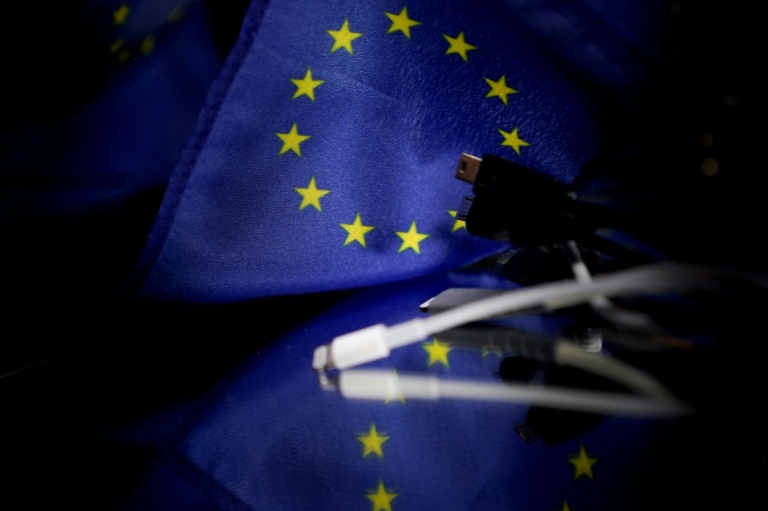
The EU parliament on Tuesday passed a new law requiring USB-C to be the single charger standard for all new smartphones, tablets and cameras from late 2024.

The measure, which EU lawmakers adopted with a vote 602 in favour, 13 against, will — in Europe at least — push Apple to drop its outdated Lightning port on its iPhones for the USB-C one already used by many of its competitors.

Makers of laptops will have extra time, from early 2026, to also follow suit.

EU policymakers say the single charger rule will simplify the life of Europeans, reduce the mountain of obsolete chargers and reduce costs for consumers. 

It is expected to save at least 200 million euros ($195 million) per year and cut more than a thousand tonnes of EU electronic waste every year, the bloc’s competition chief Margrethe Vestager said.

The EU move is expected to ripple around the world.

The European Union’s 27 countries are home to 450 million people who count among the world’s wealthiest consumers. Regulatory changes in the bloc often set global industry norms in what is known as the Brussels Effect.

“Today is a great day for consumers, a great day  for our environment,” Maltese MEP Alex Agius Saliba, the European Parliament’s pointman on the issue, said.

“After more than a decade; the single charger for multiple electronic devices will finally become a reality for Europe and hopefully we can also inspire the rest of the world,” he said.

– Faster data speed –

Apple, the world’s second-biggest seller of smartphones after Samsung, already uses USB-C charging ports on its iPads and laptops. 

But it resisted EU legislation to force a change away from its Lightning ports on its iPhones, saying that was disproportionate and would stifle innovation.

However some users of its latest flagship iPhone models — which can capture extremely high-resolution photos and videos in massive data files — complain that the Lightning cable transfers data at only a bare fraction of the speed USB-C does.

The EU law will in two years’ time apply to all handheld mobile phones, tablets, digital cameras, headphones, headsets, portable speakers, handheld videogame consoles, e-readers, earbuds, keyboards, mice and portable navigation systems.

People buying a device will have the choice of getting one with or without a USB-C charger, to take advantage of the fact they might already have at least one cable at home.

Makers of electronic consumer items in Europe agreed a single charging norm from dozens on the market a decade ago under a voluntary agreement with the European Commission.

But Apple refused to abide by it, and other manufacturers kept their alternative cables going, meaning there are still some six types knocking around.

They include old-style USB-A, mini-USB and USB-micro, creating a jumble of cables for consumers.

USB-C ports can charge at up to 100 Watts, transfer data up to 40 gigabits per second, and can serve to hook up to external displays.

Apple also offers wireless charging for its latest iPhones — and there is speculation it might do away with charging ports for cables entirely in future models. But currently the wireless charging option offers lower power and data transfer speeds than USB-C.

EU lawmakers impose single charger for all smartphones

The EU parliament on Tuesday passed a new law requiring USB-C to be the single charger standard for all new smartphones, tablets and cameras from late 2024.

The measure, which EU lawmakers adopted with a vote 602 in favour, 13 against, will — in Europe at least — push Apple to drop its outdated Lightning port on its iPhones for the USB-C one already used by many of its competitors.

Makers of laptops will have extra time, from early 2026, to also follow suit.

EU policymakers say the single charger rule will simplify the life of Europeans, reduce the mountain of obsolete chargers and reduce costs for consumers. 

It is expected to save at least 200 million euros ($195 million) per year and cut more than a thousand tonnes of EU electronic waste every year, the bloc’s competition chief Margrethe Vestager said.

The EU move is expected to ripple around the world.

The European Union’s 27 countries are home to 450 million people who count among the world’s wealthiest consumers. Regulatory changes in the bloc often set global industry norms in what is known as the Brussels Effect.

“Today is a great day for consumers, a great day  for our environment,” Maltese MEP Alex Agius Saliba, the European Parliament’s pointman on the issue, said.

“After more than a decade; the single charger for multiple electronic devices will finally become a reality for Europe and hopefully we can also inspire the rest of the world,” he said.

– Faster data speed –

Apple, the world’s second-biggest seller of smartphones after Samsung, already uses USB-C charging ports on its iPads and laptops. 

But it resisted EU legislation to force a change away from its Lightning ports on its iPhones, saying that was disproportionate and would stifle innovation.

However some users of its latest flagship iPhone models — which can capture extremely high-resolution photos and videos in massive data files — complain that the Lightning cable transfers data at only a bare fraction of the speed USB-C does.

The EU law will in two years’ time apply to all handheld mobile phones, tablets, digital cameras, headphones, headsets, portable speakers, handheld videogame consoles, e-readers, earbuds, keyboards, mice and portable navigation systems.

People buying a device will have the choice of getting one with or without a USB-C charger, to take advantage of the fact they might already have at least one cable at home.

Makers of electronic consumer items in Europe agreed a single charging norm from dozens on the market a decade ago under a voluntary agreement with the European Commission.

But Apple refused to abide by it, and other manufacturers kept their alternative cables going, meaning there are still some six types knocking around.

They include old-style USB-A, mini-USB and USB-micro, creating a jumble of cables for consumers.

USB-C ports can charge at up to 100 Watts, transfer data up to 40 gigabits per second, and can serve to hook up to external displays.

Apple also offers wireless charging for its latest iPhones — and there is speculation it might do away with charging ports for cables entirely in future models. But currently the wireless charging option offers lower power and data transfer speeds than USB-C.

US to require extra hour of rest for flight attendants

US authorities will require flight attendants be given an additional hour to rest between trips, according to new rule announced Tuesday.

The Federal Aviation Administration will lift the minimum rest time to 10 consecutive hours from nine, implementing a rule change as required by a 2018 law.

“Flight attendants, like all essential transportation workers, work hard every day to keep the traveling public safe, and we owe them our full support,” US Transportation Secretary Pete Buttigieg said. 

“This new rule will make it easier for flight attendants to do their jobs, which in turn will keep all of us safe in the air.”

The Association of Flight Attendants, which had long fought for the longer rest times, praised the FAA announcement, which takes effect in 30 days and gives airlines 90 days to be implemented.

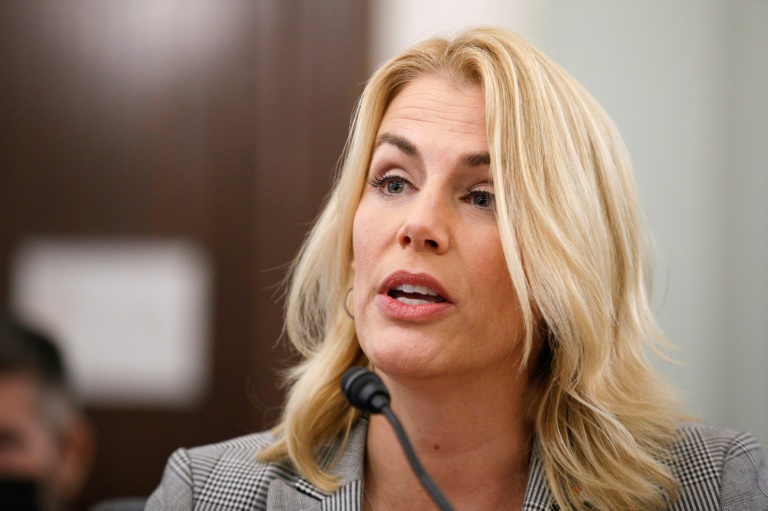
“As aviation’s first responders and last line of defense, it is critical that we are well rested and ready to perform our duties,” said AFA President Sara Nelson

“Covid has only exacerbated the safety gap with long duty days, short nights, and combative conditions on planes.”

Nelson praised President Joe Biden for enacting the measure, adding that while the 2018 congressional mandate “could not have been more clear,” officials in Donald Trump’s administration “put our rest on a regulatory road to kill it.”

Shell CEO hints energy firms should pay more tax

Shell’s departing chief executive indicated Tuesday that governments should “probably” tax energy firms more to help protect the poorest from rocketing electricity and gas bills and ease the cost-of-living crisis.

Ben van Beurden, who leaves Shell at the end of this year, was addressing the Energy Intelligence Forum industry gathering.

“You cannot have a market that behaves in such a way… that it’s going to damage a significant part of society. You simply cannot have that,” he told delegates.

“One way or another, there needs to be government intervention … that somehow results in protecting the poorest.

“And that probably means governments need to tax people in this room to pay for it — I think we just have to accept as a societal reality.”

Energy bills have sky-rocketed in the wake of key gas producer Russia’s invasion of Ukraine, sparking accusations from some quarters that the sector has reaped profits as a result of the war.

New British Prime Minister Liz Truss last month launched an energy price freeze that seeks to cushion the blow of runaway bills for households and businesses.

However the costly price freeze, contained also in the government’s recent controversial mini-budget, has sparked turmoil over its impact on government debt.

Van Beurden did not comment on the most appropriate way to tax the energy sector.

Truss, a former Shell employee, has already ruled out extending a windfall tax on energy companies’ profits, which was unveiled by her predecessor Boris Johnson.

Environmental campaigners Greenpeace welcomed van Beurden’s comments but criticised the government for doing nothing.

Susannah Streeter, an investment and market analyst, said van Beurden had “flung open a door on a windfall tax which the UK government had been trying to close”.

“This will reignite the debate over how profits of energy giants should be taxed just as a row rages about whether welfare spending will be hit to pay for the Truss administration’s slash and spend policies.”

Meanwhile, the outgoing Shell chief executive expressed scepticism on Tuesday over a possible price cap for Russian oil.

The European Union had last week proposed a new round of sanctions on Moscow, including the oil price cap.

As part of the new round of sanctions — which has to be signed off by the bloc’s 27 nations — the EU is laying out a “legal basis” for a price cap on Russian oil, in line with a G7 agreement.

“I struggle with understanding how effective an oil price cap on Russian oil will be,” van Beurden told the Energy Intelligence Forum, according to comments relayed on Twitter.

“Intervening in complex energy markets is going to be very difficult. 

“Governments need to consult with market experts on what they can and cannot do in terms of interventions.”

Plastic gobbling enzymes in worm spit may help ease pollution

Enzymes found in the saliva of wax worms can degrade one of the most common forms of plastic waste, according to research published Tuesday that could open up new ways of dealing with plastic pollution.

Humans produce some 400 million tonnes of plastic waste each year despite international drives to reduce single-use plastics and to increase recycling. 

Around a third is polyethylene, a tough plastic thanks to its structure, which traditionally requires heating or radiation before it starts to break down. 

There have been several studies showing that microorganisms can release enzymes that start the degradation process on polyethylene, but the process has until now taken months each time. 

But those contained in the saliva the wax worm moth (Galleria mellonella) can act in only a few hours, Tuesday’s research showed. 

Researcher Federica Bertocchini, an avid beekeeper, said she originally stumbled on the idea that this small caterpillar had unusual powers when storing honeycombs a few years ago.

“At the end of the season, usually beekeepers put some empty beehives in a storage room, to put them back in the field in the spring,” she told AFP. 

“One year I did that, and I found my stored honeycombs plagued with wax worms. In fact, that is their habitat.” 

Bertocchini cleaned the honeycombs and put the worms in a plastic bag.

When she returned a short time later she found the bag “riddled with holes”.

– Poured over plastics –

“That raised the question: is it the result of munching or there is a chemical modification? We checked that, doing proper lab experiments, and we found that the polyethylene had been oxidised,” she told AFP.

In her latest research Bertocchini, from Madrid’s Margarita Salas Centre for Biological Studies (CIB) and her colleagues analysed proteins in the wax worm saliva and identified two enzymes that could break polyethylene down into small polymers in only a few hours at room temperature.

Writing in the journal Nature Communications they explained how they used another worm’s saliva as a control experiment, which produced no degradation compared with the wax worm.

Bertocchini said her team were still trying to figure out precisely how the worms degraded the plastic.

While the study authors stressed that much more research was needed before Tuesday’s findings could be implemented at any meaningful scale, there were a number of possible applications.

“We can imagine a scenario where these enzymes are used in an aqueous solution, and litres of this solution is poured over piles of collected plastic in a waste management facility,” said Bertocchini, who said her team were still trying to figure out precisely how the worms degraded the plastic.

“We can also imagine small amounts that can reach more remote locations, like villages or small islands, where waste facilities are not available.” 

She said that further down the line the solution could be used in individual houses, where each family could degrade their own plastic waste.

Power blackouts hit 130 million people in Bangladesh

At least 130 million people in Bangladesh were left without power on Tuesday after a grid failure caused widespread blackouts, the government’s power utility company said. 

Bangladesh has suffered a major power crisis in recent months as a result of higher global energy prices following Russia’s invasion of Ukraine, and has imposed regular cuts to conserve electricity.

But it remained unclear what caused Tuesday’s unscheduled blackout, which hit more than 80 percent of the country shortly after 2:00 pm (0800 GMT), according to the Power Development Board.

Apart from some locations in Bangladesh’s northwest, “the rest of the country is without power”, spokesman Shamim Ahsan told AFP. 

The normally brightly lit streets of central Dhaka and other cities were dark on Tuesday evening.

Ahsan said 130 million people or more were without electricity and it remained unclear what had caused the fault.

“It is still under investigation,” he said, adding that a technical malfunction was the probable cause. 

Another official said later that only 60 percent of the poor country, which is home to factories supplying garments for Western brands, had been affected.

Since then half of those affected had had their power restored by the evening, A.B.M Badruddoza, spokesman of the state-run power grid company, told AFP.

Junior technology minister Zunaid Palak said on Facebook that power would be restored by 8:00 pm in the capital Dhaka, a megacity home to more than 22 million people.

– Energy crisis –

Prices of energy as well as food as other staples have soared worldwide in the wake of Russia’s invasion of Ukraine in February, including in Asia. 

This has wrought havoc on Bangladesh’s electricity grid in recent months, with utilities struggling to source enough diesel and gas to meet demand.

A depreciating currency and dwindling foreign exchange reserves left Bangladesh unable to import sufficient fossil fuels, forcing it to close diesel plants and leave some gas-fired power stations idle.

The government imposed lengthy power cuts to conserve existing stocks in July, with outages lasting up to 13 hours a day at their peak. 

Tens of thousands of mosques around the Muslim-majority South Asian country have been asked to curtail the use of air conditioners to ease pressure on the electricity grid.

The blackouts sparked widespread public anger and helped mobilise large demonstrations on the streets of Dhaka.

At least three protesters were killed by security forces during the rallies, partly motivated by rising cost-of-living pressures.

Around 100 others were injured during a police crackdown on one demonstration, according to the opposition Bangladesh Nationalist Party. 

Consumer inflation has hit household budgets hard and the government recently pledged to cap the price of several staple foods, including rice, to quell public discontent. 

Bangladesh last witnessed a major unscheduled blackout in November 2014, when around 70 percent of the country went without power for nearly 10 hours.

The Nobel winners who helped prove quantum 'spooky action'

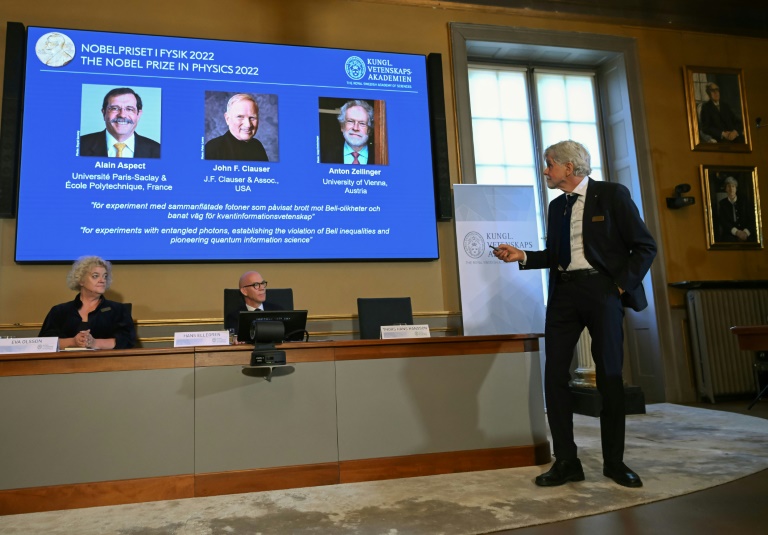
Physicists Alain Aspect, John Clauser and Anton Zeilinger developed experimental tools that helped prove quantum entanglement — a phenomenon Albert Einstein famously dismissed as “spooky action at a distance” — is real, paving the way for its use in powerful computers.

Here are mini biographies of the three scientists. 

– John Clauser –

Born in 1942, John Francis Clauser’s earliest memories were of gaping in wonder at the equipment in the lab of his father, who created the aeronautics department for Johns Hopkins, he told the American Institute of Physics in a 2002 oral history. 

An electronics buff who built some of the first computer-driven video games at high school, Clauser opted for physics at college.

In the mid-1960s, he grew interested in the ideas of quantum mechanics pioneer John Bell, who strove to better understand entanglement — when two particles behave as one and can affect each other, even at vast distances.

“I thought this is one of the most amazing papers I’ve ever read in my own life, and I kept wondering, gee, where’s the experimental evidence?”  Clauser told PBS in 2018.

Clauser believed he could test Bell’s ideas in a laboratory, but was met with widespread scorn by leading physicists of the time.

He proposed the test independently of his thesis work on radio astronomy, and carried it out with collaborators in 1972 while at UC Berkeley. 

By shining lasers at calcium atoms to emit entangled photons and measuring their properties, he was able to prove with hard data that what had defied the imagination even of the great Einstein — was true.

– Alain Aspect –

Like Clauser, Frenchman Alain Aspect was seduced by the “limpid clarity” of Bell’s theorem.

“Quantum strangeness has dominated my whole life as a physicist,” he told AFP in a 2010 interview.

As a doctoral student, Aspect built on the work of Clauser, refining the experiment to eliminate possible loopholes in its design — publishing his work in 1982.

The son of a teacher, Aspect was born in 1947 in a village in Gascony, and is currently a professor at Institut d’Optique Graduate School (Augustin Fresnel chair), in University Paris-Saclay, and at Ecole Polytechnique.

But his interest in the quantum realm stemmed from a period in his life spent away from academia — he had gone to Cameroon to complete three years of voluntary service as a teacher.

During his free time, he came across a book written by Claude Cohen-Tannoudji on the subject (Cohen-Tannoudji won the Nobel in 1997), which in turn led him to Bell.

In a phone interview with the Nobel Foundation on Tuesday, Aspect emphasized the international makeup of his co-winners — an American and an Austrian — was an important signal in the face of rising nationalism around the world.

“It’s important that scientists keep their international community at a time when… nationalism is taking over in many countries,” he said.

– Anton Zeilinger – 

Nicknamed the “quantum pope”, the physicist Anton Zeilinger, born in 1945 in Ried im Innkreis in Austria, became one of the most famous scientists in his country by succeeding for the first time in 1997 in quantum teleportation of light particles.

A success quickly compared to the “teleportation” of the television series “Star Trek.”

Using the properties of quantum entanglement for cryptography, Professor Zeilinger encrypted the first banking transaction by this means in Vienna in 2004.

In 2007, his team created entangled pairs of photons and fired one of each pair over 144 kilometers (89 miles) between the Canary Islands La Palma and Tenerife, to generate a quantum cryptographic key.

His fame comes in part from his tireless didactic talents: always keen to popularize his knowledge to the general public, he even initiated the Dalai Lama in 2012 with infectious enthusiasm.

Attached to the University of Vienna, Zeilinger corresponds in all respects to the image of the scientist: gray hair, a full beard, and small round glasses.

He had already received countless awards and did not really believe that he would one day win the Nobel. “There are so many other candidates,” he said a few years ago to the Austria Press Agency

Loretta Lynn, country music luminary and songwriting pioneer, dies at 90

Loretta Lynn, America’s groundbreaking country titan whose frank lyricism delving into women’s experiences with sex, infidelity and pregnancy touched the nerve of a nation, has died. She was 90 years old.

She “passed peacefully in her sleep” at her ranch in Tennessee Tuesday morning, her family said in a statement sent to AFP.

Lynn saw a number of her edgy tracks banned by country music stations, but over the course of more than six decades in the business, she became a standard-bearer of the genre and its most decorated female artist ever.

Born Loretta Webb on April 14, 1932 in small-town Kentucky, Lynn was the eldest daughter in an impoverished family of eight kids, a childhood she immortalized in her iconic track “Coal Miner’s Daughter” — a staple on lists of all-time best songs.

“Well, I was borned a coal miner’s daughter / In a cabin, on a hill in Butcher Holler,” Lynn sang in the hit recorded in 1970 — later the theme song for a 1980 movie about her life starring Sissy Spacek, who won an Oscar for the role. 

“We were poor but we had love / That’s the one thing that daddy made sure of. He shoveled coal to make a poor man’s dollar.”

At just 15 years old, the artist married Oliver Vanetta Lynn, who she remained married to for nearly 50 years until his death in 1996.

They moved to a logging community in Washington state, and Lynn gave birth to four children before the age of 20, adding twins to the family not long after.

An admirer of his wife’s voice, her husband bought Lynn a guitar in the early 1950s.

It would be a fateful gift.

The self-taught musician penned lyrics inspired by her own early experiences as a married woman and her oft-tumultuous relationship, the nascent days of a prolific career that would see the artist release dozens of albums.

She started her own band, Loretta and the Trailblazers, and began playing bar sets before cutting her first record — “I’m a Honky Tonk Girl” in 1960.

Her twang was warm and languid but Lynn’s lyrics were anything but: She sang with searing precision of marriage’s growing pains and gave voice to issues facing women that had long been kept quiet.

“Most songwriters tended to write about falling in love, breaking up and being alone, things like that,” Lynn told The Wall Street Journal in 2016. “The female view I wrote about was new.”

“I just wrote about what I knew, and what I knew usually involved something that somebody did to me.”

– ‘The Pill’ –

The Lynns began touring nationwide to promote the singer’s work to radio stations, and she made her debut at the storied Grand Ole Opry in 1960, going on to become one of the Nashville institution’s most acclaimed acts.

During her early years in the industry, she found a friend and mentor in Patsy Cline, one of the 20th century’s most influential singers who died in a plane crash in 1963 at age 30.

She also formed a longstanding creative partnership with Conway Twitty, with the pair becoming one of country’s classic duet acts. 

Lynn released hit single after hit single, including 1966’s “Dear Uncle Sam” — one of the era’s first tracks to document the tragedy of the Vietnam War.

Also in 1966, she put out “You Ain’t Woman Enough (To Take My Man),” which went straight to the top of the charts and made her the first woman in country to pen a number one hit.

In 1969, she released one of her most controversial songs, “Wings Upon Your Horns,” which describes through religious metaphor a teenager losing her virginity.

But her runaway success continued and she dominated the 1970s with hits such as “Fist City” — a stern warning to her cheating husband’s lover — and 1972’s “Rated X,” which triggered an outcry in discussing the stigmas faced by divorced women.

In 1975, she released “The Pill,” which praised the freedoms of birth control. 

“This incubator is overused / Because you’ve kept it filled / The feelin’ good comes easy now / Since I’ve got the pill,” Lynn sang.

“When I’d put out a record, they’d say, ‘Uh oh, another dirty song.’ ‘Rated X’? They thought that was going to be bad. But hey, it sold. ‘One’s on the Way’? They thought that song would really be dirty,” she told Billboard in 2015. 

“But everything I sang about was everyday living.”

– ‘The truth’ –

In 1988, Lynn was inducted into the Country Music Hall of Fame as one of its most storied legends.

She won virtually every arts honor available, including the prestigious Presidential Medal of Freedom, the nation’s highest civilian award, given to her by Barack Obama in 2013.

Despite the progressive airs of her music, Lynn would insist that her clearly political music had “no politics.” She leaned Republican most of her life, frequently performing for and supporting right-wing candidates — including Donald Trump in 2016 — even as she also voiced support for Democrats like Jimmy Carter.

But she was universally beloved in the industry she deeply influenced, collaborating with scores of artists including Dolly Parton, Willie Nelson and Elvis Costello. In 2004 she released the album “Van Lear Rose,” produced by Jack White.

In 2021, a month before turning 89, she released the album “Still Woman Enough,” which featured re-recordings and new material.

“As long as I’m on this earth, I will try to be on top — somewhere,” she once told Billboard, explaining that she’d never retire from music.

“When they lay me down six feet under, they can say, ‘Loretta’s quit singing.’ I’ll have on one of my gowns,” she continued.

“That’s morbid, but it’s the truth.”

Quantum entanglement: the 'spooky' science behind physics Nobel

This year’s physics Nobel prize was awarded Tuesday to three men for their work on a phenomenon called quantum entanglement, which is so bizarre and unlikely that Albert Einstein was sceptical, famously calling it “spooky”.

So how exactly does it work?

Even people with degrees in physics struggle to understand it — and some who do still find parts “hard to swallow,” said Chris Phillips, a physicist at Imperial College London.

To explain the phenomenon he used the example of a photon — “a single unit of light” — though the theory is believed to hold true for other particles.

If a photon is put through a “special crystal”, it can be split into separate photons, he told AFP.

“They’re different colours from the one you started with,” Phillips said, “but because they started from one photon, they are entangled”.

This is where it gets weird. If you measure one photon it instantly affects the other — no matter how far you separate them.

This is not supposed to happen. Einstein’s theory of relativity says nothing can travel faster than the speed of light.

And they are inextricably bound together. When you observe the first photon, there are even odds that it will show itself as “either up or down”, Phillips said. But if it is up, then its twin is instantly forced down, or vice versa. 

– New way to kill Schroedinger’s cat –

He extended the famous quantum thought experiment of Schroedinger’s cat, in which a hypothetical animal locked inside a box with a flask of poison remains simultaneously alive and dead — until the moment the box is opened.

For quantum entanglement, if you have two cats in two boxes, by opening one you would “kill that cat and instantaneously — on the other side of the universe — the other cat has been killed,” Phillips said.

Phillips has seen this “extremely strange thing” first hand in his laboratory, where he has two beams of photons set up.

“I can put my hand in one beam and something happens to the other beam on the other side of the room instantaneously — I see a needle flick,” he said.

“That would still be true if my laboratory was millions of miles across.”

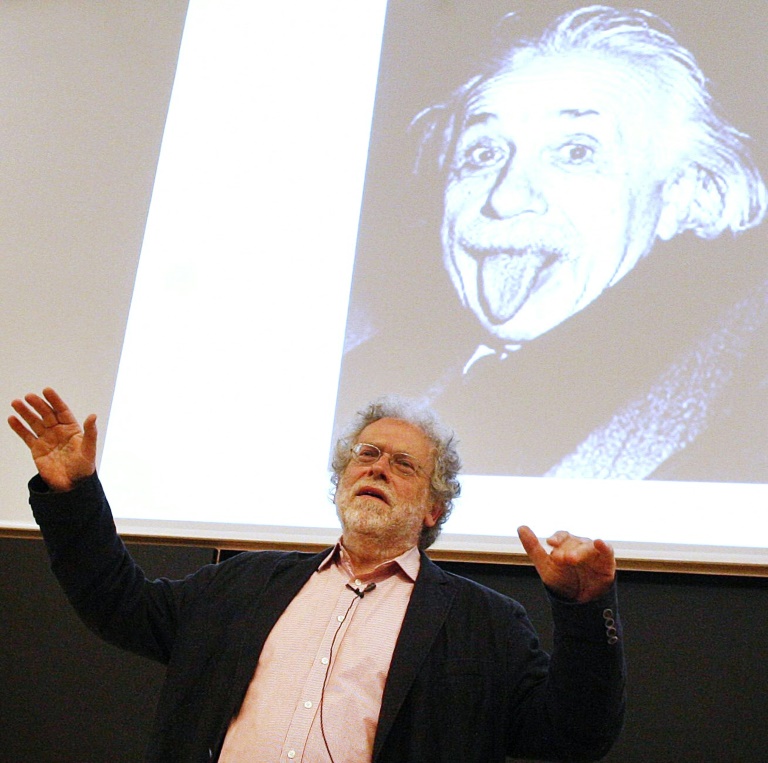
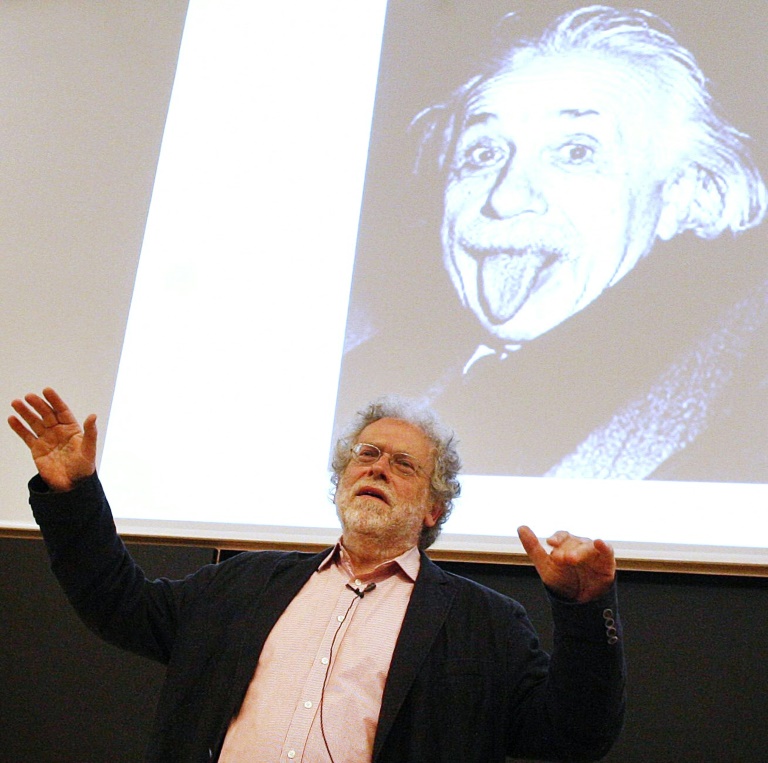
It was the fact that this occurs instantly that bothered Einstein, who dismissed this element of quantum entanglement — called non-locality — as “spooky action at a distance” in 1935.

He instead believed that “hidden variables” must somehow be behind what was happening.

In 1964, influential physicist John Stewart Bell found a way to measure whether there were in fact hidden variables inside quantum particles.

Two decades later, French physicist Alain Aspect, who won the Nobel on Tuesday, and his team were among the first able to test Bell’s theory in a laboratory.

By testing its limits, they found that “quantum mechanics resists all possible attacks,” Aspect said in an interview published by the Nobel Foundation after his win on Tuesday.

– ‘Totally crazy’ –

In doing so, Aspect proved Einstein wrong. But he was magnanimous to history’s greatest physicist.

“I like to say that Einstein’s owes a great, great merit in raising the question,” Aspect said, adding that “non-locality does not allow you to send a useful message faster than light”.

Even Aspect finds it weird to have accepted the idea of something “totally crazy” like non-locality into “my mental images,” he said.

The other physics Nobel winners, Austria’s Anton Zeilinger and John Clauser of the US, also tested Bell’s theory, ruling out loopholes and helping pave the way for what has been called the “second quantum revolution”.

Discoveries by Zeilinger, dubbed the “quantum pope”, have shown the potential for quantum entanglement to be used in encryption, quantum teleportation and more. 

Phillips from Imperial College London has developed a prototype the size of a hi-fi sound system that uses quantum entanglement to diagnose breast cancer.

But perhaps the greatest mystery about quantum entanglement remains one that puzzled Einstein nearly a century ago: why does it occur?

“We have to be humble in the face of physics,” Phillips said, adding that it was the same as any another aspect of nature.

“It just is.”

Quantum entanglement: the 'spooky' science behind physics Nobel

This year’s physics Nobel prize was awarded Tuesday to three men for their work on a phenomenon called quantum entanglement, which is so bizarre and unlikely that Albert Einstein was sceptical, famously calling it “spooky”.

So how exactly does it work?

Even people with degrees in physics struggle to understand it — and some who do still find parts “hard to swallow,” said Chris Phillips, a physicist at Imperial College London.

To explain the phenomenon he used the example of a photon — “a single unit of light” — though the theory is believed to hold true for other particles.

If a photon is put through a “special crystal”, it can be split into separate photons, he told AFP.

“They’re different colours from the one you started with,” Phillips said, “but because they started from one photon, they are entangled”.

This is where it gets weird. If you measure one photon it instantly affects the other — no matter how far you separate them.

This is not supposed to happen. Einstein’s theory of relativity says nothing can travel faster than the speed of light.

And they are inextricably bound together. When you observe the first photon, there are even odds that it will show itself as “either up or down”, Phillips said. But if it is up, then its twin is instantly forced down, or vice versa. 

– New way to kill Schroedinger’s cat –

He extended the famous quantum thought experiment of Schroedinger’s cat, in which a hypothetical animal locked inside a box with a flask of poison remains simultaneously alive and dead — until the moment the box is opened.

For quantum entanglement, if you have two cats in two boxes, by opening one you would “kill that cat and instantaneously — on the other side of the universe — the other cat has been killed,” Phillips said.

Phillips has seen this “extremely strange thing” first hand in his laboratory, where he has two beams of photons set up.

“I can put my hand in one beam and something happens to the other beam on the other side of the room instantaneously — I see a needle flick,” he said.

“That would still be true if my laboratory was millions of miles across.”

It was the fact that this occurs instantly that bothered Einstein, who dismissed this element of quantum entanglement — called non-locality — as “spooky action at a distance” in 1935.

He instead believed that “hidden variables” must somehow be behind what was happening.

In 1964, influential physicist John Stewart Bell found a way to measure whether there were in fact hidden variables inside quantum particles.

Two decades later, French physicist Alain Aspect, who won the Nobel on Tuesday, and his team were among the first able to test Bell’s theory in a laboratory.

By testing its limits, they found that “quantum mechanics resists all possible attacks,” Aspect said in an interview published by the Nobel Foundation after his win on Tuesday.

– ‘Totally crazy’ –

In doing so, Aspect proved Einstein wrong. But he was magnanimous to history’s greatest physicist.

“I like to say that Einstein’s owes a great, great merit in raising the question,” Aspect said, adding that “non-locality does not allow you to send a useful message faster than light”.

Even Aspect finds it weird to have accepted the idea of something “totally crazy” like non-locality into “my mental images,” he said.

The other physics Nobel winners, Austria’s Anton Zeilinger and John Clauser of the US, also tested Bell’s theory, ruling out loopholes and helping pave the way for what has been called the “second quantum revolution”.

Discoveries by Zeilinger, dubbed the “quantum pope”, have shown the potential for quantum entanglement to be used in encryption, quantum teleportation and more. 

Phillips from Imperial College London has developed a prototype the size of a hi-fi sound system that uses quantum entanglement to diagnose breast cancer.

But perhaps the greatest mystery about quantum entanglement remains one that puzzled Einstein nearly a century ago: why does it occur?

“We have to be humble in the face of physics,” Phillips said, adding that it was the same as any another aspect of nature.

“It just is.”

Close Bitnami banner
Bitnami