World

French-US-Austrian trio win physics Nobel for quantum mechanics work

A trio of physicists on Tuesday won the Nobel Prize for discoveries in the field of quantum mechanics that have paved the way for quantum computers, networks and secure encrypted communication.

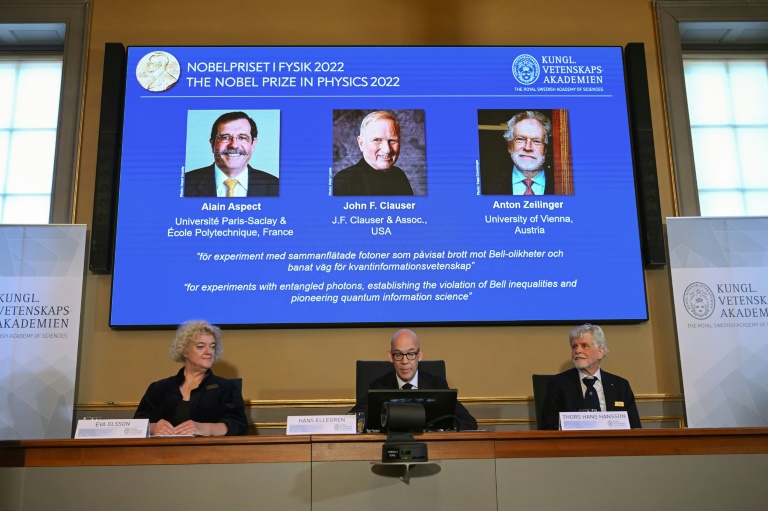
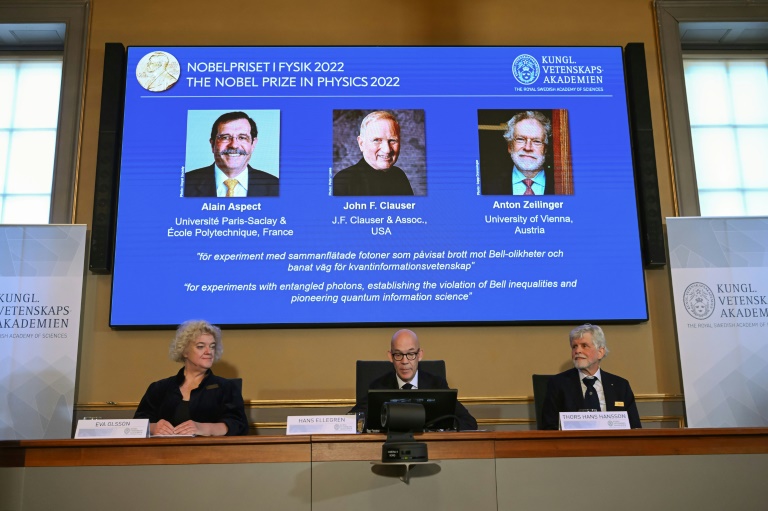
Alain Aspect of France, John Clauser of the United States and Austria’s Anton Zeilinger were honoured for “groundbreaking experiments using entangled quantum states, where two particles behave like a single unit even when they are separated”, the committee said.

“It has become increasingly clear that a new kind of quantum technology is emerging,” said Anders Irback, chair of the Nobel Committee for Physics.

Albert Einstein and two other physicists first brought up the idea of quantum entanglement in 1935, in a thought experiment that became known as the EPR paradox. 

– ‘Spooky action’ –

It involved two or more particles that existed in an “entangled” state, which means that what happens to one determines what happens to the other. 

This occurs even if they are far apart, something Einstein dismissed as “spooky action at a distance”.

While quantum mechanics have proved the iconic physicist wrong, Aspect said Einstein still played an important role in identifying the issue.

“We must give the credit to Einstein to have raised the equation,” Aspect said in his Nobel Foundation interview.

Aspect, a professor at the Paris-Saclay University, also noted the international makeup of the group as an important signal in the face of rising nationalism around the world, which he urged the scientific community to stand against.

“It’s important that scientists keep their international community at a time when… nationalism is taking over in many countries,” he said in a phone interview with the Nobel Foundation published on YouTube.

Aspect and Clauser, a research physicist based in California, were singled out for their developments on the work of John Stewart Bell, who in the 1960s “developed the mathematical inequality that is named after him”.

First, Clauser “built an apparatus that emitted two entangled photons at a time”, through a filter to test their polarisation. 

“The result was a clear violation of a Bell inequality and agreed with the predictions of quantum mechanics,” the jury said.

Aspect then closed one loophole that meant the measurement setting did not affect the results after the entangled pair had left its source.

– ‘Second revolution’ –

Zeilinger, a professor of physics at the University of Vienna, was highlighted for his work on “quantum teleportation, which makes it possible to move a quantum state from one particle to one at a distance”, the jury said.

“It is not like in the ‘Star Trek’ films or whatever, transporting something — certainly not the person — over some distance,” Zeilinger said.

“But the point is, using entanglement you can transfer all the information which is carried by an object over to some other place where the object is reconstituted.”

The physicists have been credited with paving the way towards what has been called the “second quantum revolution”.

“The first quantum revolution allowed us to have transistors, semi contactors, computers and lasers,” Mohamed Bourennane, a professor in quantum information at Stockholm University, told AFP.

“But the second revolution, which is based on superposition and entanglement, will allow us in the future to have new devices like quantum computers,” he added.

Clauser, Aspect and Zeilinger were also honoured together when they received the prestigious Wolf Prize in 2010.

The three, who will share the Nobel award sum of 10 million Swedish kronor ($901,500), will receive the prize from King Carl XVI Gustaf at a formal ceremony in Stockholm on December 10, the anniversary of the death in 1896 of scientist Alfred Nobel, who created the prizes in his last will and testament.

The scientists were congratulated by French president Emmanuel Macron, who noted Einstein’s scepticism.

“Einstein himself did not believe in quantum entanglement! Today, the promises of quantum computing are based on this phenomenon,” Macron tweeted

Last year, the academy honoured Syukuro Manabe, of Japan and the United States, and Klaus Hasselmann of Germany for their research on climate models. 

Italian Giorgio Parisi also won for his work on the interplay of disorder and fluctuations in physical systems.

The physics prize will be followed by the Nobels for chemistry on Wednesday, the highly watched literature and peace prizes on Thursday and Friday respectively, and the economics prize on Monday.
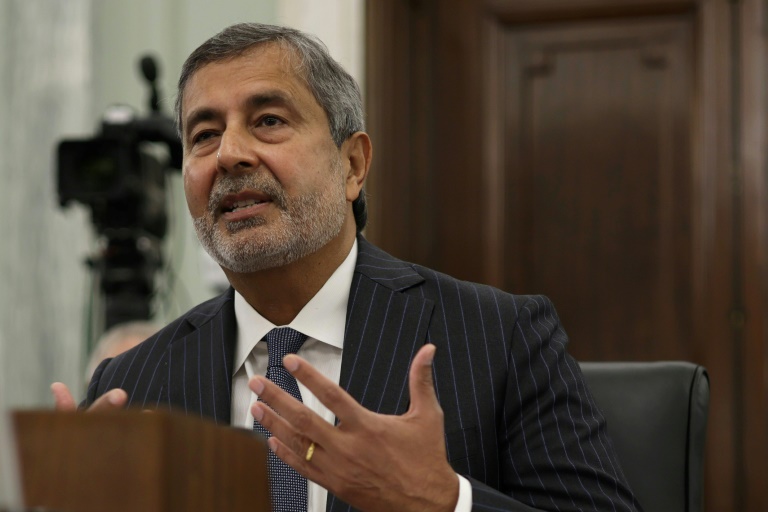
French-US-Austrian trio win physics Nobel for quantum mechanics work

A trio of physicists on Tuesday won the Nobel Prize for discoveries in the field of quantum mechanics that have paved the way for quantum computers, networks and secure encrypted communication.

Alain Aspect of France, John Clauser of the United States and Austria’s Anton Zeilinger were honoured for “groundbreaking experiments using entangled quantum states, where two particles behave like a single unit even when they are separated”, the committee said.

“It has become increasingly clear that a new kind of quantum technology is emerging,” said Anders Irback, chair of the Nobel Committee for Physics.

Albert Einstein and two other physicists first brought up the idea of quantum entanglement in 1935, in a thought experiment that became known as the EPR paradox. 

– ‘Spooky action’ –

It involved two or more particles that existed in an “entangled” state, which means that what happens to one determines what happens to the other. 

This occurs even if they are far apart, something Einstein dismissed as “spooky action at a distance”.

While quantum mechanics have proved the iconic physicist wrong, Aspect said Einstein still played an important role in identifying the issue.

“We must give the credit to Einstein to have raised the equation,” Aspect said in his Nobel Foundation interview.

Aspect, a professor at the Paris-Saclay University, also noted the international makeup of the group as an important signal in the face of rising nationalism around the world, which he urged the scientific community to stand against.

“It’s important that scientists keep their international community at a time when… nationalism is taking over in many countries,” he said in a phone interview with the Nobel Foundation published on YouTube.

Aspect and Clauser, a research physicist based in California, were singled out for their developments on the work of John Stewart Bell, who in the 1960s “developed the mathematical inequality that is named after him”.

First, Clauser “built an apparatus that emitted two entangled photons at a time”, through a filter to test their polarisation. 

“The result was a clear violation of a Bell inequality and agreed with the predictions of quantum mechanics,” the jury said.

Aspect then closed one loophole that meant the measurement setting did not affect the results after the entangled pair had left its source.

– ‘Second revolution’ –

Zeilinger, a professor of physics at the University of Vienna, was highlighted for his work on “quantum teleportation, which makes it possible to move a quantum state from one particle to one at a distance”, the jury said.

“It is not like in the ‘Star Trek’ films or whatever, transporting something — certainly not the person — over some distance,” Zeilinger said.

“But the point is, using entanglement you can transfer all the information which is carried by an object over to some other place where the object is reconstituted.”

The physicists have been credited with paving the way towards what has been called the “second quantum revolution”.

“The first quantum revolution allowed us to have transistors, semi contactors, computers and lasers,” Mohamed Bourennane, a professor in quantum information at Stockholm University, told AFP.

“But the second revolution, which is based on superposition and entanglement, will allow us in the future to have new devices like quantum computers,” he added.

Clauser, Aspect and Zeilinger were also honoured together when they received the prestigious Wolf Prize in 2010.

The three, who will share the Nobel award sum of 10 million Swedish kronor ($901,500), will receive the prize from King Carl XVI Gustaf at a formal ceremony in Stockholm on December 10, the anniversary of the death in 1896 of scientist Alfred Nobel, who created the prizes in his last will and testament.

The scientists were congratulated by French president Emmanuel Macron, who noted Einstein’s scepticism.

“Einstein himself did not believe in quantum entanglement! Today, the promises of quantum computing are based on this phenomenon,” Macron tweeted

Last year, the academy honoured Syukuro Manabe, of Japan and the United States, and Klaus Hasselmann of Germany for their research on climate models. 

Italian Giorgio Parisi also won for his work on the interplay of disorder and fluctuations in physical systems.

The physics prize will be followed by the Nobels for chemistry on Wednesday, the highly watched literature and peace prizes on Thursday and Friday respectively, and the economics prize on Monday.
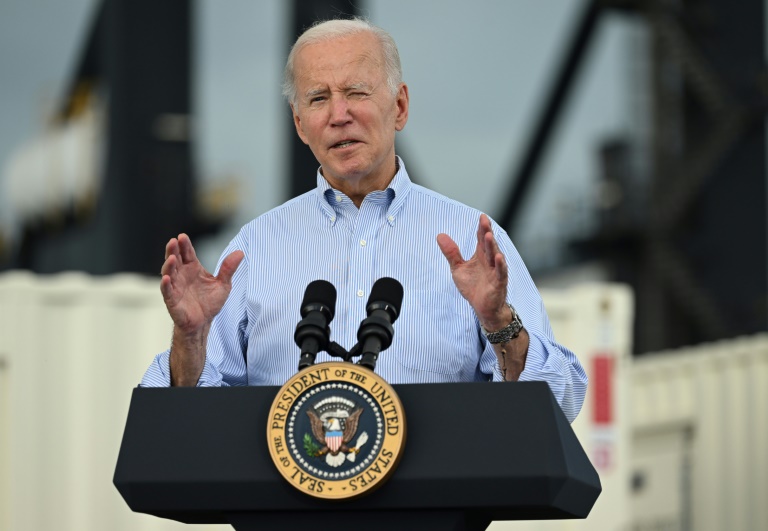
Micron unveils new $100 bn New York semiconductor plant

Micron announced Tuesday it will invest up to $100 billion to build semiconductors in New York state, capitalizing on US policies to boost domestic manufacturing of key goods.

The chip giant, which is based in the western state of Idaho, said it plans to begin construction in 2024 on a project expected to be executed over two decades. 

New York state is providing $5.5 billion in state incentives over the life of the build-out and the project also expects to utilize tax credits under the Chips Act signed into law by President Biden in August, said a Micron news release.

At an event in Syracuse to announce the investment, New York Governor Kathy Hochul likened the drive to a “fourth industrial revolution” and alluded to an improvement in fortunes for a upstate New York region that had lost thousands of manufacturing jobs in earlier decades.

There is “hope of a better tomorrow,” Hochul said.

Micron, describing the plant as the “largest semiconductor fabrication facility in the history of the United States,” said the venture would create 50,000 jobs in the state, including 9,000 at Micron. 

Biden touted the investment as reflecting the importance of the Chips and Science Act, which included around $52 billion to promote production of microchips, the tiny but powerful and relatively hard-to-make components at the heart of almost every modern piece of machinery.

“To those who doubted that America could dominate the industries of the future, I say this -– you should never bet against the American people,” Biden said in a news release. “Today is another win for America.”

Shortages of semiconductors have been a drag on the global economy during the pandemic, crimping production of automobiles, personal electronics and other goods.

Micron Chief Executive Sanya Mehrota said the investment “will deliver benefits beyond the semiconductor industry by strengthening US technology leadership as well as economic and national security, driving American innovation and competitiveness for decades to come.”

Biden warns Iran to face 'costs' for crackdown on Amini protests

The United States will impose “further costs” on Iran for its lethal crackdown on protests sparked by the death of Mahsa Amini, President Joe Biden announced, drawing accusations of “hypocrisy” from Iran on Tuesday.

Amini, 22, was pronounced dead on September 16, days after the notorious morality police detained the Kurdish Iranian for allegedly breaching rules requiring women to wear hijab headscarves and modest clothes.

Anger over her death has sparked the biggest wave of protests to rock Iran in almost three years and a state crackdown that has seen scores of protesters killed and more than 1,000 arrested.

“This week, the United States will be imposing further costs on perpetrators of violence against peaceful protesters,” Biden said in a statement Monday. “We will continue holding Iranian officials accountable and supporting the rights of Iranians to protest freely.”

Biden said he was “gravely concerned” about reports of the intensifying repression of protesters and said Washington stood with “all the citizens of Iran who are inspiring the world with their bravery”.

Rights groups voiced deep concern after Iranian riot police used tear gas and paintball guns against hundreds of students at Tehran’s Sharif University of Technology on Sunday night, with video footage showing detainees being taken away with fabric hoods over their heads.

Protests also spread to schools, with video footage shared by Kurdish rights group Hengaw showing schoolgirls demonstrating in two cities in Amini’s native Kurdistan province.

– ‘Hypocrisy’ –

“Women, Life, Freedom,” the young female protesters chanted as they marched down the central strip of a busy highway in Marivan in footage that AFP has not independently verified.

The US president gave no indication of what measures he was considering against Iran, which is already under crippling US economic sanctions largely related to its controversial nuclear programme.

Iran on Tuesday accused the US leader of “hypocrisy” in invoking human rights to impose fresh punitive measures.

“It would have been better for Mr Joe Biden to think a little about the human rights record of his own country before making humanitarian gestures, although hypocrisy does not need to be thought through,” foreign ministry spokesman Nasser Kanani said in an Instagram post, reported by Iranian media.

“The US president should be concerned about the numerous sanctions… against the Iranian nation, the sanctions whose imposition against any nation is a clear example of a crime against humanity,” he added.

Iran’s supreme leader Ayatollah Ali Khamenei had Monday accused arch foes the United States and Israel of fomenting the protests.

The riots “were engineered by America and the occupying, false Zionist regime, as well as their paid agents, with the help of some traitorous Iranians abroad”, Khamenei said.

– Nuclear talks –

The unrest has overshadowed diplomatic efforts to revive a 2015 nuclear deal between Iran and major powers which had come close to a breakthrough in recent months before stalling again.

But White House Press Secretary Karine Jean-Pierre stressed that the “problems with Iran’s behaviour” are separate from efforts to revive the nuclear deal, which Washington will pursue “as long as we believe” it is in US national security interests.

In his first public comments on Amini’s death, 83-year-old Khamenei stressed on Monday that Iranian police must “stand up to criminals”.

Khamenei said “some people, without proof or an investigation, have made the streets dangerous, burned the Koran, removed hijabs from veiled women and set fire to mosques and cars”.

He added that “this is not about hijab in Iran”, and that “many Iranian women who don’t observe the hijab perfectly are among the steadfast supporters of the Islamic republic”.

On Tuesday, an official said singer Shervin Hajipour — arrested after his song “Baraye” (“For”), with lyrics taken from social media posts about the reasons people were protesting, went viral — had been released on bail.

Iran has repeatedly accused outside forces of stoking the protests and last week said nine foreign nationals — including from France, Germany, Italy, the Netherlands and Poland — had been arrested.

At least 92 protesters have been killed so far in the Mahsa Amini rallies, said Oslo-based group Iran Human Rights, which has been working to assess the death toll despite internet outages and blocks on WhatsApp, Instagram and other online services. 

Amnesty International said earlier it had confirmed 53 deaths, after Iran’s semi-official Fars news agency said last week that “around 60” people had died.

At least 12 members of the security forces have been reported killed since September 16.

bur/pjm/lg

Markets surge on interest rate hopes

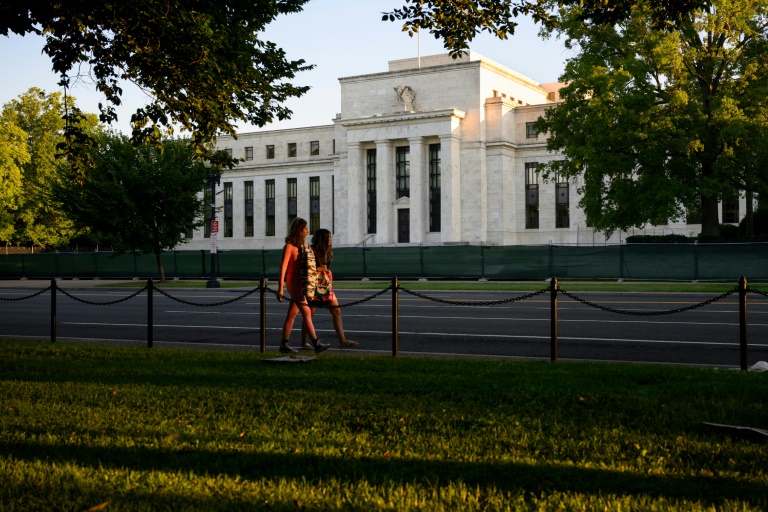
Global stocks rallied Tuesday and the dollar dipped as weak US data sparked hopes the Federal Reserve could ease its interest-rate hiking plans.

Frankfurt and Paris equities soared more than three percent in value after similar stellar gains in Tokyo, while London won two percent.

Wall Street stocks snapped higher at the open, with the Dow climbing 1.3 percent.

“Weaker-than-expected manufacturing data from the US was taken as a signal that rising interest rates may be having some effect on cooling demand for goods,” said Interactive Investor analyst Richard Hunter.

“This in turn led to hopes of a Federal Reserve pivot, even though the spectre of inflation remains firmly at the top of their stated to-do list.”

The Fed and other central banks across the world have raised interest rates in efforts to tame runaway inflation, but the monetary tightening has raised fears that it could plunge countries into recession.

Those concerns have fed into sharp drops in stocks in recent weeks, as have expectations that the Fed will have to raise interest rates by a couple more percentage points through much of next year to get on top of inflation.

But Wall Street had enjoyed a bumper start to the fourth quarter on Monday after data showed US manufacturing growth slowed more than expected in September to its weakest in more than two years.

The Institute for Supply Management said its manufacturing index dropped 1.9 points to 50.9 percent, just barely above the 50-percent threshold indicating expansion, as the prices index fell to the lowest in more than two years.

Eurozone manufacturing survey data out Monday showed a contraction on the back of the region’s ongoing energy crisis.

“The turnaround in risk appetite appears to have been driven by another deterioration in PMI surveys as traders speculate that such weakness could be a precursor to slower monetary tightening,” noted OANDA market analyst Craig Erlam.

Asian markets built on the Monday Wall Street surge. Tokyo and Seoul were among the leaders, despite news that North Korea had fired a missile over Japan for the first time since 2017.

Sydney soared 3.8 percent after the Reserve Bank of Australia lifted interest rates by less than expected.

Hong Kong and Shanghai were closed for holidays.

Investors will focus later this week on Friday’s all-important US jobs figures for the latest reading on the health of the world’s biggest economy.

“The specter of the September employment report on Friday, however, is still hanging out there as a potential spoiler,” said Briefing.com analyst Patrick O’Hare.

“By the same token, it could also provide more interest rate relief if it is on the weaker side of things,” he added.

– Sterling extends gains –

Oil also continued to rise on expectations OPEC and other major producers will slash output this week, having become spooked by a plunge in the commodity on recession fears.

The 13 members of the Organization of the Petroleum Exporting Countries (OPEC), led by Riyadh, and their 10 allies headed by Moscow will hold Wednesday their first in-person meeting at the group’s headquarters in Vienna since March 2020.

The rally in equities came as the dollar weakened owing to lower expectations for US monetary tightening, with the pound also supported by the UK government’s decision to scrap a planned cut in the top rate of income tax.

The pound extended gains after breaking back above $1.13, having last Monday tanked to a record low $1.0350. The euro rose around one percent against the greenback.

– Key figures around 1330 GMT –

Paris – CAC 40: UP 3.2 percent at 5,980.38 points

Frankfurt – DAX: UP 2.8 percent at 12,549.25

London – FTSE 100: UP 2.0 percent at 7,047.34

EURO STOXX 50: UP 3.2 percent at 3,449.00

New York – Dow: UP 1.3 percent at 29,873.99

Tokyo – Nikkei 225: UP 3.0 percent at 26,992.21 (close)

Hong Kong – Hang Seng Index: Closed for a holiday

Shanghai – Composite: Closed for a holiday

Pound/dollar: UP at $1.1358 from $1.1323 on Monday

Euro/dollar: UP at $0.9917 from $0.9826

Euro/pound: UP at 87.33 pence from 86.77 pence

Dollar/yen: UP at 144.74 yen from 144.55 yen

Brent North Sea crude: UP 2.8 percent at $91.31 per barrel

West Texas Intermediate: UP 2.6 percent at $85.83 per barrel

burs-rl/jm

North Korea fires ballistic missile over Japan

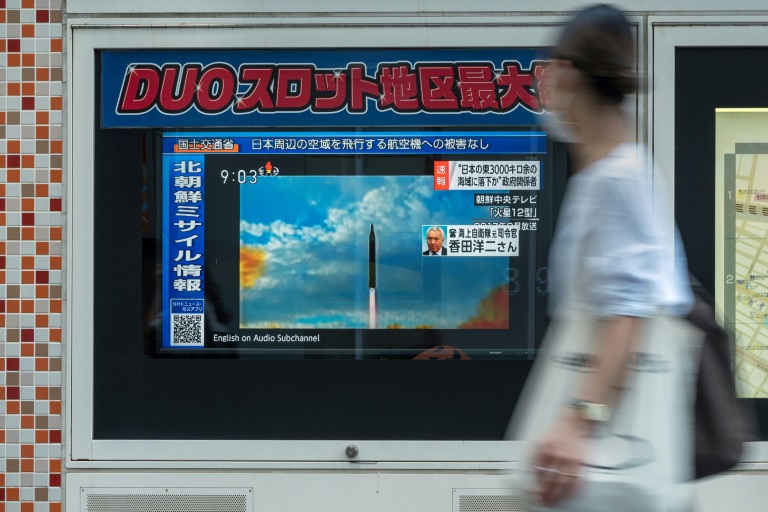
North Korea fired a ballistic missile over Japan for the first time in five years Tuesday, prompting Tokyo to activate its missile alert system and issue a rare warning for people to take shelter.

The latest launch — which the United States branded “reckless and dangerous” — comes in a record year of sanctions-busting weapons tests by North Korea, which recently revised its laws to declare itself an “irreversible” nuclear power.

The last time Pyongyang fired a missile over Japan was in 2017, at the height of a period of “fire and fury” when North Korean leader Kim Jong Un traded insults with US president Donald Trump.

South Korea said the intermediate-range ballistic missile (IRBM) flew some 4,500 kilometres (2,800 miles) — possibly a new distance record for North Korean tests, which are usually conducted on a lofted trajectory to avoid flying over neighbouring countries.

South Korean President Yoon Suk-yeol called the launch a “provocation” that violated UN regulations, and vowed a “stern response”, in a statement issued by his office.

Later Tuesday, South Korean and US fighter jets carried out a “precision bombing drill” in response, Seoul’s military said, with South Korean F-15Ks dropping joint direct attack munitions (JDAMs) at a target in the Yellow Sea.

The drills aimed to demonstrate the allies’ “capabilities to conduct a precision strike at the origin of provocations”, South Korea’s Joint Chiefs of Staff said in a statement.

On the same day, eight Japanese and four US fighter jets carried out a joint drill in airspace west of the country’s Kyushu region, according to Japan’s Joint Staff.

The forces “confirmed their readiness and demonstrated domestically and abroad the strong determination of Japan and the United States to deal with any situation”, it said in a statement.

Japanese Prime Minister Fumio Kishida described Pyongyang’s latest test as “an act of violence”, while European Union head Charles Michel called it “an unjustified aggression”.

The US State Department said the “reckless and dangerous launch” posed “an unacceptable threat to the Japanese public”.

Japanese Defence Minister Yasukazu Hamada said the missile could have been a Hwasong-12.

Pyongyang used Hwasong-12s the last two times it fired missiles over Japan — in August and September 2017 — tweeted Chad O’Carroll of specialist site NK News.

Japan activated its missile warning system and urged people in two northern regions of the country to take shelter early Tuesday.

– Nuclear message –

The Tuesday test is Pyongyang’s fifth missile launch in 10 days and sends a clear message to the United States, Park Won-gon, professor of North Korean Studies at Ewha University in Seoul, told AFP.

The missiles “put South Korea, Japan, and Guam within range”, and show that Pyongyang could hit US bases with nukes if war broke out on the Korean peninsula, he said.

“As these are missiles that can carry nuclear warheads, the launch also has a political goal of once again declaring North Korea a de facto nuclear power and showing its complete denuclearisation is impossible,” Park added.

Seoul, Tokyo and Washington have been ramping up joint military drills to counter Pyongyang’s growing threats, staging the first trilateral anti-submarine drills in five years Friday.

That came just days after the US and South Korean navies conducted large-scale exercises.

Such drills infuriate North Korea, which sees them as rehearsals for an invasion.

US Vice President Kamala Harris visited Seoul last week and toured the heavily fortified Demilitarized Zone that divides the Korean peninsula, on a trip to underscore her country’s “ironclad” commitment to South Korea’s defence.

About 28,500 US troops are stationed in South Korea to help protect it from the North.

– Significant escalation –

Firing a missile over Japan represented a “significant escalation” by North Korea, said Leif-Eric Easley, a professor at Ewha University.

“Pyongyang is still in the middle of a provocation and testing cycle,” he added.

South Korean and US officials have been warning for months that Kim is preparing to conduct another nuclear test, saying last week that this could happen soon after Pyongyang’s key ally China holds a Communist Party congress from October 16.

Pyongyang has tested nuclear weapons six times since 2006, most recently in 2017.

“North Korea always starts with a low-level provocation and gradually raises the level to attract media attention from all over the world,” said Go Myong-hyun, a researcher at the Asan Institute for Policy Studies.

“Their final provocation will probably be a nuclear test,” he said, adding that North Korea had taken the unusual and “very aggressive” step of overflying Japan to attract more attention.

“By launching the missile over Japan, they are showing that their nuclear threat is not just targeting South Korea.”

UK's Truss says 'no shame' in climbdown amid Tory tensions

Britain’s Prime Minister Liz Truss insisted Tuesday she felt “no shame” and vowed to press on with unpopular economic reforms despite lurching into a self-inflicted crisis just a month into her term.

Despite Truss’s attempts to move on, cabinet splits emerged as the ruling Conservatives endured another stormy day at their annual conference in Birmingham, central England.

Truss and Chancellor of the Exchequer Kwasi Kwarteng have been forced to climb down on their plan to cut income tax for the richest, as ordinary Britons suffer the worst cost-of-living crisis in generations.

The plan met with uproar from Tory critics, deep disapproval in opinion polls, and destabilised financial markets given its reliance on billions extra in government borrowing.

“I think there’s absolutely no shame in a leader listening to people and responding, and that’s the kind of person I am,” Truss told Sky News.

Reiterating that the tax cut had proved a “distraction”, she added on the BBC: “I want to take people with me. Yes, we are going to have to make tough decisions.”

“I’m determined to carry on with this growth package,” she told LBC radio, stressing another component of the plan to cap soaring energy bills.

– Budget confusion –

Truss and Kwarteng were widely reported as bringing forward a major debt reduction plan to later this month, having insisted previously that it would only come on November 23.

Its unveiling will be accompanied by independent forecasts from the Office for Budget Responsibility (OBR), in a bid to calm febrile financial markets.

But the two politicians both insisted November 23 remained the date, with Kwarteng telling GB News that media had been “reading the runes” incorrectly.

Mel Stride, the Tory chairman of the powerful Treasury committee in the House of Commons, had welcomed the reporting of an earlier date to show how the government intends to fix its finances.

Acting in advance of the Bank of England’s next rate-setting meeting on November 3 could “reduce the upward pressure on interest rates to the benefit of millions of people up and down the country”, he added.

Potential cuts to the welfare budget are shaping up as the next battle with dissident Tory MPs after the aborted tax cut.

“We have to look at these issues in the round. We have to be fiscally responsible,” Truss told BBC radio.

– ‘Coup’ –

But senior minister Penny Mordaunt, one of the candidates Truss beat in the Tory leadership race, stepped out of the cabinet line.

It “makes sense” that welfare should still rise in line with soaring rates of inflation, she told Times Radio.

“That’s what I voted for before, and so have a lot of my colleagues.”

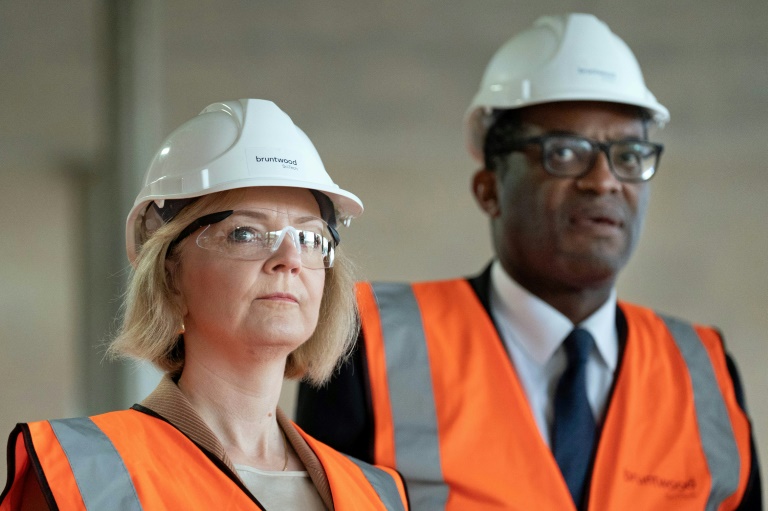
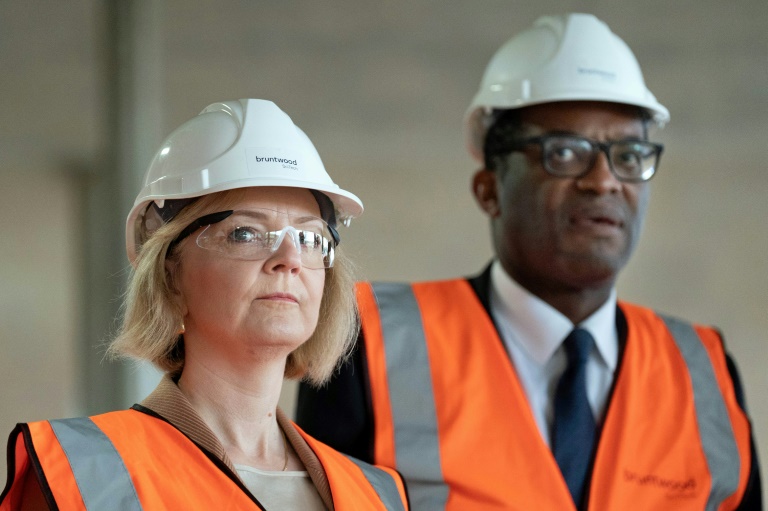
Truss said she did not intend to fire Mordaunt, and denied that she had lost control of her cabinet after putting on a show of unity with Kwarteng on a visit to a construction site in Birmingham.

“We are working with our MPs, this is a team, this Conservative team, putting forward our policies for the country and delivering for the country,” she told ITV.

There was little team spirit on display from Home Secretary Suella Braverman, however, as she accused party critics of seeking to stage a “coup” against Truss.

And many commentators argued Truss’s credibility was already in tatters not long after she succeeded Boris Johnson on September 6.

The Daily Mail newspaper, normally a trenchant voice in support of the new leader’s right-wing agenda, headlined its main story: “Get a grip!”

– Honouring Boris –

Dissident ringleader Michael Gove kept up criticism of Truss, stressing all Conservative MPs had been elected on Johnson’s manifesto of 2019. 

It included a pledge to end arbitrary evictions of tenants by private landlords, he noted at a conference fringe event held by the housing charity Shelter. 

“We’ve got to keep faith with what Boris wanted, we’ve got to make sure that manifesto commitment is honoured,” Gove said, after Truss reneged on a Johnson commitment to ban fracking. 

But asked by reporters if Truss would survive past the end of the year, the former minister said: “Yes.”

Shelter presented poll findings that suggested private renters who voted Tory in 2019 are deserting the party in droves for Labour and other opposition parties. 

Wider opinion polls in recent days have shown Labour breaching 50 percent as the Tories slump under Truss, fraying nerves in Birmingham as she prepares to close the conference on Wednesday.

UK's Truss says 'no shame' in climbdown amid Tory tensions

Britain’s Prime Minister Liz Truss insisted Tuesday she felt “no shame” and vowed to press on with unpopular economic reforms despite lurching into a self-inflicted crisis just a month into her term.

Despite Truss’s attempts to move on, cabinet splits emerged as the ruling Conservatives endured another stormy day at their annual conference in Birmingham, central England.

Truss and Chancellor of the Exchequer Kwasi Kwarteng have been forced to climb down on their plan to cut income tax for the richest, as ordinary Britons suffer the worst cost-of-living crisis in generations.

The plan met with uproar from Tory critics, deep disapproval in opinion polls, and destabilised financial markets given its reliance on billions extra in government borrowing.

“I think there’s absolutely no shame in a leader listening to people and responding, and that’s the kind of person I am,” Truss told Sky News.

Reiterating that the tax cut had proved a “distraction”, she added on the BBC: “I want to take people with me. Yes, we are going to have to make tough decisions.”

“I’m determined to carry on with this growth package,” she told LBC radio, stressing another component of the plan to cap soaring energy bills.

– Budget confusion –

Truss and Kwarteng were widely reported as bringing forward a major debt reduction plan to later this month, having insisted previously that it would only come on November 23.

Its unveiling will be accompanied by independent forecasts from the Office for Budget Responsibility (OBR), in a bid to calm febrile financial markets.

But the two politicians both insisted November 23 remained the date, with Kwarteng telling GB News that media had been “reading the runes” incorrectly.

Mel Stride, the Tory chairman of the powerful Treasury committee in the House of Commons, had welcomed the reporting of an earlier date to show how the government intends to fix its finances.

Acting in advance of the Bank of England’s next rate-setting meeting on November 3 could “reduce the upward pressure on interest rates to the benefit of millions of people up and down the country”, he added.

Potential cuts to the welfare budget are shaping up as the next battle with dissident Tory MPs after the aborted tax cut.

“We have to look at these issues in the round. We have to be fiscally responsible,” Truss told BBC radio.

– ‘Coup’ –

But senior minister Penny Mordaunt, one of the candidates Truss beat in the Tory leadership race, stepped out of the cabinet line.

It “makes sense” that welfare should still rise in line with soaring rates of inflation, she told Times Radio.

“That’s what I voted for before, and so have a lot of my colleagues.”

Truss said she did not intend to fire Mordaunt, and denied that she had lost control of her cabinet after putting on a show of unity with Kwarteng on a visit to a construction site in Birmingham.

“We are working with our MPs, this is a team, this Conservative team, putting forward our policies for the country and delivering for the country,” she told ITV.

There was little team spirit on display from Home Secretary Suella Braverman, however, as she accused party critics of seeking to stage a “coup” against Truss.

And many commentators argued Truss’s credibility was already in tatters not long after she succeeded Boris Johnson on September 6.

The Daily Mail newspaper, normally a trenchant voice in support of the new leader’s right-wing agenda, headlined its main story: “Get a grip!”

– Honouring Boris –

Dissident ringleader Michael Gove kept up criticism of Truss, stressing all Conservative MPs had been elected on Johnson’s manifesto of 2019. 

It included a pledge to end arbitrary evictions of tenants by private landlords, he noted at a conference fringe event held by the housing charity Shelter. 

“We’ve got to keep faith with what Boris wanted, we’ve got to make sure that manifesto commitment is honoured,” Gove said, after Truss reneged on a Johnson commitment to ban fracking. 

But asked by reporters if Truss would survive past the end of the year, the former minister said: “Yes.”

Shelter presented poll findings that suggested private renters who voted Tory in 2019 are deserting the party in droves for Labour and other opposition parties. 

Wider opinion polls in recent days have shown Labour breaching 50 percent as the Tories slump under Truss, fraying nerves in Birmingham as she prepares to close the conference on Wednesday.

French-US-Austrian trio win physics Nobel for quantum mechanics work

A trio of physicists on Tuesday won the Nobel Prize for discoveries in the field of quantum mechanics that have paved the way for quantum computers, networks and secure encrypted communication.

Alain Aspect of France, John Clauser of the United States and Austria’s Anton Zeilinger were honoured for “groundbreaking experiments using entangled quantum states, where two particles behave like a single unit even when they are separated”, the committee said.

Their results “have cleared the way for new technology based upon quantum information”.

“It has become increasingly clear that a new kind of quantum technology is emerging,” Anders Irback, chair of the Nobel Committee for Physics, said in a statement.

Aspect, a professor at the Paris-Saclay University, said the international makeup of the group was an important signal in the face of rising nationalism around the world, which he urged the scientific community to stand against.

“It’s important that scientists keep their international community at a time when … nationalism is taking over in many countries,” Aspect said in a phone interview with the Nobel Foundation published on YouTube.

– ‘Spooky action’ –

Albert Einstein and two other physicists first brought up the idea of quantum entanglement in 1935, in a thought experiment that became known as the EPR paradox. 

It involved two or more particles that existed in an “entangled” state, which means that what happens to one determines what happens to the other. This occurs even if they are far apart, something Einstein dismissed as “spooky action at a distance”.

While quantum mechanics have proved the iconic physicist wrong, Aspect said Einstein still played an important role in identifying the issue.

“We must give the credit to Einstein to have raised the equation,” Aspect said in his Nobel Foundation interview.

Aspect and Clauser, a research physicist based in California, were singled out for their developments on the work of John Stewart Bell, who in the 1960s “developed the mathematical inequality that is named after him”.

First, Clauser “built an apparatus that emitted two entangled photons at a time”, through a filter to test their polarisation. 

“The result was a clear violation of a Bell inequality and agreed with the predictions of quantum mechanics,” the jury said.

Aspect then closed one loophole that meant the measurement setting did not affect the results after the entangled pair had left its source.

– ‘Second revolution’ –

Zeilinger, a professor of physics at the University of Vienna, was highlighted for his work on “quantum teleportation, which makes it possible to move a quantum state from one particle to one at a distance”, the jury said.

“It is not like in the ‘Star Trek’ films or whatever, transporting something — certainly not the person — over some distance,” Zeilinger said.

“But the point is, using entanglement you can transfer all the information which is carried by an object over to some other place where the object is reconstituted.”

The physicists have been credited with paving the way towards what has been called the “second quantum revolution”.

“The first quantum revolution allowed us to have transistors, semi contactors, computers and lasers,” Mohamed Bourennane, a professor in quantum information at Stockholm University, told AFP.

“But the second revolution, which is based on superposition and entanglement, will allow us in the future to have new devices like quantum computers,” he added.

Clauser, Aspect and Zeilinger were also honoured together when they received the prestigious Wolf Prize in 2010.

The three, who will share the Nobel award sum of 10 million Swedish kronor ($901,500), will receive the prize from King Carl XVI Gustaf at a formal ceremony in Stockholm on December 10, the anniversary of the death in 1896 of scientist Alfred Nobel, who created the prizes in his last will and testament.

Last year, the academy honoured Syukuro Manabe, of Japan and the United States, and Klaus Hasselmann of Germany for their research on climate models. Italian Giorgio Parisi also won for his work on the interplay of disorder and fluctuations in physical systems.

The physics prize will be followed by the Nobels for chemistry on Wednesday, the highly watched literature and peace prizes on Thursday and Friday respectively, and the economics prize on Monday.
French-US-Austrian trio win physics Nobel for quantum mechanics work

A trio of physicists on Tuesday won the Nobel Prize for discoveries in the field of quantum mechanics that have paved the way for quantum computers, networks and secure encrypted communication.

Alain Aspect of France, John Clauser of the United States and Austria’s Anton Zeilinger were honoured for “groundbreaking experiments using entangled quantum states, where two particles behave like a single unit even when they are separated”, the committee said.

Their results “have cleared the way for new technology based upon quantum information”.

“It has become increasingly clear that a new kind of quantum technology is emerging,” Anders Irback, chair of the Nobel Committee for Physics, said in a statement.

Aspect, a professor at the Paris-Saclay University, said the international makeup of the group was an important signal in the face of rising nationalism around the world, which he urged the scientific community to stand against.

“It’s important that scientists keep their international community at a time when … nationalism is taking over in many countries,” Aspect said in a phone interview with the Nobel Foundation published on YouTube.

– ‘Spooky action’ –

Albert Einstein and two other physicists first brought up the idea of quantum entanglement in 1935, in a thought experiment that became known as the EPR paradox. 

It involved two or more particles that existed in an “entangled” state, which means that what happens to one determines what happens to the other. This occurs even if they are far apart, something Einstein dismissed as “spooky action at a distance”.

While quantum mechanics have proved the iconic physicist wrong, Aspect said Einstein still played an important role in identifying the issue.

“We must give the credit to Einstein to have raised the equation,” Aspect said in his Nobel Foundation interview.

Aspect and Clauser, a research physicist based in California, were singled out for their developments on the work of John Stewart Bell, who in the 1960s “developed the mathematical inequality that is named after him”.

First, Clauser “built an apparatus that emitted two entangled photons at a time”, through a filter to test their polarisation. 

“The result was a clear violation of a Bell inequality and agreed with the predictions of quantum mechanics,” the jury said.

Aspect then closed one loophole that meant the measurement setting did not affect the results after the entangled pair had left its source.

– ‘Second revolution’ –

Zeilinger, a professor of physics at the University of Vienna, was highlighted for his work on “quantum teleportation, which makes it possible to move a quantum state from one particle to one at a distance”, the jury said.

“It is not like in the ‘Star Trek’ films or whatever, transporting something — certainly not the person — over some distance,” Zeilinger said.

“But the point is, using entanglement you can transfer all the information which is carried by an object over to some other place where the object is reconstituted.”

The physicists have been credited with paving the way towards what has been called the “second quantum revolution”.

“The first quantum revolution allowed us to have transistors, semi contactors, computers and lasers,” Mohamed Bourennane, a professor in quantum information at Stockholm University, told AFP.

“But the second revolution, which is based on superposition and entanglement, will allow us in the future to have new devices like quantum computers,” he added.

Clauser, Aspect and Zeilinger were also honoured together when they received the prestigious Wolf Prize in 2010.

The three, who will share the Nobel award sum of 10 million Swedish kronor ($901,500), will receive the prize from King Carl XVI Gustaf at a formal ceremony in Stockholm on December 10, the anniversary of the death in 1896 of scientist Alfred Nobel, who created the prizes in his last will and testament.

Last year, the academy honoured Syukuro Manabe, of Japan and the United States, and Klaus Hasselmann of Germany for their research on climate models. Italian Giorgio Parisi also won for his work on the interplay of disorder and fluctuations in physical systems.

The physics prize will be followed by the Nobels for chemistry on Wednesday, the highly watched literature and peace prizes on Thursday and Friday respectively, and the economics prize on Monday.
Close Bitnami banner
Bitnami