World

Xi's 'Chinese Dream' flickers in one Beijing neighbourhood

Wu has staked out his patch of the Chinese Dream. Married with a second child on the way, he has a Beijing apartment and a car paid for by a tech job with a comfortable salary.

He has even jumped the fence of China’s restrictive residency rules to move from eastern Shandong province to the capital, near the middle-class neighbourhood of Shangdi.

“Things are going pretty well,” the fresh-faced thirty-something says with a smile.

His ascent through the hurly-burly of China’s competitive capital has broadly tracked the leadership of President Xi Jinping.

It is 10 years since Xi unveiled the “Chinese Dream”, a grand vision to restore the country’s global influence through a collective struggle for prosperity, power and glory — steered by the Communist Party.

Its achievements include pulling tens of millions from poverty into an economy fizzing on tech, manufacturing supply chains and the breathless energy of 1.4 billion people.

That has brought new freedoms and opportunities, alongside unexpected challenges for a party primed for control and self-preservation.

“Everyone has their own ideals, aspirations and dreams,” Xi said in a speech on November 29, 2012 shortly after he was made party general secretary.

“In my opinion, realising the great rejuvenation of the Chinese nation is the greatest Chinese Dream.”

But as Xi prepares for the party to anoint him for an unprecedented third term in office, some say that dream is losing definition.

Even in Shangdi, anxiety lurks behind the baubles of affluence.

Workers struggle with burnout and the soaring costs of housing and childcare, as well as the social pressures of marriage — all in an economy weighed down by the Covid-19 pandemic.

Expectations for the future are changing, with potentially profound implications for China’s direction.

“People are chasing different things from what they used to,” says 29-year-old Anna Chen, who works for another tech firm in Shangdi.

– Tech tales –

Over the last decade, hulking office blocks have transformed Shangdi from an unremarkable suburb to a landmark on China’s tech map.

The area is near the ruins of the Old Summer Palace — destroyed by British soldiers in 1860 — a reminder of China’s “century of humiliation” at the hands of Western nations that still rankles in Beijing.

Many of Shangdi’s new residents work for tech giants such as Baidu, Kuaishou and Didi Chuxing — companies that dominate daily life in the world’s most populous nation and now outsize many of their Western rivals.

With his wire-framed glasses, dark T-shirt and sweatpants, 31-year-old Sheldon Zhang wears the uniform of a generation of young tech professionals who have emerged as some of the best-educated and most cosmopolitan in China’s history.

A fast-talking college dropout who co-founded a startup in his early 20s, Zhang is now a user experience architect at a major firm, tinkering with robotics and artificial intelligence in a mission he says is for the “future benefit of humanity”.

Hubs such as Shangdi are drivers of AI, quantum computing, sensors and chips earmarked in the party’s last five-year plan as essential for the next phase of China’s development.

But industry insiders warn a “winter” has settled across the tech sector. 

In a widespread crackdown, Beijing has been bringing to heel major firms over fears they have too great a hold over Chinese consumers.

Revenue growth is in decline at big-hitters such as Alibaba and Tencent, and job layoffs in the sector are rising.

China’s economy grew just 0.4 percent in the second quarter of this year — its worst performance since the start of the pandemic.

“Without an explosion of new technologies, we may start to slow down or regress,” Zhang says.

– Reality bites –

Others are already feeling the squeeze.

Li Mengzhen, a 27-year-old strategy specialist at a short-video platform, says the tech scene’s rank and file now self-effacingly label themselves “digital blue-collars”.

“Our situation is quite similar to migrant workers in the 1990s,” she says.

She has a decent salary but fears property ownership in Shangdi, where apartments easily sell for 100,000 yuan ($13,900) per square metre, will forever be beyond her.

“We left our hometowns to work in Beijing… but can’t say that we’re Beijingers,” says Li.

“Our coders are like the people who worked on sewing machines or putting in screws… their jobs are easily replaceable.”

It is an ennui spreading across much of her generation, with many seeking shared solace in a counterculture of “lying flat” — abandoning the endless work cycle to meet the impossible goals of urban living.

China’s zero-Covid strategy has chopped back at growth, making it even harder to get a job and then keep it.

Youth unemployment in urban areas has repeatedly hit record highs this year, peaking in July when nearly 20 percent of people aged 16-24 were jobless, according to the National Bureau of Statistics.

But new city cultures also provide ladders out.

At a cafe in southern Shangdi, a beaming Feng Jing says she has just quit her job at a video platform to become a yoga teacher.

“I’m someone who chases freedom,” the 29-year-old says.

“I don’t feel tied down by money or other preconceived ideas.”

– Family values –

At the district’s Love Park, giggling children chase each other while being watched over by stone statues inscribed with Communist shibboleths of China’s past.

“Stabilise low birth levels, raise the quality of the newborn population,” reads one monument to a family planning policy imposed in the late 1970s to slow population growth, which restricted many families to having one child.

The government is now encouraging couples to have up to three children to head off a demographic crisis poised to burden a declining, weary young workforce with the costs of paying for hundreds of millions of retirees.

It is perhaps the biggest challenge of all to the Chinese Dream, threatening to warp state spending to provide healthcare and pensions for about 400 million people over 60 years old by 2040.

If current trends continue, the population will likely peak by the end of the decade before entering a “sustained” decline, according to the state-linked Chinese Academy of Social Sciences.

Such a decline would inflict “extremely unfavourable social and economic consequences” on the country, the academy adds.

Moves to stir a baby boom, with tax breaks and childcare rebates, have so far fallen flat.

“One kid is expensive enough,” said one father, declining to be identified.

Others question the need to marry or have children at all — a radical position in a patriarchal society where the pressure to start a family is high.

Tech worker Anna Chen said she aims to earn just enough to travel the world and support her parents through their dotage.

“There are quite enough people in the world already,” she told AFP, using a pseudonym to avoid blowback from her employer.

“And the way society is developing, you can live well without marriage or kids.”

– Rejuvenated nation? –

In the shadow of a block of luxury apartments in Beijing, 70-year-old Wang Yufu dozes through the midday heat.

Wang moved to the city from eastern Jiangsu province around the same time Xi unfurled his Chinese Dream.

Spry and unassuming, he leads a team of migrant workers beautifying Shangdi’s green spaces, earning around 6,500 yuan ($917) per month — several times his wages when he first arrived.

China’s rapid urbanisation in the last four decades has depended on migrant labour.

According to official data, there are currently 290 million people from the countryside working in urban areas, many staffing low-paid jobs.

But strict residency requirements and ballooning living costs prevent most from settling in the cities they have helped to construct.

The lunch break over, Wang cajoled his team back to work in a nearby park.

Things are better than they were a decade ago, he said, but big dreams are still for other people.

“People like us could never afford houses here.”

Bestseller or dark horse for 2022 Nobel Literature Prize?

The Swedish Academy will on Thursday announce the 2022 winner of the often-criticised Nobel Literature Prize, with the award committee known for its penchant for spotlighting lesser-known writers over bestselling authors.

In the past two years, the 18-member Academy has bestowed the prestigious prize on US poet Louise Gluck and Tanzanian author Abdulrazak Gurnah, two writers whose work had not been widely translated and was not known to the broad public — or even some publishers.

“After last year, I think it’s maybe even a bit harder to guess” who could win this year, admitted Lina Kalmteg, literary critic for public broadcaster Swedish Radio, recalling the “total surprise” in the studio when Gurnah’s name was read out last year.

“I think we can expect a more well-known name this year, after last year’s surprise”, said Bjorn Wiman, culture editor at Sweden’s newspaper of reference Dagens Nyheter.

The Academy is slowly recovering from a devastating #MeToo scandal that led to the postponement of the 2018 prize, and its controversial decision a year later to honour Austrian author Peter Handke.

His pro-Serbian positions extended to backing Serbia’s former president Slobodan Milosevic, who was on trial for genocide when he died in 2006.

Three years ago, the body promised new criteria would lead to a more global and gender-equal literature prize.

“The Academy is now very conscious of its reputation when it comes to diversity and gender representation, in a totally different way than they were before the 2017-2018 scandal”, Wiman told AFP.

“A lot of new people have joined the Academy with new perspectives and other references”, he said, noting that it was no longer just made up of “older white men”.

Since the #MeToo scandal, the Academy has awarded the Nobel to two women — Louise Gluck and Olga Tokarczuk of Poland — and one man.

Does that bode well for another woman this year?

If so, Joyce Carol Oates of the United States, Annie Ernaux and Maryse Conde of France and Canada’s Margaret Atwood could get the nod this year.

A prize to Russian author and outspoken Kremlin critic Lyudmila Ulitskaya, often cited as a potential candidate, would also send a strong message after Moscow’s invasion of Ukraine.

– Bets are on Houellebecq –

A prize to Ulitskaya “would spark reactions”, Wiman said, noting it would highlight her opposition to the Kremlin but also be considered controversial for promoting Russian culture at a time when Moscow is being lambasted for its war in Ukraine. 

“This is the kind of complex intellectual debate you really want to see around the Nobel”, Wiman said.

Unlike many other literary awards, there is no shortlist for the Nobel, and the nominations to the Academy and its deliberations are kept secret for 50 years.

Left to mere speculation, betting sites list the favourite as France’s Michel Houellebecq, whose name has made the rounds in Nobel circles for many years.

In second spot is British author Salman Rushdie, who was the victim of an attempted murder attack in August. 

It took the Academy 27 years to finally denounce, in 2016, the Iranian fatwa on “The Satanic Verses” author, a highly controversial silence it attributed to its neutrality and independence.

Other names often cited as possible winners are Kenya’s Ngugi wa Thiong’o, Hungary’s Laszlo Krasznahorkai and US authors Thomas Pynchon and Don DeLillo.

“The great American postmodern novels haven’t been honoured yet,” Jonas Thente, literary critic at Dagens Nyheter, noted. 

Yet other favourites include Jon Fosse and Karl Ove Knausgaard of Norway, who could bring the prize back to Scandinavia more than a decade after it went to Swedish poet Tomas Transtromer.

Maria Hymna Ramnehill, critic at regional daily Goteborgs-Posten, meanwhile said she was hoping the prize would go to French-Moroccan writer Tahar Ben Jelloun or Croatia’s Dubravka Ugresic.

“In different ways, both have a body of work that explores identity in relation to nationalism and to gender,” she said.

“They talk about their identity in a complex manner that highlights the complicated and hard-to-grasp reality we live in and which can’t be explained with simple solutions”.

Rubbish reform: changes to waste management could slash emissions

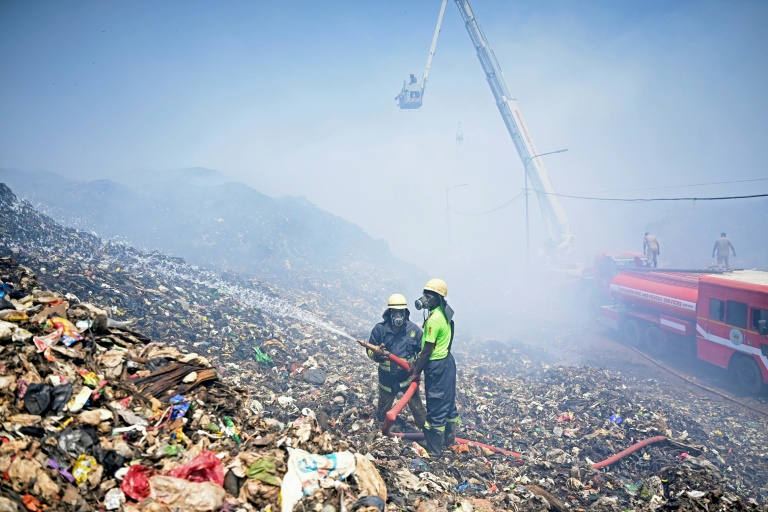
Reforms to the way that societies collect and treat their waste could slash global emissions of planet-heating methane, a new report said Monday, noting that simple measures like composting were a climate solution “staring us in the face”. 

Governments around the world have pledged to reduce emissions of methane (CH4) — which absorbs 80 times more solar radiation over short periods than carbon dioxide — in their battle to curb global warming. 

Human-induced sources of the powerful greenhouse gas are largely from livestock and manure handling, which accounts for some 30 percent of anthropogenic methane emissions, followed by the oil and gas sector (19 percent) and landfills (17 percent), according to UN climate experts.  

A new report by the organisation Global Alliance for Incinerator Alternatives (GAIA) found that simple tweaks in the waste sector, particularly in urban areas, could slash carbon emissions by the equivalent of the annual emissions of 300 million cars.  

The authors looked at “zero waste” strategies, like separating organic materials, composting, recycling non-organic material and overall reductions in discarded products. 

While reforms would not remove methane emissions from the waste system, the report estimated that policies could reduce overall emissions of methane from human sources by as much as 13 percent globally.

– Consumption changes –

The authors said that a focus on waste reduction would not only tackle methane, which leaches from landfills as organic matter rots, but could also make a major dent in the carbon pollution from the manufacture, transport and use of goods. 

“Better waste management is a climate change solution staring us in the face,” said report co-author Neil Tangri of GAIA.  

“It doesn’t require flashy or expensive new technology — it’s just about paying more attention to what we produce and consume, and how we deal with it when it is no longer needed.”

The authors stressed that tackling waste was a key element of reaching the aspirational Paris deal target of limiting global warming to 1.5 degrees Celsius above pre-industrial levels. 

The researchers modelled potential emissions reductions from eight cities around the world and found that, on average, they could cut waste sector emissions by almost 84 percent. 

Methane is responsible for roughly 30 percent of the global rise in temperatures to date. 

The powerful greenhouse gas lingers in the atmosphere only a fraction as long as CO2, but is far more efficient at trapping heat. Levels of the gas are their highest in at least 800,000 years.

At last year’s COP26 climate summit in Glasgow, more than 100 nations agreed under the Global Methane Pledge to reduce emissions 30 percent by 2030. But several major methane emitters — including China, Russia, Iran and India — failed to sign.

“This report demonstrates the huge importance of aligning our waste systems with climate goals,” said Janez Potocnik, from the International Resource Panel of the UN Environment Programme.

“It highlights the absolute necessity of reducing root sources of waste through changing our production and consumption patterns — using all the tools at our disposal to achieve the deep emissions reductions we need.”

Indonesia probes elite officers over stadium disaster

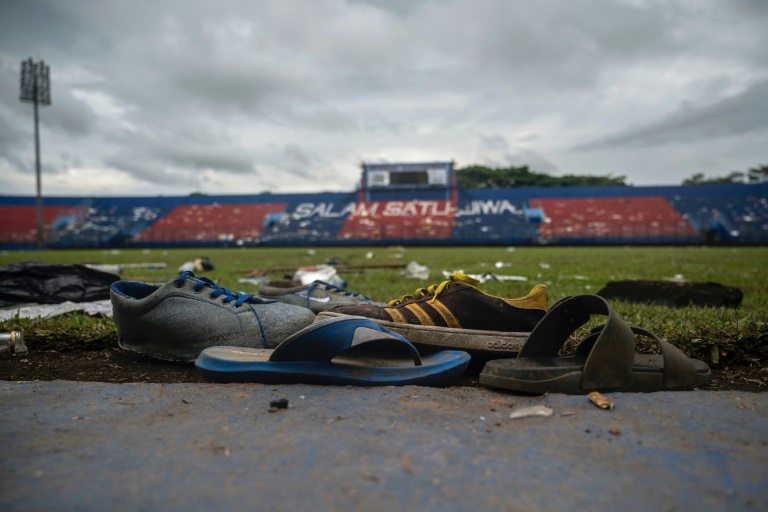
Elite Indonesian police officers were under investigation Tuesday over a stadium stampede that killed 125 people including dozens of children in one of the deadliest disasters in football history.

As public anger grew over the tragedy, police moved to punish those responsible for the crush in the city of Malang that witnesses say started when officers fired tear gas into packed stands to quell a pitch invasion.

Arema FC fans set up a makeshift centre in Malang Monday to receive legal complaints, saying they would file a lawsuit against officers for causing what they said were scores of deaths by indiscriminately targeting spectators in confined terraces.

Police described the incident as a riot and said two officers were killed, but survivors accuse them of overreacting.

“If there was a riot, it (the tear gas) should be fired to the pitch, not in the stand,” Danny Agung Prasetyo, supporter group Arema DC’s coordinator told AFP.

“Many of the victims were those who were in the stand. They were panicking because of the tear gas.”

The local police chief was replaced Monday, nine officers were suspended and 19 others were put under investigation over the disaster that struck the stadium filled with only hometown Arema FC fans, national police spokesman Dedi Prasetyo said.

The Indonesian government suspended the country’s national league and announced a task force to investigate the tragedy. It said the probe would take two to three weeks to complete.

The terraces of the Kanjuruhan stadium were packed with thousands of young “Aremania”, or Arema FC fans, to watch their team face fierce rivals Persebaya Surabaya.

But after a 3-2 defeat, the first at home for more than two decades to their adversaries from East Java’s biggest city, fans streamed down to the pitch to speak to players and management.

Police responded to the pitch invasion with force by kicking and hitting fans with batons, according to witnesses and video footage, prompting more fans to join the crowd on the pitch.

Calls for an independent investigation have grown since details of the stampede started to emerge over the weekend.

“We will find out what really happened, about the violence and the excessive use of force,” Choirul Anam, a commissioner of the National Commission of Human Rights (Komnas HAM), told a press briefing Monday.

“Why would you kick someone who was just walking on the side of the field?”

Fan anger was displayed at the stadium where a police truck was torched and the walls were daubed with graffiti that read “Tear gas vs mother’s tears” and “Our friends died here”.

– ‘Hit directly’ –

More vigils were planned in Malang on Tuesday after fans and Arema FC players gathered outside the stadium a day before to lay flowers at the scene and pray for the victims.

Among the dead were 32 children, an official at the women’s empowerment and child protection ministry told AFP, adding that the youngest was a toddler aged just three or four.

Indonesia’s health ministry said all the victims of the stampede have now been identified.

Of the hundreds injured, 68 were severely wounded and 219 suffered moderate injuries.

Twenty-six are still being treated for their wounds, health ministry official Siti Nadia Tarmizi told state news agency Antara.

Football fan violence is an enduring problem in Indonesia, and Persebaya Surabaya fans had been barred from the game because of it. 

But fans said they were not to blame.

Indonesian officials said more tickets had been allocated than should have been, while some of the stadium’s doors appeared to have been shut, according to witnesses.

That left physically stronger supporters to scale large fences in order to escape the mayhem while the most vulnerable were at the mercy of the crush as tear gas rained down.

“The doors were closed, that’s why people were pushing. Some lay down in the corner” by a closed gate to try to escape the crush, a 16-year-old survivor of the chaos told AFP.

“In the stand, there were some people who got hit directly. I saw it myself,” he said.

Everything that could go wrong at a football match, appeared to do so on Saturday night, culminating in a disaster never seen before in an Indonesian stadium.

“You could see and sense that something bad could potentially happen. That’s the kind of fear you usually get when you travel to a game here,” Indonesian football pundit Pangeran Siahaan told AFP.

“There’s a lot of dangers every time you go into a football stadium in Indonesia.”

Last stop: Paris waves goodbye to cardboard Metro tickets

The Paris Metro is phasing out cardboard tickets after 120 years, taking the capital’s urban transit into a contactless future but leaving behind nostalgic fans who will miss the humble rectangular cards.

Beyond their intended use as a transport token, the tickets with their trademark magnetic strip have inspired artists, filmmakers and singers, served as emergency notepads and, most of all, bookmarks.

“As the metro ticket disappears, so does a part of our lives,” said Gregoire Thonnat, a collector and author of a book on the history of the metro ticket. “The metro ticket is part of how we picture Paris.” 

Ile-de-France Mobilites, which operates the metro’s ticketing system, had wanted the pack of 10 tickets known as “carnets” to be gone by the first quarter of this year.

But then the Covid-19 pandemic erupted, and Russia’s war in Ukraine, and with it a global shortage of microchips needed to make the smartcards to replace the tickets — whose sales still total 550 million per year, more than 50 tonnes of paper.

“We were in a hurry, but the chip crisis slowed us down,” Laurent Probst, director-general at Ile-de-France Mobilites told AFP.

The operator has started cutting the number of metro stations that still sell carnets to nudge clients towards plastic cards, and many turnstiles can no longer read cardboard tickets.

– ‘Change their habits’ –

As a result, the share of card tickets used on urban trips has dropped from more than two-thirds a year ago to well under half now. “Our customers are beginning to change their habits,” Probst said.

He said carnets would be gone completely sometime next year.

But, probably until 2024, travellers will still be able to buy single tickets at 1.90 euros ($1.82), a markup from the 1.49 euros a single journey costs when using a smartcard.

Ile-de-France Mobilites is pushing ahead with more modernisation, including the use of smartphones at turnstiles, with Android phones to be enabled within weeks and Apple phones in 2023.

“I’m enthusiastic about this development,” Probst said. “This is a sea change in the quality of our customer service.”

Paris’s leap into the future comes 20 years after the New York subway abolished metal tokens, and more than a decade after London’s Underground went mostly paperless, but some are pleased that Paris has taken things slowly.

“I enjoy the texture of it, I enjoy the cleanness of the ticket itself when it’s new, and how much you can destroy it and still have it,” said Sarah Sturman, an Italian-American artist in Paris who uses metro tickets in her collage work.

“I’m going to keep collecting metro tickets until they’re gone, and when they’re gone they’ll be even more precious,” she told AFP.

“If I see a metro ticket in a scrapbook 10 years from now, it will all come rushing back: Memories of being on the metro late at night, or in the rush hour, my favourite metro line, or why I hate another one, losing the tickets, trying to sort through my bag at the turnstile, doing laundry and finding your crumpled metro ticket in a pocket afterwards,” she said.

– ‘Ideal thickness’ –

Cannabis smokers will also miss the 30-by-66-millimetre ticket, which can be used to make filter tips, or “crutches”, for joints.

“Ideal thickness, perfect width, readily available — the three gold standards of a good crutch,” said Jake, a Japanese-American student in Paris.

The metro ticket also has its place in popular culture, famously in singer-songwriter Serge Gainsbourg’s 1959 hit “Le Poinconneur des Lilas” (The ticket puncher at the Lilas station); as a keepsake for Yves Montand in the 1953 film “Wages of Fear”; and on the cover of Raymond Queneau’s novel “Zazie in the Metro” that director Louis Malle made into a film in 1960.

“The useful life of a metro ticket is one hour, or one and a half hours, and yet we get attached to it,” Thonnat said. “It’s quite irrational.”

“Metro ticket” is also the name of a pubic hair trimming style that leaves just a ticket-size strip after waxing. The cut, known in the United States as a “landing strip,” is the most popular among Parisian women, according to a 2020 study published by the Version Femina magazine.

– ‘Something to show our kids’ –

Some tourists visiting Paris can’t wait for the day when they won’t have to decipher complicated metro ticket machines.

“I don’t like paper tickets, I want everything on my phone,” said Javier Romani, a visitor from the Catalonia region in Spain.

“I’m against the paper tickets,” said Jeff Noel, from Indianapolis in the US state of Indiana. “If you could do this electronically in your hotel room it would be a lot easier than trying to find a machine.”

Stefania Grigoriadou, from Thessaloniki, Greece, said she preferred online booking but would hold on to the ticket she bought to get to the Disneyland Paris theme park.

“It’s nice to have it as a souvenir. Maybe we won’t come to Paris again, and so we have something to show to our kids in the future,” she told AFP.

Chile's distant paradise where scientists study climate change

Hidden inside pristine forests in Chile’s deep south, known as the end of the world, lie potential early warning signs of climate change.

Puerto Williams on Navarino island, which is separated from the South American mainland by the Beagle Channel, is the world’s southern-most town.

Far from the pollution that blights major urban and industrial centers, it is a paradise that provides unique conditions to study global warming.

“There is nowhere else like it,” Ricardo Rozzi, director of the Cape Horn International Center for global change studies and bio-cultural conservation in Puerto Williams, told AFP.

It is “a place that is especially sensitive to climate change” as average temperatures do not rise above five degrees Celsius.

This cold and windy area is the last inhabited southern frontier before reaching the Antarctic.

The ethnobotanical Omora park is home to an immense variety of lichens, mosses and fungi that scientists study by crouching down onto their knees with magnifying glasses.

In the crystal clear Robalo river, minuscule organisms act as sentinels of the changes produced by global warming.

In both the park and river, the alarm bells are ringing.

– Moss and lichen on the move –

At this latitude — 55 degrees south — climate change has an exponential effect on flora that react by seeking out low temperatures, said Rozzi, 61.

“The most obvious aspect of climate change is the rising temperatures,” he said.

“These lichens cannot survive” if a certain threshold is passed.

To escape the higher temperatures, they move.

“In the case of (mosses) we’ve noticed that they have moved. Before they were between 50 and 350 (meters above sea level) and now they are between 100 and 400,” said Rozzi.

He says Omora has more diversity per square meter of lichens and mosses than anywhere else in the world.

They also help to absorb carbon dioxide.

Another aspect is the elevational diversity gradient, an ecological pattern in which biodiversity changes with elevation.

The 700-meter high Bandera hill’s biodiversity changes every 200 meters and there is a mammoth 1.5 degrees Celsius difference in temperature between top and bottom.

“We can see what changes happen in the high mountains and in the area close to the sea in a very short distance, and we can see how the temperature affects the biodiversity that lives in this river,” Tamara Contador, 38, a biologist at the Cape Horn International Center, told AFP.

She studies the gradients themselves.

If the height difference between gradients rises or falls on the mountain, scientists can determine whether there has been a global change in temperature.

They say there has been.

– Avoiding ‘extermination’ –

“On a global level, the polar and subpolar ecosystems are the most affected by climate change, so we are in a place where climate change has a much bigger effect on biodiversity than other places,” said Contador.

River organisms also form part of the alert system.

“The organisms that live here are also indicators of water quality and global environmental change,” added Contador.

River organisms move about and have already increased their reproductive cycle, says Rozzi. This confirms there has been a small change to the climate in the area that could have been much greater elsewhere on the planet.

“Some insects that have an annual eggs to larvae to adulthood cycle are now having two cycles because the temperature has risen,” said Rozzi.

By studying these organisms and learning from them “we can avoid crossing the threshold that brings us to the extermination of humanity and other life forms,” he added.

Why crypto's big 'merge' is causing big headaches

The biggest software upgrade in the short history of crypto has fulfilled its promise to wipe out more than 99 percent of the electricity used by the second-biggest cryptocurrency, experts have told AFP.

That is no mean feat, given that the Ethereum blockchain was burning through about as much electricity as New Zealand.

Sceptics had expected glitches with the upgrade, known as “the merge”, but it ended up being a “rather boring event”, according to Alex de Vries of the Free University in Amsterdam. 

De Vries, whose Digiconomist website models the energy use of Bitcoin and Ethereum, said consumption had indeed plummeted by more than 99 percent on Ethereum.

Moritz Platt, a researcher specialising in crypto at King’s College London, said the 99 percent estimates were realistic and heralded a positive step towards “cryptocurrency sustainability”.

So the Ethereum blockchain, which supports billions of dollars of trading in games, tokens, art and the ether currency, has cleaned up its act.  

But there are complications.

Ethereum faces bitter opposition from those who lost out from the merge and it could also get greater scrutiny from regulators.

– ‘Astronomical’ growth –

The old system, known as “proof of work”, relied on people and firms to “mine” new coins — an industry worth $22 million daily before the merge, according to de Vries.  

The miners used vast power-guzzling computer rigs to compete with each other to solve complex equations, and the winner was awarded the prize of adding entries to the blockchain and generating coins. 

The merge wiped out their business model overnight. 

“Those rigs do not magically turn back into invested capital,” said a crypto-miner known only as “J” who operates between Singapore and Hong Kong. 

He said it was costing him between $30,000 and $40,000 a month to keep his staff and equipment idling while he thinks about his next move.

Plenty of miners have sold off their kit, while others are putting their rigs to work on less profitable blockchains that still use the old system. 

A miner who uses the name Leon Ravencoin, for example, has been tweeting non-stop about the “astronomical” growth of Ravencoin, one of the currencies to get a boost after the merge.

The combined computing power used by these coins is around one-fifth of the pre-merge Ethereum blockchain. 

However, de Vries said they generated only about $500,000 in daily revenue so only the most energy-efficient machines with the lowest energy costs would be able to make a profit.

As a result, one-fifth of the computing power would work out far less than one-fifth of the electricity use.

– ‘Designed to be centralised’ –

Aside from the problem with miners, the new system, known as “proof of stake”, has several issues baked in.

Anyone willing to stake a large amount of ether can now “validate” new entries on the blockchain.

The more you stake, the more chance you have of updating the chain and earning coins. 

The system gives an advantage to the biggest players, and just three companies now account for more than half of “validators”, according to research by Dune Analytics. 

Cryptocurrencies were envisaged as a decentralised alternative to the banks, corporations and governments that failed so spectacularly during the global crash of 2008.

But crypto-miner J said the new Ethereum was “designed to be more centralised” and suggested it no longer had a real purpose.

Regulators have also begun to pay attention, with US Securities and Exchange Commission Chairman Gary Gensler suggesting proof-of-stake looked like a securities market that would fall under his remit.

The disaster scenario for Ethereum would be that enough disgruntled purists switch to one of the gas-guzzling proof-of-work alternatives, with Ethereum Classic being the main one.

“There is nothing capping Ethereum Classic prices,” said de Vries, meaning that miners could potentially make good profits if the market shifted their way.

A rush from the greener blockchain was “theoretically definitely possible”, he said.

Why crypto's big 'merge' is causing big headaches

The biggest software upgrade in the short history of crypto has fulfilled its promise to wipe out more than 99 percent of the electricity used by the second-biggest cryptocurrency, experts have told AFP.

That is no mean feat, given that the Ethereum blockchain was burning through about as much electricity as New Zealand.

Sceptics had expected glitches with the upgrade, known as “the merge”, but it ended up being a “rather boring event”, according to Alex de Vries of the Free University in Amsterdam. 

De Vries, whose Digiconomist website models the energy use of Bitcoin and Ethereum, said consumption had indeed plummeted by more than 99 percent on Ethereum.

Moritz Platt, a researcher specialising in crypto at King’s College London, said the 99 percent estimates were realistic and heralded a positive step towards “cryptocurrency sustainability”.

So the Ethereum blockchain, which supports billions of dollars of trading in games, tokens, art and the ether currency, has cleaned up its act.  

But there are complications.

Ethereum faces bitter opposition from those who lost out from the merge and it could also get greater scrutiny from regulators.

– ‘Astronomical’ growth –

The old system, known as “proof of work”, relied on people and firms to “mine” new coins — an industry worth $22 million daily before the merge, according to de Vries.  

The miners used vast power-guzzling computer rigs to compete with each other to solve complex equations, and the winner was awarded the prize of adding entries to the blockchain and generating coins. 

The merge wiped out their business model overnight. 

“Those rigs do not magically turn back into invested capital,” said a crypto-miner known only as “J” who operates between Singapore and Hong Kong. 

He said it was costing him between $30,000 and $40,000 a month to keep his staff and equipment idling while he thinks about his next move.

Plenty of miners have sold off their kit, while others are putting their rigs to work on less profitable blockchains that still use the old system. 

A miner who uses the name Leon Ravencoin, for example, has been tweeting non-stop about the “astronomical” growth of Ravencoin, one of the currencies to get a boost after the merge.

The combined computing power used by these coins is around one-fifth of the pre-merge Ethereum blockchain. 

However, de Vries said they generated only about $500,000 in daily revenue so only the most energy-efficient machines with the lowest energy costs would be able to make a profit.

As a result, one-fifth of the computing power would work out far less than one-fifth of the electricity use.

– ‘Designed to be centralised’ –

Aside from the problem with miners, the new system, known as “proof of stake”, has several issues baked in.

Anyone willing to stake a large amount of ether can now “validate” new entries on the blockchain.

The more you stake, the more chance you have of updating the chain and earning coins. 

The system gives an advantage to the biggest players, and just three companies now account for more than half of “validators”, according to research by Dune Analytics. 

Cryptocurrencies were envisaged as a decentralised alternative to the banks, corporations and governments that failed so spectacularly during the global crash of 2008.

But crypto-miner J said the new Ethereum was “designed to be more centralised” and suggested it no longer had a real purpose.

Regulators have also begun to pay attention, with US Securities and Exchange Commission Chairman Gary Gensler suggesting proof-of-stake looked like a securities market that would fall under his remit.

The disaster scenario for Ethereum would be that enough disgruntled purists switch to one of the gas-guzzling proof-of-work alternatives, with Ethereum Classic being the main one.

“There is nothing capping Ethereum Classic prices,” said de Vries, meaning that miners could potentially make good profits if the market shifted their way.

A rush from the greener blockchain was “theoretically definitely possible”, he said.

Nobel Physics Prize could focus on light

Bending and manipulating light to make objects invisible or harnessing it more efficiently to produce electricity are among the discoveries tipped to win the Nobel Physics Prize on Tuesday.

The Royal Swedish Academy of Sciences is due to announce the winner at 11:45 am (0945 GMT).

Last year, the academy honoured Syukuro Manabe, of Japan and the United States, and German Klaus Hasselmann for their research on climate models, while Italian Giorgio Parisi also won for his work on the interplay of disorder and fluctuations in physical systems.

David Pendlebury, head of Clarivate — an organisation which keeps a close eye on potential laureates in the sciences — said the committee is likely to stay terrestrial this year.

“There have been so many astrophysics, cosmology prizes, just in the last few years. So I don’t think that’s on the table this year,” he told AFP.

He said a likely pick could be Britain’s John B. Pendry, who has become famous for his “invisibility cloak,” where he uses materials to bend light to make objects invisible.

Other potential winners are Sajeev John and American Eli Yablonovitch, who in 1987 discovered photonic crystals that can control and manipulate the flow of light.

– Photovoltaics? –

Ulrika Bjorksten, a science commentator for Swedish public radio, said the academy could also focus on photovoltaics: the conversion of light to electricity.

Bjorksten said work on perovskite — a material discovered by the Russian mineralogist Lev Perovski in the 19th century — might get recognised.

This could steer the academy towards Britain’s Henry Snaith, a physics professor at the University of Oxford, who is developing new materials and structures for hybrid solar cells.

The relatively recent discovery that metal halide perovskites can operate extremely efficiently in thin film solar cells makes him a contender, Bjorksten said.

“He was the origin for why there was so much attention given to perovskite,” Bjorksten told AFP.

South Korea’s Nam-Gyu Park could also be a candidate for his research into improving the stability of photovoltaic cells.

Specialists in photovoltaics on the other hand could potentially be overlooked since the field is so vast, according to Bjorksten.

“It’s really difficult… because there are so many involved,” Bjorksten said.

Linus Brohult, editor of the science desk at Swedish public broadcaster SVT, said the microphysics expert Stephen Quake, could be considered for work on microscopic fluid dynamics.

– Women absent –

Only four women — Marie Curie (1903), Maria Goeppert Mayer (1963), Donna Strickland (2018) and Andrea Ghez (2020) — have won the Nobel Physics Prize since the award was instituted in 1901.

“It reflects the unfair conditions in society, particularly in years past but still existing,” Goran Hansson, secretary general of the Swedish Academy of Sciences, told AFP last year.

Quotas however have been ruled out.

“We want every laureate (to) be accepted… because they made the most important discovery, and not because of gender or ethnicity,” Hansson said.

Last year, 12 men and one woman won Nobel Prizes, with all of the science nods going to men.

The physics prize is followed by chemistry on Wednesday, with the highly watched literature and peace prizes announced on Thursday and Friday respectively.

For the literature prize, critics told AFP they thought the Swedish Academy may go for a more mainstream author this year, after selecting lesser-known writers the past two years.

Last year, Tanzanian author Abdulrazak Gurnah won, while US poet Louise Gluck was crowned in 2020.

The peace prize is expected to hold a special significance this year given the Russian invasion of Ukraine.

The International Criminal Court, tasked with investigating war crimes in Ukraine, has been mentioned as a possible laureate this year, along with jailed Russian dissident Alexei Navalny and Belarusian opposition leader Svetlana Tikhanovskaya.

Nobel Physics Prize could focus on light

Bending and manipulating light to make objects invisible or harnessing it more efficiently to produce electricity are among the discoveries tipped to win the Nobel Physics Prize on Tuesday.

The Royal Swedish Academy of Sciences is due to announce the winner at 11:45 am (0945 GMT).

Last year, the academy honoured Syukuro Manabe, of Japan and the United States, and German Klaus Hasselmann for their research on climate models, while Italian Giorgio Parisi also won for his work on the interplay of disorder and fluctuations in physical systems.

David Pendlebury, head of Clarivate — an organisation which keeps a close eye on potential laureates in the sciences — said the committee is likely to stay terrestrial this year.

“There have been so many astrophysics, cosmology prizes, just in the last few years. So I don’t think that’s on the table this year,” he told AFP.

He said a likely pick could be Britain’s John B. Pendry, who has become famous for his “invisibility cloak,” where he uses materials to bend light to make objects invisible.

Other potential winners are Sajeev John and American Eli Yablonovitch, who in 1987 discovered photonic crystals that can control and manipulate the flow of light.

– Photovoltaics? –

Ulrika Bjorksten, a science commentator for Swedish public radio, said the academy could also focus on photovoltaics: the conversion of light to electricity.

Bjorksten said work on perovskite — a material discovered by the Russian mineralogist Lev Perovski in the 19th century — might get recognised.

This could steer the academy towards Britain’s Henry Snaith, a physics professor at the University of Oxford, who is developing new materials and structures for hybrid solar cells.

The relatively recent discovery that metal halide perovskites can operate extremely efficiently in thin film solar cells makes him a contender, Bjorksten said.

“He was the origin for why there was so much attention given to perovskite,” Bjorksten told AFP.

South Korea’s Nam-Gyu Park could also be a candidate for his research into improving the stability of photovoltaic cells.

Specialists in photovoltaics on the other hand could potentially be overlooked since the field is so vast, according to Bjorksten.

“It’s really difficult… because there are so many involved,” Bjorksten said.

Linus Brohult, editor of the science desk at Swedish public broadcaster SVT, said the microphysics expert Stephen Quake, could be considered for work on microscopic fluid dynamics.

– Women absent –

Only four women — Marie Curie (1903), Maria Goeppert Mayer (1963), Donna Strickland (2018) and Andrea Ghez (2020) — have won the Nobel Physics Prize since the award was instituted in 1901.

“It reflects the unfair conditions in society, particularly in years past but still existing,” Goran Hansson, secretary general of the Swedish Academy of Sciences, told AFP last year.

Quotas however have been ruled out.

“We want every laureate (to) be accepted… because they made the most important discovery, and not because of gender or ethnicity,” Hansson said.

Last year, 12 men and one woman won Nobel Prizes, with all of the science nods going to men.

The physics prize is followed by chemistry on Wednesday, with the highly watched literature and peace prizes announced on Thursday and Friday respectively.

For the literature prize, critics told AFP they thought the Swedish Academy may go for a more mainstream author this year, after selecting lesser-known writers the past two years.

Last year, Tanzanian author Abdulrazak Gurnah won, while US poet Louise Gluck was crowned in 2020.

The peace prize is expected to hold a special significance this year given the Russian invasion of Ukraine.

The International Criminal Court, tasked with investigating war crimes in Ukraine, has been mentioned as a possible laureate this year, along with jailed Russian dissident Alexei Navalny and Belarusian opposition leader Svetlana Tikhanovskaya.

Close Bitnami banner
Bitnami