World

Top US ski mountaineer gets Buddhist cremation in Nepal

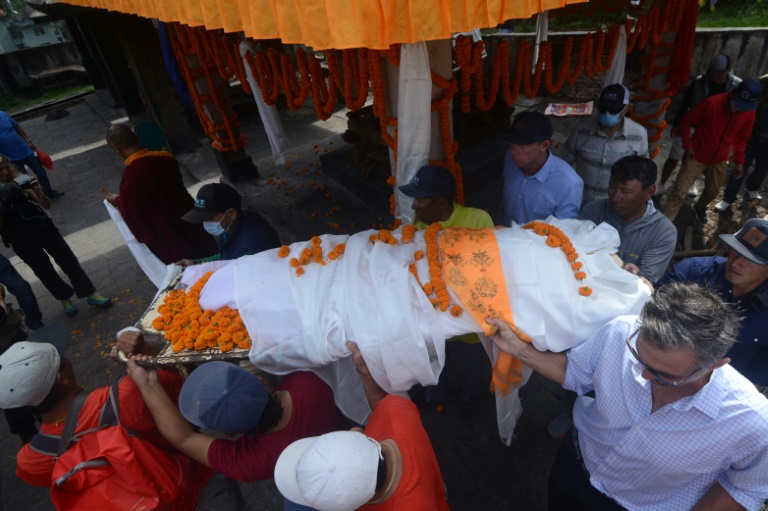
The body of renowned US ski mountaineer Hilaree Nelson, who died on Nepal’s Manaslu peak, was cremated close to a Buddhist stupa in Kathmandu on Sunday.

Nelson’s body was found on the slopes of the world’s eighth highest mountain on Wednesday, two days after she disappeared as she was skiing down from its summit.

Monks chanted prayers and played traditional drums as her family and fellow climbers offered flowers and traditional Buddhist scarves on her body. 

“The cremation was done today, attended by her brother, other climbers and officials,” Jiban Ghimire of Shangri-La Nepal Trek, which organised the expedition, told AFP.

Orange marigolds decorated the cremation area at the foothills of Swayambhu Nath stupa, one of the holiest Buddhist sites in Nepal. 

Nelson, 49, was regarded as one of the world’s most talented ski mountaineers and had been involved in dozens of expeditions around the world.

A decade ago, she became the first woman to summit both the highest mountain in the world, Everest, and the adjacent Lhotse peak within the span of 24 hours.

Then in 2018, she returned to Lhotse and made the first ski descent of the mountain, and her accomplishments earned her the prestigious National Geographic Adventurer of the Year award that year. 

Jim Morrison, who had accompanied Nelson and was able to ski down safely, led the search operations that located her body after bad weather hampered earlier rescue efforts.

Morrison said after the ceremony he would take the ashes home to the United States where Nelson’s two children live.

“It should be a beautiful tribute which Hilaree’s family and I feel this is how she would want things performed,” he said. “Her radiance will continue to affect us all.” 

Tributes have been pouring from top climbers around the world, thanking her and calling her a pioneering and inspiring adventurer.

On the day of Nelson’s accident, an avalanche hit between Camps 3 and 4 on the 8,163-metre (26,781-foot) mountain, killing Nepali climber Anup Rai and injuring a dozen others who were later rescued.

The deaths of Nelson and Rai are the first confirmed casualties of the autumn climbing season in Nepal.

Constant rain and snow have been a challenge for the 404 paying climbers attempting to reach the summit of Manaslu this year.

Several tents were damaged when another avalanche came hurling down to the Manaslu basecamp on Sunday morning, according to the tourism department, but no deaths have been reported. 
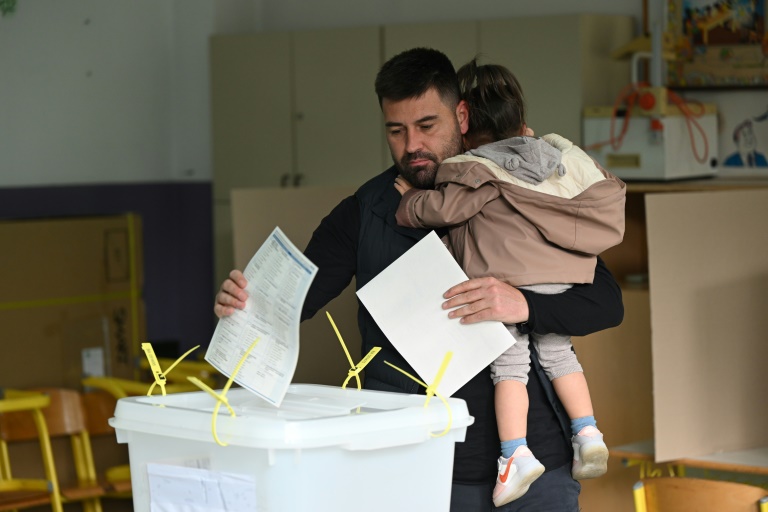
Ethnic tensions dominate as Bosnia votes

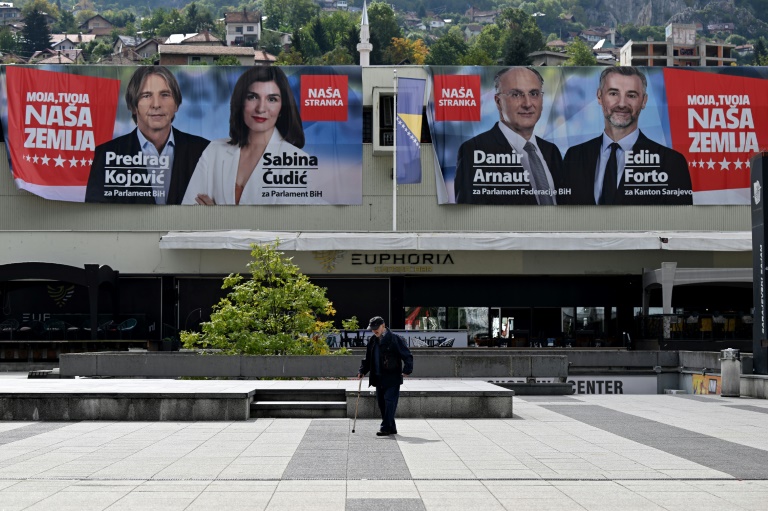
Bosnians voted in general elections on Sunday, following a campaign marked by threats of secession, political infighting, and fears of future turmoil as ethnic tensions in the country grow.  

Voters are casting ballots in a dizzying number of contests, including for the three members of Bosnia’s tripartite presidency, the deputies of the central parliament and a string of local races.

Polls opened at 7:00 am local time (5:00 GMT).

Nearly three decades after war ravaged the Balkan country, Bosnia continues to be burdened by its ethnic divisions. 

The Balkan state has been governed by a dysfunctional administrative system created by the 1995 Dayton Agreement that succeeded in ending the conflict in the 1990s, but largely failed in providing a framework for the country’s political development.

Bosnia remains partitioned between a Serb entity — the Republika Srpska (RS) — and a Muslim-Croat federation connected by a weak central government.

In the war’s wake, ethnic political parties have long exploited the country’s divisions in a bid to maintain power.

“I hope for nothing. I vote because that is the only thing I can do as an individual,” said Amra Besic, a 57-year-old economist, after voting.

– Coalition clash –

In the run-up to Sunday’s vote, the country has been torn between secessionist Orthodox Serbs and Catholic Croats demanding greater autonomy and electoral reforms. 

The country’s Muslim Bosniaks will also face a choice of voting for a disparate, 11-party coalition that is trying to unseat the rule of the mainstream SDA.

The SDA is led by Bakir Izetbegovic — the son of the first president of independent Bosnia — and has largely dominated the political scene in the country for decades. 

After casting a ballot at a polling station in downtown Sarajevo, Izetbegovic called on Bosnians to vote for politicians “who will not create blockades and crises, who will not chase away the youth from Bosnia-Herzegovina”. 

Ahead of the polls, many voters said the lack of young candidates offering fresh ideas has left them largely uninspired. 

“Most of the candidates that are running are the ones we have been watching for the last twenty years,” said Sara Djogic, a 21-year-old philosophy student in the capital Sarajevo. 

“There are not many who offer something new,” she added.

With little to no polling data available, analysts say incumbents and nationalist parties that have dominated the post-war political scene are likely to win many of the races.

The leader of Bosnia’s Serbs, Milorad Dodik, is seeking his third term as the president of the RS, after completing a stint in the tripartite presidency. 

For the past year, Dodik has been stoking tensions with his frequent calls for Bosnia’s Serbs to separate even further from the country’s central institutions, earning him fresh sanctions from the US in January. 

“People are motivated to vote for stability, for peace, for a safe life in this region,” said Dodik after voting in his home village of Laktasi in the RS. 

Dodik’s primary challenger Jelena Trivic has vowed to crack down on corruption in the RS if elected. 

“Our revenge will be the law,” Trivic said before the vote.

– Fears of turmoil –

For the country’s Catholic Croats, political turmoil has also been brewing.

Ahead of the election, many Croats have been demanding electoral reforms with the leading nationalist party HDZ threatening to boycott the contest.

Their grievances are steeped in the vast numerical advantage held by Bosniaks in the Muslim-Croat federation, which has allowed Muslim voters to hold de facto control over who can be elected to lead the Croats at the presidential level. 

HDZ and other Croat parties have been calling for the creation of a new mechanism to allow the community to choose their own representatives to the presidency and upper house. 

The move, however, has been fiercely opposed by the federation’s ruling Bosniak party.

With threats of fresh boycotts, fears are growing of potential turmoil after the polls if the incumbent Croat co-president Zeljko Komsic — who is widely reviled by all Croat parties that view him as a Bosniak proxy — is re-elected.

The ever-present threats and vitriol has led some to skip the polling booth Sunday. 

“I do not expect anything new after these elections. Everything will be the same,” said Mira Sladojevic, a pensioner in her seventies in Sarajevo.

“I haven’t voted for a long time,” she added. 

The first wave of preliminary results is expected several hours after the polls close at 7:00 pm (17:00 GMT).

Bulgarians vote again, anxious about soaring prices

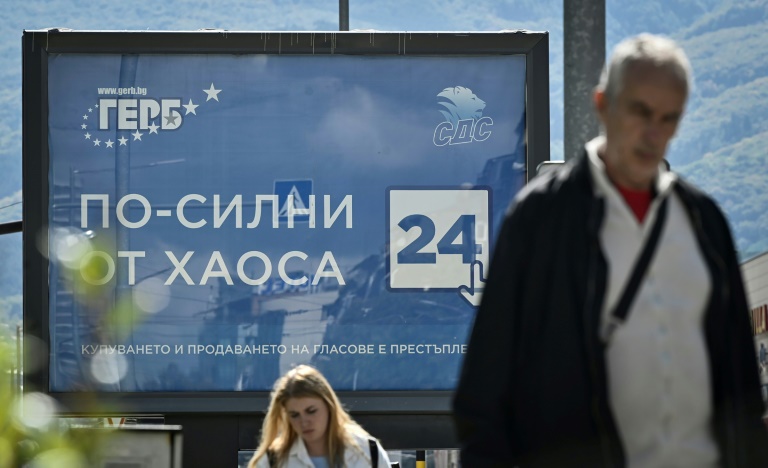
Bulgarians voted Sunday in their fourth general election in 18 months, anxious about soaring consumer prices and energy costs ahead of a winter overshadowed by the Ukraine war.

While endemic corruption was the focus of the previous vote last November, economic woes are now top of voters’ concerns.

The European Union’s poorest member state is battling annual inflation of close to 20 percent.

“Voters are preoccupied with the prices a lot more than with the geostrategical topics that political parties bicker about,” political analyst Antony Todorov told AFP before polls opened at 7:00 am (0400 GMT). 

They will close at 8:00 pm when polling agencies will announce their first exit poll results.

Krasimira Velkova, a 64-year-old economist from Sofia who came to cast her ballot shortly after polls opened, confirmed these fears.

“People worry about inflation, about the fact that when you enter a food store, a shopping trolley that’s just half full costs a fortune. The difference compared to last year is absolutely staggering,” she told AFP.

“We are worried about how we’ll get through the winter, how we’ll bear the cold, if we’ll be able to pay our bills,” Velkova added.

Bulgaria’s former three-time premier Boyko Borisov, 63, who dominated politics for a decade and is now eyeing a comeback on a “return to stability” platform, could benefit from people’s fears.

Polls on the eve of the ballot show support for his conservative GERB party rising, crediting it with about 25 percent of the votes.


– ‘More work to do’ – 

The Balkan country has been dogged by political instability since early last year when GERB lost power following massive anti-corruption demonstrations. 

Borisov’s rival, outgoing reformist premier Kiril Petkov, 42, has urged voters to let him “continue the change” he started but is lagging in the polls on around 16 percent.

The Harvard-educated former entrepreneur stormed onto the political scene in 2021 and managed to piece together a precarious four-party coalition after winning last November’s vote.

However, after only a seven-month stint in power, he was toppled in a no-confidence motion.

In an interview with AFP this week, Petkov trumpeted his success in the fight against “corruption practices” that allowed his cabinet to redistribute public funds, offering pension rises and free kindergarten.

“So it’s a great first step, but we have a lot more work to do,” he said.

“The challenge is to really show that the Bulgarians have made the choice, the choice for a new European, progressive, transparent Bulgaria versus going back to the years of transition, to the politicians of corruption,” he urged.

Retired lawyer Sasho Chobanov, 74, hailed the “right foundations” laid down by Petkov’s reformist, even if short-lived, cabinet.

“The only thing that I am anxious about, from a moral point of view, is not to have the bandit party come back to power,” he said, referring to GERB.


– Pro-Russian kingmakers? –

Petkov categorically ruled out forming a coalition with Borisov, heightening fears the vote may fail to end the country’s worst period of political instability since the end of communism in 1989. 

Borisov, on the other hand, has said he would be “open to anyone” for talks on a cabinet for the sake of stability.

Todorov, the analyst, said he was sceptical about the chances of Borisov’s GERB party being in that position.

“I don’t believe that GERB, which is very isolated, could return to power,” Todorov said.

“The situation is critical, Bulgaria needs a government but not at any cost,” he added.

The protracted political instability has left Bulgaria struggling to pass reforms and has hampered economic growth.

Another analyst, Georgy Kiryakov, said Borisov could find potential coalition partners in the Turkish minority MRF party and the ultra-nationalist Vazrazhdane party.

The openly pro-Russian formation has gained popularity since the start of the Russian invasion of Ukraine in February.

In a country with close historical, economic and cultural ties with Moscow, latest polls credit it with 11 to 14 percent of the vote.

Hundreds of women protest femicide in Ecuador

Hundreds of women marched Saturday against femicide in Ecuador, which a gender violence NGO says has claimed more than 200 victims since the start of the year.

The country was rocked by the murder of lawyer Maria Belen Bernal, 34, last month, who disappeared after entering a police training facility in capital Quito where she had gone to visit her husband.

The incident sparked nationwide protests and police have named her husband, who is on the run, as the main suspect.

On Saturday, protesters held up placards that read “Look at me carefully because I could be the next” victim and chanted “We want to live”.

Protests took place on the streets of the capital Quito as well as other parts of Ecuador following a call from social organizations to stand “united against the femicide state”.

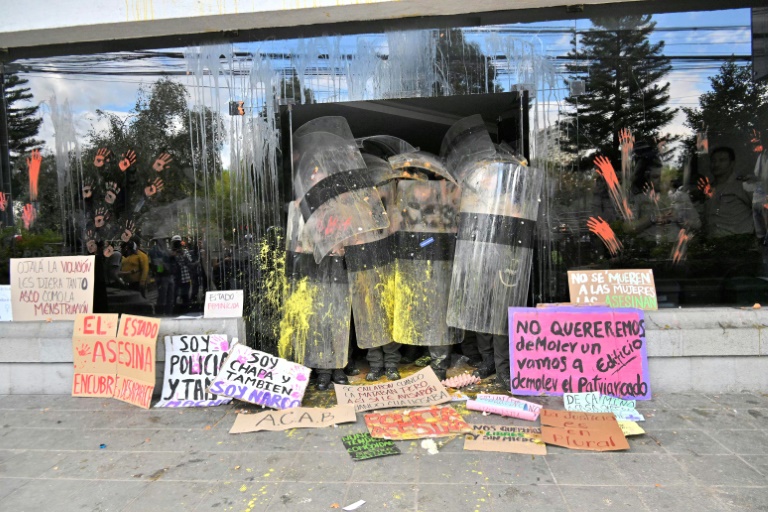
That slogan was also sprayed in front of the police headquarters in Quito, where protesters congregated to pelt the building with eggs and splatter red and yellow paint across its facade.

Bernal’s body was found four days after she disappeared on a hill some five kilometers (three miles) from the Quito police training school.

A sign reading “Murderous police” was placed at the feet of officers dressed in riot gear and their shields were covered in paint.

President Guillermo Lasso has since ordered the dismissal of two generals and Interior Minister Patricio Carrillo.

There have been 206 femicides in Ecuador since the beginning of the year, according to an NGO that monitors gender violence. 

The Attorney General’s Office says that since 2014, 573 femicides have been committed, a crime punishable by up to 26 years in prison. 

According to official statistics, 65 out of 100 women between 15 and 49 have experienced some form of violence in Ecuador.

UK's Truss admits tax cuts misstep at start of tense Tory conference

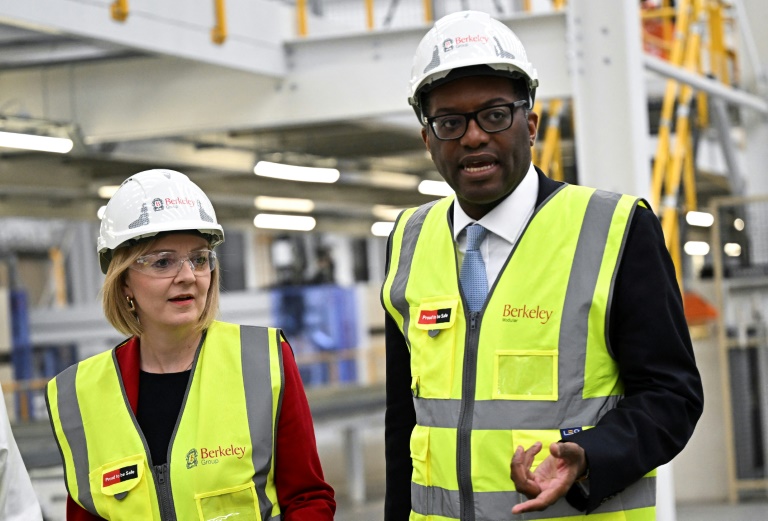
UK Prime Minister Liz Truss on Sunday conceded she should have better prepared Britain for her recent debt-fuelled mini-budget, which sparked a week of market turmoil, dismal headlines and disastrous polls.

Less than a month into the job but already mired in a deep crisis, the new Tory leader insisted her controversial plans would return Britain to economic growth, as it grapples with decades-high inflation and imminent recession.

“I do stand by the package we announced… but I do accept we should have laid the ground better there,” Truss told the BBC as her restive ruling Conservatives’ annual conference gets underway in Birmingham.

“We have a clear plan moving forward both to deal with the energy crisis and to deal with inflation, but also to get the economy growing and to put us on a good long-term footing,” she added.

Opposition parties, much of the public and even Conservative MPs — notably backers of her defeated leadership rival Rishi Sunak — are aghast at the proposals to cut taxes unveiled 10 days ago by finance minister Kwasi Kwarteng.

Markets tanked in response to the package, and the Bank of England staged an emergency intervention to bail out embattled pension funds, setting the stage for a difficult four-day gathering in Birmingham.

Appearing on the BBC immediately after Truss, senior Tory MP Michael Gove branded the plans “profoundly” wrong and said there would need to be “a course correction”.

Ahead of Sunday, Truss broke nearly a week of silence Thursday with a round of broadcast interviews with regional BBC stations — when her awkward pauses generated almost as many headlines as her defence of the plan.

She then followed up with further interviews and a newspaper article Friday in which she vowed to press on with the policies but get “an iron grip” on public finances.

“Of course, we need to bring down borrowing as a proportion of GDP over the medium term, and I have a plan to do that,” the under-fire leader reiterated Sunday.

The live TV appearance was her first before a national UK audience since Kwarteng unveiled the contentious proposals on September 23, and comes after a raft of polls showed a dramatic slump for her party.

One poll Friday by YouGov found that 51 percent of Britons think that Truss should resign — and 54 percent want Kwarteng to go.

– Existential threat? –

Several other polls in recent days showed the opposition Labour party with mammoth leads of up to 33 points over the Conservatives — its biggest since the heyday of former Labour prime minister Tony Blair in the late 1990s.

Echoing Blair, Labour leader Keir Starmer says that his party now represents mainstream UK voters, and has demanded Truss recall parliament rather than press ahead with her conference.

As it is, both Sunak and former prime minister Boris Johnson are reportedly staying away from Birmingham.

But Truss will have plenty of critics lying in wait at what the Tories bill as Europe’s largest annual political event.

Protesters angry at rising energy bills and the government’s handling of the worsening cost-of-living crisis massed in London and Birmingham Saturday, with more demonstrations planned for the start of the Tory conference Sunday.

Kwarteng is due to address the party’s four-day grassroots gathering on Monday, before Truss closes it with the leader’s keynote speech on Wednesday.

Although both have ruled out a U-turn on their economic package, they conceded ground Friday by allowing the Office for Budget Responsibility to send Kwarteng an initial independent costing score-card of it later next week.

The conference programme has already been pared back to eliminate some of its fringe partying following the September 8 death of Queen Elizabeth II -– who appointed Truss only two days before she died. 

Not that there is much to celebrate for the Tories, given their poll ratings, which have fuelled speculation that Truss could face her own leadership challenge, or that she may sacrifice Kwarteng.

Many commentators are urging contrition from the duo in Birmingham, to avoid the kind of doomsday scenario laid out by senior Tory MP Charles Walker.

A general election is not due until January 2025 at the latest. But if one were held tomorrow, Walker said, “we would cease to exist as a functioning political party”.

At least 174 dead in Indonesia football stadium stampede

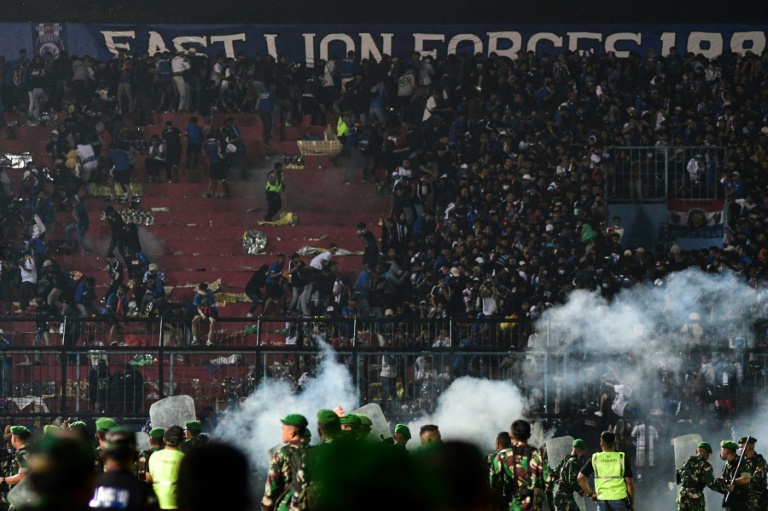
At least 174 people died at an Indonesian football stadium when  thousands of angry home fans invaded the pitch and police responded with tear gas that triggered a stampede, authorities said Sunday.

The tragedy on Saturday night in the city of Malang, which also left 180 injured, was one of the world’s deadliest sporting stadium disasters.

Arema FC supporters at the Kanjuruhan stadium stormed the pitch after their team lost 3-2 to the visiting team and bitter rivals, Persebaya Surabaya.

Police, who described the unrest as “riots”, said they tried to force fans to return to the stands and fired tear gas after two officers were killed. 

Many of the victims were trampled or choked to death, according to police. 

At least 174 people died, East Java deputy governor Emil Dardak told broadcaster Kompas TV on Sunday afternoon, raising the toll from 129.

Survivors described panicking spectators in a packed crowd as tear gas rained down on them.

“Officers fired tear gas, and automatically people were rushing to come out, pushing each other and it caused many victims,” 43-year-old spectator Doni, who declined to give his last name, told AFP. 

“Nothing was happening, there was no riot. I don’t know what the issue was, they suddenly fired tear gas. That’s what shocked me, didn’t they think about kids, women?”

President Joko Widodo ordered an investigation into the tragedy, a safety review into all football matches and directed the country’s football association to suspend all matches until “security improvements” were completed.

“I deeply regret this tragedy and I hope this football tragedy will be the last in our country,” Widodo said.

A hospital director told local TV that one of the victims was five years old.

Images taken from inside the stadium during the stampede showed police firing huge amounts of tear gas and people clambering over fences. 

People were carrying injured spectators through the chaos. 

“It was so terrifying, so shocking,” 22-year-old survivor Sam Gilang, who lost three friends in the crush, told AFP.

“People were pushing each other and… many were trampled on their way to the exit gate. My eyes were burning because of the tear gas. I fortunately managed to climb up the fence and survived,” he said.

– Enduring violence –

Video footage circulating on social media showed people shouting obscenities at police, who were holding riot shields and wielding batons.

Torched vehicles, including a police truck, littered the streets outside the stadium on Sunday morning. Police said 13 vehicles in total were damaged.

The stadium holds 42,000 people and authorities said it was a sell-out. Police said 3,000 people stormed the pitch. 

Fan violence is an enduring problem in Indonesia, where deep rivalries have previously turned into deadly confrontations.

Arema FC and Persebaya Surabaya are longtime rivals.

Persebaya Surabaya fans were not allowed to buy tickets for the game due to fears of violence.

However Indonesia’s coordinating minister for political, legal and security affairs, Mahfud MD, said organisers ignored the recommendation of authorities to hold the match in the afternoon instead of the evening.

And he said the government had recommended only 38,000 tickets be printed, but there was instead a sell-out crowd of 42,000.

– ‘Take some measures’ –

Before Widodo’s announcement, the Football Association of Indonesia (PSSI) apologised to victims’ families and suspended football matches of Indonesia’s top league, BRI Liga 1, for one week. 

It also banned Arema FC from hosting home games for the rest of the season.

The association had communicated with FIFA about the stampede and hopes to avoid sanctions from the world football governing body, PSSI secretary general Yunus Yussi told a press conference.

On why police used tear gas inside the stadium, he said they “had to take some measures to anticipate” spectators entering the pitch.

The Asian Football Confederation, the governing body for football in the region, expressed its regret at the loss of lives in the disaster.

Indonesia is to host the FIFA Under-20 World Cup in May at six stadiums across the country. The Kanjuruhan stadium in Malang is not included in that list.

It is also bidding to replace China as host of the 2023 Asian Cup alongside South Korea and Qatar, with a decision due later this month.

Other stadium disasters include a 1989 crush in the stands at Britain’s Hillsborough Stadium, which led to the deaths of 97 Liverpool fans, and the 2012 Port Said stadium tragedy in Egypt where 74 people died in clashes.

In 1964, 320 people were killed and more than 1,000 injured during a stampede at a Peru-Argentina Olympic qualifier at Lima’s National Stadium.

In Latin America, World Cup stickers are a quadrennial craze

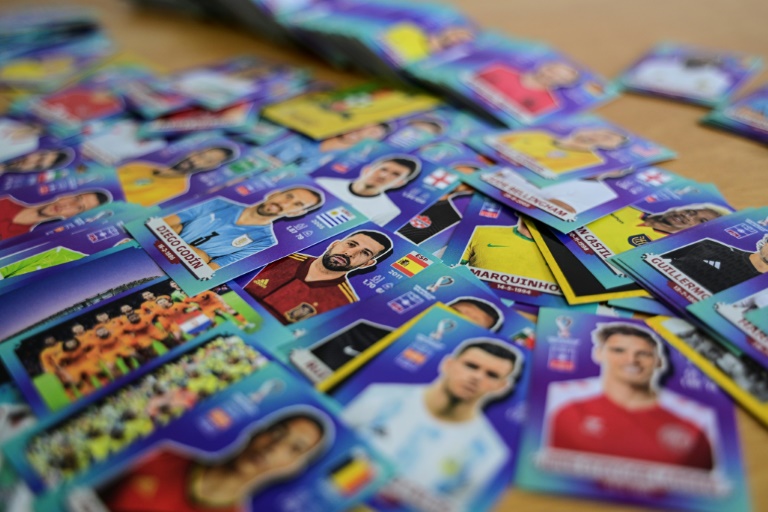
Some spend crazy amounts, others line up at dawn or gather at informal swap meets — anything to satisfy a passion that combines love of soccer, this year’s World Cup in Qatar and the ever-popular pursuit of Panini soccer stickers.

Sold in 150 countries, the stickers seem to arouse a particular frenzy in Latin America because of the possibility that this might be the last World Cup for Argentinian football icon Lionel Messi, who is 35, or that a Latin American side might finally break Europe’s hold on the Cup. 

“Almost everything I earn, that anyone lends me, or that they owe me, I invest in the stickers,” Hilda Losada, who is Argentinian, told AFP.

The 68-year-old grandmother, who is working to complete her album of nearly 700 stickers — and her grandson’s as well — has been waiting in line since 5:00 am for the opening of a store in Buenos Aires.

The stickers have been in short supply for days in Argentina, with the government itself intervening to mediate between the Italian publisher and frustrated shopkeepers who want a bigger piece of the juicy trade. 

“This is one of the few places where you can find them now,” Losada said, standing in a long line of collectors.

Not everyone will leave happy, and some are vowing to turn to the black market, if need be, even if it costs twice the official price of about $1 for five stickers. 

Her family tells her she’s crazy, but Losada pays them no mind as she happily pursues her fascination. She has been collecting the cards every four years since she was “a little girl,” she insists, even if galloping inflation in Argentina — currently at 56 percent — does not make that easy.

“Argentina is nearly always in an economic crisis,” shrugged the shop owner, Leila Edul. “But now, with these stickers… money somehow appears out of nowhere.”

That is true despite the soaring price of a packet since the 2018 World Cup in Russia. In Brazil, the cost has doubled, from 37 US cents to 74 cents. 

– ‘We like to trade’ –

“My father bought me three packets,” said an exuberant Tiziano Orselli, 14, as the two inspected the offerings at a swap meet at Buenos Aires’s Rivadavia Park.

“When I saw ‘Argentina 19’ and realized it was Messi, I was too happy,” he said. I showed it to everybody and then I stuck it, there, in the album,” he said, his eyes still wide at the thought. 

Mauricio Valencia had set up a table on sawhorses and piled it high with stacks of stickers to trade or sell. He said he had done this previously in Colombia, because “in Latin America we like to trade (Panini) stickers.” 

“But it’s not the same here,” he added. “There is such fervor — it’s packed every weekend.” 

Raul Vallecillo, a Panini official in Chile, said Latin American sales have exceeded the expectations of the Italian manufacturer, which published its first album for the 1970 World Cup in Mexico.

Chile’s national team did not qualify for this year’s World Cup, which opens in Qatar in November, yet Panini sold in a single month the stock it had expected to last four months, he said. The same trend holds in Venezuela, Colombia and Peru, all of which also failed to qualify, he said.

Vallecillo said the infatuation with the cards is heightened by the likelihood that this will be the last appearance of aging superstars like Messi and Cristiano Ronaldo, as well as the hope the Argentine or Brazilian side will be able to break the European teams’ 20-year stranglehold on the championship. 

– Street vendors –

In Sao Paulo, collectors have been gathering outside the Football Museum.

Forty-year-old Leandro Fonseca is on the hunt for some special-edition stickers, including some with Neymar’s image, which have been selling on the internet for hundreds of dollars.

“I’m off to a late start on the ‘extras,’ but I hope to fill 20 albums, he said. “I fill several during every World Cup.”

He said he had spent around $1,800 so far to complete seven albums.

Across Latin America, the resale business is brisk. 

On a busy road in Montevideo, children come, carrying lists of sticker numbers, to try to buy those they’re missing.

The stickers of stars like Messi, Neymar and local favorite Luis Suarez sell for around 100 pesos ($2.40). Other lesser stars from the Uruguayan, Argentine or Brazilian sides go for 20 to 50 pesos, while still others go for just 10 pesos (though a star like France’s Kylian Mbappe brings in 50 pesos). 

Guillermo Orcile has been helping his seven-year-old son Salvador complete his album entirely through trades.

“It’s important that he understand how trading works, which makes these albums important,” he said.

“Because if it’s just about buying, then the spirit is lost.”

Ukraine demining teams race to clear danger before winter

Small, hidden and lethal, mines and other explosives left behind by retreating Russian forces in eastern Ukraine pose an urgent challenge for demining teams ahead of winter.

“Without us, there is no chance of repairing services like electricity before winter,” said Artem, who heads a mine-clearing unit working around recently liberated Izyum.

“We found more than 30 mines and artillery shells today, mostly shells,” the 33-year-old told AFP, wiping his brow after removing his protective eyewear.

His 10-strong unit is tasked with clearing areas around damaged critical infrastructure such as electricity cables, water and gas pipes.

“Every day we start off where we finished yesterday,” he said, as a team of electricity workers gingerly advanced in single file behind a mine clearer into a sunflower field and towards a broken cable.

Other colleagues stacked discovered mines with detonators safely removed beside a truck for loading and disposal.

Demining teams dot the debris-strewn road verges between Izyum, which was captured by Ukrainian forces last month after six months, and the border of Donetsk region not far down the road.

Artem, who didn’t want to give his full name, spoke candidly about his team’s perilous work, scanning road verges and carefully wading into tall grass fields. 

“Its our job, it’s what we know how to do, but now even more than ever it’s our duty,” he said, referring to Russia’s invasion of Ukraine.

– No end in sight –

“We have 35 staff, in seven teams, from different regions of Ukraine,” said Vasyl Maidyk, commander of the demining teams in Izyum district.

“Nobody knows how long the process will last,” the 42-year-old told AFP at the base in Izyum.

“Despite the help of international organisations we haven’t even finished finding mines left since the first phase of the conflict began in 2014,” he said. 

But he added that “if we work quickly”, Izyum district can be cleared by November so that infrastructure can be operational again by winter.

Since the liberation of Izyum in early September, his teams have covered some 100 hectares in the district, and found over 5,000 mines from around former Russian positions.

The haul includes both anti-tank and anti-personnel mines as well as artillery shells, and, he said, “butterfly” mines, which are internationally banned. 

The small green explosives with wing-like sides, known in Ukrainian as “petals”, are especially dangerous, according to Maidyk, as they can be picked up by children.

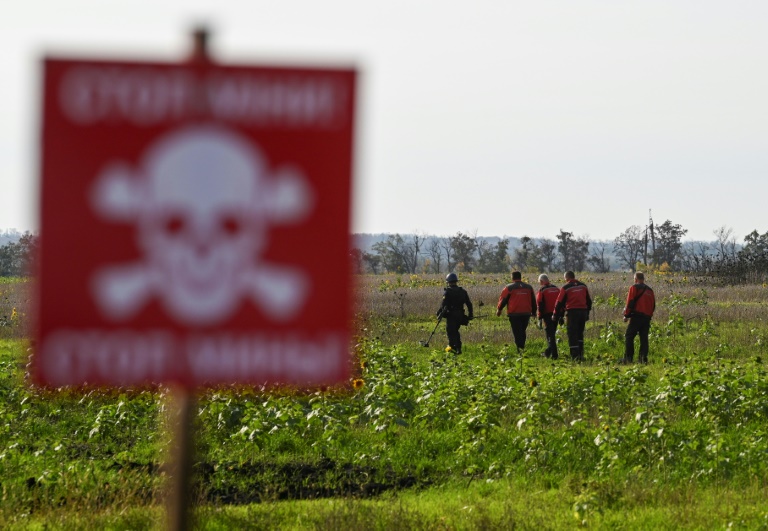
Out on the road, emptied of traffic other than military vehicles headed for the front, one of Sacha’s team hammers in wooden poles along the cleared verges.

“It’s no more dangerous than crossing the road on a normal day,” said 44-year-old Sacha with a shrug and a cigarette in his mouth.

“Now the nearest mine is two metres away, so it’s safe here more or less,” he said as a colleague stapled a red sign to the pole with a white skull and crossbones reading: “Danger – Mines!”

Bosnia heads to polls as ethnic tensions dominate vote

Bosnians headed to the polls Sunday to vote in general elections following a campaign season marked by threats of secession, political infighting, and fears of future turmoil as ethnic tensions in the country grow.  

Voters are casting ballots in a dizzying number of contests, including for the three members of Bosnia’s tripartite presidency, the deputies of the central parliament and a string of local races.

Polls opened at 7:00 am local time (5:00 GMT). 

Nearly three decades after war ravaged the Balkan country, Bosnia continues to be burdened by its ethnic divisions. 

The Balkan state has been governed by a dysfunctional administrative system created by the 1995 Dayton Agreement that succeeded in ending the conflict in the 1990s, but largely failed in providing a framework for the country’s political development.

Bosnia remains partitioned between a Serb entity — the Republika Srpska (RS) — and a Muslim-Croat federation connected by a weak central government.

In the war’s wake, ethnic political parties have long exploited the country’s divisions in a bid to maintain power.

“I hope for nothing. I vote because that is the only thing I can do as an individual,” said Amra Besic, a 57-year-old economist, as she cast her ballot in Sarajevo.

– Coalition clash –

In the run-up to Sunday’s vote, the country has been torn between secessionist Orthodox Serbs and Catholic Croats demanding greater autonomy and electoral reforms. 

The country’s Muslim Bosniaks will also face a choice of voting for a disparate, 11-party coalition that is trying to unseat the rule of the mainstream SDA.   

The SDA is led by Bakir Izetbegovic — the son of the first president of independent Bosnia — and has largely dominated the political scene in the country for decades. 

Many voters say that the lack of young candidates offering fresh ideas has left them largely uninspired on the eve of the elections. 

“Most of the candidates that are running are the ones we have been watching for the last twenty years,” said Sara Djogic, a 21-year-old philosophy student in the capital Sarajevo. 

“There are not many who offer something new,” she added.

With little to no polling data available, analysts say incumbents and nationalist parties that have dominated the post-war political scene are likely to win many of the races.

The leader of Bosnia’s Serbs, Milorad Dodik, is seeking his third term as the president of the RS, after completing a stint in the tripartite presidency. 

For the past year, Dodik has been stoking tensions with his frequent calls for Bosnia’s Serbs to separate even further from the country’s central institutions, earning him fresh sanctions from the US in January. 

Dodik’s primary challenger Jelena Trivic has vowed to crack down on corruption in the RS if elected. 

“Our revenge will be the law,” Trivic said ahead of the polls.

– Fears of turmoil –

For the country’s Catholic Croats, political turmoil has also been brewing.

Ahead of the election, many Croats have been demanding electoral reforms with the leading nationalist party HDZ threatening to boycott the contest.

Their grievances are steeped in the vast numerical advantage held by Bosniaks in the Muslim-Croat federation, which has allowed Muslim voters to hold de-facto control over who can be elected to lead the Croats at the presidential level. 

HDZ and other Croat parties have been calling for the creation of a new mechanism to allow the community to choose their own representatives to the presidency and upper house. 

The move, however, has been fiercely opposed by the federation’s ruling Bosniak party.

With threats of fresh boycotts, fears are growing of potential turmoil after the polls if the incumbent Croat co-president Zeljko Komsic — who is widely reviled by all Croat parties that view him as a Bosniak proxy — is re-elected.

The ever-present threats and vitriol has led some to skip the polling booth Sunday. 

“I do not expect anything new after these elections. Everything will be the same,” said Mira Sladojevic, a pensioner in her seventies in Sarajevo.

“I haven’t voted for a long time,” she added. 

The first wave of preliminary results is expected several hours after the polls close at 7:00 pm (19:00 GMT).

Bulgarians vote again, anxious about soaring prices

Bulgarians began voting Sunday in their fourth general election in 18 months, anxious about soaring consumer prices and energy costs ahead of a winter overshadowed by the Ukraine war.

While endemic corruption was the focus of the previous vote last November, economic woes are now top of voters’ concerns.

The European Union’s poorest member state is battling annual inflation of close to 20 percent.

“Voters are preoccupied with the prices a lot more than with the geostrategical topics that political parties bicker about,” political analyst Antony Todorov told AFP before polls opened at 7:00 am (0400 GMT). They will close at 8:00 pm.

Recent studies revealed “a fear of winter” among many Bulgarians worried about the looming impact of rising costs for heating and food.

Attempting to address those fears, former three-time premier Boyko Borisov — who is eyeing another comeback — pledged to supporters Friday to combat “the chaos”.

The 63-year-old who dominated politics for a decade until last year told a final campaign event in the central city of Plovdiv that he would “work for the stability of the country”.

Polls on the eve of the ballot put his conservative GERB party in front, with about 25 percent of the votes.


– ‘More work to do’ – 

The Balkan country has been dogged by political instability since early last year when the GERB party lost power following massive anti-corruption demonstrations. 

Borisov’s rival, outgoing reformist premier Kiril Petkov, 42, has urged voters to let him “continue the change” he started but is lagging in the polls on around 16 percent.

The Harvard-educated former entrepreneur stormed onto the political scene in 2021 and managed to piece together a precarious four-party coalition after winning last November’s vote.

However, after only a seven-month stint in power, he was toppled in a no-confidence motion.

In an interview with AFP this week, Petkov trumpeted his success in the fight against “corruption practices” that allowed his cabinet to redistribute public funds, offering pension rises and free kindergarten.

“So it’s a great first step, but we have a lot more work to do,” he said.

“The challenge is to really show that the Bulgarians have made the choice, the choice for a new European, progressive, transparent Bulgaria versus going back to the years of transition, to the politicians of corruption,” he urged.

Petkov categorically ruled out holding talks on forming a coalition with Borisov, heightening fears that the vote may fail to end the country’s worst period of political instability since the end of communism in 1989. 


– Pro-Russian kingmakers? –

Borisov, on the other hand, has said he would be “open to anyone” for talks on a cabinet for the sake of stability.

Todorov, the analyst, said he was sceptical about the chances of Borisov’s GERB party being in that position.

“I don’t believe that GERB, which is very isolated, could return to power,” Todorov said.

“The situation is critical, Bulgaria needs a government but not at any cost,” he added.

Another analyst, Georgy Kiryakov, said Borisov could find potential coalition partners in the Turkish minority MRF party and the ultra-nationalist Vazrazhdane party.

The openly pro-Russian formation has gained popularity since the start of the Russian invasion of Ukraine in February.

In a country with close historical, economic and cultural ties with Moscow, latest polls credit it with 11 to 14 percent of the vote.

Vazrazhdane’s “behaviour could prove decisive”, Kiryakov said.

The protracted political instability has left Bulgaria struggling to pass reforms and has hampered economic growth.

It has also accelerated an exodus of young people from the country, which has already lost a 10th of its population in the past decade.

And the cost of holding one snap election after another is also an issue that Borisov jumped on at Friday’s campaign event.

Linking the outlay to big infrastructure projects that he championed while in office, he said: “We have spent a billion for elections, as much as (for building) four stadiums in Plovdiv.”

Close Bitnami banner
Bitnami