World

At least 129 dead in Indonesia football stadium riot

At least 129 people died at an Indonesian football stadium riot in which thousands of angry home fans invaded the pitch and police responded with tear gas that triggered a stampede, authorities said Sunday.

The tragedy on Saturday night in the eastern city of Malang, which also left 180 injured, was one of the world’s deadliest sporting stadium disasters.

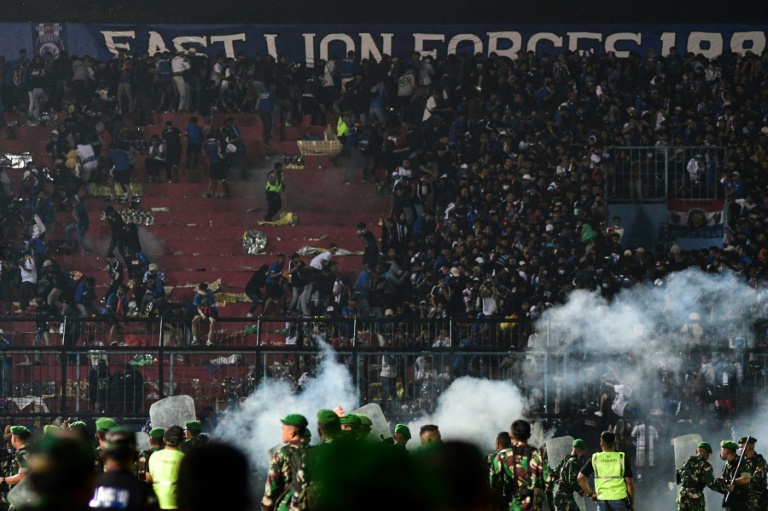
Arema FC supporters at the Kanjuruhan stadium stormed the pitch late on Saturday after their team lost 3-2 to the visiting team and bitter rivals, Persebaya Surabaya.

Police, who described the unrest as “riots”, said they tried to force fans to return to the stands and fired tear gas after two officers were killed. 

Many of the victims were trampled or choked to death, according to police. 

Survivors described panicking spectators in a packed crowd as tear gas rained down on them.

“Officers fired tear gas, and automatically people were rushing to come out, pushing each other and it caused many victims,” 43-year-old spectator Doni, who declined to give his last name, told AFP. 

“Nothing was happening, there was no riot. I don’t know what the issue was, they suddenly fired tear gas. That’s what shocked me, didn’t they think about kids, women?”

President Joko Widodo ordered an investigation into the tragedy, a safety review into all football matches and directed the country’s football association to suspend all matches until “security improvements” were completed.

“I deeply regret this tragedy and I hope this football tragedy will be the last in our country,” Widodo said.

A hospital director told local TV that one of the victims was five years old.

Images taken from inside the stadium during the stampede showed police firing huge amounts of tear gas and people clambering over fences. 

People were carrying injured spectators through the chaos. 

Video footage circulating on social media showed people shouting obscenities at police, who were holding riot shields and wielding batons.

Torched vehicles, including a police truck, littered the streets outside the stadium on Sunday morning. Police said 13 vehicles in total were damaged.

The stadium holds 42,000 people and authorities said it was a sell-out. Police said 3,000 people stormed the pitch. 

“We would like to convey that… not all of them were anarchic. Only about 3,000 who entered the pitch,” Afinta said.

– Enduring violence –

Fan violence is an enduring problem in Indonesia, where deep rivalries have previously turned into deadly confrontations.

Arema FC and Persebaya Surabaya are longtime rivals.

Persebaya Surabaya fans were not allowed to buy tickets for the game due to fears of violence.

However Indonesia’s coordinating minister for political, legal and security affairs, Mahfud MD, said organisers ignored the recommendation of authorities to hold the match in the afternoon instead of the evening.

And he said the government had recommended only 38,000 tickets be printed, but there was instead a sell-out crowd of 42,000.

“The government has made improvements to the implementation of football matches… and will continue to improve. But this sport, which is a favourite of the wider community, often provokes supporters to express emotions suddenly,” he said in an Instagram post.

Before Widodo’s announcement, the Football Association of Indonesia (PSSI) suspended football matches of Indonesia’s top league, BRI Liga 1, for one week. 

It also banned Arema FC from hosting home games for the rest of the season.

“We’re sorry and apologise to families of the victims and all parties over the incident,” PSSI chairman Mochamad Iriawan said. 

The chief of the Asian Football Confederation, the governing body for football in the region, expressed his regret at the loss of lives in the disaster.

“I am deeply shocked and saddened to hear such tragic news coming out of football-loving Indonesia,” AFC President Shaikh Salman bin Ebrahim Al Khalifa said in a statement.

Indonesia is to host the FIFA Under-20 World Cup in May at six stadiums across the country. The Kanjuruhan stadium in Malang is not included in that list.

Other stadium disasters include a 1989 crush in the stands at Britain’s Hillsborough Stadium, which led to the deaths of 97 Liverpool fans, and the 2012 Port Said stadium tragedy in Egypt where 74 people died in clashes.

In 1964, 320 people were killed and more than 1,000 injured during a stampede at a Peru-Argentina Olympic qualifier at Lima’s National Stadium.
UK's PM faces TV inquisition ahead of tense Tory conference

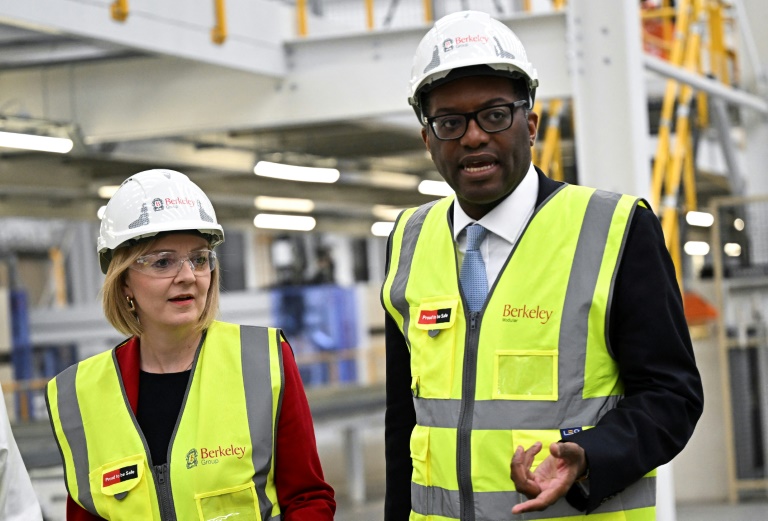
After a week of market turmoil, dismal headlines and disastrous polls, British Prime Minister Liz Truss faces a TV grilling Sunday at the start of her restive Conservative party’s annual conference.

Less than a month into the job, the new Tory leader will sit down with the BBC in Birmingham, where the party is kicking off its four-day gathering, and is expected to again defend her controversial economic plans. 

Opposition parties, much of the public and even Conservative MPs — notably backers of her defeated leadership rival Rishi Sunak — are aghast at the debt-fuelled proposals to cut taxes unveiled by Truss and finance minister Kwasi Kwarteng.

Markets tanked in response to the package, and the Bank of England staged an emergency intervention to bail out embattled pension funds, setting the stage for a difficult few days in Birmingham.

Breaking nearly a week of silence, Truss held a round of broadcast interviews with regional BBC stations on Thursday — when her awkward pauses generated almost as many headlines as her defence of the plan.

She then followed up with further interviews and a newspaper article Friday in which she vowed to press on with the policies but get “an iron grip” on public finances.

“I am going to do things differently. It involves difficult decisions and does involve disruption in the short term,” she wrote in The Sun tabloid. 

“Not everyone will like what we are doing, but I want to reassure the public that the government has a clear plan that I believe is right for the country.”

Sunday’s live TV appearance is her first before a national UK audience since Kwarteng unveiled the contentious proposals on September 23, and comes after a raft of polls showed a dramatic slump for her party.

One poll Friday by YouGov found that 51 percent of Britons think that Truss should resign — and 54 percent want Kwarteng to go.

– Existential threat? –

Several other polls in recent days showed the opposition Labour party with mammoth leads of up to 33 points over the Conservatives — its biggest since the heyday of former Labour prime minister Tony Blair in the late 1990s.

Echoing Blair, Labour leader Keir Starmer says that his party now represents mainstream UK voters, and has demanded Truss recall parliament rather than press ahead with her conference.

As it is, both Sunak and former prime minister Boris Johnson are reportedly staying away from Birmingham.

But Truss will have plenty of critics lying in wait at what the Tories bill as Europe’s largest annual political event.

Protesters angry at rising energy bills and the government’s handling of the worsening cost-of-living crisis massed in London and Birmingham Saturday, with more demonstrations planned for the start of the Tory conference Sunday.

Kwarteng is due to address the party’s grassroots on Monday, before Truss closes the gathering with the leader’s keynote speech on Wednesday.

Although both have ruled out a U-turn on their economic package, they conceded ground Friday by allowing the Office for Budget Responsibility to send Kwarteng an initial independent costing score-card of it later next week.

The conference programme has already been pared back to eliminate some of its fringe partying following the September 8 death of Queen Elizabeth II -– who appointed Truss only two days before she died. 

Not that there is much to celebrate for the Tories, given their poll ratings, which have fuelled speculation that Truss could face her own leadership challenge, or that she may sacrifice Kwarteng.

Many commentators are urging contrition from the duo in Birmingham, to avoid the kind of doomsday scenario laid out by senior Tory MP Charles Walker.

A general election is not due until January 2025 at the latest. But if one were held tomorrow, Walker said, “we would cease to exist as a functioning political party”.

Venezuela frees 7 Americans in swap for Maduro wife's nephews

Caracas on Saturday freed seven detained Americans — including five oil executives — in exchange for the release of two nephews of Venezuela’s first lady who were jailed in the United States for drug trafficking.

President Joe Biden issued the announcement that the Americans were on their way home — and a senior official in his administration confirmed shortly afterward that the US leader had made the “painful decision” to greenlight the prisoner swap to secure their freedom.

“Today, after years of being wrongfully detained in Venezuela, we are bringing home Jorge Toledo, Tomeu Vadell, Alirio Zambrano, Jose Luis Zambrano, Jose Pereira, Matthew Heath, and Osman Khan,” Biden said in a statement.

The negotiated release of “two young Venezuelans” held in the United States was confirmed in a near-simultaneous statement by Caracas — whose relations with Washington have been severely strained for years.

While Venezuelan authorities did not name the pair, they were identified by the senior US official as Francisco Flores de Freitas and his cousin Efrain Antonio Campos Flores — both nephews of President Nicolas Maduro’s wife, Cilia Flores.

“As a result of various conversations held since March 5 with representatives of the government of the United States, the release of two young Venezuelans unjustly imprisoned in that country has been achieved,” said the communique from Caracas.

Arrested in 2015 in a US sting operation in Haiti, the cousins were sentenced two years later to 18 years in prison for plotting to smuggle 800 kilos (1,760 pounds) of cocaine into the United States. 

The Venezuelan government says they were framed.

It became clear in negotiations that the release of the two Venezuelans, “sometimes referred to as the ‘narco nephews’ due to their relationship with Nicolas Maduro’s wife, was essential to securing the release of these Americans,” a senior US administration official told reporters.

“The president made a tough decision, a painful decision, to offer something the Venezuelans have actively sought” in the months-long swap negotiations, the official added.

However Venezuelan opposition leader Juan Guaido, who the United States recognizes as interim president of Venezuela, said the prisoner exchange was only further “proof” that “a criminal regime operates in Venezuela, linked to drug trafficking.”

– Oil executives freed –

Five of the seven freed Americans were executives of the Citgo oil corporation, detained in 2017 while on a business trip to the South American country and accused of corruption.

Citgo is the US subsidiary of Venezuela’s state oil company PDVSA.

The Citgo employees — former company president Pereira, along with Vadell, Toledo, and the Zambrano’s — each had been sentenced to more than 13 years in prison.

The other two Americans freed — Heath and Khan — were arrested separately.

“All seven of these Americans are in stable health,” and Biden has spoken with each of them, the administration official said.

They said the exchange took place Saturday “in a country between Venezuela and the United States.”

“A plane landed from our side, carrying those two — and a plane landed that departed from Venezuela carrying the seven Americans,” the official said.

“And then the passengers departed on different planes from the ones they came in on.”

Biden in his statement vowed his “unflinching commitment to keep faith with Americans held hostage and wrongfully detained all around the world.”

The United States had long contended that its seven nationals were held on spurious charges. State Department spokesman Ned Price referred to them a year ago as “political pawns.”

Relations between Washington and Caracas have been at rock bottom for years. The United States is one of around 60 countries that refused to recognize Maduro as the legally elected president after a widely disputed 2018 election.

But Russia’s invasion of Ukraine — and the pressure it placed on global energy supplies — brought behind-the-scenes efforts to engineer at least a minimal warming with Venezuela, a major oil producer.

A high-level US delegation traveled to Caracas in March to meet with Maduro in talks some analysts saw as a possible turning point, and which Maduro described as “respectful, cordial and diplomatic.”

Following that meeting, Caracas had previously freed two Citgo employees.

On Saturday, the senior administration official said “tough negotiations” led to the Americans’ release. “We’ve been raising their cases with Venezuelans for months now.”

Qatar races to ready luxury and budget rooms for World Cup

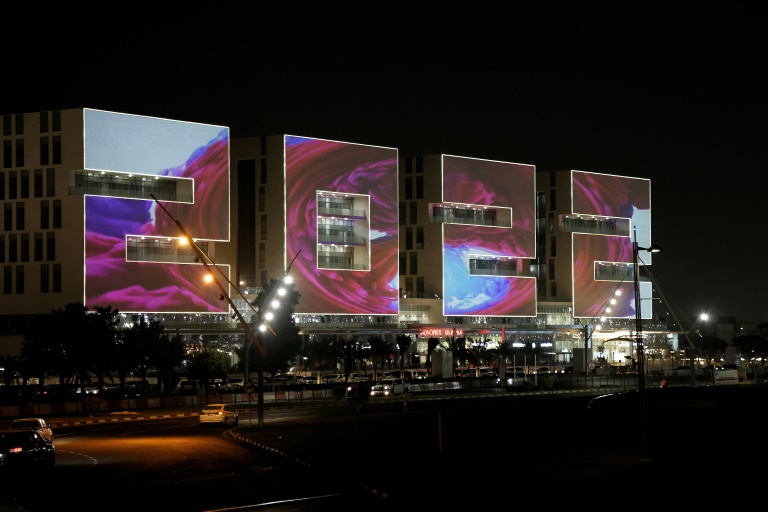
Fifty days before the World Cup kicks off in Qatar, workers are pouring concrete and hammering through the night to ready luxury hotels and bargain apartments for a million or more football fans.

Hundreds of migrants are labouring inside the 211 metre (696 feet) high Katara Towers, dramatically shaped like intertwined scimitar swords, where VIP guests of world football’s governing body FIFA will stay during the tournament.

The wealthiest will pay thousands of dollars a night for rooms with marble wine cellars and a lobby with one of the world’s biggest chandeliers.

Yet mountains of sand sit on the steps and some of the smoked glass windows are yet to be installed at this landmark on the Lusail seafront close to the stadium that will host the final.

“Everyone is working around the clock,” said one engineer on the project, speaking on condition of anonymity.

“It will be touch and go whether everything is installed to suit people paying so much,” this expert told AFP. 

A spokesperson for the Accor group, which will run the Fairmont and Raffles hotels in Katara Towers, insisted they would be ready for “FIFA guests” during the World Cup and then officially open after the tournament.

– $50,000 a night chalet –

Frenzied work is being carried out across Doha.

Forty kilometres (25 miles) away in Barwa Barahat Al Janoub, another army of labourers works under floodlights at night and scorching sunlight in the day, to ready apartments for fans paying $84 a night for a steel bed in a shared room.

The Barwa complex, out in the semi-desert, is expected to house more than 7,500 World Cup fans and will later be used for the thousands of foreign workers who keep Qatar’s oil- and gas-fuelled economy moving. 

A source on the project — which is 10 kilometres from a metro station — said that hundreds of rooms still need to be finished and that workers were engaged in “a furious race against time”.

A spokesperson for the Qatar organising committee said: “All of the accommodation options at the FIFA World Cup 2022 will be ready in good time before fans, teams and officials arrive in Qatar for the tournament.” 

A “comfortable inventory” exists for teams and fans, this spokesperson added.

Positioned at opposite extremes, the sword-shaped towers and austere workers’ rooms will play key roles in housing supporters of the 32 nations taking part in the World Cup from November 20.

Organisers say that more than one million fans will visit and that 130,000 rooms will be usable in hotels, apartments, cruise ships and desert tents.

But some supporters have already complained about prices and the availability of rooms.

Other Gulf cities, especially Dubai, are reporting a World Cup boom driven by fans who are reluctant to stay in Qatar, in part also due to perceptions — disputed by Doha — that respect for LGBTQ rights and alcohol will be in short supply. 

In Doha port there will be three cruise ships that can handle up to 13,000 people paying between $179 and $800 a night.

For $423 a night some supporters will be in traditional — but air conditioned — tents on a beachfront at Al Khor, north of Doha, with en-suite bathrooms, flat screen televisions and other luxury trappings.

One thousand bedouin-style tents are also being put up where fans can experience Qatari-style camping without air conditioning. Organisers have not announced the price.

Some Qatari landlords are trying to cash in on the World Cup, demanding $4,000-plus a night for Doha apartments. One two-bedroom chalet is advertised on booking.com at nearly $50,000 a night.

While 80 percent of Doha’s 30,000 hotel rooms are reserved by FIFA, some open market suites are being advertised at $5,500 a night.

“There is a lot of negotiating going on over prices,” said one Doha travel executive.

Nasser Al-Khater, chief executive of the World Cup Qatar organisers, stressed in a TV interview this week that official accommodation was being subsidised to keep prices down.

“The private sector also provides housing units and they have the right to determine the price they see suitable,” he said.

Qatar races to ready luxury and budget rooms for World Cup

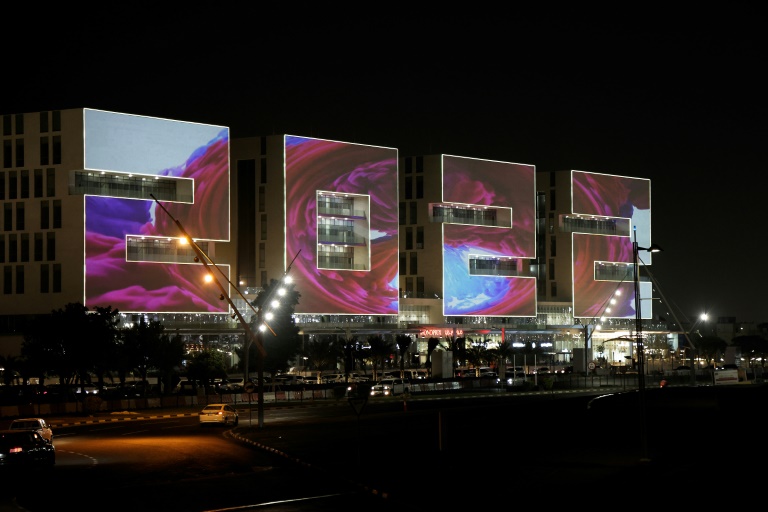
Fifty days before the World Cup kicks off in Qatar, workers are pouring concrete and hammering through the night to ready luxury hotels and bargain apartments for a million or more football fans.

Hundreds of migrants are labouring inside the 211 metre (696 feet) high Katara Towers, dramatically shaped like intertwined scimitar swords, where VIP guests of world football’s governing body FIFA will stay during the tournament.

The wealthiest will pay thousands of dollars a night for rooms with marble wine cellars and a lobby with one of the world’s biggest chandeliers.

Yet mountains of sand sit on the steps and some of the smoked glass windows are yet to be installed at this landmark on the Lusail seafront close to the stadium that will host the final.

“Everyone is working around the clock,” said one engineer on the project, speaking on condition of anonymity.

“It will be touch and go whether everything is installed to suit people paying so much,” this expert told AFP. 

A spokesperson for the Accor group, which will run the Fairmont and Raffles hotels in Katara Towers, insisted they would be ready for “FIFA guests” during the World Cup and then officially open after the tournament.

– $50,000 a night chalet –

Frenzied work is being carried out across Doha.

Forty kilometres (25 miles) away in Barwa Barahat Al Janoub, another army of labourers works under floodlights at night and scorching sunlight in the day, to ready apartments for fans paying $84 a night for a steel bed in a shared room.

The Barwa complex, out in the semi-desert, is expected to house more than 7,500 World Cup fans and will later be used for the thousands of foreign workers who keep Qatar’s oil- and gas-fuelled economy moving. 

A source on the project — which is 10 kilometres from a metro station — said that hundreds of rooms still need to be finished and that workers were engaged in “a furious race against time”.

A spokesperson for the Qatar organising committee said: “All of the accommodation options at the FIFA World Cup 2022 will be ready in good time before fans, teams and officials arrive in Qatar for the tournament.” 

A “comfortable inventory” exists for teams and fans, this spokesperson added.

Positioned at opposite extremes, the sword-shaped towers and austere workers’ rooms will play key roles in housing supporters of the 32 nations taking part in the World Cup from November 20.

Organisers say that more than one million fans will visit and that 130,000 rooms will be usable in hotels, apartments, cruise ships and desert tents.

But some supporters have already complained about prices and the availability of rooms.

Other Gulf cities, especially Dubai, are reporting a World Cup boom driven by fans who are reluctant to stay in Qatar, in part also due to perceptions — disputed by Doha — that respect for LGBTQ rights and alcohol will be in short supply. 

In Doha port there will be three cruise ships that can handle up to 13,000 people paying between $179 and $800 a night.

For $423 a night some supporters will be in traditional — but air conditioned — tents on a beachfront at Al Khor, north of Doha, with en-suite bathrooms, flat screen televisions and other luxury trappings.

One thousand bedouin-style tents are also being put up where fans can experience Qatari-style camping without air conditioning. Organisers have not announced the price.

Some Qatari landlords are trying to cash in on the World Cup, demanding $4,000-plus a night for Doha apartments. One two-bedroom chalet is advertised on booking.com at nearly $50,000 a night.

While 80 percent of Doha’s 30,000 hotel rooms are reserved by FIFA, some open market suites are being advertised at $5,500 a night.

“There is a lot of negotiating going on over prices,” said one Doha travel executive.

Nasser Al-Khater, chief executive of the World Cup Qatar organisers, stressed in a TV interview this week that official accommodation was being subsidised to keep prices down.

“The private sector also provides housing units and they have the right to determine the price they see suitable,” he said.

Germany builds new gas terminals to succeed Russian pipelines

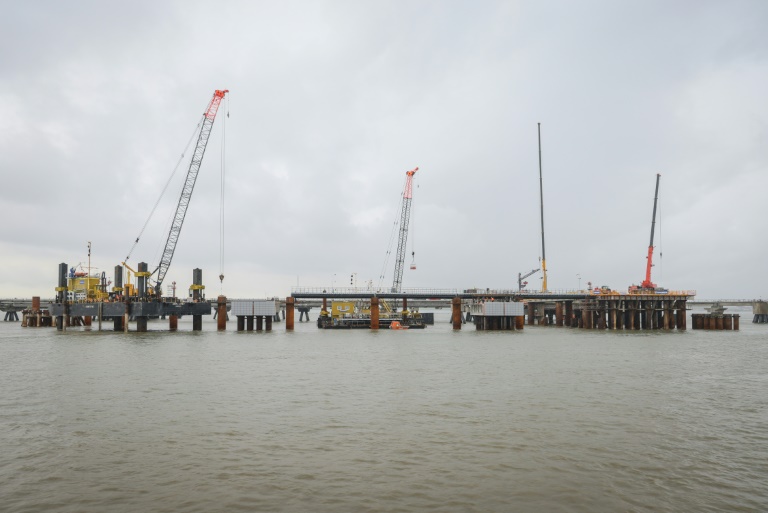
Germany’s most strategically important building site is at the end of a windswept pier on the North Sea coast, where workers are assembling the country’s first terminal for the import of liquefied natural gas (LNG).

Starting this winter, the rig, close to the port of Wilhelmshaven, will be able to supply the equivalent of 20 percent of the gas that was until recently imported from Russia.

Since its invasion of Ukraine, Moscow has throttled gas supplies to Germany, while the Nord Stream pipelines which carried huge volumes under the Baltic Sea to Europe were damaged last week in what a Danish-Swedish report called “a deliberate act.”

In the search for alternative sources, the German government has splashed billions on five projects like the one in Wilhelmshaven.

Altogether the new fleet should be able to handle around 25 billion cubic metres of gas per year, roughly equivalent to half the capacity of the Nord Stream 1 pipeline.

– New platform –

At the site in Wilhelmshaven, the half-finished concrete platform emerging from the sea sprays workers in fluorescent yellow vests with a fine mist.

Back on solid land, a constant stream of lorries delivers sections of grey pipe, which should relay the terminal to the gas network.

LNG terminals allow for the import by sea of natural gas which has been chilled and turned into a liquid to make it easier to transport.

A specialist vessel, known as an FSRU, which can stock the fuel and turn LNG back into a ready-to-use gas, is also hooked up to the platform to complete the installation.

Unlike other countries in Europe, Germany until now did not have an LNG terminal, instead relying on relatively cheap pipeline supplies from Russia.

But since the invasion of Ukraine, Germany has set about weaning itself off Moscow’s gas exports, which previously represented 55 percent of its supplies.

To diversify its sources, secure enough supplies of the fuel and keep its factories working, Berlin has bet massively on LNG to fill the gap left by Russian imports.

Chancellor Olaf Scholz last week signed an agreement with the United Arab Emirates for the supply of LNG, while touring Gulf states in search of new sources.

Renting five FSRU ships to plug into the new terminals has also set Berlin back three billion euros ($2.9 billion).

– Environment –

Following the outbreak of the war in Ukraine, Germany passed a law to drastically speed up the approval process for LNG terminals.

In Wilhelmshaven, the work is coming along rapidly. The terminal should be finished “this winter”, says Holger Kreetz, who heads the project for German energy company Uniper.

The strategic importance of the terminal has seen building work advance surprisingly quickly. “Normally, a project like this takes us five to six years,” Kreetz tells AFP.

The arrival of the new terminal has been welcomed by many residents in Wilhelmshaven, where deindustrialisation has pushed the unemployment rate up to 10 percent, almost twice the national average.

“It’s good that it’s in Wilhelmshaven… it’ll bring jobs,” Ingrid Schon, 55, tells AFP. 

Opposition comes from groups who fear the accelerated timescales for approval and construction could come at a cost to the environment.

Young activists from the group “Ende Gelaende” managed to block the site in Wilhelmshaven for a day in August.

The German environmental organisation DUH said the works would “irreversibly destroy sensitive ecosystems as well as endanger the living space of threatened porpoises”.

The source of the fuel has also been a sore point, with concerns raised that natural gas produced from fracking in the United States could be imported via the new terminal.

Criticism of the project has been dismissed by Economy Minister Robert Habeck, a Green party politician, who has emphasised the importance of “energy security”.

By 2030, the site is set to be converted for the importation of green hydrogen, produced with renewables, which Berlin has backed as part of its energy transition.

Germany builds new gas terminals to succeed Russian pipelines

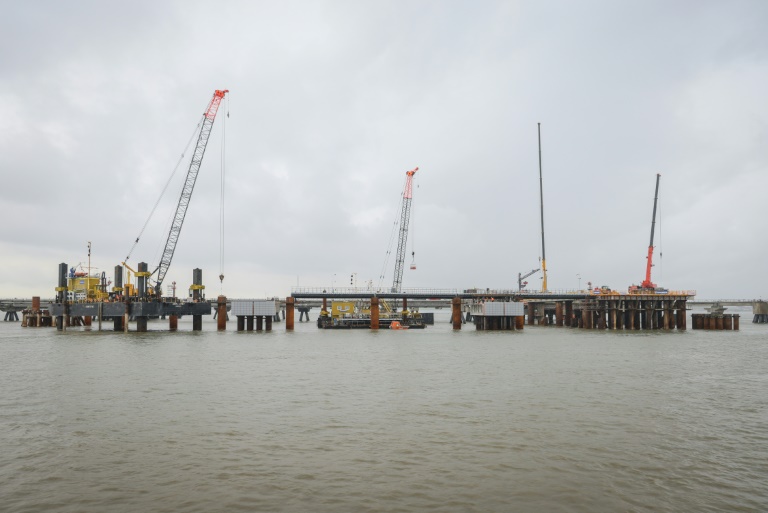
Germany’s most strategically important building site is at the end of a windswept pier on the North Sea coast, where workers are assembling the country’s first terminal for the import of liquefied natural gas (LNG).

Starting this winter, the rig, close to the port of Wilhelmshaven, will be able to supply the equivalent of 20 percent of the gas that was until recently imported from Russia.

Since its invasion of Ukraine, Moscow has throttled gas supplies to Germany, while the Nord Stream pipelines which carried huge volumes under the Baltic Sea to Europe were damaged last week in what a Danish-Swedish report called “a deliberate act.”

In the search for alternative sources, the German government has splashed billions on five projects like the one in Wilhelmshaven.

Altogether the new fleet should be able to handle around 25 billion cubic metres of gas per year, roughly equivalent to half the capacity of the Nord Stream 1 pipeline.

– New platform –

At the site in Wilhelmshaven, the half-finished concrete platform emerging from the sea sprays workers in fluorescent yellow vests with a fine mist.

Back on solid land, a constant stream of lorries delivers sections of grey pipe, which should relay the terminal to the gas network.

LNG terminals allow for the import by sea of natural gas which has been chilled and turned into a liquid to make it easier to transport.

A specialist vessel, known as an FSRU, which can stock the fuel and turn LNG back into a ready-to-use gas, is also hooked up to the platform to complete the installation.

Unlike other countries in Europe, Germany until now did not have an LNG terminal, instead relying on relatively cheap pipeline supplies from Russia.

But since the invasion of Ukraine, Germany has set about weaning itself off Moscow’s gas exports, which previously represented 55 percent of its supplies.

To diversify its sources, secure enough supplies of the fuel and keep its factories working, Berlin has bet massively on LNG to fill the gap left by Russian imports.

Chancellor Olaf Scholz last week signed an agreement with the United Arab Emirates for the supply of LNG, while touring Gulf states in search of new sources.

Renting five FSRU ships to plug into the new terminals has also set Berlin back three billion euros ($2.9 billion).

– Environment –

Following the outbreak of the war in Ukraine, Germany passed a law to drastically speed up the approval process for LNG terminals.

In Wilhelmshaven, the work is coming along rapidly. The terminal should be finished “this winter”, says Holger Kreetz, who heads the project for German energy company Uniper.

The strategic importance of the terminal has seen building work advance surprisingly quickly. “Normally, a project like this takes us five to six years,” Kreetz tells AFP.

The arrival of the new terminal has been welcomed by many residents in Wilhelmshaven, where deindustrialisation has pushed the unemployment rate up to 10 percent, almost twice the national average.

“It’s good that it’s in Wilhelmshaven… it’ll bring jobs,” Ingrid Schon, 55, tells AFP. 

Opposition comes from groups who fear the accelerated timescales for approval and construction could come at a cost to the environment.

Young activists from the group “Ende Gelaende” managed to block the site in Wilhelmshaven for a day in August.

The German environmental organisation DUH said the works would “irreversibly destroy sensitive ecosystems as well as endanger the living space of threatened porpoises”.

The source of the fuel has also been a sore point, with concerns raised that natural gas produced from fracking in the United States could be imported via the new terminal.

Criticism of the project has been dismissed by Economy Minister Robert Habeck, a Green party politician, who has emphasised the importance of “energy security”.

By 2030, the site is set to be converted for the importation of green hydrogen, produced with renewables, which Berlin has backed as part of its energy transition.

Iraq's young covet govt jobs in headache for economy

Decent salaries and stability are the hallmarks of a job in Iraq’s civil service, an institution much coveted by young graduates, even as it starves the private sector and hobbles the economy.

The patronage systems that feed the public sector in the oil-rich but war-battered nation are so entrenched that even the outgoing finance minister has despaired of ever trimming them down to size.

“We want work!”

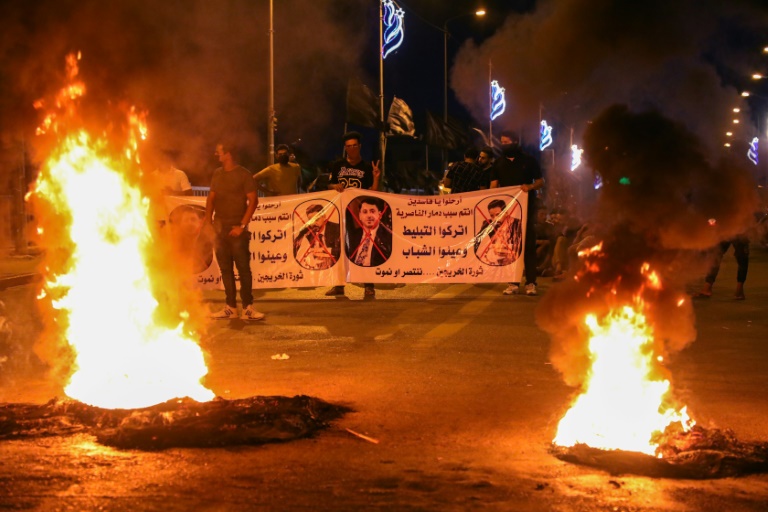
It’s a refrain that fresh graduates chant each year on the streets of the southern city of Nassiriyah.

Maitham Mohammed Redha, 32, is among them. Public sector jobs are “our legitimate right”, he says, adding that he has personally lobbied the provincial governor for work because he doesn’t have “wasta”, or an inside connection.

His situation is mirrored across Iraq, a country of 42 million in which four out of 10 young people are unemployed and where the state is by far the biggest employer. 

Propped up by oil production, which accounts for 90 percent of national revenues, young Iraqis view public sector jobs as a refuge against the political winds and insecurity that perpetually batter businesses. 

The lure is such that the private sector is robbed of bright young talent, as the smartest tend to opt for a largely unproductive easy ride in government service.

“Graduates, if they start working in the private sector, consider it a temporary job until they can find an opportunity in the public sector,” said Maha Kattaa, Iraq country coordinator for the International Labour Organization.

“The private sector feels it cannot compete with the advantages, benefits provided by the public sector,” she added.

Mohammed al-Obeidi, who has worked for nearly two decades at a ministry, acknowledges that “the salaries are good”.  

“Some ministries have good benefits” and the option to retire at 60 — or even as young as 55 — provides scope for early retirees to take on private sector work while also drawing their pension. 

– ‘Vain populism’ –

Prime Minister Mustafa al-Kadhemi has repeatedly stressed the need to trim the public sector. 

He noted last summer that “previous governments have… inflated public sector jobs in a vain populism that has exhausted the Iraqi economy”.

Between 2004 — the year after a US-led invasion toppled longtime dictator Saddam Hussein — and 2019, the number of civil service posts quadrupled, he said.

The public sector wage bill alone accounts for two-thirds of the state budget, he said, while Kattaa estimated the government employs nearly 40 percent of Iraq’s population of working age.

Such numbers are “among the highest… in the world”, she told AFP. 

Kadhemi has acknowledged the urgency for reform, but equally that he does not have a “free hand” to enact it.

His survival as head of government always depended on bargaining over patronage opportunities by the country’s main Shiite factions.

In the public sector, and even in private firms, recruitment is often driven by the allocation of tribal and political favours. 

Aptitude or formal qualifications therefore often count for little.

Even the country’s finance minister professes to have given up in despair. 

– High growth a bright spot –

“Nearly everything conspires to thwart real change and (instead conspires) to cement… rotten practices,” Ali Allawi lamented, in a letter read out to the cabinet when he resigned in August. 

Placing the blame squarely on the “cancer” of corruption, Allawi contends that the state has been unable to “break free from the control of political parties and outside interest groups”.

Kattaa says companies must improve working conditions, by matching private sector social benefits and wages.  

One bright spot is that the oil price boom of the last year has driven national output higher — the IMF predicts Iraq’s economy will grow 10 percent this year.

Entrepreneurs are seeking to capitalise on this, among them Maitham Saad, 41.

Three years ago, he set up a company that sells dates from southern Iraq to international markets.

It now employs about 30 people, despite struggling to recruit, especially young people. 

“Once they are employed in the private sector, if their boss is decent, they are happy,” he says.

Unlike in the civil service, youngsters “can negotiate their salary”, he says, expressing guarded optimism for the future.

Death toll soars after Hurricane Ian devastates Florida

The death toll from Hurricane Ian, one of the most powerful storms ever to hit the United States, soared above 40 Saturday, as President Joe Biden heads to Florida later in the week to survey the devastation.

Shocked Florida communities were only just beginning to face the full scale of the destruction, with rescuers still searching for survivors in submerged neighborhoods and along the state’s southwest coast.

Homes, restaurants and businesses were ripped apart when Ian roared ashore as a powerful Category 4 hurricane on Wednesday.

The confirmed number of storm-related deaths rose to 44 statewide, the Florida Medical Examiners Commission said late Saturday, but reports of additional fatalities were still emerging county by county -– pointing to a far higher final toll.

Hard-hit Lee County alone recorded 35 deaths, according to its sheriff, while US media including NBC and CBS tallied more than 70 deaths either directly or indirectly related to the storm.

In the coastal state of North Carolina, the governor’s office confirmed four deaths related to Ian there.

Biden and his wife, Jill, will visit Florida on Wednesday, White House Press Secretary Karine Jean-Pierre tweeted, but the couple will first head to Puerto Rico on Monday to survey the destruction from a different storm, Hurricane Fiona, which struck the US territory last month.

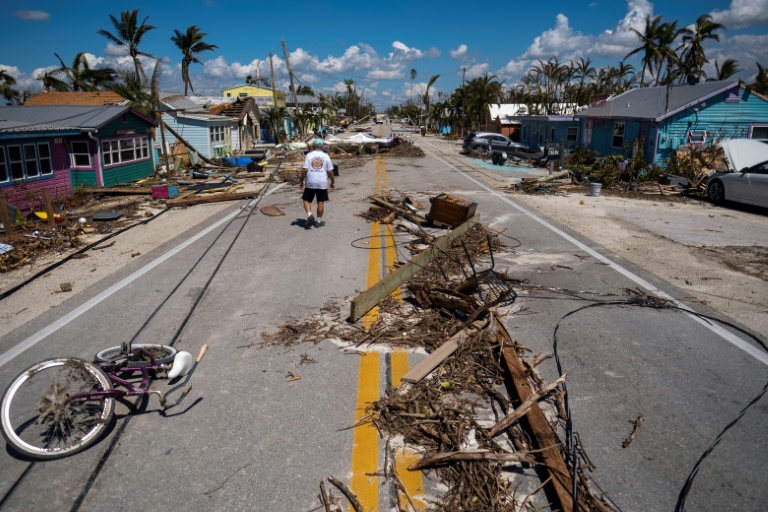
In Florida’s Lee County on Saturday, rescuers and ordinary citizens in boats were still saving the last trapped inhabitants of the small island of Matlacha. Debris, abandoned vehicles and downed trees littered the pummeled hamlet’s main street and surroundings that are dotted by colorful wooden houses with corrugated roofs.

The community, home to about 800 people, was cut off from the mainland following damage to two bridges, and those who fled early were only just beginning to return home to survey the destruction.

Sitting in the shadow of a deserted Matlacha house, Chip Farrar told AFP that “nobody’s telling us what to do, nobody’s telling us where to go.”

“The evacuation orders came in very late,” the 43-year-old said. “But most people that are still here wouldn’t have left anyway. It’s a very blue-collar place. And most people don’t have anywhere to go, which is the biggest issue.”

Sixteen migrants were missing from a boat that sank during the hurricane, according to the US Coast Guard. Two people were found dead and nine others rescued, including four Cubans who swam to shore in the Florida Keys.

More than 900,000 customers remained without power in Florida Saturday night, hampering efforts by those who evacuated to return to their homes to take stock of what they lost. 

In Fort Myers Beach, a town on the Gulf of Mexico coast which took the brunt of the storm, Pete Belinda said his home was “just flipped upside down, soaking wet, full of mud.”

Ian barreled over Florida and into the Atlantic Ocean before making US landfall again, this time on the South Carolina coast Friday as a Category 1 hurricane, with maximum sustained winds of 85 miles (140 kilometers) per hour.

It was later downgraded to a post-tropical cyclone, and it was dissipating over Virginia late Saturday.

More than 45,000 people remained without power across North Carolina and Virginia, tracking website poweroutage.us said Saturday.

CoreLogic, a firm that specializes in property analysis, said wind-related losses for residential and commercial properties in Florida could cost insurers up to $32 billion, while flooding losses could reach $15 billion.

“This is the costliest Florida storm since Hurricane Andrew made landfall in 1992,” CoreLogic’s Tom Larsen said.

– Rescues continue – 

As of Saturday morning, Governor Ron DeSantis’s office said more than 1,100 rescues had been made across Florida.

DeSantis reported that hundreds of rescue personnel were going door-to-door “up and down the coastline.”

Many Floridians evacuated ahead of the storm, but thousands chose to shelter in place and ride it out.

Two hard-hit barrier islands near Fort Myers — Pine Island and Sanibel Island — were cut off after the storm damaged causeways to the mainland.

Aerial photos and video show breathtaking destruction in Sanibel and elsewhere.

A handful of restaurants and bars reopened in Fort Myers, giving an illusion of normalcy amid downed trees and shattered storefronts.

Before pummeling Florida, Ian plunged all of Cuba into darkness after downing the island’s power network.

Electricity was gradually returning, mainly in Havana, but many homes remain without power.

A new storm in the Pacific, Hurricane Orlene, intensified to Category 2 strength off the Mexican coast, where it was forecast to make landfall in the coming days.

Human-induced climate change is resulting in more severe weather events across the globe, scientists say.

Veteran conservative faces reformer in Bulgaria polls

Bulgaria goes to the polls on Sunday for a fourth time in 18 months with experts predicting yet another fractured legislature.

Here’s a look at the two main players:

– Veteran Borisov –

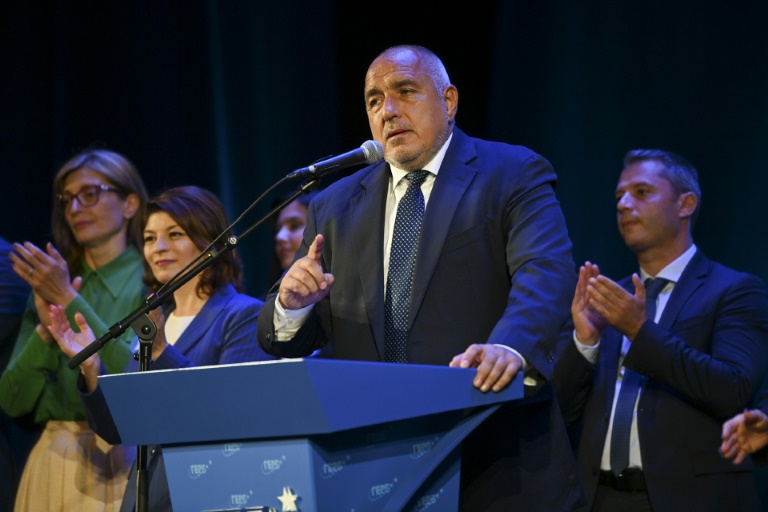
Three-time premier Boyko Borisov — an ex-firefighter and bodyguard — has dominated politics in the EU’s poorest member state for a decade, although he has previously quit twice — only to bounce back. 

Polls show the 63-year-old’s conservative party GERB will win the most votes on Sunday, but like in April last year, he may not be able to find partners to govern.

During his last stint in the top job, he faced a wave of anti-graft protests in 2020. Despite accusations of corruption, he refused to quit but his image as a “man of the people” was tarnished.

To cap it all off, embarrassing pictures emerged — which he said were doctored — including one which purportedly showed bundles of 500-euro (then worth $600) notes crammed into his bedside table.

Borisov denies all wrongdoing and is eyeing another comeback after his party felled the last government via a no-confidence motion amid soaring inflation and worries over gas supply ahead of winter.

“We carry our cross: people expect us to get them out of the crises,” Borisov said during a recent campaign event as he crisscrossed the country with the slogan “Stronger than the chaos”.

Despite being firmly pro-European, Borisov has maintained good links with Bulgaria’s communist-era “big brother” Russia — giving President Vladimir Putin a puppy in 2010 — and neighbouring Turkey.

His opponents also accuse him of helping to strengthen Russia’s energy foothold in the Balkans by building an extension of the Turk Stream transit gas pipeline through the country.

– Reformer Petkov –

Harvard-educated Kiril Petkov rose to prominence in last year’s third election in November, when his centre-left party PP won the most votes and managed to cobble together a coalition by promising “zero corruption”.

The 42-year-old outgoing prime minister represents a younger generation of foreign-educated Bulgarians, who want the country and its policies oriented more toward Western standards.

Since taking on the top job last December, Petkov and his associate, fellow Harvard graduate Assen Vassilev, have sought to reverse what they say is a system of patronage. 

“The rule of law has started to come back to Bulgaria,” Petkov, who some say looks like a younger version of Hollywood star John Travolta, told AFP in an interview this week.

The energetic, pro-European technocrat and entrepreneur said his short stint in power was “a great first step… to normality”.

Petkov grew up in Canada but returned to Bulgaria around 15 years ago as the country was joining the EU, creating his own nutritional supplement company.

Petkov and Vassilev were among thousands who protested in 2020 against Borisov.

A fresh face in politics, Petkov was appointed economy minister in a caretaker administration in 2021 before setting up his party with Vassilev.

“They stand out from the political class by their integrity and are well-intentioned, but their intransigence comes too much. Because you have to find partners to govern,” a Western diplomat said.

As premier when the war in Ukraine began, Petkov had the tricky task of managing a public that is traditionally largely pro-Russian while struggling to keep Moscow-influenced Socialists as a coalition partner.

Close Bitnami banner
Bitnami