World

Russian troops 'encircled' near key Ukraine town in annexed region

Ukraine said Saturday it encircled several thousand Russian troops near a key town in one of the four Moscow-held territories that President Vladimir Putin annexed a day earlier despite condemnation from Kyiv and the West.

Putin staged a grand ceremony in the Kremlin on Friday to celebrate the annexations of four territories controlled by his army.

“I want to say this to the Kyiv regime and its masters in the West: People living in Lugansk, Donetsk, Kherson and Zaporizhzhia are becoming our citizens forever,” Putin said.

US President Joe Biden condemned Friday’s ceremony in Moscow as a “sham routine” and pledged to continue backing Kyiv.

On Saturday, Ukrainian forces were on the doorstep of Lyman town in Donetsk, which Moscow’s forces pummelled for weeks to capture this spring.

Ukraine’s army said Saturday that it had “encircled” a Russian grouping near the eastern town, estimating it to be around 5,000 troops.

The governor of the neighbouring Lugansk region, Sergiy Gaiday, said the surrounded soldiers have three options: “try to break through, all die together or surrender.”

The Kremlin-backed leader of Donetsk said Friday that Russian troops and their allies were holding on to Lyman with “their last strength”.

The four annexed territories create a crucial land corridor between Russia and the Crimean Peninsula, annexed by Moscow in 2014.

Together, the five regions make up around 20 percent of Ukraine, where Kyiv in recent weeks has been clawing back territory.

– ‘Illegal and illegitimate’ annexation –

Washington announced “severe” new sanctions against Russian officials and the defence industry, and said G7 allies support imposing “costs” on any nation that backs the annexation.

Ukrainian President Volodymyr Zelensky immediately urged the US-led military alliance NATO to grant his country fast-track membership.

He also vowed never to hold talks with Russia as long as Putin was in power.

NATO chief Jens Stoltenberg slammed the annexation as “illegal and illegitimate” but remained non-committal after Ukraine said it was applying to join the Western alliance.

The United States and Canada voiced support for Ukraine’s membership but steered clear of promises to fast-track it.

Turkey said Saturday Russia’s annexation was a “grave violation of the established principles of international law”.

Despite warnings from Putin prior to the annexation that he could use nuclear weapons to defend the captured territories, Ukraine’s Foreign Minister Dmytro Kuleba said Kyiv would “continue liberating our land and our people”.

Kuleba also said Ukraine brought the annexations to the International Court of Justice and urged the Hague-based court to hear the case “as soon as possible”.

– Nuclear plant boss detained –

US National Security Advisor Jake Sullivan said Friday that Washington would announce an “immediate” new weapons shipment for Kyiv next week.

Sullivan also said that while there is a “risk” of Putin using nuclear weapons, there is no indication he would do so imminently. 

On Saturday, Ukraine’s nuclear agency said a “Russian patrol” detained the director general of the Moscow-held Zaporizhzhia nuclear power plant. 

Ihor Murashov was leaving the plant Friday when he was detained and “driven in an unknown direction” while blindfolded, Energoatom said. 

Zaporizhzhia — Europe’s largest nuclear energy facility — has been at the centre of tensions in recent weeks after Moscow and Kyiv accused each other of strikes on and near the plant, raising fears of an atomic disaster.

Russia on Friday vetoed a UN Security Council resolution condemning the annexation of the regions, while China, India, Brazil and Gabon abstained.

Although Russia’s veto was a certainty, Western powers had hoped to demonstrate Moscow’s growing isolation on the world stage and will now take the condemnation effort to the General Assembly, where every nation has a vote and none can kill a resolution.

At a UNESCO meeting Friday in Mexico City, representatives of dozens of countries walked out as Russia took the floor, symbolically condemning the invasion of Ukraine.

burs/raz
UN raises Kabul classroom bombing death toll to 35 as women protest 'genocide'

The death toll of a suicide bombing on a Kabul classroom has risen to 35, the UN said Saturday, as Shiite Hazara women who bore the brunt of the attack staged a defiant protest against the “genocide” of their minority community.

On Friday a suicide attacker blew himself up in a Kabul study hall as hundreds of pupils were taking tests in preparation for university entrance exams in the city’s Dasht-e-Barchi area.

The western neighbourhood is a predominantly Shiite Muslim enclave and home to the minority Hazara community — a historically oppressed group that has been targeted in some of Afghanistan’s most brutal attacks in recent years.

“The latest casualty figures from the attack number at least 35 fatalities, with an additional 82 wounded,” the United Nations Assistance Mission in Afghanistan (UNAMA) said in a statement.

More than 20 of the killed were girls and women, it said.

The UN mission’s casualty figure is higher than the toll Kabul authorities have given.

An interior ministry official told AFP anonymously on Saturday that 25 people were killed and 33 wounded in the attack on the Kaaj Higher Educational Centre — updating an earlier toll of 20 killed and 27 wounded.

Since returning to power last August, security has been a sensitive topic for the Taliban and the hardliners have often been keen to downplay attacks challenging their regime.

Meanwhile on Saturday dozens of Hazara women defied a Taliban ban on rallies to protest the latest bloodshed in their community.

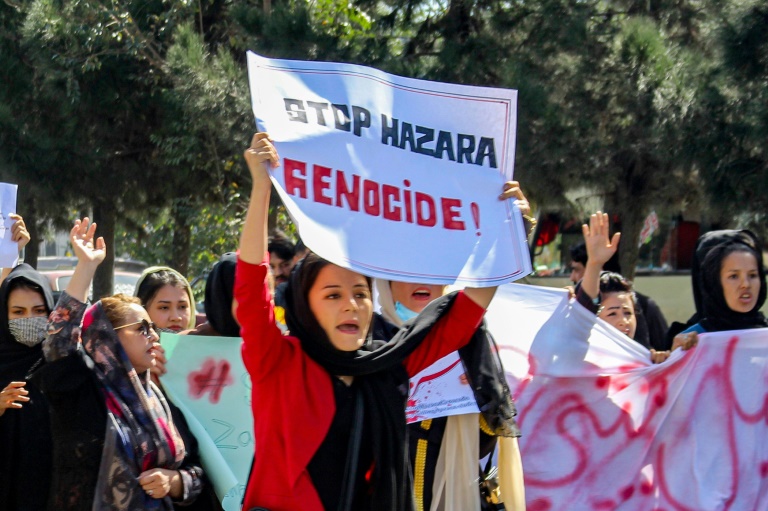
Around 50 women chanted, “Stop Hazara genocide, it’s not a crime to be a Shiite”, as they marched past a hospital in Dasht-e-Barchi where several victims of the attack were being treated.

Dressed in black hijabs and headscarves, the protesters carried banners that read: “Stop killing Hazaras”, an AFP correspondent reported.

Witnesses have told AFP that the suicide attacker detonated in the women’s section of the gender-segregated study hall.

“Yesterday’s attack was against the Hazaras and Hazara girls,” protester Farzana Ahmadi, 19, told AFP.

“We demand a stop to this genocide. We staged the protest to demand our rights.”

– Regular target –

Protesters later gathered in front of the hospital and chanted slogans as dozens of heavily armed Taliban, some carrying rocket-propelled-grenade launchers, kept watch.

Since the hardline Taliban returned to power, women’s protests have become risky, with numerous demonstrators detained and rallies broken up by Taliban forces firing shots in the air.

No group has claimed responsibility for Friday’s attack.

But the jihadist Islamic State (IS) group regards Shiites as heretics and has previously claimed attacks in the area targeting girls, schools and mosques.

The Taliban also regard the Hazara community as heathens, and rights groups often accused the Islamists of targeting them during their 20-year insurgency against the former US-backed government.

Since returning to office the Taliban have pledged to protect minorities and clamp down on security threats.

However, Amnesty International said Friday’s attack was “a shamefaced reminder of the inaptitude and utter failure of the Taliban, as de-facto authorities, to protect the people of Afghanistan”.

In May last year, before the Taliban’s return to power, at least 85 people — mainly girls — were killed and about 300 were wounded when three bombs exploded near their school in Dasht-e-Barchi.

Again, no group claimed responsibility, but a year earlier IS claimed a suicide attack on an educational centre in the same area that killed 24.

IS has emerged as a key security challenge for the Taliban, but officials claim their forces have defeated the jihadists.

After devastating Florida, Hurricane Ian begins to wind down

Deadly Hurricane Ian, one of the most powerful storms ever to hit the United States, was still dumping rain on parts of the country early Saturday, but was beginning to wind down after walloping Florida.

The National Hurricane Center (NHC) said Ian made landfall on Friday afternoon near Georgetown, South Carolina, as a Category 1 hurricane with maximum sustained winds of 85 miles (140 kilometers) per hour.

It was later downgraded to a post-tropical cyclone, and by 5 am Saturday (0900 GMT) its sustained windspeeds had decreased to near 35 miles per hour as it passed through North Carolina, according to the NHC.

Though the NHC said heavy rains continued and “limited” flooding was still possible across the central Appalachians and Mid-Atlantic as Ian moved north, the storm was expected to continue weakening and was “forecast to dissipate over south-central Virginia” by Saturday night.

As for storm-ravaged Florida, President Joe Biden said Friday: “We’re just beginning to see the scale of the destruction.

“It’s likely to rank among the worst in the nation’s history,” he said of Ian, which barreled into Florida’s southwest coast on Wednesday as a Category 4 storm, a tick shy of the most powerful on the Saffir-Simpson wind scale.

The death toll from the storm stood at 23, the Florida Department of Law Enforcement said Friday evening.

News outlets quoting county officials have given even higher tolls, with CNN saying 45 fatalities have been blamed on Ian.

Seventeen migrants also remain missing from a boat that sank during the hurricane on Wednesday, according to the Coast Guard. One person was found dead and nine others rescued, including four Cubans who swam to shore in the Florida Keys.

With damage estimates running into the tens of billions of dollars, Biden said it’s “going to take months, years to rebuild.”

“It’s not just a crisis for Florida,” he said. “This is an American crisis.”

CoreLogic, a firm that specializes in property analysis, said wind-related losses for residential and commercial properties in Florida could cost insurers up to $32 billion while flooding losses could go as high as $15 billion.

“This is the costliest Florida storm since Hurricane Andrew made landfall in 1992,” CoreLogic’s Tom Larsen said.

– ‘We made it through’ – 

Rescue teams were assisting survivors Friday in devastated Florida communities and the US Coast Guard said it had made 117 rescues using boats and helicopters of people trapped in flooded homes.

Governor Ron DeSantis said hundreds of other rescue personnel were going door-to-door “up and down the coastline.”

DeSantis said the coastal town of Fort Myers, where the hurricane first made landfall, was “ground zero” but “this was such a big storm that there are effects far inland,” including serious flooding in the city of Orlando.

Many Floridians evacuated ahead of the storm, but thousands chose to shelter in place and ride it out.

More than 1.4 million Florida residents were still without electricity on Friday and two hard-hit barrier islands near Fort Myers — Pine Island and Sanibel Island — were cut off after the storm damaged causeways to the mainland.

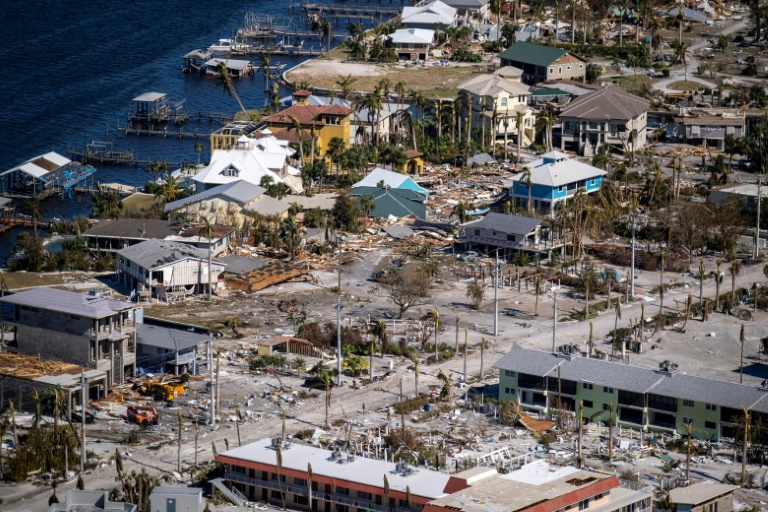
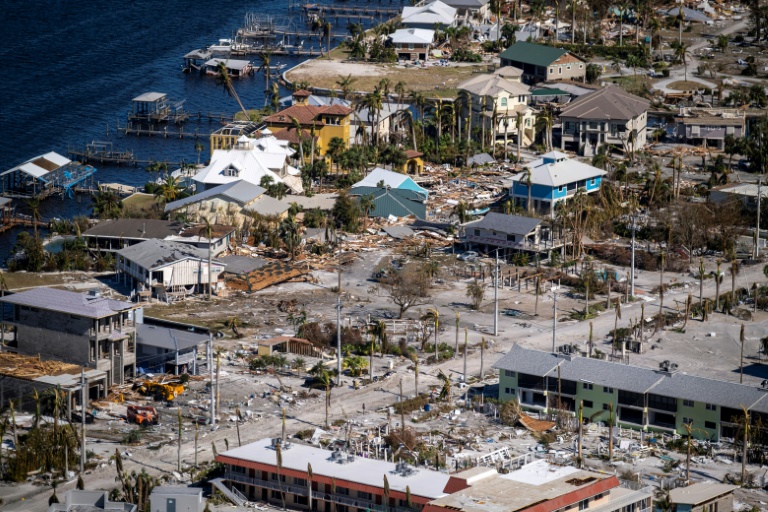
Aerial photo and video show breathtaking destruction in Sanibel and elsewhere.

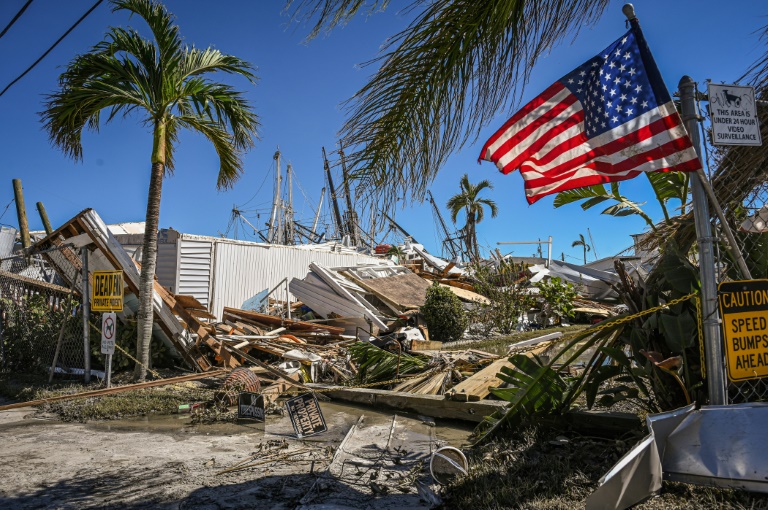
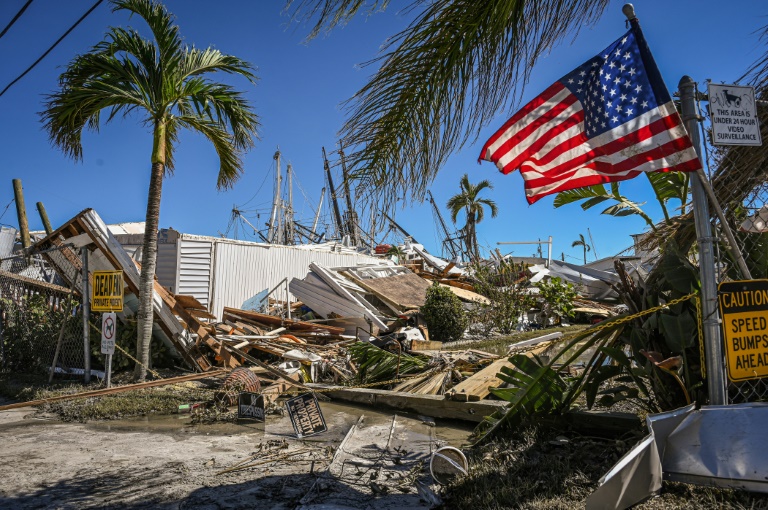
In Fort Myers Beach, a recreational boat called Crackerjack sat atop a pile of debris like an abandoned toy. A trailer park was blasted away to almost nothing.

Meanwhile in North and South Carolina, nearly half a million customers were without power, according to tracking website poweroutage.us.

In Fort Myers, a handful of restaurants and bars reopened, giving an illusion of normalcy amid downed trees and shattered storefronts.

Dozens of people sat out on terraces under a bright sun, drinking beer and eating.

Dylan Gamber, 23, said he had been waiting for two hours at a pizzeria to get food to bring home.

“It was kind of bad, but we made it through,” Gamber said. “The roof of our house came off, a big tree collapsed across our vehicles, our yard was flooded, but other than that we were pretty good.

“As a community, we seem to be coming together and helping each other out.”

– ‘All submerged’ –

In nearby Bonita Springs, Jason Crosser was inspecting the damage to his store.

“The water went over the whole building,” said Crosser, 37. “It was all submerged. It’s all saltwater and water damage.”

Before pummelling Florida, Ian plunged all of Cuba into darkness after downing the island’s power network.

Electricity was gradually returning, but many homes remain without power.

Human-induced climate change is resulting in more severe weather events across the globe, scientists say — including with Ian.

According to a rapid and preliminary analysis, human-caused climate change increased the extreme rain that Ian unleashed by over 10 percent, US scientists said.

After devastating Florida, Hurricane Ian begins to wind down

Deadly Hurricane Ian, one of the most powerful storms ever to hit the United States, was still dumping rain on parts of the country early Saturday, but was beginning to wind down after walloping Florida.

The National Hurricane Center (NHC) said Ian made landfall on Friday afternoon near Georgetown, South Carolina, as a Category 1 hurricane with maximum sustained winds of 85 miles (140 kilometers) per hour.

It was later downgraded to a post-tropical cyclone, and by 5 am Saturday (0900 GMT) its sustained windspeeds had decreased to near 35 miles per hour as it passed through North Carolina, according to the NHC.

Though the NHC said heavy rains continued and “limited” flooding was still possible across the central Appalachians and Mid-Atlantic as Ian moved north, the storm was expected to continue weakening and was “forecast to dissipate over south-central Virginia” by Saturday night.

As for storm-ravaged Florida, President Joe Biden said Friday: “We’re just beginning to see the scale of the destruction.

“It’s likely to rank among the worst in the nation’s history,” he said of Ian, which barreled into Florida’s southwest coast on Wednesday as a Category 4 storm, a tick shy of the most powerful on the Saffir-Simpson wind scale.

The death toll from the storm stood at 23, the Florida Department of Law Enforcement said Friday evening.

News outlets quoting county officials have given even higher tolls, with CNN saying 45 fatalities have been blamed on Ian.

Seventeen migrants also remain missing from a boat that sank during the hurricane on Wednesday, according to the Coast Guard. One person was found dead and nine others rescued, including four Cubans who swam to shore in the Florida Keys.

With damage estimates running into the tens of billions of dollars, Biden said it’s “going to take months, years to rebuild.”

“It’s not just a crisis for Florida,” he said. “This is an American crisis.”

CoreLogic, a firm that specializes in property analysis, said wind-related losses for residential and commercial properties in Florida could cost insurers up to $32 billion while flooding losses could go as high as $15 billion.

“This is the costliest Florida storm since Hurricane Andrew made landfall in 1992,” CoreLogic’s Tom Larsen said.

– ‘We made it through’ – 

Rescue teams were assisting survivors Friday in devastated Florida communities and the US Coast Guard said it had made 117 rescues using boats and helicopters of people trapped in flooded homes.

Governor Ron DeSantis said hundreds of other rescue personnel were going door-to-door “up and down the coastline.”

DeSantis said the coastal town of Fort Myers, where the hurricane first made landfall, was “ground zero” but “this was such a big storm that there are effects far inland,” including serious flooding in the city of Orlando.

Many Floridians evacuated ahead of the storm, but thousands chose to shelter in place and ride it out.

More than 1.4 million Florida residents were still without electricity on Friday and two hard-hit barrier islands near Fort Myers — Pine Island and Sanibel Island — were cut off after the storm damaged causeways to the mainland.

Aerial photo and video show breathtaking destruction in Sanibel and elsewhere.

In Fort Myers Beach, a recreational boat called Crackerjack sat atop a pile of debris like an abandoned toy. A trailer park was blasted away to almost nothing.

Meanwhile in North and South Carolina, nearly half a million customers were without power, according to tracking website poweroutage.us.

In Fort Myers, a handful of restaurants and bars reopened, giving an illusion of normalcy amid downed trees and shattered storefronts.

Dozens of people sat out on terraces under a bright sun, drinking beer and eating.

Dylan Gamber, 23, said he had been waiting for two hours at a pizzeria to get food to bring home.

“It was kind of bad, but we made it through,” Gamber said. “The roof of our house came off, a big tree collapsed across our vehicles, our yard was flooded, but other than that we were pretty good.

“As a community, we seem to be coming together and helping each other out.”

– ‘All submerged’ –

In nearby Bonita Springs, Jason Crosser was inspecting the damage to his store.

“The water went over the whole building,” said Crosser, 37. “It was all submerged. It’s all saltwater and water damage.”

Before pummelling Florida, Ian plunged all of Cuba into darkness after downing the island’s power network.

Electricity was gradually returning, but many homes remain without power.

Human-induced climate change is resulting in more severe weather events across the globe, scientists say — including with Ian.

According to a rapid and preliminary analysis, human-caused climate change increased the extreme rain that Ian unleashed by over 10 percent, US scientists said.

Kabul classroom bombing death toll rises to 35 as women protest 'genocide'

The death toll of a suicide bombing on a Kabul classroom has risen to 35, the UN said Saturday, as Shiite Hazara women who bore the brunt of the attack staged a defiant protest against the “genocide” of their minority community.

On Friday a suicide attacker blew himself up in a Kabul study hall as hundreds of pupils were taking tests in preparation for university entrance exams in the city’s Dasht-e-Barchi area.

The western neighbourhood is a predominantly Shiite Muslim enclave and home to the minority Hazara community — a historically oppressed group that has been targeted in some of Afghanistan’s most brutal attacks in recent years.

“The latest casualty figures from the attack number at least 35 fatalities, with an additional 82 wounded,” the United Nations Assistance Mission in Afghanistan (UNAMA) said in a statement.

The UN mission’s casualty figure is much higher than the death toll Kabul police have given — they said 20 people were killed and 27 wounded in the assault on the Kaaj Higher Educational Centre.

Since returning to power last August, security has been a sensitive topic for the Taliban and the hardliners have often been keen to downplay attacks challenging their regime.

Meanwhile on Saturday dozens of Hazara women defied a Taliban ban on rallies to protest the latest bloodshed in their community.

Around 50 women chanted, “Stop Hazara genocide, it’s not a crime to be a Shiite”, as they marched past a hospital in Dasht-e-Barchi where several victims of the attack were being treated.

Dressed in black hijabs and headscarves, the protesters carried banners that read: “Stop killing Hazaras”, an AFP correspondent reported.

Witnesses have told AFP that the suicide attacker detonated in the women’s section of the gender-segregated study hall.

“Yesterday’s attack was against the Hazaras and Hazara girls,” protester Farzana Ahmadi, 19, told AFP.

“We demand a stop to this genocide. We staged the protest to demand our rights.”

– Regular target –

Protesters later gathered in front of the hospital and chanted slogans as dozens of heavily armed Taliban, some carrying rocket-propelled-grenade launchers, kept watch.

Since the hardline Taliban returned to power, women’s protests have become risky, with numerous demonstrators detained and rallies broken up by Taliban forces firing shots in the air.

No group has claimed responsibility for Friday’s attack.

But the jihadist Islamic State (IS) group regards Shiites as heretics and has previously claimed attacks in the area targeting girls, schools and mosques.

The Taliban also regard the Hazara community as heathens, and rights groups often accused the Islamists of targeting them during their 20-year insurgency against the former US-backed government.

Since returning to office the Taliban have pledged to protect minorities and clamp down on security threats.

However, Amnesty International said Friday’s attack was “a shamefaced reminder of the inaptitude and utter failure of the Taliban, as de-facto authorities, to protect the people of Afghanistan”.

In May last year, before the Taliban’s return to power, at least 85 people — mainly girls — were killed and about 300 were wounded when three bombs exploded near their school in Dasht-e-Barchi.

Again, no group claimed responsibility, but a year earlier IS claimed a suicide attack on an educational centre in the same area that killed 24.

IS has emerged as a key security challenge for the Taliban, but officials claim their forces have defeated the jihadists.

Burkina Faso faces fresh uncertainty after latest coup

Burkina Faso awoke to fresh uncertainty Saturday after its second coup this year when junior officers toppled a junta leader, saying he had failed to fight jihadist attacks in the deeply poor and restive West African nation.

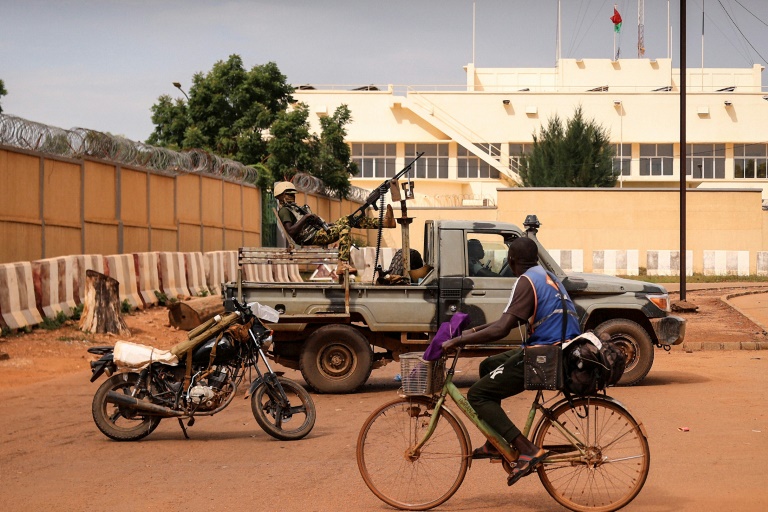
An uneasy calm permeated through the capital Ouagadougou where soldiers in armoured vehicles and pickup trucks guarded the national television centre but traffic slowly resumed on arterial roads.

Shops slowly started reopening in the dusty and spread-out city, where pre-dawn gunfire on Friday around the presidential palace culminated in the latest coup, that drew wide condemnation. 

The Economic Community of West African States regional bloc “condemned in the strongest possible terms” the latest seizure of power, calling it “inappropriate” at a time when progress was being made for a return to constitutional order by July 1, 2024.

Burkina Faso’s former colonial ruler France told its citizens in Ouagadougou, believed to number between 4,000 and 5,000, to stay home, while the European Union expressed “concern” at the unfolding events.

The United States called “for a return to calm and restraint by all actors”.

Just before 8:00 pm (2000 GMT) on Friday, more than a dozen soldiers in fatigues appeared on the state television and radio broadcaster to announce the removal of Lieutenant-Colonel Paul-Henri Sandaogo Damiba.

They proclaimed 34-year-old Captain Ibrahim Traore in charge.

“We have decided to take our responsibilities, driven by a single ideal: the restoration of security and integrity of our territory,” they said.

“Damiba failed. Since he came to power, the zones that were peaceful were attacked. He took power but then he betrayed us,” Habibata Rouamba, a trader and activist said on Saturday.

With much of the Sahel region battling a growing Islamist insurgency, the violence has prompted a series of coups in Mali, Guinea and Chad since 2020. 

In January, Damiba installed himself as leader of the country of 16 million after accusing elected president Roch Marc Christian Kabore of failing to beat back the jihadists.

– Damiba accused of failure –

But with more than 40 percent of the country outside government control, the latest putsch leaders said Damiba, too, had failed.

“Far from liberating the occupied territories, the once-peaceful areas have come under terrorist control,” the new military leaders said. 

They then suspended the constitution, sealed the borders, dissolved the transitional government and legislative assembly and instituted a 9:00 pm to 5:00 am curfew.

New strongman Traore was previously head of anti-jihadist special forces unit “Cobra” in the northern region of Kaya.

– Junta leader’s fate unclear –

Damiba’s fate remains unknown. 

Damiba’s Patriotic Movement for Preservation and Restoration (MPSR) had said earlier on Friday that there was an “internal crisis in the army” prompting troop deployments in key areas of the capital.

Government spokesman Lionel Bilgo had said the “crisis” concerned an army pay dispute, and that Damiba was taking part in negotiations.

In the morning, shots rang out in the Ouaga 2000 neighbourhood, which houses both the presidential and junta headquarters.

State television was cut for several hours prior to the military announcement, broadcasting just a blank screen with the message “no video signal”.

Though Damiba had promised to make security his priority when he took charge on January 24, violent attacks have increased since March.

In the north and east, towns have been blockaded by insurgents who have blown up bridges and attacked supply convoys.

As in bordering countries, insurgents affiliated with Al-Qaeda and the Islamic State group have stoked unrest.

Thousands have died and about two million have been displaced by the fighting since 2015 when the insurgency spread to Burkina Faso, which has since become the epicentre of the violence across the Sahel.

In September, a particularly bloody month, Damiba sacked his defence minister and assumed the role himself.

Earlier this week, suspected jihadists attacked a convoy carrying supplies to the town of Djibo in the north of the country. The government said 11 soldiers died and around 50 civilians were missing.

North Korea fires ballistic missiles, fourth time this week

North Korea fired two ballistic missiles early on Saturday, South Korea’s military said, the nuclear-armed country’s fourth launch this week as Seoul, Tokyo and Washington ramp up joint military drills to counter Pyongyang.

South Korea, Japan and the US staged anti-submarine drills Friday — the first in five years — just days after Washington and Seoul’s navies conducted large-scale exercises in waters off the peninsula.

US Vice President Kamala Harris was in Seoul Thursday and toured the heavily fortified Demilitarized Zone that divides the peninsula, on a trip that aimed to underscore her country’s “ironclad” commitment to South Korea’s defence against the North.

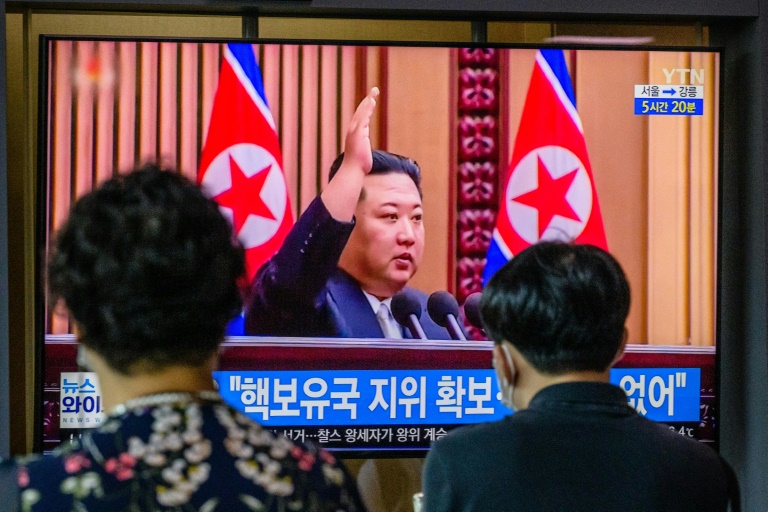
With talks long stalled, Pyongyang has doubled down on its banned weapons programmes, conducting a record-breaking blitz of tests this year and revising its laws to declare itself an “irreversible” nuclear power.

South Korea’s military said it had “detected two short-range missiles between 0645 and 0703 fired from the Sunan area in Pyongyang into the East Sea”, referring to the body of water also known as the Sea of Japan.

The missiles “flew approximately 350 km (217 miles) at an altitude of 30 km at speed of Mach 6”, Seoul’s Joint Chiefs of Staff said in a statement, calling the launches “a serious provocation”.

Tokyo also confirmed the launch, saying the missiles had landed outside Japan’s exclusive economic zones.

Toshiro Ino, Japan’s vice defence minister, said the missiles “appear to have flown in irregular trajectories”. 

Experts say the irregular trajectories indicate the missiles are capable of manoeuvring in flight, making them harder to track and intercept.

The US Indo-Pacific Command said in a statement that the latest launch “highlights the destabilising impact of the DPRK’s unlawful WMD and ballistic missile programs”, using the official abbreviation for North Korea.

– Harris trip –

North Korea marked Harris’s trip to Seoul with a flurry of missile launches — firing off short-range ballistic missiles on Sunday, Wednesday and Thursday, the latter test just hours after the vice president flew out of South Korea.

Washington has about 28,500 troops stationed in South Korea to help protect it from the North.

Under South Korea’s President Yoon Suk-yeol, who took office in May, the two countries have boosted joint exercises, which they insist are purely defensive.

Just before Harris arrived in Seoul, Washington sent the nuclear-powered USS Ronald Reagan aircraft carrier to South Korea to conduct a large-scale joint naval exercise in a show of force against Pyongyang. 

Such drills infuriate North Korea, which sees them as rehearsals for an invasion.

“North Korea’s short-range ballistic tests are less important than a nuclear test but still violate UN Security Council resolutions,” said Leif-Eric Easley, a professor at Ewha University in Seoul, adding that the timing was “provocative”.

North Korea is “rapidly modernizing weapons and taking advantage of a world divided by US-China rivalry and Russia’s annexation of more Ukrainian territory”, he said.

“Pyongyang’s actions again make clear the need for Washington and Seoul to reinforce military deterrence, tighten economic sanctions, and increase policy coordination with Tokyo,” he added.

– Nuclear test next? –

South Korean and US officials have been warning for months that North Korean leader Kim Jong Un is preparing to conduct another nuclear test.

On Wednesday, the South’s spy agency said North Korea’s next nuclear test could happen in the window between China’s upcoming party congress on October 16 and the US midterm elections on November 7.

That assessment was in line with one offered Friday by a US official, who said such a test would likely take place one to two weeks after the congress.

Admiral Sam Paparo, head of the US fleet in the region, said in Honolulu that any such test would be a “matter of grave, grave concern”, and would prompt a US response spanning “multiple instruments of national power”.

North Korea, which is under multiple UN sanctions for its weapons programmes, typically seeks to maximise the geopolitical impact of its tests with careful timing.

The isolated country has tested nuclear weapons six times since 2006, most recently in 2017.

President Yoon on Saturday warned of dire consequences if Pyongyang used nuclear weapons against its southern neighbour. 

“If North Korea attempts to use nuclear weapons it will face a resolute and overwhelming response from our military and Korea-US alliance,” he said in a speech marking Armed Forces Day. 

Boats in the streets, cars in the sea: Fort Myers Beach pummeled by Ian

As Pete Belinda and his wife slowly walked down a road outside Fort Myers Beach on the southwestern coast of Florida, they each dragged a large suitcase behind them. 

“This is all we have left,” Belinda said, shaken and visibly tired.

The town, a quiet place on the shores of the Gulf of Mexico, became the epicenter of destruction as Hurricane Ian slammed into Florida on Wednesday as a powerful Category 4 storm.

The couple lived on the lower floor of their daughter’s house, where they moved six months ago, but the storm has left them without a home.

“It’s just flipped upside down, soaking wet, full of mud,” Belinda said. 

“We don’t really know what we will do now. We’re reaching out to some friends and family for somewhere to live for a while because we don’t have anywhere to go.”

Fort Myers Beach is practically deserted now, traversed solely by emergency services vehicles and the handful of people who returned to their homes take stock of what they lost.

The part of town hit hardest by Ian, the area closest to the sea on Estero Island, was reduced to a field of ruins.

Police have restricted access for those who do not live in the neighborhood, but photos taken from a helicopter flight showed the magnitude of the damage.

Strong winds razed the wooden houses in the area — in some spots there wasn’t even rubble, just empty plots where homes once stood.

Rich Gibboni is one of those who lost his home.

“The second floor caved in from the wind, and the first floor was flooded all the way up to the second floor,” he said, sounding resigned.

The 50-year-old had come to another neighborhood in Fort Myers Beach to look for provisions before heading back to Estero Island, where he was taking shelter in a hotel with about 20 other people.

Nearby, 72-year-old holidaymaker Chris Bills pulled her hat down on her head as she waited for a bus to pick up her and her husband. 

Earlier in the day, an emergency services patrol had given them two hours to gather their belongings and vacate the apartment they had rented near the sea.

The couple traveled to Florida from England to enjoy warmer weather, and had not been worried about hurricane warnings.

“We didn’t think that it would be so severe,” Bills said.

“I was extremely scared. We’ve never experienced anything like this before.”

In the neighborhood they were leaving behind, the force of the hurricane had left dozens of boats grounded in the streets — some still moored to pieces of a pier — and dragged cars out into a nearby bay where they remained floating.

But Gibboni said he hadn’t given up hope after the destruction wrought by Ian.

“We got to survive. This is the only way to do it,” he said.

“We have got to restart. It’s gonna take a long time, so we just got to get back on our feet.”

Boats in the streets, cars in the sea: Fort Myers Beach pummeled by Ian

As Pete Belinda and his wife slowly walked down a road outside Fort Myers Beach on the southwestern coast of Florida, they each dragged a large suitcase behind them. 

“This is all we have left,” Belinda said, shaken and visibly tired.

The town, a quiet place on the shores of the Gulf of Mexico, became the epicenter of destruction as Hurricane Ian slammed into Florida on Wednesday as a powerful Category 4 storm.

The couple lived on the lower floor of their daughter’s house, where they moved six months ago, but the storm has left them without a home.

“It’s just flipped upside down, soaking wet, full of mud,” Belinda said. 

“We don’t really know what we will do now. We’re reaching out to some friends and family for somewhere to live for a while because we don’t have anywhere to go.”

Fort Myers Beach is practically deserted now, traversed solely by emergency services vehicles and the handful of people who returned to their homes take stock of what they lost.

The part of town hit hardest by Ian, the area closest to the sea on Estero Island, was reduced to a field of ruins.

Police have restricted access for those who do not live in the neighborhood, but photos taken from a helicopter flight showed the magnitude of the damage.

Strong winds razed the wooden houses in the area — in some spots there wasn’t even rubble, just empty plots where homes once stood.

Rich Gibboni is one of those who lost his home.

“The second floor caved in from the wind, and the first floor was flooded all the way up to the second floor,” he said, sounding resigned.

The 50-year-old had come to another neighborhood in Fort Myers Beach to look for provisions before heading back to Estero Island, where he was taking shelter in a hotel with about 20 other people.

Nearby, 72-year-old holidaymaker Chris Bills pulled her hat down on her head as she waited for a bus to pick up her and her husband. 

Earlier in the day, an emergency services patrol had given them two hours to gather their belongings and vacate the apartment they had rented near the sea.

The couple traveled to Florida from England to enjoy warmer weather, and had not been worried about hurricane warnings.

“We didn’t think that it would be so severe,” Bills said.

“I was extremely scared. We’ve never experienced anything like this before.”

In the neighborhood they were leaving behind, the force of the hurricane had left dozens of boats grounded in the streets — some still moored to pieces of a pier — and dragged cars out into a nearby bay where they remained floating.

But Gibboni said he hadn’t given up hope after the destruction wrought by Ian.

“We got to survive. This is the only way to do it,” he said.

“We have got to restart. It’s gonna take a long time, so we just got to get back on our feet.”

'Surreal': Greek university police makes dud debut

Over a year after it was conceived as a ground-breaking response to Greece’s notoriously unruly universities, a special campus police force has officially deployed — to underwhelming results.

The squad of 1,000 officers deployed in September to four out of Greece’s more than 20 university campuses. In Athens and second city Thessaloniki, all were chosen for having the highest instances of drug trading and petty crime.

“We haven’t seen them,” deadpanned one professor at Athens Polytechnic.

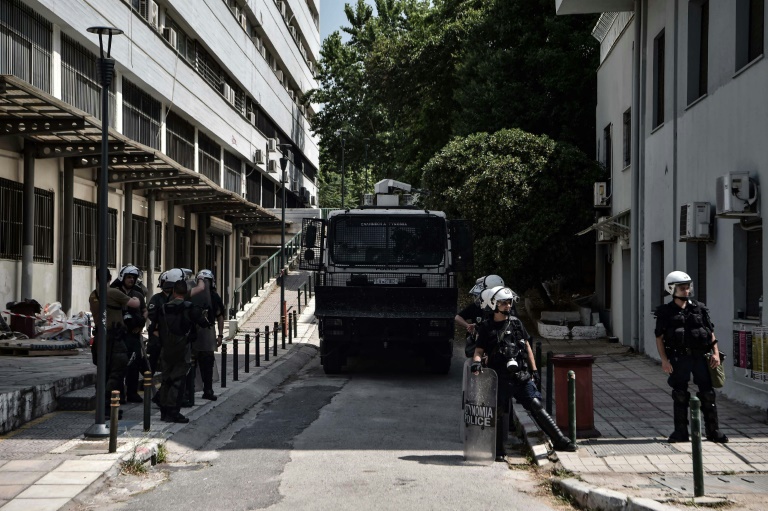
Armed only with batons, the freshly trained university protection squads (OPPI) have been deployed sparingly — and under the protection of seasoned riot police — following protests from outraged student groups. 

“The campus police turned up once, there was uproar and they pulled back,” said Sabina Kurrizi, a history student at Thessaloniki’s Aristotelio University, also part of the initiative.

“Riot police are protecting the OPPI, who are supposed to be protecting us. It’s absurd,” she added.

Greek universities are chronically underfunded and notoriously disrupted by strikes, sit-ins and violence against students and staff.

Based on the most recent figures, Greece spent just under $4,100 per student in tertiary education in 2015, according to the Organisation for the Economic Co-operation and Development, compared to an OECD average of more than $15,600.

“Having a police squad guarding another police squad is surreal,” says Theodoros Tsairidis, the head of the Thessaloniki police officers union.

– ‘Safety’ –

“Must be a world first,” he quipped to AFP.

Inadequate state spending on education is a long-running concern in Greece.

In 2009, the year before the Greek economic crisis, the education ministry’s annual budget was more than 7.2 billion euros ($6.9 billion). This year, it’s less than five billion.

In 2020, the rector of Athens University of Economics and Business was assaulted in his office by a group of hooded youths, who put a sign around his neck that read “Solidarity to sit-ins”.

Upon coming to power in 2019, the conservative government of Prime Minister Kyriakos Mitsotakis made law and order a top priority.

“Our government is determined to make the sense of safety in (universities) a reality,” Citizen’s Protection Minister Takis Theodorikakos said this week after the police raided Athens Polytechnic in an anti-gang crackdown.

More than 30 people were arrested in the swoop in connection with three gangs who turned part of a dilapidated student dormitory into a hideout, police said.

The Polytechnic is another campus chosen for the OPPI deployment.

“Prevention is always preferable to suppression,” Deputy Education Minister Angelos Syrigos told daily newspaper Kathimerini on September 20.

“Having a police force nearby creates a sense of safety, and could avert violent incidents or damage,” he said.

– ‘Climate of fear’ –

But a police presence in universities is highly controversial in Greece. During the Greek dictatorship, the police helped the army brutally crush a 1973 student uprising at the Athens Polytechnic.

Further outrage was caused this month when riot police fired tear gas during a student concert at Aristotelio.

Aristotelio staff told a news conference this week that the presence of riot police was disrupting daily life on campus.

“This is an anarchic force that creates a climate of fear. Classes cannot be held under a climate of fear,” electrochemistry professor Sotiris Sotiropoulos told reporters.

“It’s a risk to our physical and mental safety,” he said.

Student reactions are mixed.

“Yes, there were incidents of lawlessness, but now we have tank-like police vehicles on campus… many of my fellow students are afraid to walk around,” says Irini, 21, a biology student at Aristotelio.

But Artemis, a 22-year-old psychology undergraduate, says the university’s sprawling park-like campus is dangerous at night.

“There is drug trading on a daily basis, and frequent fights and stabbings. There are also regular sit-ins and vandalism by people who are not part of the university,” she said.

“We can’t have just anybody coming in and doing whatever they feel like. Students have nothing to fear from increased security,” she argued.

Close Bitnami banner
Bitnami