World

Gunfire heard near Burkina Faso presidency: witnesses

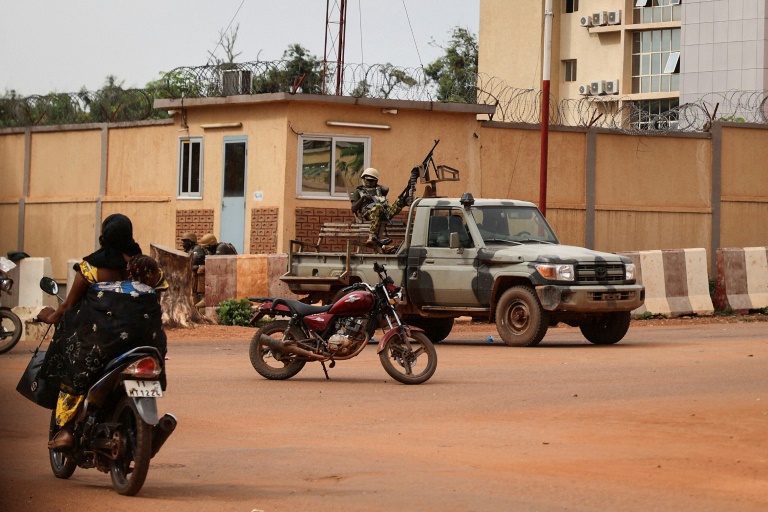
Shots rang out before dawn on Friday around Burkina Faso’s presidential palace and headquarters of the military junta, which itself seized power in a coup last January, witnesses told AFP.

Troops blocked several main roads in the capital Ouagadougou, AFP journalists said, and state television was cut, broadcasting a blank screen for several hours saying: “no video signal”.

“I heard heavy detonations around 4:30 am (0430 GMT) and now the roads around my home have been sealed off by military vehicles,” said a resident who lives close to the presidential palace.

The reason for the gunfire was not immediately clear.

But during the morning more shots were heard by an AFP cameraman in the Ouaga 2000 neighbourhood that houses both the presidential and military junta headquarters.

Junta leader Lieutenant-Colonel Paul-Henri Sandaogo Damiba “is in a safe place”, a government source told AFP, adding, “contacts are underway to find out exactly what the men want”.

A second government source said, “The negotiations are continuing… the soldiers are maintaining pressure through their presence at strategic points they occupied this morning” in the capital.

Soldiers were seen at  the city’s main crossroads, especially in Ouaga 2000 but also outside the state television centre, an AFP journalist said. The video signal was restored about 0915 GMT.

In Brussels, the EU voiced “concern” at events in the Burkina capital.

“A military movement was observed from 04:30 this morning. The situation still remains particularly confused,” said spokeswoman Nabila Massrali.

– Rein in jihadists –

Violence has long wracked the landlocked west African country where Damiba took power in a January coup, ousting elected leader Roch Marc Christian Kabore.

Damiba has pledged to restore civilian rule within two years and to defeat the armed factions.

As in bordering countries, insurgents affiliated with Al-Qaeda and the Islamic State group have stoked the unrest.

Damiba earlier this month sacked his defence minister and assumed the role himself.

The mini-shuffle, the first since the appointment of a transitional government in March, saw only one new minister introduced — Colonel-Major Silas Keita was named minister delegate in charge of national defence and promoted to brigadier general. 

Thousands have died and about two million have been displaced by the fighting since 2015 when the insurgency spread into Burkina Faso, which has since become the epicentre of the violence across the Sahel.

Attacks have increased since the start of the year, despite the junta’s vow to make security its top priority.

– Bloody September –

September has been particularly bloody.

On Monday, suspected jihadists attacked a convoy carrying supplies to the town of Djibo in the north of the country. The government said 11 soldiers were killed and around 50 civilians were missing.

On September 5 an improvised explosive device struck a supply convoy in the north killing 35 civilians dead and wounding 37.

In June, 86 civilians died in a massacre at Seytenga, near the border with Niger.

More than 40 percent of Burkina Faso, a former French colony, is outside government control.

Much of the impoverished Sahel region is battling the insurgency.

Starting in northern Mali in 2012, the insurgents attacked neighbouring Burkina Faso and Niger in 2015. The violence has in recent years begun to spill over into coastal states Ivory Coast, Togo and Benin.

“The deteriorating security situation in Burkina Faso and Mali has made the north of the coastal countries the new front line against armed groups operating in the Sahel,” the Konrad Adenauer Foundation, a German think tank, said in a report in April.

French forces supported Mali against insurgents for nearly a decade, but President Emmanuel Macron decided to pull out after falling out with the Malian junta  in the wake of two military coups since 2020.

The last French troops from operation Barkhane left last month. Despite the exit from Mali, Macron insists Paris remains committed to the “fight against terrorism” in West Africa. 
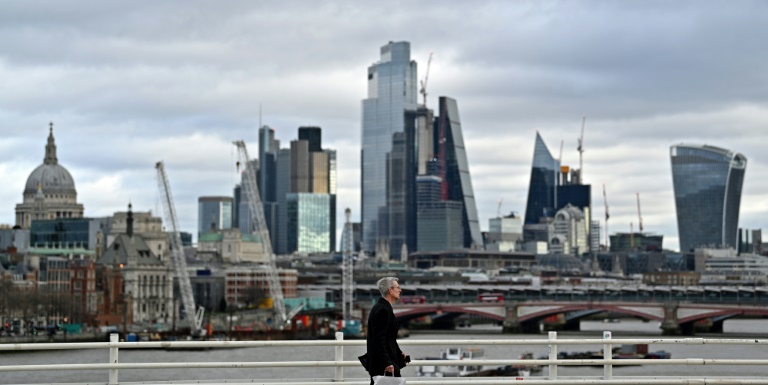
UK avoids recession in boost for under-fire Truss

Britain is not yet in recession, revised data showed Friday in a boost for under-fire Prime Minister Liz Truss, but its economy may still face a downturn on soaring interest rates.

Gross domestic product expanded 0.2 percent in the second quarter, said the Office for National Statistics in an upgrade from its previous estimate of a 0.1-percent contraction.

Even if the economy has shrunk in the current third quarter that ends Friday, as the Bank of England forecasts, it would mean the UK had avoided two successive quarters of contraction — the technical definition of a recession.

The turnaround follows a rough week for new PM Truss as the country’s borrowing costs soared and the pound hit a record dollar-low after her government announced a controversial budget plan on September 23 that included a cap on soaring energy bills.

Truss and finance minister Kwasi Kwarteng met Friday with Britain’s fiscal watchdog to discuss the economic and fiscal outlook in the wake of last week’s announcement of also debt-fuelled tax cuts.

“We will deliver the first iteration of that forecast” next week, the Office for Budget Responsibility said in a statement after the meeting.

The country’s economy output remains fragile, with Friday’s ONS data also revised to show that it was still below pre-Covid levels.

– ‘Calamitous week’ –

“In what has been a calamitous week for the UK economy, there was a rare glimmer of hope… (with it) defying expectations of a recession — for now,” said Interactive Investor analyst Richard Hunter.

“Sterling has also found some cautious support… although the jitters will remain as the government continues to justify and explain the implications of its fiscal largesse.”

Investors were spooked this week by the huge amount of borrowing likely needed for a UK budget seen as benefitting the rich more than the poorest during the cost-of-living crisis.

Less than a month into the job, Truss is already deep in a financial crisis.

The pound on Monday collapsed to an all-time low at $1.0350 on fears the budget would make sky-high inflation worse and cause the Bank of England (BoE) to hike its main interest rate even more aggressively.

Sterling has since recovered slightly.

The upbeat GDP figure came two days after the BoE carried out emergency action to snap up government bonds, whose yields had soared following the budget.

And the central bank is forecast to hike its interest rate far beyond the current 2.25 percent, which compares with a record-low 0.1 percent less than a year ago, as markets fear ever-higher inflation.

This in turn could see businesses closing and home-owners defaulting on their mortgages.

– ‘Good news, bad news’ –

Despite growth in the latest quarter, the UK economy is 0.2 percent smaller than its pre-pandemic size, the ONS added Friday. 

The statistics office previously had the UK economy at 0.6 percent larger than in 2019.

“The good news is that the economy is not already in recession,” said Capital Economics analyst Paul Dales.

“The bad news is that contrary to previous thinking, it still hasn’t returned to pre-pandemic levels.”

The ONS also said the UK economy slumped 11 percent in 2020 on fallout from the Covid pandemic.

It then rebounded with 7.5-percent growth in 2021.

Attack kills 25 in Ukraine ahead of Kremlin annexation

An attack on a frontline civilian convoy killed at least 25 people in southern Ukraine on Friday, just hours before Moscow was due to annex four occupied Ukrainian regions.

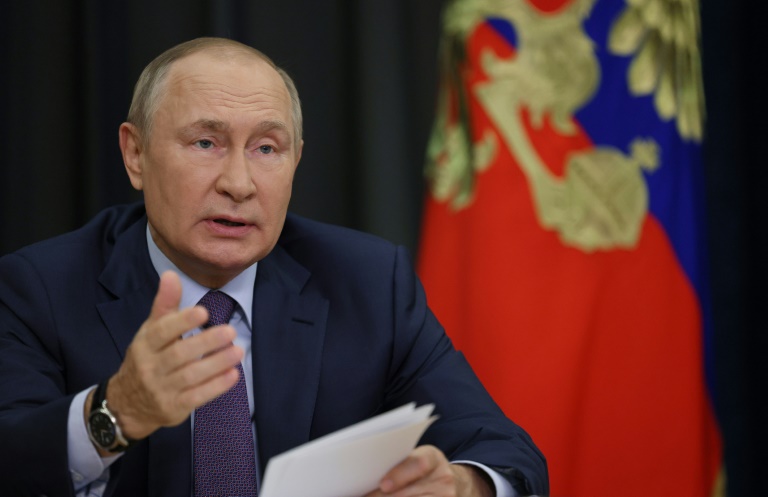
Russian President Vladimir Putin is poised to formally annex Kherson, Zaporizhzhia, Donetsk and Lugansk, which his forces mostly control, at a grand Kremlin ceremony later on Friday.

He has warned he could use nuclear weapons to retain control of the territory as the United States leads Western allies in vowing “never” to recognise the regions as anything other than part of Ukraine.

Kremlin spokesman Dmitry Peskov told reporters that the annexations would be formalised at an event at (1200 GMT) during which Putin would deliver a “major” speech.

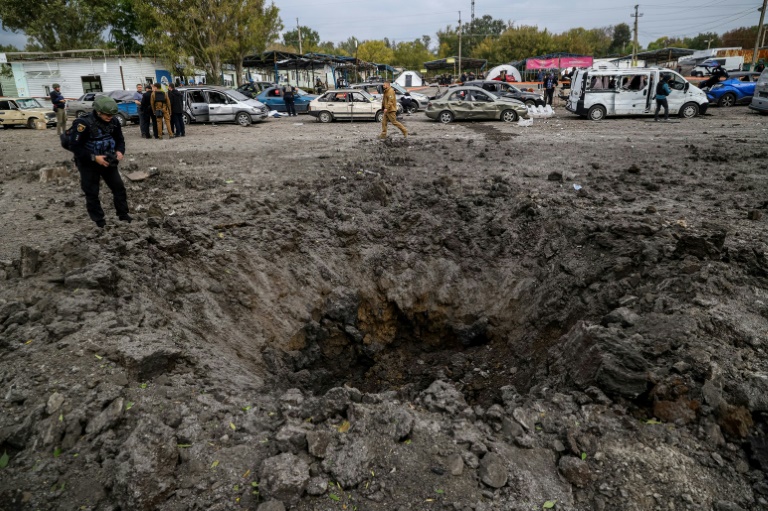
But early on Friday, an attack in Zaporizhzhia in the south, killed at least 25 people as civilians were preparing to leave to pick up relatives, Ukrainian officials said.

“Twenty-five killed and about 50 wounded in an attack by the Russian military on a humanitarian convoy in Zaporizhzhia. Investigation launched,” said the prosecutor general’s office on Telegram.

Bodies of people wearing civilian clothes were left on the ground after the attack and windows of cars blown out, an AFP photographer said. 

“Only complete terrorists could do this,” said Ukrainian President Volodymyr Zelensky. “Bloodthirsty scum! You will definitely answer,” he added. 

– Some 20 percent of Ukraine –

“The enemy launched rockets on a civilian convoy leaving the city centre,” said Zaporizhzhia governor Oleksandr Starukh.

But pro-Kremlin regional chief Vladimir Rogov accused Ukrainian troops of carrying out a “terrorist act”.

“The regime in Kyiv is trying to portray what happened as shelling by Russian troops, resorting to a heinous provocation,” he said on social media.

Preparations were underway in Moscow’s Red Square for state-organised celebrations to announce the annexation of Zaporizhzhia and the three other regions.

Municipal workers were climbing scaffolding in advance to install huge banners emblazoned with: “Donetsk. Lugansk. Zaporizhzhia. Kherson. Russia!”

“I’m happy if they want to join Russia,” Natalya Bodner, a 37-year-old lawyer told AFP in central Moscow. “They have more hope than we do”.

“It should have been done a long time ago,” a Russian serviceman Ildar Babaev from the southern region of Dagestan said.

“This is the right decision”.

The four territories create a crucial land corridor between Russia and the Crimean peninsula, annexed by Moscow in 2014.

– ‘Nobody believes it’ –

But the Kremlin said Friday it “needed to clarify” the exact borders of Kherson and Zaporizhzhia — neither fully controlled by Moscow’s forces — that it intends to annex.

Together, all five regions including Crimea, make up around 20 percent of Ukraine, whose forces in recent weeks have been clawing back wins as part of a counter-offensive.

In Sloviansk, a city in Donetsk, a military medic who goes by the name of Coconut said the annexations were nonsense.

“If my neighbour comes to my house and announces that it’s his, nobody believes it actually belongs to him,” he told AFP.

In Kherson, Russian officials announced that Ukrainian strikes with US-supplied precision artillery systems had killed a senior security chief of the Russian-controlled region.

A “pinpoint” strike by Himars hit his house, Kirill Stremousov, the deputy head of the Russian proxy administration said.

It was the latest of several targeted attacks on Russian-appointed officials in the region.

– Security Council vote –

Ukrainian forces are also on the doorstep of Lyman in Donetsk, which Moscow’s forces pummelled for weeks to capture this summer. 

“Lyman is partially surrounded,” said Denis Pushilin, the pro-Moscow leader in the breakaway region of Donetsk, on social media. Two nearby villages were “not fully under our control,” he added.

On Thursday, President Joe Biden said the United States would “never, never, never” recognise Russian sovereignty over the territories set for annexation.

The four regions’ Kremlin-installed leaders this week assembled in the Russian capital ahead of the ceremony.

They formally requested annexation after claiming residents backed the move in hastily organised referendums that were dismissed by Kyiv and the West as fraudulent.

Ukraine has said the West’s only appropriate response is to hit Russia with more sanctions and to supply Ukrainian forces with more weapons to keep reclaiming territory.

The UN Security Council will vote Friday on a resolution condemning the referendums, according to France, the council’s current president, but it has no chance of passing due to Moscow’s veto power.

Zelensky is calling an “urgent” meeting of his national security council for Friday, his spokesman said.

burs/jm

Court upholds Tanzania move to cordon off land to protect wildlife

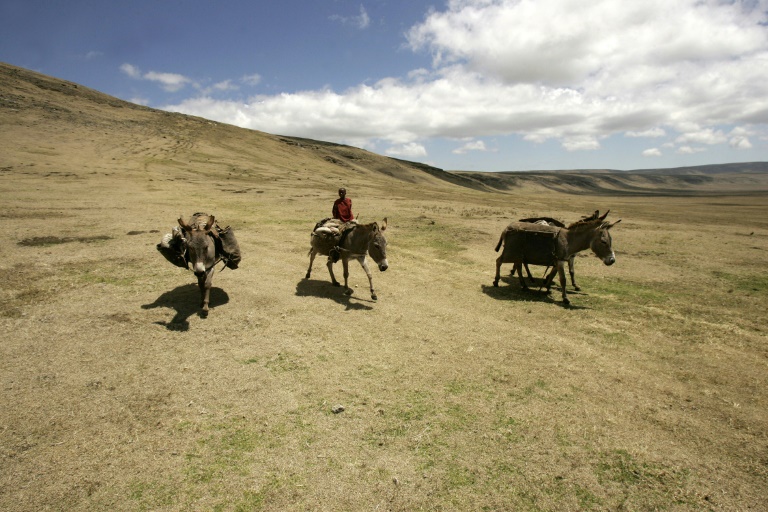
A regional court on Friday ruled that Tanzania’s decision to cordon off land for wildlife protection was legal, dealing a blow to Maasai pastoralists who had protested the move, two lawyers for the community said.

The nomadic community in Loliondo in the northern district of Ngorongoro has accused the government of trying to force them off their ancestral land in order to organise safaris and hunting expeditions.

But the government has rejected the accusations, claiming it wants to “protect” 1,500 square kilometres (580 square miles) of the area from human activity.

After several postponements, the Arusha-based East African Court of Justice upheld the government’s decision, a lawyer for the Maasai told AFP.

“Unfortunately, the court ruled against us,” Esther Mnaro said.

“They have delivered a very impugned judgement,” another lawyer, Yonas Masiaya, told AFP.

The Maasai had asked the court to “stop the evictions, the arrest, detention or persecution” of their members and demanded a billion Tanzanian shillings ($430,000) as damages.

The three-judge bench said no compensation was due, Mnaro said.

They “decided that there… was no loss of property and none of these people were injured during the evictions, but our evidence and our witnesses had said totally different things.”

Mnaro said the community would decide whether to appeal.

There was no immediate reaction to the ruling from the government, which had previously argued that the Arusha court did not have jurisdiction to hear the matter.

Tensions have soared in recent months with violent clashes breaking out in June in Loliondo between police and Maasai demonstrators.

More than two dozen Maasai protesters were charged with murder over the death of a policeman in the clashes.

– Population growth –

Tanzania has historically allowed indigenous communities such as the Maasai to live within some national parks, including the Ngorongoro conservation area, a UNESCO World Heritage site. 

But the authorities say their growing population is encroaching on wildlife habitat and began moving the pastoralists out of Ngorongoro in June, calling it a voluntary relocation.

The relocation has sparked concern, with a team of UN-appointed independent rights experts warning in June that “it could jeopardise the Maasai’s physical and cultural survival.”

Since 1959, the number of humans living in Ngorongoro has shot up from 8,000 to more than 100,000.

The livestock population has grown even more quickly, from around 260,000 in 2017 to over one million today.

As climate change leads to prolonged droughts and low crop yields, pressure on the pastoralists has increased, forcing them into conflict with wildlife over access to food and water.

In 2009, thousands of Maasai families were moved out of Loliondo to allow an Emirati safari company, Ortelo Business Corporation, to organise hunting expeditions there. 

The government cancelled that deal in 2017, following allegations of corruption.

The East Africa Court of Justice came into force in 2001 to ensure adherence to the laws establishing the seven-nation East African Community bloc, made up of Burundi, Kenya, Rwanda, South Sudan, Tanzania, the Democratic Republic of Congo and Uganda.

European stocks climb, pound stalls on mixed data

European stock markets climbed Friday but the pound and euro fell as traders assessed mixed growth and inflation data.

The pound jumped on revised figures showing the UK economy had avoided recession — but it swiftly fell back on expectations of an eventual downturn owing to sky-high inflation.

In the eurozone, consumer prices rocketed a record 10 percent in September on soaring energy prices caused by Russia’s war on Ukraine, separate official data showed.

“Stock markets are bouncing back… although I don’t think anyone is getting excited by the moves which pale in comparison to the losses that preceded them,” noted OANDA senior market analyst Craig Erlam.

“This looks like nothing more than a dead cat bounce after a steep decline over the last couple of weeks as investors have been forced to once again accept that interest rates are going to rise further and faster than hoped.”

In the United States, Federal Reserve officials have again reiterated their intention to ramp up rates until they have tamed inflation, even if that means plunging the world’s top economy into recession.

The case for a fourth successive 0.75-percentage point lift was strengthened by news Thursday that first-time unemployment benefit claims fell below 200,000 for the first time since May.

All three main indices on Wall Street finished deep in the red Thursday, with the S&P 500 ending at its lowest level since November 2020.

In Asia on Friday, Shanghai dropped as data showed China’s manufacturing and services sectors struggled again in September from Covid lockdowns in parts of the country that have battered the world’s number-two economy.

There was also little reaction to news that Beijing would allow some cities to reduce mortgage rates for first-home purchases as it tries to support the property market.

Market sentiment was being eroded also by rising fears about developments in the Ukraine war, as Russia prepares to annex four occupied regions of its neighbour Friday, with President Vladimir Putin threatening to use nuclear weapons to defend the territories.

– Key figures around 1100 GMT –

London – FTSE 100: UP 0.4 percent at 6,909.18 points 

Frankfurt – DAX: UP 0.4 percent at 12,017.95

Paris – CAC 40: UP 0.8 percent at 5,723.46

EURO STOXX 50: UP 0.6 percent at 3,297.15

Tokyo – Nikkei 225: DOWN 1.8 percent at 25,937.21 (close)

Hong Kong – Hang Seng Index: UP 0.3 percent at 17,222.83 (close)

Shanghai – Composite: DOWN 0.6 percent at 3,024.39 (close)

New York – Dow: DOWN 1.5 percent at 29,225.61 (close)

Pound/dollar: DOWN at $1.1067 from $1.1116 on Thursday

Euro/dollar: DOWN at $0.9764 from $0.9818

Euro/pound: DOWN at 88.20 pence from 88.28 pence

Dollar/yen: UP at 144.47 yen from 144.42 yen

Brent North Sea crude: UP 0.7 percent at $89.12 per barrel

West Texas Intermediate: UP 0.3 percent at $81.41 per barrel

Hurricane Ian dumped 10% more rain due to climate change: research

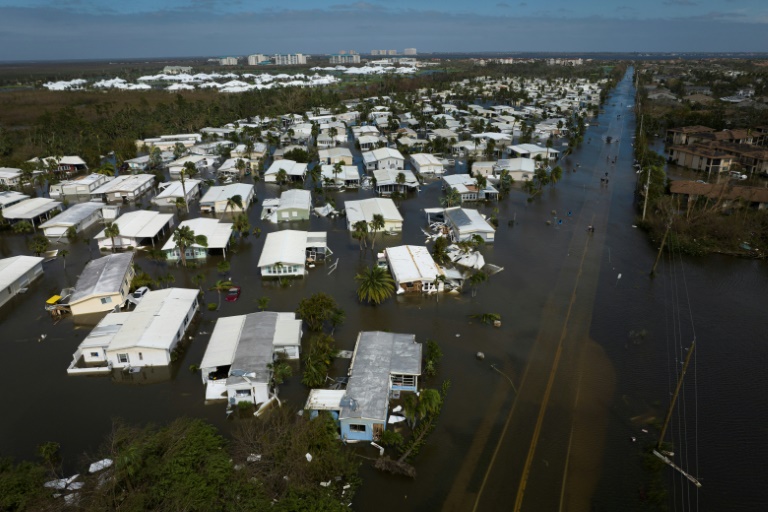
Climate change increased the rainfall from Hurricane Ian by more than 10 percent, according to a new quick-fire analysis, as one of the most powerful storms ever to hit the United States devastated parts of Florida. 

Ian “could be the deadliest hurricane in Florida history”, President Joe Biden said after the storm brought ferocious winds, turned streets into churning rivers that swept away homes and left an unknown number of casualties. 

According to a rapid and preliminary analysis, human-caused climate change increased the extreme rain that Ian unleashed by over 10 percent, US scientists said.

“Climate change didn’t cause the storm but it did cause it to be wetter,” said Lawrence Berkeley National Laboratory’s Michael Wehner, one of the scientists behind the new finding. 

The researchers compared simulations of today’s world — which has warmed nearly 1.2 degrees Celsius since pre-industrial times — with counterfactual simulations of a world without human-induced climate change. 

Wehner said these were “conservative estimates”, adding that while they are not peer reviewed, they are based on methods used in a study on the 2020 Atlantic hurricane season, which was published in April in the journal Nature Communication.

Climate change from emissions of planet-heating greenhouse gases is warming the ocean’s surface and increasing moisture in the atmosphere that fuels hurricanes. 

Although the total number of tropical storms, or cyclones, may not increase, scientists say warming is whipping up more powerful cyclones with stronger winds and more precipitation.

“Human-caused climate change is affecting hurricanes in many ways including causing them to intensify faster, be stronger overall, and dump a lot more rain,” tweeted climate scientist Katharine Hayhoe, who was not involved in the research. 

For each degree Celsius of warming, scientists expect the water in the atmosphere to increase by around seven percent.  

But Wehner said that his research found that storms are “more efficient” at turning the available moisture into rainfall.

Ian swept across Cuba on Tuesday, downing the country’s power network, before slamming into the Florida coast on Wednesday as a strong Category 4 hurricane.

The National Hurricane Center said Thursday the now Category 1 storm is expected to bring “life-threatening flooding, storm surge and strong winds” to the Carolinas.

Eurozone inflation jumps to record 10%

Eurozone consumer prices skyrocketed by a record 10 percent in September, official data showed on Friday, as inflation reached double digits on the back of soaring energy prices caused by Russia’s war on Ukraine.

Stoked by a staggering 40.8 percent rise in energy prices, the yearly inflation rate in the 19-country single currency area hit its highest level since records began, according to Eurostat.

The historic level of inflation will encourage the European Central Bank to stay on its current path of rate hikes, in an effort to cool prices despite the risk of triggering economic recession in Europe.

The ECB is desperate to prevent inflation from taking root in the economy and is taking measures that will reduce demand and could therefore slow growth.

In an urgent effort to tame prices, European Union energy ministers agreed on Friday to peak-hour power consumption and to impose windfall levies on energy companies.

The leap to 10 percent followed a 9.1 percent rise in August and doused hopes that inflation would begin to ease as energy markets stabilise seven months after Russia launched its invasion of Ukraine.

Making matters more complicated for policymakers, the eurozone’s powerhouse economies showed widely divergent inflation rates, with Germany seeing price hikes of 10.8 percent and France at 6.2 percent.

In the Netherlands inflation prices rose by 17.1 percent, the highest since World War II, in a major leap from an already sky-high 12 percent a month earlier.

Also muddying the waters, some eurozone countries are pushing through major national spending to ease the energy price burden on consumers, creating further fragmentation in the European economy.

– ECB rate hike looms –

In the face of a tough balancing act, ECB chief Christine Lagare indicated this week she would go ahead with another hefty rate hike of 0.75 percentage points at the bank’s next meeting on October 27.

“We expect to raise interest rates further over the next several meetings to dampen demand and guard against the risk of a persistent upward shift in inflation expectations,” she told EU lawmakers. 

Energy prices in Europe remain under intense pressure with Russia starving the continent of gas supply as winter approaches.

The ECB’s target for inflation is two percent and efforts to get closer to that level have raised fears that the central bank may lead the bloc into a recession in its effort to reduce prices.

“The jump in the eurozone’s headline inflation rate in September into double digits will be of grave concern to the ECB,” said Jessica Hinds of Capital Economics.

“Despite the weak economic outlook we expect the banks to prioritise inflation and deliver another bumper rate hike next month,” she added.

Eurostat data also published on Friday showed the eurozone unemployment rate remaining at a record low of 6.6 percent in July.

This will further encourage the ECB to stay the course and choose fighting inflation over concerns about economic growth and its consequences on employment.

Bolsonaro, Lula in attack mode in last Brazil presidential debate

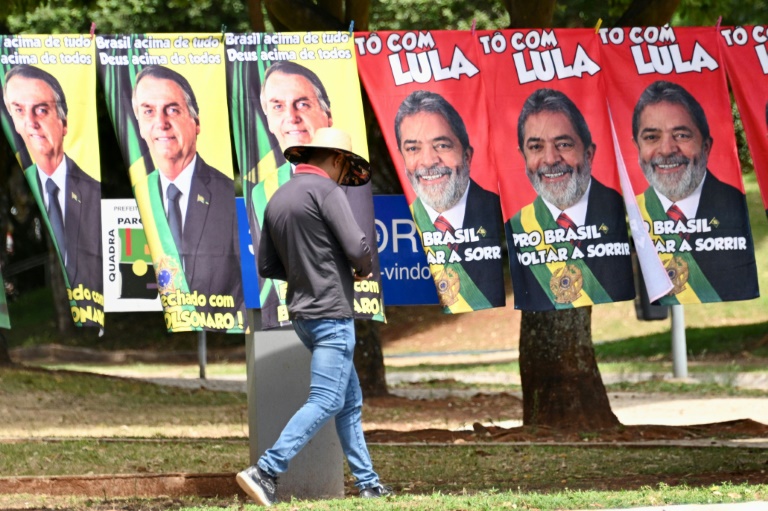
Far-right incumbent Jair Bolsonaro and leftist front-runner Luiz Inacio Lula da Silva traded heated attacks Thursday in a final debate three days from Brazil’s presidential election, accusing each other of corruption, nepotism and lying.

Trailing in the polls ahead of Sunday’s polarizing vote, Bolsonaro wasted no time going for the jugular, calling Lula a “liar, ex-inmate and traitor.”

Seeking to deliver a knockout punch and win the election in the first round, Lula, the charismatic but tarnished ex-president who led Brazil from 2003 to 2010, responded in kind.

“It’s ugly for the president of the republic to blatantly lie all the time… That’s why the people are going to send you packing,” the ex-metalworker said in his trademark gravelly voice.

He told Bolsonaro to “look in the mirror” if he wanted to see corruption, citing graft allegations against the president’s senator son Flavio and ex-education minister, accused of demanding kickbacks for influential evangelical churches.

The moderator, journalist William Bonner, reprimanded both candidates for failing to respect the ground rules, and had his work cut out for him in an unruly, heated debate that also featured five other candidates trailing far behind in the polls.

AFP fact-checkers identified numerous falsehoods in the candidates’ statements.

For example, Bolsonaro tried to fend off accusations he dragged his feet on purchasing Covid-19 vaccines, saying: “No country in the world purchased vaccines in 2020.”

In reality, millions of doses were administered around the world that year.

Lula meanwhile insisted he was “found innocent” of all corruption charges.

But his convictions were annulled on procedural grounds — he was never found not guilty.

Earlier Thursday, a poll by the Datafolha institute showed Lula maintaining a 14-point lead over Bolsonaro, 48 percent to 34 percent.

Excluding voters who said they planned to cast blank or spoiled ballots, Lula’s support reached 50 percent.

That put him on the cusp of the score needed to win outright and avoid a runoff on October 30: 50 percent of valid votes, plus one.

Bolsonaro, who is fond of saying the only reliable polls are “on the street” — where the 67-year-old incumbent regularly rallies his die-hard supporters en masse — is counting on his evangelical and business-centric base to pull through.

Lula — who presided over an economic boom, leaving office with an unprecedented approval rating of 87 percent — is meanwhile appealing to poor, minority and anti-Bolsonaro voters.

The 76-year-old is seeking a remarkable political comeback just four years after being jailed on controversial corruption convictions stemming from a massive scandal centered on state-run oil giant Petrobras.

Freed pending appeal in 2019 after 18 months behind bars, Lula regained his eligibility to run for office when the Supreme Court annulled his convictions last year, finding the lead judge in the case was biased.

– ‘Can change the picture’ –

The late-night debate on TV Globo, the most-watched broadcaster in Brazil, was the last chance for candidates to sway undecided voters.

Bolsonaro’s camp had said he would come out swinging, attacking Lula on the corruption issue and pressing home his conservative values on issues of religion and abortion.

“This is the debate that can change the picture,” a Bolsonaro campaign member told AFP on condition of anonymity.

After the first debate, a month ago, Lula was criticized for seemingly evading the corruption question. He opted not to take part in another debate, last Saturday.

Lula has urged Brazilians loyal to any of the minority candidates to rather cast a “tactical” vote for him, and against Bolsonaro.

The incumbent president got a celebrity boost Thursday for his re-election bid from football superstar Neymar, who posted a video on TikTok of himself dancing to a pro-Bolsonaro campaign song.

Grinning, the Paris Saint-Germain and Brazil striker, arguably Brazil’s most famous celebrity, flashed the number 22 with his fingers — Bolsonaro’s candidate number —  as he rocked out to the electronic dance jingle.

Datafolha will bring out another, final poll on Saturday, the eve of the first round.

Bolsonaro has repeatedly hinted he would challenge a Lula victory, saying last weekend: “We are the majority. We will win in the first round.”

Comeback kid Lula seeking Brazil's top job at 76

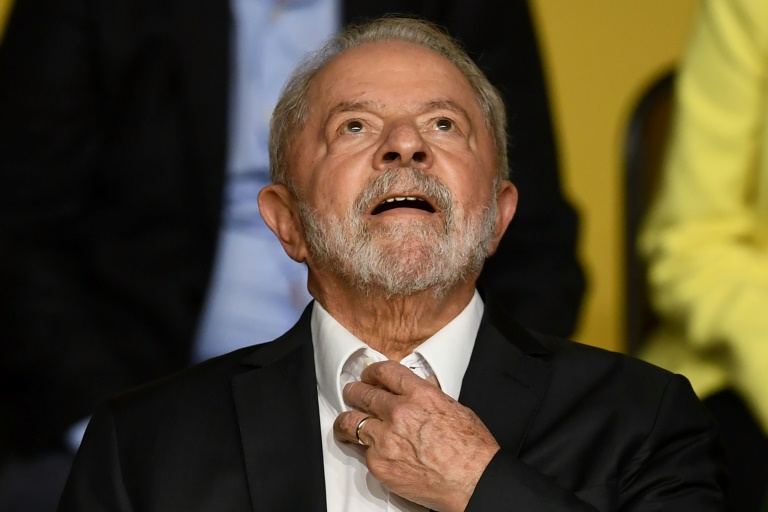
Luiz Inacio Lula da Silva will be hoping his record as the most popular president in Brazilian history can trump the ignominy of a graft conviction to hand him a third term at the helm — 12 years after his last.

Having overcome childhood poverty, cancer, deep personal loss and a controversial jail term, the 76-year-old former metalworker and unionist goes head-to-head in a first election round Sunday with far-right incumbent Jair Bolsonaro.

Known for his political skill and folksy touch, Lula left office in 2010 as a blue-collar hero who presided over a commodity-fueled economic boom that helped lift 30 million people out of poverty.

His approval rating stood at an unprecedented 87 percent.

But he then became mired in a massive corruption scandal that engulfed some of Brazil’s most influential politicians, business executives and the Workers’ Party (PT).

Lula was jailed in 2018, effectively eliminating him as the favorite in that year’s presidential race — which Bolsonaro won. 

He spent more than 18 months in prison before being freed pending appeal.

His convictions were thrown out last year by the Supreme Court, which found the lead judge on the case was biased. Lula has led Bolsonaro in the opinion polls ever since.

The leftist icon has rejected any idea of seeking vengeance if re-elected.

“I stayed calm, preparing myself as Mandela prepared for 27 years, as Gandhi prepared all his life, to get out of prison without anger,” he told supporters in Sao Paulo last week, describing himself as a man of “peace and love.”

– Workers’ Party –

Lula has crisscrossed Brazil on the campaign trail, avoiding large crowds for security reasons, and never without his bullet-proof vest.

As much as he is beloved among the poor, Lula is detested in equal measure by Bolsonaro backers as the very incarnation of Brazilian corruption.

He has, however, recovered better from the reputational blow than his Workers’ Party has — distrust of the party was a major reason for Bolsonaro’s 2018 victory.

Despite fears at the time that his brand of leftism would be too radical, Lula’s 2003-2010 administration mixed trailblazing social programs with market-friendly economic policy.

He gained a reputation as a moderate and pragmatic leader.

Lula also turned Brazil into a key player on the international stage, helping secure it the 2014 World Cup and the 2016 Olympics in Rio de Janeiro.

– ‘Most popular politician’ –

Lula was once called “the most popular politician on Earth” by no less than Barack Obama.

But just as he settled into the role of elder statesman, he was clobbered by “Operation Car Wash” — the sweeping investigation that uncovered a massive web of corruption centered on state-run oil company Petrobras.

Prosecutors struggled to prove that Lula masterminded the scheme.

He was sentenced instead to 26 years for accepting a triplex beach apartment and renovations at a ranch property as bribes for greasing access to juicy Petrobras contracts.

Lula has always denied the accusations.

– From poverty to president –

Lula grew up in deep poverty, the seventh of eight children born to a family of illiterate farmers in the arid northeastern state of Pernambuco.

When he was seven, his family joined a wave of migration to the industrial heartland of Sao Paulo. 

Lula worked as a shoeshine boy and peanut vendor before becoming a metalworker at the tender age of 14.

In the 1960s, he lost a finger in a workplace accident.

He rose quickly to become head of his trade union, and led major strikes in the 1970s that challenged the then-military dictatorship.

In 1980, he co-founded the Workers’ Party, standing as its candidate for president nine years later.

Lula lost three presidential bids from 1989 to 1998, finally succeeding in 2002 and again four years later.

This is his sixth presidential campaign.

The father of five survived throat cancer and in 2017 lost his wife of four decades, Marisa Leticia Rocco, to a stroke.

In his trademark gravelly voice, Lula has said he is again “in love as if I were 20 years old” with Rosangela “Janja” da Silva, a sociologist and PT activist whom he married in May.

If he wins, Lula has said he will not seek a second term.

Thai court rules suspended PM Prayut can resume office

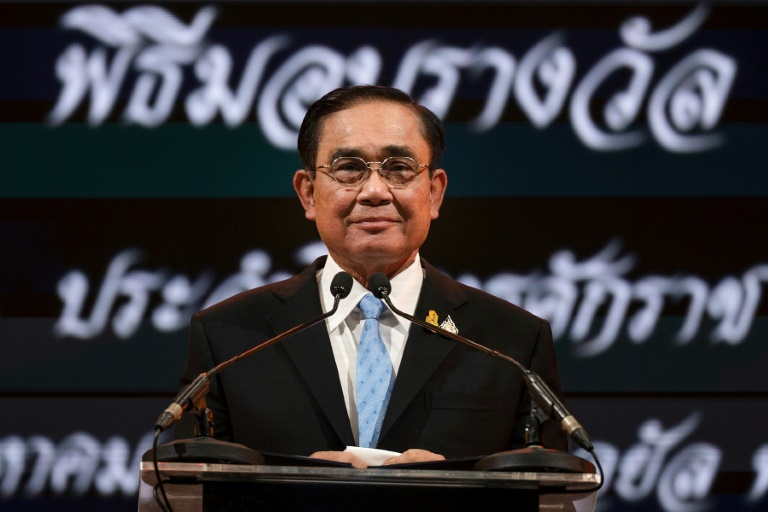
Thai Prime Minister Prayut Chan-O-Cha resumed office Friday after the country’s constitutional court ruled that he has not exceeded his eight-year term limit.

The former army chief, who came to power in a 2014 military coup, was suspended last month while the court examined a legal challenge mounted by opposition parties who argued he had reached his term limit in power.

Bangkok authorities were on alert for demonstrations after the ruling, as several protest groups had earlier said they would take to the streets if Prayut won the case.

“The constitutional court rules by a majority that the respondent’s premiership has not reached the eight-year limit,” said judge Punya Udchacon, reading the ruling.

“The cabinet under the premiership of the respondent is counted from April 6, 2017.”

Under the 2017 Thai constitution, a prime minister cannot serve more than eight years in office, but Prayut’s supporters and critics disagreed about when his term began.

The ruling counts Prayut’s term from when the new army-scripted constitution came into force and means he can stay in office until 2025 — depending on an upcoming national poll, which must be held within months.

Prayut welcomed the 6-3 majority ruling in a statement on his official Facebook page, saying he would use the government’s remaining time in office to push ahead with infrastructure projects.

“I will try my best and work with my full capacity to change the country,” he wrote.

– ‘Lose face’ –

Following Prayut’s suspension in August, his deputy Prawit Wongsuwan took over as caretaker prime minister, while Prayut continued to serve as defence minister.

The suspension had been hugely damaging to Prayut, Naresuan University political scientist Napisa Waitoolkiat said before the ruling, causing him to “lose face” in the eyes of voters.

Prayut and his Palang Pracharat Party are increasingly out of favour with voters, as an underperforming Thai economy hurts households.

A survey of 2,500 people earlier this month by the National Institute of Development Administration found that only 10.5 percent of respondents supported Prayut, who ranked a lowly fourth as a potential prime ministerial candidate.

Napisa said there could be angry reactions to the ruling going in Prayut’s favour.

“I think there will be protests in the street and demonstrations in Bangkok against the ruling.”

At least three protest groups — which came to prominence during 2020’s massive pro-democracy rallies — said Thursday they would demonstrate should Prayut carry the day. 

Deputy national police spokesman Kissana Phathanacharoen told AFP officers would be deployed to provide security near the court and in Bangkok’s shopping mall district, a popular location for previous protests.

Meanwhile, officials announced late Thursday there would be a restricted zone around the court.

Close Bitnami banner
Bitnami