World

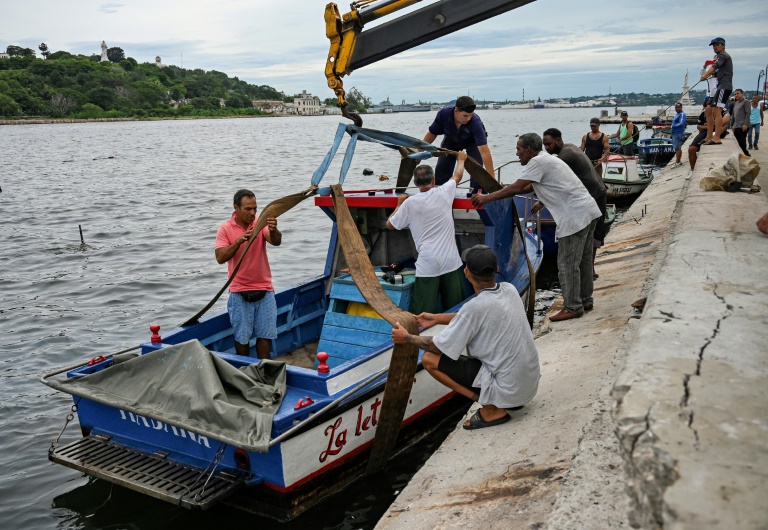
Cuba issues cyclone alert as Hurricane Ian nears

Cuba on Monday declared a cyclone alert in its six most western provinces as fast-approaching Hurricane Ian strengthened rapidly, with Florida also ramping up preparations ahead of a possible hit.

Authorities in Havana said they were ready to evacuate those from the most affected areas while supplying fresh drinking water and medical services.

“Given the continuing deterioration of the weather conditions… it was decided to establish from 0800 (1200 GMT) the Cyclone Alert Phase,” said the Civil Defense Staff on state media.

The US National Hurricane Center (NHC) warned Ian was expected to pass near the Cayman Islands and then over western Cuba late Monday and early Tuesday.

“Rapid strengthening is expected during the next day or so, and Ian is forecast to become a major hurricane,” it added, with current maximum sustained winds of 80 miles (130 kilometers) per hour.

Cuba’s Insmet meteorology institute said Ian was advancing at a speed of 22 kilometers per hour.

The six provinces put on alert are Pinar del Rio, Artemisa, La Habana, Mayabeque, Cienfuegos and Isla de la Juventud.

– ‘Huge storm surge’ expected –

In Florida, Tampa city was under a hurricane watch , and state Governor Ron DeSantis declared a state of emergency in all 67 counties as officials scrambled to prepare for the storm’s forecast landing on late Wednesday or Thursday.

Ian “will bring heavy rains, strong winds, flash flooding, storm surge, along with isolated tornado activity along Florida’s Gulf Coast,” DeSantis said in a press conference in Tallahassee on Monday.

He warned people to prepare for power cuts.

“Even if the eye of the storm doesn’t hit your region, you’re going to have really significant winds, it’s going to knock over trees, it’s going to cause interruptions,” DeSantis said, warning of likely flooding.

The governor urged residents to stock up on food, water, medicine and fuel, and he activated 7,000 National Guard members to help with the effort.

Authorities in several Florida municipalities, including Miami, Fort Lauderdale and Tampa, started distributing free sandbags to residents to help protect their homes from the risk of flooding.

President Joe Biden approved emergency aid to 24 counties in Florida through the Federal Emergency Management Agency (FEMA).

NASA said it was rolling back its Artemis 1 rocket due to blast off to the Moon into its storage hangar at the Kennedy Space Center in Florida due to the hurricane.

– Fiona’s wake –

The Caribbean and parts of eastern Canada are still counting the cost of powerful storm Fiona, which tore through last week, claiming several lives.

When it arrived in eastern Canada, the storm packed intense winds of 80 miles per hour, bringing torrential rain and waves of up to 40 feet (12 meters).

Canadian authorities have confirmed two deaths caused when Fiona barreled into Nova Scotia and Newfoundland as a post-tropical cyclone early Saturday.

Prince Edward Island authorities confirmed the death of one person while officials in Newfoundland said they found the body of a 73-year-old woman believed to have been swept from her home. She was apparently sheltering in her basement when waves broke through.

“The devastation is immense,” Nova Scotia Premier Tim Houston told reporters. “The magnitude of the storm is incredible.”

Storm surges swept at least 20 homes into the sea in the town of Channel-Port aux Basques, on the southwestern tip of Newfoundland.

Around 200 residents had been evacuated before the storm hit.

“Some people have lost everything, and I mean everything,” Button told CBC News.
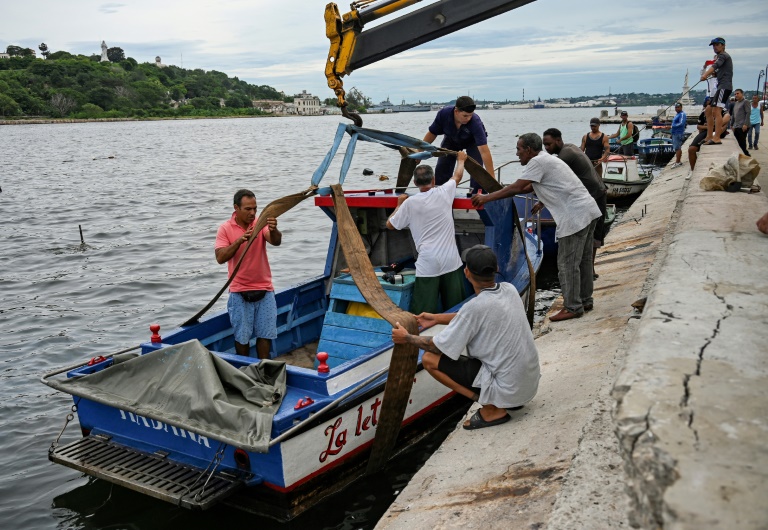
Cuba issues cyclone alert as Hurricane Ian nears

Cuba on Monday declared a cyclone alert in its six most western provinces as fast-approaching Hurricane Ian strengthened rapidly, with Florida also ramping up preparations ahead of a possible hit.

Authorities in Havana said they were ready to evacuate those from the most affected areas while supplying fresh drinking water and medical services.

“Given the continuing deterioration of the weather conditions… it was decided to establish from 0800 (1200 GMT) the Cyclone Alert Phase,” said the Civil Defense Staff on state media.

The US National Hurricane Center (NHC) warned Ian was expected to pass near the Cayman Islands and then over western Cuba late Monday and early Tuesday.

“Rapid strengthening is expected during the next day or so, and Ian is forecast to become a major hurricane,” it added, with current maximum sustained winds of 80 miles (130 kilometers) per hour.

Cuba’s Insmet meteorology institute said Ian was advancing at a speed of 22 kilometers per hour.

The six provinces put on alert are Pinar del Rio, Artemisa, La Habana, Mayabeque, Cienfuegos and Isla de la Juventud.

– ‘Huge storm surge’ expected –

In Florida, Tampa city was under a hurricane watch , and state Governor Ron DeSantis declared a state of emergency in all 67 counties as officials scrambled to prepare for the storm’s forecast landing on late Wednesday or Thursday.

Ian “will bring heavy rains, strong winds, flash flooding, storm surge, along with isolated tornado activity along Florida’s Gulf Coast,” DeSantis said in a press conference in Tallahassee on Monday.

He warned people to prepare for power cuts.

“Even if the eye of the storm doesn’t hit your region, you’re going to have really significant winds, it’s going to knock over trees, it’s going to cause interruptions,” DeSantis said, warning of likely flooding.

The governor urged residents to stock up on food, water, medicine and fuel, and he activated 7,000 National Guard members to help with the effort.

Authorities in several Florida municipalities, including Miami, Fort Lauderdale and Tampa, started distributing free sandbags to residents to help protect their homes from the risk of flooding.

President Joe Biden approved emergency aid to 24 counties in Florida through the Federal Emergency Management Agency (FEMA).

NASA said it was rolling back its Artemis 1 rocket due to blast off to the Moon into its storage hangar at the Kennedy Space Center in Florida due to the hurricane.

– Fiona’s wake –

The Caribbean and parts of eastern Canada are still counting the cost of powerful storm Fiona, which tore through last week, claiming several lives.

When it arrived in eastern Canada, the storm packed intense winds of 80 miles per hour, bringing torrential rain and waves of up to 40 feet (12 meters).

Canadian authorities have confirmed two deaths caused when Fiona barreled into Nova Scotia and Newfoundland as a post-tropical cyclone early Saturday.

Prince Edward Island authorities confirmed the death of one person while officials in Newfoundland said they found the body of a 73-year-old woman believed to have been swept from her home. She was apparently sheltering in her basement when waves broke through.

“The devastation is immense,” Nova Scotia Premier Tim Houston told reporters. “The magnitude of the storm is incredible.”

Storm surges swept at least 20 homes into the sea in the town of Channel-Port aux Basques, on the southwestern tip of Newfoundland.

Around 200 residents had been evacuated before the storm hit.

“Some people have lost everything, and I mean everything,” Button told CBC News.
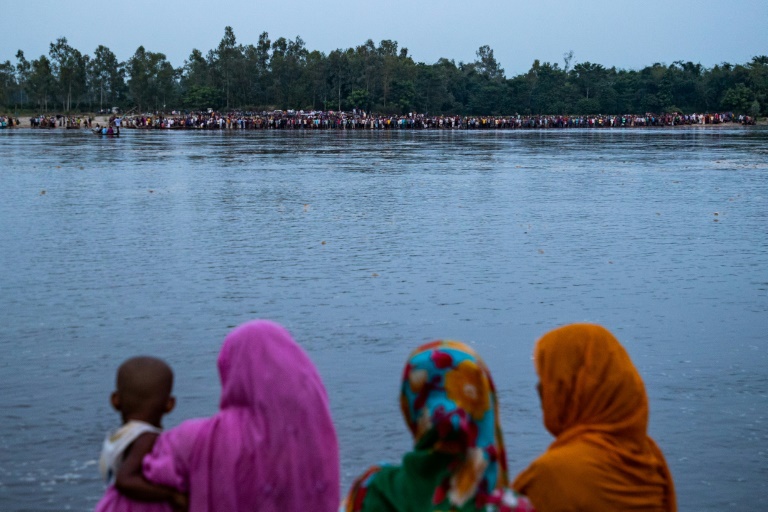
Bangladesh boat tragedy death toll hits 51

Rescue workers recovered 26 more bodies on Monday after a boat carrying religious pilgrims capsized in Bangladesh, taking the death toll to 51 with at least a dozen people still missing, police said.

The small boat packed mostly with women and children on their way to a popular temple flipped over on Sunday in a river as onlookers screamed from the shore.

The incident near the remote northern town of Boda was the latest in a string of similar tragedies blamed on poor maintenance and overcrowding in the low-lying delta country.

Regional police chief Sirajul Huda said fire service and navy divers recovered 26 bodies in the Karotoa River downstream from where the boat tipped over.

It was carrying around 90 people, of whom around 50 were pilgrims on their way to the centuries-old Hindu temple for a major festival, according to police.

Huda said up to 15 people were still missing.

“We called off the search in the night. We will resume our search operation tomorrow morning,” he told AFP.

Police said they have lowered the number of missing people as some have reported that they have found relatives who had swum to safety.

Huda said the boat was carrying three times its capacity.

“There were heavy rains in the morning and that is why when the ferrying began, pilgrims packed the boat to make it quickly to the temple,” he told AFP.

“The boatman asked some people to disembark in an effort to ease the weight-load. But no one listened,” he said.     

Local media said at least 10 people had been rescued and sent to hospital.

Mobile phone footage aired by TV station Channel 24 showed the overcrowded boat suddenly flipping over, spilling the passengers into the muddy brown river.

Dozens of people watching from the shore started shouting and screaming. The weather was calm at the time.

Thousands of Hindus in Muslim-majority Bangladesh visit the famous Bodeshwari Temple every year.

Sunday marked the start of Durga Puja, the biggest Hindu festival in Bangladesh — and also eastern India — drawing large crowds at the temple.

Last December, around 40 people perished when a packed three-storey ferry caught fire in southern Bangladesh. 

A ferry sank in Dhaka in June 2020 after a collision with another vessel, killing at least 32 people.

And at least 78 people perished in 2015 when an overcrowded ship collided with a cargo vessel in a river west of the capital.

Ukrainian geeks turned guerrillas make frontline drones

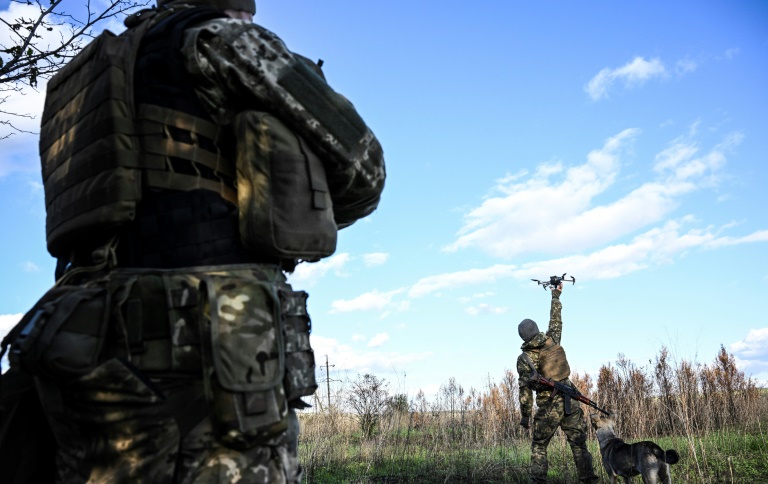
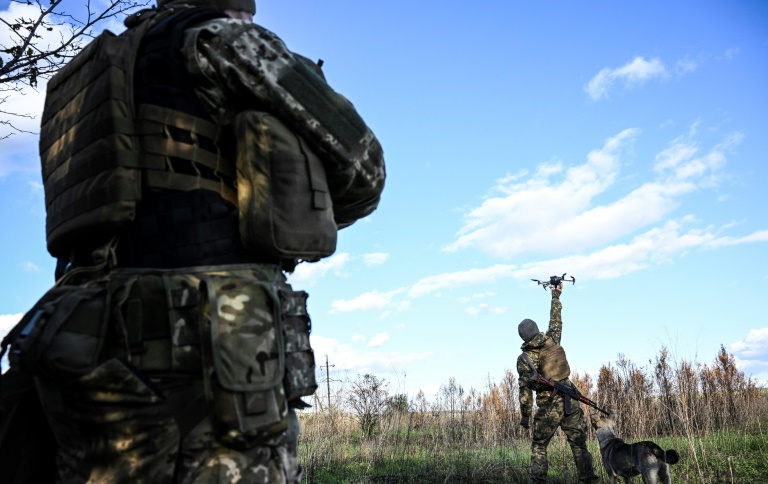
For young Ukrainian geeks, making drones — for reconnaissance or destruction — in a house basement near the Donbas frontline is “new generation” guerrilla warfare.

In dim light, the 20-somethings busily piece together electronic components spread out on tables, with the help of laptops and documents, while artillery fire thuds in the background.

Next the repair room next door -– a laundry room before the war — drones are patched up using spare parts taken from aircraft damaged “in battle” against the Russians.

In the garden shed meanwhile, a 19-year-old, whose nom de guerre is Varnak, transforms grenades designed for grenade launchers into bombs to be dropped from drones.

You just add fins to them and change the detonation system, he tells AFP, smiling.

“I manage explosives here in my section… We work on grenades and create homemade explosive objects”, says the young man, who joined the unit after responding to an announcement on Twitter.

He inscribes personalised messages for the enemy on the miniature bombs, including “Victory — and happy birthday!” and “People who live without freedom have bad taste”.

In the house garage, a platform covered with electronics is mounted on four wheels where the team puts finishing touches to a kamikaze drone able to carry an anti-tank mine, or any other type of explosive. 

A heavy machine gun waits meanwhile in the corner to be transformed into a robotic firing station.

– ‘Volunteers’ –

Aktor (“Actor” in Ukrainian) was a student at the Igor Sikorsky Technical University in Kyiv when Russia launched its invasion in February. Today, he wears a uniform and works on “robotics” to perfect kamikaze drones.

For him, these technologies can make a difference in the conflict in Ukraine “because the current war … is a new generation war”.

“It is no longer people with weapons who wage war but robotic vehicles, with a very high technical level”, says the 22-year-old.

“Why should one soldier shoot another when you have a robot that can deliver a ton of explosives to an ammunition dump?” he asks.

The group’s founder and leader, Zmiy (“Snake” in Ukrainian), is a bearded veteran of the conflict that began in 2014 in the Donbas, eastern Ukraine.

Zmiy, who wears rimmed glasses and a baseball cap decorated with a US flag, says the group comprises about 40 men and women. 

Its core team are veterans like him.

“All the others who build and invent devices joined us via Twitter. They are volunteers,” he tells AFP.

A short distance from their base and less than two kilometres (1.2 miles) from the Russian lines, Mikho the navigator and 11 the pilot prepare a drone for a bomb drop on Russian positions.

Amid constant artillery exchanges, the two men attached a bomb under the drone, a US-made model commercially available for around 3,000 euros ($2,900).

Guided by Mikho, 11 observes the Russian positions on his screen. Then he releases the bomb, which falls vertically and crashes down, exploding in a cloud of smoke.

Immediately, the Russian soldiers’ assault rifles crackle. The Russians try to destroy the device, which hovers about 300 metres (984 feet) above them. But the drone return to the Ukrainian side unscathed.

Ukrainian geeks turned guerrillas make frontline drones

For young Ukrainian geeks, making drones — for reconnaissance or destruction — in a house basement near the Donbas frontline is “new generation” guerrilla warfare.

In dim light, the 20-somethings busily piece together electronic components spread out on tables, with the help of laptops and documents, while artillery fire thuds in the background.

Next the repair room next door -– a laundry room before the war — drones are patched up using spare parts taken from aircraft damaged “in battle” against the Russians.

In the garden shed meanwhile, a 19-year-old, whose nom de guerre is Varnak, transforms grenades designed for grenade launchers into bombs to be dropped from drones.

You just add fins to them and change the detonation system, he tells AFP, smiling.

“I manage explosives here in my section… We work on grenades and create homemade explosive objects”, says the young man, who joined the unit after responding to an announcement on Twitter.

He inscribes personalised messages for the enemy on the miniature bombs, including “Victory — and happy birthday!” and “People who live without freedom have bad taste”.

In the house garage, a platform covered with electronics is mounted on four wheels where the team puts finishing touches to a kamikaze drone able to carry an anti-tank mine, or any other type of explosive. 

A heavy machine gun waits meanwhile in the corner to be transformed into a robotic firing station.

– ‘Volunteers’ –

Aktor (“Actor” in Ukrainian) was a student at the Igor Sikorsky Technical University in Kyiv when Russia launched its invasion in February. Today, he wears a uniform and works on “robotics” to perfect kamikaze drones.

For him, these technologies can make a difference in the conflict in Ukraine “because the current war … is a new generation war”.

“It is no longer people with weapons who wage war but robotic vehicles, with a very high technical level”, says the 22-year-old.

“Why should one soldier shoot another when you have a robot that can deliver a ton of explosives to an ammunition dump?” he asks.

The group’s founder and leader, Zmiy (“Snake” in Ukrainian), is a bearded veteran of the conflict that began in 2014 in the Donbas, eastern Ukraine.

Zmiy, who wears rimmed glasses and a baseball cap decorated with a US flag, says the group comprises about 40 men and women. 

Its core team are veterans like him.

“All the others who build and invent devices joined us via Twitter. They are volunteers,” he tells AFP.

A short distance from their base and less than two kilometres (1.2 miles) from the Russian lines, Mikho the navigator and 11 the pilot prepare a drone for a bomb drop on Russian positions.

Amid constant artillery exchanges, the two men attached a bomb under the drone, a US-made model commercially available for around 3,000 euros ($2,900).

Guided by Mikho, 11 observes the Russian positions on his screen. Then he releases the bomb, which falls vertically and crashes down, exploding in a cloud of smoke.

Immediately, the Russian soldiers’ assault rifles crackle. The Russians try to destroy the device, which hovers about 300 metres (984 feet) above them. But the drone return to the Ukrainian side unscathed.

North Korea sounds warning as US, South Korea begin naval drills

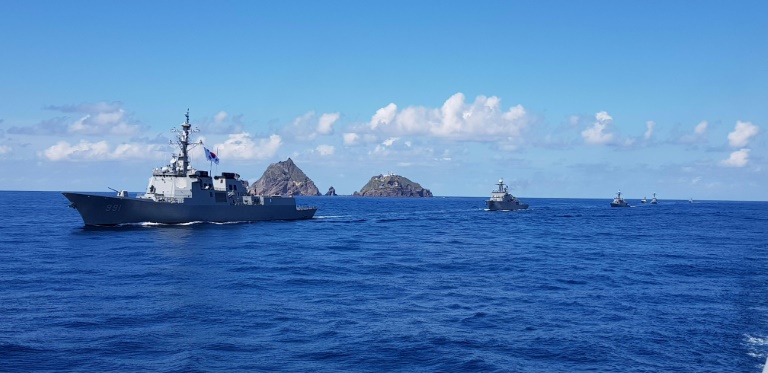
South Korea and the United States began their first combined naval exercise near the peninsula in five years on Monday, leading to a warning by North Korea that the allies risked triggering war.

South Korea’s hawkish President Yoon Suk-yeol, who took office in May, has vowed to beef up joint military drills with the United States, after years of failed diplomacy with North Korea under his predecessor.

“This exercise was prepared to demonstrate the strong will of the South Korea-US alliance to respond to North Korean provocations,” the South’s navy said in a statement.

At the United Nations, North Korea’s ambassador, Kim Song, said that the exercises draw “serious concern.”

“Obviously, this is an extremely dangerous act of igniting the fuse to drive the situation on the Korean peninsula to the brink of war,” he told the General Assembly.

The drills come a day after nuclear-armed Pyongyang conducted another ballistic missile launch, the latest in its record-breaking blitz of weapons tests this year.

Earlier this month, the North revised its nuclear weapons law, enshrining a “first strike” doctrine and vowing never to give up its nukes.

Kim told the United Nations that the United States “compelled” action by the North, officially known as the Democratic People’s Republic of Korea.

“The US should clearly understand that its heinous, hostile policy against the DPRK over the past 30 years has brought about today’s reality and ask itself and ponder how far it will prolong this situation.”

Washington is Seoul’s key security ally and stations about 28,500 troops in South Korea to protect it from the North.

The four-day exercise on South Korea’s east coast will involve more than 20 vessels and an assortment of aircraft, which will conduct drills for anti-ship and anti-submarine warfare operations, tactical manoeuvres and other maritime operations, the navy added.

“Through this exercise, we will further improve the ability to conduct joint operations between the naval forces of the two countries,” Kwak Kwang-sub, a senior South Korean naval officer, said in the statement.

North Korea is under multiple sets of international sanctions over its programmes to develop nuclear weapons and ballistic missiles.

Close neighbour China said it had “noted” the joint military drills in the region when asked about the missile launch on Monday, and called for “dialogue and consultation”.

“The main issue is that the North Korean side’s legitimate and reasonable concerns have not received due response,” foreign ministry spokesman Wang Wenbin said at a routine briefing.

“The US should shoulder its own responsibilities, stop confrontation and pressure, and create conditions for the resumption of meaningful dialogue.”

Seoul has also detected signs the North is preparing to fire a submarine-launched ballistic missile, the president’s office said Saturday, a weapon Pyongyang last tested in May.

Washington and Seoul have long carried out joint exercises, which they insist are purely defensive. North Korea, however, sees them as rehearsals for an invasion.

Last month, the United States and South Korea staged their biggest combined military drills since 2018 — the resumption of large-scale training sessions that had been scaled back due to Covid-19 and the period of diplomacy with Pyongyang.

Turkey files protest with Greece, US in islands row

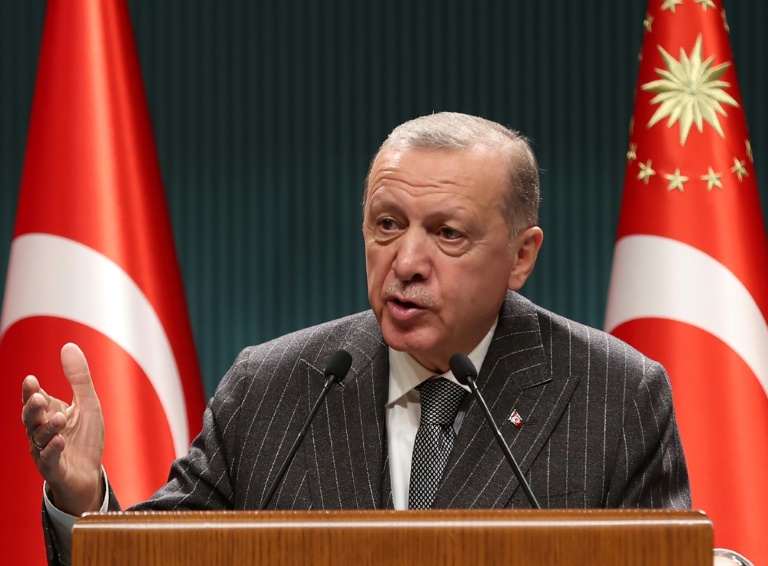
Ankara on Monday summoned the Greek ambassador and protested to Washington after accusing Greece of deploying US armoured vehicles on two Aegean islands near the Turkish coast.

Greece branded the move as “completely unfounded and incompatible with international law”, and accused Ankara of aggressive behaviour.

Greece and Turkey, which are both part of the US-led NATO defence alliance, have feuded for years over maritime borders and energy exploration rights in the Aegean and east Mediterranean seas.

The latest escalation started when Turkish security sources shared aerial images over the weekend purportedly showing ships loaded with US armoured vehicles docking at two Greek islands, Lesbos and Samos. 

The Turkish foreign ministry told the Greek envoy that Athens should “stop violations” and respect the non-military status the islands were assigned by international law, the Anadolu state news agency reported.

In a note to the US embassy in Ankara, Turkey told Washington that its “weapons should not be used in breach” of the islands’ agreed status, Anadolu said.

Turkish President Recep Tayyip Erdogan separately accused Greece of staging “provocations” and playing “perilous games”.

A Greek diplomatic source said Athens rejected Ankara’s objections as “completely unfounded and incompatible with international law”.

The source added that the Greek ambassador had written two letters to UN Secretary General Antonio Guterres to set out his country’s stance in detail.

Erdogan has repeatedly accused Greece of “occupying” the Aegean islands, whose status was settled in treaties adopted after World War I.

In response, Athens accuses Turkey of conducting hundreds of illegal military sorties over the islands.

The Greek diplomatic source said Turkey had threatened its neighbour with war, accusing it of assembling a huge naval presence and violating Greece’s sovereignty and airspace. 

Greece filed a formal complaint with the European Union, NATO and the United Nations after Erdogan hinted at a possible military operation in the Aegean earlier this month.

Erdogan continued his war of words on Monday, saying Greece was not Turkey’s equal and rejecting diplomatic talks.

He also vowed to defend Turkey’s interests with “any means at its disposal” in the islands row.

Italy takes step into unknown with far-right win

Italy took a sharp turn to the right Monday after Giorgia Meloni’s Eurosceptic populist party swept to victory in general elections, putting the one-time Mussolini admirer on course to become the first woman to lead the country.

Meloni’s Brothers of Italy party, which has neo-fascist roots, is set to win around 26 percent of the vote in Sunday’s election, while her wider coalition secured a clear majority in parliament.

With former premier Silvio Berlusconi and Matteo Salvini’s far-right League, they will now begin forming the most right-wing government since World War II, a process likely to take weeks.

Meloni’s success represents a seismic change in Italy — a founding member of the European Union and the eurozone’s third-largest economy — and for the EU, just weeks after the far-right performed strongly in Sweden’s elections.

Meloni used her first public statement to emphasise unity, saying she would govern “for all Italians”.

But the 45-year-old, whose party has never held office, has huge challenges ahead, from soaring inflation to a looming energy crisis and the war in Ukraine.

– ‘Proud, free Europe’ –

Congratulations flooded in from Meloni’s European nationalist allies, from Polish Prime Minister Mateusz Morawiecki to Spain’s far-right party Vox.

“Meloni has shown the way for a proud, free Europe of sovereign nations,” Vox leader Santiago Abascal tweeted.

But Spanish Foreign Minister Jose Manuel Albares warned that “populist movements always grow, but it always ends in the same way — in catastrophe”.

A spokesman for the European Commission said it hoped for “constructive cooperation” with the new government, a line echoed by the Kremlin.

“We are eager to work with Italy’s government on our shared goals: supporting a free and independent Ukraine, respecting human rights and building a sustainable economic future,” US Secretary of State Antony Blinken said.

“Italy is a very Europe-friendly country with very Europe-friendly citizens and we assume that won’t change,” added a spokesman for German Chancellor Olaf Scholz.

Meloni and Salvini are strongly Eurosceptic, although they no longer want Italy to leave the eurozone.

The Brothers of Italy head says Rome must assert its interests more, and has policies that look set to challenge Brussels on everything from public spending rules to mass migration.

Her coalition also wants to renegotiate Italy’s part of the EU’s post-pandemic recovery fund, arguing the almost 200 billion euros ($193 billion) it expects to receive should take into account the energy crisis.

But the funds are tied to a series of reforms only just begun by outgoing Prime Minister Mario Draghi, and analysts say she has limited room for manoeuvre.

Meloni campaigned on a platform of “God, country and family”, sparking fears of a regression on rights in the Catholic-majority country.

Berlusconi struck a Europe-friendly note, pledging the new government would maintain a “European profile” and adding that “good relations with our historic allies and the big countries of the EU are essential for Italy’s future”.

– Long-lasting government –

Meloni had been leading opinion polls since snap elections were called in July after Draghi’s government collapsed.

Hers was the only party not to join Draghi’s national unity coalition in February 2021, making her effectively the sole opposition leader.

Salvini highlighted this as he rued his League party’s poor performance, which at around nine percent is almost half that of its 17-percent showing in 2018.

However, he said he would play his part in the new government, which he hoped could “go for at least five years straight”.

Turnout fell to a historic low of around 64 percent, and some Italians were sanguine about the result, viewing it as yet another chapter in the country’s infamous instability.

“I’m not too pessimistic because Italians, in problematic situations, always find a solution,” noted Fabrizio Sabelli, out and about in Rome on Monday morning.

Meloni has distanced herself from her party’s neo-fascist past — and her own, after praising dictator Benito Mussolini as a teenager — and presented herself as a straight-talking but unthreatening leader.

“Her challenge will be to turn this electoral success into a governing leadership… that can last,” Lorenzo De Sio, head of Italian electoral studies centre CISE, told AFP.

Italian politics is notoriously unstable, with nearly 70 governments since 1946, and Meloni, Salvini and Berlusconi do not always agree.

Salvini will “have a more marginal role than he wants in the formation of a new government,” said Sofia Ventura, a professor of political science at the University of Bologna.

– Independent Ukraine –

The coalition partners have a joint programme for government, including tax cuts and promises to cut mass migration.

But while Meloni strongly supports the EU’s sanctions against Russia over Ukraine, Salvini has criticised them as ineffective.

Meanwhile billionaire media mogul Berlusconi, whose Forza Italia party won around eight percent of the vote, has long been friends with Russian President Vladimir Putin.

Democratic Party chief Enrico Letta effectively quit after his centre-left formation did worse than expected at 19 percent.

Letta, a former premier who had repeatedly warned Meloni was a danger to democracy, said he would not be a candidate in an upcoming leadership contest.

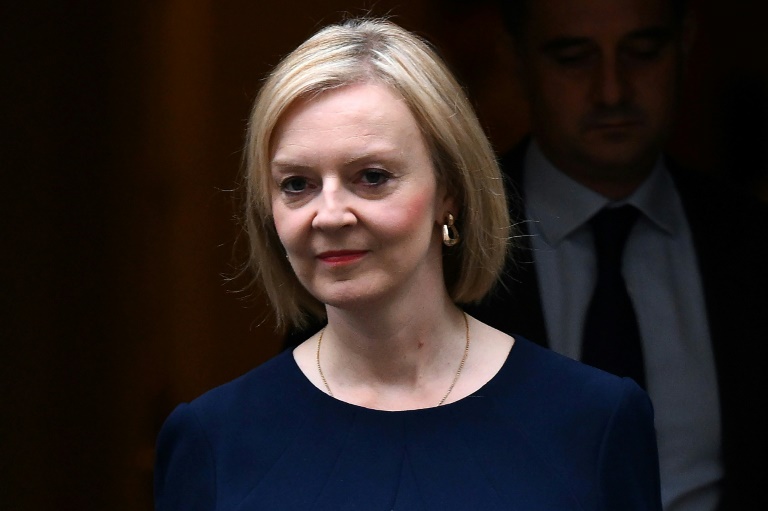
UK's new PM under fire as pound sinks and BoE sounds alarm

The government of new British Prime Minister Liz Truss on Monday came under pressure after the pound hit a record low against the dollar following a huge tax-cutting budget last week.

In a rare statement issued between its rate-setting meetings, the Bank of England said it was monitoring market developments “very closely”.

The UK central bank said it would “not hesitate to change interest rates by as much as needed” to curb high inflation — hinting at further pain for British households and companies.

But it also signalled that it would wait until its next policy meeting on November 3 before fully assessing the impact of the government’s contentious plans.

The main opposition Labour party lambasted Truss for the plans, which rely on a borrowing splurge and which some economists warn could further fuel inflation.

Addressing the party’s annual conference, Labour finance spokeswoman Rachel Reeves described the situation as a “national emergency”, noting the pound’s slump would send import and borrowing costs sharply higher.

She likened Truss and Chancellor of the Exchequer Kwasi Kwarteng to “two desperate gamblers in a casino chasing a losing run”.

But Downing Street insisted the aggressive plan of tax cuts announced by Kwarteng on Friday — just three weeks into Truss’s first month in office — was essential to kick-start anaemic growth.

The plan will “grow our economy faster than our debts”, Truss’s spokesman said, adding that the government would not comment on market movements destabilising the pound.

In a bid to reassure the markets, the Treasury announced Kwarteng would outline a new “medium-term fiscal plan” on November 23, “including ensuring that debt falls as a share of GDP in the medium term”.

Kwarteng also intends more supply-side reforms to cut red tape in the UK economy, and the fiscal plan will be accompanied by new independent forecasts from the Office for Budget Responsibility, the Treasury said. 

The absence of such forecasts from last Friday’s “fiscal event” has contributed to the sense of alarm on financial markets. 

– Dollar parity looms –

Britain has been facing a cost-of-living crisis with soaring energy prices coupled with inflation and wage stagnation.

On Friday, Kwarteng brought forward a plan to cut the lowest rate of income tax, and reduce the highest to 40 percent from 45 percent.

But investors were spooked by the huge amount of borrowing likely needed for the package, which critics said would benefit the rich far more than the poorest hit by the cost-of-living crisis.

The cost of measures to cap energy prices alone have been calculated at £60 billion ($65 billion) for only six months.

But economists estimate the whole tax package at between £100-200 billion.

The pound on Monday struck an all-time low at $1.0350 before regaining some ground to stand at $1.0706 around 1550 GMT, still perilously close to parity.

– Political fallout –

Without central bank intervention this week, the pound could well fall below dollar parity soon, warned Lee Hardman, analyst at MUFG, Japan’s largest bank.

The Bank of England Thursday raised its benchmark borrowing rate by 0.50 percentage points to 2.25 percent. Markets now believe that the rate could rise two percentage points by November.

Tension between the bank and the Treasury is now “palpable”, added Susannah Streeter, analyst at Hargreaves Lansdown.

Tony Travers, director of the LSE London research group, said Truss and Kwarteng had taken a “major gamble that the radical policies adopted can quickly deliver growth”.

“Many Conservative MPs will be concerned that their party’s poll ratings will be damaged, particularly by the profile of the tax cuts proposed,” he said, ahead of the Tories’ own annual conference next week.

“I would expect pressure from MPs on the prime minister and chancellor to grow sharply in the coming week.”

While the UK’s inflation rate stands at 9.9 percent — the highest in the G7 — the central bank also estimates that the country entered recession during the third quarter.

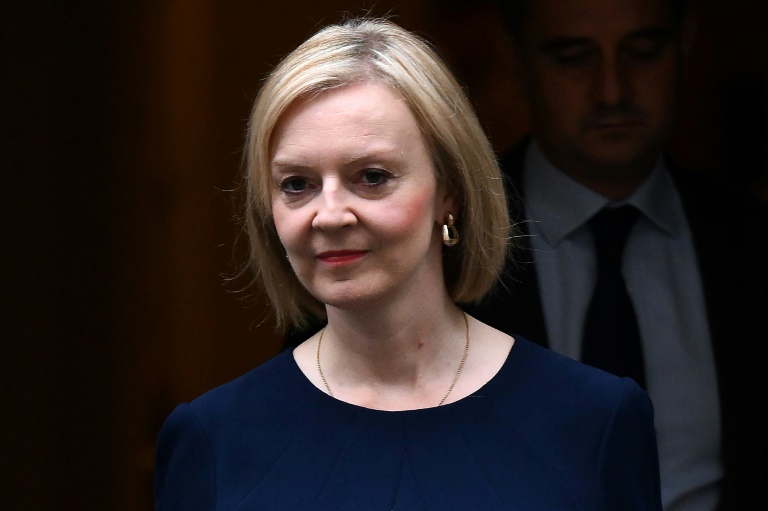
UK's new PM under fire as pound sinks and BoE sounds alarm

The government of new British Prime Minister Liz Truss on Monday came under pressure after the pound hit a record low against the dollar following a huge tax-cutting budget last week.

In a rare statement issued between its rate-setting meetings, the Bank of England said it was monitoring market developments “very closely”.

The UK central bank said it would “not hesitate to change interest rates by as much as needed” to curb high inflation — hinting at further pain for British households and companies.

But it also signalled that it would wait until its next policy meeting on November 3 before fully assessing the impact of the government’s contentious plans.

The main opposition Labour party lambasted Truss for the plans, which rely on a borrowing splurge and which some economists warn could further fuel inflation.

Addressing the party’s annual conference, Labour finance spokeswoman Rachel Reeves described the situation as a “national emergency”, noting the pound’s slump would send import and borrowing costs sharply higher.

She likened Truss and Chancellor of the Exchequer Kwasi Kwarteng to “two desperate gamblers in a casino chasing a losing run”.

But Downing Street insisted the aggressive plan of tax cuts announced by Kwarteng on Friday — just three weeks into Truss’s first month in office — was essential to kick-start anaemic growth.

The plan will “grow our economy faster than our debts”, Truss’s spokesman said, adding that the government would not comment on market movements destabilising the pound.

In a bid to reassure the markets, the Treasury announced Kwarteng would outline a new “medium-term fiscal plan” on November 23, “including ensuring that debt falls as a share of GDP in the medium term”.

Kwarteng also intends more supply-side reforms to cut red tape in the UK economy, and the fiscal plan will be accompanied by new independent forecasts from the Office for Budget Responsibility, the Treasury said. 

The absence of such forecasts from last Friday’s “fiscal event” has contributed to the sense of alarm on financial markets. 

– Dollar parity looms –

Britain has been facing a cost-of-living crisis with soaring energy prices coupled with inflation and wage stagnation.

On Friday, Kwarteng brought forward a plan to cut the lowest rate of income tax, and reduce the highest to 40 percent from 45 percent.

But investors were spooked by the huge amount of borrowing likely needed for the package, which critics said would benefit the rich far more than the poorest hit by the cost-of-living crisis.

The cost of measures to cap energy prices alone have been calculated at £60 billion ($65 billion) for only six months.

But economists estimate the whole tax package at between £100-200 billion.

The pound on Monday struck an all-time low at $1.0350 before regaining some ground to stand at $1.0706 around 1550 GMT, still perilously close to parity.

– Political fallout –

Without central bank intervention this week, the pound could well fall below dollar parity soon, warned Lee Hardman, analyst at MUFG, Japan’s largest bank.

The Bank of England Thursday raised its benchmark borrowing rate by 0.50 percentage points to 2.25 percent. Markets now believe that the rate could rise two percentage points by November.

Tension between the bank and the Treasury is now “palpable”, added Susannah Streeter, analyst at Hargreaves Lansdown.

Tony Travers, director of the LSE London research group, said Truss and Kwarteng had taken a “major gamble that the radical policies adopted can quickly deliver growth”.

“Many Conservative MPs will be concerned that their party’s poll ratings will be damaged, particularly by the profile of the tax cuts proposed,” he said, ahead of the Tories’ own annual conference next week.

“I would expect pressure from MPs on the prime minister and chancellor to grow sharply in the coming week.”

While the UK’s inflation rate stands at 9.9 percent — the highest in the G7 — the central bank also estimates that the country entered recession during the third quarter.

Close Bitnami banner
Bitnami