World

Cuban voters back liberalized family code

Cubans voted to legalize same-sex marriage and adoption as well as surrogate pregnancies in a referendum over the weekend, the communist country’s electoral officials said Monday.

Preliminary results indicate an “irreversible trend,” with almost 67 percent of votes counted so far in favor of the government-backed change, electoral council president Alina Balseiro said on state television. 

“The Family Code has been ratified by the people,” she said.

President Miguel Diaz-Canel tweeted: “Yes has won. Justice has been done.”

The updated code represents a major shift in a country where machismo is strong and where the authorities sent LGBTQ people to militarized labor camps in the 1960s and 1970s.

Official attitudes have since evolved, and the government conducted an intense media campaign in favor of the overhaul, which will replace the country’s 1975 Family Code.

The new code permits surrogate pregnancies as long as no money changes hands, and legally recognizes same-sex adoptions, as well as several fathers or mothers in addition to the biological parents.

It defines marriage as the union between two people, rather than that of a man and a woman, while also boosting the rights of children, the elderly and the disabled.

“In the end we won!” wrote LGBTQ rights activist Maykel Gonzalez on Twitter.

“It settles a debt with several generations of Cuban men and women whose family projects have been waiting for this law. From now on we will be a better nation,” said Diaz-Canel.

– ‘Punishment vote’ –

According to the National Electoral Council, 74 percent of Cuba’s 8.4 million eligible voters cast a ballot with 3.9 million valid votes counted so far in favor and only 2.0 million against.

Turnout, however, was well below the last referendum when a new constitution was adopted in 2019 with 90 percent of people casting a ballot.

It is also the lowest percentage the communist government has received in a vote since Fidel Castro’s 1959 revolution.

Diaz-Canel acknowledged Sunday that “for such complex issues, where are is a diversity” of motives, people might cast “a punishment vote.”

Experts had predicted before the vote that many Cubans would use the referendum as a means to express their disapproval of the government.

Dissidents had called on citizens to reject the code or to abstain.

Cuban political scientist Rafael Hernandez said adopting the new family code was “an effective step in the direction of social justice” and that this was the “most important” legal protection for human rights since the revolution.

The law required 50 percent voter approval to be adopted.

The referendum came amid the country’s worst economic crisis in 30 years that was exacerbated by the coronavirus pandemic.

It was the first time an issue other than a constitutional change had been put to a public vote in Cuba.

The main opposition to the law’s adoption came from Protestant and Catholic churches, the latter of which blasted the changes as “gender ideology.”

In new setback, hurricane forces Moon rocket into storage

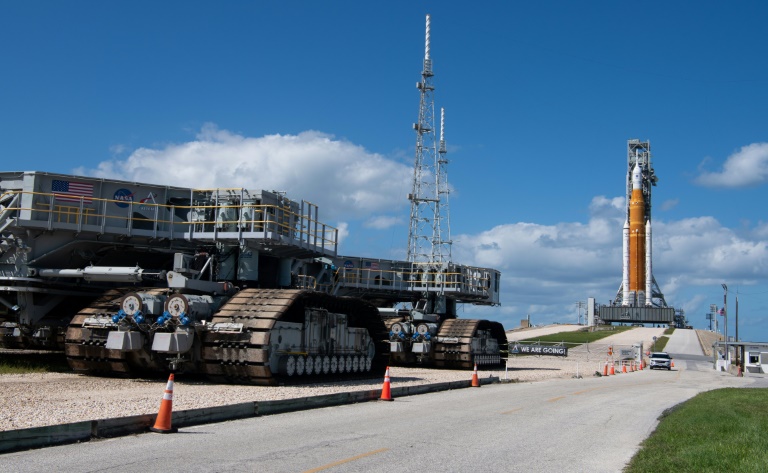
NASA’s Artemis 1 rocket — waiting to blast off on a delayed mission to the Moon — will be rolled back into its storage hangar Monday night, the space agency said, as Florida braces for Hurricane Ian.

The move, to protect the rocket from strong winds and heavy rain forecast for the Kennedy Space Center, will cause further setbacks for the uncrewed Moon mission, which was scheduled to launch last month and has already been pushed back three times.

“After reviewing the forecast for Ian, we will roll our Artemis I vehicle back to the Vehicle Assembly Building tonight,” NASA official Jim Free tweeted. “It was the right and necessary decision to keep our people and hardware safe.”

The decision was “based on the latest weather predictions associated with Hurricane Ian, after additional data gathered overnight did not show improving expected conditions,” the space agency said in a blog.

The operation to move the 98-meter (320-foot) rocket, which is sitting on its launch pad, is set to begin around 11:00 pm (0300 GMT) Monday night, NASA said.

It will be ferried along on a rolling platform moving slowly to avoid damaging the rocket with vibrations. 

Hurricane Ian, which was situated as a Category 1 hurricane southwest of Cuba on Monday, is expected to strengthen as it heads toward Florida through the Gulf of Mexico. 

NASA had waited until the last minute to decide whether to shelter Artemis I in the hope of being able to schedule a take-off attempt just after the storm passed. 

There will now be no opportunity for blast-off within the current launch window, which runs until October 4, and NASA has not indicated when another launch might be attempted.

The next window runs from October 17 to 31, and again from November 12 to 27 — both with some exceptions.

The storage decision represents only the latest setback for Artemis 1, after previous launch attempts were canceled due to the hurricane and a fuel leak. 

This latest Moon mission comes 50 years after the final flight of the Apollo program, with Artemis 1 set to show whether the Orion capsule, situated on top of the rocket, is safe to transport humans back to the Moon’s surface.

Stocks volatile, pound hits record low

Markets seesawed and the British pound took a beating Monday as recession fears brought volatility to the markets.

Having extended losses in morning trading, Frankfurt and Paris edged higher by mid afternoon, only to close the session in the red.

London shares closed flat, paring earlier losses after the pound hit a record low against the dollar on surging fears about the ailing UK economy, before recovering ground.

Further clouding the horizon, the OECD warned the world economy would take a bigger hit than previously forecast next year due to the effects of Russia’s war in Ukraine.

“Volatility reigns supreme in a jittery market environment,” analyst Patrick O’Hare at Briefing.com said.

Wall Street stocks also fell, amid the upheaval in the foreign exchange market.

The pound on Monday struck an all-time low at $1.0350, days after new UK finance minister Kwasi Kwarteng’s inflation-fighting budget.

The Bank of England said it was paying close attention to financial markets and would “not hesitate to change interest rates by as much as needed” to curb inflation.

Economists expressed concerns that last week’s huge tax-cutting budget from the government of new Prime Minister Liz Truss — aimed at helping the recession-threatened economy — could actually spark massive borrowing and further fuel inflation.

“The market’s reactions show that investors have lost confidence in the government’s approach, creating a level of volatility that puts the pound on par with some emerging market peers,” said Fiona Cincotta, a senior analyst at City Index.

“Attention is now turning to the BoE (Bank of England) to step in to support the pound.”

Sterling has struggled in recent years as the UK fails to strike major trade deals following its exit from the European Union.

Prior to Monday’s crash, the pound suffered a series of 37-year lows against the greenback this month on UK recession fears propelled by sky-high inflation.

The euro has additionally come under heavy selling pressure against the dollar in recent months, as the Federal Reserve hikes interest rates more aggressively than the European Central Bank.

The euro struck a new 20-year low at $0.9554 on Monday before recovering.

A day after Eurosceptic populists swept to victory in Italy’s general election, the interest rates on 10-year government bonds hit their highest level for around a decade in France, Germany and Italy.

But the Italian stock market closed higher as markets assessed the future political landscape.

“Time will tell how successful the new government will prove to be but the prospect of some political stability appears to be generating a small relief rally today,” said Craig Erlam, analyst at trading platform OANDA.

Elsewhere, the Moscow stock exchange plunged by 10 percent to its lowest point since Russia began its Ukraine offensive seven months ago as tensions grew across the country over partial military mobilisation.

– Key figures at around 1545 GMT –

Pound/dollar: DOWN at $1.0696 from $1.0852 on Friday

Euro/dollar: DOWN at $0.9627 from $0.9695

Euro/pound: UP at 89.97 pence from 89.28 pence 

Dollar/yen: UP at 144.42 yen from 143.31 yen

London – FTSE 100: UP 0.03 percent at 7,020.95 points

Frankfurt – DAX: DOWN 0.5 percent at 12,227.92

Paris – CAC 40: DOWN 0.2 percent at 5,769.39 

EURO STOXX 50: DOWN 0.2 percent at 3,342.56  

New York – Dow: DOWN 0.6 percent at 29,417.19  

Tokyo – Nikkei 225: DOWN 2.7 percent at 26,431.55 (close)

Hong Kong – Hang Seng Index: DOWN 0.4 percent at 17,855.14 (close)

Shanghai – Composite: DOWN 1.2 percent at 3,051.23 (close)

West Texas Intermediate: DOWN 0.4 percent at $78.42 per barrel

Brent North Sea crude: DOWN 0.5 percent at $85.75 per barrel

burs-bcp/kjm/cdw

Russia enjoys rare backing at UN from Syria

Russia found rare support for its war in Ukraine at the UN General Assembly on Monday from Syria, whose leadership has relied on Moscow’s support in its civil war.

“Syria reiterates its position on Russia’s special military operation in Ukraine and Russia’s right to defend and secure its own territory,” Foreign Minister Faisal al-Meqdad told the world body.

“We are convinced that the Russian Federation is defending not only itself but justice and humanity’s right to reject unipolar hegemony.”

Syria has for months rallied behind Russia, recognizing Russian-backed breakaway republics in eastern Ukraine and offering to send Syrian troops to fight alongside Russia.

Russia has provided wide-ranging military support to Syrian President Bashar al-Assad since 2015, helping government forces win back most of the country from the opposition and jihadists after a decade of brutal conflict  that has killed half a million people.

The top Syrian diplomat’s robust support of the Ukraine invasion came in contrast to speeches from other nominal Russian partners during the annual General Assembly, which closes Monday.

China, which before the war pledged wide cooperation with Russia, and India, a historic defense partner of Moscow despite warming ties with Washington, both called for dialogue to end the conflict in Ukraine.

But the junta-appointed interim prime minister of Mali, Colonel Abdoulaye Maiga, saluted “exemplary and fruitful cooperation” with Russia, whose Wagner Group security firm has deployed in the West African country in defiance of Western warnings on the unit’s human rights record.

Prigozhin: Kremlin 'chef' and mercenary supremo

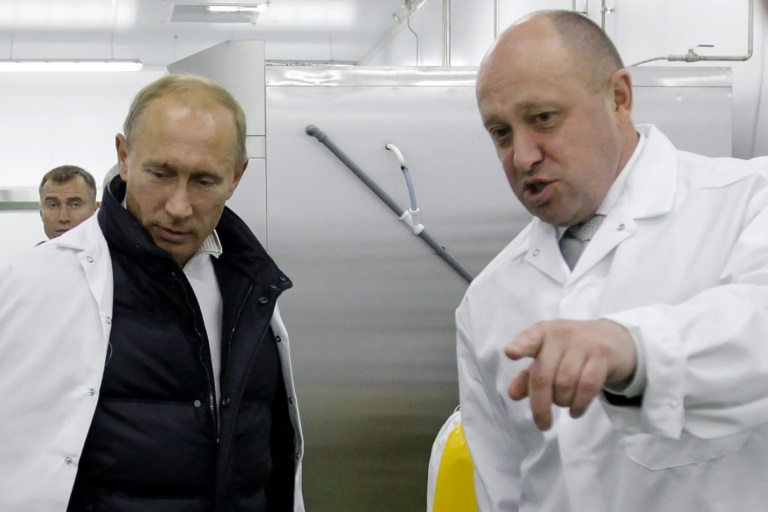
From taking a big Kremlin catering contract to personally recruiting convicts in a prison yard to fight in Ukraine, secretive businessman Yevgeny Prigozhin appears to have a unique role in President Vladimir Putin’s Russia.

The 61-year-old Saint Petersburg native on Monday broke cover to issue a rare personal statement confirming what many had already assumed — that he is behind the hugely controversial Wagner PMC (private military company) mercenary group.

But this is by no means the only controversy surrounding Prigozhin, who is sanctioned by the EU and Washington, accused of election interference in the United States and has issued threats against jailed opposition figure Alexei Navalny.

Prigozhin had for years irritably shaken off claims tying him to Wagner, whose fighters have waged battles in eastern Ukraine in 2014, Africa, Syria and now during Russia’s 2022 intervention in Ukraine.

On Monday he confirmed he had founded Wagner in 2014, saying a “group of patriots was born” who worked in Africa, Syria and even Latin America to become “pillars of our motherland”.

– ‘Friendly team’ –

Earlier this month, a video surfaced of a bald man bearing a strong resemblance to Prigozhin in a jail courtyard, offering contracts to prisoners to fight in Ukraine with a chilling set of conditions.

“If you serve six months, you go home and you are free. If you want to stay (with Wagner) you can. No one goes back to prison. 

“If you arrive in Ukraine and decide it’s not for you, we will regard it as desertion and will shoot you. Any questions, guys?” said the man.

“The first sin is desertion. No one gives themselves up,” he said, adding recruits should have grenades on them in case of capture. “If you die, your body will be repatriated to the place you wrote down on the form.”

It is not possible to verify if the man in the video is Prigozhin but a statement in his name from his holding company Concord did not deny it was him.

It cited him as saying: “Of course, if I were a prisoner, I would dream of joining this friendly team in order to be able not only to redeem my debt to the Motherland, but also to repay it with interest.”

He added: “Those who do not want PMCs (private military companies) to fight… then send your children to the front.”

– ‘Putin’s chef’ –

Prigozhin rose from a modest background to become part of the inner circle around Putin, who also hails from the former imperial capital on the Baltic Sea.

He spent nine years in prison in the final period of the USSR after being convicted of fraud and theft, emerging in 1990 as the Soviet Union was collapsing.

In the chaos of the 1990s, he began a moderately successful business selling hot dogs.

From there he fell into the restaurant business and opened a luxury location in Saint Petersburg whose customers included Putin, then making the transition from working in the Soviet KGB to local politics.

The Concord catering group he founded at one point worked for the Kremlin, earning Prigozhin the soubriquet of “Putin’s chef”.

But the sheer range of his acknowledged and alleged interests have made this name something of a misnomer.

– ‘Troll factory’ –

Prigozhin shuns the limelight and there are scant images of the man who rarely makes public appearances. When he is captured on camera, it is with a shaven head, a piercing stare and usually in a dark suit.

One of the best-known images shows him at the Kremlin in 2011, bending down over a seated Putin as he offers him a dish while the Russian leader looks back with an approving glance.

Reports in Russian media have described him as a billionaire with a vast fortune built on state contracts, although the true extent of his wealth is unknown.

He was sanctioned by Washington which accused him of playing a role in meddling in the 2016 presidential election, in particular through his internet “troll factory”.

Prigozhin denied any involvement and in March asked for $50 billion in compensation from the United States.

– Feud with Navalny –

He had until now always denied links to Wagner, which is accused of abuses and meddling not just in Ukraine but also Syria, Libya and countries in sub-Saharan Africa.

In July 2018, three journalists researching Wagner’s operations in the Central African Republic for an investigative media outlet were killed in an ambush.

Western countries have accused Wagner of coming to the aid of the military junta in Mali, in a move that contributed to France’s decision to end an almost decade-long military operation there.

Prigozhin has been unusually vocal in the wake of the poisoning of Navalny, who fell ill on a flight in Siberia and was then transferred for treatment in Germany in 2020.

The two have never made any secret of their enmity, with Navalny’s anti-corruption group accusing a firm that worked with Concord of serving food in schools that was dangerous for the health of children.

Prigozhin sued Navalny for libel and a court ordered that the campaigner’s group pay more than $1 million in damages.

Not mincing his words, Prigozhin said: “I intend to strip this group of unscrupulous people of their clothes and shoes.”

NASA to deflect asteroid in key test of planetary defense

NASA will on Monday attempt a feat humanity has never before accomplished: deliberately smacking a spacecraft into an asteroid to slightly deflect its orbit, in a key test of our ability to stop cosmic objects from devastating life on Earth.

The Double Asteroid Redirection Test (DART) spaceship launched from California last November and is fast approaching its target, which it will strike at roughly 14,000 miles (22,500 kilometers) per hour.

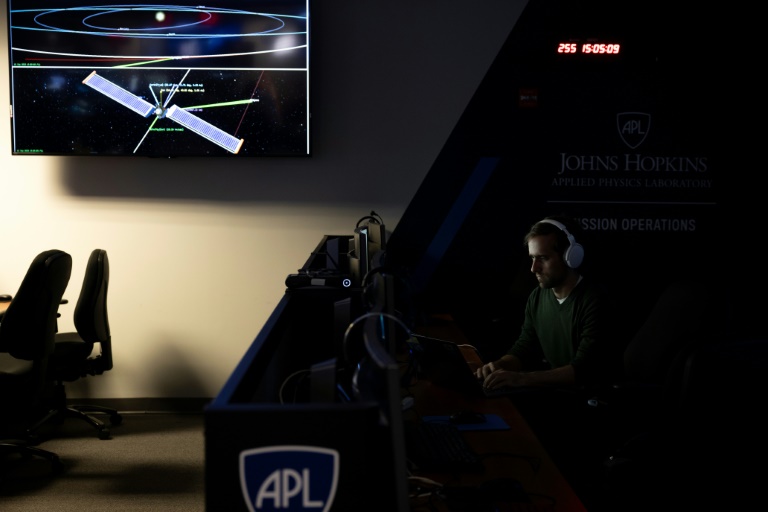
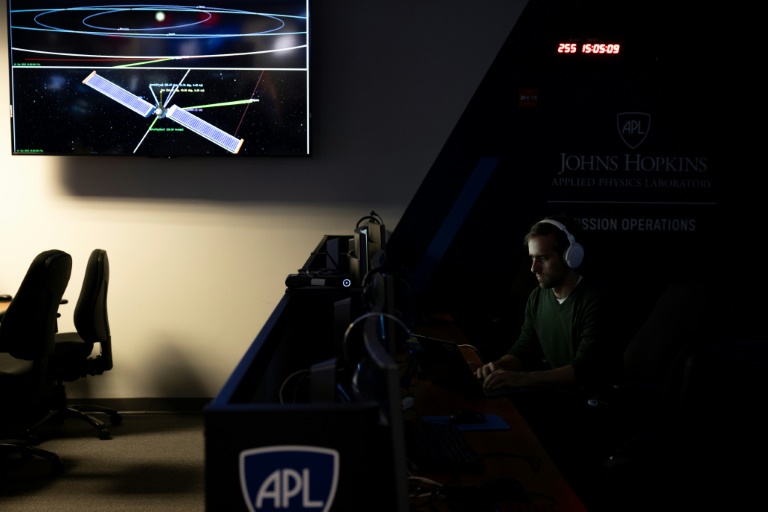
“It’s the final cosmic collision countdown,” tweeted mission control at Johns Hopkins Applied Physics Laboratory in Maryland.

To be sure, neither the asteroid moonlet Dimorphos, nor the big brother it orbits, called Didymos, pose any threat as the pair loop the Sun, passing about seven million miles from Earth at nearest approach.

But NASA has deemed the experiment important to carry out before an actual need is discovered.

If all goes to plan, impact between the car-sized spacecraft, and the 530-foot (160 meters, or two Statues of Liberty) asteroid should take place at 7:14 pm Eastern Time (2314 GMT), viewable on a NASA livestream.

By striking Dimorphos head on, NASA hopes to push it into a smaller orbit, shaving ten minutes off the time it takes to encircle Didymos, which is currently 11 hours and 55 minutes — a change that will be detected by ground telescopes in the days or weeks to come.

The proof-of-concept experiment will make a reality of what has before only been attempted in science fiction — notably in films such as “Armageddon” and “Don’t Look Up.” 

– Technically challenging –

As the craft propels itself through space, flying autonomously for the mission’s final phase, its camera system will start to beam down the very first pictures of Dimorphos.

Minutes later, a toaster-sized satellite called LICIACube, which already separated from DART a few weeks ago, will make a close pass of the site to capture images of the collision and the ejecta — the pulverized rock thrown off by impact.

LICIACube’s pictures will be sent back in the next weeks and months. 

Also watching the event: an array of telescopes, both on Earth and in space — including the recently operational James Webb — which might be able to see a brightening cloud of dust.

Finally, a full picture of what the system looks like will be revealed when a European Space Agency mission four years down the line called Hera arrives to survey Dimorphos’ surface and measure its mass, which scientists can currently only guess at.

– Being prepared –

Very few of the billions of asteroids and comets in our solar system are considered potentially hazardous to our planet, and none are expected in the next hundred years or so. 

But “I guarantee to you that if you wait long enough, there will be an object,” said NASA’s Thomas Zurbuchen. 

We know that from the geological record — for example, the six-mile wide Chicxulub asteroid struck Earth 66 million years ago, plunging the world into a long winter that led to the mass extinction of the dinosaurs along with 75 percent of all species.

An asteroid the size of Dimorphos, by contrast, would only cause a regional impact, such as devastating a city, albeit with greater force than any nuclear bomb in history.

How much momentum DART imparts on Dimorphos will depend on whether the asteroid is solid rock, or more like a “rubbish pile” of boulders bound by mutual gravity — a situation that’s not yet known.

The shape of the asteroid is also not known, but NASA engineers are confident DART’s SmartNav guidance system will hit its target.

If it misses, NASA will have another shot in two years’ time, with the spaceship containing just enough fuel for another pass.

But if it succeeds, the mission will mark the first step towards a world capable of defending itself from a future existential threat.

NASA to deflect asteroid in key test of planetary defense

NASA will on Monday attempt a feat humanity has never before accomplished: deliberately smacking a spacecraft into an asteroid to slightly deflect its orbit, in a key test of our ability to stop cosmic objects from devastating life on Earth.

The Double Asteroid Redirection Test (DART) spaceship launched from California last November and is fast approaching its target, which it will strike at roughly 14,000 miles (22,500 kilometers) per hour.

“It’s the final cosmic collision countdown,” tweeted mission control at Johns Hopkins Applied Physics Laboratory in Maryland.

To be sure, neither the asteroid moonlet Dimorphos, nor the big brother it orbits, called Didymos, pose any threat as the pair loop the Sun, passing about seven million miles from Earth at nearest approach.

But NASA has deemed the experiment important to carry out before an actual need is discovered.

If all goes to plan, impact between the car-sized spacecraft, and the 530-foot (160 meters, or two Statues of Liberty) asteroid should take place at 7:14 pm Eastern Time (2314 GMT), viewable on a NASA livestream.

By striking Dimorphos head on, NASA hopes to push it into a smaller orbit, shaving ten minutes off the time it takes to encircle Didymos, which is currently 11 hours and 55 minutes — a change that will be detected by ground telescopes in the days or weeks to come.

The proof-of-concept experiment will make a reality of what has before only been attempted in science fiction — notably in films such as “Armageddon” and “Don’t Look Up.” 

– Technically challenging –

As the craft propels itself through space, flying autonomously for the mission’s final phase, its camera system will start to beam down the very first pictures of Dimorphos.

Minutes later, a toaster-sized satellite called LICIACube, which already separated from DART a few weeks ago, will make a close pass of the site to capture images of the collision and the ejecta — the pulverized rock thrown off by impact.

LICIACube’s pictures will be sent back in the next weeks and months. 

Also watching the event: an array of telescopes, both on Earth and in space — including the recently operational James Webb — which might be able to see a brightening cloud of dust.

Finally, a full picture of what the system looks like will be revealed when a European Space Agency mission four years down the line called Hera arrives to survey Dimorphos’ surface and measure its mass, which scientists can currently only guess at.

– Being prepared –

Very few of the billions of asteroids and comets in our solar system are considered potentially hazardous to our planet, and none are expected in the next hundred years or so. 

But “I guarantee to you that if you wait long enough, there will be an object,” said NASA’s Thomas Zurbuchen. 

We know that from the geological record — for example, the six-mile wide Chicxulub asteroid struck Earth 66 million years ago, plunging the world into a long winter that led to the mass extinction of the dinosaurs along with 75 percent of all species.

An asteroid the size of Dimorphos, by contrast, would only cause a regional impact, such as devastating a city, albeit with greater force than any nuclear bomb in history.

How much momentum DART imparts on Dimorphos will depend on whether the asteroid is solid rock, or more like a “rubbish pile” of boulders bound by mutual gravity — a situation that’s not yet known.

The shape of the asteroid is also not known, but NASA engineers are confident DART’s SmartNav guidance system will hit its target.

If it misses, NASA will have another shot in two years’ time, with the spaceship containing just enough fuel for another pass.

But if it succeeds, the mission will mark the first step towards a world capable of defending itself from a future existential threat.

Direct impact or nuclear weapons? How to save Earth from an asteroid

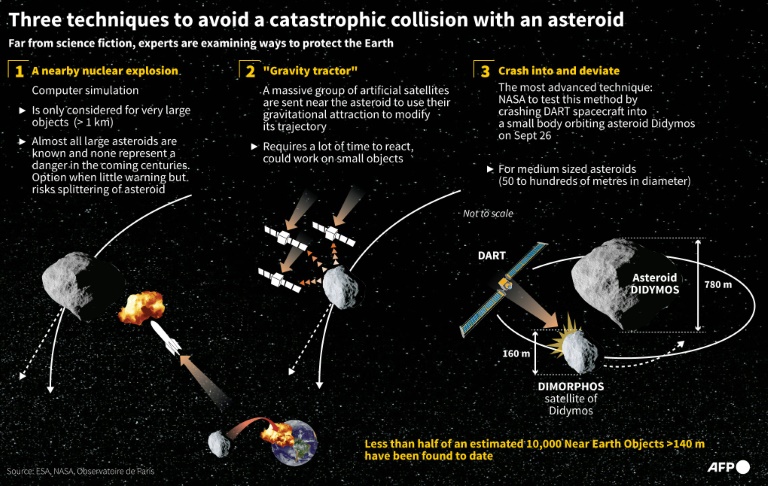
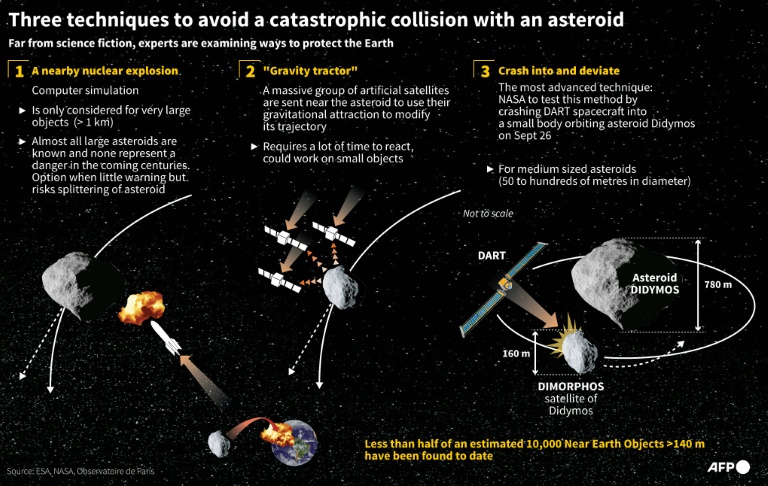
NASA’s DART mission to test deflecting an asteroid using “kinetic impact” with a spaceship is just one way to defend planet Earth from an approaching object  — and for now, the only method possible with current technology.

The operation is like playing billiards in space, using Newton’s laws of motion to guide us. 

If an asteroid threat to Earth were real, a mission might need to be launched a year or two in advance to take on a small asteroid, or decades ahead of projected impact for larger objects hundreds of kilometers in diameter that could prove catastrophic to the planet. 

Or, a larger object might require hits with multiple spacecraft.

“This demonstration will start to add tools to our toolbox of methods that could be used in the future,” said Lindley Johnson, NASA’s planetary defense office, in a recent briefing.

Other proposed ideas have included a futuristic-sounding “gravity tractor,” or a mission to blow up the hypothetical object with a nuclear weapon — the method preferred by Hollywood.

– Gravity tractor – 

Should an approaching object be detected early — years or decades before it would hit Earth — a spaceship could be sent to fly alongside it for long enough to divert its path via using the ship’s gravitational pull, creating a so-called gravity tractor.

This method “has the virtue that the method of moving the asteroid is totally well understood — it’s gravity and we know how gravity works,” Tom Statler, a DART program scientist at NASA said at a briefing last November when DART launched.

The mass of the spacecraft however would be a limiting factor — and gravity tractors would be less effective for asteroids more than 500 meters in diameter, which are the very ones that pose the greatest threat. 

In a 2017 paper, NASA engineers proposed a way to overcome this snag: by having the spacecraft scoop material from the asteroid to enhance its own mass, and thus, gravity.

But none of these concepts have been tried, and would need decades to build, launch and test.

– Nuclear detonation – 

Another option: launching nuclear explosives to redirect or destroy an asteroid. 

“This may be the only strategy that would be effective for the largest and most dangerous ‘planet-killer’ asteroids (more than one kilometer in diameter),” a NASA article on the subject says, adding such a strike might be useful as a “last resort” in case the other methods fail.

But these weapons are geopolitically controversial and technically banned from use in outer space.

Lori Glaze, NASA’s planetary science division director said in a 2021 briefing that the agency believed the best way to deploy the weapons would be at a distance from an asteroid, in order to impart force on the object without blowing it into smaller pieces that could then multiply the threat to Earth.

A 2018 paper published in the “Journal of Experimental and Theoretical Physics” by Russian scientists looked at the direct detonation scenario.

E. Yu. Aristova and colleagues built miniature asteroid models and blasted them with lasers. Their experiments showed that blowing up a 200-meter asteroid would require a bomb 200 times as powerful as the one that exploded over Hiroshima in 1945. 

They also said it would be most effective to drill into the asteroid, bury the bomb, then blow it up — just like in the movie Armageddon.

Direct impact or nuclear weapons? How to save Earth from an asteroid

NASA’s DART mission to test deflecting an asteroid using “kinetic impact” with a spaceship is just one way to defend planet Earth from an approaching object  — and for now, the only method possible with current technology.

The operation is like playing billiards in space, using Newton’s laws of motion to guide us. 

If an asteroid threat to Earth were real, a mission might need to be launched a year or two in advance to take on a small asteroid, or decades ahead of projected impact for larger objects hundreds of kilometers in diameter that could prove catastrophic to the planet. 

Or, a larger object might require hits with multiple spacecraft.

“This demonstration will start to add tools to our toolbox of methods that could be used in the future,” said Lindley Johnson, NASA’s planetary defense office, in a recent briefing.

Other proposed ideas have included a futuristic-sounding “gravity tractor,” or a mission to blow up the hypothetical object with a nuclear weapon — the method preferred by Hollywood.

– Gravity tractor – 

Should an approaching object be detected early — years or decades before it would hit Earth — a spaceship could be sent to fly alongside it for long enough to divert its path via using the ship’s gravitational pull, creating a so-called gravity tractor.

This method “has the virtue that the method of moving the asteroid is totally well understood — it’s gravity and we know how gravity works,” Tom Statler, a DART program scientist at NASA said at a briefing last November when DART launched.

The mass of the spacecraft however would be a limiting factor — and gravity tractors would be less effective for asteroids more than 500 meters in diameter, which are the very ones that pose the greatest threat. 

In a 2017 paper, NASA engineers proposed a way to overcome this snag: by having the spacecraft scoop material from the asteroid to enhance its own mass, and thus, gravity.

But none of these concepts have been tried, and would need decades to build, launch and test.

– Nuclear detonation – 

Another option: launching nuclear explosives to redirect or destroy an asteroid. 

“This may be the only strategy that would be effective for the largest and most dangerous ‘planet-killer’ asteroids (more than one kilometer in diameter),” a NASA article on the subject says, adding such a strike might be useful as a “last resort” in case the other methods fail.

But these weapons are geopolitically controversial and technically banned from use in outer space.

Lori Glaze, NASA’s planetary science division director said in a 2021 briefing that the agency believed the best way to deploy the weapons would be at a distance from an asteroid, in order to impart force on the object without blowing it into smaller pieces that could then multiply the threat to Earth.

A 2018 paper published in the “Journal of Experimental and Theoretical Physics” by Russian scientists looked at the direct detonation scenario.

E. Yu. Aristova and colleagues built miniature asteroid models and blasted them with lasers. Their experiments showed that blowing up a 200-meter asteroid would require a bomb 200 times as powerful as the one that exploded over Hiroshima in 1945. 

They also said it would be most effective to drill into the asteroid, bury the bomb, then blow it up — just like in the movie Armageddon.

UN chief urges end to 'era of nuclear blackmail'

UN Secretary-General Antonio Guterres renewed his call Monday for the global abolition of nuclear weapons as concerns grow over Russia’s threat to use them in the Ukraine war.

“Decades after the fall of the Berlin Wall, we can hear once again the rattling of nuclear sabers,” Guterres told a special General Assembly session on nuclear disarmament.

“Let me be clear — the era of nuclear blackmail must end,” he said.

“The idea that any country could fight and win a nuclear war is deranged. Any use of a nuclear weapon would incite a humanitarian Armageddon,” he said.

“Without eliminating nuclear weapons, there can be no peace.” 

Russian President Vladimir Putin in a speech last week made a thinly veiled threat to use nuclear weapons following Ukrainian forces’ recapture of land seized Moscow in its seven-month invasion.

US Secretary of State Antony Blinken replied that Washington has told Moscow, including through private channels, of “catastrophic” consequences over any use of nuclear weapons.

Guterres voiced disappointment that a review conference last month of the nuclear Non-Proliferation Treaty failed to reach a consensus.

Russia blocked the outcome after the draft document backed Ukraine’s control of the Zaporizhzhia nuclear plant, whose occupation by Moscow has raised fears of a major accident.

The United States condemned Russia’s stance. But no nuclear power backed a UN treaty adopted in 2017 that called for a comprehensive prohibition of nuclear weapons, with mostly developing countries in support.

No country has used nuclear weapons on the battlefield except the United States in 1945, when it destroyed the Japanese cities of Hiroshima and Nagasaki, killing more than 200,000 people. Imperial Japan surrendered days later, ending World War II.

Japanese Prime Minister Fumio Kishida, in his speech to the General Assembly last week, vowed to work for “a world without nuclear weapons.”

“Threatening the use of nuclear weapons, as Russia has done, let alone the actual use of nuclear weapons, is a serious threat to the peace and security of the international community, and is absolutely unacceptable,” Kishida said.

Close Bitnami banner
Bitnami