World

Lebanon migrant ship death toll rises to 94

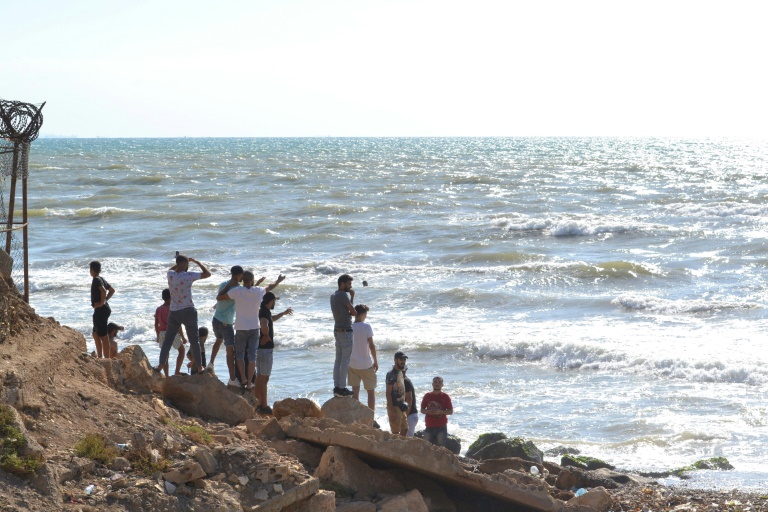
Seventeen bodies were recovered Saturday after a boat carrying migrants from Lebanon sank off Syria’s coast, raising the overall toll to 94, Syrian state television said, in one of the eastern Mediterranean’s deadliest such episodes.

The toll has repeatedly ratcheted higher since the first bodies were found on Thursday. The United Nations High Commissioner for Refugees (UNHCR), Filippo Grandi, described the shipwreck as a “heart-wrenching tragedy” and the search for those still missing continued beyond nightfall. 

At least 14 survivors were recovering in hospitals in Syria, while six others were discharged. Two remained in intensive care in Al-Basel Hospital, Syria’s official SANA news agency reported earlier.

“The death toll from the boat that sank off the coast of Tartus has risen to 94,” state television said.

The Lebanese army said that it had arrested a Lebanese national who “admitted to organising the recent (people) smuggling operation from Lebanon to Italy by sea”.

Lebanon, a country which hosts more than a million refugees from Syria’s civil war, has been mired in a financial crisis branded by the World Bank as one of the worst in modern times.

Nearly three years of economic collapse have turned the country into a launchpad for migrants, with its own citizens joining Syrian and Palestinian refugees clamouring to leave by dangerous sea routes.

As many as 150 people were on board the small boat that sank off the Syrian port of Tartus, some 50 kilometres (30 miles) north of Tripoli in Lebanon, from where the migrants set sail.

Those on board were mostly Lebanese, Syrians and Palestinians, and included both children and elderly people, the UN said.

Families in Lebanon held a second day of funerals Saturday after they were handed bodies of relatives on Friday night through the Arida border crossing. Others still await the bodies of their relatives.

In Tripoli, anger mixed with grief as relatives received news of the death of their loved ones.

Hundreds of people gathered Saturday in the Nahr al-Bared Palestinian refugee camp, north of Tripoli, for the funeral procession of one of the victims, pumping their fists in the air.

– ‘Death boats’ –

Since 2020, Lebanon has seen a spike in the number of migrants using its shores to attempt the perilous crossing in jam-packed boats to reach Europe.

The UN children’s agency, UNICEF, said that 10 children appeared to be “among those who lost their lives”.

“Years of political instability and economic crisis in Lebanon have pushed many children and families into poverty, affecting their health, welfare and education,” UNICEF added.

Philippe Lazzarini, head of the UN agency for Palestinian refugees said: “No one gets on these death boats lightly.

“People are taking these perilous decisions, risking their lives in search of dignity.”

Lazzarini said more must be done “to offer a better future and address a sense of hopelessness in Lebanon and across the region, including among Palestine refugees”.

Antonio Vitorino, head of the International Organization for Migration (IOM), said: “People looking for safety should not be compelled to take such perilous and often deadly migration journeys.”

Most of the boats setting off from Lebanon head for European Union member Cyprus, an island about 175 kilometres (110 miles) to the west.
bur-rh/aya/dwo

Hundreds rally in Paris, European cities to denounce Iran regime

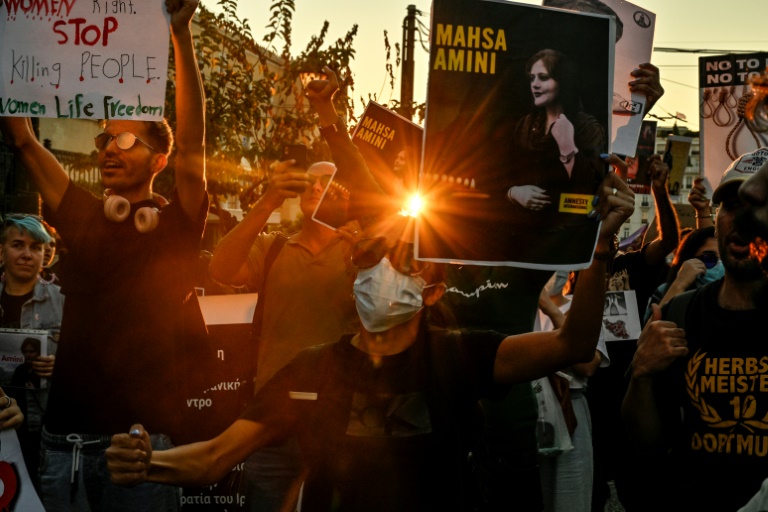
Hundreds of expatriate Iranians rallied in Paris and other European cities on Saturday to denounce Iran’s crackdown on protests following the death of Mahsa Amini after her arrest by morality police.

The protesters gathered in the central Place du Chatelet in the French capital and chanted slogans against supreme leader Ayatollah Ali Khamenei and also urged French President Emmanuel Macron to halt negotiations with Iran.

“Khamenei get out of Iran!”, “Macron enough silence!” and “Death to the Islamic republic” were among the slogans shouted by the demonstrators in French and Persian, an AFP reporter said.

The protesters also sung in Persian the Italian protest song “Bella Ciao (Goodbye Beautiful)” which has become popular with supporters of the movement. 

They also repeated the viral Persian chants used by protesters inside Iran such as “zan, zendegi, azadi!” (woman, life, freedom!) and also its Kurdish equivalent “jin, jiyan, azadi!” as Amini, also known as Jhina Amini, was Kurdish.

In other protests, Iranian women in Athens cut their hair in a gesture of solidarity with Amini, brandishing placards reading “say her name!”.

Demonstrators on Sergels torg in the centre of the Swedish capital Stockholm also cut their hair while another group outside the Swedish parliament held up pictures of those killed.

Iran says that 35 people have died in the protests that erupted after the death of Amini but activists say that the number is now over 50 and likely even higher.

Demonstrators in Paris expressed fury that Macron had met and shaken hands with Iranian President Ebrahim Raisi on the sidelines of the UN General Assembly in New York this week as Paris seeks to keep the 2015 deal on Tehran’s nuclear programme alive.

“How can you shake the hands of someone who has committed a crime against humanity?” read a placard brandished by the protesters referring to Raisi’s alleged involvement in the 1988 mass executions of political prisoners in Iran.

“The anger has caught fire and the flames will be impossible to extinguish,” said Mahtab Ghorbani, an exiled poet and writer who lives in France. 

“Those who do not speak up will be held responsible and we demand that France stops the negotiations (on the nuclear issue) and closes the Iranian embassy in Paris,” she said.

The protesters are planning to hold a second demonstration on Sunday where they intend to march on the Iranian embassy in Paris.

Russian FM, at UN, slams West for 'grotesque' Russophobia

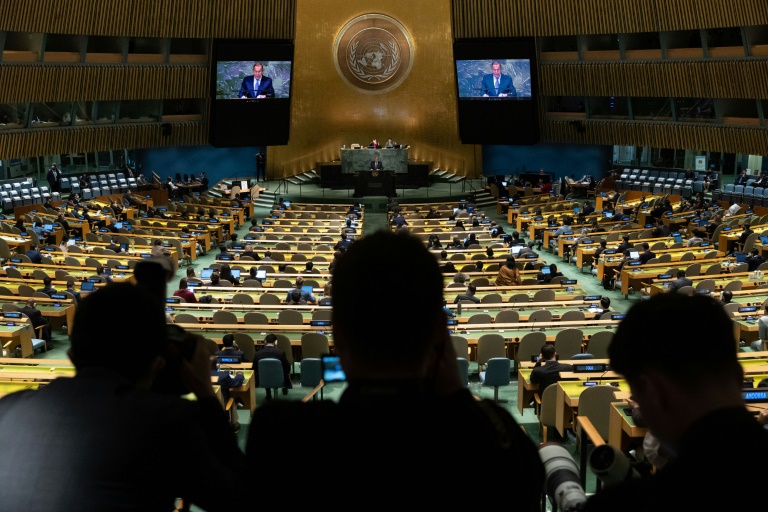
Russian Foreign Minister Sergei Lavrov bitterly criticized Western nations Saturday over the Ukraine war, telling the United Nations that the United States and its allies sought to “destroy” his country.

“The official Russophobia in the West is unprecedented. Now the scope is grotesque,” Lavrov said in a fiery UN General Assembly speech. 

“They are not shying away from declaring the intent to inflict not only military defeat on our country but also to destroy and fracture Russia.”

After days of Western leaders denouncing Russia’s invasion of Ukraine, Lavrov used Russia’s turn at the General Assembly rostrum to hit back at pressure on Moscow led by Washington. 

The United States, he said, was expanding the Monroe Doctrine — its 19th-century declaration of Latin America as its exclusive sphere of influence — and “trying to turn the entire world into its own backyard.” 

“Declaring themselves victorious in the Cold War, Washington erected themselves almost into an envoy of God on Earth, without any obligations but the sacred right to act with impunity wherever and wherever they want,” he said. 

He also defended referendums Friday in Russian-occupied parts of Ukraine, describing them as people claiming land “where their ancestors have been living for hundreds of years.” 

“The West is now throwing a fit” on the referendums, Lavrov said.

US President Joe Biden and other Western leaders have vowed never to accept results from the “sham” referendums, seeing them as part of an effort to change borders by force.

Death toll of Lebanon migrant ship tragedy rises to 90

Thirteen more bodies were recovered Saturday after a boat carrying migrants from Lebanon sank off the Syrian coast, raising the overall toll to 90, Syrian state television said, in one of the eastern Mediterranean’s deadliest such shipwrecks.

The United Nations High Commissioner for Refugees (UNHCR), Filippo Grandi, called it a “heart-wrenching tragedy”.

At least 14 of those rescued were recovering in hospitals in Syria, while six others were discharged, as search efforts continued with several people still missing since the boat sank on Thursday.

“The number of dead from the sinking off the coast of Tartus has risen to 90,” state television said.

Fourteen people are receiving treatment at Al-Basel Hospital, two of whom are in intensive care, Syria’s official SANA news agency reported earlier.

The Lebanese army said that it had arrested a Lebanese national who “admitted to organising the recent (people) smuggling operation from Lebanon to Italy by sea”.

Lebanon, a country which hosts more than a million refugees from Syria’s civil war, has been mired in a financial crisis branded by the World Bank as one of the worst in modern times.

Nearly three years of economic collapse have turned the country into a launchpad for migrants, with its own citizens joining Syrian and Palestinian refugees clamouring to leave by dangerous sea routes.

As many as 150 people were on board the small boat that sank off the Syrian port of Tartus, some 50 kilometres (30 miles) north of Tripoli in Lebanon, from where the migrants set sail.

Those on board were mostly Lebanese, Syrians and Palestinians, and included both children and elderly people, the UN said.

Families in Lebanon held a second day of funerals Saturday after they were handed bodies of relatives on Friday night through the Arida border crossing. Others still await the bodies of their relatives.

In Tripoli, anger mixed with grief as relatives received news of the death of their loved ones.

Hundreds of people gathered Saturday in the Nahr al-Bared Palestinian refugee camp, north of Tripoli, for the funeral procession of one of the victims, pumping fists into the air.

– ‘Death boats’ –

Since 2020, Lebanon has seen a spike in the number of migrants using its shores to attempt the perilous crossing in jam-packed boats to reach Europe.

The UN children’s agency, UNICEF, said they had initial reports that 10 children were “among those who lost their lives”.

“Years of political instability and economic crisis in Lebanon have pushed many children and families into poverty, affecting their health, welfare and education,” UNICEF added.

Philippe Lazzarini, head of the UN agency for Palestinian refugees said: “No one gets on these death boats lightly.

“People are taking these perilous decisions, risking their lives in search of dignity.”

Lazzarini said more must be done “to offer a better future and address a sense of hopelessness in Lebanon and across the region, including among Palestine refugees”.

Antonio Vitorino, head of the International Organization for Migration (IOM), said: “People looking for safety should not be compelled to take such perilous and often deadly migration journeys.”

Most of the boats setting off from Lebanon head for European Union member Cyprus, an island about 175 kilometres (110 miles) to the west.
bur-rh/aya/kir

Russia stiffens penalty for surrender, replaces top general

Russia on Saturday toughened penalties for voluntary surrender and refusal to fight with up to 10 years imprisonment and replaced its top logistics general after a series of setbacks to its seven-month war in Ukraine. 

The tough new amendments and personnel change come days after Russia instigated partial mobilisation with Kyiv taking back more and more territory in a counter-offensive.

It also comes as Kremlin-held regions of eastern and southern Ukraine voted for a second day on becoming part of Russia, dramatically raising the stakes. 

Integrating the four regions into Russia would mean that Moscow would consider any military move there as an attack on its own territory.

Russia’s invasion, launched on February 24, and Ukraine’s recent gains have laid bare flaws, with some analysts seeing logistics as the weak link in Moscow’s army.

“Army General Dmitry Bulgakov has been relieved of the post of deputy minister of defence” and will be replaced by Colonel General Mikhail Mizintsev, aged 60, the defence ministry said.

Russia’s partial mobilisation announced on Wednesday will likely be one of his first big logistical challenges, with the hundreds of thousands of reservists being called up needing equipment and training before deployment.

Military-age men have sought to leave, with flights full and neighbouring countries receiving an influx of Russians, including Georgia where 2,300 private vehicles were waiting to enter at one crossing, regional Russian authorities said.

“We were talking to our friends and many are thinking about leaving,” said Daria, 22, after fleeing Russia to Istanbul along with many of her compatriots.

“Not everyone wanted to leave in February. The (mobilisation) decision of September 21 forced many to think about it again.”

More than 700 people were detained in protests on Saturday against the partial mobilisation, according to independent monitoring group OVD-Info. 

Now that President Vladimir Putin has signed the legislation, servicemen who desert, surrender “without authorisation”, refuse to fight or disobey orders can face up to 10 years imprisonment.

– ‘Sham’ –

Looting will be punishable by 15 years imprisonment. 

A separate law, also signed on Saturday, facilitates Russian citizenship for foreigners who enlist in the Russian army as the Kremlin seeks to bolster the ranks.

On Friday, US President Joe Biden dismissed as a “sham” the voting on whether Russia should annex four regions of Ukraine, which ends next Tuesday.

Even Beijing, Moscow’s closest ally since the war began, called on Russia and Ukraine not to let the effects of the war “spill over”.

The voting is being held in Russian-controlled areas of Donetsk and Lugansk in the east, and Kherson and Zaporizhzhia in the south.

For four days, authorities are going door-to-door to collect votes. Polling stations then open Tuesday for residents to cast ballots on the final day. Results are expected as early as late Tuesday or Wednesday.

“Ultimately, things are moving towards the restoration of the Soviet Union. The referendum is one step towards this,” Leonid, a 59-year-old military official, told AFP.

The snap referendums were announced just this week after the Ukrainian counter-offensive seized most of the northeast Kharkiv region — bringing hundreds of settlements back under Kyiv’s control after months of Russian occupation.

Bad weather and stiff Russian resistance caused Ukraine’s counter-offensive to slow to a brutal slog in Kupiansk in the eastern Kharkiv region on Saturday. 

“For now, the rain is making it difficult to use heavy weapons everywhere. We can only use paved roads,” Ukrainian army sergeant Roman Malyna told AFP.

Irpin, close to the capital, was recaptured after weeks of fighting and residents have rallied to start rebuilding before winter sets in.

Over 100 apartment blocks in Irpin — dubbed a “hero city” by President Volodymyr Zelensky for holding back Russian invaders — were badly damaged by shelling.

– Evidence of ‘war crimes’ –

Head of his building’s residents’ association Mykhailo Kyrylenko looked proudly at the new roof taking shape.

“People don’t have much money, but they agreed” to donate funds to gradually restore the shattered homes, he told AFP.

Putin this week warned that Moscow would use “all means” to protect its territory — which former Russian leader Dmitry Medvedev said on social media could include the use of “strategic nuclear weapons”.

Zelensky has denounced the polls, on Friday calling them “crimes against international law and the law of Ukraine”.

UN investigators on Friday accused Russia of committing war crimes on a “massive scale” in Ukraine — listing bombings, executions, torture and horrific sexual violence.

In the eastern Kharkiv region, Ukrainian officials said they had exhumed 447 bodies from a site near the city of Izyum, which was recaptured from Russian forces.

The Kremlin has accused Kyiv of fabricating evidence of the alleged war crimes.

Ukraine push slowed by rain, river and Russian holdouts

What had been a lightning push by Ukraine to drive Moscow’s forces from the eastern Kharkiv region slowed to a brutal slog Saturday, stalled by heavy rain and Russian resistance.

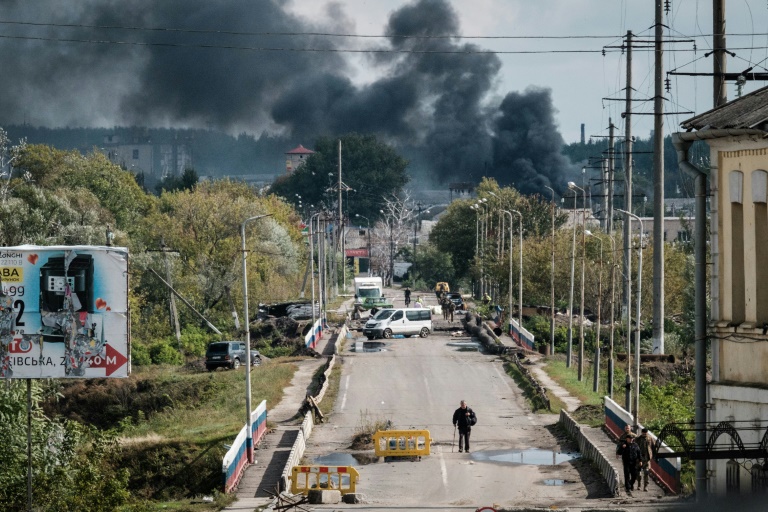
In the frontline town of Kupiansk against a background of constant shelling noise a column of dark smoke rose across the Oskil river, which separates the Ukrainian-held west bank from the east, still disputed by Russian forces.

“For now, the rain is making it difficult to use heavy weapons everywhere. We can only use paved roads,” Ukrainian army sergeant Roman Malyna told AFP, as tanks and APCs manoeuvred under the downpour.  

“For now, because it’s hard to move forward due to the weather, we are targeting their armoured vehicles, ammunition depots and groups of soldiers,” he said. 

– Bodies left behind –

On Friday, Kupiansk’s military administrator Andriy Kanashevych told AFP that it might take Ukrainian forces 10 days to fully secure the area.

Most of the shellfire on Saturday was outgoing — Ukrainian artillery targeting Russian positions in the woods beyond the east of the town — but with a Russian drone spotted overhead tension prevailed. 

A trickle of refugees were walking towards Ukrainian territory across the damaged bridge, its handrails still painted in the red, white and blue colours of Kupiansk’s former Russian occupiers.

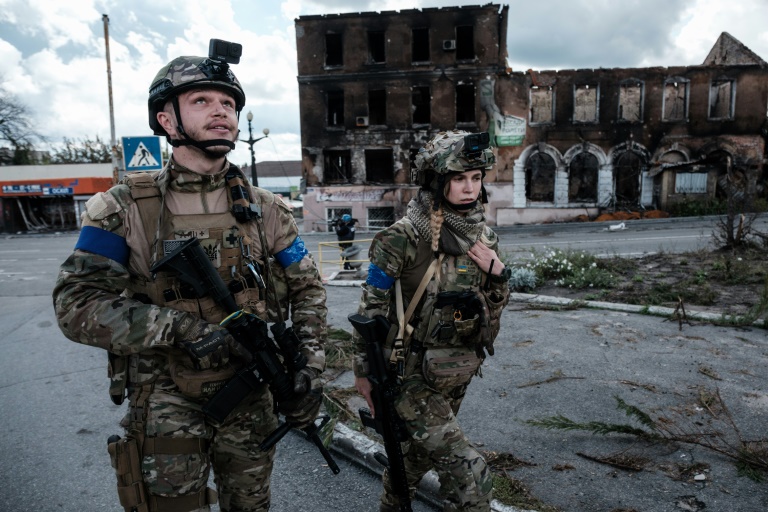
Two Ukrainian soldiers, well-equipped with US-style assault rifles and body armour, and in good spirits despite fatigue and concern over the Russian drone buzzing above the debris-strewn road, also crossed back.

One of them, using the nom de guerre “Mario”, said it was too soon to say when the east bank would come completely under Ukrainian control but was confident the Russians were in retreat. 

“Only their bodies will be left behind,” he boasted.

“In general, it’s all good, taking into account the scale of the operation, we’ve had almost no losses,” he told AFP. 

Most of Kupiansk, a key rail hub once used by Russia to supply its forces further south on the Donetsk battlefront, fell to Ukraine in this month’s stunning counterattack against the invader.

But a narrow strip of the Kharkiv region on the east side of the Oskil river remains in Russian hands and prevents Ukraine from pushing on into the Lugansk region, which Moscow holds and is seeking to annex.

“Yes, we have enough weapons and men, but it depends on what happens on the other side,” Sergeant Malyna said, referring to the Russian forces. 

“They are trying to find the weak points in our defensive line. So, they try to attack us from time to time using tanks and marines.

“Our morale is good. We are ready to fight, but we need more heavy weapons and more precision weapons,” he said, repeating a common Ukrainian appeal for more advanced arms from Kyiv’s western allies.

While the fighting continues many civilians have already fled a town that is without electricity and running water, and where shells whistle overhead.  

Some however, have nowhere to go and are reliant on food aid deliveries.

Civilians still cluster around portable generators in the doorways of five-storey concrete apartment blocks as the rain courses down, charging tablets, flashlights and razors.

Most say they are glad that Ukrainian forces returned to free the town from Russian occupation, but the ongoing fighting has taken a toll.

– Trapeze artist –

Retired trapeze artist Lyudmila Belukha, 74, once performed for the Soviet-era Moscow Circus. 

“I travelled across the entire Soviet Union and abroad too,” she remembered.

A widow — her late husband was a fellow circus performer — she lives alone in a Kupiansk housing estate.

Her sister has moved to Greece, while she has been without news of her nephew — who lives on the eastern bank of the river — for months.

“I’m at home alone, with my cats. Absolutely alone. My kitchen and balcony windows are broken. I need plastic wrap to fix them because it will be getting cold. I’m freezing,” she said.

She was picking up a food parcel from humanitarian volunteers and said she was not starving, but: “We have no water, no gas, and no electricity. Nothing. There’s no way to even boil water for tea.”

Russians flee to Istanbul after mobilisation call

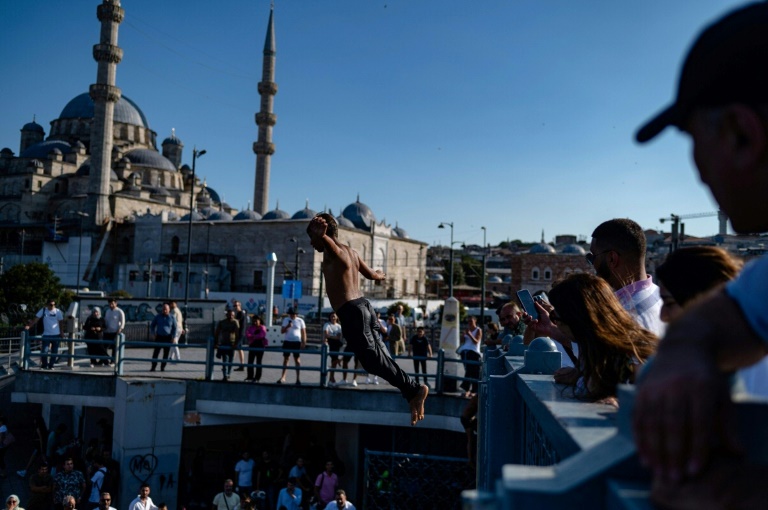
A stream of Russians flocking to Istanbul on Saturday expressed personal relief but concern for the safety of loved ones after the Kremlin announced a partial mobilisation for the war in Ukraine.

The price of some tickets from Moscow shot up 10-fold after President Vladimir Putin on Wednesday announced Russia’s first call-up of fighting-age men since World War II.

All those carrying hurriedly-packed belongings refused to give their full names for fear of retribution by Russian police against those still at home.

But all described anxiety not felt since the first days of Russia’s invasion of its Western-backed neighbour on February 24.

“We were talking to our friends and many are thinking about leaving,” said Daria, 22.

“Not everyone wanted to leave in February. The decision of September 21 forced many to think about it again.”

Her husband Andrei, 23, said he had been thinking of leaving since the first days of the war.

The mobilisation was the last straw.

“A lot of people decided to leave right now,” he said.

But Andrei also worried that speaking to reporters might cause issues for his family and friends back home.

“Yes, I think that things I am saying to you now — I am worried that there might be some punishment for that,” he said, standing next to a huge suitcase.

“The laws (in Russia) are very loosely applied. If they want to, they will find a reason to punish you.”

– Fear of closed borders –

Putin’s mobilisation order is designed to fill Russia’s military with hundreds of thousands of men after a string of setbacks that appears to have changed the tide in the seven-month war.

Turkey, a top holiday destination for many Russians, is among the few countries still operating flights out of Russia.

Russians can also reach Turkey without a travel visa, which makes trips purchased at the last minute much easier.

Flights to Turkey almost immediately sold out after Putin’s television announcement.

The last few tickets sold by popular Russian travel sites shot up in price because of soaring demand, making escape too expensive for many.

Turkish Airlines began using bigger aircraft on its Russia services, switching to wide-body Boeing 777s, because it could not immediately schedule more flights.

“Turkey is our intermediate point. We are here temporarily because there is a danger that the borders will be closed for good,” Daria said. 

“But this is not certain and no one really knows.”

– ‘We feel pressure’ –

Sasha, a 48-year-old company manager, said he knew of people who were trying to flee but could not.

“I think that many people would like to leave Russia but there are very few flights,” he told AFP at the airport. 

Sasha said it was difficult to gauge the true mood of Russians after the mobilisation order because some still supported the war and were willing to fight.

“There is no consensus in Russia right now. Some people support Putin, some people don’t support him,” he said. 

“It depends on their view of war and their philosophy.”

He added that many were too afraid to speak their mind.

“Of course we feel pressure. In Russia, there is a system of facial monitoring. And if someone sees your face, it is very easy to identify who you are,” Sasha said.

“This interview could be interpreted as being bad for the Russian army. In the future, people who give an interview like this could face problems.”

Andrei said he was now particularly worried about one of his childhood friends.

“My friend was unable to buy a ticket because it already cost 400,000 rubles ($7,000). That’s 10 times more expensive than before,” he said. 

Climate activists block superyacht marina in French Riviera

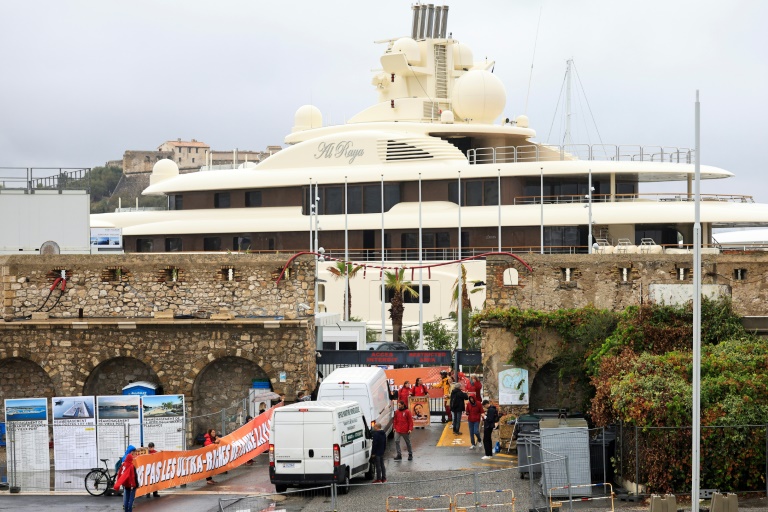
Activists blocked a quayside on the French Riviera on Saturday to protest against what they called ultra-rich “climate criminals”.

Twenty protesters from the pressure group Attac closed off the gate leading to a quay at Antibes port where many superyachts are moored, an AFP correspondent saw.

Port Vauban Antibes on southern France’s Mediterranean coast, has 1,500 berths, including 18 for superyachts, which can reach up to 160 metres (524 feet) in length.

The group blocked the port for an hour as they unfurled banners reading “Disarm climate criminals” and “Don’t let the ultra-rich destroy the planet”.

“It is unacceptable to ask for efforts from those in a precarious situation when we do nothing against the ultra-rich,” said Raphael Pradeau, spokesperson for Attac.

The activists have launched a campaign against the owners of private jets and superyachts, including a petition which they say has already been signed by 10,000 people.

NASA scraps Tuesday Moon launch due to storm

NASA has called off the scheduled Tuesday launch of its historic uncrewed mission to the Moon due to a tropical storm that is forecast to strengthen as it approaches Florida.

After two previously canceled launch attempts, NASA is weighing returning the Artemis 1 mission rocket to its assembly site under the threat of extreme weather.

“NASA is forgoing a launch opportunity… and preparing for rollback (from the launchpad), while continuing to watch the weather forecast associated with Tropical Storm Ian,” it said on Saturday.

The US National Hurricane Center (NHC) said Ian is due to “rapidly intensify” over the weekend as it moves toward Florida, home to the Kennedy Space Center, from which the rocket is set to launch.

Currently south of Jamaica, the storm is expected to approach Florida’s west coast “at or near major hurricane strength” early next week, threatening storm surge, flooding and hurricane-force winds across much of the state, the NHC said.

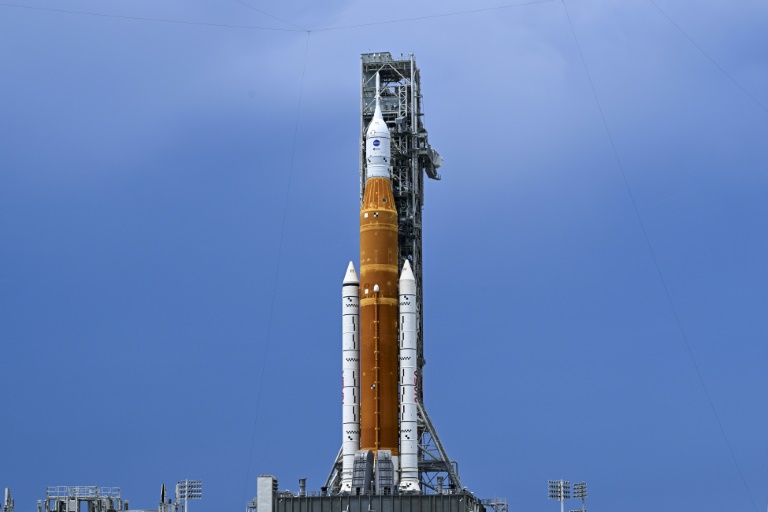
On the launchpad, the giant orange and white Space Launch System (SLS) rocket can withstand wind gusts of up to 137 kilometers (85 miles) per hour. But if it has to be sheltered, the current launch window, which runs until October 4, will be missed.

A decision on whether to roll back the rocket to the Vehicle Assembly Building is due to be taken by the Artemis 1 team on Sunday, “to allow for additional data gathering and analysis,” with the operation, if necessary, starting late Sunday or Monday morning, NASA said.

Jim Free, associate administrator for the agency’s exploration systems development directorate, said on Twitter that a “step-wise approach” to the decision to roll back preserves “a launch opportunity if conditions improve,” indicating a launch date before October 5 was still on the table.

If not, the next launch window will run from October 17 to 31, with one possibility of take-off per day, except from October 24-26 and 28.

The Artemis 1 space mission hopes to test the SLS as well as the unmanned Orion capsule that sits atop it, in preparation for future Moon-bound journeys with humans aboard.

Artemis is named after the twin sister of the Greek god Apollo, after whom the first Moon missions were named.

Unlike the Apollo missions, which sent only white men to the Moon between 1969 and 1972, Artemis missions will see the first person of color and the first woman step foot on the lunar surface.

A successful Artemis 1 mission would come as a huge relief to the US space agency, after years of delays and cost overruns. 

But another setback would be a blow to NASA, after two previous launch attempts were scrapped when the rocket experienced technical glitches including a fuel leak.

The cost of the Artemis program is estimated to reach $93 billion by 2025, with its first four missions clocking in at a whopping $4.1 billion each, according to a government audit.

Russia stiffens penalty for surrender, replaces top general

Russia on Saturday toughened penalties for voluntary surrender and refusal to fight with up to 10 years imprisonment and replaced its top logistics general after a series of setbacks to its seven-month war in Ukraine. 

The tough new amendments and personnel change come days after Russia instigated partial mobilisation with Kyiv taking back more and more territory in a counter-offensive.

It also comes as Kremlin-held regions of eastern and southern Ukraine voted for a second day on becoming part of Russia, dramatically raising the stakes. 

Integrating the four regions into Russia would mean that Moscow would consider any military move there as an attack on its own territory.

Russia’s invasion, launched on February 24, and Ukraine’s recent gains have laid bare flaws with some analysts seeing logistics as the weak link in Moscow’s army.

“Army General Dmitry Bulgakov has been relieved of the post of deputy minister of defence” and will be replaced by Colonel General Mikhail Mizintsev, aged 60, the defence ministry said.

Russia’s partial mobilisation announced on Wednesday will likely be one of his first big logistical challenges with the hundreds of thousands of reservists being called up needing to be equipped and trained before deployment.

Military-age men have sought to leave, with flights full and neighbouring countries receiving an influx of Russians, including Georgia where 2,300 private vehicles were waiting to enter at one crossing, regional Russian authorities said.

Now that President Vladimir Putin has signed the legislation, servicemen who desert, surrender “without authorisation”, refuse to fight or disobey orders can face up to 10 years imprisonment.

– ‘Sham’ –

Looting will be punishable by 15 years imprisonment. 

A separate law, also signed on Saturday, facilitates Russian citizenship for foreigners who enlist in the Russian army as the Kremlin seeks to bolster the ranks.

On Friday, US President Joe Biden has dismissed as a “sham” the voting on whether Russia should annex four regions of Ukraine, which ends next Tuesday.

Even Beijing, Moscow’s closest ally since the war began, called for the respect of “sovereignty and territorial integrity”.

The voting is being held in Russian-controlled areas of Donetsk and Lugansk in the east, and Kherson and Zaporizhzhia in the south.

For four days, authorities are going door-to-door to collect votes. Polling stations then open Tuesday for residents to cast ballots on the final day. Results are expected as early as late Tuesday or Wednesday.

“Ultimately, things are moving towards the restoration of the Soviet Union. The referendum is one step towards this,” Leonid, a 59-year-old military official, told AFP.

The snap referendums were announced just this week after the Ukrainian counter-offensive seized most of the northeast Kharkiv region — bringing hundreds of settlements back under Kyiv’s control after months of Russian occupation.

Irpin, close to the capital, was recaptured after weeks of fighting and residents have rallied to start rebuilding before winter sets in.

Over 100 apartment blocks in Irpin — dubbed a “hero city” by President Volodymyr Zelensky for holding back Russian invaders — were badly damaged by shelling.

– Evidence of ‘war crimes’ –

Head of his building’s residents’ association Mykhailo Kyrylenko looked proudly at the new roof taking shape.

“People don’t have much money, but they agreed” to donate funds to gradually restore the shattered homes, he told AFP.

Putin this week warned that Moscow would use “all means” to protect its territory — which former Russian leader Dmitry Medvedev said on social media could include the use of “strategic nuclear weapons”.

Zelensky has denounced the polls, on Friday calling them “crimes against international law and the law of Ukraine”.

G7 nations declared the polls will “never” be recognised and have “no legal effect or legitimacy”.

UN investigators on Friday accused Russia of committing war crimes on a “massive scale” in Ukraine — listing bombings, executions, torture and horrific sexual violence.

In the eastern Kharkiv region, Ukrainian officials said they had exhumed 447 bodies from a site near the city of Izyum, which was recaptured from Russian forces.

“Most of them have signs of violent death, and 30 have signs of torture,” said Kharkiv regional governor Oleg Synegubov.

“There are bodies with rope around their necks, with their hands tied, with broken limbs and gunshot wounds.” 

The Kremlin has accused Kyiv of fabricating evidence of the alleged war crimes.

Close Bitnami banner
Bitnami