World

World markets plunge on growing recession fears

Stock markets tumbled, the pound crashed against the dollar and oil prices slumped Friday on growing recession fears after central banks this week ramped up interest rates to fight decades-high inflation.

With price rises showing no solid sign of letting up, monetary policymakers have gone on the offensive, warning that short-term hits to economies are less painful than the long-term effects of not acting.

The Federal Reserve’s decision Wednesday to lift borrowing costs by 0.75 percentage points for a third successive meeting was followed by a warning that more big rises were in the pipeline and that rates would likely come down only in 2024.

There were similar moves by central banks in other countries including Britain, Sweden, Norway, Switzerland, the Philippines and Indonesia — all pointing to a dark outlook for markets.

Wall Street extended losses Friday while European equities sank in afternoon deals and Asia finished lower.

“A negative end to the week in Asia, and Europe has quickly followed as the prospect of much more tightening and a recession weighs on sentiment,” said Craig Erlam, analyst at trading platform OANDA.

In a sign that recession expectations are rising, the 10-year US Treasury yield jumped to its highest level in a decade.

“It’s a messy situation in the Treasury market to be sure and that is creating a messy situation for stocks. However, it’s not just a US situation. Things are messy elsewhere,” said Briefing.com analyst Patrick O’Hare.

The UK 10-year yield struck an 11-year high on Friday.

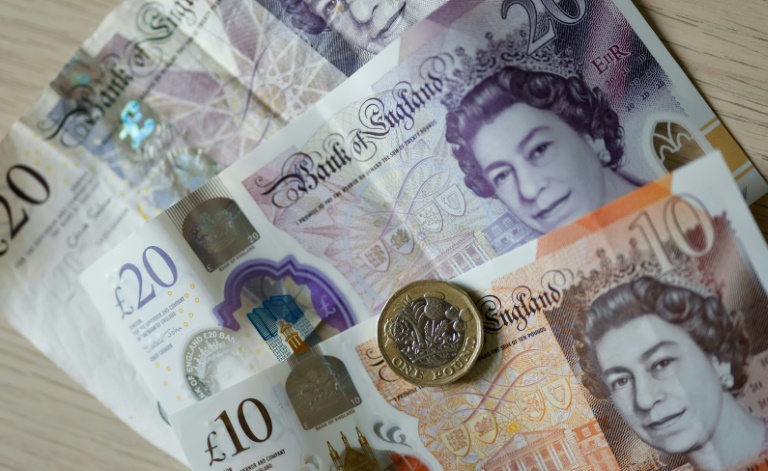
The British pound tumbled to a 37-year low under $1.10 as a tax-cutting budget sparked public finance concerns while recession fears mounted.

“Equity markets are also plunging on concerns that this (UK) package could further push inflation even higher, and thus make it more difficult to bring back down,” said Michael Hewson, chief market analyst at CMC Markets UK.

In the eurozone, recession fears deepened as data showed its economic activity fell once again in September.

The S&P eurozone PMI dropped to 48.2 in September — with a score under 50 representing economic contraction.

The euro hit a new two-decade low at $0.9751.

“A eurozone recession is on the cards as companies report worsening business conditions and intensifying price pressures linked to soaring energy costs,” said Chris Williamson, chief business economist at S&P Global Market Intelligence.

He added that falling UK business activity this month indicates that the British economy is likely already in recession.

Recession fears also caused oil prices to fall, with the main US contract, WTI, falling below $80 for the first time since January.

Traders were keeping a close eye as well on developments following the Japanese finance ministry’s intervention to support the yen, after it hit a new 24-year low of 146 against the dollar.

The first such intervention since 1998 helped strengthen the yen but it remained above 140.

Analysts warned the move was unlikely to have much long-term impact and the yen remained vulnerable owing to the Bank of Japan’s refusal to tighten policy — citing a need to boost the economy.

– Key figures at around 1435 GMT –

New York – Dow: DOWN 1.4 percent at 29,644.98 points

London – FTSE 100: DOWN 2.3 percent at 6,997.50 

Frankfurt – DAX: DOWN 1.9 percent at 12,294.22

Paris – CAC 40: DOWN 2.3 percent at 5,782.79

EURO STOXX 50: DOWN 2.3 percent at 3,349.75

Hong Kong – Hang Seng Index: DOWN 1.2 percent at 17,933.27 (close)

Shanghai – Composite: DOWN 0.7 percent at 3,088.77 (close)

Tokyo – Nikkei 225: Closed for a holiday

Pound/dollar: DOWN at $1.0972 from $1.1252 Thursday

Euro/dollar: DOWN at $0.9726 from $0.9839

Euro/pound: UP at 88.65 pence from 87.40 pence 

Dollar/yen: UP at 143.12 yen from 142.35 yen

West Texas Intermediate: DOWN 4.9 percent at $78.61 per barrel

Brent North Sea crude: DOWN 4.6 percent at $84.95 per barrel

burs-lth/ach  
Recession-bound UK fights inflation with tax cuts

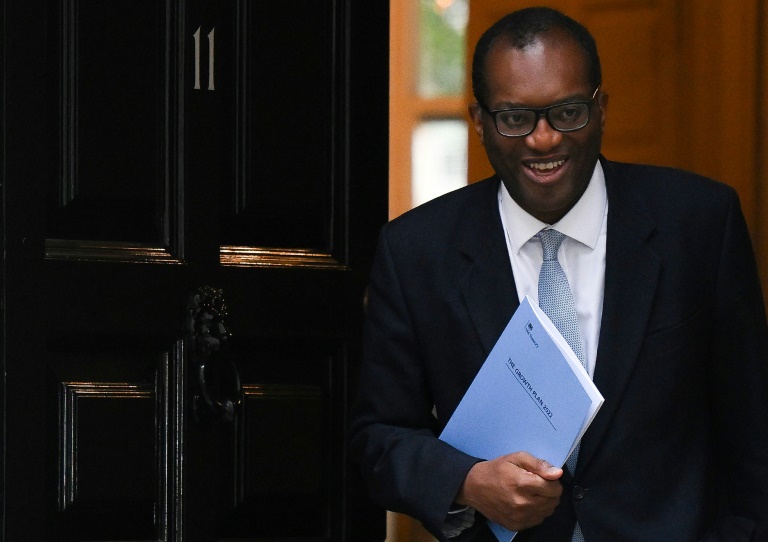
The UK’s new government on Friday unveiled a multi-billion-pound package to support households and businesses hit by the highest inflation in decades, cutting taxes as the nation heads for recession.

Finance minister Kwasi Kwarteng, fresh from being appointed by new Prime Minister Liz Truss, said caps on soaring energy bills would cost about £60 billion ($68 billion) in the first six months.

“The PM has acted with great speed to announce one of the most significant interventions the British state has ever made,” Kwarteng told parliament in a so-called mini budget.

“People need to know that help is coming.”

In a controversial move as millions of Britons face a cost-of-living crisis, Kwarteng axed an EU-inherited cap on bankers’ bonuses following Brexit to bolster the financial services sector.

Kwarteng brought forward a plan to cut the lowest rate of income tax, and reduced the highest to 40 percent from 45.

The chancellor of the exchequer also reversed a planned increase in tax on company profits signed off by Truss’s predecessor Boris Johnson.

He had announced on Thursday he would scrap a tax on salaries, reversing a 1.25-percentage-point rise in National Insurance implemented by his predecessor Rishi Sunak.

Opposition politicians slammed the budget as boosting the rich.

“We have had six so-called plans for growth from the Conservatives since 2010 — here they are, a litany of failure every single one of them,” said Rachel Reeves, finance spokeswoman for the main opposition Labour party.

“The prime minister and chancellor are like two desperate gamblers in a casino chasing a losing run,” Reeves said.

The announcement comes as economists warned that Britain was likely already in recession, as rocketing fuel and food prices take their toll.

– Pound collapse –

Adding to the pain, the pound Friday plunged two percent against the dollar on intensifying fears of a sharp downturn, while London’s stock market also sank.

Sterling hit a fresh 37-year low at $1.1021.

Kwarteng also lifted the point at which tax is levied on purchases of residential properties, as soaring interest rates put the brakes on the housing market.

Kwarteng released his plan a day after the Bank of England suggested the country was slipping into recession as it hiked interest rates again to tame red-hot inflation.

With prices soaring, Britain on Wednesday announced a six-month plan to pay about half of energy bills for businesses.

Truss had already launched a two-year household energy price freeze. The caps will not kick in, however, until Britons face another large hike in gas and electricity bills from October.

The average household will have their annual energy bill capped at £2,500 until 2024 but many are expected to spend above that to keep homes warm over the winter.

Wholesale electricity and gas prices for firms — as well as charities, hospitals and schools — will be capped at half the expected cost on the open market.

UK energy companies including BP and Shell will not get the cap, as their profits soared after Russia’s war in Ukraine sent oil and gas prices soaring.

The Labour party has demanded that the government extends a windfall tax on energy companies launched by Sunak earlier this year.

But Truss ruled it out, arguing that additional taxes hinder economic recovery and efforts by energy groups to transition into greener companies.

She took office on September 6, two days before the death of Queen Elizabeth II, after winning an election of Conservative party members on a tax-cutting platform.

– ‘Unacceptable strikes’ –

Kwarteng on Friday confirmed plans to shake up the welfare system.

Some 120,000 people in part-time work would face a benefit cut should they fail to take new steps to look for more work.

Kwarteng had described the policy as a “win-win”, pitching it as a way to fill 1.2 million UK job vacancies.

The cost-of-living crisis has triggered some of the biggest strike action in more than 30 years, involving sectors from the rail industry to postal services and even lawyers.

“At such a critical time for our economy, it is simply unacceptable that strike action is disrupting so many lives,” Kwarteng told MPs.

He said the government would legislate “to ensure strikes can only be called once negotiations have genuinely broken down”.

Russia proxies hold breakaway polls in Ukraine

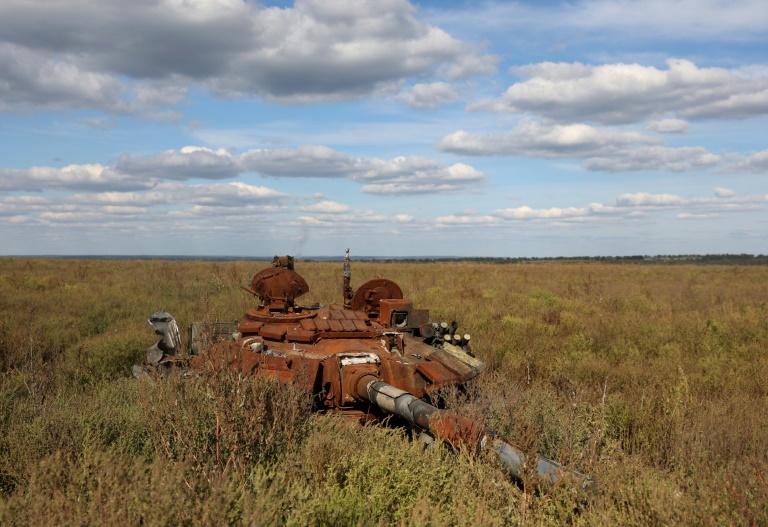
Voting on whether Russia should annex Kremlin-controlled regions of Ukraine opened Friday as the West denounced the referendum that has dramatically raised the stakes of Moscow’s seven-month invasion.

As polling got underway, Ukrainian forces said they were clawing back territory from the Moscow-backed separatists, contesting territory the Kremlin seeks to control.

The votes in four regions are the latest shock development in a ferocious war that UN investigators said had seen violence — like executions and torture — that amounted to war crimes.

The referendums in the eastern Donetsk and Lugansk regions, as well as in the southern Kherson and Zaporizhzhia regions have been dismissed as a “sham” by Kyiv’s Western allies.

And even diplomats from Russia’s closest ally since the war began, Beijing, told Ukraine that the “sovereignty and territorial integrity of all countries must be respected”.

Authorities in the Russian-controlled regions are going door-to-door for four days to collect votes. Polling stations then open Tuesday for residents to cast ballots on the final day of voting. 

It was also possible to vote at the building in Moscow that represents the Donetsk breakaway region. 

Leonid, a 59-year-old military official, told AFP he was “feeling happy”. 

“Ultimately, things are moving towards the restoration of the Soviet Union. The referendum is one step towards this,” he said.

Earlier this month, Ukrainian forces seized back most of the north-eastern Kharkiv region in a huge counter-offensive that has seen Kyiv retake hundreds of settlements that had been under Russian control for months.

On Friday, Russian news agency TASS showed officials in Donetsk alerting residents to the polls by loudspeaker, surrounding one local as he voted.

– ‘Sham’ –

Denis Pushilin, a pro-Russian separatist leader in the Donetsk region — part of the industrial Donbas region — said on Telegram that “Donbas is Russia”.

Kyiv said Friday its forces had recaptured a village in the Donetsk region and taken back positions south of the war-scarred town of Bakhmut.

The four regions’ integration into Russia — which for most observers is a foregone conclusion — would represent a major escalation of the conflict.

“We cannot — we will not — allow (Russian President Vladimir) Putin to get away with it,” US Secretary of State Antony Blinken told the UN Security Council on Thursday, condemning the referendums as a “sham”.

The referendums are reminiscent of Russia’s annexation of Ukraine’s Crimea in 2014. Western capitals maintain that a similar vote then was fraudulent and hit Moscow with sanctions.

– Paper ballots –

In Donetsk and Lugansk — which Putin already recognised as independent before invading Ukraine in February — residents are answering if they support their “republic’s entry into Russia”, TASS reported.

Ballots in Kherson and Zaporizhzhia ask the question: “Are you in favour of secession from Ukraine, formation of an independent state by the region and its joining the Russian Federation as a subject of the Russian Federation?”

Russian news agencies reported voting began on Friday at 0500 GMT while TASS reported paper ballots would be used to save time.

Ukrainian President Volodymyr Zelensky denounced the referendums as a “farce”.

Chinese Foreign Minister Wang Yi meanwhile met his Ukrainian counterpart Dmytro Kuleba at the UN and told him the “sovereignty and territorial integrity of all countries must be respected,” the ministry in Beijing said in a statement. 

UN investigators said Friday that war crimes have been committed in the Ukraine conflict, listing Russian bombings of civilian areas, numerous executions, torture and horrific sexual violence.

Erik Mose, who has led a team of investigators set up in March, said they were “struck by the large number of executions”.

Putin said Moscow would use “all means” to protect its territory — which former Russian leader Dmitry Medvedev said on social media could include the use of “strategic nuclear weapons”. 

Moscow began its mandatory troop call-up on Thursday after Putin called for about 300,000 reservists to bolster the war effort.

– ‘Don’t want to die’ –

But men were leaving Russia in droves before they were made to join, with flights to neighbouring countries booked up for days to come.

Some have not been able to avoid the summons.

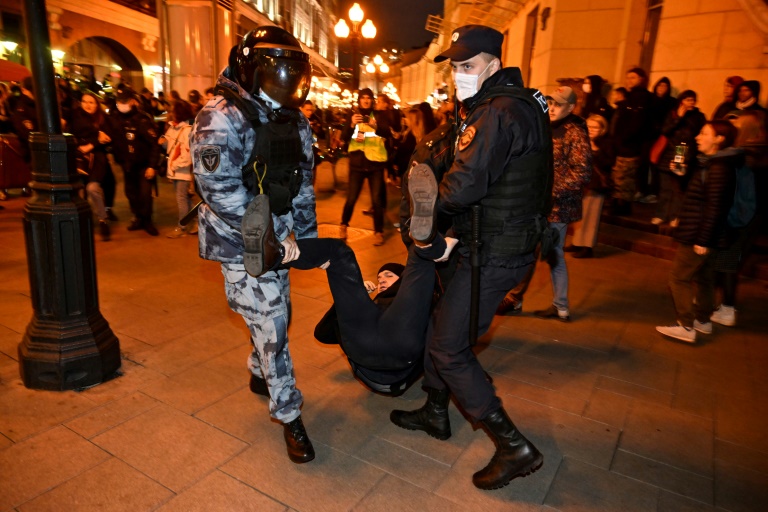
Mikhail Suetin, 29, was among those detained at an anti-mobilisation protest in Moscow this week and was handed a summons to appear at a recruitment office.

“To be told ‘tomorrow you will go to war’… that was a surprise,” 29-year-old Suetin, who regularly joins opposition protests in Moscow, told AFP.

burs/gw

Detained Russian protesters face conscription or jail

Mikhail Suetin expected to be detained when he protested Russian mobilisation, but he never imagined he would be ordered to enlist in the very army he was denouncing.

After President Vladimir Putin appeared on state television on Wednesday to announce the country’s first mobilisation since World War II, protests erupted in Russia.

“I was ready for the usual: to be arrested, taken to the police station, brought to court,” 29-year-old Suetin, who regularly joins opposition protests in Moscow, told AFP.

“But to be told ‘tomorrow you will go to war’… that was a surprise,” he said in a telephone interview.

The Independent monitoring group, OVD-Info, reported that men detained in the protests were handed draft papers while in custody in at least 15 Moscow police departments.

Answering questions from reporters the following morning, Vladimir Putin’s spokesman, Dmitry Peskov, defended the procedure, saying “it isn’t against the law”.

One day before mobilisation was announced, the Russian parliament approved a bill to toughen punishment for those refusing military summons or who desert.

The bill, yet to be signed into law, will impose prison sentences of five to 15 years.

– ‘Big trouble’ –

At the police station, Suetin said he was taken to a room alone and pressured to sign papers summoning him to the military mobilisation office the following day. 

“Either you sign this and go to war tomorrow, or you’ll sit in prison for 10 years,” he quotes police officers as threatening.

Suetin refused, on the advice of his lawyer, and was released at around 5:00 am the following morning.

He was told Russia’s investigative committee, which probes serious crimes, would be notified and that he was in “big trouble”.

More than 1,300 people were arrested during protests on Wednesday, a monitoring group reported. For those who did answer the call-up, the future is no brighter.

Andrei, who turned 18 last week, was called up — in papers seen by AFP — after being detained during the anti-mobilisation protests in Moscow.

The student described feeling “numb” after sitting for hours in a police station where officers “threatened” people who wouldn’t sign.

“It was clear I couldn’t run away… I looked around and decided not to resist… Unfortunately, I signed the paper,” Andrei told AFP by telephone, referring to documents that acknowledge he intends to turn up at his recruitment office.

– ‘Worried’ –

Russian Defence Minister Sergei Shoigu had promised on Wednesday that students would not be called up. 

This means that Andrei, who recently began university, should not have been caught up in the recruitment drive.

“As we say, Russia is a country of endless possibilities,” he joked bitterly.

Andrei decided not attend the appointment at the enlistment office on Thursday.

He says he is still looking for a lawyer and doesn’t know what he’ll do next.

“I haven’t told my parents yet,” Andrei told AFP.

They would “be worried,” he added.

“I’ll probably tell them when I have a better understanding of what’s going to happen to me.”

Iran stages rallies to counter week of deadly protests

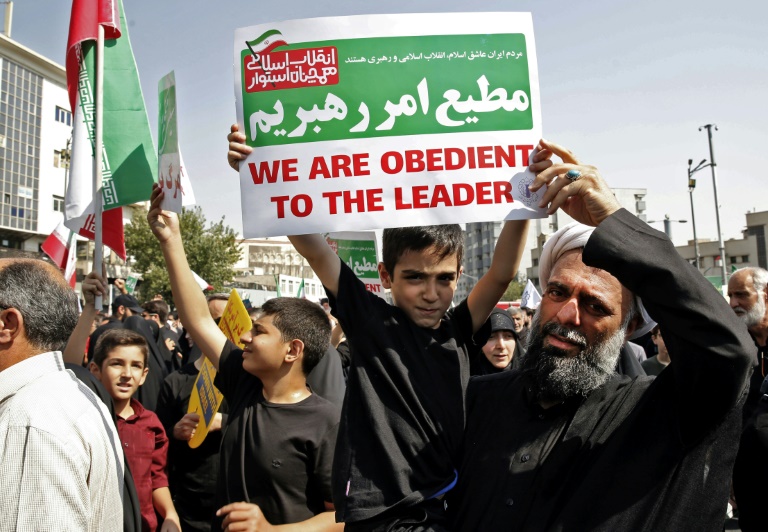
Thousands demonstrated across Iran on Friday at government-backed pro-hijab counter rallies, after a week of bloody protests over the death of a woman arrested for “improperly” wearing the Islamic headscarf.

Iran has been rocked by street violence since the death last week of Mahsa Amini, a 22-year-old Kurdish woman who had spent three days in a coma after being detained by the morality police.

The official death toll from the clashes remains at least 17, including five security personnel, but the New York-based Center for Human Rights in Iran (CHRI) put the figure at 36 and said it expected it to rise.

On Friday, thousands took to the streets in support of the hijab and a conservative dress code at government-backed counter rallies in Tehran and other cities including Ahvaz, Isfahan, Qom and Tabriz.

“The great demonstration of the Iranian people condemning the conspirators and the sacrileges against religion took place today,” said Iran’s Mehr news agency.

Imam Seyed Ahmad Khatami set the tone at weekly prayers in Tehran, urging “the judiciary to act quickly against the rioters who brutalise people, set fire to public property and burn the Koran”.

“To support the end of the veil is to do politics the American way,” chanted the faithful, who held aloft signs thanking the security forces and condemning women who burned their hijabs.

State television broadcast footage of a pro-hijab demonstration showing people holding up banners marching along streets of central Tehran, many of them men but also women dressed in black chadors.

– Overnight clashes –

Amini died on September 16, three days after she was hospitalised following her arrest by the morality police, a unit responsible for enforcing the Islamic republic’s strict dress code for women.

Activists said she suffered a blow to the head in custody but this has not been confirmed by the Iranian authorities, who have opened an investigation.

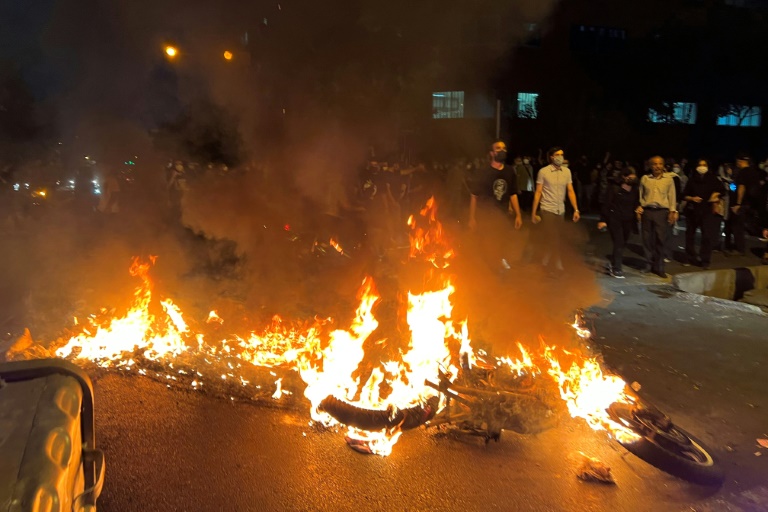
After she was pronounced dead, angry protests flared and spread to major urban centres, including the capital, Isfahan, Mashhad, Shiraz and Tabriz.

In the latest violence, security forces fired “semi-heavy weapons” at demonstrators during overnight clashes in the northern city of Oshnaviyeh, the Oslo-based Kurdish rights group Hengaw said on Friday. The report could not be independently verified.

In nearby Babol, demonstrators were seen setting ablaze a large billboard bearing the image of Iran’s supreme leader Ayatollah Ali Khamenei, according to videos shared online.

Some women demonstrators have defiantly taken off their hijabs and burned them in bonfires or symbolically cut their hair before cheering crowds, video footage spread virally on social media has shown.

In response, security forces have fired at crowds with birdshot and metal pellets, and deployed tear gas and water cannon, said Amnesty International and other human rights groups.

As part of the crackdown, the internet has been curbed and security forces have arrested activists including Majid Tavakoli, who has been repeatedly imprisoned in recent years, including after disputed 2009 elections.

– ‘Bleeding profusely’ –

Demonstrators have hurled stones at them, set fire to police cars and chanted anti-government slogans, IRNA reported.

“The government has responded with live ammunition, pellet guns and tear gas, according to videos shared on social media that have also shown protesters bleeding profusely,” the CHRI said in a statement.

Internet access has been restricted in what web monitor NetBlocks has called a “curfew-style pattern of disruptions” amid the angry protests sparked by Amini’s death.

Access to social media services, Instagram and WhatsApp have been blocked since Wednesday night, and connections were still largely disrupted on Friday.

The measure was taken in response to “the actions carried out via these social networks by counter-revolutionaries against national security”, Iran’s Fars news agency said.

Judiciary chief Gholam Hossein Mohseni-Ejei on Thursday called on the authorities to maintain peace and security and to confront “disruptive elements and professional rioters”.

President Ebrahim Raisi, at a news conference in New York where he attended the UN General Assembly, said: “We must differentiate between demonstrators and vandalism”.

The unrest comes at a particularly sensitive time for the leadership, as the Iranian economy remains mired in a crisis largely caused by sanctions over its nuclear programme.

burs/dv/kir

UK axes EU-inherited cap on banker bonuses

Britain on Friday axed a cap on bankers’ bonuses aimed at boosting London’s finance sector after Brexit, raising anger amid a cost-of-living crisis.

Finance minister Kwasi Kwarteng removed an EU-inherited policy that limits bankers’ bonuses at twice the basic salary. 

But the move, along with the scrapping of the top income tax bracket, triggered stinging criticism from opposition parties and unions.

New British Prime Minister Liz Truss, whose finance chief also outlined a costly freeze on energy bills to help households and business, said removing the bonus cap would stimulate economic growth and jobs.

Kwarteng followed up by stating that Britain needed “global banks to… invest jobs here and pay taxes here in London — not in Paris, not in Frankfurt and not in New York”. 

“All the bonus cap did was to push up the basic salaries of bankers or drive activity outside Europe,” the chancellor of the exchequer told parliament in a mini budget on Friday.

“It never capped total remuneration… so as a consequence of this we are going to get rid of it.”

A strong UK economy “has always depended on a strong financial services sector”, Kwarteng insisted. 

Britain’s cap had been in place since 2014, a legacy of membership of the European Union that Britain exited last year.

Brussels introduced the cap across the bloc following the global financial crisis, when banks received enormous state bailouts.

In another boost to high-earners on Friday, Kwarteng removed the 45-percent top rate of income tax levied on earnings above £150,000 ($169,000).

A new top rate of 40 percent would be applied to all annual salaries above £50,000.

– ‘Already wealthy’ –

Opposition politicians slammed the budget as boosting the rich, although income tax was cut slightly for all earners.

“It is all based on an outdated ideology that says if we simply reward those who are already wealthy, the whole of society will benefit,” said Rachel Reeves, finance spokeswoman for the main opposition Labour party.

Conservative party MP Kwarteng said his measures would bolster growth, as economists warn that Britain was likely already in recession.

“High tax rates damage Britain’s competitiveness,” warned Kwarteng, adding they “reduce the incentive to work, invest, and start a business”.

He also scrapped a planned tax rise on company profits.

Britain had planned to ramp up corporation tax to 25 percent from 2023.

Instead, it will remain at 19 percent — the lowest in the G20.

– Firestorm –

Susannah Streeter, senior investment and markets analyst at Hargreaves Lansdown, said the chancellor had sparked a “firestorm” over the tax measures.

“Kwasi Kwarteng has set off fireworks with this budget, while sparking a firestorm of criticism about benefiting the wealthy much more than the poorer sections of society,” she noted.

“Scrapping the top rate of tax will return many thousands of pounds to high earners, while lifting the cap on bankers’ bonuses is likely to be hard to swallow for low paid workers.”

Iran in new internet crackdown to thwart protesters

Iranian authorities have imposed tough and targeted restrictions on the use of the internet in a bid to impede protesters gathering and prevent images of crackdowns on their demonstrations reaching the outside world, observers say.

Activists have expressed alarm that the restrictions, also affecting Instagram which until now has remained unblocked in Iran and is hugely popular, could allow the authorities to carry out repression “under the cover of darkness”.

The protests erupted a week ago over the death in Tehran of Mahsa Amini, 22, following her arrest by the notorious morality police. They first erupted in her northern home province of Kurdistan before spreading nationwide.

Internet access monitor Netblocks described the access cuts as the most “severe internet restrictions” in Iran since the deadly crackdown on protests in November 2019, when the country experienced an unprecedented near-complete internet shutdown.

It says that mobile data networks have been cut — although there are signs of a return to connectivity — and there have been severe regional restrictions of access to Instagram and WhatsApp.

“It’s significantly different to what we saw in November 2019. It’s not as near total and complete as it was back then but more sporadic,” said Mahsa Alimardani, senior Iran researcher for freedom of expression group Article 19.

“But there are definitely a lot of disruptions and shutdowns happening,” she told AFP, while emphasising people were still managing to connect to filtered networks through VPNs.

– ‘Under cover of darkness’ –

Alimardani said Iranian authorities could be wary of the effect of a total internet shutdown on the economy as well as daily life issues like online medical appointments. They were also falling back on the National Information Network, an autonomous infrastructure Iran wants to develop as a homegrown internet, she said.

She said that the restrictions had “added hurdles” to the publishing of videos of the protests but that they are “still coming out”.

Videos posted on social media have included viral images of women burning their headscarves and demonstrators tearing down images of the Islamic republic’s leadership, and also security forces firing on protesters.

During Iran’s November 2019 protest wave sparked by a rise in fuel prices, activists argue that the internet shutdown allowed the authorities to carry out bloody repression largely hidden from the world.

Amnesty International says 321 people were killed then but it emphasises this only includes confirmed fatalities and the real toll may be much higher.

The rights group said it was now “gravely concerned about Iranian authorities disrupting access to internet and mobile networks” urging world leaders to take urgent action pressuring Iran “to stop killing and injuring more protesters under the cover of darkness.”

New York-based Center for Human Rights in Iran (CHRI) director Hadi Ghaemi said that “the potential for massive bloodshed now is real”.

“The government has blocked internet access because it wants to prevent people from sending evidence of the state’s atrocities to the outside world,” he said.

– ‘Stifle free expression’ –

Instagram head Adam Mosseri has expressed concern over the cuts while WhatsApp, which is also owned by social media giant Meta, insisted it was not behind any access cuts and would “do everything in our technical power to maintain our services”.

Secure messaging service Signal confirmed it remained blocked in Iran and encouraged users outside to set up a proxy server to help people connect.

The blocking of major platforms by Iran in recent years — including Facebook, Twitter, Telegram, YouTube and TikTok — had left Instagram and WhatsApp as the two most widely used social media apps in Iran.

State media reports confirmed that officials had ordered access to the two services to be restricted.

Observers have also noted a regional targeting of the internet cuts, especially in the Kurdistan region where some of the fiercest clashes have taken place.

“Disruptions to the internet are usually part of a larger effort to stifle the free expression and association of the Iranian population, and to curtail ongoing protests,” the UN’s panel of human rights experts said, describing the restrictions as the third such shutdown in Iran within a year.

“State mandated internet disruptions cannot be justified under any circumstances,” they added.

Why 'Monkey Island' creators returned to 1990s classic game

When Ron Gilbert and Dave Grossman first let loose their swords, voodoo and pirates epic “The Secret of Monkey Island”, it was sold on floppy disks and released for long-forgotten home PCs like the Amiga.

Three decades later, they are back at it with “Return to Monkey Island”, a sequel with flashier graphics and orchestral scores that is only available as a download.

“Back in 1990 we had an office and we were all in there all day long sharing space,” Grossman told AFP in a joint interview with Gilbert.

“Now we’re all remote — and not even just because of the pandemic, we’re going to be remote anyway.”

The two men worked together on the first two editions of the game, released in 1990 and 1991, before the group disbanded and went their separate ways.

The second edition ended on a cliffhanger that has never been resolved, with the hero, Guybrush Threepwood, facing off against his nemesis LeChuck.

And the secret alluded to in the title of the original was never divulged.

It has kept fans on tenterhooks ever since and gave Gilbert and Grossman a reason to come back to the franchise 30 years later.

“I think there’s unfinished business for Guybrush because he never found the secret, and I think there’s unfinished business for Dave and I as well,” said Gilbert.

– ‘Coloured by nostalgia’ –

The fan fervour around last Monday’s release showed just how strong the feelings still were for a game with blocky graphics and text prompts.

Although most of the reaction was positive, some took exception to the cartoon aesthetic of the new game and vented on social media — something 1990s creators did not have to contend with.

“Adventure game fans have always been very nice and I felt like they kind of turned a little bit,” said Gilbert. 

“It does affect you on some level but it’s not going to change how we think about the game at all.”

Slick graphics were never the appeal of “Monkey Island” — instead players solved puzzles and riddles and advanced through strange landscapes with surreal humour and pop-culture nods aplenty.

It largely set the template for adventure games that were to follow, but the “Monkey Island” franchise petered out with a few later entries published without the involvement of Gilbert.

Although the pair are polite about these subsequent editions — “we would never pooh-pooh the canon”, said Gilbert — their new game picks up the story where the 1991 game ended.

But before they could even start thinking of the story, they had to negotiate licensing the rights to the game from Disney.

“It was a long process, just because lawyers get involved and then everything takes a long time,” said Gilbert.

A core team of 25 people then spent two years beavering away on the game, dealing not only with the rigours of game design but also 30 years of expectation among fans.

“Their memories are unrealistically coloured by nostalgia,” said Grossman. “That makes a sort of an unreachable goal for us.”

Instead, they decided to make a game that they themselves would enjoy.

– ‘Golden age’ –

Despite beginning their careers when the gaming industry was still in its infancy, Gilbert and Grossman are still hugely inspired by the current landscape.

“Nearly anyone can just get three friends together and make a game in their garage, go on the internet and find an audience for it,” said Grossman, calling it “the golden age of video games”.

Their original 1990s games have already found a second life in this golden age through apps and online emulators.

And both creators are quietly confident that “Monkey Island” will continue in some form in the future.

“I think we should do one of these about every 10 or 15 years,” said Grossman.

“Yeah, see you in 2035,” replied Gilbert.

World markets plunge on growing recession fears

Stock markets tumbled, the pound crashed against the dollar and oil prices slumped Friday on growing recession fears after central banks this week ramped up interest rates to fight decades-high inflation.

With price rises showing no solid sign of letting up, monetary policymakers have been forced to go on the offensive, warning that short-term hits to economies are less painful than the long-term effects of not acting.

The Federal Reserve’s decision Wednesday to lift borrowing costs by 0.75 percentage points for a third successive meeting was followed by a warning that more big rises were in the pipeline and that rates would likely come down only in 2024.

That came along with similar moves by banks in several other countries including Britain, Sweden, Norway, Switzerland, the Philippines and Indonesia — all pointing to a dark outlook for markets.

“We see this new even-higher-for-longer rate path as associated with a substantially higher likelihood of a hard landing, and so not just unambiguously hawkish but unambiguously bad for risk,” said Krishna Guha, vice-chair of Evercore ISI.

In a sign that recession expectations are rising, the 10-year US Treasury yield jumped to 3.7 percent, its highest level in a decade, while on Wall Street the S&P 500 has sunk to its weakest level since June and just above its 2022 lows.

The UK 10-year yield struck at an 11-year high at 3.84 percent Friday.

The pound slumped to $1.1021, the lowest level since 1985, even as the UK government unveiled a tax-cutting budget aimed at driving growth.

In the eurozone, recession fears deepened as data showed its economic activity fell once again in September.

The S&P eurozone PMI dropped to 48.2 in September — with a score under 50 representing economic contraction.

“A eurozone recession is on the cards as companies report worsening business conditions and intensifying price pressures linked to soaring energy costs,” said Chris Williamson, chief business economist at S&P Global Market Intelligence. 

He added that falling UK business activity this month indicates that the British economy is likely already in recession.

Traders were keeping a close eye also on developments following the Japanese finance ministry’s intervention to support the yen, after it hit a new 24-year low of 146 against the dollar.

The first such intervention since 1998 helped strengthen the yen to just above 140.

But analysts warned the move was unlikely to have much long-term impact and the yen remained vulnerable owing to the Bank of Japan’s refusal to tighten policy — citing a need to boost the economy.

Recession fears also caused oil prices to fall by more than three percent.

– Key figures at around 1115 GMT –

London – FTSE 100: DOWN 2.4 percent at 6,984.85 points

Frankfurt – DAX: DOWN 2.6 percent at 12,201.91

Paris – CAC 40: DOWN 2.4 percent at 5,777.00

EURO STOXX 50: DOWN 2.6 percent at 3,337.10

Hong Kong – Hang Seng Index: DOWN 1.2 percent at 17,933.27 (close)

Shanghai – Composite: DOWN 0.7 percent at 3,088.77 (close)

Tokyo – Nikkei 225: Closed for a holiday

New York – Dow: DOWN 0.4 percent at 30,076.68 (close)

Pound/dollar: DOWN at $1.1059 from $1.1252 Thursday

Euro/dollar: DOWN at $0.9760 from $0.9839

Euro/pound: UP at 88.27 pence from 87.40 pence 

Dollar/yen: UP at 142.90 yen from 142.35 yen

West Texas Intermediate: DOWN 3.4 percent at $80.68 per barrel

Brent North Sea crude: DOWN 3.2 percent at $87.56 per barrel

burs-bcp/rfj/lth

World markets plunge on growing recession fears

Stock markets tumbled, the pound crashed against the dollar and oil prices slumped Friday on growing recession fears after central banks this week ramped up interest rates to fight decades-high inflation.

With price rises showing no solid sign of letting up, monetary policymakers have been forced to go on the offensive, warning that short-term hits to economies are less painful than the long-term effects of not acting.

The Federal Reserve’s decision Wednesday to lift borrowing costs by 0.75 percentage points for a third successive meeting was followed by a warning that more big rises were in the pipeline and that rates would likely come down only in 2024.

That came along with similar moves by banks in several other countries including Britain, Sweden, Norway, Switzerland, the Philippines and Indonesia — all pointing to a dark outlook for markets.

“We see this new even-higher-for-longer rate path as associated with a substantially higher likelihood of a hard landing, and so not just unambiguously hawkish but unambiguously bad for risk,” said Krishna Guha, vice-chair of Evercore ISI.

In a sign that recession expectations are rising, the 10-year US Treasury yield jumped to 3.7 percent, its highest level in a decade, while on Wall Street the S&P 500 has sunk to its weakest level since June and just above its 2022 lows.

The UK 10-year yield struck at an 11-year high at 3.84 percent Friday.

The pound slumped to $1.1021, the lowest level since 1985, even as the UK government unveiled a tax-cutting budget aimed at driving growth.

In the eurozone, recession fears deepened as data showed its economic activity fell once again in September.

The S&P eurozone PMI dropped to 48.2 in September — with a score under 50 representing economic contraction.

“A eurozone recession is on the cards as companies report worsening business conditions and intensifying price pressures linked to soaring energy costs,” said Chris Williamson, chief business economist at S&P Global Market Intelligence. 

He added that falling UK business activity this month indicates that the British economy is likely already in recession.

Traders were keeping a close eye also on developments following the Japanese finance ministry’s intervention to support the yen, after it hit a new 24-year low of 146 against the dollar.

The first such intervention since 1998 helped strengthen the yen to just above 140.

But analysts warned the move was unlikely to have much long-term impact and the yen remained vulnerable owing to the Bank of Japan’s refusal to tighten policy — citing a need to boost the economy.

Recession fears also caused oil prices to fall by more than three percent.

– Key figures at around 1115 GMT –

London – FTSE 100: DOWN 2.4 percent at 6,984.85 points

Frankfurt – DAX: DOWN 2.6 percent at 12,201.91

Paris – CAC 40: DOWN 2.4 percent at 5,777.00

EURO STOXX 50: DOWN 2.6 percent at 3,337.10

Hong Kong – Hang Seng Index: DOWN 1.2 percent at 17,933.27 (close)

Shanghai – Composite: DOWN 0.7 percent at 3,088.77 (close)

Tokyo – Nikkei 225: Closed for a holiday

New York – Dow: DOWN 0.4 percent at 30,076.68 (close)

Pound/dollar: DOWN at $1.1059 from $1.1252 Thursday

Euro/dollar: DOWN at $0.9760 from $0.9839

Euro/pound: UP at 88.27 pence from 87.40 pence 

Dollar/yen: UP at 142.90 yen from 142.35 yen

West Texas Intermediate: DOWN 3.4 percent at $80.68 per barrel

Brent North Sea crude: DOWN 3.2 percent at $87.56 per barrel

burs-bcp/rfj/lth

Close Bitnami banner
Bitnami