World

Hot gas bubble spotted spinning around Milky Way black hole

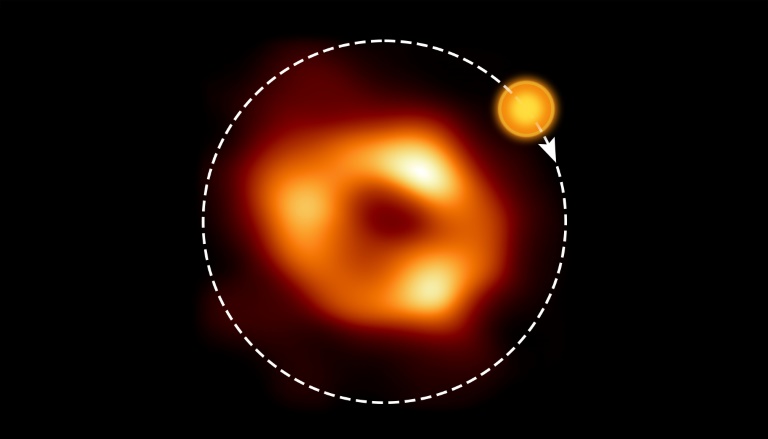
Astronomers said Thursday they have spotted a hot bubble of gas spinning clockwise around the black hole at the centre of our galaxy at “mind blowing” speeds.

The detection of the bubble, which only survived for a few hours, is hoped to provide insight into how these invisible, insatiable, galactic monsters work.

The supermassive black hole Sagittarius A* lurks in the middle of the Milky Way some 27,000 light years from Earth, and its immense pull gives our home galaxy its characteristic swirl.

The first-ever image of Sagittarius A* was revealed in May by the Event Horizon Telescope Collaboration, which links radio dishes around the world aiming to detect light as it disappears into the maw of black holes.

One of those dishes, the ALMA radio telescope in Chile’s Andes mountains, picked up something “really puzzling” in the Sagittarius A* data, said Maciek Wielgus, an astrophysicist at Germany’s Max Planck Institute for Radio Astronomy.

Just minutes before ALMA’s radio data collection began, the Chandra Space Telescope observed a “huge spike” in X-rays, Wielgus told AFP.

This burst of energy, thought to be similar to solar flares on the Sun, sent a hot bubble of gas swirling around the black hole, according to a new study published in the journal Astronomy and Astrophysics.

The gas bubble, also known as a hot spot, had an orbit similar to Mercury’s trip around the Sun, the study’s lead author Wielgus said.

But while it takes Mercury 88 days to make that trip, the bubble did it in just 70 minutes. That means it travelled at around 30 percent of the speed of light.

“So it’s an absolutely, ridiculously fast-spinning bubble,” Wielgus said, calling it “mind blowing”.

– A MAD theory –

The scientists were able to track the bubble through their data for around one and half hours — it was unlikely to have survived more than a couple of orbits before being destroyed.

Wielgus said the observation supported a theory known as MAD. “MAD like crazy, but also MAD like magnetically arrested discs,” he said.

The phenomenon is thought to happen when there is such a strong magnetic field at the mouth of a black hole that it stops material from being sucked inside.

But the matter keeps piling up, building up to a “flux eruption”, Wielgus said, which snaps the magnetic fields and causes a burst of energy.

By learning how these magnetic fields work, scientists hope to build a model of the forces that control black holes, which remain shrouded in mystery.

Magnetic fields could also help indicate how fast black holes spin — which could be particularly interesting for Sagittarius A*.

While Sagittarius A* is four million times the mass of our Sun, it only shines with the power of about 100 suns, “which is extremely unimpressive for a supermassive black hole, Wielgus said.

“It’s the weakest supermassive black hole that we’ve seen in the universe — we’ve only seen it because it is very close to us.”

But it is probably a good thing that our galaxy has a “starving black hole” at its centre, Wielgus said. 

“Living next to a quasar,” which can shine with the power of billions of suns, “would be a terrible thing,” he added.
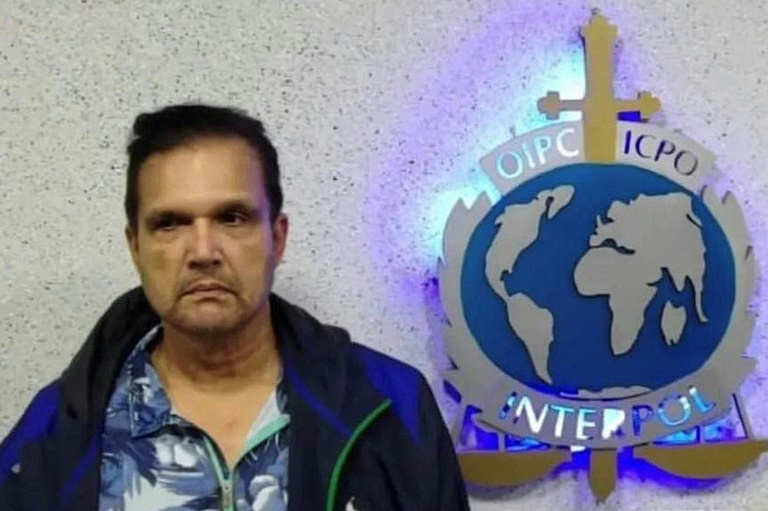
'Fat Leonard' fugitive in US Navy scandal captured in Venezuela

A military contractor known as “Fat Leonard” who pleaded guilty in the US Navy’s worst ever corruption scandal has been captured in Venezuela after fleeing the United States, the Interpol office in Caracas said.

Leonard Francis cut off his GPS monitor and escaped house arrest in California in early September.

“The fugitive was arrested at the Simon Bolivar de Maiquetia International Airport when he was about to leave the country,” a post shared on Instagram Wednesday by the Caracas Interpol office said.

Leonard “entered the country coming from Mexico with a stop in Cuba” and aimed to travel to Russia, the post said, adding that he was the subject of an Interpol red notice.

Francis, a Malaysian national who ran a military contracting company out of Singapore, pleaded guilty in 2015 to offering some $500,000 in bribes to Navy officers to steer official work to his shipyards, carrying out work on US vessels that prosecutors say he overcharged the Navy for, to the tune of $35 million.

Police were sent to his San Diego residence on September 4 after the agency monitoring his ankle bracelet reported a problem with the device, and found that he was gone, the US Marshals Service said.

Francis was arrested in 2013 and pleaded guilty two years later. He suffered numerous health problems, including kidney cancer, which led to him being released to house arrest in 2018 while acting as a cooperating witness for federal prosecutors. 

He was due to be sentenced on September 22.

Four Navy officers have been found guilty in the case so far, while another 29 people, including naval officials, contractors and Francis himself, have pleaded guilty, US media said.

Frenchman rewarded for lifetime of research into narcolepsy

Emmanuel Mignot is one of the world’s leading experts on narcolepsy, a sleep disorder that he finds both “strange” and “fascinating.”

The French-born Mignot has dedicated his life to studying the causes of narcolepsy and shedding light on one of the great biological mysteries — sleep.

His discovery of the genetic and molecular causes of the disorder led to his receiving a prestigious Breakthrough Prize on Thursday along with Japan’s Masashi Yanagisawa, who made related findings around the same time.

Because of their discoveries, new treatments for narcolepsy — which causes people to suddenly fall asleep — and other sleep disorders are being developed.

About one in every 2,000 people suffers from narcolepsy. Some may experience catalepsy — a sudden trance-like state.

“I am quite proud because what I have discovered is making an enormous difference for my patients,” Mignot said in a telephone interview with AFP. “It’s the best reward that one could receive.”

The 63-year-old Mignot is a sleep researcher at Stanford University in California.

Thirty years ago, when he was a medical student, Mignot fulfilled his military service requirements in France by coming to Stanford to study a French-made drug that was being used to treat narcolepsy.

At the time, he said, the disease was “virtually unknown” and no one was actively studying it.

He became “completely fascinated.”

“I told myself it’s incredible, this disease, people fall asleep all the time, we have no idea why, and if we could discover the cause we might understand something new about sleep.”

Stanford was already home to a renowned sleep center and its laboratory housed narcoleptic dogs, which Mignot began studying in an effort to find a genetic cause of the disease.

Genome sequencing was very primitive at that time and “everybody told me I was crazy,” said Mignot, who currently has an adopted narcoleptic dog called Watson.

“I thought it would take a few years and it ended up taking 10.”

In 1999, Mignot found a mutation in the genome of narcoleptic dogs. It was located on membrane receptors in the brain that respond to molecules outside the cell, similar to a lock and a key.

– ‘Remake a key’ –

The Japanese scientist Yanagisawa, meanwhile, had been studying orphan receptors — receptors of unknown function — in mice.

He discovered that a molecule that he named orexin binds to the same receptor Mignot detected as abnormal in dogs.

Mice who were deprived of orexin developed narcolepsy.

Mignot immediately began research on human subjects and found that orexin levels in the brain of narcolepsy patients were zero.

Normally, the molecule is produced in great quantities during the day, especially in the evening, allowing one to fight fatigue.

“You don’t make a discovery like this twice in your life,” Mignot said. “We found the cause of a disease.

“The advantage, is that we can remake a key,” he said, referring to orexin.

For the moment, most patients are treated with a combination of powerful sedatives to help them sleep more soundly and amphetamines to keep them awake during the day.

Mignot said tests using a drug that mimics orexin have been “really miraculous.”

Patients are fully awake and “transformed.”

The challenge is to develop the right dose to be delivered at the right time.

Several companies, including Takeda of Japan, are working on it, and drugs could be authorized in the next few years.

They could be applied to other patients — people suffering from depression, for example — who have difficulty waking up, or to those in a coma.

Mignot meanwhile is studying whether narcolepsy may be caused by a flu virus.

The body’s immune system may be confusing a flu virus with the cells that produce orexin and T-cells that fight infection are attacking them as a result.

“I’ve become interested in how the immune system works in the brain,” a field he said is “beginning to explode.”

As for sleep, Mignot remains fascinated by it even if he has uncovered one of the great mysteries.

“What is it that sleep does that it is so important that we have to do it every day?” he asked. “It’s true that we still don’t know.”

Kremlin proxies in Ukraine double down ahead of annexation votes

Kremlin-installed officials in Ukrainian regions controlled by Moscow’s forces vowed on Thursday to press ahead with polls this week on annexation by Russia, after world leaders condemned the votes and said the results would be void.

Russian Foreign Minister Sergei Lavrov was expected to defend what Ukraine’s allies are calling an unlawful land grab, during a UN Security Council meeting called by France over rights abuses in Ukraine.

Four Russian-occupied regions of Ukraine — Donetsk and Lugansk in the east and Kherson and Zaporizhzhia in the south — announced that they would hold the votes over five days, beginning on Friday.

Vladimir Saldo, the Moscow-installed head of Kherson, which fell early into the Russian invasion, said the referendum would go ahead in his region regardless of the criticsm.

“The date has been set. We have the green light. Voting begins tomorrow and nothing can prevent this,” he told Russian state-run media.

“People have been waiting and they’re demanding that this vote is held soon,” he added.

Western leaders convening in New York this week unanimously condemned the ballots. 

Speaking at the United Nations, US President Joe Biden accused Russian President Vladimir Putin of “shamelessly” violating the UN Charter with a war aimed at “extinguishing Ukraine’s right to exist as a state”.

– Door-to-door voting –

The integration of the war-scarred regions into Russia would represent a major escalation of the conflict, as Moscow could then try to say it was defending its own territory from Ukrainian forces.

After the votes were announced by his proxy officials in Ukraine, Putin announced that Russia would call up some 300,000 reservists to bolster the war effort and cautioned that Moscow would use “all means” to protect its territory.

Former Russian leader Dmitry Medvedev said in a statement on social media that those means included “strategic nuclear weapons”. He predicted the voting regions “will integrate into Russia”.

For most observers, the results of the concurrent votes are already a foregone conclusion and were rushed because Ukrainian forces were making sweeping gains in a counter-offensive to recapture the east.

The referendums are reminiscent of a similar ballot in 2014 that saw the Crimean Peninsula in Ukraine annexed by Russia. Western capitals said the vote was fraudulent and hit Moscow with sanctions in response.

Election officials in the Donetsk region, which has been partially controlled since 2014 by Moscow-backed separatists, said that voting would take place door-to-door for the first days. But it would only be possible in polling stations on the final day, Tuesday.

Putin’s move this week to call up reservists for Ukraine sparked small protests across Russia, resulting in more than 1,300 people being detained.

– ‘This senseless war’ –

Flights out of Russia to neighbouring countries, mainly former Soviet republics that allow Russians visa-free entry, are nearly entirely booked and prices have skyrocketed, pointing to an exodus of Russian wanting to avoid going to war.

Looking lost and exhausted in the arrivals hall of the airport in the capital of Armenia, 44-year-old Sergei said he had fled Russia to escape being called up.

“The situation in Russia would make anyone want to leave,” he told AFP on condition of anonymity.

Dmitry, 45, said he flew to Armenia from one of Russia’s eastern regions with one small bag, leaving behind his wife and two children and with “no clue what I’ll be doing here”.

“I don’t want to go to war. I don’t want to die in this senseless war,” he told AFP journalists.

However, Kremlin spokesman Dmitry Peskov on Thursday denied that Russians eligible to fight were flooding airports and lining up at the country’s borders.

“A great deal of false information has emerged about this,” he said.

The Russian defence ministry confirmed on Wednesday it had secured the release of 55 of its servicemen, in the largest prisoner swap between Kyiv and Moscow since the start of the conflict.

In exchange, Ukraine recovered 215 imprisoned citizens, including servicemen who held out against Russian forces besieging the Azovstal steel works in Mariupol.

As part of the deal, Ukraine also handed over to Russia Viktor Medvedchuk, seen as President Vladimir Putin’s top ally in Kyiv.

Medvedchuk, one of Ukraine’s richest people, has been accused by Kyiv of high treason.

Spanish court opens probe into cannabis 'Ponzi scheme'

Spain’s top criminal court has opened a fraud investigation into a Netherlands-based medicinal cannabis investment platform which allegedly swindled people around the world of millions of dollars.

The National Court opened its probe into JuicyFields on September 15 after a lawsuit filed by nearly 1,200 investors in July, a court document seen by AFP Thursday showed.

The court aims to “identify those allegedly responsible for the crimes” alleged in the lawsuit and understand the “financial mechanics” of the company.

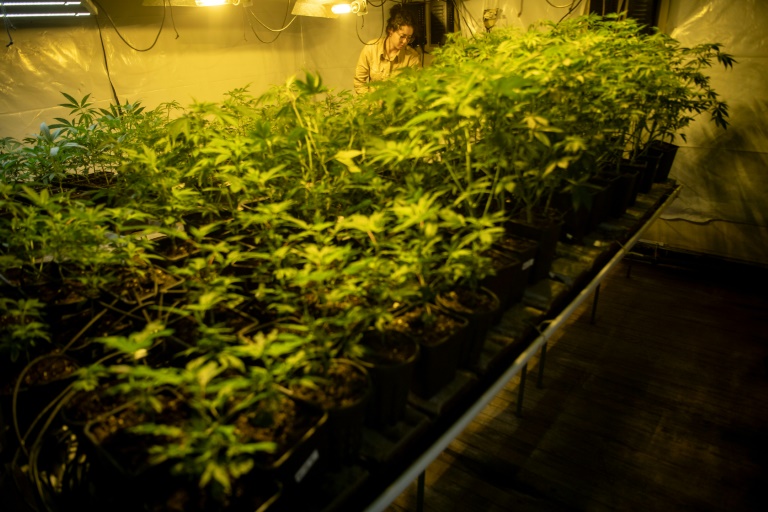
Established in 2020, JuicyFields offered investors the chance to participate in the cultivation, harvesting and sale of cannabis plants, promising returns of up to 66 percent.

But it suddenly stopped operations in mid-July, froze cash withdrawals and vanished from the internet, investors allege.

The class action lawsuit filed by the Martinez-Blanco law firm accuses JuicyFields of operating like a Ponzi scheme, in which early investors are paid out by receipts from later investors.

It estimates that there are nearly 4,500 victims in Spain alone, who each lost an average of 6,500 euros ($6,435). Some individuals lost as much as 200,000 euros.

The minimum investment was 50 euros, and the money could be deposited and withdrawn via bank transfer or cryptocurrencies.

This is believed to be the first class-action lawsuit against JuicyFields, which according to media investigations scammed investors around the world.

A group on mobile messaging service Telegram in France for people who want to take legal action against JuicyFields has over 1,600 members.

Several members of the group say they have filed individual lawsuits against JuicyFields.

A class-action lawsuit is also expected to be filed in France against the firm.

Inflation-hit Turkey cuts rate for second month

Turkey’s central bank on Thursday cut its policy rate for the second straight month despite an annual inflation rate that has reached 80 percent and is still moving higher.

The central bank said it was cutting its one-week repo rate to 12 percent from 13 percent and blamed skyrocketing consumer prices on external factors such as the global jump in the cost of energy and food caused by Russia’s invasion of Ukraine.

The decision highlights Turkish policymakers’ strong focus on economic growth nine months before a general election that polls show President Recep Tayyip Erdogan is on track to lose.

Turkey has gone the opposite direction of other central banks worldwide which have raised their rates to combat inflation, with the US Federal Reserve and European peers announcing hefty hikes this week.

The policy has put the Turkish lira under pressure, and it touched a new historic low of 18.41 against the dollar before recovering some its losses after the announcement.

Official data show Turkey’s industrial production and retail sales both starting to slow.

“Since the beginning of July, leading indicators have been pointing to a slowdown in growth due to the weakening foreign demand,” the central bank said.

“Leading indicators for the third quarter continue pointing to loss of momentum in economic activity due to the decreasing foreign demand.”

Erdogan has openly championed economic growth at all cost.

He also rejects conventional economics and believes that inflation can be brought under control by cutting interest rates.

“I am an economist. Inflation is not an economic danger that cannot be overcome,” Erdogan told US television this week. 

“Currently, there are countries which feel threatened by inflation of even eight or nine percent. We have 80 percent,” he said.

“And in my country, the shelves are not empty in the markets.”

Turkey’s inflation rate is now the highest since 1998.

– ‘Managed markets’ –

Erdogan’s two-decade rule was built around a pledge to create a new middle-class and end the corruption and economic mismanagement that plagued successive secular governments in the 1980s and 1990s.

But his Islamic-rooted party and its hard-right nationalist allies now face the real possibility of losing their parliamentary majority in next year’s polls.

Erdogan himself is expected to struggle in a likely second round runoff against any of his potential opposition rivals.

The Turkish leader has responded to the economic crisis by radically changing his foreign policy and making up with many of his former rivals in the petrodollar-rich Arab world.

Additional deals with Russia have helped shore up Turkey’s dwindling foreign currency reserves and potentially given Erdogan enough breathing room to ride out the economic storm until June.

Analysts at Fitch Ratings said they expect the central bank to end its era of unconventional economics and start raising rates after the election.

But economists believe any rate hike would need to be dramatic to have any meaningful effect.

“The Turkish central bank’s policy rate really has little real meaning these days, given inflation at 80 percent plus,” said BlueBay Asset Management analyst Timothy Ash.

“The managed markets in Turkey are now aimed at engineering Erdogan’s re-election.”

Bank of England hikes rates again, warns on recession

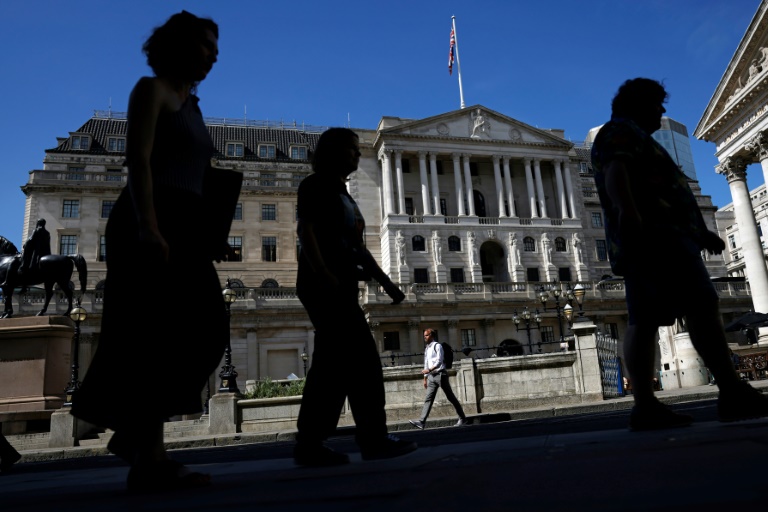
The Bank of England hiked its interest rate sharply again Thursday to combat decades-high inflation but warned the UK economy was slipping into recession.

The BoE’s second half-point increase in a row follows this week’s super-sized rate hikes from the US Federal Reserve and other global central banks, as policymakers seek to tame red-hot consumer prices.

The BoE met most market expectations as it lifted its key rate by 0.5 percentage points to 2.25 percent, repeating its August move that had already taken borrowing costs to a 14-year high.

And it noted the inflation outlook improved as a result of British Prime Minister Liz Truss’s plans to freeze energy prices for businesses and households — and ease the nation’s cost-of-living crisis.

– Rate highest since 2008 –

“The bank rate is now at the highest level since 2008 as the Bank of England attempts to curtail spiralling price rises with inflation just shy of double digits,” said Interactive Investor analyst Victoria Scholar.

The bank also indicated the UK economy would likely shrink in the current third quarter, or three months to the end of September.

That would place it in recession after it contracted by a slender 0.1 percent in the previous three months.

The technical definition of a recession is two straight quarters of negative growth.

The bank meanwhile forecast inflation to peak next month at 11 percent, downgrading its prior guidance of 13 percent.

“Since August, wholesale gas prices have been highly volatile,” the BoE said in minutes from its gathering.

“Uncertainty around the outlook for UK retail energy prices has nevertheless fallen, following the government’s announcements of support measures including an energy price guarantee.”

– Mini-budget –

Markets are on tenterhooks, with Britain set Friday to deliver a mini-budget that will seek to boost economic activity and help cushion the cost of living.

Finance minister Kwasi Kwarteng, fresh from being appointed by Truss, is expected to reverse her predecessor Boris Johnson’s plan to hike taxes on company profits and salaries.

Commentators also warn Truss’ huge spending plans will ravage public finances that are already reeling from huge spending during the deadly Covid pandemic.

Barclays bank analysts estimate that the government’s total cost-of-living expenditure could reach a colossal £235 billion ($267 billion).

UK inflation eased in August to 9.9 percent after striking a 40-year peak of 10.1 percent in July.

Yet it remains elevated largely as a result of surging energy prices following key producer Russia’s invasion of Ukraine.

– Prices gallop higher –

Some commentators had speculated that the BoE could mirror the European Central Bank and the US Federal Reserve and spring a hike of 0.75 percentage points — which would have been the BoE’s largest in three decades.

Across the world, consumer prices have galloped to their highest levels in decades on Ukraine fallout.

Central banks have responded by increasing their rates, fanning recession fears because they push up loan repayments for consumers and companies alike.

After a jumbo rate hike in Sweden earlier this week, the Swiss and Norwegian central banks announced big increases just ahead of the BoE decision, all citing inflation concerns.

The BoE earlier this month defended itself against accusations of being too slow to tackle sky-high inflation, after Truss proposed to review its operational independence.

The BoE has now lifted rates seven times since it began in December to tighten borrowing costs from a record-low level of just above zero.

Thursday’s decision had been postponed from last week following the death of Queen Elizabeth II.

Five members of the bank’s nine-strong monetary policy committee including governor Andrew Bailey voted in favour of the hike.

Three others called for a larger 0.75-percentage-point rise, while one lone voice called for a smaller gain of just 0.25 percentage points.

Erdogan emerges a key mediator in Ukraine war

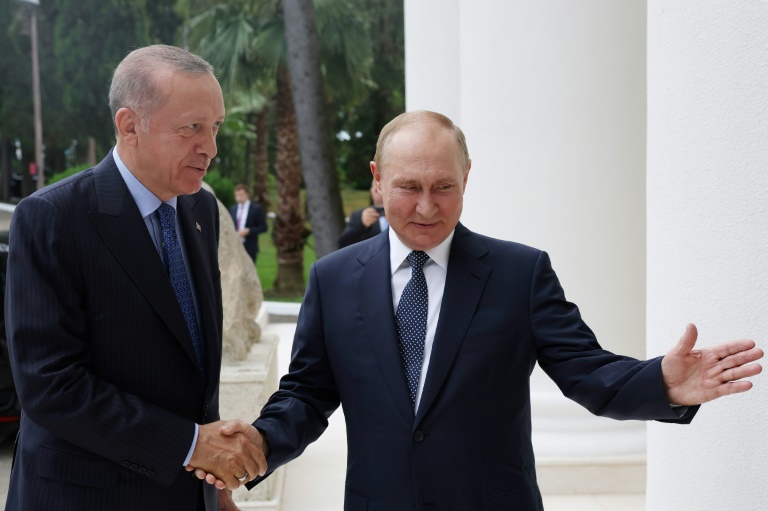
A mysterious reference on US television to an imminent Russia-Ukraine prisoner swap highlights Turkish President Recep Tayyip Erdogan’s unique role as mediator and friend of both sides in time of war.

Erdogan flew to New York from a meeting in Uzbekistan with Russian President Vladimir Putin — his third in three months — to tell US viewers on Monday that the Kremlin “is willing to end this (war) as soon as possible”.

“Two hundred hostages will be exchanged upon agreement between the parties,” Erdogan said in the interview without giving away further details.

Putin’s decision to partially call up reservists and raise the threat of nuclear warfare less than two days later appeared to lay Erdogan’s best intentions to waste.

But an announcement late Wednesday that Russia and Ukraine were exchanging some 200 prisoners helped to validate Erdogan’s efforts to walk a fine line and stay “neutral” in Europe’s bloodiest conflict since World War II.

The prisoner swap adds to a growing list of diplomatic successes Erdogan is using to brandish his image as a global statesman nine months before an election that polls show he might conceivably lose.

“Turkish diplomacy has been faultless since the start of the war,” France’s former US and UN ambassador Gerard Araud remarked.

“It has evaluated its interests, found a balance between the warring parties and used firmness when necessary while taking advantage of the circumstance.”

– Diplomatic offensive –

Erdogan can now take credit for playing a direct role in orchestrating the only two tangible agreements between Moscow and Kyiv in the seven-month war.

A UN-backed deal signed in Istanbul in July resumed Ukrainian grain deliveries across the Black Sea for the first time since Russia’s February 24 invasion.

UN Secretary-General Antonio Guterres called the shipments “a beacon of hope” for famine-ravaged parts of the world.

The prisoner swap features an arrangement to keep five Ukrainian commanders — including those defending the Azovstal steel plant from a Russian onslaught against Mariupol — stowed away in a secret location in Istanbul.

Erdogan is also offering to help mediate in the ominous military standoff around Ukraine’s Russian-occupied Zaporizhzhia nuclear power plant.

And he still hopes to bring Putin and Ukrainian President Volodymyr Zelensky together for truce talks that neither side particularly wants — but which Turkish officials insist are both essential and realistic.

“Of all states, Turkey is best placed to broker a deal between the two sides,” said London-based political risk consultant Anthony Skinner.

– ‘Managing differences’ –

Erdogan has followed a deceivingly simple approach to the war: he has supplied Ukraine with weapons while using Moscow’s diplomatic isolation to his advantage by dramatically cranking up trade with Russia.

Turkish combat drones have gained legendary status in Ukraine because they helped destroy the main Russian armoured columns that tried to seize Kyiv in the first weeks of the war.

And Russian trade and tourists have helped to keep Turkey’s teetering economy from completely collapsing in the run-up to presidential and parliament polls in June.

“Putin and Erdogan have dealt with each other for a long time and have, on balance, been able to manage their differences on a range of issues,” Skinner said.

“Ukraine is no different. Kyiv has been frustrated by the Turkish government’s failure to turn the screws on Moscow, but Ukraine also benefits immensely from Turkey’s ongoing support in the conflict.”

Turkey analyst Soner Cagaptay describes Erdogan’s approach as “pro-Ukrainian neutrality”.

“Erdogan has tried to balance between being pro-Ukraine and avoiding an overtly anti-Russia stance,” Cagaptay wrote in a report for the Washington Institute for Near East Policy.

But there are signs that Erdogan’s policy has its limits.

– ‘Many cards to play’ –

He concluded an August meeting with Putin by unveiling a broad economic cooperation agreement that switched a large part of Turkey’s trade with Russia to rubles.

The United States worries the deal will help Russia skirt sanctions that the West hopes will eventually compel Putin to stop the war.

The US Treasury told Turkish banks and businesses dealing closely with Russia that they were exposing themselves to “secondary sanctions”.

The warning sparked a sharp selloff in the Turkish stock market last week.

Two of the five Turkish bank processing ruble transactions through Russia’s Mir payment systems supended such operations this week.

But Skinner said Erdogan still needs Russian trade.

“Erdogan will not cut trade ties with Russia,” he said. “He has many cards to play.”

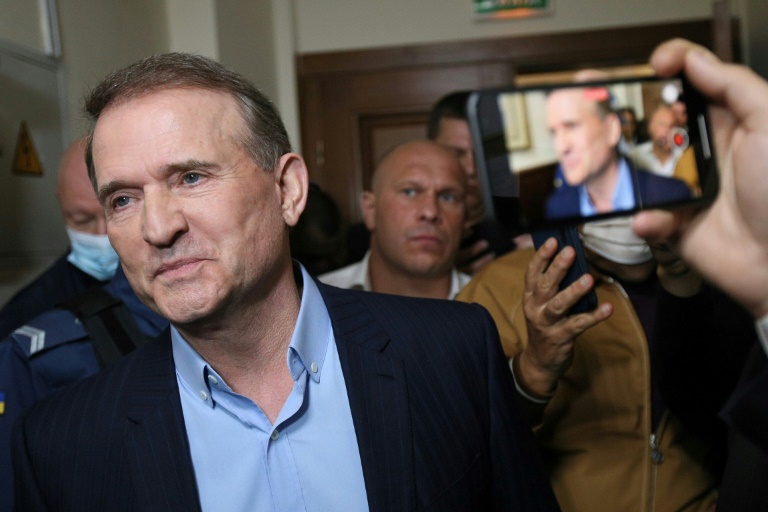
Viktor Medvedchuk: Putin's man in Ukraine exchanged for prisoners

Ukrainian tycoon Viktor Medvedchuk, one of 56 prisoners handed over to Russia on Wednesday in exchange for 215 imprisoned soldiers, was seen as President Vladimir Putin’s top ally in Kyiv and defended the Kremlin’s interests for years.

The swap was the biggest exchange between the warring sides since the start of Russia’s invasion in February.

“In exchange for the life and freedom of our defenders, Ukraine gave Medvedchuk away,” Ukrainian chief prosecutor Andriy Kostin said in a Facebook message on Thursday.

Denis Pushilin, a leader of Moscow-backed separatists in eastern Ukraine, confirmed Medvedchuk’s release to Russia’s state-run news agency RIA Novosti.

Medvedchuk, a 68-year-old former Ukrainian lawmaker, was captured in April by Ukraine’s special services after fleeing home arrest when Russia invaded. 

The super-rich powerbroker, once dubbed the “dark prince” of Ukrainian politics, was accused of high treason and attempting to steal natural resources from Russia-annexed Crimea and of handing Ukrainian military secrets to Moscow.  

“The pre-trial investigation has been completed. Medvedchuk’s testimonies are documented. We do not release anyone but transfer them from a Ukrainian prison to a large prison called Russia,” sOperating from the shadowsaid Kostin.

News of the capture of Medvedchuk — listed by Forbes last year as Ukraine’s 12th richest person and widely reviled for his close links to the Kremlin — sparked celebration among Ukrainians online.

Medvedchuk and the Kremlin denied that he pulled the strings for Moscow in Kyiv but the businessman made no secret of his proximity to Putin. 

The ties between the two men date back to the early 2000s and Medvedchuk said the Russian leader is godfather to his youngest daughter, Darya.

Medvedchuk and Putin were regularly photographed together at lavish events, including the Formula 1 race in Sochi. 

“We have a great relationship. It has been built over many years,” he said in an interview with AFP back in 2019. 

– Operating from the shadows –

The authorities in Kyiv certainly believed that Medvedchuk remained a key Kremlin asset. 

Ukraine’s security chief at the time, Ivan Bakanov, said Russia’s FSB intelligence agency was looking to spirit him out of Ukraine. 

And Ukrainian President Volodymyr Zelensky suggested swapping Medvedchuk for captured Ukrainian soldiers — although the idea was dismissed by Moscow. 

“He is a foreign politician,” Putin’s spokesman Dmitry Peskov said in April.

Medvedchuk, a former lawyer, was long at the centre of Ukraine’s murky nexus between money and politics.

The chief of staff to the country’s second president, Leonid Kuchma, he was accused of playing a key role in attempts to rig a 2004 vote in favour of pro-Russian candidate Viktor Yanukovych. 

That election sparked an uprising known as the Orange Revolution. The uprising foreshadowed the later Maidan revolution, which shifted Ukraine towards the West in 2014 and ousted Yanukovych from power.

Medvedchuk continued to operate from the shadows during the turbulence rocking his homeland, as Moscow responded by seizing the Crimea peninsula and igniting a war in eastern Ukraine.

He was sanctioned by the United States for undermining the government and was involved in peace talks and negotiations for prisoner exchanges as a go-between.

Eventually, he bounced back to the centre of the political stage. 

In the 2019 parliamentary elections, he headed the Moscow-backed Opposition Platform-For Life party, which came second behind Zelensky’s bloc. 

– Putin’s ‘eyes and ears’ –

But Medvedchuk’s fortunes began to deteriorate in February 2021.

Zelensky banned three pro-Russian television channels he was tied to and the authorities then seized his family’s assets, including a pipeline transporting Russian oil to Europe.

In May of that year he was charged with “high treason” over accusations of attempting to steal assets from Russia-annexed Crimea and later also for trying to buy coal from separatist-held regions.

He denied the allegations but was placed under house arrest.

Putin denounced the crackdown against him as a “political” purge and vowed to “respond”. 

“Medvedchuk was Putin’s deputy, his most trusted man, his eyes and ears in Ukraine, who broadcast messages from Moscow” through his media, former lawmaker Sergiy Leshchenko said. 

As fears mounted of a Russian invasion, the US in January accused Medvedchuk of involvement in efforts by Russian intelligence services to prepare friendly Ukrainian politicians to take control of the country with the backing of occupying forces.

A few days after Russian troops rolled across the border, Ukrainian police announced Medvedchuk was missing, after officers failed to find him during a check of his lavish home near Kyiv.  

In the wake of his escape, Ukrainian media discovered on land at his residence a large train carriage decorated with gold and velvet and the Russian coat of arms, apparently a birthday present from his wife, TV presenter Oksana Marchenko, who fled to Russia.

Iran protests pose new test for clerical leadership

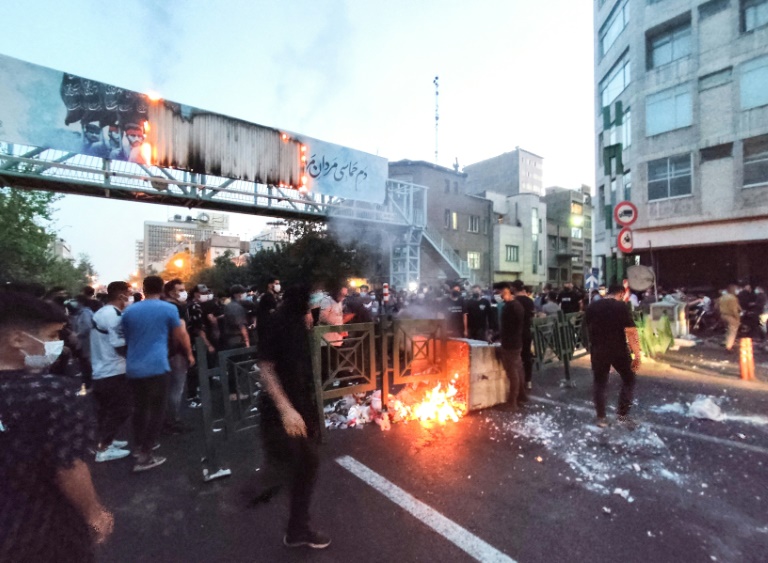
Women setting their headscarves ablaze and chanting anti-regime slogans. Pictures of the leadership defaced and burned. Vehicles belonging to the security forces set on fire. 

The images of the protests in Iran are indicative of the taboo-breaking nature of a movement that erupted after the death of Mahsa Amini, 22, following her arrest by the notorious morality police.

A country where street dissent is tightly controlled, Iran has seen bursts of protest in recent years, notably the 2009 “Green Movement” that followed disputed elections, protests in November 2019 over fuel price rises, and rallies this year over the cost of living.

But analysts say that these protests present a new challenge to the Islamic system under supreme leader Ayatollah Ali Khamenei, 83, as they are now taking place nationwide, have support across social classes and ethnic groups and were instigated by women.

Amini, also known by her Kurdish first name of Jhina, was visiting Tehran with her family last week when she was arrested for purportedly violating Iran’s strict dress code rules for women, in place since shortly after the 1979 Islamic Revolution.

She fell into a coma hours after her arrest and died in hospital on September 16. 

Activists contend she was ill-treated in detention and could have suffered a blow to the head. While this is not confirmed by the authorities, the anger fuelled the protests that started from her funeral last Saturday.

“These are the biggest protests since November 2019,” said Ali Fathollah-Nejad, Iran expert at the Issam Fares Institute for Public Policy and International Affairs at the American University of Beirut.

“While the last two nationwide uprisings were led by the lower classes and were triggered by socio-economic degradation, this time the trigger was socio-cultural and political, comparable to the 2009 Green Movement,” he told AFP.

– ‘Outrage shared’ –

The 2009 movement had been driven by demands by the middle class for fair elections and the 2019 protests by the anger of the lower classes, he said.

“Current conditions in Iran suggest that there may be a tendency toward unifying both groups. The outrage over Amini’s death is shared by both the middle and lower classes,” said Fathollah-Nejad.

The protests also come at a particularly sensitive time for the leadership, when the Iranian economy remains mired in a crisis largely caused by international sanctions over its nuclear programme.

Despite repeated warnings from Europe that time is running out, there is also no indication that the sides are on the verge of agreeing a deal to revive the 2015 Iran nuclear accord (JCPOA) that would see sanctions eased.

The protests have featured chants of “death to the dictator” as well as other anti-regime slogans and the emergence of a new rallying cry, “Zan, zendegi, azadi” (“Woman, life, freedom”).

Unprecedented images have shown protesters defacing or burning images of Khamenei or, on one occasion, setting fire to a giant image of Revolutionary Guards commander Qassem Soleimani, who is presented by the authorities as a near mythical figure after his 2020 killing by the United States in Iraq.

Protesters have also been seen directly resisting security forces, with women refusing to put their headscarves back on in front of the police and vehicles belonging to the security forces torched.

At least 11 people have been killed in the protests and activists fear the authorities will resort to the repression that, according to Amnesty International, saw 321 people killed by the security forces in November 2019.

Saeid Golkar, senior fellow at the Tony Blair Institute for Global Change, described the protests as a “turning point” and predicted that moral policing — “an ideological cornerstone of the Islamic republic” — would be weaker in future.

“This cannot be solved until the regime implements a series of reforms. Since the Islamic republic is both an ideological regime, inefficient and corrupt, it cannot solve its own created problems,” he told AFP.  

“Even if the regime can successfully suppress these protests by brutal force, the situation will be very different from the past.”

– ‘Even higher level of violence’ –

The authorities appear to have resorted to the familiar tactic of restricting access to the Internet in a bid to prevent images being shared, activists say. 

The Netblocks monitor said access to Instagram — the only major social network which is not blocked in Iran — was severely restricted from Wednesday.

The Iranian authorities’ responses “are manifest reflections of the deepening crisis of impunity in the country and the state’s policy of resorting to even higher levels of violence to quell criticisms and protests”, said Saloua Ghazouani from freedom of expression group Article 19.

The protests have extended well beyond the Kurdistan province from where Amimi originated to become a nationwide movement — extending to Tehran, the Caspian provinces in the north, the historic cities of Isfahan and Shiraz and even the tourist hub of Kish island in the Gulf. 

“I think there will be a hardening of the regime and that it will also push them to show no flexibility on the JCPOA,” said a European diplomatic source, asking not to be named.

“These demonstrations are likely to put in question the survival of the regime. In November 2019 they did not hesitate to shoot. I do not see why they would hesitate this year,” added the source.

Close Bitnami banner
Bitnami