World

Russian torture claims haunt recaptured east Ukraine

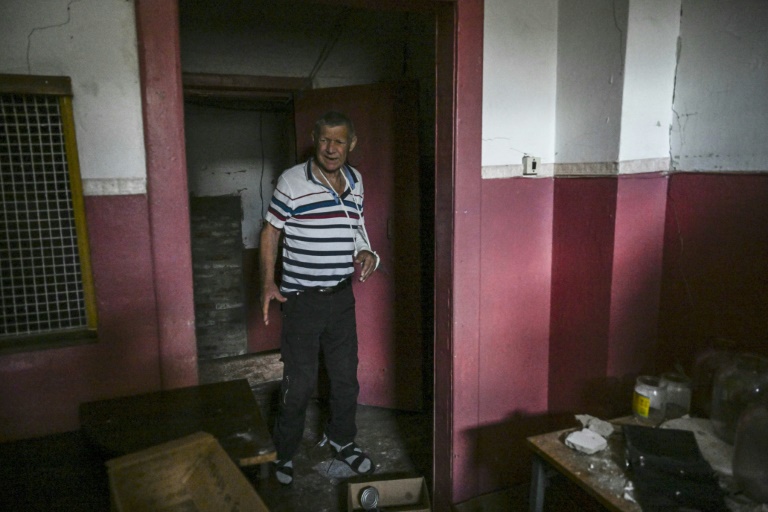
“On the second day, they broke my arm,” said Mykhailo Chindey, recalling his interrogation by Russian soldiers.

“One person was holding my hand and another one was beating my arm with a metal stick. They were beating me up two hours almost every day. 

“I lost consciousness at some point. I lost a lot of blood. They hit my heels, back, legs and kidneys,” he said.

At Izyum’s hospital, Chindey has gingerly started walking again.

His injured arm is encased in plaster, a painful reminder of Russia’s occupation of the eastern Ukrainian city.

The Russians arrested Chindey after Kyiv’s forces bombed a school near his home, killing and injuring “many” occupying troops, he said.

He was suspected of having supplied the coordinates for the strikes to Ukrainian soldiers. His interrogators insisted he reveal any communications he had had with them.

“They put a bag on my head and brought me somewhere,” the 67-year-old told AFP. “When I could see again I recognised the place: it was the police station in Izyum. 

– Torture chambers –

Chindey’s experience is just one of several stories of torture and arbitrary detention by Russian troops to have emerged from eastern Ukrainian recently.

Kyiv’s forces captured a string of towns and cities in their counter-offensive this month, including Izyum, Balakliya and Kupiansk.

Ukraine’s national police chief on Friday said more than 10 “torture chambers” had been found in the formerly Russian-controlled parts of the northeastern Kharkiv region.

Ukrainian officials also said they found mass graves after Russian troops retreated from Izyum.

President Volodymyr Zelensky denounced the Kremlin’s forces as “murderers” and “torturers”.

Chindey showed AFP the tiny, humid cell where he said he was held for 12 days with up to seven other prisoners before the arrival of Ukrainian troops.

Stuck to the cell wall in the bomb-damaged police station’s basement was a rag from his jacket that he used as a bandage.

Other detainees were kept in a dozen cells spread out over two levels in the basement, he said.

Chindey remembered seeing around 15 people — and none of them had left there without being beaten.

“I could hear the other people interrogated, screaming 24/7,” he said.

One man had died there, he added.

On the ground floor, a young officer has arrived from Ukraine’s second city, Kharkiv, to investigate potential war crimes.

The office where he starts to write his report reflects chaos. Folders are strewn on the floor, alongside broken chairs and upturned items of furniture. 

In one room, more than 100 Ukrainian passports lie on the ground, on an old sofa and a desk.

“We have much work to do,” admitted the man, who refused to give his name.

The investigators would have to check everything, even the digital fingerprints, to compare them with those found in the Kyiv suburb of Bucha and other places where potential war crimes were committed.

Alleged cases of torture would be reviewed by the investigators who arrived in Izyum on Sunday, and they were due to stay there for four to five days, he added.

– ‘Bodies floating in the river’ –

A short distance from Izyum lies Kupiansk, where a panicked Marina Mikhailychenko is trying to flee the non-stop bombing around the battered city still being fought over by both sides.

The 32-year-old said she was arrested and held for one week during the Russian occupation of Kupiansk because her brother serves in the Ukrainian army. Eight other people were crammed into her cell.

A volunteer in Kupiansk nicknamed “Bronik” told AFP the police detained and tortured anyone who had fought in the Ukrainian army since 2014 or who harboured pro-Kyiv sentiments.

“I don’t know if people died of torture,” he said.

“But there were people that were physically injured. Local residents saw bodies floating in the river.”

In Balakliya, Viktor Priliepov said the Russians held him in a police station cell for three days, forcing a bag over his head.

Priliepov, 68, was questioned about his son in the Ukrainian army but thinks he avoided rough treatment due to his “health problems”.

But others, he said, were not so fortunate.
Rattled Taiwan hit by more aftershocks

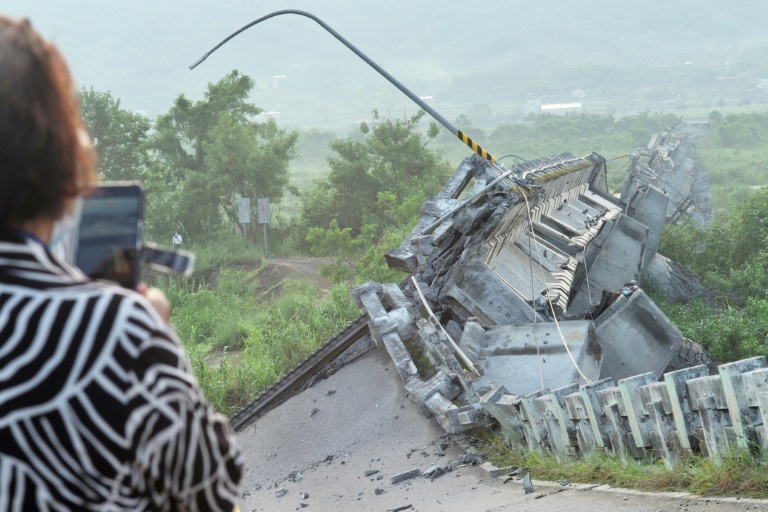
Aftershocks struck southeastern Taiwan on Monday, including a 5.5-magnitude earthquake that was felt in the capital Taipei, a day after a more powerful tremor killed one person and injured around 150 others.

The latest quake hit around 10 am (0200 GMT), 66 kilometres (41 miles) south-southwest of the coastal city of Hualien at a depth of 13 kilometres, the United States Geological Survey (USGS) said.

Taiwan’s central weather bureau put the magnitude at 5.9.

Rural and sparsely populated southeastern Taiwan has been rattled by a series of jolts since Saturday.

The most powerful, a 6.9-magnitude quake, struck on Sunday afternoon, tearing up roads and bringing down a handful of houses in the town of Yuli where at least one person was killed.

Four others were rescued from a collapsed building, while authorities said a total of 146 suffered injuries. 

Taiwan is regularly hit by quakes and most cause minimal damage but the island also has a long history of deadly disasters. 

Hualien, a tourist hotspot, was struck by a 6.4-magnitude earthquake in 2018 that killed 17 people and injured nearly 300. 

In September 1999, a 7.6-magnitude quake killed around 2,400 people in the deadliest natural disaster in the island’s history.

Royal funerals: pomp, pageantry and sometimes privacy

Funerals for senior royals since World War II have tended to be very public affairs, with pomp, pageantry and popular fervour.

Queen Elizabeth II’s on Monday will be no exception.

– 1952: King George VI –

On February 6, 1952, King George VI died suddenly after a long illness at the age of 56.

At his funeral on February 15, his coffin was carried to Paddington station in west London on a gun carriage from Westminster Hall at the Palace of Westminster, where he lay in state, to St George’s Chapel, Windsor Castle. 

A silent crowd lined the route along London’s foggy streets during the three-hour procession. His eldest daughter, who at the age of 25 had become Queen Elizabeth II, followed in a horse-drawn coach.

A year later on March 24, George’s mother, the dowager Queen Mary, died aged 85. Over two days, 120,000 people paid homage at Westminster.

– 1979: Lord Mountbatten –

On August 27, 1979, Louis Mountbatten, the queen’s cousin and last viceroy of India, was killed at the age of 79, by an Irish Republican Army bomb placed on his boat.

The assassination rocked the United Kingdom. Mountbatten was a decorated naval commander, uncle of Queen Elizabeth II’s husband, Prince Philip, and mentor of the couple’s eldest son and heir, Prince Charles.

On September 5, hundreds of thousands of people gathered in London along with representatives of the British armed forces, US Marines, and French, Canadian, Indian and Burmese soldiers to pay him a solemn farewell.

An escort of six tanks took the coffin from Westminster Abbey to Waterloo station where it was transported to Romsey, near Southampton, southern England, for burial at the town’s abbey.

– 1997: Princess Diana –

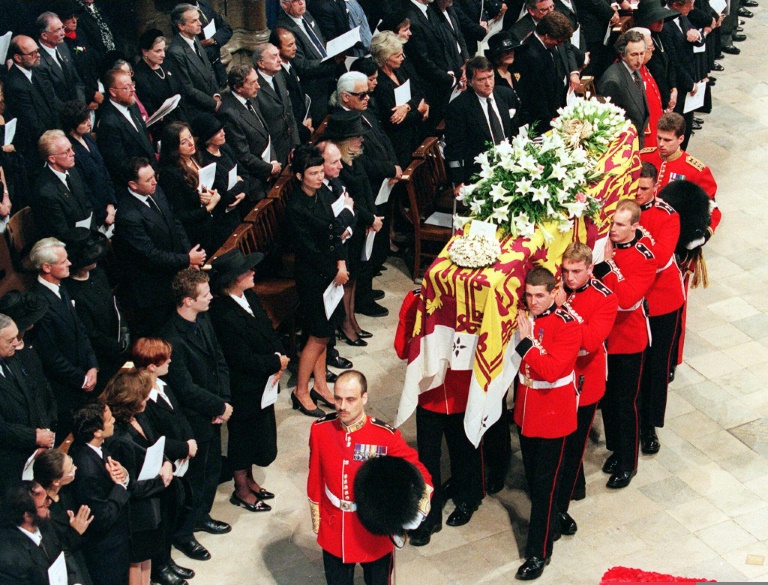
On September 6, 1997, the country came to a standstill for the funeral of Diana, Princess of Wales, who died in Paris on August 31 in a car crash aged 36.

Her death sent shockwaves around the world. Millions of people lined the streets and an estimated 2.5 billion viewers watched the service on television.

When the procession passed Buckingham Palace, Queen Elizabeth II, who had been criticised for her stand-offish initial reaction to the death of the former wife of Prince Charles, publicly bowed her head.

The couple’s two young sons, princes William and Harry, walked, heads bowed, behind their mother’s coffin. Diana was buried at Althorp, her family’s historic home in Northamptonshire, on an island in the middle of a lake.

– 2002: Princess Margaret –

Led by Queen Elizabeth II’s frail 101-year-old mother, also called Elizabeth, the royal family on February 15, 2002, laid to rest the monarch’s younger sister Princess Margaret, who had died six days earlier aged 71 after a series of strokes.

The private funeral was attended by about 450 family and friends, including 30 or so members of the royal family such as the queen, Margaret’s ex-husband Lord Snowdon, and her two children Viscount Linley and Lady Sarah Chatto.

Despite concerns over her own health, the Queen Mother attended the service at St George’s Chapel in Windsor Castle. 

It was exactly 50 years since she had buried her husband, King George VI. In a break with royal tradition, Margaret was cremated.

– 2002: The Queen Mother –

Just seven weeks after Margaret, the Queen Mother, Queen Elizabeth, died in her sleep on March 30 at Windsor. Her funeral on April 9 marked the end of an era. 

The royal matriarch was the last empress consort of India and a link to a bygone age. She was much loved as a symbol of resistance to the Nazi enemy during World War II.

Over four days, more than 200,000 people filed past her coffin paying their respects. Her funeral at Westminster Abbey was attended by 2,000 people.

More than a million people lined the 37-kilometre (23-mile) route taken by the funeral procession to Windsor, where she was interred with her husband at the King George VI memorial chapel, and alongside Margaret’s ashes.

– 2021: Prince Philip, Duke of Edinburgh –

Queen Elizabeth II’s husband of 73 years died on April 9, 2021, just a few months shy of his 100th birthday and after a lengthy stay in hospital for a heart condition.

Coronavirus restrictions limited his funeral on April 18 to just 30 people, with social distancing, face masks — and no public crowds.

The duke’s coffin was borne to St George’s Chapel on a specially adapted Land Rover he had designed himself.

His remains were interred in the Royal Vault at Windsor, with instructions to be transferred on his wife’s death to the King George VI memorial chapel.

Asian markets extend losses as traders brace for Fed hike

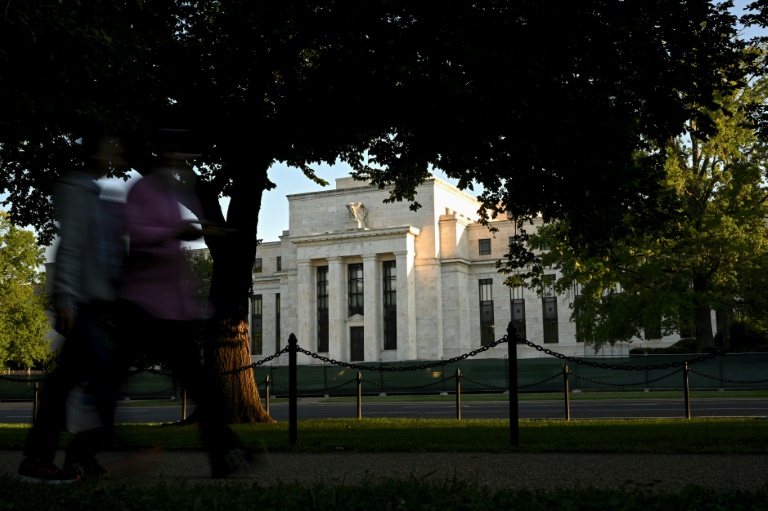
Asian markets fell Monday as traders extended last week’s rout across risk assets, with expectations high that the Federal Reserve will this week announce another outsized interest rate hike.

With recent data showing US inflation rooted at four-decade highs, investors are increasingly pessimistic about the outlook for the global economy.

Many observers have warned of a sharp recession in many countries caused by the huge rate increases, which are hitting families in the pocket.

And with uncertainty rife owing to a range of issues, including Russia’s war in Ukraine and China’s lockdown-induced slowdown, equities are in danger of revisiting the lows they hit in June.

Several central banks are due to make rate announcements this week, with Japan and Britain among the biggest, though the main event is Wednesday’s Fed decision.

There had been a hope that after two 75 basis point increases in a row, and economic data showing weakness, officials would take their foot off the pedal this month.

But last Tuesday’s disappointing consumer price figures shocked traders and ramped up bets for a third successive 75-point rise, while some have predicted a whole percentage point move.

Policymakers, including Fed boss Jerome Powell, have said time and again their ultimate aim is to bring inflation under control, even if that means sending the economy into recession.

“It is clear that the Fed will project hawkish messaging, once again reiterating that it will bring down inflation unconditionally,” said Vasileios Gkionakis at Citigroup.

Wall Street’s worst week since June ended with more losses after FedEx reported Thursday that it shipped fewer packages than expected over the summer owing to weakness in the global economy.

That came as CEO Raj Subramaniam said he expects a global recession.

Asian equity investors continued the selling on Monday.

Hong Kong lost more than one percent, even after reports of the city’s government considering ending hotel quarantine rules.

Shanghai was also down despite news that megacity Chengdu was ending a two-week Covid lockdown that saw 21 million people shut away.

Sydney, Seoul, Singapore, Taipei, Manila and Wellington were also in the red. Tokyo was closed for a holiday.

The prospect of more big Fed rate hikes is also keeping the dollar at multi-decade highs against its major peers, with the yen feeling most of the pressure as the Bank of Japan refuses to tighten policy.

“Speculative selling of the yen is readily justified by the ongoing widening in US-Japan yield differentials,” said Ray Attrill, of National Australia Bank.

“Until or unless something happens to arrest or reverse this spread widening, the yen is susceptible to additional selling pressure.”

The Japanese unit last week hit a fresh 24-year low of 144.99 to the dollar, though it has bounced slightly after comments from BoJ officials that signalled they were ready to intervene to provide support.

Oil prices rose on the news out of Chengdu, which lifted demand hopes, though the gains were capped by the growing fear of recession around the world.

– Key figures at around 0230 GMT –

Hong Kong – Hang Seng Index: DOWN 1.1 percent at 18,559.45

Shanghai – Composite: DOWN 0.2 percent at 3,119.55

Tokyo – Nikkei 225: Closed for holiday

Pound/dollar: DOWN at $1.1400 from $1.1423 on Friday

Euro/pound: UP at 87.70 pence from 87.00 pence 

Euro/dollar: DOWN at $1.0000 from $1.0018

Dollar/yen: UP at 143.13 yen from 142.91 yen

West Texas Intermediate: UP 0.8 percent at $85.79 per barrel

Brent North Sea crude: UP 0.9 percent at $92.17 per barrel

New York – Dow: DOWN 0.5 percent at 30,822.42 (close)

London – FTSE 100: DOWN 0.6 at 7,236.68 (close)

Five things to know about the queen's coffin procession

The ceremonial processions taking Queen Elizabeth II’s coffin to London’s Westminster Abbey and then towards her burial place at Windsor reflect the ancient traditions of the British monarchy.

– Hauled by the Royal Navy –

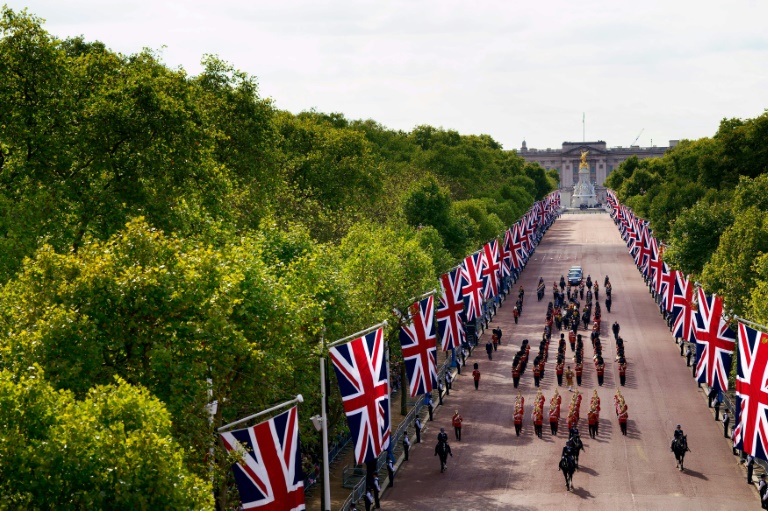
Royal Navy sailors will use ropes to pull the queen’s lead-lined coffin mounted on a gun carriage from Westminster Hall to Westminster Abbey. Their comrades in a team of 142 sailors will walk alongside to act as a brake if necessary.

This tradition dates back to Queen Victoria’s funeral in February 1901.

The horses meant to haul the gun carriage weighing more than two tons panicked and began kicking, threatening to drop the coffin.

One of the queen’s relatives, Prince Louis of Battenberg, a Royal Navy captain, suggested to the new king, Edward VII, that this problem could be avoided by replacing horses with sailors.  

Nine years later when Edward VII himself died, this idea was put into practice again and it has since become an unchanging tradition at state funerals.

– Pallbearers in bearskins –

Eight soldiers from the 1st Battalion Grenadier Guards will have the task of carrying the queen’s coffin from Westminster Hall to the gun carriage outside, and then into Westminster Abbey.

One of the most ancient in the British army, the regiment is among five infantry regiments that make up the Queen’s (now King’s) Life Guard.

The regiment’s soldiers normally wear tall bearskin hats, a uniform they copied from the grenadiers of Napoleon’s Imperial Guard, defeated at Waterloo in 1815.

The soldiers will be accompanied by Service Equerries to the Queen, attendants who assist the royals in carrying out public duties.

– Guard of Honour –

Three regiments will play a particularly important role in the procession, marching very close to the queen’s coffin.

The Yeomen of the Guard, the oldest military unit in the British Army created in 1485, and the Honourable Corps of Gentlemen at Arms are two former bodyguard units for the royals that now perform only a ceremonial role.

The Yeomen of the Guard always wear a red-and-gold uniform dating back to the Tudor era (16th century). 

One of their best-known activities is searching the Palace of Westminster for gunpowder before the State Opening of Parliament.

This annual ritual commemorates the Gunpowder Plot, a failed attempt led by Guy Fawkes to blow up King James I and parliament in 1605. 

They will be followed by members of the Royal Company of Archers, who acted as bodyguards for Elizabeth II whenever she was in Scotland.

Some detachments from other regiments in Britain and from the armed forces of the Commonwealth, a group of countries headed by the British monarch, will rejoin the funeral procession from Westminster Abbey to Wellington Arch at Hyde Park Corner near Buckingham Palace. 

– Elizabeth II’s royal house –

While members of the royal family led by the new King Charles III will follow the casket, following them will be members of the queen’s royal household, including the most senior officer of the royal household, the lord chamberlain.

In front of them will come the pipers and drummers of the Scottish and Irish regiments, and the Brigade of Gurkhas made up of soldiers from Nepal who are part of the armed forces. There will also be 200 Royal Air Force musicians.

– 6,000 troops –

Around 6,000 soldiers, sailors and air crew from the British armed forces will take part in the procession, Chief of the Defence Staff Admiral Tony Radakin told the BBC on Sunday.

At several points along the route they will perform a royal salute, for example when they pass the Victoria Memorial commemorating the queen.

“For all of us, this is our last duty for Her Majesty the Queen and it’s our first prominent duty for His Majesty King Charles,” he said.

King George VI Memorial Chapel: the queen's last resting place

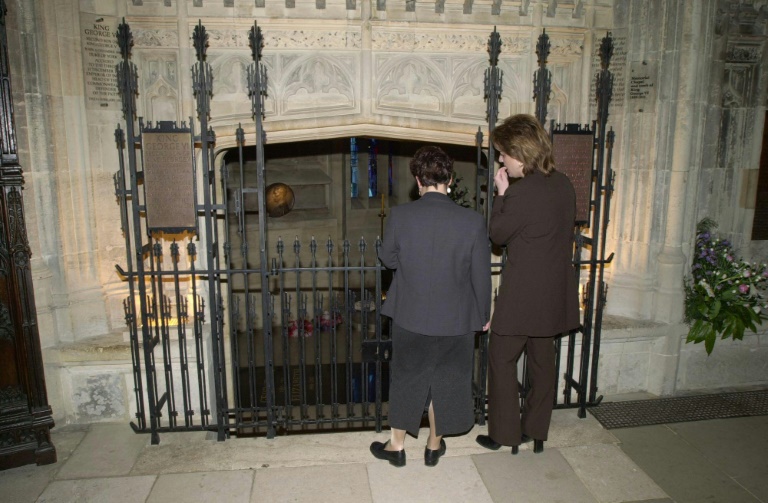
Queen Elizabeth II will be laid to rest in the King George VI Memorial Chapel at Windsor Castle’s St George’s Chapel, alongside her mother, father, sister and husband.

The queen, however, will not be joining the host of other royals who are interred in the Royal Vault beneath the chapel.

– Royal commission –

Construction of the memorial chapel, designed by George Pace, was completed in 1969.

It was commissioned by Elizabeth as a permanent resting place for her father King George VI.

The king died aged 56 in February 1952 but his death had been unexpected and as a result no specific resting place had been allocated.

At the time, the king’s remains were interred in the Royal Vault.

– Tight for space –

The Royal Vault is the final resting place of a long list of mostly 18th- and 19th-century royals, including George III who died in 1820.

With no more space to accommodate a second vault at St George’s, it was decided to construct another chantry chapel.

The resulting chapel was the first addition to St George’s since it was consecrated in the 15th century.

– Simple memorial –

The queen rejected the idea of the traditional marble chest tomb with life-sized effigies favoured by earlier royals for her father.

Instead, the king’s grave was marked with a simple stone of black Belgian marble inlaid into the floor with the inscription “George VI”.

The dedication took place on March 31, 1969, in a ceremony attended by George’s widow Queen Elizabeth the Queen Mother, the queen, Prince Philip, Elizabeth’s sister Princess Margaret and all four of the monarch’s children.

– Reunited in death –

Before his premature death, George VI enjoyed a happy family life with his wife and two daughters, referring to the tight-knit foursome as “us four”.

The death of the queen means that all four will finally be laid to rest together.

The queen mother, also called Elizabeth, was buried in the chapel on April 9, 2002, after her death aged 101.

Margaret’s ashes were moved to the chapel from the Royal Vault, where they had been placed initially following her death earlier in 2002.

Philip, who died in April 2021, left instructions for his remains to be transferred from the Royal Vault to the memorial chapel on his wife’s death.

Biden hedges on seeking reelection

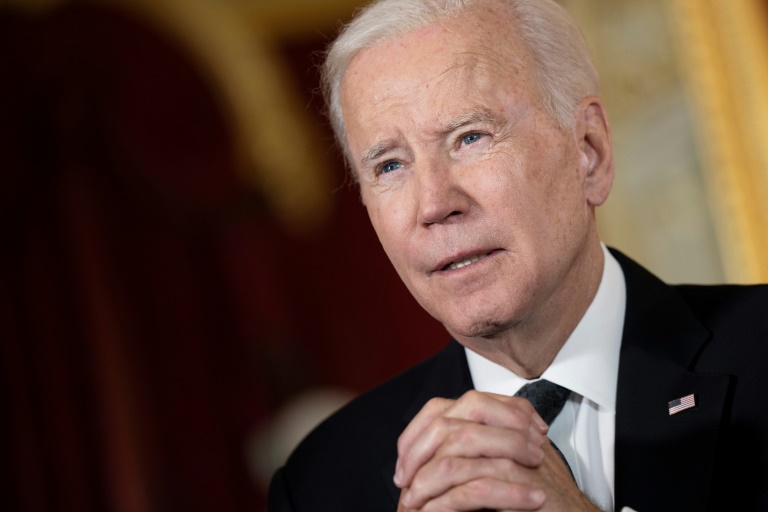
President Joe Biden issued forceful warnings to China and Russia on Sunday and expressed optimism over the US economic rebound, but surprised many by hedging on whether he’ll seek reelection.

In a rare, wide-ranging interview with the CBS “60 Minutes” program, Biden went back on repeated assertions by the White House that he is sure to run in 2024.

Biden, who turns 80 in November, told interviewer Scott Pelley that reelection is his “intention.”

“But is it a firm decision that I run again? That remains to be seen,” he said.

“It’s much too early,” Biden said, calling himself “a great respecter of fate.”

Surveying the state of the world’s largest economy, Biden was optimistic.

He declared the Covid pandemic in the United States “over” and predicted that his administration would tame inflation — the main reason for his weak approval ratings and the reason Republicans believe they can take control of Congress in the upcoming November midterms.

“We’re going to get control of inflation,” he said.

– Troops to Taiwan? –

In another surprise moment, Biden once again appeared to challenge decades of US policy on Taiwan with a vow that he would send troops to defend the self-ruling island if China tried to invade.

“Yes,” he said, adding that this would happen if it were “an unprecedented attack” — possibly referring to something beyond the frequent saber rattling conducted by Chinese military forces around Taiwan.

Under US policy known as “strategic ambiguity,” Washington recognizes Chinese sovereignty but opposes any forceful attempt to end Taiwan’s de facto self-rule. While Washington does arm Taiwan, there is no clear promise of direct US military support.

The White House said that Biden’s latest remarks do not indicate a change.

In another tough message to the United States’ biggest economic and geopolitical rival, Biden said he had warned President Xi Jinping not to support Russia militarily in its invasion of Ukraine.

He said he told Xi that US and other foreign investment in China would be disrupted and to think otherwise would be “a gigantic mistake.”

He also said that if Russian President Vladimir Putin uses nuclear or other non-conventional weapons against Ukraine the US response will be “consequential.”

When asked what he would tell Putin if the Russian leader was mulling such a move, he said: “Don’t. Don’t. Don’t.”

Biden praised the Ukrainians for their gritty fight against the huge Russian invasion force and said “they’re defeating Russia.”

Asked how to define victory for Kyiv, he said “winning the war in Ukraine is to get Russia out of Ukraine completely.”

But given the scale of human suffering and destruction inflicted in resisting the Russian onslaught, “it’s awful hard to count that as winning,” he added.

– ‘More to give’ –

Despite his poor ratings and polls showing Democrats likely to lose control of at least one chamber of Congress, Biden said he is upbeat. 

Noting that employment is booming and the economy is strong, Biden said “we hope we can have, as they say, a soft landing.”

On questions whether at his age he is physically and mentally able to continue in the grueling job, Biden said: “watch me.”

“It’s a matter of, you know, that old expression — ‘the proof of the pudding is in the eating.'”

When asked his source of inspiration when times get tough, Biden mentioned his son Beau who died in 2015 but also his parents’ exhortation to “just get up.”

Biden said he had “a lot more to give.”

Westminster Abbey: a millennium entwined with royalty

Westminster Abbey, the setting for Queen Elizabeth II’s funeral, has been paramount for Britain’s royal family for nearly a millennium.

In the 1040s, King Edward the Confessor built a stone church on the site of a Benedictine monastery founded around 960, in a major enlargement.

Construction began on the imposing Gothic abbey of today under the orders of King Henry III in 1245.

It was designed as a place for the coronation and burial of monarchs.

– Coronations –

William I was the first king crowned in the abbey in 1066 — a tradition which has endured throughout the centuries.

In 1953, Elizabeth II was crowned on the Coronation Chair, as her eldest son Charles will be.

The chair was made in 1300-1301. It enclosed the Stone of Scone, which was used for centuries to crown the kings of Scotland.

The stone was temporarily stolen in an audacious raid by Scottish students in 1950, who accidentally broke it in two.

In 1996, with nationalist sentiment rising, it was symbolically returned to Scotland but will come back from Edinburgh Castle to Westminster for coronations.

The abbey has hosted 38 coronation ceremonies for reigning monarchs.

– Weddings –

The church has also been the scene of royal weddings — most of them since World War I. The first was when King Henry I married princess Matilda of Scotland on November 11, 1100.

Queen Elizabeth’s parents, prince Albert — later King George VI — and Elizabeth Bowes-Lyon, wed in the church in 1923.

And Queen Elizabeth married Philip Mountbatten in the abbey in 1947, bringing some royal colour to the post-World War II recovery years.

Queen Elizabeth’s sister, Princess Margaret, and her children Princess Anne and Prince Andrew all got married in the abbey.

The last royal wedding was that of Charles’s eldest son Prince William, who wed his university sweetheart Kate Middleton in 2011.

Only 14 years earlier in 1997, William attended his mother Diana’s funeral in the abbey following her death in a Paris car crash.

– Famous burials –

The abbey is the final resting place of 30 kings and queens, starting with Edward the Confessor. King George II was the last, in 1760.

Around 3,330 people are buried at the abbey, including some of the great figures of British history.

They include Charles Dickens, Geoffrey Chaucer, Samuel Johnson, Rudyard Kipling, Alfred Tennyson, Henry Purcell, William Wilberforce, Laurence Olivier, Thomas Hardy and eight prime ministers.

The ashes of astrophysics giant Stephen Hawking were interred in 2018 between the graves of Isaac Newton and Charles Darwin.

Other notable personalities have memorials in the abbey, including Jane Austen, Benjamin Britten, Noel Coward, Francis Drake, Edward Elgar, Martin Luther King Jr and Oscar Wilde.

There is a memorial stone to wartime prime minister Winston Churchill inside the west entrance.

It sits near the Tomb of the Unknown Warrior, whose body was brought from continental Europe after World War I. The grave represents all Britain’s fallen troops.

Queen Elizabeth and her mother before her left their wedding bouquets on the tomb.

– Royal peculiar –

The abbey — or to give it its full name, the Collegiate Church of St Peter, Westminster — is a “royal peculiar” which means it is exempt from any ecclesiastical jurisdiction other than that of the monarch.

The British sovereign is the supreme governor of the Church of England.

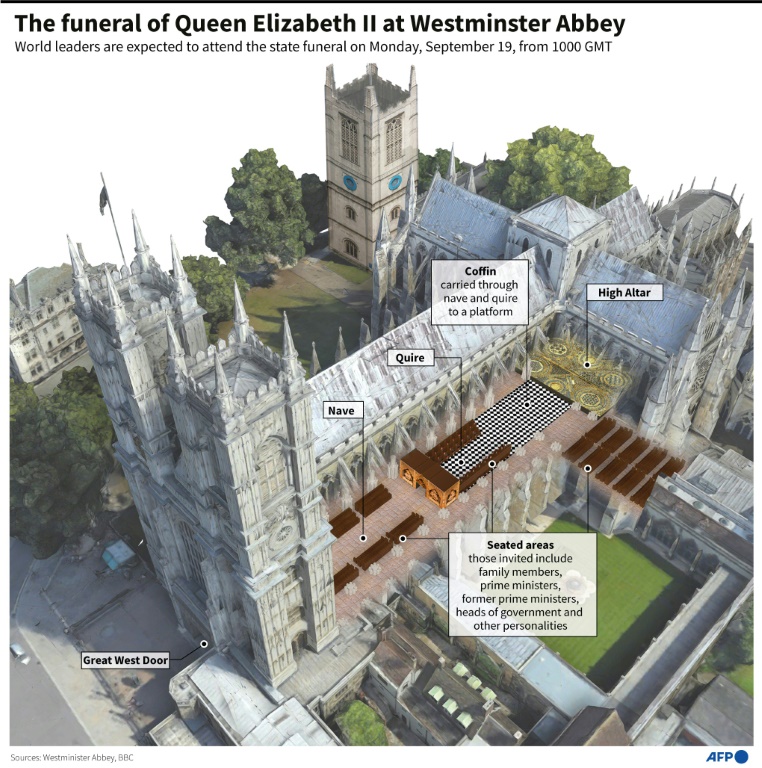
The abbey can regularly seat around 2,200 people, though most will not be able to see Queen Elizabeth’s funeral service due to the screen separating the nave from the choir.

The royal family will sit closest to the coffin.

Around 8,250 squeezed in for Queen Elizabeth’s coronation, in specially erected tiers.

The central London church played a major role in Queen Elizabeth’s life: besides her wedding, it staged her mother’s funeral and celebrations of major landmarks in her record-breaking reign.

At services in the church, Queen Elizabeth and Prince Philip nearly always sat in specially made birch chairs presented by the Canada Club in memory of Canadians who fell in World War II.

The monarch has left her mark on the abbey.

Queen Elizabeth’s record reign is celebrated in a stained-glass window unveiled in September 2018. Designed by David Hockney, it represents the Yorkshire countryside in the spring.

The sovereign opened The Queen’s Diamond Jubilee Galleries in June 2018. About 16 metres (52 feet) above the abbey floor, they display treasures and tell the story of the church’s history.

The abbey is still a working church and holds regular services open to the public.

Timeline of Queen Elizabeth II's death

Here is a timeline of Queen Elizabeth II’s death, including her final days and the aftermath of her passing aged 96, after more than 70 years on the throne.

– September 6 –

The queen receives Boris Johnson at her Balmoral private retreat in the Scottish Highlands, to accept his resignation as prime minister.

Shortly afterwards, she asks Liz Truss, the new leader of Britain’s governing Conservative Party, to form a government as prime minister.

– September 7 –

Her final public statement, as queen of Canada, is a message of condolence for victims of a fatal stabbing rampage in Saskatchewan.

The queen pulls out of an online meeting of the Privy Council formal body of advisers.

“After a full day yesterday, Her Majesty has this afternoon accepted doctors’ advice to rest,” Buckingham Palace says.

– September 8 –

Prince Charles flies to Balmoral, arriving at 10:30 am (0930 GMT).

Buckingham Palace issues a statement at 12:30 pm saying that doctors were concerned for her health and recommended she remain under medical supervision.

“The queen remains comfortable and at Balmoral,” it says.

Truss is informed of her death at 4:30 pm.

Her death is announced publicly at 6:30 pm.

“The Queen died peacefully at Balmoral this afternoon,” the statement says.

Her daughter Princess Anne was with her during her last 24 hours.

Upon her death, her eldest son immediately becomes King Charles III.

– September 9 –

King Charles and his wife Camilla, the Queen Consort, travel from Balmoral to Buckingham Palace in London where they greet mourners outside the gates.

The king meets Truss then pays tribute to his mother in a televised broadcast.

He renews her promise of lifelong service and pledges to uphold Britain’s constitutional principles.

He makes his eldest son Prince William the Prince of Wales.

A prayer service at London’s St Paul’s Cathedral is attended by senior politicians. The ceremony sees the first official singing of “God Save The King” since 1952.

– September 10 –

King Charles is formally proclaimed as the new monarch in a ceremony in London.

Twenty-one gun salutes are fired around the country.

In a rare show of unity, the king’s warring sons, Princes William and Harry, and their respective wives Catherine and Meghan, view the floral tributes outside Windsor Castle.

– September 11 –

Queen Elizabeth’s coffin is driven from Balmoral to the Palace of Holyroodhouse in Edinburgh, the monarch’s official residence in Scotland. Anne accompanies the cortege.

– September 12 –

King Charles addresses both houses of parliament in Westminster Hall in London.

The king and queen consort fly to Edinburgh.

A procession takes Queen Elizabeth’s coffin to St Giles’ Cathedral. Her four children march behind the hearse.

Members of the royal family attend a service celebrating her life.

Charles addresses the Scottish Parliament.

The first of 33,000 mourners file past the coffin in the cathedral. For around 10 minutes, Queen Elizabeth’s children mount the guard around her casket.

– September 13 –

The king and queen consort fly to Belfast.

The king meets Northern Irish lawmakers and delivers a speech. He shakes hands with Irish President Michael D. Higgins at a service at St Anne’s Cathedral — the first foreign head of state to meet the new king.

Charles returns to London.

Queen Elizabeth’s coffin, accompanied by Anne, is flown from Edinburgh to London on a military transport plane. It is then driven to Buckingham Palace.

– September 14 –

In a procession from Buckingham Palace, the coffin is taken on a gun carriage to lie in state at Westminster Hall.

The first in a continuous stream of people lasting until September 19 file past the coffin to pay their last respects.

– September 15 –

The first details from the funeral plans are laid out by the Earl Marshal, Edward Fitzalan-Howard, Duke of Norfolk.

Following the September 19 funeral, Queen Elizabeth will be buried alongside her husband Prince Philip, her parents and her sister’s ashes at St George’s Chapel in Windsor Castle.

– September 16 –

King Charles is greeted by large crowds in Cardiff. The former prince of Wales makes a speech at the devolved Welsh Assembly in English and in Welsh.

In London, the new Supreme Governor of the Church of England, who assumes the title Defender of the Faith, tells religious leaders he sees it as his sovereign “duty” to protect other faiths too.

Charles and his siblings stand guard around the coffin in a solemn tradition known as the Vigil of the Princes.

– September 17 –

Queen Elizabeth’s eight grandchildren, aged from 44 to 14 and led by William and Harry in their military uniforms, mount a vigil around the coffin.

Charles and William make an unscheduled visit to greet people waiting in the queue.

Charles meets his prime ministers from Canada, Australia, New Zealand, Jamaica and The Bahamas.

– September 18 –

US President Joe Biden pays his respects at the coffin, and hails Queen Elizabeth’s notion of service.

Charles holds a reception for visiting royalty and heads of state at Buckingham Palace on the eve of the funeral.

A national silence is held at 8:00 pm to remember Queen Elizabeth.

Britain and the world say farewell to Queen Elizabeth II

Queen Elizabeth II is laid to rest on Monday, after a grand state funeral attended by leaders from around the world, and a historic last ceremonial journey through the packed streets of London. 

The longest-serving monarch in British history died aged 96 at Balmoral, her Scottish Highland retreat, on September 8 after a year of declining health.

The last state funeral to be held in Britain was in 1965 for the country’s wartime prime minister Winston Churchill. 

Then, the cranes that once unloaded the spoils of Britain’s vast empire that Elizabeth inherited were lowered in respect as his coffin was borne up the River Thames by barge. 

In the six decades since, Britain’s global reach has been much diminished and its place in the modern world has become less certain.

But the country will still dig deep into its centuries of tradition to honour the only monarch that most Britons have ever known.

Many ordinary people have camped out for days to witness the elaborate spectacle of pageantry and to pay their final respects.

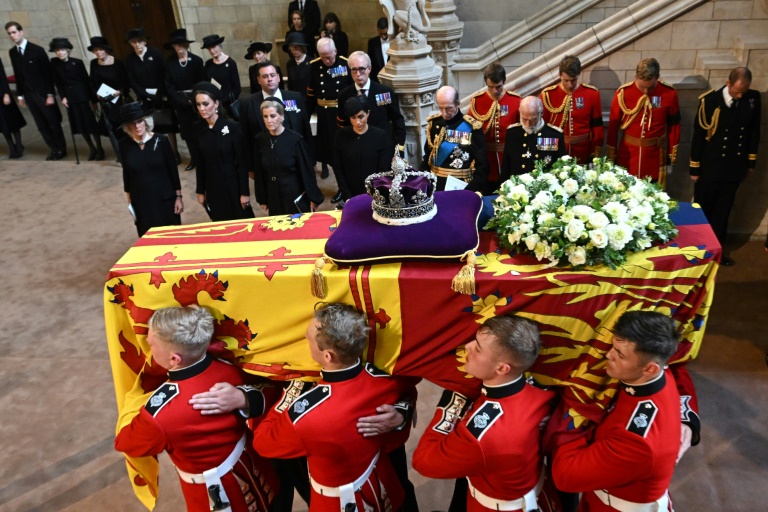
After the funeral, the flag-draped coffin of the queen, topped with the majestic Imperial State Crown, will be taken west to Windsor Castle. 

She will be buried alongside her father king George VI, her mother queen Elizabeth the queen mother, and sister princess Margaret, reuniting in death the family who once called themselves “us four”. 

The coffin of her husband, Prince Philip, who died last year aged 99, will also be transferred to lie alongside her.  

– Dignitaries –

Elizabeth’s funeral could not be more different from Philip’s at St George’s Chapel, Windsor, in April last year. 

Coronavirus restrictions limited mourners to just 30, led by the queen, a solitary figure in mourning black and a matching facemask. 

On Monday, more than 2,000 people, including heads of state from US President Joe Biden to Japan’s reclusive Emperor Naruhito, will pack Westminster Abbey, the imposing location for royal coronations, marriages and funerals for more than 1,000 years.

The queen’s eldest son and successor, King Charles III, 73, will lead mourners, alongside his three siblings and his heir, Prince William.

Late Sunday, Charles said he and his wife, Queen Consort Camilla, had been “deeply touched” by the messages of condolence and support.

“As we all prepare to say our last farewell, I wanted simply to take this opportunity to say thank you,” he added.

The queen’s death has brought two of its most controversial members — the queen’s second son Prince Andrew and Charles’s younger son Prince Harry — temporarily back into the royal fold.

In the abbey pews will also be Liz Truss, whom the queen appointed as the 15th British prime minister of her reign just two days before her death.

All of Truss’s living predecessors will be there too, plus her counterparts and representatives from the 14 Commonwealth countries outside Britain where Charles is also head of state.

Whether they remain constitutional monarchies or become republics is likely to be the defining feature of Charles’s reign.

– ‘Last duty’ –

The queen’s death has prompted deep reflection about the Britain she reigned over, the legacy of its past, its present state and what the future might hold, as well as the values of lifelong service and duty she came to represent during her 70-year reign.

“She was the glue that kept the country together,” Andy Sanderson, 46, a supermarket manager who was among the last members of the public to pay his respects as her coffin lay in state, told AFP.

Some 6,000 military personnel have been drafted in to take part in the solemn procession to and from the abbey, on the route to Windsor and the committal service at St George’s Chapel.

Britain’s highest-ranking military officer, Chief of Defence Staff Admiral Tony Radakin, called it “our last duty for Her Majesty the Queen”, their late commander-in-chief, and the first for Charles. 

The abbey service itself, taking place under London’s biggest-ever police security operation, starts at 11:00 am (1000 GMT).

After just under an hour, a bugler will play The Last Post, before two minutes of silence and the reworded national anthem, “God Save the King”. 

Former Archbishop of York John Sentamu said the queen, who headed the Protestant Church of England founded by king Henry VIII in the 16th century, did not want a “boring” send-off. 

“You’re going to be lifted to glory as you hear the service,” he told BBC television on Sunday. 

– Big Ben tolls –

Hundreds of thousands of people are estimated to have queued, sometimes for up to 25 hours and overnight, to file past the queen’s coffin since it was taken to lie in state last Wednesday. 

The doors of the cavernous Westminster Hall at the UK parliament will close at 6:30 am before the coffin is transferred to the state gun carriage and pulled by members of the Royal Navy to the abbey.

After the service, Charles and other senior royals will again follow in procession past hushed crowds to a waiting hearse and the final journey to Windsor.

Throughout, Big Ben, the giant bell atop the Elizabeth Tower at one end of the Houses of Parliament, will toll and guns will fire at one-minute intervals.

A vast television audience is expected to watch the funeral worldwide and live online, in a sign of the enduring fascination with the woman once described as “the last global monarch”.

But E.J. Kelly, 46, who travelled with two colleagues from Northern Ireland to stake out a spot on the procession route on Saturday, said there was no substitute for being there.

“Watching it on television is wonderful but being here is something else,” the primary school teacher told AFP.

“I will probably feel very emotional when it comes to it but I wanted to be here to pay my respects.”

At Windsor, her crown, orb and sceptre will be removed and placed on the altar. 

The most senior officer of the royal household, the lord chamberlain, symbolically breaks his “wand of office” and places it on the coffin.

The heavy lead-lined oak casket, draped with the queen’s colours, is then lowered into the Royal Vault as a lone bagpiper plays a lament. 

A private interment ceremony will take place at the adjoining King George VI Memorial Chapel at 1830 GMT. 

Close Bitnami banner
Bitnami