World

France sends latest nuclear shipment to Japan

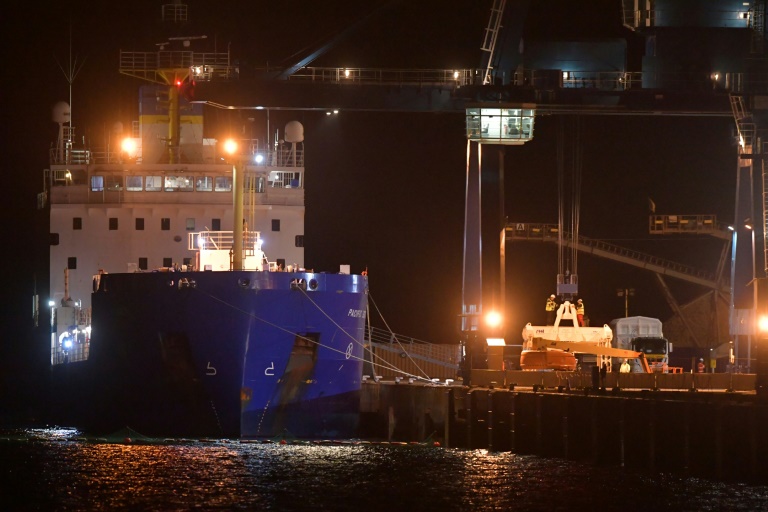
Two ships carrying reprocessed nuclear fuel destined for Japan set sail Saturday morning from northern France, an AFP photographer said, despite criticism from environmental campaigners.

The fuel was due to leave the northern French port city of Cherbourg earlier this month but was delayed by the breakdown of loading equipment.

Environmental activists have denounced the practice of transporting such highly radioactive materials, calling it irresponsible.

The previous transport of MOX fuel to Japan in September 2021 drew protests from environmental group Greenpeace. 

MOX fuel is a mixture of reprocessed plutonium and uranium.

“The Pacific Heron and Pacific Egret, the specialised ships belonging to British company PNTL, left Cherbourg harbour on September 17. They will ensure the shipment of MOX nuclear fuel to Japan,” French nuclear technology group Orano said in a statement Saturday.

They are bound for Japan for use in a power plant and Orano said it expected the shipment to arrive in November.

Japan lacks facilities to process waste from its own nuclear reactors and sends most of it overseas, particularly to France.

The operation was carried out “successfully”, Orano said, and it is the second shipment that arrived in Cherbourg from a plant in La Hague, located 20 kilometres (12 miles) away, after the first came on September 7.

Yannick Rousselet of Greenpeace France previously denounced the shipment.

“Transporting such dangerous materials from a nuclear proliferation point of view is completely irresponsible,” he said last month.

MOX is composed of 92 percent uranium oxide and eight percent plutonium oxide, according to Orano. 

The plutonium “is not the same as that used by the military,” it said.

India welcomes back cheetahs, 70 years after local extinction

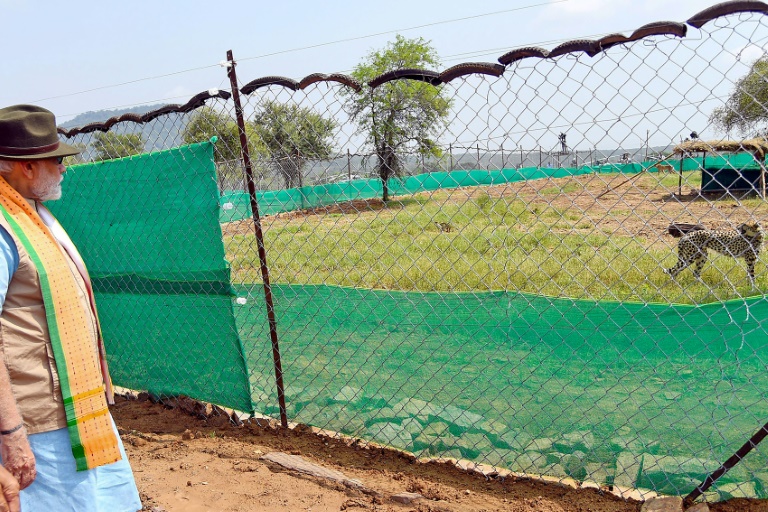
Eight Namibian cheetahs arrived in India Saturday, decades after their local extinction, in an ambitious project to reintroduce the spotted big cats that has divided experts on its prospects.

Officials say the project is the world’s first intercontinental relocation of cheetahs, the planet’s fastest land animal.

The five females and three males were moved from a game park in Namibia aboard a chartered Boeing 747 dubbed “Cat plane” for an 11-hour flight.

Prime Minister Narendra Modi presided over the release at Kuno National Park, a wildlife sanctuary 320 kilometres (200 miles) south of New Delhi selected for its abundant prey and grasslands.

“Today the cheetah has returned to the soil of India,” Modi said in a video address after their arrival, which coincided with the leader’s 72nd birthday.

“The nature loving consciousness of India has also awakened with full force,” he added. “We must not allow our efforts to fail.”

Each of the animals, aged between two and five and a half, have been fitted with a satellite collar to monitor their movements. 

They will initially be kept in a quarantine enclosure for about a month before being released in the open forest areas of the park.

Critics have warned the creatures may struggle to adapt to the Indian habitat.

A significant number of leopards are present in the park, and conservation scientist Ravi Chellam said that cubs could fall prey to feral dogs and other carnivores.

Under the government’s current action plan, “the prospects for a viable, wild and free-ranging population of cheetahs getting established in India is bleak,” he told AFP.

“The habitats should have been prepared first before bringing the cats from Namibia,” he added. “It is like us moving to a new city with only a sub-optimal place to stay — Not a nice situation at all.”

But organisers are unfazed.

“Cheetahs are very adaptable and (I’m) assuming that they will adapt well into this environment,” said Dr Laurie Marker, founder of the Namibia-based charity Cheetah Conservation Fund (CCF), which has been central to the project logistics.

“I don’t have a lot of worries,” she told AFP.

– Habitat loss and hunting –

India was once home to the Asiatic cheetah but it was declared extinct there by 1952. 

The critically endangered subspecies, which once roamed across the Middle East, Central Asia and India, are now only found, in very small numbers, in Iran.

Efforts to reintroduce the animals to India gathered pace in 2020 when the Supreme Court ruled that African cheetahs, a different subspecies, could be settled in India at a “carefully chosen location” on an experimental basis.

They are a donation from the government of Namibia, one of a tiny handful of countries in Africa where the magnificent creature survives in the wild.

Negotiations are ongoing for similar translocation from South Africa, with vets suggesting 12 cats could be moved. 

Cheetahs became extinct in India primarily because of habitat loss and hunting for their distinctive spotted coats. 

An Indian prince, the Maharaja Ramanuj Pratap Singh Deo, is widely believed to have killed the last three recorded cheetahs in India in the late 1940s.

One of the oldest of the big cat species, with ancestors dating back about 8.5 million years, cheetahs once roamed widely throughout Asia and Africa in great numbers, said CCF.

But today only around 7,000 remain, primarily in the African savannas.

The cheetah is listed globally as “vulnerable” on the International Union for the Conservation of Nature (IUCN) Red List of Threatened Species.

In North Africa and Asia it is “critically endangered”.

Their survival is threatened primarily by dwindling natural habitat and loss of prey due to human hunting, the development of land for other purposes and climate change.

Japan braces for 'very dangerous' Typhoon Nanmadol

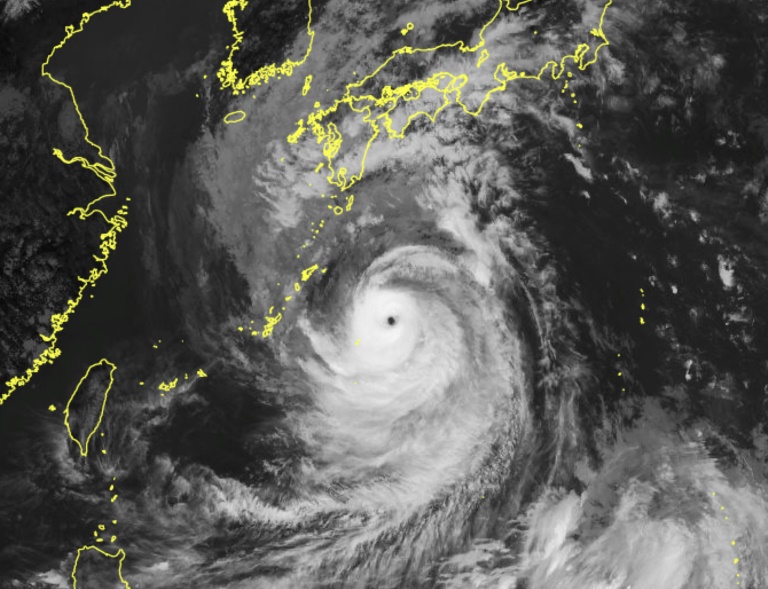
Japan’s weather agency warned Saturday of “unprecedented” risks from a “very dangerous” typhoon heading towards the southern Kyushu island, urging residents to take shelter ahead of the storm.

Typhoon Nanmadol was producing gusts of up to 270 kilometres (167 miles) an hour and classed as a “violent” storm, the agency’s top level, on Saturday.

By late afternoon it was approaching the remote Minami Daito island, 400 kilometres east of Okinawa island.

The storm is expected to approach or make landfall on Sunday in Kyushu’s southern Kagoshima prefecture, then move north the following day before heading towards Japan’s main island.

“There are risks of unprecedented storms, high waves, storm surges, and record rainfall,” Ryuta Kurora, the head of the Japan Meteorological Agency’s forecast unit, told reporters. 

“Maximum caution is required,” he said, urging residents to evacuate early.

“It’s a very dangerous typhoon.”  

Kurora said the weather agency was likely to issue its highest alert later Saturday for the Kagoshima region.

Called “special warnings”, these are issued only when the JMA forecasts conditions seen once in a few decades. 

It would be the first typhoon-linked special warning issued outside of the Okinawa region since the current system began in 2013.

“The wind will be so fierce that some houses might collapse,” Kurora told reporters, also warning of flooding and landslides.

An evacuation “instruction” — level four on a five-level scale — is already in place for 330,000 people in Kagoshima, and authorities urged people to move to shelters or alternative accommodation before a top-level call was issued.

Evacuation warnings in Japan are not mandatory, and during past extreme weather events authorities have struggled to convince residents to take shelter quickly enough.

Japan is currently in typhoon season and faces around 20 such storms a year, routinely seeing heavy rains that cause landslides or flash floods.

In 2019, Typhoon Hagibis smashed into Japan as it hosted the Rugby World Cup, claiming the lives of more than 100 people. 

A year earlier, Typhoon Jebi shut down Kansai Airport in Osaka, killing 14 people.

And in 2018, floods and landslides killed more than 200 people in western Japan during the country’s annual rainy season.

Ahead of Typhoon Nanmadol’s arrival, flight cancellations began to affect regional airports including those in Kagoshima, Miyazaki and Kumamoto, according to the websites of Japan Airlines and All Nippon Airways. 

Scientists say climate change is increasing the severity of storms and causing extreme weather such as heat waves, droughts and flash floods to become more frequent and intense. 

Queen Elizabeth's favourite brands face losing royal warrant

Queen Elizabeth II’s death means that around 600 of her favourite brands risk losing their royal warrant and must now await the approval of her successor King Charles III.

Fortnum and Mason teas, Burberry raincoats, Cadbury chocolate and even broomstick and dog food manufacturers are among those facing the loss of royal prestige.

If they do not gain the new monarch’s stamp of approval, they will have two years to remove the seal that marks them as preferred suppliers to the sovereign.

In his former role as the prince of Wales, Charles issued his own royal warrants to more than 150 brands.

Above all, the warrant is a mark of quality.

Holders receive “the right to display the appropriate royal arms on their product, packaging, stationery, advertising, premises and vehicles”, the Royal Warrant Holders Association said.

For some companies, royal endorsement is a powerful selling point, even if it is hard to measure the true impact on sales.

Fortnum and Mason were the grocers and provision merchants by appointment to Queen Elizabeth, and the tea merchants and grocers by appointment to the prince of Wales.

“We are proud to have held a warrant from Her Majesty since 1954, and to have served her and the royal household throughout her life,” the luxury London department store said.

Fortnum and Mason has a long and close history with the royal family, having created Royal Blend tea for king Edward VII in 1902.

Twinings also had royal warrants as tea and coffee merchants to Queen Elizabeth and to the prince of Wales.

– Dubonnet and champagne –

Among the other brands that benefited from their association with Queen Elizabeth was the Dubonnet wine-based aperitif — the key ingredient in her favourite cocktail of Dubonnet and gin.

Launer, which prided itself on supplying the sovereign with her ever-present handbags since 1968, now risks losing its precious cachet.

However, Barbour jackets, particularly suited to country life in the British weather, were the official manufacturers of waterproof and protective clothing to both Queen Elizabeth and her eldest son.

But for brands less well-associated with Queen Elizabeth in the public mind, the royal warrant is “above all, the recognition of know-how and tradition”, Christian Porta, the managing director of global business development at Pernod Ricard, which owns Dubonnet, told AFP.

The French wine and spirits multinational holds warrants for Dubonnet and also for Mumm champagne.

However, in this field it has some competition: Bollinger, Krug, Lanson, Laurent-Perrier, Louis Roederer, Moet and Chandon and Veuve Clicquot also hold royal warrants.

– Tougher criteria –

Consumer brands also have the royal seal of approval, including Heinz, known for its ketchup and its tins of baked beans, adored by Britons.

For Kellogg’s cereals, as a US company, “it’s nice to have such a strong connection to the UK”, said Paul Wheeler, the brand’s spokesman in Britain.

He said the company had been supplying the royal family continuously during Queen Elizabeth’s 70-year reign.

“We used to have a special van, called Genevieve, only to deliver cereals to the royals straight from the factory,” Wheeler said.

There is no cost to obtaining a royal warrant, and suppliers continue to provide their services to the grantor on a commercial basis, while the royals are also free to use other suppliers.

Royal warrants last for five years, but the criteria for renewal have been tightened.

“It’s not only about giving a perfect service,” said Wheeler. “You have to show you’re a good business,” particularly with respect to human rights.

As a result, the royal warrant is therefore a guarantee of quality which some Britons will use when choosing their goods and services.

Cyclists on alert for swooping magpies at world titles

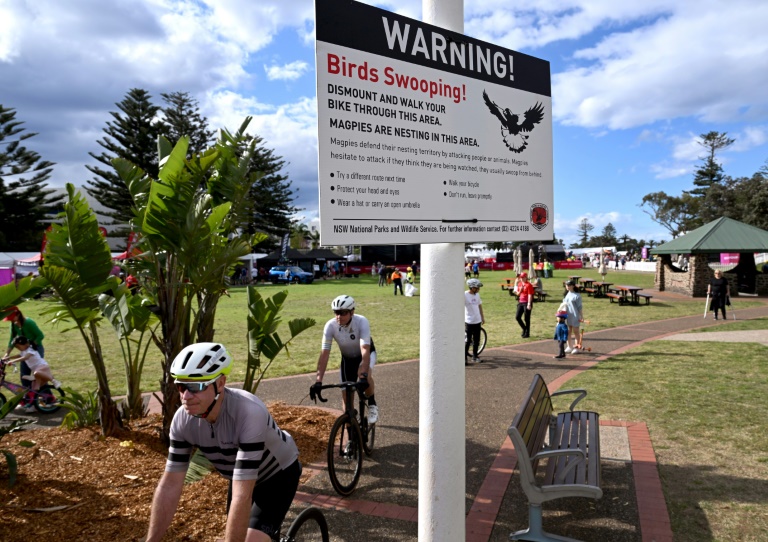
Riders are bracing for an unusual threat at the world cycling championships in Australia this week — swooping magpies.

Wollongong, a coastal city 80 kilometres (50 miles) south of Sydney that is hosting the eight-day event from Sunday, is home to flocks of the notoriously territorial black-and-white birds.

September is peak swooping season as magpies seek to protect their young in the nest, which can include dive-bombing people on bikes they perceive as a threat.

“Magpies can be quite territorial and there’s going to be a lot going on in their particular areas,” Paul Partland from the Illawarra Animal Hospital told local radio station Wave FM.

“Swooping birds tend to target people that are by themselves and also people that are moving in very fast ways.”

More than 1,000 cyclists from over 70 nations will be vying for 13 gold medals in races of wheel-to-wheel combat at the championships.

Although the riders will be wearing helmets, the threat from the sharp-beaked birds is a genuine concern.

“A fairly large bird came very close and it just kept following me,” Belgian cyclist Remco Evenepoel, who won the Vuelta a Espana in Spain last week, told cycling.com after a training session on Friday.

“It was terrifying. But that’s Australia, apparently. I hope it’s the only time it happens, but I am afraid of it,” added Evenepoel, among the favourite for Sunday’s men’s time trial.

Fellow time trial contender Stefan Kung revealed one of his Swiss teammates was also targeted.

“Yeah, one of our guys has been attacked already by a magpie,” he said.

Australia has a website for reporting magpie attacks, with 1,492 registered this year including 192 injuries, often minor.

But there have been fatalities, including a cyclist in Wollongong who died in 2019 when he crashed into a fence post while trying to avoid a swooping magpie.

Fiji PM 'disturbed' by son's Australian assault trial

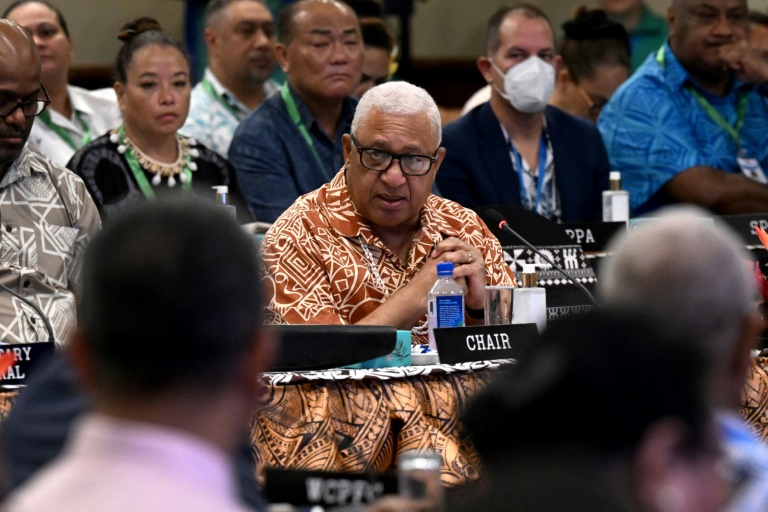
Fijian Prime Minister Frank Bainimarama expressed concern Saturday that his son faces multiple domestic violence charges in Australia.

Ratu Meli Bainimarama, 36, appeared in court on Thursday to face 17 counts, including assault, choking and distributing intimate images without consent.

“My son is not a member of the Fijian government and this is not a political or diplomatic matter,” the Fijian prime minister said in a statement, but added that he and his wife were “deeply concerned and disturbed about the charges”.

“During my service as prime minister I have openly and routinely condemned violence perpetrated against women and children, and that commitment is unwavering,” he added.

Bainimarama said it was “not appropriate” to comment further on “any matter before the Australian courts”.

Ratu Meli Bainimarama was arrested on September 8 in the state of Queensland and extradited to New South Wales.

An Australian judge initially issued a suppression order on his name, restricting the media from identifying him.

But a court in Sydney lifted the order on Friday national broadcaster ABC contested it.

The prime minister’s son faces five charges of assault causing bodily harm, four of common assault, four of choking without consent, two of stalking or intimidating, and one each of intentionally distributing intimate images and destroying property.

Bainimarama was granted bail and the case adjourned to October 13 at Windsor Court in northwestern Sydney.

'Are we ready?' Antiguans mull cutting ties with British monarchy

Republican movements may be gaining steam in British realms across the globe, but in the tiny Caribbean paradise of Antigua and Barbuda, residents have decidedly mixed feelings about their leaders’ push to break that final link.

Days after the death of Queen Elizabeth II, Antigua and Barbuda became the first of the 14 remaining realms now ruled over by her son, Charles, to openly float the idea of replacing the British monarch as its head of state.

Doing so would not be “an act of hostility” but “the final step to complete the circle of independence,” Prime Minister Gaston Browne told British broadcaster ITV news, saying that he hopes to hold a referendum on the matter within the next three years.

Whether his people want to take that step is an open question, admitted Browne’s chief of staff Lionel Hurst during an interview at the prime minister’s office overlooking the port capital of St John’s in the country’s main island, Antigua. 

“We’re not sure yet,” he said Friday. If Browne wins the next general election, which must be held by 2023, the years before any referendum would be spent “selling the idea” to Antiguans and Barbudans.

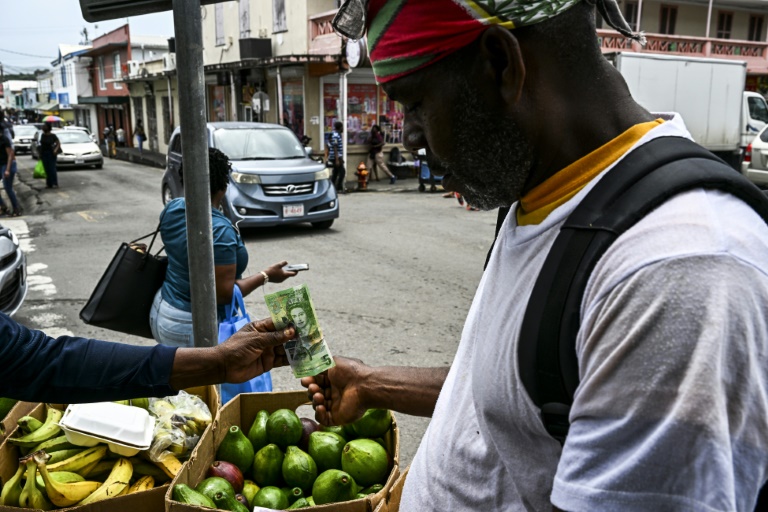
On St John’s busy Market Street, most residents agreed the idea would need to be sold.

“I think we should stay with the crown. This country cannot manage on its own,” 53-year-old Leonie Barker told AFP after buying groceries ahead of Tropical Storm Fiona, due to brush past the island Friday night.

Others said that it was too early to take a stand. 

Education and engagement on the idea are needed, 58-year-old Peter Thomas said.

“I think we have reached a stage in life (where) we would like to be on our own, but are we ready? That’s the next story,” he said.

Fashion designer and singer Kelly Richardson also said islanders needed more information, adding that he did not think it was “a bad idea.”

“I’m open to changes,” he told AFP from behind dark sunglasses.

Some could see potential on both sides. 

Antigua has already come far since independence in 1981, local cameraman JC Cornelius argued, so when it comes to removing the queen as head of state — “why not?”

But then again, he added, “unity and one love is really key. So, being with the queen… I mean, why not?”

The matter, he said, would require “some nice diligent consideration.”

– ‘Less than independence’ –

Browne’s hoped-for referendum would come nearly 400 years after Britain first colonized Antigua in 1632, followed by neighboring Barbuda in 1678.

Settlers began growing sugar on the islands — but with Indigenous Caribbean people dying by the thousands across the region, they imported African slaves to tend the profitable crop.

Emancipation finally came in 1833, and many of Antigua and Barbuda’s 97,000 people today are the descendants of slaves.

The country, whose economy is now heavily dependent on tourism, has been an independent nation for more than four decades — but, argues government spokesman Hurst, it’s a funny kind of independence.

“The monarchy is in England, we don’t deceive ourselves,” he told AFP.

“It’s kind of less than independence when your head of state is determined not by you, but by a tradition that lies 6,000 miles away.”

Any control Britain exerts is mostly procedural, however, he said — and breaking away from that is “symbolic.”

“In large part it will have a psychological impact on the people of Antigua and Barbuda, that is its primary purpose,” he said. 

Whether the younger generations are as impacted by the wounds of the past, however, also appears to be a question of some debate.

Generation Z’s biggest concern is not the nation’s psyche but development, 19-year-old student Kemani Sinclair told AFP, gesturing at the colorful buildings around the center of St John’s — some of which have fallen into disrepair.

The process of holding a referendum on removing the British monarchy would be a costly waste of money that could be spent elsewhere, he argued. 

“I truly believe Antigua shouldn’t become a republic. It’s just not ready,” Sinclair said.

Japan braces for 'very dangerous' Typhoon Nanmadol

Japan’s weather agency on Saturday warned of a “very dangerous” typhoon heading towards the country’s southern Kyushu island, urging residents to evacuate before powerful wind hits the area.

Typhoon Nanmadol was carrying gusts up to 270 kilometres on Saturday near the remote Minami Daito island, 400 kilometres (250 miles) east of Okinawa island, the weather agency said.

The storm is expected to approach or make landfall on Sunday in the southern Kagoshima prefecture in Kyushu, then move north the following day before heading towards the main Japanese island.

“There are risks of unprecedented storms, high waves, storm surges, and record rainfall,” Ryuta Kurora, the head of the Japan Meteorological Agency’s forecast unit, told reporters. 

“Maximum caution is required,” he said, urging residents to evacuate early.

“It’s a very dangerous typhoon.”   

Kurora said the weather agency was likely to issue the highest alert for Kagoshima later in the evening.

“The wind will be so fierce that some houses might collapse,” he said, also warning of flooding and landslides.

Japan is currently in typhoon season and is hit by around 20 such storms a year, routinely seeing heavy rains that cause landslides or flash floods.

Scientists say climate change is increasing the severity of storms and causing extreme weather such as heat waves, droughts and flash floods to become more frequent and intense. 

Climate takes backseat in Italy vote despite extreme events

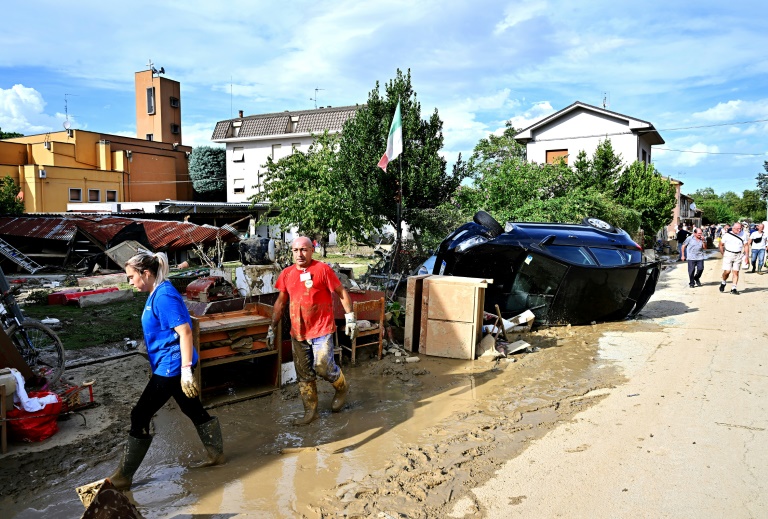
From parched rivers to a glacier collapse and this week’s deadly storms, Italy has suffered numerous climate events this year — but many politicians pay the subject little more than lip service.

Desperate to see some firm commitments ahead of September 25 elections, climate activists staged a sit-in at the Rome offices of frontrunner Giorgia Meloni earlier this month.

They demanded a public meeting with the far-right leader, but police carted them off the premises.

Concern over the spiralling cost of living has drowned out the debate over how to tackle the devastation caused by global warming.

The war in Ukraine has put the risk to energy supplies centre stage in a country heavily reliant on Russian gas. That has prompted a fresh drive for renewables — but also an increase in production in coal-fired plants.

Michele Giuli, a member of the Last Generation movement that stormed Meloni’s office, said deadly floods in central Italy this week had to refocus thinking.

Many have linked the extreme weather event to climate change, including Prime Minister Mario Draghi.

“People have died…,” he told AFP. “This must make us reflect.

“What do we want to do with our lives, while the Italian state does nothing to reduce emissions and avoid tens of thousands of similar deaths in the next few years?”

– Violence of climate events –

This summer’s drought, the worst in 70 years, drained the Po River, the peninsula’s largest water reservoir and a crucial resource for Italy’s agricultural sector.

And then the rains came, hitting land as hard as concrete. Five times the number of storms, hurricanes and floods lashed the country compared to 10 summers ago, according to the agricultural association Coldiretti.

In August, Italian scientists wrote an open letter to politicians, urging them to put the emergency first.

But an analysis published this week by Greenpeace found that less than 0.5 percent of political leaders’ statements on the main TV news programmes covered the climate crisis.

This summer in Italy “will be sadly remembered for the frequency and the violence of climate events… yet this dramatic emergency does not seem to affect many of the political leaders seeking to lead the country,” said Giuseppe Onufrio, executive director of Greenpeace Italy.

But it has been worse. Election experts at Luiss university in Rome note that some parties never used to mention the environment at all.

– Manifestos ‘weak on detail’ –

The widespread inclusion of green policies is actually “one of the novelties of this electoral campaign”, the CISE electoral studies unit said in a commentary last week.

This reflects the growing interest among the public, with 80 percent of respondents they surveyed agreeing that the fight against climate change should be a priority for Italy.

“At least climate change is addressed, or at least mentioned, in all of (the manifestos), though many are weak on detail,” said Piera Patrizio, senior researcher at the Centre for Environmental Policy at Imperial College London.

Italy had vowed to close its coal-fired plants by 2025, a goal it intends to keep despite the short-term measures to tackle the shortage of gas this winer.

Meloni’s right-wing alliance pledges to invest in renewable energies and waste-to-energy plants, as well as domestic production of natural gas, and the installation of regasification plants.

The outgoing government plans to install two such plants off Tuscany and Emilia Romagna, despite local protests.

Enrico Letta’s centre-left Democratic Party (PD), which presents the main challenge to Meloni, backs the plants as a temporary fix.

Meanwhile the anti-immigrant League party and right-wing Forza Italia — part of Meloni’s coalition — are pushing for nuclear energy though Italians rejected it in two referenda in 1987 and 2011.

The PD rejects nuclear power as too slow and expensive a solution and wants instead to sharply increase the share of renewables produced in Italy.

“There’s next to nothing (in the policies) on equity… on how some households, some parts of the country are going to be more affected than other,” Patrizio said.

The EU’s post-pandemic recovery fund, from which Italy expects to benefit almost 200 billion euros, is heavily tilted towards projects that ease the so-called “ecological transition”.

But Patrizio added: “Italy doesn’t have a net zero strategy right now… it doesn’t even know where to begin.”

Marzio Galeotti, environmental science and policy professor at Milan University, said it was “difficult to convince” the public that “environmental sustainability and emissions reduction can be combined with economic growth”.

But, he noted sadly, this is true of many countries: “We are seeing a kind of temporary amnesia that is not unique to Italy.”

Biden meets relatives of Americans jailed in Russia

President Joe Biden met Friday with relatives of basketball star Brittney Griner and fellow US citizen Paul Whelan, who are both imprisoned in Russia, as the US works to bring them home, the White House said.

In separate Oval Office meetings, Biden conferred with Whelan’s sister, Elizabeth Whelan, and then Cherelle Griner, the wife of the Olympic gold medalist.

After the meetings the White House released a statement saying Biden “appreciated the opportunity to learn more about Brittney and Paul from those who love them most, and acknowledged that every minute they are being held is a minute too long.”

The statement did not include any details about the status of talks with Russian authorities, but National Security Council spokesman John Kirby told reporters earlier in the day that “discussions are ongoing” to secure Griner’s release.

“The president is not going to let up. He’s confident that this is going to remain at the forefront of his mind and his team’s mind,” Kirby said.

Cherelle Griner, in a statement released by her wife’s agent, thanked Biden for the meeting and his “administration’s efforts to secure her release.”

“I’ve felt every minute of the grueling seven months without her,” she said.

In August, Moscow said it was ready to discuss a prisoner swap for Griner, sparking hopes of a rapid resolution.

Kirby said the Biden administration had made what he called a serious proposal but “they are not responding to our offer.”

“These two individuals ought to be home already. Period,” he added.

Griner was arrested at a Moscow airport in February, shortly before Russia’s invasion of Ukraine, for possessing vape cartridges with a small amount of cannabis oil.

The 31-year-old, who was in Russia to play for the professional Yekaterinburg team during her off-season from the Phoenix Mercury, was charged with smuggling narcotics.

In early August she was sentenced to nine years in a penal colony.

Former US marine Whelan, 52, was arrested in December 2018 and accused by Russian security services of spying. 

He was detained on a visit to Moscow to attend a wedding when he took a USB drive from an acquaintance, thinking it contained holiday photographs. He did not look at the contents of the drive, but his lawyer said it contained “state secrets.”

The former security official at a vehicle parts company — who also has British, Canadian and Irish passports — was sentenced to 16 years on espionage charges in June 2020. 

Close Bitnami banner
Bitnami