World

Iranian woman in coma after morality police arrest: activists

A young Iranian woman is in a coma and fighting for her life after being arrested in Tehran by the Islamic republic’s morality police, campaigners said Thursday.

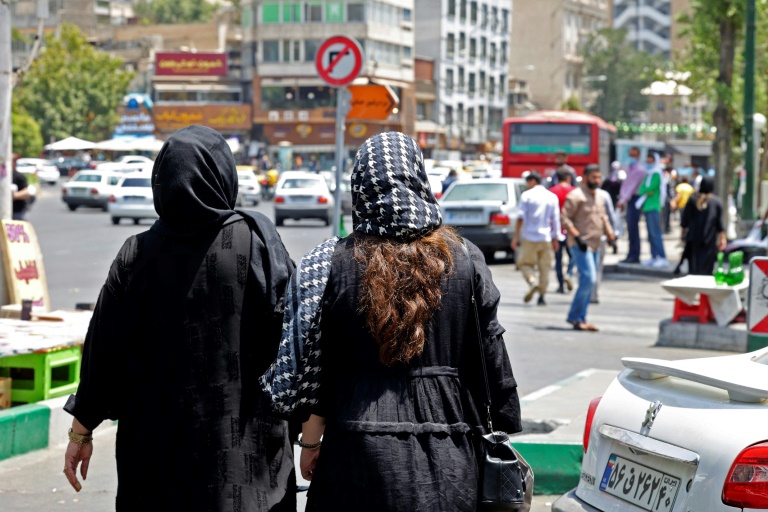
The woman, named as Mahsa Amini, 22, was on a visit to the Iranian capital with her family when she was detained by the special police unit that enforces the strict dress rules for women, including the compulsory headscarf.

Her brother Kiaresh told the Iran Wire news website that while he was waiting outside the police station for her to be released an ambulance drove out taking her to hospital.

He was told that she had had a heart attack and a brain seizure and was now in a coma.

“There were only two hours between her arrest and being taken to hospital,” he said.

Vowing to file a criminal complaint he added: “I have nothing to lose. I will not let this end without making a noise.”

A statement by the Tehran police confirmed she had been detained for “explanation and instruction” about the dress rules, along with other women.

“She suddenly suffered a heart problem while in the company of other guided people (and)… was immediately taken to the hospital with the cooperation of police and emergency services.”

It is not yet clear what happened between her arriving at the police station and her departure for hospital.

– ‘Sickening’ –

The 1500tasvir social media channel, which chronicles rights violations by the Iranian police, posted a picture of her in hospital with a tube in her mouth and said she was in a coma.

“Sickening,” the Iranian-British actress and campaigner Nazanin Boniadi wrote on Twitter. “How many innocent young lives must be brutally robbed before we all rise?”

“Mahsa Amini’s situation is an example of an intentional crime,” the Iranian freedom of expression campaigner Hossein Ronaghi wrote on social media.

“The systematic suppression of Iranian women under the pretext of enforcing the hijab by the guidance patrol and the police force is a crime.”

The incident comes as controversy grows — both inside and outside Iran — over the conduct of the gasht-e ershad (guidance patrol) who monitor and enforce the dress code in Iran.

The Islamic hijab has been compulsory for women in Iran since shortly after the 1979 Islamic revolution that ousted the shah.

Some women, encouraged by the US-based campaigner Masih Alinejad, have sought to protest the rule by removing their hijabs in public.

In mid-July, a young Iranian woman, Sepideh Rashno, disappeared in mid-July after becoming involved with a dispute on a Tehran bus with another woman who accused her of removing her headscarf.

She was held by the Revolutionary Guards and appeared on TV in what activists said was a forced confession.

She was released on bail in late August after about one and a half months behind bars.
Schiphol CEO quits over Amsterdam airport chaos

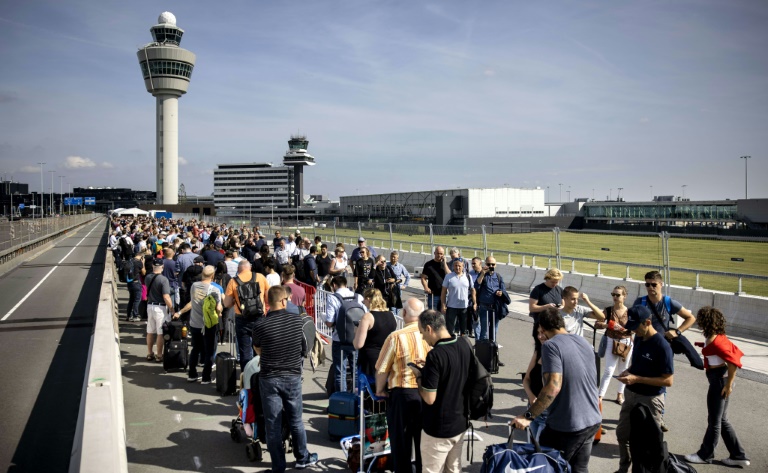
Amsterdam’s Schiphol airport chief executive Dick Benschop announced his resignation on Thursday following months of chaos at one of Europe’s largest transport hubs, plagued by long queues and baggage handling issues.

The troubles at Schiphol were among the worst in a summer where the global aviation industry struggled to cope with a surge in travel due to staff shortages after laying off thousands during the Covid pandemic. 

Benschop’s decision comes as Europe’s second-largest airport again on Monday asked airlines to cancel flights and passengers had to stand in line for hours before catching flights.

“There is a lot of attention, and also criticism, for the way in which Schiphol is tackling the problems and for my responsibility as CEO,” Benschop said in a statement.

“I am making room on my own initiative to give Schiphol the space to make a new start,” he said.

Benschop warned that Schiphol was due to announce further “bad news” measures “today or tomorrow for the coming weeks” which will lead to further disruption at the airport, which at its peak in 2019 handled almost 72 million passengers.

Benschop, a former top manager at Shell and deputy minister announced his resignation at a meeting of the airport’s supervisory board on Wednesday night.

“He will remain in his function until a successor has been appointed,” Schiphol added in the statement.

Benschop last month blamed the long queues over the summer, which saw numerous passengers miss flights despite arriving hours ahead of departure — on staff shortages.

Baggage handlers earlier this year walked off the job in a wildcat strike and lost and unclaimed luggage remains a problem.

The airport reduced passenger numbers since July in an effort to bring down waiting times. 

Schiphol also paid staff bonuses for the busy summer months, but many of those are set to finish at the end of September, while others had already ended.

“Improvements have been made over the summer, but these are not enough,” said Jaap Winter, who chairs Schiphol’s supervisory board.

He too warned further limitations on capacity may be necessary and that Schiphol more measures were needed to guarantee the airport’s security.

“As a national and international airport, Schiphol must return to the level of quality that passengers and airlines are accustomed to,” Winter said.

– ‘Need action’ –

Aviation companies as well as trade unions said they were sorry to see Benschop go, but understood that his position at the airport was untenable. 

KLM chief executive Marjan Rintel told the NOS public broadcaster she understood why Benschop made the decision “given the ongoing chaos.”

The FNV umbrella labour federation, which represents many of Schiphol’s employees, said it was “surprised by Benschop’s decision” but understood why he stepped down.

“I’m not sure a resignation is necessarily going to bring us closer to a solution,” FNV spokesman Jaap van Doesburg said.

“What we rather see is action to solve the problem,” he told the NOS.

“Benschop, over the long-term took steps to go for quality rather than quantity at the airport,” said the ANVR, the umbrella organisation for Dutch travel companies.

“But this means that the problems have not been solved in the short term — and that is terrible,” ANVR director Frank Oostdam said. 

Passenger numbers at Schiphol plummeted from over 70 million in 2019 to 20.8 million in 2020, the first year of the pandemic and to 23 million last year.

In August, however, 5.2 million passengers passed through Schiphol’s gates, as opposed to 3.8 million last year at the same time and 1.8 million in 2020.

UK vows 'fitting tribute' to queen as tens of thousands file past coffin

British officials on Thursday pledged “a fitting tribute” to Queen Elizabeth II at her funeral next week, as they revealed the historic day will culminate in her interment at a private ceremony at Windsor Castle.

The country’s longest-serving monarch, who died a week ago aged 96 after 70 years on the throne, will be honoured with a state funeral on Monday morning at Westminster Abbey.

The first to be staged in the UK in nearly six decades, it is set to draw leaders and royalty from around the world and will follow four days of her coffin lying in state at neighbouring Westminster Hall.

Mourners — some waiting through the night — have been queueing to pay their last respects to the much-loved monarch, as the first full day of lying in state attracted tens of thousands of people.

“The Queen held a unique and timeless position in all our lives,” funeral organiser Edward Fitzalan-Howard, known as the Earl Marshal, told reporters at a briefing.

“It is our aim and belief that… the next few days will unite people across the globe and resonate with people of all faiths, whilst fulfilling Her Majesty and her family’s wishes to pay a fitting tribute to an extraordinary reign.”

The 65-year-old, who also holds the Duke of Norfolk title, has spent the last two decades preparing for the queen’s funeral — the biggest Britain will have hosted since former prime minister Winston Churchill’s in 1965.

“The respect, admiration and affection in which the queen was held make our task both humbling and daunting — an honour and a great responsibility,” Fitzalan-Howard added.

– ‘Peaceful’ –

More than 2,000 guests are expected to pack the historic abbey in central London at 1000 GMT Monday for a church service dedicated to her life and record-breaking reign.

US President Joe Biden, Canadian Prime Minister Justin Trudeau, Australia’s leader Anthony Albanese and France’s Emmanuel Macron have all confirmed their attendance at the funeral, as have Japan’s Emperor Naruhito and numerous other royals.

After the service, the coffin will be transferred by royal hearse to her Windsor Castle home west of London before a committal service at St George’s Chapel at 1500 GMT.

In the meantime, attention remains focused on the growing line of mourners waiting to enter the vast hall where the queen’s coffin, mounted on a platform, has been lying since late Wednesday afternoon.

That followed a ceremonial procession through the packed streets of central London from Buckingham Palace.

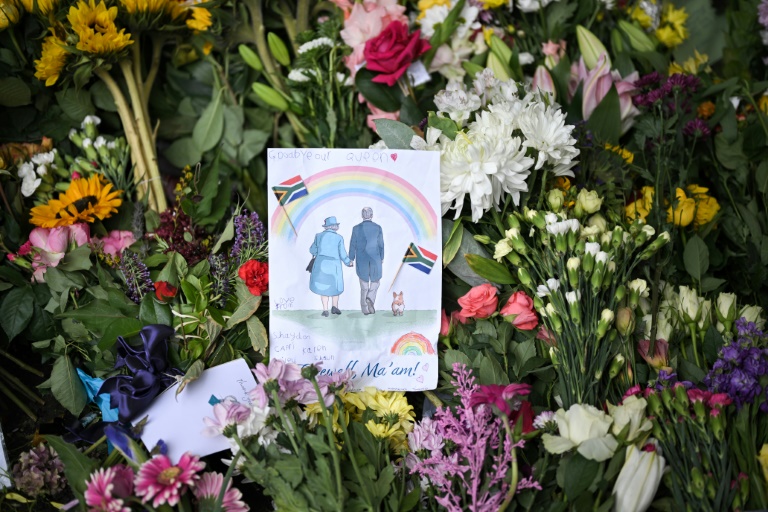
Draped in the Royal Standard flag, the casket is adorned with the Imperial State Crown, her ceremonial Orb and Sceptre, while tall, flickering candles stand at each corner.

“It’s very peaceful,” Londoner Rupa Jones, 43, told AFP after emerging from the cavernous space, the oldest part of Britain’s centuries-old parliament, calling the experience “overwhelming”.

She and her aunt had queued for nearly seven hours through the night for their fleeting moment in front of the coffin.

The sombre atmosphere inside is completed with guards in ceremonial uniform posted around the podium in a constant vigil.

One fainted overnight, a reminder of the toll standing vigil can take. Defence secretary Ben Wallace, as a member of the Royal Company of Archers, took a turn on guard.

All Britain’s national newspapers carried poignant pictures of the historic scene on their covers.

“Nation’s turn to say farewell,” the Daily Telegraph headlined on its front page.

Mourners marked their moment in front of the coffin in various ways, from bows or curtsies to the sign of the cross or by simply removing their hats.

Some wiped away tears with tissues. Others brought infants in pushchairs. Old soldiers stopped and gave one last salute to their former commander-in-chief.

– ‘Real Charles fan’ –

By early afternoon Thursday, the queue had grown to more than four miles (6.4 kilometres) along the south bank of the Thames river, with people set to wait through the day to see the late sovereign.

Organisers have prepared up to 10 miles of queueing infrastructure, with expectations hundreds of thousands will participate, in particular over the weekend.

Musician Jacqui Smith, among those in line overnight, was sad but enthusiastic about the reign of the new king.

“I’ve been waiting for it for a long time,” she told AFP from Lambeth Bridge, within sight of Westminster Hall. “I love the queen, but I’m a real Charles fan.”

Senior royals also continued visits to places around the country Thursday.

William and wife Kate travelled to Sandringham, the family’s private winter retreat in eastern England to view the floral tributes left by members of the public at the Norwich Gates.

Charles, 73, was crowned Prince of Wales by his mother in 1958, and on his first full day as monarch Friday he bestowed the title on his eldest son.

The historic title has been given to the heir apparent since the start of the 14th century.

Thursday’s visit was the first official engagement conducted by the new Prince and Princess of Wales.

Meanwhile Elizabeth’s youngest son Prince Edward, 58, and his wife Sophie, visited Manchester in northwest England to view the civic book of condolence at the city’s central library.

They also viewed the floral tributes in St Ann’s Square, met members of the public volunteering at the site, and lit a candle in memory of the queen at Manchester Cathedral.

US industrial output dips in August on drop in electricity output

A drop in electric power generation and a modest uptick in manufacturing led to a small decline in overall US industrial production in August, the Federal Reserve said Thursday.

Total output slipped 0.2 percent, worse than economists expected, on the 2.3 percent drop in utilities, which was the second straight decline.

Manufacturing edged up 0.1 percent, while mining output was flat after five consecutive months of gains, the report said.

Rubeela Farooqi of High Frequency Economics noted the downside surprise in the data.

“Momentum in factory activity has slowed,” she said. “Supply chain constraints and price pressures appear to be easing, which is a positive for manufacturing.

“But factory activity is likely to moderate in response to slowing demand amid a rising interest rate backdrop,” she added.

Production of vehicles and parts fell 1.4 percent, and the big gain in July was cut in half after revisions, the data showed.

A 3.5 percent jump in petroleum output and a 2.1 percent increase in aerospace and other transportation equipment helped offset other losses, the report showed.

Overall industrial production is up 3.7 percent compared to August 2021, while manufacturing output is 3.3 percent higher, according to the figures.

Industrial capacity in use slipped to 80 percent, from 80.2 percent, in the prior month, the report said.

Queen Elizabeth II's state funeral

The state funeral of Queen Elizabeth II at London’s Westminster Abbey on Monday will be the culmination of decades of meticulous planning.

Here is how the day will unfold:

– Return to the abbey –

The last time Westminster Abbey was used for a monarch’s funeral was for king George II in 1760.

Since then, the preferred church has been St George’s Chapel at Windsor Castle but Elizabeth opted for a larger venue.

On the morning of the funeral, the lying in state — begun at Westminster Hall in parliament on Wednesday — will continue until 6:30 am (0530 GMT).

At 6:30 am, the doors will close in preparation for the transfer of the coffin to the nearby abbey.

– Gun carriage –

Shortly after 10:35 am a bearer party will lift the coffin from the catafalque, a raised platform, and carries it to the state gun carriage which will be waiting outside the North Door of Westminster Hall.

The state gun carriage is a field gun carriage held by the Royal Navy since 1901 when it was withdrawn from active service for the funeral of Queen Victoria.

It was also used for the funerals of kings Edward VII, George V, the queen’s father George VI, wartime prime minister Winston Churchill and Lord Louis Mountbatten, who was the last viceroy of British-ruled India.

It will be drawn by 142 junior enlisted sailors — naval ratings — rather than horses and set off at 10:44 am. 

The queen’s eldest son and successor, King Charles III, will lead members of the royal family walking behind the coffin to the West Gate of Westminster Abbey, arriving at 10:52 am. 

The funeral, conducted by the Dean of Westminster, David Hoyle, with Archbishop of Canterbury Justin Welby giving the sermon, will start at 11:00 am.

Towards the end of the service at around 11:55 am, the Last Post bugle call will sound, followed by a two-minute silence.

The service will close with the national anthem and a Lament, a musical expression of grief, at around noon.

– Major security operation –

Westminster Abbey can hold up to 2,200 people. 

Those present in the congregation will include family members, Britain’s Prime Minister Liz Truss, senior politicians, former premiers, more than 100 kings, queens and heads of state and other VIPs.

Invitations are expected to be sent to representatives of all countries with which Britain has diplomatic relations.

The palace has not released a formal guest list.

But Russia and Belarus have not been invited because of the war in Ukraine, diplomatic sources said this week.

Military-run Myanmar and isolated North Korea have also not been invited, with no attendance either by representatives from Syria, Venezuela or Taliban-run Afghanistan.

– Journey to Windsor –

At 12:15 pm, the coffin will be drawn on the gun carriage, followed on foot by members of the royal family led by the king, to Wellington Arch at Hyde Park Corner near Buckingham Palace, from where it will continue to Windsor by royal hearse.

The hearse will arrive at Windsor at 3:06 pm and make its way to the castle via the Long Walk avenue.

The king and senior members of the royal family will join the procession on foot from the Quadrangle at Windsor Castle at around 3:40 pm before the cortege halts at the chapel at 3:53 pm.

The televised committal service starts at 4:00 pm.

Monday’s committal service is expected to be attended by at least 800 people, most of whom will not have been at the abbey.

They will include past and present staff members who worked for the queen.

At the end of the service the coffin will be lowered into the Royal Vault as the queen’s piper plays a lament from the doorway and the Archbishop of Canterbury pronounces the blessing.

“God Save the King” will be sung and the service ends. 

– Final resting place –


A private burial service will be held at 7:30 pm attended only by the king and members of the royal family.

The queen’s final resting place will be the King George VI memorial chapel, which is an annexe to the main chapel, where she is to be interred with Philip.

The queen’s mother and father — king George VI and queen Elizabeth the queen mother — were buried there as well as the ashes of her younger sister princess Margaret.

US retail sales see surprise bounce in August

US consumers buying cars and going to restaurants and bars in August drove a surprise bounce in retail sales, even as spending on gasoline fell as prices at the pump dropped, according to government data Thursday.

Americans flush with savings have been a key driver of the US pandemic recovery and the Federal Reserve is keeping a careful eye on economic data as it battles to quash red-hot inflation without tipping the world’s largest economy into recession.

Retail sales last month rose 0.3 percent compared to July, to $683.3 billion, the Commerce Department said.

But while the headline gain was much better than the flat result economists had projected, the figure for July was revised down to show a 0.4 percent drop, so the August increase means the total remains below the level in June.

The 3.0 percent jump in auto sales was the main factor behind the increase, and when that segment is excluded, retail sales would have declined 0.3 percent, according to the report.

Gasoline stations saw sales drop 4.2 percent following weeks of declining energy costs.

US gas prices at the pump soared in the wake of the Russian invasion of Ukraine in late February, but in recent weeks have been trending down and have fallen by more than $1 a gallon after hitting an all-time high of over $5 in mid-June, squeezing family budgets.

Meanwhile, restaurants and bars rose 1.1 percent, as did building supplies, the report said, but online sales fell.

“Households continue to spend, supported by strong job growth and rising nominal incomes. However, households face headwinds from elevated inflation that is not yet showing any significant sign of abating,” said Rubeela Farooqi of High Frequency Economics.

The data are seasonally adjusted but do not take into account changes in prices, so as costs rise, a shopping dollar does not stretch as far and American families have had to use more of their earnings on staple goods.

The latest consumer price data showing widespread inflation has solidified expectations that the Federal Reserve will announce a third consecutive three-quarter-point interest rate increase at its policy meeting next week.

The central bank has raised the benchmark borrowing rate four times this year, including two massive three-quarter point increases in June and July after US annual inflation spiked to 9.1 percent in June.

While the annual pace slowed to 8.3 percent in August, Fed officials have made it clear they will continue to hike borrowing costs until inflation moves down.

How the tide turned on data centres in Europe

Every time we make a call on Zoom, upload a document to the cloud or stream a video, our computers connect to vast warehouses filled with servers to store or access data.

Not so long ago, European countries were falling over each other to welcome the firms that run these warehouses, known as data centres or bit barns.

Wide-eyed politicians trumpeted investments and dreamt of creating global tech hubs.

But then the dream went sour.

The sheer amount of energy and water needed to power and cool these server farms shocked the public.

The industry sucked up 14 percent of Ireland’s power last year, London warned home builders that power shortages caused by bit barns could affect new projects, and Amsterdam said it simply had no more room for the warehouses.

Then things got worse.

The war in Ukraine helped spark an energy crisis across the continent, leaving consumers facing rocketing bills and countries contemplating energy shortages.

“Data centres will be a target,” critical blogger Dwayne Monroe told AFP, saying the focus would only grow if Europe cannot fix its energy crisis.

Grassroots campaigns and local opposition have already helped to halt projects this year by Amazon in France, Google in Luxembourg and Meta in the Netherlands.

The Irish government, while reaffirming support for the industry, put strict limits on new developments until 2028.

The data industry says it feels unfairly targeted, stressing its efforts to source green energy and arguing that outsourcing storage to bit barns has helped slash consumption.

– ‘Veil of shadow’ –

These arguments are playing out most spectacularly in Ireland.

Activists are campaigning on a broad range of topics and using local forums to push their case.

“They take up a huge amount of space but provide basically no employment,” says Madeleine Johansson, a Dublin councillor for the People Before Profit party, which is campaigning on the issue.

Johansson recently had a motion passed in her council area banning the centres, sparking an almighty row with the national government that is yet to be resolved.

Dylan Murphy of Not Here, Not Anywhere, one of several climate groups pushing the issue in Ireland, has filed a motion in his local council in Fingal calling for companies to reveal the kind of information they are holding.

“There’s a complete lack of transparency… about what data is actually being stored in these data centres,” he said, calling it a “veil of shadow”. 

The data industry says revealing that information would be impossible.

Michael McCarthy of Cloud Infrastructure Ireland, a lobby group, said activists had lost the argument on sustainability and were now throwing everything at the wall. 

“Data centres definitely are large energy users but they’re part of a cohort of larger energy users,” he said.

McCarthy and industry figures in other countries say the real problem is years of underinvestment in national energy infrastructure. 

He also pointed out that the industry in Europe had pledged to become carbon neutral by 2030.

And there are still countries hankering to get data firms to locate there — particularly Iceland and Norway.

– Questions over metaverse –

Against this backdrop, the tech industry continues to innovate new products that invariably require vast amounts of processing power and data storage.

Machine-learning tools, for example, are hugely energy hungry — Google said earlier this year they accounted for between 10 and 15 percent of its total energy usage.

The metaverse, an emerging concept for a 3D internet championed by Facebook owner Meta, would also be hugely energy intensive. 

Critical blogger Monroe reckons the metaverse will buckle under its own weight, partly because of its data requirements.  

“The construction of the metaverse would require Facebook to build out a distribution of data centres that would rival what Amazon, Microsoft and Google have done for their clouds,” he said.

Meta did not respond directly to questions about the metaverse but told AFP that it was “proud to build some of the most energy and water efficient data centres in the world”.

As far as the carbon footprint of such innovation goes, energy experts interviewed by AFP said it would be difficult to assess.

The metaverse, for example, could help to reduce emissions in other areas by reducing the need for travel.

An energy official who did not want to be named questioned whether data centres were the best target for criticism when cryptocurrencies were so wasteful.

While data centres accounted for one percent of global electricity use in 2020, cryptocurrency mining used about half that amount, according to the International Energy Agency.

McCarthy said those who opposed data centres needed to reckon with just how embedded they had become in everyday life, particularly since the coronavirus pandemic.

“They facilitate how we can work and live online, that’s the reality of it,” he said.

How the tide turned on data centres in Europe

Every time we make a call on Zoom, upload a document to the cloud or stream a video, our computers connect to vast warehouses filled with servers to store or access data.

Not so long ago, European countries were falling over each other to welcome the firms that run these warehouses, known as data centres or bit barns.

Wide-eyed politicians trumpeted investments and dreamt of creating global tech hubs.

But then the dream went sour.

The sheer amount of energy and water needed to power and cool these server farms shocked the public.

The industry sucked up 14 percent of Ireland’s power last year, London warned home builders that power shortages caused by bit barns could affect new projects, and Amsterdam said it simply had no more room for the warehouses.

Then things got worse.

The war in Ukraine helped spark an energy crisis across the continent, leaving consumers facing rocketing bills and countries contemplating energy shortages.

“Data centres will be a target,” critical blogger Dwayne Monroe told AFP, saying the focus would only grow if Europe cannot fix its energy crisis.

Grassroots campaigns and local opposition have already helped to halt projects this year by Amazon in France, Google in Luxembourg and Meta in the Netherlands.

The Irish government, while reaffirming support for the industry, put strict limits on new developments until 2028.

The data industry says it feels unfairly targeted, stressing its efforts to source green energy and arguing that outsourcing storage to bit barns has helped slash consumption.

– ‘Veil of shadow’ –

These arguments are playing out most spectacularly in Ireland.

Activists are campaigning on a broad range of topics and using local forums to push their case.

“They take up a huge amount of space but provide basically no employment,” says Madeleine Johansson, a Dublin councillor for the People Before Profit party, which is campaigning on the issue.

Johansson recently had a motion passed in her council area banning the centres, sparking an almighty row with the national government that is yet to be resolved.

Dylan Murphy of Not Here, Not Anywhere, one of several climate groups pushing the issue in Ireland, has filed a motion in his local council in Fingal calling for companies to reveal the kind of information they are holding.

“There’s a complete lack of transparency… about what data is actually being stored in these data centres,” he said, calling it a “veil of shadow”. 

The data industry says revealing that information would be impossible.

Michael McCarthy of Cloud Infrastructure Ireland, a lobby group, said activists had lost the argument on sustainability and were now throwing everything at the wall. 

“Data centres definitely are large energy users but they’re part of a cohort of larger energy users,” he said.

McCarthy and industry figures in other countries say the real problem is years of underinvestment in national energy infrastructure. 

He also pointed out that the industry in Europe had pledged to become carbon neutral by 2030.

And there are still countries hankering to get data firms to locate there — particularly Iceland and Norway.

– Questions over metaverse –

Against this backdrop, the tech industry continues to innovate new products that invariably require vast amounts of processing power and data storage.

Machine-learning tools, for example, are hugely energy hungry — Google said earlier this year they accounted for between 10 and 15 percent of its total energy usage.

The metaverse, an emerging concept for a 3D internet championed by Facebook owner Meta, would also be hugely energy intensive. 

Critical blogger Monroe reckons the metaverse will buckle under its own weight, partly because of its data requirements.  

“The construction of the metaverse would require Facebook to build out a distribution of data centres that would rival what Amazon, Microsoft and Google have done for their clouds,” he said.

Meta did not respond directly to questions about the metaverse but told AFP that it was “proud to build some of the most energy and water efficient data centres in the world”.

As far as the carbon footprint of such innovation goes, energy experts interviewed by AFP said it would be difficult to assess.

The metaverse, for example, could help to reduce emissions in other areas by reducing the need for travel.

An energy official who did not want to be named questioned whether data centres were the best target for criticism when cryptocurrencies were so wasteful.

While data centres accounted for one percent of global electricity use in 2020, cryptocurrency mining used about half that amount, according to the International Energy Agency.

McCarthy said those who opposed data centres needed to reckon with just how embedded they had become in everyday life, particularly since the coronavirus pandemic.

“They facilitate how we can work and live online, that’s the reality of it,” he said.

EU chief talks Ukraine 'accession' with Zelensky in Kyiv

EU commission president Ursula von der Leyen was in Kyiv Thursday to work out a roadmap with the war-torn country for its long-standing aspiration of joining the European Union.

Her trip coincided with a meeting between Vladimir Putin and his increasingly close ally Chinese leader Xi Jinping in ex-Soviet Uzbekistan, where the Russian leader praised Beijing’s “balanced” stance on the war.

It also comes as Ukrainian forces consolidate gains against Russian forces in the east of the country in a dramatic offensive aided by Western weapons.

Von der Leyen said Thursday’s visit was her third to Ukraine since Russia invaded in February, but this one was different.

“So much has changed. Ukraine is now an EU candidate,” she said on social media.

“I’ll discuss with (President Volodymyr) Zelensky and (Prime Minister) Denys Shmygal how to continue getting our economies and people closer while Ukraine progresses towards accession,” she said.

Ukraine gained EU candidacy status in June at the same time as ex-Soviet Moldova, which borders Ukraine and like its neighbour has had Russian troops stationed in an eastern breakaway region.

– Zelensky promises ‘victory’ –

The historic vote angered Moscow, which has tried to retain political and military influence in both countries since the collapse of the Soviet Union three decades ago.

EU countries have staunchly supported Ukraine since Moscow invaded in February by hitting Russia with waves of economic penalties. 

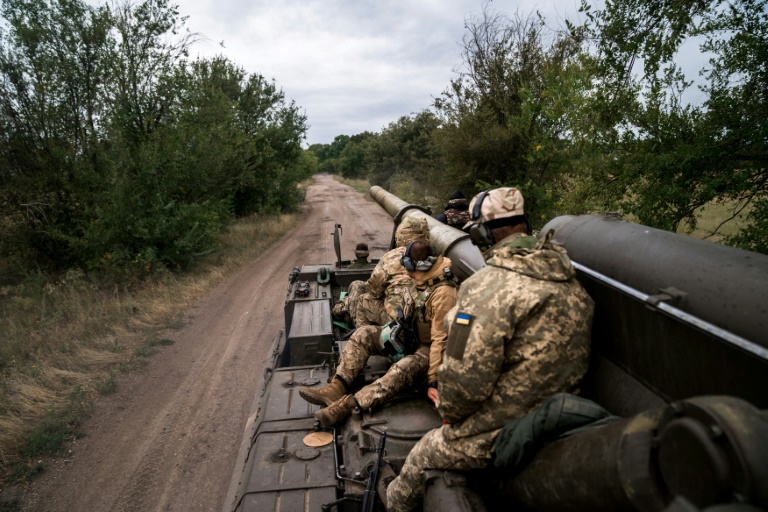
And many members of the bloc have supplied Kyiv with advanced weapons that have helped Ukrainian forces in recent weeks recapture swathes of territory from Russia.

Von der Leyen said just ahead of her trip that the successive waves of EU sanctions against Russia would remain and that Europeans must keep their resolve against Moscow.

“I want to make it very clear, the sanctions are here to stay,” she told the European Parliament.

The Kremlin maintains that Russia has weathered the economic penalties and Moscow has responded by reducing or halting entirely gas flows to European countries.

With winter fast approaching, this has forced the EU to source alternative supplies, agree plans to cut consumption and roll out financial support in the face of skyrocketing prices.

Ukraine and its allies have been buoyed by gains in the eastern Kharkiv region that borders Russia over recent days and Zelensky promised an overall Ukrainian “victory” while visiting the crucial hub of Izyum recaptured this week.

Russia’s defence ministry said Thursday its forces were carrying out high-precision strikes in areas recaptured by Kyiv in Kharkiv.

– Putin praises Xi’s stance –

Ukraine’s forces have also posted slower, but steady gains in the southern Kherson region near the Black Sea.

The Ukrainian presidency said on Thursday that intense fighting was ongoing around that southern front, adding that the military situation “remains extremely difficult.”

Local officials in the region around Zelensky’s hometown of Kryvyi Rih reported fresh Russian strikes Thursday after attacks damaged a dam and saw dozens of homes flooded.

In the eastern Donetsk region, which has been partially controlled by Russian-backed separatists since 2014, fresh shelling killed two civilians and left another 13 wounded.

In the Ukrainian-held Donetsk town of Bakhmut, AFP journalists said streets were deserted and the sound of nearby artillery was audible in the town’s centre.

Flames were still licking a residential building hit by Russian strikes overnight and plumes of thick smoke were rising as firefighters battled the blaze.

Ukraine launched a mandatory drive to evacuate civilians from the eastern industrial region, where its forces have also announced gains, ahead of the counter-offensive but many civilians remain.

At the meeting in Uzbekistan, Putin blasted attempts to create a “unipolar world” and praised China’s stance on the conflict.

“We highly appreciate the balanced position of our Chinese friends in connection with the Ukrainian crisis,” Putin told Xi.

And, he added, “we understand your concerns,” without specifying what issues China may have raised about Ukraine.

Beijing has not explicitly endorsed Moscow’s invasion, it has steadily built economic and strategic ties with Russia over the six months of the war. 

burs-jbr/ach 

Russian intelligence fails again over Ukraine counter-offensive

A lightning Ukrainian counter-offensive with the potential to be a turning point in Kyiv’s fight against the Russian invasion has once again highlighted Moscow’s intelligence shortcomings in the war, analysts say.

The offensive has seen Ukraine recapture the strategic city of Izyum — which symbolically was visited by President Volodymyr Zelensky on Wednesday — and the ousting of Russian forces from most of the country’s eastern Kharkiv region.

The push came after the over half-year conflict appeared to have reached a kind of stalemate over the summer, with Russian forces holding large parts of Ukraine’s east and south but failing to make much further headway.

“This is a colossal Russian military intelligence failure, the fact that they did not see this build-up coming,” said Michael Kofman, senior research scientist at the Center for Naval Analyses’ Russia studies program.

“The Russian military intelligence completely blew this,” he added.

“Russia failed to anticipate” Ukraine’s push, said Pierre Grasser, a historian of international relations and researcher at the Paris-based Sirice institution. 

Echoing other analysts, Grasser said Ukraine had benefitted by carrying out a major feint tactic, making a counter-attack in the south before launching an even more massive one in the northeast. 

“Faint signals could however have alerted” Moscow, he said. 

Ukraine had been active through smaller operations on the northeast frontline since August, while the conflict has also been marked by an unprecedented profusion of open-source intelligence such as satellite images.

– ‘Still very centralised’ –

But the intelligence failure also recalls the apparent over-confidence of Russia six months ago in anticipating that its forces would rapidly surge through Ukraine and take even the capital Kyiv.

Moscow then appeared to scale down its priorities in the short term by focusing on taking control of the east and the south, and no longer explicitly evoking a goal of regime change.

Yet in the face of the military setbacks and problems with reinforcements, President Vladimir Putin has so far resisted making any move toward enforced military conscription.

Rob Lee, a researcher at the Philadelphia-based Foreign Policy Research Institute (FPRI), said some Russian Telegram channels had for a month been evoking a Ukrainian concentration around Kharkiv.

“One of the Russian military’s biggest weaknesses is that it is slow to respond to changes on the battlefield,” he said.

Lee said that Russia had in particular been caught “flat-footed” by the advances in Ukraine’s military hardware due to Western support, notably the HIMARS multiple rocket launchers delivered by the US.

“There are different explanations for why these mistakes are being made, but they indicate a very fundamental problem with Russian military leadership. The Russian military’s decision-making is still very centralised,” he said.

– ‘Did not understand’ –

The Ukrainian counter-offensive has also caused open alarm in Russia, with comments by some experts on state TV abandoning the line that what Moscow dubs the “special military operation” has gone well.

The powerful leader of the Russian region of Chechnya, Ramzan Kadyrov, whose own militia fighters had been involved in the invasion, openly spoke on his Telegram channel of the “mistakes” made in the Russian tactics.

He has now urged that head of every Russian region to muster 1,000 volunteers to go fight in Ukraine.

In Moscow, Russian military expert Alexander Khramchikhin said Russia’s response had also been complicated by Ukraine’s tactic of launching simultaneous attacks.

“Russian intelligence did not understand where exactly the actual counter-offensive would take place,” he told AFP.

Khramchikhin also said there was a stark difference in mobilisation between Russia and Ukraine. 

“In Ukraine, the whole population is mobilised,” he said. “So the Ukrainians can add all the manpower they want.”

Along with the weapons deliveries from the West, Ukraine has also benefitted immensely from Western intelligence resources, he added.

“Ukraine receives real-time information from US satellites and long-range radar detection aircraft,” he said.

Close Bitnami banner
Bitnami