World

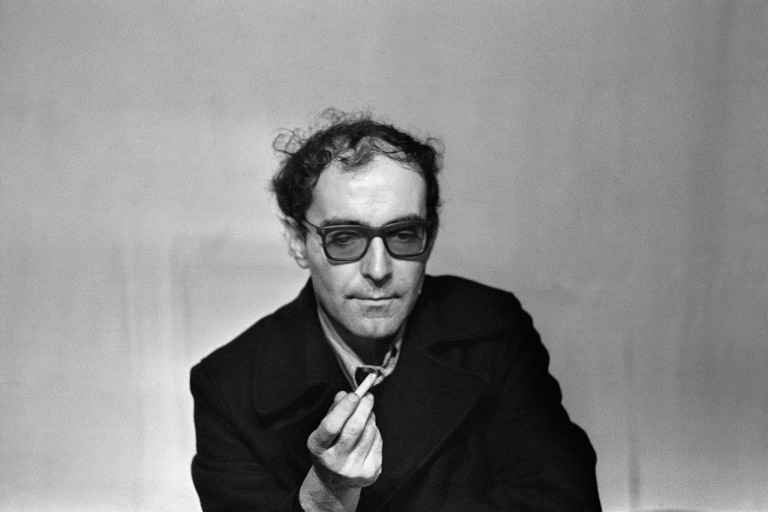
French cinema giant Jean-Luc Godard dies aged 91

Jean-Luc Godard, one of the most influential filmmakers of the 20th century and the father of the French New Wave, died “peacefully at home” on Tuesday aged 91, his family said.

His legal counsel later confirmed he died by assisted suicide.  

The legendary maverick blew up the conventions of cinema in the 1960s, shooting his gangster romance “Breathless” on the streets of Paris with a hand-held camera, using a shopping trolley for panning shots.

He continued to thumb his nose at Hollywood and an older generation of French filmmakers by breaking all the rules again in “Contempt” (1963) with Brigitte Bardot and “Pierrot le Fou” in 1965.

“No official (funeral) ceremony will take place,” his family said. “He will be cremated… And it really must happen in private.”

Godard’s legal counsel Patrick Jeanneret confirmed a report in French daily Liberation that he had resorted to assisted suicide. 

The practice is regulated in Switzerland and permitted if offered without a selfish motive to a person with decision-making capacity to end their own suffering.

“Godard had recourse to legal assistance in Switzerland for a voluntary departure as he was stricken with ‘multiple invalidating illnesses’, according to the medical report,” said Jeanneret.

Godard has lived as a virtual recluse for decades in the Swiss village of Rolle.  

– ‘National treasure’ –

It was there that he died “peacefully at home”, his wife Anne-Marie Mieville at his side, his producers said.

Godard’s influence is hard to overestimate, with directors from Martin Scorsese, Quentin Tarantino and Paul Thomas Anderson to Robert Altman, the maker of “M*A*S*H” and “The Player”, often speaking of their debt to him.

French President Emmanuel Macron hailed the director’s talent and mourned the loss of a “national treasure”.

“Jean-Luc Godard, the most iconoclastic filmmaker of the New Wave, invented a resolutely modern, intensely free art. We have lost a national treasure, a genius,” Macron tweeted.

Godard’s house, with green shutters and a green bench out front, looked empty on Tuesday, its shades drawn, with an abandoned ashtray and teapot on the windowsill, an AFP reporter said.

Despite the filmmaker’s often difficult relationship with critics, The Guardian’s Peter Bradshaw heaped praise on Godard, saying, “The last great 20th-century modernist is dead”.

He compared him to other 1960s rebels like John Lennon and Che Guevara.

“Or maybe Godard was the medium’s Socrates, believing that an unexamined cinema was not worth having,” he added.

– ‘Every edit is a lie’ –

Guy Lodge, of the screen bible Variety, tweeted that it was “glib to say ‘he changed everything’, but he sure changed a hell of a lot of things”.

Indeed, Godard became a “god” to many 1960s political and artistic radicals who would hang on every word of his often contradictory — and tongue-in-cheek — declarations on the state of cinema and the world.

“All you need for a movie is a gun and a girl,” he once proclaimed, in a nod to US actress Jean Seberg, the star of “Breathless”.

The movie was a fashion as well as a film landmark, her pixie haircut copied by millions bowled over by her effortless Parisian cool.

“A story should have a beginning, a middle and an end — but not necessarily in that order,” Godard later famously declared, and “every edit is a lie”.

As he grew older, Godard would occasionally emerge from his Swiss bolthole to make low-budget films well into his 80s.

He never, however, regained the capacity to shock or move more mainstream audiences as he had in the 1960s, though a small band of disciples remained doggedly loyal to the master.

His periodic appearances at the Cannes film festival — often via FaceTime — still drew crowds, though he no longer held the sway he did when he had managed to shut down the festival entirely in 1968 in solidarity with the student protests in Paris.

Cannes also saw the premiere in 2017 of “Redoubtable”, a tragi-comic film about Godard’s doomed romance with the French actress Anne Wiazemsky, directed by the Oscar-winning director of “The Artist”, Michel Hazanavicius.
Russia announces 'massive strikes' across Ukraine front

Russia said Tuesday it was carrying out “massive strikes” across the Ukrainian front line and accused Ukrainian soldiers of abusing civilians in territories recaptured in a dramatic counter-offensive.

Moscow’s retaliation came after it was forced to pull back its troops from swathes of the northeast, particularly in the Kharkiv region, following Kyiv’s lightning assault to wrest back terrain.

The territorial shifts marked one of Russia’s biggest setbacks since its troops were repelled from Kyiv in the earliest days of the nearly seven-month war, yet Moscow signalled it was no closer to agreeing to a negotiated peace.

“Air, rocket and artillery forces are carrying out massive strikes on units of the Ukrainian armed forces in all operational directions,” the Russian defence ministry said in its daily briefing on the conflict.

“High-precision” strikes have also been launched on Ukrainian positions around Sloviansk and Konstantinovka in the eastern Donetsk region, it added.

The Kremlin accused Kyiv’s army of abusing civilians in territory it had recaptured.

President Vladimir Putin’s spokesman said that in the Kharkiv region, reports were emerging of “outrageous” treatment of civilians.

“There are a lot of punitive measures… people are being tortured, people are being mistreated and so on,” Dmitry Peskov told journalists.

Russia’s allegations came after Ukrainian authorities claimed to have found four bodies of civilians with “signs of torture” in the recaptured eastern village of Zaliznychne.

– ‘Too early to tell’ –

Residents reported that Russian troops had killed villagers, the regional prosecutor’s office said, announcing a war crime probe.

Ukrainian forces launched their counter-offensive in early September, seemingly catching Russia’s military off guard. 

Images posted by the Ukrainian military showed crates of munitions and military hardware scattered across territory abandoned by Russian forces.

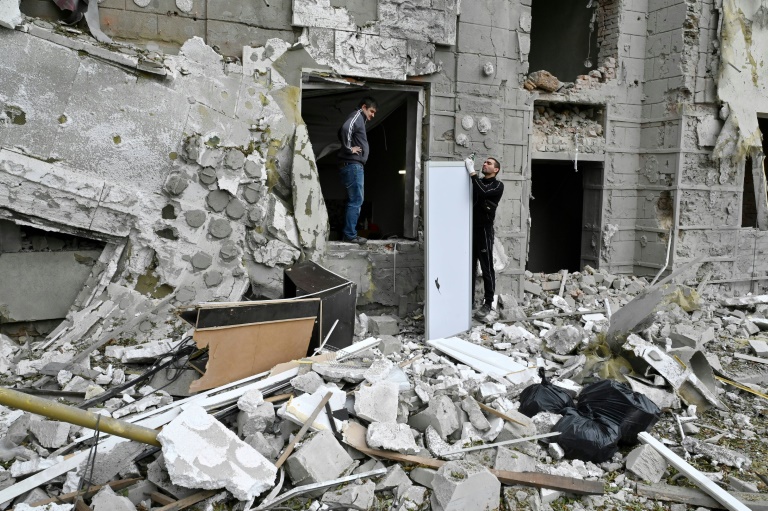
Around the north-eastern town of Balakliya, AFP journalists saw evidence of fierce battles, with buildings destroyed or damaged and streets mostly deserted.

By Monday, President Volodymyr Zelensky said that Ukraine’s forces have retaken a total of 6,000 square kilometres (2,320 square miles) from Russian control.

In the northeast, dozens of areas including the cities of Izyum, Kupiansk and Balakliya, have been retaken, Ukraine said.

Ukraine has also claimed significant gains in the southern Kherson region, where the Ukrainian army also said it had recaptured 500 square kilometres.

US Secretary of State Antony Blinken assessed that the Ukrainians had made “significant progress”, due to their resilience as well as US support.

“It’s too early to tell exactly where this is going. The Russians maintain very significant forces in Ukraine as well as equipment and arms and munitions. 

“They continue to use it indiscriminately against not just the Ukrainian armed forces but civilians and civilian infrastructure as we’ve seen,” Blinken said on Monday.

– ‘Turned the tide’ –

A US think tank, the Institute for the Study of War, tweeted: “Ukraine has turned the tide in its favour, but the current counter-offensive will not end the war.” 

Defence Minister Oleksii Reznikov told French daily Le Monde in a Monday interview that the war has entered a new phase with the help of Western weapons.

Kyiv nonetheless ramped up its calls for Western allies to rush more sophisticated weapons to help in its fight. 

“Weapons, weapons, weapons have been on our agenda since spring. I am grateful to partners who have answered our call: Ukraine’s battlefield successes are our shared ones,” Ukrainian Foreign Minister Dmytro Kuleba said.

But Germany was once again under the spotlight for failing to deliver Leopard battle tanks that Kyiv is seeking.

“Not a single rational argument on why these weapons cannot be supplied, only abstract fears and excuses,” said Kuleba, after Chancellor Olaf Scholz dodged a question on the issue on Monday, saying only that Germany would not “go-it-alone” on weapons deliveries.

Away from the battlefield, Ukraine’s allies were grappling with an energy crisis after Russia curtailed deliveries to the bloc. 

Finnish Prime Minister Sanna Marin appealed for EU unity in the face of Russian “blackmail” over energy supplies, and for more sanctions on Moscow.

Seeking emergency measures to bring down soaring energy prices, the Czech Republic, which holds the rotating presidency of the EU, called an extraordinary meeting on September 30. 

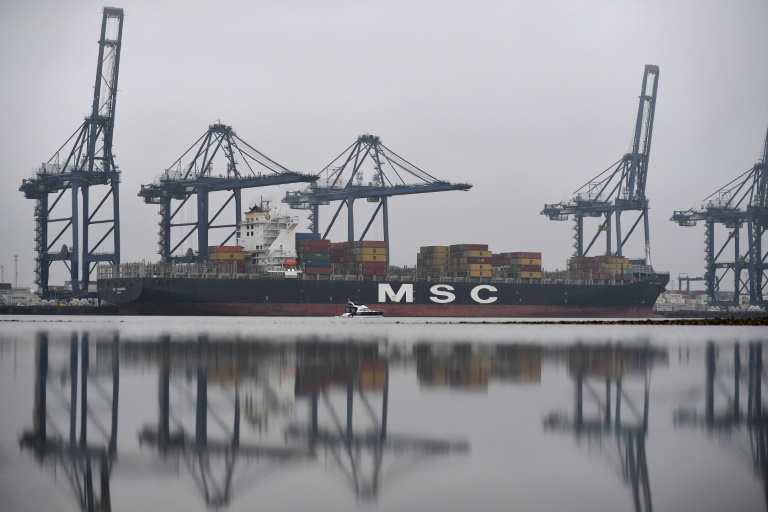
Major UK port set for fresh eight-day strike

Workers at Britain’s largest container port, Felixstowe, are to strike for a further eight days, union bosses announced Tuesday, as the country suffers a cost-of-living crisis.

The walkout from September 27 until early October 5 comes after an initial eight-day stoppage over the summer as dockers and railway staff at the port in eastern England demand pay rises to keep up with decades-high inflation.

“The latest strike action is entirely of Felixstowe’s own making,” Bobby Morton of union Unite, said in a statement.

“Rather than seeking to negotiate a deal to resolve the dispute, the company instead tried to impose a pay deal.”

Morton said the new strikes “will inevitably lead to delays and disruption to the UK’s supply chain”.

Unite said the port is responsible for almost half of the UK’s container goods.

The union said management at the Felixstowe Dock and Railway Company had “unilaterally ended pay talks after refusing to improve its pay offer and instead announced that it was imposing a pay deal of seven percent”.

UK annual inflation stands above ten percent and is set to surge further before next year as energy and food bills soar.

Felixstowe port expressed disappointment at the new walkout, adding however there is “no prospect of agreement being reached with the union”.

Britain has experienced a summer of strikes, spearheaded by tens of thousands of railway workers carrying out their biggest stoppage in 30 years, as pay offers fail to keep up with soaring inflation.

Rail staff and postal workers have however postponed walkouts planned for this week following the death of Queen Elizabeth II.

Inflation has soared around the globe this year on supply constraints after economies reopened from pandemic lockdowns, and in the wake of Russia’s invasion of Ukraine.

Portugal awaits verdict in homicide trial, 5 years after worst wildfire

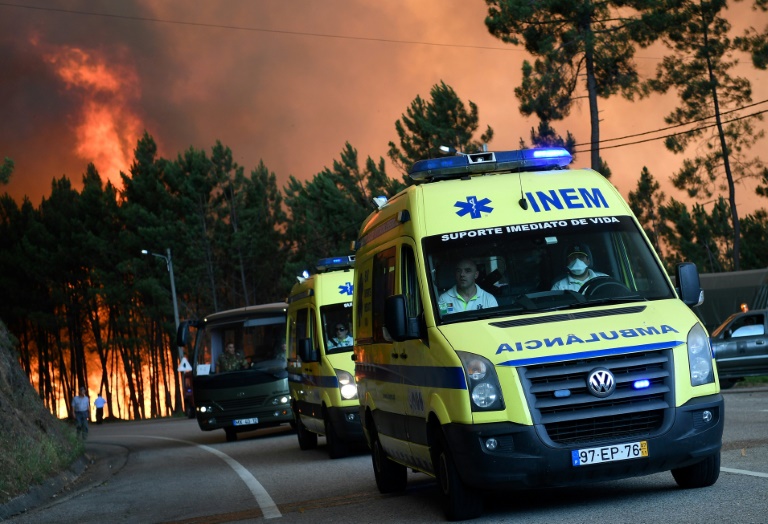
Five years after Portugal’s deadliest wildfire, which claimed 63 lives, the country was due on Tuesday to hear the verdict in the trial of 11 people accused of negligent homicide over the tragedy.

The fires broke out in the central Leiria region during a heatwave in June 2017 and burned for five days, destroying 240 square kilometres (90 square miles) of hillsides covered with pine and eucalyptus trees.

Many of the victims died trapped in their cars while trying to escape the flames, which were fanned by violent winds.

A senior firefighter and several local officials are in the dock, alongside employees of a power company and a firm responsible for maintaining a road in the Pedrogao Grande district where around 40 of the victims died.

Another 44 people were injured.

The defendants are accused of failing to prevent or combat the fire that swept through the rural area 200 kilometres (125 miles) north of Lisbon.

Several of the victims’ relatives were in the crowded courtroom in Leiria city for Tuesday’s hearing.

Prosecutors have demanded jail terms for five of the accused, which would mean sentences of at least five years.

– ‘Calm the families’ –

“We hope the verdict will calm the families,” Dina Duarte, head of the victims’ association told AFP on Monday.

She acknowledged that “no country could have been prepared” for a fire of such ferocity but said “the entire chain of command should be tried”, not just those people on the ground.

Less than six months after the Pedrogao Grande disaster, a new series of deadly wildfires broke out in the centre and north of the country, killing another 45 people.

Augusto Arnaut, who was commander of the Pedrogao Grande fire brigade at the time of the disaster in June, is accused of not taking action early enough to control the blaze before it raged out of control.

But the Portuguese Firefighters League issued a statement on Monday saying it believed Arnaut was innocent and had done all he could. 

And on Tuesday, around 100 uniformed firefighters formed a silent guard of honour for Arnaut outside the court.

Three executives from road maintenance company Ascendi could face prison too. 

Prosecutors said they had acted irresponsibly by not ensuring the clearing of vegetation from verges through which many victims sought to escape the flames.

An employee of the electricity distribution network could also face a stiff sentence because the fire was sparked by a discharge from a power cable above tinderbox scrub.

– Forests ‘neglected’ –

Several local officials from Pedrogao Grande, Castanheira de Pera and Figueiro dos Vinhos, the three worst-affected districts, are charged with failing to maintain the forests along the roads and under power lines.

Prime Minister Antonio Costa accepted the state bore some responsibility in the fires of June and October 2017, which killed 117 people. The victims’ relatives received compensation worth a total of 31 million euros.

The Socialist leader promised to overhaul Portugal’s firefighting capacity, burying power lines and turning the largely volunteer fire brigades into professional forces.

But forestry engineer Paulo Pimenta de Castro told AFP the situation now was “worse than in 2017”.

“Many forested areas are just left neglected (and) there has been no root and branch reform to firefighting, just superficial changes,” he said. 

He gave the example of a wildfire just last month that destroyed another 240 square kilometres, this time in the protected Serra da Estrela Natural Park, also in central Portugal.

Ruto pledges to work for all Kenyans after swearing-in

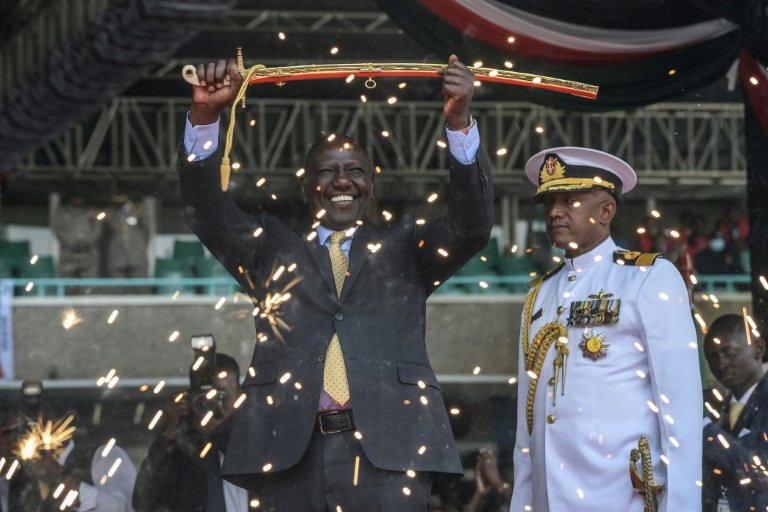
William Ruto pledged to work for all Kenyans after he was sworn in as president at a pomp-filled ceremony on Tuesday, five weeks after his narrow victory in a bitterly-fought but largely peaceful election.

Tens of thousands of people joined regional heads of state at a packed stadium in Nairobi to watch him take the oath of office, with many spectators clad in the bright yellow of Ruto’s party, cheering loudly and waving Kenyan flags.

“I will work with all Kenyans irrespective of who they voted for,” the 55-year-old said in his inauguration speech, announcing a series of measures to tackle the country’s economic woes.

“In this process we have demonstrated the maturity of our democracy, the robustness of our institutions and the resilience of the Kenyan people.”

He described his swearing-in as Kenya’s fifth post-independence president as a “moment like no other,” adding: “Today, I want to thank God, because a village boy has become the president of Kenya.” 

A notoriously ambitious politician who has been deputy president since 2013, Ruto beat his rival Raila Odinga — who had the backing of now former president Uhuru Kenyatta — by less than two percentage points in the August 9 poll.

But the Supreme Court on September 5 unanimously upheld his victory, dismissing his opponents’ claims of fraud and mismanagement.

The rags-to-riches businessman, who once sold chickens on the roadside, faces a daunting task ahead with the country hit by a deep cost-of-living crisis, youth unemployment and a punishing drought.

– ‘Dawn of Ruto era’ – 

African Union Commission chair Moussa Faki Mahamat, who was at the ceremony, hailed the peaceful transfer of power in a post on Twitter, saying it was “an enduring feature of the country’s political maturity”.

The rise of the self-proclaimed “hustler-in-chief” has been closely watched by the international community, which looks to Kenya as a reliable and stable democracy in a turbulent region.

“Dawn of Ruto era,” trumpeted the front-page headline in The Standard newspaper, while The Star said: “Time for Ruto.” 

Several people were injured earlier as crowds tried to force their way into the stadium. Television footage showed dozens of people falling on top of one other in a crush at one entrance gate.

Foreign allies and independent observers praised the conduct of the vote, which was mostly peaceful and free of the violence that has marred past elections in the country of 50 million people.

Kenyatta, who in a stunning turn of events reached a pact with his longtime rival Odinga in 2018 and banished his deputy Ruto to the sidelines, had promised a smooth transfer of power.

The 60-year-old had pointedly failed to publicly congratulate his successor for several weeks, finally shaking Ruto’s hand at a meeting at the presidential residence on Monday.

And Ruto’s new deputy Rigathi Gachagua took potshots at Kenyatta during the inauguration ceremony, saying the new administration had inherited a “dilapidated economy”.

Odinga, meanwhile, turned down an invitation to attend the event, charging that the election commission did not conduct a “free and fair” poll.

– ‘Forge united front’ –

Observers say Ruto faces a tough assignment building goodwill after the divisive political campaign that lasted well over a year and was peppered with acrimony and personal slander.

“This is the time to close ranks, embrace opponents and help forge a united front devoid of cheap political competition,” The Standard wrote in an editorial.

Many Kenyans had stayed away from the ballot box, with disillusionment and economic hardship blamed for the low turnout.

“Given sky-high popular expectations and an economy in dire straits, governing may well prove tougher than campaigning,” the International Crisis Group think tank warned.

Ruto, whose new presidential coat of arms bears his party symbol, the humble wheelbarrow, will get a salary of about $144,000 a year as well as all the trappings of presidential office.

His inauguration marks the end of Kenyatta’s near decade in power, and one of the rare occasions his powerful family has not been at the apex of Kenyan politics.

Already one of Kenya’s wealthiest citizens, he is entitled to a generous send-off under the constitution as he leaves office having served the maximum two terms allowed — a tax-free lump sum of $324,000 and more than $600,000 in allowances each year.

'Not my king': anti-monarchist arrests spark criticism in Britain

British police faced criticism from civil liberties groups on Tuesday over their treatment of anti-monarchy protesters who have publicly challenged King Charles III’s accession to the throne and the groundswell of public support for the royal family.  

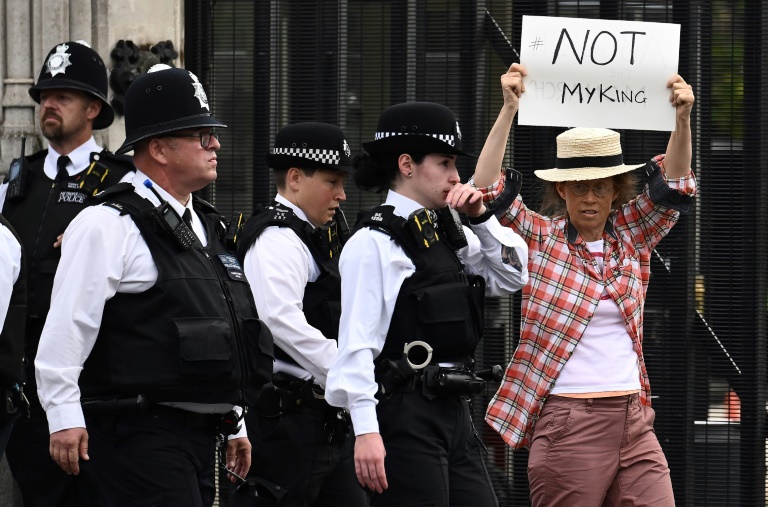
Footage went viral on social media on Monday of a female protester holding aloft a “Not My King” protest placard who was then confronted by at least four officers outside the UK parliament in London.

She was seen being escorted away from the spot, and was reportedly made to stand at another location away from the gates of parliament.

Lawyer and climate activist Paul Powlesland also wrote on Twitter that he had been warned by an officer that he risked arrest after he held up a blank piece of paper opposite parliament.

“He confirmed that if I wrote, ‘Not My King’ on it, he would arrest me under the Public Order Act because someone might be offended,” he wrote alongside video showing him talking to an officer. 

Britain is in national mourning for Queen Elizabeth II, with the death of the 96-year-old monarch provoking a rare moment of national unity amid an outpouring of sympathy for the royals.

But it has also raised questions about the space for dissent, with several civil liberties groups warning that police are failing to respect the rights of the small minority of anti-monarchists.

“If people are being arrested simply for holding protest placards then it is an affront to democracy and highly likely to be unlawful,” Big Brother Watch said in a statement.

“Police officers have a duty to protect people’s right to protest as much as they have a duty to facilitate people’s right to express support, sorrow, or pay their respects.”

In another incident, a 45-year-old man was arrested in Oxford in southern England on Sunday after he shouted “Who elected him?” during a public proclamation of Charles III’s accession. 

Jodie Beck, from the Liberty campaign group, said that the right to protest was “a vital part of a healthy and functioning democracy.”

“It is very worrying to see the police enforcing their broad powers in such a heavy-handed and punitive way to clamp down on free speech and expression,” she said in a statement.

– ‘Fundamental right’ –

London’s Metropolitan Police force appeared to acknowledge the over-zealous actions of some officers late on Monday.

“The public absolutely have a right to protest,” said deputy assistant commissioner Stuart Cundy.

“We have been making this clear to all officers involved in the extraordinary policing operation currently in place and we will continue to do so.”

The queen’s coffin was put on public display for the first time on Monday in Edinburgh following a silent procession that saw a young man shout out at Prince Andrew, the queen’s second son, as he marched behind the hearse. 

The heckler, who called Andrew a “sick old man” in reference to his links to American paedophile financier Jeffry Epstein, was shown being bundled away and escorted by police.

Bystanders reacted by shouting “God Save the King!”

Scottish police confirmed that two people had been arrested and charged on Monday for public order offences. 

Another woman who held an “abolish monarchy” sign at a proclamation ceremony for King Charles III in Edinburgh on Sunday has also been charged, reports said.

“Obviously this is a period of national mourning for the majority, the vast, vast majority of the country,” a spokesman for Prime Minister Liz Truss told reporters in London on Tuesday. 

“But the fundamental right to protest remains a keystone of our democracy.”

The 1986 UK Public Order Law gives the police powers of arrest for people judged to be guilty of causing “harassment, alarm or distress” through “threatening words or behaviour, or disorderly behaviour,” including by holding up signs. 

The right-wing Conservative government faced severe criticism from civil liberties groups over a new policing law earlier this year which increased the power of security forces to restrict protests.

Anti-monarchists are a fringe group in Britain, with 13 percent of respondents viewing the monarchy as “bad for Britain” according to a poll in May this year by the YouGov survey group.

A total of 54 percent viewed it as “good” for the country. 

Charles III in historic visit to N.Ireland

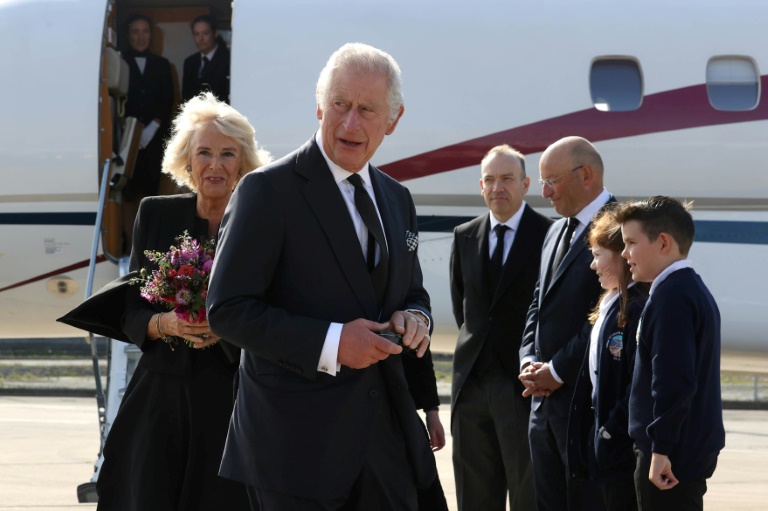
Charles III on Tuesday made his maiden visit to Northern Ireland as king, as he tours all four nations of the United Kingdom before the state funeral of his mother Queen Elizabeth II.

The 73-year-old head of state’s jet touched down in Belfast from Edinburgh, where the late queen’s coffin was brought after her death last week aged 96.

The casket will be flown on Tuesday evening to London, where huge crowds are expected to pay their respects as she lies in state from Wednesday evening until her funeral on Monday morning.

As heir-to-the-throne, Charles made 39 visits to Northern Ireland, whose recent history has been scarred by sectarian violence over British rule and where a fragile peace has held since 1998.

His 40th visit comes as unionists loyal to the Crown feel their place in the wider UK is under threat as never before, with nationalists set to lead the devolved government in Belfast for the first time.

Meanwhile the possibility of a united Ireland is seen as growing.

At Hillsborough Castle — the monarch’s official residence in Northern Ireland — he and his wife, Queen Consort Camilla, greeted crowds who had turned out early to catch a glimpse of the couple.

Ceremonial gun salutes in his honour then rang out as the royal standard was raised above the castle southwest of Belfast.

– ‘Behind him’ –

Flowers, cuddly toys and handwritten remembrance notes of the late queen had been left at the gates.

“This is very important for Charles to come here and be in Royal Hillsborough,” Rhonda Irvine, 47, a wedding and events administrator, told AFP, using the village’s full title after it was given official royal status last year.

Describing Charles’s late mother as an “inspiration for him”, she predicted he would be a “very good” king.

Ann Sudlow, 61, a retired nurse from nearby Dromore, had also made the early morning drive “to show the king that we’re behind him as a country and Northern Ireland is supporting him”.

While large crowds welcomed Charles, visiting the deeply divided region could prove testing. Nationalist parties boycotted the proclamation of the new king but will meet him.

Belfast’s feuding political leaders are split between fiercely loyal unionists and nationalists who want to reunify with Ireland, and the power-sharing assembly in Belfast is suspended.

Unionists are boycotting the devolved parliament at Stormont because of their opposition to post-Brexit trading rules that they say cuts Northern Ireland adrift from mainland Great Britain — England, Scotland and Wales.

Charles will attend an Anglican religious service in the city where the president, prime minister and foreign minister of Ireland are also expected.

– Crowds –

Britain is in 10 days of national mourning for Elizabeth II, who was a fixture of the nation’s life and consciousness for seven decades.

Charles has seen his popularity recover since the death of his former wife Diana in a 1997 car crash — and surge in recent days, according to a new survey Tuesday. 

But he has also been embroiled in several scandals in recent years.

With republican movements gaining ground from Australia to the Bahamas, the new king faces a challenge keeping the Commonwealth realms in the royal fold.

Prime Minister Jacinda Ardern said her country New Zealand, where Charles is also head of state, will likely become a republic in her lifetime.

But she told a news conference in Wellington: “I don’t see it as a short-term measure or anything that is on the agenda soon.”

The queen’s coffin will be moved from St Giles’ Cathedral in Edinburgh on Tuesday afternoon, and flown to an airbase near London, accompanied by her only daughter, Princess Anne.

Thousands of people are expected to line the route as the hearse drives the queen’s body to Buckingham Palace in central London, which has become the focal point for floral and other tributes.

The scenes in Edinburgh, where the queen’s body was brought on Sunday from Balmoral, the Scottish Highland retreat where she died last Thursday, have given a taster of the days ahead.

Thousands of people queued throughout the night to pay their respects after Charles, Anne and their two siblings, Andrew and Edward, held a 10-minute vigil inside the 12-century cathedral.

Images of the poignant scene dominated the front pages of Britain’s newspapers on Tuesday.

“The Queen’s guard,” headlined The Times alongside a photograph of a sombre-looking Charles.

“It’s part of history. We are pensioners… we’ll never see this again,” Lynn Templeton, visiting Edinburgh from northwest England, told AFP after filing past the coffin.

One woman, who gave her name only as Vicki, took an early train from Glasgow with her nine-year-old son “just to pay our respects”.

It’s “just a moment in history, once in a lifetime,” she said.

– Security –

An unprecedented security operation is being put in place for the state funeral on Monday, which is expected to be attended by hundreds of heads of state and government, as well as global royalty.

Soldiers from the Household Division of regiments, which form the monarch’s bodyguard, began practising for the funeral procession in London overnight Monday to Tuesday.

At precisely 2:22 pm (1322 GMT) on Wednesday, the queen’s coffin will be taken from Buckingham Palace to Westminster Hall, the oldest part of the parliamentary estate.

Tens of thousands of people turned out in Edinburgh on Monday to witness the queen’s coffin being taken from the monarch’s official residence in Scotland, the Palace of Holyroodhouse, to St Giles’.

Charles and his siblings followed the coffin up the majestic Royal Mile in near silence punctuated only by the sound of cannon fire at one-minute intervals from the ramparts of Edinburgh Castle.

Hundreds of thousands of mourners are expected in London to file past the queen’s coffin at Westminster, with queues predicted to snake for several miles (kilometres) along the River Thames. 

More are set to flood the streets in the run-up to the funeral and on the day itself.

The first arrived for the lying-in-state queue on Monday — more than 48 hours before the line opens.

“It’s going to be emotional,” said Vanessa Nanthakumaran, a 56-year-old administration assistant originally from Sri Lanka.

“It’s going to be a once-in-a-lifetime chance to be part of this unique event,” she told AFP.

bur-am-jit-phz/jj/ah

Russia announces 'massive strikes' on Ukraine front

Russia said Tuesday it was carrying out “massive strikes” across the Ukrainian front line and accused Ukrainian soldiers of abusing civilians in territories recaptured in a dramatic counter-offensive.

Moscow’s retaliation came after it was forced to pull back its troops from swathes of the northeast, particularly in the Kharkiv region, following Kyiv’s lightning assault to wrest back terrain.

The territorial shifts marked one of Russia’s biggest setbacks since its troops were repelled from Kyiv in the earliest days of the nearly seven-month war, yet Moscow signalled it was no closer to agreeing to a negotiated peace.

“Air, rocket and artillery forces are carrying out massive strikes on units of the Ukrainian armed forces in all operational directions,” the Russian defence ministry said in its daily briefing on the conflict.

“High-precision” strikes have also been launched on Ukrainian positions around Sloviansk and Konstantinovka in the eastern Donetsk region, it added.

The Kremlin accused Kyiv’s army of abusing civilians in territory it had recaptured.

President Vladimir Putin’s spokesman said that in the Kharkiv region, reports were emerging of “outrageous” treatment of civilians.

“There are a lot of punitive measures… people are being tortured, people are being mistreated and so on,” Dmitry Peskov told journalists.

Russia’s allegations came after Ukrainian authorities claimed to have found four bodies of civilians with “signs of torture” in the recaptured eastern village of Zaliznychne.

– ‘Too early to tell’ –

Residents reported that Russian troops had killed villagers, the regional prosecutor’s office said, announcing a war crime probe.

Ukrainian forces launched their counter-offensive in early September, seemingly catching Russia’s military off guard. 

Images posted by the Ukrainian military showed crates of munitions and military hardware scattered across territory abandoned by Russian forces.

Around the north-eastern town of Balakliya, AFP journalists saw evidence of fierce battles, with buildings destroyed or damaged and streets mostly deserted.

By Monday, President Volodymyr Zelensky said that Ukraine’s forces have retaken a total of 6,000 square kilometres (2,320 square miles) from Russian control.

In the northeast, dozens of areas including the cities of Izyum, Kupiansk and Balakliya, have been retaken, Ukraine said.

Ukraine has also claimed significant gains in the southern Kherson region, where the Ukrainian army also said it had recaptured 500 square kilometres.

US Secretary of State Antony Blinken assessed that the Ukrainians had made “significant progress”, due to their resilience as well as US support.

“It’s too early to tell exactly where this is going. The Russians maintain very significant forces in Ukraine as well as equipment and arms and munitions. 

“They continue to use it indiscriminately against not just the Ukrainian armed forces but civilians and civilian infrastructure as we’ve seen,” Blinken said on Monday.

– ‘Turned the tide’ –

A US think tank, the Institute for the Study of War, tweeted: “Ukraine has turned the tide in its favour, but the current counter-offensive will not end the war.” 

Defence Minister Oleksii Reznikov told French daily Le Monde in a Monday interview that the war has entered a new phase with the help of Western weapons.

Kyiv nonetheless ramped up its calls for Western allies to rush more sophisticated weapons to help in its fight. 

“Weapons, weapons, weapons have been on our agenda since spring. I am grateful to partners who have answered our call: Ukraine’s battlefield successes are our shared ones,” Ukrainian Foreign Minister Dmytro Kuleba said.

But Germany was once again under the spotlight for failing to deliver Leopard battle tanks that Kyiv is seeking.

“Not a single rational argument on why these weapons cannot be supplied, only abstract fears and excuses,” said Kuleba, after Chancellor Olaf Scholz dodged a question on the issue on Monday, saying only that Germany would not “go-it-alone” on weapons deliveries.

Away from the battlefield, Ukraine’s allies were grappling with an energy crisis after Russia curtailed deliveries to the bloc. 

Finnish Prime Minister Sanna Marin appealed for EU unity in the face of Russian “blackmail” over energy supplies, and for more sanctions on Moscow.

Seeking emergency measures to bring down soaring energy prices, the Czech Republic, which holds the rotating presidency of the EU, called an extraordinary meeting on September 30. 

Thai court orders rehab work on 'The Beach' 22 years after filming

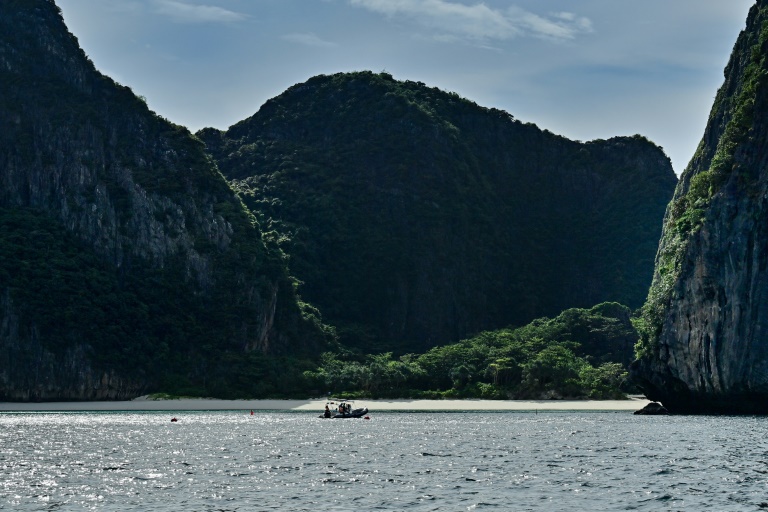
More than two decades after Hollywood film “The Beach” was shot at Thailand’s glittering Maya Bay, the kingdom’s Supreme Court on Tuesday ordered officials to press ahead with environmental rehabilitation work.

The 2000 adventure drama, starring Leonardo DiCaprio, drew criticism for the impact of the shoot on the pristine sands of the bay, located on the island of Ko Phi Phi Ley in southern Thailand.

Film-makers planted dozens of coconut trees to give a more “tropical” feel to the glimmering Maya Bay and were also accused of ripping up vegetation growing on sand dunes.

However, US production studio 20th Century Fox insisted it left the beach exactly how it had found it and had removed tonnes of rubbish.

Local authorities filed a civil lawsuit in late 1999 against Thai government agencies, US filmmaker 20th Century Fox and a Thai film coordinator, seeking 100 million baht in compensation for environmental damage.

On Tuesday, the Supreme Court in Bangkok upheld a previous ruling by a Civil Court that the Royal Forest Department was liable for rehabilitating Maya Bay.

In a final ruling, the Supreme Court ordered the department to set up a committee to formulate a rehabilitation plan within 30 days.

Environmental campaigners launched two unsuccessful legal challenges to stop filming of the movie based on Alex Garland’s cult novel, over concerns about ecological damage.

The film put Maya Bay on the map and it became a victim of mass tourism.

It was closed in October 2018 to allow it to recover from the impact of a daily influx of some 6,000 visitors.

The entire Phi Phi archipelago was forced into a convalescence when the global pandemic hit and visitor numbers dwindled to virtually nil as Thailand imposed tough travel rules.

Maya Bay reopened to tourists at the start of 2022 but visitor numbers are capped to try to limit the ecological damage.

Pope arrives in Kazakhstan to promote 'dialogue'

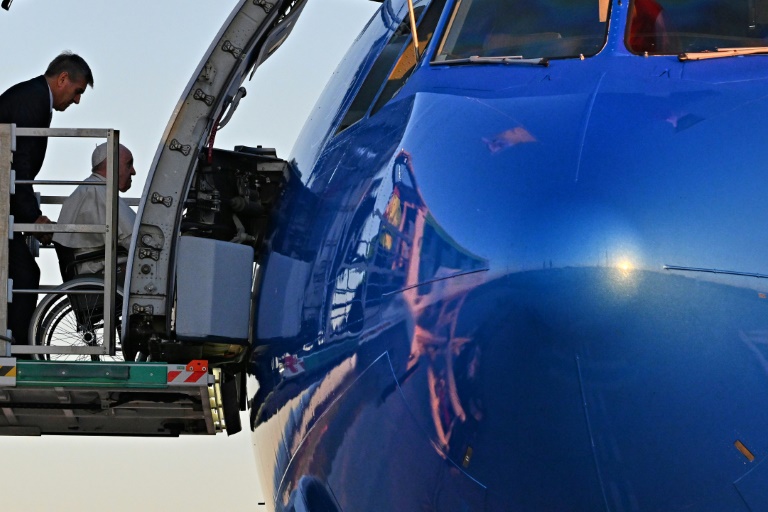
Pope Francis, warned by doctors not to travel to Ukraine, arrived in Kazakhstan in Central Asia on Tuesday for a three-day visit to promote dialogue and peace in the ex-Soviet region. 

The Argentine pope, who is forced by knee pain to use a wheelchair and has admitted he must slow down or consider retirement, will take part in an inter-religious summit in the capital, Nur-Sultan.

His plane landed shortly after 5:15 pm (1115 GMT), an AFP journalist onboard said, and the 85-year-old pontiff was already meeting shortly after with President Kassym-Jomart Tokayev before giving a first speech to the authorities and the diplomatic corps.

Francis said Sunday that the 38th trip abroad since his election in 2013 would be “an opportunity… to (have a) dialogue as brothers, animated by the common desire for peace, peace that our world is thirsty for”.

Russian Orthodox Patriarch Kirill, a close ally of President Vladimir Putin, was initially expected but has pulled out of the September 14-15 event, dashing hopes of a meeting with Francis over the Ukraine conflict.

While the pope has called for peace and denounced a “cruel and senseless war”, Kirill has defended Putin’s “military operation” and the fight against Russia’s “external and internal enemies”.

About 100 delegations from 50 countries are expected to take part in the event in Kazakhstan, a former Soviet republic that gained independence in 1991.

“Dialogue, a coming together, the search for peace between different religious and cultural worlds are at the heart of this trip,” Vatican spokesman Matteo Bruni said Monday.

– Tensions –

Tokayev, 69, is an ally of Russia, though there have been tensions between the two countries since Moscow launched the invasion in February.

He has refused to support the war and the presence of a large Russian community in the north of Kazakhstan has sparked fears of a revival of Moscow’s imperial ambitions in the area.

Kazakhstan borders other former Soviet republics, as well as China and the Caspian Sea.

Lyudmila, a 74-year-old pensioner who declined to give her last name, said she hoped the Papal visit would encourage people around the world to learn more about Kazakhstan.

“Maybe it will raise the profile of our country, that such a great spiritual figure is visiting us,” she told AFP.

On Wednesday, Francis will address the opening of the plenary session of the Congress of Leaders of World and Traditional Religions, before celebrating a mass in the afternoon and winding up his trip Thursday by meeting Catholic leaders.

Chinese President Xi Jinping will be in the country at the same time as Francis at a time when the Vatican is hoping to renew a historic accord appointing bishops in China.

Asked by journalists during the flight about a possible meeting with Xi, Francis said he had “no information” about any possible talks.

He added, however, that he was “always ready to go to China”.

Energy-rich Kazakhstan has 19 million inhabitants, 70 percent of whom are Sunni Muslims, while 26 percent are Christians — mainly Russian Orthodox. Less than one percent are Catholic.

Tokayev began a series of reforms after his election in 2019, but the country was rocked by protests over fuel prices earlier this year that left more than 200 people dead and shattered its image of stability.

Francis is the second pope to visit Kazakhstan after John Paul II’s trip in September 2001.

He said last week that doctors had forbidden him from travelling to Ukraine or Moscow for now, as he recovers from a knee problem that has forced him to cancel numerous events at the Vatican.

Close Bitnami banner
Bitnami