World

Asian and European markets rally, euro surges

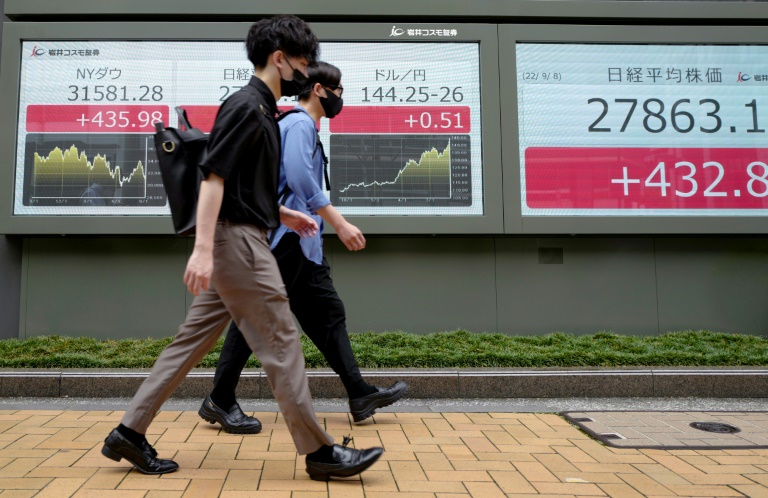
Asian and European markets rallied on Monday, building on the momentum of gains in the United States and elsewhere at the end of last week, as investors price in the expectation of further interest rate hikes aimed at taming inflation.

The euro surged in early trading, a day after German central bank chief Joachim Nagel signalled that the European Central Bank (ECB) would probably continue raising its key rate.

The European single currency rocketed more than 1.4 percent against the dollar and 1.6 percent versus the yen.

The ECB raised the key rate by a historic 75 basis points last week, and markets expect a similar-sized hike at an October meeting.

Nagel predicted inflation in Europe might peak at more than 10 percent in December.

London, Paris and Frankfurt all opened higher on Monday, with bourses in Japan, Australia, Singapore, Taiwan, Jakarta, Malaysia and Thailand also rising.

Markets in Hong Kong, China and South Korea were closed for a public holiday.

This week, investors worldwide will be closely watching US inflation data for August, due to be released on Tuesday, with the consumer price index (CPI) expected to ease slightly to eight percent — still well above the Fed’s two-percent target.

Traders expect the Fed to impose another large rate hike next week, after two 75-basis-point increases already.

“A downside surprise in US CPI is likely more of a concern and that could see the dollar weakening further,” Charu Chanana, a strategist at Saxo Capital Markets, told Bloomberg Television.

Clifford Bennett, chief economist at ACY Securities, said he expected stocks to “continue to drift higher” ahead of Tuesday’s US CPI data.

“(US CPI) may well see further improvement as petrol prices have continued to pull back,” he said. 

“Other components are still likely to be pointing higher, but fuel prices could well dominate this CPI number.” 

Oil began the week flat, as investors weigh the possibility of global demand weakening as growth slows and China’s harsh zero-Covid policy continues to sap economic activity.

On Monday, new data showed British GDP expanded by 0.2 percent in July, according to the Office for National Statistics. 

Concerns remain, however, about the overall health of the UK economy. 

“July’s GDP remains below the level seen in May, pointing to an overall contraction over the first two months of summer,” said Yael Selfin, chief economist at KPMG UK. 

– ‘Soft landing’ hopes –

US Treasury Secretary Janet Yellen on Sunday said she was hopeful the US economy could avoid a recession, but that the Fed would need to skilfully manage interest rates and also rely on “some good luck to achieve what we sometimes call a soft landing”.

“My hope is we will achieve a soft landing, but Americans know it’s essential to bring inflation down and, over the longer run, we can’t have a strong labour market without inflation under control,” she told CNN.

Yellen said that while the US economy’s growth rate was slowing, the labour market remained “exceptionally strong”, with almost two openings for every jobseeker.

In addition to the US CPI figures on Tuesday, traders will be closely watching UK CPI on Wednesday, and European CPI and China home sales, retail sales and industrial production data on Friday.

In Tokyo, stocks closed higher on Monday with gains by tech shares and a weaker yen boosting the market.

The dollar fetched 143.18 yen in Asian trade, against 142.56 yen on Friday in New York.

“A cheaper yen is positive for corporate performances, despite recent media reports” that highlight the negative aspects of the weak yen, said chief strategist Masayuki Kubota of Rakuten Securities.

On Friday, Bank of Japan chief Haruhiko Kuroda met Prime Minister Fumio Kishida, saying the rapid weakening of the currency was “undesirable”, an indication of possible upcoming action to arrest the fall.

– Key figures at around 0830 GMT –

Tokyo – Nikkei 225: UP 1.2 percent at 28,542.11 (close) 

Hong Kong – Hang Seng Index: closed for public holiday

Shanghai – Composite: closed for public holiday

New York – Dow: UP 1.2 percent at 32,151.71 (close)

New York – S&P 500: UP 1.5 percent at 4,067.36 (close)

New York – Nasdaq: UP 2.1 percent at 12,112.31 (close)

London – FTSE 100: UP 1.2 percent at 7,436.07 

Frankfurt – DAX: UP 1.4 percent at 13,268.26 

Paris – CAC 40: UP 1.0 percent at 6,275.81 

EURO STOXX 50: UP 1.2 percent at 3,612.75

Euro/dollar: UP at $1.0185 from $1.0046 

Pound/dollar: UP at $1.1691 from $1.1587  

Euro/pound: UP at 87.12 pence from 86.84 pence

Dollar/yen: UP at 142.77 yen from 142.56 yen 

Brent North Sea crude: UP 0.1 percent at $92.92 per barrel

West Texas Intermediate: DOWN 0.1 percent at $86.73 per barrel
Asian and European markets rally, euro surges

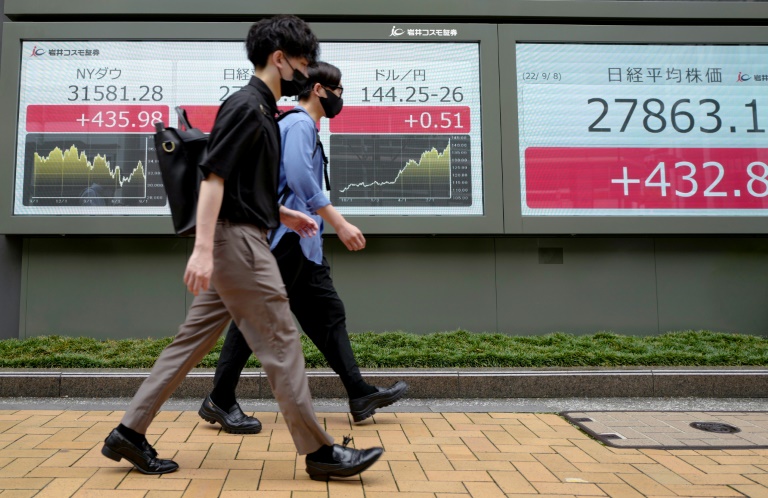
Asian and European markets rallied on Monday, building on the momentum of gains in the United States and elsewhere at the end of last week, as investors price in the expectation of further interest rate hikes aimed at taming inflation.

The euro surged in early trading, a day after German central bank chief Joachim Nagel signalled that the European Central Bank (ECB) would probably continue raising its key rate.

The European single currency rocketed more than 1.4 percent against the dollar and 1.6 percent versus the yen.

The ECB raised the key rate by a historic 75 basis points last week, and markets expect a similar-sized hike at an October meeting.

Nagel predicted inflation in Europe might peak at more than 10 percent in December.

London, Paris and Frankfurt all opened higher on Monday, with bourses in Japan, Australia, Singapore, Taiwan, Jakarta, Malaysia and Thailand also rising.

Markets in Hong Kong, China and South Korea were closed for a public holiday.

This week, investors worldwide will be closely watching US inflation data for August, due to be released on Tuesday, with the consumer price index (CPI) expected to ease slightly to eight percent — still well above the Fed’s two-percent target.

Traders expect the Fed to impose another large rate hike next week, after two 75-basis-point increases already.

“A downside surprise in US CPI is likely more of a concern and that could see the dollar weakening further,” Charu Chanana, a strategist at Saxo Capital Markets, told Bloomberg Television.

Clifford Bennett, chief economist at ACY Securities, said he expected stocks to “continue to drift higher” ahead of Tuesday’s US CPI data.

“(US CPI) may well see further improvement as petrol prices have continued to pull back,” he said. 

“Other components are still likely to be pointing higher, but fuel prices could well dominate this CPI number.” 

Oil began the week flat, as investors weigh the possibility of global demand weakening as growth slows and China’s harsh zero-Covid policy continues to sap economic activity.

On Monday, new data showed British GDP expanded by 0.2 percent in July, according to the Office for National Statistics. 

Concerns remain, however, about the overall health of the UK economy. 

“July’s GDP remains below the level seen in May, pointing to an overall contraction over the first two months of summer,” said Yael Selfin, chief economist at KPMG UK. 

– ‘Soft landing’ hopes –

US Treasury Secretary Janet Yellen on Sunday said she was hopeful the US economy could avoid a recession, but that the Fed would need to skilfully manage interest rates and also rely on “some good luck to achieve what we sometimes call a soft landing”.

“My hope is we will achieve a soft landing, but Americans know it’s essential to bring inflation down and, over the longer run, we can’t have a strong labour market without inflation under control,” she told CNN.

Yellen said that while the US economy’s growth rate was slowing, the labour market remained “exceptionally strong”, with almost two openings for every jobseeker.

In addition to the US CPI figures on Tuesday, traders will be closely watching UK CPI on Wednesday, and European CPI and China home sales, retail sales and industrial production data on Friday.

In Tokyo, stocks closed higher on Monday with gains by tech shares and a weaker yen boosting the market.

The dollar fetched 143.18 yen in Asian trade, against 142.56 yen on Friday in New York.

“A cheaper yen is positive for corporate performances, despite recent media reports” that highlight the negative aspects of the weak yen, said chief strategist Masayuki Kubota of Rakuten Securities.

On Friday, Bank of Japan chief Haruhiko Kuroda met Prime Minister Fumio Kishida, saying the rapid weakening of the currency was “undesirable”, an indication of possible upcoming action to arrest the fall.

– Key figures at around 0830 GMT –

Tokyo – Nikkei 225: UP 1.2 percent at 28,542.11 (close) 

Hong Kong – Hang Seng Index: closed for public holiday

Shanghai – Composite: closed for public holiday

New York – Dow: UP 1.2 percent at 32,151.71 (close)

New York – S&P 500: UP 1.5 percent at 4,067.36 (close)

New York – Nasdaq: UP 2.1 percent at 12,112.31 (close)

London – FTSE 100: UP 1.2 percent at 7,436.07 

Frankfurt – DAX: UP 1.4 percent at 13,268.26 

Paris – CAC 40: UP 1.0 percent at 6,275.81 

EURO STOXX 50: UP 1.2 percent at 3,612.75

Euro/dollar: UP at $1.0185 from $1.0046 

Pound/dollar: UP at $1.1691 from $1.1587  

Euro/pound: UP at 87.12 pence from 86.84 pence

Dollar/yen: UP at 142.77 yen from 142.56 yen 

Brent North Sea crude: UP 0.1 percent at $92.92 per barrel

West Texas Intermediate: DOWN 0.1 percent at $86.73 per barrel

Papua New Guinea quake toll rises to seven

The death toll from a massive earthquake in Papua New Guinea rose to seven Monday and is expected to grow as rescuers begin to reach remote landslide-hit communities.

Police Commissioner David Manning said the victims of Sunday’s 7.6-magnitude quake had been found across the central north of the country, where there is widespread damage to homes and infrastructure.

“The tremors caused damage to buildings and public roads” he said, adding “a number of landslides were triggered.”

Three alluvial miners were buried alive near the settlement of Wau and four others died in locations across Morobe and Madang provinces, Manning said.

University of Goroka buildings were badly damaged and “there are reports of injuries to students on the campus and they have been admitted to hospital,” said Manning.

Missionary groups and private aviation firms have been trying to reach isolated communities and airlift the injured to safety.

Aerial reconnaissance by the Mission Aviation Fellowship indicated “visible slides in the Nankina area and that some are still actively slipping”, according to the UN’s Papua New Guinea Disaster Management Team.

Many people are feared to have been displaced but early on-the-ground assessments have been sketchy.

Papua New Guinea Red Cross secretary-general Valachie Quagliata said the area’s rough mountainous terrain made access difficult, with the worst affected areas not accessible by car.

According to a UN assessment, the earthquake damaged the Ramu hydropower plant “resulting in a total system outage across the Highlands provinces, Madang, and Morobe”.

“There will be major interruptions to power going forward,” Quagliata said.

An undersea cable linking the regional capital Madang to Port Moresby was also affected by the quake, as was a link between Madang and Sydney.

Parts of the vital Highlands Highway, which connects several of Papua New Guinea’s main cities, have been damaged.

However, regional airports in Goroka and Lae-Nadzab remained open with no damage reported, according to the United Nations.

Prime Minister James Marape has warned Papua New Guineans to be cautious after the “massive” earthquake, but said its impact was expected to be less than a 2018 quake which killed 150 people.

The country’s national coronavirus hotline has been redirected to take calls from people affected by the earthquake.

The quake struck at a depth of 61 kilometres (38 miles), about 67 kilometres from the town of Kainantu, according to the US Geological Survey.

Papua New Guinea sits on the Pacific “Ring of Fire”, causing it to experience frequent earthquakes. 

Queen's funeral set to knock UK economy after rebound

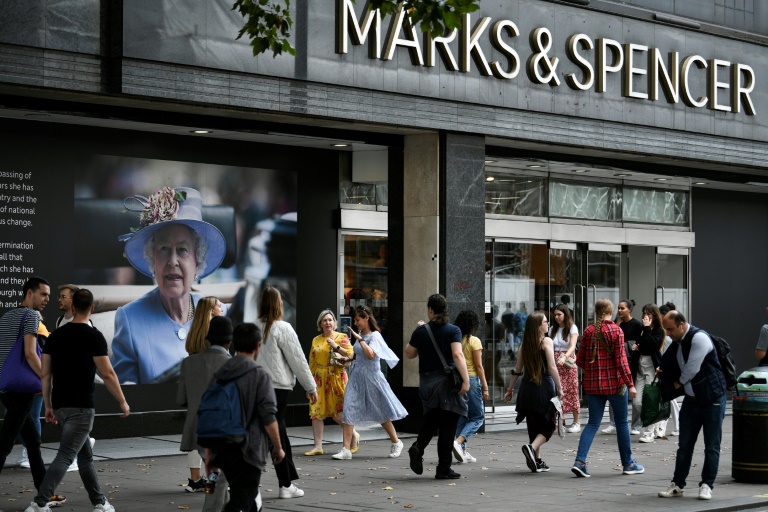
The UK’s recession-threatened economy rebounded in July, data showed Monday, but is set to receive a further hit from a public holiday marking next week’s funeral of Queen Elizabeth II.

British gross domestic product expanded 0.2 percent after a drop of 0.6 percent in June, the Office for National Statistics said in a statement.

June’s big decline had been attributed partly to an extra public holiday for the queen’s Platinum Jubilee marking 70 years on the throne before her passing last week.

Another public holiday is scheduled next Monday for the queen’s state funeral.

“The feeble 0.2-percent bounce back in July was driven by weak GDP in June due in part to the loss of working days from the Jubilee long weekend,” noted Yael Selfin, chief economist at KPMG UK.

“More concerning, July’s GDP remains below the level seen in May, pointing to an overall contraction over the first two months of summer.”

Britain usually has only one public holiday in early summer but the amount was doubled for the Jubilee.

Time off work for millions of Britons next Monday means the economy will have had two more public holidays than usual in 2022.

The Bank of England (BoE) expects the UK economy to enter recession before the end of the year on decades-high inflation fuelled by surging energy and food bills.

– ‘More damaging’ –

“Looking ahead, the extra public holiday for the queen’s funeral on September 19 has the potential to be more damaging for the economy than the extra day off for the Jubilee in June,” Samuel Tombs, chief UK economist at Pantheon Macroeconomics, said following Monday’s data.

“That said, many businesses will be able to catch up work, as most of them did in June.” 

Pantheon is predicting the funeral to hit September GDP by 0.2 percent. 

“That suggests that a technical recession — widely defined as two quarters of declining GDP — is hanging in the balance.”

The BoE forecasts UK inflation — already at a 40-year high above 10 percent — to keep surging this year.

In a bid to tame runaway prices, the central bank has hiked its main interest rate several times since the end of last year.

More tightening of borrowing costs had been nailed on at a BoE meeting this week but its latest monetary policy gathering has been delayed until after the funeral.

Mourners later Monday get the first opportunity to pay respects before the coffin of Queen Elizabeth II, as it lies in an Edinburgh cathedral where successor King Charles III will mount a vigil.

The queen died in Scotland last Thursday, aged 96.

South Korean drama 'Squid Game' competes for Emmys history

South Korea’s “Squid Game” is bidding to make Emmys history Monday by becoming the first foreign-language television show to win top honors for best drama.

The Netflix show — in which misfits and criminals compete for cash in barbaric and deadly versions of schoolyard games — is aiming to emulate the success of Oscar-winning South Korean movie “Parasite” with a triumph at TV’s top prize gala.

But it faces tough competition from previous winner “Succession,” the tale of a family vying for control of a media empire — rife with Shakespearean backstabbing — that earned the most nominations overall at 25.

“It’s pretty hard to go against that HBO juggernaut,” said Pete Hammond, awards columnist for Hollywood publication Deadline.

Experts polled by awards prediction site Gold Derby have tipped “Succession” as the favorite.

“I do think [‘Squid Game’] is going to win best actor,” noted Hammond — an outcome that would make Lee Jung-jae the category’s first winner for a non-English performance.

Other shows contending for the night’s top drama prizes include Apple TV+ dystopian workplace series “Severance,” starring Adam Scott, and the final season of Netflix’s much-lauded crime saga “Ozark.”

Zendaya, who became the youngest-ever best actress winner two years ago for HBO’s hard-hitting teen drama “Euphoria,” is tipped to repeat. 

– Keaton ‘lock’ –

Best comedy series looks like an open goal for season two of Apple TV+’s fish-out-of-water soccer coach “Ted Lasso.” 

In the best actor category, star Jason Sudeikis is up against Bill Hader, whose dark hitman comedy “Barry” returns from a three-year absence.

Jean Smart is heavily tipped to repeat as best comedy actress for “Hacks,” in which she plays an aging Las Vegas diva forced to reinvent her dated stand-up routine.

Offering some fresh blood are the nominees in the limited series section, which honors shows capped at a single season.

Four of the five contenders chronicle real-life scandals.

“Dopesick” looks at the US opioid crisis, “The Dropout” recounts the Theranos fraud, “Pam and Tommy” recalls an infamous celebrity sex tape and “Inventing Anna” is inspired by a Russian con artist who scammed upper-crust New York.

But the pundits’ favorite in a tight race is “The White Lotus,” a satirical look at hypocrisy and wealth among the guests at a luxury Hawaii hotel.

The show — which is bending Emmy rules having returned for a second season, albeit with a largely new cast and location — has a whopping eight acting nominations, including for Jennifer Coolidge.

“I think Michael Keaton has got a lock on actor in a limited series” for ‘Dopesick’,” said Hammond, while Amanda Seyfried’s turn as disgraced Theranos boss Elizabeth Holmes in “The Dropout” is expected to prove popular.

– ‘The Slap’ –

The ceremony, which will be hosted by “Saturday Night Live” stalwart Kenan Thompson, is the first major Hollywood awards ceremony since this year’s extraordinary Oscars.

Back in March, Will Smith stunned viewers by slapping Chris Rock live on stage for cracking a joke about his wife.

Emmy organizers say they don’t expect a repeat.

“We have smart security. We have people around that make quick decisions,” Television Academy head Frank Scherma told Deadline.

“I can’t imagine that lightning will strike twice.” 

Britons get first chance to view Queen Elizabeth II's coffin

Mourners will on Monday get the first opportunity to pay respects before the coffin of Queen Elizabeth II, as it lies in an Edinburgh cathedral where King Charles III will preside over a vigil.

Thousands of people are expected to line up for the chance to see the flag-draped casket at St Giles’ Cathedral in the Scottish capital, a week before her funeral in London.

The new monarch will walk behind his mother’s coffin in a sombre afternoon procession leading from Holyroodhouse palace — where it arrived on Sunday after making a six-hour road journey from Balmoral Castle — to the cathedral.

In the morning, the new king is due to address British lawmakers in London for the first time since ascending the throne, as the pageantry continues ahead of the queen’s September 19 state funeral.

The lengthy mourning period comes with Britain trying to reconcile itself to the death of its longest-serving monarch, who has been part of the backdrop of national life almost since World War II.

“To see her pass, in front of us, I think actually gave a bit of closure,” said Lucy Hampshire, who came to Edinburgh with her boyfriend from the northern English city of York.

Crowds turned out in the Scottish capital Sunday as the hearse carrying the queen drove through the city, with some cheering, some throwing flowers and a few shedding tears in an outpouring of respect.

People also lined the streets of towns and villages along the 180-mile (290-kilometre) route from her beloved Balmoral estate, where she died on Thursday aged 96 after seven decades on the throne.

Images of the coffin draped in the Royal Standard of Scotland dominated the front pages of British newspapers Monday.

“The saddest journey… now the long goodbye,” headlined the Daily Mail on its cover.

– ‘Last respects’ –

Elizabeth II’s oak casket rested overnight in the throne room of Holyroodhouse palace. Charles and his queen consort Camilla are due to fly to Edinburgh on Monday after his speech in parliament.

The king and senior royals will then follow on foot behind her hearse, flanked by soldiers, in a procession to take her along Edinburgh’s historic Royal Mile to the 12th century St Giles’ Cathedral.

The coffin will be carried into the imposing grey stone cathedral, where it will be topped with the Crown of Scotland, before a minister leads a service of “prayer and reflection” for the queen.

Her coffin will remain there for 24 hours “to enable people of Scotland to pay their last respects”, a palace official said. Reports said there would be tight security and long queues were expected.

King Charles III and senior royals will mount a vigil beside the late queen at 7:20 pm (1820 GMT), while soldiers from the Royal Company of Archers will stay on guard throughout.

The queen’s body will be flown to London on Tuesday by Royal Air Force jet to an airfield near London, accompanied by the queen’s daughter Princess Anne, and driven to Buckingham Palace.

The following day royals will follow the coffin, carried atop a gun carriage, to Westminster Hall — the oldest part of the UK parliament — where it will lie in state from 5:00 pm (1600 GMT) until the day of the funeral.

At least a million people are expected to visit the coffin, resting on a catafalque in the cavernous hall. Officials have warned that people should expect to wait “many hours” and possibly even to queue overnight, and must go through “airport-style security”.

The funeral itself is set to be watched worldwide and attended by numerous heads of state, including US President Joe Biden, as well as global royalty.

– ‘Why stop now?’ –

As Charles III takes on what he has called the “heavy responsibilities” of kingship, the new monarch’s traditional visit to parliament will enshrine his role as constitutional head of state.

In Monday’s ceremony at Westminster Hall, where the queen will eventually lie in state, both chambers of the British parliament will express their condolences at her “demise”. 

Charles will then give a formal reply.

The new king will also make his first visits as monarch to Northern Ireland and Wales this week in a show of national unity.

While the emotional scenes in Scotland showed the deep affection for the queen there, her passing has also reignited a debate over Scottish independence from the United Kingdom.

Scotland’s First Minister Nicola Sturgeon said it was a “sad and poignant moment” to see the coffin leaving Balmoral. But the pro-independence leader has been pushing for a new referendum on the divisive issue.

“I’m not for independence — we’ve been together for hundreds of years. Why stop now?” said mourner Anne Johnston, 68, from Edinburgh.

She added, however, that “no offence to Charles, but I don’t think he’ll ever live up to the queen.”

– Republican realms? –

Britons have lost the only monarch that most of them have ever known, a figure familiar to them and millions around the world from banknotes, stamps and annual Christmas televised messages.

Charles has seen his popularity recover since the death of his former wife Diana in a 1997 car crash, but has been embroiled in several scandals in recent years.

He takes the throne at a moment of deep anxiety in Britain over the spiralling cost of living and international instability caused by the war in Ukraine.

With republican movements gaining ground from Australia to the Bahamas, the new king also faces a challenge keeping the Commonwealth realms in the royal fold.

Charles hosted his first reception Sunday for representatives of the 14 former colonies over which he reigns in addition to Britain — at least for now.

Just hours earlier, Australia and New Zealand had officially named Charles king.

Meanwhile, one previously unanswered question was resolved Sunday, when it emerged that scandal-hit Prince Andrew and his ex-wife Sarah Ferguson will look after the queen’s two beloved remaining corgis.

The prince — who stepped back from royal duties in 2021 over his association with convicted US paedophile Jeffrey Epstein — will take on Muick and Sandy, dogs that he had gifted to the queen that same year.

Mongolia completes rail crossing with China to boost coal exports

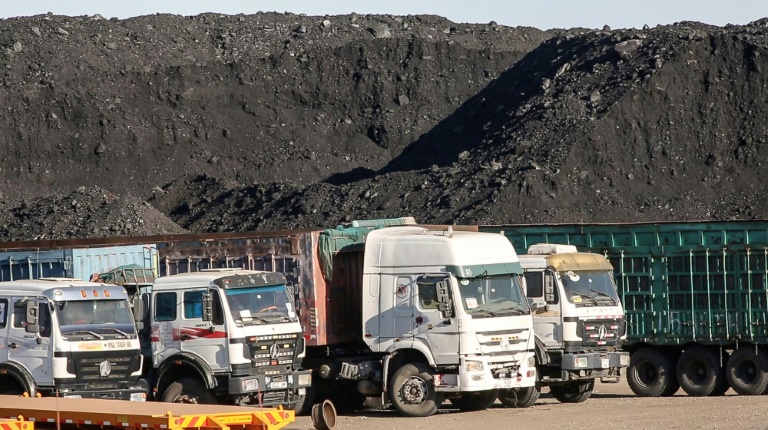
Mongolia has launched a rail line that could help boost coal exports to China to 50 million tonnes a year, the country’s president said, ending a decade-long wait for the crossing.

A ceremony to mark the launch of the rail service between the Tavan Tolgoi coal field and Gashuun Sukhait on the Chinese border was held on Friday.

Mongolian President Ukhnaa Khurelsukh was among the dignitaries in attendance, according to his website.

Heavily dependent on mining, Mongolia has long sought cheaper and more efficient ways to export its minerals abroad and has a national strategy to expand its rail network connections with Russia and China. 

Mining makes up a quarter of the country’s gross domestic product.

China has stepped up its investment in coal in the face of extreme weather, an economic slowdown and a global fuel crisis.

The 233-kilometre (145-mile) Tavan Tolgoi rail line has the capacity to export between 30 million and 50 million tonnes of coal to China annually, according to Tavantolgoi Railway LLC, the state agency that built the line. 

In 2020 the North Asian country exported 28.6 million tonnes of coal. Last year, exports fell to 15.9 million tonnes. 

The railway is also expected to lower the cost to transport coal to $8 per tonne, compared to $32 per tonne when coal is delivered by truck, according to the railway authority. 

Tavan Tolgoi is rich in coking coal, an essential ingredient in the steel-making process. 

For years coal has been transported in trucks to China, a process that has led to long queues at the border and frequent accidents. 

Mongolian governments have attempted to build a railway from Tavan Tolgoi to the Gashuun Sukhait border for more than a decade. 

Tavantolgoi LLC was formed in 2018 to complete the project. Ulaanbaatar-based Bodi International served as the general contractor. 

The Gashuun Sukhait-Gantsmod border crossing is now the second Mongolia-China border point with a rail crossing, with the other at Zamyn-Uud-Erlian. 

Progress Rail, a division of Caterpillar, agreed to supply 16 locomotives to support operations for the railway project. 

The new locomotives are designed to fit the 1,520 mm gauge used in Mongolia, Russia, and other former Soviet republics. 

Mongolia’s current 1,900 km rail network was almost entirely constructed during the 20th century with help from the Soviet Union. 

It consists mainly of the Trans-Mongolia line between Russia and China, and a spur line to the city of Erdenet.

Asian markets rally in early trading, building on US gains

Asian markets rallied in early trading on Monday, building on the momentum of gains in the United States and Europe at the end of last week, as investors price in the expectation of further interest rate hikes aimed at taming inflation.

Equities in Japan, Australia, Singapore, Taiwan and Jakarta surged, while markets in Hong Kong, China and South Korea were closed for a public holiday.

The euro continued to gain against the dollar, with investors in Europe weighing the prospect of the European Central Bank (ECB) following the US Federal Reserve’s lead and raising key rates.

On Sunday, German central bank president Joachim Nagel signalled the ECB would probably continue raising interest rates to curb runaway inflation.

Nagel predicted inflation in Europe might peak at more than 10 percent in December.

The ECB raised the key rate by a historic 75 basis points last week, and markets expect a similar-sized hike at an October meeting.

This week, investors worldwide will be closely watching US inflation data for August, due to be released on Tuesday, with the consumer price index (CPI) expected to ease slightly to eight percent — still well above the Fed’s two-percent target.

Traders expect the Fed to impose another large hike in interest rates next week, after two 75-basis-point increases already.

“A downside surprise in US CPI is likely more of a concern and that could see the dollar weakening further,” Charu Chanana, a strategist at Saxo Capital Markets, told Bloomberg Television.

“We’ve seen some glimpses of that… towards the end of last week. That could potentially be a risk to watch particularly this week.”

– ‘Soft landing’ hopes –

On Sunday, US Treasury Secretary Janet Yellen said she was hopeful the US economy could avoid a recession, but that the Fed would need to skilfully manage interest rates and also rely on “some good luck to achieve what we sometimes call a soft landing”.

“My hope is we will achieve a soft landing, but Americans know it’s essential to bring inflation down and, over the longer run, we can’t have a strong labour market without inflation under control,” she told CNN.

Yellen said that while the US economy’s growth rate was slowing, the labour market remained “exceptionally strong”, with almost two openings for every jobseeker.

In addition to the US CPI figures on Tuesday, traders will be closely watching UK CPI on Wednesday, and European CPI and China home sales, retail sales and industrial production data on Friday.

In Tokyo, stocks opened higher on Monday, driven by positive market sentiment off the back of last week’s gains and a weaker yen.

The dollar fetched 142.65 yen in early Asian trade, against 142.56 yen on Friday in New York.

“A cheaper yen is positive for corporate performances, despite recent media reports” that highlight the negative aspects of the weak yen, said chief strategist Masayuki Kubota of Rakuten Securities.

On Friday, Bank of Japan chief Haruhiko Kuroda met Prime Minister Fumio Kishida, saying the rapid weakening of the currency was “undesirable”, an indication of possible upcoming action to arrest the fall.

– Key figures at around 0300 GMT –

Tokyo – Nikkei 225: UP 1.1 percent at 28,528.90 

Hong Kong – Hang Seng Index: UP 2.7 percent at 19,362.25 (closed for public holiday Monday)

Shanghai – Composite: UP 0.8 percent at 3,262.05 (closed for public holiday Monday)

New York – Dow: UP 1.2 percent at 32,151.71 (close)

New York – S&P 500: UP 1.5 percent at 4,067.36 (close)

New York – Nasdaq: UP 2.1 percent at 12,112.31 (close)

London – FTSE 100: UP 1.2 percent at 7,351.07 (close)

Frankfurt – DAX: UP 1.4 percent at 13,088.21 (close)

Paris – CAC 40: UP 1.4 percent at 6,212.33 (close)

EURO STOXX 50: UP 1.6 percent at 3,570.04 (close)

Euro/dollar: UP at $1.0085 from $1.0046 

Pound/dollar: UP at $1.1609 from $1.1587  

Euro/pound: UP at 86.86 pence from 86.84 pence

Dollar/yen: UP at 142.65 yen from 142.56 yen 

Brent North Sea crude: DOWN 1.4 percent at $91.57 per barrel

West Texas Intermediate: DOWN 1.5 percent at $85.49 per barrel

Asian markets rally in early trading, building on US gains

Asian markets rallied in early trading on Monday, building on the momentum of gains in the United States and Europe at the end of last week, as investors price in the expectation of further interest rate hikes aimed at taming inflation.

Equities in Japan, Australia, Singapore, Taiwan and Jakarta surged, while markets in Hong Kong, China and South Korea were closed for a public holiday.

The euro continued to gain against the dollar, with investors in Europe weighing the prospect of the European Central Bank (ECB) following the US Federal Reserve’s lead and raising key rates.

On Sunday, German central bank president Joachim Nagel signalled the ECB would probably continue raising interest rates to curb runaway inflation.

Nagel predicted inflation in Europe might peak at more than 10 percent in December.

The ECB raised the key rate by a historic 75 basis points last week, and markets expect a similar-sized hike at an October meeting.

This week, investors worldwide will be closely watching US inflation data for August, due to be released on Tuesday, with the consumer price index (CPI) expected to ease slightly to eight percent — still well above the Fed’s two-percent target.

Traders expect the Fed to impose another large hike in interest rates next week, after two 75-basis-point increases already.

“A downside surprise in US CPI is likely more of a concern and that could see the dollar weakening further,” Charu Chanana, a strategist at Saxo Capital Markets, told Bloomberg Television.

“We’ve seen some glimpses of that… towards the end of last week. That could potentially be a risk to watch particularly this week.”

– ‘Soft landing’ hopes –

On Sunday, US Treasury Secretary Janet Yellen said she was hopeful the US economy could avoid a recession, but that the Fed would need to skilfully manage interest rates and also rely on “some good luck to achieve what we sometimes call a soft landing”.

“My hope is we will achieve a soft landing, but Americans know it’s essential to bring inflation down and, over the longer run, we can’t have a strong labour market without inflation under control,” she told CNN.

Yellen said that while the US economy’s growth rate was slowing, the labour market remained “exceptionally strong”, with almost two openings for every jobseeker.

In addition to the US CPI figures on Tuesday, traders will be closely watching UK CPI on Wednesday, and European CPI and China home sales, retail sales and industrial production data on Friday.

In Tokyo, stocks opened higher on Monday, driven by positive market sentiment off the back of last week’s gains and a weaker yen.

The dollar fetched 142.65 yen in early Asian trade, against 142.56 yen on Friday in New York.

“A cheaper yen is positive for corporate performances, despite recent media reports” that highlight the negative aspects of the weak yen, said chief strategist Masayuki Kubota of Rakuten Securities.

On Friday, Bank of Japan chief Haruhiko Kuroda met Prime Minister Fumio Kishida, saying the rapid weakening of the currency was “undesirable”, an indication of possible upcoming action to arrest the fall.

– Key figures at around 0300 GMT –

Tokyo – Nikkei 225: UP 1.1 percent at 28,528.90 

Hong Kong – Hang Seng Index: UP 2.7 percent at 19,362.25 (closed for public holiday Monday)

Shanghai – Composite: UP 0.8 percent at 3,262.05 (closed for public holiday Monday)

New York – Dow: UP 1.2 percent at 32,151.71 (close)

New York – S&P 500: UP 1.5 percent at 4,067.36 (close)

New York – Nasdaq: UP 2.1 percent at 12,112.31 (close)

London – FTSE 100: UP 1.2 percent at 7,351.07 (close)

Frankfurt – DAX: UP 1.4 percent at 13,088.21 (close)

Paris – CAC 40: UP 1.4 percent at 6,212.33 (close)

EURO STOXX 50: UP 1.6 percent at 3,570.04 (close)

Euro/dollar: UP at $1.0085 from $1.0046 

Pound/dollar: UP at $1.1609 from $1.1587  

Euro/pound: UP at 86.86 pence from 86.84 pence

Dollar/yen: UP at 142.65 yen from 142.56 yen 

Brent North Sea crude: DOWN 1.4 percent at $91.57 per barrel

West Texas Intermediate: DOWN 1.5 percent at $85.49 per barrel

Western arms production to ramp up as Ukraine burns through stockpiles

Western governments are mobilizing their arms manufacturers to ramp up production and replenish stockpiles heavily diminished by supplying Ukraine’s six-month-old battle against Russia’s invasion.

US Defense Secretary Lloyd Austin announced this week a meeting of senior national armaments directors from allied countries to make long-term plans for supplying Ukraine and rebuilding their own arms reserves.

“They will discuss how our defense industrial bases can best equip Ukraine’s future forces with the capabilities that they need,” he said at a meeting at Ramstein Air Force Base in Germany of the Ukraine Contact Group, 50 countries currently supporting the war effort.

On Friday, the Pentagon’s arms acquisition chief Bill LaPlante said the meeting would take place in Brussels on September 28.

The goal is to determine “how we can continue to work together to ramp up production of key capabilities and resolve supply chain issues and increase interoperability and interchangeability of our systems,” LaPlante told reporters at the Pentagon.

– Billions more for arms –

NATO countries do not all have the same weapons, but their arms are compatible. So ammunition manufactured in one country in the Atlantic alliance can be used by another.

At the start of the war, Ukraine’s military mostly used weapons and munitions that matched Russian standards. But within a few months those were exhausted — especially in crucial artillery and missile systems — and it has grown to depend on Western allies with NATO-standard arms.

But that in turn has drawn down large amounts of munitions the allies had kept for their own defense.

Rebuilding those supplies is now crucial. 

In July, the European Union announced 500 million euros for joint purchases over the next two years to replenish arms provided to Kyiv.

The priority is more anti-armor and anti-aircraft missile systems, and 155mm artillery pieces and ammunition.

EU countries “have drawn on their stocks of ammunition, light and heavy artillery, anti-aircraft and anti-tank defense systems, and even armored vehicles and tanks,” European Commissioner Thierry Breton said at the time.

“This has created a de facto vulnerability that now needs to be addressed urgently,” he warned.

The United States, the primary defense supplier of Ukraine since the war began, has pledged $15.2 billion worth of weaponry, including Javelin anti-tank missiles, artillery and ammunition compatible with NATO weaponry.

– Boosting production –

The Pentagon has furnished some 800,000 155mm artillery rounds to Ukraine, while United States has just one factory making them, the General Dynamics plant in Scranton, Pennsylvania that produces only 14,000 rounds a month.

“We have plans…  to get that in increments ultimately up to 36,000 a month in about three years,” said LaPlante.

But that would take annual production to just over half of what Washington has given the Ukrainians in less than six months.

The Pentagon wants allies to ramp up their own production lines to help replenish stockpiles.

The US military has recently announced a slew of new contracts with arms manufacturers inside and outside the United States to do this. 

It includes $364 million for 250,000 rounds of 155mm artillery ammunition from multiple makers, $624 million for Stinger anti-aircraft missiles, $324 million for Javelin anti-tank missiles, and millions more for other weapons systems, ammunition and defense supplies.

Dave Butler, spokesman for the Pentagon’s joint chiefs of staff, said the decision is guided by but not determined specifically by US manufacturing capacities.

“Ukraine’s needs for a given weapon are the ultimate driving factor,” he said.

Close Bitnami banner
Bitnami