World

From Covid to carbon emissions: Charles III in numbers

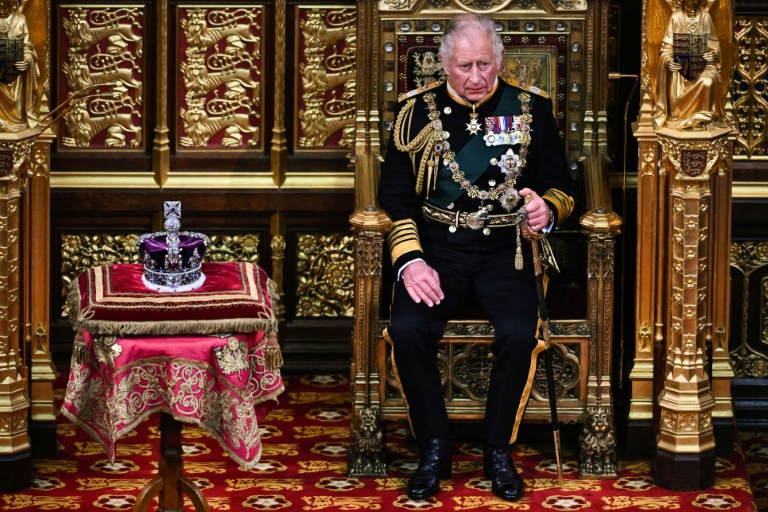
Charles, who on Friday marked the first full day of his reign following the death of his mother, Queen Elizabeth II, has spent a lifetime waiting to take on the top job.

Here are some key numbers associated with the new monarch.

– 2 –

The number of times Charles contracted coronavirus. He spent a week isolating after first testing positive in March 2020. In February this year he tested positive again but showed no symptoms.

– 3 –

Age at which Charles became first in line to the throne after his grandfather, King George VI, died in 1952 and his mother became Queen Elizabeth II.

– 4 –

Age at which he acquired the impeccable side parting that became his personal style signifier.

– 11 –

Number of years Charles spent with Diana Spencer after a fairytale wedding in 1981. They separated in 1992, with Diana blaming the breakdown of the marriage on his affair with Camilla Parker Bowles. They divorced in 1996.

– 27 –

Number of letters dubbed the “black spider memos” sent in Charles’ spidery script to Tony Blair’s government in 2004-2005. In the missives, Charles urges government action on issues ranging from inadequate army equipment to the plight of the Patagonian Toothfish.

– 52 –

The number of years Charles has owned his venerable Aston Martin DB6 convertible, which he converted in 2008 to run on bioethanol made from wine and cheese. 

His elder son, Prince William, used the car to leave Buckingham Palace with his new wife after their wedding in 2011.

– 350 –

The number of years a clothing company in Worcester, central England, had to wait to be repaid the £453.15 ($527 in today’s money) in debt run up by King Charles II in the 17th century for army uniforms. 

The prince who became Charles III on Thursday paid the money back in 2008, minus the interest.

– 3,344 –

The number of tonnes of CO2 emissions generated by Charles and Camilla in the year ending March 31, 2019, the most recent year for which they provide records. 

The king, an environmentalist, has been criticised for his liberal use of private jets.

– 1,000,000 –

The number of people who have benefitted to date from the Prince’s Trust, which Charles set up in 1976 with his Royal Navy severance pay to help youngsters from disadvantaged areas.

It is also the amount of the donation towards his charity that Charles reportedly accepted from the family of 9/11 mastermind Osama bin Laden in 2013.

– 1.6 million –

The number of followers Charles and Camilla have on Instagram. By comparison, Prince William and Kate, the Duke and Duchess of Cornwall and Cambridge, have 13.9 million.

UN chief in Pakistan to boost flood aid for devastated millions

United Nations chief Antonio Guterres began a two-day visit to flood-hit Pakistan on Friday that officials hope will boost global support for a humanitarian crisis affecting millions.

A third of the country is under water — an area the size of the United Kingdom — following record rains brought by what Guterres has described as “a monsoon on steroids”.

Pakistan officials say it will cost at least $10 billion to rebuild and repair damaged infrastructure — an impossible sum for the deeply indebted nation — but the priority, for now, is food and shelter for millions made homeless.

“If he comes and sees us, Allah will bless him,” Rozina Solangi, a 30-year-old housewife from a flooded village near Sukkur, told AFP Friday.

“All the children, men and women are roasting in this scorching heat. We have nothing to eat, there is no roof on our heads. So he must do something for us poor.”

In a tweet sent before he arrived, Guterres said he wanted to “be with the people in their time of need, galvanize international support and bring global focus on the disastrous repercussions of climate change”.

He plans to tour flood-hit parts of the south on Saturday, and also visit Mohenjo-daro, a centuries-old UNESCO-designated world heritage site threatened by the deluge.

Pakistan receives heavy — often destructive — rains during its annual monsoon season, which are crucial for agriculture and water supplies.

But a downpour as intense as this years has not been seen for decades, and Pakistan officials blame climate change, which is increasing the frequency and intensity of extreme weather around the world.

Pakistan is responsible for less than one percent of global greenhouse gas emissions, but is eighth on a list compiled by the NGO Germanwatch of countries most vulnerable to extreme weather caused by climate change.

– Tents and tarpaulins needed –

A flood relief plan compiled by the Pakistan government and UN calls for an immediate $160 million in international funding, and aid is already arriving.

On Thursday, a US Air Force C-17 landed — the first American military plane in Pakistan for years — bringing desperately needed tents and tarpaulins for temporary shelter.

While Washington is a key supplier of military hardware to Islamabad, relations have been fractious as a result of conflicting interests in neighbouring Afghanistan — especially since the Taliban returned to power in August last year.

The meteorological office says Pakistan received five times more rain than normal in 2022. Padidan, a small town in Sindh, has been drenched by more than 1.8 metres (71 inches) since the monsoon began in June.

The effect of the heavy rains has been twofold — flash floods in rivers in the mountainous north that washed away roads, bridges and buildings in minutes, and a slow accumulation of water in the southern plains that has submerged hundreds of thousands of square kilometres of land.

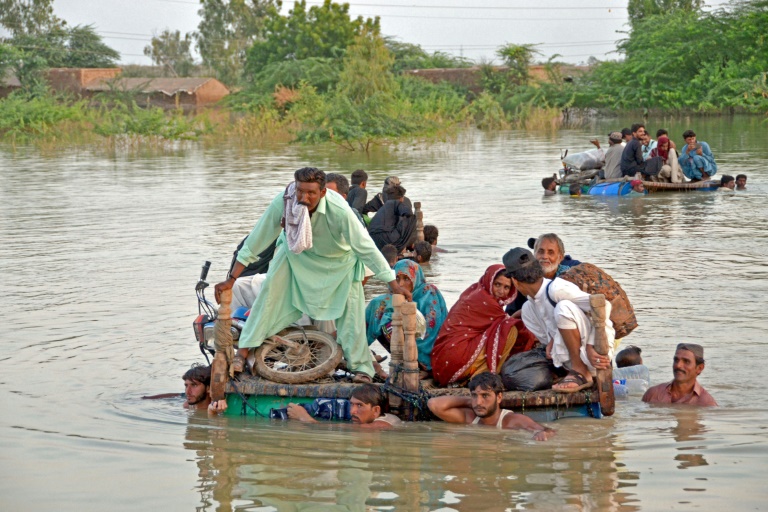
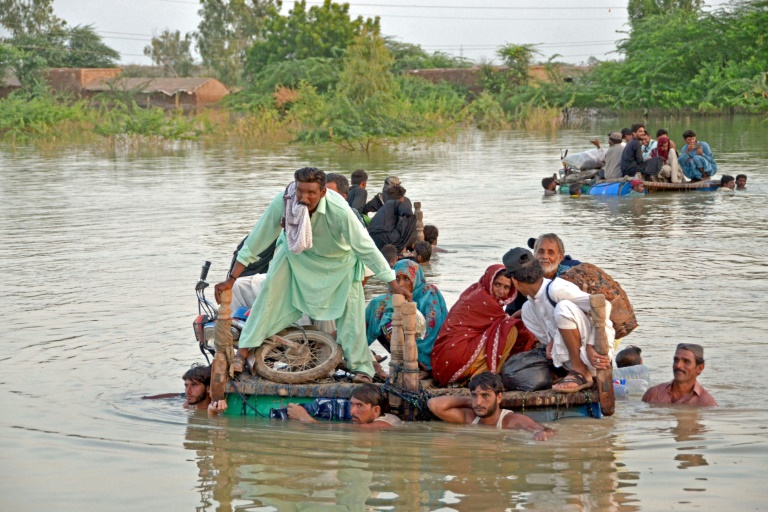
In Jaffarabad district of Balochistan on Thursday, villagers were fleeing their homes on makeshift rafts made from upturned wooden “charpoy” beds.

Thousands of temporary campsites have mushroomed on slivers of dry land in the south and west — often roads and railway tracks are the only high ground in a landscape of water.

With people and livestock cramped together, the camps are ripe for outbreaks of disease, with many cases of mosquito-borne dengue reported, as well as scabies.

The floods have killed nearly 1,400 people, according to the latest National Disaster Management Authority report.

Nearly 7,000 km of roads have been damaged, about 246 bridges washed away and more than 1.7 million homes and businesses destroyed.

UN chief in Pakistan to boost flood aid for devastated millions

United Nations chief Antonio Guterres began a two-day visit to flood-hit Pakistan on Friday that officials hope will boost global support for a humanitarian crisis affecting millions.

A third of the country is under water — an area the size of the United Kingdom — following record rains brought by what Guterres has described as “a monsoon on steroids”.

Pakistan officials say it will cost at least $10 billion to rebuild and repair damaged infrastructure — an impossible sum for the deeply indebted nation — but the priority, for now, is food and shelter for millions made homeless.

“If he comes and sees us, Allah will bless him,” Rozina Solangi, a 30-year-old housewife from a flooded village near Sukkur, told AFP Friday.

“All the children, men and women are roasting in this scorching heat. We have nothing to eat, there is no roof on our heads. So he must do something for us poor.”

In a tweet sent before he arrived, Guterres said he wanted to “be with the people in their time of need, galvanize international support and bring global focus on the disastrous repercussions of climate change”.

He plans to tour flood-hit parts of the south on Saturday, and also visit Mohenjo-daro, a centuries-old UNESCO-designated world heritage site threatened by the deluge.

Pakistan receives heavy — often destructive — rains during its annual monsoon season, which are crucial for agriculture and water supplies.

But a downpour as intense as this years has not been seen for decades, and Pakistan officials blame climate change, which is increasing the frequency and intensity of extreme weather around the world.

Pakistan is responsible for less than one percent of global greenhouse gas emissions, but is eighth on a list compiled by the NGO Germanwatch of countries most vulnerable to extreme weather caused by climate change.

– Tents and tarpaulins needed –

A flood relief plan compiled by the Pakistan government and UN calls for an immediate $160 million in international funding, and aid is already arriving.

On Thursday, a US Air Force C-17 landed — the first American military plane in Pakistan for years — bringing desperately needed tents and tarpaulins for temporary shelter.

While Washington is a key supplier of military hardware to Islamabad, relations have been fractious as a result of conflicting interests in neighbouring Afghanistan — especially since the Taliban returned to power in August last year.

The meteorological office says Pakistan received five times more rain than normal in 2022. Padidan, a small town in Sindh, has been drenched by more than 1.8 metres (71 inches) since the monsoon began in June.

The effect of the heavy rains has been twofold — flash floods in rivers in the mountainous north that washed away roads, bridges and buildings in minutes, and a slow accumulation of water in the southern plains that has submerged hundreds of thousands of square kilometres of land.

In Jaffarabad district of Balochistan on Thursday, villagers were fleeing their homes on makeshift rafts made from upturned wooden “charpoy” beds.

Thousands of temporary campsites have mushroomed on slivers of dry land in the south and west — often roads and railway tracks are the only high ground in a landscape of water.

With people and livestock cramped together, the camps are ripe for outbreaks of disease, with many cases of mosquito-borne dengue reported, as well as scabies.

The floods have killed nearly 1,400 people, according to the latest National Disaster Management Authority report.

Nearly 7,000 km of roads have been damaged, about 246 bridges washed away and more than 1.7 million homes and businesses destroyed.

EU energy ministers plan for 'difficult winter'

EU energy ministers met on Friday to seek a united response to the energy shock triggered by Russia’s war on Ukraine, which has sent prices for electricity and heating skyrocketing.

Moscow’s invasion has seen the price of natural gas hit record levels, throwing the EU economy into deep uncertainty, with all eyes on whether Russian President Vladimir Putin will cut off the energy flow entirely.

Before the war, 40 percent of the EU’s gas imports came from Russia, with most of the supply going to Germany, the bloc’s economic powerhouse, now scrambling to come up with new ways to heat homes and power factories.

The European Commission, the EU’s executive, will ask the ministers meeting in Brussels to consider a series of highly complex proposals designed to ease the burden.

“Right now, we need extraordinary intervention measures to address high and very volatile prices,” the EU’s energy commissioner Kadri Simson said, as she arrived for the talks.

“No doubt, ahead of us is a very difficult winter but our energy union is strong and we will prevail.”

The main drive will be to find ways to compensate households and businesses that are struggling to pay their bills and keep activity going.

The EU executive will propose a mechanism that would make non-gas electricity companies, such as nuclear, solar or renewable firms, share windfall revenues won on the back of high prices for electric power.

The market price of electricity in Europe is closely linked to the gas price, meaning non-gas utilities are enjoying a revenue bonanza while companies stuck paying for gas struggle.

Fossil fuel companies would also be levied on their mega profits from the inflated energy prices.

Finding consensus will be difficult with energy policy and dependence on Russia varying greatly across the EU’s 27 countries.

“Today, we are defining a mandate for the European Commission. We have to agree on a series of objectives, a calendar,” French energy minister Agnes Pannier-Runacher said.

– Price cap push stalled –

One proposal that has broad backing is an idea to rescue electricity companies that are struggling to hedge their spending on energy markets that have been extremely volatile.

This would be done by relaxing EU rules on state rescues of companies that are suddenly facing more onerous terms for cash as fears of a crisis spread.

The commission will also ask member states to agree on a united way to cut back on energy demand, with mandatory cuts on usage still considered an option, diplomats said.

“These are proposals where I feel there is quite a large convergence of views among the member states,” a key EU diplomat said.

An idea to cap Russian gas prices, however, is stalled, diplomats warned, amid fears that retribution from Moscow would throw the European economy into even further chaos.

US Secretary of State Antony Blinken, ahead of a visit to Brussels, on Friday urged Europeans to seize the opportunity and finally end the dependence on Russian energy “once and for all”.

But an EU diplomat aware of the state of negotiations warned that there was no majority among the member states in favour of the idea. 

The EU’s energy ministers are set to debate the commission’s ideas, with many countries expected to come to the table with their own proposals.

The commission, which draws up laws that are then ratified by member states and the European Parliament, would then formalise the proposal next week.

Commonwealth marks loss of figurehead, link to the past

As Britain mourned the death of Queen Elizabeth II on Friday, a string of dominions, realms and former colonies marked the loss of a shared figurehead and an irreplaceable link to a quickly fading era.

Although she was 96 years old, the queen’s death came as an emotional jolt felt from Africa to the Pacific.

“Papua New Guineans from the mountains, valleys and coasts rose up this morning to the news that our Queen has been taken to rest by God,” Prime Minister James Marape told his nation.

“We fondly call her ‘Mama Queen'”, he said, in just one of dozens of emotive tributes that poured in from countries once coloured pink on maps.

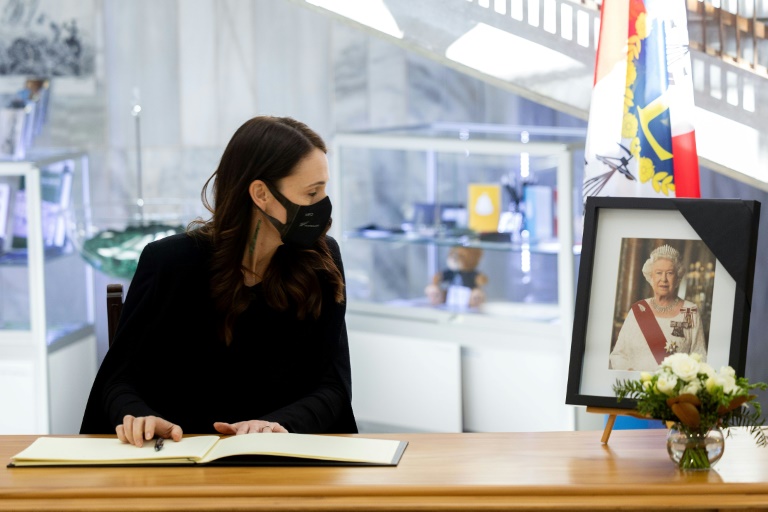
In New Zealand, Prime Minister Jacinda Ardern had been reading ominous news about her monarch’s ill health before going to bed.

A “police officer shone a torch into my room at around 10 to five this morning… I knew immediately what it meant”.

“I am profoundly sad,” she added, fondly recalling conversations about bringing up children in the public spotlight.

On the other side of the Pacific, Prime Minister Justin Trudeau said the queen would “forever remain an important part” of Canada’s history, adding personal memories that moved beyond stuffy declarations.

“She was one of my favourite people in the world,” he said. “I will so miss those chats.”

Most of Britain’s former colonies have transformed utterly since a fresh-faced Elizabeth Windsor was crowned in 1953.

At that time, India’s population was about 380 million — versus 1.4 billion today — British forces were brutally suppressing Kenya’s Mau Mau revolt, and New Zealand subject Edmund Hillary was making the first successful ascent of Mount Everest with his under-recognised Nepalese partner Tenzing Norgay.

For some, Elizabeth II represented one of the few remaining links to a sepia era of empire, to “the old country”, to an intertwined history or the shared sacrifice of a savage world war.

India’s Hindu nationalist Prime Minister Narendra Modi recalled Elizabeth II showing him a hand-spun handkerchief gifted to her by independence hero Mahatma Gandhi at her wedding. 

“I will always cherish that gesture,” he wrote on Twitter. “She personified dignity and decency in public life. Pained by her demise.”

– ‘Can’t be replaced’ –

Elizabeth II’s death inevitably raised questions about whether bonds forcibly formed by colonisation and sustained by the diminutive monarch’s charisma can endure.

The queen had been a “driving force” in the Commonwealth, said Harsh V Pant, professor of international relations at King’s India Institute in London.

The bloc of 56 countries — most former British colonies — spans Africa, Asia, the Americas, Europe and the Pacific, and includes 15 realms where Elizabeth II was still head of state.

“So what happens to that Commonwealth now? Will it survive going forward?” asked Pant.

In Sydney, 20-year-old Maya Munro said the queen was both an “incredible figurehead” and an exemplar, particularly for women.

But, like many young Australians, she imagines “a very different role” for the monarchy going forward.

“I think the queen was the monarchy for such a long time. And she brought it so much respect and history and honour,” she said.

“I think it’s just it plays a different role in our lives these days. Maybe we’re moving away from the monarchy now.”

In the New Zealand capital Wellington, 50-year-old Warwick Murray said “politicians come and go, but someone like Queen Elizabeth can’t be replaced”.

“The fact she was above politics and could really rally positivity means that I have a deep admiration for her.”

Australian Prime Minister Anthony Albanese — an avowed republican — sought to deflect questions about the future head of state as he declared 10 days of mourning.

Instead, he paid tribute to Queen Elizabeth’s “timeless decency”, saying her death marked the “end of an era”.

“An historic reign and a long life devoted to duty, family, faith and service has come to an end,” he said.

“Today is a day for one issue, and one issue only, which is to pay tribute.”

Even in places where the legacy of British colonialism is still raw, leaders focused on the attributes of the woman, rather than the baggage of her role.

“The story of modern Nigeria will never be complete without a chapter on Queen Elizabeth II, a towering global personality and an outstanding leader,” said President Muhammadu Buhari.

In Kenya, President Uhuru Kenyatta said she was “a towering icon of selfless service to humanity”, while president-elect William Ruto said her leadership of the Commonwealth was “admirable”.

The president of Zimbabwe, which withdrew from the Commonwealth in 2003 after its suspension over human rights concerns and endured decades of frosty relations with its former colonial ruler, offered his sympathies to the British public.

“May she rest in peace,” wrote President Emmerson Mnangagwa.

Her death was also lamented as far away as the Cook Islands, where a condolence book will be open for the public to sign before being sent to Buckingham Palace.

The islands’ Prime Minister Mark Brown declared: “The Queen is dead, long live the King.”

burs-arb/leg

Shipping giant changes course to save Sri Lanka whales

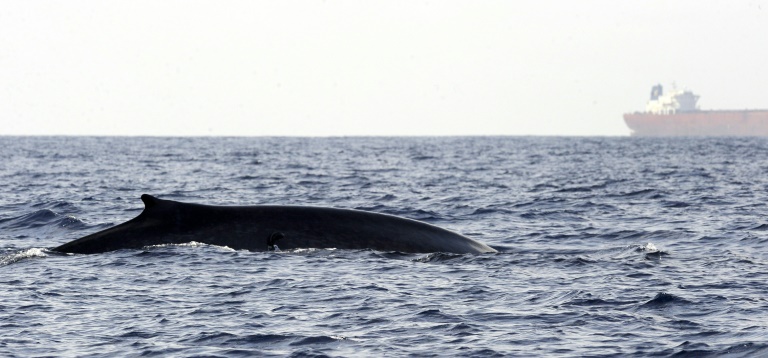
Animal rights activists on Friday cheered a move by a shipping giant to alter course in Sri Lankan waters to avoid collisions with blue whales, the world’s largest mammals.

The island’s southern coast has an unusually high density of blue whales, classed as endangered on the IUCN Red List of Threatened Species, and is one of the world’s busiest international shipping lanes.

Campaigners believe more than a dozen of the gigantic animals — the largest ever to have lived on Earth at up to 30 metres long and 150 tonnes — have been killed in collisions with commercial ships in the last decade.

There have also been occasional reports of fishermen dying when their boats were run down by container ships in the area, a rich fishing ground.

International activists and local environmentalists have for years pressed authorities to shift the east-west shipping routes 15 nautical miles further offshore.

The Geneva-based Mediterranean Shipping Company (MSC), one of the world’s biggest container carriers, announced Thursday that it had voluntarily adjusted its routes around Sri Lanka by that distance to reduce the risk of accidents involving whales, dolphins and porpoises.

The move could reduce the strike risk as much as 95 percent, the company said. 

It is also ordering its smaller feeder vessels in the area to slow to 10 knots in blue whale habitats.

The International Fund for Animal Welfare welcomed the announcement, calling it “good news for both blue whales and for people”.

The presence of the mammals has spawned a lucrative tourist whale-watching industry.

Sri Lankan animal rights activist and researcher Gehan Wijeratne said the topography of the ocean floor, currents and monsoons make the sea off southern Sri Lanka rich in nutrients and marine life.

“This rich food web results in an area which is optimal for fishing,” Wijeratne said. “Not surprisingly whales also gather in this area.”

Any move to improve the safety of fishermen and shipping will automatically have a positive impact on whales and whale watching, he added.

Leading Sri Lankan environmentalist Jagath Gunawardena told AFP that MSC’s unilateral action exposed Colombo’s failure to protect marine life and fishermen.

“We should be embarrassed that we failed, but an international shipping company had to take the initiative,” he said.

King Charles III starts reign as mourning begins for late queen

King Charles III on Friday readied to address his mourning subjects on the first full day of his new reign, as Britain and the world commemorated the extraordinary life of his late mother, Queen Elizabeth II.

At 73, Charles is the oldest monarch yet to ascend the throne, following the death of his “cherished” mother at her remote Scottish estate on Thursday.

He was due to return to London from Balmoral, where the 96-year-old queen died “peacefully” after a year-long period of ill-health and decline, at the culmination of a record-breaking reign of 70 years.

“During this period of mourning and change, my family and I will be comforted and sustained by our knowledge of the respect and deep affection in which the queen was so widely held,” Charles said in a statement.

Buckingham Palace said the king and other members of the royal family would observe an extended mourning period from now until seven days after her funeral.

The date of the funeral, which will be attended by heads of state and government, has yet to be announced but is expected to be on Monday, September 19.

– King’s speech –

One of the planet’s most recognisable people, the queen was the only British monarch most people alive today had ever known.

The tributes were universal, including from Russia and China.

New York’s Empire State Building was illuminated after sunset in silver and royal purple, while the Eiffel Tower in Paris dimmed its lights in tribute. 

US President Joe Biden described the queen, whom he met for tea at Windsor Castle last year, as “a stateswoman of unmatched dignity”.

He relayed the comforting words she gave when the United States was plunged into mourning after the September 11, 2001 attacks.

The Daily Telegraph newspaper chose the same words for its sombre front-page headline: “Grief is the price we pay for love,” it read. 

Other British newspapers also printed special editions to mark the occasion. “Our hearts are broken,” headlined popular tabloid the Daily Mail. 

The Mirror wrote simply: “Thank you.”

Charles’s inaugural address, set to be pre-recorded, was expected to be broadcast on Friday evening, part of 10 days of plans honed over decades by Buckingham Palace and the UK government.

The new king was also expected to hold his first audience with Prime Minister Liz Truss, who was only appointed on Tuesday in one of the queen’s last official acts before her death.

Truss acclaimed the “second Elizabethan age”, five centuries after the celebrated first.

“We offer him (Charles) our loyalty and devotion just as his mother devoted so much to so many for so long,” she said in a televised address Thursday. “God save the king.”

Charles was also due to meet officials in charge of the arrangements for his mother’s elaborate state funeral, which will take place before she is laid to rest in the King George VI memorial chapel at Windsor Castle.

Gun salutes — one round for every year of the queen’s life — will be fired Friday across Hyde Park in central London and from the Tower of London on the River Thames.

Muffled church bells will toll at Westminster Abbey, St Paul’s Cathedral and at Windsor, among other places, and Union flags were flying at half-mast across the UK.

Truss and other senior ministers were set to attend a public remembrance service at St Paul’s, while the UK parliament will start two days of special tributes.

The queen’s death and its ceremonial aftermath comes as the government strives to rush through emergency legislation to tackle the kind of war-fuelled economic privation that marked the start of Elizabeth’s reign in 1952.

– Tributes –

Elizabeth’s public appearances had become rarer in the months since she spent an unscheduled night in hospital in October 2021 for undisclosed health tests.

She was seen smiling in her last official photographs from Tuesday when she appointed Truss as the 15th prime minister of her reign, which started with Winston Churchill in Downing Street.

But the queen, visibly thinner and stooped, leant on a walking stick. Her hand was also bruised dark blue-purple, sparking concern. 

Jane Barlow, the photographer who took the last public pictures of the queen on Tuesday, said she was “frail” but in “good spirits”.

“I got a lot of smiles from her,” said Barlow, who works for the UK’s domestic Press Association news agency.

The queen’s closest family members had rushed to be at her bedside at Balmoral, a private residence set among thousands of acres (hectares) of rolling grouse moors and forests in the Scottish Highlands.

Her body is expected to remain there initially before being taken Sunday to the Palace of Holyroodhouse in Edinburgh. 

From the Scottish capital, her coffin is due to be flown to London on Tuesday for a lying in state accessible to the public. 

Officials expect more than one million people to file past the catafalque in Westminster Hall, the oldest part of the parliamentary complex, before the televised funeral service at Westminster Abbey opposite.

Braving steady rain, crowds gathered late into Thursday night outside Buckingham Palace in London, and Windsor Castle west of the capital, placing flowers and reflecting on her long reign.

Londoner Joshua Ellis, 24, choked back tears as he mourned the “nation’s grandmother” at the palace.

“I know she is 96 but there is still a sense of shock. She is in all our minds and hearts,” he said.

“You could always look to the queen, to a sense of stability. Every time people needed support, she was there.” 

As day broke on Friday, Joan Russell, a 55-year-old project manager from Hackney, northeast London, had tears running down her cheeks as she looked at the flowers outside the palace. 

“I think I came to say a prayer. She has been our monarch all my life and she has led by example, she has learnt, she has listened, wherever you go, she is our stamp,” she told AFP.

“Charles has had such a great example to follow. I believe he will do his very utmost to continue the legacy of his parents — his mum and dad — have set before him.”

– Consistently popular –

Queen Elizabeth II came to the throne aged just 25 in the exhausted aftermath of World War II, joining a world stage dominated by political figures from Churchill to Mao Zedong and Joseph Stalin.

In the ensuing decades, the last vestiges of Britain’s vast empire crumbled. 

At home, Brexit shook the foundations of her kingdom, and her family endured a series of scandals.

But throughout, she remained consistently popular and was head of state not just of the United Kingdom but 14 former British colonies, including Australia and Canada. 

New Zealand proclaimed Charles its new king. But Australia’s new government looks set to revive a push to ditch the monarchy, casting doubt on his inheritance even as it mourns the queen.

The final public farewell at Westminster Abbey in London will be a public holiday in the form of a Day of National Mourning.

Charles’s coronation, an elaborate ritual steeped in tradition and history, will take place in the same historic surroundings, as it has for centuries, on a date to be fixed.

On Saturday, his reign will be formally proclaimed by the Accession Council, which comprises senior politicians, bishops, City of London dignitaries and Commonwealth ambassadors.

Asian markets rally, dollar dips as traders price in policy tightening

Asian markets rallied Friday following a healthy performance on Wall Street, with investors largely pricing in more interest rate hikes aimed at taming runaway inflation.

The more confident mood was reflected in a dip in the dollar, which has surged in recent weeks to multi-decade highs against its major peers owing to the Federal Reserve’s hawkish tilt to tighter monetary policy.

The greenback’s softness came even after Fed chief Jerome Powell reasserted the bank’s determination to keep hiking rates to fight prices, even at the cost of economic growth.

His warning that “we need to act now forthrightly, strongly” followed comments from his deputy Lael Brainard, who said policymakers would lift borrowing costs for as long as it takes to bring inflation down from 40-year highs.

Still, Wall Street ended in positive territory, putting markets on course for a weekly gain and easing some pressure after hefty losses in August caused by worries that rising rates would spark a recession.

“The markets have finally digested the fact that rates are almost certain to go up by 75 basis points when the Fed moves next (on September 21),” JoAnne Feeney, at Advisors Capital Management, told Bloomberg TV.

“What we are seeing though is some recognition that perhaps the sell-off that we saw in the second half of August was a bit overdone,” she said.

New York’s rise filtered through to Asia, where Hong Kong rose close to three percent heading into a long weekend, while Tokyo, Sydney, Shanghai, Singapore, Wellington, Mumbai, Manila and Bangkok were also well up.

London, Paris and Frankfurt also rose in early trading.

OANDA’s Edward Moya said traders cheered as “Powell stuck to his hawkish script and affirmed the commitment to tighten policy until inflation is back towards their target.

“Wall Street is expecting to see some pricing pressure relief with next week’s inflation report, but that shouldn’t derail the current 75 basis-point pace of tightening.”

There was also some cheer from news that inflation in China had eased slightly in August, giving the government more room to introduce more economy-supporting measures, though the recovery remains hostage to leaders’ strict zero-Covid strategy of growth-sapping lockdowns.

On currency markets, the euro was holding well above parity with the dollar after the European Central Bank announced its own 75 basis-point rise as it warned inflation was “far too high” and likely to stay above target for “an extended period”.

ECB chief Christine Lagarde suggested policy would continue to be tightened for some time.

The yen strengthened as officials began speaking up after the unit approached a 32-year low versus the greenback.

The pick-up came after Bank of Japan chief Haruhiko Kuroda met Prime Minister Fumio Kishida on Friday before saying “the rapid weakening of the yen is undesirable”. 

The talks were used as a sign of intent to act in support of the currency if it continued to weaken. 

However, there is an expectation the Japanese unit will see more losses as the BoJ sticks rigidly to its ultra-loose policies despite the Fed’s increasingly hawkish moves.

Oil prices edged up after Thursday’s gains though they remain pressured by ongoing worries about the impact on demand from possible recessions caused by the rate hikes and inflation. 

Weakness in China’s economy and lockdowns in major cities were also cause for concern among commodities traders. 

Reports that President Joe Biden was considering releasing more crude from the US strategic reserves were also weighing on the market.

Washington is concerned that prices could spike in December when European Union sanctions on Russian supplies kick in.

– Key figures at around 0810 GMT –

Tokyo – Nikkei 225: UP 0.5 percent at 28,214.75 (close)

Hong Kong – Hang Seng Index: UP 2.7 percent at 19,362.25 (close)

Shanghai – Composite: UP 0.8 percent at 3,262.05 (close)

London – FTSE 100: UP 1.0 percent at 7,335.91

Euro/dollar: UP at $1.0096 from $1.0001 on Thursday

Pound/dollar: UP at $1.1628 from $1.1500

Euro/pound: DOWN at 86.81 pence from 86.93 pence

Dollar/yen: DOWN at 142.39 yen from 144.07 yen 

West Texas Intermediate: UP 1.2 percent at $84.54 per barrel

Brent North Sea crude: UP 1.3 percent at $90.32 per barrel

New York – Dow: UP 0.6 percent at 31,774.52 (close)

'Our hearts are broken': UK newspapers mark queen's death

Poignant photographs of Queen Elizabeth II dominated the front pages of Britain’s grieving newspapers on Friday, charting her journey from coronation to matriarch of the nation.

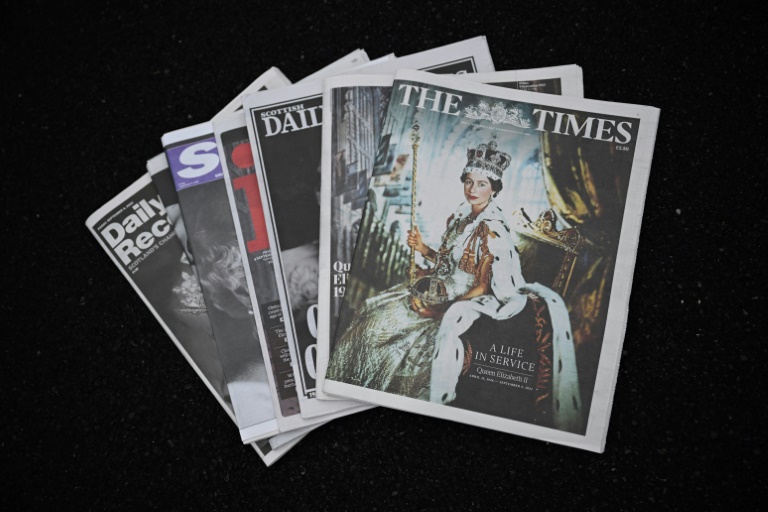
A picture of the 27-year-old Elizabeth taken at her 1953 coronation, full of regal splendour clasping the Sovereign’s Orb and Sceptre in the vaulted walls of Westminster Abbey, covered the front pages of The Times, Guardian, Daily Star and Independent.

The Sun, Daily Telegraph, Daily Express and Daily Mirror instead chose images of the white-haired monarch as she neared the end of her record-breaking 70-year-reign.

The Telegraph carried a quote made by the queen for the victims of the September 11, 2001 attacks. “Grief is the price we pay for love,” it said.

Most tabloids marked the occasion with subdued black-and-white front pages, although the Sun splashed its header in royal purple, above the headline “We loved you Ma’am.”

“Rest in peace, Ma’am. The Sun and our readers loved you. We are proud you were our Queen,” it added.

The Daily Express carried the headline “Our Beloved Queen is Dead”, while the Daily Mirror simply wrote “Thank you”.

“Our hearts are broken”, said the Daily Mail headline.

“How to find the words? Our grief is a hundred different emotions, all of them hard to grasp,” said its front-page splash.

“As God Save the Queen played on the radio and TV, as we heard that our beloved monarch had died, a nation’s heart broke,” it added.

– ‘Long live the King’ –

The story unsurprisingly filled the inside pages of the souvenir edition papers, with most dedicating at least 20 pages to the seismic events.

“A light has gone out on our lives. The day Britain and much of the world dreaded is upon us. She is gone,” said The Sun’s editorial.

“The mother of our nation. The most famous, most loved, most respected woman on Earth. Britain’s backbone.

“It is, quite simply, hard to think of British life without her presence,” it added. “The new world will seem strange.”

In its obituary, The Times described Elizabeth as “the woman who saved the monarchy”.

“It is thanks to her dedication and seriousness of purpose that an institution that has at times seemed outdated and out of keeping with the values of contemporary society still has a relevance and popularity today.”

Inside the left-wing Guardian, columnist Jonathan Freedland wrote that her death heralded the start of “a new future”.

“The one element in our collective life that was consistently, reliably the same… has gone.”

The Daily Telegraph meanwhile paid tribute to Elizabeth’s “lifetime of service”. 

“She was more than just a distant, matriarchal symbol of nationhood; she was our constant companion and guide, reassuringly composed even in the most turbulent of times.

“The Second Age of Elizabeth is at an end. Long live King Charles III,” it said.

King Charles III starts reign as mourning begins for late queen

King Charles III on Friday readied to address his mourning subjects on the first full day of his new reign as Britain and the world commemorated the extraordinary life of his late mother, Queen Elizabeth II.

At 73, Charles is the oldest monarch yet to ascend the throne of the United Kingdom, following the death of his “cherished” mother at her Scottish estate of Balmoral on Thursday.

He was due to return to London from Balmoral, where the 96-year-old queen died “peacefully” after a year-long period of ill-health and decline, at the culmination of a record-breaking reign of 70 years.

“During this period of mourning and change, my family and I will be comforted and sustained by our knowledge of the respect and deep affection in which the queen was so widely held,” Charles said in a statement.

One of the planet’s most recognisable people, she was the only British monarch most people alive today had ever known.

The tributes were universal, including from Russia and China.

New York’s Empire State Building was illuminated after sunset in silver and royal purple, while the Eiffel Tower in Paris dimmed its lights in tribute. 

President Joe Biden described Queen Elizabeth as “a stateswoman of unmatched dignity”, and relayed the comforting words she gave when the United States was plunged into mourning on 9/11.

They were the same words chosen by the Daily Telegraph for its sombre front-page: “Grief is the price we pay for love.”

Other British newspapers also printed special editions to mark the occasion. “Our hearts are broken,” headlined popular tabloid the Daily Mail. 

The Mirror wrote simply: “Thank you.”

Charles’s inaugural address, set to be pre-recorded, was expected to be broadcast on Friday evening, part of 10 days of plans honed over decades by Buckingham Palace and the UK government.

The new king was also expected to hold his first audience with Prime Minister Liz Truss, who was only appointed on Tuesday in one of the queen’s last official acts before her death.

Truss acclaimed the “second Elizabethan age”, five centuries after the celebrated first.

“We offer him (Charles) our loyalty and devotion just as his mother devoted so much to so many for so long,” she said in a televised address Thursday. “God save the king.”

Charles was also due to meet officials in charge of the elaborate arrangements for his mother’s lavish state funeral, which will be attended by crowned and elected heads of state from around the world.

He will decide on the length of the royal household’s period of mourning, which is expected to last a month, while the UK government will observe at least 10 days of official remembrance, when limited business is conducted. 

Gun salutes — one round for every year of the queen’s life — will be fired Friday across Hyde Park in central London and from the Tower of London on the River Thames.

Muffled church bells will toll at Westminster Abbey, St Paul’s Cathedral and Windsor Castle, among other places, and Union flags will fly at half-mast.

Truss and other senior ministers were set to attend a public remembrance service at St Paul’s, while the UK parliament will start two days of special tributes.

The queen’s death and its ceremonial aftermath comes as the government strives to rush through emergency legislation to tackle the kind of war-fuelled economic privation that marked the start of Elizabeth’s reign in 1952.

– Tributes –

Elizabeth’s public appearances had become rarer in the months since she spent an unscheduled night in hospital in October 2021 for undisclosed health tests.

She was seen smiling in her last official photographs from Tuesday when she appointed Truss as the 15th prime minister of her reign, which started with Winston Churchill in Downing Street.

But the queen looked frail and leant on a walking stick. Her hand was also bruised dark blue-purple, sparking concern. 

Her closest family members had rushed to be at her bedside at Balmoral, a private residence set among thousands of acres (hectares) of rolling grouse moors and forests in the Scottish Highlands.

Her body will initially remain there, before being taken to the Scottish capital Edinburgh. 

From there, her coffin is expected to travel by train to London for a lying in state accessible to the public, before the funeral.

Braving steady rain, crowds gathered late into Thursday night outside Buckingham Palace in London, and Windsor Castle west of the capital, with the number of well-wishers set to swell in the days ahead.

Londoner Joshua Ellis, 24, choked back tears as he mourned the “nation’s grandmother” at the palace.

“I know she is 96 but there is still a sense of shock. She is in all our minds and hearts,” he said.

“You could always look to the queen, to a sense of stability. Every time people needed support, she was there.” 

– ‘Cherished sovereign’ –

Queen Elizabeth II came to the throne aged just 25 in the exhausted aftermath of World War II, joining a world stage dominated by political figures from Churchill to Mao Zedong and Joseph Stalin.

In the ensuing decades, the last vestiges of Britain’s vast empire crumbled. At home, Brexit shook the foundations of her kingdom, and her family endured a series of scandals.

But throughout, she remained consistently popular and was head of state not just of the United Kingdom but 14 former British colonies, including Australia and Canada. 

New Zealand proclaimed Charles its new king. But Australia’s new government looks set to revive a push to ditch the monarchy, casting doubt on his inheritance even as it mourns the queen.

Britain’s mourning will culminate in a final public farewell at Westminster Abbey in London. The funeral day will be a public holiday in the form of a Day of National Mourning.

Charles’s coronation, an elaborate ritual steeped in tradition and history, will take place in the same historic surroundings, as it has for centuries, on a date to be fixed.

On Saturday, his reign will be formally proclaimed by the Accession Council, which comprises senior politicians, bishops, City of London dignitaries and Commonwealth ambassadors.
Close Bitnami banner
Bitnami