World

North Korea law makes nuclear programme 'irreversible'

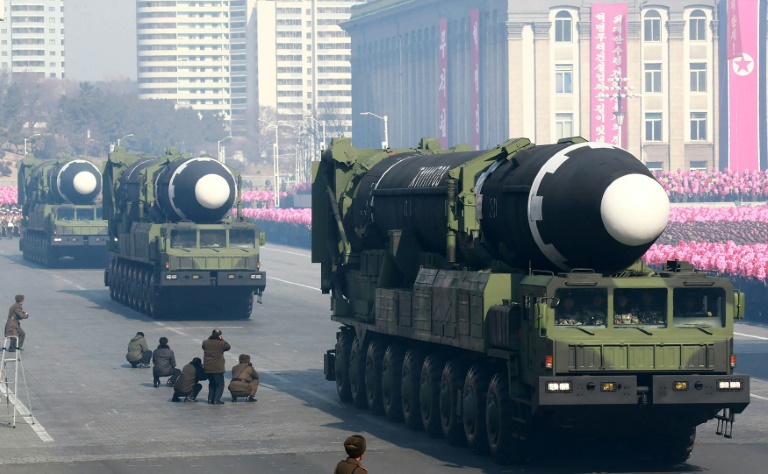
North Korea has passed a law declaring its readiness to launch preventive nuclear strikes, including in the face of conventional attacks, state media said Friday.

The move effectively eliminates the possibility of denuclearisation talks, with leader Kim Jong Un saying the country’s status as a nuclear state was now “irreversible”.

The announcement comes at a time of heightened tension between North and South, with Pyongyang blaming Seoul for the outbreak of Covid-19 in its territory and conducting a record number of weapons tests this year. 

The newly enacted law says North Korea can carry out a preventive nuclear strike “automatically” and “immediately to destroy the hostile forces” when a foreign country poses an imminent threat to Pyongyang, the official Korean Central News Agency (KCNA) said. 

The law specifically states the North can use nuclear weapons “in case of a nuclear or non-nuclear attack by hostile forces on the state leadership and the command organization of the state’s nuclear forces”, among other situations, according to state media. 

“The status of our country as a nuclear weapons state has become irreversible”, Kim Jong Un said, KCNA reported. 

The law “publicly justifies Pyongyang’s use of its nuclear power” in the event of any military clash, Cheong Seong-chang of the Center for North Korea Studies at the Sejong Institute told AFP. 

As the North’s dictator, “Kim Jong Un does not need laws to launch a nuclear strike”, but the new law serves as a way to “vindicate Kim’s use of nuclear weapons in case of emergency by disclosing the principles of nuclear use at home and abroad in advance,” he added. 

Kim in July said his country was “ready to mobilise” its nuclear capability in any war with the United States and the South.

He reiterated that Pyongyang would never give up the nuclear weapons it needed to counter hostilities from Washington, claiming the United States was seeking to “collapse” his regime.

Nuclear talks and diplomacy between Washington and Pyongyang have been derailed since 2019 over sanctions relief and what Pyongyang would be willing to give up in return.

“There is absolutely no such thing as giving up nuclear weapons first, and there is no denuclearisation and no negotiation for it,” Kim said during a speech at North Korea’s rubber-stamp parliament on Thursday, KCNA reported.

– ‘Height of absurdity’ –

A blitz of North Korean weapons tests since January included the firing of an intercontinental ballistic missile at full range for the first time since 2017.

Washington and South Korean officials have repeatedly warned that the North is preparing to carry out what would be its seventh nuclear test.

Yang Moo-jin, a professor at the University of North Korean Studies, said the North’s latest announcement clearly reaffirmed Pyongyang’s stance — that nuclear negotiations are no longer on the table.

“Pyongyang is likely to form closer ties with China and Russia against Washington, and … launch its seventh nuclear test in the near future,” he told AFP.

Seoul, Washington’s key security ally, last month offered Pyongyang an “audacious” aid plan that would include food, energy and infrastructure help in return for the North abandoning its nuclear weapons programme. 

But Pyongyang ridiculed the offer, calling it the “height of absurdity” and a deal the North would never accept.

South Korea’s hawkish President Yoon Suk-yeol said last month that his administration had no plans to pursue its own nuclear deterrent.
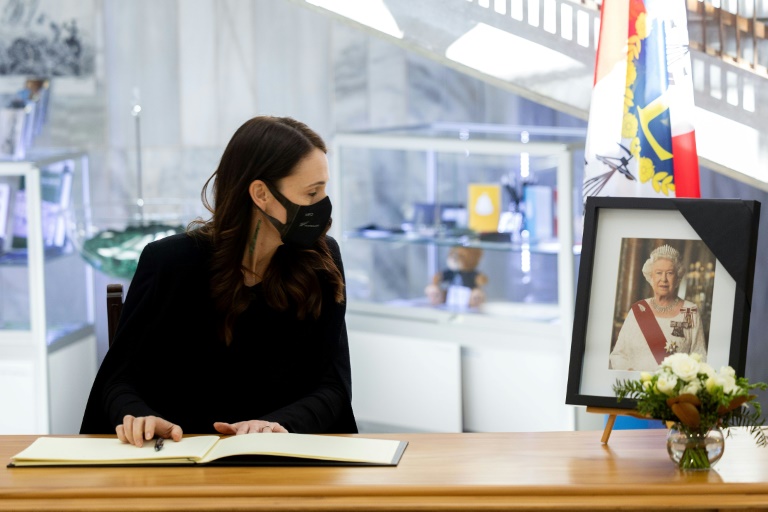

Commonwealth marks loss of figurehead, link to the past

As Britain mourned the death of Queen Elizabeth II on Friday, a string of dominions, realms and former colonies marked the loss of a shared figurehead and an irreplaceable link to a quickly fading era.

Although she was 96 years old, the queen’s death came as an emotional jolt felt from Africa to the Pacific.

“Papua New Guineans from the mountains, valleys and coasts rose up this morning to the news that our Queen has been taken to rest by God,” Prime Minister James Marape told his nation.

“We fondly call her ‘Mama Queen'”, he said, in just one of dozens of emotive tributes that poured in from countries once coloured pink on maps.

In New Zealand, Prime Minister Jacinda Ardern had been reading ominous news about her monarch’s ill health before going to bed.

A “police officer shone a torch into my room at around 10 to five this morning… I knew immediately what it meant”.

“I am profoundly sad,” she added, fondly recalling conversations about bringing up children in the public spotlight.

On the other side of the Pacific, Prime Minister Justin Trudeau said the queen would “forever remain an important part” of Canada’s history, adding personal memories that moved beyond stuffy declarations.

“She was one of my favourite people in the world,” he said. “I will so miss those chats.”

Most of Britain’s former colonies have transformed utterly since a fresh-faced Elizabeth Windsor ascended to the throne in 1953.

At that time, India’s population was about 380 million — versus 1.4 billion today — British forces were brutally suppressing Kenya’s Mau Mau revolt, and New Zealand subject Edmund Hillary was making the first successful ascent of Mount Everest with his under-recognised Nepalese partner Tenzing Norgay.

For some, Elizabeth II represented one of the few remaining links to a sepia era of empire, to “the old country”, to an intertwined history or the shared sacrifice of a savage world war.

India’s Hindu nationalist Prime Minister Narendra Modi recalled Elizabeth II showing him a hand-spun handkerchief gifted to her by independence hero Mahatma Gandhi at her wedding. 

“I will always cherish that gesture,” he wrote on Twitter. “She personified dignity and decency in public life. Pained by her demise.”

– ‘Can’t be replaced’ –

Elizabeth II’s death inevitably raised questions about whether bonds forcibly formed by colonisation and sustained by the diminutive monarch’s charisma can endure.

The queen had been a “driving force” in the Commonwealth, said Harsh V Pant, professor of international relations at King’s India Institute in London.

The bloc of 56 countries — most former British colonies — spans Africa, Asia, the Americas, Europe and the Pacific, and includes 15 realms where Elizabeth II was still head of state.

“So what happens to that Commonwealth now? Will it survive going forward?” asked Pant.

In Sydney, 20-year-old Maya Munro said the queen was both an “incredible figurehead” and an exemplar, particularly for women. 

But, like many young Australians, she imagines “a very different role” for the monarchy going forward.

“I think the queen was the monarchy for such a long time. And she brought it so much respect and history and honour,” she said.

“I think it’s just it plays a different role in our lives these days. Maybe we’re moving away from the monarchy now.”

In the New Zealand capital Wellington, 50-year-old Warwick Murray said “politicians come and go, but someone like Queen Elizabeth can’t be replaced”. 

“The fact she was above politics and could really rally positivity means that I have a deep admiration for her.”

Australian Prime Minister Anthony Albanese — an avowed republican — sought to deflect questions about the future head of state as he declared 10 days of mourning.

Instead, he paid tribute to Queen Elizabeth’s “timeless decency”, saying her death marked the “end of an era”.

“An historic reign and a long life devoted to duty, family, faith and service has come to an end,” he said.

“Today is a day for one issue, and one issue only, which is to pay tribute.”

Even in places where the legacy of British colonialism is still raw, leaders focused on the attributes of the woman, rather than the baggage of her role.

“The story of modern Nigeria will never be complete without a chapter on Queen Elizabeth II, a towering global personality and an outstanding leader,” said President Muhammadu Buhari.

In Kenya, President Uhuru Kenyatta said she was “a towering icon of selfless service to humanity”, while president-elect William Ruto said her leadership of the Commonwealth was “admirable”.

The president of Zimbabwe, which withdrew from the Commonwealth in 2003 after its suspension over human rights concerns and endured decades of frosty relations with its former colonial ruler, offered his sympathies to the British public.

“May she rest in peace,” wrote President Emmerson Mnangagwa.

Her death was also lamented as far away as the Cook Islands, where a condolence book will be open for the public to sign before being sent to Buckingham Palace.

The islands’ Prime Minister Mark Brown declared “The Queen is dead, long live the King.”

burs-arb/aha

Crime, far-right set tone in Swedish nail-biter vote

Sweden’s right-wing parties hope to unseat the ruling Social Democrats in Sunday’s general election, relying for the first time on far-right support in a tight race where crime tops the agenda.

The anti-immigration and nationalist Sweden Democrats were long treated as pariahs on the Scandinavian country’s political scene, but they have gradually been welcomed into the right-wing bloc in the past few years.

Recent opinion polls have suggested they could surge to become the second-biggest party in parliament — meaning their backing will be essential if the right wants to form a government.

Sweden, currently in the delicate process of joining NATO, has since 2014 been governed by the Social Democrats which have dominated Swedish politics since the 1930s.

Prime Minister Magdalena Andersson, who took over the post just nine months ago after seven years as finance minister, enjoys strong support among voters.

Some 55 percent want her to remain in the job, compared to 32 percent for her challenger from the conservative Moderates, Ulf Kristersson, according to a poll from late August.

Andersson has earned voters’ respect for steering the country with a steady hand, leading it into a long-unthinkable NATO membership application in May following Russia’s invasion of Ukraine. 

Sweden had until then been militarily non-aligned for two centuries.

Most polls put the left- and right-wing blocs in a near deadlock, crediting the left with 49.1 to 50.1 percent of voter support and the right with 49.2 to 49.9 percent.

To form a government the Social Democrats can rely on support from the Greens, Left and Centre parties, while the Moderates, Christian Democrats, Liberals and Sweden Democrats make up the right-wing bloc.

Both blocs are however beset by internal divisions that will make the process of forming a government tricky.

– Gang violence –

The election campaign has been dominated by issues close to right-wing voters, with crime, immigration and skyrocketing electricity prices overshadowing the welfare state and the economy.

“Inflation has soared and the same is true for crime and shootings, and these are contextual factors that should benefit the right-wing opposition,” Patrik Ohberg, a University of Gothenburg political scientist, told AFP.

Sweden has struggled to combat escalating gang shootings attributed to battles over the drugs and weapons market, and the country now tops European statistics for firearm deaths.

While the violence was once contained to locations frequented by criminals, it has spread to public spaces such as parks and shopping centres, sparking concern among ordinary Swedes in a country long known as safe and peaceful.

Addressing the mother of a 12-year-old girl killed by stray bullets in a gang-related 2020 shooting, Andersson and Kristersson both lamented the soaring violence during a televised debate on Wednesday.

“No other country in Europe has what we have,” Kristersson said.

“What we are seeing in Sweden is horrible,” Andersson concurred.

Since January 1, 48 people have been killed by firearms in Sweden, three more than in all of 2021. There are also frequent bombings of homes and cars and grenade attacks.

– ‘Enormous shift’ –

The end of the Sweden Democrats’ political isolation, and the prospect of it becoming the biggest right-wing party, is “an enormous shift in Swedish society”, said Anders Lindberg, an editorialist at left-wing tabloid Aftonbladet.

Born out of a neo-Nazi movement at the end of the 1980s, the Sweden Democrats entered parliament in 2010 with 5.7 percent of votes.

The party’s anti-immigration stance and defence of Swedes’ cherished welfare state has appealed to the working class and pensioners.

Its rise has come alongside a large influx of immigrants, with the country of 10 million taking in almost half a million asylum seekers in a decade.

While Kristersson remains Andersson’s challenger for the post of prime minister, having the far-right overtake the Moderates as the biggest party on the right would be a heavy blow for him.

If the right bloc were to win a majority, the Sweden Democrats could demand cabinet positions rather than just provide informal backing in parliament.

“We want to have a maximum of influence, so it’s clear that our point of departure is to be in the government”, the Sweden Democrats’ leader Jimmie Akesson told AFP.

“Otherwise it’s going to be costly for the government to have us on board.”

Opening the door to the Sweden Democrats may turn out to have been a costly gamble for Kristersson.

“If the Moderates lose the election and become the third-largest party, they will change party leader,” Stockholm University political science professor Jan Teorell told AFP.

Heatwave batters Spain's Mediterranean mussel crop

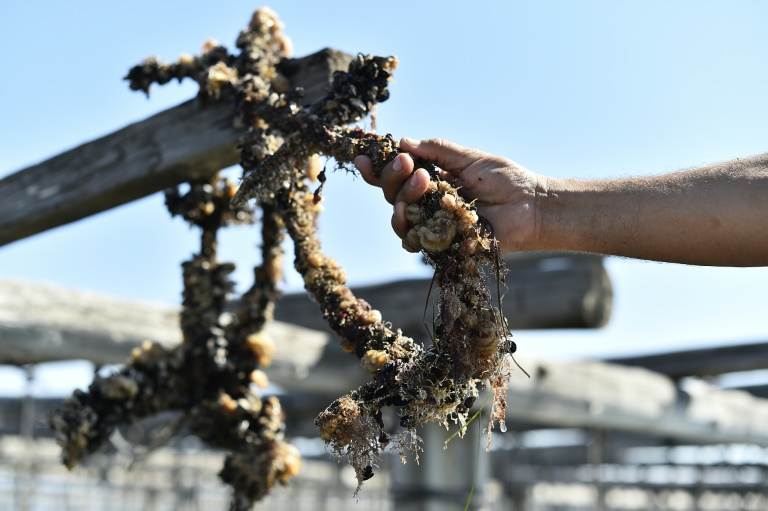
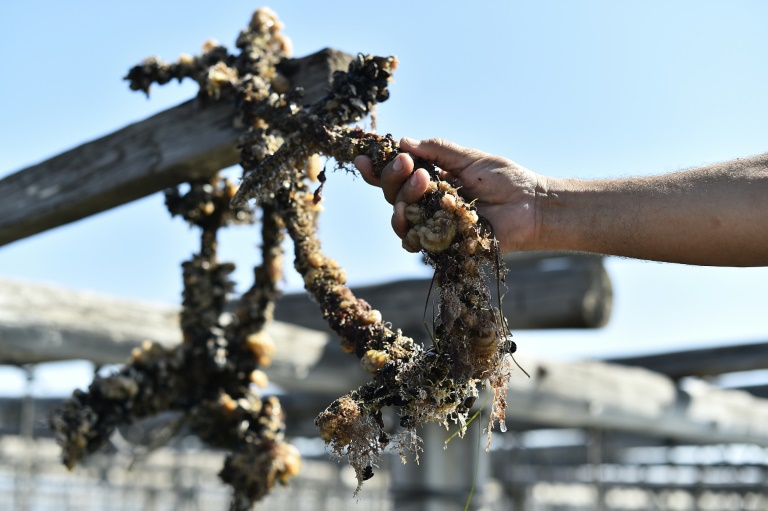
“There’s nothing left here,” sighs Javier Franch as he shakes the heavy rope of mussels he’s just pulled to the surface in northeastern Spain. They are all dead. 

With the country hit by a long and brutal heatwave this summer, the water temperature in the Ebro Delta, the main mussels production area of the Spanish Mediterranean, is touching 30 degrees Celsius (86 degrees Fahrenheit).

And any grower who hasn’t removed their molluscs in time will have lost everything. 

But that’s not the worst of it: most of next year’s crop has also died in one of the most intense marine heatwaves in the Spanish Mediterranean.

By the end of July, experts said the western Mediterranean was experiencing an “exceptional” marine heatwave, with persistently hotter-than-normal temperatures posing a threat to the entire marine ecosystem. 

“The high temperatures have cut short the season,” says Franch, 46, who has spent almost three decades working for the firm founded by his father, which has seen production fall by a quarter this year. 

The relentless sun has heated up the mix of fresh and saltwater along Catalonia’s delicate coastal wetlands where the River Ebro flows into the Mediterranean. 

On a scorching summer morning in Deltebre, one of the municipalities of the Delta, the mussel rafts — long wooden structures with ropes attached which can each grow up to 20 kilograms (44 pounds) of mussels — should be teeming with workers hurrying around during the busy season. 

But there is hardly any movement. 

“We lost the yield that was left, which wasn’t much, because we were working to get ahead so we wouldn’t go through this,” explains Carles Fernandez, who advises the Ebro Delta’s Federation of Mollusc Producers (Fepromodel). 

“But the problem is that we’ve lost the young stock for next year and we’ll have quite a high cost overrun.” 

– Millions in losses –

The heat has wiped out 150 tonnes of commercial mussels and 1,000 tonnes of young stock in the Delta, initial estimates suggest. 

And producers are calculating their losses at over one million euros ($1,000,000) given they will now have to buy young molluscs from Italy or Greece for next year. 

“When you have a week when temperatures are higher than 28C, there can be some mortality, but this summer it has lasted almost a month and a half,” with peak temperatures of almost 31C, says Fepromodel head Gerardo Bonet.

Normally, the Ebro Delta’s two bays produce around 3,500 tonnes of mussels, and 800 tonnes of oysters, making Catalonia Spain’s second-largest producer, although it remains far behind the output of Galicia, the northwestern region on the colder Atlantic coast. 

For years now, the harvest in the Delta has been brought forward, cutting short a season that once ran from April to August. 

– ‘Tropical’ Mediterranean – 

Hit by coastal erosion and a lack of sediment supply, the rich ecosystem of the Ebro Delta — a biosphere reserve and one of the most important wetlands of the western Mediterranean — is particularly vulnerable to climate change. 

And this extreme summer, when Spain endured 42 days of heatwave — a record three times the average over the past decade, the AEMET national forecaster says — has also left its mark below the surface of the water. 

“Some marine populations which are unable to cope with temperatures as high as these over a long period of time are going to suffer what we call mass mortality,” says marine biologist Emma Cebrian of the Spanish National Research Council (CISC). 

“Imagine a forest, it’s like 60 or 80 percent of the trees dying, with the resulting impact on its associated biodiversity,” she says. 

The succession of heatwaves on land has generated another at sea which — pending analysis of all the data in November — may turn out to be “the worst” in this area of the Mediterranean since records began in the 1980s. 

Although marine heatwaves are not a new phenomenon, they are becoming more extreme with increasingly dire consequences. 

“If we compare it with a wildfire, one can have an impact, but if you keep having them, it will probably mean the affected populations are not able to recuperate,” Cebrian said. 

Experts say the Mediterranean is becoming “tropicalised”, and mollusc grower Franch is struck by the mounting evidence as his boat glides between empty mussel rafts in a bay without a breath of wind. 

He is mulling an increase in his production of oysters, which are more resistant to high temperatures, but which currently represent just 10 percent of his output.

But he hopes it will help ensure his future in a sector that employs 800 people directly or indirectly in the Ebro Delta. 

“(The sector) is under threat because climate change is a reality and what we are seeing now will happen again,” he says worriedly. 

Heatwave batters Spain's Mediterranean mussel crop

“There’s nothing left here,” sighs Javier Franch as he shakes the heavy rope of mussels he’s just pulled to the surface in northeastern Spain. They are all dead. 

With the country hit by a long and brutal heatwave this summer, the water temperature in the Ebro Delta, the main mussels production area of the Spanish Mediterranean, is touching 30 degrees Celsius (86 degrees Fahrenheit).

And any grower who hasn’t removed their molluscs in time will have lost everything. 

But that’s not the worst of it: most of next year’s crop has also died in one of the most intense marine heatwaves in the Spanish Mediterranean.

By the end of July, experts said the western Mediterranean was experiencing an “exceptional” marine heatwave, with persistently hotter-than-normal temperatures posing a threat to the entire marine ecosystem. 

“The high temperatures have cut short the season,” says Franch, 46, who has spent almost three decades working for the firm founded by his father, which has seen production fall by a quarter this year. 

The relentless sun has heated up the mix of fresh and saltwater along Catalonia’s delicate coastal wetlands where the River Ebro flows into the Mediterranean. 

On a scorching summer morning in Deltebre, one of the municipalities of the Delta, the mussel rafts — long wooden structures with ropes attached which can each grow up to 20 kilograms (44 pounds) of mussels — should be teeming with workers hurrying around during the busy season. 

But there is hardly any movement. 

“We lost the yield that was left, which wasn’t much, because we were working to get ahead so we wouldn’t go through this,” explains Carles Fernandez, who advises the Ebro Delta’s Federation of Mollusc Producers (Fepromodel). 

“But the problem is that we’ve lost the young stock for next year and we’ll have quite a high cost overrun.” 

– Millions in losses –

The heat has wiped out 150 tonnes of commercial mussels and 1,000 tonnes of young stock in the Delta, initial estimates suggest. 

And producers are calculating their losses at over one million euros ($1,000,000) given they will now have to buy young molluscs from Italy or Greece for next year. 

“When you have a week when temperatures are higher than 28C, there can be some mortality, but this summer it has lasted almost a month and a half,” with peak temperatures of almost 31C, says Fepromodel head Gerardo Bonet.

Normally, the Ebro Delta’s two bays produce around 3,500 tonnes of mussels, and 800 tonnes of oysters, making Catalonia Spain’s second-largest producer, although it remains far behind the output of Galicia, the northwestern region on the colder Atlantic coast. 

For years now, the harvest in the Delta has been brought forward, cutting short a season that once ran from April to August. 

– ‘Tropical’ Mediterranean – 

Hit by coastal erosion and a lack of sediment supply, the rich ecosystem of the Ebro Delta — a biosphere reserve and one of the most important wetlands of the western Mediterranean — is particularly vulnerable to climate change. 

And this extreme summer, when Spain endured 42 days of heatwave — a record three times the average over the past decade, the AEMET national forecaster says — has also left its mark below the surface of the water. 

“Some marine populations which are unable to cope with temperatures as high as these over a long period of time are going to suffer what we call mass mortality,” says marine biologist Emma Cebrian of the Spanish National Research Council (CISC). 

“Imagine a forest, it’s like 60 or 80 percent of the trees dying, with the resulting impact on its associated biodiversity,” she says. 

The succession of heatwaves on land has generated another at sea which — pending analysis of all the data in November — may turn out to be “the worst” in this area of the Mediterranean since records began in the 1980s. 

Although marine heatwaves are not a new phenomenon, they are becoming more extreme with increasingly dire consequences. 

“If we compare it with a wildfire, one can have an impact, but if you keep having them, it will probably mean the affected populations are not able to recuperate,” Cebrian said. 

Experts say the Mediterranean is becoming “tropicalised”, and mollusc grower Franch is struck by the mounting evidence as his boat glides between empty mussel rafts in a bay without a breath of wind. 

He is mulling an increase in his production of oysters, which are more resistant to high temperatures, but which currently represent just 10 percent of his output.

But he hopes it will help ensure his future in a sector that employs 800 people directly or indirectly in the Ebro Delta. 

“(The sector) is under threat because climate change is a reality and what we are seeing now will happen again,” he says worriedly. 

UN chief in Pakistan to boost flood aid for devastated millions

United Nations chief Antonio Guterres began a two-day visit to flood-hit Pakistan Friday that officials hope will boost global support for a humanitarian crisis affecting millions.

A third of the country is under water — an area the size of the United Kingdom — following record rains brought by what Guterres has described as “a monsoon on steroids”.

Pakistan officials say it will cost at least $10 billion to rebuild and repair damaged infrastructure — an impossible sum for the deeply indebted nation — but the priority, for now, is food and shelter for millions made homeless.

“Everything is drowned, everything washed away,” said Ayaz Ali, suffering from fever as he reluctantly took his place Thursday on a navy boat rescuing villagers from flooded rural communities in southern Sindh province.

In a tweet en route to Pakistan, Guterres said he wanted to “be with the people in their time of need, galvanize international support and bring global focus on the disastrous repercussions of climate change”.

Pakistan receives heavy — often destructive — rains during its annual monsoon season, which are crucial for agriculture and water supplies.

But a downpour as intense as this year’s not been seen for decades, and Pakistan officials blame climate change, which is increasing the frequency and intensity of extreme weather around the world.

Pakistan is responsible for less than one percent of global greenhouse gas emissions, but is eighth on a list compiled by the NGO Germanwatch of countries deemed most vulnerable to extreme weather caused by climate change.

– Tents and tarpaulins needed –

A flood relief plan scaled by the Pakistan government and UN last month called for an immediate $160 million in international funding, and aid is already arriving.

On Thursday a US Air Force C-17 landed — the first American military plane in Pakistan for years — bringing desperately needed tents and tarpaulins for temporary shelter.

While Washington is a key supplier of military hardware to Islamabad, relations have been fractious as a result of conflicting interests in neighbouring Afghanistan — especially since the Taliban returned to power there in August last year.

The meteorological office says Pakistan received five times more rain than normal in 2022 — Padidan, a small town in Sindh, has been drenched by more than 1.8 metres (70 inches) since the monsoon began in June.

The effect of the heavy rains has been twofold — flash floods in rivers in the mountainous north that washed away roads, bridges and buildings in minutes, and a slow accumulation of water in the southern plains that has submerged hundreds of thousands of square kilometres (miles) of land.

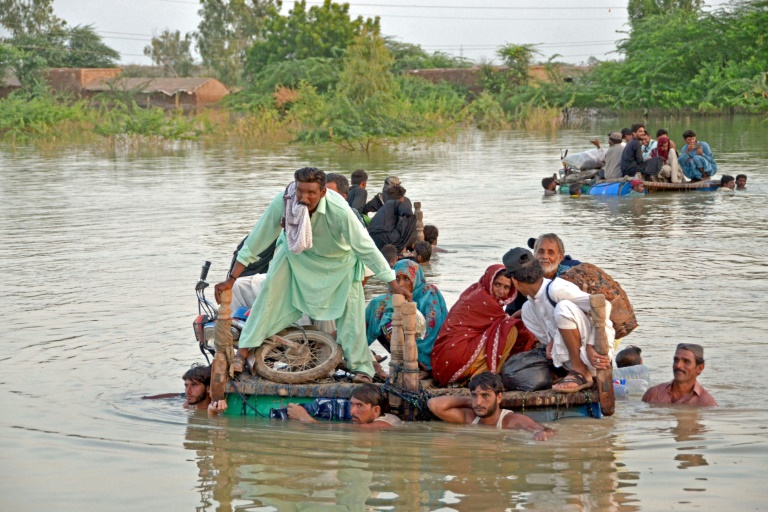
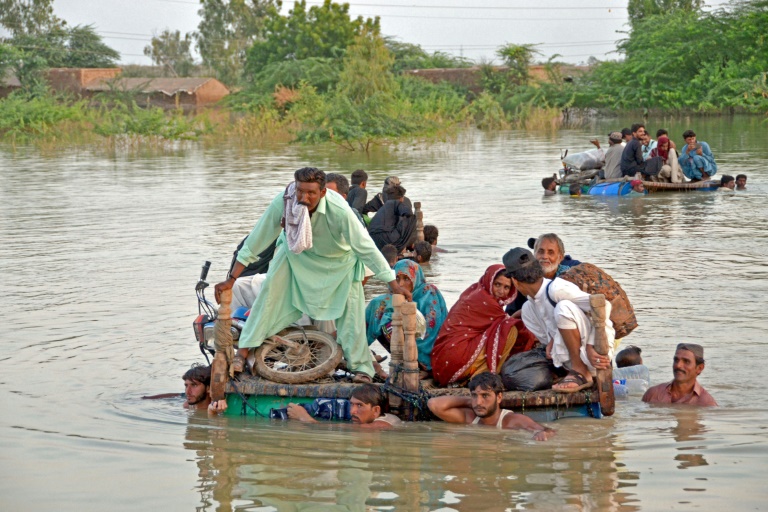
In Jaffarabad district of Balochistan Thursday, villagers were fleeing their homes on makeshift rafts made from upturned wooden “charpoy” beds.

Thousands of temporary campsites have mushroomed on slivers of dry land in the south and west — often roads and railway tracks are the only high ground in a landscape of water.

With people and livestock cramped together, the camps are ripe for outbreaks of disease, with many cases of mosquito-borne dengue reported, as well as scabies.

The floods have killed nearly 1,400 people, according to the latest National Disaster Management Authority report.

Nearly 7,000 km of roads have been damaged, some 246 bridges washed away and more than 1.7 million homes and businesses destroyed.

UN chief in Pakistan to boost flood aid for devastated millions

United Nations chief Antonio Guterres began a two-day visit to flood-hit Pakistan Friday that officials hope will boost global support for a humanitarian crisis affecting millions.

A third of the country is under water — an area the size of the United Kingdom — following record rains brought by what Guterres has described as “a monsoon on steroids”.

Pakistan officials say it will cost at least $10 billion to rebuild and repair damaged infrastructure — an impossible sum for the deeply indebted nation — but the priority, for now, is food and shelter for millions made homeless.

“Everything is drowned, everything washed away,” said Ayaz Ali, suffering from fever as he reluctantly took his place Thursday on a navy boat rescuing villagers from flooded rural communities in southern Sindh province.

In a tweet en route to Pakistan, Guterres said he wanted to “be with the people in their time of need, galvanize international support and bring global focus on the disastrous repercussions of climate change”.

Pakistan receives heavy — often destructive — rains during its annual monsoon season, which are crucial for agriculture and water supplies.

But a downpour as intense as this year’s not been seen for decades, and Pakistan officials blame climate change, which is increasing the frequency and intensity of extreme weather around the world.

Pakistan is responsible for less than one percent of global greenhouse gas emissions, but is eighth on a list compiled by the NGO Germanwatch of countries deemed most vulnerable to extreme weather caused by climate change.

– Tents and tarpaulins needed –

A flood relief plan scaled by the Pakistan government and UN last month called for an immediate $160 million in international funding, and aid is already arriving.

On Thursday a US Air Force C-17 landed — the first American military plane in Pakistan for years — bringing desperately needed tents and tarpaulins for temporary shelter.

While Washington is a key supplier of military hardware to Islamabad, relations have been fractious as a result of conflicting interests in neighbouring Afghanistan — especially since the Taliban returned to power there in August last year.

The meteorological office says Pakistan received five times more rain than normal in 2022 — Padidan, a small town in Sindh, has been drenched by more than 1.8 metres (70 inches) since the monsoon began in June.

The effect of the heavy rains has been twofold — flash floods in rivers in the mountainous north that washed away roads, bridges and buildings in minutes, and a slow accumulation of water in the southern plains that has submerged hundreds of thousands of square kilometres (miles) of land.

In Jaffarabad district of Balochistan Thursday, villagers were fleeing their homes on makeshift rafts made from upturned wooden “charpoy” beds.

Thousands of temporary campsites have mushroomed on slivers of dry land in the south and west — often roads and railway tracks are the only high ground in a landscape of water.

With people and livestock cramped together, the camps are ripe for outbreaks of disease, with many cases of mosquito-borne dengue reported, as well as scabies.

The floods have killed nearly 1,400 people, according to the latest National Disaster Management Authority report.

Nearly 7,000 km of roads have been damaged, some 246 bridges washed away and more than 1.7 million homes and businesses destroyed.

Queen Elizabeth's death 'great loss' for the world: Japan PM

The death of Britain’s Queen Elizabeth II is a “great loss” for the entire world, Japanese Prime Minister Fumio Kishida said Friday, expressing his “deep sorrow”.

“The death of the queen, who led Britain through turbulent times in the world, is a great loss not only for the British people but also the international community,” he told reporters.

Kishida praised the queen’s “extremely important role in world peace and stability”, saying she “contributed greatly to the strengthening of Japan-UK relations”.

He offered the government’s condolences, and said news of her death had left him “feeling deep sorrow”.

Flags in Japan will be flown at half-mast in respect for the late monarch, chief cabinet secretary Hirokazu Matsuno said.

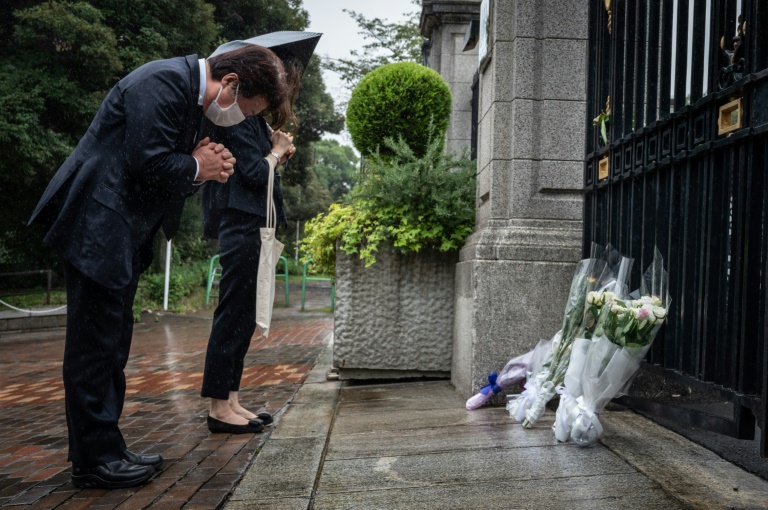
Noboru Suzuki, 81, was among those who went to pay condolences outside the British embassy in Tokyo, where some people left flowers at the gate.

“The British royal family is one of the best known, so I’m sure the whole world is engulfed by sadness, but because Japan has its own imperial family, we’re in shock, too,” he told AFP.

Another mourner, 54-year-old Yasuko Osawa, said she had studied in Britain twice, her trips coinciding with the heyday of princess Diana’s popularity.

“So my path crossed with the British royal family, even just a little,” she said.

Osawa said her generation in Japan had embraced British music, and “everyone around me was going to the UK to study”.

“British royals have had their share of scandals, but I sincerely hope they are able to overcome this loss,” she said, adding that the queen was “someone truly deserving of a state funeral”.

Japan will hold a state funeral for assassinated former prime minister Shinzo Abe later this month, an event that has caused controversy partly over its $12 million price tag.

Murder at sea: North Korea killings roil politics in South

When North Korean soldiers found a South Korean fisheries official in their territorial waters, they shot him dead and burned the body — an incident so shocking it later prompted Kim Jong Un to apologise.

Details are sketchy — and mostly classified — but exactly how and why the official came to be floating in a life jacket above the sea border known as the Northern Limit Line in September 2020 has become a bitter political debate in the South.

Was the 47-year-old official, Lee Dae-jun, a would-be defector fleeing gambling debts, as the government of then-president Moon Jae-in said citing intelligence it then sealed for 30 years?

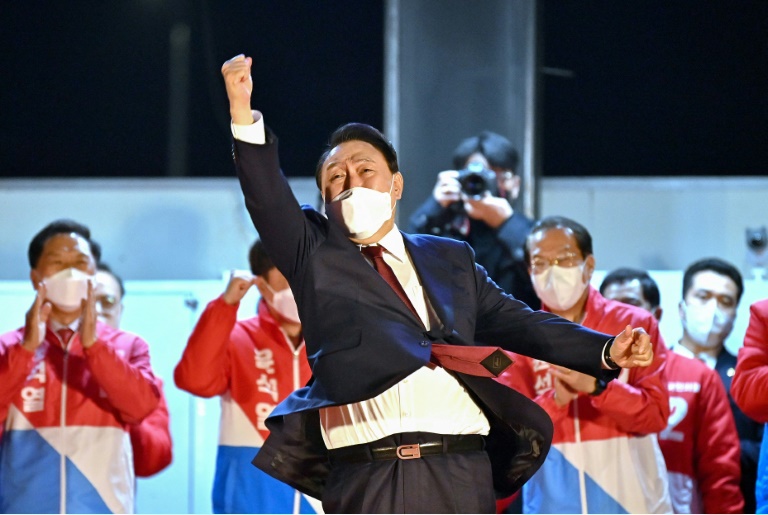
Or is that version of events actually a high-level smear campaign and cover-up, as the new government of Yoon Suk-yeol has claimed in raiding an ex-spy master’s house and launching legal action over the former administration’s handling of the case?

The intelligence services claim that their former chief, Park Jie-won, destroyed evidence showing Lee had no plans to move to Pyongyang.

Park told AFP the charges were “political revenge on the former administration”, dismissing the allegations as unfounded.

Seoul’s new administration has also reopened enquiries into a second explosive case, in which two North Korean fishermen who confessed to killing 16 crewmates at sea were deported in 2019.

Dramatic video showing the pair being dragged seemingly unwillingly through the heavily fortified Demilitarized Zone (DMZ) and returned to the North was released by Yoon’s conservative government.

Moon’s government at the time said the brutal nature of the killings meant the men were not entitled to the usual protections afforded to North Korean defectors and could not be considered refugees.

– Political ploy? –

The political fight over the two cases highlights the risks of interpreting classified intelligence and the law in highly partisan ways, analysts say.

Critics argue the hawkish Yoon, who is struggling with record-low approval ratings just months after becoming president, is engaging in old-school red-baiting in a bid to salvage his popularity with disgruntled voters.

“For conservatives, these two cases are an example of liberals taking a subservient approach to the North,” lawyer and columnist Yoo Jung-hoon told AFP.

But “the timing of the probe that came right after the change of power raises questions of a political motive behind it,” he added.

Supporters of Yoon, a former prosecutor who won a close election in March vowing to get tough on Pyongyang after years of failed diplomacy, say he is simply trying to solve the cases.

“It would be a bigger problem if prosecutors chose to ignore the allegations and bury the cases fearing it would be called a ‘political investigation’,” Shin Yul, a professor at Myongji University, told AFP. 

– ‘Realistic approach’ –

Legal experts say the cases have exposed contradictions in the country’s constitution.

Trying the fishermen in South Korean courts would have been unprecedented, as it was unclear whether local courts had jurisdiction.

One clause of South Korea’s constitution describes the country’s territory as “the Korean peninsula”.

Yoon has suggested that clause meant the men should have been considered South Korean citizens and tried at home.

But the next clause pledges to work for “peaceful reunification” with the North, recognising the reality that there are two distinct countries on the peninsula.

“Seoul has to take a realistic approach when dealing with the North,” said Kim Jong-dae of the Yonsei Institute for North Korean Studies.

Yoon’s administration has accused Moon’s government of sending the fishermen “straight to death row” by repatriating them to the North.

But critics say the president has prioritised “revenge politics” over dealing with more pressing policy issues such as spiralling inflation and a plunging currency.

Seeking to prosecute officials while not presenting “smoking gun” counter-evidence in either case looks suspicious, said Kim Jong-dae.

“The administration is charging ahead with punitive governance with prosecutors on the forefront,” he said.

“It’s one thing to raise questions and demand answers about how the former government handled the two cases. But investigating ex-officials is a totally different thing that inevitably raises suspicions of political motives.”

Westminster Abbey's role in Queen Elizabeth II's life

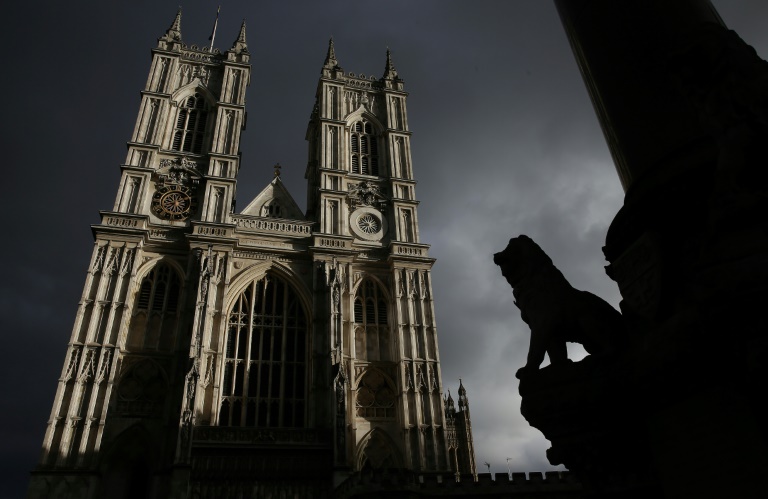
The funeral of Queen Elizabeth II will take place at Westminster Abbey, the historic church in central London which has played a major role in her life.

– 1934: Princess bridesmaid –

In her first major appearance at Westminster Abbey, the eight-year-old princess Elizabeth of York was a bridesmaid at the wedding of her uncle prince George, duke of Kent, and princess Marina of Greece and Denmark on November 29.

It was the first royal wedding to be broadcast by radio.

– 1937: Father’s coronation –

King George VI was crowned on May 12, five months after his brother King Edward VIII abdicated.

“I thought it all very, very wonderful,” the 11-year-old princess Elizabeth said in a handwritten account. 

“At the end the service got rather boring as it was all prayers.”

Afterwards, Elizabeth and her sister Margaret helped themselves to “sandwiches, stuffed rolls, orangeade, and lemonade”.

– 1947: Elizabeth marries Philip –

The November 20 wedding lifted some of the post-war gloom. 

Having renounced his Greek and Danish titles, Philip was created the Duke of Edinburgh.

The ceremony was broadcast by BBC radio to 200 million people around the world.

So soon after World War II, Philip’s three surviving sisters, who married German princes, could not attend.

Princess Elizabeth still needed ration coupons to buy the satin for her Norman Hartnell dress.

– 1953: The coronation –

The June 2 coronation saw Queen Elizabeth make the sacred vows of lifelong service that she upheld throughout her reign.

It was the first televised coronation and for many it was the first time they had watched TV. 

Some 27 million out of Britain’s 36 million population did so. It was also filmed in colour and experimental 3D.

The service lasted almost three hours. Some 8,251 guests attended, crammed into temporary tiers, while 129 nations and territories were officially represented.

In 2018, the sovereign described the Gold State Coach ride as “horrible”.

– 1960: Margaret gets married –

Queen Elizabeth’s sister princess Margaret was talked out of marrying equerry Peter Townsend in 1953, as he was divorced.

She married photographer Antony Armstrong-Jones on May 6 with their artsy friends in attendance.

Their father having died in 1952, Prince Philip walked Margaret down the aisle.

The Earl and Countess of Snowdon drifted apart by the early 1970s and divorced in 1978.

– 1973: Anne’s wedding –

Princess Anne was the first of Queen Elizabeth’s children to wed, marrying army lieutenant Mark Phillips on November 14 in a ceremony filmed in colour and televised globally.

Unusually, Phillips, an Olympic gold medal-winning equestrian, did not take a title. The couple divorced in 1992.

– 1986: Andrew and Fergie –

After Prince Charles and Diana’s wedding at St Paul’s Cathedral in 1981, Queen Elizabeth’s second son Prince Andrew married fun-loving Sarah Ferguson, a major’s daughter. 

The July 23 event followed the big-scale template set five years earlier.

The couple have two children, Princesses Beatrice and Eugenie. They divorced in 1996 but remain close.

– 1997: Diana’s funeral –

Queen Elizabeth was criticised for her seemingly stand-offish response to Diana’s death in a car crash in Paris.

Nearly a million people lined the streets, while an estimated 2.5 billion people watched the September 6 service on television.

When the cortege passed Buckingham Palace, Queen Elizabeth publicly bowed her head.

Diana’s brother Charles Spencer rebuked the royal family in his eulogy. The Windsors took note and gradually began to modernise.

– 2002: Queen Mother’s funeral –

The April 9 funeral of queen Elizabeth the Queen Mother marked the end of an era. Aged 101, the royal matriarch was the last empress of India and a link to a bygone age.

More than 200,000 people filed past her coffin in respect.

Coming two months after Margaret died, the death sparked an outpouring of public mourning and sympathy for the monarch, after years of hostility over Diana’s death.

– 2011: William and Kate –

On April 29, the biggest royal wedding in a generation was watched by up to two billion people worldwide and helped breathe new life into Britain’s monarchy after years of crisis.

Queen Elizabeth allowed William to rip up the stuffy original guest list and start again, bringing in more of their own friends rather than dignitaries.

– 2013: Coronation anniversary –

After jubilee events throughout her reign, the June 4 service was the last major personal anniversary Queen Elizabeth attended at Westminster Abbey.

The glittering solid gold crown and the holy oil used to anoint her took centre stage.

The 60th anniversary service reflected her coronation and lifetime of duty ever since.

Queen Elizabeth smiled as she paused by the Coronation Chair that she sat in 60 years beforehand.

Close Bitnami banner
Bitnami