World

King Charles III to address UK as mourning begins for late queen

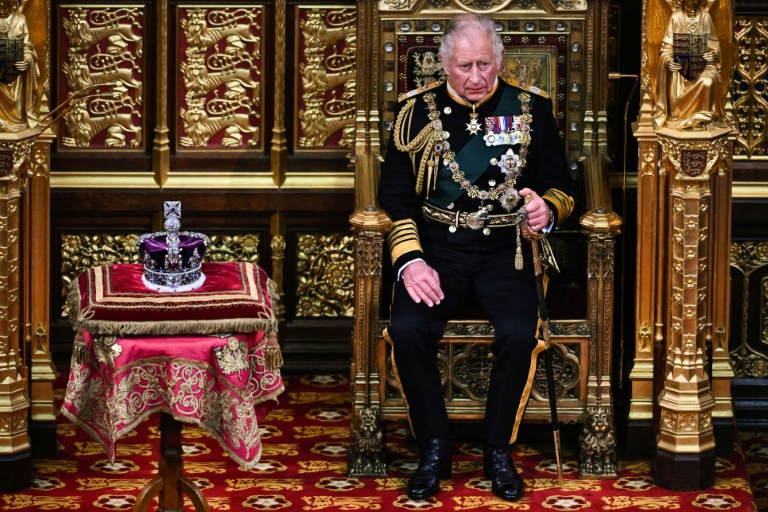
King Charles III was on Friday due to address his new subjects, as Britain was plunged into mourning by the death of queen Elizabeth II, ending a history making 70-year reign.

Charles, 73, became monarch immediately after the death of his mother at her Scottish Highland retreat on Thursday, sparking tributes at home and abroad.

He is due to return to London from Balmoral, where the 96-year-old queen died “peacefully” after a year-long period of ill health and decline.

Details of his inaugural address, set to be pre-recorded, were not immediately released by the palace, but are part of 10 days of detailed pre-prepared plans honed over decades.

Also on Friday, the new king is expected to hold his first audience with Prime Minister Liz Truss, who was only appointed on Tuesday in one of the queen’s last ceremonial acts before her death.

He was also due to meet officials in charge of his accession and the elaborate arrangements for his mother’s set-piece funeral.

He will decide on the length of the royal household’s period of mourning, which is expected to last a month, while the UK government will observe 10 days of official remembrance, when limited business is conducted. 

Gun salutes — one round for every year of the queen’s life — will be fired across Hyde Park in central London and from the Tower of London, the ancient royal fortress on the River Thames.

Muffled church bells will toll at Westminster Abbey, St Paul’s Cathedral and Windsor Castle, among other places, and Union flags will fly at half-mast.

Truss and other senior ministers are set to attend a public remembrance service at St Paul’s, while the UK parliament will start two days of special tributes.

The queen’s death and its ceremonial aftermath comes as the government strives to rush through emergency legislation to tackle the kind of war-fuelled economic privation that marked the start of Elizabeth’s reign in 1952.

– Tributes –

British newspapers were inevitably dominated by the queen’s passing, printing special editions to mark the occasion.

“Our hearts are broken,” headlined popular tabloid the Daily Mail. “We loved you Ma’am,” said The Sun. The Mirror wrote simply: “Thank you.”

Elizabeth, whose public appearances had become rarer, died following months of ill-health that first came to light after she spent an unscheduled night in hospital in October 2021 for undisclosed health tests. 

In one of her last official acts, on Tuesday she appointed Truss as the 15th prime minister of her reign, which started with Winston Churchill in Downing Street

She was seen smiling in photographs but looked frail and leant on a walking stick. Her hand was also bruised dark blue-purple, sparking concern. 

Her coffin will initially remain at Balmoral, a private residence set among thousands of acres (hectares) of rolling grouse moors and forests.

Her closest family members had rushed to be at her bedside at Balmoral, where her body will now lie before being taken to the Scottish capital Edinburgh.

From there, it is expected to travel by train to London for a lying in state and funeral.

Speaking on the steps of Downing Street shortly after her death was announced, Truss acclaimed the “second Elizabethan age”, five centuries after the celebrated first.

“We offer him (Charles) our loyalty and devotion just as his mother devoted so much to so many for so long,” she said in the televised address. “God save the king.”

Braving steady rain, crowds gathered late into Thursday night outside Buckingham Palace in London, and Windsor Castle west of the capital, with the number of well-wishers set to swell in the days ahead.

Londoner Joshua Ellis, 24, choked back tears as he mourned the “nation’s grandmother” at the palace.

“I know she is 96 but there is still a sense of shock. She is in all our minds and hearts,” he said.

“You could always look to the queen, to a sense of stability. Every time people needed support, she was there.” 

– ‘Cherished sovereign’ –

Queen Elizabeth II came to the throne aged just 25 in the exhausted aftermath of World War II, joining a world stage dominated by political figures from Winston Churchill to Mao Zedong and Joseph Stalin.

Her record-breaking reign straddled two centuries of seismic social, political and technological upheaval. 

The last vestiges of Britain’s vast empire crumbled. At home, Brexit shook the foundations of her kingdom, and her family endured a series of scandals.

But throughout, she remained consistently popular and was head of state not just of the United Kingdom but 14 former British colonies, including Australia and Canada. 

New Zealand proclaimed Charles its new king. But Australia’s new government looks set to revive a push to ditch the monarchy, casting doubt on his inheritance even as it mourns the queen.

Britain’s mourning will culminate in a final public farewell at Westminster Abbey in London. The funeral day will be a public holiday in the form of a Day of National Mourning.

Charles’s coronation, an elaborate ritual steeped in tradition and history, will take place in the same historic surroundings, as it has for centuries, on a date to be fixed.

On Saturday, his reign will be formally proclaimed by the Accession Council, which comprises senior politicians, bishops, City of London dignitaries and Commonwealth ambassadors.

In a statement, the new king described his mother as a “cherished sovereign” whose loss would “be deeply felt throughout the country, the Realms and the Commonwealth, and by countless people around the world”.

“During this period of mourning and change, my family and I will be comforted and sustained by our knowledge of the respect and deep affection in which the queen was so widely held,” Charles said.
EU ministers seek ways to face energy shock

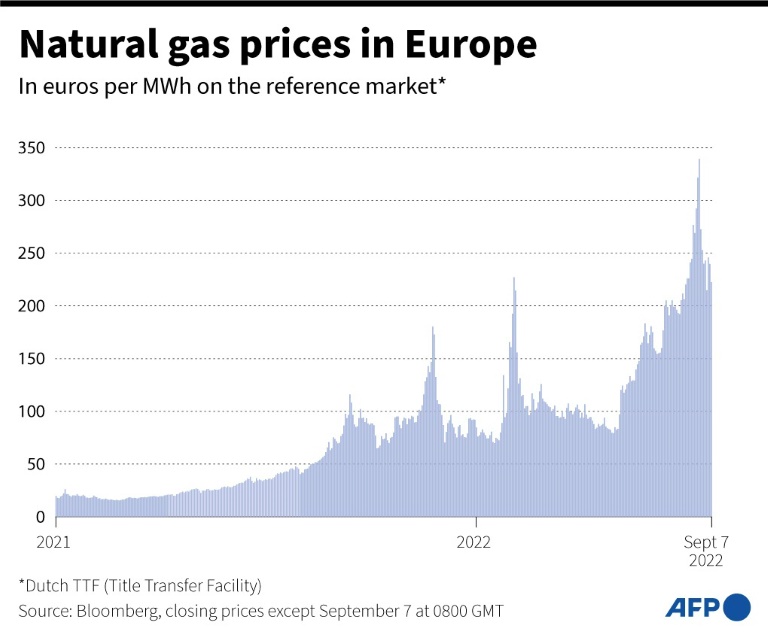
EU energy ministers on Friday will attempt to forge a united response to the energy shock from Russia’s war on Ukraine that has sent prices for electricity and heating skyrocketing.

Moscow’s invasion has seen the price of natural gas hit record levels, throwing the EU economy into deep uncertainty with all eyes on whether Russian President Vladimir Putin will cut off the energy flow entirely.

Before the war, 40 percent of the EU’s gas imports came from Russia, with most of the supply going to Germany, the bloc’s economic powerhouse that is now scrambling to come up with new ways to heat homes and power factories.

The European Commission, the EU’s executive, will ask the ministers meeting in Brussels to consider a series of highly complex proposals designed to ease the burden.

The main drive will be to find ways to compensate households and businesses that are struggling to pay their bills and keep activity going.

The EU executive will propose a mechanism that would see non-gas electricity companies, such as nuclear, solar or renewable firms, share windfall revenues won on the back of high prices for electric power.

The market price of electricity in Europe is closely linked to the gas price, meaning non-gas utilities are enjoying a revenue bonanza while companies stuck paying for gas struggle.

Fossil fuel companies would also be levied on their mega profits from the inflated energy prices.

There needs to be a “discussion without qualms” about a potential solidarity levy on “energy companies that make windfall profits in times of war”, said Austrian Energy Minister Leonore Gewessler ahead of the talks.

– Price cap push stalled –

Another proposal that has broad backing is an idea to rescue electricity companies that are struggling to hedge their spending on the financial markets.

This would be done by relaxing EU rules on state rescues of companies that are suddenly facing more onerous terms for cash as fears of a crisis spread.

The commission will also ask member states to agree on a united way to cut back on energy demand, with mandatory cuts on usage still considered an option, diplomats said.

“These are proposals where I feel there is quite a large convergence of views among the member states,” said a key EU diplomat.

An idea to cap Russian gas prices however is stalled, diplomats warned, with fears rife that the retribution from Russia would throw the European economy into even further chaos.

EU chief Ursula von der Leyen on Wednesday urged member states to agree a price cap on Russian gas, a measure that Putin has warned would be “an absolutely stupid decision”.

But an EU diplomat aware of the state of negotiations warned that there was no majority among the member states in favour of the idea. 

The EU’s energy ministers are set to debate the commission’s ideas, with many countries expected to come to the table with their own proposals.

The commission, which draws up laws that are then ratified by member states and the European Parliament, would then formalise the proposal next week.

EU ministers seek ways to face energy shock

EU energy ministers on Friday will attempt to forge a united response to the energy shock from Russia’s war on Ukraine that has sent prices for electricity and heating skyrocketing.

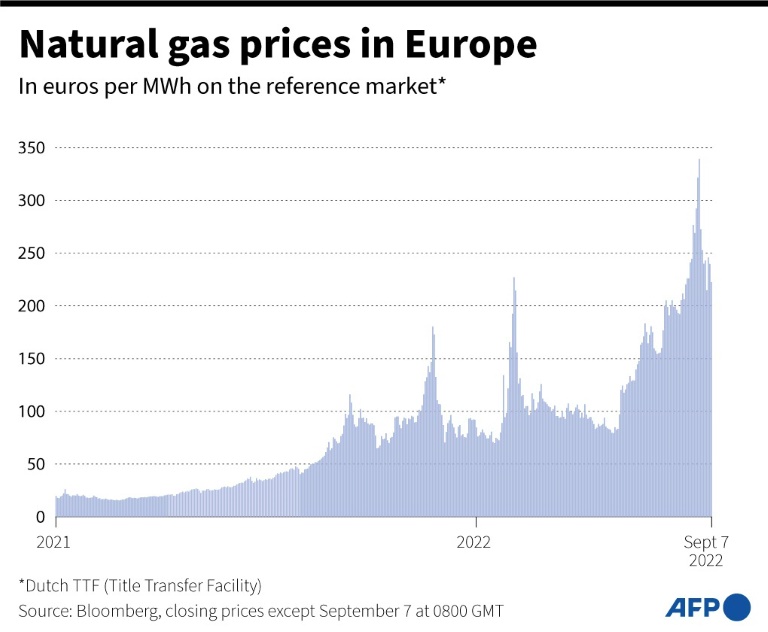
Moscow’s invasion has seen the price of natural gas hit record levels, throwing the EU economy into deep uncertainty with all eyes on whether Russian President Vladimir Putin will cut off the energy flow entirely.

Before the war, 40 percent of the EU’s gas imports came from Russia, with most of the supply going to Germany, the bloc’s economic powerhouse that is now scrambling to come up with new ways to heat homes and power factories.

The European Commission, the EU’s executive, will ask the ministers meeting in Brussels to consider a series of highly complex proposals designed to ease the burden.

The main drive will be to find ways to compensate households and businesses that are struggling to pay their bills and keep activity going.

The EU executive will propose a mechanism that would see non-gas electricity companies, such as nuclear, solar or renewable firms, share windfall revenues won on the back of high prices for electric power.

The market price of electricity in Europe is closely linked to the gas price, meaning non-gas utilities are enjoying a revenue bonanza while companies stuck paying for gas struggle.

Fossil fuel companies would also be levied on their mega profits from the inflated energy prices.

There needs to be a “discussion without qualms” about a potential solidarity levy on “energy companies that make windfall profits in times of war”, said Austrian Energy Minister Leonore Gewessler ahead of the talks.

– Price cap push stalled –

Another proposal that has broad backing is an idea to rescue electricity companies that are struggling to hedge their spending on the financial markets.

This would be done by relaxing EU rules on state rescues of companies that are suddenly facing more onerous terms for cash as fears of a crisis spread.

The commission will also ask member states to agree on a united way to cut back on energy demand, with mandatory cuts on usage still considered an option, diplomats said.

“These are proposals where I feel there is quite a large convergence of views among the member states,” said a key EU diplomat.

An idea to cap Russian gas prices however is stalled, diplomats warned, with fears rife that the retribution from Russia would throw the European economy into even further chaos.

EU chief Ursula von der Leyen on Wednesday urged member states to agree a price cap on Russian gas, a measure that Putin has warned would be “an absolutely stupid decision”.

But an EU diplomat aware of the state of negotiations warned that there was no majority among the member states in favour of the idea. 

The EU’s energy ministers are set to debate the commission’s ideas, with many countries expected to come to the table with their own proposals.

The commission, which draws up laws that are then ratified by member states and the European Parliament, would then formalise the proposal next week.

All eyes on army as Brazil heads for elections

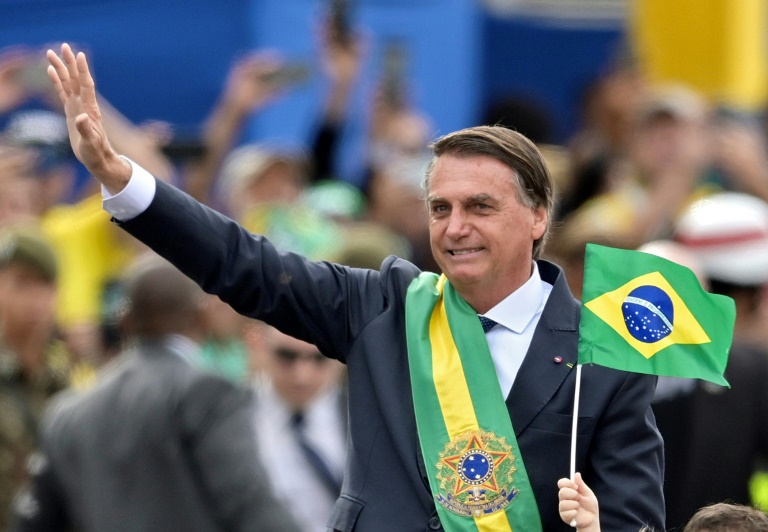
With President Jair Bolsonaro trailing in the polls and regularly alleging Brazil’s voting system is plagued by fraud, all eyes are on the military and the role it could play in the country’s deeply divisive October elections.

The far-right president, an ex-army captain, has enthusiastically courted the military’s support and has put it forward as a referee in the elections, raising fears he could seek an armed intervention if he loses.

However, experts say that while Bolsonaro has the backing of some in the military, it is highly unlikely the institution would get involved in anything resembling a coup.

Bolsonaro, who openly admires Brazil’s 1964-1985 military dictatorship, has drawn the army into politics on an unprecedented scale, naming more than 6,000 active-duty or retired service members to jobs in his administration, all the way up to Vice President Hamilton Mourao, an army reserve general.

That mix of military and politics was on full display Wednesday as Brazil celebrated the 200th anniversary of its independence from Portugal with the 67-year-old commander in chief presiding over a combination of military parades and campaign rallies by his supporters.

“Bolsonaro believes it strengthens him to cultivate close ties with the armed forces and put on displays of military strength,” said Carlos Fico, a military history expert at the Federal University of Rio de Janeiro.

– Enlisting the army –

Bolsonaro, who trails leftist ex-president Luiz Inacio Lula da Silva (2003-2010) heading into the October 2 election, has never presented concrete evidence of electoral fraud.

But he has sought to enlist the military in his crusade against Brazil’s electronic voting system.

The armed forces regularly provide logistical support for elections, but the president has pushed to expand that to new levels, insisting they act as referees.

When the Superior Electoral Tribunal (TSE) bowed to his wishes by inviting the military to take part in a special Election Transparency Commission, Bolsonaro hailed the move.

“The armed forces are responsible, they’re credible in the eyes of the public and they’re not going to play a merely decorative role in this election,” he said.

“They’re going to do the right thing.”

Hewing to Bolsonaro’s line, the nine military members on the commission presented it with a list of nearly 100 points questioning supposed vulnerabilities in the electronic voting machines Brazil has used since 1996.

But in the end, the TSE concluded that most of the critiques were “opinions,” and denied allegations such as the existence of a “dark room” where votes are tabulated.

– ‘Political theater’ –

However, experts say military support for Bolsonaro has its limits.

“There’s not the slightest chance (the military) will play any role outside the one established in the constitution,” said reserve general Maynard Santa Rosa, former secretary for strategic affairs under Bolsonaro.

Even though Bolsonaro enjoys close ties with top military figures, such as Defense Minister Paulo Sergio Nogueira, and has picked former defense minister Walter Braga Netto as his running mate, Fico, the military history expert, said those two “have no troops under their command.”

“There is no generalized movement by active duty service members worried about verifying the electronic voting system,” he said.

Fico added that any election-related unrest from the security forces was more likely to come from the police, a group “very influenced by ‘Bolsonaro-ism.'”

Bolsonaro’s campaign team has pushed him to tone down his rhetoric on the election system, fearful of alienating moderate voters.

But an aide close to the president, speaking on condition of anonymity, admitted Bolsonaro was unlikely to listen.

“It’s part of his persona. It’s political theater,” the aide said.

“Without that, he wouldn’t be Bolsonaro.”

Colombia's territorial battle between Indigenous and Black communities

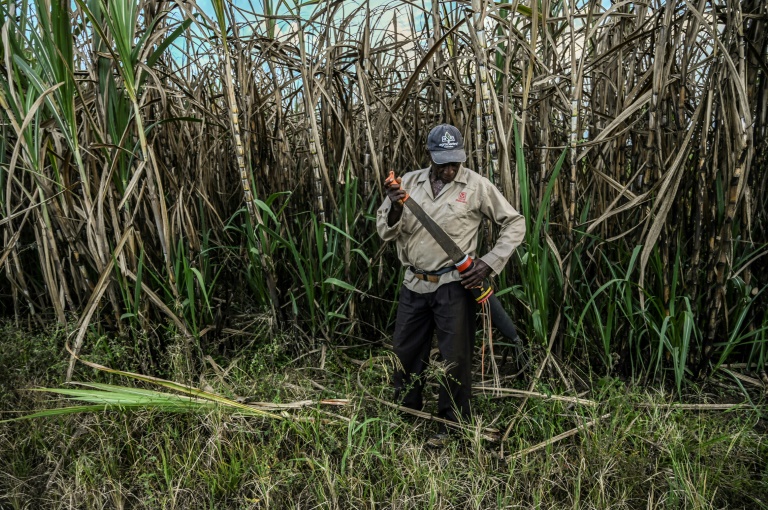
Cattle nonchalantly graze near a dilapidated farm on partly charred and abandoned sugarcane fields.

In the fertile Cauca valley in Colombia’s southwest, Nasa Indigenous people have been forcibly occupying farmland, claiming to be putting to an end damaging monoculture in the country’s main sugarcane growing area.

These sudden eruptions have provoked serious tensions with manual laborers from the sugarcane industry, who are often Black and find themselves chased off their land and out of work.

It seems that a new conflict is about to break out in the Corinto valley, where everyone is claiming “ancestral” lands.

“How can they (the Nasa) claim this land belongs to them if our ancestors lived here their whole lives,” one of the local Black leaders told AFP.

Many Black communities have lived in the region for more than a century.

The Nasa want to “build their houses on top of ours,” he added, hitting out at the “violence” brought by the occupiers.

Close to 2,500 people of African descent, “small- and medium-scale sugarcane producers, live in Severo Mulato, a village bordering several occupied areas. 

The Nasa don’t accept sugarcane plantations. They say these dry out the land and enrich only the sugar barons living in Cali, one of Colombia’s main cities.

– ‘Fighting with stones’ –

Since the June election of Gustavo Petro, the country’s first ever leftist president, Indigenous people have stepped up forceful occupations and confiscations of land in Cauca, which is already one of the worst affected areas by the violence brought by armed gangs and drug traffickers.

Police say there have been 30 occupations of farmland, including nine in the last month.

Hugely popular amongst Indigenous people, Petro has promised an “agrarian reform” to redistribute land in a country where a small landowning elite controls the majority of territory. 

Territorial access is at the heart of the bloody six-decade long conflict that has ravaged Colombia.

During the 1960s, it was the main factor motivating farmers in their armed struggle against the state.

In the following decades, right-wing paramilitaries violently displaced thousands of families in favor of major landowners and cattle ranchers.

Indigenous people have now occupied land in seven of Colombia’s 32 provinces.

It has been condemned by the government, which said the police would intervene.

The Nasa “cut down anything they like … they build cabins, burn” the sugarcane, and destroyed five hectares of crops, said the Black leader.

After the abolition of slavery in 1851, Black people bought land in exchange for their work.

Now, most of their descendents grow sugarcane to sell to the major exporters in the region.

“When we faced up to (the Indigenous people), we had to fight with stones because we didn’t have any other weapons,” he added.

– Getting the valley back –

Just a year ago, the Severo Mulato settlement lay next to a sugarcane farm.

Some 400 “landless” Indigenous families descended from the mountains and took over the land.

In the abandoned homes, infested with mosquitoes, Nasa women and children crowd around wood fires living off vegetables grown in small plots.

“We came and put our lives (at risk) for the right to a piece of land,” argues the group’s leader, his face masked for fear of persecution.

He said the large scale farmers had forced Indigenous people “into the mountains” by colonizing the cultivable land.

With a growing population, they had to cut down the forest to grow food, to the detriment of local fauna and flora.

That’s why they decided to “reclaim” the valley — and to destroy the sugarcane to plant bananas, rice and corn in its place.

Indigenous reserves account for 20 percent of Cauca.

But the Indigenous people complain that these lands are mostly uncultivable forest.

The Indigenous people have established a territory of 1.5 hectares, blocked off from police intervention by tree trunks.

The Black villages are nearby in the valley.

It is a powder keg.

The union of sugarcane exploiters has complained about the loss of “close to 6,000 jobs.”

The industry was responsible for “the development of these communities” according to Juan Carlos Agudelo, a spokesman for the sugarcane workers.

The poverty rate in Cauca of 58 percent is largely above the national average of 39.5 percent.

“Communities that have no schools, no homes, that have no running water. Where is the development?” asks the Indigenous leader.

Hurricane Kay hits northwest Mexico before weakening

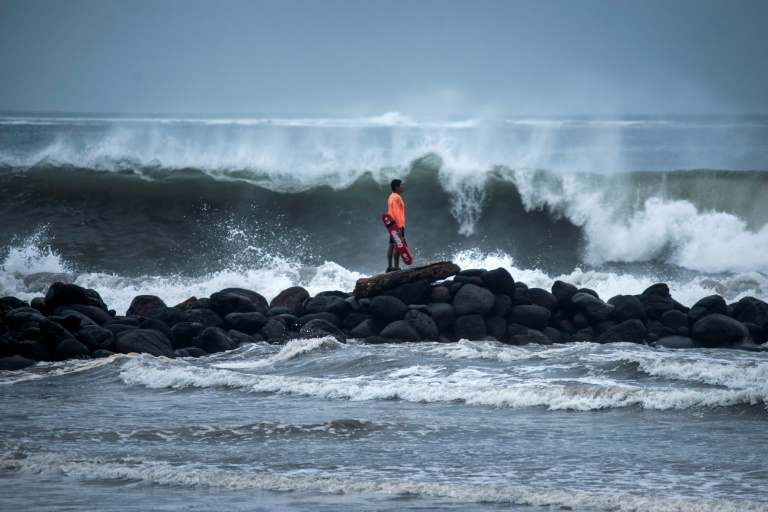
Hurricane Kay made landfall Thursday in northwestern Mexico before losing strength as it moved inland, bringing heavy rain to parts of the Baja California Peninsula, forecasters said.

Kay came ashore in a fairly sparsely populated area as a Category One hurricane — the lowest on a scale of five — and was later downgraded to a tropical storm.

At 0000 GMT Friday Kay was packing maximum sustained winds of 70 miles (110 kilometers) per hour and located about 30 miles east of Punta Eugenia, according to the US National Hurricane Center (NHC).

“Kay continues to bring very heavy rains to portions of the Baja California Peninsula,” it said.

Mexican authorities had earlier opened storm shelters and urged residents to take “extreme precautions” due to the danger of landslides and flooding.

Strong winds and heavy rain were also expected across parts of southern California and southwestern Arizona, the NHC said.

Mexico is regularly lashed by tropical storms on both its Pacific and Atlantic coasts, generally between the months of May and November.

This year was the first since 1997 that no tropical cyclones formed in the North Atlantic, Caribbean Sea or the Gulf of Mexico in August, according to the NHC.

The deadliest storm to hit Mexico last year was a Category Three hurricane called Grace that killed 11 people in the eastern states of Veracruz and Puebla in August.

Donkey domestication happened 7,000 years ago in Africa: DNA study

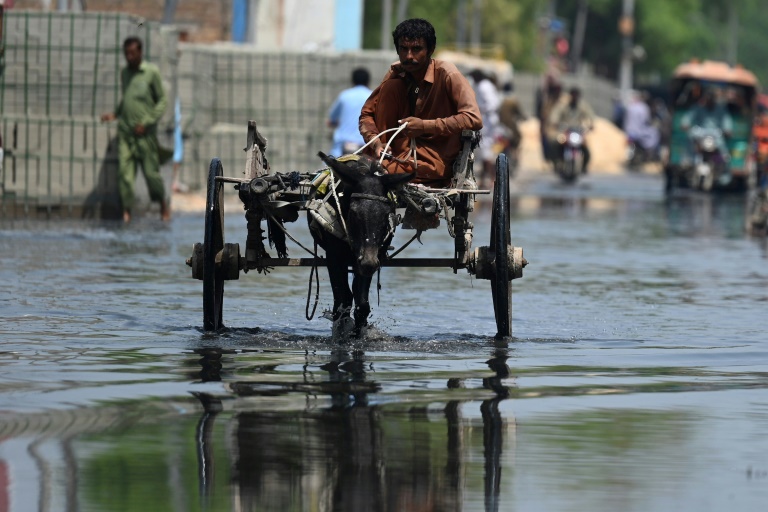
Despite transforming history as beasts of burden essential for transporting goods and people, the humble donkey has long been woefully understudied.

But scientists on Thursday took a big step towards clarifying the species’ origins with a comprehensive genomic analysis of 238 ancient and modern donkeys, finding they were likely domesticated in a single event in eastern Africa some 7,000 years ago.

The paper, published in the journal Science, was the result of an international collaboration led by Evelyn Todd at the Centre for Anthropobiology and Genomics of Toulouse, France.

“Donkeys subsequently spread into Eurasia from ~2500 BCE, and Central and Eastern Asian subpopulations differentiated ~2000 to 1000 BCE,” the team wrote.

Eventually, lineages from Europe and the Near East backbred into western African donkey populations.

Horses, their equid cousins, are believed on the other hand to have been domesticated twice — the first time around 6,000 years ago in the western Eurasian steppes.

The donkey DNA study included three jennies (females) and six jacks (males) from an ancient Roman site in France who were closely interbred.

The authors suggest that Romans bred improved donkey bloodlines to produce mules that were essential to sustaining the military and economic might of the empire.

Donkeys were vital to the development of ancient societies and remain important in middle and lower income countries, but lost their status and utility in modern industrial societies, perhaps explaining why they were neglected by science.

US Justice Dept appeals freeze on review of seized Trump documents

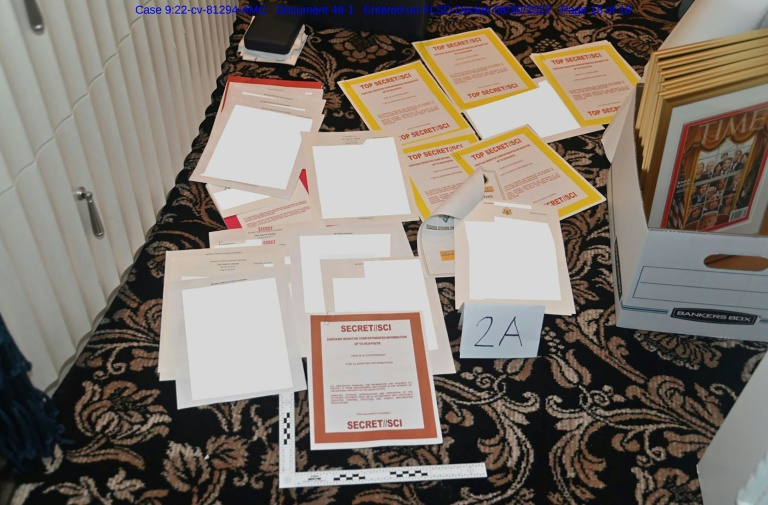
The US Justice Department said Thursday it was appealing a Florida judge’s order to freeze access to thousands of documents, including top secret files, seized from former president Donald Trump’s home.

The department said the order Monday by federal court Judge Aileen Cannon to sequester all the documents for review by an independent “special master” hindered its ability to conduct criminal investigation related to Trump’s possession of the classified documents.

It asked Cannon to set aside her freeze on just over 100 classified documents seized in the August 8 raid on Trump’s Florida home and to keep them from the hands of any special master named to examine the seized materials.

The papers are part of an ongoing FBI criminal investigation into unauthorized possession of national defense information, which comes under the Espionage Act, and Trump has no claim over them, the department said in its filing.

“The classified records are the very subject of the government’s ongoing investigation,” it said.

Last month’s unprecedented FBI raid on Trump’s Palm Beach, Florida Mar-a-Lago home saw thousands of government records, including the highly classified materials, retrieved.

Much of it was mixed together into dozens of boxes with Trump personal records and other things like clothing and media clippings.

Last week Trump asked Cannon to shield all of it from being examined or used in investigations, citing his executive privileges as a former president, attorney-client privileges over any personal legal documents in the trove, and also Constitutional protections from unjustified searches.

Cannon issued a freeze saying a special master could be named for an independent review of what Trump could in fact claim privilege over and what the government could keep.

The government has maintained that Trump has no right to any of the official government records, which belong to the National Archives, and especially not to the classified materials.

It has not detailed what is in the classified documents, but media reports say some are extremely restricted, and the Washington Post reported that one deals with a foreign country’s nuclear program and nuclear defenses.

The Justice Department cited the law on retaining defense materials and the law against destruction of government records for the raid.

It also cited obstruction of justice, after Trump and his attorneys told the FBI in June there were no more government or classified records in Mar-a-Lago.

In a social media posting Trump accused the FBI and Justice department of a “document hoax” and praised Cannon as “brilliant and courageous.”

Euro slides as Fed chief steals ECB's rate hike thunder

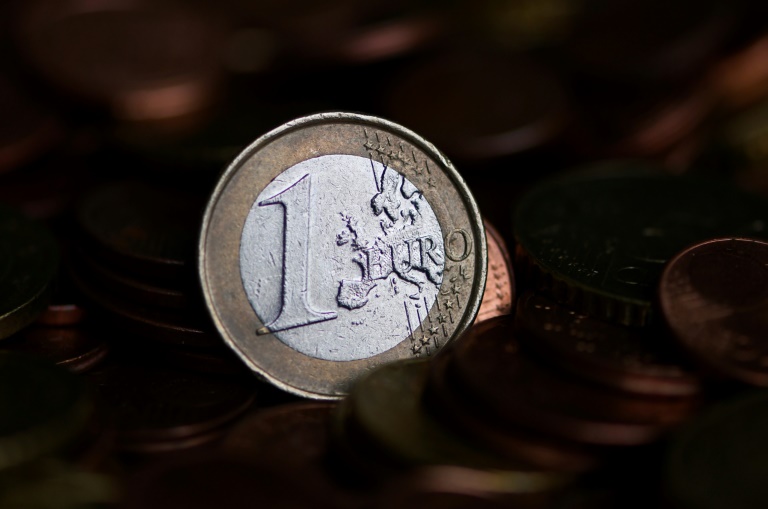
The euro slid on Thursday against the dollar despite a record interest rate hike by the European Central Bank as Federal Reserve chief Jerome Powell also signaled a tough approach against inflation.

Meanwhile, the pound remained close to a 37-year low against the dollar that was struck Wednesday, as new British Prime Minister Liz Truss announced that she will freeze domestic fuel bills for two years to help ease the burden of a UK cost-of-living crisis.

The British currency did not move significantly on news of the death of Queen Elizabeth II after a 70-year reign.

The ECB warned Thursday that inflation was “far too high” and likely to stay above target for “an extended period” as it announced its record 0.75 percentage point hike.

ECB chief Christine Lagarde made clear interest rates were far from where they need be to bring inflation down.

“We actually took the decision today that we would continue to raise interest rates… because we believe that we are far away from the rate at which we hope we’ll see inflation return to the two percent medium term target,” she said.

Lagarde also warned the eurozone risks recession if Russia completely cuts off gas, which it has nearly done.

But comments by Fed chief Jerome Powell were seen as even more hawkish than those by Lagarde.

“We need to act now forthrightly, strongly as we have been doing and we need to keep at it until the job is done to avoid … the kind of very high social costs” of the surge in inflation in the 1970s and 1980s, Powell told a US think tank.

– Greenback ‘more attractive’ –

Chris Beauchamp, chief market analyst at online trading platform IG, said “Investors clearly believe that the Fed is more committed to higher rates than the ECB, while the stronger economic performance of the US means the greenback and not the euro seems the more attractive prospect.”

The euro, which had broken back above parity with the dollar, slid down as far as $0.9934 before recovering some ground.

The Fed has made it clear it plans to continue to aggressively raise interest rates to rein in surging inflation, even at the cost of causing some economic pain.

The dollar has moved ever higher against its major peers in recent weeks as investors flood into the currency hoping for better returns as the Fed raises rates and as they seek a haven in the face of economic turmoil.

The euro on Wednesday touched a fresh 20-year dollar low.

The Fed holds its next policy meeting on September 21, with a third successive 75-basis-point lift forecast.

In equities trading, eurozone stocks closed the day mostly higher, and Wall Street equities pushed higher following a choppy session.

Analysts said the hawkish central bank policy was largely in line with expectations.

“The resilience was construed as a sign that a lot of bad news, and worries about near-term rate hikes, have been priced in already,” said Briefing.com. 

– Key figures at around 2130 GMT –

New York – Dow: UP 0.6 percent at 31,774.52 (close)

New York – S&P 500: UP 0.7 percent at 4,006.18 (close)

New York – Nasdaq: UP 0.6 percent at 11,862.13 (close)

London – FTSE 100: UP 0.3 percent at 7,262.06 (close) 

Frankfurt – DAX: DOWN less than 0.1 percent at 12,904.32 (close)

Paris – CAC 40: UP 0.3 percent at 6,125.90 (close)

EURO STOXX 50: UP 0.3 percent at 3,512.38 (close)

Tokyo – Nikkei 225: UP 2.3 percent at 28,065.28 (close)

Hong Kong – Hang Seng Index: DOWN 1.0 percent at 18,854.62 (close)

Shanghai – Composite: DOWN 0.3 percent at 3,235.59 (close)

Euro/dollar: DOWN at $1.0001 from $1.0006 on Wednesday

Pound/dollar: DOWN at $1.1500 from $1.1533

Euro/pound: UP at 86.93 pence from 86.76 pence

Dollar/yen: UP at 144.07 yen from 143.74 yen 

West Texas Intermediate: UP 2.0 percent at $83.54 per barrel

Brent North Sea crude: UP 1.3 percent at $89.15 per barrel

burs-jmb/st

The new king: Charles III in dates

Charles III is the longest-serving heir-apparent in British history.

Aged 73, he has been heir to the throne since the age of just three, when his mother became Queen Elizabeth II. 

Following are key dates in his life:

– Early years –

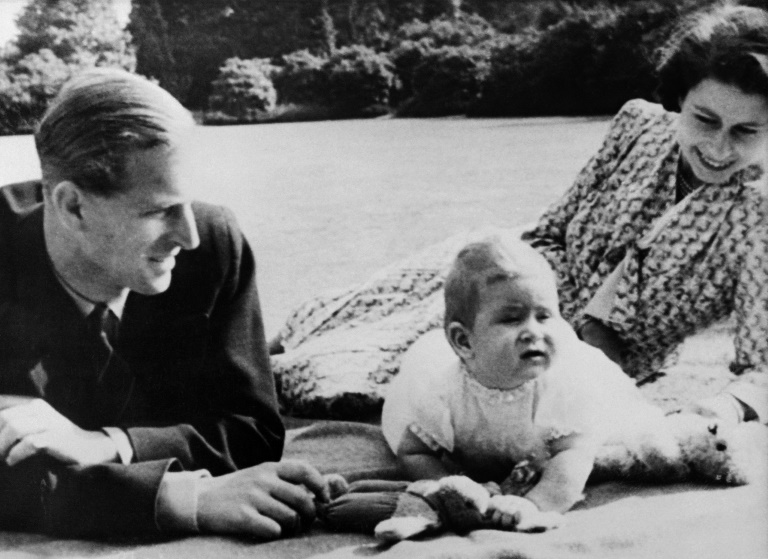
November 14, 1948: His Royal Highness Prince Charles Philip Arthur George of Edinburgh is born in Buckingham Palace, second in line to the throne.

December 15, 1948: Charles is christened by the Archbishop of Canterbury in the palace’s Music Room.

February 6, 1952: Death of Charles’s grandfather, King George VI, and ascent of Queen Elizabeth II. As the sovereign’s eldest son, Charles, aged just three, becomes heir to the throne.

June 2, 1953: Charles becomes the first heir to the throne to attend his mother’s coronation.

July 26, 1958: He becomes the 21st Prince of Wales, aged nine.

April 1962: Charles starts at Gordonstoun, a boarding school in northeast Scotland, which his father, Prince Philip, Duke of Edinburgh, attended.

– Gown and crown –

1967: Charles leaves Gordonstoun and goes to Trinity College at Cambridge University to study archeology and anthropology, then history. 

July 1, 1969: He is invested as Prince of Wales in a televised ceremony at Caernarfon Castle, after spending a term at the University College of Wales, Aberystwyth, learning Welsh. 

1970: Charles graduates from university — the first heir to the throne to do so.

– In the navy –

September 1971: The future king joins the Royal Navy, a path also taken by his father. Serves on the guided missile destroyer HMS Norfolk and two frigates.

1974: Already a trained jet pilot, he qualifies as a helicopter pilot and joins an air squadron operating from the aircraft carrier HMS Hermes.

1976: Charles commands the coastal minehunter HMS Bronington before leaving the Royal Navy. He uses his navy severance pay of £7,400 to set up The Prince’s Trust charity.

– Loss, love and children –

August 27, 1979: Charles’s great-uncle and closest confidant Lord Louis Mountbatten is assassinated by the Irish Republican Army.

July 29, 1981: The prince marries Lady Diana Spencer at London’s St. Paul’s Cathedral in a fairy-tale wedding watched by an estimated 750 million people worldwide. She becomes Princess of Wales.

June 21, 1982: The couple’s first son, Prince William, is born, ensuring the succession. Prince Harry follows on September 15, 1984.

March 10, 1988: Charles escapes uninjured in an avalanche while skiing in Klosters, Switzerland, but one of his friends is killed and another injured.

– Divorce and tragedy –

December 9, 1992: Charles and Diana announce their separation. The royal family is rocked by revelations about the couple’s marriage and infidelities. They formally divorce on August 28, 1996.

August 31, 1997: Diana, her boyfriend Dodi Fayed and driver Henri Paul are killed in a high-speed car crash in Paris as they try to flee paparazzi photographers.

Charles repatriates her body and insists she be granted full royal honours in death.

September 6, 1997: Charles accompanies William, Harry and their uncle, Charles Spencer, on foot behind her coffin to the funeral.

– Camilla and grandchildren –

April 9, 2005: Charles marries his longtime mistress Camilla Parker Bowles at Windsor Guildhall in a civil ceremony. She becomes the Duchess of Cornwall.

April 29, 2011: William marries Kate Middleton, a commoner, at Westminster Abbey.

July 22, 2013: Charles becomes a grandfather after the birth of William and Kate’s son, Prince George. Princess Charlotte follows in 2015, then Prince Louis, in 2018.

May 19, 2018: Charles walks Meghan Markle down the aisle at St. George’s Chapel, Windsor Castle, as she marries his youngest son, Prince Harry.

November 14: Charles turns 70.

– Later years –

May 6, 2019: Charles becomes a grandfather again, as Meghan gives birth to Archie. Lilibet Diana follows in 2021.

March 7, 2021: Harry hits out at his father in a television interview from the United States, where he moved after quitting royal life in 2020.

He accuses Charles of being suffocated by tradition and of cutting him off financially after the move, although royal officials later maintain he “allocated a substantial sum” to the couple to help them with the transition.

November 30, 2021: Charles attends a ceremony in Barbados as the Caribbean islandbecomes a republic.

June 2022: Charles’ role as future monarch becomes increasingly prominent as he deputises for the ailing queen at several of her Platinum Jubilee celebrations.

September 8 2022: The queen dies in Balmoral, Scotland at the age of 96. Charles ascends to the throne, becoming King Charles III, and his wife Camilla is named queen consort.

Close Bitnami banner
Bitnami