World

China earthquake death toll rises to 82

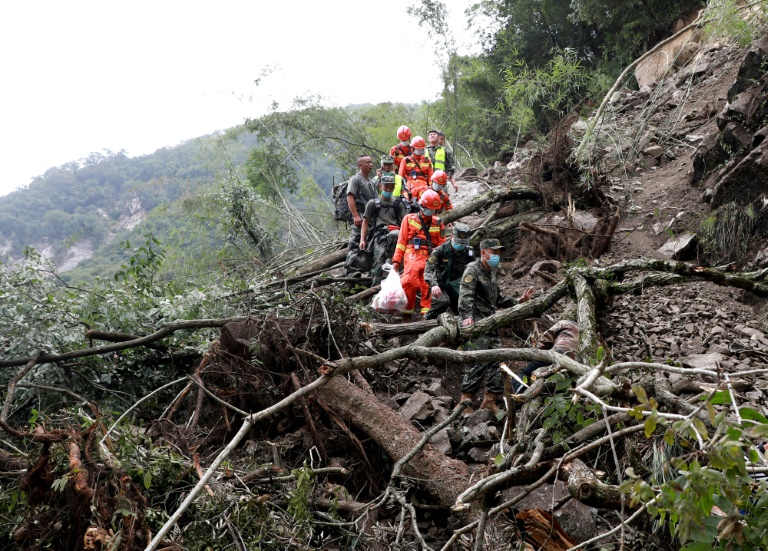
The death toll from a strong earthquake that struck southwest China rose to 82, state media reported Thursday, as rain and possible mudslides threatened the search for dozens of missing people. 

The magnitude 6.6 quake hit about 43 kilometres (26 miles) southeast of the city of Kangding in Sichuan province at a depth of 10 kilometres on Monday, according to the US Geological Survey, forcing thousands to be resettled into temporary camps.

State broadcaster CCTV said that 46 people died in Ganzi prefecture near the epicentre, while 36 deaths were reported in neighbouring Ya’an city. 

More than 270 were injured, while the number of missing remained at 35, CCTV reported.

The national weather service said moderate rain will continue in the affected earthquake area on Thursday and Friday, with some localised heavy showers. 

“Since the post-earthquake geological conditions are inherently fragile, and the impact of additional rainfall may lead to landslides and mudslides, the local area needs to beware of secondary disasters,” China’s meteorological administration said.

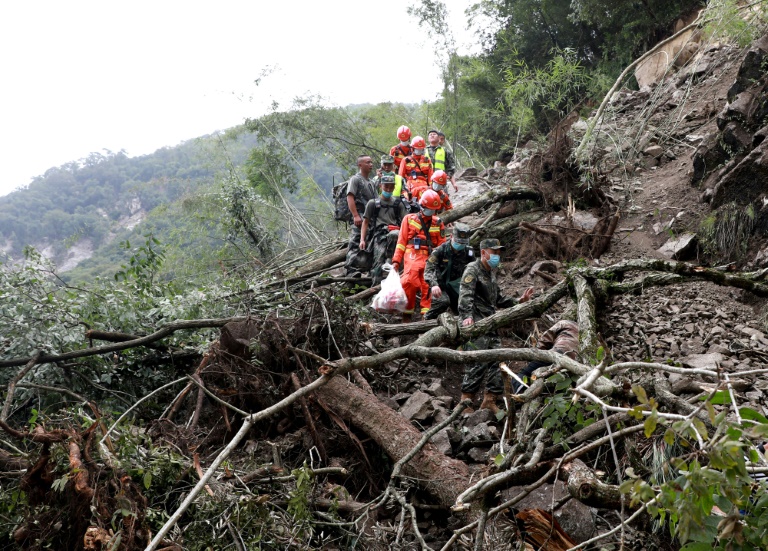
The People’s Liberation Army, paramilitary police, and fire rescue services dispatched more than 10,000 workers to the area, who continued search operations and landslide clean-up efforts in the remote countryside.

– Mountain torrents –

Rescuers braved flash floods and landslides caused by aftershocks to relocate villagers from destroyed homes, often having to haul them through mountainous terrain on ropes and stretchers.

“We also waded through the water to get to Xingfu village. The mountain torrents contain rocks… the stones you can’t see in the water pose the greatest threat to us,” a rescue team member named Tan Ke told CCTV.

“We quickly used ropes to build a human ladder… when we first started wading, the water reached our knees and thighs. By the time we got to a safe place, the flash flood had reached waist level.” 

Over 22,000 people have so far been resettled into 124 temporary sites across Ganzi and Ya’an, the state-owned People’s Daily newspaper reported. 

The paper said over 21,000 students and staff at a school in Shimian county — where Ya’an is located — were safely evacuated within one minute of the quake. 

Nearly 1,800 schools in the area had reopened by Wednesday, it added. 

Workers raced to fix hundreds of kilometres of power and optical cables, with communications in affected areas “basically restored” as of Thursday, the China Youth Daily reported. 

Local authorities have received over 100 million yuan ($14 million) in disaster relief donations so far, the report said. 

The quake also rocked buildings in the provincial capital of Chengdu — where millions are confined to their homes under a strict Covid-19 lockdown — and in the nearby megacity of Chongqing, residents told AFP.

China earthquake death toll rises to 82

The death toll from a strong earthquake that struck southwest China rose to 82, state media reported Thursday, as rain and possible mudslides threatened the search for dozens of missing people. 

The magnitude 6.6 quake hit about 43 kilometres (26 miles) southeast of the city of Kangding in Sichuan province at a depth of 10 kilometres on Monday, according to the US Geological Survey, forcing thousands to be resettled into temporary camps.

State broadcaster CCTV said that 46 people died in Ganzi prefecture near the epicentre, while 36 deaths were reported in neighbouring Ya’an city. 

More than 270 were injured, while the number of missing remained at 35, CCTV reported.

The national weather service said moderate rain will continue in the affected earthquake area on Thursday and Friday, with some localised heavy showers. 

“Since the post-earthquake geological conditions are inherently fragile, and the impact of additional rainfall may lead to landslides and mudslides, the local area needs to beware of secondary disasters,” China’s meteorological administration said.

The People’s Liberation Army, paramilitary police, and fire rescue services dispatched more than 10,000 workers to the area, who continued search operations and landslide clean-up efforts in the remote countryside.

– Mountain torrents –

Rescuers braved flash floods and landslides caused by aftershocks to relocate villagers from destroyed homes, often having to haul them through mountainous terrain on ropes and stretchers.

“We also waded through the water to get to Xingfu village. The mountain torrents contain rocks… the stones you can’t see in the water pose the greatest threat to us,” a rescue team member named Tan Ke told CCTV.

“We quickly used ropes to build a human ladder… when we first started wading, the water reached our knees and thighs. By the time we got to a safe place, the flash flood had reached waist level.” 

Over 22,000 people have so far been resettled into 124 temporary sites across Ganzi and Ya’an, the state-owned People’s Daily newspaper reported. 

The paper said over 21,000 students and staff at a school in Shimian county — where Ya’an is located — were safely evacuated within one minute of the quake. 

Nearly 1,800 schools in the area had reopened by Wednesday, it added. 

Workers raced to fix hundreds of kilometres of power and optical cables, with communications in affected areas “basically restored” as of Thursday, the China Youth Daily reported. 

Local authorities have received over 100 million yuan ($14 million) in disaster relief donations so far, the report said. 

The quake also rocked buildings in the provincial capital of Chengdu — where millions are confined to their homes under a strict Covid-19 lockdown — and in the nearby megacity of Chongqing, residents told AFP.

Manhunt in Canada stabbing spree ends with both suspects dead

A days-long search for the second man suspected of carrying out a deadly stabbing spree in a remote western Canadian Indigenous community ended Wednesday, with the 32-year-old dying after being taken into custody, police said.

Federal police Assistant Commissioner Rhonda Blackmore told a news conference that Myles Sanderson, suspected along with his brother of killing 10 people and wounding 18 on Sunday, “went into medical distress” shortly after being arrested in Saskatchewan province.

She added that he was taken to hospital where he was pronounced dead, but gave no other details of the circumstances.

On Monday, his 31-year-old brother Damien Sanderson had been found dead in a grassy field in the Cree community.

Authorities said he likely had been killed by his older sibling, who remained a fugitive until his arrest near the town of Rosthern in Saskatchewan — about 100 kilometers (60 miles) west of where the stabbings occurred.

Blackmore said that with both brothers now dead, “we may never have an understanding of (their) motivation.”

The manhunt had stretched across three provinces, and gone from Regina, Saskatchewan province’s capital 300 kilometers to the south, and then back to the James Smith Cree Nation — in response to reported sightings.

An AFP reporter at the scene near Rosthern on Wednesday saw several police cars surrounding a white pickup along the side of a highway. 

An hour before the arrest, police issued an alert about a man armed with a knife in a stolen white Chevrolet Avalanche nearby, making a link to the stabbing case and urging locals to shelter in place.

Blackmore said police, after receiving an emergency call about the theft, spotted the speeding vehicle and “directed (it) off the road and into a nearby ditch.”

“He was arrested by police and taken into custody,” she said. “A knife was located inside the vehicle.”

It was a dramatic end to a four-day manhunt across the vast Prairies region.

It also offered relief to a nation distressed by one of modern Canada’s deadliest incidents of mass violence.

“Our province is breathing a collective sigh of relief as Miles Sanderson is no longer at large,” Blackmore commented, adding that now the families of victims and the community “will be able to start healing.”

– ‘Senseless act’ –

Myles Sanderson had a history of explosive violence that led to 59 past convictions, and was also wanted for breaching parole in May after serving part of a sentence for assault and robbery.

But with no known motive for the latest attacks, relatives of victims spoke out earlier Wednesday about their “nightmare” and called for answers from authorities.

Mark Arcand said the killings that claimed the lives of his sister Bonnie Burns, 48, and her son Gregory Burns, 28, were a “horrible, senseless act.”

“We’re broken,” he said, describing emotions of anger and sadness. “It still feels like it’s a nightmare. It doesn’t feel real.”

“How did this happen to our family? Why did it happen? We have no answers,” he told a press conference. “We just know that our family members were killed in their own home, in their yard.”

Arcand recounted how his sister had rushed out of her house to help her son, who was bleeding out in their driveway after being stabbed several times.

“She was stabbed two times, and she died right beside him,” he said. “She was trying to protect her son.”

A neighbor ran over to try to stop the assailants, but she too was killed, he said.

The family and the community, Arcand added, has “a steep hill to climb, and we’re going to climb it together, united.”

The coroner has released the names of the deceased victims — six men and four women aged 23 to 78 years old. 

All but one were members of the Cree community. The other was a widower who lived with his adult grandson in nearby Weldon.

Seventeen adults and one young teen were also wounded in the attacks, police said. Among them was another son of Bonnie Burns who was slashed in the neck.

Ten people remain hospitalized, including two in critical condition, according to the Saskatchewan Health Authority. Seven others have been discharged.

Police believe some of the victims were targeted and others were attacked randomly.

The grisly attack followed several recent mass killings across Canada. A gunman masquerading as a policeman killed 22 people in Nova Scotia in April 2020, two years after a driver of a van killed 11 pedestrians in Toronto.

Another shooter killed six worshippers at a Quebec City mosque in January 2017.

'Help wanted': businesses struggle to fill jobs

Germany has a shortage of plumbers. The United States needs more postal workers. Australia is lacking engineers. In Canada, hospitals are looking for more nurses. 

“The Great Resignation” that countries have experienced since Covid pandemic restrictions were eased is not over yet.

Michael Blume, chief executive of a software company in eastern Germany, said he had “a lot of difficulties finding workers”.

“Wherever we look, we are lacking qualified workers,” Blume, whose firm Currentsystem23 is based in eastern Germany, told AFP.

There were 887,000 job vacancies in Germany — Europe’s biggest economy — in August, some 108,000 openings more than last year.

“Help Wanted” signs are plastered in front of restaurants and other businesses in the United States, where there were more than 11 million job openings in late July, or two for every employment seeker.

“Vacancy rates are very high across the world. Surveys and firms are saying it is still very hard to fill positions,” said Ariane Curtis, a Toronto-based economist at research firm Capital Economics. 

Countries in Western Europe and North America are having a particularly tough time filling jobs, though the problem is also present in eastern Europe, Turkey and Latin America, Curtis said.

Vacancy-to-unemployed rates rose sharply in Australia, Canada and Britain in later 2021 compared to pre-pandemic levels, an OECD report said in July.

– Businesses closing early –

The shortages have persisted even as the world economy has begun to slow since Russia invaded Ukraine earlier this year.

It affects a broad range of sectors: from a lack of teachers in Texas to not enough staff in the hospitality industry in Italy or the Canadian health system.

The shortages have forced businesses to adapt.

Pharmacies in the US state of Wisconsin, services at hospitals in Canada’s province of Alberta and restaurants in Australia’s Sunshine Coast have had to close for parts of the day, according to local news reports.

White-collar workers are also in short supply.

Clement Verrier, who co-heads an executive recruiting firm in Paris, said it used to be difficult to find companies looking to hire. Now it’s the opposite. 

“We’re seeing an unprecedented number of candidates who disappear in the middle of the recruitment process, without calling back,” Verrier said.

– ‘Shift in mindset’ –

Aging populations were already starting to cause shortages before Covid, but the problem exploded with the pandemic.

There are multiple factors behind the phenomenon: some people have chosen to retire early, while others have struggled with long Covid symptoms. Others have simply had enough of poor working conditions or low salaries.

Other factors include a drastic drop in immigration due to lockdowns, people moving out of cities and workers seizing the moment to rethink their career choices.

“The pandemic drove a fundamental shift in mindset and priorities, and employers aren’t keeping pace with that change,” said Bonnie Dowling, expert associate partner at McKinsey, a global consultancy that conducted a study on the wave of resignations around the world.

To keep or woo workers, companies are offering higher salaries. Other benefits that have emerged include the option of working from home, “bonus” holidays and more personal days.

Some countries are easing their immigration rules to attract more workers.

Germany unveiled plans Wednesday to make it easier for people to hold multiple nationalities and make naturalisation of foreigners easier.

“The big question is if what we have seen in the last months will cool down or not,” said Mike Smith, CEO of Netherlands-based international recruiter Randstad Sourceright.

“From our position we don’t believe it is transitory,” he said.

“We think it is a structural change in the way employees are looking to interact with work. Trends continue to point to that. The shift in worker expectations is here to stay.”

'Help wanted': businesses struggle to fill jobs

Germany has a shortage of plumbers. The United States needs more postal workers. Australia is lacking engineers. In Canada, hospitals are looking for more nurses. 

“The Great Resignation” that countries have experienced since Covid pandemic restrictions were eased is not over yet.

Michael Blume, chief executive of a software company in eastern Germany, said he had “a lot of difficulties finding workers”.

“Wherever we look, we are lacking qualified workers,” Blume, whose firm Currentsystem23 is based in eastern Germany, told AFP.

There were 887,000 job vacancies in Germany — Europe’s biggest economy — in August, some 108,000 openings more than last year.

“Help Wanted” signs are plastered in front of restaurants and other businesses in the United States, where there were more than 11 million job openings in late July, or two for every employment seeker.

“Vacancy rates are very high across the world. Surveys and firms are saying it is still very hard to fill positions,” said Ariane Curtis, a Toronto-based economist at research firm Capital Economics. 

Countries in Western Europe and North America are having a particularly tough time filling jobs, though the problem is also present in eastern Europe, Turkey and Latin America, Curtis said.

Vacancy-to-unemployed rates rose sharply in Australia, Canada and Britain in later 2021 compared to pre-pandemic levels, an OECD report said in July.

– Businesses closing early –

The shortages have persisted even as the world economy has begun to slow since Russia invaded Ukraine earlier this year.

It affects a broad range of sectors: from a lack of teachers in Texas to not enough staff in the hospitality industry in Italy or the Canadian health system.

The shortages have forced businesses to adapt.

Pharmacies in the US state of Wisconsin, services at hospitals in Canada’s province of Alberta and restaurants in Australia’s Sunshine Coast have had to close for parts of the day, according to local news reports.

White-collar workers are also in short supply.

Clement Verrier, who co-heads an executive recruiting firm in Paris, said it used to be difficult to find companies looking to hire. Now it’s the opposite. 

“We’re seeing an unprecedented number of candidates who disappear in the middle of the recruitment process, without calling back,” Verrier said.

– ‘Shift in mindset’ –

Aging populations were already starting to cause shortages before Covid, but the problem exploded with the pandemic.

There are multiple factors behind the phenomenon: some people have chosen to retire early, while others have struggled with long Covid symptoms. Others have simply had enough of poor working conditions or low salaries.

Other factors include a drastic drop in immigration due to lockdowns, people moving out of cities and workers seizing the moment to rethink their career choices.

“The pandemic drove a fundamental shift in mindset and priorities, and employers aren’t keeping pace with that change,” said Bonnie Dowling, expert associate partner at McKinsey, a global consultancy that conducted a study on the wave of resignations around the world.

To keep or woo workers, companies are offering higher salaries. Other benefits that have emerged include the option of working from home, “bonus” holidays and more personal days.

Some countries are easing their immigration rules to attract more workers.

Germany unveiled plans Wednesday to make it easier for people to hold multiple nationalities and make naturalisation of foreigners easier.

“The big question is if what we have seen in the last months will cool down or not,” said Mike Smith, CEO of Netherlands-based international recruiter Randstad Sourceright.

“From our position we don’t believe it is transitory,” he said.

“We think it is a structural change in the way employees are looking to interact with work. Trends continue to point to that. The shift in worker expectations is here to stay.”

China's Chengdu extends Covid lockdown

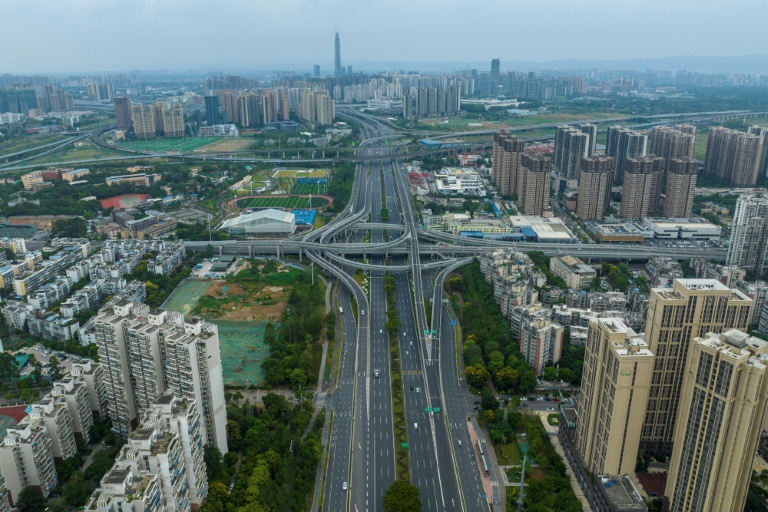
The Chinese megacity of Chengdu has extended a Covid-19 lockdown in most areas, maintaining curbs that have ground business to a halt and confined the majority of its 21 million residents to their homes.

China is the last major economy welded to a zero-Covid strategy, tamping down virus flare-ups through a combination of snap lockdowns, mass testing and lengthy quarantines.

Chengdu, the capital of southwestern Sichuan province, has been effectively under lockdown for a week since reporting several hundred Covid cases.

The measure was expected to be lifted on Wednesday, but the city government said in a notice that “the entire city will continue to deeply push forward our assault for zero community spread”.

Authorities would “strive hard for a week to realise the goal of zero community transmission in the whole city”, the government added.

“The fruits of the whole city’s anti-epidemic measures are beginning to become apparent, but the risk of community transmission still exists in some areas,” it said.

All residents under lockdown will be tested every day, and each household will be permitted to send out one person per day to purchase groceries and other supplies, according to the notice.

Chengdu logged 116 new local infections on Thursday, more than half of which showed no symptoms, according to figures from the provincial health commission.

Confined to their housing complexes, some residents were unable to flee when a strong earthquake in a nearby part of Sichuan reverberated through the city earlier this week, locals told AFP.

China’s government has shown few signs of backing away from a zero-Covid approach despite mounting criticism that it is harming growth in the world’s second-largest economy.

Businesses in Chengdu have been forced to temporarily close, with Swedish carmaker Volvo last week suspending production at a plant in the city that employs nearly 3,000 people.

Elsewhere, the southern business and technology hub of Shenzhen eased some curbs this week after a virus surge prompted authorities to order the city’s 18 million residents to refrain from leaving their homes.

Officials in Beijing have urged the capital to guard against a rebound in infections during the Mid-Autumn public holiday, which runs from Saturday to Monday and is a popular period for travel and social gatherings.

China reported 1,334 new domestic infections on Thursday, the majority of which were asymptomatic, according to the National Health Commission.

UK's Truss expected to freeze energy bills

New British Prime Minister Liz Truss was on Thursday expected to unveil a costly plan to freeze domestic fuel bills to help ease the burden of a soaring cost-of-living crisis.

Truss only took over from Boris Johnson on Tuesday, but has vowed to hit the ground running as calls mount for urgent action to help hard-pressed households and businesses.

Reports suggest the plan could top more than £100 billion ($116 billion), surpassing Britain’s Covid-era furlough jobs support scheme.

Neither Truss nor her office have confirmed the eye-watering sums. Downing Street on Wednesday night said only that it would be a “bold plan of action”.

“I know families and businesses across the country are worried about how they are going to make ends meet this autumn and winter,” she said.

“Putin’s war in Ukraine and weaponisation of gas supply in Europe is causing global prices to rise –- and this has only made clearer that we must boost our long-term energy security and supply.

“We will take action immediately to help people and businesses with bills but also take decisive action to tackle the root cause of these problems, so that we are not in this position again.”

British households are facing a colossal 80-percent jump in domestic electricity and gas prices from October, which have stoked fears millions will be unable to heat their homes this winter.

A further rise is predicted from January.

– ‘Immediate action’ –

Britain is heavily reliant for its energy needs on gas, but prices have surged this year after key producer Russia’s invasion of Ukraine. 

Truss is also expected to slash taxes to boost the economy, which the Bank of England forecasts will tank in an inflation-induced recession.

Bloomberg last month quoted Treasury estimates that British gas and electricity producers were on course to make excess profits of up to £170 billion in the next two years.

Truss on Wednesday reaffirmed her opposition to windfall taxes on energy giants, although aides said she would not row back on one imposed by former finance minister Rishi Sunak.

She also called for more North Sea oil and gas projects while Downing Street hinted that a moratorium on fracking could be lifted to secure more valuable energy.

Fracking was banned in 2019 after causing tremors in northern England, and easing restrictions could be problematic, as it runs counter to the Tories’ 2019 general election manifesto.

Truss, who was elected only by a vote of Conservative members, has no wider public mandate to rip up the commitment.

“The manifesto stands,” her spokesman told reporters on Wednesday.

– Slump –

Media suggest Truss wants to cap the average annual household energy bill at £2,500 per year — £1,000 less than October’s planned level.

The Times newspaper reported that this move would be financed by taxation revenues and debt.

Such a plan would contrast with Truss’ comments during the Conservative leadership campaign, when she rejected “sticking plaster” solutions to the cost-of-living crisis such as direct government aid.

Financial markets are meanwhile fretting over the prospect of worsening public finances, which were already ravaged by emergency Covid expenditure.

On bond markets, the UK’s 10-year borrowing rate topped 3 percent on Tuesday for the first time since 2014.

That imperils Britain’s ability to borrow cheaply if the markets reject Truss’s plans.

Recession fears then sent the pound slumping Wednesday to its lowest dollar level since 1985 — when Margaret Thatcher was in power.

UK inflation spiked to a 40-year peak of 10.1 percent in July, with some experts predicting a jump to 18 percent.

– Sticking plaster –

An energy freeze would be a costly measure that might not improve the situation in the long run, according to economist Neil Shearing at research consultancy Capital Economics. 

“If the new Truss government implements a freeze on domestic gas and electricity prices then inflation may peak at around 11 percent in October this year,” Shearing said.

“A freeze in retail gas and electricity prices is an expensive sticking plaster, but not a long term solution,” he added, noting that the UK economy was still likely to enter recession.

Added to the backdrop, Truss also faces the prospect of growing industrial unrest as more UK workers protest over wages that have failed to keep pace with sky-high inflation.

Human development set back 5 years by Covid, other crises: UN report

A United Nations report published Thursday argues that an unprecedented array of crises, chiefly among them Covid-19, has set human progress back five years and fueled a global wave of uncertainty.

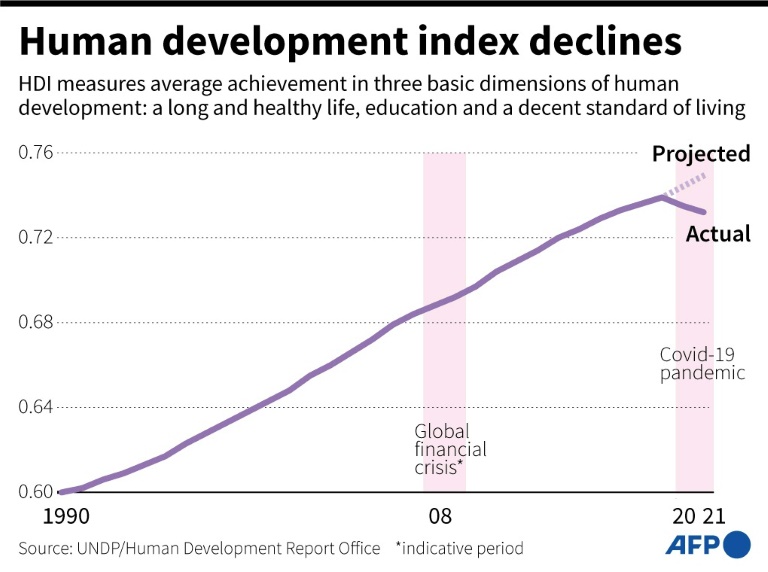
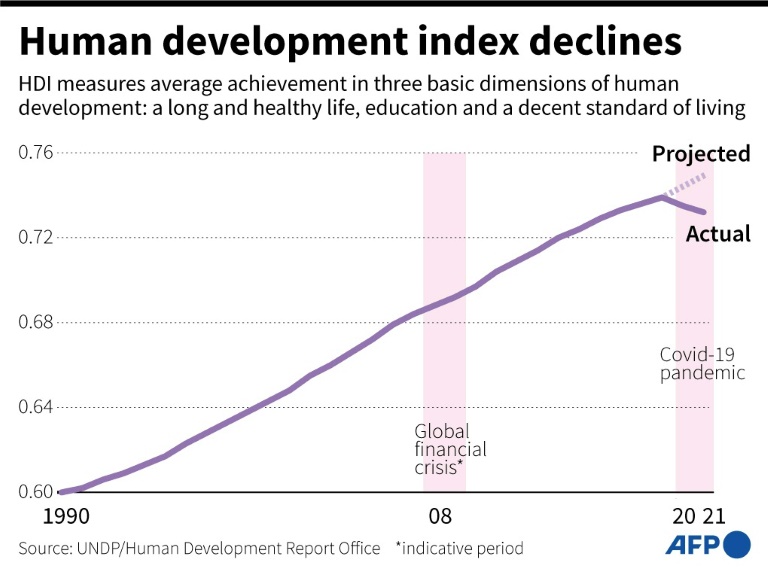
The UN Development Program (UNDP) announced that for the first time since it was created over 30 years ago, the Human Development Index — a measure of countries’ life expectancies, education levels, and standards of living — has declined for two years straight, in 2020 and 2021.

“It means we die earlier, we are less well educated, our incomes are going down,” UNDP chief Achim Steiner told AFP in an interview.

“Just under three parameters, you can get a sense of why so many people are beginning to feel desperate, frustrated, worried about the future,” he said.

The Human Development Index has steadily risen for decades, but began sliding in 2020 and continued its fall in 2021, erasing the gains of the preceding five years, the paper says.

Titled “Uncertain times, unsettled lives,” the report points to the Covid-19 pandemic as a major driver of the global reversion, but also says that a compounding number of crises — political, financial and climate-related — have not allowed time for populations to recover.

“We’ve had disasters before. We’ve had conflicts before. But the confluence of what we’re facing right now is a major setback to human development,” said Steiner.

The setback is truly global, impacting more than 90 percent of countries around the world, according to the study.

Switzerland, Norway and Iceland all retain their spots at the top of the list, while South Sudan, Chad and Niger sit at the bottom.

And while some countries had begun to recover from the pandemic, many others in Latin America, sub-Saharan Africa, South Asia and the Caribbean had not yet turned the corner before a new crisis hit: the war in Ukraine.

– ‘Lost trust’ –

While the fallout from Russia’s invasion of Ukraine on food and energy security has not yet been calculated into this year’s index, “without any doubt, the outlook for 2022 is grim,” Steiner said.

A large contributor to the Human Development Index’s recent decline is a global drop in life expectancy, down from 73 years in 2019 to 71.4 years in 2021.

The report’s lead author, Pedro Conceicao, described the decrease as an “unprecedented shock,” noting that some countries — the United States included — had drops of two years or more.

The report also describes how transformational forces, such as climate change, globalization and political polarization, present humanity with a complex level of uncertainty “never seen in human history,” leading to rising feelings of insecurity.

“People have lost trust in one another,” said Steiner.

“Never mind in institutions, our neighbor now becomes sometimes the greatest threat, whether literally speaking in the community, or globally by nations, that is paralyzing us.”

“We can’t continue with the playbook of the last century,” Steiner argued, preferring a focus on economic transformation rather than a reliance on growth as a panacea.

“Frankly speaking, the transformations we now need require us to introduce the metrics of the future: low carbon, less inequality, greater sustainability.”

The report strikes a positive note as well, saying that improvements could be made by focusing on three main areas: investments in renewable energy and preparation for future pandemics, insurance to absorb shocks, and innovations to strengthen the capacity to cope with future crises.

Steiner also called for a reversal in the recent downward trend of development assistance to the most vulnerable countries.

Continuing down that road would be a grave error, said Steiner, and “underestimates the impact it has on our ability to work together as nations.”

Human development set back 5 years by Covid, other crises: UN report

A United Nations report published Thursday argues that an unprecedented array of crises, chiefly among them Covid-19, has set human progress back five years and fueled a global wave of uncertainty.

The UN Development Program (UNDP) announced that for the first time since it was created over 30 years ago, the Human Development Index — a measure of countries’ life expectancies, education levels, and standards of living — has declined for two years straight, in 2020 and 2021.

“It means we die earlier, we are less well educated, our incomes are going down,” UNDP chief Achim Steiner told AFP in an interview.

“Just under three parameters, you can get a sense of why so many people are beginning to feel desperate, frustrated, worried about the future,” he said.

The Human Development Index has steadily risen for decades, but began sliding in 2020 and continued its fall in 2021, erasing the gains of the preceding five years, the paper says.

Titled “Uncertain times, unsettled lives,” the report points to the Covid-19 pandemic as a major driver of the global reversion, but also says that a compounding number of crises — political, financial and climate-related — have not allowed time for populations to recover.

“We’ve had disasters before. We’ve had conflicts before. But the confluence of what we’re facing right now is a major setback to human development,” said Steiner.

The setback is truly global, impacting more than 90 percent of countries around the world, according to the study.

Switzerland, Norway and Iceland all retain their spots at the top of the list, while South Sudan, Chad and Niger sit at the bottom.

And while some countries had begun to recover from the pandemic, many others in Latin America, sub-Saharan Africa, South Asia and the Caribbean had not yet turned the corner before a new crisis hit: the war in Ukraine.

– ‘Lost trust’ –

While the fallout from Russia’s invasion of Ukraine on food and energy security has not yet been calculated into this year’s index, “without any doubt, the outlook for 2022 is grim,” Steiner said.

A large contributor to the Human Development Index’s recent decline is a global drop in life expectancy, down from 73 years in 2019 to 71.4 years in 2021.

The report’s lead author, Pedro Conceicao, described the decrease as an “unprecedented shock,” noting that some countries — the United States included — had drops of two years or more.

The report also describes how transformational forces, such as climate change, globalization and political polarization, present humanity with a complex level of uncertainty “never seen in human history,” leading to rising feelings of insecurity.

“People have lost trust in one another,” said Steiner.

“Never mind in institutions, our neighbor now becomes sometimes the greatest threat, whether literally speaking in the community, or globally by nations, that is paralyzing us.”

“We can’t continue with the playbook of the last century,” Steiner argued, preferring a focus on economic transformation rather than a reliance on growth as a panacea.

“Frankly speaking, the transformations we now need require us to introduce the metrics of the future: low carbon, less inequality, greater sustainability.”

The report strikes a positive note as well, saying that improvements could be made by focusing on three main areas: investments in renewable energy and preparation for future pandemics, insurance to absorb shocks, and innovations to strengthen the capacity to cope with future crises.

Steiner also called for a reversal in the recent downward trend of development assistance to the most vulnerable countries.

Continuing down that road would be a grave error, said Steiner, and “underestimates the impact it has on our ability to work together as nations.”

Manhunt in Canada stabbing spree ends with both suspects dead

A days-long search for the second man suspected of carrying out a stabbing spree in a remote western Canadian Indigenous community ended Wednesday, with the 32-year-old dying after being taken into custody, police said.

Federal police Assistant Commissioner Rhonda Blackmore told a news conference that Myles Sanderson “went into medical distress” shortly after being arrested in Saskatchewan province, and that he was taken to hospital where he was pronounced dead.

She gave no other details of the circumstances.

An AFP reporter at the scene near Rosthern saw several police cars surrounding a white pickup along the side of a highway. 

An hour before the arrest, police issued an alert about a man armed with a knife in a stolen white Chevy Avalanche nearby, making a link to the stabbing case and urging locals to shelter in place.

Blackmore said police, after receiving an emergency call about the theft, spotted the speeding vehicle and “directed (it) off the road and into a nearby ditch.”

“He was arrested by police and taken into custody,” she said. “A knife was located inside the vehicle.”

It was a dramatic end to a four-day manhunt across the vast Prairies region for Myles Sanderson and his brother Damien, believed to be responsible for the killings on Sunday.

It also offered relief to a nation distressed by one of modern Canada’s deadliest incidents of mass violence.

The manhunt had stretched across three provinces, and gone from Regina, Saskatchewan province’s capital 300 kilometers (185 miles) to the south, and then back to the James Smith Cree Nation — in response to reported sightings.

On Monday the search turned up the body of 31-year-old Damien Sanderson in a grassy field in the Cree community.

Authorities said he likely had been killed by his 32-year-old sibling, who remained a fugitive until his arrest near the town of Rosthern in Saskatchewan — about 100 kilometres west of where the stabbings occurred.

“Our province is breathing a collective sigh of relief as Miles Sanderson is no longer at large,” Blackmore commented, adding that now the families of victims and the community “will be able to start healing.”

– ‘Senseless act’ –

Myles Sanderson had a history of explosive violence that led to 59 past convictions, and was also wanted for breaching parole in May after serving part of a sentence for assault and robbery.

But with no known motive for the latest attacks, relatives of victims spoke out earlier Wednesday about their “nightmare” and called for answers from authorities.

Mark Arcand said the killings that claimed the lives of his sister Bonnie Burns, 48, and her son Gregory Burns, 28, were a “horrible, senseless act.”

“We’re broken,” he said, describing emotions of anger and sadness. “It still feels like it’s a nightmare. It doesn’t feel real.”

“How did this happen to our family? Why did it happen? We have no answers,” he told a press conference. “We just know that our family members were killed in their own home, in their yard.”

Arcand recounted how his sister had rushed out of her house to help her son, who was bleeding out in their driveway after being stabbed several times.

“She was stabbed two times, and she died right beside him,” he said. “She was trying to protect her son.”

A neighbour ran over to try to stop the assailants, but she too was killed, he said.

The family and the community, Arcand added, has “a steep hill to climb, and we’re going to climb it together, united.”

The coroner has released the names of the deceased victims — six men and four women aged 23 to 78 years old. 

All but one were members of the Cree community. The other was a widower who lived with his adult grandson in nearby Weldon.

Seventeen adults and one young teen were also wounded in the attacks, police said. Among them was another son of Bonnie Burns who was slashed in the neck.

Ten people remain hospitalized, including two in critical condition, according to the Saskatchewan Health Authority. Seven others have been discharged.

Police believe some of the victims were targeted and others were attacked randomly.

Blackmore said with both brothers now dead, “we may never have an understanding of (their) motivation.”

The grisly attack followed several recent mass killings across Canada. A gunman masquerading as a policeman killed 22 people in Nova Scotia in April 2020 two years after a driver of a van killed 11 pedestrians in Toronto.

Another shooter killed six worshippers at a Quebec City mosque in January 2017.

Close Bitnami banner
Bitnami