World

El Salvador marks 1st year of Bitcoin use as confidence wanes

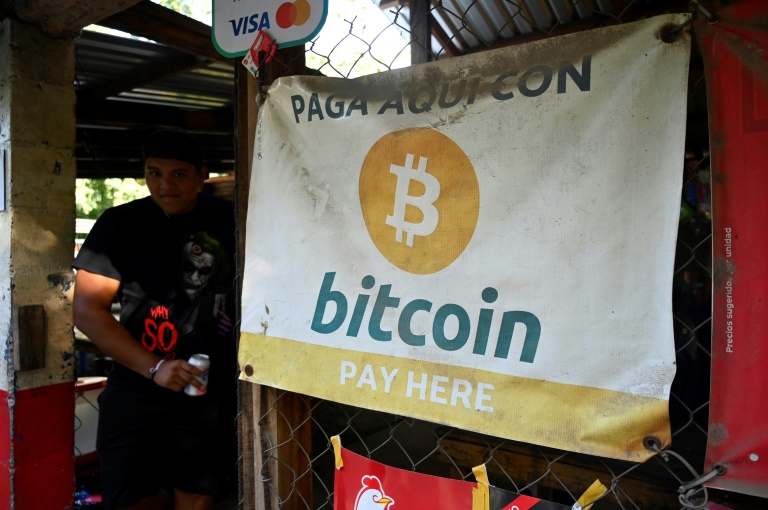
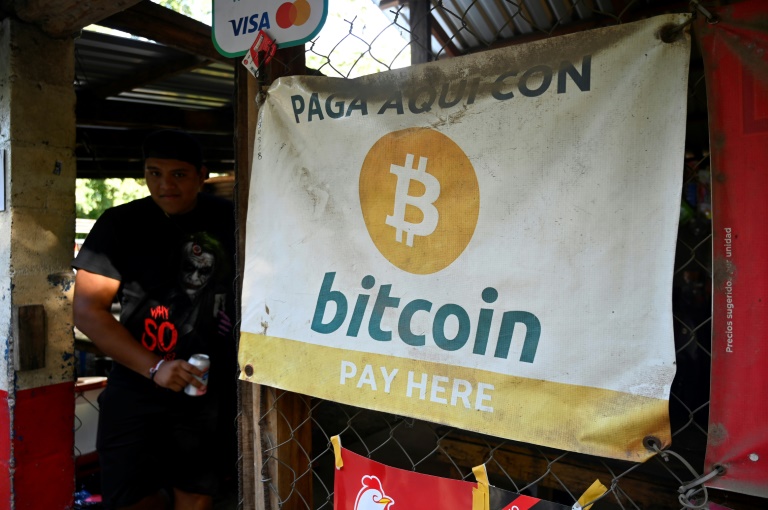
A year ago, El Salvador began accepting Bitcoin as legal tender following a controversial and much criticized decision by President Nayib Bukele.

All seemed rosy for the first few months as citizens enthusiastically embraced the new opportunity, but Bitcoin’s value has plummeted since and some experts say the move has been a failure.

Maria Aguirre, 52, a shopkeeper in the El Zonte seaside resort that has been a major center for Bitcoin use, says things were going well last year as Bitcoin’s value rose from $52,660 at opening on September 7, 2021, to briefly over $68,000 a couple of months later.

“But over the last five months it’s been only falling,” said Aguirre, who continues to accept Bitcoin transactions.

Bitcoin has dipped under $20,000 for most of this September.

In El Zonte, around 60 kilometers southwest of capital San Salvador, Bitcoin was already being used before Bukele’s move, which was designed to encourage a population where only 35 percent of people owned an account at a financial institution in 2021, according to the World Bank.

El Salvador became the first country to accept Bitcoin as legal tender, alongside the US dollar that has been the official currency for two decades.

The government even created the Chivo electronic wallet and granted each user the equivalent of $30.

By January, the application had been downloaded four million times, according to Bukele — an impressive amount in a country of 6.6 million, although with a diaspora of three million living mostly in the United States.

Bukele’s idea was to ensure that remittances, which make up 28 percent of El Salvador’s GDP, be sent by Chivo meaning less money lost in commission to exchange agencies.

However, former central bank president Carlos Acevedo says the body’s records show that “less than two percent of remittances are arriving through digital wallets, which means that this hasn’t been a benefit either.”

University student Carmen Majia, 22, said she used Bitcoin in the beginning “but given how things are going, now I don’t trust it and I uninstalled the application.”

– Volatility –

When Bukele’s plan was launched, Aguirre had already been using Bitcoin for eight months in the Pacific seaside resort that is popular with surfers.

After Bitcoin shot up in value between September and November 2021, Bukele announced a plan to build Bitcoin City — a tax haven for cryptocurrencies and blockchain technology on the Gulf of Fonseca that would be powered by geothermal energy from the Conchagua volcano.

To build it, Bukele was going to issue $1 billion in Bitcoin bonds but those plans were delayed by the volatile cryptocurrency market that saw some less robust currencies crash and Bitcoin take a huge hit.

According to the credit rating company Moody’s, Bukele’s plan has cost El Salvador $375 million.

Taking advantage of the drop in value, Bukele bought 80 Bitcoins at $19,000 each in July, taking El Salvador’s total holdings to 2,381 units of the cryptocurrency, all bought over the last year.

In June he told compatriots to “stop looking at the graph” insisting that Bitcoin is a secure investment that will bounce back up.

“Patience is the key,” he said.

– Little enthusiasm –

But Acevedo insists that the use of Bitcoin “really has not worked” and that “so far it has really been a failed bet.”

But not a total failure “because it could recover and get out of this crypto winter.”

Acevedo says Bitcoin has not produced Bukele’s stated aim of “financial inclusion” and its fall in value has “psychologically influenced people who do not view it with enthusiasm.”

The adoption of Bitcoin has also complicated El Salvador’s attempts to secure a $1.3 billion loan from the International Monetary Fund, which had urged against the move.

Faced with a warning that the country could default over its public debt that has surpassed 80 percent of GDP, Bukele announced in June a plan to buy back bonds due to expire in 2023 and 2025.

He insists the country has the cash to do so.

That reduced the country’s risk from 35 percent to 25 percent but Acevedo says El Salvador will not be able to return to the debt markets until that figure comes down to “at least five percent.”

In El Zonte, Cheetara Hasbún, a hotel employee, still thinks Bitcoin is a “good payment” method and just “needs more time, as was given to the dollar.”

El Salvador marks 1st year of Bitcoin use as confidence wanes

A year ago, El Salvador began accepting Bitcoin as legal tender following a controversial and much criticized decision by President Nayib Bukele.

All seemed rosy for the first few months as citizens enthusiastically embraced the new opportunity, but Bitcoin’s value has plummeted since and some experts say the move has been a failure.

Maria Aguirre, 52, a shopkeeper in the El Zonte seaside resort that has been a major center for Bitcoin use, says things were going well last year as Bitcoin’s value rose from $52,660 at opening on September 7, 2021, to briefly over $68,000 a couple of months later.

“But over the last five months it’s been only falling,” said Aguirre, who continues to accept Bitcoin transactions.

Bitcoin has dipped under $20,000 for most of this September.

In El Zonte, around 60 kilometers southwest of capital San Salvador, Bitcoin was already being used before Bukele’s move, which was designed to encourage a population where only 35 percent of people owned an account at a financial institution in 2021, according to the World Bank.

El Salvador became the first country to accept Bitcoin as legal tender, alongside the US dollar that has been the official currency for two decades.

The government even created the Chivo electronic wallet and granted each user the equivalent of $30.

By January, the application had been downloaded four million times, according to Bukele — an impressive amount in a country of 6.6 million, although with a diaspora of three million living mostly in the United States.

Bukele’s idea was to ensure that remittances, which make up 28 percent of El Salvador’s GDP, be sent by Chivo meaning less money lost in commission to exchange agencies.

However, former central bank president Carlos Acevedo says the body’s records show that “less than two percent of remittances are arriving through digital wallets, which means that this hasn’t been a benefit either.”

University student Carmen Majia, 22, said she used Bitcoin in the beginning “but given how things are going, now I don’t trust it and I uninstalled the application.”

– Volatility –

When Bukele’s plan was launched, Aguirre had already been using Bitcoin for eight months in the Pacific seaside resort that is popular with surfers.

After Bitcoin shot up in value between September and November 2021, Bukele announced a plan to build Bitcoin City — a tax haven for cryptocurrencies and blockchain technology on the Gulf of Fonseca that would be powered by geothermal energy from the Conchagua volcano.

To build it, Bukele was going to issue $1 billion in Bitcoin bonds but those plans were delayed by the volatile cryptocurrency market that saw some less robust currencies crash and Bitcoin take a huge hit.

According to the credit rating company Moody’s, Bukele’s plan has cost El Salvador $375 million.

Taking advantage of the drop in value, Bukele bought 80 Bitcoins at $19,000 each in July, taking El Salvador’s total holdings to 2,381 units of the cryptocurrency, all bought over the last year.

In June he told compatriots to “stop looking at the graph” insisting that Bitcoin is a secure investment that will bounce back up.

“Patience is the key,” he said.

– Little enthusiasm –

But Acevedo insists that the use of Bitcoin “really has not worked” and that “so far it has really been a failed bet.”

But not a total failure “because it could recover and get out of this crypto winter.”

Acevedo says Bitcoin has not produced Bukele’s stated aim of “financial inclusion” and its fall in value has “psychologically influenced people who do not view it with enthusiasm.”

The adoption of Bitcoin has also complicated El Salvador’s attempts to secure a $1.3 billion loan from the International Monetary Fund, which had urged against the move.

Faced with a warning that the country could default over its public debt that has surpassed 80 percent of GDP, Bukele announced in June a plan to buy back bonds due to expire in 2023 and 2025.

He insists the country has the cash to do so.

That reduced the country’s risk from 35 percent to 25 percent but Acevedo says El Salvador will not be able to return to the debt markets until that figure comes down to “at least five percent.”

In El Zonte, Cheetara Hasbún, a hotel employee, still thinks Bitcoin is a “good payment” method and just “needs more time, as was given to the dollar.”
A new life begins for the Titkovs, far from Ukraine

After months of anguish and hesitation, the Titkov family — who fled to Vienna from Ukraine just after Russia invaded — have finally decided to stay.

Their three boys — Danylo, nine, Denys, 11, and Dmitry, 15 — began the new school year there this week, another landmark in their new life in the Austrian capital.

Despite being “a bit stressed” about their German, they wrote little messages to go with the presents for their teachers. Back home in Ukraine, they would have brought them flowers.

Mother Irina, 39, wore her traditional Ukrainian “gerdan” necklace for the occasion, knowing that school is the first step to integration. 

AFP is following the refugee family from Irpin, one of the Kyiv suburbs that saw the worst of the fighting in the war’s early weeks, during the first year of their new life in a land where a quarter of the population are immigrants.

– ‘Miracle’ birthday –

After six months of uncertainty, little Danylo has taken to school like a fish to water. He lists out all the pens and stationery he needs in class in German. 

But his oldest brother prefers to hang around with his Ukrainian friends than knuckle down to his school work. 

Worried — and doing her best so her boys finally feel at home — Irina is meeting the headmistress to talk about how they can help Dmitry.  

The family have just moved into a pretty two-bedroomed apartment that looks onto a leafy courtyard in a residential area half an hour from the centre of Vienna.

Irina Titkova welcomed AFP into their new home with delicious Ukrainian dumplings and vareniki raviolis, served with a steaming bortsch soup.

It’s a huge relief to finally have their own place, and not to have to depend on the goodwill of others.

Up to then, the five of them shared the same room in a flat they found through friends of friends.

“After three months of searching every day, I got a call from the (Protestant charity) Diakonie” saying they had found an apartment, said Irina. 

“It was a miracle on my birthday!”

Their teenager now has a room where he can play his guitar. The younger boys — both bundles of energy — have bunk beds. There’s a hammock on the balcony, an invitation to dream of better days ahead. And all for a rent of 400 euros ($397) a month.

“It gives us a feeling of comfort,” Irina said with a smile.

Starting all over again is not easy, particularly when you have had to leave your home, your family, your job and your status behind. 

The former English teacher now works at the checkout of an American fast food restaurant. Her husband, Valerii, a physiotherapist back home, also works there in the storeroom.

– ‘We need to be useful’ –

“It’s tough… but it’s money, and I can earn it, and it’s not a donation. Maybe I am too proud, but I feel we need to be useful to society.”

The Titkovs want to “feel equal… and not just like refugees”.

The family ended up in Vienna by accident because Irina had taken a school trip there when she was teaching. 

“I remember how beautiful it was and multicultural. Vienna impressed me.”

Yet in June the Titkovs almost returned to Ukraine. Hearing about friends who had been killed, about war crimes, and from those who had stayed behind to fight, Irina was wracked by guilt for not being able to help.

Then the fighting intensified again and the family — one of seven million people displaced by the invasion, according to the United Nations — had second thoughts about going back. 

“Maybe it’s (our) destiny to be here, and the chance to explore another culture,” Irina said. 

“When I see soldiers having to fight, obviously it causes me pain,” said Valerii, who has an athlete’s build. “But honestly I am incapable of going to war. I couldn’t kill a fly.”

As a father of three children, he is one of the very few men of fighting age allowed to leave and escape conscription into the Ukrainian military.

It is the second time that this Russian speaker has been uprooted by war, having had to leave Azerbaijan at the age of 13 for Kyiv when a post-Soviet conflict flared up there with neighbouring Armenia.

But for now the family are focused on the future and managing those back-to-school butterflies.

For at the end of the month, the two parents will return to school themselves, to start a German course… 

East Timor says China could help fund major pipeline project

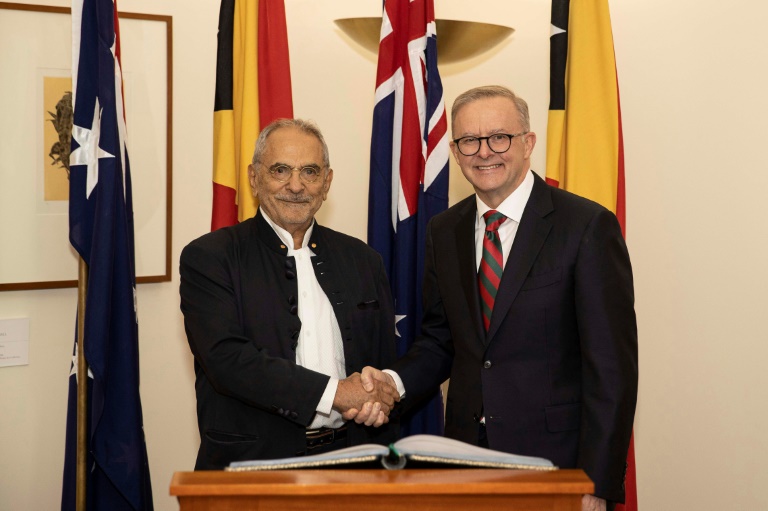
East Timor leader Jose Ramos-Horta on Wednesday said China could help fund a vast fossil fuel project seen as crucial to the nation’s economic future, dismissing Western concerns over Beijing’s growing influence.

Speaking to reporters after a meeting with Australian Prime Minister Anthony Albanese in Canberra, the president and Nobel peace laureate said “of course, China” could be involved in the Greater Sunrise project, which aims to tap trillions of cubic feet of natural gas.

The project, located in waters between East Timor and Australia, has long been touted as a joint venture between the two countries.

But exploration has been stalled for years due to disputes over maritime boundaries and whether the gas should be refined in Australia or East Timor.

Ramos Horta is pushing hard to gain foreign financing and to have LNG facilities built in his country, seeing it as a potential economic game-changer.

He told reporters that a number of Asia-Pacific countries could be involved in the project — including Japan and South Korea — but also mooted Beijing’s involvement, aware it was likely to raise hackles in Canberra.

“Of course China (could be involved). It’s a pipeline, we are not talking about maritime security. It’s just a pipeline. China would just be an investor,” he said.

But policymakers in Canberra are likely to baulk at Chinese involvement in critical infrastructure so close to Australia’s borders.

Australia is already concerned about China’s rapidly expanding regional influence, including in East Timor, which gained independence in 2002 and sits just a few hundred kilometres (miles) off Australia’s northern coast.

China built the country’s parliament, Ramos-Horta’s presidential palace and the foreign ministry.

Revenues from existing fossil fuel projects are soon expected to run dry, and the country’s sovereign wealth fund is rapidly dwindling, leading some to warn of an impending “fiscal cliff.”

Australia’s top diplomat, Penny Wong, recently warned Dili that it faces some “pretty serious economic challenges” and warned against the risks of so-called “debt trap” diplomacy, a term widely used in reference to Chinese investment strategy in countries like Sri Lanka.

“Our debt, our loans, they are in the spirit of wanting East Timor to be more resilient”, she said on a visit to the island nation’s capital. 

“We know that economic resilience can be affected, can be constrained, by unsustainable debt burdens or by lenders who have different objectives.”

12 dead, 11 injured in Vietnam karaoke bar fire

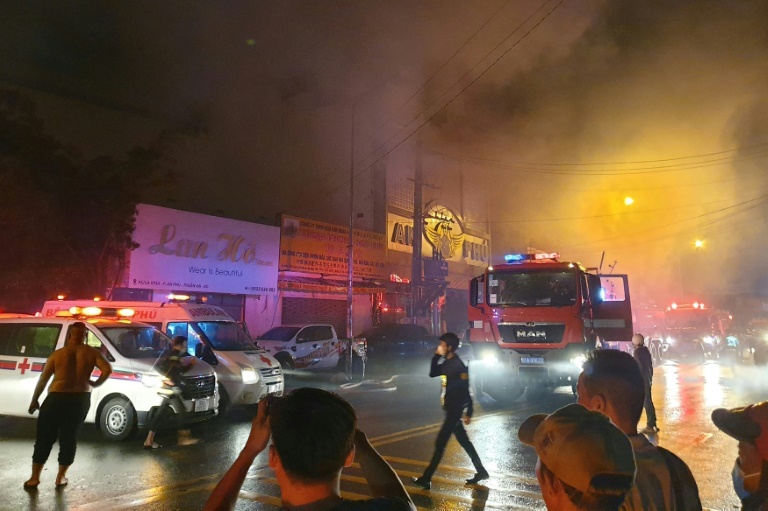
A fire tore through a karaoke bar in southern Vietnam killing 12 people and leaving 11 injured, a local official said Wednesday.

The blaze engulfed the second and third floors of the building on Tuesday night, trapping customers and staff members as dense smoke filled the staircase and blocked the emergency exit, state media reported.

Many crowded onto a balcony to escape the flames, which grew quickly as they caught the wooden interior, and others were forced to jump from the building, the reports added.

Photos showed plumes of smoke billowing out of the bar — located in a crowded residential neighbourhood in Thuan An city, north of commercial hub Ho Chi Minh City — as firefighters on cranes tried to extinguish the fire.

A local official confirmed to AFP that 12 people were dead and 11 injured in the blaze.

“Rescue teams are still looking for victims at the scene. The cause of the fire has not been determined and is being investigated,” Nguyen Thanh Tam, a top official with the ruling communist party in Thuan An, told AFP.

Witness Nguyen Sang, who lives near the karaoke bar, told the VnExpress news site that when fire trucks arrived at the scene, a receptionist said there were 40 people stuck inside.

“Many people ran outside through the main entrance, but many others could not stand the heat and they jumped down, breaking their hands and legs,” Sang said.

Rescue workers searched through the night for anyone trapped in the 30-room bar, according to state media.

Local police said the karaoke facility’s fire prevention regulations had been checked prior to the blaze, it added.

The fire was Vietnam’s deadliest since 2018, when 13 people died in a blaze in an apartment complex in Ho Chi Minh City.

In 2016, a blaze in a karaoke bar in the capital Hanoi left 13 people dead, prompting a country-wide assessment of fire prevention measures at bars and clubs.

Vietnamese Prime Minister Pham Minh Chinh on Wednesday ordered a further inspection of high-risk venues, especially karaoke bars.

Last month, three firefighters died after trying to extinguish a fire at another karaoke bar in Hanoi.

China earthquake death toll rises to 74

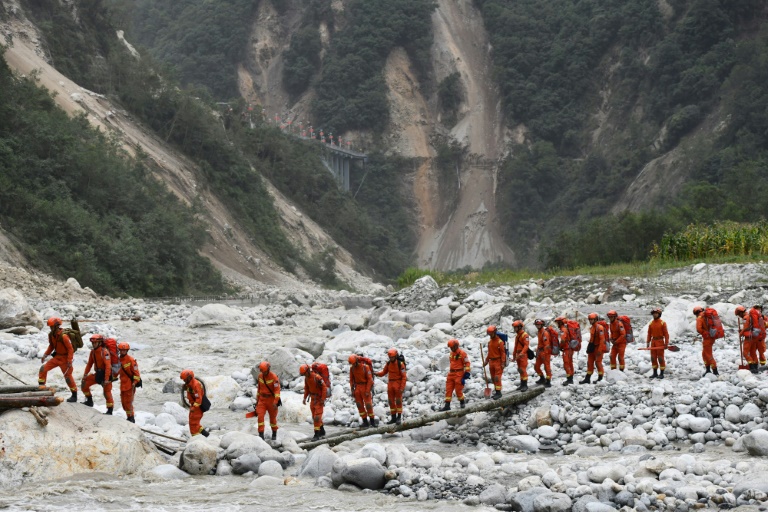
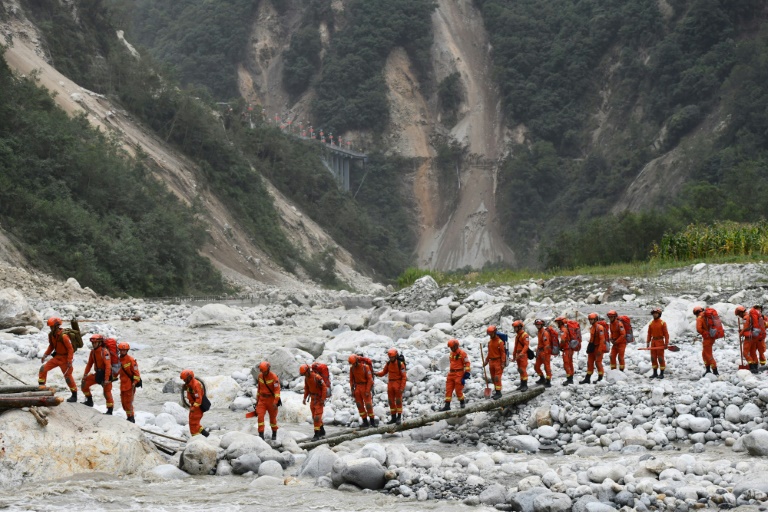
The death toll from a strong earthquake that struck southwest China has risen to 74, state media reported Wednesday, as thousands were evacuated into temporary shelters and heavy rains threatened to cause more landslides.

The magnitude 6.6 quake hit about 43 kilometres (26 miles) southeast of the city of Kangding in Sichuan province at a depth of 10 kilometres on Monday, according to the US Geological Survey.

The state-run People’s Daily said that 34 people died in Sichuan’s Ya’an city, while 40 deaths were reported in neighbouring Ganzi prefecture.

More than 21,000 people have been evacuated from areas prone to landslides or building collapse, state broadcaster CCTV said.

Rescuers are still scouring remote villages in the country’s mountainous southwest in a race to find survivors of the earthquake, with dozens of people believed stranded or missing.

“My head was stuck between the two columns, and my legs were sandwiched between the tables,” one woman who was trapped for nearly five hours under a collapsed hotel in the town of Moxi, one of the worst-affected areas, told state-run Red Star News.

“I could only lie in one position, resigned to my fate. I don’t know who saved me,” she added, saying she had worried for her children and whether their school building had collapsed.

“I could only think about whether the children were crying for their mother.”

Dramatic footage aired by state broadcaster CCTV showed kindergarten teachers waking up napping children and rushing them out when the quake hit.

The quake also rocked buildings in the provincial capital of Chengdu — where millions are confined to their homes under a strict Covid-19 lockdown — and in the nearby megacity of Chongqing, residents told AFP.

At least 13 aftershocks of magnitude 3.0 and above had been detected as of 7 am local time (2300 GMT) on Tuesday, the China Earthquake Networks Center said.

The provincial grid operator yesterday said power had been restored to over 22,000 households and that 12 emergency shelters in Ya’an were connected to a temporary power supply after the quake knocked out electricity across swathes of countryside. 

Beijing’s cabinet on Monday said it had dispatched a special team to lead the efforts, with CCTV reporting more than 6,500 people had been sent as part of the emergency rescue response. 

But the China Meteorological Administration warned that quake-stricken areas would experience “significant rainfall” until Thursday and that landslides could hamper rescue work.

China earthquake death toll rises to 74

The death toll from a strong earthquake that struck southwest China has risen to 74, state media reported Wednesday, as thousands were evacuated into temporary shelters and heavy rains threatened to cause more landslides.

The magnitude 6.6 quake hit about 43 kilometres (26 miles) southeast of the city of Kangding in Sichuan province at a depth of 10 kilometres on Monday, according to the US Geological Survey.

The state-run People’s Daily said that 34 people died in Sichuan’s Ya’an city, while 40 deaths were reported in neighbouring Ganzi prefecture.

More than 21,000 people have been evacuated from areas prone to landslides or building collapse, state broadcaster CCTV said.

Rescuers are still scouring remote villages in the country’s mountainous southwest in a race to find survivors of the earthquake, with dozens of people believed stranded or missing.

“My head was stuck between the two columns, and my legs were sandwiched between the tables,” one woman who was trapped for nearly five hours under a collapsed hotel in the town of Moxi, one of the worst-affected areas, told state-run Red Star News.

“I could only lie in one position, resigned to my fate. I don’t know who saved me,” she added, saying she had worried for her children and whether their school building had collapsed.

“I could only think about whether the children were crying for their mother.”

Dramatic footage aired by state broadcaster CCTV showed kindergarten teachers waking up napping children and rushing them out when the quake hit.

The quake also rocked buildings in the provincial capital of Chengdu — where millions are confined to their homes under a strict Covid-19 lockdown — and in the nearby megacity of Chongqing, residents told AFP.

At least 13 aftershocks of magnitude 3.0 and above had been detected as of 7 am local time (2300 GMT) on Tuesday, the China Earthquake Networks Center said.

The provincial grid operator yesterday said power had been restored to over 22,000 households and that 12 emergency shelters in Ya’an were connected to a temporary power supply after the quake knocked out electricity across swathes of countryside. 

Beijing’s cabinet on Monday said it had dispatched a special team to lead the efforts, with CCTV reporting more than 6,500 people had been sent as part of the emergency rescue response. 

But the China Meteorological Administration warned that quake-stricken areas would experience “significant rainfall” until Thursday and that landslides could hamper rescue work.

Heatwaves and wildfires to worsen air pollution: UN

More frequent and intense heatwaves and wildfires driven by climate change are expected to worsen the quality of the air we breathe, harming human health and ecosystems, the UN warned Wednesday.

A new report from the UN’s World Meteorological Organization (WMO) cautioned that the interaction between pollution and climate change would impact hundreds of millions of people over the coming century, and urged action to rein in the harm.

The WMO’s annual Air Quality and Climate Bulletin examined the impacts of large wildfires across Siberia and western North America in 2021, finding that they produced widespread increases in health hazards, with concentrations in eastern Siberia reaching “levels not observed before”.

Tiny particles with a diameter of less than 2.5 micrometres (PM2.5) are considered particularly harmful since they can penetrate deep into the lungs or cardiovascular system.

“As the globe warms, wildfires and associated air pollution are expected to increase, even under a low emissions scenario,” WMO chief Petteri Taalas said in a statement.

“In addition to human health impacts, this will also affect ecosystems as air pollutants settle from the atmosphere to Earth’s surface.”

– ‘Foretaste of the future’ –

At the global scale, there has been a reduction over the past two decades in the total burned area, as a result of decreasing numbers of fires in savannas and grasslands.

But WMO said that some regions like western North America, the Amazon and Australia were seeing far more fires.

Even beyond wildfires, a hotter climate can drive up pollution and worsen air quality.

Taalas pointed out that severe heatwaves in Europe and China this year, coupled with stable high atmospheric conditions, sunlight and low wind speeds, had been “conducive to high pollution levels,” warning that “this is a foretaste of the future.”

“We expect a further increase in the frequency, intensity and duration of heatwaves, which could lead to even worse air quality,” he said.

This phenomenon is known as the “climate penalty”, which refers to how climate change amplifies ground-level ozone production, which negatively impacts air quality. 

In the stratosphere, ozone provides important protection from cancer-causing ultraviolet rays, but closer to the ground it is very hazardous for human health.

If emission levels remain high, this climate penalty is expected to account for “a fifth of all surface ozone concentration increase,” WMO scientific officer Lorenzo Labrador told reporters.

He warned that most of that increase will happen over Asia, “and there you have about one quarter of the entire world population.”

The WMO called for action, stressing that “a worldwide carbon neutrality emissions scenario would limit the future occurrence of extreme ozone air pollution episodes.”

The report points out that air quality and climate are interconnected, since chemicals that worsen air quality are normally co-emitted with greenhouse gases.

“Changes in one inevitably cause changes in the other,” it said.

Heatwaves and wildfires to worsen air pollution: UN

More frequent and intense heatwaves and wildfires driven by climate change are expected to worsen the quality of the air we breathe, harming human health and ecosystems, the UN warned Wednesday.

A new report from the UN’s World Meteorological Organization (WMO) cautioned that the interaction between pollution and climate change would impact hundreds of millions of people over the coming century, and urged action to rein in the harm.

The WMO’s annual Air Quality and Climate Bulletin examined the impacts of large wildfires across Siberia and western North America in 2021, finding that they produced widespread increases in health hazards, with concentrations in eastern Siberia reaching “levels not observed before”.

Tiny particles with a diameter of less than 2.5 micrometres (PM2.5) are considered particularly harmful since they can penetrate deep into the lungs or cardiovascular system.

“As the globe warms, wildfires and associated air pollution are expected to increase, even under a low emissions scenario,” WMO chief Petteri Taalas said in a statement.

“In addition to human health impacts, this will also affect ecosystems as air pollutants settle from the atmosphere to Earth’s surface.”

– ‘Foretaste of the future’ –

At the global scale, there has been a reduction over the past two decades in the total burned area, as a result of decreasing numbers of fires in savannas and grasslands.

But WMO said that some regions like western North America, the Amazon and Australia were seeing far more fires.

Even beyond wildfires, a hotter climate can drive up pollution and worsen air quality.

Taalas pointed out that severe heatwaves in Europe and China this year, coupled with stable high atmospheric conditions, sunlight and low wind speeds, had been “conducive to high pollution levels,” warning that “this is a foretaste of the future.”

“We expect a further increase in the frequency, intensity and duration of heatwaves, which could lead to even worse air quality,” he said.

This phenomenon is known as the “climate penalty”, which refers to how climate change amplifies ground-level ozone production, which negatively impacts air quality. 

In the stratosphere, ozone provides important protection from cancer-causing ultraviolet rays, but closer to the ground it is very hazardous for human health.

If emission levels remain high, this climate penalty is expected to account for “a fifth of all surface ozone concentration increase,” WMO scientific officer Lorenzo Labrador told reporters.

He warned that most of that increase will happen over Asia, “and there you have about one quarter of the entire world population.”

The WMO called for action, stressing that “a worldwide carbon neutrality emissions scenario would limit the future occurrence of extreme ozone air pollution episodes.”

The report points out that air quality and climate are interconnected, since chemicals that worsen air quality are normally co-emitted with greenhouse gases.

“Changes in one inevitably cause changes in the other,” it said.

Ethiopians from war-ravaged Tigray celebrate holiday in Sudan

Donning a festive white dress, with her hair intricately braided and her eyes lined with the traditional kohl paint, Ethiopian Yudita Ihab prepared for the annual Ashenda celebration.

But for Yudita and the thousands of other women who gathered in Sudan’s capital Khartoum late last month, the normally joyful week-long Ethiopian holiday was overshadowed by the ongoing war that has ravaged the northern Ethiopian region of Tigray they hail from.

“It’s our identity and we want to express it despite the difficulties we are going through,” Naabali Kahtay told AFP.

The two-year conflict between Ethiopian government forces and the Tigray People’s Liberation Front (TPLF) has created a humanitarian crisis, driving tens of thousands of people to seek refuge in neighbouring Sudan and wrenching families apart.

For Tigrayans in Sudan, the conflict has transformed their view of Ashenda, typically marking the end of a 15-day fast known as Filseta, which is observed by the Ethiopian Orthodox Tewahedo Church.

Naabali said she had lost contact with her family more than a year ago; they remain trapped in the Tigrayan capital of Mekele.

“I don’t know if they are alive or dead.”

In November 2020 Ethiopian Prime Minister Abiy Ahmed sent troops into Tigray to topple the TPLF, Tigray’s ruling party, saying the move came in response to TPLF attacks on army camps.

“The celebrations are beautiful, but we cannot be fully happy,” 21-year-old Aziza Moustafa told AFP.

“Celebrating the Ashenda means a lot to me,” said Ihab, 18, noting the significance of this tradition, passed down through generations of women.

In the Tigrinya language, Ashenda is a type of tall green grass found on river banks in the region. As part of the festivities, women wear skirts made of the weaved Ashenda grass over white cotton dresses with colourful embroidery. 

“Young girls usually style their hair by doing five cornrow braids to show their beauty during Ashenda,” said Naabali.

In Khartoum, the women were playing drums to traditional music, with many wearing headbands of red and yellow, the colours of the Tigrayan flag. Traditional chicken stew and flatbread was also served to the crowd.

The Tigray conflict has displaced around two million people but the death toll remains unknown as the region reels from a near-complete blockade and a communications blackout.

But many still hold on to hopes that the war will end.

“Hopefully, we can celebrate it next year in Tigray,” said Naabali of the holiday.

Close Bitnami banner
Bitnami