World

Rescuers search for survivors after dozens killed in China quake

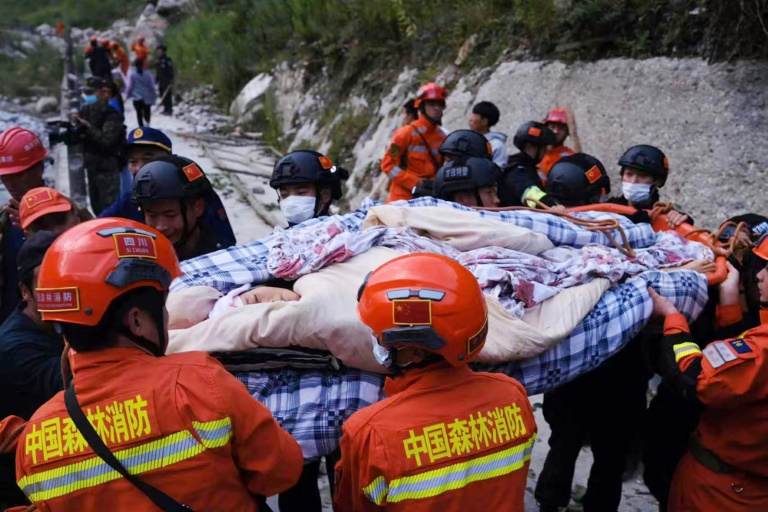
Rescuers scoured through the rubble of remote villages in mountainous southwestern China Tuesday in a race to find survivors of an earthquake that claimed dozens of lives, with hundreds of people believed stranded or missing.

The magnitude 6.6 quake hit about 43 kilometres (26 miles) southeast of the city of Kangding in Sichuan province at a depth of 10 kilometres on Monday, according to the US Geological Survey.

At least 66 people were killed, state media reported, with more than 200 still cut off from rescuers in a remote scenic area. Scores were reported missing elsewhere.

State broadcaster CCTV showed firefighters pulling a bruised and bloodied woman from the rubble and carrying a survivor on a stretcher across a river on a makeshift bridge. It also showed damaged buildings and streets strewn with debris.

Footage shared by the China Earthquake Networks Center (CENC) on Monday showed boulders thundering down mountainsides in Luding county, kicking up clouds of dust as the tremors swayed roadside telephone wires.

At least seven hydropower stations were damaged by the quake, the Ministry of Water Resources said.

And CCTV reported that more than 11,000 people have been evacuated from areas prone to landslides or building collapse.

“Most buildings (in our village) are dilapidated, some of them have not collapsed, but all of them have cracks,” Yang Qing from Moxi town, one of the worst affected areas near the epicentre of the quake, told AFP.

“You can’t get in and live in them, police have cordoned off all these buildings.” 

“It’s hard to say how long we’ll have to stay in these tents,” Chen Ling, a restaurant owner from Moxi, told AFP.

“It’ll probably take 10 or 15 days or so for things to resume.”

The China Meteorological Administration has warned that quake-stricken areas will experience “significant rainfall” until Thursday and that landslides could hamper rescue work.

The region has also suffered a summer of extreme weather, with a record-breaking heatwave noticeably drying rivers in Chongqing.

– Flash flood warning –

The quake also rocked buildings in the provincial capital of Chengdu — where millions are confined to their homes under a strict Covid-19 lockdown — and in the nearby megacity of Chongqing, residents told AFP.

At least 10 aftershocks of magnitude 3.0 and above had been detected as of 7 am local time (2300 GMT Monday), CCTV said.

More than 200 people are reportedly cut off from rescuers in the Hailuogou Scenic Resort.

CCTV aired footage of bulldozers clearing boulders and other debris that were blocking access to the area.

More than 100 people have been told to evacuate due to fears of a flash flood after a landslide cut off a tributary to the Dadu river, the Luding government said on its official Weibo account.

Rescuers in kayaks were seen transporting villagers downstream from a dammed lake formed by the landslide, CCTV said.

China’s cabinet said Monday it has dispatched a special team to lead the efforts, with CCTV reporting more than 6,500 people had been sent as part of the emergency rescue response. 

Local officials have launched a public appeal for donations to help with relief work.

Earthquakes are fairly common in China, especially in the country’s seismically active southwest.

A smaller magnitude 4.6 tremor hit eastern Tibet less than an hour after the initial quake, according to the USGS.

A magnitude 8.0 quake in 2008 in Sichuan’s Wenchuan county left tens of thousands dead and caused enormous damage.


Solomons says Australian offer to fund election 'inappropriate'

Solomon Islands on Tuesday said an Australian offer to fund its next election was “inappropriate”, dismissing Canberra’s latest effort to strengthen ties with the Pacific nation as it increasingly courts Beijing.

In a statement, the Solomons government accused Australia of trying “to influence how Members of Parliament will vote” on an upcoming bill that would delay national polls by seven months.

It comes after Solomons Prime Minister Manasseh Sogavare signed a landmark security pact with Beijing in April, sparking intense diplomatic jostling between China, the United States and its allies including Australia.

Australia’s Foreign Minister Penny Wong revealed the funding offer during an interview with ABC radio on Tuesday morning.

With the vote on an election delay due as early as Thursday, the Solomons government took umbrage at the timing, saying it “was in the process of replying when the Australian Foreign Minister made an announcement to the Australian media”.

Sogavare has argued the Pacific nation must delay the poll until after it hosts the 2023 Pacific Games because of high costs.

But critics have accused him of trying to “bulldoze” democracy by rushing the bill through parliament.

Australia’s government has attempted in recent months to reset its relationship with Sogavare, who has grown close to Beijing since violent riots against his leadership broke out in the capital of Honiara last year.

– ‘Historical commitment’ –

The Solomons government said it received the offer from Wong on September 1 and would formally respond after the election bill was dealt with.

While the amount offered by Australia was not revealed, Sogavare’s secretary Jimmie Rogers previously told the Solomons state broadcaster that the election would cost more than US$49 million.

In her Tuesday interview, Wong denied Australia’s offer had come in response to calls for support from the Solomon Islands opposition.

“(It) reflects our longstanding and historical commitment to supporting democracy and democratic processes in Solomon Islands,” she said.

The bill to delay the election was “domestically controversial”, Wong added, “(but) that’s ultimately a matter for their parliament to resolve”.

She sought to tamp down suggestions the funding was unusual, citing Australian support for recent elections in Papua New Guinea.

The Australian government last week updated its travel advice for Solomon Islands, warning citizens to exercise “a high degree of caution due to the possibility of further civil unrest” ahead of the vote on the election delay.

– ‘Sad moment’ –

Solomon Islands MP John Maneniaru said Tuesday that he was “very disheartened” with a decision by Sogavare to fast-track the election bill, skipping the scrutiny of his Bills and Legislation Committee.

“This is for me a sad moment indeed. And for our democracy,” he said. “A deliberate decision was made to bulldoze into our parliament and democracy.” 

Sogavare, a four-time prime minister, is expected to visit Australia soon, with discussions ongoing about the timing.

He recently accused Western media organisations in the Solomons of “spreading anti-China sentiment”.

Sogavare’s office threatened to ban or deport reporters for “disrespectful and demeaning” coverage, and said some foreign media were trying to “engineer regime change”.

Asian markets mostly rise as bargain-buying offsets fears over outlook

Asian investors squeezed out gains Tuesday as they tried to recover from the previous day’s losses, but they remain gripped by fears over Europe’s worsening energy crisis, China’s economic slowdown and central bank efforts to contain surging inflation.

The dollar lost some momentum, with the euro supported ahead of an expected European Central Bank interest rate hike and sterling lifted by reports that new UK Prime Minister Liz Truss will unveil plans to cut energy bills.

Russia’s decision not to resume gas supplies to Europe — in retaliation for sanctions over Ukraine — sent shock waves through trading floors Monday as it ramped up expectations of a painful recession in major economies.

“This shouldn’t have been a surprise to most people, given that it was widely expected that Putin would play this card at some point,” said CMC Markets analyst Michael Hewson. 

“Now that he has, Russia doesn’t really have anywhere else to go, and while natural gas prices did shoot higher, they closed well off the highs of the day.”

With Wall Street closed for a holiday, Asia had few new catalysts to drive buying.

Markets fluctuated between gains and losses in the morning but managed to clamber up as the day progressed.

Shanghai enjoyed a healthy bounce after China unveiled fresh economy-boosting measures. 

But analysts warned that while a stimulus was welcomed as growth dwindles, traders were only looking for signs of an easing in the country’s zero-Covid strategy, which has left millions in lockdown and threatens economic activity.

Singapore, Seoul, Taipei, Manila, Mumbai, Bangkok and Jakarta all rose, while Tokyo was marginally up and Hong Kong inched down. 

Sydney dipped after the Reserve Bank of Australia lifted interest rates to a near eight-year high and warned of more pain ahead. Wellington also slipped.

London, Paris and Frankfurt enjoyed small gains.

– Global recession risk –

“A lot of clients are asking, have we seen the bottom yet and are we going into a global recession?” Grace Tam, of BNP Paribas Wealth Management Hong Kong, told Bloomberg Television.

“We do think the risk of a global recession, especially next year, is actually quite high” and that the energy crisis “is not fully priced” into markets, she said.

The next key event for investors is the ECB rate decision Thursday, with some observers tipping a 75 basis point hike to bring down record-high inflation.

That is followed later in the month by the Federal Reserve’s meeting, where policymakers will debate a similar move, which would be the third rise in a row.

However, while central banks are lifting borrowing costs to fight surging prices, they have little power over the cost of oil, a key driver of the rises.

And on Monday, OPEC and other major producers announced a surprise cut in output, sending both main contracts rising. The move came after the crude market fell in recent months on demand fears caused by a possible recession.

“In absolute terms, the 100,000 barrels a day supply cut doesn’t matter that much to global supply balances,” said Noah Barrett of Janus Henderson Investors.

“However, in terms of signalling, the move is important as it indicates that OPEC+ is watching demand very closely and is trying to manage supply to keep a floor on oil prices.”

Several countries including the United States had earlier called for a rise in production, which was followed by a small lift of 100,000 barrels.

“The modest increase we got a month ago is now gone, so OPEC+ is clearly sending a message that they are not bowing to external demands,” said Barrett.

“We should expect continued volatility in oil prices, with global demand indicators driving price movements.”

Brent and WTI were both down from Monday’s levels.

– Key figures at around 0810 GMT –

Tokyo – Nikkei 225: FLAT at 27,626.51 (close)

Hong Kong – Hang Seng Index: DOWN 0.1 percent at 19,202.73 (close)

Shanghai – Composite: UP 1.4 percent at 3,243.45 (close)

London – FTSE 100: UP 0.3 percent at 7,305.39

Euro/dollar: UP at $0.9967 from $0.9921 on Monday

Pound/dollar: UP at $1.1568 from $1.1507

Dollar/yen: UP at 141.65 yen from 140.53 yen

Euro/pound: DOWN at 86.10 pence from 86.22 pence

West Texas Intermediate: DOWN 0.2 percent at $89.30 per barrel

Brent North Sea crude: DOWN 0.1 percent at $95.69 per barrel

New York – Dow: Closed for public holiday

'A different Sweden': Gang shootings loom large in vote

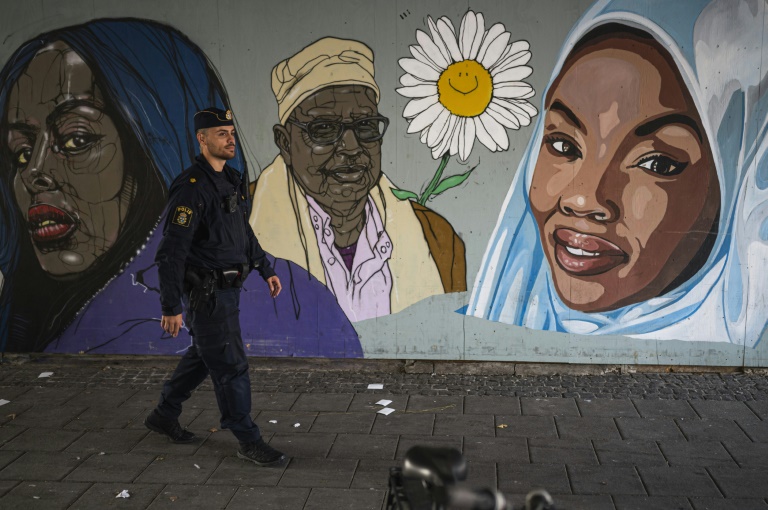
Gang shootings have escalated and spread across Sweden, with authorities struggling to contain the war-like violence that now tops voters’ concerns ahead of Sunday’s general election.

“This is my son, Marley, when he was 19 years old”, Maritha Ogilvie tells AFP, holding a framed photo of a smiling young man, one of many that adorn the walls of her Stockholm apartment.

“He was shot in the head sitting in a car with a friend”, says the 51-year-old.

The killing, on March 24, 2015 in Varby gard, a disadvantaged concrete suburb southwest of Stockholm, has never been resolved and the case was closed 10 months later.

Murders like these are usually settlings of scores between rival gangs often controlled by immigrant clans, according to police, and increasingly taking place in public in broad daylight.

The violence is primarily attributed to battles over the drug and weapons market and personal vendettas. 

It has escalated to the point where Sweden — one of the richest and most egalitarian countries in the world — now tops the European rankings for fatal shootings.

According to a report published last year by the National Council for Crime Prevention, among 22 countries with comparable data only Croatia had more deadly shootings, and no other country posted a bigger increase than Sweden in the past decade.

– Shopping mall execution –

Despite various measures introduced by the Social Democratic government to crack down on the gangs — including tougher prison sentences and boosting police resources — the number of dead and injured continues to mount.

Since January 1, 48 people have been killed by firearms in Sweden, three more than in all of 2021.

There are also frequent bombings of homes and cars and grenade attacks.

For the first time, crime has dislodged the usual welfare state issues of health care and education and is one of Swedes’ main concerns in Sunday’s election.

While the violence was once contained to locations frequented by criminals, it has now spread to public spaces, sparking concern among ordinary Swedes in a country long known as safe and peaceful.

On August 19, a 31-year-old man identified as a gang leader in Sweden’s third biggest city Malmo was gunned down in the Emporia shopping centre, several months after the death of his brother.

A 15-year-old was arrested for the murder.

A week later, a young woman and her son were wounded by stray bullets as they played in a park in Eskilstuna, a quiet town of 67,000 people west of Stockholm.

The right-wing opposition, led by the conservative Moderates and the far-right Sweden Democrats who hope to wrest power from the Social Democrats, have vowed to restore “law and order”.

Defending the left from allegations of laxism, Prime Minister Magdalena Andersson has promised a “national offensive” against the scourge which poses “a threat to all of Sweden”.

– ‘Parallel societies’ –

According to Andersson, the escalating crime numbers are due to the emergence of “parallel societies” following “too much immigration and too little integration”.

Jacob Fraiman, an ex-gangster who now helps other criminals leave that life behind, says even he is shocked by the level of violence.

“I’m from another generation, obviously we had weapons too. But it wasn’t often you had to shoot someone”, he tells AFP in Sodertalje, an industrial town south of Stockholm with a large immigrant population.

“You used to shoot someone in the legs. Now, they’re told to shoot in the head”, he says.

At the police station in Rinkeby, one of Stockholm’s disadvantaged suburbs, 26-year-old patrol cop Michael Cojocaru says he and his colleagues regularly encounter brutal violence reminiscent of war and seize assault weapons, grenades and explosives.

“You’ll see wounds, people who’ve been shot with AK47s, who’ve been stabbed, people who have war wounds”, he tells AFP.

“It’s like a totally different society … another type of Sweden”.

Experts attribute the escalating violence to a series of factors, including segregation, integration and economic difficulties for immigrants, and a large black market for weapons.

The recruitment of young teens into criminal gangs — who aren’t tried as adults if they get caught — is also a major concern.

Seven years later, Maritha Ogilvie is still trying to understand why her son was killed. “He was just a normal kid”.

“I don’t know what happened with our society. I don’t know how they lost control over certain areas, but they did”, she sighs. “And it keeps on getting worse”.

Romania's plagiarism hunter becomes the hunted

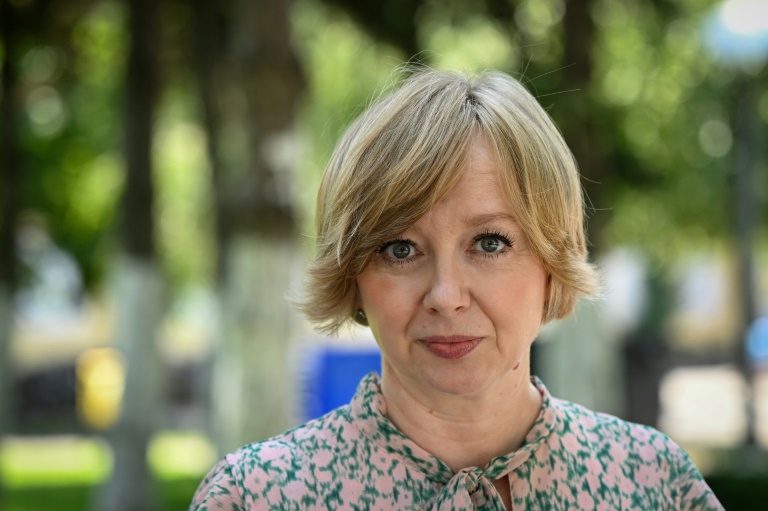
Romanian journalist Emilia Sercan has made it her mission to expose plagiarism at the country’s highest levels. 

But her latest investigation of whether the prime minister passed off other people’s work as his own in his doctoral thesis has made her the target of a deluge of threats and leaked intimate photos she says are aimed at silencing her. 

Sercan has exposed some 50 cases of plagiarism involving the great and good over the last seven years, showing ministers, prosecutors and judges breaking the rules when publishing books, scientific articles or PhD theses.

The latest to come into her crosshairs is Romania’s premier, former general Nicolae Ciuca.

In mid-January, she published an investigation in the independent media outlet PressOne, accusing Ciuca of using plagiarised content in 42 pages of his 138-page 2003 doctoral thesis on military science.  

Since then the journalist has been the victim of a barrage of insults and hate speech on social media to the point where Sercan said she feels “in danger”.

“Never before have I felt targeted in such a way,” said the 46-year-old writer and academic, who has filed two complaints to the police over the threats.

Ciuca, a retired four star general who served in Iraq and Afghanistan, leads the ruling National Liberal Party (PNL) after being cherry-picked by President Klaus Iohannis, himself a liberal.

The 55-year-old premier has rejected the accusations, saying he respected the academic rules of the time.

“I didn’t plagiarise,” he insisted.

– ‘Kompromat’ operation – 

Sercan previously received a death threat in 2019 after revealing cases of plagiarism in PhD theses in the country’s police academy. A Bucharest court later sentenced a rector and his deputy, who pressured a subordinate into threatening her, to a three-year suspended jail term.

But this time stolen intimate photos taken by her fiance some 20 years ago have been used to attack her.

Shortly after Sercan sent police screenshots of the images, the screenshots were published by a website in neighbouring Moldova and quickly ended up on 74 other sites, she said.

Sercan accused the authorities of having “orchestrated a kompromat operation” to try to discredit her.

Prosecutors opened a criminal case, but Sercan said the investigation seems to be making no progress.

“At the highest level of state, people are blocking the process and want to bury the case,” said told AFP.

“They are using their power to cover their tracks and push me into silence.”

The prosecutor’s office told AFP that a criminal investigation had started and was ongoing.

Ten press freedom organisations, including Reporters Without Borders (RSF) and Committee to Protect Journalists (CPJ) said they are “disturbed by the harassment” of Sercan — who is also a professor of journalism at the University of Bucharest — and have called for a thorough investigation.

“All this support meant a lot for me, but not for the Romanian prosecutors, it seems,” she added, saying she was “furious and frustrated” by the lack of action.

– ‘Plagiarism networks’ – 

The journalist said members of the premier’s party accused her of “having chosen the wrong moment” to reveal the plagiarism, and of wanting to destabilise the state with war raging in neighbouring Ukraine.

Three other complaints of plagiarism brought against Ciuca — including one by an opposition MP — have been dismissed by the courts.

A new education bill abolishing the independent body responsible for investigating plagiarism has also angered government critics.

It would also place a time limit of three years on prosecution of cases of academic misconduct.

Romania is seen as one of the most corrupt countries in the EU, and academic fraud held a particular place in its post-communist history, with many of the country’s elite accused of using it as a shortcut to power and prestige. 

Professor Ciprian Mihali of the University of Cluj, a specialist in the subject, said the problem has its roots in “the proliferation of universities between 1990 and 2000 after the fall of the communist regime.”

PhDs became the key to reaching the upper echelons of power and “we have had to deal with the development of a real plagiarism industry,” he said.

“It’s a whole line of production and networks” allowing “incompetent people to rise to vital positions” and to stay there despite criticism.

Another Romanian prime minister, Victor Ponta, was accused of plagiarism by the scientific journal Nature in 2012, but refused to step down. 

He was eventually forced to resign in 2015 after massive anti-corruption protests rocked the country. A few months later, the Ministry of Education stripped him of his law doctorate and he later lost a court battle to have it restored.

Belarus exiles find home from home in 'travelling' bar

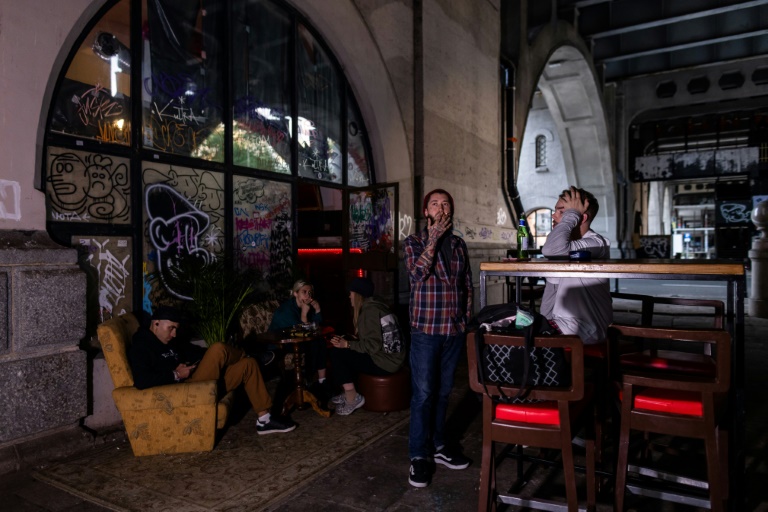
Tucked under a bridge in downtown Warsaw is a bar like no other. Over the years, Karma has relocated from Belarus to Ukraine and Poland, in the face of repression and war.

Along the way, the watering hole has become a home away from home where tattooed young people drink beer, roll cigarettes and mix and mingle in their mother tongue. 

“This bar never wanted to be a travelling bar… It was just to keep our community together,” said co-owner Gleb Kovalev, sporting a dark scraggly beard and inked from head to ankle.

“After things became much more political, we had to move and we had to stay together,” the hyperactive 31-year-old told AFP over a hotdog and a whiskey and coke.

The Belarusian regime staged a brutal crackdown on historic protests in 2020.

More recently, the country has served as a springboard for its ally Russia’s assault on Ukraine.

The events have led thousands of Belarusians and Ukrainians to take refuge in neighbouring Poland — a staunch critic of both the regime in Minsk and the Kremlin.

Some of the new arrivals end up at Karma.

Kovalev, who speaks seven languages, is sitting in a makeshift living room on the pavement behind the bar. There are a couple of armchairs, a tattered rug and potted plants.

It is a weekday and the night is young but already a dozen Belarusians are standing around with drinks, their laughter intermingling with the traffic overhead.  

“I was in every Karma bar,” said Anton Lutsevich, a 3D artist from the central town of Bobruisk, noting the familiar faces from the original location.

“Many of them are now here, many of them were in Kyiv… Karma is like a sitcom. You come here and you see the same characters,” the tall 23-year-old told AFP.

His friend Andrey Makarevich once hightailed it from riot police across a Minsk cemetery. 

“You know, your motherland is not a place — it’s the people from your country,” said Makarevich, a 27-year-old quality assurance engineer from the northeastern city of Vitebsk.

“So here I feel like I’m at home.” 

– Police ‘smashing faces’ – 

Karma first opened in the Belarusian capital in late 2017 as an art bar with music and free tattoos raffled off every Monday, a place to “make parties” as Kovalev puts it.

Then came August 9, 2020, when veteran strongman Alexander Lukashenko crushed the protests that erupted after allegations of fraud in his election to a sixth term.

“It was the night that changed everything in our lives… My bar was assaulted by riot police,” Kovalev said.

“I was inside hiding people and I saw police being out of control, just like smashing faces,” he added.

“I was like two metres from being arrested. So yeah, I decided to leave absolutely.”

Kovalev opened another Karma in the Ukrainian capital last year, before he was again forced to pack his bags when Russia invaded. 

The Warsaw edition of Karma has been up and running since June, mainly drawing Belarusians but also Ukrainians, Russian oppositionists, other foreigners and the occasional Pole.

“It’s pretty much a migrant bar now… We welcome everyone who shares our values,” Kovalev said.

“Like art, music, tattoos, a certain way of democracy and freedom that we didn’t have in the places we escaped, and also peace.”

Alex Chekonov, a regular, describes Karma as a safe place where “everybody will help you”. 

“It’s always happy, always joy. Always funny and everybody is beautiful here,” the 32-year-old IT guy told AFP. 

– ‘Russian roulette’ –

While young and cheerful, many in the crowd have a traumatic tale or two from back home. 

“I’m not going back because, yeah, I’m afraid,” said Veronika Lindorenko, 32, who wore white and carried flowers at women’s protests after the Belarusian election.

“There is a high risk of me being imprisoned, as I was quite active, and it’s like Russian roulette — you never know,” she said, firing with her thumb and index finger like a gun.

The start-up consultant has reason to be scared: she spent 10 days locked up after one tense run-in with police while supporting striking factory workers in court.

“I don’t want to remember all this stuff because for me it’s quite painful,” she told AFP.

Lindorenko left for Ukraine when she heard the powers-that-be wanted to interview her — and then again started from scratch in Poland. 

Kovalev has a theory about being an immigrant.  

“You know, it’s very hard to lose everything only for the first time. Then the second time, it’s fine. And the third,” he said. 

“It’s going to be even easier now because there are so many people who lost everything, like me.

“You just have to unite and recreate it.”

Outgoing UK PM Johnson promises full backing for Truss

Boris Johnson on Tuesday promised unswerving support for his successor Liz Truss, as he left Downing Street for the final time as British prime minister to tender his resignation.

Johnson, whose tenure was dominated by Brexit and Covid and cut short by scandal, bid farewell to cheers and applause from supporters before heading for an audience with Queen Elizabeth II.

In a typical rhetorical flourish, he likened himself to “one of those booster rockets that has fulfilled its function” and would splash down “in a remote and obscure corner of the Pacific”.

But he promised: “I will be supporting Liz Truss and the new government every step of the way.”

And he urged his ruling Conservative party to put aside their differences to tackle the energy crisis that looks set to dominate Truss’s immediate future.

“If Dilyn (his dog) and Larry (the Downing Street cat) can put behind them their occasional difficulties then so can the Conservative party,” he added.

– Highlands –

Normally the handover of power in Britain is a swift affair, with the outgoing and incoming leaders making a short trip to Buckingham Palace in central London in quick succession.

But both Johnson and Truss face a 1,000-mile (1,600-kilometre) round trip to the head of state’s remote Balmoral retreat in the Scottish Highlands.

The queen opted not to return from her annual summer break for the brief ceremonial audience, after persistent health issues that have affected her ability to walk and stand.

Johnson is due to arrive at 11:20 am (1020 GMT) at Balmoral, with Truss expected at 12:10 pm, royal officials said.

At the meeting, which should last about 30 minutes, she will ask Truss, as the leader of the largest party in parliament, to form a government.

Truss, 47, was announced winner of an internal vote of Conservative party members on Monday, after a gruelling contest that began in July.

All eyes will be on her return to the British capital and first address as prime minister, which is expected to take place outside 10 Downing Street on Tuesday afternoon — weather permitting.

Heavy rain and storms are forecast, mirroring the gloomy economic situation that she and her new senior ministers will have to tackle from day one.

The appointments are due to be finalised before she hosts her first cabinet meeting and faces questions in parliament on Wednesday.

– To-do list –

Business secretary Kwasi Kwarteng is expected to become finance minister, with attorney general Suella Braverman moved to the tricky brief of home secretary, and James Cleverly to foreign affairs.

If confirmed, it would mean no white men in any of Britain’s four main ministerial posts for the first time ever.

Truss faces a daunting to-do list, with the UK in the grip of its worst economic crisis in decades.

Inflation is rampant and running at 40-year highs of 10.1 percent, with predictions of worse to come and recession as winter bites.

Households face an 80 percent increase in gas and electricity bills from October, while businesses warn they could go to the wall from even bigger hikes.

Truss, who touts herself as a free-market liberal, has promised tax cuts to stimulate growth, despite warnings that greater borrowing could make inflation worse.

British media reported on Tuesday that she would freeze energy bills.

The contrast to her beaten leadership rival Rishi Sunak’s more cautious approach has opened another rift in the Conservative party that was already divided by Johnson’s departure.

Recent opinion polls suggest a sizeable chunk of the British public have no faith in her ability to tackle the cost-of-living crisis.

A new poll by YouGov said only 14 percent expect Truss to do a better job than Johnson.

– Comeback –

Johnson, 58, remains popular among grassroots Tories as a charismatic election winner, who took the country out of the European Union.

Despite repeated accusations of corruption and cronyism during his tenure, and an unprecedented police fine for breaking his own lockdown rules, Johnson is said to be smarting at having to leave.

Speculation has swirled that he could bide his time for a comeback, particularly if Truss struggles to overcome the country’s many problems.

On Tuesday, Johnson said he would “return to his plough”, like the Roman statesman Cincinnatus, although Latin scholars were quick to point out that he eventually returned to politics.

In her acceptance speech on Monday, Truss ruled out seeking her own mandate from the public at an early general election, vowing victory in 2024.

'A different Sweden': Gang shootings loom large in vote

Gang shootings have escalated and spread across Sweden in recent years, with authorities struggling to contain the war-like violence that now tops voters’ concerns ahead of Sunday’s general election.

“This is my son, Marley, when he was 19 years old”, Maritha Ogilvie tells AFP, holding a framed photo of a smiling young man, one of many that adorn the walls of her Stockholm apartment.

“He was shot in the head sitting in a car with a friend”, says the 51-year-old.

The killing, on March 24, 2015 in Varby gard, a disadvantaged concrete suburb southwest of Stockholm, has never been resolved and the case was closed 10 months later.

Murders like these are usually settlings of scores between rival gangs often controlled by immigrant clans, according to police, and increasingly taking place in public places in broad daylight.

The violence is primarily attributed to battles over the drug and weapons market and personal vendettas. 

It has escalated to the point where Sweden — one of the richest and most egalitarian countries in the world — now tops the European rankings for fatal shootings.

According to a report published last year by the National Council for Crime Prevention, among 22 countries with comparable data only Croatia had more deadly shootings, and no other country posted a bigger increase than Sweden in the past decade.

– Shopping mall execution –

Despite various measures introduced by the Social Democratic government to crack down on the gangs — including tougher prison sentences and boosting police resources — the number of dead and injured continues to mount.

Since January 1, 48 people have been killed by firearms in Sweden, three more than in all of 2021.

There are also frequent bombings of homes and cars and grenade attacks.

For the first time, crime has dislodged the usual welfare state issues of health care and education and is one of Swedes’ main concerns in Sunday’s election.

While the violence was once contained to locations frequented by criminals, it has now spread to public spaces, sparking concern among ordinary Swedes in a country long known as safe and peaceful.

On August 19, a 31-year-old man identified as a gang leader in Sweden’s third biggest city Malmo was gunned down in the Emporia shopping centre, several months after the death of his brother.

A 15-year-old was arrested for the murder.

A week later, a young woman and her son were wounded by stray bullets as they played in a park in Eskilstuna, a quiet town of 67,000 people west of Stockholm.

The right-wing opposition, led by the conservative Moderates and the far-right Sweden Democrats who hope to wrest power from the Social Democrats, have vowed to restore “law and order”.

Defending the left from allegations of laxism, Prime Minister Magdalena Andersson has promised a “national offensive” against the scourge which poses “a threat to all of Sweden”.

– ‘Parallel societies’ –

According to Andersson, the escalating crime numbers are due to the emergence of “parallel societies” following “too much immigration and too little integration”.

Jacob Fraiman, an ex-gangster who now helps other criminals leave that life behind, says even he is shocked by the level of violence.

“I’m from another generation, obviously we had weapons too. But it wasn’t often you had to shoot someone”, he tells AFP in Sodertalje, an industrial town south of Stockholm with a large immigrant population.

“You used to shoot someone in the legs. Now, they’re told to shoot in the head”, he says.

At the police station in Rinkeby, one of Stockholm’s disadvantaged suburbs, 26-year-old patrol cop Michael Cojocaru says he and his colleagues regularly encounter brutal violence reminiscent of war and seize assault weapons, grenades and explosives.

“You’ll see wounds, people who’ve been shot with AK47s, who’ve been stabbed, people who have war wounds”, he tells AFP.

“It’s like a totally different society … another type of Sweden”.

Experts attribute the escalating violence to a series of factors, including segregation, integration and economic difficulties for immigrants, and a large black market for weapons.

The recruitment of young teens into criminal gangs — who aren’t tried as adults if they get caught — is also a major concern.

Seven years later, Maritha Ogilvie is still trying to understand why her son was killed. “He was just a normal kid”.

“I don’t know what happened with our society. I don’t know how they lost control over certain areas, but they did”, she sighs. “And it keeps on getting worse”.

Typhoon kills one, leaves several missing in South Korea

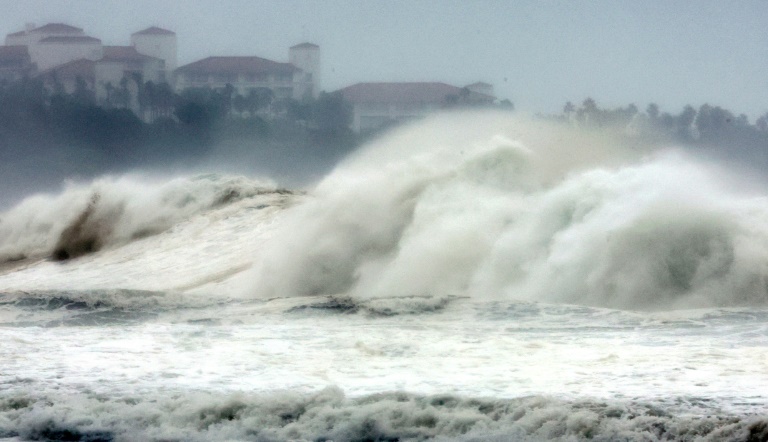
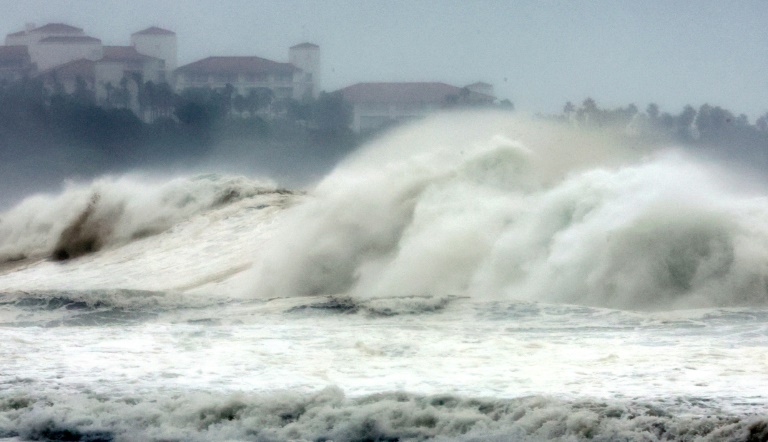
Typhoon Hinnamnor killed one person and left nine missing on Tuesday, before heading back to sea with few reports of major property damage. 

The typhoon, one of the most powerful to bear down on the country in decades, hit the southern island of Jeju overnight before making landfall near the port city of Busan, which was battered by huge waves and heavy rain which damaged beachfront roads and shops.

Early Tuesday in the eastern port city of Pohang, an elderly woman in her 70s was swept away in flooding and killed, the Central Disaster and Safety Countermeasures Headquarters said.

Death tolls could climb later in the day, authorities having identified at least nine people missing as of Tuesday afternoon, including seven people at a submerged underground parking lot in Pohang.

More than 60,000 households nationwide lost power because of the typhoon.

As a precaution, authorities closed more than 600 schools nationwide, and local carriers grounded some 250 domestic flights — but service gradually resumed Tuesday as Hinnamnor headed towards Japan.

North Korea had also been bracing for the storm, with leader Kim Jong-un overseeing a meeting in Pyongyang to assess the country’s preparedness, state media reported Tuesday.

Kim said boosting Pyongyang’s disaster response was crucial as “nothing is more precious… than the people’s life and safety”, news agency KCNA reported.

Experts say North Korea is particularly vulnerable to flooding and heavy rains due to deforestation and poor irrigation.

On Tuesday morning, the typhoon was over the Sea of Japan, known as the East Sea in Korea, 100 kilometres (62 miles) off Tsushima island, according to the Japan Meteorological Agency.

Bringing gusts of up to 180 kilometres per hour, it was moving northeast at a speed of 45 kph and was expected to bring heavy rains to western Japan on Tuesday.

More than 35,000 households were without power in Japan’s southwestern Kyushu region, Kyushu Electricity said in a statement.

Some of Japan’s bullet trains were suspended due to strong winds and rain, and many local trains also paused service, operator JR Kyushu said.

At least 120 flights departing and landing at Kyushu’s airport were cancelled, public broadcaster NHK reported.

Typhoon kills one, leaves several missing in South Korea

Typhoon Hinnamnor killed one person and left nine missing on Tuesday, before heading back to sea with few reports of major property damage. 

The typhoon, one of the most powerful to bear down on the country in decades, hit the southern island of Jeju overnight before making landfall near the port city of Busan, which was battered by huge waves and heavy rain which damaged beachfront roads and shops.

Early Tuesday in the eastern port city of Pohang, an elderly woman in her 70s was swept away in flooding and killed, the Central Disaster and Safety Countermeasures Headquarters said.

Death tolls could climb later in the day, authorities having identified at least nine people missing as of Tuesday afternoon, including seven people at a submerged underground parking lot in Pohang.

More than 60,000 households nationwide lost power because of the typhoon.

As a precaution, authorities closed more than 600 schools nationwide, and local carriers grounded some 250 domestic flights — but service gradually resumed Tuesday as Hinnamnor headed towards Japan.

North Korea had also been bracing for the storm, with leader Kim Jong-un overseeing a meeting in Pyongyang to assess the country’s preparedness, state media reported Tuesday.

Kim said boosting Pyongyang’s disaster response was crucial as “nothing is more precious… than the people’s life and safety”, news agency KCNA reported.

Experts say North Korea is particularly vulnerable to flooding and heavy rains due to deforestation and poor irrigation.

On Tuesday morning, the typhoon was over the Sea of Japan, known as the East Sea in Korea, 100 kilometres (62 miles) off Tsushima island, according to the Japan Meteorological Agency.

Bringing gusts of up to 180 kilometres per hour, it was moving northeast at a speed of 45 kph and was expected to bring heavy rains to western Japan on Tuesday.

More than 35,000 households were without power in Japan’s southwestern Kyushu region, Kyushu Electricity said in a statement.

Some of Japan’s bullet trains were suspended due to strong winds and rain, and many local trains also paused service, operator JR Kyushu said.

At least 120 flights departing and landing at Kyushu’s airport were cancelled, public broadcaster NHK reported.

Close Bitnami banner
Bitnami