World

US says sending envoy to Ethiopia, condemns Eritrea return to war

The United States on Friday dispatched an envoy to Ethiopia to seek an end to renewed fighting, and condemned neighboring Eritrea for re-entering the conflict in the northern region of Tigray.

Mike Hammer, the US special envoy for the Horn of Africa, will head this weekend to Ethiopia and “convey that all parties should halt military operations and engage in peace talks,” White House Press Secretary Karine Jean-Pierre said.

“We condemn Eritrea’s re-entry into the conflict, the continuing TPLF offensive outside of Tigray and the Ethiopian government’s air strikes,” she told reporters, referring to the rebel Tigray People’s Liberation Front.

Fighting resumed last week in the northern region after a five-month lull, dashing hopes of peacefully resolving the nearly two-year war and of ending a humanitarian crisis in which Tigray has suffered widespread hunger.

“There is no military solution to the conflict,” Jean-Pierre said.

“All parties should exercise restraint and we urge de-escalation by all actors, particularly so that there can be a resumption of humanitarian relief and basic services to all parties in need.”

The State Department said Hammer, a veteran diplomat whose assignment also covers troubled Sudan and Somalia, would travel from Sunday through September 15 in the Horn of Africa.

He will meet both Ethiopian and African Union officials as well as political players from elsewhere in the country, it said.

Hammer took on the role in June and the following month visited Ethiopia in a bid to help launch peace talks, which never began due to disputes between the government and TPLF even while the ceasefire was holding.

The two sides have traded blame for starting the latest round of hostilities.

The TPLF, once Ethiopia’s dominant force, has said that historic rival Eritrea again sent in forces as part of a major offensive with Ethiopian troops.

Eritrea, one of the world’s most closed nations with one of its most authoritarian governments, has been accused of heinous violence in the conflict.

Amnesty International said that Eritrean forces at the start of the conflict in November 2020 massacred hundreds of civilians in the ancient city of Axum.

After months of denial that Eritrean troops had crossed the border, Ethiopian Prime Minister Abiy Ahmed in March 2021 admitted to their presence and promptly announced their departure.

– US distance from Ethiopia –

Abiy won the Nobel Peace Prize for his reconciliation with Eritrea but has fallen out of favor with the United States, a longtime Ethiopian ally which voiced revulsion over the violence in Tigray, where US Secretary of State Antony Blinken has spoken of “ethnic cleansing.”

President Joe Biden’s administration as of January 1 booted Ethiopia out of a key trade agreement that allowed duty-free access, outraging segments of the growing Ethiopian-American community which said the United States was ceding influence to rival powers such as China.

Ethiopia’s ambassador in Washington, Seleshi Bekele, met Thursday with senior officials including Deputy Secretary of State Wendy Sherman and called on the United States to condemn the TPLF, which he said was to blame for breaking the ceasefire.

Access to northern Ethiopia is severely restricted and Tigray has been under a communications blackout for over a year.

TPLF spokesman Kindeya Gebrehiwot earlier told AFP that a major offensive was coming from Eritrea.

Combat had been concentrated around the southeastern border of Tigray, with the rebels pushing into the neighboring Amhara and Afar regions, sending residents fleeing.

The fighting so far has not terminated relief efforts, with UN spokesman Stephane Dujarric saying that 17 trucks distributed fertilizer in Tigray this week for farmers in their planting season.

Abiy sent troops into Tigray to topple the TPLF in November 2020 in response to what he said were rebel attacks on federal army camps.

Google allows Parler app back into Play Store

Google allowed social media network Parler back into its Play Store Friday, more than a year after banning the platform popular with conservatives in the wake of the insurrection at the US Capitol.

Google pulled the Parler app from its online marketplace just days after the deadly attack on the seat of US government on January 6, 2021, saying it had allowed “egregious content” that could incite more violence.

Parler had become a haven for far-right personalities who say they have been censored by other social media platforms such as Twitter. 

The attack on the Capitol, incited in part by online misinformation and violent rhetoric on sites such as Parler, was carried out by far-right supporters of former president Donald Trump, who sought to overturn the results of the 2020 election which he lost to Joe Biden.

Parler was allowed back in the Play Store after meeting requirements regarding removing abusive posts and blocking users who break the app’s rules, according to Google.

“All apps on Google Play that feature user generated content are required to implement robust moderation practices that prohibit objectionable content,” a Google spokesperson said in response to an AFP inquiry.

“Apps are able to appear on Google Play provided they comply with Play’s developer policies.”

Parler agreed to abide by Play Store rules and modified its app for Android-powered mobile devices to comply with its policies, according to Google.

Versions of the Parler app tailored for iPhones or iPads were also banned at Apple’s App Store after the insurrection.

But they were put back on its virtual shelves last year after updates aimed at curbing incitements to violence, Apple said at the time.

Parler claimed to have more than 20 million users before being pulled from the Apple and Google online marketplaces.

Conservatives backing Trump’s bid to overturn his election loss sparked a migration to alternative social media sites whose lax moderation policies have allowed misinformation to flourish.

Oil slick from cargo ship off Gibraltar reaches shore

Small amounts of oil from a bulk carrier that collided with a gas tanker off Gibraltar has reached the shoreline of the British territory and neighbouring Spain, local officials said Friday.

The head of Gibraltar’s government, Fabian Picardo, told Spanish news radio Cadena Ser that a slick from the stricken vessel had reached “parts of the coast of Gibraltar.”

“But it was a small slick, we don’t want there to be any slick, but it was small,” he added.

Crews have been deployed to “begin the clean-up of oil from the shoreline,” the government of Gibraltar said in a statement.

Gibraltar’s department of environment has received reports “of small numbers of oiled birds,” it added.

Meanwhile the mayor of the Spanish town of La Linea de la Concepcion which borders Gibraltar said an oil slick from the carrier had reached its beach, forcing its closure.

“What has arrived is a slick which, frankly, is worrying but we are not talking about a tragedy,” Juan Franco told local reporters.

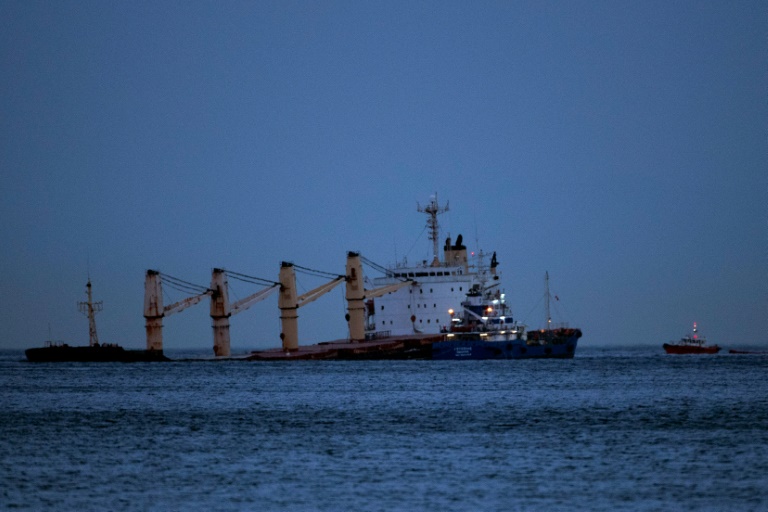
The carrier — the OS 35 — has been beached off Gibraltar since the two vessels collided late on Monday off the territory located on the southern tip of the Iberian peninsula.

The captain of the damaged ship was detained for questioning on Thursday for allegedly not obeying Gibraltar port orders initially after the collision.

No one was injured in the accident.

Booms were placed around the stricken cargo ship but some oil still managed to escape the floating barriers.

Gibraltar officials said Friday that all of the diesel on the ship had been removed, and the priority now was the removal of the heavy fuel oil that is still on board.

Divers on Thursday sealed two tank vents that leaked fuel from the bulk carrier and the amount of oil that is leaking is “significantly reduced”, the government of Gibraltar statement said.

Gibraltar, measuring just 6.8 square kilometres (2.6 square miles), overlooks the only entrance to the Mediterranean from the Atlantic Ocean, putting it on the key shipping route to the Middle East.

Its strategic location and low tax rates have helped turn it into one of the world’s busiest ports for ships to refuel.

Greenpeace said oil spills will “continue to be a threat” in the Strait of Gibraltar as long as it continues to be “the biggest ‘low cost’ fuel station in southern Europe.”

It's raining diamonds across the universe, research suggests

It could be raining diamonds on planets throughout the universe, scientists suggested Friday, after using common plastic to recreate the strange precipitation believed to form deep inside Uranus and Neptune.

Scientists had previously theorised that extremely high pressure and temperatures turn hydrogen and carbon into solid diamonds thousands of kilometres below the surface of the ice giants.

Now new research, published in Science Advances, inserted oxygen into the mix, finding that “diamond rain” could be more common than thought.

Ice giants like Neptune and Uranus are thought to be the most common form of planet outside our Solar System, which means diamond rain could be occurring across the universe.

Dominik Kraus, a physicist at Germany’s HZDR research lab and one of the study’s authors, said that diamond precipitation was quite different to rain on Earth.

Under the surface of the planets is believed to be a “hot, dense liquid”, where the diamonds form and slowly sink down to the rocky, potentially Earth-size cores more than 10,000 kilometres (6,200 miles) below, he said.

There fallen diamonds could form vast layers that span “hundreds of kilometres or even more”, Kraus told AFP.

While these diamonds might not be shiny and cut like a “a nice gem on a ring”, he said they were formed via similar forces as on Earth.

Aiming to replicate the process, the research team found the necessary mix of carbon, hydrogen and oxygen in a readily available source — PET plastic, which is used for everyday food packaging and bottles. 

Kraus said that while the researchers used very clean PET plastic, “in principle the experiment should work with Coca-Cola bottles”.

The team then turned a high-powered optical laser on the plastic at the SLAC National Accelerator Laboratory in California.

“Very, very short X-ray flashes of incredible brightness” allowed them to watch the process of nanodiamonds — tiny diamonds too small to see with the naked eye — as they formed, Kraus said.

“The oxygen that is present in large amounts on those planets really helps suck away the hydrogen atoms from the carbon, so it’s actually easier for those diamonds to form,” he added.

– New way to make nanodiamonds? – 

The experiment could point towards a new way to produce nanodiamonds, which have a wide and increasing range of applications including drug delivery, medical censors, non-invasive surgery and quantum electronics.

“The way nanodiamonds are currently made is by taking a bunch of carbon or diamond and blowing it up with explosives,” said SLAC scientist and study co-author Benjamin Ofori-Okai.

“Laser production could offer a cleaner and more easily controlled method to produce nanodiamonds,” he added.

The diamond rain research remains hypothetical because little is known about Uranus and Neptune, the most distant planets in our Solar System.

Only one spacecraft — NASA’s Voyager 2 in the 1980s — has flown past the two ice giants, and the data it sent back is still being used in research.

But a NASA group has outlined a potential new mission to the planets, possibly launching next decade.

“That would be fantastic,” Kraus said.

He said he is greatly looking forward to more data — even if it takes a decade or two.

NASA Moon launch to attract up to 400,000 visitors

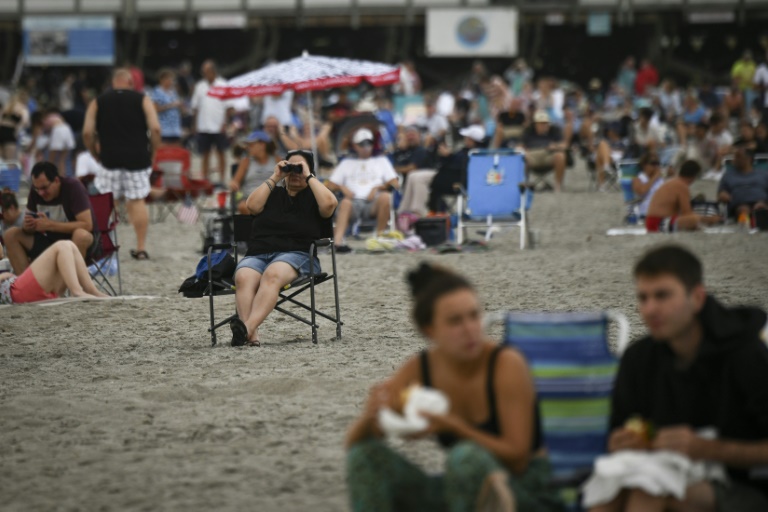
Up to 400,000 visitors are expected to flock to the Florida coast on Saturday, hoping to catch a glimpse — and hear the roar — of NASA’s rocket launch to the Moon.

If the uncrewed Space Launch System (SLS) lifts off successfully, it will be not only awe-inspiring but historic for NASA, marking the first of its Artemis missions plotting a return to the Moon.

The Kennedy Space Center will be closed to the public, but spectators on local beaches will be able to see the most powerful vehicle that NASA has ever launched climb into the sky.

“I remember being a little kid and some of the (Apollo) lunar landings,” Alberto Tirado told AFP on Cocoa Beach, the day before the rocket’s scheduled launch.

“So I want to feel that power and what they felt in the 1960s.”

On Monday, when a first launch attempt had to be scuttled at the last moment due to technical issues, local Brevard County authorities had expected between 100,000 and 200,000 visitors.

Don Walker, the county’s communications director, says that though Monday’s numbers have yet to be finalized, they estimate “double that amount on Saturday.”

“We are ‘guesstimating’ the launch viewing crowd to number between 200,000 to 400,000 people,” Walker told AFP.

For comparison, SpaceX’s first manned launch in 2020 — amid the pandemic — drew 220,000 people.

The fact that the launch is scheduled for a weekend, with Monday also a US holiday, means that the crowd is likely to be much larger, said Meagan Happel with the Space Coast Office of Tourism.

As on Monday, traffic is expected to get heavy “three to four hours” before the launch, Happel told AFP.

Liftoff is currently scheduled for 2:17 pm (18:17 GMT) on Saturday, with the potential for up to a two-hour delay if necessary.

Hotels along the coast have been fully booked for several weeks, and there are only a limited number of parking spaces near the best viewpoints.

Artemis 1 is a test flight without any astronauts on board.

The Orion capsule, after separating from the SLS rocket, will spend about six weeks in space and travel at one point nearly 40,000 miles (64,000 km) past the Moon — farther than any human-grade vehicle has ever gone.

It is the Orion that will then take future astronauts back to the Moon — including the first woman and the first person color to walk on its surface — in 2025 at the earliest.

West, Russia trade pressure on energy as Ukraine goes on attack

Western powers and Moscow hit back at each other Friday with painful pressure measures on energy as Ukraine said it bombed a Russian base near a nuclear plant that has caused growing concern.

The Group of Seven major industrial democracies vowed to move urgently to set a price cap on Russian oil imports, a crucial source of revenue for Moscow and its war in Ukraine.

“Russia is benefitting economically from the uncertainty on energy markets caused by the war and is making big profits from the export of oil and we want to counter that decisively,” German Finance Minister Christian Lindner said in a press conference after the move was announced.

The aim of the price cap on oil exports was to “stop an important source of financing for the war of aggression and contain the rise in global energy prices”, he added.

Ahead of the decision, the Kremlin warned that the move would destabilise oil markets. It has shown it is willing to use gas supplies to Europe as leverage in what the United States has denounced as “weaponisation” of energy.

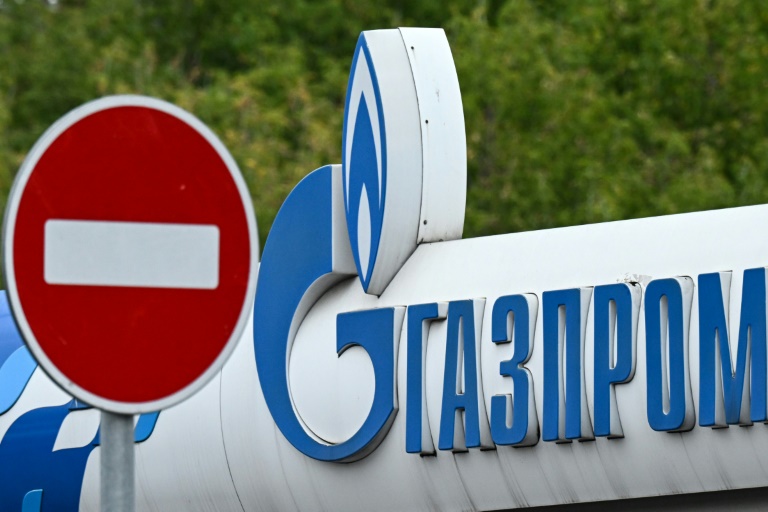
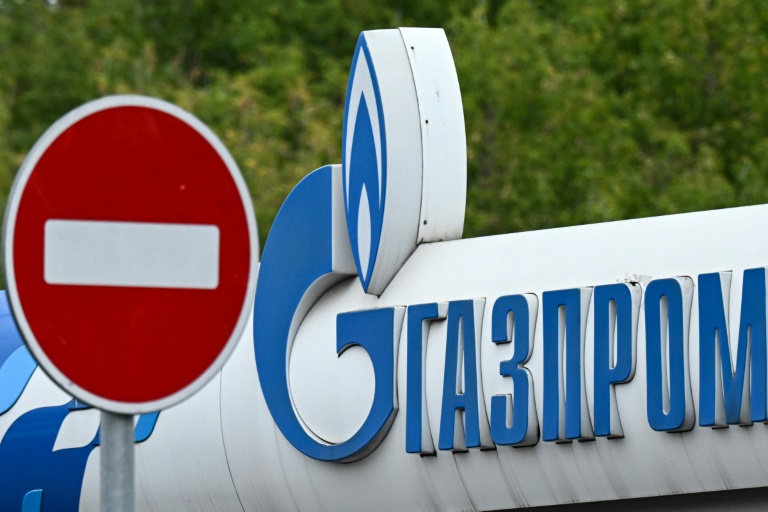
As if on cue, Russian gas giant Gazprom said it had halted gas deliveries to Germany for an indefinite period as there were leaks in a turbine.

Gazprom earlier said it expected a resumption on Saturday of gas shipments through Nord Stream, a pipeline — denounced at its inception by Russia’s critics — that links St Petersburg to Germany under the Baltic Sea.

“The reliability of the operation, of the whole system, is at risk,” Kremlin spokesman Dmitry Peskov said, blaming a lack of spare parts.

Siemens Energy, the German manufacturer of the turbine where Gazprom said it identified problems, said that the leaks identified by the Russians were not a reason to stop operation.

– Fighting near nuclear plant –

The showdown on energy comes amid growing alarm over Europe’s largest nuclear plant, Zaporizhzhia, which is under occupation of Russian troops.

Ukraine said it bombed a Russian base in the nearby town of Energodar, destroying three artillery systems as well as an ammunition depot.

Dmytro Orlov, the pro-Kyiv mayor of Energodar in southern Ukraine, told AFP from his location in exile that phone services in the town were badly disrupted.

A 14-strong team from the International Atomic Energy Agency (IAEA) is visiting Zaporizhzhia, with the UN nuclear watchdog’s chief, Rafael Grossi, saying that the site had been damaged in fighting.

The Ukrainian army charged the Russian forces had removed their equipment from the site before the UN team arrived on Thursday.

Russian troops seized control of the site in early March. There have been repeated attacks in the vicinity but both Moscow and Kyiv have denied responsibility and blamed each other.

UN inspectors spent their second day at Zaporizhzhia on Friday. Russia’s envoy to Vienna, Mikhail Ulyanov, said six IAEA inspectors would stay behind for several days and that two more would remain there “on a permanent basis”. 

“We welcome this because an international presence can dispel the many rumours about the state of affairs at the nuclear power plant,” he told Russian news agency RIA Novosti. 

– ‘Stop playing with fire’ –

Red Cross director general Robert Mardini on Thursday warned the consequences of hitting the plant could be “catastrophic”, saying “the slightest miscalculation could trigger devastation that we will regret for decades”.

“It is high time to stop playing with fire and instead take concrete measures to protect this facility … from any military operations,” he told reporters in Kyiv.

Ukraine has accused Russia of storing ammunition at Zaporizhzhia and deploying hundreds of soldiers there. 

It also suspects Moscow is intending to divert power from the plant to the nearby Crimean peninsula, annexed by Russia in 2014. 

Meanwhile, Ukrainian troops pressed ahead with a counter-offensive in the nearby region of Kherson to retake areas seized by Russia at the start of the invasion.

The president’s office said explosions had been heard across Kherson throughout Thursday night and that “heavy fighting” was taking place in two areas just up river from Kherson city, the regional capital. 

In the eastern Donetsk region, four people were killed and 10 wounded in various shelling incidents, while another died in the north east when a village was hit near Kharkhiv, Ukraine’s second city.

Despite the conflict, now in its seventh month, children started a new school year on September 1, although in several regions that meant lessons online due to the ongoing fighting.

“I’m happy to be back at school but I would be even happier if there was no war because I miss my teacher and my friends,” nine-year-old Antonina Sidorenko, told AFP, with the distant crackle of gunfire in the background. 

West, Russia trade pressure on energy as Ukraine goes on attack

Western powers and Moscow hit back at each other Friday with painful pressure measures on energy as Ukraine said it bombed a Russian base near a nuclear plant that has caused growing concern.

The Group of Seven major industrial democracies vowed to move urgently to set a price cap on Russian oil imports, a crucial source of revenue for Moscow and its war in Ukraine.

“Russia is benefitting economically from the uncertainty on energy markets caused by the war and is making big profits from the export of oil and we want to counter that decisively,” German Finance Minister Christian Lindner said in a press conference after the move was announced.

The aim of the price cap on oil exports was to “stop an important source of financing for the war of aggression and contain the rise in global energy prices”, he added.

Ahead of the decision, the Kremlin warned that the move would destabilise oil markets. It has shown it is willing to use gas supplies to Europe as leverage in what the United States has denounced as “weaponisation” of energy.

As if on cue, Russian gas giant Gazprom said it had halted gas deliveries to Germany for an indefinite period as there were leaks in a turbine.

Gazprom earlier said it expected a resumption on Saturday of gas shipments through Nord Stream, a pipeline — denounced at its inception by Russia’s critics — that links St Petersburg to Germany under the Baltic Sea.

“The reliability of the operation, of the whole system, is at risk,” Kremlin spokesman Dmitry Peskov said, blaming a lack of spare parts.

Siemens Energy, the German manufacturer of the turbine where Gazprom said it identified problems, said that the leaks identified by the Russians were not a reason to stop operation.

– Fighting near nuclear plant –

The showdown on energy comes amid growing alarm over Europe’s largest nuclear plant, Zaporizhzhia, which is under occupation of Russian troops.

Ukraine said it bombed a Russian base in the nearby town of Energodar, destroying three artillery systems as well as an ammunition depot.

Dmytro Orlov, the pro-Kyiv mayor of Energodar in southern Ukraine, told AFP from his location in exile that phone services in the town were badly disrupted.

A 14-strong team from the International Atomic Energy Agency (IAEA) is visiting Zaporizhzhia, with the UN nuclear watchdog’s chief, Rafael Grossi, saying that the site had been damaged in fighting.

The Ukrainian army charged the Russian forces had removed their equipment from the site before the UN team arrived on Thursday.

Russian troops seized control of the site in early March. There have been repeated attacks in the vicinity but both Moscow and Kyiv have denied responsibility and blamed each other.

UN inspectors spent their second day at Zaporizhzhia on Friday. Russia’s envoy to Vienna, Mikhail Ulyanov, said six IAEA inspectors would stay behind for several days and that two more would remain there “on a permanent basis”. 

“We welcome this because an international presence can dispel the many rumours about the state of affairs at the nuclear power plant,” he told Russian news agency RIA Novosti. 

– ‘Stop playing with fire’ –

Red Cross director general Robert Mardini on Thursday warned the consequences of hitting the plant could be “catastrophic”, saying “the slightest miscalculation could trigger devastation that we will regret for decades”.

“It is high time to stop playing with fire and instead take concrete measures to protect this facility … from any military operations,” he told reporters in Kyiv.

Ukraine has accused Russia of storing ammunition at Zaporizhzhia and deploying hundreds of soldiers there. 

It also suspects Moscow is intending to divert power from the plant to the nearby Crimean peninsula, annexed by Russia in 2014. 

Meanwhile, Ukrainian troops pressed ahead with a counter-offensive in the nearby region of Kherson to retake areas seized by Russia at the start of the invasion.

The president’s office said explosions had been heard across Kherson throughout Thursday night and that “heavy fighting” was taking place in two areas just up river from Kherson city, the regional capital. 

In the eastern Donetsk region, four people were killed and 10 wounded in various shelling incidents, while another died in the north east when a village was hit near Kharkhiv, Ukraine’s second city.

Despite the conflict, now in its seventh month, children started a new school year on September 1, although in several regions that meant lessons online due to the ongoing fighting.

“I’m happy to be back at school but I would be even happier if there was no war because I miss my teacher and my friends,” nine-year-old Antonina Sidorenko, told AFP, with the distant crackle of gunfire in the background. 

US stocks fall after Gazprom shutdown announcement

After following European equities higher Friday, Wall Street stocks reversed course, finishing sharply lower after Russia kept shut a key gas pipeline to Germany.

US stocks had initially gained following August jobs data that showed employment growth moderating and unemployment ticking higher in a report seen by investors as lessening pressure on the Federal Reserve to increase interest rates. 

But markets did a 180-degree turn midday as worries increased about the winter ahead after Russian gas giant Gazprom moved to keep natural gas deliveries to Germany off-line.

In a statement, Gazprom indicated it had discovered “oil leaks” in a turbine during a planned three-day maintenance operation, a statement that was seen skeptically in light of international condemnation of Russia’s invasion of Ukraine.

The announcement by Gazprom came the same day as the G7 nations said they would work to quickly implement a price cap on Russian oil exports, a move which would starve the Kremlin of critical revenue for its war effort. 

Fear of shortages of natural gas has driven futures contracts for electricity in France and Germany to record levels.

“You can draw a line to that Gazprom news,” said Briefing.com analyst Patrick O’Hare. “We’re going to continue to be stuck with this energy crisis hitting Europe and the prospect of a recession there.”

After opening higher, the broad-based S&P 500 finished at 3,924.35, down 1.1 percent for the day and 3.3 percent for the week.

The Gazprom announcement came after European bourses had already closed, with London, Paris and Frankfurt all posting solid gains following the US jobs data.

Labor Department data showed US employment increased by 315,000 jobs last month, which was in line with what economists were expecting but at a much slower pace than the 526,000 hires in July.

Markets have been expecting a third 0.75-percentage-point hike later this month. While the August jobs growth remained solid, unemployment rose to 3.7 percent from 3.5 percent.

“This is a goldilocks scenario for traders who now know that the Fed is unlikely to increase the rate aggressively,” said Naeem Aslam, chief market analyst at Avatrade.

“This factor has pushed the dollar index lower and gold prices moved higher on the back of this,” he added.

The dollar had rallied this week to highs not seen for decades including against the pound, euro and yen on expectations that the Fed would continue to raise interest rates aggressively.

The yen hit a new 24-year low against the dollar on Friday.

– Key figures at around 2020 GMT –

New York – Dow: DOWN 1.1 percent at 31,318.58 (close)

New York – S&P 500: DOWN 1.1 percent at 3,924.35 (close)

New York – Nasdaq: DOWN 1.3 percent at 11,630.86 (close)

London – FTSE 100: UP 1.9 percent at 7,281.19 (close)

Frankfurt – DAX: UP 3.3 percent at 13,050.27 (close)

Paris – CAC 40: UP 2.2 percent at 6,167.51 (close)

EURO STOXX 50: UP 2.5 percent at 3,544.38 (close)

Tokyo – Nikkei 225: FLAT at 27,650.84 (close)

Hong Kong – Hang Seng Index: DOWN 0.7 percent at 19,452.09 (close)

Shanghai – Composite: UP 0.1 percent at 3,186.48 (close)

Dollar/yen: UP at 140.16 yen from 139.44 yen on Thursday

Euro/dollar: UP at $.9957 from $0.9946

Pound/dollar: DOWN at $1.1515 from $1.1545

Euro/pound: UP at 86.45 pence from 86.14 pence

West Texas Intermediate: UP 0.3 percent at $86.87 per barrel

Brent North Sea crude: UP 0.7 percent at $93.02 per barrel

burs-jmb/bfm

Russia halts gas supplies to Germany

Russia has halted gas deliveries to Germany via a key pipeline for an indefinite period, after saying Friday it had found problems in a key piece of equipment, a development that will worsen Europe’s energy crisis.

Russian gas giant Gazprom said Friday that the Nord Stream pipeline due to reopen at the weekend would remain shut until a turbine is repaired.

In a statement, Gazprom indicated it had discovered “oil leaks” in a turbine during a planned three-day maintenance operation.

Gazprom added that “until it is repaired… the transport of gas via Nord Stream is completely suspended”.

Resumption of deliveries via the pipeline which runs from near St Petersburg to Germany under the Baltic Sea, had been due to resume on Saturday. 

Gazprom said it had discovered the problems while carrying out maintenance with representatives of Siemens, which manufactured the turbine in a compressor station that pushes gas through the pipeline.

On its Telegram page it published a picture of cables covered in a brown liquid.

Earlier in the day, the Kremlin warned the future operation of the Nord Stream pipeline, one of Gazprom’s major supply routes, was at risk due to a lack of spare parts.

“There are no technical reserves, only one turbine is working,” Kremlin spokesman Dmitry Peskov told reporters.

“So the reliability of the operation, of the whole system, is at risk,” he said, adding that it was “not through the fault” of Russian energy giant Gazprom.

The turbine-maker Siemens Energy said in a statement that the oil leaks blamed by Gazprom was “not a technical reason for stopping operation”.

“Such leakages do not usually affect the operation of a turbine and can be sealed on site,” it said, adding that it was “not contracted for maintenance work”.

Following the imposition of economic sanctions over the Kremlin’s invasion of Ukraine, Russia has reduced or halted supplies to different European nations, causing energy prices to soar.

The Kremlin has blamed the reduction of supplies via Nord Stream on European sanctions which it says have blocked the return of a Siemens turbine that had been undergoing repairs in Canada.

Germany, which is where the turbine is located now, has said Moscow is blocking the return of the critical piece of equipment.

Berlin has previously accused Moscow of using energy as a weapon.

The announcement by Gazprom comes the same day as the G7 nations said they would work to quickly implement a price cap on Russian oil exports, a move which would starve the Kremlin of critical revenue for its war effort.

Gazprom also announced the suspension of gas supplies to France’s main provider Engie from Thursday after it failed to pay for all deliveries made in July.

– ‘Much better position’ –

As winter approaches, European nations have been seeking to completely fill their gas reserves, secure alternative supplies, and put into place plans to reduce consumption. 

A long-term halt to Russian gas supplies would complicate efforts by some nations to avoid shortages and rationing, however.

Germany said Friday its gas supplies were secure despite the halt to deliveries via Nord Stream.

“The situation on the gas market is tense, but security of supply is guaranteed,” a spokeswoman for the economy ministry said in a statement. 

The spokeswoman did not comment on the “substance” of Gazprom’s announcement earlier Friday but said Germany had “already seen Russia’s unreliability in the past few weeks”.

German officials have in recent times struck a more positive tone about the coming winter.

Before the latest shutdown, Chancellor Olaf Scholz said Germany was now “in a much better position” in terms of energy security, having achieved its gas storage targets far sooner than expected.

Europe as a whole has also been pushing ahead with filling its gas storage tanks, while fears over throttled supplies have driven companies to slash their energy usage.

Germany’s industry consumed 21.3 percent less gas in July than the average for the month from 2018 to 2021, said the Federal Network Agency.

Agency chief Klaus Mueller has said such pre-emptive action “could save Germany from a gas emergency this winter”.

Europe as a bloc meanwhile has been preparing to take emergency action to reform the electricity market in order to bring galloping prices under control. 

Fear of shortages of natural gas has driven futures contracts for electricity in France and Germany to record levels.

European consumers are also bracing for huge power bills as utilities pass on their higher energy costs.

burs-rl-sea/har

Russia halts gas supplies to Germany

Russia has halted gas deliveries to Germany via a key pipeline for an indefinite period, after saying Friday it had found problems in a key piece of equipment, a development that will worsen Europe’s energy crisis.

Russian gas giant Gazprom said Friday that the Nord Stream pipeline due to reopen at the weekend would remain shut until a turbine is repaired.

In a statement, Gazprom indicated it had discovered “oil leaks” in a turbine during a planned three-day maintenance operation.

Gazprom added that “until it is repaired… the transport of gas via Nord Stream is completely suspended”.

Resumption of deliveries via the pipeline which runs from near St Petersburg to Germany under the Baltic Sea, had been due to resume on Saturday. 

Gazprom said it had discovered the problems while carrying out maintenance with representatives of Siemens, which manufactured the turbine in a compressor station that pushes gas through the pipeline.

On its Telegram page it published a picture of cables covered in a brown liquid.

Earlier in the day, the Kremlin warned the future operation of the Nord Stream pipeline, one of Gazprom’s major supply routes, was at risk due to a lack of spare parts.

“There are no technical reserves, only one turbine is working,” Kremlin spokesman Dmitry Peskov told reporters.

“So the reliability of the operation, of the whole system, is at risk,” he said, adding that it was “not through the fault” of Russian energy giant Gazprom.

The turbine-maker Siemens Energy said in a statement that the oil leaks blamed by Gazprom was “not a technical reason for stopping operation”.

“Such leakages do not usually affect the operation of a turbine and can be sealed on site,” it said, adding that it was “not contracted for maintenance work”.

Following the imposition of economic sanctions over the Kremlin’s invasion of Ukraine, Russia has reduced or halted supplies to different European nations, causing energy prices to soar.

The Kremlin has blamed the reduction of supplies via Nord Stream on European sanctions which it says have blocked the return of a Siemens turbine that had been undergoing repairs in Canada.

Germany, which is where the turbine is located now, has said Moscow is blocking the return of the critical piece of equipment.

Berlin has previously accused Moscow of using energy as a weapon.

The announcement by Gazprom comes the same day as the G7 nations said they would work to quickly implement a price cap on Russian oil exports, a move which would starve the Kremlin of critical revenue for its war effort.

Gazprom also announced the suspension of gas supplies to France’s main provider Engie from Thursday after it failed to pay for all deliveries made in July.

– ‘Much better position’ –

As winter approaches, European nations have been seeking to completely fill their gas reserves, secure alternative supplies, and put into place plans to reduce consumption. 

A long-term halt to Russian gas supplies would complicate efforts by some nations to avoid shortages and rationing, however.

Germany said Friday its gas supplies were secure despite the halt to deliveries via Nord Stream.

“The situation on the gas market is tense, but security of supply is guaranteed,” a spokeswoman for the economy ministry said in a statement. 

The spokeswoman did not comment on the “substance” of Gazprom’s announcement earlier Friday but said Germany had “already seen Russia’s unreliability in the past few weeks”.

German officials have in recent times struck a more positive tone about the coming winter.

Before the latest shutdown, Chancellor Olaf Scholz said Germany was now “in a much better position” in terms of energy security, having achieved its gas storage targets far sooner than expected.

Europe as a whole has also been pushing ahead with filling its gas storage tanks, while fears over throttled supplies have driven companies to slash their energy usage.

Germany’s industry consumed 21.3 percent less gas in July than the average for the month from 2018 to 2021, said the Federal Network Agency.

Agency chief Klaus Mueller has said such pre-emptive action “could save Germany from a gas emergency this winter”.

Europe as a bloc meanwhile has been preparing to take emergency action to reform the electricity market in order to bring galloping prices under control. 

Fear of shortages of natural gas has driven futures contracts for electricity in France and Germany to record levels.

European consumers are also bracing for huge power bills as utilities pass on their higher energy costs.

burs-rl-sea/har

Close Bitnami banner
Bitnami