World

Greenpeace drops boulders on UK seabed to curb bottom-trawling fishing

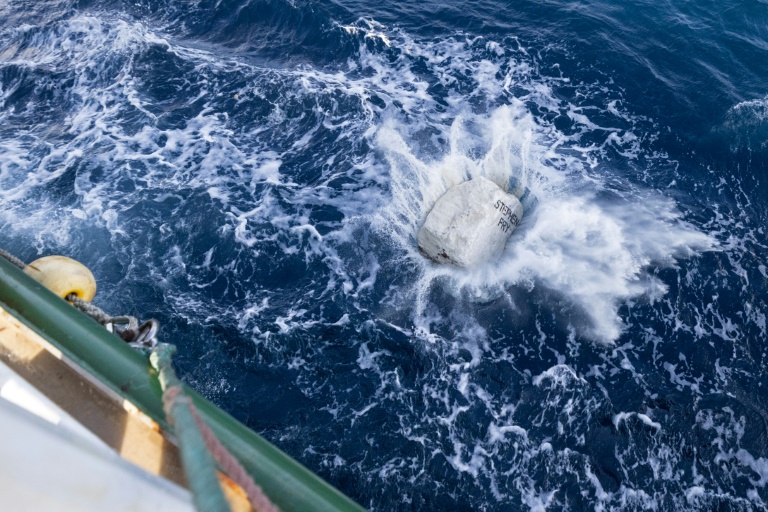
Greenpeace UK said Friday it had dropped 18 large boulders on the seabed in a marine conservation zone off the coast of southwest England to prevent “destructive” industrial fishing.

The environmental campaigners sailed to the western part of the Channel between the UK and France, loaded with the boulders of Portland limestone, each weighing between 500 and 1,400 kilograms (1,100 and 3,100 pounds). 

The giant rocks were dropped on Thursday from its Arctic Sunrise research vessel in an area of the South West Deeps (East) Conservation Zone, which lies some 190 kilometres (120 miles) off Land’s End, the most westerly point of mainland England.

“We are placing large limestone boulders on the seabed to create a protective underwater barrier which will put the area off limits to destructive fishing,” Anna Diski, UK oceans campaigner, told AFP on board.

The action would make it “impossible for them to drag the heavy fishing gear along the seabed, destroying the habitat and disturbing the carbon”, she added.

Artists created a giant ammonite sculpture — inspired by the fossil often found in Portland limestone — out of one of the boulders, which was also placed on the seabed.

The names of the action’s celebrity backers and supportive politicians were also inscribed on the rocks.

“Right now, there’s an industrial fishing frenzy happening in UK waters, and what’s our government doing about it?” asked Greenpeace UK’s head of oceans, Will McCallum.

“Greenpeace UK has created this underwater boulder barrier as a last resort to protect the oceans. We’d much rather the government just did their job.” 

McCallum said it was “outrageous” that bottom-trawlers are allowed to operate on the seabed in protected areas.

“They destroy huge swathes of the marine ecosystem and make a mockery of our so-called ‘protection’,” he added.

– ‘Get serious!’ –

The action comes after the latest round of UN talks to try to secure protection for marine life in international waters broke up without agreement.

Greenpeace said the 4,600-square-kilometre (1,776-square-mile) South West Deeps is “one of the most heavily fished so-called Marine Protected Areas in the UK”.

It cited figures from the Global Fishing Watch monitoring agency that said that 110 vessels — more than half of them from France — fished for 18,928 hours in the area in the 18 months to July.

Of that, industrial vessels with bottom-towed fishing gear spent 3,376 hours fishing in the zone. 

Bottom-trawling is only banned in four out of the UK’s 76 offshore Marine Protected Areas, and the government is consulting over possible bans in a further 13. 

“The problem is that the majority of the UK’s MPAs don’t have any actual protection at all,” said Jasmine Watkiss, one of those on board the Arctic Sunrise.

“The government needs to get serious about ocean protection before it’s too late.

“The next prime minister should ban industrial fishing in all of the UK’s Marine Protected Areas by tweaking commercial fishing licences,” she added.

UK regulator the Marine Management Organisation (MMO) said it had launched an investigation into Greenpeace for the “potentially illegal” deposit of construction material.

But it assessed that dropping the rocks “will have minimal impact” on fishing activity in the area.

“The MMO remains open to discussions with Greenpeace to ensure we can achieve our joint goal of marine nature recovery.” 

Neil Whitney, a fisherman from East Sussex in southern England, said bottom-trawling was “like ploughing a combine harvester through a national park”. 

“They’re able to take out entire ecosystems, and if they cause a fishery to collapse, they just move on to the next one,” he added.

“Industrial fishing, like fly-shooters (vessels which tow lead-weighted ropes along the seabed) and supertrawlers (trawlers over 100 metres long), are killing our marine environment, and small-scale UK fishermen like me are losing out big time.”

He said it was “absurd” that bottom-trawling was legal in MPAs. “MPAs are supposed to be the areas where fish stocks can recover, so that we fish for generations to come.”

video-jwp/phz/jj/cdw

Greenpeace drops boulders on UK seabed to curb bottom-trawling fishing

Greenpeace UK said Friday it had dropped 18 large boulders on the seabed in a marine conservation zone off the coast of southwest England to prevent “destructive” industrial fishing.

The environmental campaigners sailed to the western part of the Channel between the UK and France, loaded with the boulders of Portland limestone, each weighing between 500 and 1,400 kilograms (1,100 and 3,100 pounds). 

The giant rocks were dropped on Thursday from its Arctic Sunrise research vessel in an area of the South West Deeps (East) Conservation Zone, which lies some 190 kilometres (120 miles) off Land’s End, the most westerly point of mainland England.

“We are placing large limestone boulders on the seabed to create a protective underwater barrier which will put the area off limits to destructive fishing,” Anna Diski, UK oceans campaigner, told AFP on board.

The action would make it “impossible for them to drag the heavy fishing gear along the seabed, destroying the habitat and disturbing the carbon”, she added.

Artists created a giant ammonite sculpture — inspired by the fossil often found in Portland limestone — out of one of the boulders, which was also placed on the seabed.

The names of the action’s celebrity backers and supportive politicians were also inscribed on the rocks.

“Right now, there’s an industrial fishing frenzy happening in UK waters, and what’s our government doing about it?” asked Greenpeace UK’s head of oceans, Will McCallum.

“Greenpeace UK has created this underwater boulder barrier as a last resort to protect the oceans. We’d much rather the government just did their job.” 

McCallum said it was “outrageous” that bottom-trawlers are allowed to operate on the seabed in protected areas.

“They destroy huge swathes of the marine ecosystem and make a mockery of our so-called ‘protection’,” he added.

– ‘Get serious!’ –

The action comes after the latest round of UN talks to try to secure protection for marine life in international waters broke up without agreement.

Greenpeace said the 4,600-square-kilometre (1,776-square-mile) South West Deeps is “one of the most heavily fished so-called Marine Protected Areas in the UK”.

It cited figures from the Global Fishing Watch monitoring agency that said that 110 vessels — more than half of them from France — fished for 18,928 hours in the area in the 18 months to July.

Of that, industrial vessels with bottom-towed fishing gear spent 3,376 hours fishing in the zone. 

Bottom-trawling is only banned in four out of the UK’s 76 offshore Marine Protected Areas, and the government is consulting over possible bans in a further 13. 

“The problem is that the majority of the UK’s MPAs don’t have any actual protection at all,” said Jasmine Watkiss, one of those on board the Arctic Sunrise.

“The government needs to get serious about ocean protection before it’s too late.

“The next prime minister should ban industrial fishing in all of the UK’s Marine Protected Areas by tweaking commercial fishing licences,” she added.

UK regulator the Marine Management Organisation (MMO) said it had launched an investigation into Greenpeace for the “potentially illegal” deposit of construction material.

But it assessed that dropping the rocks “will have minimal impact” on fishing activity in the area.

“The MMO remains open to discussions with Greenpeace to ensure we can achieve our joint goal of marine nature recovery.” 

Neil Whitney, a fisherman from East Sussex in southern England, said bottom-trawling was “like ploughing a combine harvester through a national park”. 

“They’re able to take out entire ecosystems, and if they cause a fishery to collapse, they just move on to the next one,” he added.

“Industrial fishing, like fly-shooters (vessels which tow lead-weighted ropes along the seabed) and supertrawlers (trawlers over 100 metres long), are killing our marine environment, and small-scale UK fishermen like me are losing out big time.”

He said it was “absurd” that bottom-trawling was legal in MPAs. “MPAs are supposed to be the areas where fish stocks can recover, so that we fish for generations to come.”

video-jwp/phz/jj/cdw
G7 to implement Russian oil price cap 'urgently'

G7 industrialised powers vowed Friday to “urgently” move towards implementing a price cap on Russian oil imports in a bid to cut a major source of funding for Moscow’s war in Ukraine.

The G7 said it was working towards a “broad coalition” of support for the measure but officials in France urged caution, saying a “final” decision could only be taken once all 27 members of the European Union had given their assent.

Households on the continent have borne the brunt of rising energy prices, with governments under pressure to alleviate the pain of the resulting high inflation.

“Russia is benefitting economically from the uncertainty on energy markets caused by the war and is making big profits from the export of oil and we want to counter that decisively,” German Finance Minister Christian Lindner said in a press conference after the move was announced.

The aim of the price cap on oil exports was to “stop an important source of financing for the war of aggression and contain the rise in global energy prices”, he added.

Ahead of Friday’s decision, Kremlin spokesman Dmitry Peskov sounded a clear warning.

The adoption of a price cap “will lead to a significant destabilisation of the oil markets,” he said.

Moscow would “simply not supply oil and petroleum products to companies or states that impose restrictions,” Russia’s Deputy Prime Minister Alexander Novak had warned on Thursday, according to Russian news agencies.

“Interference in the market mechanisms of such an important industry … will only destabilise the oil industry, the oil market. And for this, European and American consumers will be the first to pay,” he said.

– ‘Powerful tool’ –

At a summit in June, the G7 leaders agreed to work towards implementing the ceiling on crude sales.

In their statement, finance ministers from the G7 said they would “urgently work on the finalisation and implementation” of the long-considered measure, without specifying the cap level.

The price cap was “one of the most powerful tools we have to fight inflation and protect workers and businesses in the United States”, US Secretary of the Treasury Janet Yellen said in a statement Friday. 

However, the French finance ministry said technical work on the price cap was still “in progress”.

“It is clear that no final decision can be taken until we have consulted and obtained unanimous support from all 27 member states of the European Union,” it said.

“We support all measures that reduce the income that Russia derives from the sale of oil,” French Finance Minister Bruno Le Maire added.

EU Commissioner Paolo Gentiloni said the bloc aims to find a deal by December 5 for crude oil and February 5 for petroleum products.

– ‘Broad coalition’ –

The G7 also voiced ambition to extend the measure beyond the bloc, saying it was seeking to form a “broad coalition” of support for the oil price cap to “maximise” the effectiveness of the measure.

The ministers urged “all countries that still seek to import Russian oil and petroleum products to commit to doing so only at prices at or below the price cap”.

The push to get as many countries as possible to go along with the cap is expected to be a key topic for discussion by leaders at the G20 summit in Bali on November 15 and 16.

The initial cap would be set “at a level based on a range of technical inputs” the G7 ministers said, adding that its effectiveness would be “closely monitored”.

Analysts warned, however, that the cap may yet fuel another rise in prices.

The cap would introduce new risks for the oil market by “potentially disrupting Russian energy supplies”, Capital Economics analyst Liam Perch said in June. “This could push global energy prices up further.”

“The cap may also be effective at reducing the Russian government’s tax revenues,” he said, speculating that a cap just below $80 (80 euros) per barrel could “push Russia’s budget into a deficit”. 

burs-sea/hmn/lth

Four things to know about Kenya's vote dispute

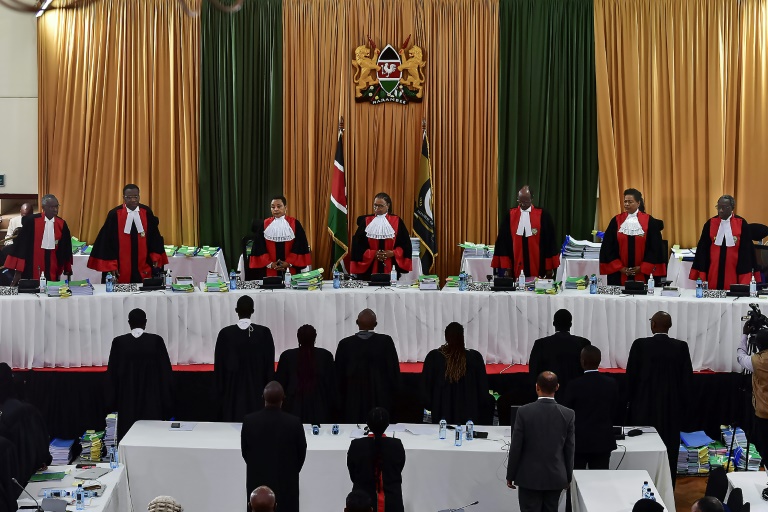
Kenya’s Supreme Court on Friday wrapped up hearing three days of oral arguments in the case challenging the validity of the August 9 presidential election won by Deputy President William Ruto.

His 77-year-old opponent Raila Odinga, who lost his fifth stab at the presidency, insists the election results were manipulated and claims to have “enough evidence” to prove his case.

With the seven-judge bench set to hand down its decision on Monday — the constitutional deadline — here are some key questions about the case and its potential implications for the country.

– How did we get here? –

The Independent Election and Boundaries Commission (IEBC) proclaimed 55-year-old Ruto president-elect on August 15 after a nail-biting wait for results. 

Odinga lost by a wafer-thin margin of around 230,000 votes despite the support of his old foe and outgoing President Uhuru Kenyatta, and the weight of the ruling party machinery behind him.

The former prime minister cried foul over the outcome, which also triggered turmoil within the IEBC.

No presidential poll outcome has gone uncontested in Kenya since 2002, and Odinga himself has been down this road before, petitioning the court in 2013 and 2017. 

In August 2017, the Supreme Court annulled the election after Odinga rejected Kenyatta’s victory.

The IEBC was under intense pressure to produce a transparent vote after facing stinging criticism over its handling of the 2017 election.

– What are the complaints? –

Seven petitioners — whose cases have been collapsed into one — have alleged that there were massive irregularities that compromised the integrity of the vote.

Odinga’s 72-page petition claims that hackers broke into the IEBC servers and “converted, manipulated and unlawfully” dumped forms used to tabulate results from polling stations. 

He alleges that the IEBC released contradictory figures on voter turnout and failed to tally results from at least 27 of the 290 constituencies, arguing that Ruto did not therefore meet the constitutional threshold of 50 percent plus 1 of the valid votes cast. 

The court, led by Chief Justice Martha Koome, said it had identified nine issues to consider before arriving at a verdict.

Judges will attempt to figure out whether the IEBC website was hacked and if there was any interference with the transmission of result forms. 

They will also scrutinise the IEBC’s servers to ascertain if the election technology — a hot-button issue that led to the nullification of the August 2017 vote — met the “standards of integrity, verifiability, security and transparency”.

IEBC chairman Wafula Chebukati has denied the allegations, insisting he carried out his duties according to the law of the land despite facing “intimidation and harassment”.

– What next? –

There are three possible outcomes.

If the court finds substantial irregularities that could have seriously affected the results announced by the IEBC, it can nullify the election and order a new vote within 60 days.

Alternatively, it can criticise the electoral process but conclude that the irregularities do not merit an annulment.

If it nonetheless finds that the president-elect did not secure 50 percent plus 1 of valid votes, it will order a runoff, which must be held within 30 days, marking a first for Kenya.

Finally, it can uphold Ruto’s victory, allowing him to be sworn in on September 13. 

The court’s ruling will be decided by a majority vote. 

The Supreme Court is the highest in the land, created under Kenya’s 2010 constitution “as the final arbiter and interpreter of the constitution”. 

Its rulings are final and binding.

– What’s at stake for Kenya? –

Plenty. 

The aftermath of the poll and court decision is being keenly watched as a test of democratic maturity in the East African powerhouse.

While Kenya is considered a pillar of stability in a volatile region, there are fears a drawn-out dispute may trigger violence in a country with a history of post-poll unrest.

Kenya’s worst electoral violence occurred after the 2007 vote, when more than 1,100 people died in politically motivated bloodletting between rival tribes.

A prolonged electioneering period will also exacerbate already difficult economic conditions, with business likely to slow down in the midst of political uncertainty. 

The country is struggling with soaring prices, a crippling drought that has left millions hungry, endemic corruption and disenchantment with the political elite.

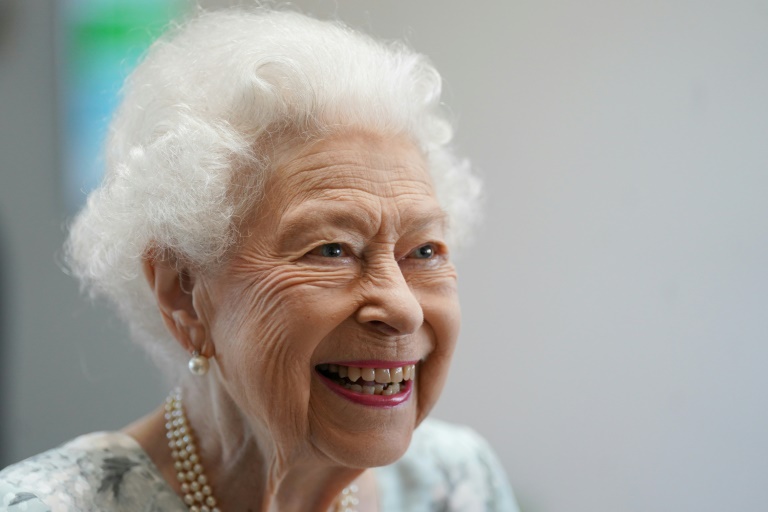
Queen Elizabeth II to miss Highland Games event

Queen Elizabeth II will not attend a traditional highlight of her summer trip to Scotland because of persistent health worries, British media said Friday.

The 96-year-old monarch has been dogged by problems walking and standing since last year, forcing her to cancel a series of public engagements.

Fears about a flare-up of what royal officials call “episodic mobility problems” have prevented her returning to London to appoint a new prime minister.

The queen had this weekend been expected to attend the Braemar Gathering near her remote Balmoral retreat in northeast Scotland.

A decision on her withdrawal was made for her comfort, British media reported, without quoting sources.

The event, which is always held on the first Saturday in September, is the most famous on the Highland Games circuit.

Senior royals, including the monarch, have attended the games regularly since the mid-19th century, to watch feats of strength and endurance.

Events include tossing the caber, in which kilted competitors endeavour to lift and throw a full-length log of Scots Pine.

Attendees this year — the first since 2019 because of the coronavirus pandemic — include the queen’s eldest son and heir, Prince Charles.

The queen, who came to the throne in 1952, traditionally appoints the country’s prime minister at an audience at Buckingham Palace in London.

In a change to convention, she will perform the constitutional role at Balmoral next week, instead of returning to the British capital.

Normally the handover of power is a swift affair, given the palace’s location, just a short distance from parliament and government offices.

But the 1,000-mile (1,600-kilometre) round-trip to the Scottish Highlands will lengthen the process, delaying key appointments to the new government.

Boris Johnson, who resigned as Conservative party leader in July, will formally tender his resignation as prime minister to the queen Tuesday.

She will then ask the new Tory leader — either Foreign Secretary Liz Truss or former finance minister Rishi Sunak — to form a new government.

Truss and Sunak have been vying to succeed Johnson. The winner of the vote of Tory MPs and grassroots part members closes on Friday, with the winner due to be announced on Monday.

The next incumbent at 10 Downing Street will be the queen’s 15th prime minister of her record-breaking 70-year reign.

Her first was World War II leader Winston Churchill, who returned for a second term of office in 1951 until 1955.

Climate activists target UK parliament

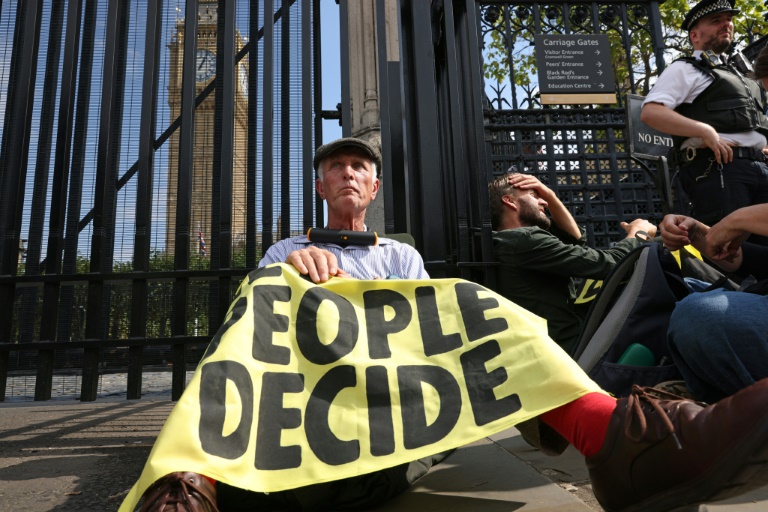
Members of climate activist group Extinction Rebellion on Friday glued themselves to the Speaker’s chair in the UK House of Commons, calling for a “Citizens’ Assembly” to help shape environmental policy.

“Just before noon today (1100 GMT), a group of around fifty people took nonviolent action at the House of Commons,” the group said in a statement. 

“The parliament action began with three people booked on an official tour of the building, gluing themselves in a chain around the Speaker’s Chair.” 

The group, wearing t-shirts reading “Let The People Decide”, took it in turns to read a speech calling for a Citizens’ Assembly to “give ordinary people a say over the major crises facing us.” 

Parliament is currently on summer recess, with politicians due to return on Monday.

Outside parliament, another member climbed up scaffolding around the Elizabeth Tower housing “Big Ben” and raised a banner reading “Let The People Decide — Citizens’ Assemblies Now”.

Two others chained themselves to the railings. 

“To create a new, fairer politics will require first thousands, then millions of us,” said Alanna Byrne, of Extinction Rebellion. 

“It will require sustained culture-shifting civil disobedience, until we become impossible to ignore.”

The group has carried out multiple actions over recent years, including blocking motorways and London roads, with some activists receiving jail terms.

It called Friday’s action “the opening act” of its September plans, which “will act as a launch event for a five-phase plan to bring 100,000 people onto the streets in civil resistance next spring.”

Top cleric among 18 killed in Afghanistan mosque blast

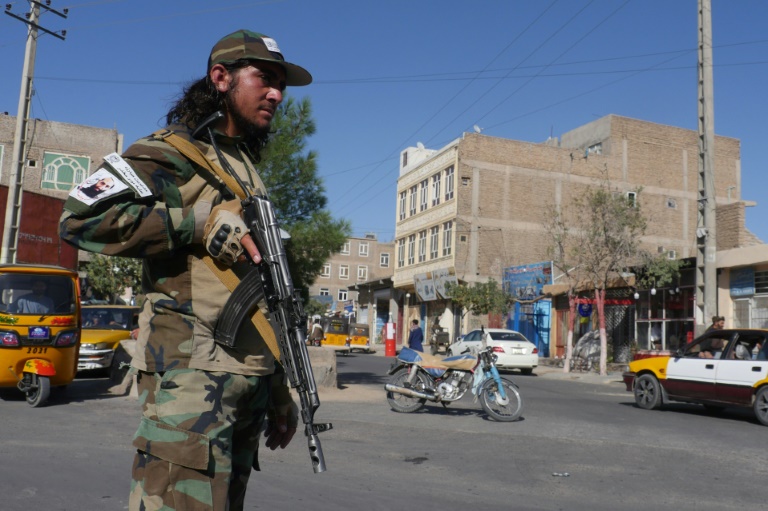
A suicide bomber struck one of the biggest mosques in western Afghanistan on Friday, killing at least 18 people, including an influential imam who earlier this year called for those who commit “the smallest act” against the government to be beheaded.

Images posted on Twitter showed what appeared to be blood-stained bodies scattered around the compound of Gazargah Mosque in Herat.

Violence has largely declined since the Taliban returned to power last year, but several bomb blasts — some targeting minority communities — have rocked the country in recent months, many claimed by the jihadist Islamic State (IS) group.

At least 18 people, including prominent pro-Taliban cleric Mujib ur Rahman Ansari, were killed and 23 wounded in Friday’s suicide attack, said Hameedullah Motawakel, spokesman for the governor of Herat province.

“The bomber came near Ansari and then set off his explosives-laden vest,” Motawakel told AFP. 

Deputy Prime Minister Abdul Ghani Baradar, who had met Ansari just hours earlier in the day at a separate gathering in Herat, condemned the cleric’s killing.

“A strong and brave religious scholar of the country was martyred while performing Friday prayers,” Baradar said on Twitter.

“The perpetrators of this heinous act will be punished.”

No group has so far claimed the attack.

Ansari, who was in his late 30s, was an influential cleric known for his fiery speeches.

In July, during a religious gathering in Kabul, he strongly defended Afghanistan’s new Taliban rulers.

“Whoever commits the smallest act against our Islamic government should be beheaded,” he said.

“This (Taliban) flag has not been raised easily, and it will not be lowered easily.”

Even before the Taliban returned to power in August 2021, the ultra-conservative cleric had been calling for women to be fully covered in public, and for bans on musical concerts in Herat.

In his speeches, he used to regularly launch tirades against the previous US-backed governments.

Ansari is the second pro-Taliban cleric to be killed in a blast in less than a month, after an August 11 suicide attack targeted Rahimullah Haqqani at his madrassa in Kabul.

Haqqani was known for angry speeches against IS, who later claimed responsibility for his death.

He had also spoken in favour of girls being allowed to attend secondary school, despite the government banning them from attending classes in most provinces.

Several mosques across the country have been targeted this year, some in attacks claimed by IS.

At least 21 people were killed and dozens more wounded on August 17 when a blast ripped through a mosque packed with worshippers in Kabul.

IS has primarily targeted minority communities such as Shiites, Sufis and Sikhs.

While IS is a Sunni Islamist group like the Taliban, the two are bitter rivals and greatly diverge on ideological grounds.

Government officials claim that IS has been defeated but experts say the group is the main security challenge for the country’s current Islamist rulers.

Russia's Gazprom expected to resume pipeline supplies

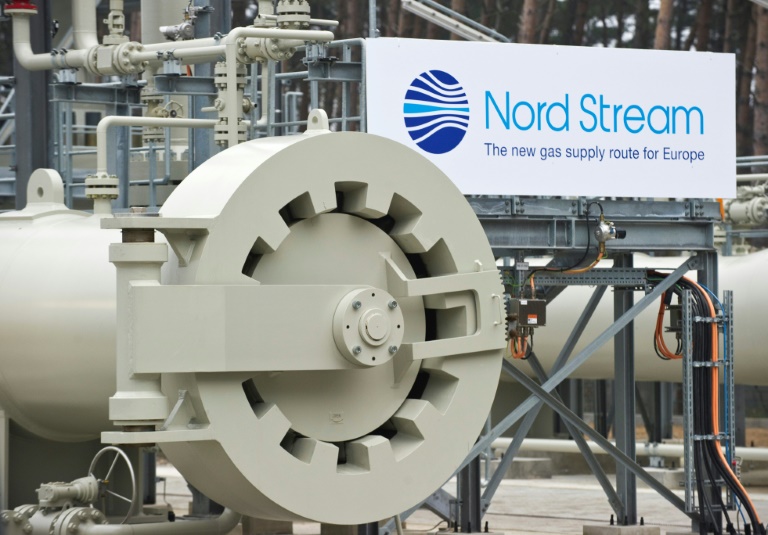
Russia’s Gazprom looked set to resume gas supplies to Europe via Nord Stream 1 this weekend, data from the pipeline operator showed Friday, after a halt that fuelled an energy crisis.

The resumption Saturday of deliveries after the three-day stoppage — which Gazprom said was needed for repairs — would bring some short-term relief.

But it will do little to ease fears about further supply disruptions as winter approaches.

Delivery orders, published on the Nord Stream website, indicated that supplies should resume at 2:00 am Saturday (0000 GMT) at 20 percent of their usual capacity — the same level as before the latest maintenance works. 

The stoppage began on Wednesday, and reduced gas deliveries via the key pipeline that runs from Russia to northern Germany to zero. 

Gazprom had said the work on a compressor unit was necessary but Germany’s Federal Network Agency said the decision was “technically incomprehensible”.

Details of the expected volumes can still change and need to be confirmed by actual deliveries.

A German economy ministry spokeswoman said while the pipeline operator had confirmed some initial orders, “we must nevertheless advise caution, and observe the situation closely”.

Europe is facing soaring energy prices after Russia slashed gas deliveries to the region amid soaring tensions following its February invasion of Ukraine. 

Germany, which is particularly dependent on Russian gas, has accused Moscow of using energy as a “weapon”.

As winter approaches, European consumers are bracing for huge power bills, with some countries like France warning that rationing is a possibility.

The Russian energy giant had already carried out 10 days of long-scheduled maintenance works in July. While it restored gas flows following the works, it drastically reduced supplies just days later, claiming a technical issue on a turbine.

The Kremlin warned Friday that Nord Stream may face future technical difficulties after the ongoing maintenance work, blaming sanctions for a shortage of spare parts.

“There are no technical reserves, only one turbine is working,” Kremlin spokesman Dmitry Peskov told reporters.

“So the reliability of the operation, of the whole system, is at risk,” he said, adding that it was “not through the fault” of Gazprom.

War in Ukraine: latest developments

Here are the latest developments in the war in Ukraine:

– G7 to ‘urgently’ impose Russian oil price cap –

G7 members announce plans to urgently implement a price cap on Russian oil imports in an effort to sap the Kremlin of some of its export earnings and funding for the war in Ukraine.

“We commit to urgently work on the finalisation and implementation of this measure”, G7 finance ministers said in a statement.

The ministers from Britain, Canada, France, Germany, Italy, Japan and United States did not say what price they would pay for Russian crude.

They said they hoped other countries would follow their lead “in order to maximise effectiveness” of the measure.

The US has led the push for the price cap, which would mark a serious escalation of the West’s sanctions on Russia. Energy exports are Russia’s biggest earner.

– UN visit to nuclear plant ‘positive’: Kremlin –

The Kremlin describes as “very positive” the visit by UN inspectors to the Russian-controlled Zaporizhzhia nuclear plant in southern Ukraine, adding it is “too early” to evaluate the UN’s work.

A 14-strong team of inspectors from the International Atomic Energy Agency arrived at the facility on Thursday to assess the impact of the war on its operations in the face of regular shelling of the area around the plant, which is close to the frontline.

“In general, we are very positive about the fact that, despite all the difficulties and problems… the commission arrived and started to work,” Kremlin spokesman Dmitry Peskov told reporters.

IAEA chief Rafael Grossi said Thursday the “physical integrity” of the plant had been “violated” by the shelling and that staff would remain there until “Sunday or Monday” to continue their assessment.

– Russian warning on Nord Stream –

The Kremlin warns that the Nord Stream pipeline, which supplies Europe with Russian gas, may face future technical difficulties following three days of maintenance that put it out of action.

“There are no technical reserves, only one turbine is working,” Kremlin spokesman Dmitry Peskov told reporters.

“So the reliability of the operation, of the whole system, is at risk,” he said of the pipeline which runs under the Baltic Sea to Germany.

Russia has slashed its gas deliveries to Europe on several occasions since the start of its offensive in Ukraine in response to Western sanctions, sending energy prices through the roof.

Europe has accused Moscow of using energy for blackmail and worked on securing alternative supplies in order to reduce its dependence on Russian gas.

– US raids properties of Putin-allied oligarch –

US police have raided several properties belonging to Russian billionaire Viktor Vekselberg, a close ally of President Vladimir Putin who is under Western sanctions, according to NBC News.

The raids targeted an apartment on Manhattan’s lavish Park Avenue, a house in the Hamptons, an upscale vacation destination near New York City, and a property on Miami’s Fisher Island believed to be linked to Vekselberg.

Vekselberg is the head of the Renova Group, a Moscow-based conglomerate. 

In April, his 90-million-euro ($99 million) superyacht was seized by Spanish authorities in Mallorca at the request of the US government.

burs-cb/bp

G20 talks end with pledge to accelerate energy transition

G20 energy talks in Bali ended Friday with the world’s leading economies pledging to accelerate the transition to cleaner energy, but there was no binding agreement as officials struggle to overcome discord over Russia’s invasion of Ukraine.

The price of energy has skyrocketed since Moscow launched its military offensive, with many Western countries scrambling to find alternative sources in an attempt to cut ties with Russia.

Energy upheavals have put pressure on global efforts to address climate change.

Host Indonesia put forward a plan at the talks outlining principles to speed up a “fair” transition to greener energy and it was endorsed by the G20 nations.

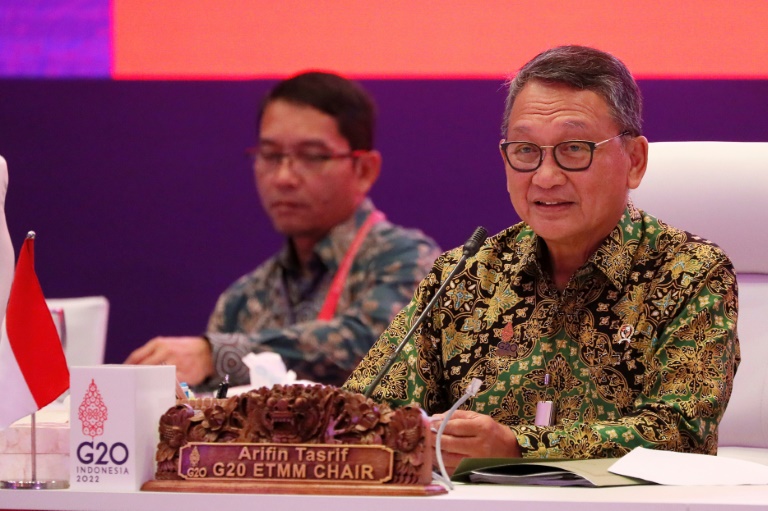
The non-binding “Bali Compact”, which lists principles for achieving net zero emissions, was agreed by all members, Indonesian energy minister Arifin Tasrif said. 

Details were not released but the minister said the plan seeks to strengthen national energy planning and implementation to improve energy security, efficiency and boost investment and financing.

“G20 energy ministers sent a strong signal to the market that policymakers are taking action to strengthen the investment-enabling environment,” Tasrif told an online press conference Friday.

But the officials failed to reach a consensus on a joint communique due to “differences among countries” at the one-day meeting, Tasrif said without elaborating.

Several nations, including Britain and France, denounced the invasion of Ukraine and said it had destabilised energy supply. 

The presence of Russia at the forum meant a consensus could not be reached for a communique, a source close to the meeting told AFP.

The “current energy crisis shows the urgency to accelerate the energy transition”, the source added.

Representatives from the United States, Saudi Arabia, Australia, Germany, India, South Africa and the European Union were also present, according to a list seen by AFP. 

The energy talks follow G20 environment discussions in Bali on Wednesday that also ended without a joint communique, reflecting divisions among member countries over how to tackle climate change.

Britain’s climate minister Alok Sharma said governments should “revisit and strengthen” their commitments to achieving net zero emissions.

“There must not be any backsliding on commitments,” he tweeted on Wednesday. 

This week’s talks are a prelude to a November leaders’ summit that Indonesian President Joko Widodo has said Russian counterpart Vladimir Putin will attend despite Moscow’s isolation.

Close Bitnami banner
Bitnami