Bloomberg

Nissan CEO Wants Grace Period for Biden Rules on EV Subsidies

(Bloomberg) — Nissan Motor Co. is pushing for more of a grace period in the implementation of the Biden administration’s plan to speed adoption of electric vehicles while mandating more US content.

The Japanese company and other carmakers have been urging the White House to adopt a more flexible approach to subsidy eligibility in the Inflation Reduction Act, which was recently passed into law. The measure provides generous incentives for selling EVs, but has stringent requirements on manufacturing and supply-chain sourcing. 

“The IRA in the short term is challenging,” Nissan Chief Executive Officer Makoto Uchida said Thursday in an interview with Bloomberg in New York. “Those regulations probably should have had some grace period.”

Beginning in January, automakers must manufacture EVs in North America and cut reliance on China for battery components and materials to qualify for the maximum $7,500 in tax credits — a tall order for slow-moving global supply chains. Its pending implementation has spurred industry lobbying efforts to shape the rulemaking.

“Directionally we are not opposed to that, but of course we cannot build a plant in one day. So how we can make sure that a kind of grace period or adoption period can be considered” should be part of the implementation discussions, Uchida said.

Mississippi-Made EVs

Nissan has sold the battery-powered Leaf model in the US for more than a decade and its new all-electric Ariya debuts this month. It aims to offer six all-electric models by 2030 — four of which will be made at its factory in Canton, Mississippi. 

The IRA will likely accelerate Nissan’s plans to produce more EVs in the US, Uchida said.

The automaker expects electrified models — both full EVs and hybrids — to make up 40% of its US sales by the end of the decade. That’s well behind markets such as Europe and Japan, which are projected to hit 90% and 55%, respectively, by 2026. In China, the world’s largest car market, Nissan sees its EV sales percentage somewhere between the rates in the US and Japan.

Uchida said Nissan remains committed to the Chinese market at a time when at least one other major global automaker is trimming its bets on the country. But he warned that disruptions from Covid-linked shutdowns is making it more difficult to operate.

“Frankly, it’s worrisome,” he said. “We have a lot of operational impact already.”

More stories like this are available on bloomberg.com

©2022 Bloomberg L.P.

Ye Will No Longer Acquire Social Site Parler, Company Says

(Bloomberg) — Ye, formerly known as Kanye West, will no longer be acquiring the social media site Parler, the company said in a statement.

“This decision was made in the interest of both parties in mid-November,” the company said in a statement. “Parler will continue to pursue future opportunities for growth and the evolution of the platform for our vibrant community.”

Earlier Thursday, Ye appeared on a show by the conspiracy theorist Alex Jones and spoke positively about Adolf Hitler. He didn’t immediately respond to a request for comment.

–With assistance from Kim Bhasin.

More stories like this are available on bloomberg.com

©2022 Bloomberg L.P.

Novogratz Says Bankman-Fried Is ‘Delusional’ Over FTX Collapse

(Bloomberg) — Galaxy Digital Chief Executive Officer Mike Novogratz characterized Sam Bankman-Fried as “delusional” when the former FTX exchange head recently sought to explain the collapse of his cryptocurrency empire. 

“It’s kind of surprising that his lawyers are letting him speak,” Novogratz said on Bloomberg Television. “Having watched two interviews, the word delusional kept coming to mind.”

FTX and more than 100 affiliated companies filed for bankruptcy in November after failing to meet redemptions from customers that had lost faith in the exchange. The reason behind a $8 billion shortfall is still unclear.

“He’s in a reality that is not real,” Novogratz said. “The reality is that Sam and his cohorts perpetuated a fraud. He stole money from people, people should go to jail.”

Galaxy Digital is among the users who have funds trapped on the shuttered exchange. The firm disclosed a $76.8 million exposure to FTX.com. 

On Wednesday, Bankman-Fried appeared via video in a long-ranging interview at the New York Times DealBook Summit.

“I didn’t ever try to commit fraud on anyone,” Bankman-Fried said at the conference.

More stories like this are available on bloomberg.com

©2022 Bloomberg L.P.

After Taking On Facebook, This Startup is Setting its Sights on the World

(Bloomberg) — A Vietnamese internet startup that’s successfully defended its home market of 100 million people against global giants like Facebook is now going into attack mode.

VNG Corp., Vietnam’s answer to Tencent Holdings Ltd. with games, messaging, videos and music among its services, is accelerating its international expansion, co-founder Le Hong Minh said in an interview at its headquarters in Ho Chi Minh City. Games will be its spearhead, and VNG also seeks to add global revenue from artificial intelligence and cloud computing products.

The tech startup’s success abroad would be a milestone for Vietnam, a Communist country better known for textiles and agriculture. As part of its growth plans, VNG has taken steps toward being included on a local exchange for unlisted firms, often a precursor for a listing on an official exchange. The company is also reportedly eyeing a US listing — something Minh wouldn’t directly confirm.

“We want to be a global technology company,” said Minh, also the company’s chief executive officer. “So we have to play in the same playground, and access the best and obviously most demanding investor base in the world.”

VNG has emerged as one of the country’s most watched startups and a US IPO would make it the first Vietnamese tech company to list in America. Its stock-market debut could follow on the heels of Vietnamese electric-car maker Vinfast, which is targeting an IPO on the US stock market as soon as January.

VNGGames, the company’s gaming arm, is key to its international expansion, Minh said. It has users in more than 130 countries and expects to have 320 million customers globally in 2023, according to the unit’s website. VNG has seven offices abroad, including in Beijing, Taipei and Bangkok.

Formerly known as Vinagame, VNG had its start as a game publisher in 2004. It develops and publishes its own titles as well as local versions of international hits, and has gradually expanded to a wide range of services, such as music sharing, video streaming, messaging, a news portal and mobile payments.

Its messaging app, Zalo, became a breakaway success, overtaking Meta Platform Inc.’s Facebook Messenger in 2020 in Vietnam. It won over users by allowing them to send higher-quality images and incorporating culturally relevant features such as emojis reflecting the Tet Lunar New Year, Minh said.

Zalo is now deeply embedded in the life of Vietnamese who use it to chat, pay bills and shop. The app had 74.7 million monthly active users in February, while Messenger had 67.8 million, according to the Ministry of Information and Communications, the most recent data available.

“We are proud about the fact that we openly competed with the best in the world,” Minh said. “We were able to build a dominant product because of our product strength and ability to understand users.”

Yet finding success abroad won’t be easy. Gaming leaders such as Tencent and Activision Blizzard Inc. have billions of dollars in development and marketing budgets and world-famous titles. US apps from Facebook and Instagram to Twitter and YouTube dominate the social media market internationally, leaving China’s TikTok as a rare major international success story from Asia.

“VNG should warrant more investor attention because of its striking resemblance to that of Tencent, with businesses in online gaming, social messaging, fintech, e-commerce,” said Alec Tseung, a partner at KT Capital Group, a Hong Kong-based research firm that focuses on Southeast Asia. Still, he said VNG lacks some of the advantages of its giant Chinese counterpart. “The domestic dominance of Tencent could largely be thanks to the regulatory environment in China that VNG doesn’t have,” he said.

A successful IPO could give VNG firepower for its effort. Valued at $2.2 billion to $2.5 billion about a year ago, according to a person familiar with the matter, it also has deep-pocketed backers such as Tencent, and Singapore state investors GIC Pte and Temasek Holdings Pte.

VNG has been exploring going public in the US since at least 2017. In July, media outlet IFR reported that the company is planning a US IPO of about $500 million by listing about 12.5% of its equity as early as the end of this year. VNG declined to comment on US IPO plans.

In Vietnam, the company took steps in November to register its shares for depository ahead of planned trading on the Unlisted Public Companies Market, or UpCoM. The move is the most significant step yet by VNG toward a stock-market listing.

Minh says he draws inspiration from Silicon Valley and looks to replicate its office campus culture. Three years ago VNG moved into its glass-walled atrium headquarters overlooking the Saigon River in an area previously known for textiles. The building features feng shui architecture with open spaces filled with plants, cafes, a koi pond, state-of-the-art gym and employees clicking away at laptops while sitting on giant beanbags.

Minh sees his company, which was founded at a time when only a fraction of Vietnam’s population accessed the internet, as a catalyst for the nation’s young tech startup culture. Vietnam last year drew record high venture capital investments at more than $1.4 billion in 165 deals, up from $451 million with 105 deals raised in 2020, according to a report by Do Ventures and the National Innovation Center.

“In the future, Vietnam won’t just be known for coffee and manufacturing,” Minh said. “We can build capabilities and people and provide services to the global technology industry.”

–With assistance from Yoolim Lee and Nguyen Kieu Giang.

More stories like this are available on bloomberg.com

©2022 Bloomberg L.P.

Activist Fund That Took on Toshiba Targets $2 Billion Japan Firm

(Bloomberg) — 3D Investment Partners Pte, the money manager that pushed for change at Toshiba Corp., is targeting another Japanese company with a proxy fight over board directors that will be decided in a shareholder vote on Sunday.

Singapore-based 3D is seeking to appoint four outside board members at Fuji Soft Inc., a Tokyo-listed software firm with a market capitalization of about $2 billion. 3D, the largest shareholder with a 21% stake, argues that Fuji Soft’s board has “presided over a long period of inefficient capital allocation and weak performance.” At particular issue is the company’s large real estate holdings.

It’s the latest test case for whether shareholders are becoming more influential in the country’s more than $5 trillion equity market. For much of the past decade, Japan has worked to overhaul how companies are run and get stock owners to press management to improve profitability and shareholder returns.

In a sign of how Japanese management teams are listening more to shareholders, Fuji Soft has endorsed two of the fund’s director nominations, although it also proposed three additional candidates of its own. The company also set up a Corporate Value Enhancement Committee in August and says its goal is to adopt advice and suggestions from stakeholders on how to improve the company’s value.

“We found a gap between the way we think and how the capital market participants view things,” Fuji Soft President Satoyasu Sakashita said in an interview. The company plans to address shareholders’ requests as needed, he said. 

3D, which declined to be interviewed for this story, rejects two of Fuji Soft’s board candidates and says that because the committee is composed of current Fuji Soft directors, it will have the same issues as the existing board and will be ineffective.

Two major proxy advisers, Institutional Shareholder Services Inc. and Glass Lewis & Co., differ in their voting recommendations for the extraordinary general meeting. ISS suggests backing three of 3D’s candidates and two of the company’s, saying 3D has presented a “compelling case that change at the board level is warranted.” Glass Lewis encourages shareholders to vote for all of Fuji Soft’s nominations, arguing the company is “earnestly considering various reforms.” It says they should reject two of 3D’s candidates.

This is 3D’s second proxy fight at Fuji Soft. The fund failed in March to have two director candidates — including its founder and chief Kanya Hasegawa — appointed to the company’s board. But at that time, it only held slightly more than 9% of Fuji Soft’s shares. Now, it owns more than double that percentage.

Fuji Soft’s shares have risen more than 170% from a recent low in March 2020, but they still trade more than 40% below their peak in 1999.

Hasegawa founded 3D in 2015 after previously working at companies including Tudor Investment Corp. and Goldman Sachs Group Inc. The value-focused investment fund is one of Toshiba’s largest shareholders and has pressed the conglomerate on its strategy after years of mishaps. 3D also recently sent a letter to beverage maker Sapporo Holdings Ltd., asking its outside directors to address “prolonged underperformance.”

Read more: Toshiba’s No. 2 Shareholder Steps Up Fight Over Breakup Plan

–With assistance from Hiroshi Miyazaki and Kurt Schussler.

More stories like this are available on bloomberg.com

©2022 Bloomberg L.P.

‘Too Much Speculation’ Is Hurting Crypto, BitGo’s Belshe Says

(Bloomberg) — There’s a lot going on in crypto following the collapse of the FTX exchange. But traders’ focus has in recent days turned to the price disparity between Bitcoin and a derivative of the largest cryptocurrency. 

Wrapped Bitcoin, or wBTC, is backed 1-to-1 by the token, which is held in custody by the digital-trust firm BitGo. The offshoot normally trades on par with the original token but had over the past few days traded at a discount to Bitcoin. 

Mike Belshe, chief executive officer of BitGo, spoke with Bloomberg News on Tuesday about wrapped Bitcoin, the state of crypto markets and more. The following is an edited version of the conversation:

Q: What’s going on with wrapped Bitcoin?

A:  It’s pretty clear there’s been a big brouhaha around nothing. Wrapped Bitcoin is a token on the Ethereum network, which is backed 1-to-1 by Bitcoin that’s owned by a DAO and then custodied by BitGo. You can go to wBTC.network. With wrapped Bitcoin, because the Ethereum token is in a smart contract, it’s verifiable on-chain right now mathematically. Additionally, the Bitcoin is also a digital token, so we can add all those up  — you can see that on wBTC.network in real time exactly how many tokens are available on the Ethereum network and exactly how many Bitcoins are held in cold storage custody. 

There hasn’t been any challenge to this proof of reserves — it’s solid. A lot of people don’t understand some of the technicals around it and we see some of that on Twitter this last week. 

Q: How frustrating has it been to deal with Twitter rumors, things swirling online?

A: One of the troubles we’ve had in the asset class is too much speculation on, frankly, some really unworthy projects — and people don’t necessarily understand the assets they’re speculating on. I’m not talking about wrapped Bitcoin, but it makes, especially crypto Twitter and some of the retail markets, susceptible to misinformation. I definitely do think we’ve had too much speculation and we could use some clean-up in the industry about that. 

(Corrects story that ran Nov. 30 to remove an inexact reference to wrapped Ether by Belshe in the final paragraph.)

More stories like this are available on bloomberg.com

©2022 Bloomberg L.P.
Apple Renames Mixed-Reality Software ‘xrOS’ in Sign Headset Is Approaching

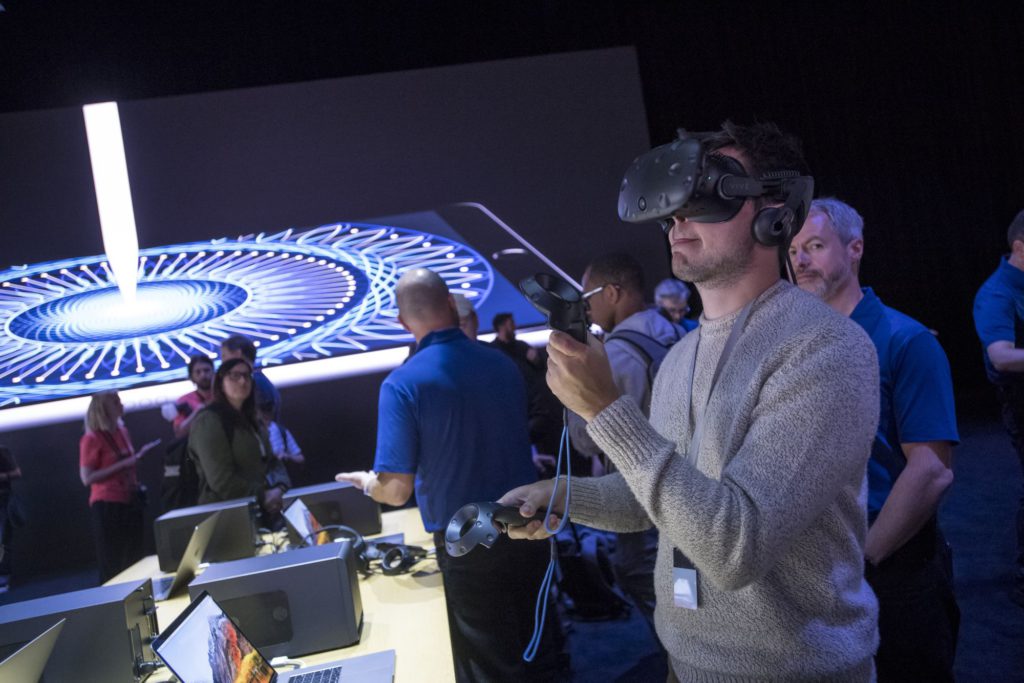
(Bloomberg) — Apple Inc. is ramping up work on a mixed-reality headset, its first major new product category since the Apple Watch, and has renamed the accompanying software in the latest sign of an approaching debut. 

The company plans to introduce the headset as early as next year, along with a dedicated operating system and app store for third-party software, according to people with knowledge of the matter. Internally, the company recently changed the name of the operating system to “xrOS” from “realityOS,” said the people, who asked not to be identified because the project is still under wraps. 

The new software name is a nod to the headset’s mixed-reality capabilities. “XR” stands for extended reality, a term that encompasses both augmented and virtual reality. Augmented reality overlays graphics and virtual information over the real world, while virtual reality is an all-encompassing experience for gaming and watching video.

Apple’s push into the market sets it up for a showdown with Meta Platforms Inc., the owner of Facebook and Instagram, which is betting on the metaverse in part to decrease its reliance on Apple devices. The move is also part of a perennial search for Apple’s “next big thing.” With the Apple Watch, released in 2015, the company turned its wearables business into a division that now generates more than 10% of its sales — contributing $41.2 billion in the last fiscal year.

A representative for Cupertino, California-based Apple declined to comment on its headset plans.

In offering both AR and VR technologies, Apple’s new headset takes a different tack than most existing models from companies like Meta and HTC Corp. But Meta does have a newer headset, the Quest Pro, that blends the two approaches.

Read more: Meta confronts Apple-sized hole in its once-mighty ad business

The mixed-reality operating system will offer new versions of core apps — like Messages and Maps — and will work with a software development kit that third parties can use to create their own apps and games, Bloomberg News has reported. The headset and its accompanying operating system and apps are developed within what the company calls its Technology Development Group, or TDG, a secretive unit led by executive Mike Rockwell. The operating system has been overseen by Geoff Stahl, a senior engineering manager and nearly 24-year Apple veteran who has led work on gaming and graphics software.

Recent job listings revealed that Apple is looking to create its own 3D-based “mixed-reality world.” People with knowledge of the company’s plans have said the device will offer virtual collaboration tools and a VR version of FaceTime, rivaling services like Zoom and Meta’s Horizon Workrooms. Apple recently enlisted the head of engineering for its iWork productivity apps, Notes app and Apple News to work on the headset.

When Apple started developing the operating system about seven years ago, the company internally dubbed it “realityOS” — or “rOS” for short. Apple recently started referring to the software as “xrOS” inside the company. The new name, unlike the more generic-sounding “reality” moniker, could help Apple lay claim to the nascent mixed-reality market.

Around the same time as the name change, a secretive shell corporation named Deep Dive LLC filed to trademark the brand “xrOS” in several countries internationally and is trying to secure the name in the US. If Apple is indeed behind the filings, that suggests it’s considering using “xrOS” as its public product name as well.

Deep Dive, which was registered by yet another shell corporation in 2017, first applied for the name in Switzerland in March. It recently expanded registrations to the UK, Israel, Malaysia, Mexico, Ukraine, Philippines, Australia, Japan, Canada and the European Union. In September, a law firm representing Deep Dive filed to oppose a March US trademark application for the xrOS name by an unrelated Chinese company. 

The shell company has made the trademark claims for classifications that include “head-mounted displays” and devices that provide “virtual reality and augmented reality experiences.” Those same classifications were used for the original trademark of the name “realityOS” last year.

Trademarking a name via a shell company in several foreign countries follows Apple’s usual strategy for establishing a brand, though the decision to start in Switzerland is somewhat out of character. Apple typically files for trademarks in countries like Jamaica, Liechtenstein or Trinidad and Tobago, which don’t easily allow the public to peruse registrations.

For instance, Apple recently trademarked the iPhone 14 Pro “Dynamic Island” name in Jamaica. But its applications for “Reality One” and “Reality Pro” — possible names for the headset itself — are also available online, as is the filing for “realityOS.” In both cases, Apple was behind the filings, according to people with knowledge of the matter.

Even so, there’s no guarantee Apple doesn’t ultimately move forward with “realityOS” or another name as its consumer-facing brand.

Apple wouldn’t be the first company to use the name “xrOS.” In an awkward coincidence, Meta had a team of about 300 engineers developing a mixed-reality operating system by the same name. But that company doesn’t appear to be behind the latest trademark filings.

Apple Chief Executive Officer Tim Cook has touted his interest in augmented reality for the last several years, and the company has built a related platform called ARKit, allowing iPhones and iPads to run AR apps.

Its first device in the space is expected to be far pricier than existing mainstream competitors and include ultra-high-resolution screens for VR and several external cameras to handle the AR elements. It will also have hand tracking capabilities and run a processor based on the M2 chip — the component featured in the company’s latest Macs.

In a sign of development progress, Apple previewed the device to its board of directors earlier this year. 

More stories like this are available on bloomberg.com

©2022 Bloomberg L.P.
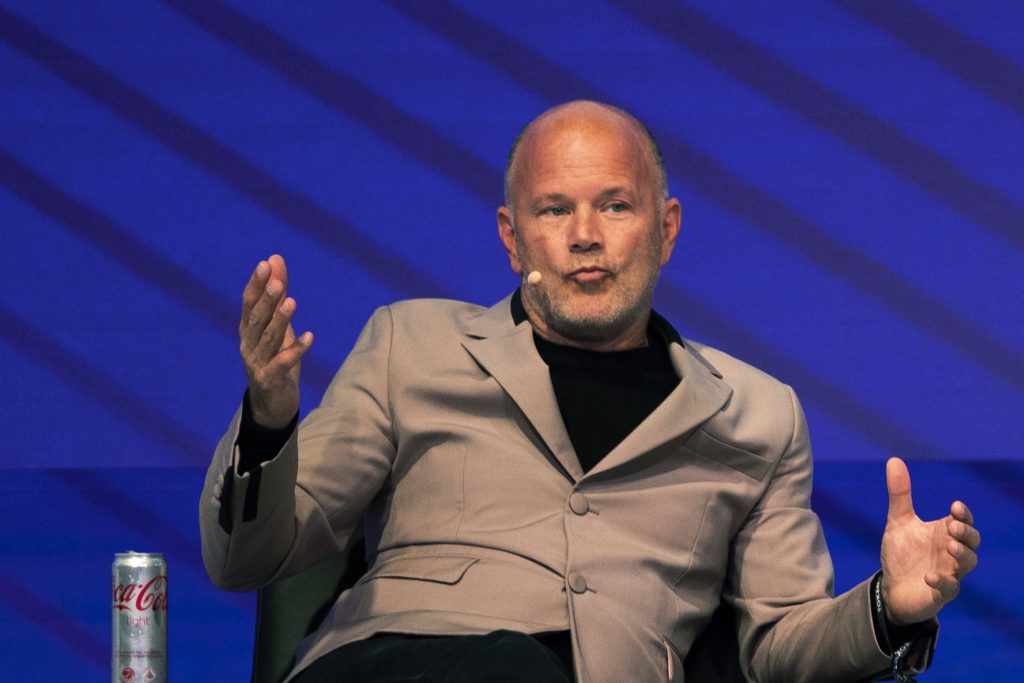
Novogratz Drops Forecast for Bitcoin to Hit $500,000 In 5 Years

(Bloomberg) — Crypto advocate Mike Novogratz dropped his forecast for Bitcoin to climb to $500,000 in five years, citing the Federal Reserve’s interest rate increases. 

It will, but “not in five years,” Novogratz said Thursday during an interview on Bloomberg Television. The biggest change that happened is that Fed Chair Jerome Powell found “his central banking superpowers.”

Like most risk assets, Bitcoin has slumped this year because the Fed is raising rates to contain inflation, Novogratz, the chief executive of Galaxy Digital, said. 

Bitcoin has tumbled more than 60% this year, dropping to around $17,000. Fallout from the bankruptcy of the FTX exchange last month helped accelerate losses across the cryptocurrency market.    

The demise of FTX, along with the collapse of hedge fund Three Arrows Capital and lenders Celsius Network and BlockFi are “certainly hurting the overall confidence in crypto, but that too shall pass,” he said.

Galaxy Digital is looking at potentially acquiring distressed and cheap crypto assets via “some small acquisitions,” Novogratz said. Galaxy has also reduced its balances on crypto exchanges as a precaution and began looking closely at exchanges’ reserves, he said, after having some of its assets trapped on the FTX exchange.   

–With assistance from Romaine Bostick and Scarlet Fu.

More stories like this are available on bloomberg.com

©2022 Bloomberg L.P.
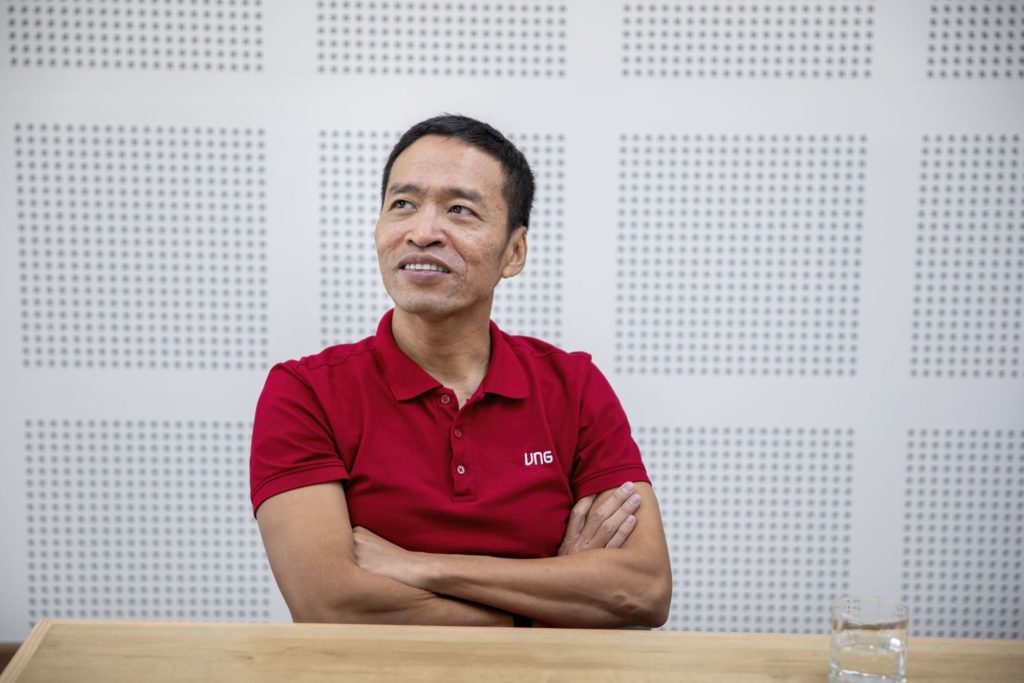
New York Online Hate Speech Law Challenged by Thiel-Backed Rumble

(Bloomberg) — A New York law prohibiting hate speech on social media was challenged by the Volokh Conspiracy legal blog and the Peter Thiel-backed video site Rumble Inc., which claimed the measure will hurt online services and seek to silence unfavorable but constitutionally protected expression.

In a federal lawsuit filed Thursday against New York Attorney General Letitia James, the plaintiffs sought to stop the new state law from taking effect as scheduled on Saturday. They claim New York “cannot regulate disfavored online speech by compelling online service to ‘mouth support for views they find objectionable’ in hopes of deterring or eliminating hate speech.”

The law requires social-media networks to “provide and maintain a clear and easily accessible mechanism for individual users to report incidents of hateful conduct” and a “direct response to any individual reporting hateful conduct informing them of how the matter is being handled.”

The Volokh Conspiracy is run by University of California, Los Angeles, Law School Professor Eugene Volokh. Rumble is seen as a right-wing alternative to YouTube and claims to “create technologies that are immune to cancel culture.”

The New York Attorney General’s Office didn’t immediately respond to a request for comment.

The new law “hangs like the Sword of Damocles over a broad swath of online services,” Volokh and Rumble claimed in their lawsuit. “There can be no reasonable doubt New York will enforce the Online Hate Speech Law to strong-arm online services into censoring protected speech.”

According to the suit, the new law could unfairly deem some comedy routines as hate speech. In one example, they said This Week Tonight host John Oliver doing a segment mocking the British monarchy could be construed as humiliating English people based on their national origin. The law also might prohibit a video of Malcolm X discussing white guilt because it could be viewed as “vilifying or humiliating White people based on their race,” they said.

“New York cannot justify such a sweeping regulation of protected speech,” Volokh and Rumble said in the suit. “The Online Hate Speech Law violates the First Amendment because it burdens the publication of speech based on its viewpoint, unconstitutionally compels speech, and is overbroad.”

The case is Volokh v James, 22-cv-10195, US District Court, Southern District of New York.

More stories like this are available on bloomberg.com

©2022 Bloomberg L.P.
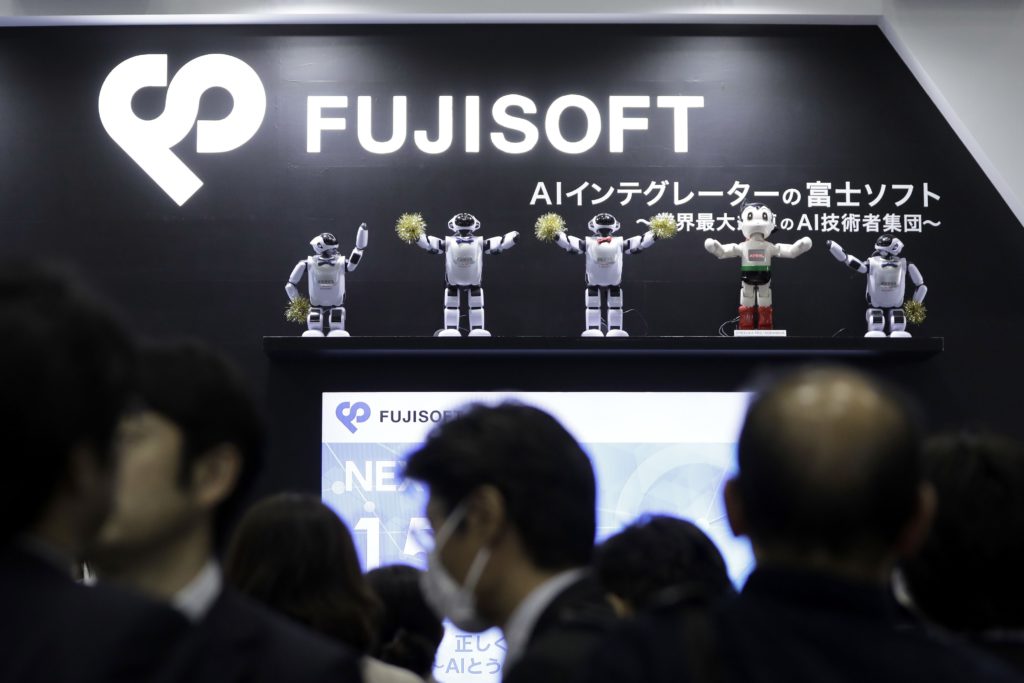
Salesforce Orders Some Workers Back to Offices as Growth Slows

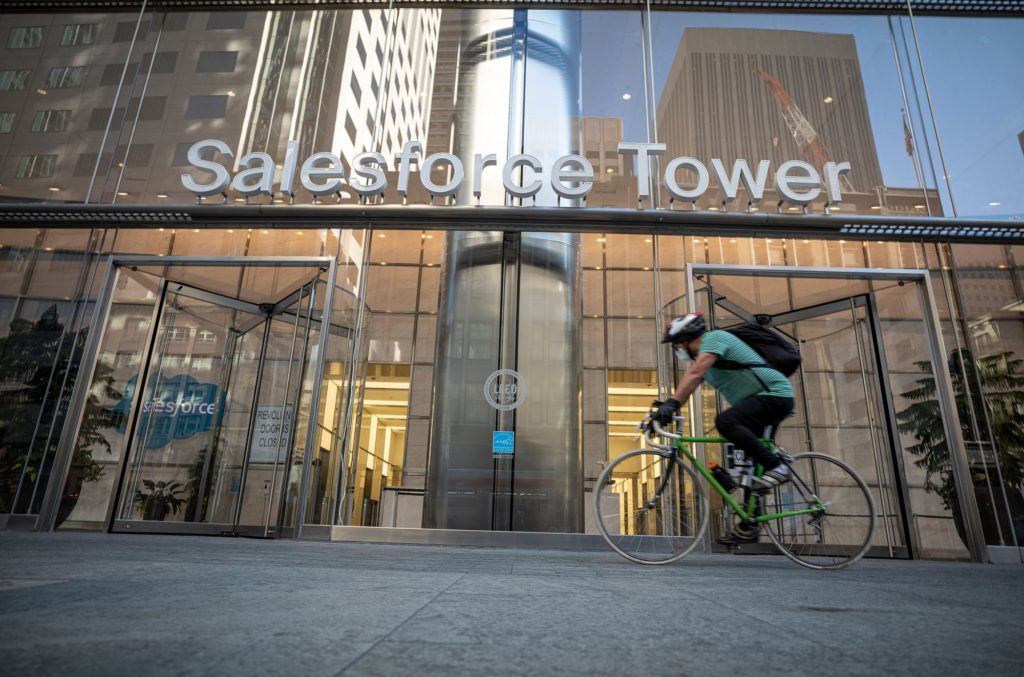
(Bloomberg) — Salesforce Inc., one of the first tech companies to let employees work from anywhere, is requiring some sales workers to return to the office and abide by other productivity rules as the software maker grapples with slowing revenue growth.

Some sales employees who live near offices were asked to work at company locations Tuesday through Thursday beginning this week, according to an internal memo issued last week and seen by Bloomberg. The message was posted by a senior manager in a Slack channel for hundreds of sales workers. 

Each account executive will be expected to conduct eight customer meetings a week — half in-person — deliver twice-weekly internal presentations. The rules are intended to “drive more collaboration and success” in the current quarter, the manager wrote.

Co-founder Marc Benioff, long a proponent of remote work, appeared to soften his tone on office mandates during a conference call with analysts Wednesday after the company released its quarterly results. “Even at Salesforce we have what I would call factory jobs — folks that are required to be here,” Benioff said, citing core operational roles or entry-level workers who need mentorship. “But we’re never going back to how it was.”

A company spokesperson said Salesforce has a “hybrid work environment that empowers leaders and teams to work together with purpose. They can decide when and where they come together to collaborate, innovate and drive customer success.”

Salesforce, the top provider of customer management software, has been struggling with slowing growth and investor pressure to improve profit. On Wednesday, the company reported its smallest year-over-year quarterly revenue increase since becoming a public company in 2004 and projected the sales gain would be even less in the current quarter ending in January 2023.

Compounding the difficulties for the San Francisco-based company, Salesforce made a surprise announcement Wednesday that co-Chief Executive Officer Bret Taylor would leave at the end of January after just one year sharing CEO duties with Benioff.

Shares declined 9.6% to $144.93 at 1:47 p.m. Thursday in New York, after falling as much as 11%, the worst intraday drop in a year. The stock had plunged 37% through Wednesday’s close. 

Insider earlier reported that some Salesforce employees would be asked to regularly return to the office.

Salesforce in February 2021 put in place a “work from anywhere” policy in which some employees would return to offices one to three days a week and others could remain fully remote. While that policy changed a bit over time, the company in November 2021 formally said it was encouraging employees to return to offices more often, but left the specific details to workplace teams.

And at a company event in New York in June, Benioff said, “Office mandates are never going to work.”

More stories like this are available on bloomberg.com

©2022 Bloomberg L.P.
Close Bitnami banner
Bitnami