Bloomberg

Ether and Altcoins Lead Crypto Rout as Terra DeFi Fallout Deepens

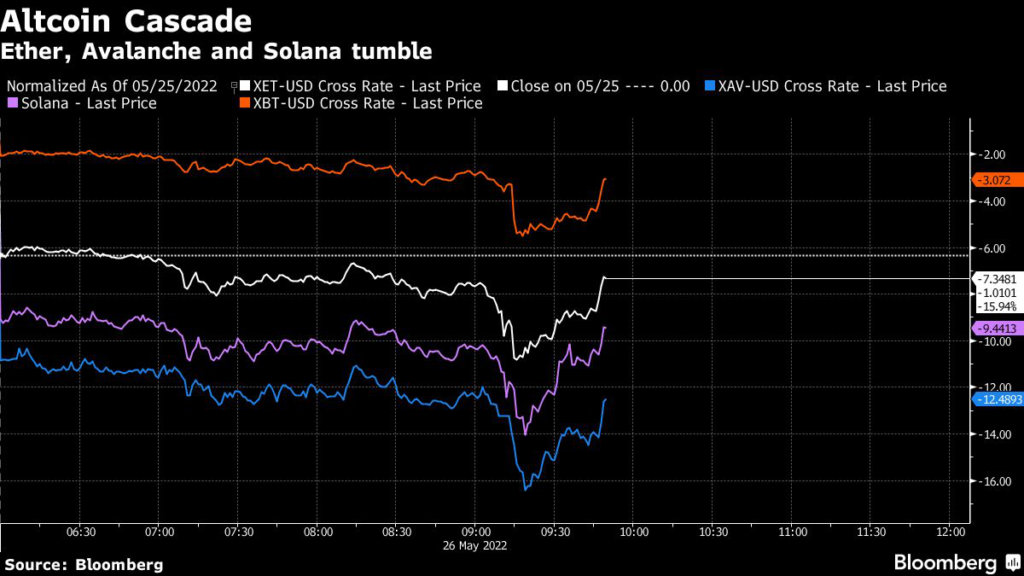
(Bloomberg) — It’s an all-round sea of red for nearly everything in crypto, with altcoins such as Ether, Solana and Avalanche taking a beating. Traders are partially stumped, but for Ethereum, the signs of a lack of demand have been building for quite some time.

The impact of the collapse of Terra, a blockchain ecosystem that supported one of the biggest experiments in decentralized finance, knocked an already bearish market into wild contagion this month. While Terra’s operators had passed a revival plan to start afresh on a totally new blockchain on Wednesday, investors in the rest of DeFi were less than convinced. A glitch in the process to make the Ethereum network less energy intensive added to the concern. 

“Bearish sentiment remains the theme for cryptos,” said Edward Moya, senior market analyst at Oanda. He noted that Ethereum’s growing list of competitors could make the fallout from unexpected hitches to its update, known as the Merge, particularly intense. 

Ether fell as much as 5.3% on Friday in Asia to around $1,729, taking this year’s losses to 53%. It’s far below the key threshold of $2,000 which it needs to trade above meaningfully — and soon — if bearish sentiment is to ease. Other tokens linked to protocols popular with decentralized finance projects like Avalanche, Solana and Polkadot were also slumping, down between 5% and 8% on Friday.    

Bitcoin acted as somewhat of a haven, sliding around 1.8% after dropping to as low as $28,007. Still, the largest cryptocurrency decoupled Thursday from US equities after recently mirroring price changes in risk assets in recent weeks. Stocks continued to rebound from the lowest levels in over year. 

Demand for blockspace on the Ethereum network has reduced significantly in the wake of Terra’s collapse, which means that consequently, the network’s so-called gas fees are falling. With the exception of a few spikes during high-profile minting events like Yuga Labs’ Otherside land sale, Glassnode data show gas prices have been trending downward since December and recently reached multiyear lows. 

Read More: Terra Collapse Triggers $83 Billion Decentralized Finance Slump

“Even though it was just a single anecdotal day’s data, Solana’s NFT volume surpassing Ethereum is a significant blow to investor confidence that it will remain the go-to base layer protocol of the decentralized web,” added Mati Greenspan, founder of crypto research firm Quantum Economics. “That said, the entire crypto market is down right now so we should be weary about making any long term conclusions from short term data.”

Coupled with poor price performance, that’s likely to exacerbate headwinds for the token in the short term. DeFi developers are dusting themselves off after Terra’s collapse halved the sector’s total value, and dampened markets aren’t going to help in convincing them that now’s the time to get back in the game. 

The Ethereum beacon chain, which plays a crucial part in the network’s highly anticipated technical upgrade, experienced a potential security risk called the reorganization on Wednesday.

“Part of the ETH drop is due to the reorg issue which might mean a delay in expected Merge timing,” said Noelle Acheson, head of market insights at Genesis Global Trading. When mixed with the context of the global macro environment, Pantera’s Semir Gabeljic said the resultant jitters meant “bad business”.

Investors who once were hot on crypto have also cooled on its prospects, as the Federal Reserve’s rate-hiking regime spurs volatility in the market and dulls previously-hot growth and speculative assets. Guggenheim Partners Chief Investment Officer Scott Minerd said this week he expects Bitcoin to fall to $8,000. He had once predicted that it could reach $400,000. 


(Updates Ether’s price drop in fourth paragraph.)

More stories like this are available on bloomberg.com

©2022 Bloomberg L.P.

UK Flexes Its New National Security Powers to Intervene on Deals

(Bloomberg) — The UK has new powers to intervene on foreign investment deals, and it’s not afraid to use them. 

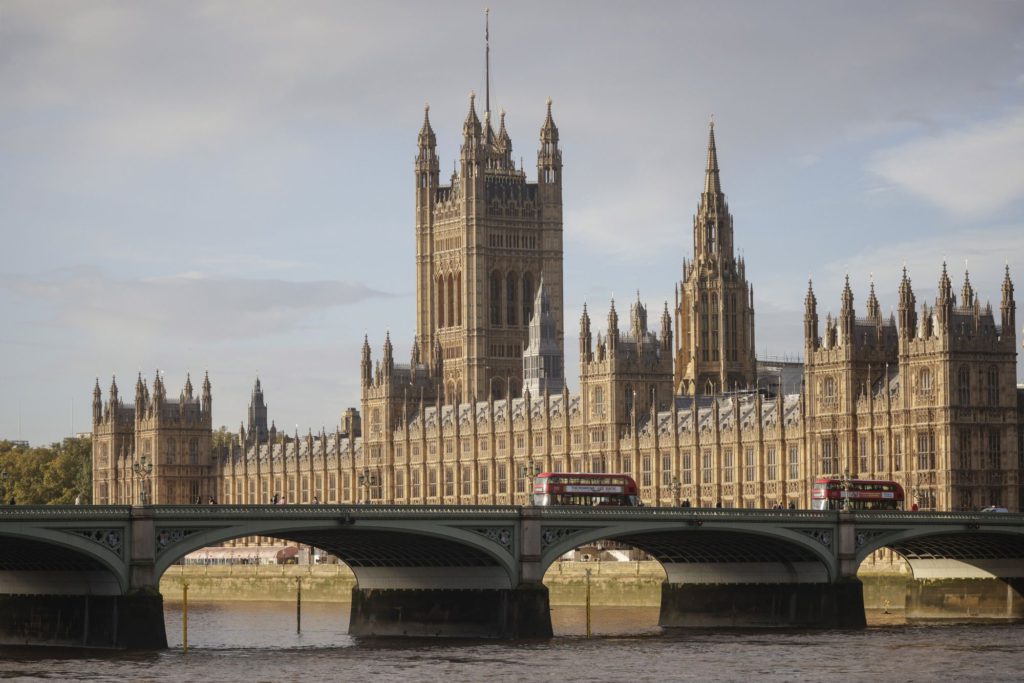
The government announced the first probes into deals under a new national security law this week — scrutinizing both a Chinese-led takeover of a British semiconductor plant and a French telecom tycoon’s increased stake in BT Group Plc. The powers enable the UK to block, impose conditions and even pull-apart deals retrospectively where there’s a legitimate national security concern. The UK is scrutinizing other deals it’s concerned about, which will be announced in the coming weeks.

While government intervention into foreign investment, particularly Chinese, isn’t necessarily novel the new powers give ministers more flexibility about what it can get involved in. Officials will need to find the right balance of protecting the national interest while not scaring off potentially lucrative foreign investment. 

“It’s a step change away from where we were several years ago, there’s no question about that,” said John Adebiyi, a partner at Skadden, Arps, Slate, Meagher and Flom. The fact that deals can be looked at and unwound retroactively “for a lot of market participants that will be very unsettling.”

Governments globally are strengthening their foreign direct investment regimes to scrutinize investments on national security grounds. Western countries, including the US’s CFIUS, are paying particular attention to emerging technologies. The new UK regime highlights 17 sectors including artificial intelligence, synthetic biology, and data infrastructure.

These first deals will act as a test case, said Roger Barker director of policy at the Institute of Directors, a business lobby group. If the process is speedy and the outcome is justified, rather than being bogged-down in politics, people will say the system is working as it should, he said. Officials have 30 working days to carry out an assessment, under the law — though they can extend that by another 45 days if deemed necessary. 

Previously Prime Minister Boris Johnson has shown his government isn’t afraid to weigh in on projects or investment that may cause harm to the UK. He blocked China’s Huawei Technologies Co. from taking part in Britain’s 5G wireless rollout and weighed blocking a takeover of Arm Ltd. by Nvidia Corp. on national security concerns. Ministers are also trying to find a way to remove China General Nuclear Power Corp. as an investor in a nuclear project in south-east England.

It comes at a time when the government is increasingly intervening in business. On Thursday, it announced a one-off tax on the profits of oil and gas companies after opposition from MPs who prefer the Conservatives to be seen as a business-friendly, low tax party.

“There’s a lot of people in the Conservative Party who don’t want to be interventionists,” said Barker. “But expectations of society have changed since the pandemic, so when there’s another crisis like the energy crisis people expect a similar sort of rescue package — it’s quite difficult to get away from that.”

More stories like this are available on bloomberg.com

©2022 Bloomberg L.P.

Russians Throng Seychelles Even as Archipelago Pans Putin’s War

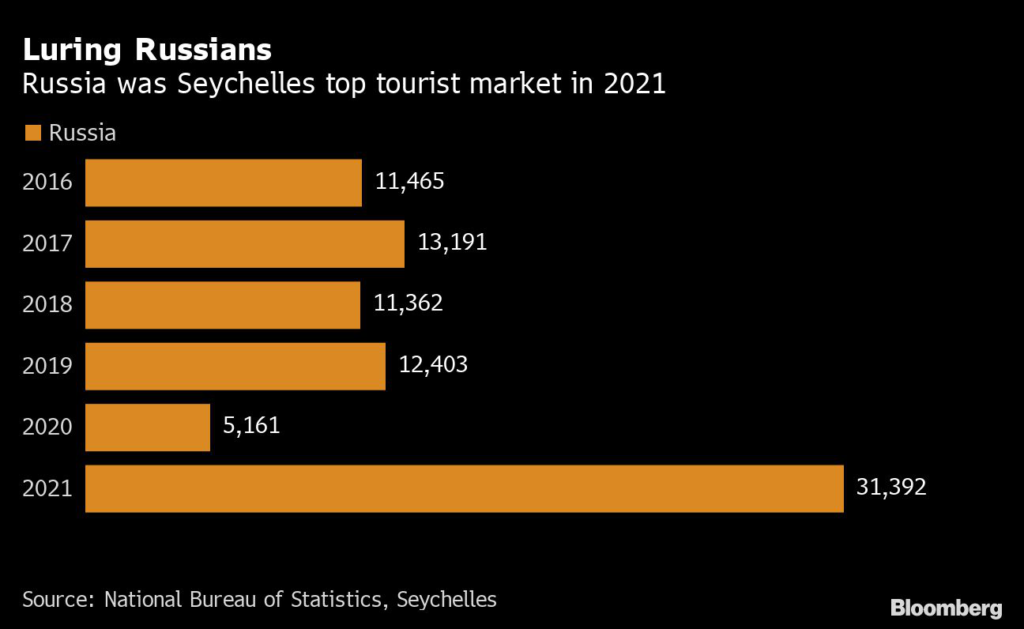
(Bloomberg) — Russian visitors to beach resorts in Seychelles have jumped three-fold in the first four months of the year undeterred by the island nation’s opposition to President Vladimir Putin’s invasion of Ukraine.

Seychelles voted in favor of United Nations resolutions to condemn the invasion of Ukraine and suspend Russia from the UN Human Rights Council, even as dozens of other African Union member nations objected or abstained. While Seychelles denounces the war, it “welcomes Russians with open arms,” the archipelago’s President Wavel Ramkalawan said in an interview from Victoria, the nation’s capital, on Thursday. 

“Seychelles is not at war with Russia. At least, we are not at war with the Russian people,” Ramkalawan said. “Seychelles is a tourist destination. Anybody is free to come in.” 

That’s good news for wealthy Russian tourists reeling from airspace closures and sanctions imposed by the US, the UK and European nations. Russia became Seychelles’ top tourist market last year prompting Aeroflot PJSC to return after 17 years. The African nation — home to white sandy beaches and palm-fringed islands — became the world’s most vaccinated country last year, which is helping it bounce back from the pandemic-induced slump. 

Seychelles lured more than 13,000 Russian tourists so far this year and with Aeroflot resuming flights, that number could jump, Ramkalawan said. Aeroflot didn’t immediately respond to an email seeking comment. 

A big obstacle for Russians traveling abroad is airspace closures and the inability of many carriers to fly over Russia and Ukraine. Some die-hard tourists are using Dubai and other Gulf hubs to transit.

Last year, tourism accounted for half of Seychelles foreign currency revenue, while arrivals climbed 59%. Borders reopened in the last week of March, and it anticipates attracting slightly more than 300,000 visitors this year with many of its five-star hotels already booked out.

“The vaccination program, the reopening of the country are the two main elements that saved the country,” Ramkalawan said. “We were prepared for Covid. We had extra hospitals open. And this what has put us on a good footing.”

Other highlights from the interview:

  • Seychelles budget deficit narrowed to less than 7% last year, from an initial prediction of 14% to 15%, and is expected to narrow further to under 5% this year.
  • “If there was not the Russia-Ukraine war, we would have balanced things out.”
  • Seychelles has no intention of making adopting any cryptocurrency as legal tenure as the Central African Republic has done. “We are very happy with our rupee.”
  • Ramkalawan, who is in the first 18 months of his first five-year term, intends seeking re-election. “We will see what they say. If they say enough is enough, I will leave quietly and there will be a smooth transition.

More stories like this are available on bloomberg.com

©2022 Bloomberg L.P.

Elon Musk Poll Asks Whether Billionaires or Politicians Are Less Trustworthy

(Bloomberg) — Elon Musk asked his more than 95 million Twitter followers whether they trusted billionaires or politicians less, in his latest poll on the social media site. By a wide margin, his social media respondents so far say they back the rich more than the elected.

With roughly 20 hours remaining, more than 75% of respondents voted politicians as less trustworthy than billionaires from well over 1 million votes as of 11:15pm Eastern time. Musk, the world’s richest person, said that the use of the word billionaire as a pejorative was “morally wrong & dumb” if a person was a billionaire for building products that make millions of people happy.

He later dared Representative Alexandria Ocasio-Cortez, the New York Democrat who has sparred with Musk on Twitter, to run the same poll with her own followers.

Last month, Musk made a $44 billion offer to buy Twitter. Weeks before the offer, Musk asked users in a Twitter poll if they wanted an edit button. In 2021, he polled Twitter users on whether he should sell a 10% stake in Tesla, which a majority supported. 

(Updates with latest polling figures in second paragraph.)

More stories like this are available on bloomberg.com

©2022 Bloomberg L.P.

Apple Supplier Faces Worker Revolt in Locked Down China Factory

(Bloomberg) — Violent clashes, mounting infections and vacant factory floors: the turmoil that’s engulfed tens of thousands of workers at an Apple Inc. supplier in Shanghai is a troubling symptom of China’s extreme efforts to keep factories humming during its worst Covid outbreak since 2020.

Trapped in a bubble for almost two months, locked down by government decree and walled off from the outside world, Quanta Computer Inc.’s mostly low-wage workers are demanding more freedom and beginning to revolt against their overseers, people familiar with the matter said, asking not to be identified for fear of reprisals.

Hundreds of workers have clashed with guards. A large contingent, worried that their supplies would run out should the lockdown persist, flooded past guarded isolation barriers earlier this month in search of daily necessities, according to several employees. Over the past weekend, media reports went viral of a large group storming a dormitory housing Quanta’s Taiwanese managers after a dispute over the prolonged lockdown and pay — triggering an hours-long standoff confirmed by several workers within the compound.

The incidents underscore how sentiment is souring on a lockdown that’s up-ended the lives of 25 million Shanghainese since March. 

“People are getting frustrated and tired of these controls,” one of the workers said. “That’s inevitable, especially when there is no timeline on when all this will end.” 

Quanta and Apple representatives declined to comment for this story. In April, Quanta said in a filing to the Taiwan exchange that it was halting production at its Shanghai site and adopting measures in compliance with the local government’s regulations to protect its staff.

The upheaval at one of the most prominent manufacturers operating out of the affluent eastern Chinese region adds to the growing tumult across society and industry over virus curbs. The speed with which the situation escalated in Shanghai — home to marquee names from Tesla Inc. to General Motors Co. — is a stark warning to policy makers trying to stamp out infections through unprecedented quarantine measures. Worker unrest risks disrupting a vast manufacturing sector at a time China’s struggling to meet its official 5.5% growth target.

It’s not just laborers. In past months, college students in Beijing have rebelled; housing compounds have staged protests; and social media users posting critical videos have tried to outwit an army of censors.

Yet the chaos at Quanta exposes a more consequential breakdown in Beijing’s Covid Zero strategy: China’s mandarins have insisted that the world’s No. 2 economy can keep going amid lockdowns, through measures like those now in force at the MacBook maker. The reality is far more complicated.

Why China Is Sticking With Its Covid Zero Strategy: QuickTake

It’s unclear how widespread factory unrest is at the moment, but economists say Quanta is unlikely to be an isolated incident. Employees at the Shanghai factory who talked with Bloomberg News by phone asked for anonymity because they had not been authorized to speak publicly and feared retribution.

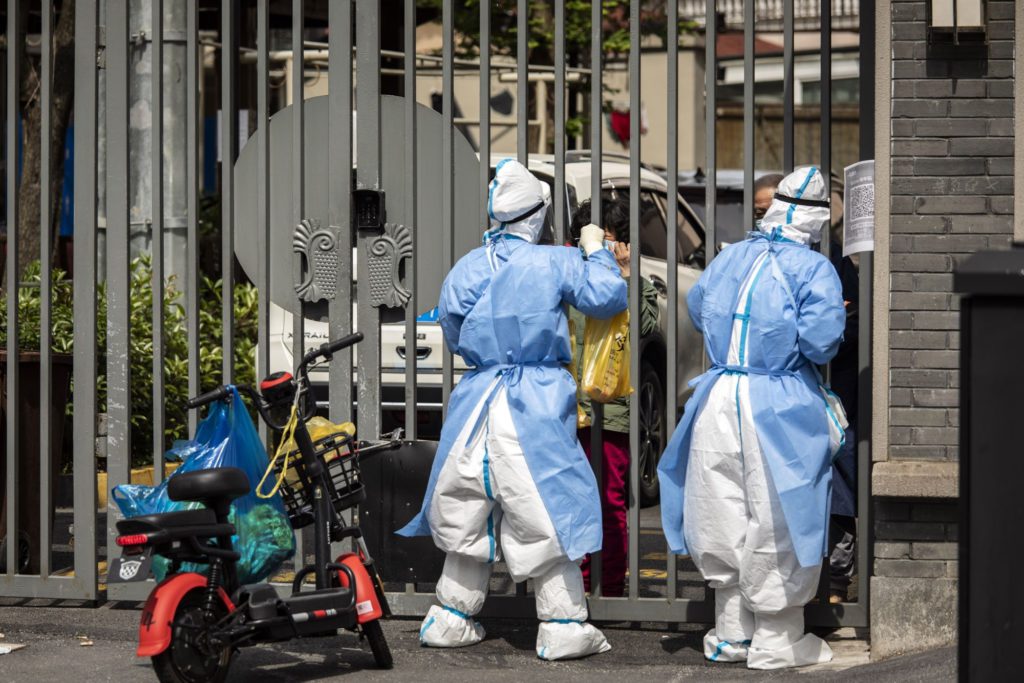
Most factories in and around Shanghai have gone into “closed loops” since late March, a mechanism hailed by China’s government as the most effective way to contain the spread of Covid while keeping the engines of the economy running. The system forces workers to live and sleep on factory sites — or in nearby accommodations. Now, Quanta’s experience may contain lessons for the other manufacturers operating in similar bubbles, that collectively make much of the world’s smartphones, laptops and computers.

The fallout is real and growing. China’s biggest chipmaker and a major iPhone supplier cut their outlooks for the second quarter. Apple — Quanta’s biggest customer — estimates Covid restrictions in China and other supply constraints will cost the company as much as $8 billion of sales. Even Tencent Holdings Ltd.’s billionaire co-founder Pony Ma shared a viral opinion piece on the economic costs of China’s strict Covid Zero measures.

“I don’t think closed loops are sustainable in the medium term as workers will eventually not be able to continue working in this way,” said Alicia Garcia Herrero, chief economist for Asia Pacific at Natixis SA. The closed loop system can only be a transitory solution even if the model succeeds in driving the economy, because the social burdens are mounting. “A healthy economy and society is much more than that.”

Read more: Fear of Punishment Keeps Large Parts of Shanghai in Lockdown

Quanta’s vast campus in the Shanghai suburb of Songjiang serves as both workplace and temporary home for unskilled migrant workers from across the country — as well as higher-paid engineers from Taiwan. Before the Covid outbreak, blue-collar workers would take shifts to make Apple’s MacBook and other laptops in a factory nearby. A standard dorm room houses 12 workers stacked in bunk beds, according to people who have stayed in the compound.

In the early days of the mandatory lockdown in April, Quanta had to shut most of its factory and seal workers in their dormitories. Production resumed at reduced capacity once management put in place a closed loop. The company continued to pay workers their basic salary of around 3,000 yuan ($450) that month, said a worker. That’s a fraction of the average wage in China’s richest city. Many felt failure to comply was tantamount to breaking the law. “Not complying with Covid measures is a violation of the law. You’d get caught for that,” one of the workers said.

But viruses don’t obey human laws. Covid snuck inside the compound just ahead of the lockdown, and crowded living conditions ignited a local outbreak, according to accounts by several employees. 

Managers moved swiftly, commissioning buses — sometimes dozens at a time — to ferry positive workers to makeshift hospitals. But as daily infections in the city soared, some were asked to stay with their uninfected roommates until more transport could be arranged, said two workers. Quanta recalled employees that worked at their own residences, putting them into closed loops and subjecting them to daily, repeated testing. 

As cases piled up, it began taking longer for test results to come back, stirring up frustration.

“Most of the workers in the factory are those recovered from Covid,” said one of the workers. “The company doesn’t want negative workers to resume work.”

Read more: Beijing Sees Most Cases of Outbreak, Fueling Lockdown Angst

Some of the consequences of the lockdown weren’t easily identifiable. Weeks in confined spaces took a toll on mental health as well, several workers said. Packed into their crowded dorms with little to do except await test results, employees smoked, played video games, complained about their confinement while exchanging stories about colleagues cracking under pressure.

China’s financial hub has been slowly easing restrictions as its outbreak ebbs, with hardly any infections found outside of quarantined areas. Most residents are now allowed on limited trips outside their compounds. But the closed loops that Quanta and others have been operating in appear to be here to stay, and officials have signaled that they want the system expanded to other parts of the economy. Last week, the city said more than 800 financial firms can resume on-site operations so long as closed loops are used, while other officials repeatedly stress the efficacy of the model in containing Covid so far. 

Tesla is still isolating thousands of its workers in disused factories and an old military camp to ensure they’re Covid-19 free. A representative for the company in China has said no further updates could be shared as yet regarding the factory’s status.

Meanwhile, the lockdowns continue to ripple through the global economy, with nearly 200 listed companies across the globe citing China’s measures as a drag on earnings this past quarter. Shortages of components for production and supply chain disruption are likely to persist through the year, executives in industries from semiconductors to electronics have said.

Closed-loops aren’t practically sustainable said Bruce Pang, head of macro and strategy research at China Renaissance Securities Hong Kong Ltd. They incur greater costs and not every company has the ability to provide food and accommodation for workers over a long period of time, he said. 

The system also doesn’t help solve logistics issues, such as deliveries of raw materials and finished products, which is one of the biggest problems businesses in locked down cities are facing.

“China’s policy makers are still facing the trilemma of shoring up growth, achieving the maximum Covid prevention and normalizing social and economic life,” he said. 

At Quanta, many workers say they have grown resigned to enforced quarantine in their adopted city. Shanghai has allowed people to leave, but trains are scarce after a spate of routes were canceled.

That means they could be confined to their campus for the foreseeable future.

“There’s also local lockdown policies on the other end that they’re expected to obey,” said one worker. “They just can’t go back home easily.” 

More stories like this are available on bloomberg.com

©2022 Bloomberg L.P.

Baidu’s Shares Soar After Surprise Revenue Gain From AI Push

(Bloomberg) — Baidu Inc. shares jumped more than 12% on Friday after the Chinese internet search leader posted a surprise quarterly revenue gain, reassuring investors spooked by the impact of Covid lockdowns.

Sales nudged 1% higher in the January-March quarter, as efforts to expand in areas such as cloud computing and autonomous driving offset weak ad sales hurt by Covid outbreaks and lockdowns. Baidu’s Netflix-style streaming affiliate iQiyi Inc. also posted its first quarterly net income since its 2018 listing, after carrying out aggressive cost control measures.

Baidu is trying to pivot from its core online marketing business to reinvent itself as a supplier of deep tech, by expanding into self-driving systems, cloud computing and chips. The country’s weakening economy, coupled with Covid lockdowns in cities like Shanghai and Beijing, has hammered advertising spending and other consumer activity. That’s given new urgency to Baidu’s push to monetize its artificial intelligence tech.

Online marketing revenue shrank 4% during the March quarter while AI cloud businesses expanded 45%. 

Baidu is preparing to launch a fully driverless ride-hailing platform in China in 2023, after nabbing a first-of-its-kind testing license from regulators in April. The company has said it plans to expand the robotaxi service into 100 cities across the country by 2030. It’s also looking to raise about $300 million in a new financing round for its AI chip spinoff Kunlun, Bloomberg News reported, to tap more external clients.

For now, Baidu is counting on its flagship search-feed app and streaming affiliate iQiyi to retain users and advertisers. 

While Beijing’s attempts to open up the country’s internet ecosystem and deflate its most powerful tech giants may benefit Baidu, it’s fighting an uphill battle against more addictive social media offerings from Tencent Holdings Ltd. and ByteDance Ltd.

Baidu logged sales of 28.4 billion yuan ($4.2 billion) for the three months ended March, compared with the 27.9 billion yuan forecast by analysts. Net loss was 885 million yuan, partly due to a 3 billion yuan one-time loss from long-term investments, versus an estimated profit of 142 million yuan.

The company has stopped giving revenue guidance since the October-December quarter, citing common practice among other US-listed companies on the Hong Kong Exchange.

More stories like this are available on bloomberg.com

©2022 Bloomberg L.P.
Alibaba Surges After Revenue Beat Eases Fears of Covid Fallout

(Bloomberg) — Alibaba Group Holding Ltd. soared after reporting revenue rose a better-than-expected 9%, reassuring investors trying to come to grips with the economic cost of sweeping lockdowns intended to eradicate Covid-19.

The shares rose more than 12% in Hong Kong after the company reported revenue climbed to 204.05 billion yuan ($30.3 billion) in the March quarter, beating analysts’ projections. On Thursday, Chief Executive Officer Daniel Zhang emphasized his company would pursue higher-quality expansion, keep a lid on costs and keep expanding its ability to build cloud and digital infrastructure for customers. SoftBank Group Corp., Alibaba’s biggest shareholder, gained 4.5% in Tokyo.

But China’s e-commerce leader also refrained from offering its usual revenue forecast for the year, underscoring the unpredictable impact of a Covid Zero policy that’s already cast the country’s supply chains into disarray and hammered consumer sentiment.

Alibaba — a barometer for Chinese consumer sentiment because of its dominance of Asia’s largest retail arena — is grappling with intensifying competition and mounting economic uncertainty at home. This week, Chinese Premier Li Keqiang warned of dire consequences if officials didn’t move decisively to safeguard the economy.

Alibaba will play its part in helping shore up the economy, Zhang told analysts on a post-earnings conference call. The company’s own revenues had slid by a single-digit percentage in April, though logistics were improving in areas such as hard-hit Shanghai as Covid cases came down. 

“In the new fiscal year, we will focus even more on cost control and continue to improve our operating efficiency,” he said.

Click here for a live blog on the results.

What Bloomberg Intelligence Says

Alibaba’s stronger-than-expected fiscal-4Q commerce-revenue gain raises the likelihood of a speedy recovery of the internet giant’s retail and consumer units by the September quarter, assuming disruptions from Covid-19 on mainland China fade. April commerce revenue probably dropped by more than 7% from a year earlier as China gross merchandise volume declined 10% amid virus-led lockdowns. The company can stanch its slide if virus cases drop and cause restrictions to be lifted, spurring a rise in buying sentiment by fiscal 2Q. 

– Catherine Lim, analyst

Click here for the research.

Once the most valuable company in China, Alibaba has seen its market value erode since Beijing launched its sweeping crackdown on the private sector more than a year ago. The government forced Alibaba’s finance affiliate, Ant Group Co., to call off what would have been the world’s largest initial public offering in 2020, and then launched reforms that have undercut Alibaba’s business model.

Chinese antitrust watchdogs have since chilled Alibaba’s expansion plans and helped JD.com Inc. overtake it on sales growth, while up-and-coming competitors from ByteDance Ltd. to Pinduoduo Inc. are drawing users from the traditional online-shopping leaders. 

Beijing this year pledged to support the internet sector, designating the digital economy an important growth driver. Last week, rival Tencent Holdings Ltd. said it will take time for regulators to take action.

China’s two largest internet firms are responding in 2022 to a new era of sharply lower growth brought on by relentless Beijing scrutiny. Alibaba said in February it’ll focus on retaining users rather than pursuing the aggressive market-share grab of years past. That marked a major shift for a company that once fought rivals in arenas from media to the cloud and retailing, and follows more than a year of curbs on every facet of China’s internet sector.

Alibaba’s net loss widened in the March quarter to about 16.2 billion yuan, after the value of its investments fell. Its annual active users in China surpassed the 1 billion mark.

More recently, China’s commitment to Covid Zero has hit the world’s second-largest economy, with production and logistics suffering from stringent anti-virus measures. Companies are quarantining thousands of workers and having them sleep on factory floors, with operations being disrupted by repeated mass testings and movement restrictions. In a rare show of frustration, Tencent’s billionaire co-founder Pony Ma shared a viral opinion piece on the economic costs of China’s strict Covid Zero measures this week.

“The history of economic development has always been filled with twists and turns,” Zhang said. “In the long run, we strongly believe in the resilience and the potential of the Chinese economy.”

In a response to domestic hurdles, Alibaba has turned increasingly outward — Lazada, its Southeast Asian arm, Trendyol in Turkey and Daraz around South Asia have evolved into important units of the company. Alibaba has outlined a long-term goal of quintupling Lazada’s gross merchandise value, the sum of transactions across its platforms, to $100 billion.

More stories like this are available on bloomberg.com

©2022 Bloomberg L.P.
Bitcoin Beating Ether by Most in Seven Months 

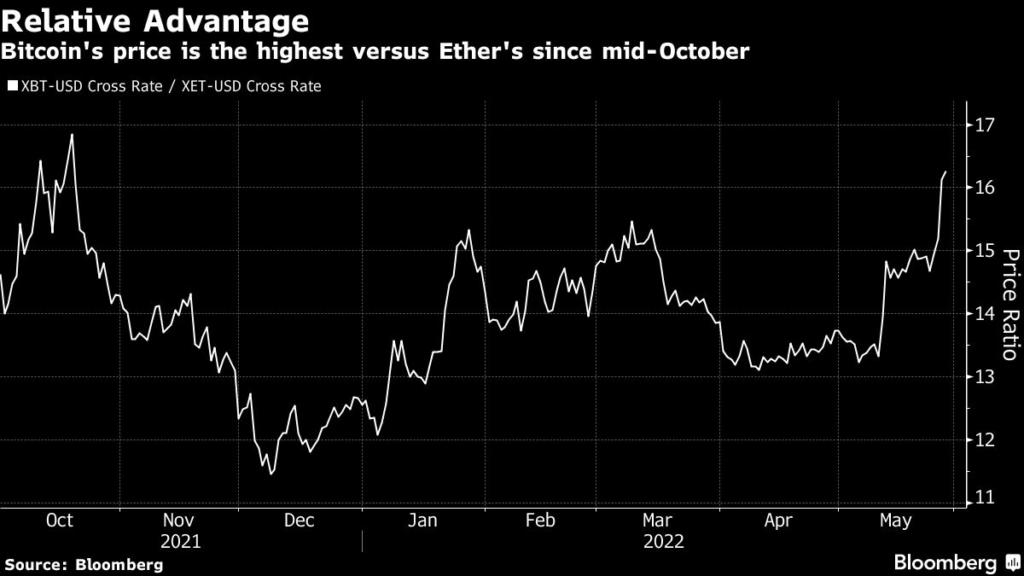
(Bloomberg) — Bitcoin is most expensive relative to second-ranked Ether since October. Some market-watchers have pointed to a glitch in the process of making the Ethereum network less energy-intensive as fueling worries in the space in recent days. The market moves come at a time when cryptocurrency has been depressed overall as the Federal Reserve begins a rate-hike cycle and inflation surges around the world. 

More stories like this are available on bloomberg.com

©2022 Bloomberg L.P.
US Plans Economic Talks With Taiwan in Latest Challenge to China

(Bloomberg) — The US and Taiwan are planning to announce negotiations to deepen economic ties, people familiar with the matter said, in a fresh challenge to Beijing, which has cautioned Washington on its relationship with the island.

The talks would focus on enhancing economic cooperation and supply-chain resiliency, falling short of a traditional free-trade agreement, according to the people. The deal is likely to include areas of trade facilitation, supply-chain work and trade in agricultural products, they said, speaking on condition of anonymity ahead of a public announcement.

Those elements are similar to the pillars in the 13-member Indo-Pacific Economic Framework that President Joe Biden announced during his visit to Tokyo this week. While a bipartisan group of lawmakers wanted Taiwan in that group, it was excluded because some countries that agreed to join refused to have Taipei included over fear of retribution from Beijing, according to people familiar with the process. 

The talks are an effort to elevate the US-Taiwan economic relationship, the people said, and will go beyond existing discussions under a Trade and Investment Framework Agreement between the two governments. 

Biden earlier this week made a public pledge to militarily support Taiwan in the event of a Chinese invasion, before he and White House officials walked the comments back. China denounced the president’s remarks, and has protested Washington’s deepening official bilateral engagement with Taiwan, which it regards as part of its territory despite never controlling it. 

Read More: Biden’s Latest Taiwan Gaffe Stokes Tensions With Beijing

Secretary of State Antony Blinken on Thursday reiterated that US policy toward Taiwan hasn’t changed and that the US doesn’t support Taiwan independence. Still, the US and Taiwan have a “strong unofficial relationship,” he said in a long-awaited speech on the Biden administration’s policy toward China.

A USTR spokesman declined to comment on the plans for talks on deepening bilateral economic engagement. A spokesperson for Taiwan’s economic and cultural office in Washington didn’t respond to a request for comment.

US Trade Representative Katherine Tai told Bloomberg TV this week that she and her Taiwanese counterpart, John Deng, had “very positive conversations” when they recently met in Bangkok.

Related: Blinken Aims at Xi in Speech Vowing to Shape the Global Order

“We are committed to deepening and enhancing the bilateral trade and economic relationship and we instructed our teams to work over the course of the next couple of weeks on that deepening and enhancement,” she said.

The two agreed to meet again in the coming weeks to discuss the path forward, the USTR said in a readout. A large Taiwanese government and business delegation is expected to attend the SelectUSA Investment Summit outside Washington in late June, giving both sides another chance to meet face-to-face.

Chips Issue

US officials have stressed that the reliance on Taiwan for semiconductors in particular is a geopolitical strategic problem and have pushed for a subsidy program that incentivizes domestic manufacturing of chips. That initiative is part of broader legislation that could pass later this year.

Taiwan for years has been pushing the US to negotiate a trade agreement, but American officials have stressed that roadblocks in Taiwan’s economic practices, including on agriculture, would need to be resolved as a prerequisite for any negotiations to take place.

The Trump administration, in particular, was hesitant to engage with Taiwan economically while it was negotiating its phase-one trade deal with Beijing, people familiar with the deliberations said at the time said.

More stories like this are available on bloomberg.com

©2022 Bloomberg L.P.
Eleven Arrested at Chipotle Worker Rally in Manhattan

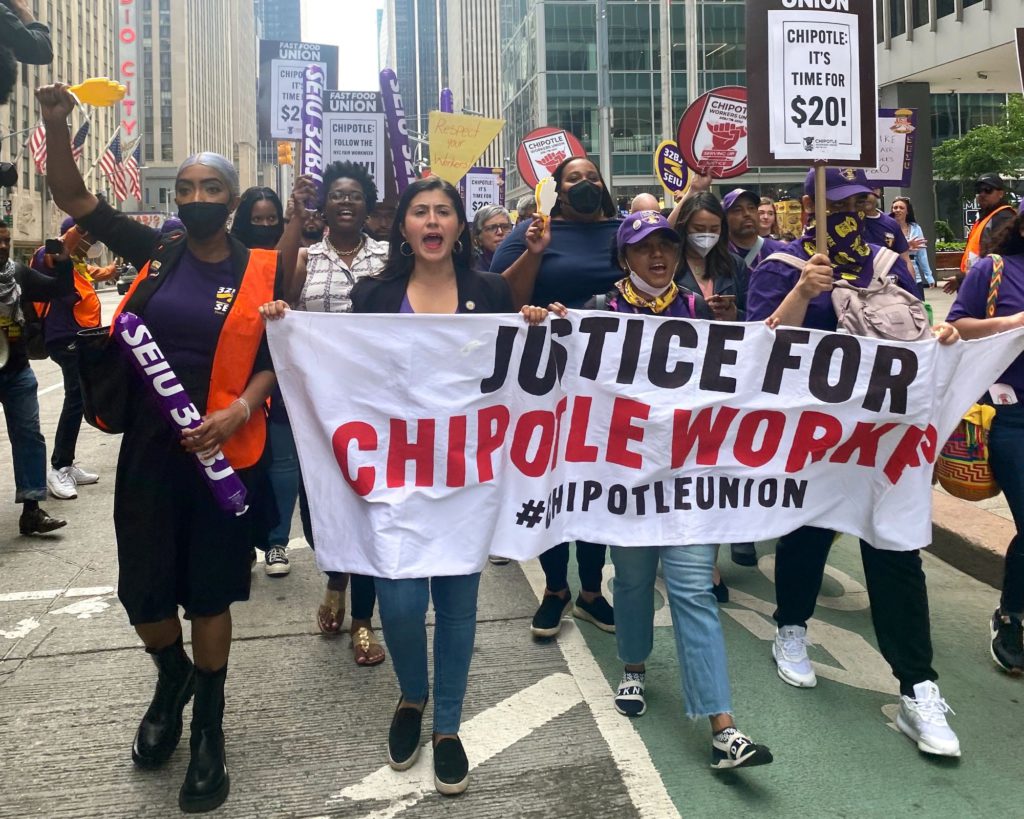
(Bloomberg) — Chipotle Mexican Grill Inc. workers and activists gathered in Midtown Manhattan on Thursday to demand better conditions and a $20 minimum wage, resulting in the arrest of 11 protesters, including New York State Senator Jessica Ramos.

Roughly 200 people rallied on the corner of 48th St and 6th Ave., close to Rockefeller Center, at 3 p.m. New York time. Workers for the quick-serve Mexican restaurant chain collaborated with organizers at Service Employees International Union, Local 32BJ, which represents some 175,000 workers in positions like doormen, security guards and food service.

Manny Pastreich, secretary treasurer of the union, said the action marks the first sustained attempt to organize Chipotle workers in the US. The effort comes amid a wave of unionization efforts at companies like Starbucks Corp. and Amazon.com Inc. 

“They don’t pay enough,” Pastreich said. “People are working in conditions that aren’t safe,” adding that workers have complained of health and safety violations pertaining to the food as well as rats in buildings.

Chipotle has boosted average hourly wages 11% to $17.37, with managers making more, the company’s chief corporate affairs officer, Laurie Schalow, said in an emailed statement. The chain offers industry-leading benefits, including tuition reimbursement and quarterly bonuses. 

“In our NYC restaurants, schedules are provided with hours that are mutually agreed upon by the manager and their employee,” she said. “Systems are in place for employees to request open shifts in locations across all five boroughs.

Workers, union organizers, and government officials, including state Assemblymember Linda Rosenthal and state Senator Brad Hoylman, spoke on a stage before the crowd marched up 6th Avenue.

The action ended close to 4:30 p.m., when 11 individuals, some of whom were Chipotle employees, were arrested for blocking the intersection of 56th St. and 6th Ave, according to Rush Perez, a communications representative for the union.

The New York Police Department could not confirm that number at the time of publication.

Workers from more than a dozen Chipotle locations in the city have gone on strike this week, refusing to show up for shifts in protest of what they allege are harmful workplace conditions.

Maria Romero, a 24 year-old cashier, skipped her shift. She came to the rally to call for better benefits and higher pay. Currently, she makes $17.50 per hour. “It’s an expensive city,” said Romero, who has worked at a Chipotle on the Upper East Side for 6 years. “I have a family.”

The Newport Beach, California-based burrito seller has faced criticism for worker violations in the past. In April of 2021, New York City sued the company for what it alleged were violations of the city’s Fair Workweek Law, which requires predicable schedules and full-time work. According to the complaint, the company owes workers more than $150 million in relief. 

Workers across the country have been pushing for better conditions and higher wages. Over the past several months, a growing number of Starbucks locations have voted to unionize. Amazon employees in New York recently voted to join a labor union, making them the first in the company’s US operations to do so. 

Last May, Chipotle raised its average hourly wage to $15 an hour, with individual starting wages ranging from $11 to $18. The increase came amid a hiring crunch that left the chain short of 20,000 staffers across the US.

Alyssa Roman wants Chipotle workers to form a union, in part, to help young workers learn their rights as employees. The 21 year-old, who is pregnant, said a union could protect her and her fellow workers. 

“I’m not disposable,” she said. “And neither is my labor.”

(Updated with Chipotle comments in fifth paragraph.)

More stories like this are available on bloomberg.com

©2022 Bloomberg L.P.
Close Bitnami banner
Bitnami