Bloomberg

UK to Probe Drahi’s BT Stake on National Security Concerns

(Bloomberg) — The UK will review French telecom tycoon Patrick Drahi’s increased stake in BT Group Plc after Business Secretary Kwasi Kwarteng exercised new takeover powers focusing on national security.

Drahi’s investment vehicle Altice UK increased its stake in the former state-owned telecommunications monopoly from 12.1% to 18% in December. He’s now BT’s largest shareholder and the investment has raised concerns in government, BT said Thursday. 

BT is the biggest owner of Britain’s internet backbone through fiber infrastructure company Openreach, as well as mobile network EE. It also runs important connectivity and service contracts across government and business.

Drahi’s interest in the company fueled speculation since he revealed his initial stake last June, sparking concerns about a takeover attempt, or so-called creeping control. The billionaire previously said he doesn’t intend to make an imminent takeover bid, triggering six-month standstills under British takeover law. The second of those expires in June.

BT shares fell 5.5% to 179.55 pence at 8:19 a.m. in London.

“Some investors are involved in BT because of the stake-building and arguably the government has indicated it’s somewhat concerned about that,” Deutsche Bank analyst Robert Grindle said by phone.

Whether ministers intervene or not after this review, it shows that any further move on BT, valued at about £18 billion ($22.6 billion), would face intense political scrutiny and hurdles. 

It’s the second roll-out in 24 hours of the new National Security and Investment Act, which came into force Jan. 4, after Kwarteng referred a Chinese-led takeover of a British semiconductor firm for an in-depth probe on Wednesday. 

The Department for Business, Energy and Industrial Strategy didn’t immediately respond to a request for comment for further detail about why the probe had been triggered, and a spokesman for Altice did not immediately respond to a request for comment.

In 2020 BT found itself at the heart of another national security debate, about the role played by Chinese telecommunications vendor Huawei Technologies Co., which was supplying a large portion of the carrier’s 5G wireless network before it was banned by Prime Minister Boris Johnson amid a wider crackdown led by former US President Donald Trump. 

Since then, British ministers have toughened rules on foreign investment. Officials now have 30 working days to carry out an assessment, under the law — though they can extend that by another 45 days if deemed necessary. 

“BT is one of the jewels in the crown of UK R&D and tech innovation, so it is right that the government is taking an active role in scrutinizing its future,” Mike Clancy, general secretary of BT union Prospect, said in an email. The government must ensure that jobs are protected, he added.

(Updates with shares, analysts from 5th paragraph)

More stories like this are available on bloomberg.com

©2022 Bloomberg L.P.

UK Investigating Drahi’s Stake in BT: The London Rush

(Bloomberg) — Here’s the key business news from London-listed companies this morning.

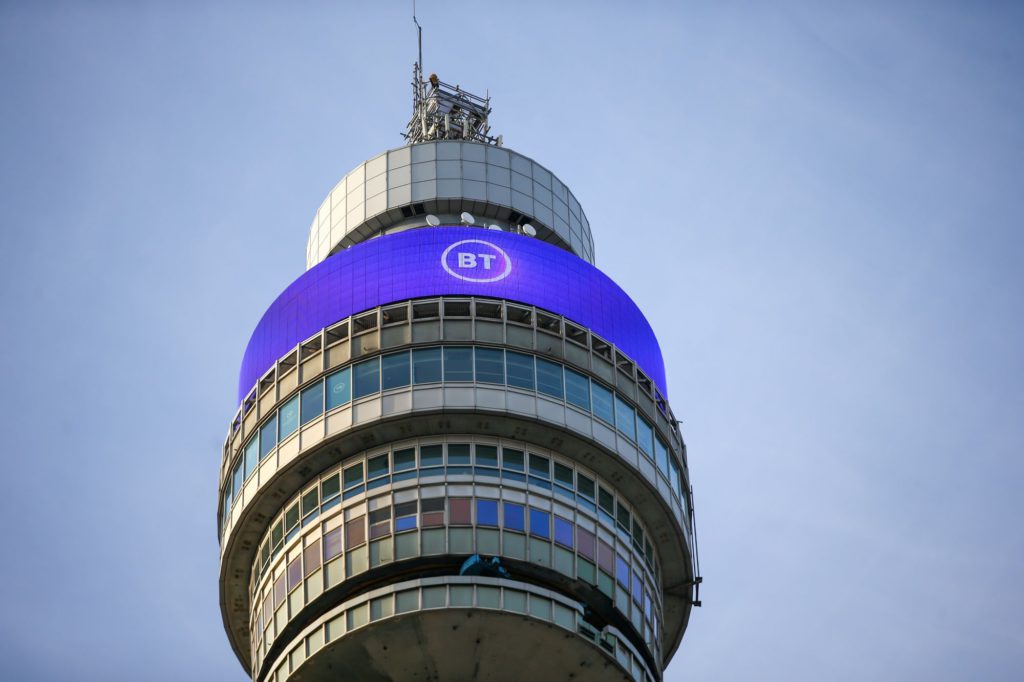
BT Group: The UK will review French telecom tycoon Patrick Drahi’s increased stake in the British telecommunications company under the National Security and Investment Act 2021, after Business Secretary Kwasi Kwarteng exercised his “call-in power”. 

  • It is the second case of this power being used in as many days, with Nexperia’s deal to buy British semiconductor plant Newport Wafer Fab being called in by Kwarteng on Wednesday

Serco Group Plc: The outsourcing provider boosted its full year expectations despite its lucrative Test & Trace revenues dropping off.

  • The company said it replaced Test & Trace sales with contracts in Immigration and other work around the world, meaning its underlying trading profit will be “significantly ahead” of the expectations it set out in February 

Johnson Matthey Plc: The specialty chemicals provider agreed a sale of part of its battery materials business to EV Metals Group for £50 million cash.

  • The company chose to exit the competitive battery making industry due to “insufficient returns” as well as the need for “very high capital investments to remain competitive,” the CEO said

Outside The City

Boris Johnson’s government will today set out fresh support for Britons struggling with a record squeeze on living standards, which may prove more threatening to the prime minister’s political future than the damning Partygate report. 

Meanwhile, public support for the Northern Ireland Protocol has more than doubled from a year ago, a new survey showed. 

In Case You Missed It 

Almost a decade after playing home to Europe’s first mass-produced electric car, the UK is at risk of becoming a footnote in the global auto industry’s shift to battery-powered vehicles.

And HSBC Holdings Plc has been examining an initial public offering of its Indonesian business to tap buoyant investor demand in the world’s fourth-most populous country.

Also, the latest episode of ‘In The City’ is out this morning. Listen to Roger Mitchell, founder of sports consulting firm Albachiara, explain how American money will change European football, after Todd Boehly’s deal for Chelsea FC was approved.

Looking Ahead

Next week, Dr. Martens Plc and Russian gold miner Petropavlovsk Plc are among the few London-listed companies due to report ahead of the long Jubilee Weekend.

More stories like this are available on bloomberg.com

©2022 Bloomberg L.P.

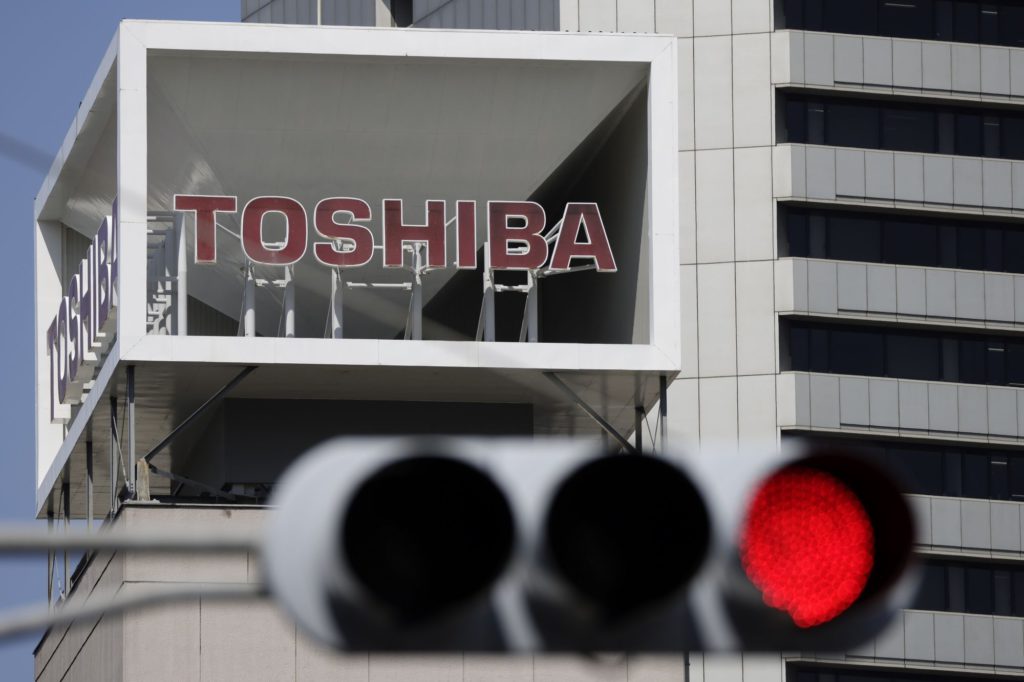
Toshiba Taps Activists for Board, Boosting Odds of Buyout

(Bloomberg) — Toshiba Corp. tapped candidates from its activist shareholders to serve as directors, increasing the likelihood of privatization as a staunch opponent of a buyout will step down from the board. 

The Tokyo-based firm nominated an executive each from Elliott Management Corp. and Farallon Capital Management, it said in a statement Thursday. Former Chief Executive Officer Satoshi Tsunakawa will leave the board.

If elected by shareholders at the annual meeting in June, the candidates could help smooth the path for a sale to private equity as the conglomerate seeks offers on privatization and other strategic alternatives.

“Having shareholder representatives join the board strengthens the alignment between shareholders and management,” Raymond Zage, chairperson of the nomination committee, said in the statement.

The announcement of the director slate was initially delayed earlier this month as the company said it needed more time. Proposed candidates met opposition from some Toshiba executives for being close to activist shareholders, broadcaster TV Tokyo reported at the time.

Eijiro Imai, a managing director at Farallon Capital Japan, is one of the proposed director candidates, while Nabeel Bhanji, who hails from Elliott, is another.

Akihiro Watanabe, chairman, managing director and chairman of Asia corporate finance at Houlihan Lokey, was nominated as chairman of the board.

Tsunakawa, who is departing, was one of the most vocal opponents of going private within Toshiba. In an interview with Bloomberg News in February, the 66-year-old company veteran said Toshiba would lose orders from public entities and would be forced to sell sensitive technology operations if it did so. Tsunakawa’s alternative vision for the firm, to split in two, was voted down by stock owners in March. 

Toshiba, which is now exploring other strategic options, has set a deadline of May 30 for receiving non-binding proposals from investors, including bids to go private. 

Japan Investment Corp., a government-backed fund, is considering is considering making an offer, Bloomberg News reported this week, citing people familiar with the matter. Bain Capital, Blackstone Inc., CVC Capital Partners and KKR & Co. are among the buyout firms that are also weighing bids, Bloomberg has reported.

Read more: Japan State-Backed Fund JIC Is Said to Explore Toshiba Bid

Toshiba executives have opposed director candidates from activist shareholders before. 

When Effissimo Capital Management Pte., the company’s largest stock holder, sought in 2020 to put one of its co-founders on Toshiba’s board, shareholders rejected it. Suspicious about how the vote was conducted, Effissimo called for independent investigators be appointed to look into it, winning a landmark shareholder vote last year. The subsequent report from the probe alleged that Toshiba management worked hand in hand with government allies to sway the outcome, findings that four Toshiba board members described as “deeply disturbing.”

(Updates with board chairman in seventh paragraph)

More stories like this are available on bloomberg.com

©2022 Bloomberg L.P.

Tree-Boring Beetle Could Cost South Africa $18.5 Billion

(Bloomberg) — A tree-boring beetle the size of a sesame seed could cost South Africa $18.5 billion over the next decade as millions of urban trees are expected to die and will have to be removed and fruit, nut and lumber plantations are harmed, researchers estimate. 

The polyphagous shot-hole borer, which arrived in South Africa in 2012, has spread into eight of the country’s nine provinces with some infestations more than 1,000 kilometers (621 miles) apart, researchers from Stellenbosch University and the University of Pretoria said in a study released this week. 

Growing infestations by the beetle, which has killed trees in outbreaks in Israel and California, could kill 65 million, or about a quarter of South Africa’s urban trees, over the next 10 years, the researchers said. That would result in costs of $17.5 billion, mostly in the form of the expense of removing dead trees. Damage to avocado and lumber plantations would increase the total cost by about another $1 billion.

This is “the largest current outbreak of this invasive pest globally,” the researchers said.

Johannesburg has one of the world’s biggest urban forests, with a canopy of green stretching as far as the eye can see in the north of the city. Other cities such as Cape Town are also heavily wooded. The pest could also affect South Africa’s citrus and macadamia nut plantations.

The female beetle burrows into trees and leaves fungus in the tunnel for her offspring that contains a pathogen that blocks the circulation of the tree. Some trees, planes particularly, become reproductive hosts, or breeding grounds, and the fungus is particularly lethal for the English oaks, Chinese and Japanese maples, and box elders found on the streets of South African cities. 

Managing the impact of the infestation “will be no easy task,” the researchers said. “A strategy to protect the standing stock of especially urban trees, but also agricultural and commercial forestry species, against invasion is in the best interests of national-level policy makers, municipalities and citizens.”

Still, there are few options other than restricting the movement of infested wood and quickly removing infected trees, the researchers said. Insecticides and fungicides can be injected directly into infected trees but this is “expensive and time-consuming.”

(Updates with citrus and macadamia nuts in fifth paragraph)

More stories like this are available on bloomberg.com

©2022 Bloomberg L.P.

Ukraine Latest: Russia Pledges to Open Sea Corridors, Kyiv Wary

(Bloomberg) — Russia said it’s opening corridors for shipping from seven Ukrainian ports amid growing international criticism of an unfolding global food crisis triggered by its blockade. Kyiv warned that security issues could still prevent free passage.

Ukrainian Foreign Minister Dmytro Kuleba spoke at the World Economic Forum in Davos and said peace negotiations with Russia are going “nowhere.” He compared Moscow’s offensive in the eastern Donbas region to a World War II battle.

The Bank of Russia moved up its next interest-rate meeting by more than two weeks to Thursday. Moscow may make foreign debt payments in local currency after the US Treasury Department let a waiver expire, pushing Russia closer to a default.  

(See RSAN on the Bloomberg Terminal for the Russian Sanctions Dashboard.)

Key Developments

  • Rare Ship-to-Ship Transfers Keep Oil Moving From Russia to China
  • Double Crises From Ukraine to China Take Toll on Global Recovery
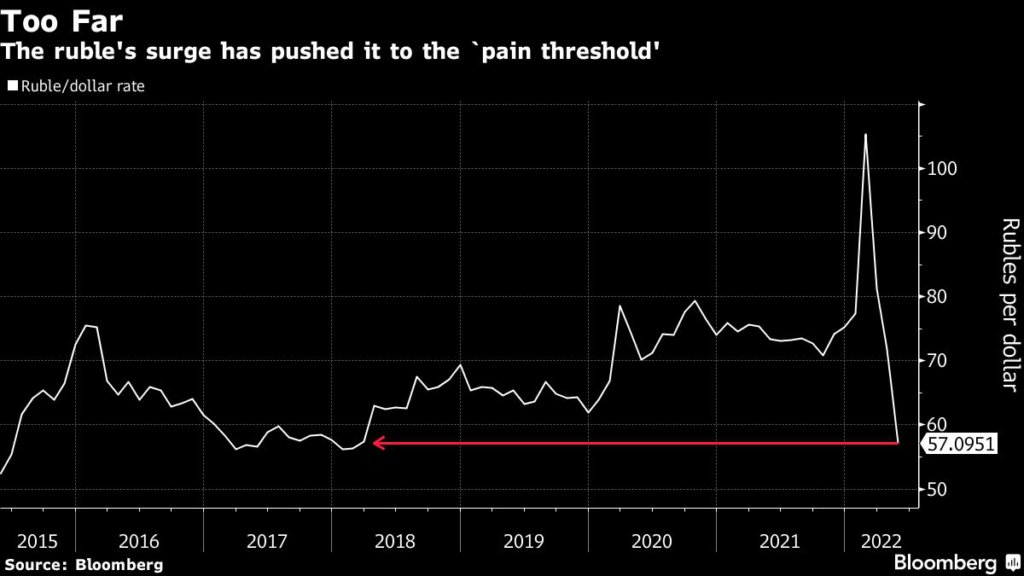
  • Russia Poised to Act Against Ruble Rebound That’s Gone Too Far
  • Russia Says It’s Opening Sea Corridors From Ukraine Ports 
  • Mined Ports, Polish Red Tape Among Issues Stopping Ukraine Grain
  • Klitschko Boxing Heroes Warn That Returning to Kyiv Is Dangerous

All times CET:

Oligarch’s Megayacht Reappears in Mediterranean (6:37 a.m.)

A $150-million ultra-luxurious yacht tied to Russia’s second-richest citizen Leonid Mikhelson, who is facing sanctions, reappeared after nearly two weeks without broadcasting its location. Its final destination is unclear.

The 85-meter (280 feet) Pacific, which can accommodate two helicopters, was cruising past Malta in the Mediterranean Sea after reappearing near the Canary Islands on May 20, when its location transponder was turned on again, vessel data compiled by Bloomberg News show.

Read more: Oligarch’s Megayacht Reappears in Med, Final Destination Unknown

Russia Poised to Act Against Ruble Rebound That’s Gone Too Far (3:29 a.m.)

Russia is racing to stem a rally in the ruble and is poised to accelerate interest-rate cuts as officials increasingly view the currency’s rebound as an economic threat.

An unscheduled policy meeting for Thursday has spurred expectations for a big reduction, and the possibility that capital restrictions may be loosened further. The ruble swung to a loss of as much as 6.6% versus the dollar in Moscow trading after the announcement, ending a five-day gain.

Russia Says It’s Opening Sea Corridors (9:01 p.m.)

Humanitarian maritime corridors from Black Sea and Sea of Azov ports including Odesa will operate from 8 a.m. to 7 p.m. daily, Mikhail Mizintsev, a Defense Ministry official said according to an emailed statement. But shipments may not begin moving quickly because Ukraine would have to remove its mines after seeking assurances of protection from Russia’s Black Sea fleet.

The head of the UN’s World Food Programme, David Beasley, said Monday that Russia’s blockade of Ukrainian ports, preventing shipments of grain from the country, is a “declaration of war” on global food security. 

The interruption of Ukraine’s agricultural cycle risks a multi-year global food crisis, Kuleba said at Davos, “but in the end the problem is that you cannot trust Russia even if they sign papers guaranteeing safe passage.” 

Ukraine’s Kuleba Warns Davos Russia Poses Broader Risks (8:45 p.m.)

Kuleba if the issue of security guarantees for Ukraine isn’t resolved in one way or another, “there will always be a risk of war in Europe as long as Russia remains Russia.”

He said Ukraine needs security guarantees and that while its continued aspiration to join NATO “did not fly,” it needs “something now.” Kuleba said his country is upset that a sixth round of European Union sanctions against Russia is “hanging in the air” because of Hungary’s resistance to an embargo on Russian oil purchases.

War Crimes Advisory Group Created to Aid Ukraine (6:55 p.m.)

The EU, UK and US announced the creation of the Atrocity Crimes Advisory group will aim to ensure “efficient coordination of their respective support to accountability efforts on the ground,” according to a joint statement. 

“The overarching mission of the ACA is to support the War Crimes Units of the Office of the Prosecutor General of Ukraine in its investigation and prosecution of conflict-related crimes,” according to the statement. 

Dutch May Join Naval Escorts if Russia Commits (6:41 p.m.)

The Netherlands would consider joining an alliance to send warships to escort grain supplies stuck in Ukrainian ports but would need assurances from Russia and, ideally, involvement by Turkey, according to the Dutch defense minister. 

“If there is any way to make it happen, and if the Netherlands were asked to play a part, of course I would be very happy to be part of such an alliance,” Dutch Defense Minister Kajsa Ollongren told Bloomberg on the sidelines of the World Economic Forum. “But we’re not there yet unfortunately.”

Putin Says Economy Doing Better Than Some Expected (5:15 p.m.)

Russia’s economy is doing better than some forecasters expected, Putin told officials, although he added this year remains “not easy.”

“Our economy’s trend is significantly better than some experts forecast,” he told a televised Kremlin meeting, saying inflation this year won’t exceed 15%. He didn’t mention the government’s prediction that output will contract by 8% this year under pressure from Western sanctions imposed over his attack on Ukraine.

Putin Visits Military Hospital for First Time During War (5:11 p.m.)

Putin met doctors and wounded soldiers at a Moscow military hospital in his first such visit since he ordered the invasion of Ukraine three months ago. The wounded soldiers he met were dressed in matching pajamas and had no visible injuries in photographs on the Kremlin website and broadcast on state TV.

Russia hasn’t announced casualty figures since March 25, when it said 1,351 soldiers died and 3,825 were wounded in fighting in Ukraine. The UK Defence Ministry estimated this week that about as many Russians have been killed as in the Soviet Union’s 9-year war in Afghanistan, when about 15,000 soldiers died.

Russia Offers Fast-Track Citizenship in Occupied Ukraine (4:51 p.m.)

Putin signed a decree on offering fast-track citizenship to residents of two occupied southern Ukrainian regions — Kherson and Zaporizhzhia. Ukraine condemned the move, with the Foreign Ministry saying that “illegal” distribution of Russian passports violates its sovereignty, territorial integrity and international laws. 

Russia offered a similar path to citizenship in the breakaway eastern Donetsk and Luhansk regions, which about 860,000 people received before the Feb. 24 invasion of Ukraine. Russia is moving to annex Ukrainian territory it controls, according to occupation authorities and people in Moscow familiar with the matter.

Mined Ports, Red Tape Stopping Ukraine Grain (3:22 p.m.)

Resuming Ukrainian gain shipments will be time consuming given challenges that include mine-clearing in Black Sea ports and the need for cooperation from the very country that kicked off the war, Lithuanian President Gitanas Nauseda said.

“It could take weeks, not months, but if there will be no will of the Russians to open this window, it will be impossible,” Nauseda said in an interview Wednesday. “The Russians could use this instrument as yet another leverage to destabilize the situation in the world. They are highly interested to do as much harm as possible.”

Ukraine Seeks More Rocket Launchers as Donbas Front Deteriorates (2:41 p.m.)

Ukraine needs multiple rocket launch systems as soon as possible, Foreign Minister Kuleba said on the sidelines of World Economic Forum. Delay will worsen an “extremely bad” situation in Donbas and prevent Ukraine from liberating the region around Kherson in the south, he said.

“We cannot allow Russia to stay in Kherson because if they do, they will have a strategic position to pose a threat to central Ukraine but also to southwestern Ukraine in the direction of Odesa, and they will keep stealing our grain.”

Moldova Frets of Being Left Behind as Ukraine Vies for EU Entry (1:25 p.m.)

With all eyes on Ukraine as it strives to mount the first rung of the process to join the European Union, neighbor Moldova worries that its own push to join the bloc may be forgotten.

Pressing the message that Moldovans were ready to anchor themselves to a European future, Prime Minister Natalia Gavrilita said her country was pushing ahead with strengthening its institutions and bolstering the rule of law, key requirements to be considered an EU candidate. 

“The time is now,” she said in an interview at the World Economic Forum. “The people of Moldova have voted massively for European integration a while before the war even started.”

Russia Welcomes Tribunal for Azovstal Defenders (1:20 p.m.)

Russia said it backs the establishment of a tribunal by its separatist allies to try Ukrainian defenders for war crimes after they surrendered at the Azovstal steel plant.

Russia said that 2,439 Ukrainian fighters surrendered last week at the final bastion of resistance in the port city of Mariupol. Moscow has said it is willing to consider swapping the detainees for captured Russians only after they are tried and convicted, a stance that may complicate Kyiv’s hopes of freeing its soldiers.

Citigroup Improves Russian 2022 Economic Forecast (1:18 p.m.)

Citigroup Inc.’s chief Russia economist revised the outlook for the country’s economic decline to 5.5% in 2022 from 9.6% previously due to recent data suggesting improved consumer strength and net-export performance.

Belarus Exports Could Drop 30% This Year From War (11:22 a.m.)

Belarusian export revenue is poised to decline 30% this year, or by $14 billion, after the war led to foreign sanctions and a loss of access to Ukraine’s market, state-owned news agency Belta reported, citing First Deputy Prime Minister Nikolai Snopkov.

The country’s GDP declined 2.1% over the first four months of the year due to sanctions, Snopkov said. Belarus, which was already heavily sanctioned before the war, came under increased pressure as its authorities allowed the country to be used as a staging area for the invasion.

Lebedev Steps Down From UK News Board (11:01 a.m.)

Former KGB agent Alexander Lebedev stepped down from the board of a UK newspaper business that his son owns days after he was sanctioned by Canada, filings show. 

The move underscores a tightening focus on his family amid the war in Ukraine that has become politically awkward for Prime Minister Boris Johnson. Johnson appointed Lebedev’s son Evgeny to the UK’s upper chamber of parliament as a Lord in 2020. 

Russian Cruise Missile Strike as Zaporizhzhia Offensive Ramps Up (10:03 a.m.) 

Cruise missiles hit industrial cities in Ukraine’s east as Russia intensified an offensive near Zaporizhzhia. The strikes killed one person and destroyed more than 60 houses in the city of more than 700,000 on the Dnipro River, the region’s administration said on Facebook. 

Three missiles damaged a factory in the steel-making hub Kryvyi Rih, Dnipro region governor Valentyn Reznichenko said on Telegram. Russian missiles also fell on residential areas in Kramatorsk north of Russia-controlled Donetsk, a local official said.

Bank of Russia Reschedules Rate Meeting Amid Ruble Rally (9:04 a.m.)

Russia’s central bank moved its next interest-rate decision to 9:30 a.m. Thursday, after government officials suggested further monetary easing may be needed to help stem the ruble’s surge to highest since 2018.

The Bank of Russia has lowered the key rate twice since an emergency rate hike to 17% in the days after Russia’s invasion of Ukraine. The benchmark rate now stands at 14% and the next scheduled meeting wasn’t until June 10. The Economy Ministry said earlier this week that the ruble’s strengthening was nearing a peak. 

Ukraine Seeks Return of All of Its Territories, Zelenskiy Says (8:55 a.m.)

Ukraine will fight until it returns all of its territory, President Volodymyr Zelenskiy said via video link at a breakfast organized by the Victor Pinchuk Foundation in Davos.

Talks with Russia have stalled and Kyiv doesn’t see prospects for diplomacy until the Kremlin pulls its troops back to positions held before the invasion, according to Zelenskiy. Putin doesn’t “realize to the very end what is happening, he lives in his informational world,” the Ukrainian leader said.

Ukraine Sees No Will of NATO to Help With Naval Escorts (8:12 a.m.)

Kuleba said he saw no desire from NATO now to help secure safe passage of grains through the Black Sea, a crucial move as the world worries about food shortages and rising prices.

“I would wholeheartedly welcome the decision, but I just don’t see the stamina and the bravery to take all the risks associated with this operation,” he said.

Russia and China Air Drill Rankles Neighbors (7:19 a.m.)

Japan’s top government spokesman Hirokazu Matsuno condemned a joint exercise held by Chinese and Russian war planes as a “heightened provocation.” The countries conducted a military drill Tuesday as US President Joe Biden finished an Asia trip, sending bombers and other aircraft south of the Korean Peninsula and over waters between Japan and South Korea, Seoul said, as it criticized the move.

China said its joint strategic air patrol with Russia didn’t target any third party and had nothing to do with the current international and regional situations, according to a statement from the defense ministry. 

Read more: Joint Russia-China Air Drill During Biden Trip Rankles Neighbors

More stories like this are available on bloomberg.com

©2022 Bloomberg L.P.

Lenovo Profit Beats Estimates Despite Lockdown-Sapped Demand

(Bloomberg) — Lenovo Group Ltd.’s profit beat market estimates after the world’s biggest personal computer maker widened its lead over longtime rival HP Inc.

Net income of the Chinese PC giant jumped 58% to $412 million in the first three months of the year, a company filing showed, higher than analysts’ average estimate of $354 million. Sales were $16.7 billion in the same period, compared with the average expectation of $17.6 billion.

Shares of Lenovo fell slightly in Hong Kong on Thursday morning before the results were announced.

Lenovo held on to its top spot in the worldwide PC market in the first quarter with 22.7% market share. HP, its biggest rival, saw its market share slump below 20% following supply chain and logistics challenges, research firm IDC said.

PC vendors are now searching for new growth to replace demand from remote work and online learning as economies resume pre-pandemic activity. Beijing has ordered central government agencies and state-owned enterprises to scrap foreign-branded PCs for local names in the next two years. That creates demand for at least 50 million PCs from local manufacturers such as Lenovo, Bloomberg News reported earlier this month. 

“The macro landscape remains challenging due to factors as varied as climate change, the digital divide, the ongoing pandemic and newly emerged geopolitical risks,” Lenovo said in its earnings announcement.

The company sees growing headwinds as China’s severe Covid-19 containment measures erase retail demand and cripple manufacturing and logistics. In Shanghai, authorities barred its 25 million residents from leaving the city for nearly two months, erecting metal barriers outside residential compounds. Carmaker Toyota Motor Corp. suspended further production due to parts shortages caused by the lockdown covering the city, a sign of persisting supply-chain bottlenecks in manufacturing. 

The recent lockdowns have led to order cuts across the consumer electronics and infrastructure sectors, potentially hurting Lenovo more than other brands due to its higher sales exposure at home, JPMorgan analysts including Albert Hung wrote in a note.

More stories like this are available on bloomberg.com

©2022 Bloomberg L.P.
UK Risks Car Collapse as Jaguar Land Rover Looks Elsewhere for Batteries

(Bloomberg) — Almost a decade after playing home to Europe’s first mass-produced electric car, the UK is at risk of becoming a footnote in the global auto industry’s shift to battery-powered vehicles.

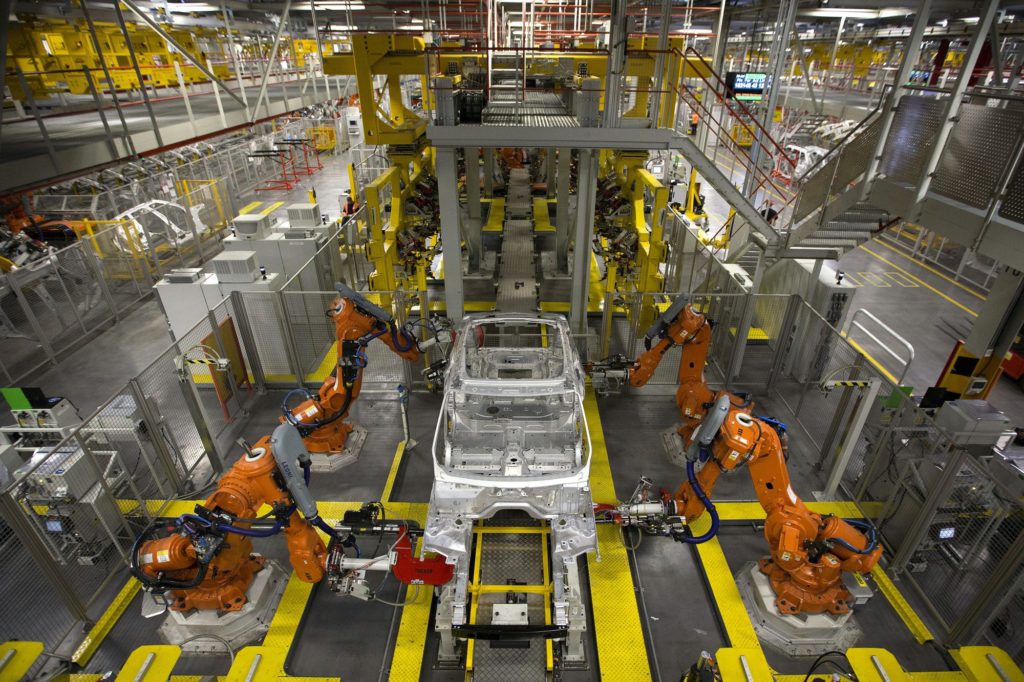
The UK lacks the cell and pack factories automakers will need to support their transition away from the internal combustion engine. In what could be a fresh blow to British carmaking, the country’s top auto manufacturer, Jaguar Land Rover, is in talks with Northvolt AB and SVolt Energy Technology Co. about supplying batteries for a range of EVs it may assemble in Slovakia, according to people familiar with the matter.

Unless battery investment picks up, carmakers may only accelerate their exodus from what was once the world’s second-biggest auto manufacturing base. The last few years, the UK fell outside the top 15.

“It’s about to be too late to preserve the UK role as a major automotive producer,” said Andy Palmer, the former CEO of Aston Martin who also helped spearhead Nissan’s creation of the Leaf EV built in Sunderland, England. “Unless there’s either a carrot or a stick to incentivize battery production in the UK, it’s only a matter of time before the automobile industry here becomes a niche industry that caters to brands such as Rolls-Royce and Bentley.”

As the move to electric vehicles redraws manufacturing maps, the UK is endangered by scarce supply of raw materials, expensive energy, meager government incentives and potential Brexit-related tariffs. While the country has pumped hundreds of millions of pounds into battery-technology research, this has spurred minimal production.

To date, the UK has just one major plant in operation, owned by China’s Envision Group. The manufacturer added production of longer-range packs for Nissan Leaf EVs last year and announced plans to expand, though not until 2024 at the earliest.

A spokesperson for Jaguar Land Rover, which produced more than 220,000 vehicles in the UK last year, said the manufacturer continues to explore all options for EV battery supply, and that no decisions have been made. Representatives for Northvolt and SVolt declined to comment. 

Read more: The U.K.’s Green Plan Includes Banning Combustion-Only Cars From 2030

Electric vehicles pose a chicken-and-egg dilemma. Carmakers are reluctant to build new factories or retool existing ones to make EVs without a battery facility onsite or nearby. Battery manufacturers in turn are generally unwilling to invest billions of dollars to set up a plant without reliable customers within short range.

Britishvolt is among a handful of startups that have announced plans to build giant battery plants in the UK, but firm orders and manufacturer commitments are lacking. That could be a persistent obstacle, given the industry is mostly home to lower-volume luxury and sports-car brands such as McLaren, Bentley, Aston Martin and Lotus.

While Nissan Motor Co., Stellantis NV and Volkswagen AG-owned Bentley have committed to making EVs in the UK, analysts have warned much more investment is needed to protect the industry’s position. To preserve the current size of the car sector, the UK needs to increase battery capacity 45-fold to more than 90 gigawatt hours, the Green Finance Institute’s Coalition for the Decarbonisation of Road Transport said in a report this month.

“If a battery sector does not emerge in the UK, there is both the lost opportunity cost of the financial gains of batteries being captured elsewhere, and in turn a risk that the existing automotive industry in the UK could diminish through moving to co-locate with battery production,” the government-backed group said.

There have been some positive developments.

Britishvolt has broken ground on the UK’s first giant battery factory in northern England, with aims to produce 30 gigawatt-hours from the end of 2027 — enough cells for around 300,000 EV battery packs a year. It’s secured preliminary partnerships with Aston Martin, which has slated its first fully electric model for 2025, as well as Lotus.

A public-private venture between the owners of Coventry’s airport and its city council in central England, called West Midlands Gigafactory, aims to open in 2025 and eventually supply 60 gigawatt-hours per year at full capacity. But it’s unclear whether it will succeed without the support of a major carmaker.

The window to attract battery makers is narrowing, with European governments lining up big support packages that have made them more attractive for investment. EU countries have collectively pledged more than 6 billion euros ($6.3 billion) in public spending to build up the industry, an investment they say will unlock another $14 billion euros in private funds.

This month, VW said it was pushing ahead with plans for a 10 billion-euro EV battery and vehicle production hub at its Seat brand plants in Martorell and Pamplona, Spain. That followed an announcement from the alliance led by Stellantis and Mercedes-Benz Group AG that they’ll add a third battery manufacturing site, in Italy, on top of ones already planned for Germany and France.

The trade deal set up between the UK and the European Union in the wake of Brexit further complicates matters. While initially a relief to carmakers because the industry avoided a no-deal disaster, the pact clouds the path forward. By 2027, half of the parts content going into EVs and hybrids will need to be sourced locally — either from the EU or UK — to qualify for tariff-free trade.

JLR, which announced plans for Jaguar to ditch combustion engines completely by 2025, and for Land Rover to introduce electrified variants beginning a year earlier, hasn’t yet detailed its production plans. The company has a contract-manufacturing arrangement with Magna Steyr for its sole fully electric model, the Jaguar I-Pace, which is made in Austria.

“It’s not, unfortunately, a level playing field,” said Mike Hawes, chief executive officer of the Society of Motor Manufacturers and Traders, the UK’s car lobby. “Governments intervene in Europe. They intervene in America. They intervene in in Asia. So the UK government has got to make sure that, at the very least, it creates the framework for UK manufacturing to be competitive.”

More stories like this are available on bloomberg.com

©2022 Bloomberg L.P.
Sanctioned Chipmaker SMIC Joins Hang Seng’s ESG Indexes

(Bloomberg) — Semiconductor Manufacturing International Corp. has been added to two ESG-focused indexes in Hong Kong, even as China’s largest chipmaker remains a sanctioned entity in the US.

The company will join the HSI ESG Enhanced Index and the HSI ESG Enhanced Select Index following a review, according to a statement from Hang Seng Indexes Co. late Wednesday. The change will come into effect on June 13. Shares rose as much as 1.3% on Thursday before erasing gains.

SMIC was blacklisted by the Trump administration in 2020 because of its links with the “Chinese military industrial complex,” and the US is now said to be considering tougher sanctions on the firm. The company was recently included in Hong Kong’s benchmark Hang Seng Index. 

READ: SMIC 1Q Profit More Than Doubles to $447.2m From Year Ago

For inclusion in the ESG indexes, Hang Seng Indexes screens stocks for their ESG risk ratings by data provider Sustainalytics, compliance with the United Nations Global Compact Principles and involvement with controversial products such as coal, tobacco and weapons.

Hang Seng Indexes didn’t immediately respond to a request for comment. A spokeswoman for Morningstar Inc., which owns Sustainalytics, declined to comment.

Orient Overseas International Ltd., Zhongsheng Group Holdings Ltd. and CK Infrastructure Holdings Ltd. will also join the ESG gauges, while AAC Technologies Holdings Inc. has been removed.

More stories like this are available on bloomberg.com

©2022 Bloomberg L.P.
Apple to Boost Pay for US Workers as Inflation Bites

(Bloomberg) — Apple Inc. is raising salaries for workers in the US by 10% or more as it faces a tight labor market and the spread of unionization efforts across its retail stores.

The Cupertino, California-based company is expanding its overall compensation budget this year, it said in a statement Wednesday. It will hike minimum hourly pay for its staff to at least $22, up 10% on last year. The move follows a pay bump in February after inflation woes and complaints from some staffers about working conditions during the Covid-19 pandemic. 

Apple is now accelerating its annual performance-based pay increases for retail and corporate team members by three months, according to an email to employees. The company is contending with unionization efforts in several parts of the US, including Georgia, Maryland, New York and Kentucky. In a recent video message to employees, Apple’s retail chief warned “We have a relationship that is based on an open and collaborative and direct engagement,” and “I worry about what it would mean to put another organization in the middle of our relationship.”

Companies often announce improvements while battling unionization campaigns, and by doing so may interfere with employees’ free choice, Seattle University labor law professor Charlotte Garden said in an email. “The risk is that workers perceive that keeping the improvements is contingent on voting against union representation, and that if they vote for the union, the company will play hardball.”

US tech companies are battling a shortage of talent after many chose flexible options or left the workforce during the pandemic. Software maker Microsoft Corp. is among those spending more aggressively to stay competitive, planning to nearly double its budget for salary increases this year in an effort to retain employees.

Inflation is also playing a role in driving up pay expectations, with US consumer prices rising an annual 8.3% in April, according to government data released Wednesday.

Apple has approximately 154,000 full-time or equivalent employees, according to regulatory filings. Its starting wage is comfortably above the US nationwide minimum, which has been $7.25 since 2009; New York City’s wage floor is $15. Like other leading tech firms, the company has so far operated without a formal worker organization, however successful moves to unionize at a New York Amazon.com Inc. warehouse and Starbucks Corp. cafes across the country have given impetus to new campaigns.

(Updates with additional background)

More stories like this are available on bloomberg.com

©2022 Bloomberg L.P.

UN Corrects China on Human Rights Chief’s ‘Actual’ Words To Xi

(Bloomberg) — The United Nations issued a “clarification” of its human rights chief’s remarks during a call with President Xi Jinping, in an apparent suggestion Chinese state media mischaracterized her comments.

“In response to widely reported remarks attributed to High Commissioner Bachelet, please find here a link to her actual opening remarks at her meeting with the President of China,” a spokesperson for the office of Michelle Bachelet said in an emailed statement late Wednesday. 

Shortly after the video call held earlier that day, state broadcaster China Central Television issued a read out saying Bachelet had told Xi that she admired the “efforts and achievement China has made in the areas of poverty elimination, human rights protection.”

The UN transcript, in contrast, said Bachelet stressed in her opening remarks that human rights must be at the core of “development, peace and security,” and that China had a crucial role to play within multilateral institutions on issues such as inequality. The excerpt contained nothing that could be construed as praising China’s human rights achievements.  

The UN didn’t immediately reply to a request for more information about the apparent discrepancy between the two sides’ accounts.

READ: Blacklists, Trade and More U.S.-China Flashpoints: QuickTake

Bachelet’s trip has been criticized for failing to secure guarantees she would have unfettered access to the remote Xinjiang region, where the US accuses China of genocide against the mostly Muslim Uyghur people. US Ambassador Nicholas Burns told Bachelet he had “profound concerns” about attempts by Beijing to manipulate the trip, according to multiple people on a Monday call who asked for anonymity as they weren’t authorized to speak.

Her video meeting with Xi came a day after tens of thousands of apparently hacked files provided new evidence of the alleged abuse of Uyghurs in mass detention camps in Xinjiang. 

Hacked Data Shows Ethnic Abuse in China’s Xinjiang Camps

Beijing claims the facilities are vocational training centers to counter religious extremism and bring prosperity to the region, and vehemently denies accusations of genocide, a major source of tension between the world’s two largest economies.

More stories like this are available on bloomberg.com

©2022 Bloomberg L.P.
Close Bitnami banner
Bitnami