
Bloomberg

China Protesters Demand Back Billions Tied to Suspected Scam

(Bloomberg) — Hundreds of people took to the streets of the largest city in China’s Henan province this week, calling on authorities to ensure the return of tens of billions of yuan invested in what could be one of the nation’s largest financial scams.

Protesters gathered outside the local office of the China Banking and Insurance Regulatory Commission on Monday in Zhengzhou city, carrying signs that read “Return my savings,” according to half a dozen people familiar with the matter, who asked not to be named discussing a sensitive subject. The crowd was dispersed by police and told to return home as soon as possible, the people said.

The protest, unusual for China, followed a freeze in online and mobile cash withdrawal services by four banks in Henan. A subsequent probe found that Henan Xincaifu Group Investment Holding Co., a private investment firm with stakes in all four lenders, colluded with bank employees to illicitly attract public funds via online platforms, the CBIRC said in a written response to questions.

At least tens of billions of yuan in funds were involved, according to a person with direct knowledge of the matter who asked not to be named discussing internal information. The investigation is ongoing and it isn’t clear whether the funds are missing.

“Waiting is very painful since we haven’t received any response on how regulators will deal with our savings,” said Chris, who bought about 400,000 yuan ($59,693) worth of deposit products from one of the banks. “What’s worse, we are quite concerned that our savings would be regarded as illegal investment products.” Chris asked to only be identified by her first name as she fears reprisal for speaking publicly.

The CBIRC said it’s “highly concerned” about the situation and vowed to severely punish any financial crimes.

Consumers should choose official channels for financial business and beware of false propaganda such as “high interest” and “high yield,” the regulator said. Deposit and withdrawal services through branches at the banks — Yuzhou Xinminsheng Village Bank, Shangcai Huimin County Bank, Zhecheng Huanghuai Community Bank and New Oriental Country Bank of Kaifeng — are normal, the CBIRC said. 

All four banks weren’t immediately available for comment when reached by Bloomberg. Xincaifu Group, which specializes in corporate investment and management, had its business license revoked in February, according to company registration information, and couldn’t be reached for comment.  

The incident highlights the risks associated with efforts by the nation’s small lenders to attract funds from outside their limited home bases through partnerships with non-proprietary online platforms. The central bank last year banned lenders from conducting such “innovative” deposit services, citing the need to “safeguard the pockets of ordinary people.”

The protest also risks renewing doubts over the financial strength and corporate governance of nearly 4,000 rural Chinese lenders that collectively control $7 trillion of assets. Confidence in the country’s smaller lenders has waned since 2019, when the government seized a bank for the first time since 1998 and imposed losses on some creditors. 

Depositor concerns over the safety of savings at smaller Chinese banks led to several protests in 2020. More recently, the troubles at real estate developer China Evergrande Group have sparked protests in cities across the country.

China’s largest case of financial fraud was in 2016, when the Ezubo P2P lending platform defrauded more than 900,000 people out of the equivalent of $7.6 billion. The firm was fined about 1.8 billion yuan a year later and its owner was sentenced to life imprisonment.

China has disposed of 2.6 trillion yuan worth of bad debt at more than 600 rural banks classified as high-risk over the last few years, and injected 133.4 billion yuan of capital into 289 rural lenders, according to the regulator. Authorities are also considering raising several hundred billion yuan for a stability fund to bail out troubled financial firms.

(Updates with investor comment in the fifth paragraph.)

More stories like this are available on bloomberg.com

©2022 Bloomberg L.P.

Sony Plans to Buy More Game Studios, Grow With Live Services, PC

(Bloomberg) — Sony Group Corp.’s PlayStation division will acquire more game studios and increase investment in live services, PC and mobile offerings, its gaming chief said on Thursday.

The company is “not at all finished expanding PlayStation Studios inorganically” and will look to keep making deals, said Jim Ryan, president of Sony Interactive Entertainment. Sony has been bolstering its portfolio by agreeing to take over Bungie Inc. and several other game developers in recent months. The company also wants to integrate Bungie’s expertise as a live services operator into its broader ecosystem as it aims to build out that aspect of its consumer offering.

Sony is already spending nearly half its PlayStation 5 investment budget on developing and growing live services and plans to increase that ratio to 55% by fiscal year 2025. It’s a part of the gaming business where Sony has had little meaningful presence previously, Ryan said, alongside PC and mobile, the two other areas of focus for expansion. The company projects PC net sales of $300 million in the current fiscal year, up almost four-fold from $80 million in the year just ended.

By 2025, Sony intends to have nearly half of its new first-party game releases on PC or mobile platforms, moving decisively “to a future where large elements of our community extend beyond the console,” the company’s presentation said.

On the hardware front, Sony said it expects the PlayStation 5 to overcome supply constraints next year and overtake the sales pace of the PlayStation 4 again. The PS5 was the fastest Sony console to reach 10 million units sold, however component and logistics issues have hampered the company’s ability to put consoles in gamers’ hands. Sony is mitigating additional market instability born out of the war in Ukraine by sourcing multiple suppliers, it said.

More stories like this are available on bloomberg.com

©2022 Bloomberg L.P.
Fed’s Brainard Sees Need for Regulation Around Crypto Assets

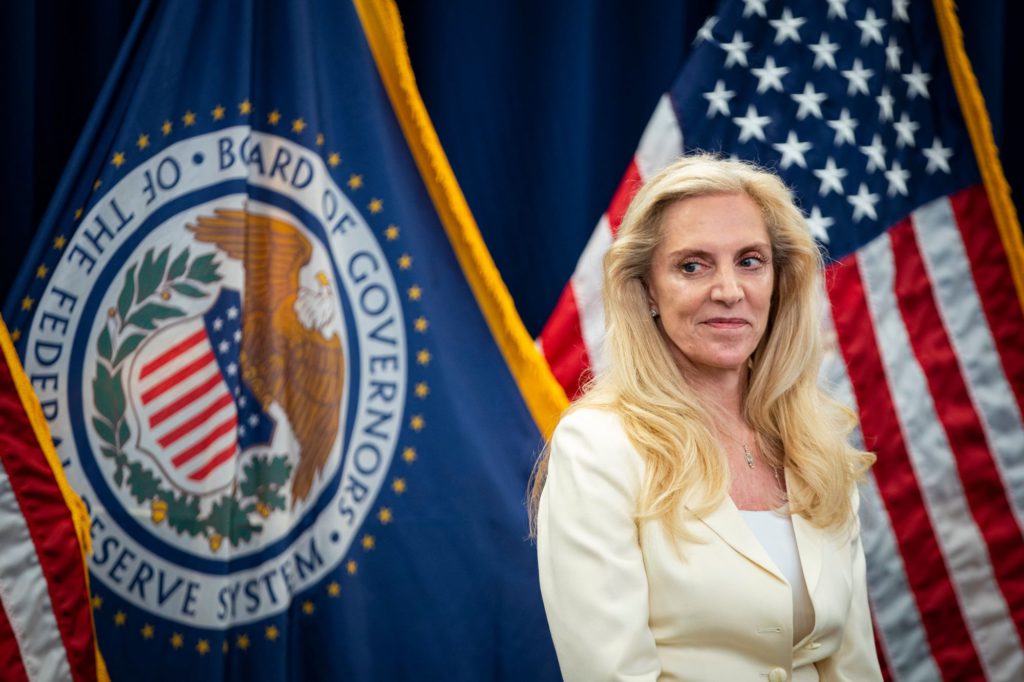
(Bloomberg) — Federal Reserve Vice Chair Lael Brainard said growth in new digital assets and the recent pressure some of them have seen highlights the need for better regulatory guardrails around these instruments.

“The recent turmoil in crypto financial markets makes clear that the actions we take now — whether on the regulatory framework or a digital dollar — should be robust to the future evolution of the financial system,” Brainard said in testimony prepared for a House Financial Services Committee hearing on Thursday.

She alluded to the recent collapse of algorithmic stablecoin TerraUSD as well as Tether’s dipping below its intended one-to-one peg to the dollar, saying “these events underscore the need for clear regulatory guardrails.”

The Fed issued a discussion paper on central bank digital currency in January, calling it a “first step” in public discussion with stakeholders. The Fed has made no commitment to issue a digital dollar, though Brainard’s previous comments on the topic suggest she views such a step as strategically important for the US to both have a say in global standards and assure the dollar’s status as the anchor currency in the international payment system.

“In future states where other major foreign currencies are issued in CBDC form, it is prudent to consider how the potential absence or presence of a U.S. central bank digital dollar could affect the use of the dollar in global payments,” Brainard said. “U.S. CBDC may be one potential way to ensure that people around the world who use the dollar can continue to rely on the strength and safety of the U.S. currency to transact and conduct business in the digital financial system.”

Brainard also said the Fed must be attentive to the risk that a digital dollar replace some bank liabilities in the financial system.

“Accordingly, if the Federal Reserve were to move forward on CBDC, it would be important to develop design features that could mitigate such risks, such as offering a non-interest bearing CBDC or limiting the amount of CBDC a consumer could hold or transfer.”

(Adds comments on stablecoins in third paragraph.)

More stories like this are available on bloomberg.com

©2022 Bloomberg L.P.

Embattled Payments Startup Bolt Is Cutting One-Third of Staff

(Bloomberg) — Payments startup Bolt Financial Inc. is eliminating about 250 employees, according to a person familiar with the company. That number is equivalent to about one-third of Bolt’s workforce, the person said. 

In a message to staff on Wednesday, Bolt Chief Executive Officer Maju Kuruvilla wrote that the company was making cuts as part of a broader restructuring. “It’s no secret that the market conditions across our industry and the tech sector are changing,” Kuruvilla wrote in the message, which was also posted to the company’s blog. “In an effort to ensure Bolt owns its own destiny, the leadership team and I have made the decision to secure our financial position.” The company began holding meetings with employees Wednesday morning.

Bolt was most recently valued by investors at $11 billion, a price tag that made it one of the most valuable startups in the US. The company’s software aims to provide retailers with one-click online checkout options. But Bolt has run into trouble recently: The startup was sued by its most prominent customer, which claimed that its technology did not work as promised.

Bolt, founded in 2014, has garnered national attention for giving employees Fridays off and for the tweetstorms of its colorful co-founder, Ryan Breslow. Earlier this year Breslow claimed in a series of tweets that Silicon Valley’s elite is a “boys club” full of “mob bosses.” Breslow stepped down as CEO soon after the tweets, becoming the company’s executive chairman. 

After Bolt closed its latest funding round, the company started trying to raise more money at an even higher $14 billion valuation. However, like many other startups in a newly difficult economic climate, it has abandoned those fundraising plans, according to the person with knowledge of the situation, who asked not to be identified discussing private information. In his note to staff, Kuruvilla said that Bolt would aim to “reach profitability with the money we have already raised.” 

Bolt is one of many companies that has laid off staff in recent weeks, as public markets hammer tech stocks. Venture backed startups have cut thousands of jobs this spring, according to employment tracker Layoffs.fyi. 

The job cuts at Bolt were sudden. The company had held annual reviews for employees earlier this month — a process which resulted in some people getting a pay increase. A company spokesperson said that some salaries had been “calibrated.” 

Earlier this year, when Bolt appeared to be on a rocket ship to ever-higher valuations, the company gave many of its employees loans in order to exercise their stock options early. If the value of Bolt’s shares tumbles, employees who took out loans could be in a financially precarious situation. A spokeswoman for the company said that the number of employees who lost their jobs on Wednesday and who had also taken out loans was “in the single digits” and that the value of those loans was less than $200,000.

“We are being extremely thoughtful of any impact this restructuring has on our employees, including the Early Exercise & Loan Program,” the spokeswoman wrote in an email.

(Updates with the number of layoffs at Bolt in the first paragraph.)

More stories like this are available on bloomberg.com

©2022 Bloomberg L.P.
Snowflake Falls After Saying Slower Sales Growth Ahead

(Bloomberg) — Snowflake Inc., a software company that helps businesses organize data in the cloud, dropped in extended trading after giving a sales forecast that signaled slower growth for the second consecutive quarter amid concerns about the pace of corporate spending on information technology.

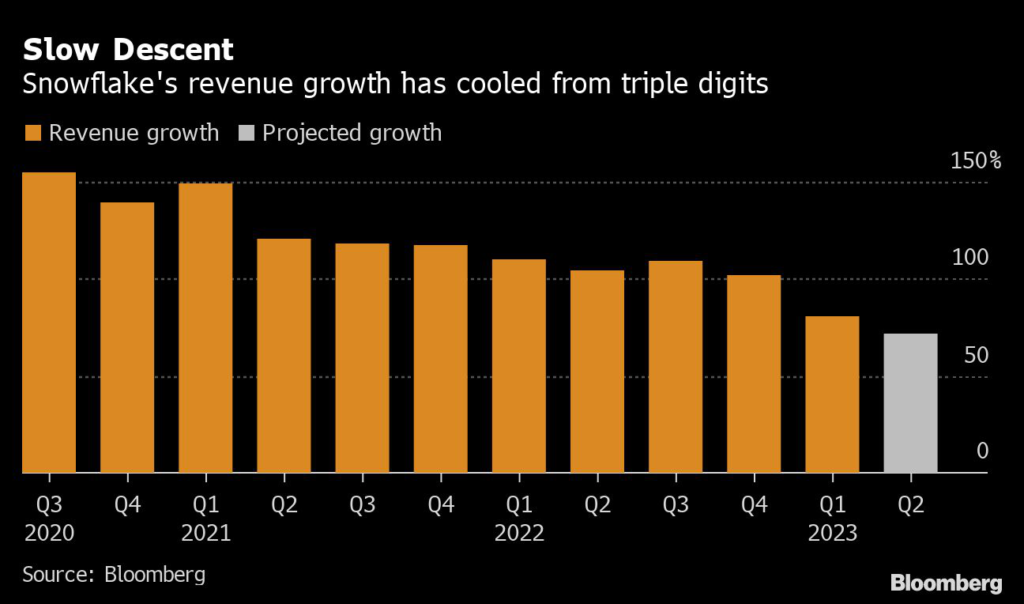
Product revenue is projected to be $435 million to $440 million in the current period, which ends in July, the company said Wednesday in a statement. That would mean growth of 71% to 73% compared with a year earlier — the slowest since Snowflake became a public company in 2020. Product sales make up more than 90% of Snowflake’s total revenue and are watched closely by investors and analysts.

Snowflake came to prominence with one of the biggest U.S. initial public offerings for a software company. Sales had more than doubled year-over-year for six straight quarters through the end of last year, raising expectations and pushing shares to a record $401.89 in mid-November. The stock tumbled 61% this year as part of a broad decline in software company valuations and after Snowflake in March projected revenue would slow below its triple-digit pace.

“Today, some customers face a more challenging operating environment — specific customers consuming less than we anticipated amid shifting economic circumstances we believe are unique to their businesses,” Chief Financial Officer Michael Scarpelli said during a conference call after the results.

Scarpelli said the “macro headwinds we’re hearing” made executives more cautious with their forecast, but didn’t diminish the company’s opportunity for long-term growth. 

Snowflake earns revenue when customers store data and run queries on its platform, which is different from other software vendors that charge a monthly subscription cost. Asked on the call about whether this consumption model posed risks when enterprises cut back on spending, Scarpelli said the company is committed to the model and isn’t considering going to subscription-based contracts.

In the fiscal first quarter, product revenue increased 84% to $394 million. Snowflake said it had 6,322 customers at the end of the period April 30, just missing analysts’ average estimate, and a 6% increase from the previous quarter. 

Revenue retention — a metric of sales growth among current customers — is of particular interest to the market, since Snowflake has managed to keep the figure higher than most peers, said Morningstar analyst Julie Bhusal Sharma. “Usually, you’ll see that start to trend downward as new companies get a little older and a more mature base.”

If tech valuations remain depressed, Snowflake may look for smaller acquisitions to expand technical capacity, Scarpelli said. Bloomberg Intelligence analyst Mandeep Singh wrote in a research note ahead of earnings that the company could use deals to expand into adjacent segments such as data visualization.

Snowflake’s net revenue retention rate was 174% in the quarter, compared with analysts’ average estimate of 161%.

Net loss narrowed to $166 million, or 53 cents a share, from $203 million, or 70 cents a share, a year earlier.

The shares declined about 13% in extended trading price after closing at $132.77 in New York.  

(Updates with additional CFO comments in the sixth paragraph.)

More stories like this are available on bloomberg.com

©2022 Bloomberg L.P.

UK Store Workers Are Desperate to Quit, Retail Charity Finds

(Bloomberg) — The cost of living crisis is the final straw for workers on the UK’s high street. 

One in five retail workers plans to quit due to concerns around their finances, abuse from customers and poor mental health after working through the pandemic, according to a new report. Retail Trust, a charity, surveyed more than 1,500 retail staff and found that a quarter of managers also want to leave the industry.

Higher living costs feature most heavily in workers’ concerns. The Retail Trust has seen a 28% increase in the number of applications it receives for financial aid from retail workers this year, and visits to the charity’s website offering financial health support nearly tripled.

As Britons battle the highest inflation in 40 years, those working in shops are among the worst off. Two-fifths of UK supermarket employees earn below the real living wage and an increasing number use food banks, according to the Independent Food Aid Network. 

“Our research shows there’s a clear gap between how retailers think their employees are feeling and the reality,” said Chris Brook-Carter, chief executive of the Retail Trust. 

The charity provided more than 400,000 pounds ($500,000) in financial support over the past year. The situation poses a serious long-term challenge to the industry as more people leave, according to Brook-Carter.

The Retail Trust has joined with Microsoft Corp., career development firm Workl and UK business consultancy BJSS to create an index allowing employers to track the progress of measures focused on improving their employees’ wellbeing.


More stories like this are available on bloomberg.com

©2022 Bloomberg L.P.

UK Shop Workers Are Desperate to Quit, Retail Charity Finds

(Bloomberg) — The cost of living crisis is the final straw for workers on the UK’s high street. 

One in five retail workers plans to quit due to concerns around their finances, abuse from customers and poor mental health after working through the pandemic, according to a new report. Retail Trust, a charity, surveyed more than 1,500 retail staff and found that a quarter of managers also want to leave the industry.

Higher living costs feature most heavily in workers’ concerns. The Retail Trust has seen a 28% increase in the number of applications it receives for financial aid from retail workers this year, and visits to the charity’s website offering financial health support nearly tripled.

As Britons battle the highest inflation in 40 years, those working in shops are among the worst off. Two-fifths of UK supermarket employees earn below the real living wage and an increasing number use food banks, according to the Independent Food Aid Network. 

“Our research shows there’s a clear gap between how retailers think their employees are feeling and the reality,” said Chris Brook-Carter, chief executive of the Retail Trust. 

The charity provided more than 400,000 pounds ($500,000) in financial support over the past year. The situation poses a serious long-term challenge to the industry as more people leave, according to Brook-Carter.

The Retail Trust has joined with Microsoft Corp., career development firm Workl and UK business consultancy BJSS to create an index allowing employers to track the progress of measures focused on improving their employees’ wellbeing.


More stories like this are available on bloomberg.com

©2022 Bloomberg L.P.

Musk’s Revised Twitter Bid Drops Margin Loan, Requires More Cash

(Bloomberg) — Elon Musk is dropping plans to partially fund his purchase of Twitter Inc. with a margin loan tied to his Tesla Inc. stake and increasing the size of the deal’s equity component to $33.5 billion. 

Musk will provide an additional $6.25 billion in equity financing for the $44 billion buyout, according to a regulatory filing Wednesday. That’s enough to eliminate the margin loan of the same size, which had already been reduced earlier this month.

The new structure could reduce the risk of the deal for both Musk and his lenders, particularly given the recent slide in Tesla’s stock price. The electric carmaker has sunk about 40% since Musk first announced his stake in Twitter in early April. An extended slump raised the prospect that he wouldn’t have enough unpledged shares to cover the margin loan.

Musk, Tesla’s co-founder, is still on the hook for coming up with the full $33.5 billion equity component. But he can turn to others for help. 

Musk is seeking additional financing commitments, including having discussions with Twitter co-founder Jack Dorsey and other investors about rolling their equity into the private company, according to the latest filing. He already announced earlier this month that he secured $7.1 billion of equity commitments from investors including billionaire Larry Ellison, Sequoia Capital and Binance.

Bloomberg reported earlier this month that Musk had received commitments for another $1 billion in equity since that initial round, and his advisers were soliciting interest from potential investors for as much as $6 billion in preferred equity financing.

Musk, 50, is the world’s richest person, with a personal fortune of $200 billion, according to the Bloomberg Billionaires Index. That’s largely due to his stake in Tesla.

Musk already disposed of $8.5 billion of Tesla shares to help raise cash for his Twitter deal, tweeting at the time that he had no further sales planned. 

Twitter closed Wednesday at $37.16, well below Musk’s offering price of $54.20. The shares were up 6.8% in after-hours trading at 4:58 p.m. in New York, while Tesla slid 1.4%.  

(Updates with Tesla share price decline starting in third paragraph.)

More stories like this are available on bloomberg.com

©2022 Bloomberg L.P.

Sequoia Capital Warns Founders on Arrival of ‘Crucible Moment’

(Bloomberg) — Calling the current environment a “crucible moment,” Sequoia Capital warned that the good times are not only over, there’s no indication when they’ll return. 

In a Zoom call earlier this month with the founders of its approximately 250 portfolio companies, the venture firm reviewed a 50-page presentation titled “Adapting to Endure,” according to documents obtained by Bloomberg News. 

Sequoia laid out the case for a long and drawn-out recession, and instructed founders to “do the cut exercise” immediately if they haven’t already done so by examining ways to conserve cash through eliminating or scaling back projects, R&D, marketing and other expenses.

“It doesn’t mean you have to pull the trigger, but that you are ready to do it in the next 30 days if needed,” Menlo Park, California-based Sequoia wrote in the presentation. The Information earlier reported the presentation.

An increasing number of late stage private tech companies  — the same ones that were bankrolled by investors to grow at all costs –- are re-focusing on profit. Swedish buy-now-pay-later company Klarna Bank AB and Berlin-based grocery delivery startup Gorillas Technologies GmbH are among businesses that have laid off hundreds of people recently. 

Sequoia, which also weighed in on the 2020 dip with its Black Swan memo and the RIP Good Times in 2008, called out pre-IPO startups as being particular vulnerable if they weren’t focused on delivering profits.

More stories like this are available on bloomberg.com

©2022 Bloomberg L.P.

Nvidia Revenue Forecast Letdown Sends AMD, Chipmakers Lower

(Bloomberg) — Nvidia Corp.’s disappointing quarterly revenue forecast sent the stock down as much as 10%, and dragged lower the shares of other large chipmakers with it. 

Advanced Micro Devices Inc. and Marvell Technology were among stocks that fell more than 2% in postmarket trading after Nvidia’s outlook, which the company blamed on Chinese supply chain problems and the war in Ukraine. Other decliners included Micron Technology Inc. and Western Digital Corp.

The shares of chipmakers have been pummeled this year amid soaring interest rates and concerns about slowing economic growth that could threaten to leave semiconductor companies saddled with excess inventories. The Philadelphia Stock Exchange Semiconductor Index is down 27% this year compared with a 17% decline for the S&P 500.

As the biggest US chipmaker by market value and a key provider of semiconductors used in data centers, Nvidia is seen as a bellwether for the industry. The Santa Clara, California-based company helped spark a broader rally in March when it pledged to use free cash to maintain growth with new products rather than pursue more aggressive stock buybacks. 

Chipmaker declines coupled with worse than expected results from cloud-computing company Snowflake Inc. late Wednesday could weigh on technology shares after the tech-heavy Nasdaq 100 Index rebounded from a new low for the year during the session.

(Adds background beginning in third paragraph.)

More stories like this are available on bloomberg.com

©2022 Bloomberg L.P.

Close Bitnami banner
Bitnami