

Bloomberg

Google Takes Yet Another Run at E-Commerce—and Amazon

(Bloomberg) — Google executive Prabhakar Raghavan recently had an issue with his rose bushes. His wife took a photo of the plants on her phone, uploaded the image to Google, identified the culprit and followed a link for a fungicide. Then she bought it.

A seamless transaction that didn’t involve typing into a search bar, it was a real-life test of sorts for Raghavan’s strategic vision. A senior vice president responsible for most of Google’s largest services—search, maps, advertising and more—the 61-year-old executive is determined to crack e-commerce, a market projected to hit $2.27 trillion in 2025 that the Alphabet Inc. division has tried and failed to figure out many times before.

In the past, Google has tried emulating Amazon.com Inc.’s online retail and delivery services, with little luck. Now, under Raghavan, the search giant is positioning itself as a kind of anti-Amazon, a free marketplace for merchants and Amazon rivals that’s designed to get consumers more comfortable shopping with Google. 

Earlier this month, at Google’s I/O software conference, Raghavan and his deputies demonstrated new features they hope will achieve that end, including one that lets visitors use photos to search for nearby retail products or find any item in the physical world with the click of a camera. And on Tuesday, the company unveiled a feature that lets people go from merchant listings on Google search to their checkout pages in one click. Raghavan hopes the various initiatives will persuade millions of people to click buy, prompting sellers to purchase many more Google ads. 

For Amazon, which built a booming business by essentially renting its digital real estate to small sellers, the risk is that Google could give those brands a pathway to thriving outside its marketplace. That in turn could force the Seattle-based company to more aggressively court sellers with discounts on fees, advertising or logistics services.

Still, Amazon remains a formidable rival, and Google confronts daunting challenges. Its renewed push into e-commerce coincides with a slowdown in online shopping as consumers revert to their pre-pandemic habits. Amazon and EBay Inc. both recently reported slowing growth and weak profit outlooks. Moreover, Google has always sought to make its technology fade into the background. Turning the site into a shopping destination risks wrecking the experience and alienating visitors. Ahead of the I/O presentation, Raghavan took pains to say shopping on Google would be “super smooth.” If the concept works as advertised, he said, shoppers won’t have to think: “‘Am I doing a search? Am I on Amazon or Google?’”

Raghavan is the first Google executive to oversee the technical operations behind both search and the ads division since Sundar Pichai did in 2014, shortly before he became CEO. Raghavan  is also one of the company’s best compensated executives, pulling down $28.6 million last year in salary and stock grants. As such, he has the clout to set an ambitious e-commerce strategy and, at least theoretically, get people who traditionally operated in silos to collaborate instead.

Those who have worked with Raghavan point to his technical mastery and operational shrewdness—an unusual combination of attributes at a company that has so often coasted on its inventions and profits. “Google is violently allergic to strategic thinking,” said Sam Ramji, a former executive who worked with Raghavan on Google’s cloud products. “He’s the man who brought strategy to Google.” Adds Martha Welsh, Google’s director of commerce strategy: “He really takes a holistic view of the business.”

Since Raghavan’s promotion in mid-2020, he has torn up Google’s e-commerce playbook, scrapping the fees the company levied for online purchases and shuttering the delivery service. He has tried poaching merchants irritated with Amazon, reshuffled the leadership ranks, and overhauled Google’s payments operations by dropping its banking plans and narrowing the focus. He even tasked his search division with catering to people making heady commercial decisions, like buying a home or picking a college.

“He’s willing to make bold moves,” said Bill Ready, Google’s president of commerce, who joined in 2020 as one of Raghavan’s top deputies.

Boldness is required. While Google’s advertising operation continues to print money, the model is under siege from regulators and privacy clampdowns, including Apple’s ban on targeted marketing messages. Due in part to these headwinds, the growth rate of the ad business is destined to slow, and Google isn’t the only one jumping into e-commerce to goose revenue; Meta Platforms Inc. and TikTok are as well.

Meanwhile, even as Google tries to build an online shopping destination to complement its ad business, Amazon has done the inverse: created a robust advertising operation on top of its enormous online bazaar. Google’s success is hard to gauge because it doesn’t break out e-commerce sales or retail ads. Amazon’s is easy to see; its ads business posted 23% growth in the first quarter. “That seems to be working way better for Amazon than it is for Google,” said Mike Ryan, a portfolio strategist for Smarter Ecommerce GmbH. 

Raghavan has tied Google’s main revenue and profit drivers—search and ads—more tightly to its e-commerce efforts than ever before. That’s all put more pressure on him to deliver on his strategy.

Shopping Express

Google’s last big e-commerce push involved going at Amazon head-on. In 2013, Google launched Shopping Express, a delivery service with a nifty app and a promise to ship many items on the same day. Google had huge retail partners on board, including Target Corp. and Walgreens, and planned an annual subscription model a la Amazon Prime. Back then, when quick e-commerce delivery was a novelty, Google’s service looked like a natural Amazon contender.

But it never was. Shopping Express expanded to a few cities outside of the San Francisco Bay Area, but had little appeal for consumers. Google’s “Shopping” site, accessible as a tab on its homepage, aggregated listings from online retailers with paid ads at the top, but attracted relatively few visitors compared with the main search page. Former Google employees say managerial indecision and an unwillingness to invest heavily in the margin-thin business undercut the strategy. Then in 2015, Europe hit Google with a massive anti-monopoly suit that argued the search engine unfairly promoted its own shopping service over others. That forced the company to spin off the European business and move more cautiously.

Google brought in consultants from BCG to assess a specific e-commerce strategy, but didn’t follow the firm’s recommendations. The company shortened the delivery service’s name (to just Express) and revamped it to center on its digital voice-assistant, another Amazon competitor. That effort fizzled, too. “For the past 15 years, Google has been trying to figure out commerce,” said Rick Watson, the head of RMW Commerce Consulting. “And they’ve never really executed.”

In early 2020, Google reset its strategy. Management recruited Ready from PayPal to lead the commerce unit and realigned the search, payments and maps divisions to work more closely with his. To run that entire portfolio, Google picked Raghavan, a veteran of its enterprise division who was put in charge of ads in 2018.

Before joining Google in 2012, Raghavan spent years at tech research labs and in academia, where he became an expert on web search technologies just as they began taking off. He speaks five languages and still carries himself more like a professor than a senior executive. While discussing Google’s decision to emulate the visual, rapid-fire features of TikTok, he said, “It behooves us to also start thinking about those paradigms.” He once requested classical music to accompany his entrance onstage at an event before a staffer interceded.

“He’s always surprised when he gets more responsibility,” said Jayshree Ullal, a longtime friend who runs Arista Networks Inc. “You can never tell he’s a high-powered number-two executive at Google.”

Still, Raghavan made his e-commerce ambitions clear during the first year in his new role. Google, he told colleagues, should think of users being on “journeys”—not simply coming to Google.com for information but to research and, hopefully, buy something. 

He and Ready quickly decided to pull the plug on Express. They dropped the commission Google took for sales on its properties and the fees it charged merchants to list items on its shopping site, a signal to the industry that it wanted to be an open marketplace, not a competitor. “We’re not trying to put boxes on doorsteps,” Ready explained. “What we’re trying to solve is the information part of the problem.” 

By that, Ready meant making it easier for consumers to find desired products, deals or brands—even those that haven’t bought an ad. Search results now identify identify discounts and loyalty programs, while new widgets list the shipping costs and hidden fees on specific purchases.  Google cut deals with Shopify Inc., Block Inc. and other commerce companies to make it more compelling for businesses to sell on Google properties. 

Those features are designed for buying products like sneakers and cooking pans. But the company is also experimenting with items that aren’t on most e-commerce sites—helping consumers buy NFTs via image search or research such big-ticket purchases as real estate. The company has noticed that searchers in the market for a home, college or car will often return to Google more than 60 times with similar queries before making a decision. The idea is to customize the search experiences for these use cases in ways Google hasn’t before.

Google has already done that with certain categories, creating unique features for people searching for jobs or hotels. Companies like Yelp and the online travel industry have complained that these changes buried their sites and forced them to buy more ads to get clicks. Google’s search team has been quietly working on adding more topics. Under the project, codenamed Mercury, the search team has ceded to the advertising group such areas as “shopping, real estate, mortgages, etc,” according to a memo reviewed by Bloomberg. The authors of the document prioritized boosting traffic for merchants and creating “oh wow moments!” that would lure searchers back to Google.com and, eventually, a purchase. Google declined to comment on the project, but executives have said the ads division doesn’t influence unpaid search results.

Raghavan said the company has no plans to rival real estate brokers like Redfin. And, so far, Google has resisted using the search history of repeat visitors to tailor results. That’s largely to avoid violating people’s sense of privacy, he explained. “Can you, in these situations, offer the user more support in a long-running journey, without in any way creeping them out?” Raghavan said his teams were still exploring if they could.

Some in Silicon Valley have blasted Google for filling search results with too many ads. Raghavan said increased demand from advertisers during the pandemic probably drove the recent uptick in advertising, and he expects it to cool off amid easing restrictions on travel and events.

Early Success

There are signs that Raghavan’s strategy is starting to pay off. Earlier this year, Google revealed that e-commerce advertising was a leading contributor to a 43% bump to search revenue in 2021. Google also said last year that over a billion people shop on its properties every day, though it hasn’t updated the figure. In the fall, Morgan Stanley research showed that consumers were using Google and YouTube to research products and price-shop more often than they used Amazon, EBay or Walmart. In April, the bank reported that 59% of survey respondents who are Amazon Prime members said they started researching products on Google, up from 50% in the fall. 

Talley & Twine, an independent watch brand based in Virginia, started getting serious about Google in the past two years and has sometimes seen a fivefold return on its ad spending. “It’s been a saving grace for us,” said President Randy Williams. The other benefit, he added, is that the search engine sends customers to his web store. “That’s the roadblock we have with Amazon,” Williams said. “Amazon’s customers are Amazon customers.”

Still, some industry insiders say Google’s biggest moves to create a marketplace—cutting commissions and listing fees for merchants—have yet to attract significant numbers of shoppers. When those changes were announced, some merchants braced for a big uptick in traffic and sales, said Ryan, the e-commerce strategist. “Then nothing happened,” he said. “I would describe it as nice, but low-impact.”

Kirk Williams, head of the online agency Zato Marketing, said he wouldn’t be surprised if Google’s fee adjustments didn’t alter consumer behavior enough to lure in more merchants. Not many more people visited Google’s shopping site, and most eyeballs remained on the search page, where merchants still feel they have to buy ads to get in front of consumers. “It hasn’t been anywhere near the traffic volume that they were hoping to see,” Williams said.

(Corrects timing of Google’s I/O software conference.)

More stories like this are available on bloomberg.com

©2022 Bloomberg L.P.

 Andreessen Horowitz Raises $4.5 Billion Crypto Fund, the Largest of Its Kind

(Bloomberg) —

Sagging crypto prices and the collapse of the TerraUSD stablecoin are no deterrent for venture capitalists who still see a lot of promise in the industry. In the latest example of that commitment, Andreessen Horowitz said Wednesday that it had raised a $4.5 billion crypto fund, the industry’s largest to date. 

The firm is dedicating $3 billion to venture investments and $1.5 billion to seed investments. The fund, the fourth crypto-dedicated investment vehicle for Andreessen Horowitz, brings its total digital-asset-focused efforts to $7.6 billion. It has backed some of the biggest names in blockchain, including crypto exchange Coinbase Global Inc., nonfungible-token marketplace OpenSea, NBA Top Shot creator Dapper Labs and Sky Mavis, the developer of NFT game Axie Infinity.

With the fund, Andreessen Horowitz blows past initiatives raised in the past year by “crypto-native” firms that have been some of the industry’s biggest cheerleaders. They argue that they better understand the complexities of blockchain and the politics of token governance in comparison to traditional firms that spread out their bets. Included in this cohort is Haun Ventures, the firm started by former Andreessen Horowitz general partner Katie Haun, who raised $1.5 billion dedicated to crypto investments. 

Andreessen Horowitz has taken some steps to give it more of a crypto-native flavor, like launching a research arm stacked with crypto experts to help its portfolio companies and delegating voting stakes to organizations like student clubs in an effort to dilute their influence. These measures, along with the new fund, might not be enough to convince critics that Andreessen Horowitz has crypto’s best interest at heart. 

Despite investing in startups that now make up some of the industry’s biggest cornerstones, Andreessen Horowitz’s influence in crypto, and that of venture capital, have proven controversial. The firm has doubled down on building “web3,” which refers to a decentralized version of the internet owned by users rather than tech giants. But Andreessen Horowitz’s investments, some of which include large crypto token purchases that correlate with major voting power over how blockchain projects are managed, have brought into question whether web3 is as decentralized as its supporters claim.

That tension came to a head when Block Inc. Chief Executive Officer Jack Dorsey sparred with Andreessen Horowitz’s Marc Andreessen and Chris Dixon. “You don’t own ‘web3’,” Dorsey tweeted in December. “The VCs and their LPs do. It will never escape their incentives.” 

The dig resulted in a Twitter block from Andreessen and a barb from Dixon, who tweeted a reference to a Gandhi quote: “First they ignore you, then they laugh at you, then they fight you, then you win.”

“You’re a fund determined to be a media empire that can’t be ignored … not Gandhi,” Dorsey tweeted in response.

Read more: Crypto Investing Shows Signs of Life With StarkWare, Babel Deals

In addition to Andreessen Horowitz’s massive new fund, there are other signs that VC interest in crypto is alive and well. Blockchain startup StarkWare and crypto firm Babel Finance snagged multi-billion dollar valuations in their latest funding rounds.


(Adds startup fundraisings in final paragraphs.)

More stories like this are available on bloomberg.com

©2022 Bloomberg L.P.

Ukraine Says Russia Peace Talks Going ‘Nowhere’: Davos Update

(Bloomberg) — Ukraine Foreign Minister Dmytro Kuleba said peace negotiations with Russia are going “nowhere” and compared Moscow’s offensive in the eastern Donbas region to a World War II battle.

“Tanks, artillery, combat helicopters, air attacks, multiple-launch rocket systems, everything is involved,” Kuleba said during a Q&A at the World Economic Forum in Davos. “When you are conducting an operation like this you basically say no to negotiations.”

The conflict in Ukraine has overshadowed the first in-person Davos meeting in two years. Surging inflation, food shortages, climate change and migration risks have also been high on the agenda, prompting a series of dire warnings about threats to the global economic outlook.

On the final day of the meeting on Thursday, German Chancellor Olaf Scholz delivers a speech and Iran’s Foreign Minister Hossein Amir-Abdollahian takes part in a one-on-one discussion. Bloomberg TV has interviews with the United Arab Emirates’ trade minister and chief executive officers from Rio Tinto Plc, Fidelity International and Moderna Inc.

Key Developments

  • Oil Markets Balanced But Spare Buffers Running Low, Says Aramco
  • Mined Ports, Polish Red Tape Among Issues Stopping Ukraine Grain
  • Moldova Frets of Being Forgotten as Ukraine Pushes for EU Entry
  • Europe Should “Flex Muscles” on World Stage, Lagarde Says
  • Coronavirus Daily: A Quieter Davos Adapts to the Age of Covid

All times CET:

Malaysia Sees Strong Growth (5:45 p.m.)

Malaysia’s economy is growing strongly thanks to the rise in commodity prices and central bankers “still have room” to tighten monetary policy to tackle accelerating inflation if needed, according to Finance Minister Zafrul Aziz.

“We think we are on the right track,” Zafrul told Bloomberg TV. “Our interest rate has gone by up by 25 basis points mainly because of the strength of the economy. I think we are able to increase it without having much adverse impact on the economy because of where we are. But again it is still accommodative.”

Zafrul also said he is “comfortable” with where the ringitt is trading and officials are not considering pegging the currency.

EU Trade Chief Backs Safe Grain Corridors (5:35 p.m.)

Valdis Dombrovskis, the European Union’s trade chief, said that the “fastest way” to export Ukraine’s grain currently blocked by Russian warships would be to create safe corridors with naval escorts. “There are talks to create secured corridors, posibly with military assistance,” he said on a panel.

Dombrovskis added that some shipping is already happening via land corridors through Poland and Romania, but this option isn’t going to replace the volumes that could be sent via sea routes in the short term.

Ireland’s Martin Says US Could Help Resolve UK Spat (5 p.m.)

The involvement of the US in dealing with the dispute over the Northern Irish Protocol is “much more than symbolic,” and the issue can be resolved, Irish Prime Minister Micheal Martin said in an interview with Bloomberg Television.

“The trade representatives and those with experience of trade on the delegation really couldn’t see anything that couldn’t be resolved in terms of the technicalities around the protocol and the issues around the operation of it between the UK government and the European Union,” he said.

The UK “knew exactly what they were signing up to in 2019” and hasn’t given the negotiation process a chance, he said. Even so, a trade war between the EU and the UK is something “nobody wants,” he added.

Bitcoin to Sink to $8,000: Minerd (4 p.m.)

Guggenheim Partners Chief Investment Officer Scott Minerd said he expects Bitcoin to fall to $8,000 and that cryptocurrency has become a market of “a bunch of yahoos.”

“Bitcoin and any cryptocurrency at this point has not really established itself as a credible institutional investment,” Minerd told Bloomberg TV. “Everything is suspect.” Minerd said his firm bought Bitcoin at $20,000 and sold when it reached $40,000. Guggenheim no longer holds any Bitcoin but if it did he’d recommend short selling it, he said.

Action Needed to Prevent Volatility: Aramco (3:50 p.m.)

Oil markets are balanced but companies need to invest more in production to meet rising demand and prevent even greater price volatility, Saudi Aramco’s chief executive officer said.

Output buffers that can be used in emergencies stand at roughly 2 million barrels a day, or 2% of global consumption, Amin Nasser told Bloomberg TV. “That’s very low,” he said. As OPEC+ continues to gradually increase production each month, “very soon you will have a world with basically no spare capacity.”

Brazil ‘Ahead in Inflation Fight’ (3:45 p.m.)

An interest-rate hiking cycle “ahead of the curve” and positive surprises on the fiscal front will help Brazil to “get rid of the inflation problem before advanced economies,” according to Economy Minister Paulo Guedes.

“Central bankers are in my view sleeping at the wheel. Except for Brazil on the monetary and fiscal front,” he said.

Mined Ports Among Issues Stopping Ukraine Grain (3:30 p.m.)

Resuming Ukrainian gain shipments will be time consuming given challenges that include mine-clearing in Black Sea ports and the need for cooperation from the very country that kicked off the war, Lithuanian President Gitanas Nauseda said.

“It could take weeks, not months, but if there will be no will of the Russians to open this window, it will be impossible,” Nauseda said in an interview. “The Russians could use this instrument as yet another leverage to destabilize the situation in the world. They are highly interested to do as much harm as possible.”

Diess Cautious on EU Chip Policy (2:45 p.m.)

Europe building up its own chip capacity was a good development but it’s “dangerous” to talk about becoming “independent” from China and other countries or regions, Volkswagen AG CEO Herbert Diess said during a panel discussion.

“We need an industrial policy” but the goal of complete “autonomy” is the wrong mindset, Diess said. “A self-sufficient world in blocks is a much more dangerous world and a less innovative world, a world that cannot grow as fast and solve as many problems.”

Moldova Frets EU Will Leave it Behind (1:25 p.m.)

With all eyes on Ukraine as it strives to mount the first rung of the process to join the European Union, neighbor Moldova worries that its own push to join the bloc may be forgotten.

Pressing the message that Moldovans were ready to anchor themselves to a European future, Prime Minister Natalia Gavrilita said her country was pushing ahead with strengthening its institutions and bolstering the rule of law, key requirements to be considered an EU candidate.

Chip Shortage Carrier’s Biggest Challenge (1:15 p.m.)

The global shortage of semiconductors makes up “two-thirds” of the challenges facing Carrier Global Corp., Chief Executive Officer David Gitlin told Bloomberg TV.

“It’s the single biggest challenge we have,” said Gitlin, who runs the maker of air conditioning units and refrigerators. “The additional capacity cannot come online fast enough.” Carrier is working directly with manufacturers to switch to alternative types of chips that are more readily available, he said.

Climate Change Is Easiest Problem to Talk About (2 p.m.)

A war in Europe, food shortages in developing countries and surging global inflation haven’t stopped the rich and powerful at Davos from talking about the climate crisis, Bloomberg Green reporter Akshat Rathi writes in his latest newsletter.

That’s not to say the numerous panel discussions on the problem will lead to world-changing solutions right away or that they are even particularly revelatory. But spending time talking about climate change can be a form of therapy given there’s so much consensus on the issue at WEF.

WHO Slams Pfizer on Lack of Covid Research Support (1 p.m.)

Pfizer Inc. should make its Covid-19 medicine Paxlovid available for independent research, in particular into potential antiviral combinations, said Soumya Swaminathan, chief scientist of the World Health Organization.

“Ideally we should have more trials, both combinations as well as different durations of treatment and different patient groups,” Swaminathan said in an interview. She cited potential concerns of antiviral resistance as well as a rebound effect seen in some patients after an initial course of the drug, and said a few thousand doses would be enough for study. Pfizer is confident in its own trial results, and additional studies are “underway or being explored,” a spokeswoman said in an email.

Knot Supports Lagarde’s Policy Plan (12:20 p.m.)

European Central Bank Governing Council member Klaas Knot said he endorses President Christine Lagarde’s new policy timetable, which foresees an exit from negative rates by the end of the third quarter.

“I’m fully on board, I fully support everything that is in the blog,” the Dutch central banker said at panel discussion. “It nicely charts the policy course.”

The comments by Knot, a hawkish voice on the Governing Council, contrast with his Austrian counterpart Robert Holzmann, who on Tuesday called for a half-point hike in July. That’s double the magnitude implied by Lagarde. The ECB’s deposit rate has been negative since 2014 and currently stands at -0.5%.

Genome Manipulation ‘New Nuclear Threat’ (12 p.m.)

Bioterrorists using cyber attacks to target national genome projects pose a bigger threat than a nuclear strike, the global head of healthcare at KPMG LLP has warned. Were malicious hackers able to infiltrate gene editing experiments and manipulate a virus, the consequences would be worse than the Covid-19 pandemic, KPMG International’s Anna van Pouke said in an interview.

“Imagine that there is someone who finds out how to manipulate a genome,” she said. “We had a mutated virus. We don’t know where it mutated, whether it was in a market or a research lab in China, but you know what it did to the world,” she said.

“Just imagine if we have several cases even more severe than that because of genome manipulation in medication, coming from a lab,” van Pouke said. “If someone hacks the genome project with malicious intentions — a nuclear bomb is nothing compared to that. We need to have cyber security working very hard.”

Mitsotakis Shrugs Off Erdogan Jab (12 p.m.)

Greek Prime Minister Kyriakos Mitsotakis brushed off a statement by Turkey’s President Recep Tayyip Erdogan, saying there’s no one named Mitsotakis for him anymore. “We’re neighbors, we always need to talk and we always need to keep channels of communication open,” he said in a one-on-one discussion.

Regarding Turkey’s stance on Finland and Sweden’s accession to NATO, Mitsotakis said: “I think it is a mistake if Turkey continues to use these negotiations to extract sort of benefits for its own national interest.” The last thing we need now within the NATO “is another source of geopolitical instability in the eastern Mediterranean,” he added.

Lagarde: Europe Should ‘Flex Muscles’ (11:45 a.m.)

The war in Ukraine has shown Europe doesn’t understand how powerful it could be on the world stage and the bloc should “flex its muscles” more than it does, ECB’s Lagarde said.

She said the EU’s “monumental market” means it can set the conditions of trade and its competition laws mean it can block mergers around the world. She also noted potential strength as a unified purchasing group and huge pension fund resources that could be better deployed.

Siemens Energy Sees Grids Critical to Green Transition (11:35 a.m.)

Germany’s transition away from cheap Russian gas should take about three to five years with power infrastructure essential to speed up the process, Siemens Energy AG Chairman Joe Kaeser told Bloomberg TV. “If it takes eight years to build a grid, then you have a problem,” he said. “Construction of grids is the critical component to connect renewable energy supply.”

Wind-turbine suppliers such as Siemens Gamesa are currently stuck with a negative profit pool after the industry was caught out by massively rising input costs, Kaeser added. Siemens Energy over the weekend offered to buy the remaining shares in the loss-making unit for $4.3 billion.

Microsoft, Salesforce Add $300 Million for Carbon Removal (11:15 a.m.)

Microsoft Corp. and Salesforce Inc. are committing $200 million and $100 million, respectively, toward buying offsets using carbon-removal technologies before 2030. That adds to $2 billion committed to the sector last month, including investments from Stripe Inc. and Alphabet Inc.

The US government and WEF announced the expansion of First Movers Coalition, a buyers’ club that is supporting technologies to cut emissions from industry. It now boasts 50 global companies and eight countries partners, including India, Japan and the UK. The group is setting out advanced market commitments for green technologies in sectors such as aviation, shipping, trucking, aluminum, steel, cement, chemicals and carbon removal.

Green Shift Needs to Address Inequality, Spain Says (10:30 a.m.)

The climate transition has to address social aspects and inequality in order to ensure popular support, Spanish Minister for the Environmental Transition Teresa Ribera said. “We need to ensure that people benefit from the very first day from the changes,” she said. “Otherwise it’s going to be hard to have the support of the people.”

Ribera warned about a gap of understanding among those calling for climate action and implementing changes, and the workers that will be affected by these changes. “There has been no preparation to create the space for building consensus on how to change.”

EU Must Be More ‘Proactive’: Irish PM (11 a.m.)

The European Union needs to be more proactive in “promoting and supporting” countries that share its values and Albania and North Macedonia should be members of the bloc, according to Irelarn’s Martin. 

Speaking on the same panel, Dutch Prime Minister Mark Rutte urged the EU to become a genuine “player” on the global stage and called for a short-term boost in military spending. “The problem we have is that the EU has for too long been a playing field instead of the player,” Rutte said. “I believe we should now step up our game.”

Raimondo Says Tariffs Can Combat Inflation (10:55 a.m.)

Raimondo said the administration is “looking at” reducing tariffs to help combat America’s “untenable” inflation rate. “Tariffs are obviously a tool in the toolbox that any president has to bring down costs,” Raimondo said in a Q&A. “It’s something we are analyzing.”

The US Federal Reserve has the most powerful tools to deal with inflation and “may need to take more action,” she said. “I’m glad I’m not Jay Powell. It’s a very hard job that he has to try to land the plane on inflation, which is is necessary, without putting the brakes on the economy.”

Accenture Sees Training Countering Great Resignation (10:50 a.m.)

The boss of Accenture says the firm is spending $1 billion on training staff in the increasingly competitive market for white-collar workers.

“That’s great for our current employees, but it’s really attractive if you’re going to join Accenture,” Julie Sweet said in an interview with Bloomberg TV. The firm has 700,000 employees, having added 200,000 in the past two years as businesses look to spend more on IT. “Wage inflation is real and paying market is absolutely critical. However, in a tight labor market it’s not all about wages,” she said.

Standard Chartered Chairman Sees ‘Perfect Storm’ (10:45 a.m.)

“What I worry about is the accumulation of different issues and crises,” Vinals told Bloomberg TV, citing challenges including stagflation, food and energy crises, “fragmentation in the global order of trade and capital flows,” and “cracks in global governance.”

“We’ve had big crises in the past but coming from so many different dimensions this may be quite unique,” he said.

HSBC Touts ‘Massive’ Climate Opportunities (10:40 a.m.)

The head of sustainability at HSBC Holdings Plc said the bank is repositioning itself for the “massive value creation” that’s set to come as the global economy decarbonizes.

Celine Herweijer, chief sustainability officer at HSBC in London, said achieving net-zero carbon emissions is “the focus of pretty much every single board meeting since I joined a year ago, every single executive meeting. It’s a huge transformation job across the bank,” she said during a panel.

Water Needs a Price to Be Valued, Coca-Cola CEO Says (10:20 a.m.)

Water needs to be attached to the climate discussion and be given value, Coca-Cola Co. CEO James Quincey said in a panel. One of the great barriers is that some 70% of the water is used by small-scale agricultural farmers and imposing a price on them would be very economically damaging, he said. 

“But unless water has a value, it’s going to be difficult,” Quincey said. “If we could value water in the same way we could value carbon, then the market will be the mechanism to drive the results.”

Gates: Risk of War Pulling Focus from Health (9:50 a.m. CET)

Russia’s war in Ukraine may pull the world’s focus away from key global health issues, exacerbating challenges that linger due to the Covid-19 pandemic, according to Bill Gates, co-chair of the Bill and Melinda Gates Foundation.

“The Ukrainian situation is stretching the world’s resources,” Gates said at a news conference, adding that the pandemic had already pressured budgets, with malaria deaths rising and routine vaccination rates down. “We see that both in terms of resources for health, resources for food, availability of fertilizer. The tragedy of the war goes far beyond the battlefield.”

Siemens Sees Green Investment Opportunities (9:40 a.m.)

Green is the best investment opportunity now, Siemens AG Chairman Jim Hagemann Snabe said on a panel on globalization’s role in decarbonization. Following technological advances over the past two decades — such as generating cheaper electricity with solar — a dramatic boost in investments in energy and food systems as well as transportation needs to happen, he said.

“We need a healthy inflation rate of 2%, then we need to shift investments to green,” Snabe said. “I am optimistic. We have the technologies to shift investments to decarbonization. It’s a leadership moment.” Putting a price on CO2 is the sharpest knife to decarbonize, he said, while high prices for coal and oil are helping too.

Looming Oil Boom ‘Will Wreck the Amazon’ (9:30 a.m.)

Ecuador is about to experience an expansion in oil production that will further damage the Amazon, according to environmental and human rights activist Helena Gualinga.

“Legal and illegal mining have expanded incredibly in Ecuador and there’s an oil expansion coming,” Gualinga told a panel. “We don’t know exactly where that oil will be coming from, but we know the Amazon will be affected.”

Improper drilling for oil means the Ecuadorian Amazon is currently seeing two to five spills per week, she said. Indigenous people are disproportionately affected by the pollution, with children suffering rashes on their bodies as authorities and companies fail to alert communities.

Drug Companies Lobby for Biotech (9:30 a.m.)

Europe needs to do better to promote biotech development, according to pharmaceutical executives. Regulators in Europe “should rather take an opportunity-focused stance. In North America, this is much better,” Bayer AG CEO Werner Baumann said at a panel. Governments need “to play a role and have an open mindset to bring forward biotech as great source of health for the planet,” Royal DSM NV CEO Dimitri de Vreeze said at the same panel.

Baumann pointed to Bayer’s BlueRock unit that is potentially developing a first curative treatment for Parkinson’s disease with stem-cell therapy and has already enrolled a number of patients in early-stage trials. “About 1 out of 100 stage one projects is successful” and that type of research need to be incentivized properly, he said.

IMF’s Gopinath See Uneven Recoveries (9:30 a.m.)

Advanced economies will recover more swiftly from the impact of the coronavirus pandemic than emerging and developing countries, according to the IMF’s Gopinath.

“We have the advanced economies that based on our projections will basically get back to where they would have been in the absence of pandemic in 2024, so literally no output losses,” Gopinath said on a Bloomberg panel. “But we have emerging and developing economies that will be around 5% below where they would have been in the absence of the pandemic.”

Nasdaq CEO Expects IPO Market to Pick Up in 2H (9:15 a.m.)

Nasdaq Inc. Chief Executive Officer Adena Friedman says the moribund IPO market may bounce back in the second half of the year if inflation is tamed by the Federal Reserve. She said Nasdaq has a pipeline of about 270 companies that have shown interest in listing at some point.

War Clouds Ownership of Europe’s Biggest Nuclear Plant (9:10 a.m.)

The head of the world’s nuclear watchdog said that Russian demands that Ukraine begin paying for electricity generated at an occupied atomic plant is adding new layers of complexity to the conflict. Russia wrested control over the Zaporizhzhya Nuclear Power Plant — Europe’s biggest such facility — in the early days of the war and has maintained control ever since.

“The plant is in Russian hands but is operated by Ukrainian people and is feeding the Ukrainian grid,” International Atomic Energy Agency Director General Rafael Mariano Grossi told Bloomberg TV. “That brings a lot of problems that are not technical but political in nature.”

While the Kremlin has yet to officially confirm its intentions, comments last week by Russian Deputy Prime Minister Marat Khusnullin suggested to some that the Kremlin may be preparing to hold onto the plant for the long term. IAEA monitors continue trying to gain access to Zaporizhzhya, in order to account for the 30,000 kilograms of plutonium and 40,000 kilograms of enriched uranium last reported at the site.

EU Oil Embargo Seen in ‘Coming Week’ (9 a.m.)

The European Union is pushing to overcome Hungary’s resistance to a ban on Russian oil imports, with Economy Commissioner Paolo Gentiloni hopeful of a deal within a week.

“We are all discussing that Hungary is not supporting the oil embargo, and it’s true but we are working on this,” Gentiloni told Bloomberg TV. Asked if the EU could move to halt Russian oil imports without Hungary, he added: “I don’t like to discuss Plan B when we are working on Plan A.”

Pfizer Slashes Drug Prices for Poorest Nations (9 a.m.)

Pfizer plans to sell its entire portfolio of brand-name drugs at cost in as many as 45 lower-income countries, one of the most comprehensive and ambitious drug-access programs ever announced by a large pharmaceutical manufacturer.

The initiative will start in five African countries with 23 drugs for cancer, rare illnesses, inflammatory conditions and infectious diseases. It will eventually include all of the New York-based company’s future therapies or vaccines. The drugs will be sold at the cost of manufacturing, Pfizer said, typically a fraction of their price in U.S. or European markets. Chief Executive Albert Bourla plans to speak about the drugmaker’s effort at Davos.

Ukraine Says West Shouldn’t Push Partial Victory (8:50 a.m.)

Ukraine’s Kuleba said the transatlantic alliance was “reinvigorated” only because of his nation’s efforts to withstand the Russian invasion and should in turn fully back Ukraine’s desire to achieve a complete victory. The government in Kyiv has previously expressed concern that some allies would prefer it agree to cede some territory in order to bring the war to a quick end.

“We need the West primarily to finally accept the idea that the ultimate goal of this war should be the victory of Ukraine,” Kuleba said at the Victor Pinchuk Foundation event.

“Even some very good friends of Ukraine who help us really a lot they are are still hesitant,” he said. “What is the end goal of their support for Ukraine? Is it not to allow Russia to win? Is it not to allow Ukraine to fail? No, the goal should be very simple and clear — Ukraine must win. Full stop. Period,” Kuleba said.

Ukraine Doesn’t See NATO Securing Grain Passage (8:15 a.m.)

Ukraine’s Kuleba said he saw no desire from NATO now to help secure safe passage of grains through the Black Sea, an effort seen as crucial to counter concerns about food shortages and rising prices.

“If NATO did not close the Ukrainian skies in the most tragic moments of the war, why should they dare to close the Ukrainian sea to allow the free passage of vessels with Ukrainian agricultural products,” he said. “I would wholeheartedly welcome the decision, but I just don’t see the stamina and the bravery to take all the risks associated with this operation.”

The interruption of the agricultural cycle of Ukraine risks a multi-year global food crisis, Kuleba told a breakfast organized by the Victor Pinchuk Foundation, “but in the end, the problem is that you cannot trust Russia even if they sign papers guaranteeing safe passage.”

More stories like this are available on bloomberg.com

©2022 Bloomberg L.P.

Hungary to Force Large Companies to Turn Over ‘Extra Profit’

(Bloomberg) — Hungary will force large companies ranging from energy companies to airlines to turn over the bulk of their “extra profit” to two funds that will cover the cost of utility price subsidies as well the development of the armed forces, Prime Minister Viktor Orban said.

The measure, which will be in place for 2022 and 2023, affects banks and “large multinational companies,” including in energy, insurance, large retail, airline and telecommunications companies, Orban said after a cabinet meeting on Wednesday. He said these companies have made “extra profit” during the ongoing war in Ukraine.

It was the first government decision announced under a wartime state of emergency that took effect on Wednesday. Details of the move and its costs will be announced at a government briefing on Thursday, Orban said.

The forint extended losses after Orban’s announcement, dropping 1.8% against the euro.

More stories like this are available on bloomberg.com

©2022 Bloomberg L.P.

Apple Car Director Heads to Luminar After Less Than a Year

(Bloomberg) — Luminar Technologies Inc. hired Christopher “CJ” Moore, a manager on Apple Inc.’s car project and a former director of Autopilot at Tesla Inc., to lead global software development.

Moore, who had joined Apple in August, will lead Luminar’s software team to develop autonomous safety features integrated with its lidar, or laser sensors, the auto-parts company said in a statement Wednesday. Luminar shares jumped as much as 8.2% and were trading up 4.8% at 12:09 p.m. in New York.

The departure from Apple continues a string of high-profile changes to its car project. Over the last two years, nearly the entire Apple Car management team has left. Earlier this month, Ian Goodfellow, another director on the Apple project, left for Alphabet Inc.’s DeepMind. At the same time, Apple has hired new managers from Ford, Rivian and other car industry players.

Orlando, Florida-based Luminar, which went public via a $3.4 billion reverse merger in 2020, has signed agreements with Mercedes-Benz, Volvo Car AB, and SAIC Motor Corp. to provide laser sensors to enable semi-autonomous driving in passenger cars.

Luminar also said it hired Taner Ozcelik, a veteran of Nvidia Corp.’s automotive business, to lead product development.

Apple shares declined less than 1%.

(Updates with share reaction in second pararaph and hiring of Nvidia executive.)

More stories like this are available on bloomberg.com

©2022 Bloomberg L.P.
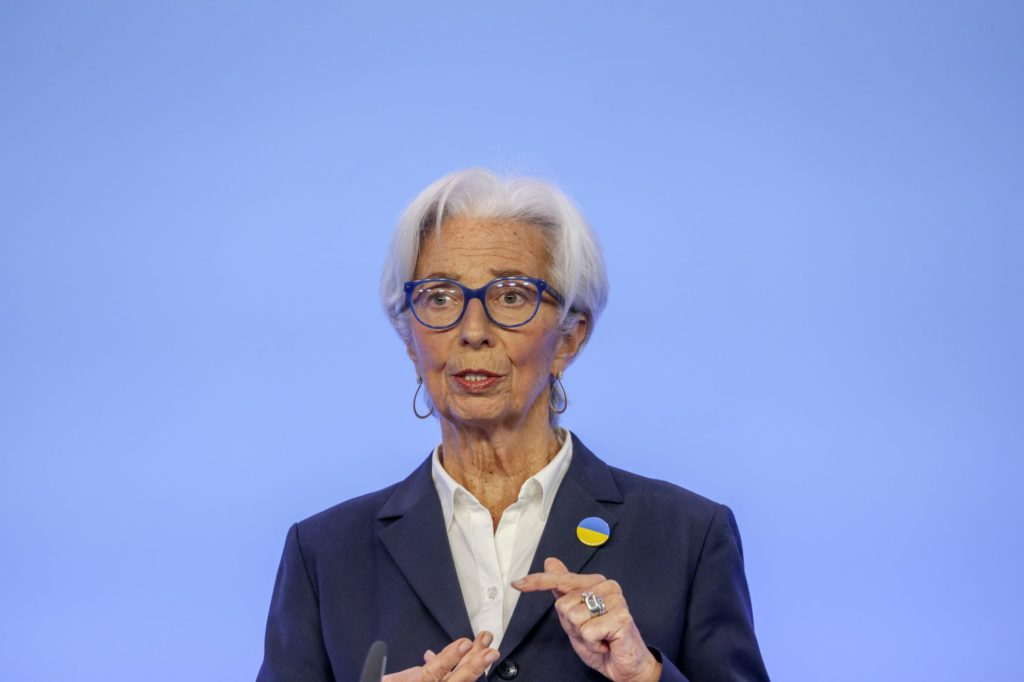
Once a Crypto Trailblazer, Estonia Is Cracking Down on Risk

(Bloomberg) — Estonia, the Baltic nation of 1.3 million that’s sought to be one of Europe’s leading crypto hubs, is reining in the digital assets it once championed.

The regulatory crackdown is emblematic of a broader effort among European policymakers rushing to address the risks posed to the financial system by crypto markets as they grow in size and complexity. 

It’s also a remarkable reversal for Estonia, which was home to more than half the world’s registered virtual-asset service providers last year. A sector once hailed for innovation has since been hit with allegations of links to ransomware and money-laundering schemes. 

Matis Maeker, the head of Estonia’s Financial Intelligence Unit, said investors will begin “waking up” to the need to bring the crypto market to heel after the boom gives way to fresh scrutiny and evaporating value, most recently illustrated by the meltdown of the stablecoin TerraUSD and its sister token Luna. 

“When the market starts crashing, people see that the places that they invested — the NFTs, the DeFis, the DAOs, and Web3 — they are losing their assets,” Maeker said in an interview last month in Tallinn, rattling off a list of digital platforms. 

Starting June 15, Estonian crypto companies will need to meet new transparency and supervision requirements, according to rules set forth by the FIU. Accounts can no longer be anonymous and the minimum threshold for startup capital will jump as much as 30-fold to 350,000 euros ($376,000). 

A ‘Highly Speculative Asset’

Five years ago, Estonia — known for producing tech pioneers such as digital payments group Wise Plc and Uber rival Bolt Technology OU — began offering scores of licenses to firms. 

After the number of licensed crypto companies peaked at well over a thousand in 2019, the risks tied to the ever-rising financial volumes multiplied. Attitudes hardened after a 2018 money-laundering scandal involving Danske Bank A/S and allegations of up to $200 billion in suspicious flows.

Estonia’s FIU said in January that between July 2020 and July 2021, transaction volumes in the sector amounted to about 20 billion euros, the bulk of it handled by a handful of firms. Licensed companies have about 5 million clients. 

The FIU has now revoked the majority of crypto licenses it’s issued, with 381 remaining as of the beginning of this year — many of which are expected to be either revoked or given up next month. 

For Maeker, Estonia’s role as a pioneer of sorts in crypto means that it’s in a better position than most to know how to go about imposing regulations.  

“We are better off than many countries in the world, which still don’t know how to regulate them — and we do,” Maeker said. 

The Estonian effort could be a bellwether for Europe. A stability review from the European Central Bank said that crypto markets “show all the signs of an emerging financial stability risk,” as the central bank mulls regulatory efforts. ECB President Christine Lagarde said last week that crypto is “worth nothing,” a sentiment she repeated in an interview with Bloomberg Television. 

“All I know is that it has moved up and has moved down — and it is a highly speculative asset,” she said at the World Economic Forum in Davos, Switzerland, on Tuesday. “Some are experiencing this at the moment.” 

Estonia especially has come under scrutiny. Two of the country’s largest crypto players have been sanctioned by US authorities for having links to ransomware. In April, Garantex Europe, a crypto exchange with 5 billion euros of transactions annually, was sanctioned by the US authorities for processing $100 million in transactions associated with criminal actors and darknet markets.

The pushback has drawn protest from the industry, which has complained about heavy-handed policies that have sapped the allure of licenses and prompted investors to consider shifting resources elsewhere. 

“For startups with great ideas, the threshold to get access to this market is completely different than before,” Raido Saar, chairman of the Estonian Cryptocurrency Association, said in an interview in Tallinn last month.

(Adds transaction volume in ninth paragraph.)

More stories like this are available on bloomberg.com

©2022 Bloomberg L.P.
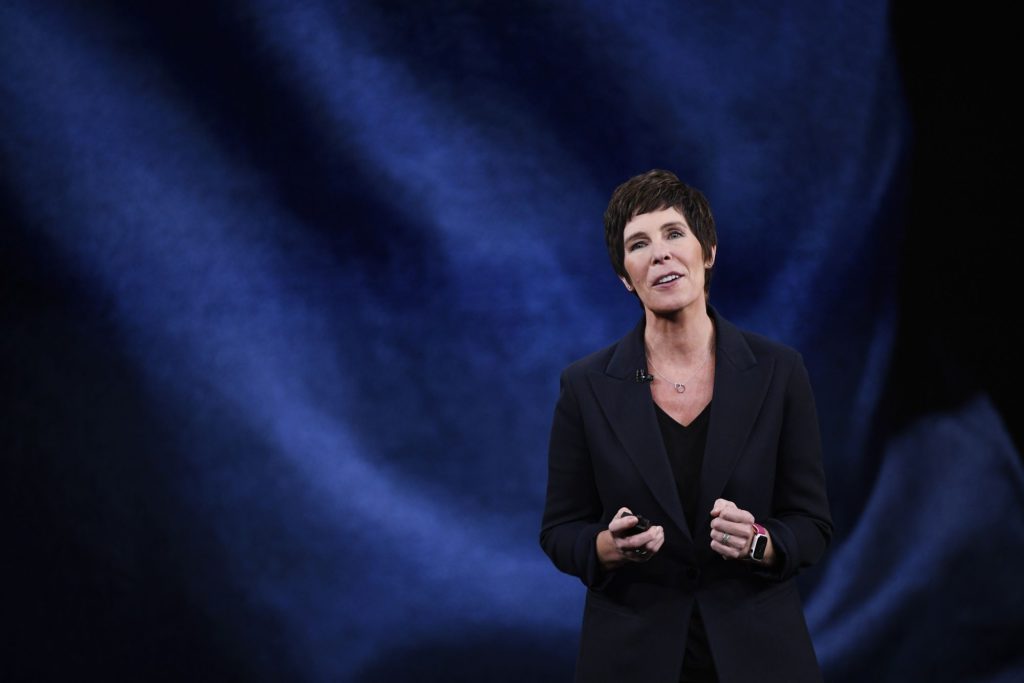
Apple’s Retail Chief Pushes Back on Unionization in Video to Staff

(Bloomberg) — Apple Inc.’s retail chief, pushing back on a campaign to unionize stores, told employees that the effort could slow workplace progress and that third-party labor groups don’t share the company’s commitment to employees. 

“It is your right to join a union — and it is equally your right not to join a union,” Deirdre O’Brien, senior vice president of retail and human resources since 2019, said in a video to employees. “And if you’re faced with that decision, I want to encourage you to consult a wide range of people and sources to make sure you understand what it could mean to work at Apple under a collective bargaining agreement.”

The Cupertino, California-based company, which has about 270 retail stores in the US, declined to comment.

Apple is contending with unionization efforts in several parts of the US, including Washington state, New York City and Maryland. Earlier this month, Apple posted signs in break rooms within retail locations to reiterate its employee benefits while implying that some may disappear if stores become unionized. 

O’Brien, a veteran Apple executive, said that the relationship between the company and its retail employees could suffer if stores are represented by unions. She also implied that the organizations may not be acting in the best interests of workers.

“We have a relationship that is based on an open and collaborative and direct engagement, which I feel could fundamentally change if a store is represented by a union under a collective bargaining agreement,” she said. “And I worry about what it would mean to put another organization in the middle of our relationship. An organization that doesn’t have a deep understanding of Apple or our business, and most importantly, one that I do not believe shares our commitment to you.”

Over the past several months — after retail employees raised concerns about workplace conditions and benefits — Apple has increased pay, issued additional bonuses and expanded vacation time. O’Brien said that implementing new changes could take longer under unions. 

“I don’t know if we could have moved as quickly under a collective bargaining agreement as it could limit our ability to make immediate, widespread changes to improve your experience,” she said. “Because the union would bring its own legally mandated rules that would determine how we work through issues, it could make it harder for us to act swiftly to address things that you raise.”

More stories like this are available on bloomberg.com

©2022 Bloomberg L.P.
Ukraine Latest: Putin Offers Russian Passports in Occupied South

(Bloomberg) — Russian President Vladimir Putin approved a fast-tracked citizenship process for people in areas of southern Ukraine occupied by his forces, drawing condemnation from Kyiv.

Ukrainian President Volodymyr Zelenskiy said the Kremlin should pull back its troops to their positions before the Feb. 24 invasion to show it is ready to resume talks, even as Russia amassed forces for an offensive near the city of Zaporizhzhia and continued attacks in the Donbas region.

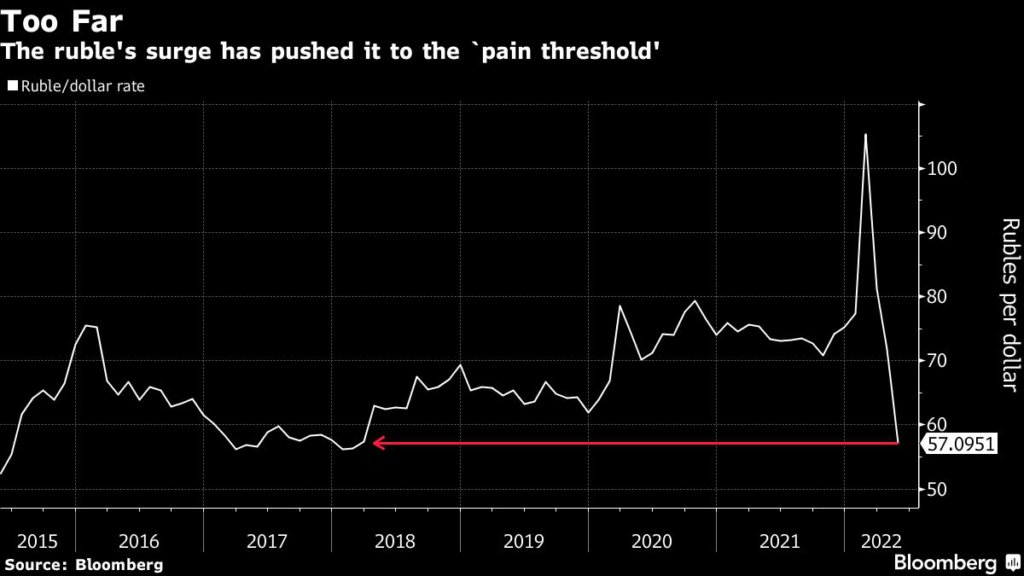
The Bank of Russia moved up its next interest-rate meeting by more than two weeks to Thursday as currency controls and high commodity prices have fueled the ruble’s surge against the dollar. Moscow may make foreign debt payments in local currency after the US Treasury Department let a waiver expire, pushing Russia closer to a default.  

(See RSAN on the Bloomberg Terminal for the Russian Sanctions Dashboard.)

Key Developments

  • Mined Ports, Polish Red Tape Among Issues Stopping Ukraine Grain
  • Russian Billionaire Investigated by UK for Sanctions Violations
  • Russia Edges Closer to Default as US Says Key Waiver Will Expire
  • Russia Set to Step Up Actions to Tame Rampant Ruble Rally
  • Klitschko Boxing Heroes Warn That Returning to Kyiv Is Dangerous
  • Oil’s Most-Prized Barrels Soar as Europe Switches Out Russia

All times CET:

Putin Says Economy Doing Better Than Some Expected (5:15 p.m.)

Russia’s economy is doing better than some forecasters expected, Putin told officials, although he added this year remains “not easy.”

“Our economy’s trend is significantly better than some experts forecast,” he told a televised Kremlin meeting, saying inflation this year won’t exceed 15%. He didn’t mention the government’s prediction that output will contract by 8% this year under pressure from Western sanctions imposed over his attack on Ukraine.

Putin also touted the strength of the ruble, which this week has hit the highest levels against the dollar since 2018, prompting the government to ease capital controls imposed after the invasion.

Putin Visits Military Hospital For First Time During War (5:11 p.m.)

Putin met doctors and wounded soldiers at a Moscow military hospital in his first such visit since he ordered the invasion of Ukraine three months ago. The wounded soldiers he met were dressed in matching pajamas and had no visible injuries in photographs on the Kremlin website and broadcast on state TV.

Russia has not announced casualty figures since March 25, when it said 1,351 soldiers died and 3,825 were wounded in fighting in Ukraine. The UK Defence Ministry estimated this week that about as many Russians have been killed as in the Soviet Union’s 9-year war in Afghanistan, when about 15,000 soldiers died.

Russia Offers Fast-Track Citizenship in Occupied Ukraine (4:51 p.m.)

Putin signed a decree on Wednesday offering fast-track citizenship to residents of two occupied southern Ukrainian regions — Kherson and Zaporizhzhia.

Russia offered a similar path to citizenship in the breakaway eastern Donetsk and Luhansk regions, which about 860,000 people received prior to the Feb. 24 invasion of Ukraine. Russia is moving to annex Ukrainian territory it controls, according to occupation authorities and people in Moscow familiar with the matter.

Ukraine condemned the move, with the Foreign Ministry saying that “illegal” distribution of Russian passports violates its sovereignty, territorial integrity and international laws. “Forced passportization of Ukrainians in Kherson and Zaporizhia is another evidence of the criminal goal of Russia’s war against Ukraine,” it said.

Mined Ports, Red Tape Stopping Ukraine Grain (3:22 p.m.)

Resuming Ukrainian gain shipments will be time consuming given challenges that include mine-clearing in Black Sea ports and the need for cooperation from the very country that kicked off the war, Lithuanian President Gitanas Nauseda said.

“It could take weeks, not months, but if there will be no will of the Russians to open this window, it will be impossible,” Nauseda said in an interview Wednesday. “The Russians could use this instrument as yet another leverage to destabilize the situation in the world. They are highly interested to do as much harm as possible.”

Another option, Nauseda said, is to reroute Ukrainian grain through other ports in the region by rail, though that channel would be daunting. An “experimental train” sent from Ukraine via Poland to the Lithuanian port of Klaipeda took three weeks, he said.

Ukraine Seeks More Rocket Launchers as Donbas Front Deteriorates (2:41 p.m.)

Ukraine needs multiple rocket launch systems as soon as possible, Kuleba said on the sidelines of World Economic Forum in Davos. Delay will worsen an “extremely bad” situation in Donbas and prevent Ukraine from liberating the region around Kherson in the south, he said.

“We cannot allow Russia to stay in Kherson because if they do, they will have a strategic position to pose a threat to central Ukraine but also to southwestern Ukraine in the direction of Odesa, and they will keep stealing our grain.”

Military spokesman Oleksandr Motuzyanyk said that, while Russia has achieved some “tactical successes” in different areas, they are result of Ukrainian maneuvering and shouldn’t be mistaken for retreat by Kyiv’s forces.

Moldova Frets of Being Left Behind as Ukraine Vies for EU Entry (1:25 p.m.)

With all eyes on Ukraine as it strives to mount the first rung of the process to join the European Union, neighbor Moldova worries that its own push to join the bloc may be forgotten.

Pressing the message that Moldovans were ready to anchor themselves to a European future, Prime Minister Natalia Gavrilita said her country was pushing ahead with strengthening its institutions and bolstering the rule of law, key requirements to be considered an EU candidate. 

“The time is now,” she said in an interview at the World Economic Forum in Davos, Switzerland. “The people of Moldova have voted massively for European integration a while before the war even started.”

Russia Welcomes Tribunal for Azovstal Defenders (1:20 p.m.)

Russia said it backs the establishment of a tribunal by its separatist allies to try Ukrainian defenders for war crimes after they surrendered at the Azovstal steel plant.

“We welcome the start of this process,” Russian Foreign Ministry spokeswoman Maria Zakharova said at her weekly briefing on Wednesday.

Russia said that 2,439 Ukrainian fighters surrendered last week at the final bastion of resistance in the port city of Mariupol. Moscow has said it is willing to consider swapping the detainees for captured Russians only after they are tried and convicted, a stance that may complicate Kyiv’s hopes of freeing its soldiers.

Citigroup Improves Russian 2022 Economic Forecast (1:18 p.m.)

Citigroup’s chief Russia economist revised the outlook for the country’s economic decline to 5.5% in 2022 from 9.6% previously due to recent data suggesting improved consumer strength and net-export performance.

“The original financial shock had weighed on sentiment, but the robust policy response by authorities supported a faster-than-anticipated return to normalcy,” Ivan Tchakarov wrote in a note.

Big Tech Lobbies EU to Send Ukraine Telecom Gear (12:21 p.m.)

A Tech lobby group that includes companies such as Amazon.com and Microsoft are urging the European Commission to do more to boost donations of telecom and data center equipment to Ukraine to replace infrastructure destroyed by the war.

Russia has targeted key communications infrastructure in Ukraine since the opening days of the invasion, when missiles struck TV towers and data centers around the country.

Belarus Exports Could Drop 30% This Year From War (11:22 a.m.)

Belarusian export revenue is poised to decline 30% this year, or by $14 billion, after the war led to foreign sanctions and a loss of access to Ukraine’s market, state-owned news agency Belta reported, citing First Deputy Prime Minister Nikolai Snopkov.

The country’s GDP declined 2.1% over the first four months of the year due to sanctions, Snopkov said. Belarus, which was already heavily sanctioned before the war, came under increased pressure as its authorities allowed the country to be used as a staging area for the invasion.

Lebedev Steps Down From UK News Board (11:01 a.m.)

Former KGB agent Alexander Lebedev stepped down from the board of a UK newspaper business that his son owns days after he was sanctioned by Canada, filings show. 

The move underscores a tightening focus on his family amid the war in Ukraine that has become politically awkward for Prime Minister Boris Johnson. Johnson appointed Lebedev’s son Evgeny to the UK’s upper chamber of parliament as a Lord in 2020. 

Russia, Iran Tighten Trade Ties (10:41 a.m.)

Russia said it is strengthening trade with Iran, boosting the economies of both nations as they contend with heavy US sanctions.

“We’re on track to raise trade, economic, logistics, investment, financial, banking cooperation, despite the unprecedented pressure that Russia is experiencing,” Deputy Prime Minister Alexander Novak said at a meeting with businesses in Tehran, Interfax reported. Trade between Russia and Iran rose by more than 10% in the first quarter, he said. 

Russia May Make Foreign Debt Payments in Rubles (10:32 a.m.) 

Russia plans to make foreign debt payments in rubles after the US Treasury Department let a key sanctions waiver that could force the country into default expire, State Duma Speaker Vyacheslav Volodin said, citing Russia’s experience requiring ruble payments for gas shipments. 

“First of all, we have all the necessary monetary resources for payments,” Volodin wrote on his Telegram channel. “Secondly, we will pay in rubles.”

Russian Cruise Missile Strike as Zaporizhzhia Offensive Ramps Up (10:03 a.m.) 

Cruise missiles hit industrial cities in Ukraine’s east as Russia intensified an offensive near Zaporizhzhia. The strikes killed one person and destroyed more than 60 houses in the city of more than 700,000 on the Dnipro river, the region’s administration said on Facebook. 

Three missiles damaged a factory in the steel-making hub Kryvyi Rih, Dnipro region governor Valentyn Reznichenko said on Telegram. Russian missiles also fell on residential areas in Kramatorsk north of Russia-controlled Donetsk, a local official said.

Russia May Allow Corridor For Grain Shipments (9:41 a.m.)

Russia is ready for a dialog to resolve the situation with blocked grain freighters in Ukraine, Deputy Foreign Minister Andrey Rudenko said, Interfax reported. He reiterated Russia’s claim that Kyiv is to blame for the problem because it mined its ports.

Moscow has effectively blockaded Ukrainian ports, leaving the government in Kyiv struggling to get grain shipments out and sending prices to near-record highs.  

Bank of Russia Reschedules Rate Meeting Amid Ruble Rally (9:04 a.m.)

Russia’s central bank moved its next interest-rate decision to 9:30 a.m. Thursday, after government officials suggested further monetary easing may be needed to help stem the ruble’s surge to highest since 2018.

The Bank of Russia has lowered the key rate twice since an emergency rate hike to 17% in the days after Russia’s invasion of Ukraine. The benchmark rate now stands at 14% and the next scheduled meeting wasn’t until June 10. The Economy Ministry said earlier this week that the ruble’s strengthening was nearing a peak. 

Ukraine Seeks to Return all of Its Territories, Zelenskiy Says (8:55 a.m.)

Ukraine will fight until it returns all of its territory, Zelenskiy said via video link at a breakfast organized by the Victor Pinchuk Foundation in Davos.

Talks with Russia have stalled and Kyiv doesn’t see prospects for diplomacy until the Kremlin pulls its troops back to positions held before the invasion, according to Zelenskiy. Putin doesn’t “realize to the very end what is happening, he lives in his informational world,” the Ukrainian leader said.

West Should Back Full Victory for Ukraine, Kuleba Says (8:44 a.m)

Kuleba said his nation’s efforts to withstand the Russian invasion were to credit for a “reinvigorated” West on the world stage, and it should in turn fully back Ukraine’s desire to achieve a complete victory. 

“We need the west primarily to finally accept the idea that the ultimate goal of this war should be the victory of Ukraine,” Kuleba said at the Victor Pinchuk Foundation breakfast. The government in Kyiv has previously expressed concern that some allies would prefer it agree to cede some territory.

Ukraine Sees No Will of NATO to Help With Naval Escorts (8:12 a.m.)

Kuleba said he saw no desire from NATO now to help secure safe passage of grains through the Black Sea, a crucial move as the world worries about food shortages and rising prices.

“I would wholeheartedly welcome the decision but I just don’t see the stamina and the bravery to take all the risks associated with this operation,” he said.

The interruption of Ukraine’s agricultural cycle risks a multi-year global food crisis, Kuleba said, “but in the end the problem is that you cannot trust Russia even if they sign papers guaranteeing safe passage.” 

Russia and China Air Drill Rankles Neighbors (7:19 a.m.)

Japan’s top government spokesman Hirokazu Matsuno condemned a joint exercise held by Chinese and Russian war planes as a “heightened provocation.” The countries conducted a military drill Tuesday as US President Joe Biden finished an Asia trip, sending bombers and other aircraft south of the Korean Peninsula and over waters between Japan and South Korea, Seoul said, as it criticized the move.

China said its joint strategic air patrol with Russia didn’t target any third party and had nothing to do with the current international and regional situations, according to a statement from the defense ministry. 

More stories like this are available on bloomberg.com

©2022 Bloomberg L.P.

Terra Blockchain to Split, Abandon Collapsed UST Stablecoin

(Bloomberg) — A proposal by the founder of the troubled Terra ecosystem to salvage the project was approved, averting a total collapse of one of the most-watched experiments in decentralized finance. 

Under Do Kwon’s newly approved structure, the original blockchain will be known as Terra Classic, while its native token Luna, which plunged close to zero this month, will be renamed Luna Classic with the ticker LUNC. The new Terra blockchain will start running a coin under the existing Luna name and ticker, and won’t include the TerraUSD stablecoin. 

Terra’s unraveling, which started earlier this month with the implosion of the algorithmic stablecoin Kwon had touted relentlessly, marked one of the biggest busts in the crypto industry’s history. While the outcome of Wednesday’s vote represents a victory of sorts for Kwon and his supporters, doubts persist about whether Terra can ultimately be revived. 

The process means Terraform Labs is effectively abandoning the stablecoin TerraUSD, or UST, which from now on will only trade on the Terra Classic blockchain. Designed to maintain a 1-to-1 peg to the dollar, it traded at around 10 cents on Wednesday.

Read more: Do Kwon Proposes Creating Another Blockchain From Terra’s Ashes

Kwon, the crypto entrepreneur behind Terra, had proposed to split the blockchain in half, carrying out what is known in the industry as a “hard fork” of the network. His suggestion was later amended by Terraform Labs, the project’s main operator, to instead forge an entirely new Terra blockchain and leave the old network to be managed by users. 

Kwon said the new Luna tokens would be distributed to previous holders of Luna and UST in a so-called “air drop,” relying on a snapshot taken of the old Terra network to verify participants. All decentralized applications and assets built on the old Terra chain will need to migrate to the new one, Terraform Labs said, with Luna and UST holders advised to transfer their tokens to native Terra wallets rather than holding them on exchanges. 

Doomed Mechanism

UST used a mix of algorithms and trader incentives to adjust its supply in relation to its sister token Luna and maintain its dollar peg. In theory, those mechanisms were supposed to guarantee that UST never deviated for long from its link. 

As UST began to lose its peg in the days following May 7, TerraForm labs was forced to dramatically increase the supply of Luna coins to restore the link. That, in turn, caused the price of Luna to collapse — ultimately dooming the effort and wiping out some $40 billion in total market value. 

Luna rose about 12% after the proposal passed. The token has lost almost all its value since the UST crash.   

Kwon’s proposal was met with criticism from many validators and investors, who sought restitution from the project’s leadership after watching the value of their holdings disintegrate. A final tally of the votes on the proposal on Wednesday showed 65% in favor and 21% abstaining. Some 13% of votes were “no with veto,” short of the 33.4% needed to scuttle the proposal. 

Terra also faced a questions over how it used a $3.2 billion reserve it had built up in Bitcoin and other cryptoassets to support UST, while major investors including Delphi Digital and Galaxy Digital said they erred in blindly supporting the ecosystem.

Competing Proposal

A competing proposal from the Terra community, voted on before Kwon’s, suggested deploying a so-called burn mechanism to effectively eradicate the overhang in UST supply and ease the pressure on Luna. The proposal was passed but failed to execute due to a numerical error, and was later replaced with a follow-up proposal for Terra Classic that’s still being voted upon.

On the Telegram channels of entities like Orion.Money, a Terra validator wielding 9.67% of the voting power, some individuals were petitioning those with the most influence to vote against Kwon’s proposal. In the end, Orion abstained from voting, while the second-largest validator Stake Systems voted against the idea with veto rights.

Some validators opposed Kwon’s proposal early in the seven-day voting process. Allnodes, which held 1.51% of the votes, said its research on Terra’s social networks showed that most of the community preferred the burn mechanism idea over building a second blockchain.

“We didn’t like the fact that the whole governance process of this proposal looks like a dictatorship model,” Allnodes Chief Executive Officer Konstantin Boyko-Romanovsky said in an email. “It looks like the launch of new chain is decided even before voting is finished. The way how this voting is managed is against what crypto stands for.”

(Updates with Luna advance in ninth paragraph.)

More stories like this are available on bloomberg.com

©2022 Bloomberg L.P.

TikTok Rolls Out Livestream Subscription Service to Compete With Twitch

(Bloomberg) — TikTok is taking a page — or many — from Twitch’s playbook.The wildly popular live video app, made famous with lip-synching music covers and dance moves, is launching a new subscription option for its TikTok Live service on Thursday, granting fans perks in exchange for a monthly fee to access their favorite creators’ content. Access will be restricted to select invited TikTok users as part of a beta launch, then rolled out to all eligible users in coming weeks.The monetization tool has powered video game streamers on Twitch for years and TikTok has taken note.

Twitch, owned by Amazon.com Inc., launched in 2011 and vaulted to success with video games like League of Legends or Fortnite. It has since become the go-to app for all sorts of live streaming and its most popular content category now is “Just Chatting,” where streamers talk with hundreds or thousands of fans, who respond through a text chat. That kind of content is finding a new home on TikTok, which is owned by China’s ByteDance Ltd.Live video is one of the fastest-growing areas of social media, and competition between the two apps is getting increasingly cutthroat. TikTok has been investing heavily in live streaming content over the past two years and since 2020 it has wooed about a dozen Twitch employees, including some to work on TikTok Live and serve as liaisons between the creators and the company. TikTok lists 173 open positions referencing “Live,” and 35 for “gaming,” according to its website. At the same time, Twitch has faced an exodus of executives amid a strategy shift over how to monetize its more than 1 million daily active streamers.  TikTok is also spending heavily in gaming and is conducting tests to feature games on its platform, Reuters reported. Some of those games may be part of the TikTok Live experience, with streamers playing games together and combining their audiences. However, featuring games on the platform isn’t the same as fostering a culture and industry of game livestreamers as Twitch has done.

Twitch declined to comment on TikTok’s new subscription service. 

It’s hard for creators to ignore the pull of TikTok’s 1 billion monthly active users, and streaming on the platform is a low-effort way to increase their fan base. Some Twitch streamers have simultaneously livestreamed themselves on TikTok as part of an effort to build their audiences across platforms. However, TikTok Live still lacks important quality-of-life features like robust live moderation and easily identifiable alerts about fan interactions. And while Twitch streamers use elaborate PC setups to boost stream performance, not all TikTok Live content creators have access to PC livestreaming. 

BBJess, who doesn’t share her full name publicly, had been posting dances and memes on TikTok since 2019. Lately, she has started streaming more on TikTok Live along with her peers from Twitch’s “Just Chatting” category.

“Gaming content is great to bring people in, but it’ll take interactive livestreamers to keep people spending money,” she said. 

For now, Twitch is ahead on that front. Last month, BBJess said she received an email from TikTok inviting her to be a part of TikTok Live’s beta program for subscriptions. Her most lucrative TikTok stream earned her $200 dollars for three hours of work. On Twitch, she says, she can earn $2,000 to $3,000 in that same period through subscription revenue and donations from fans on the platform. In the past, TikTok has been criticized by creators who feel the platform underpays them.

“Once TikTok figures out how to directly help more of their creators monetize their content, you will definitely see creators investing additional time on the platform and maintaining a consistent presence there,” said Mike Lee, an Esports agent at United Talent Agency. 

That might be about to change. In a Live Subscription playbook shared with Bloomberg, TikTok pitches the program as “a new monetization opportunity for you to generate predictable income on a monthly basis through always-on support from your engaged followers.” Features will include subscriber badges, custom emotes, subscriber-only chats — features all currently available on Twitch.TikTok declined to disclose the price of these subscriptions. A spokesperson said after app store fees, creators will split revenue from TikTok  50/50. “As the feature is still an early pilot program, right now we’re focused on building the product and hearing feedback from some of our top creators,” the spokesperson said.

Twitch has also taken steps to retain the loyalty of its top streamers. Twitch Partners — a program for 51,500 top streamers who earn revenue from $5-minimum monthly subscriptions — sign exclusivity agreements with the platform. Some streamers are evading these exclusivity agreements and livestreaming on TikTok anyway. 

Twitch has considered removing its exclusivity clauses, Bloomberg has reported, as part of an effort to revamp creator pay structures. For now, it’s eased enforcement efforts, a current employee said. 

“The removal of the exclusivity clause would enable creators to share the same content that they’re already streaming on one platform to TikTok’s broader, non-gaming-specific audience,” said UTA’s Lee. “This would allow Twitch-endemic streamers to build communities on TikTok without having to adopt new skills like dancing or heavily editing their videos.”

Until TikTok beefs up its features, Twitch will remain the go-to app for livestreaming. BBJess has been using TikTok to push her audience back to Twitch, where she focuses her livestreaming efforts.  But she’ll “keep continuing to build my Twitch because that’s my safe zone.”

More stories like this are available on bloomberg.com

©2022 Bloomberg L.P.

Close Bitnami banner
Bitnami
